EP1925844A1 - Verfahren und vorrichtung für Maschinenkühlung - Google Patents
Verfahren und vorrichtung für Maschinenkühlung Download PDFInfo
- Publication number
- EP1925844A1 EP1925844A1 EP06124773A EP06124773A EP1925844A1 EP 1925844 A1 EP1925844 A1 EP 1925844A1 EP 06124773 A EP06124773 A EP 06124773A EP 06124773 A EP06124773 A EP 06124773A EP 1925844 A1 EP1925844 A1 EP 1925844A1
- Authority
- EP
- European Patent Office
- Prior art keywords
- temperature
- arrangement
- brake
- fluid
- temperature range
- Prior art date
- Legal status (The legal status is an assumption and is not a legal conclusion. Google has not performed a legal analysis and makes no representation as to the accuracy of the status listed.)
- Withdrawn
Links
- 238000001816 cooling Methods 0.000 title claims abstract description 43
- 238000000034 method Methods 0.000 title claims description 25
- 239000012530 fluid Substances 0.000 claims abstract description 114
- 239000002826 coolant Substances 0.000 claims abstract description 16
- 230000004044 response Effects 0.000 claims description 12
- 230000008569 process Effects 0.000 claims description 6
- 238000006073 displacement reaction Methods 0.000 claims description 5
- 230000003071 parasitic effect Effects 0.000 abstract description 2
- 230000009471 action Effects 0.000 description 7
- 238000002485 combustion reaction Methods 0.000 description 3
- 230000003247 decreasing effect Effects 0.000 description 3
- 230000000694 effects Effects 0.000 description 3
- 239000003921 oil Substances 0.000 description 2
- 238000012545 processing Methods 0.000 description 2
- 230000003111 delayed effect Effects 0.000 description 1
- 230000001419 dependent effect Effects 0.000 description 1
- 238000013461 design Methods 0.000 description 1
- 238000011156 evaluation Methods 0.000 description 1
- 239000000446 fuel Substances 0.000 description 1
- 230000017525 heat dissipation Effects 0.000 description 1
- 239000010720 hydraulic oil Substances 0.000 description 1
- 238000012986 modification Methods 0.000 description 1
- 230000004048 modification Effects 0.000 description 1
- 230000009467 reduction Effects 0.000 description 1
- 230000000979 retarding effect Effects 0.000 description 1
- 230000001960 triggered effect Effects 0.000 description 1
Images

Classifications
-
- F—MECHANICAL ENGINEERING; LIGHTING; HEATING; WEAPONS; BLASTING
- F16—ENGINEERING ELEMENTS AND UNITS; GENERAL MEASURES FOR PRODUCING AND MAINTAINING EFFECTIVE FUNCTIONING OF MACHINES OR INSTALLATIONS; THERMAL INSULATION IN GENERAL
- F16D—COUPLINGS FOR TRANSMITTING ROTATION; CLUTCHES; BRAKES
- F16D65/00—Parts or details
- F16D65/78—Features relating to cooling
- F16D65/84—Features relating to cooling for disc brakes
- F16D65/853—Features relating to cooling for disc brakes with closed cooling system
-
- F—MECHANICAL ENGINEERING; LIGHTING; HEATING; WEAPONS; BLASTING
- F16—ENGINEERING ELEMENTS AND UNITS; GENERAL MEASURES FOR PRODUCING AND MAINTAINING EFFECTIVE FUNCTIONING OF MACHINES OR INSTALLATIONS; THERMAL INSULATION IN GENERAL
- F16D—COUPLINGS FOR TRANSMITTING ROTATION; CLUTCHES; BRAKES
- F16D65/00—Parts or details
- F16D65/78—Features relating to cooling
- F16D2065/783—Features relating to cooling cooling control or adjustment
-
- F—MECHANICAL ENGINEERING; LIGHTING; HEATING; WEAPONS; BLASTING
- F16—ENGINEERING ELEMENTS AND UNITS; GENERAL MEASURES FOR PRODUCING AND MAINTAINING EFFECTIVE FUNCTIONING OF MACHINES OR INSTALLATIONS; THERMAL INSULATION IN GENERAL
- F16D—COUPLINGS FOR TRANSMITTING ROTATION; CLUTCHES; BRAKES
- F16D65/00—Parts or details
- F16D65/78—Features relating to cooling
- F16D2065/784—Features relating to cooling the coolant not being in direct contact with the braking surface
Definitions
- the present disclosure is directed to an arrangement for controlling a temperature of a machine, and more particularly but not exclusively, to an arrangement for on demand machine brake cooling with a controllable cooling arrangement.
- Some types of machines such as for example certain types of articulated dump trucks and telehandlers, have drive axles with integrated wet brake arrangements.
- the brake discs run in a bath filled with a fluid, such as an oil, to dissipate heat created during retarding of the machine and to prolong the general service life of the brake discs.
- the fluid may be sealed in the axle and replaced at certain service intervals, or alternatively an intermittent or continuous flow of fluid may take place through the axles.
- the latter is a method which is a subject of European Patent Application EP1561963A1 , a disclosure aimed at preventing an excessive build up of pressure in a brake arrangement.
- EP1561963A1 European Patent Application EP1561963A1
- the system prevents overpressurisation of the brake arrangement.
- the system is complicated, utilizing a significant number of pumps, motors and valves, and the system does not address the problem of accurately controlling the temperature of the brakes.
- the system of EP1561963A1 provides for a constant flow from the pump resulting in significant parasitic power loss and fuel consumption.
- the current disclosure has the object of improving or overcoming at least some of these disadvantages.
- the disclosure provides a method of controlling the temperature of a brake arrangement (60) for a machine.
- a flow of pressurised fluid is provided to the brake arrangement (60) and a first temperature (T1) of the fluid downstream of the brake arrangement (60) is sensed.
- a first temperature range for the brake arrangement (60) is determined and it is determined if the first sensed temperature (T1) falls in the first temperature range.
- a request may be made to adjust at least one fluid parameter of the flow of pressurised fluid in response to determining that the first sensed temperature (T1) does not fall within the first temperature range such that the sensed temperature (T1) moves to the first temperature range.
- the disclosure further provides a brake temperature control arrangement (10) for a machine having a brake arrangement (60), a source of pressurised fluid (12), a system valve (18) for distributing pressurised fluid from the fluid source (12) to the brake arrangement (60), and a first temperature sensor (26) configured to sense a first temperature (T1) indicative of a temperature of the brake arrangement (60).
- the arrangement further includes an electronic control unit (28) configured for receiving temperature data from the first temperature sensor (26) and to compare the temperature data with at least one stored value indicative of a first temperature range, the electronic control unit (28) further configured to adjust the temperature of the brake arrangement (60) by adjusting at least one parameter of the pressurised fluid if the sensed first temperature (T1) does not fall within the first temperature range.
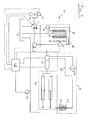
- Fig. 1 is a diagrammatic illustration of an exemplary disclosed cooling arrangement
- Fig. 2 is an exemplary flowchart for a method of temperature control corresponding to the cooling arrangement of Fig. 1.
- the brake temperature control arrangement 10 includes a pump 12, which may be any type of pump or it may be a plurality of pumps working together to provide fluid to various portions of the brake temperature control arrangement 10.
- the pump 12 may be a variable displacement pump driven by a power source 14 and a variable fluid output may be provided by adjusting a swash angle of the pump 12, by varying the speed of the power source 14 or by a combination of both.
- the pump 12 may draw a fluid such as, for example, an oil or more specifically a hydraulic oil, from a reservoir 16 and may pump the pressurised fluid to a first valve 18.
- This first valve 18 may be a system valve and may distribute fluid towards various machine systems such as steering and brake operation (both not shown), etc.
- a cooling portion generally designated as portion 30.
- the cooling portion 30 may include more or fewer components and is designated as such for clarity purposes only.
- the cooling portion 30 may include a motor 32 such as a fluid driven variable displacement motor wherein the rotational speed of the variable displacement motor may be dependent on the volume of fluid it receives, the swash angle of the motor or a combination of both.
- the motor 32 may also be of any other suitable kind or type, such as for example an electric motor.
- the motor 32 may drive a fan 34 for pulling or pushing air through or over at least one or more heat exchangers such as an intercooler 35, an engine coolant radiator 36 and a fluid cooler 38.
- the fan 34 is typically a variable speed fan.
- the fluid cooler 38 may be configured to cool the fluid provided by the pump 12 and used to drive the motor 32.
- the fluid may then be returned to the reservoir 16 such that the temperature of the bulk fluid may be influenced. It is to be understood that more or fewer heat exchangers may be used and that the type of heat exchanger may also be chosen as preferred.
- a by-pass arrangement 40 may be provided to allow fluid to by-pass the heat exchanger 38 to allow the fluid to warm up rapidly and to protect the heat exchanger from overpressurisation
- the power source 14 may be an internal combustion engine and may be provided with at least two sensors 20 and 22.
- An engine coolant used to control the temperature of the internal combustion engine may be directed to the engine coolant radiator 36 if cooling may be deemed necessary, and the sensor 20 may be used to monitor the temperature of the engine coolant (T2).
- the internal combustion engine may be a turbocharged and intercooled engine wherein the intake air may be firstly compressed by a turbocharger (not shown) and subsequently fed through the intercooler 35 to lower the temperature of the intake air.
- the sensor 22 may be a temperature sensor in the inlet manifold for sensing the temperature of the intake air (T3).
- the system valve 18 may also direct a portion of the fluid as displaced by the pump 12 to the control valve 24.
- the control valve 24 may be an on-demand control valve (ODCV) and may control the flow to both a brake arrangement 60 and a machine function portion 90. The flow to either of the brake arrangement 60 and the machine function portion 90 may be triggered by an operator or system command.
- the control valve 24 may also be a priority valve for prioritizing flow to the machine function portion 90 over the brake arrangement 60 or vice versa.
- the control valve 24 may also reduce the pressure of the fluid directed to the brake arrangement 60 as the pressure generated by the pump 12 may due to the various system demands be higher than the maximum operating pressure of the brake arrangement 60.
- the brake temperature control arrangement 10 may be applied to a dump truck.
- a dump truck Such a machine has a loading platform that may be raised to tip the load of the platform and the machine function portion 90 may be a hoisting arrangement for raising and lowering the platform. At least a portion of the control valve 24 may then be regarded as a hoist valve.
- the brake arrangement may be a brake arrangement as used with a drive axle of a machine (not shown). At least a portion of the brake arrangement may be sealed within the axle and may include a wet disc brake arrangement 92 having multiple brake discs at least partially immersed in a fluid bath 94. The fluid may be the same as the one stored in the reservoir 16.
- the brake arrangement 60 may further include a heat exchanger 96 which may use engine coolant to either cool or heat the fluid flowing from the control valve 24 to the fluid bath 94.
- a sensor 26 Downstream of the fluid bath 94 and the wet disc brake arrangement 92 there may be provided a sensor 26. Downstream in this context may also include a position at or near the brake arrangement 60.
- the sensor 26 may be a temperature sensor for sensing the temperature of the fluid leaving the fluid bath 94 and the wet disc brake arrangement 92.
- the sensor 26 is preferably arranged in such a manner that it senses the temperature of fluid leaving the fluid bath 94 and the wet disc brake arrangement 92 in a direct manner such that the temperature T1 corresponds closely to the temperature of the fluid bath 94 and the wet disc brake arrangement 92. Sensing just this temperature may contribute to increasing the chance of accurately determining the temperature of the fluid leaving these components and hence the temperature of the components themselves.
- the sensing feed line 98 allows a small continuous flow of fluid through the fluid bath 94 and the wet disc brake arrangement 92 to the sensor 26.
- an electronic control unit (ECU) 28 may be provided and configured to receive the signals from the sensors 20, 22 and 26.
- the ECU 28 may also be configured to control and alter the swash angles of the pump 14 and the motor 32.
- the ECU 28 may furthermore be configured to control the control valve 24 so as to alter the flow to the brake arrangement 60, prioritize the flow to the machine function portion 90 over the brake arrangement 60, or vice versa.
- the method and brake temperature control arrangement as disclosed may be useful for a wide range of applications and in particularly for industrial machines such as dump trucks, telehandlers and the like.
- a first step 110 may be to provide a flow of fluid using a suitable arrangement such as a pump 12. Via the system valve 18, the fluid may be distributed to the cooling arrangement 30, the control valve 24 and any other systems that may require fluid.
- a temperature downstream of the fluid bath 94 and the wet disc brake arrangement 92, hereinafter designated as T1 may be sensed by sensor 26 and a signal indicative of this temperature may be send to the ECU 28 for processing in step 113.
- a first temperature range (T a1 -T b1 ) may be determined for the brake arrangement 60, which may for example be a preferred range, an optimum range or an allowable range. This determination may include retrieving data previously stored in the ECU 28.
- the ECU 28 may determine if T1 falls within T a1 -T b1 or is outside the boundaries. If T1 falls within T a1 -T b1 no action may be taken as shown in step 126. If T1 is outside the boundaries of T a1 -T b1 an adjustment of a fluid parameter may be requested.
- the available range of fluid parameter adjustment may include increasing fan speed, decreasing fan speed, increasing flow rate, decreasing flow rate and any suitable combination thereof.
- T1 ⁇ T a1- T b1 i.e. the fluid temperature T1 sensed by the sensor 26 is below the first range
- several fluid parameter adjustments may be requested. Firstly a decrease in fan speed may be requested as shown in step 122. A decrease in fan speed may reduce the cooling effect of the cooling air on the heat exchangers 35, 36 and 38, hence the fluid may not be cooled or be cooled to a lesser degree and due to heat dissipation from the brake temperature control arrangement 10, the fluid may warm up.
- a decrease in flow rate through the fluid bath 94 and the wet disc brake arrangement 92 may be requested as shown in step 128.
- a reduction of fluid flow may allow the fluid bath 94 and the wet disc brake arrangement 92 to warm up which will then translate into a higher T1.
- an increase in flow rate through the fluid bath 94 and the wet disc brake arrangement 92 may be requested as shown in step 130. If for example the temperature of the fluid flowing towards the fluid bath 94 and the wet disc brake arrangement 92 is higher than the temperature of the fluid bath 94 and the wet disc brake arrangement 92, the fluid may actually warm up the fluid bath 94 and the wet disc brake arrangement 92. In this situation an increase in flow may warm up the fluid bath 94 and the wet disc brake arrangement 92 more rapidly.
- a combination of the above adjustments may be possible, for example, a decrease in fan speed and a decrease in flow rate may be requested simultaneously.
- T1>T a1- T b1 i.e. the temperature T1 measured by the sensor 26 is too high
- the following actions may be requested. Firstly, an increase in flow rate through the fluid bath 94 and the wet disc brake arrangement 92 may be requested as shown in step 130. Such increase in flow rate may increase the cooling effect and hence the temperature T1 sensed by the sensor 26 may drop over time.
- an increase in speed of the fan 34 may be requested as shown in step 124. An increase in speed of the fan 34 may increase the cooling of the fluid flowing through the fluid cooler 38. The fluid leaving the fluid cooler 38 may then reduce the temperature of the bulk fluid in the reservoir 16.
- both an increase in speed of the fan 34 and an increase in flow rate through the fluid bath 94 and the wet disc brake arrangement 92 may be requested simultaneously if preferred.
- the steps 314-326 regarding the engine coolant temperature (T3) and the steps 214-226 for the air intake temperature (T2) may be regarded as similar to the steps 114-126.
- Like numerals have like functions or considerations attached. It is to be understood however that the processes for T1, T2 and T3 need not be identical. Any suitable individual variation may be made as preferred.
- the steps 210 and 310 may be taken simultaneously or sequentially to the above steps and in the steps 210 and 310 the air intake temperature T2 (step 210) and the engine coolant temperature T3 (step 310) may be sensed.
- a second temperature range (T a2 -T b2 ) is determined for the air intake temperature T2, which may for example be a preferred range, an optimum range or an allowable range.
- the ECU 28 evaluates the air intake temperature T2 by determining if T2 falls within the range T a2 -T b2 . If T2 ⁇ T a2 -T b2 a fan speed decrease may be requested in step 222. If T2>T a2 -T b2 a fan speed increase may be requested in step 224. If T2 is in the range of T a2 -T b2 a fan speed no action may be requested in step 226.
- a third temperature range (T a3 -T b3 ) is determined for the engine coolant temperature T3, which may for example be a preferred range, an optimum range or an allowable range.
- the ECU 28 evaluates the engine coolant temperature T3 by determining if T3 falls within the range T a3 -T b3 . If T3 ⁇ T a3 -T b3 a fan speed decrease may be requested in step 322. If T3>T a3 -T b3 a fan speed increase may be requested in step 324. If T3 is in the range of T a3 -T b3 a fan speed no action may be requested in step 226.
- All requests for fluid parameter adjustment may be considered by the ECU 28 in step 132.
- the ECU 28 may in response make a number of fluid parameter adjustments including various combinations thereof to move any of T1, T2 and T3 to their respective first, second and third ranges. If all of the conditions T a1 ⁇ T1 ⁇ T b1, T a2 ⁇ T2 ⁇ T b2 and T a3 ⁇ T3 ⁇ T b3 are fulfilled no action may be taken as all three temperatures are within their respective first, second and third range. This cycle of the process may then end with step 132 wherein the ECU 28 decides upon comparing all requests that no adjustment of a fluid parameter may be required.
- T1, T2 and T3 result in conflicting requests, i.e. simultaneous requests for no action and one for an increase in flow.
- the ECU 28 may therefore evaluate all requests and weigh the importance of each or prioritise the various requests. If it is determined that one request may be critical, this request may be regarded as being an overriding request and may be the one that is executed. For example in a situation wherein T1 ⁇ T a1 -T b1 and T2>T a2 -T b2 the ECU 28 may receive requests for a decrease in fan speed via step 122, a request for a decrease in flow via step 128 and a request for an increase in fan speed via step 224.
- the ECU 28 may decide that decreasing T2 may be more critical than T1 and may adjust a fluid parameter via step 134 by increasing the fan speed. Of course the ECU 28 may still allow a decrease in flow in accordance with step 128.
- Any of the above processes may run cyclically and a repeated cycle may be started from any suitable starting point in the process.
- ECU 28 It is to be understood that a variety of decisions may be made by the ECU 28 and that the ECU 28 may be programmed differently depending on factors such as system design, machine type, individual component requirements, external factors, ambient operating conditions, etc.
Landscapes
- Engineering & Computer Science (AREA)
- General Engineering & Computer Science (AREA)
- Mechanical Engineering (AREA)
- Braking Arrangements (AREA)
- Valves And Accessory Devices For Braking Systems (AREA)
Priority Applications (2)
| Application Number | Priority Date | Filing Date | Title |
|---|---|---|---|
| EP06124773A EP1925844A1 (de) | 2006-11-24 | 2006-11-24 | Verfahren und vorrichtung für Maschinenkühlung |
| US11/984,705 US8006813B2 (en) | 2006-11-24 | 2007-11-21 | Method and arrangement for machine cooling |
Applications Claiming Priority (1)
| Application Number | Priority Date | Filing Date | Title |
|---|---|---|---|
| EP06124773A EP1925844A1 (de) | 2006-11-24 | 2006-11-24 | Verfahren und vorrichtung für Maschinenkühlung |
Publications (1)
| Publication Number | Publication Date |
|---|---|
| EP1925844A1 true EP1925844A1 (de) | 2008-05-28 |
Family
ID=37910895
Family Applications (1)
| Application Number | Title | Priority Date | Filing Date |
|---|---|---|---|
| EP06124773A Withdrawn EP1925844A1 (de) | 2006-11-24 | 2006-11-24 | Verfahren und vorrichtung für Maschinenkühlung |
Country Status (2)
| Country | Link |
|---|---|
| US (1) | US8006813B2 (de) |
| EP (1) | EP1925844A1 (de) |
Cited By (1)
| Publication number | Priority date | Publication date | Assignee | Title |
|---|---|---|---|---|
| CN119532354A (zh) * | 2023-08-31 | 2025-02-28 | 芜湖伯特利电子控制系统有限公司 | 解决车辆制动液过温的控制方法及装置 |
Families Citing this family (9)
| Publication number | Priority date | Publication date | Assignee | Title |
|---|---|---|---|---|
| US20080098998A1 (en) * | 2006-10-30 | 2008-05-01 | Dicke Paul A | Engine mounted air-to-air aftercooler |
| US20110005852A1 (en) | 2009-07-10 | 2011-01-13 | Sand Darrel R | Liquid cooled brake |
| US8663058B2 (en) | 2012-01-23 | 2014-03-04 | Caterpillar Inc. | Brake assembly having piloted park brake housing |
| US8626410B2 (en) | 2012-01-23 | 2014-01-07 | Caterpillar Inc. | Powertrain system having lockable differential |
| US9169884B2 (en) | 2012-01-23 | 2015-10-27 | Caterpillar Inc. | Wet brake assembly |
| US9574660B2 (en) | 2014-02-21 | 2017-02-21 | Federal Signal Corporation | Hydraulic fan drive system |
| US10330126B2 (en) * | 2016-12-16 | 2019-06-25 | Caterpillar Inc. | Fan control system with electro-hydraulic valve providing three fan motor operational positions |
| DE102017007409A1 (de) * | 2017-07-11 | 2019-01-17 | Wabco Gmbh | Hydraulische Fremdkraftbremsanlage und Verfahren zur ABS-Steuerung |
| CN111734763A (zh) * | 2020-07-01 | 2020-10-02 | 吉林大学青岛汽车研究院 | 一种湿式多盘制动器循环冷却系统 |
Citations (3)
| Publication number | Priority date | Publication date | Assignee | Title |
|---|---|---|---|---|
| EP1350982A2 (de) * | 2002-04-03 | 2003-10-08 | Meritor Heavy Vehicle Technology LLC | System zur Regelung der Temperatur eines Teils eines Kraftfahrzeug-Antriebsstrangs mit Zirkulation eines Kühlmittels |
| WO2005054026A1 (en) * | 2003-12-08 | 2005-06-16 | Volvo Construction Equipment Holding Sweden Ab | Brake protection device, brake arrangement and method for controlling a brake temperature |
| EP1561963A1 (de) * | 2004-02-09 | 2005-08-10 | Astra Veicoli Industriali S.p.A. | Verfahren und Kreislauf zum Regeln des Massenstroms des Hydrauliköls im Bremskühlsystem eines Fahrzeuges |
Family Cites Families (7)
| Publication number | Priority date | Publication date | Assignee | Title |
|---|---|---|---|---|
| US5050710A (en) | 1990-04-10 | 1991-09-24 | Caterpillar Inc. | Wet disc brake mechanism |
| FR2668440B1 (fr) * | 1990-10-30 | 1992-12-24 | Alsthom Gec | Systeme de freinage pour vehicule ferroviaire. |
| JP2002340065A (ja) | 2001-05-18 | 2002-11-27 | Komatsu Forklift Co Ltd | 湿式多板ブレーキの冷却油回路 |
| JP2004224509A (ja) | 2003-01-23 | 2004-08-12 | Hitachi Sumitomo Heavy Industries Construction Crane Co Ltd | ウインチのブレーキ装置、ブレーキ装置の冷却方法、およびブレーキ装置を備えたクレーン |
| JP2004224510A (ja) | 2003-01-23 | 2004-08-12 | Hitachi Sumitomo Heavy Industries Construction Crane Co Ltd | ウインチのブレーキ装置およびクレーン |
| JP2005054941A (ja) | 2003-08-06 | 2005-03-03 | Toyota Industries Corp | 冷却油回路 |
| DE102004021067A1 (de) * | 2004-04-29 | 2005-11-17 | Linde Ag | Lamellenbremse oder -kupplung |
-
2006
- 2006-11-24 EP EP06124773A patent/EP1925844A1/de not_active Withdrawn
-
2007
- 2007-11-21 US US11/984,705 patent/US8006813B2/en not_active Expired - Fee Related
Patent Citations (3)
| Publication number | Priority date | Publication date | Assignee | Title |
|---|---|---|---|---|
| EP1350982A2 (de) * | 2002-04-03 | 2003-10-08 | Meritor Heavy Vehicle Technology LLC | System zur Regelung der Temperatur eines Teils eines Kraftfahrzeug-Antriebsstrangs mit Zirkulation eines Kühlmittels |
| WO2005054026A1 (en) * | 2003-12-08 | 2005-06-16 | Volvo Construction Equipment Holding Sweden Ab | Brake protection device, brake arrangement and method for controlling a brake temperature |
| EP1561963A1 (de) * | 2004-02-09 | 2005-08-10 | Astra Veicoli Industriali S.p.A. | Verfahren und Kreislauf zum Regeln des Massenstroms des Hydrauliköls im Bremskühlsystem eines Fahrzeuges |
Cited By (2)
| Publication number | Priority date | Publication date | Assignee | Title |
|---|---|---|---|---|
| CN119532354A (zh) * | 2023-08-31 | 2025-02-28 | 芜湖伯特利电子控制系统有限公司 | 解决车辆制动液过温的控制方法及装置 |
| CN119532354B (zh) * | 2023-08-31 | 2025-09-12 | 芜湖伯特利电子控制系统有限公司 | 解决车辆制动液过温的控制方法及装置 |
Also Published As
| Publication number | Publication date |
|---|---|
| US20080121476A1 (en) | 2008-05-29 |
| US8006813B2 (en) | 2011-08-30 |
Similar Documents
| Publication | Publication Date | Title |
|---|---|---|
| US8006813B2 (en) | Method and arrangement for machine cooling | |
| CN107499176B (zh) | 车辆电驱动系统的冷却方法和装置 | |
| JP4489757B2 (ja) | 自動車の操作機関における油圧システムの制御方法 | |
| US9726129B2 (en) | Method for determining a fuel fraction in oil | |
| JP5119481B2 (ja) | 車両の冷却用ファンの制御装置 | |
| EP3211194B1 (de) | Fahrzeug und verfahren zum steuern einer drehzahlregelbaren wasserpumpe | |
| US10816090B2 (en) | Oil supply system of an automatic transmission or automated manual transmission in a powertrain | |
| CN1798912B (zh) | 驱动装置及用于优化驱动装置冷却系统的能量供给的方法 | |
| CN106523124B (zh) | 用于运行尤其用于车辆的油循环的方法 | |
| US6314727B1 (en) | Method and apparatus for controlling an electro-hydraulic fluid system | |
| EP1563146B1 (de) | Verfahren zur steuerung eines fahrzeugs und rechnerprogramm zur durchfuehrung des verfahrens | |
| CN102383896A (zh) | 用于控制发动机中油的液压和流速的系统及其控制方法 | |
| SE1050648A1 (sv) | Förfarande vid SCR-system och anordning hos SCR-system | |
| CN107002863A (zh) | 液压供给装置和操控方法 | |
| US20180045100A1 (en) | Thermal management system and method for a vehicle | |
| CN110195638A (zh) | 冷却系统和内燃机 | |
| JP6029324B2 (ja) | 自動的にファン回転速度を調節する建設機械 | |
| WO2011005171A1 (en) | Device and method for improving performance of a motor vehicle | |
| JP2007518915A (ja) | 自動車の駆動伝達系を操作する方法 | |
| US9523306B2 (en) | Engine cooling fan control strategy | |
| KR20150097749A (ko) | 차량의 냉각 시스템 | |
| US20050006953A1 (en) | Power dissipation management system | |
| JP2001527612A (ja) | エンジンオイルを最適温度に維持するためのシステム | |
| JP7238502B2 (ja) | ファン制御装置 | |
| US12163459B2 (en) | Flow sharing control for multiple hydraulic fan motors |
Legal Events
| Date | Code | Title | Description |
|---|---|---|---|
| PUAI | Public reference made under article 153(3) epc to a published international application that has entered the european phase |
Free format text: ORIGINAL CODE: 0009012 |
|
| AK | Designated contracting states |
Kind code of ref document: A1 Designated state(s): AT BE BG CH CY CZ DE DK EE ES FI FR GB GR HU IE IS IT LI LT LU LV MC NL PL PT RO SE SI SK TR |
|
| AX | Request for extension of the european patent |
Extension state: AL BA HR MK RS |
|
| 17P | Request for examination filed |
Effective date: 20081028 |
|
| 17Q | First examination report despatched |
Effective date: 20081219 |
|
| AKX | Designation fees paid |
Designated state(s): AT BE BG CH CY CZ DE DK EE ES FI FR GB GR HU IE IS IT LI LT LU LV MC NL PL PT RO SE SI SK TR |
|
| STAA | Information on the status of an ep patent application or granted ep patent |
Free format text: STATUS: THE APPLICATION IS DEEMED TO BE WITHDRAWN |
|
| 18D | Application deemed to be withdrawn |
Effective date: 20090430 |