EP1926339A2 - Verfahren und System zur Zuweisung von Funkressourcen in einem Mobiltelefonsystem über Drahtrelaisstationen - Google Patents
Verfahren und System zur Zuweisung von Funkressourcen in einem Mobiltelefonsystem über Drahtrelaisstationen Download PDFInfo
- Publication number
- EP1926339A2 EP1926339A2 EP07121203A EP07121203A EP1926339A2 EP 1926339 A2 EP1926339 A2 EP 1926339A2 EP 07121203 A EP07121203 A EP 07121203A EP 07121203 A EP07121203 A EP 07121203A EP 1926339 A2 EP1926339 A2 EP 1926339A2
- Authority
- EP
- European Patent Office
- Prior art keywords
- sub
- channel
- mobile station
- channels
- station
- Prior art date
- Legal status (The legal status is an assumption and is not a legal conclusion. Google has not performed a legal analysis and makes no representation as to the accuracy of the status listed.)
- Granted
Links
Images




Classifications
-
- H—ELECTRICITY
- H04—ELECTRIC COMMUNICATION TECHNIQUE
- H04W—WIRELESS COMMUNICATION NETWORKS
- H04W72/00—Local resource management
- H04W72/20—Control channels or signalling for resource management
- H04W72/23—Control channels or signalling for resource management in the downlink direction of a wireless link, i.e. towards a terminal
-
- H—ELECTRICITY
- H04—ELECTRIC COMMUNICATION TECHNIQUE
- H04W—WIRELESS COMMUNICATION NETWORKS
- H04W72/00—Local resource management
- H04W72/50—Allocation or scheduling criteria for wireless resources
- H04W72/54—Allocation or scheduling criteria for wireless resources based on quality criteria
- H04W72/542—Allocation or scheduling criteria for wireless resources based on quality criteria using measured or perceived quality
-
- H—ELECTRICITY
- H04—ELECTRIC COMMUNICATION TECHNIQUE
- H04W—WIRELESS COMMUNICATION NETWORKS
- H04W72/00—Local resource management
- H04W72/04—Wireless resource allocation
-
- H—ELECTRICITY
- H04—ELECTRIC COMMUNICATION TECHNIQUE
- H04W—WIRELESS COMMUNICATION NETWORKS
- H04W72/00—Local resource management
- H04W72/12—Wireless traffic scheduling
- H04W72/121—Wireless traffic scheduling for groups of terminals or users
-
- H—ELECTRICITY
- H04—ELECTRIC COMMUNICATION TECHNIQUE
- H04W—WIRELESS COMMUNICATION NETWORKS
- H04W4/00—Services specially adapted for wireless communication networks; Facilities therefor
- H04W4/06—Selective distribution of broadcast services, e.g. multimedia broadcast multicast service [MBMS]; Services to user groups; One-way selective calling services
- H04W4/08—User group management
-
- H—ELECTRICITY
- H04—ELECTRIC COMMUNICATION TECHNIQUE
- H04W—WIRELESS COMMUNICATION NETWORKS
- H04W84/00—Network topologies
- H04W84/02—Hierarchically pre-organised networks, e.g. paging networks, cellular networks, WLAN [Wireless Local Area Network] or WLL [Wireless Local Loop]
- H04W84/04—Large scale networks; Deep hierarchical networks
- H04W84/042—Public Land Mobile systems, e.g. cellular systems
- H04W84/047—Public Land Mobile systems, e.g. cellular systems using dedicated repeater stations
Definitions
- the present invention relates generally to Radio Resource Management (RRM) of a cellular communication system having Relay Stations (RSs), i.e. a Radio over Fiber (RoF) cellular communication system, and in particular, to a method and system for variably assigning a sub-channel to a Mobile Station (MS) according to a channel state per sub-channel and the number of available channels per RS.
- RRM Radio Resource Management
- RSs Relay Stations
- RoF Radio over Fiber
- Examples of cellular systems which are being implemented or have been realized, are a single-hop system, a repeater system supporting a repeater, and a multi-hop system.
- the single-hop system has a structure in which a BS exists in each cell without a repeater, and a terminal or MS is directly connected to the BS without any relay.
- the repeater system is to improve reception signal performance of a MS in a cell boundary area or shadow area by additionally installing a repeater between a BS and the MS.
- a single cell is formed with a BS and a plurality of repeaters, and a MS transmits and receives a signal to and from the BS and repeater(s) at the same time.
- the repeaters can be divided into wired-optical repeaters and wireless-Radio Frequency (RF) repeaters.
- the wired repeaters have an advantage of low signal attenuation and a disadvantage of non-mobility, and the wireless repeaters have a disadvantage of amplifying and broadcasting all reception signals without distinguishing a signal desired by a MS from an interference signal. While the wireless repeaters can be installed with a cheap price, antenna isolation is needed in a network construction.
- a difference between a wireless RS system and a wireless repeater system is as follows. While a wireless repeater transmits a signal by amplifying a signal from a BS and an interference signal from another cell, a wireless RS can amplify only a signal desired by a MS and perform the scheduling/Radio Resource Management (RRM) of MSs in a sub-cell formed using the RS. In other words, using a wireless RS, transmission can be performed even for MSs in a shadow area in which a BS cannot directly transmit data, resulting in an expansion of cell coverage and an increase of cell throughput.
- RRM Radio Resource Management
- transmission performance can be improved in a wireless RS multi-hop system compared to the single-hop or repeater system.
- the wireless RS multi-hop system requires additional transmission for a data relay compared to the single-hop system.
- limited resources must be shared by a plurality of sub-cells and relay links, and this may cause degradation of Quality of Service (QoS). That is, although a reception Signal to Interference pulse Noise Ratio (SINR) of a MS in a cell boundary area can be improved, since a portion of frame resources is used for relay transmission, available channel resources which can be assigned to MSs may be decreased, resulting in a decrease of throughput.
- SINR reception Signal to Interference pulse Noise Ratio
- wired RS system Radio over Fiber (RoF) RS technology
- a basic network configuration of the wired RS system is the same as that of the wireless RS multi-hop system except that a link between a BS and a RS or between RSs is wired.
- the wired RS system has drawbacks in that expenses for optical cable installation between a BS and each RS are required, and it is difficult to move an installed RS.
- the wired RS system does not have signal loss between the BS and each RS and has a radio resource increase effect compared to the wireless RS system.
- a high-complex and high-efficient scheduling scheme which is limited in the wireless RS system, can be applied. Due to these advantages, the wired RS system can achieve an increase in transmission throughput for each user and the entire cell.
- each RS acts as a small BS, the transmission throughput is increased proportional to the number of RSs in an ideal case compared to a single-hop system. Further, according to a change toward a gradual decrease of hardware costs and a gradual increase of frequency resource costs, it is predicted that the wired RS system eventually has more advantages than the wireless RS system.
- the present invention has been designed to substantially solve at least the above problems and/or disadvantages and to provide at least the advantages below. Accordingly, the object of the present invention is to increase Quality of Service (QoS) of a Mobile Station (MS) (decrease non-operating probability of MSs which do not satisfying a minimum data rate) and mean cell throughput.
- QoS Quality of Service
- MS Mobile Station
- a method of assigning radio resources in a cellular system using wired Relay Stations comprising: a Base Station (BS) gathering fed-back control information of all Mobile Stations (MSs) via the RSs in a cell of the BS; a first process, wherein the MSs are divided into two groups according to a channel state of each MS; a second process, wherein sub-channels are dynamically assigned to MSs belonging to a group, in which a channel state of each MS is good, of the two groups; and a third process, wherein sub-channels are dynamically assigned to MSs belonging to a group, in which a channel state of each MS is bad, of the two groups by considering a resource state per RS and a channel gain between sub-channels.
- BS Base Station
- MSs Mobile Stations
- a system for assigning radio resources between wired Relay Stations (RSs) of a cellular system comprising: a plurality of Mobile Stations (MSs) performing an update process by transmitting signal information and control information containing a resource demand and supply state to each RS and/or a Base Station (BS); and a plurality of BSs receiving the control information via a wired network and performing RS selection and radio resource assignment to each MS according to the number of RSs and the number of sub-channels.
- MSs Mobile Stations
- BS Base Station
- FIG. 1 is a configuration of a cellular system using wired Relay Stations (RSs) according to an exemplary embodiment of the present invention.
- a single cell can be constituted of a single Base Station (BS) and a number of wired RSs, for example 6, each RS covering its sub-cell area.
- BS Base Station
- RS Wireless Relay Station
- a Mobile Station (MS) close to the BS receives a service from the BS, and a MS located in a cell boundary, i.e. having a relatively low reception Signal to Interference pulse Noise Ratio (SINR), receives a service from an adjacent RS.
- SINR Signal to Interference pulse Noise Ratio
- the wired RS system (as in a wireless RS system) shows a cell-split effect from one cell to 7 cells due to the RSs.
- Such a wired RS multi-hop system provides an effect of expanding a service area of the BS and removing a shadow area by efficiently transmitting data to MSs, which are located in a cell boundary or an obstacle area in which a channel state is relatively poor due to a cell-split effect with the RSs.
- the wired RS system illustrated in FIG. 1 a link between the BS and each RS is connected using optical fiber. Therefore, the wired RS system has problems that additional expenses are required to install optical cable between the BS and each RS, and it is difficult to move each RS once the RS is installed.
- a transmission method which can be applied to the wired RS system, uses Orthogonal Frequency Division Multiple Access (OFDMA) using multiple carriers. It is assumed that resource assignment to each MS is achieved per sub-channel. In this case, since fading channels of MSs are independent to each other, a sub-channel advantageous to each MS is selected, that is, a sub-channel is assigned to each MS using multi-user diversity (since the sub-channel assignment includes a case where a RS transmits data to a MS and a case where the BS directly transmits the data to the MS, hereinafter, 'RS' is used as terminology of a concept including both 'BS' and 'RS').
- OFDMA Orthogonal Frequency Division Multiple Access
- wired RS system Since the wired RS system has a feature of supporting a plurality of RSs, unlike a single-hop OFDMA system, sub-channel assignment is achieved in the wired RS system as follows.
- a RS for supporting a service to a specific MS is determined in advance, and sub-channel assignment is independently performed for MSs belonging to the determined RS.
- a method of determining a RS is performed by selecting a RS corresponding to the highest mean signal level of the entire band from among signals of RSs, which were received by each MS. That is, since a RS for each MS is determined and the sub-channel assignment is performed in each RS to which MSs belong, each process is independently performed. However, even if a MS located in a boundary of a sub-cell, which is a service area of a RS, has a higher mean signal level of the entire band, a signal level of an assigned sub-channel may be different from the trend of a mean signal level of the entire band.
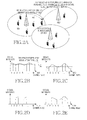
- FIG. 2A A MS1 illustrated in FIG. 2A is located in a boundary area between the coverage of a RS1 and the coverage of a RS2, and as illustrated in FIGs. 2B and 2C, a mean signal level received from the RS1 may be greater. However, due to a frequency selective characteristic of a channel, a sub-channel can be assigned to the MS1 so that a signal level received from the RS2 is greater as illustrated in FIGs. 2D and 2E. Thus, when a RS is selected for each MS located in the boundary of RS coverage, more correct dynamic resource assignment can be achieved by comparing signal levels of sub-channels to be assigned to each MS, instead of comparing mean signal levels of the entire band.
- each MS can transmit signal information and control information, such as a resource demand and supply state, received from a relevant RS back to the BS and RSs, must be assumed.
- control information such as a resource demand and supply state
- the wired RS system can be a system that is easy to realize this assumption.
- FIG. 3 is a flowchart illustrating a centralized resource assignment process for providing a dynamic resource assignment according to an exemplary embodiment of the present invention.
- the centralized resource assignment process may include an initialization process (step 311) and four subsequent processes ⁇ step 1> to ⁇ step 4>.
- a minimum data rate requested by each MS k is rk.
- c k,n,s is the number of transmission bits satisfying a target Bit Error Rate (BER) considering a signal level of a sub-channel n assigned to a MS k by a RS s (the number of transmission bits according to a Modulation & Coding Selection (MCS) level), and ⁇ n,s is a parameter having a value of k if a MS k uses a sub-channel n of a RS s or 0 if no sub-channel is assigned to a MS k . In the initial stage, this parameter is 0 since no sub-channel is assigned to any MS.
- BER Bit Error Rate
- the ⁇ step 1> is a process of dividing k MSs into a group A and a group B according to the conditions described below
- the ⁇ step 2> is a process of dynamically assigning sub-channels to MSs belonging to the group A
- the ⁇ step 3> is a process of dynamically assigning sub-channels to MSs belonging to the group B considering a resource state per RS and a channel gain between sub-channels
- the ⁇ step 4> (step 315) is a process of additionally assigning remaining sub-channels of each RS, which were not assigned in the ⁇ step 3>, to MSs of respective RSs. The entire operation can be performed by performing these processes.
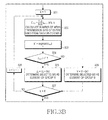
- FIG. 3B is a flowchart of the ⁇ step 1> (step 312) illustrated in FIG. 3A.
- the ⁇ step 1> is performed by the BS by feeding back MS control information from all RSs.
- k MSs are divided into two groups. That is, k MSs are divided into the group A in which MSs are located relatively close to the BS or a relevant RS and the group B in which MSs are relatively located in a boundary area of a relevant RS.
- the dividing process can be accomplished by the algorithm illustrated in FIG. 3B.
- step 321 k is set to 1.
- step 322 the number of mean transmission bits c k,s , which a k th MS can receive from each RS using the entire sub-channels, is calculated.
- step 323 a RS index corresponding to the greatest number of mean transmission bits among the numbers of mean transmission bits, i.e. c k,s , calculated in step 322 is obtained.
- step 324 the number of mean transmission bits c k,s , corresponding to the RS index obtained in step 323 is compared to a threshold r.
- FIG. 3C is a flowchart of the ⁇ step 2> (step 313) illustrated in FIG. 3A.
- the ⁇ step 2> is a process of determining resource assignment for MSs belonging to the group A per RS and can be performed for RSs in parallel.
- s is set to 1.
- a resource assignment is sequentially performed for MSs belonging to the group A, which are managed by a RS s.
- a first MS is selected from elements of the group A, which are managed by the RS s, and a variable u is set to 1.
- k 1 denotes an index of the first MS of U s .
- step 334 a sub-channel is repeatedly assigned until a minimum data rate is satisfied.
- step 335 it is determined whether the sub-channel assignment to all MSs belonging to the group A, which are managed by the RS s , has ended.
- step 337 If it is determined in step 337 that s ⁇ S , s is increased by 1 in step 338, and by going back to step 332 and repeating the steps, the sub-channel assignment to all MSs belonging to the group A, which are managed by a subsequent RS s , is performed. If the sub-channel assignment to all MSs belonging to the group A, which are managed by all RSs, ends, the ⁇ step 2> ends.
- FIG. 3D is a flowchart of the ⁇ step 3> (step 314) illustrated in FIG. 3A.
- step 341 channel information per RS is gathered for MSs belonging to the group B.
- a metric for RS selection for all MSs and all RSs of the group B is calculated as represented by Equation 1.
- N s denotes the number of non-assigned sub-channels per RS
- step 343 a pair of MS and RS (d k,s ) having the greatest selection metric is selected.
- steps 344 and 345 sub-channels are assigned to the MS selected in step 343.
- ⁇ n ', s ' ⁇ is substituted by 1.
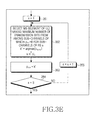
- FIG. 3E is a flowchart of the ⁇ step 4> (step 315) illustrated in FIG. 3A.
- the ⁇ step 4> is a process of assigning non-assigned sub-channels when the non-assigned sub-channels exist even after the ⁇ step 3> process ends.
- s is set to 1.
- a dynamic resource assignment method in a wired RS system variably determines the resource assignment to MSs located in a sub-cell boundary according to traffic per RS in the wired RS system, wherein an efficient resource assignment to the MSs located in the sub-cell boundary can be performed by considering the signal level of a sub-channel to be assigned instead of a mean signal level.
- MSs are divided into groups A and B according to the quality of sub-channels, sub-channels are assigned according to the groups A and B, and sub-channels are assigned based on each RS in the case of MSs of the group A. Therefore, complexity can be reduced.
Landscapes
- Engineering & Computer Science (AREA)
- Computer Networks & Wireless Communication (AREA)
- Signal Processing (AREA)
- Quality & Reliability (AREA)
- Mobile Radio Communication Systems (AREA)
Applications Claiming Priority (1)
| Application Number | Priority Date | Filing Date | Title |
|---|---|---|---|
| KR1020060115087A KR100842523B1 (ko) | 2006-11-21 | 2006-11-21 | 유선 중계국을 활용한 셀룰러 시스템에서 무선 자원 할당방법 및 그 시스템 |
Publications (3)
| Publication Number | Publication Date |
|---|---|
| EP1926339A2 true EP1926339A2 (de) | 2008-05-28 |
| EP1926339A3 EP1926339A3 (de) | 2012-11-28 |
| EP1926339B1 EP1926339B1 (de) | 2018-02-21 |
Family
ID=39153997
Family Applications (1)
| Application Number | Title | Priority Date | Filing Date |
|---|---|---|---|
| EP07121203.9A Ceased EP1926339B1 (de) | 2006-11-21 | 2007-11-21 | Verfahren und system zur zuweisung von funkressourcen in einem mobiltelefonsystem über drahtrelaisstationen |
Country Status (3)
| Country | Link |
|---|---|
| US (1) | US7969940B2 (de) |
| EP (1) | EP1926339B1 (de) |
| KR (1) | KR100842523B1 (de) |
Cited By (1)
| Publication number | Priority date | Publication date | Assignee | Title |
|---|---|---|---|---|
| WO2011097758A1 (en) * | 2010-02-11 | 2011-08-18 | Telefonaktiebolaget L M Ericsson (Publ) | Link adaptation in type-ii relay network |
Families Citing this family (12)
| Publication number | Priority date | Publication date | Assignee | Title |
|---|---|---|---|---|
| KR100921330B1 (ko) * | 2007-07-10 | 2009-10-13 | 에스케이 텔레콤주식회사 | 중계기를 사용하는 무선 통신 시스템에서의 자원 할당 방법 |
| WO2010005233A2 (ko) * | 2008-07-08 | 2010-01-14 | 엘지전자 주식회사 | 캐리어 집합 생성 방법 및 캐리어 집합 정보 전송방법 |
| US8660071B2 (en) * | 2009-03-19 | 2014-02-25 | Qualcomm Incorporated | Adaptive resource partitioning in a wireless communication network |
| US8472868B2 (en) * | 2009-05-06 | 2013-06-25 | Telefonaktiebolaget Lm Ericsson (Publ) | Method and apparatus for MIMO repeater chains in a wireless communication network |
| WO2010148123A2 (en) | 2009-06-19 | 2010-12-23 | Research In Motion Limited | Uplink transmissions for type 2 relay |
| EP2443903B1 (de) * | 2009-06-19 | 2016-08-24 | BlackBerry Limited | Downlink übertragung für typ 2 relaystationen |
| CN105165049B (zh) * | 2013-05-08 | 2019-11-05 | 索尼公司 | 通信控制装置、通信控制方法和信息处理设备 |
| US9825678B2 (en) | 2013-11-26 | 2017-11-21 | Marvell World Trade Ltd. | Uplink multi-user multiple input multiple output for wireless local area network |
| WO2015081269A1 (en) | 2013-11-27 | 2015-06-04 | Marvell Semiconductor, Inc. | Sounding and tone block allocation for orthogonal frequency division multiple access (ofdma) in wireless local area networks |
| US9166660B2 (en) | 2013-11-27 | 2015-10-20 | Marvell World Trade Ltd. | Uplink multi-user multiple input multiple output beamforming |
| WO2015168639A1 (en) | 2014-05-02 | 2015-11-05 | Marvell World Trade Ltd. | Multiple user allocation signaling in a wireless communication network |
| CN115119257B (zh) * | 2021-03-23 | 2024-09-27 | 宸芯科技股份有限公司 | 一种触发csi-rs发送的方法、装置、设备及存储介质 |
Citations (1)
| Publication number | Priority date | Publication date | Assignee | Title |
|---|---|---|---|---|
| WO2006034578A1 (en) | 2004-09-29 | 2006-04-06 | Nortel Networks Limited | Method and system for capacity and coverage enhancement in wireless networks with relays |
Family Cites Families (14)
| Publication number | Priority date | Publication date | Assignee | Title |
|---|---|---|---|---|
| JP2946492B2 (ja) * | 1991-08-23 | 1999-09-06 | 日本電信電話株式会社 | セルラ移動通信方式 |
| KR20030049407A (ko) * | 2001-12-14 | 2003-06-25 | 삼성전자주식회사 | 이동통신시스템의 기지국 장치 |
| US7466666B2 (en) * | 2003-06-18 | 2008-12-16 | Telefonaktiebolaget Lm Ericsson (Publ) | Forward ACK/NACK channel for CDMA system |
| US8018893B2 (en) * | 2003-09-03 | 2011-09-13 | Motorola Mobility, Inc. | Method and apparatus for relay facilitated communications |
| US7400856B2 (en) * | 2003-09-03 | 2008-07-15 | Motorola, Inc. | Method and apparatus for relay facilitated communications |
| DE10350909B4 (de) * | 2003-10-31 | 2005-12-01 | Siemens Ag | Verfahren zur Signalisierung eines Pfades an Funkstationen eines Funkkommunikationssystems |
| US8498650B2 (en) | 2003-12-05 | 2013-07-30 | Qualcomm Incorporated | Systems and methods for adaptively allocating resources between a dedicated reference signal and a traffic signal |
| SE0303602D0 (sv) * | 2003-12-30 | 2003-12-30 | Ericsson Telefon Ab L M | Method and arrangement in self-organizing cooperative network |
| KR200349407Y1 (ko) | 2004-01-24 | 2004-05-04 | 송석달 | 회전식의 표현물의 포켓 외부면이 부착된 가방 |
| DE102005007326A1 (de) * | 2005-02-17 | 2006-09-07 | Siemens Ag | Dynamische Zuweisung von Funkressourcen in einem Mehrträgerkommunikationssystem |
| EP1938485A4 (de) * | 2005-09-20 | 2015-04-22 | Maxtech Networks Ltd | Echtzeit-peer-to-peer-netzwerk |
| EP1773091B1 (de) * | 2005-10-06 | 2018-12-05 | Samsung Electronics Co., Ltd. | Verfahren zur kanalkonfiguration und resourcenzuweisung in einem drahtlosen mehrstrecken-relaisübertragungskommunikationssystem |
| US20070177545A1 (en) * | 2006-01-30 | 2007-08-02 | Natarajan Kadathur S | System and method for allocating sub-channels in a network |
| EP2060023A4 (de) * | 2006-08-18 | 2012-11-28 | Fujitsu Ltd | Drahtlose datenrahmenstruktur zwischen knoten |
-
2006
- 2006-11-21 KR KR1020060115087A patent/KR100842523B1/ko not_active Expired - Fee Related
-
2007
- 2007-09-10 US US11/900,333 patent/US7969940B2/en active Active
- 2007-11-21 EP EP07121203.9A patent/EP1926339B1/de not_active Ceased
Patent Citations (1)
| Publication number | Priority date | Publication date | Assignee | Title |
|---|---|---|---|---|
| WO2006034578A1 (en) | 2004-09-29 | 2006-04-06 | Nortel Networks Limited | Method and system for capacity and coverage enhancement in wireless networks with relays |
Cited By (2)
| Publication number | Priority date | Publication date | Assignee | Title |
|---|---|---|---|---|
| WO2011097758A1 (en) * | 2010-02-11 | 2011-08-18 | Telefonaktiebolaget L M Ericsson (Publ) | Link adaptation in type-ii relay network |
| US9144108B2 (en) | 2010-02-11 | 2015-09-22 | Telefonaktiebolaget L M Ericsson (Publ) | Link adaptation in type-II relay network |
Also Published As
| Publication number | Publication date |
|---|---|
| KR100842523B1 (ko) | 2008-07-01 |
| EP1926339A3 (de) | 2012-11-28 |
| EP1926339B1 (de) | 2018-02-21 |
| US7969940B2 (en) | 2011-06-28 |
| US20080119194A1 (en) | 2008-05-22 |
| KR20080045868A (ko) | 2008-05-26 |
Similar Documents
| Publication | Publication Date | Title |
|---|---|---|
| EP1926339B1 (de) | Verfahren und system zur zuweisung von funkressourcen in einem mobiltelefonsystem über drahtrelaisstationen | |
| KR101421294B1 (ko) | 유선 중계국을 활용한 셀룰러 시스템에서 스케줄링 방법 및장치 | |
| KR100871227B1 (ko) | 유선 중계국을 활용한 셀룰러 시스템에서 중계국간 선택적신호 결합을 통한 셀 용량 증대 방법 및 장치 | |
| US7953365B2 (en) | Apparatus and method for selecting a relay mode in a multihop relay broadband wireless communication system | |
| KR100957314B1 (ko) | 셀룰라 무선 이동 통신 시스템에서 역방향 트래픽 로드 제어 시스템 및 방법 | |
| US7801490B1 (en) | Interference based scheduling using cognitive radios | |
| CN101657982B (zh) | 具有多跳中继站的无线蜂窝网络中的无线电资源管理 | |
| CN101106807B (zh) | 一种基于中继器的蜂窝网络以及空分双工通信方法 | |
| KR101066326B1 (ko) | 분산 안테나 시스템에서 스케줄링 장치 및 방법 | |
| US7877097B2 (en) | Reuse pattern network scheduling using interference levels | |
| US7920825B2 (en) | Method and apparatus for transmitting and receiving data using multi-user superposition coding in a wireless relay system | |
| US8244266B2 (en) | Scheduling method in a cellular system using wired relay station | |
| US20060094363A1 (en) | Apparatus and method for dynamically allocating resources in a communication system using an orthogonal frequency division multiple access scheme | |
| EP1956761B1 (de) | Verfahren und Vorrichtung zur gemeinsamen Planung zur Erhöhung der Frequenzeffizienz und Fairness in einem verteilten Antennensystem unter Verwendung von Frequenzwiederverwendung und gemeinsame Leistungssteuerung | |
| US20070243874A1 (en) | Method and system for allocating resources in a communication system | |
| CN101409921A (zh) | 一种无线通信系统中信道和信号发送参数联合分配的方法 | |
| KR20060113973A (ko) | 협동 릴레이를 이용한 무선 통신 네트워크를 위한 방법 및시스템 | |
| US20050074030A1 (en) | Method for increasing network throughput of cellular wireless packet network by loading control | |
| US8971793B2 (en) | Apparatus and method for transmitting and receiving data in a communication system | |
| CN101925185A (zh) | 中继蜂窝网络的干扰抑制方法、基站和网络系统 | |
| US7809327B2 (en) | Apparatus and method for controlling power in cellular system using wired relay stations | |
| KR100921492B1 (ko) | 무선 데이터 통신 시스템의 패킷 스케줄링 방법 | |
| JP5033823B2 (ja) | 無線通信システム、基地局およびスケジューリング方法 | |
| KR20060040949A (ko) | 시분할 다중 방식을 사용하는 직교 주파수 분할 다중 통신시스템에서 적응적 시간 슬럿 할당에 따른 링크 적응 방법 | |
| Wang et al. | Centralized Spatial Reuse Designing for Fixed Multihop Relay Wireless Access Networks |
Legal Events
| Date | Code | Title | Description |
|---|---|---|---|
| PUAI | Public reference made under article 153(3) epc to a published international application that has entered the european phase |
Free format text: ORIGINAL CODE: 0009012 |
|
| 17P | Request for examination filed |
Effective date: 20071121 |
|
| AK | Designated contracting states |
Kind code of ref document: A2 Designated state(s): AT BE BG CH CY CZ DE DK EE ES FI FR GB GR HU IE IS IT LI LT LU LV MC MT NL PL PT RO SE SI SK TR |
|
| AX | Request for extension of the european patent |
Extension state: AL BA HR MK RS |
|
| RIC1 | Information provided on ipc code assigned before grant |
Ipc: H04W 4/00 20090101AFI20120704BHEP |
|
| RAP1 | Party data changed (applicant data changed or rights of an application transferred) |
Owner name: INDUSTRY-UNIVERSITY COOPERATION FOUNDATION SOGANG Owner name: SAMSUNG ELECTRONICS CO., LTD. |
|
| PUAL | Search report despatched |
Free format text: ORIGINAL CODE: 0009013 |
|
| AK | Designated contracting states |
Kind code of ref document: A3 Designated state(s): AT BE BG CH CY CZ DE DK EE ES FI FR GB GR HU IE IS IT LI LT LU LV MC MT NL PL PT RO SE SI SK TR |
|
| AX | Request for extension of the european patent |
Extension state: AL BA HR MK RS |
|
| RIC1 | Information provided on ipc code assigned before grant |
Ipc: H04W 72/04 20090101AFI20121025BHEP Ipc: H04W 72/08 20090101ALI20121025BHEP |
|
| AKX | Designation fees paid |
Designated state(s): DE FR GB |
|
| 17Q | First examination report despatched |
Effective date: 20160128 |
|
| REG | Reference to a national code |
Ref country code: DE Ref legal event code: R079 Ref document number: 602007053950 Country of ref document: DE Free format text: PREVIOUS MAIN CLASS: H04Q0007380000 Ipc: H04W0072080000 |
|
| GRAP | Despatch of communication of intention to grant a patent |
Free format text: ORIGINAL CODE: EPIDOSNIGR1 |
|
| RIC1 | Information provided on ipc code assigned before grant |
Ipc: H04W 84/04 20090101ALN20170906BHEP Ipc: H04W 72/08 20090101AFI20170906BHEP |
|
| INTG | Intention to grant announced |
Effective date: 20170920 |
|
| GRAS | Grant fee paid |
Free format text: ORIGINAL CODE: EPIDOSNIGR3 |
|
| GRAA | (expected) grant |
Free format text: ORIGINAL CODE: 0009210 |
|
| AK | Designated contracting states |
Kind code of ref document: B1 Designated state(s): DE FR GB |
|
| REG | Reference to a national code |
Ref country code: GB Ref legal event code: FG4D |
|
| REG | Reference to a national code |
Ref country code: DE Ref legal event code: R096 Ref document number: 602007053950 Country of ref document: DE |
|
| REG | Reference to a national code |
Ref country code: FR Ref legal event code: PLFP Year of fee payment: 12 |
|
| REG | Reference to a national code |
Ref country code: DE Ref legal event code: R097 Ref document number: 602007053950 Country of ref document: DE |
|
| PLBE | No opposition filed within time limit |
Free format text: ORIGINAL CODE: 0009261 |
|
| STAA | Information on the status of an ep patent application or granted ep patent |
Free format text: STATUS: NO OPPOSITION FILED WITHIN TIME LIMIT |
|
| 26N | No opposition filed |
Effective date: 20181122 |
|
| PGFP | Annual fee paid to national office [announced via postgrant information from national office to epo] |
Ref country code: GB Payment date: 20211022 Year of fee payment: 15 |
|
| PGFP | Annual fee paid to national office [announced via postgrant information from national office to epo] |
Ref country code: FR Payment date: 20211022 Year of fee payment: 15 |
|
| REG | Reference to a national code |
Ref country code: DE Ref legal event code: R079 Ref document number: 602007053950 Country of ref document: DE Free format text: PREVIOUS MAIN CLASS: H04W0072080000 Ipc: H04W0072540000 |
|
| PGFP | Annual fee paid to national office [announced via postgrant information from national office to epo] |
Ref country code: DE Payment date: 20220621 Year of fee payment: 16 |
|
| GBPC | Gb: european patent ceased through non-payment of renewal fee |
Effective date: 20221121 |
|
| PG25 | Lapsed in a contracting state [announced via postgrant information from national office to epo] |
Ref country code: GB Free format text: LAPSE BECAUSE OF NON-PAYMENT OF DUE FEES Effective date: 20221121 |
|
| PG25 | Lapsed in a contracting state [announced via postgrant information from national office to epo] |
Ref country code: FR Free format text: LAPSE BECAUSE OF NON-PAYMENT OF DUE FEES Effective date: 20221130 |
|
| REG | Reference to a national code |
Ref country code: DE Ref legal event code: R119 Ref document number: 602007053950 Country of ref document: DE |
|
| PG25 | Lapsed in a contracting state [announced via postgrant information from national office to epo] |
Ref country code: DE Free format text: LAPSE BECAUSE OF NON-PAYMENT OF DUE FEES Effective date: 20240601 |
|
| PG25 | Lapsed in a contracting state [announced via postgrant information from national office to epo] |
Ref country code: DE Free format text: LAPSE BECAUSE OF NON-PAYMENT OF DUE FEES Effective date: 20240601 |