EP1926345A2 - Stereophone Tonsteuerungsvorrichtung und Verfahren - Google Patents
Stereophone Tonsteuerungsvorrichtung und Verfahren Download PDFInfo
- Publication number
- EP1926345A2 EP1926345A2 EP07121194A EP07121194A EP1926345A2 EP 1926345 A2 EP1926345 A2 EP 1926345A2 EP 07121194 A EP07121194 A EP 07121194A EP 07121194 A EP07121194 A EP 07121194A EP 1926345 A2 EP1926345 A2 EP 1926345A2
- Authority
- EP
- European Patent Office
- Prior art keywords
- data
- stereophonic sound
- distance
- audio data
- directional
- Prior art date
- Legal status (The legal status is an assumption and is not a legal conclusion. Google has not performed a legal analysis and makes no representation as to the accuracy of the status listed.)
- Withdrawn
Links
Images


Classifications
-
- G—PHYSICS
- G01—MEASURING; TESTING
- G01S—RADIO DIRECTION-FINDING; RADIO NAVIGATION; DETERMINING DISTANCE OR VELOCITY BY USE OF RADIO WAVES; LOCATING OR PRESENCE-DETECTING BY USE OF THE REFLECTION OR RERADIATION OF RADIO WAVES; ANALOGOUS ARRANGEMENTS USING OTHER WAVES
- G01S19/00—Satellite radio beacon positioning systems; Determining position, velocity or attitude using signals transmitted by such systems
- G01S19/38—Determining a navigation solution using signals transmitted by a satellite radio beacon positioning system
- G01S19/39—Determining a navigation solution using signals transmitted by a satellite radio beacon positioning system the satellite radio beacon positioning system transmitting time-stamped messages, e.g. GPS [Global Positioning System], GLONASS [Global Orbiting Navigation Satellite System] or GALILEO
- G01S19/42—Determining position
- G01S19/48—Determining position by combining or switching between position solutions derived from the satellite radio beacon positioning system and position solutions derived from a further system
- G01S19/49—Determining position by combining or switching between position solutions derived from the satellite radio beacon positioning system and position solutions derived from a further system whereby the further system is an inertial position system, e.g. loosely-coupled
-
- G—PHYSICS
- G01—MEASURING; TESTING
- G01S—RADIO DIRECTION-FINDING; RADIO NAVIGATION; DETERMINING DISTANCE OR VELOCITY BY USE OF RADIO WAVES; LOCATING OR PRESENCE-DETECTING BY USE OF THE REFLECTION OR RERADIATION OF RADIO WAVES; ANALOGOUS ARRANGEMENTS USING OTHER WAVES
- G01S19/00—Satellite radio beacon positioning systems; Determining position, velocity or attitude using signals transmitted by such systems
- G01S19/38—Determining a navigation solution using signals transmitted by a satellite radio beacon positioning system
- G01S19/39—Determining a navigation solution using signals transmitted by a satellite radio beacon positioning system the satellite radio beacon positioning system transmitting time-stamped messages, e.g. GPS [Global Positioning System], GLONASS [Global Orbiting Navigation Satellite System] or GALILEO
- G01S19/53—Determining attitude
-
- H—ELECTRICITY
- H04—ELECTRIC COMMUNICATION TECHNIQUE
- H04R—LOUDSPEAKERS, MICROPHONES, GRAMOPHONE PICK-UPS OR LIKE ACOUSTIC ELECTROMECHANICAL TRANSDUCERS; ELECTRIC HEARING AIDS; PUBLIC ADDRESS SYSTEMS
- H04R2499/00—Aspects covered by H04R or H04S not otherwise provided for in their subgroups
- H04R2499/10—General applications
- H04R2499/13—Acoustic transducers and sound field adaptation in vehicles
-
- H—ELECTRICITY
- H04—ELECTRIC COMMUNICATION TECHNIQUE
- H04S—STEREOPHONIC SYSTEMS
- H04S1/00—Two-channel systems
Definitions
- the present invention relates to a stereophonic sound control apparatus appropriate for use, for example, for a car navigation system or a mobile phone that includes a navigation function, and a stereophonic sound control method.
- GPS Global Positioning System
- position data obtained using the GPS receivers are presented on display units.
- an acceleration sensor especially is mounted on a car navigation system, directional data is obtained using the acceleration sensor, and is presented, along with position data, on a display unit.
- an apparatus that has a function not only for visually displaying a position or a direction, but for audibly notifying a user of the position or the direction.
- Patent Document 1 JP-A-2006-157558
- Patent Document 1 JP-A-2006-157558
- one objective of the present invention is to provide a stereophonic sound control apparatus that can easily issue, at a low cost, audio instructions for directions, and a stereophonic sound control method.
- the azimuth data and the position data are employed to obtain the distance data and the directional data for the predesignated or given position, and since these data are output as sound localization data, an audio instruction for directions can be issued separately from visual data. Further, since stereophonic sounds can be provided using two loudspeakers, at the minimum, the rise in cost due to the introduction of the stereophonic sound apparatus of this invention can be minimized.
- directional data for speech are prepared by performing the stereophonic sound process, and separately from visual data, audio direction instructions, such as guidance, recognition and a warning, can be provided for the listener.
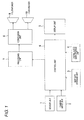
- Fig. 1 is a schematic block diagram illustrating the configuration of a stereophonic sound apparatus according to a first embodiment of the present invention.
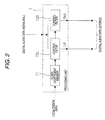
- Fig. 2 is a block diagram illustrating the detailed arrangement of the processing unit of the stereophonic sound apparatus according to the first embodiment of the invention.
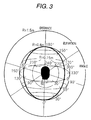
- Fig. 3 is a diagram showing coordinate information, as example localization data, represented by a "bearing, an elevation and a distance" with a listener being located in the center.
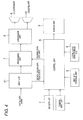
- Fig. 4 is a schematic block diagram illustrating the configuration of a stereophonic sound apparatus according to a second embodiment of the present invention.
- Fig. 5 is a diagram for explaining the function of a stereophonic sound apparatus according to the second embodiment of the invention.
- Fig. 6 is a block diagram illustrating the detailed arrangement of the processing unit of the stereophonic sound apparatus according to the second embodiment of the invention.
- Fig. 7 is a schematic block diagram illustrating the configuration of a stereophonic sound apparatus according to a third embodiment of the present invention.
- Fig. 1 is a schematic block diagram illustrating the configuration of a stereophonic sound apparatus according to a first embodiment of the present invention. While referring to Fig. 1, the stereophonic sound apparatus of this invention is a car navigation system for which the present invention is applied, and comprises a sensor unit 1, a camera input unit 2, a map data storage unit 3, a digital audio data storage unit 4, a display unit 5, a control unit 6, a processing unit 7, a conversion unit 8 and loudspeakers 9 and 10.
- the stereophonic sound apparatus of this invention is a car navigation system for which the present invention is applied, and comprises a sensor unit 1, a camera input unit 2, a map data storage unit 3, a digital audio data storage unit 4, a display unit 5, a control unit 6, a processing unit 7, a conversion unit 8 and loudspeakers 9 and 10.
- the sensor unit 1 includes a GPS (Global Positioning System) receiver, for receiving a GPS signal, and an acceleration sensor.
- the GPS receiver obtains position data while the acceleration sensor obtains acceleration data, and the obtained position data and acceleration data are transmitted to the control unit 6.
- the camera input unit 2 obtains camera video data by photographing an object, and transmits the camera video data to the control unit 6.
- the map data storage unit 3 stores map data.
- the digital audio data storage unit 4 stores digital audio data used to prepare a message for a direction instruction, such as guidance, recognition or a warning.
- the display unit 5 includes a liquid crystal display screen, and displays display data, including position data, received from the control unit 6.
- the control unit 6 controls the individual sections of the apparatus, and includes a CPU (Central Processing Unit) (not shown), a nonvolatile memory, such as a ROM (Read Only Memory) in which a program for operating the CPU is stored, and a volatile memory, such as a RAM (Random Access Memory) that is employed for operations performed by the CPU.
- a CPU Central Processing Unit
- nonvolatile memory such as a ROM (Read Only Memory) in which a program for operating the CPU is stored
- a volatile memory such as a RAM (Random Access Memory) that is employed for operations performed by the CPU.
- RAM Random Access Memory
- the control unit 6 obtains position data from the sensor unit 1 for specifying the location of the main body of the apparatus, obtains from the map data storage unit 3 map data representing that the main body of the apparatus is located in the center, obtains acceleration data from the sensor unit 1 to specify the azimuth along which the main body faces forward, employs the azimuth data and the position data to calculate distance information and directional information relative to a predesignated or given position, and outputs these data as localization data for sounds.
- This localization data is transmitted to the processing unit 7.
- digital audio data that is stored in the digital audio data storage unit 4 and that is consonant with the current situation is also transmitted to the processing unit 7.
- control unit 6 converts camera video data received from the camera input unit 2 into display data that can be displayed by the display unit 5, and transmits the display data to the display unit 5.
- control unit 6 may employ an image captured by the camera input unit 2 to identify a listener who is listening to sounds output through the loudspeakers 9 and 10, and may obtain data for the position of the listener and the azimuth for the listener, relative to the main body of the apparatus, to calculate distance data and directional data that it outputs as sound localization data to the processing unit 7.
- the processing unit 7 When the processing unit 7 receives from the control unit 6 the sound localization data (distance data and azimuth data) and the digital audio data, and when the distance data indicates a distance equal to or shorter than a predesignated distance, the processing unit 7 performs a stereophonic sound process for the digital audio data based on the localization data that are received, and transmits the process results to the conversion unit 8.
- the stereophonic sound process may be performed for a case wherein the distance data indicates a distance that falls within a predesignated range, in addition to a case wherein the distance data indicates a distance equal to or shorter than a predesignated distance. Alternately, these limitations may be eliminated.
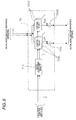
- Fig. 2 is a block diagram showing the detailed arrangement of the processing unit 7. While referring to Fig. 2, the processing unit 7 includes: a filter coefficient memory 71, in which a plurality of filter coefficients are stored; and control filters 72L and 72R for left and right channels that employ filter coefficients correlated with bearing data, and that control the phase of digital audio data received from the digital audio data storage unit 4.
- a filter coefficient memory 71 in which a plurality of filter coefficients are stored
- control filters 72L and 72R for left and right channels that employ filter coefficients correlated with bearing data, and that control the phase of digital audio data received from the digital audio data storage unit 4.
- filter coefficients are stored in a table in correlation with bearing data, and filter coefficients correlated with the bearing data are output.
- the filter coefficients that are read from the table are transmitted to the control filters 72L and 72R.
- the filter coefficient for channel L is transmitted to the control filter 72L for channel L
- the filter coefficient for channel R is transmitted to the control filter 72R for the R.
- the control filters 72L and 72R employ the filter coefficients transmitted from the filter coefficient memory 71, and control the phase of the digital audio data that is obtained from the digital audio data storage unit 4 and is received via the control unit 6.
- the digital audio data obtained from the digital audio data storage unit 4 are monaural data, and are adjusted to the phase for channel L by the control filter 72L and to the phase for channel R by the control filter 72R.
- the localization data input to the filter coefficient memory 71 is coordinate data represented by "a bearing, an elevation and a distance", with a listener being located in the center.
- the filter coefficients correlated with the localization data are read from the filter coefficient memory 71 and transmitted to the control filters 72L and 72R.
- a user in addition to storing filter coefficients in advance in the filter coefficient memory 71 and transmitting them to the control filters 72L and 72R, may enter values directly to the control filters 72L and 72R.
- the processing unit 7 localizes the monaural, digital audio data based on the localization data, and outputs stereo, digital audio data.
- the conversion unit 8 includes a D/A converter (not shown), converts digital audio data received from the processing unit 7 into analog audio signals, and drives the loudspeakers 9 and 10.
- the loudspeakers 9 and 10 are arranged to obtain stereophonic effects.
- the sensor unit 1 and the control unit 6 respectively serve as a position data acquisition unit and an acceleration detector.
- the camera input unit 2 corresponds to an image pickup unit
- the digital audio data storage unit 4 and the control unit 6 constitute an audio data acquisition unit.
- the control unit 6 also corresponds to a controller and the processing unit 7 corresponds to a processor. Further, the sensor unit 1, the digital audio data storage unit 4, the control unit 6, the processing unit 7 and the conversion unit 8 constitute a stereophonic sound control apparatus.
- the control unit 6 obtains position data and angle data from the sensor unit 1. Then, the control unit 6 employs the angle data to determine the azimuth along which the main body of the apparatus moved, or is currently moving, and employs the azimuth data and position data obtained through determination and calculates distance data and directional data relative to a predesignated position or a given position, and outputs these data as sound localization data to the processing unit 7. Furthermore, from the digital audio data storage unit 4, the control unit 6 reads digital audio data that is optimal for the current situation, such as guidance or recognition of a direction, or a warning, and transmits the audio data to the processing unit 7.
- the processing unit 7 When the processing unit 7 receives localization data and relative digital audio data from the control unit 6, the processing unit 7 performs a stereophonic sound process for the digital audio data based on the localization data, and transmits the results to the conversion unit 8. That is, the processing unit 7 reads filter coefficients from the filter coefficient memory 71 in correlation with localization data for the coordinate system that is represented by using "a bearing, an elevation and a distance", with a listener being located in the center, and transmits the filter coefficients to the control filters 72L and 72R. In this case, the filter coefficient for channel L is transmitted to the control filter 72L for channel L, while the filter coefficient for channel R is transmitted to the control filter 72R for channel R.
- the control filter 72L employs the filter coefficient for channel L to control the phase for the digital audio data
- the control filter 72R employs the filter coefficient for channel R to control the phase for the digital audio data.
- the digital audio data for channel L and channel R, for which the phase is controlled are transmitted as stereo digital audio data to the conversion unit 8.
- the conversion unit 8 converts the stereo digital audio data received from the processing unit 7 into analog audio data, and drives the loudspeakers 9 and 10.
- stereophonic sounds are released through the loudspeakers 9 and 10. Since the stereophonic sounds have directivity, audio direction instruction is enabled, instead of using a display. It should be noted that since the stereophonic sound apparatus of this embodiment is a car navigation system for which the present invention is applied, a listener, naturally, is a driver.
- the acceleration data is obtained by the sensor unit 1, which can obtain position data and detect acceleration, and the azimuth along which the main body of the apparatus was moved, or is moving, is determined. Then, the azimuth data and the position data obtained through a determination are employed, and the distance data and the directional data relative to the predesignated or given position are calculated, and while these data are regarded as localization data, the stereophonic sound process is performed for the digital audio data to generate digital audio data having directivity. Then, the digital audio data that is generated is converted into analog audio data, and the two loudspeakers 9 and 10 are driven to output stereophonic sounds.
- the audio form can be used to provide a direction instruction (guidance, recognition or warning) that a listener will quickly understand.
- a direction instruction guidance, recognition or warning
- the direction instructions will not simply be provided to the left or to the right, but in all directions.
- distance for example, can be instructed along with direction
- a user listener
- the cost rise due to the introduction of the stereophonic sound apparatus of the invention can be minimized.
- a conventional car navigation system provides a direction instruction using merely a display and a speech, so that in a case, for example, where a guidance for making a left turn further down a street is to be issued, the turn and the distance to the turn are presented on the display, while a speech, "Make a left turn further down this street", is provided by the loudspeakers. Subsequently, the driver must view the display to obtain detailed information for the turn and the distance to the turn; however, since at much the same time actual traffic conditions must be visually confirmed, the driver may have time to view only part or none of the turn information, and may miss the turn. On the other hand, according to the invention, visual confirmation is substantially not required, so that little or no time is needed to fully grasp the information that is provided, and a situation where a driver obtains inadequate information does not occur.
- acceleration data is obtained to determine an azimuth.
- the acceleration sensor included in the sensor unit 1 is not necessarily required.
- position data is employed, however, the following process is performed.
- the control unit 6 specifies the azimuth for the main body of the apparatus based on the change in the position data that is obtained by the sensor unit 1, employs the azimuth and the position data obtained by the sensor unit 1 to calculate distance data and directional data relative to a predesignated or given position, and while these data are regarded as sound localization data, performs a stereophonic sound process for the digital audio data that is obtained from the digital audio data storage unit 4.
- the determination of the azimuth can also be performed using the bearing sensor (a bearing detector (not shown)) that detects a vehicle bearing. That is, the control unit 6 obtains bearing data from the bearing sensor, and determines the azimuth along which the main body of the apparatus faces forward. Then, based on the azimuth data and the position data obtained through the determination, the control unit 6 calculates distance data and directional data relative to a predesignated or given position, and while these data are regarded as sound localization data, performs a stereophonic sound process for the digital audio data that are obtained from the digital audio data storage unit 4. Further, the accuracy of the directional data can be increased by using a posture detector (not shown), such as a geomagnetic sensor or a horizon sensor. That is, the control unit 6 obtains posture data, from the posture detection sensor, that indicates the posture of the main body of the apparatus relative to the surface of the earth, and corrects the directional data based on the obtained posture data.
- a posture detector such as a geomagnetic sensor or
- the sensor unit 1 obtains position data and acceleration data.
- a sensor a blind spot detector (not shown) for detecting the presence of a person at the rear or to the side of a vehicle is additionally mounted on the sensor unit 1, the position of a person present at the rear or to the side of the vehicle can be detected.
- control unit 6 obtains the distance data and the directional data relative to the presence of the person or object captured by the person presence sensor, and transmits these data as sound localization data to the processing unit 7.
- the unit for monitoring the rear and the side of the vehicle is additionally provided, unlike in the visual case, information is received without especially paying attention. Therefore, the recognition speed is increased, and safe driving is ensured.
- position data for another party a user is conversing with on the phone can be obtained by GPS.
- speech can be output from the location on the screen of the phone occupied by an image of the other party. If the sounds heard at this time are those of the voice of the party the user is conversing with, the sensation is similar to that were the other party person actually present.
- the present invention has been applied for a car navigation system; however, the same effects can be obtained when the present invention is applied for a mobile terminal, such as a mobile phone.
- a mobile terminal such as a mobile phone.
- the acceleration sensor instead of the acceleration sensor, a geomagnetic sensor or a horizon sensor can be employed as the sensor unit 1.
- the camera input unit 2 can be employed to calculate the posture of the motile terminal relative to the surface of the earth, and based on the results, the directional data can be corrected.
- the posture of the mobile terminal relative to the person can be roughly obtained. So long as this posture data can be obtained, then, the position data for the mobile terminal can be corrected using the posture data, and an instruction directing that a person's image be positioned in the center of a screen is enabled.
- an acceleration sensor or a horizon sensor must be mounted on a mobile terminal in order to accurately correct the directional bearing of a case wherein the condition is not satisfied.
- an acceleration sensor or a horizon sensor must be mounted on a mobile terminal in order to accurately correct the directional bearing of a case wherein the condition is not satisfied.
- loudspeakers 9 and 10 have been prepared for this embodiment.
- the number of loudspeakers is not limited to two, and more than two may be employed in order to obtain stereophonic effects. However, since many loudspeakers increase manufacturing costs, this should be taken into account.
- an optional function is not included for arbitrarily selecting the use of the function whereby a stereophonic sound process is performed for audio data obtained by the digital audio data storage unit 4 and the control unit 6.
- the optional function for selecting whether or not this function is to be employed may be provided on a menu screen or a system setup screen for starting navigation. Or instead, this function may be selected manually, or automatically based on distance data.
- the sensation of distance is represented using a transverse angle, and a volume and a frequency property; however, an elevation angle may be employed.
- Fig. 4 is a schematic block diagram illustrating a stereophonic sound apparatus according to a second embodiment of the present invention. While referring to Fig. 4, the stereophonic sound apparatus for this embodiment is a mobile terminal, such as a mobile phone, for which the present invention is applied.
- the stereophonic sound apparatus includes an input unit (input means) 11 that receives data, including audio data, for a plurality of channels by wire. For communication using packets in a time-dividing manner, each packet consists of an "identifier" and correlated "audio data".
- a control unit 6 obtains predesignated or given position data for each channel for data that is entered by the input unit 11, and calculates distance data and directional data.
- control unit 6 outputs these data as sound localization data. Furthermore, the control unit 6 identifies audio data entered via the same channel by the input unit 11, obtains position data that is predesignated or given not only for channel data but also for identification data, calculates distance data and directional data, and outputs these data as sound localization data.
- sounds produced using stereophonic data can be obtained for individual identifiers. That is, speech is released, while different directions for individual identifiers are multiplexed. Therefore, a listener can identify a plurality of sounds substantially without them being mixed up.
- the directional bearing data may be multiplexed with data entered for the input unit 11. Further, speech may be generated by exchanging character data and converting the data. Also, the bearing data may be displayed on the display unit 5, so that detailed information, such as a student name and the student's class, obtained from identification data, may be additionally provided to more easily identify the individual. This state is shown in Fig. 5.
- the speech of speakers A, B and C are multiplexed, and the obtained digital data is delivered as a radio wave to a mobile terminal 15. This radio wave is received by the input unit 11, and since the digital data is delivered as a packet, the data is separated into data for the individual speakers.
- a processing unit 7A provides a display based on the localization data for the individuals. As a result, as shown in Fig. 5, the image of speaker A is displayed in the lower left area of the screen for the display unit 5, the image of speaker B is displayed in the upper center, and the image of the speaker C is displayed in the lower right area.
- the processing unit 7A includes a plurality of control filters for channel L and channel R for performing a plurality of sets of audio data at the same time. For this embodiment, assume that there are control filters provided that are equivalent in number to three speakers A to C. As shown in Fig. 6, the processing unit 7A includes a filter coefficient memory 71 A, three control filters 72AL for channel L, three control filters 72AR for channel R, an adder 73AL for adding the outputs of the three control filters 72AL, and an adder 73AR for adding the outputs of the three control filters 72AR.
- filter coefficients are stored for the individual speakers in a table in correlation with localization data, and filter coefficients are output in consonance with the input localization data.
- filter coefficients for channels L and R for the speaker A since there are three speakers A to C, filter coefficients for channels L and R for the speaker A, filter coefficients for channels L and R for the speaker B and filter coefficients for channels L and R for the speaker C are output.
- the filter coefficients for channels L and R that are correlated with the speaker A are transmitted to the first control filter 72AL and 72AR
- the filter coefficients for the channels L and R that are correlated with the speaker B are transmitted to the second control filter 72AL and 72AR
- the filter coefficients for channels L and R that are correlated with the speaker C are transmitted to the third control filter 72AL and 72AR.
- the individual control filters 72AL and 72AR employ the filter coefficients from the filter coefficient memory 71 A to control the phases of the input digital audio data for the individual speakers.
- Digital audio data that enters the processing unit 7A is monaural, and is adjusted to the phase of channel L by the control filters 72AL and to the phase of channel R by the control filters 72AR.
- the localization data transmitted to the filter coefficient memory 71A is coordinate data represented by "a bearing, an elevation and a distance" with the listener being located in the center. Not only are the filter coefficients stored in advance in the filter coefficient memory 71 A and transmitted to the control filters 72AL and 72AR, but also values may be directly entered by a user.
- the adder 73AL adds together the outputs of the control filters 72AL for the channel L and outputs the result
- the adder 73AR adds together the outputs of the control filters 72AR for the channel R and outputs the result. In this manner, based on the localization data for the individuals, the processing unit 7A performs the localization process for monaural digital audio data, and outputs stereo digital audio data.
- the control unit 6 displays data as identifiers on the display unit 5. For example, for a videophone, the control unit 6 displays image data at a designated location. It should be noted that a user may employ the display unit 5 to manually enter bearing data for each identifier. For example, while watching the display, the user positions the identifier at an arbitrary display position. Thus, bearing data can be provided in accordance with a method favored by a user.
- audio data entered for the input unit 11 does not include an identifier, and is simply multiplexed data to which sounds have been added.
- Such example data are data obtained when speeches by a plurality of speakers are collected using a single microphone at a video conference. Assuming that this audio data is transmitted, the control unit 6 analyzes the audio data by performing voice recognition, and generates bearing data. Through this process, speeches can be identified in a pseudo manner. As described above, also using the mobile terminal, a speech can be reproduced as though the individual were actually present.
- the sensor unit 1, the digital audio data storage unit 4, the control unit 6, the processing unit 7A, the conversion unit 8 and the input unit 11 constitute a stereophonic sound control apparatus.
- a stereophonic sound process is performed for the individual sets of audio data for which an identifier is provided, and audio data having directivity is generated. Therefore, the listener can identify a plurality of sounds without them being mixed up. Therefore, when a user talks to a plurality of parties on the phone at the same time, the user can hear the voices of the parties at different positions, and can identify these voices without becoming confused.
- Fig. 7 is a schematic block diagram illustrating a stereophonic sound apparatus according to a third embodiment of the present invention. While referring to Fig. 7, the stereophonic sound apparatus of this embodiment is a mobile terminal, such as a mobile phone, for which the present invention is applied. In addition to the configuration and the function that correspond to the first embodiment, the stereophonic sound apparatus includes an input unit 12 that has a function for externally fetching digital data by radio, i.e., a function for receiving radio waves transmitted from by radio transmission source.
- a control unit 6 receives, every specific period of time, the radio state together with digital audio data that are received by the input unit 12, and records the radio state. Then, the control unit 6 employs the radio state and a posture change of the mobile terminal to determine a radio intensity and a bearing, i.e., to determine the directional intensity of the received radio wave. Following this, based on the directional intensity, the control unit 6 obtains the direction of the radio transmission source and calculates directional data, and outputs the directional data as sound localization data. It should be noted that the input unit 12 may include a transmission function, whereby a detection radio wave is reversely transmitted to read the radio reception intensity.
- the sensor unit 1, the digital audio data storage unit 4, the control unit 6, the processing unit 7 (or 7A), the conversion unit 8 and the input unit 11 constitute a stereophonic sound control apparatus.
- a radio wave (digital data) transmitted by a radio transmission source is received every specific period of time, and the directional intensity of the received radio wave is determined by referring to the posture change for the mobile terminal. Therefore, the bearing of the radio transmission source can be presented to a user, and when the reception intensity of the radio transmission source is multiplied by the sound volume, rough distance data can also be presented.
- one set of audio data has been processed.
- a plurality of sets of audio data may be processed.
- the processing unit 7A is employed.
- the present invention provides the following effects.
- a stereophonic sound process is performed for a specific speech, a direction can be easily followed or identified, or useful data, such as a warning, can be obtained as auxiliary information.
- the present invention can be applied for a car navigation system or a mobile phone having a navigation function.
Landscapes
- Engineering & Computer Science (AREA)
- Radar, Positioning & Navigation (AREA)
- Remote Sensing (AREA)
- Computer Networks & Wireless Communication (AREA)
- Physics & Mathematics (AREA)
- General Physics & Mathematics (AREA)
- Stereophonic System (AREA)
Applications Claiming Priority (2)
| Application Number | Priority Date | Filing Date | Title |
|---|---|---|---|
| JP2006315841 | 2006-11-22 | ||
| JP2007266778A JP2008151766A (ja) | 2006-11-22 | 2007-10-12 | 立体音響制御装置及び立体音響制御方法 |
Publications (2)
| Publication Number | Publication Date |
|---|---|
| EP1926345A2 true EP1926345A2 (de) | 2008-05-28 |
| EP1926345A3 EP1926345A3 (de) | 2011-09-14 |
Family
ID=39106128
Family Applications (1)
| Application Number | Title | Priority Date | Filing Date |
|---|---|---|---|
| EP07121194A Withdrawn EP1926345A3 (de) | 2006-11-22 | 2007-11-21 | Stereo-Tonsteuerungseinrichtung und Stereo-Tonsteuerungsverfahren |
Country Status (2)
| Country | Link |
|---|---|
| US (1) | US20080118074A1 (de) |
| EP (1) | EP1926345A3 (de) |
Families Citing this family (10)
| Publication number | Priority date | Publication date | Assignee | Title |
|---|---|---|---|---|
| US20130089220A1 (en) * | 2011-10-10 | 2013-04-11 | Korea Advanced Institute Of Science And Technology | Sound reproducing appartus |
| US20130108995A1 (en) * | 2011-10-31 | 2013-05-02 | C&D Research Group LLC. | System and method for monitoring and influencing body position |
| CN105980962B (zh) * | 2014-02-17 | 2019-07-23 | 索尼公司 | 信息处理设备和信息处理方法 |
| CN106165402A (zh) * | 2014-04-22 | 2016-11-23 | 索尼公司 | 信息再现装置、信息再现方法、信息记录装置和信息记录方法 |
| JP6470041B2 (ja) * | 2014-12-26 | 2019-02-13 | 株式会社東芝 | ナビゲーション装置、ナビゲーション方法及びプログラム |
| WO2016140058A1 (ja) | 2015-03-04 | 2016-09-09 | シャープ株式会社 | 音声信号再生装置、音声信号再生方法、プログラム、および記録媒体 |
| CN106293660B (zh) * | 2015-05-21 | 2020-04-24 | 联想(北京)有限公司 | 一种信息处理方法及电子设备 |
| EP3468224A4 (de) * | 2016-05-30 | 2019-06-12 | Sony Corporation | Vorrichtung zur bildung eines lokalen schallfeldes, verfahren zur bildung eines lokalen schallfeldes und programm |
| JP7044040B2 (ja) | 2018-11-28 | 2022-03-30 | トヨタ自動車株式会社 | 質問応答装置、質問応答方法及びプログラム |
| JP7332741B1 (ja) * | 2022-03-29 | 2023-08-23 | 本田技研工業株式会社 | 安全支援装置 |
Family Cites Families (5)
| Publication number | Priority date | Publication date | Assignee | Title |
|---|---|---|---|---|
| US5857026A (en) * | 1996-03-26 | 1999-01-05 | Scheiber; Peter | Space-mapping sound system |
| JP4502351B2 (ja) * | 2001-06-11 | 2010-07-14 | パイオニア株式会社 | 移動体用電子システムの制御装置及び制御方法、移動体用電子システム並びにコンピュータプログラム |
| JP2005333621A (ja) * | 2004-04-21 | 2005-12-02 | Matsushita Electric Ind Co Ltd | 音情報出力装置及び音情報出力方法 |
| JP4277746B2 (ja) * | 2004-06-25 | 2009-06-10 | 株式会社デンソー | カーナビゲーション装置 |
| US20060140210A1 (en) * | 2004-12-29 | 2006-06-29 | Automotive Data Research Inc. | Apparatus and method for manipulating automotive data packets |
-
2007
- 2007-11-21 EP EP07121194A patent/EP1926345A3/de not_active Withdrawn
- 2007-11-21 US US11/943,819 patent/US20080118074A1/en not_active Abandoned
Also Published As
| Publication number | Publication date |
|---|---|
| US20080118074A1 (en) | 2008-05-22 |
| EP1926345A3 (de) | 2011-09-14 |
Similar Documents
| Publication | Publication Date | Title |
|---|---|---|
| CN101203071A (zh) | 立体声声音控制设备和立体声声音控制方法 | |
| EP1926345A2 (de) | Stereophone Tonsteuerungsvorrichtung und Verfahren | |
| US11240624B2 (en) | Information processing apparatus, information processing method, and program | |
| US9538289B2 (en) | Control parameter dependent audio signal processing | |
| EP2669634A1 (de) | Persönliches Navigationssystem mit Hörvorrichtung | |
| EP2724556B1 (de) | Verfahren und vorrichtung zur verarbeitung von tondaten | |
| EP3657822A1 (de) | Tonausgabevorrichtung und tonerzeugungsverfahren | |
| EP2690407A1 (de) | Hörgerät mit Bereitstellung gesprochener Informationen zu ausgewählten Interessenpunkten | |
| EP2725818A1 (de) | Hörgerät mit einer Abstandsmesseinheit | |
| EP2720001A1 (de) | Navigationssystem mit Hörvorrichtung | |
| KR20170025840A (ko) | 이어셋, 이어셋 시스템 및 그 제어방법 | |
| JP2017138277A (ja) | 音声ナビゲーションシステム | |
| EP4113961A1 (de) | Sprachanrufverfahren und -vorrichtung, elektronische vorrichtung und computerlesbares speichermedium | |
| JPWO2016072164A1 (ja) | 車載用音声処理装置 | |
| EP2685217A1 (de) | Hörgerät mit Bereitstellung gesprochener Informationen zur Umgebung | |
| KR100653091B1 (ko) | 입체 음향을 이용한 위치 인지 시스템, 시스템에 구비되는송신부, 수신부 및 위치 인지 방법 | |
| US20150086023A1 (en) | Audio control apparatus and method | |
| CN117083882A (zh) | 信息处理装置、信息处理方法和程序 | |
| JP3998360B2 (ja) | 通話装置 | |
| JP2021150834A (ja) | 音響出力装置、音響出力システム及び音響出力方法 | |
| JP2007036610A (ja) | 発音装置 | |
| US12177650B2 (en) | Audio signal output method, audio signal output device, and audio system | |
| JP2020188494A (ja) | 音声ナビゲーションシステムおよび音声ナビゲーション方法 | |
| JP2019096220A (ja) | 文字情報提供装置および方法 | |
| JP2005333252A (ja) | 情報交換システム |
Legal Events
| Date | Code | Title | Description |
|---|---|---|---|
| PUAI | Public reference made under article 153(3) epc to a published international application that has entered the european phase |
Free format text: ORIGINAL CODE: 0009012 |
|
| AK | Designated contracting states |
Kind code of ref document: A2 Designated state(s): AT BE BG CH CY CZ DE DK EE ES FI FR GB GR HU IE IS IT LI LT LU LV MC MT NL PL PT RO SE SI SK TR |
|
| AX | Request for extension of the european patent |
Extension state: AL BA HR MK RS |
|
| RAP1 | Party data changed (applicant data changed or rights of an application transferred) |
Owner name: PANASONIC CORPORATION |
|
| PUAL | Search report despatched |
Free format text: ORIGINAL CODE: 0009013 |
|
| AK | Designated contracting states |
Kind code of ref document: A3 Designated state(s): AT BE BG CH CY CZ DE DK EE ES FI FR GB GR HU IE IS IT LI LT LU LV MC MT NL PL PT RO SE SI SK TR |
|
| AX | Request for extension of the european patent |
Extension state: AL BA HR MK RS |
|
| RIC1 | Information provided on ipc code assigned before grant |
Ipc: H04S 3/00 20060101AFI20110811BHEP |
|
| AKY | No designation fees paid | ||
| REG | Reference to a national code |
Ref country code: DE Ref legal event code: R108 |
|
| REG | Reference to a national code |
Ref country code: DE Ref legal event code: R108 Effective date: 20120523 |
|
| STAA | Information on the status of an ep patent application or granted ep patent |
Free format text: STATUS: THE APPLICATION IS DEEMED TO BE WITHDRAWN |
|
| 18D | Application deemed to be withdrawn |
Effective date: 20120315 |