EP1927392A1 - Procédé de fabrication d'une structure en nids d'abeilles, et structure en nids d'abeilles - Google Patents
Procédé de fabrication d'une structure en nids d'abeilles, et structure en nids d'abeilles Download PDFInfo
- Publication number
- EP1927392A1 EP1927392A1 EP07018263A EP07018263A EP1927392A1 EP 1927392 A1 EP1927392 A1 EP 1927392A1 EP 07018263 A EP07018263 A EP 07018263A EP 07018263 A EP07018263 A EP 07018263A EP 1927392 A1 EP1927392 A1 EP 1927392A1
- Authority
- EP
- European Patent Office
- Prior art keywords
- inorganic
- structured body
- honeycomb structured
- honeycomb
- particles
- Prior art date
- Legal status (The legal status is an assumption and is not a legal conclusion. Google has not performed a legal analysis and makes no representation as to the accuracy of the status listed.)
- Granted
Links
Images

Classifications
-
- C—CHEMISTRY; METALLURGY
- C04—CEMENTS; CONCRETE; ARTIFICIAL STONE; CERAMICS; REFRACTORIES
- C04B—LIME, MAGNESIA; SLAG; CEMENTS; COMPOSITIONS THEREOF, e.g. MORTARS, CONCRETE OR LIKE BUILDING MATERIALS; ARTIFICIAL STONE; CERAMICS; REFRACTORIES; TREATMENT OF NATURAL STONE
- C04B35/00—Shaped ceramic products characterised by their composition; Ceramics compositions; Processing powders of inorganic compounds preparatory to the manufacturing of ceramic products
- C04B35/622—Forming processes; Processing powders of inorganic compounds preparatory to the manufacturing of ceramic products
- C04B35/626—Preparing or treating the powders individually or as batches ; preparing or treating macroscopic reinforcing agents for ceramic products, e.g. fibres; mechanical aspects section B
- C04B35/63—Preparing or treating the powders individually or as batches ; preparing or treating macroscopic reinforcing agents for ceramic products, e.g. fibres; mechanical aspects section B using additives specially adapted for forming the products, e.g.. binder binders
- C04B35/632—Organic additives
-
- B—PERFORMING OPERATIONS; TRANSPORTING
- B01—PHYSICAL OR CHEMICAL PROCESSES OR APPARATUS IN GENERAL
- B01J—CHEMICAL OR PHYSICAL PROCESSES, e.g. CATALYSIS OR COLLOID CHEMISTRY; THEIR RELEVANT APPARATUS
- B01J35/00—Catalysts, in general, characterised by their form or physical properties
- B01J35/50—Catalysts, in general, characterised by their form or physical properties characterised by their shape or configuration
- B01J35/56—Foraminous structures having flow-through passages or channels, e.g. grids or three-dimensional [3D] monoliths
- B01J35/57—Honeycombs
-
- C—CHEMISTRY; METALLURGY
- C04—CEMENTS; CONCRETE; ARTIFICIAL STONE; CERAMICS; REFRACTORIES
- C04B—LIME, MAGNESIA; SLAG; CEMENTS; COMPOSITIONS THEREOF, e.g. MORTARS, CONCRETE OR LIKE BUILDING MATERIALS; ARTIFICIAL STONE; CERAMICS; REFRACTORIES; TREATMENT OF NATURAL STONE
- C04B35/00—Shaped ceramic products characterised by their composition; Ceramics compositions; Processing powders of inorganic compounds preparatory to the manufacturing of ceramic products
- C04B35/01—Shaped ceramic products characterised by their composition; Ceramics compositions; Processing powders of inorganic compounds preparatory to the manufacturing of ceramic products based on oxide ceramics
- C04B35/16—Shaped ceramic products characterised by their composition; Ceramics compositions; Processing powders of inorganic compounds preparatory to the manufacturing of ceramic products based on oxide ceramics based on silicates other than clay
- C04B35/18—Shaped ceramic products characterised by their composition; Ceramics compositions; Processing powders of inorganic compounds preparatory to the manufacturing of ceramic products based on oxide ceramics based on silicates other than clay rich in aluminium oxide
-
- C—CHEMISTRY; METALLURGY
- C04—CEMENTS; CONCRETE; ARTIFICIAL STONE; CERAMICS; REFRACTORIES
- C04B—LIME, MAGNESIA; SLAG; CEMENTS; COMPOSITIONS THEREOF, e.g. MORTARS, CONCRETE OR LIKE BUILDING MATERIALS; ARTIFICIAL STONE; CERAMICS; REFRACTORIES; TREATMENT OF NATURAL STONE
- C04B35/00—Shaped ceramic products characterised by their composition; Ceramics compositions; Processing powders of inorganic compounds preparatory to the manufacturing of ceramic products
- C04B35/622—Forming processes; Processing powders of inorganic compounds preparatory to the manufacturing of ceramic products
- C04B35/626—Preparing or treating the powders individually or as batches ; preparing or treating macroscopic reinforcing agents for ceramic products, e.g. fibres; mechanical aspects section B
- C04B35/63—Preparing or treating the powders individually or as batches ; preparing or treating macroscopic reinforcing agents for ceramic products, e.g. fibres; mechanical aspects section B using additives specially adapted for forming the products, e.g.. binder binders
-
- C—CHEMISTRY; METALLURGY
- C04—CEMENTS; CONCRETE; ARTIFICIAL STONE; CERAMICS; REFRACTORIES
- C04B—LIME, MAGNESIA; SLAG; CEMENTS; COMPOSITIONS THEREOF, e.g. MORTARS, CONCRETE OR LIKE BUILDING MATERIALS; ARTIFICIAL STONE; CERAMICS; REFRACTORIES; TREATMENT OF NATURAL STONE
- C04B35/00—Shaped ceramic products characterised by their composition; Ceramics compositions; Processing powders of inorganic compounds preparatory to the manufacturing of ceramic products
- C04B35/71—Ceramic products containing macroscopic reinforcing agents
- C04B35/78—Ceramic products containing macroscopic reinforcing agents containing non-metallic materials
- C04B35/80—Fibres, filaments, whiskers, platelets, or the like
-
- C—CHEMISTRY; METALLURGY
- C04—CEMENTS; CONCRETE; ARTIFICIAL STONE; CERAMICS; REFRACTORIES
- C04B—LIME, MAGNESIA; SLAG; CEMENTS; COMPOSITIONS THEREOF, e.g. MORTARS, CONCRETE OR LIKE BUILDING MATERIALS; ARTIFICIAL STONE; CERAMICS; REFRACTORIES; TREATMENT OF NATURAL STONE
- C04B38/00—Porous mortars, concrete, artificial stone or ceramic ware; Preparation thereof
- C04B38/0006—Honeycomb structures
-
- F—MECHANICAL ENGINEERING; LIGHTING; HEATING; WEAPONS; BLASTING
- F01—MACHINES OR ENGINES IN GENERAL; ENGINE PLANTS IN GENERAL; STEAM ENGINES
- F01N—GAS-FLOW SILENCERS OR EXHAUST APPARATUS FOR MACHINES OR ENGINES IN GENERAL; GAS-FLOW SILENCERS OR EXHAUST APPARATUS FOR INTERNAL-COMBUSTION ENGINES
- F01N3/00—Exhaust or silencing apparatus having means for purifying, rendering innocuous, or otherwise treating exhaust
- F01N3/02—Exhaust or silencing apparatus having means for purifying, rendering innocuous, or otherwise treating exhaust for cooling, or for removing solid constituents of, exhaust
- F01N3/021—Exhaust or silencing apparatus having means for purifying, rendering innocuous, or otherwise treating exhaust for cooling, or for removing solid constituents of, exhaust by means of filters
- F01N3/022—Exhaust or silencing apparatus having means for purifying, rendering innocuous, or otherwise treating exhaust for cooling, or for removing solid constituents of, exhaust by means of filters characterised by specially adapted filtering structure, e.g. honeycomb, mesh or fibrous
- F01N3/0222—Exhaust or silencing apparatus having means for purifying, rendering innocuous, or otherwise treating exhaust for cooling, or for removing solid constituents of, exhaust by means of filters characterised by specially adapted filtering structure, e.g. honeycomb, mesh or fibrous the structure being monolithic, e.g. honeycombs
-
- F—MECHANICAL ENGINEERING; LIGHTING; HEATING; WEAPONS; BLASTING
- F01—MACHINES OR ENGINES IN GENERAL; ENGINE PLANTS IN GENERAL; STEAM ENGINES
- F01N—GAS-FLOW SILENCERS OR EXHAUST APPARATUS FOR MACHINES OR ENGINES IN GENERAL; GAS-FLOW SILENCERS OR EXHAUST APPARATUS FOR INTERNAL-COMBUSTION ENGINES
- F01N3/00—Exhaust or silencing apparatus having means for purifying, rendering innocuous, or otherwise treating exhaust
- F01N3/08—Exhaust or silencing apparatus having means for purifying, rendering innocuous, or otherwise treating exhaust for rendering innocuous
- F01N3/10—Exhaust or silencing apparatus having means for purifying, rendering innocuous, or otherwise treating exhaust for rendering innocuous by thermal or catalytic conversion of noxious components of exhaust
- F01N3/24—Exhaust or silencing apparatus having means for purifying, rendering innocuous, or otherwise treating exhaust for rendering innocuous by thermal or catalytic conversion of noxious components of exhaust characterised by constructional aspects of converting apparatus
- F01N3/28—Construction of catalytic reactors
- F01N3/2803—Construction of catalytic reactors characterised by structure, by material or by manufacturing of catalyst support
- F01N3/2825—Ceramics
- F01N3/2828—Ceramic multi-channel monoliths, e.g. honeycombs
-
- B—PERFORMING OPERATIONS; TRANSPORTING
- B01—PHYSICAL OR CHEMICAL PROCESSES OR APPARATUS IN GENERAL
- B01J—CHEMICAL OR PHYSICAL PROCESSES, e.g. CATALYSIS OR COLLOID CHEMISTRY; THEIR RELEVANT APPARATUS
- B01J35/00—Catalysts, in general, characterised by their form or physical properties
- B01J35/40—Catalysts, in general, characterised by their form or physical properties characterised by dimensions, e.g. grain size
-
- B—PERFORMING OPERATIONS; TRANSPORTING
- B01—PHYSICAL OR CHEMICAL PROCESSES OR APPARATUS IN GENERAL
- B01J—CHEMICAL OR PHYSICAL PROCESSES, e.g. CATALYSIS OR COLLOID CHEMISTRY; THEIR RELEVANT APPARATUS
- B01J35/00—Catalysts, in general, characterised by their form or physical properties
- B01J35/40—Catalysts, in general, characterised by their form or physical properties characterised by dimensions, e.g. grain size
- B01J35/45—Nanoparticles
-
- C—CHEMISTRY; METALLURGY
- C04—CEMENTS; CONCRETE; ARTIFICIAL STONE; CERAMICS; REFRACTORIES
- C04B—LIME, MAGNESIA; SLAG; CEMENTS; COMPOSITIONS THEREOF, e.g. MORTARS, CONCRETE OR LIKE BUILDING MATERIALS; ARTIFICIAL STONE; CERAMICS; REFRACTORIES; TREATMENT OF NATURAL STONE
- C04B2111/00—Mortars, concrete or artificial stone or mixtures to prepare them, characterised by specific function, property or use
- C04B2111/00474—Uses not provided for elsewhere in C04B2111/00
- C04B2111/00793—Uses not provided for elsewhere in C04B2111/00 as filters or diaphragms
-
- C—CHEMISTRY; METALLURGY
- C04—CEMENTS; CONCRETE; ARTIFICIAL STONE; CERAMICS; REFRACTORIES
- C04B—LIME, MAGNESIA; SLAG; CEMENTS; COMPOSITIONS THEREOF, e.g. MORTARS, CONCRETE OR LIKE BUILDING MATERIALS; ARTIFICIAL STONE; CERAMICS; REFRACTORIES; TREATMENT OF NATURAL STONE
- C04B2111/00—Mortars, concrete or artificial stone or mixtures to prepare them, characterised by specific function, property or use
- C04B2111/00474—Uses not provided for elsewhere in C04B2111/00
- C04B2111/0081—Uses not provided for elsewhere in C04B2111/00 as catalysts or catalyst carriers
-
- C—CHEMISTRY; METALLURGY
- C04—CEMENTS; CONCRETE; ARTIFICIAL STONE; CERAMICS; REFRACTORIES
- C04B—LIME, MAGNESIA; SLAG; CEMENTS; COMPOSITIONS THEREOF, e.g. MORTARS, CONCRETE OR LIKE BUILDING MATERIALS; ARTIFICIAL STONE; CERAMICS; REFRACTORIES; TREATMENT OF NATURAL STONE
- C04B2235/00—Aspects relating to ceramic starting mixtures or sintered ceramic products
- C04B2235/02—Composition of constituents of the starting material or of secondary phases of the final product
- C04B2235/30—Constituents and secondary phases not being of a fibrous nature
- C04B2235/32—Metal oxides, mixed metal oxides, or oxide-forming salts thereof, e.g. carbonates, nitrates, (oxy)hydroxides, chlorides
- C04B2235/3217—Aluminum oxide or oxide forming salts thereof, e.g. bauxite, alpha-alumina
-
- C—CHEMISTRY; METALLURGY
- C04—CEMENTS; CONCRETE; ARTIFICIAL STONE; CERAMICS; REFRACTORIES
- C04B—LIME, MAGNESIA; SLAG; CEMENTS; COMPOSITIONS THEREOF, e.g. MORTARS, CONCRETE OR LIKE BUILDING MATERIALS; ARTIFICIAL STONE; CERAMICS; REFRACTORIES; TREATMENT OF NATURAL STONE
- C04B2235/00—Aspects relating to ceramic starting mixtures or sintered ceramic products
- C04B2235/02—Composition of constituents of the starting material or of secondary phases of the final product
- C04B2235/30—Constituents and secondary phases not being of a fibrous nature
- C04B2235/34—Non-metal oxides, non-metal mixed oxides, or salts thereof that form the non-metal oxides upon heating, e.g. carbonates, nitrates, (oxy)hydroxides, chlorides
- C04B2235/3418—Silicon oxide, silicic acids or oxide forming salts thereof, e.g. silica sol, fused silica, silica fume, cristobalite, quartz or flint
-
- C—CHEMISTRY; METALLURGY
- C04—CEMENTS; CONCRETE; ARTIFICIAL STONE; CERAMICS; REFRACTORIES
- C04B—LIME, MAGNESIA; SLAG; CEMENTS; COMPOSITIONS THEREOF, e.g. MORTARS, CONCRETE OR LIKE BUILDING MATERIALS; ARTIFICIAL STONE; CERAMICS; REFRACTORIES; TREATMENT OF NATURAL STONE
- C04B2235/00—Aspects relating to ceramic starting mixtures or sintered ceramic products
- C04B2235/02—Composition of constituents of the starting material or of secondary phases of the final product
- C04B2235/30—Constituents and secondary phases not being of a fibrous nature
- C04B2235/44—Metal salt constituents or additives chosen for the nature of the anions, e.g. hydrides or acetylacetonate
-
- C—CHEMISTRY; METALLURGY
- C04—CEMENTS; CONCRETE; ARTIFICIAL STONE; CERAMICS; REFRACTORIES
- C04B—LIME, MAGNESIA; SLAG; CEMENTS; COMPOSITIONS THEREOF, e.g. MORTARS, CONCRETE OR LIKE BUILDING MATERIALS; ARTIFICIAL STONE; CERAMICS; REFRACTORIES; TREATMENT OF NATURAL STONE
- C04B2235/00—Aspects relating to ceramic starting mixtures or sintered ceramic products
- C04B2235/02—Composition of constituents of the starting material or of secondary phases of the final product
- C04B2235/50—Constituents or additives of the starting mixture chosen for their shape or used because of their shape or their physical appearance
- C04B2235/52—Constituents or additives characterised by their shapes
- C04B2235/5276—Whiskers, spindles, needles or pins
-
- Y—GENERAL TAGGING OF NEW TECHNOLOGICAL DEVELOPMENTS; GENERAL TAGGING OF CROSS-SECTIONAL TECHNOLOGIES SPANNING OVER SEVERAL SECTIONS OF THE IPC; TECHNICAL SUBJECTS COVERED BY FORMER USPC CROSS-REFERENCE ART COLLECTIONS [XRACs] AND DIGESTS
- Y02—TECHNOLOGIES OR APPLICATIONS FOR MITIGATION OR ADAPTATION AGAINST CLIMATE CHANGE
- Y02T—CLIMATE CHANGE MITIGATION TECHNOLOGIES RELATED TO TRANSPORTATION
- Y02T10/00—Road transport of goods or passengers
- Y02T10/10—Internal combustion engine [ICE] based vehicles
- Y02T10/12—Improving ICE efficiencies
Definitions
- the present invention relates to a method for manufacturing a honeycomb structured body, and a honeycomb structured body.
- honeycomb catalysts formed by supporting catalyst components on a honeycomb structured body which are used for converting exhaust gases of vehicles, are being manufactured by supporting materials having a large specific surface area such as activated alumina and a catalyst metal such as platinum on the surface of a cordierite-based honeycomb structured body having an integral structure and low thermal expansion.
- an alkaline earth metal such as barium (Ba) is supported on the honeycomb catalyst of this kind as a NOx adsorber in order to treat NOx in an atmosphere of excess oxygen like those in a lean burn engine and a diesel engine.
- barium barium
- a carrier has a larger specific surface area, that a particle diameter of the noble metal is reduced, and that the noble metal particles are highly dispersed.
- a honeycomb structured body containing a material having a large specific surface area for example, honeycomb structured bodies formed by extrusion-molding inorganic particles and inorganic fibers with an inorganic binder are known (for example, see Patent Documents 1 to 3) .
- the present inventors made earnest investigations to solve the above-mentioned problems, and consequently found that by using an inorganic binder having a prescribed average particle diameter for a raw material composition, a honeycomb structured body having a large specific surface area while securing strength can be manufactured, thereby completing the present invention.
- a method for manufacturing a honeycomb structured body of the present invention is a method for manufacturing a honeycomb structured body, comprising: a molding step of manufacturing a pillar-shaped honeycomb molded body having a large number of cells disposed in parallel with one another in a longitudinal direction with a cell wall therebetween by using a raw material composition comprising: inorganic particles; at least one of inorganic fibers and inorganic whiskers; and an inorganic binder; and a firing step of carrying out a firing treatment on the honeycomb molded body to manufacture a honeycomb fired body, wherein the inorganic particles comprise secondary particles formed by an agglomeration of primary particles, and an average particle diameter of the inorganic binder in the raw material composition is 1/200 to 1/40 of an average particle diameter of the inorganic particles.
- an average particle diameter of the secondary particles is desirably 0.5 to 20 ⁇ m, and a specific surface area of the secondary particles is desirably 50 to 300 m 2 /g.
- the inorganic binder is desirably at least one kind selected from the group consisting of alumina sol, silica sol, titania sol, sepiolite and attapulgite.
- a honeycomb structured body of the present invention is a honeycomb structured body manufactured by undergoing at least: a molding step of manufacturing a pillar-shaped honeycomb molded body having a large number of cells disposed in parallel with one another in a longitudinal direction with a cell wall therebetween by using a raw material composition comprising: inorganic particles; at least one of inorganic fibers and inorganic whiskers; and an inorganic binder; and a firing step of carrying out a firing treatment on the honeycomb molded body to manufacture a honeycomb fired body, wherein the inorganic particles comprise secondary particles formed by an agglomeration of primary particles, and an average particle diameter of the inorganic binder in the raw material composition is 1/200 to 1/40 of an average particle diameter of the inorganic particles.
- an average particle diameter of the secondary particles is desirably 0.5 to 20 ⁇ m, and a specific surface area of the secondary particles is desirably 50 to 300 m 2 /g.
- the inorganic binder is desirably at least one kind selected from the group consisting of alumina sol, silica sol, titania sol, sepiolite and attapulgite.
- a catalyst is desirably supported on the honeycomb structured body of the present invention, and the catalyst desirably contains at least one kind selected from the group consisting of noble metals, alkali metals, alkaline earth metals, and oxides.
- the honeycomb structured body is desirably used for converting exhaust gases of vehicles.
- a honeycomb structured body having high strength and a large specific surface area can be manufactured since an inorganic binder having a prescribed average particle diameter is used.
- the honeycomb structured body of the present invention has a large specific surface area and high strength, and can be suitably used as a catalyst supporting carrier.
- the method for manufacturing a honeycomb structured body of the present invention is a method for manufacturing a honeycomb structured body, comprising: a molding step of manufacturing a pillar-shaped honeycomb molded body having a large number of cells disposed in parallel with one another in a longitudinal direction with a cell wall therebetween by using a raw material composition comprising: inorganic particles; at least one of inorganic fibers and inorganic whiskers; and an inorganic binder; and a firing step of carrying out a firing treatment on the honeycomb molded body to manufacture a honeycomb fired body, wherein the inorganic particles comprise secondary particles formed by an agglomeration of primary particles, and an average particle diameter of the inorganic binder in the raw material composition is 1/200 to 1/40 of an average particle diameter of the inorganic particles.
- a substance comprising: inorganic particles; at least one of inorganic fibers and inorganic whiskers; and an inorganic binder, and as needed, further containing an organic binder, a dispersion medium and a forming auxiliary, which are appropriately added according to the moldability of the raw material composition, can be used.
- the inorganic particles secondary particles formed by an agglomeration of primary particles is used, and as the inorganic binder, an inorganic binder having a lower limit of 1/200 of an average particle diameter of the inorganic particles and an upper limit of 1/40 of an average particle diameter of the inorganic particles is used.
- an inorganic binder having a large specific surface area and high strength can be manufactured by undergoing the manufacturing steps described later.
- an average particle diameter of the inorganic binder is less than 1/200 or more than 1/40 of the average particle diameter of the inorganic particles, the strength of the manufactured honeycomb structured body becomes insufficient. The reason for this is presumably described as follows.
- the inorganic binder mainly plays a role of bonding the inorganic particles, the inorganic fibers and the inorganic whiskers, and the inorganic binder presumably exerts an adhesive function by interposing between the inorganic fibers (inorganic whiskers) and the inorganic particles to simultaneously come into contact with the inorganic fibers (inorganic whiskers) and the inorganic particles, or by interposing between each of the inorganic particles to simultaneously come into contact with the different inorganic particles.
- the average particle diameter is less than 1/200 of the average particle diameter of the inorganic particles, it is difficult to simultaneously come into contact with the inorganic fibers (inorganic whiskers) and the inorganic particles or to simultaneously come into contact with the different inorganic particles, and therefore there are cases where a sufficient adhesive strength cannot be obtained, and on the other hand, when the average particle diameter is more than 1/40 of the average particle diameter of the inorganic particles, the number of points to be bonded decreases and consequently the strength becomes insufficient.
- an average particle diameter of the inorganic binder is more than 1/40 of the average particle diameter of the inorganic particles, the specific surface area of the manufactured honeycomb structured body is not increased sufficiently, and it is disadvantageous when the honeycomb structured body is used as a catalyst supporting carrier.
- the reason for this is that since the average particle diameter of the inorganic binder is large, the inorganic binder covers the surface of the inorganic particles so that it becomes difficult to secure a large specific surface area in the manufactured honeycomb structured body.
- a desired average particle diameter of the inorganic binder is 1/100 of the average particle diameter of the inorganic particles in the lower limit and 1/50 of the average particle diameter of the inorganic particles in the upper limit.
- inorganic sols and clay binders can be used, and the specific examples of the inorganic sols include alumina sol, silica sol, titania sol and the like.
- the specific examples of the clay binders include clays having a double-chain structure such as white clay, kaolin, montmorillonite, sepiolite and attapulgite, and the like. These inorganic binders may be used alone or in combination of two or more kinds. Among these binders, at least one kind selected from the group consisting of alumina sol, silica sol, titania sol, sepiolite and attapulgite is desirable.
- a blending amount of the inorganic binder is, in terms of solid matter content, 5% by weight as a desirable lower limit, 10% by weight as a more desirable lower limit, and 15% by weight as a furthermore desirable lower limit to the total amount of: the inorganic particles; at least one of the inorganic fibers and inorganic whiskers; and the solid matter of the inorganic binder (hereinafter, referred to as the total amount of essential raw materials).
- the blending amount of the inorganic binder is 50% by weight as a desirable upper limit, 40% by weight as a more desirable upper limit, and 35% by weight as a furthermore desirable upper limit.
- the blending amount of the inorganic binder is less than 5% by weight, the strength of the manufactured honeycomb structured body may be deteriorated, and on the other hand, when the blending amount of the inorganic binder is more than 50% by weight, the moldability of the raw material composition tends to be deteriorated.
- TEM transmission electron microscope
- the inorganic particles include particles of alumina, silica, zirconia, titania, ceria, mullite, zeolite and the like. These particles may be used alone or in combination of two or more kinds. Among these particles, alumina particles and ceria particles are particularly desirable.
- a blending amount of the inorganic particles is 30% by weight as a desirable lower limit to the total amount of essential raw materials, 40% by weight as a more desirable lower limit, and 50% by weight as a furthermore desirable lower limit.
- the blending amount of the inorganic particles is 90% by weight as a desirable upper limit, 80% by weight as a more desirable upper limit, and 75% by weight as a furthermore desirable upper limit.
- the strength of the manufactured honeycomb structured body tends to be deteriorated since the amounts of the inorganic binder, the inorganic fibers and the inorganic whiskers, contributing to the improvement of the strength, are relatively decreased.
- secondary particles of the inorganic particles mixed in the raw material composition desirably have an average particle diameter of 0.5 to 20 ⁇ m.
- the average particle diameter of the secondary particles is less than 0.5 ⁇ m, the manufactured honeycomb structured body is densified, and therefore the permeability of gases may be low upon using the honeycomb structured body as a catalyst supporting carrier, and on the other hand, when the average particle diameter of the secondary particles is more than 20 ⁇ m, the specific surface area of the manufactured honeycomb structured body tends to be reduced.
- primary particles of the inorganic particles desirably have an average particle diameter of 5 to 100 nm.
- the primary particles refer to particles forming a powder or agglomerate, and also refer to particles of a minimum unit existing without breaking a bond between molecules.
- the secondary particles refer to particles formed by the agglomeration of the primary particles.
- the inorganic particles (secondary particles) desirably have a specific surface area of 50 to 300 m 2 /g.
- the reason for this is that when the specific surface area is less than 50 m 2 /g, the specific surface area of the manufactured honeycomb structured body tends to be reduced, and on the other hand, when the specific surface area is more than 300 m 2 /g, the specific surface area of the honeycomb structured body is not increased so much even though the specific surface area of the inorganic particles (secondary particles) is increased.
- the inorganic particles (secondary particles) desirably have an average aspect ratio of 1 to 5.
- the inorganic fibers or inorganic whiskers include inorganic fibers and inorganic whiskers containing alumina, silica, silicon carbide, silica-alumina, glass, potassium titanate, aluminum borate, or the like. These inorganic fibers or inorganic whiskers may be used alone or in combination of two or more kinds.
- the inorganic fibers or the inorganic whiskers have an average aspect ratio of more than 5. Further, an average aspect ratio of each of the inorganic fibers and inorganic whiskers is desirably 10 to 1000.
- the total blending amount of at least one of the inorganic fibers and inorganic whiskers is 3% by weight as a desirable lower limit to the total amount of essential raw materials, 5% by weight as a more desirable lower limit, and 8% by weight as a furthermore desirable lower limit.
- the blending amount of at least one of the inorganic fibers and inorganic whiskers is 50% by weight as a desirable upper limit, 40% by weight as a more desirable upper limit, and 30% by weight as a furthermore desirable upper limit.
- the strength of the manufactured honeycomb structured body may be deteriorated, and on the other hand, when this total blending amount is more than 50% by weight, since the amount of the inorganic particles contributing to the increase of specific surface area is relatively decreased in the manufactured honeycomb structured body, the specific surface area of the honeycomb structured body may be reduced, and therefore it may become impossible to highly disperse a catalyst component upon supporting the catalyst component on a catalyst supporting carrier.
- an organic binder In the raw material composition, an organic binder, a dispersion medium, and a forming auxiliary may be mixed.
- the organic binder is not particularly limited, and examples of the binder include methyl cellulose, carboxymethyl cellulose, hydroxyethyl cellulose, polyethylene glycol, and the like. These binders may be used alone or in combination of two or more kinds.
- a blending amount of the organic binder is desirably 1 to 10 parts by weight to 100 parts by weight of the total of the inorganic particles, the inorganic fibers, the inorganic whiskers and the inorganic binder.
- the dispersion medium is not particularly limited, and examples of the dispersion medium include water, organic solvents (benzene, and the like), alcohols (methanol, and the like) and the like.
- the forming auxiliary is not particularly limited, and examples of the forming auxiliary include ethylene glycol, dextrin, fatty acid, fatty acid soap, polyalcohol and the like.
- a method for preparing the raw material composition is not particularly limited, and it is preferred to mix and/or knead a raw material, and the raw material may be mixed with, for example, a mixer or an attritor, or may be kneaded well with a kneader.
- the raw material composition is extrusion-molded to manufacture a pillar-shaped honeycomb molded body having a large number of cells disposed in parallel with one another in a longitudinal direction with a cell wall therebetween.
- a drying step is carried out as needed on the honeycomb molded body.
- the drying step can be carried out with, for example, a microwave drying apparatus, a hot-air drying apparatus, a dielectric drying apparatus, a reduced pressure drying apparatus, a vacuum drying apparatus, a freeze drying apparatus, and the like.
- a degreasing step is carried out, as needed, on the honeycomb molded body dried as needed.
- degreasing conditions are not particularly limited and appropriately selected according to kinds and amounts of organic substances contained in the molded body, and about 400°C and 2 hours are desirable as these conditions.
- a firing temperature in the firing treatment is not particularly limited, and a temperature of 500 to 1200°C is desirable, and a temperature of 600 to 1000 °C is more desirable.
- the firing temperature is less than 500°C, an adhesive function of the inorganic binder is hard-to-develop and sintering of the inorganic particles is also hard-to-proceed, and therefore the strength of the manufactured honeycomb structured body may be deteriorated, and when it is more than 1200°C, the sintering of the inorganic particles proceeds excessively and the specific surface area per unit volume of the manufactured honeycomb structured body is reduced, and therefore it may become impossible to sufficiently highly disperse a catalyst component to be supported on a honeycomb structured body upon using the honeycomb structured body as a catalyst supporting carrier.
- honeycomb fired body By undergoing these steps, a pillar-shaped honeycomb fired body having a large number of cells disposed in parallel with one another in a longitudinal direction with a cell wall therebetween can be manufactured.
- the honeycomb fired body itself, manufactured by undergoing these steps, is a honeycomb structured body, and in the method for manufacturing a honeycomb structured body of the present invention, the overall steps can be terminated at the firing step. Further, a sealing material layer (coat layer) is formed on the periphery of the honeycomb fired body manufactured by the above-mentioned manufacturing method, and the resulting honeycomb fired body may be used as a finished product of the honeycomb structured body.
- the honeycomb structured body comprising one honeycomb fired body is also referred to as an integral honeycomb structured body in the following.
- a method for forming the sealing material layer is similar to a method for forming a sealing material layer (coat layer) on the periphery of a honeycomb block upon manufacturing the honeycomb structured body by binding a plurality of the honeycomb fired bodies together to form the honeycomb block to be described later.
- the honeycomb structured body may be manufactured by the above-mentioned method, and then binding a plurality of these honeycomb fired bodies together to form the honeycomb block.
- the following method may be used.
- the honeycomb structured body formed by binding a plurality of the honeycomb fired bodies together is also referred to as an aggregated honeycomb structured body.
- a sealing material paste to become a sealing material layer is applied to the obtained honeycomb fired body to bind the honeycomb fired body in sequence, and thereafter the sealing material paste is dried and solidified to manufacture an aggregate of the honeycomb fired bodies having a prescribed size bound by interposing the sealing material layer (adhesive layer).
- a prescribed number of the honeycomb fired bodies are piled up by interposing a spacer, and then a sealing material paste is filled into a gap between the honeycomb fired bodies, and thereafter the sealing material paste is dried and solidified to manufacture an aggregate of the honeycomb fired bodies having a prescribed size bound by interposing the sealing material layer (adhesive layer).
- the sealing material paste for forming an adhesive layer is not particularly limited, and for example, a mixture of an inorganic binder and ceramic particles, a mixture of an inorganic binder and inorganic fibers, or a mixture of an inorganic binder, ceramic particles and inorganic fibers can be used.
- an organic binder may be added to these sealing material pastes.
- the organic binder is not particularly limited, and examples of the binder include polyvinyl alcohol, methyl cellulose, ethyl cellulose, carboxymethyl cellulose and the like. These binders may be used alone or in combination of two or more kinds.
- a thickness of the sealing material layer (adhesive layer) is desirably 0.5 to 5 mm.
- the thickness of the sealing material layer (adhesive layer) is less than 0.5 mm, sufficient adhesive strength may not be obtained, and when the thickness of the sealing material layer (adhesive layer) is more than 5 mm, since the sealing material layer (adhesive layer) is a portion not functioning as a catalyst supporting carrier, the specific surface area per unit volume of the honeycomb structured body is reduced, and therefore it may become impossible to sufficiently highly disperse a catalyst component upon supporting the catalyst component on a catalyst supporting carrier. Further, when the thickness of the sealing material layer (adhesive layer) is more than 5 mm, pressure loss may become high.
- the number of the honeycomb fired bodies to be bound may be appropriately determined according to the size of the honeycomb structured body.
- an aggregate of the honeycomb fired bodies formed by binding the honeycomb fired bodies together by interposing the sealing material layer (adhesive layer) is appropriately cut and polished as needed to form a honeycomb block.
- a sealing material layer (coat layer) is formed by applying a sealing material paste for forming a coat layer onto the periphery of the honeycomb block as needed, and drying and solidifying the sealing material paste.
- a sealing material layer (coat layer)
- the periphery of the honeycomb block can be protected, and consequently the strength of the honeycomb structured body can be improved.
- the sealing material paste for forming the coat layer is not particularly limited, and it may be made from the same materials as of the sealing material paste for forming the adhesive layer, or may be made from the different materials from those of the sealing material paste for forming the adhesive layer. In addition, when the sealing material paste for forming the coat layer is made from the same materials as of the sealing material paste for forming the adhesive layer, blending ratios of the composition of both the sealing material pastes may be the same as or different from each other.
- a thickness of the sealing material layer is not particularly limited, and this thickness is desirably 0.1 to 2 mm.
- this thickness is less than 0.1 mm, there may be a possibility that the periphery cannot be protected fully and the strength cannot be improved, and when the thickness is more than 2 mm, the specific surface area per unit volume of the honeycomb structured body may be reduced, and therefore it may become impossible to sufficiently highly disperse a catalyst component upon supporting the catalyst component on a catalyst supporting carrier.
- the honeycomb fired bodies after binding a plurality of the honeycomb fired bodies together by interposing the sealing material layer (adhesive layer) (however, when a sealing material layer (coat layer) is provided, calcine them after forming the coat layer).
- the sealing material layer adheresive layer
- calcine them after forming the coat layer when an organic binder is contained in the sealing material layer (adhesive layer) and the sealing material layer (coat layer), the organic binder can be degreased and removed by calcination.
- the conditions of the calcination are appropriately determined according to kinds and amounts of organic substances contained, and about 700°C and 2 hours are desirable as these conditions.
- the honeycomb structured body of the present invention is manufactured by undergoing at least: a molding step of manufacturing a pillar-shaped honeycomb molded body having a large number of cells disposed in parallel with one another in a longitudinal direction with a cell wall therebetween by using a raw material composition comprising: inorganic particles; at least one of inorganic fibers and inorganic whiskers; and an inorganic binder; and a firing step of carrying out a firing treatment on the honeycomb molded body to manufacture a honeycomb fired body, wherein the inorganic particles comprise secondary particles formed by an agglomeration of primary particles, and an average particle diameter of the inorganic binder in the raw material composition is 1/200 to 1/40 of an average particle diameter of the inorganic particles.
- a pillar shape includes arbitrary pillar shapes such as a round pillar shape, a cylindroid shape, and a polygonal pillar shape.
- the honeycomb structured body of the present invention is a honeycomb structured body manufactured by undergoing at least the molding step and the firing step, wherein the inorganic particles comprise the secondary particles formed by the agglomeration of the primary particles, and the average particle diameter of the inorganic binder in the raw material composition is 1/200 to 1/40 of the average particle diameter of the inorganic particles. Accordingly, the honeycomb structured body of the present invention can be manufactured by use of the above-mentioned method for manufacturing a honeycomb structured body of the present invention.
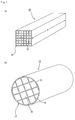
- Fig. 1(a) is a perspective view schematically showing one example of a honeycomb fired body (one example of a honeycomb structured body) manufactured by undergoing a firing step
- Fig. 1(b) is a perspective view schematically showing another example of a honeycomb structured body of the present invention formed by using the honeycomb fired body shown in Fig. 1(a).
- a honeycomb fired body 20 has a square pillar shape, and has a large number of cells 21 disposed in parallel with one another in a longitudinal direction (the direction shown by an arrow a in Fig. 1(a)) with a cell wall 22 therebetween.
- a honeycomb structured body 10 of the present invention a plurality of the honeycomb fired bodies 20 shown in Fig. 1(a) are bound together by interposing a sealing material layer (adhesive layer) 14 to configure a ceramic block 15, and a sealing material layer (coat layer) 13 is formed on the periphery thereof.
- a thickness of the cell wall is not particularly limited, and the thickness of the cell wall has a desirable lower limit of 0.05 mm, a more desirable lower limit of 0.10 mm, and a particularly desirable lower limit of 0.15 mm.
- the thickness of the cell wall has a desirable upper limit of 0.35 mm, a more desirable upper limit of 0.30 mm, and a particularly desirable upper limit of 0.25 mm.
- the thickness of the cell wall is less than 0.05 mm, the strength of the honeycomb fired body may be deteriorated, and on the other hand, when the thickness of the cell wall is more than 0.35 mm, the performance of converting the exhaust gases may be deteriorated since a contacting area with the exhaust gases is reduced, and the gases do not permeate deeply into a catalyst supporting carrier and therefore the catalyst supported on the inner surface in the cell wall hardly comes into contact with the gases upon using the honeycomb structured body as a catalyst supporting carrier for converting the exhaust gases.
- a cell density of the honeycomb fired body has a desirable lower limit of 15.5 pcs/cm 2 (100 cpsi), a more desirable lower limit of 46.5 pcs/cm 2 (300 cpsi), and a furthermore desirable lower limit of 62 pcs/cm 2 (400 cpsi).
- the cell density has a desirable upper limit of 186 pcs/cm 2 (1200 cpsi), a more desirable upper limit of 170. 5 pcs/cm 2 (1100 cpsi), and a furthermore desirable upper limit of 155 pcs/cm 2 (1000 cpsi).
- the cell density is less than 15.5 pcs/cm 2
- an area of the cell wall contacting the exhaust gases within the honeycomb fired body may be reduced upon using the honeycomb structured body as a catalyst supporting carrier for converting the exhaust gases, and when the cell density is more than 186 pcs/cm 2 , pressure loss may become high and also manufacturing of the honeycomb fired body may become difficult.
- a cross-sectional area of the honeycomb fired body in the direction perpendicular to the longitudinal direction of the honeycomb fired body has a lower limit of 5 cm 2 and an upper limit of 50 cm 2 , and particularly when the honeycomb structured body is formed by binding a plurality of the honeycomb fired bodies together, the cross-sectional area is desirably within the above-mentioned range.
- the cross-sectional area is less than 5 cm 2 , since an area of the sealing material layer (adhesive layer), with which a plurality of the honeycomb fired bodies are bound, is relatively increased in a cross section perpendicular to the longitudinal direction of the honeycomb structured body, an area on which a catalyst can be supported may be relatively reduced upon using the honeycomb structured body as a catalyst supporting carrier.
- the cross-sectional area is more than 50 cm 2 , it may become impossible to sufficiently suppress thermal stress generated in the honeycomb fired body since the honeycomb fired body is large.
- the cross-sectional area has a more desirable lower limit of 6 cm 2 , and a particularly desirable lower limit of 8 cm 2 , and a more desirable upper limit of 40 cm 2 , and a particularly desirable upper limit of 30 cm 2 .
- a shape of a cross section perpendicular to the longitudinal direction of a cell formed in the honeycomb fired body is not particularly limited, and an approximate triangle or an approximate hexagon may be used other than a rectangle like the honeycomb fired body shown in Fig. 1(a).
- a ratio of the total cross-sectional area of the honeycomb fired bodies to the cross-sectional area of the honeycomb structured body is 90% or more in a cross section perpendicular to the longitudinal direction of the honeycomb structured body. The reason for this is that when this ratio is less than 90%, the specific surface area of the honeycomb structured body is reduced.
- the specific surface area per unit area of the honeycomb structured body of the present invention is 25000 m 2 /L (litter) or more.
- the reason for this is that when the specific surface area is within the above range, it becomes easy to sufficiently broadly support and disperse a catalyst on the whole honeycomb structured body.
- a desirable upper limit of the specific surface area is 70000 m 2 /L in consideration of the limit of dispersion of the catalyst (for example, platinum).
- a bending strength of the honeycomb structured body is higher, and specifically, it is desirable that the bending strength is 3.0 MPa or more when the honeycomb fired body has a rectangular pillar shape of 37 mm ⁇ 37 mm ⁇ 75 mm.
- the reason for this is that a possibility of destruction of the honeycomb structured body due to thermal stress and the like generated upon using the honeycomb structured body becomes less.
- the honeycomb structured body of the present invention is not limited to an aggregated honeycomb structured body as shown in Fig. 1(b), and it may be an integral honeycomb structured body as shown in Fig. 2.
- Fig. 2 is a perspective view schematically showing another example of the honeycomb structured body of the present invention.
- a honeycomb structured body 30 shown in Fig. 2 is formed by a honeycomb fired body having a pillar shape, and having a large number of cells 31 (in the direction shown by an arrow b in Fig. 2) disposed in parallel with one another in a longitudinal direction with a cell wall 32 therebetween.
- a sealing material layer may be formed on the periphery of the honeycomb fired body.
- a catalyst is desirably supported on the honeycomb structured body of the present invention having such a configuration.
- the reason for this is that the honeycomb structured body of the present invention can be suitably used as a catalyst supporting carrier.
- the catalyst is not particularly limited, and examples of the catalyst include noble metals, alkali metals, alkaline earth metals, oxides and the like. These may be used alone or in combination of two or more kinds.
- Examples of the noble metals include platinum, palladium, rhodium and the like
- examples of the alkali metals include potassium, sodium and the like
- examples of the alkaline earth metals include barium and the like
- examples of the oxides include perovskite (La 0.75 K 0.25 MnO 3 and the like), CeO 2 and the like.
- the applications of the honeycomb structured body on which a catalyst is supported as described above is not particularly limited, and the honeycomb structured body can be used for, for example, the so-called three-way catalyst for converting the exhaust gases of automobiles or a NOx adsorbing catalyst.
- a timing of supporting a catalyst is not particularly limited, and the catalyst may be supported after manufacturing the honeycomb structured body, or may be supported on inorganic particles in the raw material composition.
- a method for supporting a catalyst is not particularly limited, and the catalyst can be supported, for example, by an impregnation method.
- honeycomb structured body of the present invention has been described with examples mainly using the honeycomb structured body as a catalyst supporting carrier, but the application of the honeycomb structured body of the present invention is not limited to the catalyst supporting carrier, and the honeycomb structured body can be also used for the applications without the catalyst components supported on, such as adsorbents which adsorb gas components or liquid components.
- the honeycomb molded body was dried well with a microwave drying apparatus and a hot-air drying apparatus, and further kept at 400°C for 2 hours to be degreased. Thereafter, a firing treatment was carried out on the honeycomb molded body while keeping the honeycomb molded body at 900°C for 2 hours to manufacture a honeycomb fired body having a rectangular pillar shape (37 mm ⁇ 37 mm ⁇ 75 mm), a cell density of 93 pcs/cm 2 (600 cpsi), a thickness of a cell wall of 0.2 mm, with a cross-sectional shape of the cells formed into a rectangular (square) shape.
- Honeycomb fired bodies were manufactured by following the same procedure as in Example 1 except for using ⁇ alumina particles (secondary particles) having average particle diameters shown in Table 1 as inorganic particles and silica sol (solid concentration is 30% by weight) having average particle diameters shown in Table 1 as an inorganic binder used upon preparing a raw material composition.
- ⁇ alumina particles secondary particles
- silica sol solid concentration is 30% by weight
- ratios of the average particle diameters of the inorganic binder to the average particle diameters of the inorganic particles are shown in Table 1.
- a honeycomb fired body was manufactured by following the same procedure as in Example 1 except for using mixed particles of 50% by weight of ⁇ alumina particles (an average particle diameter of secondary particles is 2 ⁇ m) and 50% by weight of ⁇ zeolite particles (an average particle diameter of secondary particles is 2 ⁇ m) in place of the ⁇ alumina particles as inorganic particles.
- Honeycomb fired bodies were manufactured by following the same procedure as in Example 7 except for using mixed particles of 50% by weight of ⁇ alumina particles (secondary particles) having average particle diameters shown in Table 1 and 50% by weight of ⁇ zeolite particles (secondary particles) having average particle diameters shown in Table 1 as inorganic particles, and silica sol (solid concentration is 30% by weight) having average particle diameters shown in Table 1 as an inorganic binder used upon preparing a raw material composition.
- silica sol solid concentration is 30% by weight
- Honeycomb fired bodies were manufactured by following the same procedure as in Example 1 except for using ⁇ alumina particles (secondary particles) having average particle diameters shown in Table 1 as inorganic particles and silica sol (solid concentration is 30% by weight) having average particle diameters shown in Table 1 as an inorganic binder used upon preparing a raw material composition.
- ⁇ alumina particles secondary particles
- silica sol solid concentration is 30% by weight
- ratios of the average particle diameters of the inorganic binder to the average particle diameters of the inorganic particles are shown in Table 1.
- Honeycomb fired body was manufactured by following the same procedure as in Example 7 except for using mixed particles of 50% by weight of ⁇ alumina particles (an average particle diameter of secondary particles is 4 ⁇ m) and 50% by weight of ⁇ zeolite particles (an average particle diameter of secondary particles is 4 ⁇ m) as inorganic particles, and silica sol (solid concentration is 30% by weight) having average particle diameter of 10 ⁇ m as an inorganic binder used upon preparing a raw material composition.
- a ratio of the average particle diameter of the inorganic binder to the average particle diameter of the inorganic particles is 1/400.
- a BET specific surface area A (m 2 /g) per unit weight of each of the honeycomb fired bodies was measured.
- the BET specific surface area was measured by one-point method with N 2 gas according to JIS R 1626 (1996) stipulated in the Japanese Industrial Standards by using a BET measuring apparatus (Micromeritics FlowSorb II-2300, manufactured by Shimadzu Corp.).
- a sample cut out into a cylindrical small piece (15 mm in diameter ⁇ 15 mm in height) was used for measurement.
- Example 1 Inorganic particles Average particle diameter of inorganic particles (secondary particles) ( ⁇ m) Average particle diameter of inorganic binder (nm) Ratio of average particle diameter of inorganic binder to average particle diameter of inorganic particles Bending strength (MPa) Specific surface area (m 2 /L)
- Example 1 ⁇ alumina 1 10 1/100 3.8 43800
- Example 2 ⁇ alumina 1 5 1/200 3.1 44800
- Example 3 ⁇ alumina 1 25 1/40 3.4 42000
- Example 4 ⁇ alumina 2 30 3/200 (1/66.6) 5.8
- Example 5 ⁇ alumina 2 10 1/200 4.2 45200
- Example 6 ⁇ alumina 2 50 1/40 4.0 42500
- Example 7 ⁇ alumina + ⁇ zeolite 2 30 3/200 (1/66.6) 5.4
- Example 8 ⁇ alumina + ⁇ zeolite 4 40 1/100 5.1 40200
- Example 9 ⁇ alumina + ⁇ zeolite 4 20 1/200
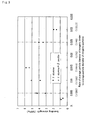
- Fig. 3 is a graph showing a relationship between a ratio of an average particle diameter of the inorganic binder to an average particle diameter of inorganic particles and bending strength of each of the honeycomb fired bodies manufactured in Examples and Comparative Examples.
- honeycomb fired body was manufactured and this honeycomb fired body was evaluated as a honeycomb structured body, but in the case where an aggregated honeycomb structured body as shown in Figs. 1(a) and 1(b) is manufactured by using a plurality of the honeycomb fired bodies, similar results are presumably obtained.
Landscapes
- Chemical & Material Sciences (AREA)
- Engineering & Computer Science (AREA)
- Ceramic Engineering (AREA)
- Manufacturing & Machinery (AREA)
- Organic Chemistry (AREA)
- Materials Engineering (AREA)
- Structural Engineering (AREA)
- Chemical Kinetics & Catalysis (AREA)
- Inorganic Chemistry (AREA)
- Combustion & Propulsion (AREA)
- Mechanical Engineering (AREA)
- General Engineering & Computer Science (AREA)
- Health & Medical Sciences (AREA)
- Toxicology (AREA)
- Catalysts (AREA)
Applications Claiming Priority (2)
| Application Number | Priority Date | Filing Date | Title |
|---|---|---|---|
| JP2006322876 | 2006-11-16 | ||
| PCT/JP2006/324982 WO2008059607A1 (fr) | 2006-11-16 | 2006-12-14 | Procédé permettant de produire une structure en nid d'abeilles et structure en nid d'abeilles ainsi formée |
Publications (2)
| Publication Number | Publication Date |
|---|---|
| EP1927392A1 true EP1927392A1 (fr) | 2008-06-04 |
| EP1927392B1 EP1927392B1 (fr) | 2011-06-22 |
Family
ID=38656711
Family Applications (1)
| Application Number | Title | Priority Date | Filing Date |
|---|---|---|---|
| EP07018263A Not-in-force EP1927392B1 (fr) | 2006-11-16 | 2007-09-18 | Procédé de fabrication d'une structure en nids d'abeilles |
Country Status (1)
| Country | Link |
|---|---|
| EP (1) | EP1927392B1 (fr) |
Cited By (8)
| Publication number | Priority date | Publication date | Assignee | Title |
|---|---|---|---|---|
| WO2009073099A1 (fr) * | 2007-11-30 | 2009-06-11 | Corning Incorporated | Corps en nid d'abeille à base de zéolite |
| EP2130602A2 (fr) * | 2008-05-20 | 2009-12-09 | Ibiden Co., Ltd. | Structure en nid d'abeille |
| EP2130807A1 (fr) * | 2008-05-20 | 2009-12-09 | Ibiden Co., Ltd. | Structure en nid d'abeille |
| EP2130588A3 (fr) * | 2008-05-20 | 2010-01-27 | Ibiden Co., Ltd. | Structure en nid d'abeille |
| EP2130601A3 (fr) * | 2008-05-20 | 2010-02-03 | Ibiden Co., Ltd. | Structure en nid d'abeille |
| EP2130591A3 (fr) * | 2008-05-20 | 2010-02-24 | Ibiden Co., Ltd. | Structure en nid d'abeille |
| EP2130592A3 (fr) * | 2008-05-20 | 2010-03-03 | Ibiden Co., Ltd. | Structure en nid d'abeille |
| EP2371450A1 (fr) * | 2010-03-26 | 2011-10-05 | NGK Insulators, Ltd. | Structure de zéolite en nid d'abeille |
Families Citing this family (1)
| Publication number | Priority date | Publication date | Assignee | Title |
|---|---|---|---|---|
| CA3094306C (fr) | 2018-04-04 | 2024-05-14 | Unifrax I Llc | Fibres poreuses activees et produits les comprenant |
Citations (7)
| Publication number | Priority date | Publication date | Assignee | Title |
|---|---|---|---|---|
| EP1555254A1 (fr) * | 2002-10-23 | 2005-07-20 | Ngk Insulators, Ltd. | Fabrication d'une structure poreuse en nid d'abeille |
| WO2005075075A1 (fr) * | 2004-02-04 | 2005-08-18 | Ibiden Co., Ltd. | Structure en nid d'abeilles, ensemble de structure en nid d'abeilles, et catalyseur en nid d'abeilles |
| WO2006070540A1 (fr) * | 2004-12-27 | 2006-07-06 | Ibiden Co., Ltd. | Structure alvéolaire céramique |
| US20060172886A1 (en) * | 2005-01-28 | 2006-08-03 | Kabushiki Kaisha Toyota Chuo Kenkyusho | Catalyst support and method of producing the same |
| EP1717218A1 (fr) * | 2003-12-26 | 2006-11-02 | Ibiden Co., Ltd. | Structure en nid d'abeille |
| EP1736459A1 (fr) * | 2005-06-24 | 2006-12-27 | Ibiden Co., Ltd. | Corps à structure en nid d'abeilles |
| EP1736222A1 (fr) * | 2005-06-24 | 2006-12-27 | Ibiden Co., Ltd. | Structure en nid d'abeille |
-
2007
- 2007-09-18 EP EP07018263A patent/EP1927392B1/fr not_active Not-in-force
Patent Citations (8)
| Publication number | Priority date | Publication date | Assignee | Title |
|---|---|---|---|---|
| EP1555254A1 (fr) * | 2002-10-23 | 2005-07-20 | Ngk Insulators, Ltd. | Fabrication d'une structure poreuse en nid d'abeille |
| EP1717218A1 (fr) * | 2003-12-26 | 2006-11-02 | Ibiden Co., Ltd. | Structure en nid d'abeille |
| WO2005075075A1 (fr) * | 2004-02-04 | 2005-08-18 | Ibiden Co., Ltd. | Structure en nid d'abeilles, ensemble de structure en nid d'abeilles, et catalyseur en nid d'abeilles |
| WO2006070540A1 (fr) * | 2004-12-27 | 2006-07-06 | Ibiden Co., Ltd. | Structure alvéolaire céramique |
| EP1852184A1 (fr) * | 2004-12-27 | 2007-11-07 | Ibiden Co., Ltd. | Structure alvéolaire céramique |
| US20060172886A1 (en) * | 2005-01-28 | 2006-08-03 | Kabushiki Kaisha Toyota Chuo Kenkyusho | Catalyst support and method of producing the same |
| EP1736459A1 (fr) * | 2005-06-24 | 2006-12-27 | Ibiden Co., Ltd. | Corps à structure en nid d'abeilles |
| EP1736222A1 (fr) * | 2005-06-24 | 2006-12-27 | Ibiden Co., Ltd. | Structure en nid d'abeille |
Cited By (13)
| Publication number | Priority date | Publication date | Assignee | Title |
|---|---|---|---|---|
| WO2009073099A1 (fr) * | 2007-11-30 | 2009-06-11 | Corning Incorporated | Corps en nid d'abeille à base de zéolite |
| US8349755B2 (en) | 2007-11-30 | 2013-01-08 | Corning Incorporated | Zeolite-based honeycomb body |
| US7754638B2 (en) | 2007-11-30 | 2010-07-13 | Corning Incorporated | Zeolite-based honeycomb body |
| EP2130592A3 (fr) * | 2008-05-20 | 2010-03-03 | Ibiden Co., Ltd. | Structure en nid d'abeille |
| EP2130601A3 (fr) * | 2008-05-20 | 2010-02-03 | Ibiden Co., Ltd. | Structure en nid d'abeille |
| EP2130591A3 (fr) * | 2008-05-20 | 2010-02-24 | Ibiden Co., Ltd. | Structure en nid d'abeille |
| EP2130588A3 (fr) * | 2008-05-20 | 2010-01-27 | Ibiden Co., Ltd. | Structure en nid d'abeille |
| EP2130807A1 (fr) * | 2008-05-20 | 2009-12-09 | Ibiden Co., Ltd. | Structure en nid d'abeille |
| US8187691B2 (en) | 2008-05-20 | 2012-05-29 | Ibiden Co., Ltd. | Honeycomb structure |
| US8202601B2 (en) | 2008-05-20 | 2012-06-19 | Ibiden Co., Ltd. | Honeycomb structure and manufacturing method of the honeycomb structure |
| EP2130602A2 (fr) * | 2008-05-20 | 2009-12-09 | Ibiden Co., Ltd. | Structure en nid d'abeille |
| EP2371450A1 (fr) * | 2010-03-26 | 2011-10-05 | NGK Insulators, Ltd. | Structure de zéolite en nid d'abeille |
| US8629074B2 (en) | 2010-03-26 | 2014-01-14 | Ngk Insulators, Ltd. | Zeolite honeycomb structure |
Also Published As
| Publication number | Publication date |
|---|---|
| EP1927392B1 (fr) | 2011-06-22 |
Similar Documents
| Publication | Publication Date | Title |
|---|---|---|
| EP1923373B1 (fr) | Procédé de fabrication d'un élément structuré en nid d'abeille | |
| US20080118701A1 (en) | Method for manufacturing honeycomb structure, and honeycomb structure | |
| US20080176028A1 (en) | Method for manufacturing honeycomb structure, and honeycomb structure | |
| EP1738814B1 (fr) | Structure alvéolaire | |
| US7901755B2 (en) | Honeycomb structure and method for manufacturing the same | |
| EP1738815B1 (fr) | Structure alvéolaire | |
| EP1927392B1 (fr) | Procédé de fabrication d'une structure en nids d'abeilles | |
| CN100528342C (zh) | 蜂窝结构体 | |
| EP1717218B1 (fr) | Structure en nid d'abeille | |
| CN101023044B (zh) | 蜂窝结构体 | |
| EP1736642A1 (fr) | Structure en nid d'abeille | |
| EP1977818A1 (fr) | Support de catalyseur | |
| EP2105590B1 (fr) | Corps structuré en nid d'abeille | |
| JP2008169104A (ja) | ハニカム構造体の製造方法、及び、ハニカム構造体 | |
| EP1808228A1 (fr) | Structure en nid d abeilles, procédé de production et dispositif de purification de gaz d échappement | |
| EP2105194A1 (fr) | Structure en nid d'abeille | |
| EP1927391A1 (fr) | Procédé de fabrication d'une structure en nids d'abeilles, et structure en nids d'abeilles | |
| EP2050492A2 (fr) | Corps structuré en nid d'abeille | |
| EP2363385A1 (fr) | Procédé de fabrication d'une structure en nid d'abeille au carbure de silicium, structure en nid d'abeille au carbure de silicium, filtre en nid d'abeille et filtre en nid d'abeille support de catalyseur | |
| JP4753781B2 (ja) | ハニカム構造体 | |
| JP2008169105A (ja) | ハニカム構造体の製造方法 | |
| JP2008173626A (ja) | ハニカム構造体の製造方法、及び、ハニカム構造体 | |
| WO2008059608A1 (fr) | Procédé de production de structures en nid d'abeilles | |
| KR100871304B1 (ko) | 허니컴 구조체 | |
| KR100725434B1 (ko) | 하니콤 구조체 |
Legal Events
| Date | Code | Title | Description |
|---|---|---|---|
| PUAI | Public reference made under article 153(3) epc to a published international application that has entered the european phase |
Free format text: ORIGINAL CODE: 0009012 |
|
| 17P | Request for examination filed |
Effective date: 20070918 |
|
| AK | Designated contracting states |
Kind code of ref document: A1 Designated state(s): AT BE BG CH CY CZ DE DK EE ES FI FR GB GR HU IE IS IT LI LT LU LV MC MT NL PL PT RO SE SI SK TR |
|
| AX | Request for extension of the european patent |
Extension state: AL BA HR MK RS |
|
| 17Q | First examination report despatched |
Effective date: 20080828 |
|
| AKX | Designation fees paid |
Designated state(s): AT BE BG CH CY CZ DE DK EE ES FI FR GB GR HU IE IS IT LI LT LU LV MC MT NL PL PT RO SE SI SK TR |
|
| RTI1 | Title (correction) |
Free format text: METHOD FOR MANUFACTURING HONEYCOMB STRUCTURED BODY |
|
| GRAP | Despatch of communication of intention to grant a patent |
Free format text: ORIGINAL CODE: EPIDOSNIGR1 |
|
| GRAS | Grant fee paid |
Free format text: ORIGINAL CODE: EPIDOSNIGR3 |
|
| GRAA | (expected) grant |
Free format text: ORIGINAL CODE: 0009210 |
|
| AK | Designated contracting states |
Kind code of ref document: B1 Designated state(s): AT BE BG CH CY CZ DE DK EE ES FI FR GB GR HU IE IS IT LI LT LU LV MC MT NL PL PT RO SE SI SK TR |
|
| REG | Reference to a national code |
Ref country code: GB Ref legal event code: FG4D |
|
| REG | Reference to a national code |
Ref country code: CH Ref legal event code: EP |
|
| REG | Reference to a national code |
Ref country code: IE Ref legal event code: FG4D |
|
| REG | Reference to a national code |
Ref country code: DE Ref legal event code: R096 Ref document number: 602007015320 Country of ref document: DE Effective date: 20110811 |
|
| REG | Reference to a national code |
Ref country code: NL Ref legal event code: VDEP Effective date: 20110622 |
|
| PG25 | Lapsed in a contracting state [announced via postgrant information from national office to epo] |
Ref country code: LT Free format text: LAPSE BECAUSE OF FAILURE TO SUBMIT A TRANSLATION OF THE DESCRIPTION OR TO PAY THE FEE WITHIN THE PRESCRIBED TIME-LIMIT Effective date: 20110622 Ref country code: SE Free format text: LAPSE BECAUSE OF FAILURE TO SUBMIT A TRANSLATION OF THE DESCRIPTION OR TO PAY THE FEE WITHIN THE PRESCRIBED TIME-LIMIT Effective date: 20110622 |
|
| PG25 | Lapsed in a contracting state [announced via postgrant information from national office to epo] |
Ref country code: CY Free format text: LAPSE BECAUSE OF FAILURE TO SUBMIT A TRANSLATION OF THE DESCRIPTION OR TO PAY THE FEE WITHIN THE PRESCRIBED TIME-LIMIT Effective date: 20110622 Ref country code: FI Free format text: LAPSE BECAUSE OF FAILURE TO SUBMIT A TRANSLATION OF THE DESCRIPTION OR TO PAY THE FEE WITHIN THE PRESCRIBED TIME-LIMIT Effective date: 20110622 Ref country code: GR Free format text: LAPSE BECAUSE OF FAILURE TO SUBMIT A TRANSLATION OF THE DESCRIPTION OR TO PAY THE FEE WITHIN THE PRESCRIBED TIME-LIMIT Effective date: 20110923 Ref country code: SI Free format text: LAPSE BECAUSE OF FAILURE TO SUBMIT A TRANSLATION OF THE DESCRIPTION OR TO PAY THE FEE WITHIN THE PRESCRIBED TIME-LIMIT Effective date: 20110622 Ref country code: LV Free format text: LAPSE BECAUSE OF FAILURE TO SUBMIT A TRANSLATION OF THE DESCRIPTION OR TO PAY THE FEE WITHIN THE PRESCRIBED TIME-LIMIT Effective date: 20110622 Ref country code: AT Free format text: LAPSE BECAUSE OF FAILURE TO SUBMIT A TRANSLATION OF THE DESCRIPTION OR TO PAY THE FEE WITHIN THE PRESCRIBED TIME-LIMIT Effective date: 20110622 |
|
| PG25 | Lapsed in a contracting state [announced via postgrant information from national office to epo] |
Ref country code: BE Free format text: LAPSE BECAUSE OF FAILURE TO SUBMIT A TRANSLATION OF THE DESCRIPTION OR TO PAY THE FEE WITHIN THE PRESCRIBED TIME-LIMIT Effective date: 20110622 Ref country code: NL Free format text: LAPSE BECAUSE OF FAILURE TO SUBMIT A TRANSLATION OF THE DESCRIPTION OR TO PAY THE FEE WITHIN THE PRESCRIBED TIME-LIMIT Effective date: 20110622 |
|
| PG25 | Lapsed in a contracting state [announced via postgrant information from national office to epo] |
Ref country code: CZ Free format text: LAPSE BECAUSE OF FAILURE TO SUBMIT A TRANSLATION OF THE DESCRIPTION OR TO PAY THE FEE WITHIN THE PRESCRIBED TIME-LIMIT Effective date: 20110622 Ref country code: PT Free format text: LAPSE BECAUSE OF FAILURE TO SUBMIT A TRANSLATION OF THE DESCRIPTION OR TO PAY THE FEE WITHIN THE PRESCRIBED TIME-LIMIT Effective date: 20111024 Ref country code: EE Free format text: LAPSE BECAUSE OF FAILURE TO SUBMIT A TRANSLATION OF THE DESCRIPTION OR TO PAY THE FEE WITHIN THE PRESCRIBED TIME-LIMIT Effective date: 20110622 Ref country code: IS Free format text: LAPSE BECAUSE OF FAILURE TO SUBMIT A TRANSLATION OF THE DESCRIPTION OR TO PAY THE FEE WITHIN THE PRESCRIBED TIME-LIMIT Effective date: 20111022 |
|
| PG25 | Lapsed in a contracting state [announced via postgrant information from national office to epo] |
Ref country code: RO Free format text: LAPSE BECAUSE OF FAILURE TO SUBMIT A TRANSLATION OF THE DESCRIPTION OR TO PAY THE FEE WITHIN THE PRESCRIBED TIME-LIMIT Effective date: 20110622 Ref country code: PL Free format text: LAPSE BECAUSE OF FAILURE TO SUBMIT A TRANSLATION OF THE DESCRIPTION OR TO PAY THE FEE WITHIN THE PRESCRIBED TIME-LIMIT Effective date: 20110622 Ref country code: SK Free format text: LAPSE BECAUSE OF FAILURE TO SUBMIT A TRANSLATION OF THE DESCRIPTION OR TO PAY THE FEE WITHIN THE PRESCRIBED TIME-LIMIT Effective date: 20110622 |
|
| PLBE | No opposition filed within time limit |
Free format text: ORIGINAL CODE: 0009261 |
|
| STAA | Information on the status of an ep patent application or granted ep patent |
Free format text: STATUS: NO OPPOSITION FILED WITHIN TIME LIMIT |
|
| PG25 | Lapsed in a contracting state [announced via postgrant information from national office to epo] |
Ref country code: MC Free format text: LAPSE BECAUSE OF NON-PAYMENT OF DUE FEES Effective date: 20110930 |
|
| REG | Reference to a national code |
Ref country code: CH Ref legal event code: PL |
|
| GBPC | Gb: european patent ceased through non-payment of renewal fee |
Effective date: 20110922 |
|
| 26N | No opposition filed |
Effective date: 20120323 |
|
| PG25 | Lapsed in a contracting state [announced via postgrant information from national office to epo] |
Ref country code: IT Free format text: LAPSE BECAUSE OF FAILURE TO SUBMIT A TRANSLATION OF THE DESCRIPTION OR TO PAY THE FEE WITHIN THE PRESCRIBED TIME-LIMIT Effective date: 20110622 |
|
| REG | Reference to a national code |
Ref country code: IE Ref legal event code: MM4A |
|
| REG | Reference to a national code |
Ref country code: FR Ref legal event code: ST Effective date: 20120531 |
|
| PG25 | Lapsed in a contracting state [announced via postgrant information from national office to epo] |
Ref country code: DK Free format text: LAPSE BECAUSE OF FAILURE TO SUBMIT A TRANSLATION OF THE DESCRIPTION OR TO PAY THE FEE WITHIN THE PRESCRIBED TIME-LIMIT Effective date: 20110622 |
|
| REG | Reference to a national code |
Ref country code: DE Ref legal event code: R097 Ref document number: 602007015320 Country of ref document: DE Effective date: 20120323 |
|
| PG25 | Lapsed in a contracting state [announced via postgrant information from national office to epo] |
Ref country code: IE Free format text: LAPSE BECAUSE OF NON-PAYMENT OF DUE FEES Effective date: 20110918 Ref country code: CH Free format text: LAPSE BECAUSE OF NON-PAYMENT OF DUE FEES Effective date: 20110930 Ref country code: LI Free format text: LAPSE BECAUSE OF NON-PAYMENT OF DUE FEES Effective date: 20110930 |
|
| PG25 | Lapsed in a contracting state [announced via postgrant information from national office to epo] |
Ref country code: FR Free format text: LAPSE BECAUSE OF NON-PAYMENT OF DUE FEES Effective date: 20110930 Ref country code: GB Free format text: LAPSE BECAUSE OF NON-PAYMENT OF DUE FEES Effective date: 20110922 |
|
| PG25 | Lapsed in a contracting state [announced via postgrant information from national office to epo] |
Ref country code: MT Free format text: LAPSE BECAUSE OF FAILURE TO SUBMIT A TRANSLATION OF THE DESCRIPTION OR TO PAY THE FEE WITHIN THE PRESCRIBED TIME-LIMIT Effective date: 20110622 |
|
| PG25 | Lapsed in a contracting state [announced via postgrant information from national office to epo] |
Ref country code: LU Free format text: LAPSE BECAUSE OF NON-PAYMENT OF DUE FEES Effective date: 20110918 |
|
| PG25 | Lapsed in a contracting state [announced via postgrant information from national office to epo] |
Ref country code: BG Free format text: LAPSE BECAUSE OF FAILURE TO SUBMIT A TRANSLATION OF THE DESCRIPTION OR TO PAY THE FEE WITHIN THE PRESCRIBED TIME-LIMIT Effective date: 20110922 |
|
| PG25 | Lapsed in a contracting state [announced via postgrant information from national office to epo] |
Ref country code: TR Free format text: LAPSE BECAUSE OF FAILURE TO SUBMIT A TRANSLATION OF THE DESCRIPTION OR TO PAY THE FEE WITHIN THE PRESCRIBED TIME-LIMIT Effective date: 20110622 |
|
| PG25 | Lapsed in a contracting state [announced via postgrant information from national office to epo] |
Ref country code: ES Free format text: LAPSE BECAUSE OF FAILURE TO SUBMIT A TRANSLATION OF THE DESCRIPTION OR TO PAY THE FEE WITHIN THE PRESCRIBED TIME-LIMIT Effective date: 20111003 Ref country code: HU Free format text: LAPSE BECAUSE OF FAILURE TO SUBMIT A TRANSLATION OF THE DESCRIPTION OR TO PAY THE FEE WITHIN THE PRESCRIBED TIME-LIMIT Effective date: 20110622 |
|
| PGFP | Annual fee paid to national office [announced via postgrant information from national office to epo] |
Ref country code: DE Payment date: 20220803 Year of fee payment: 16 |
|
| REG | Reference to a national code |
Ref country code: DE Ref legal event code: R119 Ref document number: 602007015320 Country of ref document: DE |
|
| PG25 | Lapsed in a contracting state [announced via postgrant information from national office to epo] |
Ref country code: DE Free format text: LAPSE BECAUSE OF NON-PAYMENT OF DUE FEES Effective date: 20240403 |