EP1928079B1 - Programmierbare Leitmodussteuerung für Schaltkreise - Google Patents
Programmierbare Leitmodussteuerung für Schaltkreise Download PDFInfo
- Publication number
- EP1928079B1 EP1928079B1 EP07121449.8A EP07121449A EP1928079B1 EP 1928079 B1 EP1928079 B1 EP 1928079B1 EP 07121449 A EP07121449 A EP 07121449A EP 1928079 B1 EP1928079 B1 EP 1928079B1
- Authority
- EP
- European Patent Office
- Prior art keywords
- conduction mode
- switching
- mode
- circuit
- signal
- Prior art date
- Legal status (The legal status is an assumption and is not a legal conclusion. Google has not performed a legal analysis and makes no representation as to the accuracy of the status listed.)
- Not-in-force
Links
- 230000001939 inductive effect Effects 0.000 claims description 18
- 238000004804 winding Methods 0.000 claims description 13
- 238000000034 method Methods 0.000 claims description 11
- 230000001276 controlling effect Effects 0.000 description 7
- 238000010586 diagram Methods 0.000 description 6
- 230000008901 benefit Effects 0.000 description 5
- 238000012986 modification Methods 0.000 description 4
- 230000004048 modification Effects 0.000 description 4
- 230000001934 delay Effects 0.000 description 2
- 230000003111 delayed effect Effects 0.000 description 2
- 238000001914 filtration Methods 0.000 description 2
- 239000007787 solid Substances 0.000 description 2
- 239000003990 capacitor Substances 0.000 description 1
- 238000006243 chemical reaction Methods 0.000 description 1
- 230000000694 effects Effects 0.000 description 1
- 238000004519 manufacturing process Methods 0.000 description 1
- 238000012544 monitoring process Methods 0.000 description 1
- 238000011084 recovery Methods 0.000 description 1
- 230000001105 regulatory effect Effects 0.000 description 1
- 238000001228 spectrum Methods 0.000 description 1
Images



Classifications
-
- H—ELECTRICITY
- H02—GENERATION; CONVERSION OR DISTRIBUTION OF ELECTRIC POWER
- H02M—APPARATUS FOR CONVERSION BETWEEN AC AND AC, BETWEEN AC AND DC, OR BETWEEN DC AND DC, AND FOR USE WITH MAINS OR SIMILAR POWER SUPPLY SYSTEMS; CONVERSION OF DC OR AC INPUT POWER INTO SURGE OUTPUT POWER; CONTROL OR REGULATION THEREOF
- H02M3/00—Conversion of DC power input into DC power output
- H02M3/22—Conversion of DC power input into DC power output with intermediate conversion into AC
- H02M3/24—Conversion of DC power input into DC power output with intermediate conversion into AC by static converters
- H02M3/28—Conversion of DC power input into DC power output with intermediate conversion into AC by static converters using discharge tubes with control electrode or semiconductor devices with control electrode to produce the intermediate AC
- H02M3/325—Conversion of DC power input into DC power output with intermediate conversion into AC by static converters using discharge tubes with control electrode or semiconductor devices with control electrode to produce the intermediate AC using devices of a triode or a transistor type requiring continuous application of a control signal
- H02M3/335—Conversion of DC power input into DC power output with intermediate conversion into AC by static converters using discharge tubes with control electrode or semiconductor devices with control electrode to produce the intermediate AC using devices of a triode or a transistor type requiring continuous application of a control signal using semiconductor devices only
Definitions
- a BCM controller adjusts switching frequency according to load and line conditions. Load step change and line voltage variation affect the switching frequency directly. The resulting variable switching frequency may shift the noise spectrum out of an acceptable range of electromagnetic interference (EMI) and cause uncertainty for EMI filtering.
- EMI electromagnetic interference
- Variable switching frequency also affects output voltage ripple. When the switching frequency is high, output voltage ripple is low. Conversely, when switching frequency is low, output voltage ripple is high.
- Another disadvantage is "jittering" at light load conditions, when the switching frequency can reach a very high level.
- DCM operation enables a switching regulator to alleviate the EMI and "jittering" problems and conveniently provide ripple filtering. Therefore, it would be desirable to provide a conduction mode control system that will allow a switching regulator to combine benefits of BCM and DCM by having a capability to operate in either mode, selectively. Also, it would be desirable to control a switching converter so as to support its operation in a hybrid DCM/BCM mode, in which the converter is able to switch between BCM and DCM, depending on specific conditions.
- US 2006/0220623 A1 discloses a switched mode power supply circuit comprising a control circuit configured to operate selectively in CCM and DCM, and a control circuit configured to monitor an output voltage of the switched mode supply circuit during DCM operation and to revert the regulation circuit to CCM operation responsive to the output voltage reaching a defined voltage limit.
- the mode control circuit may set the switching circuit into a third conduction mode, in which the switching circuit may operate in the first conduction mode at a first predetermined condition and to operate in the second conduction mode at a second predetermined condition.
- the switching circuit in the third conduction mode, may be controlled to operate in BCM at a heavy load condition and to operate in DCM at a light load condition.
- the mode control circuit may include a signal selector for selecting between the mode control signal and a conduction mode support signal produced.
- the switching circuit may be controlled to operate in the first conduction mode when the frequency of the mode control signal is set to a value exceeding an expected maximum frequency of the conduction mode support signal.
- the second conduction mode may be set when the frequency of the mode control signal is less than an expected minimum frequency of the conduction mode support signal.
- the third conduction mode may be established when the frequency of the mode control signal is in a range between the expected minimum frequency and the expected maximum frequency of the conduction mode support signal.
- a power supply system may comprise a switching circuit, and a mode control circuit for controlling a conduction mode of the switching circuit.
- the control circuit may be responsive to a mode control signal having a parameter, such as frequency, programmable to enable the switching circuit to switch between the first conduction mode and the second conduction mode.
- the signal selector may be configured for passing to the output circuit a selected one of the mode control signal and the conduction mode support signal, and preventing from passing to the output circuit a non-selected one of the mode control signal and the conduction mode support signal.
- the signal selector may be configured to pass the conduction mode support signal to the output circuit to operate the switching circuit in the first conduction mode if the signal selector receives the conduction mode support signal after receiving the mode control signal.
- the mode control signal may be passed to the output circuit to operate the switching circuit in the second conduction mode if the signal selector receives the mode control signal after receiving the conduction mode support signal.
- the signal selector may include first and second flip-flop circuits having respective set inputs supplied by the conduction mode support signal and the mode control signal, respectively.
- the signal selector may further include an output gate circuit responsive to respective outputs of the first and second flip-flop circuits and having an output connected to respective reset inputs of the first and second flip-flop circuits.
- the parameter of the mode control signal may be programmable to enable operation of the switching circuit in a third conduction mode combining the first conduction mode and the second conduction mode.
- frequency of the mode control signal may be programmable to set a conduction mode of the switching circuit.
- the control method of the present disclosure may further comprise the step of selecting between the mode control signal and an additional control signal to provide control of the switching element.
- the switching circuit may be controlled to operate in the first conduction mode if the additional control signal is supplied after the mode control signal.
- the second conduction mode may be set if the additional control signal is supplied before the mode control signal.
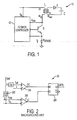
- FIG. 1 shows an exemplary No-Opto flyback switching regulator 10 having a switch S, a transformer Tr with primary and secondary windings w pr and w sec , and controller 12 that controls switching of the switch S in BCM operation.
- a sense resistor Rsense is coupled to the switch S to monitor current I at the output of the switch S.
- a capacitor C and a diode D are coupled to the secondary winding w sec .
- the flyback switching regular 10 may convert an input DC voltage Vin into one or more output DC voltages with very high power conversion efficiency.
- the controller 12 may include a BCM control block 20 for controlling BCM operation of the flyback switching regulator 10.
- the BCM control block may include a subtraction circuit 202 that determines a difference between the input voltage Vin supplied to the switching regulator 10 and a switching voltage Vsw produced at the output of the switch S.
- the output signal of the subtraction circuit 202 which reflects the output voltage, is supplied to a compensator Gc that produces a reference current value Iref to regulate the output voltage to Vref.
- the compensator Gc may be an error amplifier that produces an output current Iref in order to keep the output voltage regulated.
- the VC comparator 206 compares the input voltage Vin with the switch voltage Vsw to produce a voltage collapse signal VC when the switch voltage Vsw falls below the input voltage Vin.
- the VC signal is supplied to the S-input of the RS flip-flop circuit 208 to set a gate control signal at the Q-output of the RS flip-flop circuit 208.
- the OC signal is applied as a gate reset signal to the R-input of the RS flip-flop circuit 208 to reset the gate control signal at the Q-output.
- the gate control signal When the gate control signal is set, it turns on the switch S. When the gate control signal is reset, it turns off the switch S.
- the BCM control block 20 detects collapse of the switch voltage Vsw, which indicates that the current i' sec flowing through the diode D in the secondary winding of the transformer Tr crosses a zero level.
- the VC signal is produced to turn on the switch S.
- the OC signal gate reset signal
- FIG. 4 shows a timing diagram illustrating a conventional flyback switching regulator operating in DCM.
- a fixed frequency synchronization signal SYNC is supplied to turn on the switch of the DCM switching regulator, whereas the OC signal is used to turn off the switch.
- the secondary current i'sec is at a zero level much longer than in the BCM switching regulator described previously. Therefore, the BCM operation substantially reduces the ripple voltage at the output of the switch, and substantially reduces the resistive loss.
- FIG. 5 illustrates a known BCM control block 30 that provides minimum off-time control to reduce the "jittering" problem.
- the BCM control block 30 comprises a VC comparator 302 and an OC comparator 304 that generate the VC and OC signals in a manner similar to producing these signals in the BCM arrangement in FIG. 2 .
- the BCM control block 30 includes a fixed time delay circuit Min-OFF 306 that delays the OC signal and supplies the delayed signal to a first input of an AND gate circuit 308. A second input of the AND gate circuit 308 is fed with the VC signal.
- the output of the AND gate circuit 308 is supplied to the S-input of an RS flip-flop circuit 310 that produces a gate control signal at its Q-output.
- the Min-OFF delay circuit 306 delays the turning-on of the switch to set the minimum off-time period of the switch. If the switching off-time period is longer than the delay period, the delay circuit 306 has no effect on the switching.
- FIG. 6 illustrates another known way of reducing "jittering.”
- BCM control block 40 comprises a VC comparator 402 and an OC comparator 404 that generate the VC and OC signals in a manner similar to producing these signals in the BCM arrangement in FIG. 2 .
- the BCM control block 40 includes a MIN-Iref circuit 406 for setting a minimum value of the reference current Iref.
- the MIN-Iref circuit 406 may be a limiting circuit that prevents the reference current Iref from falling below a preset minimum value.
- the OC and VC signals are respectively supplied to the R- and S-inputs of the flip-flop circuit 410 that produces the gate control signal at its Q-output.
- the BCM control block 40 sets the minimum time period for the sensed current I to reach the reference value Iref. As a result, the minimum on-time period for the switching of the flyback switching regulator is established.
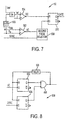
- FIG. 7 shows a conduction mode control arrangement that enables the flyback switching regulator 10 to operate alternatively in BCM or in DCM, combining advantages of these conductions modes, in accord with the teachings herein. Also, as discussed in more detail below, the conduction mode control arrangement in FIG. 7 enables the flyback switching regulator to operate in a hybrid BCM/DCM mode, in which the switching regulator operates in BCM at some predetermined conditions and operates in DCM at other predetermined conditions.
- a conduction mode control block 50 in FIG. 7 comprises a VC comparator 502 and an OC comparator 504 that respectively generate the described VC and OC signals using a subtraction circuit 506 and compensator Gc in a manner similar to production of these signals in the BCM arrangement in FIG. 2 .
- the conduction mode control block 50 receives an external synchronization signal SYNC having a programmable frequency f sync .
- the SYNC signal may be generated by an external pulse signal generator.
- the VC signal and the SYNC signal are supplied to a second pulse selector (SPS) 508 having its output coupled to an S-input of the flip-flop circuit 510 that produces a gate control signal at its Q-output.
- the gate control signal controls switching of the switch S ( FIG. 1 ) in the flyback switching regulator 10.
- the SPS 508 is configured to pass to its output only one or the other of the supplied input signals. In particular, only that input signal which is supplied later than the other input signal is allowed to pass to the output of the SPS 508.
- the SPS 508 may comprise RS flip-flop circuits 602 and 604, an AND gate circuit 606 and a delay circuit 608.
- the VC and SYNC signals are respectively supplied to S-inputs of the flip-flop circuits 602 and 604 to set output signals at their Q-ouputs.
- the output signals of the flip-flop circuits 602 and 604 are supplied to respective inputs of the AND gate circuit 606.
- the SPS 508 passes the VC signal to set the gate control signal if the VC signal is produced after the SYNC signal is supplied, and passes the SYNC signal to set the gate control signal if the VC signal is produced before the SYNC signal is supplied. Further, when the SYNC signal is at a high level, the VC signal always passes to the input of the flip-flop circuit 510. However, when the SYNC signal is at a low level, the VC signal is prevented from passing to the input of the flip-flop circuit 510 to keep the switch S of the flyback switching regulator in an off-state.
- the conduction mode control block 50 uses control signals OC, VC and SYNC to control switching of the flyback switching regulator 10.
- the switch S is turned off by the OC signal when the sensed current I reaches the reference current value Iref.
- the flyback switching regulator 10 operates in DCM (solid waveform of current I).
- DCM solid waveform of current I.
- the current in the transformer Tr remains at a zero level until the SYNC signal is supplied to turn on the switch S.
- the current in the transformer Tr is maintained at a non-zero level during time period T2 within each switching cycle of the switching regulator 10.
- the time period T1 differs from the time period T2.
- a desired conduction mode of the flyback switching regulator 10 may be set by programming the frequency f sync of the SYNC signal.
- the frequency f sync may be set higher than the expected maximum BCM frequency.
- the second pulse selector 508 selects the VC signal instead of the SYNC signal.
- the frequency f sync may be set lower than the expected minimum BCM frequency.
- the second pulse selector 508 selects the SYNC signal instead of the VC signal.
- the BCM frequency may correspond to the frequency of the VC signal.
- the frequency f sync may be selected in a range between the expected maximum BCM frequency and the expected minimum BCM frequency.
- the flyback switching regulator 10 may automatically switch between the BCM and DCM modes of operation depending on load and line conditions. For example, the flyback switching regulator 10 will operate in the BCM at a heavier load, and in the DCM at a lighter load.
- the flyback switching regulator 10 may be controlled to operate in any one of three conduction modes using the same control arrangement such as shown in FIG. 7 .
- the flyback switching regulator 10 may be set to operate in DCM for lower power applications or at light load, to operate in BCM for higher power applications or at full load, and to operate in the hybrid BCM/DCM mode for intermediate power applications or at variable load.
Landscapes
- Engineering & Computer Science (AREA)
- Power Engineering (AREA)
- Dc-Dc Converters (AREA)
- Electronic Switches (AREA)
Claims (36)
- Steuerungs- bzw. Regelungssystem (50) zum Steuern bzw. Regeln eines Schaltkreises (10) mit einem Schaltelement (S) und einem induktiven Element, aufweisend primäre und sekundäre Windungen, und gekoppelt mit einem Ausgang des Schaltelements (S), wobei das System (50) umfasst:eine Schaltsteuerungs- bzw. -regelungsschaltung, konfiguriert zum Steuern bzw. Regeln des Schaltelements (S), um den Schaltkreis (10) in einem ersten Leitungsbetriebsmodus zu betreiben, in dem Strom in dem induktiven Element auf einem Nicht-Null-Pegel während einer ersten Zeitspanne (T1) in jedem von aufeinanderfolgenden Schaltzyklen gehalten wird, wobei das Schaltelement (S) in dem ersten Leitungsmodus dahingehend gesteuert bzw. geregelt wird, sich einzuschalten, wenn der Strom (i'sec) in der sekundären Spule des induktiven Elements auf einen Null-Pegel sinkt,wobei die Schaltsteuerungs- bzw. -regelungsschaltung ferner konfiguriert ist zum Steuern bzw. Regeln des Schaltelements (S), um den Schaltkreis (10) in einem zweiten Leitungsbetriebsmodus zu betreiben, in dem Strom in dem induktiven Element auf einem Nicht-Null-Pegel während einer zweiten Zeitspanne (T2) in jedem von aufeinanderfolgenden Schaltzyklen gehalten wird, wobei die erste Zeitspanne (T1) von der zweiten Zeitspanne verschieden ist, undeine Leitungsmodus-Steuerungs- bzw. Regelungsschaltung zum Steuern bzw. Regeln eines Leitungsbetriebsmodus des Schaltkreises (10), um zwischen einem Betrieb des Schaltkreises (10) in dem ersten Leitungsmodus und einem Betrieb des Schaltkreises (10) in dem zweiten Leitungsmodus zu wählen.
- System (50) nach Anspruch 1, wobei der erste Leitungsbetriebsmodus ein Grenzleitungsmodus (BCM) ist und der zweite Leitungsbetriebsmodus ein diskontinuierlicher Leitungsmodus (DCM) ist.
- System (50) nach Anspruch 1, wobei die Modussteuerungs- bzw. -regelungsschaltung konfiguriert ist, den Schaltkreis (10) zu aktivieren bzw. freizugeben, um in einem dritten Leitungsmodus zu arbeiten.
- System (50) nach Anspruch 3, wobei in dem dritten Leitungsmodus der Schaltkreis (10) dahingehend gesteuert bzw. geregelt wird, in dem ersten Leitungsmodus ansprechend auf eine erste vorbestimmte Bedingung zu arbeiten und in dem zweiten Leitungsmodus ansprechend auf eine zweite vorbestimmte Bedingung zu arbeiten.
- System (50) nach Anspruch 3, wobei in dem dritten Leitungsmodus der Schaltkreis (10) dahingehend gesteuert bzw. geregelt wird, in BCM ansprechend auf die erste vorbestimmte Bedingung zu arbeiten und in DCM ansprechend auf die zweite vorbestimmte Bedingung zu arbeiten.
- System (50) nach Anspruch 3, wobei in dem dritten Leitungsmodus der Schaltkreis (10) dahingehend gesteuert bzw. geregelt wird, in BCM bei einer Bedingung starker Last zu arbeiten und in DCM bei einer Bedingung geringerer Last zu arbeiten.
- System (50) nach Anspruch 1, wobei der Schaltkreis (10) einen Schaltregler bzw. -regulator enthält.
- System (50) nach Anspruch 1, wobei der Schaltkreis (10) einen Rücklaufschaltregler bzw. -regulator mit einem Transformator (Tr) enthält.
- System (50) nach Anspruch 8, wobei in dem ersten Leitungsbetriebsmodus Strom in dem Transformator (Tr) auf einem Nicht-Null-Pegel während der ersten Zeitspanne (T1) in jedem Schaltzyklus gehalten wird; und in dem zweiten Leitungsbetriebsmodus Strom in dem Transformator (Tr) auf einem Nicht-Null-Pegel während der zweiten Zeitspanne (T2) in jedem Schaltzyklus gehalten wird.
- System (50) nach Anspruch 1, wobei die Modussteuerungs- bzw. -regelungsschaltung auf ein Modussteuerungs- bzw. -regelungssignal anspricht, das einen Parameter aufweist, der programmierbar ist, um zwischen dem ersten Leitungsmodus und dem zweiten Leitungsmodus zu wählen.
- System (50) nach Anspruch 10, wobei der Parameter des Modussteuerungs- bzw. -regelungssignals programmierbar ist, um den Schaltkreis (10) zu aktivieren bzw. freizugeben, um in einem dritten Leitungsmodus zu arbeiten, der den ersten Leitungsmodus und den zweiten Leitungsmodus kombiniert.
- System (50) nach Anspruch 1, wobei die Modussteuerungs- bzw. -regelungsschaltung auf ein Modussteuerungs- bzw. -regelungssignal anspricht, das eine Frequenz aufweist, die programmierbar ist, um zwischen dem ersten Leitungsmodus und dem zweiten Leitungsmodus zu wählen.
- System (50) nach Anspruch 12, wobei die Frequenz des Modussteuerungs- bzw. -regelungssignals programmierbar ist, um den Schaltkreis (10) zu aktivieren bzw. freizugeben, um in einem dritten Leitungsmodus zu arbeiten, der den ersten Leitungsmodus und den zweiten Leitungsmodus kombiniert.
- System (50) nach Anspruch 13, wobei die Modussteuerungs- bzw. -regelungsschaltung einen Signalwähler zum Wählen zwischen dem Modussteuerungs- bzw. -regelungssignal und einem Leitungsmodusunterstützungssginal enthält, das von der Schaltsteuerungs- bzw. -regelungsschaltung erzeugt wird.
- System (50) nach Anspruch 13, wobei der Schaltkreis (10) konfiguriert ist, dahingehend gesteuert bzw. geregelt zu werden, in dem ersten Leitungsmodus zu arbeiten, wenn die Frequenz des Modussteuerungs- bzw. -regelungssignals auf einen Wert festgelegt ist, der eine erwartete Maximalfrequenz des Leitungsmodusunterstützungssignals überschreitet.
- System (50) nach Anspruch 15, wobei der Schaltkreis (10) konfiguriert ist, dahingehend gesteuert bzw. geregelt zu werden, in dem zweiten Leitungsmodus zu arbeiten, wenn die Frequenz des Modussteuerungs- bzw. -regelungssignals auf einen Wert festgelegt ist, der niedriger ist als eine erwartete Minimumfrequenz des Leitungsmodusunterstützungssignals.
- System (50) nach Anspruch 16, wobei der Schaltkreis (10) konfiguriert ist, dahingehend gesteuert bzw. geregelt zu werden, in dem dritten Leitungsmodus zu arbeiten, wenn die Frequenz des Modussteuerungs- bzw. -regelungssignals auf einen Wert in einem Bereich zwischen der erwarteten Minimumfrequenz und der erwarteten Maximalfrequenz des Leitungsmodusunterstützungssignals festgelegt ist.
- Leistungsversorgungssystem, umfassend:einen Schaltkreises (10) mit einem Schaltelement (S) und einem induktiven Element, aufweisend primäre und sekundäre Windungen, und gekoppelt mit einem Ausgang des Schaltelements (S),wobei der Schaltkreis (10) konfiguriert ist, in einem ersten Leitungsbetriebsmodus zu arbeiten, in dem Strom in dem induktiven Element auf einem Nicht-Null-Pegel während einer ersten Zeitspanne (T1) in jedem von aufeinanderfolgenden Schaltzyklen gehalten wird, wobei das Schaltelement (S) in dem ersten Leitungsmodus dahingehend gesteuert bzw. geregelt wird, sich einzuschalten, wenn der Strom (i'sec) in der sekundären Spule des induktiven Elements auf einen Null-Pegel sinkt,wobei der Schaltkreis (10) ferner konfiguriert ist, in einem zweiten Leitungsbetriebsmodus zu arbeiten, in dem Strom in dem induktiven Element auf einem Nicht-Null-Pegel während einer zweiten Zeitspanne (T2) in jedem von aufeinanderfolgenden Schaltzyklen gehalten wird, wobei die erste Zeitspanne (T1) von der zweiten Zeitspanne (T2) verschieden ist, undeine Modusteuerungs- bzw. -regelungsschaltung zum Steuern bzw. Regeln eines Leitungsbetriebsmodus des Schaltkreises (10), wobei die Modusteuerungs- bzw. -regelungsschaltung auf ein Modussteuerungs- bzw. -regelungssignal anspricht, das einen Parameter aufweist, der programmierbar ist, um den Schaltkreis (10) dahingehend zu aktivieren bzw. freizugeben, zwischen dem ersten Leitungsmodus und dem zweiten Leitungsmodus umzuschalten.
- System nach Anspruch 18, wobei die Modussteuerungs- bzw. -regelungsschaltung konfiguriert ist zum Steuern bzw. Regeln des Leitungsmodus ansprechend auf das Modussteuerungs- bzw. -regelungssignal, dass programmierbare Frequenz aufweist.
- System nach Anspruch 19, wobei die Modussteuerungs- bzw. -regelungsschaltung einen Signalwähler (508) zum Wählen zwischen dem Modussteuerungs- bzw. -regelungssignal und einem Leitungsmodusunterstützungssginal enthält, das der Modussteuerungs- bzw. -regelungsschaltung zugeführt wird, um den Schaltkreis (10) in dem ersten Leitungsmodus zu betreiben.
- System nach Anspruch 20, wobei die Modussteuerungs- bzw. -regelungsschaltung ferner eine Ausgangsschaltung (510) enthält, die auf den Signalwähler (508) anspricht, um ein Schaltersteuerungs- bzw. -regelungssignal zum Steuern bzw. Regeln des Schaltelements (S) bereitzustellen.
- System nach Anspruch 21, wobei der Signalwähler (508) konfiguriert ist, der Ausgangsschaltung (510) ein Ausgewähltes des Modussteuerungs- bzw. -regelungssignals und des Leitungsmodusunterstützungssignals zuzuführen, und zu verhindern, dass der Ausgangsschaltung (510) ein Nichtausgewähltes des Modussteuerungs- bzw. -regelungssignals und des Leitungsmodusunterstützungssignals zugeführt wird.
- System nach Anspruch 22, wobei der Signalwähler (508) konfiguriert ist, der Ausgangsschaltung (510) das Leitungsmodusunterstützungssignal zuzuführen, um den Schaltkreis (10) in dem ersten Leitungsmodus zu betreiben, wenn der Signalwähler (508) das Leitungsmodusunterstützungssignal nach dem Empfang des Modussteuerungs- bzw. -regelungssignals empfängt.
- System nach Anspruch 23, wobei der Signalwähler (508) konfiguriert ist, der Ausgangsschaltung (510) das Modussteuerungs- bzw. -regelungssignal zuzuführen, um den Schaltkreis in dem zweiten Leitungsmodus zu betreiben, wenn der Signalwähler (508) das Modussteuerungs- bzw. -regelungssignal nach dem Empfang des Leitungsmodusunterstützungssignals empfängt.
- System nach Anspruch 24, wobei der Signalwähler (508) eine erste (602) und eine zweite (604) Flip-Flop-Schaltung enthält, die jeweilige festgelegte Eingänge bzw. Eingaben aufweisen, die von dem Leitungsmodusunterstützungssignal bzw. dem Modussteuerungs- bzw. -regelungssignal zugeführt bzw. versorgt werden.
- System nach Anspruch 25, wobei der Signalwähler (508) ferner eine Ausgangsgatterschaltung (606) enthält, die auf jeweilige Ausgaben der ersten (602) und der zweiten (604) Flip-Flop-Schaltung anspricht und einen Ausgang aufweist, der mit jeweiligen Rücksetzeingängen der ersten (602) und der zweiten (604) Flip-Flop-Schaltung verbunden ist.
- System nach Anspruch 18, wobei der Schaltkreis (10) einen Rücklaufschaltregler bzw. -regulator mit einem Transformator (Tr) enthält.
- System nach Anspruch 27, wobei in dem ersten Leitungsbetriebsmodus Strom in dem Transformator (Tr) auf einem Nicht-Null-Pegel während der ersten Zeitspanne (T1) in jedem Schaltzyklus gehalten wird; und in dem zweiten Leitungsbetriebsmodus Strom in dem Transformator (Tr) auf einem Nicht-Null-Pegel während der zweiten Zeitspanne (T2) in jedem Schaltzyklus gehalten wird.
- System nach Anspruch 18, wobei die Modussteuerungs- bzw. -regelungsschaltung konfiguriert ist, den Schaltkreis (10) dahingehend zu aktivieren bzw. freizugeben, ansprechend auf vorbestimmte Bedingungen alternativ in BCM und DCM zu arbeiten.
- Verfahren zum Steuern bzw. Regeln eines Schaltkreises (10) mit einem Schaltelement (S) und einem induktiven Element, aufweisend primäre und sekundäre Windungen, und gekoppelt mit einem Ausgang des Schaltelements (S), wobei das Verfahren die Schritte umfasst:Unterstützen eines Betriebs des Schaltkreises (10) in einem ersten Leitungsbetriebsmodus, in dem Strom in dem induktiven Element auf einem Nicht-Null-Pegel während einer ersten Zeitspanne (T1) in jedem Schaltzyklus gehalten wird, wobei das Schaltelement (S) in dem ersten Leitungsmodus dahingehend gesteuert bzw. geregelt wird, sich einzuschalten, wenn der Strom (i'sec) in der sekundären Spule des induktiven Elements auf einen Null-Pegel sinkt,Unterstützen eines Betriebs des Schaltkreises (10) in einem zweiten Leitungsbetriebsmodus, in dem Strom in dem induktiven Element auf einem Nicht-Null-Pegel während einer zweiten Zeitspanne (T2) in jedem von aufeinanderfolgenden Schaltzyklen gehalten wird, wobei die erste Zeitspanne (T1) von der zweiten Zeitspanne (T2) verschieden ist, undBereitstellen eines Modussteuerungs- bzw. -regelungssignals, das einen Parameter aufweist, der programmierbar ist, um zwischen einem Betrieb des Schaltkreises (10) in dem ersten Leitungsmodus und einem Betrieb des Schaltkreises (10) in dem zweiten Leitungsmodus zu wählen.
- Verfahren nach Anspruch 30, wobei der Parameter des Modussteuerungs- bzw. -regelungssignals programmierbar ist, um den Betrieb des Schaltkreises (10) in einem dritten Leitungsmodus zu aktivieren bzw. freizugeben, der den ersten Leitungsmodus und den zweiten Leitungsmodus kombiniert.
- Verfahren nach Anspruch 31, wobei der erste Leitungsmodus BCM ist und der zweite Leitungsmodus DCM ist.
- Verfahren nach Anspruch 31, wobei Frequenz des Modussteuerungs- bzw. -regelungssignals programmierbar ist, um einen Leitungsmodus de Schaltkreises (10) festzulegen.
- Verfahren nach Anspruch 33, ferner umfassend den Schritt des Wählens zwischen dem Modussteuerungs- bzw. -regelungssignal und einem zusätzlichen Steuerungs- bzw. Regelungsschsignal, um eine Steuerung bzw. Regelung des Schaltelements (S) bereitzustellen.
- Verfahren nach Anspruch 34, wobei der Schaltkreis (10) dahingehend gesteuert bzw. geregelt wird, in dem ersten Leitungsmodus zu arbeiten, wenn das zusätzliche Steuerungs- bzw. Regelungssignal nach dem Modussteuerungs- bzw. -regelungssignal zugeführt wird.
- Verfahren nach Anspruch 35, wobei der Schaltkreis (10) dahingehend gesteuert bzw. geregelt wird, in dem zweiten Leitungsmodus zu arbeiten, wenn das zusätzliche Steuerungs- bzw. Regelungssignal vor dem Modussteuerungs- bzw. -regelungssignal zugeführt wird.
Applications Claiming Priority (1)
| Application Number | Priority Date | Filing Date | Title |
|---|---|---|---|
| US11/605,297 US7733672B2 (en) | 2006-11-29 | 2006-11-29 | Programmable conduction mode control for switching circuits |
Publications (3)
| Publication Number | Publication Date |
|---|---|
| EP1928079A2 EP1928079A2 (de) | 2008-06-04 |
| EP1928079A3 EP1928079A3 (de) | 2010-12-01 |
| EP1928079B1 true EP1928079B1 (de) | 2014-01-15 |
Family
ID=39181827
Family Applications (1)
| Application Number | Title | Priority Date | Filing Date |
|---|---|---|---|
| EP07121449.8A Not-in-force EP1928079B1 (de) | 2006-11-29 | 2007-11-23 | Programmierbare Leitmodussteuerung für Schaltkreise |
Country Status (2)
| Country | Link |
|---|---|
| US (1) | US7733672B2 (de) |
| EP (1) | EP1928079B1 (de) |
Families Citing this family (6)
| Publication number | Priority date | Publication date | Assignee | Title |
|---|---|---|---|---|
| NZ576387A (en) * | 2009-04-20 | 2011-06-30 | Eaton Ind Co | PFC booster circuit |
| TWI473394B (zh) * | 2009-09-04 | 2015-02-11 | Richtek Technology Corp | 切換式電源供應器及其驅動電路與控制方法 |
| WO2012087337A2 (en) | 2010-12-24 | 2012-06-28 | Semiconductor Components Industries, Llc | Power factor controller and method |
| US10848051B2 (en) * | 2017-10-26 | 2020-11-24 | Analog Devices International Unlimited Company | Synchronizing hiccup over-current protection of multiphase switching converters |
| CN113472210B (zh) * | 2021-07-05 | 2022-05-17 | 电子科技大学 | 一种用于原边反馈反激变换器的混合控制电路 |
| TWI822546B (zh) * | 2022-06-01 | 2023-11-11 | 立錡科技股份有限公司 | 切換電容式電壓轉換電路及切換電容轉換器控制方法 |
Family Cites Families (6)
| Publication number | Priority date | Publication date | Assignee | Title |
|---|---|---|---|---|
| US6469917B1 (en) * | 2001-08-16 | 2002-10-22 | Green Power Technologies Ltd. | PFC apparatus for a converter operating in the borderline conduction mode |
| US6728117B2 (en) * | 2001-10-23 | 2004-04-27 | Koninklijke Philips Electronics N.V. | Frequency modulated self-oscillating switching power supply |
| FR2848356A1 (fr) * | 2002-12-05 | 2004-06-11 | St Microelectronics Sa | Procede de commande d'une alimentation a decoupage a un seul element inductif et plusieurs sorties, et alimentation correspondante, en particulier pour un telephone mobile cellulaire |
| US7045992B1 (en) * | 2004-06-22 | 2006-05-16 | National Semiconductor Corporation | Apparatus and method for start-up for a synchronous switching regulator |
| US7288924B2 (en) * | 2004-07-16 | 2007-10-30 | Cellex Power Products, Inc. | Digital input current control for switch mode power supplies |
| US7855864B2 (en) * | 2005-03-31 | 2010-12-21 | Semtech Corporation | Switched mode power supply method and apparatus |
-
2006
- 2006-11-29 US US11/605,297 patent/US7733672B2/en active Active
-
2007
- 2007-11-23 EP EP07121449.8A patent/EP1928079B1/de not_active Not-in-force
Also Published As
| Publication number | Publication date |
|---|---|
| EP1928079A2 (de) | 2008-06-04 |
| EP1928079A3 (de) | 2010-12-01 |
| US7733672B2 (en) | 2010-06-08 |
| US20080122420A1 (en) | 2008-05-29 |
Similar Documents
| Publication | Publication Date | Title |
|---|---|---|
| US7826237B2 (en) | Method and system for efficient power control with multiple modes | |
| US5532577A (en) | Method and apparatus for multiple output regulation in a step-down switching regulator | |
| JP4856415B2 (ja) | スイッチング・レギュレータから一時的ピーク電力を供給するための方法および装置 | |
| JP5509182B2 (ja) | スイッチング電源における出力電力を制限する方法および装置 | |
| US9444364B2 (en) | Adaptive peak power control | |
| US9093909B2 (en) | Switching mode power supply and the method thereof | |
| US9866133B2 (en) | Control circuits and methods for regulating output voltages using multiple and/or adjustable reference voltages | |
| JP6070189B2 (ja) | スイッチング電源装置 | |
| US20130027996A1 (en) | Variable frequency timing circuit for a power supply control circuit | |
| EP1928079B1 (de) | Programmierbare Leitmodussteuerung für Schaltkreise | |
| WO2015105601A1 (en) | Circuits and techniques for improving regulation in a regulator having more than one mode of operation | |
| JP2017017767A (ja) | 高効率力率改善回路およびスイッチング電源装置 | |
| KR101919625B1 (ko) | 전류제어 모드 dc-dc 컨버터 | |
| US10797591B2 (en) | Power controllers with frequency jittering, and control methods thereof | |
| US20160134197A1 (en) | Input overvoltage protection using current limit | |
| JP5974563B2 (ja) | 昇圧型スイッチング電源 | |
| US20160056722A1 (en) | Dc-dc converter | |
| US8988055B2 (en) | Digital windowing current-mode controller for a DC-DC converter | |
| US11063520B2 (en) | Simplified hybrid PWM/PFM control method for SLLC converter | |
| JP2009153373A (ja) | 電源制御回路および電源制御方法 | |
| US11996778B2 (en) | Circuit for controlling a switching mode power supply and the method thereof | |
| CN100492839C (zh) | Dc-dc变换器及其控制器和控制方法及包括其的装置 | |
| EP1909380B1 (de) | Integrierter Schalter mit intern eingestellter Leitungszeit | |
| CN101411048A (zh) | 开关模式电源控制系统 | |
| US8630101B2 (en) | Power converters |
Legal Events
| Date | Code | Title | Description |
|---|---|---|---|
| PUAI | Public reference made under article 153(3) epc to a published international application that has entered the european phase |
Free format text: ORIGINAL CODE: 0009012 |
|
| AK | Designated contracting states |
Kind code of ref document: A2 Designated state(s): AT BE BG CH CY CZ DE DK EE ES FI FR GB GR HU IE IS IT LI LT LU LV MC MT NL PL PT RO SE SI SK TR |
|
| AX | Request for extension of the european patent |
Extension state: AL BA HR MK RS |
|
| PUAL | Search report despatched |
Free format text: ORIGINAL CODE: 0009013 |
|
| AK | Designated contracting states |
Kind code of ref document: A3 Designated state(s): AT BE BG CH CY CZ DE DK EE ES FI FR GB GR HU IE IS IT LI LT LU LV MC MT NL PL PT RO SE SI SK TR |
|
| AX | Request for extension of the european patent |
Extension state: AL BA HR MK RS |
|
| 17P | Request for examination filed |
Effective date: 20110601 |
|
| AKX | Designation fees paid |
Designated state(s): AT BE BG CH CY CZ DE DK EE ES FI FR GB GR HU IE IS IT LI LT LU LV MC MT NL PL PT RO SE SI SK TR |
|
| 17Q | First examination report despatched |
Effective date: 20110816 |
|
| RAP1 | Party data changed (applicant data changed or rights of an application transferred) |
Owner name: LINEAR TECHNOLOGY CORPORATION |
|
| GRAP | Despatch of communication of intention to grant a patent |
Free format text: ORIGINAL CODE: EPIDOSNIGR1 |
|
| INTG | Intention to grant announced |
Effective date: 20130828 |
|
| GRAS | Grant fee paid |
Free format text: ORIGINAL CODE: EPIDOSNIGR3 |
|
| GRAA | (expected) grant |
Free format text: ORIGINAL CODE: 0009210 |
|
| AK | Designated contracting states |
Kind code of ref document: B1 Designated state(s): AT BE BG CH CY CZ DE DK EE ES FI FR GB GR HU IE IS IT LI LT LU LV MC MT NL PL PT RO SE SI SK TR |
|
| REG | Reference to a national code |
Ref country code: GB Ref legal event code: FG4D Ref country code: CH Ref legal event code: EP |
|
| REG | Reference to a national code |
Ref country code: AT Ref legal event code: REF Ref document number: 650193 Country of ref document: AT Kind code of ref document: T Effective date: 20140215 |
|
| REG | Reference to a national code |
Ref country code: IE Ref legal event code: FG4D |
|
| REG | Reference to a national code |
Ref country code: DE Ref legal event code: R096 Ref document number: 602007034772 Country of ref document: DE Effective date: 20140227 |
|
| REG | Reference to a national code |
Ref country code: NL Ref legal event code: T3 |
|
| REG | Reference to a national code |
Ref country code: AT Ref legal event code: MK05 Ref document number: 650193 Country of ref document: AT Kind code of ref document: T Effective date: 20140115 |
|
| REG | Reference to a national code |
Ref country code: LT Ref legal event code: MG4D |
|
| PG25 | Lapsed in a contracting state [announced via postgrant information from national office to epo] |
Ref country code: LT Free format text: LAPSE BECAUSE OF FAILURE TO SUBMIT A TRANSLATION OF THE DESCRIPTION OR TO PAY THE FEE WITHIN THE PRESCRIBED TIME-LIMIT Effective date: 20140115 Ref country code: IS Free format text: LAPSE BECAUSE OF FAILURE TO SUBMIT A TRANSLATION OF THE DESCRIPTION OR TO PAY THE FEE WITHIN THE PRESCRIBED TIME-LIMIT Effective date: 20140515 |
|
| PG25 | Lapsed in a contracting state [announced via postgrant information from national office to epo] |
Ref country code: AT Free format text: LAPSE BECAUSE OF FAILURE TO SUBMIT A TRANSLATION OF THE DESCRIPTION OR TO PAY THE FEE WITHIN THE PRESCRIBED TIME-LIMIT Effective date: 20140115 Ref country code: SE Free format text: LAPSE BECAUSE OF FAILURE TO SUBMIT A TRANSLATION OF THE DESCRIPTION OR TO PAY THE FEE WITHIN THE PRESCRIBED TIME-LIMIT Effective date: 20140115 Ref country code: FI Free format text: LAPSE BECAUSE OF FAILURE TO SUBMIT A TRANSLATION OF THE DESCRIPTION OR TO PAY THE FEE WITHIN THE PRESCRIBED TIME-LIMIT Effective date: 20140115 Ref country code: PT Free format text: LAPSE BECAUSE OF FAILURE TO SUBMIT A TRANSLATION OF THE DESCRIPTION OR TO PAY THE FEE WITHIN THE PRESCRIBED TIME-LIMIT Effective date: 20140515 Ref country code: CY Free format text: LAPSE BECAUSE OF FAILURE TO SUBMIT A TRANSLATION OF THE DESCRIPTION OR TO PAY THE FEE WITHIN THE PRESCRIBED TIME-LIMIT Effective date: 20140115 Ref country code: ES Free format text: LAPSE BECAUSE OF FAILURE TO SUBMIT A TRANSLATION OF THE DESCRIPTION OR TO PAY THE FEE WITHIN THE PRESCRIBED TIME-LIMIT Effective date: 20140115 |
|
| PG25 | Lapsed in a contracting state [announced via postgrant information from national office to epo] |
Ref country code: BE Free format text: LAPSE BECAUSE OF FAILURE TO SUBMIT A TRANSLATION OF THE DESCRIPTION OR TO PAY THE FEE WITHIN THE PRESCRIBED TIME-LIMIT Effective date: 20140115 Ref country code: LV Free format text: LAPSE BECAUSE OF FAILURE TO SUBMIT A TRANSLATION OF THE DESCRIPTION OR TO PAY THE FEE WITHIN THE PRESCRIBED TIME-LIMIT Effective date: 20140115 |
|
| REG | Reference to a national code |
Ref country code: DE Ref legal event code: R097 Ref document number: 602007034772 Country of ref document: DE |
|
| PG25 | Lapsed in a contracting state [announced via postgrant information from national office to epo] |
Ref country code: EE Free format text: LAPSE BECAUSE OF FAILURE TO SUBMIT A TRANSLATION OF THE DESCRIPTION OR TO PAY THE FEE WITHIN THE PRESCRIBED TIME-LIMIT Effective date: 20140115 Ref country code: RO Free format text: LAPSE BECAUSE OF FAILURE TO SUBMIT A TRANSLATION OF THE DESCRIPTION OR TO PAY THE FEE WITHIN THE PRESCRIBED TIME-LIMIT Effective date: 20140115 Ref country code: CZ Free format text: LAPSE BECAUSE OF FAILURE TO SUBMIT A TRANSLATION OF THE DESCRIPTION OR TO PAY THE FEE WITHIN THE PRESCRIBED TIME-LIMIT Effective date: 20140115 Ref country code: DK Free format text: LAPSE BECAUSE OF FAILURE TO SUBMIT A TRANSLATION OF THE DESCRIPTION OR TO PAY THE FEE WITHIN THE PRESCRIBED TIME-LIMIT Effective date: 20140115 |
|
| PLBE | No opposition filed within time limit |
Free format text: ORIGINAL CODE: 0009261 |
|
| STAA | Information on the status of an ep patent application or granted ep patent |
Free format text: STATUS: NO OPPOSITION FILED WITHIN TIME LIMIT |
|
| PG25 | Lapsed in a contracting state [announced via postgrant information from national office to epo] |
Ref country code: SK Free format text: LAPSE BECAUSE OF FAILURE TO SUBMIT A TRANSLATION OF THE DESCRIPTION OR TO PAY THE FEE WITHIN THE PRESCRIBED TIME-LIMIT Effective date: 20140115 Ref country code: PL Free format text: LAPSE BECAUSE OF FAILURE TO SUBMIT A TRANSLATION OF THE DESCRIPTION OR TO PAY THE FEE WITHIN THE PRESCRIBED TIME-LIMIT Effective date: 20140115 |
|
| 26N | No opposition filed |
Effective date: 20141016 |
|
| REG | Reference to a national code |
Ref country code: DE Ref legal event code: R097 Ref document number: 602007034772 Country of ref document: DE Effective date: 20141016 |
|
| PG25 | Lapsed in a contracting state [announced via postgrant information from national office to epo] |
Ref country code: SI Free format text: LAPSE BECAUSE OF FAILURE TO SUBMIT A TRANSLATION OF THE DESCRIPTION OR TO PAY THE FEE WITHIN THE PRESCRIBED TIME-LIMIT Effective date: 20140115 |
|
| PG25 | Lapsed in a contracting state [announced via postgrant information from national office to epo] |
Ref country code: MC Free format text: LAPSE BECAUSE OF FAILURE TO SUBMIT A TRANSLATION OF THE DESCRIPTION OR TO PAY THE FEE WITHIN THE PRESCRIBED TIME-LIMIT Effective date: 20140115 Ref country code: LU Free format text: LAPSE BECAUSE OF FAILURE TO SUBMIT A TRANSLATION OF THE DESCRIPTION OR TO PAY THE FEE WITHIN THE PRESCRIBED TIME-LIMIT Effective date: 20141123 |
|
| REG | Reference to a national code |
Ref country code: CH Ref legal event code: PL |
|
| PG25 | Lapsed in a contracting state [announced via postgrant information from national office to epo] |
Ref country code: LI Free format text: LAPSE BECAUSE OF NON-PAYMENT OF DUE FEES Effective date: 20141130 Ref country code: CH Free format text: LAPSE BECAUSE OF NON-PAYMENT OF DUE FEES Effective date: 20141130 |
|
| REG | Reference to a national code |
Ref country code: IE Ref legal event code: MM4A |
|
| PG25 | Lapsed in a contracting state [announced via postgrant information from national office to epo] |
Ref country code: IE Free format text: LAPSE BECAUSE OF NON-PAYMENT OF DUE FEES Effective date: 20141123 |
|
| REG | Reference to a national code |
Ref country code: FR Ref legal event code: PLFP Year of fee payment: 9 |
|
| PG25 | Lapsed in a contracting state [announced via postgrant information from national office to epo] |
Ref country code: BG Free format text: LAPSE BECAUSE OF FAILURE TO SUBMIT A TRANSLATION OF THE DESCRIPTION OR TO PAY THE FEE WITHIN THE PRESCRIBED TIME-LIMIT Effective date: 20140115 |
|
| PG25 | Lapsed in a contracting state [announced via postgrant information from national office to epo] |
Ref country code: GR Free format text: LAPSE BECAUSE OF FAILURE TO SUBMIT A TRANSLATION OF THE DESCRIPTION OR TO PAY THE FEE WITHIN THE PRESCRIBED TIME-LIMIT Effective date: 20140416 |
|
| PG25 | Lapsed in a contracting state [announced via postgrant information from national office to epo] |
Ref country code: MT Free format text: LAPSE BECAUSE OF FAILURE TO SUBMIT A TRANSLATION OF THE DESCRIPTION OR TO PAY THE FEE WITHIN THE PRESCRIBED TIME-LIMIT Effective date: 20140115 Ref country code: TR Free format text: LAPSE BECAUSE OF FAILURE TO SUBMIT A TRANSLATION OF THE DESCRIPTION OR TO PAY THE FEE WITHIN THE PRESCRIBED TIME-LIMIT Effective date: 20140115 Ref country code: HU Free format text: LAPSE BECAUSE OF FAILURE TO SUBMIT A TRANSLATION OF THE DESCRIPTION OR TO PAY THE FEE WITHIN THE PRESCRIBED TIME-LIMIT; INVALID AB INITIO Effective date: 20071123 |
|
| REG | Reference to a national code |
Ref country code: FR Ref legal event code: PLFP Year of fee payment: 10 |
|
| REG | Reference to a national code |
Ref country code: FR Ref legal event code: PLFP Year of fee payment: 11 |
|
| REG | Reference to a national code |
Ref country code: FR Ref legal event code: PLFP Year of fee payment: 12 |
|
| REG | Reference to a national code |
Ref country code: DE Ref legal event code: R082 Ref document number: 602007034772 Country of ref document: DE Representative=s name: MUELLER-BORE & PARTNER PATENTANWAELTE PARTG MB, DE Ref country code: DE Ref legal event code: R081 Ref document number: 602007034772 Country of ref document: DE Owner name: ANALOG DEVICES INTERNATIONAL UNLIMITED COMPANY, IE Free format text: FORMER OWNER: LINEAR TECHNOLOGY CORP., MILPITAS, CALIF., US Ref country code: DE Ref legal event code: R082 Ref document number: 602007034772 Country of ref document: DE Representative=s name: WITHERS & ROGERS LLP, DE |
|
| REG | Reference to a national code |
Ref country code: DE Ref legal event code: R082 Ref document number: 602007034772 Country of ref document: DE Representative=s name: WITHERS & ROGERS LLP, DE |
|
| REG | Reference to a national code |
Ref country code: GB Ref legal event code: 732E Free format text: REGISTERED BETWEEN 20210930 AND 20211006 |
|
| PGFP | Annual fee paid to national office [announced via postgrant information from national office to epo] |
Ref country code: NL Payment date: 20211020 Year of fee payment: 15 |
|
| REG | Reference to a national code |
Ref country code: NL Ref legal event code: PD Owner name: ANALOG DEVICES INTERNATIONAL UNLIMITED COMPANY; IE Free format text: DETAILS ASSIGNMENT: CHANGE OF OWNER(S), ASSIGNMENT; FORMER OWNER NAME: LINEAR TECHNOLOGY LLC Effective date: 20211216 |
|
| PGFP | Annual fee paid to national office [announced via postgrant information from national office to epo] |
Ref country code: GB Payment date: 20211020 Year of fee payment: 15 |
|
| PGFP | Annual fee paid to national office [announced via postgrant information from national office to epo] |
Ref country code: IT Payment date: 20211025 Year of fee payment: 15 Ref country code: FR Payment date: 20211020 Year of fee payment: 15 |
|
| PGFP | Annual fee paid to national office [announced via postgrant information from national office to epo] |
Ref country code: DE Payment date: 20220616 Year of fee payment: 16 |
|
| REG | Reference to a national code |
Ref country code: NL Ref legal event code: MM Effective date: 20221201 |
|
| GBPC | Gb: european patent ceased through non-payment of renewal fee |
Effective date: 20221123 |
|
| PG25 | Lapsed in a contracting state [announced via postgrant information from national office to epo] |
Ref country code: NL Free format text: LAPSE BECAUSE OF NON-PAYMENT OF DUE FEES Effective date: 20221201 |
|
| PG25 | Lapsed in a contracting state [announced via postgrant information from national office to epo] |
Ref country code: IT Free format text: LAPSE BECAUSE OF NON-PAYMENT OF DUE FEES Effective date: 20221123 Ref country code: GB Free format text: LAPSE BECAUSE OF NON-PAYMENT OF DUE FEES Effective date: 20221123 |
|
| PG25 | Lapsed in a contracting state [announced via postgrant information from national office to epo] |
Ref country code: FR Free format text: LAPSE BECAUSE OF NON-PAYMENT OF DUE FEES Effective date: 20221130 |
|
| REG | Reference to a national code |
Ref country code: DE Ref legal event code: R119 Ref document number: 602007034772 Country of ref document: DE |
|
| PG25 | Lapsed in a contracting state [announced via postgrant information from national office to epo] |
Ref country code: DE Free format text: LAPSE BECAUSE OF NON-PAYMENT OF DUE FEES Effective date: 20240601 |
|
| PG25 | Lapsed in a contracting state [announced via postgrant information from national office to epo] |
Ref country code: DE Free format text: LAPSE BECAUSE OF NON-PAYMENT OF DUE FEES Effective date: 20240601 |