EP1928201A1 - Verfahren zur Weiterleitung eines Telefongespräches von einem drahtlosen Netzwerk zu einem anderen, sowie telefonisches Doppelmodus-Endgerät dafür - Google Patents
Verfahren zur Weiterleitung eines Telefongespräches von einem drahtlosen Netzwerk zu einem anderen, sowie telefonisches Doppelmodus-Endgerät dafür Download PDFInfo
- Publication number
- EP1928201A1 EP1928201A1 EP07121260A EP07121260A EP1928201A1 EP 1928201 A1 EP1928201 A1 EP 1928201A1 EP 07121260 A EP07121260 A EP 07121260A EP 07121260 A EP07121260 A EP 07121260A EP 1928201 A1 EP1928201 A1 EP 1928201A1
- Authority
- EP
- European Patent Office
- Prior art keywords
- communication
- network
- terminal
- plmn
- wlan
- Prior art date
- Legal status (The legal status is an assumption and is not a legal conclusion. Google has not performed a legal analysis and makes no representation as to the accuracy of the status listed.)
- Withdrawn
Links
- 238000000034 method Methods 0.000 title claims abstract description 33
- 238000004891 communication Methods 0.000 claims abstract description 141
- 230000009977 dual effect Effects 0.000 claims abstract description 14
- 238000012546 transfer Methods 0.000 claims description 13
- 241000287107 Passer Species 0.000 description 5
- 241001080024 Telles Species 0.000 description 5
- 238000006677 Appel reaction Methods 0.000 description 4
- 230000008901 benefit Effects 0.000 description 4
- 238000010586 diagram Methods 0.000 description 3
- 238000012986 modification Methods 0.000 description 3
- 230000004048 modification Effects 0.000 description 3
- 230000011664 signaling Effects 0.000 description 3
- 241000896693 Disa Species 0.000 description 1
- 238000007796 conventional method Methods 0.000 description 1
- 239000000284 extract Substances 0.000 description 1
- 238000009434 installation Methods 0.000 description 1
- 230000001960 triggered effect Effects 0.000 description 1
Images



Classifications
-
- H—ELECTRICITY
- H04—ELECTRIC COMMUNICATION TECHNIQUE
- H04W—WIRELESS COMMUNICATION NETWORKS
- H04W76/00—Connection management
- H04W76/40—Connection management for selective distribution or broadcast
-
- H—ELECTRICITY
- H04—ELECTRIC COMMUNICATION TECHNIQUE
- H04W—WIRELESS COMMUNICATION NETWORKS
- H04W84/00—Network topologies
- H04W84/02—Hierarchically pre-organised networks, e.g. paging networks, cellular networks, WLAN [Wireless Local Area Network] or WLL [Wireless Local Loop]
- H04W84/10—Small scale networks; Flat hierarchical networks
- H04W84/12—WLAN [Wireless Local Area Networks]
-
- H—ELECTRICITY
- H04—ELECTRIC COMMUNICATION TECHNIQUE
- H04W—WIRELESS COMMUNICATION NETWORKS
- H04W84/00—Network topologies
- H04W84/02—Hierarchically pre-organised networks, e.g. paging networks, cellular networks, WLAN [Wireless Local Area Network] or WLL [Wireless Local Loop]
- H04W84/10—Small scale networks; Flat hierarchical networks
- H04W84/16—WPBX [Wireless Private Branch Exchange]
-
- H—ELECTRICITY
- H04—ELECTRIC COMMUNICATION TECHNIQUE
- H04W—WIRELESS COMMUNICATION NETWORKS
- H04W88/00—Devices specially adapted for wireless communication networks, e.g. terminals, base stations or access point devices
- H04W88/02—Terminal devices
- H04W88/06—Terminal devices adapted for operation in multiple networks or having at least two operational modes, e.g. multi-mode terminals
-
- H—ELECTRICITY
- H04—ELECTRIC COMMUNICATION TECHNIQUE
- H04W—WIRELESS COMMUNICATION NETWORKS
- H04W92/00—Interfaces specially adapted for wireless communication networks
- H04W92/02—Inter-networking arrangements
Definitions
- the invention relates to a method for transferring a telephone communication from a global wireless telecommunication network, of the GSM type, for example, to a wireless local telecommunication network, of the Wifi or Bluetooth type, for example, and vice versa. It also relates to a dual mode terminal comprising means for implementing this method. It relates more particularly to wireless local area networks that include at least one PBX capable of establishing a conference call.
- a dual-mode mobile telephony terminal has two radio interfaces, respectively making it possible to communicate via a global wireless telecommunication network, for example according to the GSM standard, and / or via a wireless local telecommunication network, according to the Wi-Fi standard. for example, the latter being connected to a public telecommunication network, fixed, by a permanent link using the Internet protocol (called IP link in the following) which allows VoIP-type voice over Internet Protocol (VOIP) ).
- IP link Internet protocol
- the global network provides country-wide coverage but communications are expensive.
- the local network offers more limited coverage, which is included in the previous coverage, but voice over Internet Protocol (VoIP) communications are inexpensive.
- VoIP voice over Internet Protocol
- a shopping center or airport can be equipped with a wireless LAN, accessible to the public.
- a wireless LAN When a wireless LAN covers the site of a company, or the apartment of an individual, the use of this local network should be preferred for telephone communications, because of its low cost.
- the terminal being mobile, the problem arises of transferring a telephone communication between the two networks, without interrupting this telephone communication, and without inconvenient delay for the users.
- UMA Unlicensed Mobile Access
- the UMA controller transforms the signal from the mobile telephone terminal, via the IP link, to make it appear as coming from another GSM base station, virtual. Therefore, when a mobile telephone terminal enters the coverage area of a wireless LAN (where it has access rights), the heart of the GSM telephone network simply considers that this terminal has changed GSM base station , as for a classical intercellular transfer. There is therefore no communication break while the telephone terminal passes from a GSM radio link to a Wi-Fi or Bluetooth radio link, or vice versa.
- the disadvantage of this method is to require a modification of the overall network considered, resulting in installation costs and operating costs that the operator of the global network charges to the user.
- the object of the invention is to propose a method that does not require modification in the global network.
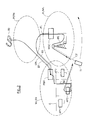
- the figure 1 illustrates a first step of the implementation of the method according to the invention, in an example where a mobile telephone terminal T1, dual mode, Wi-fi GSM, is in communication with a telephone terminal T2 of a public fixed network PSTN, via wireless LAN, Wi-Fi type WLAN.
- the local area network WLAN is connected to the public fixed network PSTN by an IP link referenced IPL in the figures.
- the local area network WLAN comprises a PBX switch connected to radio access points AP1, AP2, AP3, via a wired Ethernet network E; and connected to the PSTN fixed public network by the IPL link.
- This PBX is capable of switching voice-over-Internet Protocol communications within the WLAN, providing additional services, including allowing three-way conferencing.
- the terminal T1 is right in the coverage area of the local area network WLAN.
- the terminal T1 is also in the coverage area of a global wireless network PLMN, GSM type in this example.
- the communication considered is established via the local area network WLAN rather than via the global network PLMN, to benefit from a much cheaper rate.
- the selection of the network is done manually by the user, or by a known automatic method.
- the PBX PBX establishes a connection that includes a branch B1 connecting the PBX PBX to the public fixed network PSTN by the IPL link, and a branch B2 connecting the PBX PBX terminal T1 by AP2 radio access point.
- the figure 2 illustrates a second step of the implementation of the method according to the invention.
- the mobile terminal T1 is on the move and is approaching the limit of WLAN LAN radio coverage.
- a procedure for transferring the communication B1-B2 from the local area network WLAN to the global network PLMN is triggered, either automatically by the terminal T1 when it detects a fall in the amplitude of the signal received from the access point AP2, and that it can not also not use one of the other radio access points AP1 and AP3; either manually by the user of the terminal T1.
- the GSM radio interface of the dual mode terminal T1 periodically listens to the GSM base stations that it can receive. She knows that she can establish communication via the base station BS in this example. By its GSM interface, the dual-mode terminal T1 requests the establishment of a second call, by sending to the switch of the mobile service, MSC, a message containing a called number and a calling number which are both the own number of the call.
- T1 terminal in the public dial plan that is common to the PLMN global wireless network and the PSTN fixed public network. This number comprises a first field which designates the PBX and a second field which designates the extension constituted by the terminal T1 when connected to the local area network WLAN.
- the mobile service switch MSC communicates with the PBX via the fixed network PSTN, a fixed link referenced FL, connecting the switch of the mobile service MSC to the public fixed network PSTN.
- This second communication is conventionally established, in the local area network WLAN, by the so-called automatic selection process on arrival: the PBX is designated by the first field of the number; it receives the called number and extracts the second field, then sends a call signal to the extension whose number is contained in this second field.
- the PBX PBX knows that this extension is the dual-mode mobile terminal T1, which has associated with AP2 radio access point.
- the PBX switch connects the B2 branch to a new B3 branch that connects the PBX to the PLMN global network.
- the two-mode terminal T1 is then in communication with the terminal T2 simultaneously by two telephone communications, B1-B2 and B1-B3, placed in conference.
- the figure 3 illustrates a third step of the implementation of the method according to the invention.
- the terminal T1 receives on its Wi-fi radio interface a signaling message indicating that the PBX PBX has achieved the conferencing he requested.
- the terminal T1 then automatically requests the PBX to release the first communication.
- the PBX switch releases the B2 branch. It maintains the connection between the branch B3 and the branch B1.
- the second communication B1-B3 replaces the first communication without any inconvenience for the users: There is no interruption since the two communications coexist for a certain time.
- figures 4 , 5 , 6 illustrate the transfer in the opposite direction, ie from the global network PLMN to the local area network WLAN. These networks are the same as on the figure 1 to 3 they will not be re-described.
- the figure 4 illustrates a first step of the transfer in opposite direction.
- a mobile terminal T3, dual mode, Wi-fi / GSM is in communication with a telephone terminal T4 of the fixed public network PSTN, via the network global wireless, PLMN.
- this communication also passes through the PBX switch of the wireless local area network, WLAN, for the following reasons.
- This terminal T3 and the local area network WLAN typically belong to a company.
- Outgoing calls from this PBX, and having to use the PLMN global network benefit from a particularly attractive tariff, from the operator of the global network PLMN, because of the high number of calls billed to the company.
- the user of the T3 terminal has an interest in requesting the establishment of his GSM calls through the PBX switch of the company that employs him, because he then has at his disposal additional services provided by this switch, including a corporate directory.
- the terminal T3 is far from the coverage area of the local area network WLAN. But it is in the coverage area of the PLMN global wireless network.
- the selection of the network is done manually by the user, or by a known automatic method.
- the PBX PBX establishes a connection between a branch B4 connecting the PBX to the PLMN global network via the IPL link and the PSTN fixed public network, and a branch B5 connecting the PBX switch to the T4 terminal by the IPL permanent link.
- the figure 5 illustrates a second step of the implementation of the method according to the invention.
- the mobile terminal T3 is on the move and it enters the coverage area of the local area network WLAN.
- the Wi-Fi interface of the dual mode T3 terminal listens to Wi-Fi access points periodically.
- a procedure for transferring the communication from the local area network WLAN to the global network PLMN is initiated, either automatically by the terminal T3 when it detects that it is in the coverage area of the local area network WLAN, and that it has verified that it has the right to access this network, either manually by the user of the T3 terminal.
- the Wi-fi interface of the dual-mode terminal T3 associates with the access point AP3, for example, and is then authenticated by the local area network WLAN, according to a known method.
- the terminal T3 signals its presence to the PBX switch.
- the PBX knows that the terminal T3 is associated with AP3 access point, by a conventional method. He is now able to route a call to this T3 terminal, if called.
- the terminal T3 requests the PBX to set up a second call, by calling a number which is its own number in the common PSTN fixed public network numbering plan and the PLMN global network.
- This number includes a first field which designates the PBX and a second field which designates the extension formed by the terminal T3 when connected to the local area network WLAN.
- the terminal T3 continues to communicate with the terminal T4 via the base station BS, the mobile service switch MSC, and the fixed link FL.
- the two-mode terminal T3 is then in communication with the terminal T4 simultaneously by two telephone communications, B1-B2 and B1-B3, placed in conference, via its Wi-fi interface and its GSM interface simultaneously.
- the figure 6 illustrates a third step of the implementation of the method according to the invention.
- the terminal T3 controls a release of the first communication B4-B5, in a conventional manner.
- the PBX switch releases the B4 branch. It maintains the connection between branch B5 and branch B6.
- the second communication B5-B6 replaces the first communication B4-B5 without any inconvenience for the users: There is no interruption since there is a small time when the two communications coexist. For users, everything happens as if the radio segment of the communication had been transferred instantly from the PLMN global network to the local WLAN.
- This method has the remarkable advantage that it does not require any modification in the equipment of the local area network WLAN and the global network PLMN.
- terminals T2 and T4 are any terminals of the fixed network PSTN, but that they could be any terminals of the global wireless network PLMN or of a local network, for example the local area network WLAN itself .
- the dual-mode mobile terminal instead of calling its own number to request the establishment of a second call, the dual-mode mobile terminal, T1 or T3, could use a known method called Direct Access to the System (DISA: Direct Inward System Access):
- DISA Direct Inward System Access
- the terminal would call a predetermined number that would allow it to access the PBX and launch a particular application.
- the particular application would establish a second communication.
- the terminal would ask this application to conference the first and second communication, then ask him to relax the first communication.
- control means CM are able to control the radio interfaces Gl and Wl to send to a local network switch messages containing a call establishment request containing a calling number and a called number which all of them are constituted by the bi-mode terminal number in the public numbering plan common to the global network PLMN and the public fixed network PSTN.
- control means CM are able to control the radio interfaces Gl and Wl to send to a switch messages containing a call setup request containing a specific predetermined number for this communication transfer request. .
Landscapes
- Engineering & Computer Science (AREA)
- Computer Networks & Wireless Communication (AREA)
- Signal Processing (AREA)
- Mobile Radio Communication Systems (AREA)
Applications Claiming Priority (1)
| Application Number | Priority Date | Filing Date | Title |
|---|---|---|---|
| FR0655134A FR2909249B1 (fr) | 2006-11-28 | 2006-11-28 | Procede de transfert d'une communication telephonique d'un reseau sans fil, a un autre ; et terminal telephonique mobile bi-mode pour la mise en oeuvre de ce procede. |
Publications (1)
| Publication Number | Publication Date |
|---|---|
| EP1928201A1 true EP1928201A1 (de) | 2008-06-04 |
Family
ID=38137331
Family Applications (1)
| Application Number | Title | Priority Date | Filing Date |
|---|---|---|---|
| EP07121260A Withdrawn EP1928201A1 (de) | 2006-11-28 | 2007-11-22 | Verfahren zur Weiterleitung eines Telefongespräches von einem drahtlosen Netzwerk zu einem anderen, sowie telefonisches Doppelmodus-Endgerät dafür |
Country Status (5)
| Country | Link |
|---|---|
| US (1) | US20080146209A1 (de) |
| EP (1) | EP1928201A1 (de) |
| CN (1) | CN101193386A (de) |
| FR (1) | FR2909249B1 (de) |
| WO (1) | WO2008065033A1 (de) |
Cited By (1)
| Publication number | Priority date | Publication date | Assignee | Title |
|---|---|---|---|---|
| WO2009153277A1 (en) * | 2008-06-18 | 2009-12-23 | Alcatel Lucent | A method and a server for enabling a multimode communication unit to benefit from the services of a local area network when said unit is roaming in a wide area network |
Families Citing this family (5)
| Publication number | Priority date | Publication date | Assignee | Title |
|---|---|---|---|---|
| CN101778485A (zh) * | 2010-02-12 | 2010-07-14 | 华为终端有限公司 | 一种WiFi手持设备的电路域链路建立方法和装置 |
| CN102918151B (zh) * | 2010-03-31 | 2015-09-09 | 诺维信股份有限公司 | 纤维二糖水解酶变体及编码其的多核苷酸 |
| US8509186B2 (en) * | 2010-04-26 | 2013-08-13 | Research In Motion Limited | Conversion of mobile device to LAN-only telephony functions |
| US20110280239A1 (en) * | 2010-05-13 | 2011-11-17 | Murata Manufacturing Co., Ltd. | Communication session hand-off method and communication device |
| CN102905319A (zh) * | 2012-10-23 | 2013-01-30 | 李文龙 | 一种数据分流的方法及系统 |
Citations (3)
| Publication number | Priority date | Publication date | Assignee | Title |
|---|---|---|---|---|
| US20040264410A1 (en) * | 2003-06-30 | 2004-12-30 | Motorola, Inc. | Method and apparatus for providing a communication unit with a handoff between networks |
| US6889045B2 (en) * | 2002-06-26 | 2005-05-03 | Motorola, Inc. | Method and apparatus for implementing bi-directional soft handovers between wireless networks via media gateway control |
| WO2006127255A1 (en) * | 2005-05-26 | 2006-11-30 | Sprint Spectrum L.P. | Method and system using a conference bridge for handoff of a multi-mode mobile station |
Family Cites Families (1)
| Publication number | Priority date | Publication date | Assignee | Title |
|---|---|---|---|---|
| EP1021757A1 (de) * | 1997-07-25 | 2000-07-26 | Starvox, Inc. | Verfahren und vorrichtung für integriertes sprach-gateway |
-
2006
- 2006-11-28 FR FR0655134A patent/FR2909249B1/fr not_active Expired - Fee Related
-
2007
- 2007-11-22 CN CNA2007101868401A patent/CN101193386A/zh active Pending
- 2007-11-22 WO PCT/EP2007/062665 patent/WO2008065033A1/fr not_active Ceased
- 2007-11-22 EP EP07121260A patent/EP1928201A1/de not_active Withdrawn
- 2007-11-27 US US11/945,728 patent/US20080146209A1/en not_active Abandoned
Patent Citations (3)
| Publication number | Priority date | Publication date | Assignee | Title |
|---|---|---|---|---|
| US6889045B2 (en) * | 2002-06-26 | 2005-05-03 | Motorola, Inc. | Method and apparatus for implementing bi-directional soft handovers between wireless networks via media gateway control |
| US20040264410A1 (en) * | 2003-06-30 | 2004-12-30 | Motorola, Inc. | Method and apparatus for providing a communication unit with a handoff between networks |
| WO2006127255A1 (en) * | 2005-05-26 | 2006-11-30 | Sprint Spectrum L.P. | Method and system using a conference bridge for handoff of a multi-mode mobile station |
Cited By (2)
| Publication number | Priority date | Publication date | Assignee | Title |
|---|---|---|---|---|
| WO2009153277A1 (en) * | 2008-06-18 | 2009-12-23 | Alcatel Lucent | A method and a server for enabling a multimode communication unit to benefit from the services of a local area network when said unit is roaming in a wide area network |
| EP2136527A1 (de) * | 2008-06-18 | 2009-12-23 | Alcatel Lucent | Verfahren und Server zur Aktivierung einer multimodalen Kommunikationseinheit zur Nutzung der Dienste einer LAN im Roaming-Modus dieser Einheit in einem WAN |
Also Published As
| Publication number | Publication date |
|---|---|
| WO2008065033A1 (fr) | 2008-06-05 |
| CN101193386A (zh) | 2008-06-04 |
| US20080146209A1 (en) | 2008-06-19 |
| FR2909249B1 (fr) | 2009-05-01 |
| FR2909249A1 (fr) | 2008-05-30 |
Similar Documents
| Publication | Publication Date | Title |
|---|---|---|
| JP6091595B2 (ja) | モバイルおよび衛星電話サービスを統合するための装置、方法、およびシステム | |
| EP2575395B1 (de) | Mobiles Multimodus-Telefonendgerät, das die telefonische Übertragung von einem drahtlosen Netz zu einem anderen ermöglicht | |
| US8724619B2 (en) | Transparently routing a telephone call between mobile and VOIP services | |
| RU2455774C2 (ru) | Система и способ непрямой связи для мобильных телефонов | |
| US20090116466A1 (en) | Mobile communications | |
| CN101019442A (zh) | 蜂窝和企业无线网络之间的切换 | |
| EP1928201A1 (de) | Verfahren zur Weiterleitung eines Telefongespräches von einem drahtlosen Netzwerk zu einem anderen, sowie telefonisches Doppelmodus-Endgerät dafür | |
| FR2949287A1 (fr) | Procede et dispositif de fourniture de services d'interconnexion permettant de relier un ensemble de reseaux cellulaires. | |
| JP5074210B2 (ja) | 通信方法及び通信システム | |
| WO2008055041A2 (en) | Enhanced wireless voice services using a signaling protocol | |
| WO2009033423A1 (en) | A method, an exchange and a device for conversation handover between the terminals | |
| CN101019449A (zh) | 蜂窝和桌面电话之间的通信会话切换 | |
| EP2381665B1 (de) | Systeme und Verfahren für eine Sprachanruf-Einrichtung für mobile Geräte | |
| JP2010206448A (ja) | VoIP通信装置、VoIP通信装置の通信方法ならびに通信システム | |
| ES2307647T3 (es) | Procedimiento de establecimineto de una conexion para llamadas. | |
| WO2005120115A1 (fr) | Procede de commutation entre deux services de telephonie | |
| EP1813121B1 (de) | Weiterreichen von kommunikationssitzungen zwischen mobil- und festnetztelefonen | |
| BE1021396B1 (fr) | Ameliorations apportees au controle de qualite vocale | |
| WO2017141268A1 (en) | Private system for mobile communication (psm) and apparatus therefor | |
| WO1999035877A1 (fr) | Procede de gestion des canaux de transmission d'une regie numerique d'abonne et regie correspondante | |
| FR2806246A1 (fr) | Procede d'appel, pour communiquer a travers un reseau informatique, d'un terminal d'un premier reseau cellulaire regional en deplacement dans la region d'un second reseau cellulaire regional | |
| WO2013046691A1 (ja) | 通信端末装置、その制御方法及びプロセッサ | |
| EP2629501A1 (de) | Verfahren zum Unterbrechen der Klingeltöne einer Gruppe von Endgeräten | |
| WO2007099267A1 (fr) | Procede de redirection d'un appel et terminal mobile adapte a mettre en oeuvre un tel procede | |
| HK1136409B (en) | Mobile phone related indirect communication system and method |
Legal Events
| Date | Code | Title | Description |
|---|---|---|---|
| PUAI | Public reference made under article 153(3) epc to a published international application that has entered the european phase |
Free format text: ORIGINAL CODE: 0009012 |
|
| AK | Designated contracting states |
Kind code of ref document: A1 Designated state(s): AT BE BG CH CY CZ DE DK EE ES FI FR GB GR HU IE IS IT LI LT LU LV MC MT NL PL PT RO SE SI SK TR |
|
| AX | Request for extension of the european patent |
Extension state: AL BA HR MK RS |
|
| 17P | Request for examination filed |
Effective date: 20081204 |
|
| AKX | Designation fees paid |
Designated state(s): AT BE BG CH CY CZ DE DK EE ES FI FR GB GR HU IE IS IT LI LT LU LV MC MT NL PL PT RO SE SI SK TR |
|
| 17Q | First examination report despatched |
Effective date: 20090120 |
|
| STAA | Information on the status of an ep patent application or granted ep patent |
Free format text: STATUS: THE APPLICATION HAS BEEN WITHDRAWN |
|
| 18W | Application withdrawn |
Effective date: 20090703 |