EP1929933A2 - Endoskopisches Diagnosesystem - Google Patents
Endoskopisches Diagnosesystem Download PDFInfo
- Publication number
- EP1929933A2 EP1929933A2 EP07014110A EP07014110A EP1929933A2 EP 1929933 A2 EP1929933 A2 EP 1929933A2 EP 07014110 A EP07014110 A EP 07014110A EP 07014110 A EP07014110 A EP 07014110A EP 1929933 A2 EP1929933 A2 EP 1929933A2
- Authority
- EP
- European Patent Office
- Prior art keywords
- director
- endoscopic
- radio wave
- operator
- signal
- Prior art date
- Legal status (The legal status is an assumption and is not a legal conclusion. Google has not performed a legal analysis and makes no representation as to the accuracy of the status listed.)
- Withdrawn
Links
- 238000012327 Endoscopic diagnosis Methods 0.000 claims description 8
- 238000012545 processing Methods 0.000 abstract description 26
- 238000000034 method Methods 0.000 description 16
- 238000003780 insertion Methods 0.000 description 9
- 230000037431 insertion Effects 0.000 description 9
- 238000006243 chemical reaction Methods 0.000 description 7
- XLYOFNOQVPJJNP-UHFFFAOYSA-N water Substances O XLYOFNOQVPJJNP-UHFFFAOYSA-N 0.000 description 6
- 238000004891 communication Methods 0.000 description 5
- 238000001514 detection method Methods 0.000 description 5
- 238000000926 separation method Methods 0.000 description 4
- 238000010586 diagram Methods 0.000 description 3
- 230000003321 amplification Effects 0.000 description 2
- 230000005540 biological transmission Effects 0.000 description 2
- 230000006835 compression Effects 0.000 description 2
- 238000007906 compression Methods 0.000 description 2
- 230000002596 correlated effect Effects 0.000 description 2
- 238000005286 illumination Methods 0.000 description 2
- 238000003199 nucleic acid amplification method Methods 0.000 description 2
- 238000005070 sampling Methods 0.000 description 2
- 238000004140 cleaning Methods 0.000 description 1
- 230000001276 controlling effect Effects 0.000 description 1
- 230000003247 decreasing effect Effects 0.000 description 1
- 230000006866 deterioration Effects 0.000 description 1
- 238000003384 imaging method Methods 0.000 description 1
- 238000012544 monitoring process Methods 0.000 description 1
- 230000003287 optical effect Effects 0.000 description 1
- 238000000638 solvent extraction Methods 0.000 description 1
- 238000012546 transfer Methods 0.000 description 1
Images




Classifications
-
- A—HUMAN NECESSITIES
- A61—MEDICAL OR VETERINARY SCIENCE; HYGIENE
- A61B—DIAGNOSIS; SURGERY; IDENTIFICATION
- A61B1/00—Instruments for performing medical examinations of the interior of cavities or tubes of the body by visual or photographical inspection, e.g. endoscopes; Illuminating arrangements therefor
- A61B1/04—Instruments for performing medical examinations of the interior of cavities or tubes of the body by visual or photographical inspection, e.g. endoscopes; Illuminating arrangements therefor combined with photographic or television appliances
- A61B1/05—Instruments for performing medical examinations of the interior of cavities or tubes of the body by visual or photographical inspection, e.g. endoscopes; Illuminating arrangements therefor combined with photographic or television appliances characterised by the image sensor, e.g. camera, being in the distal end portion
-
- A—HUMAN NECESSITIES
- A61—MEDICAL OR VETERINARY SCIENCE; HYGIENE
- A61B—DIAGNOSIS; SURGERY; IDENTIFICATION
- A61B1/00—Instruments for performing medical examinations of the interior of cavities or tubes of the body by visual or photographical inspection, e.g. endoscopes; Illuminating arrangements therefor
- A61B1/00002—Operational features of endoscopes
- A61B1/00011—Operational features of endoscopes characterised by signal transmission
- A61B1/00016—Operational features of endoscopes characterised by signal transmission using wireless means
-
- A—HUMAN NECESSITIES
- A61—MEDICAL OR VETERINARY SCIENCE; HYGIENE
- A61B—DIAGNOSIS; SURGERY; IDENTIFICATION
- A61B1/00—Instruments for performing medical examinations of the interior of cavities or tubes of the body by visual or photographical inspection, e.g. endoscopes; Illuminating arrangements therefor
- A61B1/00002—Operational features of endoscopes
- A61B1/00043—Operational features of endoscopes provided with output arrangements
- A61B1/00045—Display arrangement
-
- A—HUMAN NECESSITIES
- A61—MEDICAL OR VETERINARY SCIENCE; HYGIENE
- A61B—DIAGNOSIS; SURGERY; IDENTIFICATION
- A61B1/00—Instruments for performing medical examinations of the interior of cavities or tubes of the body by visual or photographical inspection, e.g. endoscopes; Illuminating arrangements therefor
- A61B1/00002—Operational features of endoscopes
- A61B1/00043—Operational features of endoscopes provided with output arrangements
- A61B1/00045—Display arrangement
- A61B1/0005—Display arrangement combining images e.g. side-by-side, superimposed or tiled
-
- A—HUMAN NECESSITIES
- A61—MEDICAL OR VETERINARY SCIENCE; HYGIENE
- A61B—DIAGNOSIS; SURGERY; IDENTIFICATION
- A61B1/00—Instruments for performing medical examinations of the interior of cavities or tubes of the body by visual or photographical inspection, e.g. endoscopes; Illuminating arrangements therefor
- A61B1/00002—Operational features of endoscopes
- A61B1/00059—Operational features of endoscopes provided with identification means for the endoscope
-
- A—HUMAN NECESSITIES
- A61—MEDICAL OR VETERINARY SCIENCE; HYGIENE
- A61B—DIAGNOSIS; SURGERY; IDENTIFICATION
- A61B5/00—Measuring for diagnostic purposes; Identification of persons
- A61B5/0002—Remote monitoring of patients using telemetry, e.g. transmission of vital signals via a communication network
-
- G—PHYSICS
- G09—EDUCATION; CRYPTOGRAPHY; DISPLAY; ADVERTISING; SEALS
- G09B—EDUCATIONAL OR DEMONSTRATION APPLIANCES; APPLIANCES FOR TEACHING, OR COMMUNICATING WITH, THE BLIND, DEAF OR MUTE; MODELS; PLANETARIA; GLOBES; MAPS; DIAGRAMS
- G09B23/00—Models for scientific, medical, or mathematical purposes, e.g. full-sized devices for demonstration purposes
- G09B23/28—Models for scientific, medical, or mathematical purposes, e.g. full-sized devices for demonstration purposes for medicine
- G09B23/285—Models for scientific, medical, or mathematical purposes, e.g. full-sized devices for demonstration purposes for medicine for injections, endoscopy, bronchoscopy, sigmoidscopy, insertion of contraceptive devices or enemas
-
- H—ELECTRICITY
- H04—ELECTRIC COMMUNICATION TECHNIQUE
- H04N—PICTORIAL COMMUNICATION, e.g. TELEVISION
- H04N7/00—Television systems
- H04N7/18—Closed-circuit television [CCTV] systems, i.e. systems in which the video signal is not broadcast
- H04N7/183—Closed-circuit television [CCTV] systems, i.e. systems in which the video signal is not broadcast for receiving images from a single remote source
- H04N7/185—Closed-circuit television [CCTV] systems, i.e. systems in which the video signal is not broadcast for receiving images from a single remote source from a mobile camera, e.g. for remote control
Definitions
- the present invention relates to an endoscopic diagnosing system that allows an operator who is present in an examination room to conduct endoscopic diagnosis under the instruction of a director who stays in a direction room.
- the electronic endoscopes are frequently used for medical diagnoses in the medical field.
- the electronic endoscope is to be inserted into a subject interior at its insertion tube wherein the insertion tube incorporates an imaging device, such as a CCD, at the tip thereof.
- an imaging device such as a CCD
- the image signal acquired at the CCD By processing at the processor unit the image signal acquired at the CCD, the image of a subject interior (hereinafter, referred to as an "endoscopic image”) can be observed on the monitor.
- the electronic endoscopes and processor units are set up in a plurality of examination rooms demarcated by partitioning, say, a hospital room so that a plurality of subjects can be diagnosed with endoscopes at the same time.
- JP-A-2005-118232 is directed to a plurality of electronic endoscopes. However, it could not monitor the system overall panoramically because the monitor in the direction room is to display an endoscopic image only from one electronic endoscope. Meanwhile, when the director desires to intensively observe a particular point of an endoscopic image, the operator each time is troublesomely notified to perform zooming.
- JP-A-2000-271147 discloses that the endoscopic image can be changed to a desired state by the manual operation of a director.
- a communication line such as an ISDN
- an endoscopic image cannot be sent freely from deterioration unless a certain measure be taken, e.g. decreasing the frame rate of the endoscopic image, performing compression on the endoscopic image.
- transfer rate is insufficient over such a communication line as an ISDN thus being less feasible.
- the present invention aims at providing an endoscopic diagnosing system allowing for monitoring the entire panoramically so that correct directions can be given to the operators.
- the present invention is an endoscopic diagnosing system that allows at least one operator who is present in at least one examination room to conduct endoscopic diagnosis, under instructions of a director who stays in a direction room, the system comprising: (i) a plurality of operator's endoscopic diagnosing units in said at least one examination room, each of the operator's endoscopic diagnosing units including an electronic endoscope that takes an image of a subject interior at a point-under-observation and outputs a video signal, to modulate the video signal into a first radio wave to transmit, an operator's processor unit that receives the first radio wave and demodulates the first radio wave into a video signal in a former form, to generate an endoscopic image from the video signal, and an operator's monitor that displays the endoscopic image generated at the operator's processor unit; and (ii) a director's endoscopic diagnosing unit in the direction room, the director's endoscopic diagnosing unit including a director's processor unit that receives the first radio wave and demodulates the
- Each of said plurality of operator's endoscopic diagnosing units preferably further comprises: an operator's information input device that inputs inquiry information of from the operator to the director; and an operator's information output device that outputs instruction information of from the director to the operator, and wherein the director's endoscopic diagnosing unit further comprises: a director's information input device that inputs the instruction information; and a director's information output device that outputs the inquiry information, wherein the electronic endoscope superposes a signal representative of the inquiry information on the first radio wave which the video signal is modulated and then transmits the first radio wave, the transmitting section modulates a signal representative of the instruction information into a third radio wave and then transmits the third radio, and the electronic endoscope and the director's processor unit being to send and receive the first radio wave superposed with the signal representative of the inquiry information and the third radio wave which the signal representative of the instruction information is modulated, according to half-duplex operation.
- the director's processor unit preferably comprises a receiving section that receives radio waves from said plurality of electronic endoscopes by a switchover at a constant time interval when the split-screen display is being done, and selectively receives a radio wave from one of said plurality of electronic endoscopes forming a basis of the one of endoscopic images being displayed on full screen when the full-screen display is being done.
- the operation input device preferably comprises: a display selecting section that selects an endoscopic image for the full-screen display out of the endoscopic images being displayed split on the screen, and a display change section that changes between the split-screen display and the full-screen display.
- the operation input device preferably comprises a zooming section that changes a zoom magnification as to the endoscopic image, and the transmitting section preferably modulates an operation input signal to the zooming section into the radio wave and transmits the radio wave.
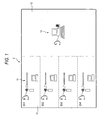
- An endoscopic diagnosing unit 2 includes, say, four operator's endoscopic diagnosing units 13 set up respectively in four examination rooms 10 where operators are to conduct endoscope diagnoses on subjects, and a director's endoscopic diagnosing unit 13 set up in a direction room 12 where a director 12 stays to gives directions for endoscopic diagnosis to the operators.
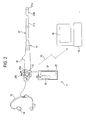
- the operator's endoscopic diagnosing unit 11 is constructed with an electronic endoscope 14, an operator's processor unit 15 for generating an endoscopic image, an operator's monitor 16 for displaying an endoscopic image, an operator's microphone 17 for capturing an operator's speech, and an operator's headset 19 having an operator's speaker 18 for outputting the operator's speech.
- the electronic endoscope 14 and the operator's processor unit 15 are to exchange signals by way of radio waves 20.
- the radio waves 20 have transmission/reception frequency bands that are different between the examination chambers 10, i.e. assigned with four channels (Ch 1 - 4, see Fig. 1).
- the electronic endoscope 14 has an insertion tube 21 for insertion into a subject body and an operation body 22 provided continuing from the base of the insertion tube 21.
- the insertion tube 21 has, at its tip end, a tip portion 21a incorporating therein an objective lens 23 for capturing image light from a point-under-observation of a subject body, a CCD 24 for picking up the image light, an illumination lens 25 and an LED 26 for illuminating a subject interior (see Fig. 3, on each).
- a flex portion 21b is provided by a connection of a plurality of flexion pieces.
- the flex portion 21b is to be bent up, down, left and light by pushing forward and backward a wire passed through the insertion tube 21b through operating an angle knob 22a provided at the operation body 22. This positions the tip portion 21a in a desired direction in a subject interior.
- a flexible non-rigid portion 21c is provided to bend in a desired direction along the insertion path into a subject.
- a cartridge 29 is removably provided incorporating therein a water reservoir tank 27 storing water and an air bombe 28 storing air.
- the water and air stored in the water reservoir tank 27 and air bombe 28 is to be ejected to the objective lens 23 through a cleaning nozzle (not shown), formed at the tip portion 21a, through a feed water pipe and feed air pipe arranged within the electronic endoscope 14, in response to the operation of a feed water/air button 21b on the operation body 22.
- This can remove the dirt, etc. put on the surface of the objective lens 23 and supply air to a subject interior.
- the cartridge 29 is arranged in a position the palm of an operator abuts upon using the electronic endoscope 14, thus serving also to stabilize the operationality of the electronic endoscope 14.
- reference character 30 designates a forceps port where to insert a manipulation tool.
- a CPU 40 is to take total control of the electronic endoscope 14 operation in its entirety.
- the CPU 40 is connected with a ROM 41 storing the various program and data to control the operation of the electronic endoscope 14.
- the CPU 40 is to read a required program or data out of the ROM 41 and performs operation control of the electronic endoscope 14.
- the lens motor 42 is placed under operation control of a drive section 43 connected to the CPU 40.
- the drive section 43 is to operate the lens motor 42 according to an operation input signal of from a zooming button (not shown) provided on the operation body 22 or to an operation input signal sent by way of a radio wave from a director's processor unit 70 (see Fig. 6).
- the LED 26 is connected to a drive section 44.
- the drive section 44 is to on-off drive the LED 26, under control of the CPU 40.
- the light emitted from the LED 26 is illuminated to a point-under-observation of a subject through the illumination lens 25.
- the LED 26 may be arranged not in the tip portion 21a but in the operation body 22 so that light can conduct through a light guide to the tip portion 21a.
- the CCD 24 is to focus on an image surface, the image light incoming from the point-under-observation of the subject through the objective lens 23, and output an image signal commensurate therewith from pixels thereof.
- An AFE 45 is to perform correlated double sampling, amplification and A/D conversion on the image signal inputted from the CCD 24, and convert the image signal into a digital video signal under control of the CPU 40.
- a modulating section 46 is to perform, say, digital orthogonal modulation on the digital video signal outputted from the AFE 45, and generate an RF signal that is a radiofrequency signal including a video signal and horizontal and vertical synchronization signals.
- the modulating section 46 is to output the generated RF signal to a data superposing section 47.
- a speech-signal processing section 48 is to perform various processes, such as A/D conversion and noise removal, on the operator's speech inputted through the operator's microphone 17, and generate a digital speech signal.
- the speech-signal processing section 48 is to output the generated speech signal to the data superposing section 47.
- the speech-signal processing section 48 is to perform various processes, such as noise removal and A/D conversion, on the speech signal demodulated by a demodulating section 52 as detailed later, and output a processed signal to an operator's speaker 18.
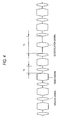
- the data superposing section 47 is to superpose the speech signal outputted from the speech-signal processing section 48 over a horizontal synchronization period Th of the RF signal generated at the modulating section 46. Meanwhile, the data superposing section 47 is to superpose an identification signal representative of a superposition with speech signal, over a vertical synchronization period Tv portion of the RF signal.
- the data superposing section 47 is not operative. Hence, the RF signal in this case is not superposed with speech and identification signals.
- a transmitting section 49 is to convert the RF signal outputted from the data superposing section 47 into a radio wave 20, and send it to the operator's processor unit 15 and director's processor unit 70 by way of an antenna 50 (see Fig. 6).
- a receiving section 51 is to convert the radio wave 76 (see also Fig. 6), received at the antenna 50 and sent from the director's processor unit 70, into an RF signal and to amplify it.
- the demodulating section 52 is to perform, say, digital orthogonal detection on the RF signal converted from the radio wave 76, and demodulate the speech signal superposed on the radio wave 76 and the operation input signal to the zooming button 100 (see Fig. 8).
- the demodulating section 52 is to output the demodulated speech signal and operation input signal to the speech-signal processing section 48 and CPU 40.
- a battery 54 is connected to a connector 53.
- the power of the battery 54 is supplied to the various sections of the electronic endoscope 14 from the power supply section 55 that is under control of the CPU 40.
- a battery chamber is provided in the rear of the operation body 22 in order to receive a battery 54 therein.
- the connector 53 is arranged in the chamber. Meanwhile, there is also provided a connector to which the operator's headset 19 is to be connected.
- a CPU 60 is to take total control of the operator's processor unit 15 operation in its entirety.
- the CPU 60 is connected with a ROM 61 storing the various programs and data to control the operation of the operator's processor unit 15.
- the CPU 60 is to read a required program or data out of the ROM 61 and takes operation control of the operator's processor unit 15.
- An antenna 62 is to receive a radio wave 20 from the electronic endoscope 14.
- a receiving section 63 is to convert the radio wave 20 received at the antenna 62 into an RF signal, and amplify it.
- a demodulating section 64 performs, say, digital orthogonal detection on the RF signal converted from the radio wave 20, thus demodulating the RF signal into a video signal in the form before modulated by the endoscope 14.
- a synchronization separating section 65 is to separate a synchronization signal out of the video signal demodulated at the demodulating section 64 by means of amplitude-based separation, and then separate horizontal and vertical synchronization signals therefrom by means of frequency-based separation.
- a video-signal generating section 66 is to generate a digital video signal from the video signal.
- a video-signal processing section 67 is to perform various signal processes, such as mask generation and character-information addition, on the video signal generated at the video-signal generating section 66.
- a buffer 68 is to once store the video signal that has been subjected to various signal processes at the video-signal processing section 67 and is to be displayed as an endoscopic image on the operator's monitor 16.
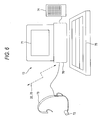
- the director's endoscopic diagnosing unit 13 is constructed with a director's processor unit 70 for generating an endoscopic image, a director's monitor 71 for displaying an endoscopic image, a director's headset 73 having a director's microphone 72 for capturing the speech of a director, a director's speaker 74 for outputting the speech of a director, and an operation input device 75.
- the director's processor unit 70 is to exchange signals with the electronic endoscope 14 by way of radio waves 20, 76.
- the radio wave 70 has a transmission/reception frequency band similar to that of the radio wave 20, which is to be switched over between four channels Ch 1 - 4.
- a CPU 80 is to take total operation control of the director's processor unit 70 operation in its entirety.
- the CPU 80 is connected with a ROM 81 storing the various programs and data to control the operation of the director's processor unit 70.
- the CPU 80 is to read a required program and data out of the ROM 81 and take operation control of the director's processor unit 70.
- An antenna 82 is to receive a radio wave 20 from the electronic endoscope 14 and send a radio wave 76 to the electronic endoscope 14.
- a receiving section 83 is to convert the radio wave 20 received at the antenna 82 into an RF signal and amplify it.
- a demodulating section 84 is to perform, say, digital orthogonal detection on the RF signal and demodulate the RF signal into a video signal in the form before modulated by the electronic endoscope 14. Meanwhile, the demodulating section 84 is to demodulate the speech signal superposed on the radio wave 20.
- a speech-signal processing section 85 is to perform various processes, such as A/D conversion and noise removal, on the director's speech inputted from the director's microphone 72, and output a digital speech signal.
- the speech-signal processing section 85 is, also, to perform various processes, such as noise removal and A/D conversion, on the speech signal demodulated by a demodulating section 84, and output a processed signal to the director's speaker 74.
- a modulating section 86 is to generate an RF signal which a dummy signal is applied to a video signal portion in Fig. 4.
- a data superposing section 87 is to superpose the speech signal outputted from the speech-signal processing section 85 and the operation input signal onto the zoom-operation button 100, over the horizontal synchronization period Th portion of the RF signal generated at the modulating section 86.
- the data superposing section 87 is to superimpose an identification signal representative of a superposition with speech and operation-input signals, over the vertical synchronization period Tv portion of the RF signal.
- the data superposing section 87 is not operative when there is no input of a speech to the director's microphone 72 or when the zooming button 100 is not pressed.
- the identification signals superposed at the data superposing sections 47, 87 are mutually different in value in order to be distinguished from each other.
- a transmitting section 88 is to convert an RF signal, outputted from the data superposing section 87, into a radio wave 76 and send it to the operator's processor unit 15 by way of an antenna 82.
- the elements of from the synchronization separating section 89 to the buffer 92 are similar in function to the counterpart elements of from the synchronization separating section 65 to the buffer 68 of the operator's processor unit 15, and hence omitted to explain.
- the operation input device 75 has a zooming button 100, a channel selector dial 101 and a display change button 102.
- the zooming button 100 is operated to change the zoom magnification of an endoscopic image being displayed fully on the screen.
- the channel selector dial 101 is operated to select a channel for the electronic endoscope 14 at which a speech is made effective on the split-screen display (see Figs. 9A and 9B) or a channel for the electronic endoscope 14 at which a radio wave 20 is given off to constitute an endoscopic image to be displayed fully on the screen (see Figs. 9A and 9B).
- the display change button 102 is operated to change over between split-screen display and full-screen display.
- the video-signal processing section 91 switches over the endoscopic image on display, i.e. endoscopic images separately between four electronic endoscopes 14 on the director's monitor 71 as shown in Fig. 9A, and display on the full screen, i.e. an endoscopic image only based on the electronic endoscope 14 whose channel is selected by the channel selector dial 101 as shown in Fig. 9B, in response to the operation on the display change button 102.
- the endoscopic diagnosing unit 11 not used, no display is made or a message is displayed indicative of no use, etc. on the relevant area of the split screen.
- the receiving section 83 receives radio waves 20 from the four electronic endoscopes 14 while switching over between those at a constant time interval. Meanwhile, when full screen is selected, a radio wave 20 is selectively received from the electronic endoscope 14 whose channel is selected by the channel selector dial 101. Namely, the endoscopic images on the split screen are given as an intermittent moving image having a frame rate commensurate with the switchover interval at the receiving section 83 while the endoscopic image on the full screen is given as a moving image having a frame rate equal to that shown on the relevant operator's monitor 16.
- the endoscopic image whose channel is selected by the channel selector dial 101 is framed by a bold-lined cursor 103.
- the channel selected by the channel selector dial 101 only is made effective so that the director's speaker 74 outputs the speech inputted to the operator's microphone 17. Meanwhile, at other channels not selected, no output is made effective through the director's speaker 74 even if a speech is input to the operator's microphone 17.
- the speech-input/output state is taken over even when full screen is selected, thus making effective only the operator's speech whose channel is selected by the channel selector dial 101. Those at the other channels are rendered ineffective.
- the transmitting section 88 sends a radio wave 76 to the operator's processor unit 15 whose channel 15 is selected by the channel selector dial 101.
- speech is effective only at the channel selected by the channel selector dial 101 so that the operator's speaker 19 outputs the speech inputted to the director's microphone 72.
- a speech even if inputted to the director's microphone 72 is ineffectively outputted through the operator's speaker 19.
- the speech input/output state is taken over even when full screen is selected. This makes effective only the director's speech whose channel is selected by the channel selector dial 101, making ineffective those at the other channels.
- zooming button 100 when split screen is selected, even if the zooming button 100 is operated, the lens motor 42 is ineffectively driven. Zooming is effective only at the channel selected by the channel selector dial 101 with full screen selected. In other words, communication is available between the operator and the director only at the channel selected by the channel selector dial 101.
- the electronic endoscope 14 and the director's processor unit 70 exchanges a radio wave 20 superposed with a speech signal and a radio wave 76 superimposed with speech and operation-input signals, according to half-duplex operation. Specifically, the CPU 40 of the electronic microscope 14 detects whether or not an identification signal is superposed on the RF signal converted at the receiving section 51.
- the data superposing section 47 is controlled in operation not to superpose a speech signal on the RF signal even if there is a speech input to the operator's microphone 17.
- the CPU 80 of the director's processor unit 70 controls the speech-signal processing section 85 not to output an operator's speech through the director's speaker 74 even if receiving a radio wave 20 superposed with a speech signal. Otherwise, it is detected whether or not an identification signal is superposed on the RF signal converted at the receiving section 83.
- the transmitting section 88 is controlled not to send a radio wave 76 even if a speech is inputted to the director's microphone 72 or even if the zooming button 100 is operated.
- the radio wave 76 is received also at the operator's processor unit 15, the operator's processor unit 15 is adapted not to process but to erase the RF signal whose identification signal has been detected. Processing is made only on the RF signal which is a conversion of the radio wave 20.
- the LED 26 When observing a subject interior by use of the endoscopic diagnosing system 2 thus constructed, the LED 26 is turned on. By inserting the insertion tube 21 in a body cavity, the endoscopic image through the CCD 24 is observed on the operator's monitor 16 while illuminating the body cavity.
- the image light of the point-under-observation of the subject, incoming through the objective lens 23, is focused on the image surface of the CCD 24 so that CCD 24 outputs an image signal.
- the AFE 45 performs a correlated double sampling, amplification and A/D conversion on the image signal outputted from the CCD 24 and converts it into a digital video signal.
- the video signal outputted from the AFE 45, is subjected to digital orthogonal modulation by the modulating section 46, to generate an RF signal.
- the generated RF signal is amplified at the transmitting section 49 and then sent as a radio wave at the antenna 20.
- the receiving section 63 converts the RF signal into an RF signal and amplifies the converted RF signal.
- the demodulating section 64 performs digital orthogonal detection on the amplified RF signal and demodulates it into a video signal in the form before modulated by the electronic endoscope 14.
- the video signal, demodulated by the demodulating section 64, is subjected to synchronizing separation by the synchronizing separation circuit 65 under control of the CPU 60 so that the video-signal generating section 66 can output a digital video signal.
- the video signal, outputted from the video-signal generating circuit 66, is subjected to various image processes at the video-signal processing circuit 67 and once stored in the buffer 68, thus being displayed as an endoscopic image on the operator's monitor 16.
- an endoscopic image is generated from the radio wave 20 similarly to the operator's processor unit 15.
- the generated endoscopic image is displayed on the director's monitor 71.
- the receiving section 83 receives radio waves 20, in order, from the four electronic endoscopes 14 at a constant time interval.
- the director's monitor 71 displays separately endoscopic images based on the four electronic endoscopes 14.
- the endoscopic image, selected by the channel selector dial 101, is framed with a cursor 103. This allows the director to positively grasp the situation of endoscopic diagnosis being conducted in each examination room 10.
- the receiving section 83 receives only a radio wave 20 fom the electronic endoscope 14 whose channel is selected by the channel selector dial 101.
- the director's monitor 71 displays only an endoscopic image based on the electronic endoscope 14 whose channel is selected by the channel selector dial 101. This allows the director to grasp, in detail, the situation of endoscopic diagnosis being conducted in each examination room 10.
- an endoscopic image is generated from the radio wave 20 according to the foregoing process.
- the director's processor unit 70 when the radio wave 20 is received at the antenna 82, an RF signal represented by the radio wave 20 is inputted to the demodulating section 84 via the receiving section 83.
- the demodulating section 84 demodulates it into the former form of video and speech signals.
- the demodulated video signal is turned into an endoscopic image through the processing similar to that of the operator's processor unit 15, and displayed fully on the screen of the director's monitor 71. Meanwhile, the demodulated speech signal is subjected to various processes at the speech-signal processing section 85 and outputted to the director's speaker 74. This allows the operator to make an inquiry to the director by use of the operator's microphone 17. The director can listen on the inquiry of from the operator, by use of the director's speaker 74.
- the director makes a speech input of an instruction for endoscopic diagnosis to the director's microphone 72.
- the director's speech inputted to the director's microphone 72, is subjected to various processes at the speech-signal processing section 85 and converted into a digital speech signal.
- the speech signal, digitized at the speech-signal processing section 85, is superposed on the horizontal synchronization period Th portion of a. dummy video signal generated at the modulating section 86 in a data superposing section 87 and sent as a radio wave 76 to the electronic endoscope 14 whose channel is selected by the channel selector dial 101 by way of the transmitting section 88 and the antenna 82.
- the demodulating section 52 demodulates it into the former dummy form of video and speech signals.
- the demodulated speech signal is subjected to various processes at the speech-signal processing section 48 and outputted to the operator's speaker 18.
- the dummy video signal is erased away without being processed. This allows the director to give an instruction to the operator by use of the director's microphone 72. The operator can listen on the director's instruction through the operator's speaker 18.
- the operation input signal to the zooming button 100 is outputted to the data superposing section 87 where it is superposed on the horizontal synchronization period Th portion of a dummy video signal generated at the modulating section 86 and sent as a radio wave 76 to the electronic endoscope 14 whose channel is selected by the channel selector dial 101 by way of the transmitting section 88 and the antenna 82.
- the demodulating section 52 demodulates it into the former dummy form of video and speech signals.
- the operation input signal, demodulated by the demodulating section 52, is inputted to the CPU 40.
- the drive section 43 operates the lens motor 42 according to the operation input signal. This allows the director, staying in the direction room 12 distant from the examination room 10, is allowed to change the zoom magnification as to the endoscopic image. Incidentally, where split screen has been selected, the radio wave 76 is not sent even if the director operates the zooming button 100.
- the electronic endoscope 14 controls the data superposing section 47 not to superpose a speech signal on the RF signal even if there is a speech input to the operator's microphone 17.
- the speech-signal processing section 85 is controlled not to output the operator's speech through the director's speaker 74 even if a radio wave 20 superposed with a speech signal is received. Otherwise, detection is made as to whether or not an identification signal is superposed on the RF signal converted at the receiving section 83.
- the transmitting section 88 is controlled not to send a radio wave even if the zooming button 100 is operated.
- This allows for sending/receiving a radio wave 20 superposed with a speech signal and a radio wave 76 superposed with speech and operation-input signals, according to half-duplex operation. Therefore, there is no need to prepare a frequency band separately from the radio waves 20, 76 in order to send/receive speech and operation-input signals. Thus, every signal can be sent and received in the common frequency band.
- This can architect an endoscopic diagnosing system 2 capable of using operator's endoscopic diagnosing units 11 greater in the number with assigned channels.
- character input devices such as keyboards may be provided for the units 11, 13 so that the characters inputted on the character input device can be displayed on the monitor 16, 71.
- the setting information may be provided for controlling the operation of the device, e.g. a receiving section of a radio wave 76 may be provided on the operator's processor unit 15, to send/receive various parameters (white balance, edge enhancement, etc.) for the video-signal processing section 67.
- the director's monitor 71 may be structured with a touch panel, to enable the director's monitor 71 to perform the function as imposed upon the operation input device 75 in the embodiment.
- full-screen display is satisfactorily switched to by touching an endoscopic image area where the director desires for full-screen display when display is based on split screens.
- the director's processor unit has a transmitting section that modulates an operation input signal, inputted by the operation input device, into a radio wave to transmit; and a display control section that switches over between split-screen display to display endoscopic images separately between a plurality of electronic endoscopes on the director's monitor and full-screen display to display one endoscopic image entirely on the director's monitor. This can monitor the entire part panoramically, thus allowing the director to give a correct direction to the operators. Besides, by sending and receiving radio waves according to half-duplex operation, every signal can be sent and received in the common frequency band.
Landscapes
- Health & Medical Sciences (AREA)
- Life Sciences & Earth Sciences (AREA)
- Engineering & Computer Science (AREA)
- Surgery (AREA)
- Physics & Mathematics (AREA)
- General Health & Medical Sciences (AREA)
- Medical Informatics (AREA)
- Molecular Biology (AREA)
- Biophysics (AREA)
- Animal Behavior & Ethology (AREA)
- Public Health (AREA)
- Pathology (AREA)
- Radiology & Medical Imaging (AREA)
- Veterinary Medicine (AREA)
- Biomedical Technology (AREA)
- Heart & Thoracic Surgery (AREA)
- Optics & Photonics (AREA)
- Nuclear Medicine, Radiotherapy & Molecular Imaging (AREA)
- General Physics & Mathematics (AREA)
- Computer Networks & Wireless Communication (AREA)
- Mathematical Analysis (AREA)
- Mathematical Physics (AREA)
- Chemical & Material Sciences (AREA)
- Medicinal Chemistry (AREA)
- Algebra (AREA)
- Computational Mathematics (AREA)
- Multimedia (AREA)
- Signal Processing (AREA)
- Mathematical Optimization (AREA)
- Pulmonology (AREA)
- Pure & Applied Mathematics (AREA)
- Business, Economics & Management (AREA)
- Educational Administration (AREA)
- Educational Technology (AREA)
- Theoretical Computer Science (AREA)
- Endoscopes (AREA)
- Instruments For Viewing The Inside Of Hollow Bodies (AREA)
Applications Claiming Priority (1)
| Application Number | Priority Date | Filing Date | Title |
|---|---|---|---|
| JP2006217875A JP4880398B2 (ja) | 2006-08-10 | 2006-08-10 | 内視鏡診断システム |
Publications (2)
| Publication Number | Publication Date |
|---|---|
| EP1929933A2 true EP1929933A2 (de) | 2008-06-11 |
| EP1929933A3 EP1929933A3 (de) | 2008-07-16 |
Family
ID=39172002
Family Applications (1)
| Application Number | Title | Priority Date | Filing Date |
|---|---|---|---|
| EP07014110A Withdrawn EP1929933A3 (de) | 2006-08-10 | 2007-07-18 | Endoskopisches Diagnosesystem |
Country Status (3)
| Country | Link |
|---|---|
| US (1) | US20080183040A1 (de) |
| EP (1) | EP1929933A3 (de) |
| JP (1) | JP4880398B2 (de) |
Cited By (6)
| Publication number | Priority date | Publication date | Assignee | Title |
|---|---|---|---|---|
| EP2087833A3 (de) * | 2008-02-05 | 2009-09-09 | Olympus Medical Systems Corporation | Medizinisches Unterstützungssteuerungssystem |
| EP2296359A4 (de) * | 2008-06-30 | 2011-12-07 | Olympus Corp | Drahtloses kommunikationssystem mit einem empfänger und bildsender und drahtloses kommunikationsverfahren dafür |
| US8219859B2 (en) | 2008-02-19 | 2012-07-10 | Olympus Medical Systems Corp. | Medical support control system |
| EP2719318A1 (de) * | 2012-10-11 | 2014-04-16 | Karl Storz Imaging Inc. | Automatischer Zoom für Videokamera |
| US10565977B1 (en) | 2018-08-20 | 2020-02-18 | Verb Surgical Inc. | Surgical tool having integrated microphones |
| US11446113B2 (en) | 2018-09-11 | 2022-09-20 | Sony Corporation | Surgery support system, display control device, and display control method |
Families Citing this family (3)
| Publication number | Priority date | Publication date | Assignee | Title |
|---|---|---|---|---|
| JP5558033B2 (ja) * | 2009-06-10 | 2014-07-23 | オリンパス株式会社 | 無線内視鏡装置およびその受信装置、受信方法、受信プログラム |
| DE102009060500B4 (de) * | 2009-12-22 | 2015-12-17 | Xion Gmbh | Verfahren zur stroboskopischen Untersuchung sich wiederholender Vorgänge und Anordnung zum Betreiben dieses Verfahrens |
| JP6289755B2 (ja) * | 2015-06-18 | 2018-03-07 | オリンパス株式会社 | 医療システム |
Citations (3)
| Publication number | Priority date | Publication date | Assignee | Title |
|---|---|---|---|---|
| JP2000271147A (ja) | 1999-03-19 | 2000-10-03 | Olympus Optical Co Ltd | 遠隔手術支援システム |
| JP2005111080A (ja) | 2003-10-09 | 2005-04-28 | Olympus Corp | 手術支援システム |
| JP2005118232A (ja) | 2003-10-15 | 2005-05-12 | Olympus Corp | 手術支援システム |
Family Cites Families (16)
| Publication number | Priority date | Publication date | Assignee | Title |
|---|---|---|---|---|
| JPS5645629A (en) * | 1979-09-20 | 1981-04-25 | Olympus Optical Co | System for transmitting data of endoscope |
| US5751341A (en) * | 1993-01-05 | 1998-05-12 | Vista Medical Technologies, Inc. | Stereoscopic endoscope system |
| US6384868B1 (en) * | 1997-07-09 | 2002-05-07 | Kabushiki Kaisha Toshiba | Multi-screen display apparatus and video switching processing apparatus |
| US6490490B1 (en) * | 1998-11-09 | 2002-12-03 | Olympus Optical Co., Ltd. | Remote operation support system and method |
| JP2001008190A (ja) * | 1999-06-18 | 2001-01-12 | Canon Inc | 映像伝送システム並びに無線通信装置及び方法 |
| JP2001353124A (ja) * | 2000-04-10 | 2001-12-25 | Olympus Optical Co Ltd | 内視鏡装置 |
| JP2002017666A (ja) * | 2000-06-30 | 2002-01-22 | Olympus Optical Co Ltd | 簡易型内視鏡画像音声送受信装置 |
| ATE495703T1 (de) * | 2000-11-28 | 2011-02-15 | Intuitive Surgical Operations | Endoskopischer stabilisator für das schlagende herz und gefässokklusionsverschluss |
| JP2003010112A (ja) * | 2001-06-28 | 2003-01-14 | Olympus Optical Co Ltd | 内視鏡システム |
| US20030046109A1 (en) * | 2001-08-30 | 2003-03-06 | Olympus Optical Co., Ltd. | Medical information system for improving efficiency of clinical record creating operations |
| US20040073455A1 (en) * | 2002-05-08 | 2004-04-15 | University Of Rochester Medical Center | Child care telehealth access network |
| JP4187508B2 (ja) * | 2002-11-12 | 2008-11-26 | フジノン株式会社 | 電子内視鏡装置 |
| JP2004181229A (ja) * | 2002-11-20 | 2004-07-02 | Olympus Corp | 遠隔手術支援システム及び支援方法 |
| EP1800594A1 (de) * | 2003-08-22 | 2007-06-27 | Olympus Corporation | Vorrichtung zum Erkennen einer Endoskopform |
| US8069420B2 (en) * | 2004-12-29 | 2011-11-29 | Karl Storz Endoscopy-America, Inc. | System for controlling the communication of medical imaging data |
| JP2007097653A (ja) * | 2005-09-30 | 2007-04-19 | Fujinon Corp | 内視鏡診断システム |
-
2006
- 2006-08-10 JP JP2006217875A patent/JP4880398B2/ja not_active Expired - Fee Related
-
2007
- 2007-07-18 EP EP07014110A patent/EP1929933A3/de not_active Withdrawn
- 2007-07-30 US US11/882,042 patent/US20080183040A1/en not_active Abandoned
Patent Citations (3)
| Publication number | Priority date | Publication date | Assignee | Title |
|---|---|---|---|---|
| JP2000271147A (ja) | 1999-03-19 | 2000-10-03 | Olympus Optical Co Ltd | 遠隔手術支援システム |
| JP2005111080A (ja) | 2003-10-09 | 2005-04-28 | Olympus Corp | 手術支援システム |
| JP2005118232A (ja) | 2003-10-15 | 2005-05-12 | Olympus Corp | 手術支援システム |
Cited By (10)
| Publication number | Priority date | Publication date | Assignee | Title |
|---|---|---|---|---|
| EP2087833A3 (de) * | 2008-02-05 | 2009-09-09 | Olympus Medical Systems Corporation | Medizinisches Unterstützungssteuerungssystem |
| US8219859B2 (en) | 2008-02-19 | 2012-07-10 | Olympus Medical Systems Corp. | Medical support control system |
| EP2296359A4 (de) * | 2008-06-30 | 2011-12-07 | Olympus Corp | Drahtloses kommunikationssystem mit einem empfänger und bildsender und drahtloses kommunikationsverfahren dafür |
| EP2719318A1 (de) * | 2012-10-11 | 2014-04-16 | Karl Storz Imaging Inc. | Automatischer Zoom für Videokamera |
| US9060674B2 (en) | 2012-10-11 | 2015-06-23 | Karl Storz Imaging, Inc. | Auto zoom for video camera |
| US9687140B2 (en) | 2012-10-11 | 2017-06-27 | Karl Storz Imaging, Inc. | Auto zoom for video camera |
| US10565977B1 (en) | 2018-08-20 | 2020-02-18 | Verb Surgical Inc. | Surgical tool having integrated microphones |
| US11723515B2 (en) | 2018-08-20 | 2023-08-15 | Verb Surgical Inc. | Surgical tool having integrated microphones |
| US12539017B2 (en) | 2018-08-20 | 2026-02-03 | Verb Surgical Inc. | Surgical tool having integrated microphones |
| US11446113B2 (en) | 2018-09-11 | 2022-09-20 | Sony Corporation | Surgery support system, display control device, and display control method |
Also Published As
| Publication number | Publication date |
|---|---|
| JP2008036318A (ja) | 2008-02-21 |
| US20080183040A1 (en) | 2008-07-31 |
| JP4880398B2 (ja) | 2012-02-22 |
| EP1929933A3 (de) | 2008-07-16 |
Similar Documents
| Publication | Publication Date | Title |
|---|---|---|
| EP1929933A2 (de) | Endoskopisches Diagnosesystem | |
| US7485115B2 (en) | Remote operation support system and method | |
| US20050149001A1 (en) | Operation support system and support method of operation support system | |
| US8764634B2 (en) | Imaging apparatus | |
| US6950691B2 (en) | Surgery support system and surgery support method | |
| CN103458760B (zh) | 无线影像传输系统以及发送装置 | |
| JP2005169009A (ja) | 内視鏡システム、及び内視鏡 | |
| EP2719318B1 (de) | Automatischer Zoom für Videokamera | |
| JP6234638B2 (ja) | ビデオプロセッサ | |
| JP2010035637A (ja) | 画像表示装置およびこれを用いた内視鏡システム | |
| EP1723897B1 (de) | Endoskopsystem; endoskopvorrichtung und bilddarstellungsverfahren | |
| JP2000271147A (ja) | 遠隔手術支援システム | |
| US7758496B2 (en) | Diagnostic system using endoscope | |
| US20090213140A1 (en) | Medical support control system | |
| EP3641296A1 (de) | Bildverarbeitungsvorrichtung, bildverarbeitungsverfahren und bilderfassungssystem | |
| US20060241418A1 (en) | Electronic endoscope system | |
| JP2011167332A (ja) | 遠隔医療用電子内視鏡システム | |
| JP2009039249A (ja) | 内視鏡システム | |
| US9782060B2 (en) | Medical system | |
| JP3762612B2 (ja) | 医療システム及び内視鏡装置 | |
| JP2009178542A (ja) | 医療支援制御装置 | |
| JP2000245738A (ja) | 遠隔手術支援システム | |
| JP3766598B2 (ja) | 観察システム | |
| JP2005143918A (ja) | 遠隔手術支援システム | |
| JP2000271081A (ja) | 内視鏡カメラ視野制御方法 |
Legal Events
| Date | Code | Title | Description |
|---|---|---|---|
| PUAI | Public reference made under article 153(3) epc to a published international application that has entered the european phase |
Free format text: ORIGINAL CODE: 0009012 |
|
| 17P | Request for examination filed |
Effective date: 20070718 |
|
| AK | Designated contracting states |
Kind code of ref document: A2 Designated state(s): AT BE BG CH CY CZ DE DK EE ES FI FR GB GR HU IE IS IT LI LT LU LV MC MT NL PL PT RO SE SI SK TR |
|
| AX | Request for extension of the european patent |
Extension state: AL BA HR MK RS |
|
| PUAL | Search report despatched |
Free format text: ORIGINAL CODE: 0009013 |
|
| AK | Designated contracting states |
Kind code of ref document: A3 Designated state(s): AT BE BG CH CY CZ DE DK EE ES FI FR GB GR HU IE IS IT LI LT LU LV MC MT NL PL PT RO SE SI SK TR |
|
| AX | Request for extension of the european patent |
Extension state: AL BA HR MK RS |
|
| RIC1 | Information provided on ipc code assigned before grant |
Ipc: G06F 19/00 20060101ALI20080611BHEP Ipc: G09B 23/28 20060101ALI20080611BHEP Ipc: A61B 19/00 20060101ALI20080611BHEP Ipc: A61B 5/00 20060101ALI20080611BHEP Ipc: A61B 1/05 20060101AFI20080507BHEP |
|
| AKX | Designation fees paid |
Designated state(s): AT BE BG CH CY CZ DE DK EE ES FI FR GB GR HU IE IS IT LI LT LU LV MC MT NL PL PT RO SE SI SK TR |
|
| RAP1 | Party data changed (applicant data changed or rights of an application transferred) |
Owner name: FUJIFILM CORPORATION |
|
| STAA | Information on the status of an ep patent application or granted ep patent |
Free format text: STATUS: THE APPLICATION IS DEEMED TO BE WITHDRAWN |
|
| 18D | Application deemed to be withdrawn |
Effective date: 20140201 |