EP1930251A1 - Emballage blister avec sécurité enfant - Google Patents
Emballage blister avec sécurité enfant Download PDFInfo
- Publication number
- EP1930251A1 EP1930251A1 EP06125426A EP06125426A EP1930251A1 EP 1930251 A1 EP1930251 A1 EP 1930251A1 EP 06125426 A EP06125426 A EP 06125426A EP 06125426 A EP06125426 A EP 06125426A EP 1930251 A1 EP1930251 A1 EP 1930251A1
- Authority
- EP
- European Patent Office
- Prior art keywords
- segments
- blister
- segment
- securing
- section
- Prior art date
- Legal status (The legal status is an assumption and is not a legal conclusion. Google has not performed a legal analysis and makes no representation as to the accuracy of the status listed.)
- Granted
Links
Images





Classifications
-
- B—PERFORMING OPERATIONS; TRANSPORTING
- B65—CONVEYING; PACKING; STORING; HANDLING THIN OR FILAMENTARY MATERIAL
- B65D—CONTAINERS FOR STORAGE OR TRANSPORT OF ARTICLES OR MATERIALS, e.g. BAGS, BARRELS, BOTTLES, BOXES, CANS, CARTONS, CRATES, DRUMS, JARS, TANKS, HOPPERS, FORWARDING CONTAINERS; ACCESSORIES, CLOSURES, OR FITTINGS THEREFOR; PACKAGING ELEMENTS; PACKAGES
- B65D75/00—Packages comprising articles or materials partially or wholly enclosed in strips, sheets, blanks, tubes or webs of flexible sheet material, e.g. in folded wrappers
- B65D75/28—Articles or materials wholly enclosed in composite wrappers, i.e. wrappers formed by associating or interconnecting two or more sheets or blanks
- B65D75/30—Articles or materials enclosed between two opposed sheets or blanks having their margins united, e.g. by pressure-sensitive adhesive, crimping, heat-sealing, or welding
- B65D75/32—Articles or materials enclosed between two opposed sheets or blanks having their margins united, e.g. by pressure-sensitive adhesive, crimping, heat-sealing, or welding one or both sheets or blanks being recessed to accommodate contents
- B65D75/325—Articles or materials enclosed between two opposed sheets or blanks having their margins united, e.g. by pressure-sensitive adhesive, crimping, heat-sealing, or welding one or both sheets or blanks being recessed to accommodate contents one sheet being recessed, and the other being a flat not- rigid sheet, e.g. puncturable or peelable foil
- B65D75/327—Articles or materials enclosed between two opposed sheets or blanks having their margins united, e.g. by pressure-sensitive adhesive, crimping, heat-sealing, or welding one or both sheets or blanks being recessed to accommodate contents one sheet being recessed, and the other being a flat not- rigid sheet, e.g. puncturable or peelable foil and forming several compartments
-
- B—PERFORMING OPERATIONS; TRANSPORTING
- B65—CONVEYING; PACKING; STORING; HANDLING THIN OR FILAMENTARY MATERIAL
- B65D—CONTAINERS FOR STORAGE OR TRANSPORT OF ARTICLES OR MATERIALS, e.g. BAGS, BARRELS, BOTTLES, BOXES, CANS, CARTONS, CRATES, DRUMS, JARS, TANKS, HOPPERS, FORWARDING CONTAINERS; ACCESSORIES, CLOSURES, OR FITTINGS THEREFOR; PACKAGING ELEMENTS; PACKAGES
- B65D2215/00—Child-proof means
- B65D2215/04—Child-proof means requiring the combination of different actions in succession
Definitions
- the invention relates to a blister pack having the features of the preamble of claim 1.
- blisters for packaging medicines in the form of tablets, capsules, dragees, etc. may be used.
- the blisters consist of a provided with wells for receiving packaged carrier sheet and a pressure-sensitive flat cover sheet. To remove the packaged goods this is pushed through the cover sheet in a the cup associated pressing-through. These packages are intended to make access to the packaged goods for children more difficult.
- a generic comparable blister pack describes, for example, the US 2004/0188312 A1 ,
- the blister pack shown therein consists essentially of a front portion forming a first portion with recesses for receiving the wells of the blister, a second, the back forming portion and a central portion which is disposed between the blister and the second portion.
- Removable barrier segments are arranged on the second section, each covering a recess for packaged goods or a corresponding push-through region of a cover film of the blister. These blocking segments are firmly connected by adhesive bonding with also separable individual segments of the central portion.
- On the front first section are D-shaped push tabs.
- a blocking segment By pressing on this D-shaped segment, a blocking segment can be partially separated from the rear section and finally torn away.
- the push-through area is now free and the packaged goods can be pushed out.
- the push-through segments not without can be pressed further, they are protected on the back of the blister pack by tear-off segments.
- These segments are arranged in rows on the second section, each segment being associated with a push-through segment. Only after such a segment has been torn away, a push-through segment for partially pushing out the locking segment according to the functional description can be pressed.
- a tear-off band is provided at a front end of the row of tear-off segments, which is to tear away for releasing the subsequent segments first and foremost.
- a blister pack having the features of claim 1.
- the essential components of the blister packaging are the bottom portion and the blister portion, which are each preferably formed flat.
- the cost of materials for the blister pack is therefore low.
- the blister pack could be designed as a blister card, as a blister wallet (this would require at least one lid section) or even as a box be.
- the use of the locking segments according to the invention and securing segments ensures a high degree of child safety. Since only after at least partial separation of the securing segments a pressurization for the first step for separating the blocking segments from the bottom portion is possible, the operation of the opening process for pushing through packaged for children is difficult to see.
- Another advantage of the blister packaging is that the bottom portion and the blister portion only have to be connected together in an outer edge region.
- This fixation may preferably be an adhesive bond.
- the bonding can preferably take place in a peripheral edge region.
- the securing segments may be at least partially separable from the plane of the blister section by pressure from the rear side.
- the fuse segments could possibly also be replaced elsewhere.
- a respective cutout for peeling off or peeling off the securing segment adjoins each securing segment.
- Such recesses would be designed such that they would enable intervention by means of fingernails on an edge region of a securing segment.
- the securing segments can be folding sections which can be opened out of the plane of the blister section.
- a flap section may be a type of flag that can be easily grasped and unfolded.
- the flap sections can each be formed by approximately U-shaped perforation lines. In principle, however, other non-closed weakening lines would be conceivable.
- the ends of these perforation lines or weakening lines define a folding line about which the folding section can be opened. The folding line could be given to improve the folding behavior by a fold line.
- the securing segments may be formed by a closed perforation line arrangement which is subdivided into two differently perforated perforated line sections.
- a first perforation line section has a weaker perforation, whereby the safety segment in this area is easily depressible for a first Abpeel step.
- a second perforation line section has a stronger perforation compared to the first perforation line section.
- This perforation line arrangement leads to an advantageous operation guidance, since the user would first act on the security segment intuitively in the area of the weaker perforation.
- the stronger perforation in the second Perforationslinienabites only serves to ensure that a partially unfolded fuse segment can be completely demolished.
- the perforation line arrangement can be achieved, for example, such that, for the weaker perforation, the webs between the perforation cuts are shorter than the corresponding webs in the stronger perforation.
- folding sections do not necessarily have to be designed only hinged.
- the securing segments, in particular the flap sections could possibly also be formed by respective closed perforation lines.
- the ends of the U-shaped perforation lines could be connected by weakening webs, whereby the flap portion after the Unfolding could easily be completely severed or demolished.
- a folding portion is hinged about a folding line, which extends in a plan view preferably approximately centrally through the blocking segment.
- this rollover line does not have to be exactly above a center line of the ratchet segment.
- the folding line may define a front end of an overlapping area between the blocking segment and the securing segment. This overlap region defines an engagement surface on the blocking segment, which is preferably sufficiently large that it can be acted upon by a finger in an efficient manner. The handling can be simplified and in particular the senior friendliness of the packaging can be increased.
- the bottom section further comprises push-through segments lying below the securing segments and which can be pressed in from the rear side.
- the securing segment By pressing on a respective push-through segment, the securing segment can be partially separated, wherein it can be folded out, in particular in the embodiment as a folding section. If at most lower demands are placed on the parental control, it could simply be provided instead of naturaldgursegmente corresponding recesses.
- a push-through segment in the plan view for complete coverage is in each case surrounded by a securing segment, a push-through segment lying flat against a front end region of the securing segment facing away from the folding line.
- a securing segment in the plan view covers each part of a locking segment and completely covers a push-through segment. Such an arrangement has a favorable effect on the handling of the blister pack.
- the blocking segments and / or the push-through segments can each be formed by closed perforation lines or other weakening lines.
- the push-through segments are designed as folding parts. In this case, they could be given by a U-shaped perforation line.
- the perforation lines for the barrier segments and the push-through segments can be separated from each other. Since the blocking segments and the push-through segments are thus formed as separate segments on the bottom section, it is ensured that unintentional multiple openings can be prevented.
- the blister portion and the bottom portion may be formed as separate sheet-like components. However, it may be advantageous if the blister pack consists of a single blank of cardboard or paperboard laminate. Of course, the blank could also be made of plastic.
- the respective segments i. the blocking segments, the securing segments and the push-through segments can be arranged mirror-symmetrically, whereby commercial blisters with two parallel rows of wells can be advantageously packaged in a simple manner.
- Another aspect of the invention relates to a blank for the previously described blister pack.
- the cut has a blister portion and a bottom portion separated by a fold line.
- the blank could further comprise a lid portion with which the blister portion would be covered to protect the cups.
- This lid section would also be separated by a fold line from the blister section or blister bottom section (Blisterwallet).
- a second cover section could connect to the cover section, with which even the bottom section would be covered.
- FIG. 1 shows a blank 17 for a blister pack.
- the blank 17 consists of a blister section 5 and a bottom section 6, which are separated by a fold line 16. By folding over the fold line 16, a blister can be sandwiched between these sections.
- F is a front side and R is a back side.
- a plurality of circular recesses can be seen, in which wells of a blister can be received.
- Respectively laterally next to each recess 10 securing segments 8 are arranged, which are each formed by U-shaped perforation lines.
- blocking segments 7 and push-through segments 9 are arranged, which are each predetermined by closed perforation lines 14 and 15.
- a push-through segment is designed only as a folding section. In this case, one would provide a non-closed perforation line, with their ends each specify a folding line.
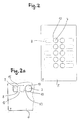
- FIG. 2 shows a plan view of the front side F of the Blisterabitess 5, wherein the bottom portion has been folded over the fold line.
- a portion of the locking segments 7 can be seen, which block a push-through area for packaged a cover sheet of a blister.
- FIG. 2a shows how the individual segments are arranged one above the other in the folded-over state.
- the actually hidden or partially hidden perforation lines 15 and 14 are also shown.
- the push-through segment 9 is obviously surrounded by the fuse segment 8 and thus completely covered.
- a front region of the securing segment 8 lies flat over the push-through segment 9.
- the ends of the perforation line 12 are connected to one another by a folding line indicated by 13.
- This folding line 13 can be, for example, by a fold line created with corresponding tools. However, such processing is not absolutely necessary because a folding line would automatically result when folding the securing segment 8.
- the securing segment 8 overlaps the blocking segment, the folding line 13 extending approximately centrally through the blocking segment 7.
- the overlapping area between the blocking segment 7 and the securing segment 8 defines an engagement surface which is sufficiently large to be selected so that efficient pressure can be exerted on the blocking segment 7 with one finger in this area. The mode of operation for opening the blister pack is described below with reference to FIG FIGS. 3 to 6 shown.
- FIG. 3 a blister pack 1 for a blister 2 is shown in which the blister is sandwiched between the blister section 5 and the bottom section 6. In each case a cup 3 of the blister is performed through the recess 10.
- the blister 2 consists essentially of a carrier film 4 provided with a plurality of cups 3 for receiving packaged goods 18 and a cover film 11 closing the cups.
- the carrier film 4 is generally made of a transparent or non-transparent plastic; the cover sheet 11 consists for example of aluminum, paper, a laminate or other suitable material through which packaged goods can be pushed through. From the rest position according to FIG. 3 It can be seen that the blocking segment 7 in each case covers a push-through region of the cover film 11 for the packaged product 18.
- the blocking segment 7 In order to separate the blocking segment 7 in order to create a removal position, in a first step, the blocking segment would have to be partially separated from the bottom section by pressure from the front side F, whereby it would be able to be torn away in a second step (cf. Fig. 5 ). As can be seen, however, this is prevented by the securing segment 8 in the blister section 5.
- FIG. 4 As can be seen, for example, a user first has to exert pressure on the push-through segment 9 from the back R with one finger, for example, whereby the securing segment 8 is partially separated from the plane of the blister section 5.
- the securing segment 8 is a flag-like folding section which can be opened by the folding line indicated by 13. This flap section can then be opened further from the front side F, as a result of which the blocking segment 7 is partially released. Now it can be pushed out from the front F on the shared side. This step is in FIG. 5 shown.
- the blocking segment is partially separated from the bottom section 6 in a first step.
- usually the locking segment 7 is only slightly unfolded.
- the free end of the locking segment 7 could now be detected and then the locking segment be torn away.
- the push-through area in the region of the cover film 11 for pushing through the packaged product 18 would then be exposed.
- FIG. 5 Furthermore, the push-through segment has been completely detached, whereby a through opening 22 in the bottom portion 6 is formed.
- FIG. 6 shows the blister pack 1 in the removal position.
- the packaged product 18 has already been pushed through the cover film 11.
- the blocking segment has been completely detached.
- such a complete detachment of the barrier segment is not necessarily required for the removal of the packaged goods would be necessary. An unfolding of the barrier segment would suffice per se.
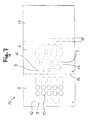
- the blank 17 according to FIG. 7 differs from the blank according to FIG. 1 merely in that in addition a lid portion 19 is provided for covering the cups.
- the lid portion 19 is connected via a hinge strip with the bottom portion 6.
- the hinge strip is defined by the two fold lines 20.
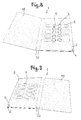
- FIGS. 8 and 9 is a front view and a rear view of an open blister pack 1 to see, for this purpose, the blank according to the previous FIG. 7 has been used.
- FIG. 8 For example, it can be seen that tablets 18 are inserted into the cups 3 in each case.
- other packaged goods for medical applications or other applications could be included in the blister.
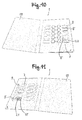
- FIG. 10 are different unfolded fuse segments 8 recognizable.
- a designated with 8 'fuse segment is only slightly unfolded; a designated with 8 '' fuse segment is opened almost to a folding angle of 90 °.
- the opening 22 created by the at least partial detachment of the push-through segment as well as a part of the locking segment 7 can be seen.
- FIG. 11 is shown with a 9 'Durchdschreibsegment shown, which was not completely detached, but only folded. On the other hand, the blocking segment was completely detached, resulting in a clear view through the opening 21 on the blister. So is about in FIG. 11 a cover sheet 11 'destroyed as a result of crushing.
- FIG. 12 Another embodiment of a blank 17 for a blister pack is shown in FIG. 12 shown.
- no push-through segments are provided in the bottom section.
- the locking segments 7 in the bottom portion 6 substantially correspond to those of the previous embodiments.
- the securing segments 8 are therefore not separable from the plane of the blister section 5 by pressure from the rear side.
- the detachment of the fuse segments 8 is in FIG. 12 with the help of recesses 24 allows.
- each securing segment is adjoined laterally by a recess 24 which allows the securing segment 8 to be peeled out by means of fingernails.
- FIG. 13 a blank 17 for a box-like blister pack is shown.
- the blank 17 has a box bottom section 25, to which each laterally separated by fold lines web sections connect to form a prismatic hollow side wall.
- a lid box section 26 To close the box is a lid box section 26.
- Such boxes are (but without child safety), for example, from WO 2006/040230 known.
- the securing segment 8 is formed by a closed perforation line 12, whereby it can be demolished.
- the perforation lines 12, 14 and 15 are designed in a special way (see. Fig. 14 ).
- FIG. 14 shows details of the perforation lines for the individual segments 7, 8 and 9.
- the securing segment 12 is subdivided into two differently perforated perforated line sections.
- a first perforation line section 12 ' has a weaker perforation, as a result of which the safety segment can easily be pressed in this area for a first peeling-off step.
- a second perforation line section 12 '' has a - compared to the first perforation line section 12 '- stronger perforation. This perforation is designed so that this area can not be pressed in, but only torn off.
- the stronger perforation in the second perforation line section 12 '' serves to allow a partially unfolded safety segment to be completely torn off.
Landscapes
- Chemical & Material Sciences (AREA)
- Composite Materials (AREA)
- Engineering & Computer Science (AREA)
- Mechanical Engineering (AREA)
- Packages (AREA)
- Medical Preparation Storing Or Oral Administration Devices (AREA)
- Bag Frames (AREA)
Priority Applications (5)
| Application Number | Priority Date | Filing Date | Title |
|---|---|---|---|
| EP06125426A EP1930251B1 (fr) | 2006-12-05 | 2006-12-05 | Emballage blister avec sécurité enfant |
| DK06125426T DK1930251T3 (da) | 2006-12-05 | 2006-12-05 | Blisterpakning med börnesikring |
| AT06125426T ATE428652T1 (de) | 2006-12-05 | 2006-12-05 | Blisterverpackung mit kindersicherung |
| ES06125426T ES2323543T3 (es) | 2006-12-05 | 2006-12-05 | Embalaje blister con proteccion para niños. |
| DE502006003485T DE502006003485D1 (de) | 2006-12-05 | 2006-12-05 | Blisterverpackung mit Kindersicherung |
Applications Claiming Priority (1)
| Application Number | Priority Date | Filing Date | Title |
|---|---|---|---|
| EP06125426A EP1930251B1 (fr) | 2006-12-05 | 2006-12-05 | Emballage blister avec sécurité enfant |
Publications (2)
| Publication Number | Publication Date |
|---|---|
| EP1930251A1 true EP1930251A1 (fr) | 2008-06-11 |
| EP1930251B1 EP1930251B1 (fr) | 2009-04-15 |
Family
ID=37744093
Family Applications (1)
| Application Number | Title | Priority Date | Filing Date |
|---|---|---|---|
| EP06125426A Active EP1930251B1 (fr) | 2006-12-05 | 2006-12-05 | Emballage blister avec sécurité enfant |
Country Status (5)
| Country | Link |
|---|---|
| EP (1) | EP1930251B1 (fr) |
| AT (1) | ATE428652T1 (fr) |
| DE (1) | DE502006003485D1 (fr) |
| DK (1) | DK1930251T3 (fr) |
| ES (1) | ES2323543T3 (fr) |
Cited By (3)
| Publication number | Priority date | Publication date | Assignee | Title |
|---|---|---|---|---|
| US7779614B1 (en) | 2007-05-30 | 2010-08-24 | Walgreen Co. | Method of loading a multi-dose blister card using intermediate blister cards |
| US7866476B2 (en) | 2007-05-30 | 2011-01-11 | Walgreen Co. | Multi-dose blister card pillbook |
| US8251219B1 (en) | 2007-10-22 | 2012-08-28 | Walgreen Co. | Package for medicine |
Citations (3)
| Publication number | Priority date | Publication date | Assignee | Title |
|---|---|---|---|---|
| US20040188312A1 (en) * | 2003-03-28 | 2004-09-30 | Shorewood Packaging Corporation | 024340 Childproof blister pack card |
| CA2436335A1 (fr) * | 2003-07-30 | 2005-01-30 | Thomas D. Intini | Emballage ameliore a ouverture pliable et pelable et a delamination controlable |
| EP1674408A1 (fr) * | 2004-12-23 | 2006-06-28 | Dividella AG | Emballage alvéolé, du type blister |
-
2006
- 2006-12-05 ES ES06125426T patent/ES2323543T3/es active Active
- 2006-12-05 DE DE502006003485T patent/DE502006003485D1/de active Active
- 2006-12-05 EP EP06125426A patent/EP1930251B1/fr active Active
- 2006-12-05 AT AT06125426T patent/ATE428652T1/de active
- 2006-12-05 DK DK06125426T patent/DK1930251T3/da active
Patent Citations (3)
| Publication number | Priority date | Publication date | Assignee | Title |
|---|---|---|---|---|
| US20040188312A1 (en) * | 2003-03-28 | 2004-09-30 | Shorewood Packaging Corporation | 024340 Childproof blister pack card |
| CA2436335A1 (fr) * | 2003-07-30 | 2005-01-30 | Thomas D. Intini | Emballage ameliore a ouverture pliable et pelable et a delamination controlable |
| EP1674408A1 (fr) * | 2004-12-23 | 2006-06-28 | Dividella AG | Emballage alvéolé, du type blister |
Cited By (8)
| Publication number | Priority date | Publication date | Assignee | Title |
|---|---|---|---|---|
| US7779614B1 (en) | 2007-05-30 | 2010-08-24 | Walgreen Co. | Method of loading a multi-dose blister card using intermediate blister cards |
| US7818950B1 (en) | 2007-05-30 | 2010-10-26 | Walgreen Co. | Method of loading a multi-dose blister card using a transfer fixture |
| US7866476B2 (en) | 2007-05-30 | 2011-01-11 | Walgreen Co. | Multi-dose blister card pillbook |
| US7946101B1 (en) | 2007-05-30 | 2011-05-24 | Walgreen Co. | Method and system for verification of contents of a multi-cell, multi-product blister pack |
| US7971414B1 (en) | 2007-05-30 | 2011-07-05 | Walgreen Co. | Multi-dose filling machine |
| US8915051B1 (en) | 2007-05-30 | 2014-12-23 | Walgreen Co. | Method of loading a multi-dose blister card using a transfer fixture |
| US8943780B1 (en) | 2007-05-30 | 2015-02-03 | Walgreen Co. | Method and system for verification of product transfer from an intermediate loading cartridge to a multi-container blister pack |
| US8251219B1 (en) | 2007-10-22 | 2012-08-28 | Walgreen Co. | Package for medicine |
Also Published As
| Publication number | Publication date |
|---|---|
| DK1930251T3 (da) | 2009-07-27 |
| EP1930251B1 (fr) | 2009-04-15 |
| ATE428652T1 (de) | 2009-05-15 |
| ES2323543T3 (es) | 2009-07-20 |
| DE502006003485D1 (de) | 2009-05-28 |
Similar Documents
| Publication | Publication Date | Title |
|---|---|---|
| DE60202458T2 (de) | Kindergesicherte verpackung für pharmazeutische produkte | |
| EP1140650B1 (fr) | Emballage d'objets/de produits plats | |
| EP2341003B1 (fr) | Emballage avec sécurité enfant | |
| EP1985544B1 (fr) | Emballage et procédé de fabrication d'un emballage formé en tant que boîte pliante | |
| EP3439979B1 (fr) | Boite pliante refermable a fermeture originale et section de boite pliante destinee a sa fabrication | |
| WO2006069814A1 (fr) | Emballage transparent | |
| EP2055649A1 (fr) | Unité de conditionnement | |
| EP1481913A1 (fr) | Emballage inviolable pour les enfants | |
| EP1964788A1 (fr) | Emballage-coque à securité de reprise successive | |
| EP2326575B1 (fr) | Emballage pour cigarettes | |
| EP1930251B1 (fr) | Emballage blister avec sécurité enfant | |
| EP1270440A1 (fr) | Emballage blister avec sécurité enfant | |
| EP4029799B1 (fr) | Boîte pliante pourvue de fermeture inviolable | |
| EP1108413B1 (fr) | Utilisation d'un emballage du type "blister" | |
| DE202006007553U1 (de) | Kindersicheres Wallet | |
| DE602004007700T2 (de) | Originalitätsverschlusssystem für einen Behälter | |
| EP3924267B1 (fr) | Emballage doté d'une sécurité enfant | |
| EP2323925B1 (fr) | Contenant en feuilles | |
| EP1700796A1 (fr) | Emballage en carton avec sécurité pour enfants | |
| DE202006007552U1 (de) | Kindersicheres Wallet | |
| EP3067293B1 (fr) | Sac d'emballage pour produit alimentaire | |
| AT517864B1 (de) | Überverpackung für Blisterverpackung | |
| WO2007009570A2 (fr) | Emballage pour preservatifs | |
| EP2774863A1 (fr) | Emballage et découpe destinée à la fabrication de l'emballage | |
| DE2321604A1 (de) | Kindersichere verpackung |
Legal Events
| Date | Code | Title | Description |
|---|---|---|---|
| PUAI | Public reference made under article 153(3) epc to a published international application that has entered the european phase |
Free format text: ORIGINAL CODE: 0009012 |
|
| AK | Designated contracting states |
Kind code of ref document: A1 Designated state(s): AT BE BG CH CY CZ DE DK EE ES FI FR GB GR HU IE IS IT LI LT LU LV MC NL PL PT RO SE SI SK TR |
|
| AX | Request for extension of the european patent |
Extension state: AL BA HR MK RS |
|
| 17P | Request for examination filed |
Effective date: 20080710 |
|
| 17Q | First examination report despatched |
Effective date: 20080820 |
|
| GRAP | Despatch of communication of intention to grant a patent |
Free format text: ORIGINAL CODE: EPIDOSNIGR1 |
|
| AKX | Designation fees paid |
Designated state(s): AT BE BG CH CY CZ DE DK EE ES FI FR GB GR HU IE IS IT LI LT LU LV MC NL PL PT RO SE SI SK TR |
|
| GRAS | Grant fee paid |
Free format text: ORIGINAL CODE: EPIDOSNIGR3 |
|
| GRAA | (expected) grant |
Free format text: ORIGINAL CODE: 0009210 |
|
| AK | Designated contracting states |
Kind code of ref document: B1 Designated state(s): AT BE BG CH CY CZ DE DK EE ES FI FR GB GR HU IE IS IT LI LT LU LV MC NL PL PT RO SE SI SK TR |
|
| REG | Reference to a national code |
Ref country code: GB Ref legal event code: FG4D Free format text: NOT ENGLISH Ref country code: CH Ref legal event code: EP |
|
| REG | Reference to a national code |
Ref country code: IE Ref legal event code: FG4D |
|
| REG | Reference to a national code |
Ref country code: CH Ref legal event code: NV Representative=s name: HEPP WENGER RYFFEL AG |
|
| REF | Corresponds to: |
Ref document number: 502006003485 Country of ref document: DE Date of ref document: 20090528 Kind code of ref document: P |
|
| REG | Reference to a national code |
Ref country code: ES Ref legal event code: FG2A Ref document number: 2323543 Country of ref document: ES Kind code of ref document: T3 |
|
| REG | Reference to a national code |
Ref country code: DK Ref legal event code: T3 |
|
| REG | Reference to a national code |
Ref country code: SE Ref legal event code: TRGR |
|
| PG25 | Lapsed in a contracting state [announced via postgrant information from national office to epo] |
Ref country code: LT Free format text: LAPSE BECAUSE OF FAILURE TO SUBMIT A TRANSLATION OF THE DESCRIPTION OR TO PAY THE FEE WITHIN THE PRESCRIBED TIME-LIMIT Effective date: 20090415 Ref country code: PT Free format text: LAPSE BECAUSE OF FAILURE TO SUBMIT A TRANSLATION OF THE DESCRIPTION OR TO PAY THE FEE WITHIN THE PRESCRIBED TIME-LIMIT Effective date: 20090915 |
|
| PG25 | Lapsed in a contracting state [announced via postgrant information from national office to epo] |
Ref country code: PL Free format text: LAPSE BECAUSE OF FAILURE TO SUBMIT A TRANSLATION OF THE DESCRIPTION OR TO PAY THE FEE WITHIN THE PRESCRIBED TIME-LIMIT Effective date: 20090415 Ref country code: SI Free format text: LAPSE BECAUSE OF FAILURE TO SUBMIT A TRANSLATION OF THE DESCRIPTION OR TO PAY THE FEE WITHIN THE PRESCRIBED TIME-LIMIT Effective date: 20090415 Ref country code: LV Free format text: LAPSE BECAUSE OF FAILURE TO SUBMIT A TRANSLATION OF THE DESCRIPTION OR TO PAY THE FEE WITHIN THE PRESCRIBED TIME-LIMIT Effective date: 20090415 Ref country code: IS Free format text: LAPSE BECAUSE OF FAILURE TO SUBMIT A TRANSLATION OF THE DESCRIPTION OR TO PAY THE FEE WITHIN THE PRESCRIBED TIME-LIMIT Effective date: 20090815 |
|
| PG25 | Lapsed in a contracting state [announced via postgrant information from national office to epo] |
Ref country code: RO Free format text: LAPSE BECAUSE OF FAILURE TO SUBMIT A TRANSLATION OF THE DESCRIPTION OR TO PAY THE FEE WITHIN THE PRESCRIBED TIME-LIMIT Effective date: 20090415 Ref country code: EE Free format text: LAPSE BECAUSE OF FAILURE TO SUBMIT A TRANSLATION OF THE DESCRIPTION OR TO PAY THE FEE WITHIN THE PRESCRIBED TIME-LIMIT Effective date: 20090415 Ref country code: CZ Free format text: LAPSE BECAUSE OF FAILURE TO SUBMIT A TRANSLATION OF THE DESCRIPTION OR TO PAY THE FEE WITHIN THE PRESCRIBED TIME-LIMIT Effective date: 20090415 |
|
| PGFP | Annual fee paid to national office [announced via postgrant information from national office to epo] |
Ref country code: AT Payment date: 20091211 Year of fee payment: 4 Ref country code: DK Payment date: 20091211 Year of fee payment: 4 Ref country code: IE Payment date: 20091215 Year of fee payment: 4 Ref country code: SE Payment date: 20091207 Year of fee payment: 4 |
|
| PLBE | No opposition filed within time limit |
Free format text: ORIGINAL CODE: 0009261 |
|
| STAA | Information on the status of an ep patent application or granted ep patent |
Free format text: STATUS: NO OPPOSITION FILED WITHIN TIME LIMIT |
|
| PG25 | Lapsed in a contracting state [announced via postgrant information from national office to epo] |
Ref country code: SK Free format text: LAPSE BECAUSE OF FAILURE TO SUBMIT A TRANSLATION OF THE DESCRIPTION OR TO PAY THE FEE WITHIN THE PRESCRIBED TIME-LIMIT Effective date: 20090415 |
|
| 26N | No opposition filed |
Effective date: 20100118 |
|
| PG25 | Lapsed in a contracting state [announced via postgrant information from national office to epo] |
Ref country code: BG Free format text: LAPSE BECAUSE OF FAILURE TO SUBMIT A TRANSLATION OF THE DESCRIPTION OR TO PAY THE FEE WITHIN THE PRESCRIBED TIME-LIMIT Effective date: 20090715 |
|
| PGFP | Annual fee paid to national office [announced via postgrant information from national office to epo] |
Ref country code: BE Payment date: 20091224 Year of fee payment: 4 |
|
| PG25 | Lapsed in a contracting state [announced via postgrant information from national office to epo] |
Ref country code: MC Free format text: LAPSE BECAUSE OF NON-PAYMENT OF DUE FEES Effective date: 20100701 |
|
| PG25 | Lapsed in a contracting state [announced via postgrant information from national office to epo] |
Ref country code: FI Free format text: LAPSE BECAUSE OF NON-PAYMENT OF DUE FEES Effective date: 20091205 |
|
| PG25 | Lapsed in a contracting state [announced via postgrant information from national office to epo] |
Ref country code: GR Free format text: LAPSE BECAUSE OF FAILURE TO SUBMIT A TRANSLATION OF THE DESCRIPTION OR TO PAY THE FEE WITHIN THE PRESCRIBED TIME-LIMIT Effective date: 20090716 |
|
| PGFP | Annual fee paid to national office [announced via postgrant information from national office to epo] |
Ref country code: IT Payment date: 20101215 Year of fee payment: 5 Ref country code: GB Payment date: 20101201 Year of fee payment: 5 Ref country code: NL Payment date: 20101210 Year of fee payment: 5 |
|
| PG25 | Lapsed in a contracting state [announced via postgrant information from national office to epo] |
Ref country code: LU Free format text: LAPSE BECAUSE OF NON-PAYMENT OF DUE FEES Effective date: 20091205 |
|
| BERE | Be: lapsed |
Owner name: DIVIDELLA A.G. Effective date: 20101231 |
|
| PG25 | Lapsed in a contracting state [announced via postgrant information from national office to epo] |
Ref country code: HU Free format text: LAPSE BECAUSE OF FAILURE TO SUBMIT A TRANSLATION OF THE DESCRIPTION OR TO PAY THE FEE WITHIN THE PRESCRIBED TIME-LIMIT Effective date: 20091016 |
|
| PGFP | Annual fee paid to national office [announced via postgrant information from national office to epo] |
Ref country code: ES Payment date: 20110120 Year of fee payment: 5 |
|
| REG | Reference to a national code |
Ref country code: DK Ref legal event code: EBP |
|
| PG25 | Lapsed in a contracting state [announced via postgrant information from national office to epo] |
Ref country code: TR Free format text: LAPSE BECAUSE OF FAILURE TO SUBMIT A TRANSLATION OF THE DESCRIPTION OR TO PAY THE FEE WITHIN THE PRESCRIBED TIME-LIMIT Effective date: 20090415 |
|
| REG | Reference to a national code |
Ref country code: SE Ref legal event code: EUG |
|
| REG | Reference to a national code |
Ref country code: IE Ref legal event code: MM4A |
|
| PG25 | Lapsed in a contracting state [announced via postgrant information from national office to epo] |
Ref country code: CY Free format text: LAPSE BECAUSE OF FAILURE TO SUBMIT A TRANSLATION OF THE DESCRIPTION OR TO PAY THE FEE WITHIN THE PRESCRIBED TIME-LIMIT Effective date: 20090415 Ref country code: BE Free format text: LAPSE BECAUSE OF NON-PAYMENT OF DUE FEES Effective date: 20101231 Ref country code: SE Free format text: LAPSE BECAUSE OF NON-PAYMENT OF DUE FEES Effective date: 20101206 |
|
| PG25 | Lapsed in a contracting state [announced via postgrant information from national office to epo] |
Ref country code: IE Free format text: LAPSE BECAUSE OF NON-PAYMENT OF DUE FEES Effective date: 20101206 |
|
| REG | Reference to a national code |
Ref country code: NL Ref legal event code: V1 Effective date: 20120701 |
|
| REG | Reference to a national code |
Ref country code: AT Ref legal event code: MM01 Ref document number: 428652 Country of ref document: AT Kind code of ref document: T Effective date: 20111205 |
|
| PG25 | Lapsed in a contracting state [announced via postgrant information from national office to epo] |
Ref country code: NL Free format text: LAPSE BECAUSE OF NON-PAYMENT OF DUE FEES Effective date: 20120701 Ref country code: AT Free format text: LAPSE BECAUSE OF NON-PAYMENT OF DUE FEES Effective date: 20111205 |
|
| GBPC | Gb: european patent ceased through non-payment of renewal fee |
Effective date: 20121205 |
|
| REG | Reference to a national code |
Ref country code: ES Ref legal event code: FD2A Effective date: 20131021 |
|
| PG25 | Lapsed in a contracting state [announced via postgrant information from national office to epo] |
Ref country code: ES Free format text: LAPSE BECAUSE OF NON-PAYMENT OF DUE FEES Effective date: 20111206 |
|
| PG25 | Lapsed in a contracting state [announced via postgrant information from national office to epo] |
Ref country code: GB Free format text: LAPSE BECAUSE OF NON-PAYMENT OF DUE FEES Effective date: 20121205 |
|
| PG25 | Lapsed in a contracting state [announced via postgrant information from national office to epo] |
Ref country code: IT Free format text: LAPSE BECAUSE OF NON-PAYMENT OF DUE FEES Effective date: 20121205 |
|
| PGFP | Annual fee paid to national office [announced via postgrant information from national office to epo] |
Ref country code: DE Payment date: 20141202 Year of fee payment: 9 |
|
| PGFP | Annual fee paid to national office [announced via postgrant information from national office to epo] |
Ref country code: FR Payment date: 20141208 Year of fee payment: 9 |
|
| REG | Reference to a national code |
Ref country code: DE Ref legal event code: R119 Ref document number: 502006003485 Country of ref document: DE |
|
| REG | Reference to a national code |
Ref country code: FR Ref legal event code: ST Effective date: 20160831 |
|
| PG25 | Lapsed in a contracting state [announced via postgrant information from national office to epo] |
Ref country code: DE Free format text: LAPSE BECAUSE OF NON-PAYMENT OF DUE FEES Effective date: 20160701 |
|
| PG25 | Lapsed in a contracting state [announced via postgrant information from national office to epo] |
Ref country code: FR Free format text: LAPSE BECAUSE OF NON-PAYMENT OF DUE FEES Effective date: 20151231 |
|
| REG | Reference to a national code |
Ref country code: CH Ref legal event code: U11 Free format text: ST27 STATUS EVENT CODE: U-0-0-U10-U11 (AS PROVIDED BY THE NATIONAL OFFICE) Effective date: 20260101 |
|
| PGFP | Annual fee paid to national office [announced via postgrant information from national office to epo] |
Ref country code: CH Payment date: 20260101 Year of fee payment: 20 |