EP1931009A2 - Procédés pour la synchronisation d'une pluralité de générateurs - Google Patents
Procédés pour la synchronisation d'une pluralité de générateurs Download PDFInfo
- Publication number
- EP1931009A2 EP1931009A2 EP07023435A EP07023435A EP1931009A2 EP 1931009 A2 EP1931009 A2 EP 1931009A2 EP 07023435 A EP07023435 A EP 07023435A EP 07023435 A EP07023435 A EP 07023435A EP 1931009 A2 EP1931009 A2 EP 1931009A2
- Authority
- EP
- European Patent Office
- Prior art keywords
- supply network
- generators
- synchronisation signal
- fault condition
- frequency
- Prior art date
- Legal status (The legal status is an assumption and is not a legal conclusion. Google has not performed a legal analysis and makes no representation as to the accuracy of the status listed.)
- Withdrawn
Links
Images



Classifications
-
- F—MECHANICAL ENGINEERING; LIGHTING; HEATING; WEAPONS; BLASTING
- F03—MACHINES OR ENGINES FOR LIQUIDS; WIND, SPRING, OR WEIGHT MOTORS; PRODUCING MECHANICAL POWER OR A REACTIVE PROPULSIVE THRUST, NOT OTHERWISE PROVIDED FOR
- F03D—WIND MOTORS
- F03D9/00—Adaptations of wind motors for special use; Combinations of wind motors with apparatus driven thereby; Wind motors specially adapted for installation in particular locations
- F03D9/20—Wind motors characterised by the driven apparatus
- F03D9/25—Wind motors characterised by the driven apparatus the apparatus being an electrical generator
- F03D9/255—Wind motors characterised by the driven apparatus the apparatus being an electrical generator connected to electrical distribution networks; Arrangements therefor
- F03D9/257—Wind motors characterised by the driven apparatus the apparatus being an electrical generator connected to electrical distribution networks; Arrangements therefor the wind motor being part of a wind farm
-
- H—ELECTRICITY
- H02—GENERATION; CONVERSION OR DISTRIBUTION OF ELECTRIC POWER
- H02J—ELECTRIC POWER NETWORKS; CIRCUIT ARRANGEMENTS OR SYSTEMS FOR SUPPLYING OR DISTRIBUTING ELECTRIC POWER; SYSTEMS FOR STORING ELECTRIC ENERGY
- H02J3/00—Circuit arrangements for AC mains or AC distribution networks
- H02J3/38—Arrangements for feeding a single network from two or more generators or sources in parallel; Arrangements for feeding already energised networks from additional generators or sources in parallel
-
- F—MECHANICAL ENGINEERING; LIGHTING; HEATING; WEAPONS; BLASTING
- F03—MACHINES OR ENGINES FOR LIQUIDS; WIND, SPRING, OR WEIGHT MOTORS; PRODUCING MECHANICAL POWER OR A REACTIVE PROPULSIVE THRUST, NOT OTHERWISE PROVIDED FOR
- F03D—WIND MOTORS
- F03D7/00—Controlling wind motors
- F03D7/02—Controlling wind motors the wind motors having rotation axis substantially parallel to the air flow entering the rotor
- F03D7/028—Controlling wind motors the wind motors having rotation axis substantially parallel to the air flow entering the rotor controlling wind motor output power
- F03D7/0284—Controlling wind motors the wind motors having rotation axis substantially parallel to the air flow entering the rotor controlling wind motor output power in relation to the state of the electric grid
-
- F—MECHANICAL ENGINEERING; LIGHTING; HEATING; WEAPONS; BLASTING
- F03—MACHINES OR ENGINES FOR LIQUIDS; WIND, SPRING, OR WEIGHT MOTORS; PRODUCING MECHANICAL POWER OR A REACTIVE PROPULSIVE THRUST, NOT OTHERWISE PROVIDED FOR
- F03D—WIND MOTORS
- F03D7/00—Controlling wind motors
- F03D7/02—Controlling wind motors the wind motors having rotation axis substantially parallel to the air flow entering the rotor
- F03D7/04—Automatic control; Regulation
- F03D7/042—Automatic control; Regulation by means of an electrical or electronic controller
- F03D7/048—Automatic control; Regulation by means of an electrical or electronic controller controlling wind farms
-
- H—ELECTRICITY
- H02—GENERATION; CONVERSION OR DISTRIBUTION OF ELECTRIC POWER
- H02J—ELECTRIC POWER NETWORKS; CIRCUIT ARRANGEMENTS OR SYSTEMS FOR SUPPLYING OR DISTRIBUTING ELECTRIC POWER; SYSTEMS FOR STORING ELECTRIC ENERGY
- H02J3/00—Circuit arrangements for AC mains or AC distribution networks
- H02J3/38—Arrangements for feeding a single network from two or more generators or sources in parallel; Arrangements for feeding already energised networks from additional generators or sources in parallel
- H02J3/40—Synchronisation of generators for connection to a network or to another generator
-
- Y—GENERAL TAGGING OF NEW TECHNOLOGICAL DEVELOPMENTS; GENERAL TAGGING OF CROSS-SECTIONAL TECHNOLOGIES SPANNING OVER SEVERAL SECTIONS OF THE IPC; TECHNICAL SUBJECTS COVERED BY FORMER USPC CROSS-REFERENCE ART COLLECTIONS [XRACs] AND DIGESTS
- Y02—TECHNOLOGIES OR APPLICATIONS FOR MITIGATION OR ADAPTATION AGAINST CLIMATE CHANGE
- Y02E—REDUCTION OF GREENHOUSE GAS [GHG] EMISSIONS, RELATED TO ENERGY GENERATION, TRANSMISSION OR DISTRIBUTION
- Y02E10/00—Energy generation through renewable energy sources
- Y02E10/70—Wind energy
- Y02E10/72—Wind turbines with rotation axis in wind direction
-
- Y—GENERAL TAGGING OF NEW TECHNOLOGICAL DEVELOPMENTS; GENERAL TAGGING OF CROSS-SECTIONAL TECHNOLOGIES SPANNING OVER SEVERAL SECTIONS OF THE IPC; TECHNICAL SUBJECTS COVERED BY FORMER USPC CROSS-REFERENCE ART COLLECTIONS [XRACs] AND DIGESTS
- Y02—TECHNOLOGIES OR APPLICATIONS FOR MITIGATION OR ADAPTATION AGAINST CLIMATE CHANGE
- Y02E—REDUCTION OF GREENHOUSE GAS [GHG] EMISSIONS, RELATED TO ENERGY GENERATION, TRANSMISSION OR DISTRIBUTION
- Y02E10/00—Energy generation through renewable energy sources
- Y02E10/70—Wind energy
- Y02E10/76—Power conversion electric or electronic aspects
Definitions
- the present invention relates to methods for synchronising a plurality of generators connected to a common power grid or supply network during normal operating conditions and also in the event of a network fault.
- the methods are particularly suitable for use with, but not restricted to, generators that are driven by wind turbines.
- the present invention is particular suitable for synchronising generators using fully rated power converters directly connected to the stator of cage induction electrical machines, permanent magnet electrical machines or superconducting electrical machines.
- stator voltage The ac frequency that is developed at the stator terminals of the electrical machine (the "stator voltage") is directly proportional to the speed of rotation of the rotor for cage induction electrical machines and permanent magnet electrical machines.
- the voltage at the terminals of the electrical machine also varies as a function of speed and, for cage induction electrical machines, on the flux level.
- the speed of rotation of the output shaft of the wind turbine will vary according to the speed of the wind driving the turbine blades.
- the speed of rotation of the output shaft is controlled by altering the pitch of the turbine blades.
- Matching of the variable voltage and frequency of the electrical machine to the nominally constant voltage and frequency of the supply network can be achieved by using a power converter connected between the stator of the electrical machine and the supply network.
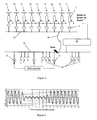
- FIG. 1 A schematic diagram of a group of wind turbines is shown in Figure 1 .
- Each wind turbine 1a to 1i includes blades and a generator 2 that incorporates a rotating electrical machine, a power converter and associated control circuits as a combined unit.
- the output of each generator 2 is supplied through a transformer 4 to a local parallel connection 6a to 6d that in turn is connected by means of an electrical cable 8 to the supply network or power grid 10.
- the conventional arrangement shown in Figure 1 is to have a small number of wind turbines connected to a local parallel connection.
- the generators of wind turbines 1a and 1b are connected in parallel to a first local parallel connection 6a
- the generators of wind turbines 1c and 1d are connected in parallel to a second local parallel connection 6b
- the generators of wind turbines 1e and 1f are connected in parallel to a third local parallel connection 6c
- the generators of wind turbines 1g, 1h and 1i are connected in parallel to a fourth local parallel connection 6d.
- a number of conventional rotating electrical machines 12 (also called alternators) that are normally sited within a power station, for example, also supply power to the supply network 10.
- a number of loads 14 are also shown connected to the supply network 10 to represent the users of the power that is distributed through the supply network.
- Network codes are used to define the amount of fundamental power and reactive power that electrical machines should export to the supply network 10 during normal operating conditions and also in the event of a network fault or transient conditions. For a large group of wind turbine generators having a combined output of more than 50 MW, for example, then the network codes may require that the group acts as a conventional rotating electrical machine 12 during a network fault. A smaller group of wind turbine generators having a combined output of less than 50 MW, for example, may be subject to less strict requirements.
- the generators 2 of the wind turbines 1a to 1 are fully defined in technical publications and a common feature is an individual synchronisation signal Sin using the prevailing ac voltage at the local parallel connection to the control unit of the power converter to control the phasing of the fundamental power and reactive power that is delivered to the local supply network at any particular time.
- individual synchronisation signals can give rise to stability problems if the fundamental power and reactive power delivered by each generator 2 happens to be different. Further problems with stability can arise if the group of wind turbines is connected to the supply network through one or more very long electrical cables. This might be the case for groups where the wind turbines are sited in remote places such as offshore.
- the generators of the wind turbines require the use of the individual synchronisation signals Sin to control the phasing of the fundamental power and reactive power that is delivered to the local supply network. Serious problems can therefore arise during a fault condition when the ac voltage of the local supply network, and hence the prevailing ac voltage at the local parallel connection, falls to a value outside the normal operating range including zero voltages. This might be acceptable for a small group of wind turbines, but if the group of wind turbines is required to act as a conventional rotating electrical machine 12 then the individual generators must stay synchronised before the start of the network fault, during the network fault, as the network fault is clearing and for the following period of normal operation.
- the individual generators of the wind turbine group must export, or be ready to export, the required fundamental power and reactive power to the supply network as defined in the various standards and network codes. This is simply not achievable using individual synchronisation signals Sin that use the prevailing ac voltage at the local parallel connection.
- Figure 3 is a graph of voltage versus time for the supply network 10 over a series of 20 supply network cycles.
- the supply network 10 is configured for 50 Hz operation but it will be appreciated that the following description is also applicable to a supply network configured to operate at other frequencies such as 60 Hz, for example.
- supply network cycle 4 there is the onset of a supply network fault condition and this lasts until normal operation is established again in supply network cycle 12.
- the fault condition therefore lasts for 8 supply network cycles, but in practice this may depend on other factors such as the type of fault or transient and the protection apparatus (not shown) associated with the supply network 10.
- the retained voltage of the supply network 10 during the fault condition is 20%, but it will be readily appreciated that the retained voltage can be any level outside the normal operating range including 0%, depending on the fault.
- Figure 4 is a graph of frequency versus time for the ac current produced by a conventional rotating electrical machine 12 that is connected to the supply network 10.
- Figure 5 is a graph of internal electro-motive force (emf) verses time for the conventional rotating electrical machine 12. It can be seen that the internal emf and the frequency of the ac current remain unchanged during the fault condition because the conventional rotating electrical machine 12 incorporates a "frequency versus time memory" as mentioned above.
- Figure 6 is a graph of power (fundamental power and reactive power) versus time for an individual generator 2 of the wind turbine group. It is clear from Figure 6 that the generator 2 loses power completely during the fault condition and takes time to start to output power again once the fault condition has been cleared at supply network cycle 12.
- the present invention aims to reproduce the "frequency versus time memory" of a conventional rotating electrical machine to enable a plurality of generators to remain synchronised and connected to the supply network or power grid even when the ac voltage of the supply network falls to a value outside the normal operating range during a fault condition.
- the present invention is therefore particularly applicable to generators that include rotating or linear electrical machines driven by wind, wave, tidal and ocean current systems, for example, and which normally receive individual synchronisation signals.
- the present invention provides a method of synchronising a plurality of generators connected together in parallel to a supply network, the method comprising the steps of generating a common synchronisation signal having a frequency versus time pattern that is the same as the frequency versus time pattern of the supply network during normal operating conditions, and supplying the common synchronisation signal to each of the generators to control the level of power (typically both fundamental power and reactive power) that is supplied to the supply network by the generators.
- a common synchronisation signal improves the stability of the generators and the export of power to the supply network.
- the use of a common synchronisation signal is of particular benefit during a fault condition of the supply network when the ac voltage of the supply network falls to a value outside the normal operating range until the fault is cleared. This would include the situation where the ac voltage of the supply network falls to zero.
- the common synchronisation signal can be supplied to each of the generators during normal operating conditions of the supply network both before and after a fault condition occurs.
- the common synchronisation signal that is supplied to each of the generators after the fault has been cleared may have a frequency versus time pattern with an increasing frequency. This means that it possible in the period immediately following the fault being cleared to allow for a gradual increase in the frequency of the ac current as a conventional rotating electrical machine recovers and speeds up.
- the method preferably includes the step of supplying a common synchronisation signal to each of the generators both during a fault condition of the supply network.
- the common synchronisation signal that is supplied during the fault condition may be the same as the common synchronisation signal that is supplied during a normal operating condition of the supply network.
- a series of common synchronisation signals, each having the same or a different frequency versus time pattern may be supplied in sequence to the generators during each operating condition of the supply network, i.e. before a fault condition occurs, during the fault condition and after the fault has been cleared.
- the common synchronisation signal that is supplied to each of the generators during a fault condition of the supply network may have a frequency versus time pattern that is the same as the frequency versus time pattern of the supply network that existed during the previous normal operating conditions. This ensures that the generators remain synchronised with each other, and as far as is practicable to any conventional rotating electrical machines on the supply network, so that power can be exported to the supply network at the optimum level both during the fault condition and as soon as the fault is cleared.
- the common synchronisation signal that is generated during normal operating conditions of the supply network can be stored and then supplied to each of the generators during a fault condition of the supply network.
- the actual rate at which the frequency decreases and increases back to a normal operating frequency can be selected depending on the particular requirements of the network codes and the operating parameters of the supply network or power grid, for example.
- the common synchronisation signal may be supplied to the generators by any suitable means.
- the common synchronisation signal may be a wireless signal (such as a radio frequency (RF) signal, for example) transmitted from a controller through a suitable wireless transmitter arrangement.
- the common synchronisation signal may also be an electrical or optical signal transmitted from a controller through a cable or optical fibre.
- the common synchronisation signal may also be generated by a controller associated with one of the generators and then transmitted to all of the remaining generators in the wind turbine group. It may be necessary to compensate for hardware delays caused primarily by the transmission time of the common synchronisation signal to the generators.
- the individual generators could select to use an individual synchronisation signal in preference to the common synchronisation signal. This could occur, for example, if the common synchronisation signal has some type of fault and this would then enable the generators to continue to function.
- the present invention further provides an arrangement comprising a plurality of generators connected together in parallel to a supply network, and a controller adapted to generate a common synchronisation signal having a frequency versus time pattern that is the same as the frequency versus time pattern of the supply network during normal operating conditions, and supply the common synchronisation signal to each of the generators to control the level of power that is supplied to the supply network by the generators.
- the generators are preferably connected in parallel to a local parallel connection.
- the local parallel connection is preferably connected to the supply network by at least one electrical cable.
- the controller can be implemented in a number of different ways.
- the controller could be implemented in hardware by using a motor to drive a conventional rotating electrical machine at a constant speed in such a way as to produce an ac voltage that would be compatible with the power requirements of the supply network.
- the ac voltage can then be used to derive a common synchronisation signal that is indicative of the ac voltages of the supply network during normal operating conditions.
- the motor could continue to drive the rotating electrical machine at the constant speed or it could be switched off to allow the frequency of the ac current to reduce as the rotating electrical machine slows down.
- the controller will normally be powered directly from the supply network but must include an auxiliary power source such as a battery so that it can continue functioning during a fault condition where the ac voltage falls outside the normal operating range.
- an auxiliary power source such as a battery
- Each generator may include a power converter and associated control circuits.
- the controller is preferably adapted to apply the common synchronisation signal to the control circuit of each of the power converters to control the level of power that is output to the supply network by the generators.
- the present invention also provides a plurality of wind turbines, each wind turbine comprising a generator having a stator and a rotor, a power converter, and a turbine assembly including at least one blade for rotating the rotor of the generator, wherein the generators are connected together in parallel to a supply network and are synchronised according to the method described above.
- FIG. 2 A schematic diagram of a group of wind turbines that are synchronised according to a method of the present invention is shown in Figure 2 .
- Figure 2 A schematic diagram of a group of wind turbines that are synchronised according to a method of the present invention is shown in Figure 2 .
- This description focuses on wind turbine applications, it will be obvious to the skilled person that the invention has wider applicability.
- the arrangement of Figure 2 is similar in many respects to the arrangement of Figure 1 and like parts have been given the same reference numerals.
- Each wind turbine 1a to 1i includes blades and a generator 2 that incorporates a power converter and control circuits.
- the output of each generator 2 is supplied through a transformer 4 to a local parallel connection 16 that in turn is connected by means of a single long electrical cable 18 to the supply network or power grid 10.
- a transformer 4 to a local parallel connection 16 that in turn is connected by means of a single long electrical cable 18 to the supply network or power grid 10.
- the power output of the group of wind turbines is sufficiently large for the network codes of the supply network 10 to require that the group act as a conventional rotating electrical machine 12 during a network fault.
- An electronic controller 20 derives a common synchronisation signal Scom that is transmitted to each of the generators 2 (or more particularly to each of the control circuits of the power converters) through a series of electrical cables.
- the generators 2 use the synchronisation signal Scom to control the phasing of the fundamental power and reactive power that is delivered to the supply network 10 at any particular time.
- the electronic controller 20 has an input signal indicative of the prevailing voltage of the supply network 10.
- the controller 20 is therefore able to recognise immediately if the supply network 10 experiences a fault where the ac voltages fall to a value outside the normal operating range.
- the synchronisation signal Scom will normally be directly connected to the same connection point that is used by the individual synchronisation signal Sin.
- the synchronisation signal Scom will naturally be a voltage signal of sinusoidal shape with the appropriate voltage level that depends on the design of the particular generators.
- the waveforms for the synchronisation signal Scom will then be directly as shown in Figures 7 , 10 and 13 .
- the relevant voltage, frequency and phase data can be transmitted to each generator 2 by any type of analogue or digital communication signal and protocol.
- the frequency and phase of the synchronisation signal Scom that is derived by the electronic controller 20 is identical to the prevailing frequency and phase of the ac voltages of the supply network 10.
- the synchronisation signal Scom is transmitted to each of the generators 2 and is continuously stored in the electronic controller 20.
- the regular sampling and storage of the synchronisation signal Scom can be implemented using any suitable electronic storage techniques.
- the electronic controller 20 will immediately start to transmit the stored synchronisation signal Scom' to each of the generators 2.
- the phase and frequency of the stored synchronisation signal Scom' that is transmitted during a supply network fault condition is therefore identical to the prevailing frequency and phase of the ac voltages of the supply network 10 during normal operating conditions (i.e. before the fault condition occurred). This means that the phase of the stored synchronisation signal Scom' transmitted by the electronic controller 20 during a supply network fault condition may not match the phase of the input signal indicative of the prevailing voltage of the supply network 10.
- the electronic controller 20 recognises that the fault condition has been cleared, it will immediately derive a new synchronisation signal Scom" with a frequency and phase that is identical to the prevailing frequency and phase of the ac voltages supply network.
- the frequency and phase of the stored synchronisation signal Scom' will then be smoothly changed to become the new synchronisation signal Scom" in a preset period, typically one supply network cycle.
- Figure 7 is a graph of power (fundamental power and reactive power) versus time for an individual generator 2 of the wind turbine group.
- the electronic controller 20 transmits a synchronisation signal Scom to the generator 2 and stores the synchronisation signal.
- the frequency and phase of the synchronisation signal Scom that is transmitted to the generator 2 during supply network cycles 1 to 4 is identical to the prevailing frequency and phase of the ac voltages of the supply network shown in Figure 3 .
- the electronic controller 20 recognises that a supply network fault condition has occurred and immediately starts to transmit the stored synchronisation signal Scom' to the generator 2.
- the synchronisation signal Scom is sampled and stored once every supply network cycle, in which case the stored synchronisation signal Scom' would be the synchronisation signal that was stored during supply network cycle 3 before the fault condition occurred.
- the stored synchronisation signal Scom' is transmitted during supply network cycles 4 to 11.
- the electronic controller 20 recognises that the fault has cleared and smoothly changes to transmit a new synchronisation signal Scom" in a preset period.
- the new synchronisation signal Scom" has a frequency and phase that is identical to the prevailing frequency and phase of the ac voltages of the supply network (i.e. the frequency and phase of the ac voltages of the supply network after the fault is cleared).
- Figure 7 shows that the generator 2 can continue to output power before, during and after a supply network fault condition in exactly the same way as the conventional rotating electrical machine 12.
- FIG. 8 is a graph of frequency versus time for the ac current produced by the conventional rotating electrical machine 12.
- the frequency reduces gradually in a substantially linear manner throughout the lifetime of the fault condition from a normal operating frequency of 50 Hz in supply network cycle 4 to a frequency of 40 Hz in supply network cycle 12.
- the frequency of the ac current is restored rapidly to the normal operating frequency of 50 Hz. This can happen if the conventional rotating electrical machine 12 is small and is reconnected to other larger electrical machines after the fault, for example.
- the rate at which the frequency of the ac current will fall will depend on the properties and characteristics of the conventional rotating electrical machine 12.
- Figure 9 is a graph of internal emf versus time for the situation where the conventional rotating electrical machine 12 slows down. It can be seen that the frequency of the internal emf of the conventional rotating electrical machine 12 reduces gradually during the lifetime of the fault condition by noting how the spacing between the adjacent peaks and troughs gradually increases between supply network cycles 4 and 12.
- the electronic controller 20 may transmit a modified synchronisation signal (that is optionally initially based on the frequency and phase of the stored synchronisation signal Scom') where the frequency of the modified synchronisation signal is reduced at a predetermined rate.
- a minimum frequency limit can be supplied to the modified synchronisation signal.
- Figure 10 shows how the generator 2 can be controlled by a modified synchronisation signal to output power with a frequency that reduces gradually during the lifetime of the fault condition in exactly the same way as the conventional rotating electrical machine 12.
- the frequency of the ac current produced by the conventional rotating electrical machine 12 may gradually reduce as the conventional rotating electrical machine slows down during the fault condition and then recover gradually after the fault has been cleared.
- Figure 11 is a graph of frequency versus time for the ac current produced by the conventional rotating electrical machine 12.
- the frequency reduces gradually in a substantially liner manner throughout the lifetime of the fault condition from a normal operating frequency of 50 Hz in supply network cycle 4 to a frequency of 40 Hz in supply network cycle 12.
- the frequency of the ac current increases gradually until the normal operating frequency of 50 Hz is reached at supply network cycle 16.
- the rate at which the frequency of the ac current will fall and recover will depend on the properties and characteristics of the conventional rotating electrical machine 12.
- Figure 12 is a graph of internal emf versus time for the situation where the conventional rotating electrical machine 12 slows down during the fault condition and speeds up gradually after the fault has cleared. It can be seen that the frequency of the internal emf of the conventional rotating electrical machine 12 reduces gradually during the lifetime of the fault condition by noting how the spacing between the adjacent peaks and troughs gradually increases between supply network cycles 4 and 12. When the fault is cleared, the frequency of the internal emf of the conventional rotating electrical machine 12 increases gradually between supply network cycles 12 and 16.
- the electronic controller 20 may transmit a modified synchronisation signal (that is optionally initially based on the frequency and phase of the stored synchronisation signal Scom') where the frequency of the modified synchronisation signal is reduced at a predetermined rate while the fault condition occurs and where the frequency of the modified synchronisation signal is increased at a predetermined rate after the fault is cleared.
- Figure 13 shows how the generator 2 can be controlled by a modified synchronisation signal to output power with a frequency that reduces gradually during the lifetime of the fault condition and increases gradually when the fault is cleared in exactly the same way as the conventional rotating electrical machine 12.
- the generators 2 of the wind turbines 1a to 1i can remain connected to the supply network 10 and will remain synchronised with each other so that they can start to export power to the supply network at the correct level once the fault is cleared.
- the synchronisation signals Scom, Scom' and Scom" can be supplied to one cluster of generators 2 or to several clusters of generators, each cluster having its own connection (e.g. the electrical cable 18) to the supply network 10.
Landscapes
- Engineering & Computer Science (AREA)
- Life Sciences & Earth Sciences (AREA)
- Sustainable Development (AREA)
- Sustainable Energy (AREA)
- Chemical & Material Sciences (AREA)
- Combustion & Propulsion (AREA)
- Mechanical Engineering (AREA)
- General Engineering & Computer Science (AREA)
- Power Engineering (AREA)
- Control Of Eletrric Generators (AREA)
- Supply And Distribution Of Alternating Current (AREA)
- Synchronisation In Digital Transmission Systems (AREA)
Applications Claiming Priority (1)
| Application Number | Priority Date | Filing Date | Title |
|---|---|---|---|
| GB0624594A GB2444528B (en) | 2006-12-09 | 2006-12-09 | Methods for synchronising a plurality of generators |
Publications (2)
| Publication Number | Publication Date |
|---|---|
| EP1931009A2 true EP1931009A2 (fr) | 2008-06-11 |
| EP1931009A3 EP1931009A3 (fr) | 2014-12-31 |
Family
ID=37711833
Family Applications (1)
| Application Number | Title | Priority Date | Filing Date |
|---|---|---|---|
| EP20070023435 Withdrawn EP1931009A3 (fr) | 2006-12-09 | 2007-12-04 | Procédés pour la synchronisation d'une pluralité de générateurs |
Country Status (6)
| Country | Link |
|---|---|
| US (1) | US7923853B2 (fr) |
| EP (1) | EP1931009A3 (fr) |
| CN (1) | CN101197502B (fr) |
| CA (1) | CA2613665A1 (fr) |
| GB (1) | GB2444528B (fr) |
| NO (1) | NO20076321L (fr) |
Cited By (4)
| Publication number | Priority date | Publication date | Assignee | Title |
|---|---|---|---|---|
| WO2010037388A1 (fr) * | 2008-09-30 | 2010-04-08 | Vestas Wind System A/S | Schéma logique pour détection de graves défaillances |
| EP2182207A3 (fr) * | 2008-10-31 | 2012-08-08 | General Electric Company | Commande de transmission de zone étendue de parcs éoliens |
| WO2012082430A3 (fr) * | 2010-12-13 | 2012-09-07 | Northern Power Systems Utility Scale, Inc. | Procédés, systèmes et logiciel de commande de convertisseur de puissance durant des conditions de traversée de tension basse (nulle) |
| ES2424591R1 (es) * | 2009-08-19 | 2014-02-04 | Schweitzer Engineering Laboratories, Inc. | Sistemas y métodos para conversión de datos de muestreo asíncrono |
Families Citing this family (30)
| Publication number | Priority date | Publication date | Assignee | Title |
|---|---|---|---|---|
| US9136711B2 (en) | 2007-08-21 | 2015-09-15 | Electro Industries/Gauge Tech | System and method for synchronizing multiple generators with an electrical power distribution system |
| WO2009081205A2 (fr) | 2007-12-20 | 2009-07-02 | Enecsys Limited | Synchronisation de réseau de distribution |
| GB2455755B (en) * | 2007-12-20 | 2010-10-20 | Enecsys Ltd | Grid synchronisation |
| US20090212563A1 (en) * | 2008-02-21 | 2009-08-27 | General Electric Company | System and method for improving performance of power constrained wind power plant |
| DE102008010543A1 (de) * | 2008-02-22 | 2009-08-27 | Nordex Energy Gmbh | Verfahren zum Betreiben einer Windenergieanlage und Windenergieanlage |
| US20100052328A1 (en) * | 2008-08-29 | 2010-03-04 | Thales Research, Inc. | Hybrid wind turbine - combustion engine electrical power generator |
| EP2382701B1 (fr) | 2009-01-16 | 2016-11-30 | Boulder Wind Power, Inc. | Stator segmenté pour dispositif à champ axial |
| EP2435885B1 (fr) * | 2009-05-25 | 2018-04-18 | Vestas Wind Systems A/S | Temps précis global et temps de transmission maximal |
| US9154024B2 (en) | 2010-06-02 | 2015-10-06 | Boulder Wind Power, Inc. | Systems and methods for improved direct drive generators |
| US20110320053A1 (en) * | 2010-06-25 | 2011-12-29 | Chad Eric Dozier | Control system having user-defined connection criteria |
| JP5635314B2 (ja) * | 2010-06-29 | 2014-12-03 | 日立オートモティブシステムズ株式会社 | 電気自動車、ハイブリッド自動車、自動車、自動車ブレーキネットワークシステム、車載ネットワークシステム |
| US20120091817A1 (en) * | 2010-10-18 | 2012-04-19 | Advanced Energy Industries, Inc. | System, method, and apparatus for ac grid connection of series-connected inverters |
| DE102010050591A1 (de) * | 2010-11-05 | 2012-05-10 | Eads Deutschland Gmbh | Windpark, Windenergieanlage in einem Windpark, sowie Betriebssteuerung hierfür |
| US9660451B1 (en) * | 2010-11-29 | 2017-05-23 | Sunpower Corporation | Islanded operation of distributed power sources |
| GB2485423B (en) | 2011-01-18 | 2014-06-04 | Enecsys Ltd | Solar photovoltaic systems |
| CN102183936B (zh) * | 2011-05-04 | 2013-04-17 | 广东康菱动力科技有限公司 | 浆纸厂自备临界火电厂黑启动电力系统及其供电方法 |
| US9552029B2 (en) * | 2012-02-20 | 2017-01-24 | Engineered Electric Company | Micro grid power distribution unit |
| US12399520B2 (en) | 2012-04-04 | 2025-08-26 | Ei Electronics Llc | Phasor measurement units, synchrophasor systems and methods thereof |
| CN104285059B (zh) * | 2012-05-11 | 2017-03-01 | 维斯塔斯风力系统集团公司 | 风力发电厂频率控制 |
| US8736133B1 (en) | 2013-03-14 | 2014-05-27 | Boulder Wind Power, Inc. | Methods and apparatus for overlapping windings |
| US8823193B1 (en) * | 2013-05-28 | 2014-09-02 | Siemens Aktiengesellschaft | Method and system for limitation of power output variation in variable generation renewable facilities |
| US10177620B2 (en) | 2014-05-05 | 2019-01-08 | Boulder Wind Power, Inc. | Methods and apparatus for segmenting a machine |
| US9350281B2 (en) * | 2014-05-09 | 2016-05-24 | Alonso Rodiguez | Circuit and method for frequency synthesis for signal detection in automatic voltage regulation for synchronous generators |
| EP3012420A1 (fr) * | 2014-10-24 | 2016-04-27 | Siemens Aktiengesellschaft | Procédé de synchronisation d'une turbine au réseau électrique |
| US10418817B2 (en) * | 2016-07-29 | 2019-09-17 | Cummins Power Generation Ip, Inc. | Synchronization of parallel gensets with source arbitration |
| US10291028B2 (en) | 2016-07-29 | 2019-05-14 | Cummins Power Generation Ip, Inc. | Masterless distributed power transfer control |
| US10338119B2 (en) | 2016-08-16 | 2019-07-02 | Kohler Co. | Generator waveform measurement |
| CN110488704A (zh) * | 2019-08-21 | 2019-11-22 | 深圳大学 | 一种多工位协同运动的网络稳定控制方法及系统 |
| CN114323542B (zh) * | 2022-03-08 | 2022-05-13 | 中国空气动力研究与发展中心低速空气动力研究所 | 一种风洞动态试验多信号采集同步方法 |
| US12278590B2 (en) | 2022-08-04 | 2025-04-15 | Google Llc | Synthetic generator synchronization |
Family Cites Families (18)
| Publication number | Priority date | Publication date | Assignee | Title |
|---|---|---|---|---|
| US3794846A (en) * | 1972-09-18 | 1974-02-26 | Electric Machinery Mfg Co | Automatic synchronizing control system |
| US4249088A (en) * | 1979-07-19 | 1981-02-03 | General Electric Company | Automatic device for synchronization of prime mover with electrical grid |
| US4492874A (en) * | 1982-04-26 | 1985-01-08 | General Electric Company | Synchronization fuel control for gas turbine-driven AC generator by use of maximum and minimum fuel signals |
| US4874961A (en) * | 1988-10-31 | 1989-10-17 | Sundstrand Corporation | Electrical power generating system having parallel generator control |
| US5761073A (en) * | 1995-02-09 | 1998-06-02 | Basler Electric Company | Programmable apparatus for synchronizing frequency and phase of two voltage sources |
| US5729059A (en) * | 1995-06-07 | 1998-03-17 | Kilroy; Donald G. | Digital no-break power transfer system |
| US5745356A (en) * | 1996-06-25 | 1998-04-28 | Exide Electronics Corporation | Independent load sharing of AC power systems connected in parallel |
| EP1638184A3 (fr) * | 1998-04-02 | 2009-03-25 | Capstone Turbine Corporation | Organe de commande de puissance |
| US6522030B1 (en) * | 2000-04-24 | 2003-02-18 | Capstone Turbine Corporation | Multiple power generator connection method and system |
| CN1228908C (zh) * | 2001-12-31 | 2005-11-23 | 艾默生网络能源有限公司 | 并联变换器系统的开关同步方法 |
| US7181644B2 (en) * | 2002-01-11 | 2007-02-20 | Delphi Technologies, Inc. | Method for synchronizing data utilized in redundant, closed loop control systems |
| US6915186B2 (en) * | 2002-08-07 | 2005-07-05 | Frank Patterson, Jr. | System and method for synchronizing electrical generators |
| US7233129B2 (en) * | 2003-05-07 | 2007-06-19 | Clipper Windpower Technology, Inc. | Generator with utility fault ride-through capability |
| US7262520B2 (en) * | 2003-12-18 | 2007-08-28 | General Electric Company | Robust power distribution systems and methods |
| US8754544B2 (en) * | 2005-01-27 | 2014-06-17 | General Electric Company | Apparatus for synchronizing uninterruptible power supplies |
| CH697550B1 (de) * | 2005-03-30 | 2008-11-28 | Alstom Technology Ltd | Verfahren zur Steuerung eines Frequenzkonverters. |
| GB2449427B (en) * | 2007-05-19 | 2012-09-26 | Converteam Technology Ltd | Control methods for the synchronisation and phase shift of the pulse width modulation (PWM) strategy of power converters |
| US7656060B2 (en) * | 2007-10-31 | 2010-02-02 | Caterpillar Inc. | Power system with method for adding multiple generator sets |
-
2006
- 2006-12-09 GB GB0624594A patent/GB2444528B/en not_active Expired - Fee Related
-
2007
- 2007-12-04 EP EP20070023435 patent/EP1931009A3/fr not_active Withdrawn
- 2007-12-05 US US11/999,411 patent/US7923853B2/en not_active Expired - Fee Related
- 2007-12-07 CA CA 2613665 patent/CA2613665A1/fr not_active Abandoned
- 2007-12-07 NO NO20076321A patent/NO20076321L/no not_active Application Discontinuation
- 2007-12-10 CN CN200710195043XA patent/CN101197502B/zh not_active Expired - Fee Related
Cited By (7)
| Publication number | Priority date | Publication date | Assignee | Title |
|---|---|---|---|---|
| WO2010037388A1 (fr) * | 2008-09-30 | 2010-04-08 | Vestas Wind System A/S | Schéma logique pour détection de graves défaillances |
| US7881888B2 (en) | 2008-09-30 | 2011-02-01 | Vestas Wind Systems A/S | Logical scheme for severe fault detection |
| EP2182207A3 (fr) * | 2008-10-31 | 2012-08-08 | General Electric Company | Commande de transmission de zone étendue de parcs éoliens |
| ES2424591R1 (es) * | 2009-08-19 | 2014-02-04 | Schweitzer Engineering Laboratories, Inc. | Sistemas y métodos para conversión de datos de muestreo asíncrono |
| WO2012082430A3 (fr) * | 2010-12-13 | 2012-09-07 | Northern Power Systems Utility Scale, Inc. | Procédés, systèmes et logiciel de commande de convertisseur de puissance durant des conditions de traversée de tension basse (nulle) |
| CN103314498A (zh) * | 2010-12-13 | 2013-09-18 | 北方动力系统效用公司 | 控制功率转换器在低(零)电压条件穿越的方法,系统和软件 |
| CN103314498B (zh) * | 2010-12-13 | 2015-11-25 | 北方动力系统公司 | 控制功率转换器在低(零)电压条件穿越的方法,系统和软件 |
Also Published As
| Publication number | Publication date |
|---|---|
| GB0624594D0 (en) | 2007-01-17 |
| US7923853B2 (en) | 2011-04-12 |
| GB2444528A (en) | 2008-06-11 |
| NO20076321L (no) | 2008-06-10 |
| US20080157538A1 (en) | 2008-07-03 |
| CN101197502A (zh) | 2008-06-11 |
| EP1931009A3 (fr) | 2014-12-31 |
| CA2613665A1 (fr) | 2008-06-09 |
| CN101197502B (zh) | 2012-09-26 |
| GB2444528B (en) | 2011-07-06 |
Similar Documents
| Publication | Publication Date | Title |
|---|---|---|
| US7923853B2 (en) | Methods of synchronizing a plurality of generators | |
| EP1728304B1 (fr) | Procede de fonctionnement d'un convertisseur de frequence d'une generatrice et turbine eolienne comprenant une generatrice fonctionnant selon ce procede | |
| US9450416B2 (en) | Wind turbine generator controller responsive to grid frequency change | |
| US9593672B2 (en) | Isochronous wind turbine generator capable of stand-alone operation | |
| US7843078B2 (en) | Method and apparatus for generating power in a wind turbine | |
| JP5972169B2 (ja) | 電力変換システムおよび方法 | |
| Apata et al. | Wind turbine generators: Conventional and emerging technologies | |
| EP2685602A1 (fr) | Configuration d'une éolienne et procédé pour commander une configuration de génération éolienne | |
| US20120139246A1 (en) | Asynchronous generator system and wind turbine having an asynchronous generator system | |
| Amirat et al. | Survey paper generators for wind energy conversion systems: state of the art and coming attractions | |
| EP4220883A1 (fr) | Système et procédé pour fournir une commande de formation de grille d'une ressource basée sur un onduleur | |
| Pandey | Performance analysis of PMSG wind turbine at variable wind speed | |
| WO2024112316A1 (fr) | Système et procédé pour assurer un démarrage à froid de ressources basées sur un onduleur formant un réseau | |
| EP3617497B1 (fr) | Système et procédé pour augmenter l'inertie mécanique d'un rotor d'éolienne pour supporter le réseau au cours d'un événement de fréquence | |
| EP2017953A2 (fr) | Système de commande à vitesse variable | |
| RU2133375C1 (ru) | Способ управления ветроэнергетической установкой | |
| US20160032896A1 (en) | System and method for controlling a power output of a wind turbine generator | |
| EP4432505A1 (fr) | Procédé de commande d'une éolienne, produit programme d'ordinateur et éolienne | |
| RU2225531C1 (ru) | Ветроэнергетическая установка | |
| EP4607737A1 (fr) | Procédé de commande d'une éolienne, produit programme d'ordinateur et éolienne | |
| Blaabjerg et al. | Generator Systems for Wind Turbines | |
| WO2025141303A1 (fr) | Système et procédé pour assurer un démarrage à froid de ressources basées sur un onduleur formant un réseau | |
| Postolov et al. | Comparative Analysis of Energy Production of Wind Turbines with Double-fed Induction Generator (DFIG) and with Conventional Induction Generator | |
| WO2025155283A1 (fr) | Système et procédé pour réaliser un démarrage autonome de ressources basées sur un onduleur formant un réseau | |
| Jensen et al. | Technologies for electricity generation in wind turbines |
Legal Events
| Date | Code | Title | Description |
|---|---|---|---|
| PUAI | Public reference made under article 153(3) epc to a published international application that has entered the european phase |
Free format text: ORIGINAL CODE: 0009012 |
|
| AK | Designated contracting states |
Kind code of ref document: A2 Designated state(s): AT BE BG CH CY CZ DE DK EE ES FI FR GB GR HU IE IS IT LI LT LU LV MC MT NL PL PT RO SE SI SK TR |
|
| AX | Request for extension of the european patent |
Extension state: AL BA HR MK RS |
|
| RAP1 | Party data changed (applicant data changed or rights of an application transferred) |
Owner name: CONVERTEAM UK LTD |
|
| RAP1 | Party data changed (applicant data changed or rights of an application transferred) |
Owner name: GE ENERGY POWER CONVERSION UK LIMITED |
|
| PUAL | Search report despatched |
Free format text: ORIGINAL CODE: 0009013 |
|
| AK | Designated contracting states |
Kind code of ref document: A3 Designated state(s): AT BE BG CH CY CZ DE DK EE ES FI FR GB GR HU IE IS IT LI LT LU LV MC MT NL PL PT RO SE SI SK TR |
|
| AX | Request for extension of the european patent |
Extension state: AL BA HR MK RS |
|
| RIC1 | Information provided on ipc code assigned before grant |
Ipc: H02J 3/38 20060101AFI20141125BHEP Ipc: F03D 7/04 20060101ALI20141125BHEP Ipc: F03D 9/00 20060101ALI20141125BHEP |
|
| AKY | No designation fees paid | ||
| AXX | Extension fees paid |
Extension state: AL Extension state: BA Extension state: RS Extension state: MK Extension state: HR |
|
| REG | Reference to a national code |
Ref country code: DE Ref legal event code: R108 |
|
| STAA | Information on the status of an ep patent application or granted ep patent |
Free format text: STATUS: THE APPLICATION IS DEEMED TO BE WITHDRAWN |
|
| 18D | Application deemed to be withdrawn |
Effective date: 20150701 |