EP1931075A1 - Procédé de décodage d'un signal reçu multidimensionnel - Google Patents
Procédé de décodage d'un signal reçu multidimensionnel Download PDFInfo
- Publication number
- EP1931075A1 EP1931075A1 EP06301223A EP06301223A EP1931075A1 EP 1931075 A1 EP1931075 A1 EP 1931075A1 EP 06301223 A EP06301223 A EP 06301223A EP 06301223 A EP06301223 A EP 06301223A EP 1931075 A1 EP1931075 A1 EP 1931075A1
- Authority
- EP
- European Patent Office
- Prior art keywords
- signal
- sub
- decoding
- matrix
- candidate
- Prior art date
- Legal status (The legal status is an assumption and is not a legal conclusion. Google has not performed a legal analysis and makes no representation as to the accuracy of the status listed.)
- Granted
Links
Images



Classifications
-
- H—ELECTRICITY
- H04—ELECTRIC COMMUNICATION TECHNIQUE
- H04L—TRANSMISSION OF DIGITAL INFORMATION, e.g. TELEGRAPHIC COMMUNICATION
- H04L1/00—Arrangements for detecting or preventing errors in the information received
- H04L1/02—Arrangements for detecting or preventing errors in the information received by diversity reception
- H04L1/06—Arrangements for detecting or preventing errors in the information received by diversity reception using space diversity
- H04L1/0618—Space-time coding
- H04L1/0631—Receiver arrangements
-
- H—ELECTRICITY
- H04—ELECTRIC COMMUNICATION TECHNIQUE
- H04L—TRANSMISSION OF DIGITAL INFORMATION, e.g. TELEGRAPHIC COMMUNICATION
- H04L25/00—Baseband systems
- H04L25/02—Details ; arrangements for supplying electrical power along data transmission lines
- H04L25/0202—Channel estimation
- H04L25/024—Channel estimation channel estimation algorithms
- H04L25/0242—Channel estimation channel estimation algorithms using matrix methods
Definitions
- the present invention relates to the field of digital communication. More specifically, it deals with an efficient way to implement a decoding based on a lattice (lattice decoding corresponds to a decoding of a distorted discrete multidimensional signal), that is used, for example, in a decoding of a signal transmitted through a noisy channel or multi-user detection.
- lattice lattice decoding corresponds to a decoding of a distorted discrete multidimensional signal
- An optimal decoder is the one that finds the candidate digital signal that is the most likely, given the received observed signal. Such optimal decoder is said to be optimal in the sense of Maximum Likelihood (or ML).
- a basic approach to perform ML decoding consists in exhaustively enumerating all possible transmitted digital signals and selecting the most likely candidate.
- the selection criterion often consists in computing a Euclidean distance between the filtered candidate and the received observation (or receive signal).
- exhaustive enumeration is very time consuming and most of the time impractical for real time applications. Indeed the number of candidates, and hence the decoder complexity, is exponential with respect to the length of the digital signal. For instance a signal carrying 10 bits may take 1024 (or 2 10 ) different values and all these values need being enumerated in basic ML decoding.
- lattice decoders More appropriate ML decoding algorithms have emerged based on a multidimensional lattice description of the problem, which will be referred to as lattice decoders in the sequel. For instance a signal made of 8 consecutive 16QAM symbols can be described by a 8 dimension lattice with 16 discrete possible values per dimension. After linear filtering, the lattice will remain a lattice but it will be distorted. Instead of enumerating all possible lattice points (16 8 in the present case), lattice decoders will restrict to evaluating lattice points that are in the vicinity of the received signal.
- Such decoding methods are based on the enumeration of candidates as in document " A universal lattice code decoder for fading channel,” written by E. Viterbo and J. Boutros (and published in IEEE Trans. Inform. Theory, vol. 45, pp. 1639-1642, July 1999 ) or in document “ Lattice basis reduction: Improved practical algorithms and solving subset sum problems,” written by C.P. Schnorr and M. Euchner (and published in Math. ProGraming, vol. 66, pp. 181-191, 1994 ).
- Those documents disclose ML recursive decoding algorithms that are based on a lattice and enable enumeration of points and selection of points after reception of a signal representative of data.
- ML point is selected either by enumerating candidates points in a sphere (Boutros) or by successive projections on sublattices (Schnorr/Euchner).
- lattice decoders are still complex (especially for real time applications) even if they have polynomial decoding complexity (instead of exponential for basic ML).
- Patent document referred as US20050009476 disclosed a system for doing BLAST (or Bell Labs Layered Space Time) (as disclosed in document written by Gerard. J. Foschini (1996), entitled “Layered Space-Time Architecture for Wireless Communication in a Fading Environment When Using Multi-Element Antennas” and published in Bell Laboratories Technical Journal October on pages 41-59 ) with fewer receive antennas or even only one receiving antenna is provided. Indeed, this method is limited to very restricted conditions and remains sub-optimal.
- the invention is aimed at alleviating these drawbacks of the prior art.
- the objective of the invention is to simplify the implementation of a decoding method of a MIMO signal with space/time or frequency encoding, while keeping good performances.
- the invention proposes a method of decoding of a multidimensional received signal corresponding to a discrete multidimensional coded signal transmitted through a channel, so-called transmitted signal, the multidimensional received signal comprising several elementary signals, corresponding each to a sample of time and/or frequency and of space.
- the method comprises the following steps:
- the first sub-matrix is of maximum rank.
- the enumeration is performed either on all possible values of the second sub-signal or on only a part of possible values of the second sub-signal.
- the second sub-signal are advantageously related to the columns of the channel matrix, that have energy over a threshold.
- the transmitted signal is space-time or space-frequency encoded.
- the transmitted signal can be space-time or space-frequency encoded that is not limited to a simple spatial multiplexing.
- the method comprises a reception of multidimensional received signal on antennas, the number of antennas being smaller that the number of symbols per channel use.
- this constraint on the number of receive antennas is not required to satisfy, by using a non linear receiver.
- an optimal in the sense of Maximum Likelihood (or ML)
- ML Maximum Likelihood
- Figure 1 represents a wireless network 1 comprising several stations 10 to 12. Each station 10 to 12 comprises a transmitter and a receiver using a MIMO (or Multiple Input Multiple Output) antenna system. Station 10 has Ntx antennas and communicates with stations 11 and 12 through a wireless link. Stations 11 and 12 have only one antenna.
- MIMO Multiple Input Multiple Output
- Figure 2 represents an exemplary architecture of a data transmitter 2 capable of sending data in a way compliant with the invention applied to decoding of a signal transmitted through a MIMO noisy channel.
- the data transmitter 2 can be implemented in station 10.
- the transmitter 2 comprises:
- the transmitter 2 receives a binary signal 22 which is digitally modulated by the modulator 21 with a first modulation which is, for instance a QAM modulation (or "Quadrature Amplitude Modulation") (e.g. 16 QAM or 64QAM).
- the modulator 21 generates groups of Q complex QAM symbols S1 to SQ. Q is for example equal to 8.
- Each group of Q symbols 22 is then encoded with the encoder 23 to form a STBC (or Space Time Block Code) codeword 24.
- the STBC is, for instance, a Golden code such as disclosed in document " The Golden Code: A 2 x 2 Full-Rate Space-Time Code with Non-Vanishing Determinants," which has been written by J.-C. Belfiore, G. Rekaya, E. Viterbo (and published in IEEE Transactions on Information Theory, vol. 51, n. 4, pages 1432-1436, Apr. 2005 .).
- the STBC is based on a complex matrix of dimension N tx * N where N is the time dimension of the STBC or the number of channel uses per STBC code word.
- the rate in number of symbols per channel use is defined as Q / N . According to the invention, the rate is strictly greater than 1.
- the generated STBC 24 is mapped in the time/frequency mapper that transmits a dedicated signal 261 to 26Ntx to each of OFDM modulator 271 to 27Ntx. Then, each modulator 271 to 27Ntx modulates its input signal into an OFDM modulated signal that is sent on an antenna respectively 281 to 28Ntx (after possibly filtering, frequency transposition and amplification as usually done in a radio transmitted signal). As summary, the STBC codeword 24 is then sent on a MIMO channel.
- Such a transmitter system is disclosed in " Space-frequency coded broadband OFDM systems", written by H. Bölcskei and A. J. Paulraj (and published in Proc. Wireless Commun. Networking Conf., Chicago, IL, Sept. 23-28, 2000, pages 1-6 ).
- a single carrier modulation can replace the OFDM modulation (or any multi carrier modulation such IOTA (for "Isotropic Orthogonal Transform Algorithm")). Then, a time/frequency mapper 25 and the OFDM modulators 271 to 27Ntx are replaced by at least two single carrier modulators associated each with a antenna.
- the first modulation can be of any digital modulation, e.g. nPSK (for “Phase Shift Keying with n phase values) or nQAM (eg with n equals to 16, 32, 64, 256).
- nPSK Phase Shift Keying with n phase values
- nQAM e.g with n equals to 16, 32, 64, 256.
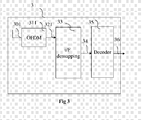
- Figure 3 represents an exemplary architecture of a data receiver 3 according to a specific embodiment of the invention.
- the receiver 3 receives a signal sent by the transmitter 2 through a wireless channel.
- This channel is noisy and comprises Additive White Gaussian Noise (or AWGN) and possibly other noise such as interferences.
- the sent signal can also be affected by multipath echos and/or Doppler effect.
- the data receiver 3 can be implemented in stations 11 or 12.
- the receiver 3 comprises:
- the receiver 3 matches the transmitter 2 (especially for modulation and code used by the transmitter). Then, according to variants using single carrier modulation inside the transmitter, the OFDM demodulators are replaced by the corresponding single carrier demodulators.
- the receiver 3 comprises one receive antenna 301 so that the received signal 301 can be represented by a Nrx*N matrix, or equivalently a ( Nrx*N ) * 1 vector R.
- Nrx represents the number of receive antennas and is equal to one in the described embodiment. According to a variant of the invention, Nrx is greater that 1. According to another variant, Nrx is smaller or equal to the rate Q / N.
- the space/time coding process takes place with real inputs (instead of complex inputs).
- the C matrix is a real matrix with a dimension (2 Ntx*N )*(2 Q ).
- the use of real matrix is advantageous for QAM modulation that can be seen as a combination of two real PAM (Pulse Amplitude Modulation).
- the received signal R is written in real notation and denoted R' of size ( 2 Nrx*N) *1.
- the components of R' are made of the real and imaginary parts of components of R.
- complex matrices are used.
- the detection can take place in the polar domain.
- ⁇ 2 represents the variance of the resulting whitened noise.
- the time/frequency demapper 33 received demodulated signal from OFDM demodulators 311 to 31 Nrx and is doing the reverse mapping (corresponding to dual operation of mapper 25). It provides a demapped signal to decoder 35.
- the decoder 35 is particularly well suited to perform ML decoding of the Space-Time Block encoded signal. It implements the algorithm presented in figure 5 .
- the system represented above is underdetermined, i.e. the number of components of the received signal 2 N rx N given by the size of R' (that correspond to the received space-time signal written in real notations; it is a real vector of size (2 N rx N )*1 smaller than the number of unknowns 2*Q given by the size of S' (S' is the transmitted multidimensional discrete signal written in real notations; it is a real vector of size 2Q*1).
- AWGN Additive White Gaussian Noise
- all possible values of S' 2 are enumerated, and, for each candidate value of S' 2 a intermediate signal is formed and a ML decoding of the intermediate signal is performed to produce S' 1 .
- a decoded candidate for S' is made of the components of S' 1 and S' 2 , and the ML solution among all candidates S' is the one within smallest Euclidean distance from the multidimensional received signal R'.
- finding S ⁇ [ S ⁇ 1 S ⁇ 2 ] that minimizes the value of ⁇ R ⁇ - G ⁇ 1 G ⁇ 2 ⁇ S ⁇ 1 S ⁇ 2 ⁇ is equivalent to, given a candidate S' 2 , finding S' 1 that minimizes the value of ⁇ R ⁇ - G ⁇ 2 S ⁇ 2 ⁇ R " - G ⁇ 1 S ⁇ 1 ⁇ .
- Figure 4 represents an exemplary architecture of the decoder 35 of the receiver 3.
- Decoder 35 comprises following elements that are linked together by a data and address bus 44:
- the word « register» used in the specification can correspond to area of small capacity (some bits) or to very large area (e.g. a whole program or large amount of received or decoded data).
- ROM 42 comprises a program 420.
- Algorithm of the method according to the invention are stored in the ROM 42.
- the CPU 41 uploads the program 420 in the RAM and executes the corresponding instructions.
- RAM 43 comprises:
- the decoder 35 is implemented in pure hardware configuration (e.g. in one or several FPGA, ASIC or VLSI with corresponding memory) or in a configuration using both VLSI and DSP.
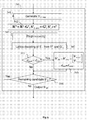
- Figure 5 represents a decoding method of a multidimensional received signal, implemented in the decoder 35, especially in an undetermined case as mentioned above.
- the multidimensional received signal corresponds to a discrete multidimensional signal, S', which is coded by transmitter 2 and is transmitted through a channel to a receiver.
- the multidimensional received signal comprises several elementary signals, corresponding each to a sample of time and/or frequency and of space.
- the decoding begins with a initialization step 50, wherein different parameters of the method are set to their initial value(s).
- the decoder 35 waits for and receives a signal from demapper 33.
- the CPU 41 makes a channel estimation 52 based upon the received signal (associated to one transmitted block) or part of it.
- the estimation 52 is based upon several received signals (or part of them), each being associated to a transmitted block.
- the estimation 52 is not done at each reception of signal corresponding to one transmitted block; in this case, it may be done when necessary according to the channel changes (e.g. every 1 ms).
- the transmitted signal S' corresponds to the multidimensional received signal being considered as the sum of contributions of two transmitted sub-signals S' 1 and S' 2 , the first sub-signal S'1 being associated to the first sub-matrix G' 1 and a second sub-signal S' 2 being associated to the second sub-matrix G' 2 .
- G' 1 is made of a subset of 2 N rx N columns of G' out of the 2 Q columns, so that the resulting matrix G' 1 is of maximum rank (i.e. G' 1 is a 2 N rx N* 2 N rx N ).
- G' 1 is any of possible matrices of largest rank (to reduce the complexity of the lattice search) (e.g. the first ones).
- G' 1 comprises any subset of 2 N rx N columns of G' .
- G' 2 is made of remaining column of G'.
- the selection of G' 1 comprises a selection of independent columns.
- the STBC is a simple spatial multiplexing
- any 2 N rx N columns of G' e.g. the first ones
- G' 1 any subset of columns of G' has statistically the same independency properties.
- the distance dmin is first set to infinite value (+ ⁇ ).
- a lattice decoding of S' 1 is performed on an intermediate signal corresponding to enumerated values of S' 2 .
- a ML candidate or candidate signal is selected.
- the result of the decoding of the received signal corresponds to a combination of a candidate signal and of the value of the second sub-signal for which the candidate distance (i.e. the distance between the intermediate signal (denoted R" in the following) and the contribution of the candidate signal (denoted S' 1cand in the following)) is minimum.
- the candidate distance i.e. the distance between the intermediate signal (denoted R" in the following) and the contribution of the candidate signal (denoted S' 1cand in the following)
- the candidate distance i.e. the distance between the intermediate signal (denoted R" in the following) and the contribution of the candidate signal (denoted S' 1cand in the following)
- the candidate distance i.e. the distance between the intermediate signal (denoted R" in the following) and the contribution of the candidate
- step 51 is reiterated.
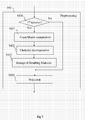
- Figure 6 details step 54.
- a candidate S' 2 denoted S' 2cand is selected.
- step 541 is executed in step 54, any possible candidate is chosen.
- a candidate is chosen among non already chosen candidates.
- a intermediate signal R" is generated.
- the signal R" is equal to R'-G' 2 S' 2cand .
- R" is also equals to G' 1 S' 1 + ⁇ '.
- a ML candidate S' ML is assigned to the candidate S' cand corresponding to vector made of S' 1cand and S' 2cand .
- distance dmin is assigned to candidate distance dcand corresponding to the distance associated to S' cand .
- step 545 or if the result of test 644 is negative, during a test 546, the CPU 41 checks if candidates S' 2 are remaining.
- step 541 is reiterated.
- step 54 is ended and the output S' ML corresponds to the ML decoding of received signal R'.
- FIG. 7 details the preprocessing step 543.
- the step 543 begins with a test 5430, which checks if step 543 is performed for the first time during step 54.
- Gram matrix corresponds to a multiplication of a matrix G' 1 by its transpose G' 1 t .
- a triangular decomposition e.g. a Cholesky decomposition of the associated Gram matrix.
- step 5434 the received signal is projected on the matrix computed on step 5432. This projection first multiplies the signal R" by G' 1 t and then by the inverse of U t .
- step 5432 is replaced by a QR decomposition of a new equivalent channel matrix (G' 1 ), G' 1 being equal to QU where Q is an orthogonal matrix and U an upper triangular matrix.
- step 5434 comprises a multiplication by Q t .
- the invention is compatible with any type of wireless link (point to point links, wireless LANs, mobile networks, digital broadcasting, satellite communication, ).
- the disclosed receiver in figure 3 comprises then elements adapted to a specific application (such as front end, demodulator, MAC layer interface, and all other usual communication layer elements).
- the invention is especially well adapted to the reception of Digital Video Broadcasting (or DVB (e.g. DVB-T (terrestrial), DVB-S (satellite), DVB-H (handheld)..).
- DVB Digital Video Broadcasting
- the discrete multidimensional coded signal comprises data representative of a digital video broadcast signal.
- the invention is advantageously used in high spectral efficiency wireless transmission (MIMO system and/or nQAM modulation), and, in particular, high rate transmission. Indeed, the invention can be used for other transmission (eg. single antenna for multi-user detection, nQPSK modulation, ).
- the invention is not limited to MIMO decoding or multi-user detection and can be applied to combination of MIMO decoding and multi-user detection and more generally to any system wherein noise amplitude distribution is following a chi square law and more generally laws that are not centred on 0 (these laws are generally associated to a multidimensional distribution of noise in a multidimensional signal decoding).
- the invention comprises the determination of a minimum distance according to a noise level associated to the multidimensional received signal.
- the dimensions of the received signals corresponds to K (in real notation for nQAM or nPSK modulation) or Q (in complex notation for nQAM or nPSK modulation or polar notation for nPSK modulation).
- the receiver decodes a signal that has been space time encoded and transmitted with at least two antennas.
- the space time encoding can be based on a space time block code.
- the space time encoding is a simple spatial multiplexing; then, the code matrix C is the identity matrix.
Landscapes
- Engineering & Computer Science (AREA)
- Computer Networks & Wireless Communication (AREA)
- Signal Processing (AREA)
- Physics & Mathematics (AREA)
- Mathematical Physics (AREA)
- Power Engineering (AREA)
- Radio Transmission System (AREA)
- Compression, Expansion, Code Conversion, And Decoders (AREA)
- Reduction Or Emphasis Of Bandwidth Of Signals (AREA)
- Circuits Of Receivers In General (AREA)
- Digital Transmission Methods That Use Modulated Carrier Waves (AREA)
Priority Applications (3)
| Application Number | Priority Date | Filing Date | Title |
|---|---|---|---|
| EP06301223A EP1931075B1 (fr) | 2006-12-07 | 2006-12-07 | Procédé de décodage d'un signal reçu multidimensionnel |
| AT06301223T ATE488924T1 (de) | 2006-12-07 | 2006-12-07 | Verfahren zur dekodierung eines empfangenen mehrdimensionalen signals |
| DE602006018332T DE602006018332D1 (de) | 2006-12-07 | 2006-12-07 | Verfahren zur Dekodierung eines empfangenen mehrdimensionalen Signals |
Applications Claiming Priority (1)
| Application Number | Priority Date | Filing Date | Title |
|---|---|---|---|
| EP06301223A EP1931075B1 (fr) | 2006-12-07 | 2006-12-07 | Procédé de décodage d'un signal reçu multidimensionnel |
Publications (2)
| Publication Number | Publication Date |
|---|---|
| EP1931075A1 true EP1931075A1 (fr) | 2008-06-11 |
| EP1931075B1 EP1931075B1 (fr) | 2010-11-17 |
Family
ID=37964275
Family Applications (1)
| Application Number | Title | Priority Date | Filing Date |
|---|---|---|---|
| EP06301223A Not-in-force EP1931075B1 (fr) | 2006-12-07 | 2006-12-07 | Procédé de décodage d'un signal reçu multidimensionnel |
Country Status (3)
| Country | Link |
|---|---|
| EP (1) | EP1931075B1 (fr) |
| AT (1) | ATE488924T1 (fr) |
| DE (1) | DE602006018332D1 (fr) |
Cited By (4)
| Publication number | Priority date | Publication date | Assignee | Title |
|---|---|---|---|---|
| EP2075927A1 (fr) | 2007-12-21 | 2009-07-01 | Thomson Licensing | Procédé de transmission d'au moins un paquet de données par plusieurs antennes et son procédé de réception |
| CN101562464B (zh) * | 2009-05-18 | 2012-11-07 | 北京天碁科技有限公司 | 一种基于深度优先搜索的球形译码检测方法 |
| CN113475023A (zh) * | 2018-12-06 | 2021-10-01 | 法国矿业电信学校联盟 | 用于并行化的递归块解码的设备和方法 |
| US20220070027A1 (en) * | 2018-12-19 | 2022-03-03 | Telefonaktiebolaget Lm Ericsson (Publ) | Methods, remote radio units and base band units of a distributed base station system for handling uplink signals |
Citations (2)
| Publication number | Priority date | Publication date | Assignee | Title |
|---|---|---|---|---|
| US20050009476A1 (en) | 2003-07-07 | 2005-01-13 | Shiquan Wu | Virtual MIMO transmitters, receivers, systems and methods |
| EP1635500A1 (fr) | 2004-09-14 | 2006-03-15 | Kabushi Kaisha Toshiba | Récepteur utilisé dans un système MIMO |
-
2006
- 2006-12-07 EP EP06301223A patent/EP1931075B1/fr not_active Not-in-force
- 2006-12-07 DE DE602006018332T patent/DE602006018332D1/de active Active
- 2006-12-07 AT AT06301223T patent/ATE488924T1/de not_active IP Right Cessation
Patent Citations (2)
| Publication number | Priority date | Publication date | Assignee | Title |
|---|---|---|---|---|
| US20050009476A1 (en) | 2003-07-07 | 2005-01-13 | Shiquan Wu | Virtual MIMO transmitters, receivers, systems and methods |
| EP1635500A1 (fr) | 2004-09-14 | 2006-03-15 | Kabushi Kaisha Toshiba | Récepteur utilisé dans un système MIMO |
Non-Patent Citations (4)
| Title |
|---|
| C.P. SCHNORR; M. EUCHNER: "Lattice basis reduction: Improved practical algorithms and solving subset sum problems", MATH. PROGRAMING, vol. 66, 1994, pages 181 - 191 |
| GERARD. J. FOSCHINI: "Layered Space-Time Architecture for Wireless Communication in a Fading Environment When Using Multi-Element Antennas", BELL LABORATORIES TECHNICAL JOURNAL, October 1996 (1996-10-01), pages 41 - 59 |
| INFORM. THEORY, vol. 45, July 1999 (1999-07-01), pages 1639 - 1642 |
| UYSAL M ET AL: "NEW SPACE-TIME BLOCK CODES FOR HIGH THROUGHPUT EFFICIENCY", GLOBECOM'01. 2001 IEEE GLOBAL TELECOMMUNICATIONS CONFERENCE. SAN ANTONIO, TX, NOV. 25 - 29, 2001, IEEE GLOBAL TELECOMMUNICATIONS CONFERENCE, NEW YORK, NY : IEEE, US, vol. VOL. 2 OF 6, 25 November 2001 (2001-11-25), pages 1103 - 1107, XP001099276, ISBN: 0-7803-7206-9 * |
Cited By (5)
| Publication number | Priority date | Publication date | Assignee | Title |
|---|---|---|---|---|
| EP2075927A1 (fr) | 2007-12-21 | 2009-07-01 | Thomson Licensing | Procédé de transmission d'au moins un paquet de données par plusieurs antennes et son procédé de réception |
| CN101562464B (zh) * | 2009-05-18 | 2012-11-07 | 北京天碁科技有限公司 | 一种基于深度优先搜索的球形译码检测方法 |
| CN113475023A (zh) * | 2018-12-06 | 2021-10-01 | 法国矿业电信学校联盟 | 用于并行化的递归块解码的设备和方法 |
| US20220070027A1 (en) * | 2018-12-19 | 2022-03-03 | Telefonaktiebolaget Lm Ericsson (Publ) | Methods, remote radio units and base band units of a distributed base station system for handling uplink signals |
| US12143246B2 (en) * | 2018-12-19 | 2024-11-12 | Telefonaktiebolaget Lm Ericsson (Publ) | Methods, remote radio units and base band units of a distributed base station system for handling uplink signals |
Also Published As
| Publication number | Publication date |
|---|---|
| EP1931075B1 (fr) | 2010-11-17 |
| ATE488924T1 (de) | 2010-12-15 |
| DE602006018332D1 (de) | 2010-12-30 |
Similar Documents
| Publication | Publication Date | Title |
|---|---|---|
| EP2223442B1 (fr) | Procédé d'affectation adaptative des fréquences à une pluralité d'antennes | |
| KR100918717B1 (ko) | 다입다출력 직교주파수분할다중화 이동통신 시스템에서의신호 시퀀스 추정 방법 및 장치 | |
| EP1850506A1 (fr) | Procede de pre-codage de bloc espace-temps dans une liaison descendante multi-utilisateurs | |
| KR101043698B1 (ko) | 공간다중화 시스템에서 신호검출 장치 및 방법 | |
| US8842755B2 (en) | Process for decoding ALAMOUTI block code in an OFDM system, and receiver for the same | |
| US20070206697A1 (en) | Signal receiving method and signal receiving equipment for multiple input multiple output wireless communication system | |
| EP3697010B1 (fr) | Procédé et dispositif de traitement de données | |
| EP2104260B1 (fr) | Techniques diverses de formation de faisceau à transmission de code à grande vitesse utilisant un précodage algébrique partiel et récepteurs à faible complexité quasi optimaux | |
| Yenilmez et al. | Performance of GFDM-maximal ratio transmission over Nakagami-m fading channels | |
| EP1931075B1 (fr) | Procédé de décodage d'un signal reçu multidimensionnel | |
| US8693602B2 (en) | Method and device for mono- and multi-antenna reception for Alamouti-type links | |
| US11044122B2 (en) | Semi-blind channel estimation method and apparatus | |
| EP1912367B1 (fr) | Procédé de décodage d'un signal multidimensionnel reçu et dispositif correspondant | |
| EP1912368B1 (fr) | Procédé de décodage d'un signal multidimensionnel reçu et dispositif correspondant | |
| de Mello et al. | Spectrum efficient GFDM based on faster than Nyquist signaling | |
| EP1912369A1 (fr) | Procédé de décodage d'un signal multidimensionnel reçu et dispositif correspondant | |
| EP1912370A1 (fr) | Dispositif comprennant un décodeur d'un signal multidimensionnel reçu et système correspondant | |
| Torabi et al. | Performance evaluation of space-frequency coded OFDM systems over frequency selective fading channels | |
| Park et al. | Efficient signal detection technique for interactive digital broadcasting system with multiple antennas | |
| KR101225649B1 (ko) | 다중 안테나 통신시스템의 채널추정 장치 및 방법 | |
| VEENA et al. | Implementation of Channel Estimation and Modulation Technique for MIMO System | |
| Feng et al. | Sparse multipath channel estimation and decoding for broadband vector OFDM systems | |
| EP2319217B1 (fr) | Procédé et appareil pour la réception de signaux numériques transmis par multiplexage en fréquences codées pour systèmes de transmission, en particulier de type à diversité spatiale | |
| MIMO | Journal Of Harmonized Research (JOHR) | |
| Wong et al. | Nonredundant error correction DQPSK for the aeronautical-satellite channel |
Legal Events
| Date | Code | Title | Description |
|---|---|---|---|
| PUAI | Public reference made under article 153(3) epc to a published international application that has entered the european phase |
Free format text: ORIGINAL CODE: 0009012 |
|
| AK | Designated contracting states |
Kind code of ref document: A1 Designated state(s): AT BE BG CH CY CZ DE DK EE ES FI FR GB GR HU IE IS IT LI LT LU LV MC NL PL PT RO SE SI SK TR |
|
| AX | Request for extension of the european patent |
Extension state: AL BA HR MK RS |
|
| 17P | Request for examination filed |
Effective date: 20081208 |
|
| 17Q | First examination report despatched |
Effective date: 20090114 |
|
| AKX | Designation fees paid |
Designated state(s): AT BE BG CH CY CZ DE DK EE ES FI FR GB GR HU IE IS IT LI LT LU LV MC NL PL PT RO SE SI SK TR |
|
| RAP1 | Party data changed (applicant data changed or rights of an application transferred) |
Owner name: THOMSON LICENSING |
|
| GRAP | Despatch of communication of intention to grant a patent |
Free format text: ORIGINAL CODE: EPIDOSNIGR1 |
|
| RTI1 | Title (correction) |
Free format text: METHOD OF DECODING OF A RECEIVED MULTIDIMENSIONAL SIGNAL |
|
| RIN1 | Information on inventor provided before grant (corrected) |
Inventor name: GUEGUEN, ARNAUD |
|
| GRAS | Grant fee paid |
Free format text: ORIGINAL CODE: EPIDOSNIGR3 |
|
| GRAA | (expected) grant |
Free format text: ORIGINAL CODE: 0009210 |
|
| AK | Designated contracting states |
Kind code of ref document: B1 Designated state(s): AT BE BG CH CY CZ DE DK EE ES FI FR GB GR HU IE IS IT LI LT LU LV MC NL PL PT RO SE SI SK TR |
|
| REG | Reference to a national code |
Ref country code: GB Ref legal event code: FG4D |
|
| REG | Reference to a national code |
Ref country code: CH Ref legal event code: EP |
|
| REG | Reference to a national code |
Ref country code: IE Ref legal event code: FG4D |
|
| REF | Corresponds to: |
Ref document number: 602006018332 Country of ref document: DE Date of ref document: 20101230 Kind code of ref document: P |
|
| REG | Reference to a national code |
Ref country code: NL Ref legal event code: VDEP Effective date: 20101117 |
|
| LTIE | Lt: invalidation of european patent or patent extension |
Effective date: 20101117 |
|
| PG25 | Lapsed in a contracting state [announced via postgrant information from national office to epo] |
Ref country code: LT Free format text: LAPSE BECAUSE OF FAILURE TO SUBMIT A TRANSLATION OF THE DESCRIPTION OR TO PAY THE FEE WITHIN THE PRESCRIBED TIME-LIMIT Effective date: 20101117 |
|
| PG25 | Lapsed in a contracting state [announced via postgrant information from national office to epo] |
Ref country code: BG Free format text: LAPSE BECAUSE OF FAILURE TO SUBMIT A TRANSLATION OF THE DESCRIPTION OR TO PAY THE FEE WITHIN THE PRESCRIBED TIME-LIMIT Effective date: 20110217 Ref country code: FI Free format text: LAPSE BECAUSE OF FAILURE TO SUBMIT A TRANSLATION OF THE DESCRIPTION OR TO PAY THE FEE WITHIN THE PRESCRIBED TIME-LIMIT Effective date: 20101117 Ref country code: SI Free format text: LAPSE BECAUSE OF FAILURE TO SUBMIT A TRANSLATION OF THE DESCRIPTION OR TO PAY THE FEE WITHIN THE PRESCRIBED TIME-LIMIT Effective date: 20101117 Ref country code: AT Free format text: LAPSE BECAUSE OF FAILURE TO SUBMIT A TRANSLATION OF THE DESCRIPTION OR TO PAY THE FEE WITHIN THE PRESCRIBED TIME-LIMIT Effective date: 20101117 Ref country code: CY Free format text: LAPSE BECAUSE OF FAILURE TO SUBMIT A TRANSLATION OF THE DESCRIPTION OR TO PAY THE FEE WITHIN THE PRESCRIBED TIME-LIMIT Effective date: 20101117 Ref country code: IS Free format text: LAPSE BECAUSE OF FAILURE TO SUBMIT A TRANSLATION OF THE DESCRIPTION OR TO PAY THE FEE WITHIN THE PRESCRIBED TIME-LIMIT Effective date: 20110317 Ref country code: SE Free format text: LAPSE BECAUSE OF FAILURE TO SUBMIT A TRANSLATION OF THE DESCRIPTION OR TO PAY THE FEE WITHIN THE PRESCRIBED TIME-LIMIT Effective date: 20101117 Ref country code: PT Free format text: LAPSE BECAUSE OF FAILURE TO SUBMIT A TRANSLATION OF THE DESCRIPTION OR TO PAY THE FEE WITHIN THE PRESCRIBED TIME-LIMIT Effective date: 20110317 Ref country code: LV Free format text: LAPSE BECAUSE OF FAILURE TO SUBMIT A TRANSLATION OF THE DESCRIPTION OR TO PAY THE FEE WITHIN THE PRESCRIBED TIME-LIMIT Effective date: 20101117 Ref country code: NL Free format text: LAPSE BECAUSE OF FAILURE TO SUBMIT A TRANSLATION OF THE DESCRIPTION OR TO PAY THE FEE WITHIN THE PRESCRIBED TIME-LIMIT Effective date: 20101117 |
|
| PG25 | Lapsed in a contracting state [announced via postgrant information from national office to epo] |
Ref country code: GR Free format text: LAPSE BECAUSE OF FAILURE TO SUBMIT A TRANSLATION OF THE DESCRIPTION OR TO PAY THE FEE WITHIN THE PRESCRIBED TIME-LIMIT Effective date: 20110218 |
|
| PG25 | Lapsed in a contracting state [announced via postgrant information from national office to epo] |
Ref country code: BE Free format text: LAPSE BECAUSE OF FAILURE TO SUBMIT A TRANSLATION OF THE DESCRIPTION OR TO PAY THE FEE WITHIN THE PRESCRIBED TIME-LIMIT Effective date: 20101117 Ref country code: MC Free format text: LAPSE BECAUSE OF NON-PAYMENT OF DUE FEES Effective date: 20101231 Ref country code: CZ Free format text: LAPSE BECAUSE OF FAILURE TO SUBMIT A TRANSLATION OF THE DESCRIPTION OR TO PAY THE FEE WITHIN THE PRESCRIBED TIME-LIMIT Effective date: 20101117 Ref country code: EE Free format text: LAPSE BECAUSE OF FAILURE TO SUBMIT A TRANSLATION OF THE DESCRIPTION OR TO PAY THE FEE WITHIN THE PRESCRIBED TIME-LIMIT Effective date: 20101117 Ref country code: ES Free format text: LAPSE BECAUSE OF FAILURE TO SUBMIT A TRANSLATION OF THE DESCRIPTION OR TO PAY THE FEE WITHIN THE PRESCRIBED TIME-LIMIT Effective date: 20110228 |
|
| REG | Reference to a national code |
Ref country code: CH Ref legal event code: PL |
|
| PG25 | Lapsed in a contracting state [announced via postgrant information from national office to epo] |
Ref country code: SK Free format text: LAPSE BECAUSE OF FAILURE TO SUBMIT A TRANSLATION OF THE DESCRIPTION OR TO PAY THE FEE WITHIN THE PRESCRIBED TIME-LIMIT Effective date: 20101117 Ref country code: RO Free format text: LAPSE BECAUSE OF FAILURE TO SUBMIT A TRANSLATION OF THE DESCRIPTION OR TO PAY THE FEE WITHIN THE PRESCRIBED TIME-LIMIT Effective date: 20101117 Ref country code: PL Free format text: LAPSE BECAUSE OF FAILURE TO SUBMIT A TRANSLATION OF THE DESCRIPTION OR TO PAY THE FEE WITHIN THE PRESCRIBED TIME-LIMIT Effective date: 20101117 Ref country code: DK Free format text: LAPSE BECAUSE OF FAILURE TO SUBMIT A TRANSLATION OF THE DESCRIPTION OR TO PAY THE FEE WITHIN THE PRESCRIBED TIME-LIMIT Effective date: 20101117 |
|
| PLBE | No opposition filed within time limit |
Free format text: ORIGINAL CODE: 0009261 |
|
| STAA | Information on the status of an ep patent application or granted ep patent |
Free format text: STATUS: NO OPPOSITION FILED WITHIN TIME LIMIT |
|
| 26N | No opposition filed |
Effective date: 20110818 |
|
| PG25 | Lapsed in a contracting state [announced via postgrant information from national office to epo] |
Ref country code: CH Free format text: LAPSE BECAUSE OF NON-PAYMENT OF DUE FEES Effective date: 20101231 Ref country code: IE Free format text: LAPSE BECAUSE OF NON-PAYMENT OF DUE FEES Effective date: 20101207 Ref country code: LI Free format text: LAPSE BECAUSE OF NON-PAYMENT OF DUE FEES Effective date: 20101231 |
|
| REG | Reference to a national code |
Ref country code: DE Ref legal event code: R097 Ref document number: 602006018332 Country of ref document: DE Effective date: 20110818 |
|
| PG25 | Lapsed in a contracting state [announced via postgrant information from national office to epo] |
Ref country code: IT Free format text: LAPSE BECAUSE OF FAILURE TO SUBMIT A TRANSLATION OF THE DESCRIPTION OR TO PAY THE FEE WITHIN THE PRESCRIBED TIME-LIMIT Effective date: 20101117 |
|
| PG25 | Lapsed in a contracting state [announced via postgrant information from national office to epo] |
Ref country code: LU Free format text: LAPSE BECAUSE OF NON-PAYMENT OF DUE FEES Effective date: 20101207 Ref country code: HU Free format text: LAPSE BECAUSE OF FAILURE TO SUBMIT A TRANSLATION OF THE DESCRIPTION OR TO PAY THE FEE WITHIN THE PRESCRIBED TIME-LIMIT Effective date: 20110518 |
|
| PG25 | Lapsed in a contracting state [announced via postgrant information from national office to epo] |
Ref country code: TR Free format text: LAPSE BECAUSE OF FAILURE TO SUBMIT A TRANSLATION OF THE DESCRIPTION OR TO PAY THE FEE WITHIN THE PRESCRIBED TIME-LIMIT Effective date: 20101117 |
|
| PGFP | Annual fee paid to national office [announced via postgrant information from national office to epo] |
Ref country code: DE Payment date: 20141219 Year of fee payment: 9 |
|
| PGFP | Annual fee paid to national office [announced via postgrant information from national office to epo] |
Ref country code: GB Payment date: 20150105 Year of fee payment: 9 Ref country code: FR Payment date: 20141215 Year of fee payment: 9 |
|
| REG | Reference to a national code |
Ref country code: DE Ref legal event code: R119 Ref document number: 602006018332 Country of ref document: DE |
|
| GBPC | Gb: european patent ceased through non-payment of renewal fee |
Effective date: 20151207 |
|
| REG | Reference to a national code |
Ref country code: FR Ref legal event code: ST Effective date: 20160831 |
|
| PG25 | Lapsed in a contracting state [announced via postgrant information from national office to epo] |
Ref country code: GB Free format text: LAPSE BECAUSE OF NON-PAYMENT OF DUE FEES Effective date: 20151207 Ref country code: DE Free format text: LAPSE BECAUSE OF NON-PAYMENT OF DUE FEES Effective date: 20160701 |
|
| PG25 | Lapsed in a contracting state [announced via postgrant information from national office to epo] |
Ref country code: FR Free format text: LAPSE BECAUSE OF NON-PAYMENT OF DUE FEES Effective date: 20151231 |