EP1931677B1 - Neuartige pyrazolopyrimidine als cyclin-abhängige kinasehemmer - Google Patents
Neuartige pyrazolopyrimidine als cyclin-abhängige kinasehemmer Download PDFInfo
- Publication number
- EP1931677B1 EP1931677B1 EP06836186.4A EP06836186A EP1931677B1 EP 1931677 B1 EP1931677 B1 EP 1931677B1 EP 06836186 A EP06836186 A EP 06836186A EP 1931677 B1 EP1931677 B1 EP 1931677B1
- Authority
- EP
- European Patent Office
- Prior art keywords
- compound
- preparative example
- mmol
- mixture
- yield
- Prior art date
- Legal status (The legal status is an assumption and is not a legal conclusion. Google has not performed a legal analysis and makes no representation as to the accuracy of the status listed.)
- Active
Links
- 0 CCOC1OC1C(*)C(IN)=O Chemical compound CCOC1OC1C(*)C(IN)=O 0.000 description 15
- IXIPWEZNJKGWEJ-UHFFFAOYSA-N C[n]1ncc(-c2c3nc(C4CNCCC4)c(F)c(N)[n]3nc2)c1 Chemical compound C[n]1ncc(-c2c3nc(C4CNCCC4)c(F)c(N)[n]3nc2)c1 IXIPWEZNJKGWEJ-UHFFFAOYSA-N 0.000 description 4
- VQDGPUBPVHUDCV-UHFFFAOYSA-N C[n]1ncc(-c2c3nc(C4CNCCC4)c(Cl)c(N)[n]3nc2)c1 Chemical compound C[n]1ncc(-c2c3nc(C4CNCCC4)c(Cl)c(N)[n]3nc2)c1 VQDGPUBPVHUDCV-UHFFFAOYSA-N 0.000 description 3
- WEITXVPFZGIOKO-UHFFFAOYSA-N CC(C)(C)OC(N(CC1)CC1c(c(Br)c(N)[n]1nc2)nc1c2-c1c[n](C)nc1)=O Chemical compound CC(C)(C)OC(N(CC1)CC1c(c(Br)c(N)[n]1nc2)nc1c2-c1c[n](C)nc1)=O WEITXVPFZGIOKO-UHFFFAOYSA-N 0.000 description 1
- FMHZMTRZVKFANZ-UHFFFAOYSA-O CC(C)(C)OC(N(Cc1cc[nH+]cc1)c1cc(-c(cccc2)c2F)nc2ccn[n]12)=O Chemical compound CC(C)(C)OC(N(Cc1cc[nH+]cc1)c1cc(-c(cccc2)c2F)nc2ccn[n]12)=O FMHZMTRZVKFANZ-UHFFFAOYSA-O 0.000 description 1
- BZBIWMKUTYVQSY-UHFFFAOYSA-N CC(C)(C)OC(N1CC(c(c(Br)c(N)[n]2nc3)nc2c3-c2c[nH]nc2)SCC1)=O Chemical compound CC(C)(C)OC(N1CC(c(c(Br)c(N)[n]2nc3)nc2c3-c2c[nH]nc2)SCC1)=O BZBIWMKUTYVQSY-UHFFFAOYSA-N 0.000 description 1
- XAVPSIBIOXWQNS-UHFFFAOYSA-N CC(C)(C)OC(NC(CC1)CCN1C(c1cccc(C(F)(F)F)c1)=O)=O Chemical compound CC(C)(C)OC(NC(CC1)CCN1C(c1cccc(C(F)(F)F)c1)=O)=O XAVPSIBIOXWQNS-UHFFFAOYSA-N 0.000 description 1
- CKXZPVPIDOJLLM-UHFFFAOYSA-N CC(C)(C)OC(NC1CCNCC1)=O Chemical compound CC(C)(C)OC(NC1CCNCC1)=O CKXZPVPIDOJLLM-UHFFFAOYSA-N 0.000 description 1
- MZDXQPKJGLGAOI-UHFFFAOYSA-N CC(C)(C)OC(NCC(CCC1)CN1C(N)=O)=O Chemical compound CC(C)(C)OC(NCC(CCC1)CN1C(N)=O)=O MZDXQPKJGLGAOI-UHFFFAOYSA-N 0.000 description 1
- KHPQHXGYYXYTDN-UHFFFAOYSA-N CC(C)(C)OC(NCC1CNCCC1)=O Chemical compound CC(C)(C)OC(NCC1CNCCC1)=O KHPQHXGYYXYTDN-UHFFFAOYSA-N 0.000 description 1
- HZOTZABXBMXFOI-CQSZACIVSA-N CC(C)(C)OC(NC[C@@H](CCC1)N1c(cc(NC(OC(C)(C)C)=O)[n]1nc2)nc1c2[Br]=C)=O Chemical compound CC(C)(C)OC(NC[C@@H](CCC1)N1c(cc(NC(OC(C)(C)C)=O)[n]1nc2)nc1c2[Br]=C)=O HZOTZABXBMXFOI-CQSZACIVSA-N 0.000 description 1
- BOBSXNAUMHODFM-ZDUSSCGKSA-N CC(C)(C)OC(N[C@@H](CC1)CN1c(cc(NC(OC(C)(C)C)=O)[n]1nc2)nc1c2N=C=S)=O Chemical compound CC(C)(C)OC(N[C@@H](CC1)CN1c(cc(NC(OC(C)(C)C)=O)[n]1nc2)nc1c2N=C=S)=O BOBSXNAUMHODFM-ZDUSSCGKSA-N 0.000 description 1
- ZALFWDXMSXQHSY-LBPRGKRZSA-N CC(C)(C)OC(N[C@@H](CC1)CN1c(cc(NC(OC(C)(C)C)=O)[n]1nc2)nc1c2S)=O Chemical compound CC(C)(C)OC(N[C@@H](CC1)CN1c(cc(NC(OC(C)(C)C)=O)[n]1nc2)nc1c2S)=O ZALFWDXMSXQHSY-LBPRGKRZSA-N 0.000 description 1
- LPCLHVZPOKPGGR-AWEZNQCLSA-N CC(C)(C)OC(N[C@@H](CC1)CN1c(cc(NC(OC(C)(C)C)=O)[n]1nc2)nc1c2SCCO)=O Chemical compound CC(C)(C)OC(N[C@@H](CC1)CN1c(cc(NC(OC(C)(C)C)=O)[n]1nc2)nc1c2SCCO)=O LPCLHVZPOKPGGR-AWEZNQCLSA-N 0.000 description 1
- XFAKCJJAZPQZFI-KRWDZBQOSA-N CC(C)(C)OC(N[C@@H](CC1)CN1c(cc(NC(OC(C)(C)C)=O)[n]1nc2)nc1c2Sc1ccccc1)=O Chemical compound CC(C)(C)OC(N[C@@H](CC1)CN1c(cc(NC(OC(C)(C)C)=O)[n]1nc2)nc1c2Sc1ccccc1)=O XFAKCJJAZPQZFI-KRWDZBQOSA-N 0.000 description 1
- VHEOBJZOMQVBCH-UHFFFAOYSA-N CC(C)(c1nc2ccn[n]2c(NCc2cnccc2)c1)O Chemical compound CC(C)(c1nc2ccn[n]2c(NCc2cnccc2)c1)O VHEOBJZOMQVBCH-UHFFFAOYSA-N 0.000 description 1
- DMOYLRWXSRRIPX-UHFFFAOYSA-N CC(C)c1c(NC(CC2=O)=O)[n]2nc1 Chemical compound CC(C)c1c(NC(CC2=O)=O)[n]2nc1 DMOYLRWXSRRIPX-UHFFFAOYSA-N 0.000 description 1
- DCXYGSQYDQEDJO-UHFFFAOYSA-N CC(CCCC1)C1C(C1)=Nc2ccn[n]2C1Cl Chemical compound CC(CCCC1)C1C(C1)=Nc2ccn[n]2C1Cl DCXYGSQYDQEDJO-UHFFFAOYSA-N 0.000 description 1
- WUVLTLJUFBFGML-UHFFFAOYSA-N CC(c1nc2ccn[n]2c(NCc2cnccc2)c1)O Chemical compound CC(c1nc2ccn[n]2c(NCc2cnccc2)c1)O WUVLTLJUFBFGML-UHFFFAOYSA-N 0.000 description 1
- QBXXBTJDUGHCTH-UHFFFAOYSA-N CCN(C=CC(CN)=C1)C1=O Chemical compound CCN(C=CC(CN)=C1)C1=O QBXXBTJDUGHCTH-UHFFFAOYSA-N 0.000 description 1
- GVJGVIVDKQDJNU-UHFFFAOYSA-N CCOC(CC(C(C1)OCCN1C(OC(C)(C)C)=O)=O)=O Chemical compound CCOC(CC(C(C1)OCCN1C(OC(C)(C)C)=O)=O)=O GVJGVIVDKQDJNU-UHFFFAOYSA-N 0.000 description 1
- IMQDTRNWEUTKBY-UHFFFAOYSA-N CCOC(CC(C1C(C)CCCC1)=O)=O Chemical compound CCOC(CC(C1C(C)CCCC1)=O)=O IMQDTRNWEUTKBY-UHFFFAOYSA-N 0.000 description 1
- YWTDODYQRCIOAZ-UHFFFAOYSA-N CCOC(CC(C1C(CC2)CC2C1)=O)=O Chemical compound CCOC(CC(C1C(CC2)CC2C1)=O)=O YWTDODYQRCIOAZ-UHFFFAOYSA-N 0.000 description 1
- AVYVYBSVLSCWTE-UHFFFAOYSA-N CCOC(CC(Cc(c(Cl)ccc1)c1Cl)=O)=O Chemical compound CCOC(CC(Cc(c(Cl)ccc1)c1Cl)=O)=O AVYVYBSVLSCWTE-UHFFFAOYSA-N 0.000 description 1
- XZOUEGUVGJXUHL-UHFFFAOYSA-N CCOC(c1nc2ccn[n]2c(Cl)c1)=O Chemical compound CCOC(c1nc2ccn[n]2c(Cl)c1)=O XZOUEGUVGJXUHL-UHFFFAOYSA-N 0.000 description 1
- NDSGMGQUNZXDTA-UHFFFAOYSA-N CCc(c(C)nc([n]1nc2)c2Br)c1Cl Chemical compound CCc(c(C)nc([n]1nc2)c2Br)c1Cl NDSGMGQUNZXDTA-UHFFFAOYSA-N 0.000 description 1
- QFSOXHZZXZVMHY-UHFFFAOYSA-N CCc(cn[n]1c(Cl)c2)c1nc2Cl Chemical compound CCc(cn[n]1c(Cl)c2)c1nc2Cl QFSOXHZZXZVMHY-UHFFFAOYSA-N 0.000 description 1
- BYSLBLMAUUTIJI-UHFFFAOYSA-N CCc(cn[n]1c(N)c2)c1nc2-c1ccccc1 Chemical compound CCc(cn[n]1c(N)c2)c1nc2-c1ccccc1 BYSLBLMAUUTIJI-UHFFFAOYSA-N 0.000 description 1
- KKWKSPDTVTUADY-UHFFFAOYSA-N CCc1c(N)[n]2ncc([Br]=C)c2nc1C Chemical compound CCc1c(N)[n]2ncc([Br]=C)c2nc1C KKWKSPDTVTUADY-UHFFFAOYSA-N 0.000 description 1
- PZBBESSUKAHBHD-UHFFFAOYSA-N COC(C(CCC1)C1=O)=O Chemical compound COC(C(CCC1)C1=O)=O PZBBESSUKAHBHD-UHFFFAOYSA-N 0.000 description 1
- RRZHCWWXFYNPJN-UHFFFAOYSA-N COc(cccc1)c1-c1nc2ccn[n]2c(Cl)c1 Chemical compound COc(cccc1)c1-c1nc2ccn[n]2c(Cl)c1 RRZHCWWXFYNPJN-UHFFFAOYSA-N 0.000 description 1
- RZNHSEZOLFEFGB-UHFFFAOYSA-N COc1ccccc1C(Cl)=O Chemical compound COc1ccccc1C(Cl)=O RZNHSEZOLFEFGB-UHFFFAOYSA-N 0.000 description 1
- OERITKQWELOJBM-UHFFFAOYSA-N CSc1ncc(C=O)cn1 Chemical compound CSc1ncc(C=O)cn1 OERITKQWELOJBM-UHFFFAOYSA-N 0.000 description 1
- ABKYUYQTKHOQNY-UHFFFAOYSA-N C[n]1ncc(-c2c3nc(C(CC4)CNC4c([n](C)nc4)c4-c4c5nc(C6CNCCC6)c(F)c(N)[n]5nc4)c(F)c(N)[n]3nc2)c1 Chemical compound C[n]1ncc(-c2c3nc(C(CC4)CNC4c([n](C)nc4)c4-c4c5nc(C6CNCCC6)c(F)c(N)[n]5nc4)c(F)c(N)[n]3nc2)c1 ABKYUYQTKHOQNY-UHFFFAOYSA-N 0.000 description 1
- JGWJRPGWLZPBIJ-UHFFFAOYSA-N C[n]1ncc(-c2c3nc(C4CNCC4)c(Br)c(N)[n]3nc2)c1 Chemical compound C[n]1ncc(-c2c3nc(C4CNCC4)c(Br)c(N)[n]3nc2)c1 JGWJRPGWLZPBIJ-UHFFFAOYSA-N 0.000 description 1
- IAWHQRAHQNMAIL-UHFFFAOYSA-N C[n]1ncc(-c2c3nc(C4OCCNC4)c(Br)c(N)[n]3nc2)c1 Chemical compound C[n]1ncc(-c2c3nc(C4OCCNC4)c(Br)c(N)[n]3nc2)c1 IAWHQRAHQNMAIL-UHFFFAOYSA-N 0.000 description 1
- MGCHCKUUSGHSES-UHFFFAOYSA-N C[n]1ncc(-c2c3nc(C4SCCNC4)c(Br)c(N)[n]3nc2)c1 Chemical compound C[n]1ncc(-c2c3nc(C4SCCNC4)c(Br)c(N)[n]3nc2)c1 MGCHCKUUSGHSES-UHFFFAOYSA-N 0.000 description 1
- NZPFQOXRHLUPRT-UHFFFAOYSA-N Cc1ccc(CN)cn1 Chemical compound Cc1ccc(CN)cn1 NZPFQOXRHLUPRT-UHFFFAOYSA-N 0.000 description 1
- PTFKCZGHPYMBEN-UHFFFAOYSA-N ClC1=CC(Cl)=CCC1c1nc2ccn[n]2c(Cl)c1 Chemical compound ClC1=CC(Cl)=CCC1c1nc2ccn[n]2c(Cl)c1 PTFKCZGHPYMBEN-UHFFFAOYSA-N 0.000 description 1
- VOSALQRHGMYOTP-UHFFFAOYSA-N Clc([n]1[n]c2)cc(-c3ccccc3)nc1c2I Chemical compound Clc([n]1[n]c2)cc(-c3ccccc3)nc1c2I VOSALQRHGMYOTP-UHFFFAOYSA-N 0.000 description 1
- LJNFKIQODDUSMN-UHFFFAOYSA-N Clc([n]1nc2)cc(C3CCOCC3)nc1c2Br Chemical compound Clc([n]1nc2)cc(C3CCOCC3)nc1c2Br LJNFKIQODDUSMN-UHFFFAOYSA-N 0.000 description 1
- CJIKMWXLGRVJMI-UHFFFAOYSA-N Clc([n]1nc2)cc(Cl)nc1c2Br Chemical compound Clc([n]1nc2)cc(Cl)nc1c2Br CJIKMWXLGRVJMI-UHFFFAOYSA-N 0.000 description 1
- UWHHFOCTBOXHHU-UHFFFAOYSA-N Clc(cc1)cc(Cl)c1-c(cc([n]1nc2)Cl)nc1c2Br Chemical compound Clc(cc1)cc(Cl)c1-c(cc([n]1nc2)Cl)nc1c2Br UWHHFOCTBOXHHU-UHFFFAOYSA-N 0.000 description 1
- CJCKPYMOUSZAFL-UHFFFAOYSA-N Clc1cc(-c(cccc2)c2Br)nc2ccn[n]12 Chemical compound Clc1cc(-c(cccc2)c2Br)nc2ccn[n]12 CJCKPYMOUSZAFL-UHFFFAOYSA-N 0.000 description 1
- KIGJAIMNHQNNNY-UHFFFAOYSA-N Clc1cc(-c2nccnc2)nc2ccn[n]12 Chemical compound Clc1cc(-c2nccnc2)nc2ccn[n]12 KIGJAIMNHQNNNY-UHFFFAOYSA-N 0.000 description 1
- ZXQZETUNXXDLEZ-UHFFFAOYSA-N Clc1cc(C2C(CC3)CC3C2)nc2ccn[n]12 Chemical compound Clc1cc(C2C(CC3)CC3C2)nc2ccn[n]12 ZXQZETUNXXDLEZ-UHFFFAOYSA-N 0.000 description 1
- JMTFWCYVZOFHLR-UHFFFAOYSA-N Clc1cc(Cl)nc2ccn[n]12 Chemical compound Clc1cc(Cl)nc2ccn[n]12 JMTFWCYVZOFHLR-UHFFFAOYSA-N 0.000 description 1
- KNQYSTFPHSUHEB-UHFFFAOYSA-N Clc1cccc(-c(cc([n]2nc3)Cl)nc2c3Br)c1Cl Chemical compound Clc1cccc(-c(cc([n]2nc3)Cl)nc2c3Br)c1Cl KNQYSTFPHSUHEB-UHFFFAOYSA-N 0.000 description 1
- CBTKRIOEPSOJOJ-UHFFFAOYSA-N Fc(cccc1)c1-c1nc2ccn[n]2c(Cl)c1 Chemical compound Fc(cccc1)c1-c1nc2ccn[n]2c(Cl)c1 CBTKRIOEPSOJOJ-UHFFFAOYSA-N 0.000 description 1
- ZAIYYXVHGBMLEC-UHFFFAOYSA-N Fc(cccc1)c1-c1nc2ccn[n]2c(NCc2ccncc2)c1 Chemical compound Fc(cccc1)c1-c1nc2ccn[n]2c(NCc2ccncc2)c1 ZAIYYXVHGBMLEC-UHFFFAOYSA-N 0.000 description 1
- SCHUXPBWLLMJTB-UHFFFAOYSA-N N#Cc1cccc(-c2ncc[s]2)c1 Chemical compound N#Cc1cccc(-c2ncc[s]2)c1 SCHUXPBWLLMJTB-UHFFFAOYSA-N 0.000 description 1
- SBKQYEDAEHMIOI-UHFFFAOYSA-N NCC(CCC1)CN1C(N)=O Chemical compound NCC(CCC1)CN1C(N)=O SBKQYEDAEHMIOI-UHFFFAOYSA-N 0.000 description 1
- YRYLTTPCTDJAMT-UHFFFAOYSA-N NCc(cc1C2)ccc1NC2=O Chemical compound NCc(cc1C2)ccc1NC2=O YRYLTTPCTDJAMT-UHFFFAOYSA-N 0.000 description 1
- WHYXSYWCALWOKX-UHFFFAOYSA-N NCc1ccc2[nH]cnc2c1 Chemical compound NCc1ccc2[nH]cnc2c1 WHYXSYWCALWOKX-UHFFFAOYSA-N 0.000 description 1
- FKKJJPMGAWGYPN-UHFFFAOYSA-N NCc1ccc[s]1 Chemical compound NCc1ccc[s]1 FKKJJPMGAWGYPN-UHFFFAOYSA-N 0.000 description 1
- TZHVYJWJIDWFQI-UHFFFAOYSA-N Nc([n]1nc2)cc(-c(cccc3)c3F)nc1c2Br Chemical compound Nc([n]1nc2)cc(-c(cccc3)c3F)nc1c2Br TZHVYJWJIDWFQI-UHFFFAOYSA-N 0.000 description 1
- ZBDTVJDJYIAHHD-UHFFFAOYSA-N Nc([n]1nc2)cc(C3CCCCC3)nc1c2Br Chemical compound Nc([n]1nc2)cc(C3CCCCC3)nc1c2Br ZBDTVJDJYIAHHD-UHFFFAOYSA-N 0.000 description 1
- PWIODDUWXYZRSN-UHFFFAOYSA-N Nc([n]1nc2)cc(Cl)nc1c2Br Chemical compound Nc([n]1nc2)cc(Cl)nc1c2Br PWIODDUWXYZRSN-UHFFFAOYSA-N 0.000 description 1
- ZRSGZIMDIHBXIN-UHFFFAOYSA-N O=C(c(cc1)cc2c1OCO2)Cl Chemical compound O=C(c(cc1)cc2c1OCO2)Cl ZRSGZIMDIHBXIN-UHFFFAOYSA-N 0.000 description 1
- QIQITDHWZYEEPA-UHFFFAOYSA-N O=C(c1ccc[s]1)Cl Chemical compound O=C(c1ccc[s]1)Cl QIQITDHWZYEEPA-UHFFFAOYSA-N 0.000 description 1
- QRKXTOKFZTZFAV-UHFFFAOYSA-N O=C1[n]2nccc2NC(C(F)(F)F)=C1 Chemical compound O=C1[n]2nccc2NC(C(F)(F)F)=C1 QRKXTOKFZTZFAV-UHFFFAOYSA-N 0.000 description 1
Classifications
-
- C—CHEMISTRY; METALLURGY
- C07—ORGANIC CHEMISTRY
- C07D—HETEROCYCLIC COMPOUNDS
- C07D487/00—Heterocyclic compounds containing nitrogen atoms as the only ring hetero atoms in the condensed system, not provided for by groups C07D451/00 - C07D477/00
- C07D487/02—Heterocyclic compounds containing nitrogen atoms as the only ring hetero atoms in the condensed system, not provided for by groups C07D451/00 - C07D477/00 in which the condensed system contains two hetero rings
- C07D487/04—Ortho-condensed systems
-
- A—HUMAN NECESSITIES
- A61—MEDICAL OR VETERINARY SCIENCE; HYGIENE
- A61K—PREPARATIONS FOR MEDICAL, DENTAL OR TOILETRY PURPOSES
- A61K31/00—Medicinal preparations containing organic active ingredients
- A61K31/33—Heterocyclic compounds
- A61K31/395—Heterocyclic compounds having nitrogen as a ring hetero atom, e.g. guanethidine or rifamycins
- A61K31/495—Heterocyclic compounds having nitrogen as a ring hetero atom, e.g. guanethidine or rifamycins having six-membered rings with two or more nitrogen atoms as the only ring heteroatoms, e.g. piperazine or tetrazines
- A61K31/505—Pyrimidines; Hydrogenated pyrimidines, e.g. trimethoprim
- A61K31/519—Pyrimidines; Hydrogenated pyrimidines, e.g. trimethoprim ortho- or peri-condensed with heterocyclic rings
-
- A—HUMAN NECESSITIES
- A61—MEDICAL OR VETERINARY SCIENCE; HYGIENE
- A61P—SPECIFIC THERAPEUTIC ACTIVITY OF CHEMICAL COMPOUNDS OR MEDICINAL PREPARATIONS
- A61P19/00—Drugs for skeletal disorders
- A61P19/02—Drugs for skeletal disorders for joint disorders, e.g. arthritis, arthrosis
-
- A—HUMAN NECESSITIES
- A61—MEDICAL OR VETERINARY SCIENCE; HYGIENE
- A61P—SPECIFIC THERAPEUTIC ACTIVITY OF CHEMICAL COMPOUNDS OR MEDICINAL PREPARATIONS
- A61P25/00—Drugs for disorders of the nervous system
- A61P25/28—Drugs for disorders of the nervous system for treating neurodegenerative disorders of the central nervous system, e.g. nootropic agents, cognition enhancers, drugs for treating Alzheimer's disease or other forms of dementia
-
- A—HUMAN NECESSITIES
- A61—MEDICAL OR VETERINARY SCIENCE; HYGIENE
- A61P—SPECIFIC THERAPEUTIC ACTIVITY OF CHEMICAL COMPOUNDS OR MEDICINAL PREPARATIONS
- A61P29/00—Non-central analgesic, antipyretic or antiinflammatory agents, e.g. antirheumatic agents; Non-steroidal antiinflammatory drugs [NSAID]
-
- A—HUMAN NECESSITIES
- A61—MEDICAL OR VETERINARY SCIENCE; HYGIENE
- A61P—SPECIFIC THERAPEUTIC ACTIVITY OF CHEMICAL COMPOUNDS OR MEDICINAL PREPARATIONS
- A61P31/00—Antiinfectives, i.e. antibiotics, antiseptics, chemotherapeutics
- A61P31/10—Antimycotics
-
- A—HUMAN NECESSITIES
- A61—MEDICAL OR VETERINARY SCIENCE; HYGIENE
- A61P—SPECIFIC THERAPEUTIC ACTIVITY OF CHEMICAL COMPOUNDS OR MEDICINAL PREPARATIONS
- A61P31/00—Antiinfectives, i.e. antibiotics, antiseptics, chemotherapeutics
- A61P31/12—Antivirals
-
- A—HUMAN NECESSITIES
- A61—MEDICAL OR VETERINARY SCIENCE; HYGIENE
- A61P—SPECIFIC THERAPEUTIC ACTIVITY OF CHEMICAL COMPOUNDS OR MEDICINAL PREPARATIONS
- A61P35/00—Antineoplastic agents
-
- A—HUMAN NECESSITIES
- A61—MEDICAL OR VETERINARY SCIENCE; HYGIENE
- A61P—SPECIFIC THERAPEUTIC ACTIVITY OF CHEMICAL COMPOUNDS OR MEDICINAL PREPARATIONS
- A61P35/00—Antineoplastic agents
- A61P35/02—Antineoplastic agents specific for leukemia
-
- A—HUMAN NECESSITIES
- A61—MEDICAL OR VETERINARY SCIENCE; HYGIENE
- A61P—SPECIFIC THERAPEUTIC ACTIVITY OF CHEMICAL COMPOUNDS OR MEDICINAL PREPARATIONS
- A61P35/00—Antineoplastic agents
- A61P35/04—Antineoplastic agents specific for metastasis
-
- A—HUMAN NECESSITIES
- A61—MEDICAL OR VETERINARY SCIENCE; HYGIENE
- A61P—SPECIFIC THERAPEUTIC ACTIVITY OF CHEMICAL COMPOUNDS OR MEDICINAL PREPARATIONS
- A61P43/00—Drugs for specific purposes, not provided for in groups A61P1/00-A61P41/00
-
- A—HUMAN NECESSITIES
- A61—MEDICAL OR VETERINARY SCIENCE; HYGIENE
- A61P—SPECIFIC THERAPEUTIC ACTIVITY OF CHEMICAL COMPOUNDS OR MEDICINAL PREPARATIONS
- A61P9/00—Drugs for disorders of the cardiovascular system
-
- Y—GENERAL TAGGING OF NEW TECHNOLOGICAL DEVELOPMENTS; GENERAL TAGGING OF CROSS-SECTIONAL TECHNOLOGIES SPANNING OVER SEVERAL SECTIONS OF THE IPC; TECHNICAL SUBJECTS COVERED BY FORMER USPC CROSS-REFERENCE ART COLLECTIONS [XRACs] AND DIGESTS
- Y02—TECHNOLOGIES OR APPLICATIONS FOR MITIGATION OR ADAPTATION AGAINST CLIMATE CHANGE
- Y02P—CLIMATE CHANGE MITIGATION TECHNOLOGIES IN THE PRODUCTION OR PROCESSING OF GOODS
- Y02P20/00—Technologies relating to chemical industry
- Y02P20/50—Improvements relating to the production of bulk chemicals
- Y02P20/582—Recycling of unreacted starting or intermediate materials
Definitions
- the present invention relates to pyrazolo[1,5-a]pyrimidine compounds useful as protein kinase inhibitors (such as for example, the inhibitors of the cyclin-dependent kinases, mitogen-activated protein kinase (MAPK/ERK), glycogen synthase kinase 3(GSK3beta) and the like), pharmaceutical compositions containing the compounds, and the compounds and compositions for use in the treatment of diseases such as, for example, cancer, inflammation, arthritis, viral diseases, neurodegenerative diseases such as Alzheimer's disease, cardiovascular diseases, and fungal diseases.
- diseases such as, for example, cancer, inflammation, arthritis, viral diseases, neurodegenerative diseases such as Alzheimer's disease, cardiovascular diseases, and fungal diseases.
- Protein kinase inhibitors include kinases such as, for example, the inhibitors of the cyclin-dependent kinases (CDKs), mitogen activated protein kinase (MAPK/ERK), glycogen synthase kinase 3 (GSK3beta), and the like. Protein kinase inhibitors are described, for example, by M. Hale et al in WO02/22610 A1 and by Y. Mettey et al in J. Med. Chem., (2003) 46 222-236 . The cyclin-dependent kinases are serine/threonine protein kinases, which are the driving force behind the cell cycle and cell proliferation.
- CDKs cyclin-dependent kinases
- MAPK/ERK mitogen activated protein kinase
- GSK3beta glycogen synthase kinase 3
- Protein kinase inhibitors are described, for example, by M. Hale et al
- CDK1, CDK2, CDK3, CDK4, CDK5, CDK6 and CDK7, CDK8, CDK9 and the like perform distinct roles in cell cycle progression and can be classified as either G1, S, or G2M phase enzymes.
- Uncontrolled proliferation is a hallmark of cancer cells, and misregulation of CDK function occurs with high frequency in many important solid tumors.
- CDK2 and CDK4 are of particular interest because their activities are frequently misregulated in a wide variety of human cancers.
- CDK2 activity is required for progression through G1 to the S phase of the cell cycle, and CDK2 is one of the key components of the G1 checkpoint.
- Checkpoints serve to maintain the proper sequence of cell cycle events and allow the cell to respond to insults or to proliferative signals, while the loss of proper checkpoint control in cancer cells contributes to tumorgenesis.
- the CDK2 pathway influences tumorgenesis at the level of tumor suppressor function (e.g. p52, RB, and p27) and oncogene activation (cyclin E).
- tumor suppressor function e.g. p52, RB, and p27
- cyclin E oncogene activation
- Both the coactivator, cyclin E, and the inhibitor, p27, of CDK2 are either over - or underexpressed, respectively, in breast, colon, nonsmall cell lung, gastric, prostate, bladder, non-Hodgkin's lymphoma, ovarian, and other cancers. Their altered expression has been shown to correlate with increased CDK2 activity levels and poor overall survival.
- CDK inhibitors are known.
- flavopiridol (Formula I) is a nonselective CDK inhibitor that is currently undergoing human clinical trials, A. M. Sanderowicz et al, J. Clin. Oncol. (1998) 16, 2986-2999 .
- CDK inhibitors include, for example, olomoucine ( J. Vesely et al, Eur. J. Biochem., (1994) 224, 771-786 ) and roscovitine ( I. Meijer et al, Eur. J. Biochem., (1997) 243, 527-536 ).
- U.S. 6,107,305 describes certain pyrazolo[3,4-b] pyridine compounds as CDK inhibitors.
- An illustrative compound from the '305 patent has the Formula II:
- 2004/209878 A1 describes pyrazolo[1,5-a]pyrimidine compounds as inhibitors of cyclin dependent kinases, methods of preparing such compounds, pharmaceutical compositions containing one or more such compounds, methods of preparing pharmaceutical formulations comprising one or more such compounds, and methods of treatment, prevention, inhibition, or amelioration of one or more diseases associated with the CDKs using such compounds or pharmaceutical compositions.
- Other publications of interest are: WO 03/101993 (published December 11, 2003 ), WO 03/091256 (published November 6, 2003 ), and DE 10223917 (published December 11, 2003 ).
- the present invention provides novel pyrazolo[1,5-a]pyrimidine compounds as inhibitors of cyclin dependent kinases, methods of preparing such compounds, pharmaceutical compositions comprising one or more such compounds, methods of preparing pharmaceutical formulations comprising one or more such compounds, and such compounds and compositions for use in the treatment of one or more diseases associated with the CDKs.
- the present invention relates to compounds selected from the group consisting of compounds of the formula: and or a pharmaceutically acceptable salt or solvate thereof.
- the compounds of the invention can be useful as protein kinase inhibitors and can be useful in the treatment and prevention of proliferative diseases, for example, cancer, inflammation and arthritis. They may also be useful in the treatment of neurodegenerative diseases such Alzheimer's disease, cardiovascular diseases, viral diseases and fungal diseases.
- the present invention is directed to the following compounds: or a pharmaceutically acceptable salt or solvate thereof.
- Alkyl means an aliphatic hydrocarbon group which may be straight or branched and comprising about 1 to about 20 carbon atoms in the chain. Preferred alkyl groups contain about 1 to about 12 carbon atoms in the chain. More preferred alkyl groups contain about 1 to about 6 carbon atoms in the chain. Branched means that one or more lower alkyl groups such as methyl, ethyl or propyl, are attached to a linear alkyl chain. "Lower alkyl” means a group having about 1 to about 6 carbon atoms in the chain which may be straight or branched.
- Alkyl may be unsubstituted or optionally substituted by one or more substituents which may be the same or different, each substituent being independently selected from the group consisting of halo, alkyl, aryl, cycloalkyl, cyano, hydroxy, alkoxy, alkylthio, amino, -NH(alkyl), -NH(cycloalkyl), -N(alkyl) 2 , carboxy and -C(O)O-alkyl.
- suitable alkyl groups include methyl, ethyl, n-propyl, isopropyl and t-butyl.
- Alkenyl means an aliphatic hydrocarbon group containing at least one carbon-carbon double bond and which may be straight or branched and comprising about 2 to about 15 carbon atoms in the chain.
- Preferred alkenyl groups have about 2 to about 12 carbon atoms in the chain; and more preferably about 2 to about 6 carbon atoms in the chain.
- Branched means that one or more lower alkyl groups such as methyl, ethyl or propyl, are attached to a linear alkenyl chain.
- “Lower alkenyl” means about 2 to about 6 carbon atoms in the chain which may be straight or branched.
- alkenyl may be unsubstituted or optionally substituted by one or more substituents which may be the same or different, each substituent being independently selected from the group consisting of halo, alkyl. aryl, cycloalkyl, cyano, alkoxy and -S(alkyl).
- suitable alkenyl groups include ethenyl, propenyl, n-butenyl, 3-methylbut-2-enyl, n-pentenyl, octenyl and decenyl.
- Alkylene means a difunctional group obtained by removal of a hydrogen atom from an alkyl group that is defined above.
- alkylene include methylene, ethylene and propylene.
- Alkynyl means an aliphatic hydrocarbon group containing at least one carbon-carbon triple bond and which may be straight or branched and comprising about 2 to about 15 carbon atoms in the chain.
- Preferred alkynyl groups have about 2 to about 12 carbon atoms in the chain; and more preferably about 2 to about 4 carbon atoms in the chain.
- Branched means that one or more lower alkyl groups such as methyl, ethyl or propyl, are attached to a linear alkynyl chain.
- “Lower alkynyl” means about 2 to about 6 carbon atoms in the chain which may be straight or branched.
- alkynyl groups include ethynyl, propynyl, 2-butynyl and 3-methylbutynyl.
- Alkynyl may be unsubstituted or optionally substituted by one or more substituents which may be the same or different, each substituent being independently selected from the group consisting of alkyl, aryl and cycloalkyl.
- Aryl means an aromatic monocyclic or multicyclic ring system comprising about 6 to about 14 carbon atoms, preferably about 6 to about 10 carbon atoms.
- the aryl group can be optionally substituted with one or more "ring system substituents" which may be the same or different, and are as defined herein.
- suitable aryl groups include phenyl and naphthyl.
- Heteroaryl means an aromatic monocyclic or multicyclic ring system comprising about 5 to about 14 ring atoms, preferably about 5 to about 10 ring atoms, in which one or more of the ring atoms is an element other than carbon, for example nitrogen, oxygen or sulfur, alone or in combination. Preferred heteroaryls contain about 5 to about 6 ring atoms.
- the "heteroaryl” can be optionally substituted by one or more "ring system substituents" which may be the same or different, and are as defined herein.
- the prefix aza, oxa or thia before the heteroaryl root name means that at least a nitrogen, oxygen or sulfur atom respectively, is present as a ring atom.
- a nitrogen atom of a heteroaryl can be optionally oxidized to the corresponding N-oxide.
- suitable heteroaryls include pyridyl, pyrazinyl, furanyl, thienyl, pyrimidinyl, pyridone (including N-substituted pyridones), isoxazolyl, isothiazolyl, oxazolyl, thiazolyl, pyrazolyl, furazanyl, pyrrolyl, pyrazolyl, triazolyl, 1,2,4-thiadiazolyl, pyrazinyl, pyridazinyl, quinoxalinyl, phthalazinyl, oxindolyl, imidazo[1,2-a]pyridinyl, imidazo[2,1-b]thiazolyl, benzofurazanyl, indolyl, azaindolyl, benzimidazolyl, benzothieny
- Aralkyl or “arylalkyl” means an aryl-alkyl- group in which the aryl and alkyl are as previously described. Preferred aralkyls comprise a lower alkyl group. Non-limiting examples of suitable aralkyl groups include benzyl, 2-phenethyl and naphthalenylmethyl. The bond to the parent moiety is through the alkyl.
- Alkylaryl means an alkyl-aryl- group in which the alkyl and aryl are as previously described. Preferred alkylaryls comprise a lower alkyl group. Non-limiting example of a suitable alkylaryl group is tolyl. The bond to the parent moiety is through the aryl.
- Cycloalkyl means a non-aromatic mono- or multicyclic ring system comprising about 3 to about 10 carbon atoms, preferably about 5 to about 10 carbon atoms. Preferred cycloalkyl rings contain about 5 to about 7 ring atoms.
- the cycloalkyl can be optionally substituted with one or more "ring system substituents" which may be the same or different, and are as defined above.
- suitable monocyclic cycloalkyls include cyclopropyl, cyclopentyl, cyclohexyl, cycloheptyl and the like.
- suitable multicyclic cycloalkyls include 1-decalinyl, norbornyl, adamantyl and the like.
- Cycloalkylalkyl means a cycloalkyl moiety as defined above linked via an alkyl moiety (defined above) to a parent core.
- suitable cycloalkylalkyls include cyclohexylmethyl, adamantylmethyl and the like.
- Cycloalkenyl means a non-aromatic mono or multicyclic ring system comprising about 3 to about 10 carbon atoms, preferably about 5 to about 10 carbon atoms which contains at least one carbon-carbon double bond. Preferred cycloalkenyl rings contain about 5 to about 7 ring atoms.
- the cycloalkenyl can be optionally substituted with one or more "ring system substituents" which may be the same or different, and are as defined above.
- suitable monocyclic cycloalkenyls include cyclopentenyl, cyclohexenyl, cyclohepta-1,3-dienyl, and the like.
- Non-limiting example of a suitable multicyclic cycloalkenyl is norbornylenyl.
- Cycloalkenylalkyl means a cycloalkenyl moiety as defined above linked via an alkyl moiety (defined above) to a parent core.
- suitable cycloalkenylalkyls include cyclopentenylmethyl, cyclohexenylmethyl and the like.
- Halogen means fluorine, chlorine, bromine, or iodine. Preferred are fluorine, chlorine and bromine.
- Ring system substituent means a substituent attached to an aromatic or non-aromatic ring system which, for example, replaces an available hydrogen on the ring system.
- Ring system substituents may be the same or different, each being independently selected from the group consisting of alkyl, alkenyl, alkynyl, aryl, heteroaryl, aralkyl, alkylaryl, heteroaralkyl, heteroarylalkenyl, heteroarylalkynyl, alkylheteroaryl, hydroxy, hydroxyalkyl, alkoxy, aryloxy, aralkoxy, acyl, aroyl, halo, nitro, cyano, carboxy, alkoxycarbonyl, aryloxycarbonyl, aralkoxycarbonyl, alkylsulfonyl, arylsulfonyl, heteroarylsulfonyl, alkylthio, arylthio, heteroarylthio, aralkylthio
- Ring system substituent may also mean a single moiety which simultaneously replaces two available hydrogens on two adjacent carbon atoms (one H on each carbon) on a ring system.
- Examples of such moiety are methylene dioxy, ethylenedioxy, -C(CH 3 ) 2 - and the like which form moieties such as, for example:
- Heteroarylalkyl means a heteroaryl moiety as defined above linked via an alkyl moiety (defined above) to a parent core.
- suitable heteroaryls include 2-pyridinylmethyl, quinolinylmethyl and the like.
- Heterocyclyl means a non-aromatic saturated monocyclic or multicyclic ring system comprising about 3 to about 10 ring atoms, preferably about 5 to about 10 ring atoms, in which one or more of the atoms in the ring system is an element other than carbon, for example nitrogen, oxygen or sulfur, alone or in combination. There are no adjacent oxygen and/or sulfur atoms present in the ring system.
- Preferred heterocyclyls contain about 5 to about 6 ring atoms.
- the prefix aza, oxa or thia before the heterocyclyl root name means that at least a nitrogen, oxygen or sulfur atom respectively is present as a ring atom.
- Any -NH in a heterocyclyl ring may exist protected such as, for example, as an -N(Boc), - N(CBz), -N(Tos) group and the like; such protections are also considered part of this invention.
- the heterocyclyl can be optionally substituted by one or more "ring system substituents" which may be the same or different, and are as defined herein.
- the nitrogen or sulfur atom of the heterocyclyl can be optionally oxidized to the corresponding N-oxide, S-oxide or S,S-dioxide.
- heterocyclyl rings include piperidyl, pyrrolidinyl, piperazinyl, morpholinyl, thiomorpholinyl, thiazolidinyl, 1,4-dioxanyl, tetrahydrofuranyl, tetrahydrothiophenyl, lactam, lactone, and the like.
- Heterocyclyl may also mean a single moiety (e.g., carbonyl) which simultaneously replaces two available hydrogens on the same carbon atom on a ring system. Example of such moiety is pyrrolidone:
- Heterocyclylalkyl means a heterocyclyl moiety as defined above linked via an alkyl moiety (defined above) to a parent core.
- suitable heterocyclylalkyls include piperidinylmethyl, piperazinylmethyl and the like.
- Heterocyclenyl means a non-aromatic monocyclic or multicyclic ring system comprising about 3 to about 10 ring atoms, preferably about 5 to about 10 ring atoms, in which one or more of the atoms in the ring system is an element other than carbon, for example nitrogen, oxygen or sulfur atom, alone or in combination, and which contains at least one carbon-carbon double bond or carbon-nitrogen double bond. There are no adjacent oxygen and/or sulfur atoms present in the ring system.
- Preferred heterocyclenyl rings contain about 5 to about 6 ring atoms.
- the prefix aza, oxa or thia before the heterocyclenyl root name means that at least a nitrogen, oxygen or sulfur atom respectively is present as a ring atom.
- the heterocyclenyl can be optionally substituted by one or more ring system substituents, wherein "ring system substituent" is as defined above.
- the nitrogen or sulfur atom of the heterocyclenyl can be optionally oxidized to the corresponding N-oxide, S-oxide or S,S-dioxide.
- heterocyclenyl groups include 1,2,3,4- tetrahydropyridinyl, 1,2-dihydropyridinyl, 1,4-dihydropyridinyl, 1,2,3,6-tetrahydropyridinyl, 1,4,5,6-tetrahydropyrimidinyl, 2-pyrrolinyl, 3-pyrrolinyl, 2-imidazolinyl, 2-pyrazolinyl, dihydroimidazolyl, dihydrooxazolyl, dihydrooxadiazolyl, dihydrothiazolyl, 3,4-dihydro-2H-pyranyl, dihydrofuranyl, fluorodihydrofuranyl, 7-oxabicyclo[2.2.1]heptenyl, dihydrothiophenyl, dihydrothiopyranyl, and the like.
- Heterocyclenyl may also mean a single moiety (e.g., carbonyl) which simultaneously replaces
- Heterocyclenylalkyl means a heterocyclenyl moiety as defined above linked via an alkyl moiety (defined above) to a parent core.
- hetero-atom containing ring systems of this invention there are no hydroxyl groups on carbon atoms adjacent to a N, O or S, as well as there are no N or S groups on carbon adjacent to another heteroatom.
- N, O or S there are no N or S groups on carbon adjacent to another heteroatom.
- Alkynylalkyl means an alkynyl-alkyl- group in which the alkynyl and alkyl are as previously described. Preferred alkynylalkyls contain a lower alkynyl and a lower alkyl group. The bond to the parent moiety is through the alkyl. Non-limiting examples of suitable alkynylalkyl groups include propargylmethyl.
- Heteroaralkyl means a heteroaryl-alkyl- group in which the heteroaryl and alkyl are as previously described. Preferred heteroaralkyls contain a lower alkyl group. Non-limiting examples of suitable aralkyl groups include pyridylmethyl, and quinolin-3-ylmethyl. The bond to the parent moiety is through the alkyl.
- Hydroxyalkyl means a HO-alkyl- group in which alkyl is as previously defined. Preferred hydroxyalkyls contain lower alkyl. Non-limiting examples of suitable hydroxyalkyl groups include hydroxymethyl and 2-hydroxyethyl.
- acyl means an H-C(O)-, alkyl-C(O)- or cycloalkyl-C(O)-, group in which the various groups are as previously described.
- the bond to the parent moiety is through the carbonyl.
- Preferred acyls contain a lower alkyl.
- suitable acyl groups include formyl, acetyl and propanoyl.
- Aroyl means an aryl-C(O)- group in which the aryl group is as previously described. The bond to the parent moiety is through the carbonyl.
- suitable groups include benzoyl and 1- naphthoyl.
- Alkoxy means an alkyl-O- group in which the alkyl group is as previously described.
- suitable alkoxy groups include methoxy, ethoxy, n-propoxy, isopropoxy and n-butoxy.
- the bond to the parent moiety is through the ether oxygen.
- Aryloxy means an aryl-O- group in which the aryl group is as previously described.
- suitable aryloxy groups include phenoxy and naphthoxy.
- the bond to the parent moiety is through the ether oxygen.
- Alkyloxy means an aralkyl-O- group in which the aralkyl group is as previously described.
- suitable aralkyloxy groups include benzyloxy and 1- or 2-naphthalenemethoxy.
- the bond to the parent moiety is through the ether oxygen.
- Alkylthio means an alkyl-S- group in which the alkyl group is as previously described.
- suitable alkylthio groups include methylthio and ethylthio.
- the bond to the parent moiety is through the sulfur.
- Arylthio means an aryl-S- group in which the aryl group is as previously described.
- suitable arylthio groups include phenylthio and naphthylthio.
- the bond to the parent moiety is through the sulfur.
- Alkylthio means an aralkyl-S- group in which the aralkyl group is as previously described.
- Non-limiting example of a suitable aralkylthio group is benzylthio.
- the bond to the parent moiety is through the sulfur.
- Alkoxycarbonyl means an alkyl-O-CO- group.
- suitable alkoxycarbonyl groups include methoxycarbonyl and ethoxycarbonyl.
- the bond to the parent moiety is through the carbonyl.
- Aryloxycarbonyl means an aryl-O-C(O)- group.
- suitable aryloxycarbonyl groups include phenoxycarbonyl and naphthoxycarbonyl.
- the bond to the parent moiety is through the carbonyl.
- Alkoxycarbonyl means an aralkyl-O-C(O)- group.
- a suitable aralkoxycarbonyl group is benzyloxycarbonyl.
- the bond to the parent moiety is through the carbonyl.
- Alkylsulfonyl means an alkyl-S(O 2 )- group. Preferred groups are those in which the alkyl group is lower alkyl. The bond to the parent moiety is through the sulfonyl.
- Arylsulfonyl means an aryl-S(O 2 )- group. The bond to the parent moiety is through the sulfonyl.
- substituted means that one or more hydrogens on the designated atom is replaced with a selection from the indicated group, provided that the designated atom's normal valency under the existing circumstances is not exceeded, and that the substitution results in a stable compound. Combinations of substituents and/or variables are permissible only if such combinations result in stable compounds.
- stable compound' or “stable structure” is meant a compound that is sufficiently robust to survive isolation to a useful degree of purity from a reaction mixture, and formulation into an efficacious therapeutic agent.
- purified refers to the physical state of said compound after being isolated from a synthetic process or natural source or combination thereof.
- purified refers to the physical state of said compound after being obtained from a purification process or processes described herein or well known to the skilled artisan, in sufficient purity to be characterizable by standard analytical techniques described herein or well known to the skilled artisan.
- protecting groups When a functional group in a compound is termed "protected", this means that the group is in modified form to preclude undesired side reactions at the protected site when the compound is subjected to a reaction. Suitable protecting groups will be recognized by those with ordinary skill in the art as well as by reference to standard textbooks such as, for example, T. W. Greene et al, Protective Groups in organic Synthesis (1991), Wiley, New York.
- variable e.g., aryl, heterocycle, R 2 , etc.
- its definition on each occurrence is independent of its definition at every other occurrence.
- composition is intended to encompass a product comprising the specified ingredients in the specified amounts, as well as any product which results, directly or indirectly, from combination of the specified ingredients in the specified amounts.
- One or more compounds of the invention may exist in unsolvated as well as solvated forms with pharmaceutically acceptable solvents such as water, ethanol, and the like, and it is intended that the invention embrace both solvated and unsolvated forms.
- “Solvate” means a physical association of a compound of this invention with one or more solvent molecules. This physical association involves varying degrees of ionic and covalent bonding, including hydrogen bonding. In certain instances the solvate will be capable of isolation, for example when one or more solvent molecules are incorporated in the crystal lattice of the crystalline solid. "Solvate” encompasses both solution-phase and isolatable solvates. Non-limiting examples of suitable solvates include ethanolates, methanolates, and the like.
- “Hydrate” is a solvate wherein the solvent molecule is H 2 O.
- One or more compounds of the invention may optionally be converted to a solvate.
- Preparation of solvates is generally known.
- M. Caira et al, J. Pharmaceutical Sci., 93(3), 601-611 (2004 ) describe the preparation of the solvates of the antifungal fluconazole in ethyl acetate as well as from water.
- Similar preparations of solvates, hemisolvate, hydrates and the like are described by E. C. van Tonder et al, AAPS PharmSciTech., 5(1), article 12 (2004 ); and A. L. Bingham et al, Chem. Commun., 603-604 (2001 ).
- a typical, non-limiting, process involves dissolving the inventive compound in desired amounts of the desired solvent (organic or water or mixtures thereof) at a higher than ambient temperature, and cooling the solution at a rate sufficient to form crystals which are then isolated by standard methods.
- Analytical techniques such as, for example I. R. spectroscopy, show the presence of the solvent (or water) in the crystals as a solvate (or hydrate).
- Effective amount or “therapeutically effective amount” is meant to describe an amount of compound or a composition of the present invention effective in inhibiting the above-noted diseases and thus producing the desired therapeutic, ameliorative, inhibitory or preventative effect.
- salts can form salts which are also within the scope of this invention.
- Reference to a compound of the invention herein is understood to include reference to salts thereof, unless otherwise indicated.
- a compound of the invention contains both a basic moiety, such as, but not limited to a pyridine or imidazole, and an acidic moiety, such as, but not limited to a carboxylic acid, zwitterions ("inner salts”) may be formed and are included within the term "salt(s)" as used herein.
- Salts of the compounds of the invention may be formed, for example, by reacting a compound of the invention with an amount of acid or base, such as an equivalent amount, in a medium such as one in which the salt precipitates or in an aqueous medium followed by lyophilization.
- Exemplary acid addition salts include acetates, ascorbates, benzoates, benzenesulfonates, bisulfates, borates, butyrates, citrates, camphorates, camphorsulfonates, fumarates, hydrochlorides, hydrobromides, hydroiodides, lactates, maleates, methanesulfonates, naphthalenesulfonates, nitrates, oxalates, phosphates, propionates, salicylates, succinates, sulfates, tartarates, thiocyanates, toluenesulfonates (also known as tosylates,) and the like.
- Exemplary basic salts include ammonium salts, alkali metal salts such as sodium, lithium, and potassium salts, alkaline earth metal salts such as calcium and magnesium salts, salts with organic bases (for example, organic amines) such as dicyclohexylamines, t-butyl amines, and salts with amino acids such as arginine, lysine and the like.
- Basic nitrogen-containing groups may be quarternized with agents such as lower alkyl halides (e.g. methyl, ethyl, and butyl chlorides, bromides and iodides), dialkyl sulfates (e.g.
- dimethyl, diethyl, and dibutyl sulfates dimethyl, diethyl, and dibutyl sulfates
- long chain halides e.g. decyl, lauryl, and stearyl chlorides, bromides and iodides
- aralkyl halides e.g. benzyl and phenethyl bromides
- the compounds of the invention may contain asymmetric or chiral centers, and, therefore, exist in different stereoisomeric forms. It is intended that all stereoisomeric forms of the compounds of the invention as well as mixtures thereof, including racemic mixtures, form part of the present invention.
- the present invention embraces all geometric and positional isomers. For example, if a compound of the invention incorporates a double bond or a fused ring, both the cis- and trans-forms, as well as mixtures, are embraced within the scope of the invention.
- Diastereomeric mixtures can be separated into their individual diastereomers on the basis of their physical chemical differences by methods well known to those skilled in the art, such as, for example, by chromatography and/or fractional crystallization.
- Enantiomers can be separated by converting the enantiomeric mixture into a diastereomeric mixture by reaction with an appropriate optically active compound (e.g., chiral auxiliary such as a chiral alcohol or Mosher's acid chloride), separating the diastereomers and converting (e.g., hydrolyzing) the individual diastereomers to the corresponding pure enantiomers.
- an appropriate optically active compound e.g., chiral auxiliary such as a chiral alcohol or Mosher's acid chloride
- converting e.g., hydrolyzing
- some of the compounds of the invention may be atropisomers (e.g., substituted biaryls) and are considered as part of this invention.
- Enantiomers can also
- the compounds of the invention may exist in different tautomeric forms, and all such forms are embraced within the scope of the invention. Also, for example, all keto-enol and imine-enamine forms of the compounds are included in the invention.
- All stereoisomers (for example, geometric isomers, optical isomers and the like) of the present compounds including those of the salts and solvates of the), such as those which may exist due to asymmetric carbons on various substituents, including enantiomeric forms (which may exist even in the absence of asymmetric carbons), rotameric forms, atropisomers, and diastereomeric forms, are contemplated within the scope of this invention, as are positional isomers (such as, for example, 4-pyridyl and 3-pyridyl).
- a compound of the invention incorporates a double bond or a fused ring, both the cis- and trans-forms, as well as mixtures, are embraced within the scope of the invention.
- all keto-enol and imine-enamine forms of the compounds are included in the invention.
- Individual stereoisomers of the compounds of the invention may, for example, be substantially free of other isomers, or may be admixed, for example, as racemates or with all other, or other selected, stereoisomers.
- the chiral centers of the present invention can have the S or R configuration as defined by the IUPAC 1974 Recommendations.
- salt is intended to equally apply to the salt and solvate of enantiomers, stereoisomers, rotamers, tautomers, positional isomers or racemates of the inventive compounds.
- the present invention also embraces isotopically-labelled compounds of the present invention which are identical to those recited herein, but for the fact that one or more atoms are replaced by an atom having an atomic mass or mass number different from the atomic mass or mass number usually found in nature.
- isotopes that can be incorporated into compounds of the invention include isotopes of hydrogen, carbon, nitrogen, oxygen, phosphorus, fluorine and chlorine, such as 2 H, 3 H, 13 C, 14 C, 15 N, 18 O, 17 O, 31 P, 32 P, 35 S, 18 F, and 36 Cl, respectively.
- Certain isotopically-labelled compounds of the invention are useful in compound and/or substrate tissue distribution assays. Tritiated (i.e., 3 H) and carbon-14 (i.e., 14 C) isotopes are particularly preferred for their ease of preparation and detectability. Further, substitution with heavier isotopes such as deuterium (i.e., 2 H) may afford certain therapeutic advantages resulting from greater metabolic stability (e.g., increased in vivo half-life or reduced dosage requirements) and hence may be preferred in some circumstances.
- Isotopically labelled compounds of the invention can generally be prepared by following procedures analogous to those disclosed in the Schemes and/or in the Examples hereinbelow, by substituting an appropriate isotopically labelled reagent for a non-isotopically labelled reagent.
- pharmaceutical composition is also intended to encompass both the bulk composition and individual dosage units comprised of more than one (e.g., two) pharmaceutically active agents such as, for example, a compound of the present invention and an additional agent selected from the lists of the additional agents described herein, along with any pharmaceutically inactive excipients.
- the bulk composition and each individual dosage unit can contain fixed amounts of the afore-said "more than one pharmaceutically active agents”.
- the bulk composition is material that has not yet been formed into individual dosage units.
- An illustrative dosage unit is an oral dosage unit such as tablets, pills and the like.
- the herein-described method of treating a patient by administering a pharmaceutical composition of the present invention is also intended to encompass the administration of the afore-said bulk composition and individual dosage units.
- the compounds according to the invention have pharmacological properties; in particular, the compounds of the invention can be inhibitors of protein kinases such as, for example, the inhibitors of the cyclin-dependent kinases, mitogen-activated protein kinase (MAPK/ERK), glycogen synthase kinase 3(GSK3beta) and the like.
- the cyclin dependent kinases (CDKs) include, for example, CDC2 (CDK1), CDK2, CDK4, CDK5, CDK6, CDK7 CDK8 and CDK9.
- novel compounds of the invention are expected to be useful in the therapy of proliferative diseases such as cancer, autoimmune diseases, viral diseases, fungal diseases, neurological/neurodegenerative disorders, arthritis, inflammation, anti-proliferative (e.g., ocular retinopathy), neuronal, alopecia and cardiovascular disease.
- proliferative diseases such as cancer, autoimmune diseases, viral diseases, fungal diseases, neurological/neurodegenerative disorders, arthritis, inflammation, anti-proliferative (e.g., ocular retinopathy), neuronal, alopecia and cardiovascular disease.
- proliferative diseases such as cancer, autoimmune diseases, viral diseases, fungal diseases, neurological/neurodegenerative disorders, arthritis, inflammation, anti-proliferative (e.g., ocular retinopathy), neuronal, alopecia and cardiovascular disease.
- the compounds of the invention can be useful in the treatment of a variety of cancers, including (but not limited to) the following: carcinoma, including that of the bladder, breast, colon, kidney, liver, lung, including small cell lung cancer, non-small cell lung cancer, head and neck, esophagus, gall bladder, ovary, pancreas, stomach, cervix, thyroid, prostate, and skin, including squamous cell carcinoma; hematopoietic tumors of lymphoid lineage, including leukemia, acute lymphocytic leukemia, acute lymphoblastic leukemia, B-cell lymphoma, T- cell lymphoma, Hodgkins lymphoma, non-Hodgkins lymphoma, hairy cell lymphoma, mantle cell lymphoma, myeloma, and Burkett's lymphoma; hematopoietic tumors of myeloid lineage, including acute and chronic myelogenous leukemias, myelodys
- inhibitors could act as reversible cytostatic agents which may be useful in the treatment of any disease process which features abnormal cellular proliferation, e.g., benign prostate hyperplasia, familial adenomatosis polyposis, neuro-fibromatosis, atherosclerosis, pulmonary fibrosis, arthritis, psoriasis, glomerulonephritis, restenosis following angioplasty or vascular surgery, hypertrophic scar formation, inflammatory bowel disease, transplantation rejection, endotoxic shock, and fungal infections.
- any disease process e.g., benign prostate hyperplasia, familial adenomatosis polyposis, neuro-fibromatosis, atherosclerosis, pulmonary fibrosis, arthritis, psoriasis, glomerulonephritis, restenosis following angioplasty or vascular surgery, hypertrophic scar formation, inflammatory bowel disease, transplantation rejection, endotoxic shock, and fungal infections.
- Compounds of the invention may also be useful in the treatment of Alzheimer's disease, as suggested by the recent finding that CDK5 is involved in the phosphorylation of tau protein ( J. Biochem, (1995) 117, 741-749 ).
- Compounds of the invention may induce or inhibit apoptosis.
- the apoptotic response is aberrant in a variety of human diseases.
- Compounds of the invention, as modulators of apoptosis will be useful in the treatment of cancer (including but not limited to those types mentioned hereinabove), viral infections (including but not limited to herpevirus, poxvirus, Epstein- Barr virus, Sindbis virus and adenovirus), prevention of AIDS development in HIV-infected individuals, autoimmune diseases (including but not limited to systemic lupus, erythematosus, autoimmune mediated glomerulonephritis, rheumatoid arthritis, psoriasis, inflammatory bowel disease, and autoimmune diabetes mellitus), neurodegenerative disorders (including but not limited to Alzheimer's disease, AIDS-related dementia, Parkinson's disease, amyotrophic lateral sclerosis, retinitis pigmentosa, spinal muscular atrophy and cerebellar degeneration), myel
- Compounds of the invention can modulate the level of cellular RNA and DNA synthesis. These agents would therefore be useful in the treatment of viral infections (including but not limited to HIV, human papilloma virus, herpesvirus, poxvirus, Epstein-Barr virus, Sindbis virus and adenovirus).
- viral infections including but not limited to HIV, human papilloma virus, herpesvirus, poxvirus, Epstein-Barr virus, Sindbis virus and adenovirus.
- Chemoprevention is defined as inhibiting the development of invasive cancer by either blocking the initiating mutagenic event or by blocking the progression of pre-malignant cells that have already suffered an insult or inhibiting tumor relapse.
- Compounds of the invention may also be useful in inhibiting tumor angiogenesis and metastasis.
- Compounds of the invention may also act as inhibitors of other protein kinases, e.g., protein kinase C, her2, raf 1, MEK1, MAP kinase, EGF receptor, PDGF receptor, IGF receptor, PI3 kinase, wee1 kinase, Src, Abl and thus be effective in the treatment of diseases associated with other protein kinases.
- Another aspect of this invention are compounds of the invention for use in the treatment of a mammal (e.g., human) having a disease or condition associated with the CDKs by administering a therapeutically effective amount of at least one compound of the invention, or a pharmaceutically acceptable salt or solvate of said compound to the mammal.
- a preferred dosage is about 0.001 to 500 mg/kg of body weight/day of the compound of the invention.
- An especially preferred dosage is about 0.01 to 25 mg/kg of body weight/day of a compound of the invention, or a pharmaceutically acceptable salt or solvate of said compound.
- the compounds of this invention may also be useful in combination (administered together or sequentially) with one or more of anti-cancer treatments such as radiation therapy, and/or one or more anti-cancer agents selected from the group consisting of cytostatic agents, cytotoxic agents (such as for example, but not limited to, DNA interactive agents (such as cisplatin or doxorubicin)); taxanes (e.g.
- topoisomerase II inhibitors such as etoposide
- topoisomerase I inhibitors such as irinotecan (or CPT-11), camptostar, or topotecan
- tubulin interacting agents such as paclitaxel, docetaxel or the epothilones
- hormonal agents such as tamoxifen
- thymidilate synthase inhibitors such as 5-fluorouracil
- anti-metabolites such as methoxtrexate
- alkylating agents such as temozolomide (TEMODAR TM from Schering-Plough Corporation, Kenilworth, New Jersey), cyclophosphamide
- Farnesyl protein transferase inhibitors such as, SARASAR TM (4-[2-[4-[(11R)-3,10-dibromo-8-chloro-6,11-dihydro-5H-benzo[5,6]cyclohepta[1,2-b]pyr
- anti-cancer agents include but are not limited to Uracil mustard, Chlormethine, Ifosfamide, Melphalan, Chlorambucil, Pipobroman, Triethylenemelamine, Triethylenethiophosphoramine, Busulfan, Carmustine, Lomustine, Streptozocin, dacarbazine, Floxuridine, Cytarabine, 6-Mercaptopurine, 6-Thioguanine, Fludarabine phosphate, oxaliplatin, leucovirin, oxaliplatin (ELOXATIN TM from Sanofi-Synthelabo Pharmaeuticals, France), Pentostatine, Vinblastine, Vincristine, Vindesine, Bleomycin, Dactinomycin, Daunorubicin, Doxorubicin, Epirubicin, Idarubicin, Mithramycin, Deoxycoformycin, Mitomycin-C, L-Asparaginase, Tenipos
- the compounds of this invention may specifically be useful in combination (administered together, concurrently or sequentially) with temozolomide and/or radiation therapy.
- such combination products employ the compounds of this invention within the dosage range described herein and the other pharmaceutically active agent or treatment within its dosage range.
- the CDC2 inhibitor olomucine has been found to act synergistically with known cytotoxic agents in inducing apoptosis ( J. Cell Sci., (1995) 108, 2897 .
- Compounds of the invention may also be administered sequentially with known anticancer or cytotoxic agents when a combination formulation is inappropriate.
- the invention is not limited in the sequence of administration; compounds of the invention may be administered either prior to or after administration of the known anticancer or cytotoxic agent.
- cytotoxic activity of the cyclin-dependent kinase inhibitor flavopiridol is affected by the sequence of administration with anticancer agents. Cancer Research, (1997) 57, 3375 . Such techniques are within the skills of persons skilled in the art as well as attending physicians.
- this invention includes combinations comprising an amount of at least one compound of the invention, or a pharmaceutically acceptable salt or solvate thereof, and an amount of one or more anti-cancer treatments and anti-cancer agents listed above wherein the amounts of the compounds/ treatments result in desired therapeutic effect.
- the pharmacological properties of the compounds of this invention may be confirmed by a number of pharmacological assays.
- the exemplified pharmacological assays which are described later have been carried out with the compounds according to the invention and their salts.
- compositions which comprise at least one compound of the invention, or a pharmaceutically acceptable salt or solvate of said compound and at least one pharmaceutically acceptable carrier.
- inert, pharmaceutically acceptable carriers can be either solid or liquid.
- Solid form preparations include powders, tablets, dispersible granules, capsules, cachets and suppositories.
- the powders and tablets may be comprised of from about 5 to about 95 percent active ingredient.
- Suitable solid carriers are known in the art, e.g., magnesium carbonate, magnesium stearate, talc, sugar or lactose. Tablets, powders, cachets and capsules can be used as solid dosage forms suitable for oral administration. Examples of pharmaceutically acceptable carriers and methods of manufacture for various compositions may be found in A. Gennaro (ed.), Remington's Pharmaceutical Sciences, 18th Edition, (1990), Mack Publishing Co., East on, Pennsylvania.
- Liquid form preparations include solutions, suspensions and emulsions. As an example may be mentioned water or water-propylene glycol solutions for parenteral injection or addition of sweeteners and opacifiers for oral solutions, suspensions and emulsions. Liquid form preparations may also include solutions for intranasal administration.
- Aerosol preparations suitable for inhalation may include solutions and solids in powder form, which may be in combination with a pharmaceutically acceptable carrier, such as an inert compressed gas, e.g. nitrogen.
- a pharmaceutically acceptable carrier such as an inert compressed gas, e.g. nitrogen.
- solid form preparations that are intended to be converted, shortly before use, to liquid form preparations for either oral or parenteral administration.
- liquid forms include solutions, suspensions and emulsions.
- the compounds of the invention may also be deliverable transdermally.
- the transdermal compositions can take the form of creams, lotions, aerosols and/or emulsions and can be included in a transdermal patch of the matrix or reservoir type as are conventional in the art for this purpose.
- the compounds of this invention may also be delivered subcutaneously.
- the compound is administered orally or intravenously.
- the pharmaceutical preparation is in a unit dosage form.
- the preparation is subdivided into suitably sized unit doses containing appropriate quantities of the active component, e.g., an effective amount to achieve the desired purpose.
- the quantity of active compound in a unit dose of preparation may be varied or adjusted from about 1 mg to about 100 mg, preferably from about 1 mg to about 50 mg, more preferably from about 1 mg to about 25 mg, according to the particular application.
- the actual dosage employed may be varied depending upon the requirements of the patient and the severity of the condition being treated. Determination of the proper dosage regimen for a particular situation is within the skill of the art. For convenience, the total daily dosage may be divided and administered in portions during the day as required.
- a typical recommended daily dosage regimen for oral administration can range from about 1 mg/day to about 500 mg/day, preferably 1 mg/day to 200 mg/day, in two to four divided doses.
- kits comprising a therapeutically effective amount of at least one compound of the invention, or a pharmaceutically acceptable salt or solvate of said compound and a pharmaceutically acceptable carrier, vehicle or diluent.
- kits comprising an amount of at least one compound of the invention, or a pharmaceutically acceptable salt or solvate of said compound and an amount of at least one anticancer therapy and/or anti-cancer agent listed above, wherein the amounts of the two or more ingredients result in desired therapeutic effect.
- the compounds described in this invention can be prepared through the general routes described below in Scheme 1.
- Treatment of the starting nitrile with potassium t-butoxide and ethyl formate gives rise to the intermediate enol 2 which upon treatment with hydrazine gives the desired substituted 3-aminopyrazole.
- Condensation of compounds of type 3 with the appropriately functionalized keto ester of type 5 gives rise to the pyridones 6 as shown in Scheme 3.
- the keto esters used in this general route are either commercially available or can be made as illustrated in Scheme 2.
- the chlorides of type 9 can be prepared by treatment of the pyridones 8 with POCl 3 .
- R 2 is equal to H, substitution in this position is possible on the compounds of type 9 by electrophilic halogenation, acylation, and various other electrophilic aromatic substitutions.
- the chlorides of type 14 can be prepared by treatment of the pyridones 13 with POCl 3 .
- R 2 is H, substitution in this position is possible on compounds of type 9 by electrophilic halogenation, acylation, and various other electrophilic aromatic substitutions.
- the chlorides of type 14 can be prepared by treatment of the pyridones 13 with POCl 3 .
- R 2 is equal to H, substitution in this position is possible on compounds of type 14 by electrophilic halogenation, acylation, and various other electrophilic aromatic substitutions.
- the known amine dihydrochloride was prepared according to methods described in WO 02/64211 .
- the above compound was prepared according to methods described in WO 02/64211 .
- the known primary alcohol was prepared according to WO 00/37473 and was converted to the desired amine dihydrochloride in analogous fashion as Preparative Example 220 according to WO 02/064211 .
- Pd(PPh 3 ) 4 (0.404 gm, 0.35 mmol) was added to a degassed solution of 4-cyanobenzene boronic acid (1.029 g, 7 mmol) and 2-bromopyridine (1.11 g, 7 mmol) in 75 mL acetonitrile.
- 0.4 M sodium carbonate solution 35 mL was added to the reaction mixture and the resulting solution was refluxed at 90°C under Ar for 24 hours (progress of reaction was monitored by TLC).
- the reaction mixture was cooled and aqueous layer was separated.
- the organic layer containing the product and spent catalyst was mixed with silica gel (15 g) and concentrated to dryness.
- BH 3 -THF solution (1 M, 24 mL, 5 eq) was added slowly to a stirring solution of 4-(2-pyridyl)-benzonitrile (0.85 g, 4.72 mmol) in anhydrous THF (25 mL) under Ar, and the resulting solution was refluxed for about 12 hr. The solution was cooled to 0°C using ice-water. Methanol (15 mL) was added drop-wise to the cold reaction mixture and stirred for 1 h to destroy excess BH 3 . Added HCl - methanol (1 M, 10 mL) slowly to the reaction mixture and refluxed for 5 h.
- Isonipecotamide (10g, 78.0mmoles) was dissolved in distilled water (100mL) and 37% aqueous formaldehyde (7.6mL, equivalent to 2.81 g HCHO, 93.6mmoles) was added.
- Wet 10% Pd-C (8 spoon spatulas) was added under argon and the mixture was hydrogenated at 25°C and 50psi for 43h.
- the catalyst was filtered off through Celite and the latter was washed with water and methanol. The combined filtrates were evaporated to dryness and the residue was chromatographed on a silica gel column (60x5cm) using 8%-10%-20% (10% conc.
- 1-Methylisonipecotamide (6.75g, 47.5mmoles) (prepared as described in Preparative Example 245, Step A above) was dissolved in anhydrous THF (350mL) and the resulting mixture was added in portions to a stirred slurry of lithium aluminum hydride (1.8g, 47.5mmoles) in anhydrous THF (100mL) at 0°C under nitrogen. The mixture was stirred at 0°C for 30min and then heated at 66°C for 25h under nitrogen.
- Step A (0.68 g, 3.0 mmol) in THF (20 mL) at 0 °C was added MeMgl (5.1 mL, 3.0M in Et 2 O) dropwise over 10 min.
- the resulting solution was stirred for 16 h at rt whereupon the mixture was quenched by addition of sat. aq. NH 4 Cl.
- the mixture was concentrated to dryness and the resultant residue was stirred with EtOAc (100 mL) for 45 min and filtered. The filtrate was concentrated under reduced pressure to afford 0.68g (100%) of a yellow/orange oil.
- M+H 226.
- the crude material was taken onto Step C without further purification.
- the aldehyde was prepared according to the procedure of Gupton ( J. Heterocyclic Chem. (1991), 28, 1281 ).
- Example 1600K-, Example 1700-K, Example 1800-K and Example 1900-K By a similar procedure, the following compounds can also be prepared:
- BACULOVIRUS CONSTRUCTIONS Cyclins A and E were cloned into pFASTBAC (Invitrogen) by PCR, with the addition of a GluTAG sequence (EYMPME) at the amino-terminal end to allow purification on anti-GluTAG affinity columns.
- the expressed proteins were approximately 46kDa (cyclin E) and 50kDa (cyclin A) in size.
- CDK2 was also cloned into pFASTBAC by PCR, with the addition of a haemaglutinin epitope tag at the carboxy-terminal end (YDVPDYAS). The expressed protein was approximately 34kDa in size.
- ENZYME PRODUCTION Recombinant baculoviruses expressing cyclins A, E and CDK2 were infected into SF9 cells at a multiplicity of infection (MOI) of 5, for 48 hrs. Cells were harvested by centrifugation at 1000 RPM for 10 minutes. Cyclin-containing (E or A) pellets were combined with CDK2 containing cell pellets and lysed on ice for 30 minutes in five times the pellet volume of lysis buffer containing 50mM Tris pH 8.0, 0.5% NP40, 1 mM DTT and protease/phosphatase inhibitors (Roche Diagnostics GmbH, Mannheim, Germany). Mixtures were stirred for 30-60 minutes to promote cyclin-CDK2 complex formation.
- MOI multiplicity of infection
- CDK2 kinase assays (either cyclin A or E-dependent) were performed in low protein binding 96-well plates (Corning Inc, Corning, New York). Enzyme was diluted to a final concentration of 50 ⁇ g/ml in kinase buffer containing 50mM Tris pH 8.0, 10mM MgCl 2 , 1mM DTT, and 0.1 mM sodium orthovanadate.
- the substrate used in these reactions was a biotinylated peptide derived from Histone H1 (from Amersham, UK). The substrate was thawed on ice and diluted to 2 ⁇ M in kinase buffer.
- the reaction was stopped by adding 200 ⁇ l of stop buffer containing 0.1% Triton X-100, 1mM ATP, 5mM EDTA, and 5 mg/ml streptavidine coated SPA beads (from Amersham, UK) for 15 minutes.
- the SPA beads were then captured onto a 96-well GF/B filter plate (Packard/Perkin Elmer Life Sciences) using a Filtermate universal harvester (Packard/Perkin Elmer Life Sciences.).
- Non-specific signals were eliminated by washing the beads twice with 2M NaCl then twice with 2 M NaCl with 1% phosphoric acid.
- the radioactive signal was then measured using a TopCount 96 well liquid scintillation counter (from Packard/Perkin Elmer Life Sciences).
- IC 50 DETERMINATION Dose-response curves were plotted from inhibition data generated, each in duplicate, from 8 point serial dilutions of inhibitory compounds. Concentration of compound was plotted against % kinase activity, calculated by CPM of treated samples divided by CPM of untreated samples. To generate IC 50 values, the dose-response curves were then fitted to a standard sigmoidal curve and IC 50 values were derived by nonlinear regression analysis. These kinase activities were generated by using cyclin A or cyclin E using the above-described assay.
Landscapes
- Health & Medical Sciences (AREA)
- Chemical & Material Sciences (AREA)
- Organic Chemistry (AREA)
- Life Sciences & Earth Sciences (AREA)
- Veterinary Medicine (AREA)
- Public Health (AREA)
- General Health & Medical Sciences (AREA)
- Animal Behavior & Ethology (AREA)
- Medicinal Chemistry (AREA)
- Pharmacology & Pharmacy (AREA)
- Chemical Kinetics & Catalysis (AREA)
- Nuclear Medicine, Radiotherapy & Molecular Imaging (AREA)
- General Chemical & Material Sciences (AREA)
- Bioinformatics & Cheminformatics (AREA)
- Engineering & Computer Science (AREA)
- Oncology (AREA)
- Rheumatology (AREA)
- Communicable Diseases (AREA)
- Neurosurgery (AREA)
- Neurology (AREA)
- Biomedical Technology (AREA)
- Hospice & Palliative Care (AREA)
- Immunology (AREA)
- Heart & Thoracic Surgery (AREA)
- Cardiology (AREA)
- Virology (AREA)
- Hematology (AREA)
- Psychiatry (AREA)
- Pain & Pain Management (AREA)
- Orthopedic Medicine & Surgery (AREA)
- Physical Education & Sports Medicine (AREA)
- Epidemiology (AREA)
- Pharmaceuticals Containing Other Organic And Inorganic Compounds (AREA)
- Nitrogen Condensed Heterocyclic Rings (AREA)
- Medicines That Contain Protein Lipid Enzymes And Other Medicines (AREA)
- Nitrogen And Oxygen Or Sulfur-Condensed Heterocyclic Ring Systems (AREA)
- Powder Metallurgy (AREA)
Claims (21)
- Eine Verbindung, ausgewählt aus der Gruppe, bestehend aus den Verbindungen der Formel:


- Die Verbindung nach Anspruch 1, die
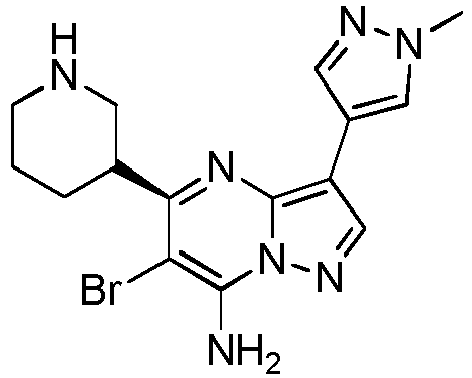
- Die Verbindung nach Anspruch 1 oder ein pharmazeutisch annehmbares Salz oder Solvat davon zur Verwendung als Medikament.
- Die Verbindung nach Anspruch 1 oder ein pharmazeutisch annehmbares Salz oder Solvat davon zur Verwendung bei der Behandlung einer Erkrankung, ausgewählt aus der Gruppe, bestehend aus Krebs, Entzündung, Arthritis, Viruserkrankungen, neurodegenerativen Erkrankungen, kardiovaskulären Erkrankungen und Pilzerkrankungen.
- Die Verbindung nach Anspruch 4, wobei
eine Menge einer ersten Verbindung, die eine Verbindung nach Anspruch 1 ist, oder eines pharmazeutisch annehmbaren Salzes oder Solvats davon in einer Form zur Verabreichung mit
einer Menge wenigstens einer zweiten Verbindung vorliegt, wobei die zweite Verbindung ein Mittel gegen Krebs ist,
wobei die Mengen an erster Verbindung und zweiter Verbindung eine therapeutische Wirkung ergeben. - Die Verbindung nach Anspruch 5, wobei die Behandlung ferner Strahlentherapie umfasst.
- Die Verbindung nach Anspruch 5, wobei das Mittel gegen Krebs ausgewählt ist aus der Gruppe, bestehend aus einem zytostatischen Mittel, Cisplatin, Doxorubicin, Taxotere, Taxol, Etoposid, Irinotecan, Camptostar, Topotecan, Paclitaxel, Docetaxel, Epothilonen, Tamoxifen, 5-Fluoruracil, Methoxtrexat, Temozolomid, Cyclophosphamid, Lonafarnib, 6-[Amino(4-chlorphenyl)(1-methyl-1H-imidazol-5-yl)methyl]-4-(3-chlorphenyl)-1-methyl-2(1H)-chinolin, 4-[[5-[[4-(3-Chlorphenyl)-3-oxo-1-piperazinyl]methyl]-1H-imidazol-1-yl]methyl]benzonitril-Monohydrochlorid, (R)-2,3,4,5-Tetrahydro-1-(1H-imidazol-4-ylmethyl)-3-phenylmethyl)-4-(2-thienylsulfonyl)-1H-1,4-benzodiazepin-7-carbonitril, Iressa, Tarceva, Antikörper gegen EGFR, Gleevec, Intron, Ara-C, Adriamycin, Cytoxan, Gemcitabin, Uramustin, Chlormethin, Ifosfamid, Melphalan, Chlorambucil, Pipobroman, Triethylenmelamin, Triethylenthiophosphoramin, Busulfan, Carmustin, Lomustin, Streptozocin, Dacarbazin, Floxuridin, Cytarabin, 6-Mercaptopurin, 6-Thioguanin, Fludarabinphosphat, Oxaliplatin, Leucovirin, Pentostatin, Vinblastin, Vincristin, Vindesin, Bleomycin, Dactinomycin, Daunorubicin, Doxorubicin, Epirubicin, Idarubicin, Mithramycin, Desoxycoformycin, Mitomycin-C, L-Asparaginase, Teniposid, 17α-Ethinylestradiol, Diethylstilbestrol, Testosteron, Prednison, Fluoxymesteron, Dromostanolonpropionat, Testolacton, Megestrolacetat, Methylprednisolon, Methyltestosteron, Prednisolon, Triamcinolon, Chlortrianisen, Hydroxyprogesteron, Aminoglutethimid, Estramustin, Medroxyprogesteronacetat, Leuprolid, Flutamid, Toremifen, Goserelin, Cisplatin, Carboplatin, Hydroxyharnstoff, Amsacrin, Procarbazin, Mitotan, Mitoxantron, Levamisol, Navelben, Anastrazol, Letrazol, Capecitabin, Reloxafin, Droloxafin, Hexamethylmelamin, Avastin, Herceptin, Bexxar, Velcade, Zevalin, Trisenox, Xeloda, Vinorelbin, Porfimer, Erbitux, Liposomal, Thiotepa, Altretamin, Melphalan, Trastuzumab, Lerozol, Fulvestrant, Exemestan, Fulvestrant, Ifosfomid, Rituximab, Cetuximat und Campath.
- Eine pharmazeutische Zusammensetzung, umfassend eine therapeutisch wirksame Menge wenigstens einer Verbindung nach Anspruch 1 oder eines pharmazeutisch annehmbaren Salzes oder Solvats davon in Kombination mit wenigstens einem pharmazeutisch annehmbaren Träger.
- Die pharmazeutische Zusammensetzung nach Anspruch 8, die zusätzlich ein oder mehrere Mittel gegen Krebs umfasst, ausgewählt aus der Gruppe, bestehend aus einem zytostatischen Mittel, Cisplatin, Doxorubicin, Taxotere, Taxol, Etoposid, Irinotecan, Camptostar, Topotecan, Paclitaxel, Docetaxel, Epothilonen, Tamoxifen, 5-Fluoruracil, Methoxtrexat, Temozolomid, Cyclophosphamid, Lonafarnib, 6-[Amino(4-chlorphenyl)(1-methyl-1 H-imidazol-5-yl)methyl]-4-(3-chlorphenyl)-1-methyl-2(1 H)-chinolin, 4-[[5-[[4-(3-Chlorphenyl)-3-oxo-1-piperazinyl]methyl]-1H-imidazol-1-yl]methyl]benzonitril-Monohydrochlorid, (R)-2,3,4,5-Tetrahydro-1-(1H-imidazol-4-ylmethyl)-3-phenylmethyl)-4-(2-thienylsulfonyl)-1H-1,4-benzodiazepin-7-carbonitril, Iressa, Tarceva, Antikörper gegen EGFR, Gleevec, Intron, Ara-C, Adriamycin, Cytoxan, Gemcitabin, Uramustin, Chlormethin, Ifosfamid, Melphalan, Chlorambucil, Pipobroman, Triethylenmelamin, Triethylenthiophosphoramin, Busulfan, Carmustin, Lomustin, Streptozocin, Dacarbazin, Floxuridin, Cytarabin, 6-Mercaptopurin, 6-Thioguanin, Fludarabinphosphat, Oxaliplatin, Leucovirin, Pentostatin, Vinblastin, Vincristin, Vindesin, Bleomycin, Dactinomycin, Daunorubicin, Doxorubicin, Epirubicin, Idarubicin, Mithramycin, Desoxycoformycin, Mitomycin-C, L-Asparaginase, Teniposid, 17α-Ethinylestradiol, Diethylstilbestrol, Testosteron, Prednison, Fluoxymesteron, Dromostanolonpropionat, Testolacton, Megestrolacetat, Methylprednisolon, Methyltestosteron, Prednisolon, Triamcinolon, Chlortrianisen, Hydroxyprogesteron, Aminoglutethimid, Estramustin, Medroxyprogesteronacetat, Leuprolid, Flutamid, Toremifen, Goserelin, Cisplatin, Carboplatin, Hydroxyharnstoff, Amsacrin, Procarbazin, Mitotan, Mitoxantron, Levamisol, Navelben, Anastrazol, Letrazol, Capecitabin, Reloxafin, Droloxafin, Hexamethylmelamin, Avastin, Herceptin, Bexxar, Velcade, Zevalin, Trisenox, Xeloda, Vinorelbin, Porfimer, Erbitux, Liposomal, Thiotepa, Altretamin, Melphalan, Trastuzumab, Lerozol, Fulvestrant, Exemestan, Fulvestrant, Ifosfomid, Rituximab, Cetuximat und Campath.
- Die pharmazeutische Zusammensetzung nach Anspruch 8 zur Verwendung bei der Behandlung einer Erkrankung, ausgewählt aus der Gruppe, bestehend aus Krebs, Entzündung, Arthritis, Viruserkrankungen, neurodegenerativen Erkrankungen, kardiovaskulären Erkrankungen und Pilzerkrankungen.
- Die Verbindung nach Anspruch 4, wobei
eine Menge einer ersten Verbindung, die eine Verbindung nach Anspruch 1 ist, oder eines pharmazeutisch annehmbaren Salzes oder Solvats davon in einer Form zur Verabreichung mit
einer Menge Temozolomid vorliegt,
wobei die Mengen der ersten Verbindung und des Temozolomids eine therapeutische Wirkung ergeben. - Die Verbindung nach Anspruch 11, wobei die Behandlung ferner Strahlentherapie umfasst.
- Die pharmazeutische Zusammensetzung nach Anspruch 8, umfassend (i) eine therapeutisch wirksame Menge einer Verbindung nach Anspruch 1 oder eines pharmazeutisch annehmbaren Salzes oder Solvats davon und (ii) Temozolomid.
- Die pharmazeutische Zusammensetzung nach Anspruch 13 zur Verwendung bei der Behandlung einer Erkrankung, ausgewählt aus der Gruppe, bestehend aus Krebs, Entzündung, Arthritis, Viruserkrankungen, neurodegenerativen Erkrankungen, kardiovaskulären Erkrankungen und Pilzerkrankungen.
- Die pharmazeutische Zusammensetzung nach Anspruch 13 zur Verwendung bei der Behandlung von Krebs.
- Die Verbindung nach Anspruch 1 oder ein pharmazeutisch annehmbares Salz oder Solvat davon zur Verwendung bei der Behandlung von Krebs.
- Die Verbindung nach Anspruch 16, wobei der Krebs ausgewählt ist aus der Gruppe, bestehend aus:Blasen-, Brust-, Kolon-, Nieren-, Leber-, Lungenkarzinom, kleinzelligem Lungenkarzinom, nicht-kleinzelligem Lungenkarzinom, Kopf- und Halskrebs, Speiseröhren-, Gallenblasen-, Eierstock-, Bauchspeicheldrüsen-, Magen-, Gebärmutterhals-, Schilddrüsen-, Prostata- und Hautkrebs, einschließlich PlattenepithelkarzinomLeukämie, akuter lymphatischer Leukämie, akuter lymphoblastischer Leukämie, B-Zell-Lymphom, T-Zell-Lymphom, Hodgkins-Lymphom, Nicht-Hodgkins-Lymphom, Haarzell-Lymphom, Mantelzell-Lymphom, Myelom und Burkett-Lymphom,akuter und chronischer myeloischer Leukämie, myelodysplastischem Syndrom und promyeloischer Leukämie,Fibrosarkom, Rhabdomyosarkom,Kopf- und Halskrebs, Mantelzell-Lymphom, Myelom,Astrozytom, Neuroblastom, Gliom und Schwannomen,Melanom, Seminom, Teratokarzinom, Osteosarkom, Xenoderma pigmentosum, Keratoakanthom, Thyroidfollikelkarzinom und Kaposi-Sarkom.
- Die Verbindung nach Anspruch 16, wobei
eine Menge einer ersten Verbindung, die eine Verbindung nach Anspruch 1 ist, oder eines pharmazeutisch annehmbaren Salzes oder Solvats davon in einer Form zur Verabreichung mit
einer Menge wenigstens einer zweiten Verbindung vorliegt, wobei die zweite Verbindung ein Mittel gegen Krebs ist,
wobei die Mengen an erster Verbindung und zweiter Verbindung eine therapeutische Wirkung ergeben. - Die Verbindung nach Anspruch 18, wobei die Behandlung ferner Strahlentherapie umfasst.
- Die Verbindung nach Anspruch 18, wobei das Mittel gegen Krebs ausgewählt ist aus der Gruppe, bestehend aus einem zytostatischen Mittel, Cisplatin, Doxorubicin, Taxotere, Taxol, Etoposid, Irinotecan, Camptostar, Topotecan, Paclitaxel, Docetaxel, Epothilonen, Tamoxifen, 5-Fluoruracil, Methoxtrexat, Temozolomid, Cyclophosphamid, Lonafarnib, 6-[Amino(4-chlorphenyl)(1-methyl-1H-imidazol-5-yl)methyl]-4-(3-chlorphenyl)-1-methyl-2(1 H)-chinolin, 4-[[5-[[4-(3-Chlorphenyl)-3-oxo-1-piperazinyl]methyl]-1 H-imidazol-1-yl]methyl]benzonitril-Monohydrochlorid, (R)-2,3,4,5-Tetrahydro-1-(1H-imidazol-4-ylmethyl)-3-(phenylmethyl)-4-(2-thienylsulfonyl)-1H-1,4-benzodiazepin-7-carbonitril, Iressa, Tarceva, Antikörper gegen EGFR, Gleevec, Intron, Ara-C, Adriamycin, Cytoxan, Gemcitabin, Uramustin, Chlormethin, Ifosfamid, Melphalan, Chlorambucil, Pipobroman, Triethylenmelamin, Triethylenthiophosphoramin, Busulfan, Carmustin, Lomustin, Streptozocin, Dacarbazin, Floxuridin, Cytarabin, 6-Mercaptopurin, 6-Thioguanin, Fludarabinphosphat, Oxaliplatin, Leucovirin, Pentostatin, Vinblastin, Vincristin, Vindesin, Bleomycin, Dactinomycin, Daunorubicin, Doxorubicin, Epirubicin, Idarubicin, Mithramycin, Desoxycoformycin, Mitomycin-C, L-Asparaginase, Teniposid, 17α-Ethinylestradiol, Diethylstilbestrol, Testosteron, Prednison, Fluoxymesteron, Dromostanolonpropionat, Testolacton, Megestrolacetat, Methylprednisolon, Methyltestosteron, Prednisolon, Triamcinolon, Chlortrianisen, Hydroxyprogesteron, Aminoglutethimid, Estramustin, Medroxyprogesteronacetat, Leuprolid, Flutamid, Toremifen, Goserelin, Cisplatin, Carboplatin, Hydroxyharnstoff, Amsacrin, Procarbazin, Mitotan, Mitoxantron, Levamisol, Navelben, Anastrazol, Letrazol, Capecitabin, Reloxafin, Droloxafin, Hexamethylmelamin, Avastin, Herceptin, Bexxar, Velcade, Zevalin, Trisenox, Xeloda, Vinorelbin, Porfimer, Erbitux, Liposomal, Thiotepa, Altretamin, Melphalan, Trastuzumab, Lerozol, Fulvestrant, Exemestan, Fulvestrant, Ifosfomid, Rituximab, Cetuximat und Campath.
- Die Verbindung nach Anspruch 16, wobei (i) eine therapeutisch wirksame Menge wenigstens einer Verbindung nach Anspruch 1 oder eines pharmazeutisch annehmbaren Salzes oder Solvats davon in einer Form zur Verabreichung mit (ii) Temozolomid vorliegt.
Applications Claiming Priority (2)
| Application Number | Priority Date | Filing Date | Title |
|---|---|---|---|
| US11/245,401 US7196078B2 (en) | 2002-09-04 | 2005-10-06 | Trisubstituted and tetrasubstituted pyrazolopyrimidines as cyclin dependent kinase inhibitors |
| PCT/US2006/038939 WO2007044449A2 (en) | 2005-10-06 | 2006-10-04 | Novel pyrazolopyrimidines as cyclin dependent kinase inhibitors |
Publications (2)
| Publication Number | Publication Date |
|---|---|
| EP1931677A2 EP1931677A2 (de) | 2008-06-18 |
| EP1931677B1 true EP1931677B1 (de) | 2016-04-20 |
Family
ID=37866152
Family Applications (1)
| Application Number | Title | Priority Date | Filing Date |
|---|---|---|---|
| EP06836186.4A Active EP1931677B1 (de) | 2005-10-06 | 2006-10-04 | Neuartige pyrazolopyrimidine als cyclin-abhängige kinasehemmer |
Country Status (20)
| Country | Link |
|---|---|
| US (2) | US7196078B2 (de) |
| EP (1) | EP1931677B1 (de) |
| JP (2) | JP4925226B2 (de) |
| KR (2) | KR101661405B1 (de) |
| CN (2) | CN101321756A (de) |
| AR (1) | AR056873A1 (de) |
| AU (1) | AU2006302443B2 (de) |
| BR (1) | BRPI0616987B1 (de) |
| CA (1) | CA2624829C (de) |
| EC (1) | ECSP088345A (de) |
| ES (1) | ES2574782T3 (de) |
| IL (2) | IL190510A (de) |
| MY (1) | MY162134A (de) |
| NO (1) | NO20082091L (de) |
| NZ (1) | NZ567187A (de) |
| PE (1) | PE20070496A1 (de) |
| RU (1) | RU2441005C2 (de) |
| TW (2) | TWI372625B (de) |
| WO (1) | WO2007044449A2 (de) |
| ZA (1) | ZA200802996B (de) |
Families Citing this family (66)
| Publication number | Priority date | Publication date | Assignee | Title |
|---|---|---|---|---|
| US7196078B2 (en) * | 2002-09-04 | 2007-03-27 | Schering Corpoartion | Trisubstituted and tetrasubstituted pyrazolopyrimidines as cyclin dependent kinase inhibitors |
| US8673924B2 (en) | 2002-09-04 | 2014-03-18 | Merck Sharp & Dohme Corp. | Substituted pyrazolo[1,5-a]pyrimidines as cyclin dependent kinase inhibitors |
| US8580782B2 (en) * | 2002-09-04 | 2013-11-12 | Merck Sharp & Dohme Corp. | Substituted pyrazolo[1,5-a]pyrimidines as cyclin dependent kinase inhibitors |
| US7605155B2 (en) * | 2002-09-04 | 2009-10-20 | Schering Corporation | Substituted pyrazolo[1,5-a]pyrimidines as protein kinase inhibitors |
| US7563798B2 (en) * | 2002-09-04 | 2009-07-21 | Schering Corporation | Substituted pyrazolo[1,5-a]pyrimidines as protein kinase inhibitors |
| BRPI0616985B1 (pt) * | 2005-10-06 | 2021-10-26 | Merck Sharp & Dohme Corp. | Composto de pirazolo[1,5-a]pirimidina, e, uso de um composto |
| US7584565B2 (en) * | 2006-10-05 | 2009-09-08 | Jazwares, Inc. | Jigsaw puzzle display frame |
| CA2669982A1 (en) * | 2006-11-17 | 2008-05-29 | Schering Corporation | Combination therapy for proliferative disorders |
| NZ580982A (en) | 2007-05-08 | 2012-05-25 | Schering Corp | Methods of treatment using intravenous formulations comprising temozolomide |
| MX2009013336A (es) * | 2007-06-07 | 2010-01-20 | Schering Corp | Sintesis de 3-aminopirazoles sustituidos. |
| EP2271646A1 (de) | 2008-03-31 | 2011-01-12 | Takeda Pharmaceutical Company Limited | Inhibitoren der apoptosesignalsteuernden kinase 1 |
| KR20110033223A (ko) * | 2008-06-20 | 2011-03-30 | 제넨테크, 인크. | 트리아졸로피리딘 jak 억제제 화합물 및 방법 |
| US20100035875A1 (en) * | 2008-06-20 | 2010-02-11 | Bing-Yan Zhu | Triazolopyridine jak inhibitor compounds and methods |
| RS53350B (sr) | 2008-09-22 | 2014-10-31 | Array Biopharma, Inc. | Supstituisana jedinjenja imidazo[1,2-b]piridazina kao inhibitori trk kinaze |
| HRP20140309T1 (hr) * | 2008-10-22 | 2014-05-09 | Array Biopharma, Inc. | SUPSTITUIRANI SPOJEVI PIRAZOLO[1,5-a]PIRIMIDINA KAO INHIBITORI TRK KINAZE |
| US8591943B2 (en) * | 2009-04-09 | 2013-11-26 | Merck Sharp & Dohme Corp. | Pyrazolo[1,5-a]pyrimidine derivatives as mTOR inhibitors |
| AU2015201984B2 (en) * | 2009-07-09 | 2016-08-04 | Array Biopharma Inc. | SUBSTITUTED PYRAZOLO[1,5-a]PYRIMIDINE COMPOUNDS AS TRK KINASE INHIBITORS |
| AR077468A1 (es) * | 2009-07-09 | 2011-08-31 | Array Biopharma Inc | Compuestos de pirazolo (1,5 -a) pirimidina sustituidos como inhibidores de trk- quinasa |
| EP2473041B1 (de) | 2009-09-04 | 2018-03-07 | Merck Sharp & Dohme Corp. | Modulatoren von zellzyklus-kontrollpunkten und ihre verwendung in kombination mit kontrollpunkt-kinasehemmern |
| EP2947073B1 (de) | 2009-10-22 | 2019-04-03 | Fibrotech Therapeutics Pty Ltd | Analoga von antifibriotischen mitteln mit kondensierten ringen |
| TWI476200B (zh) * | 2010-02-26 | 2015-03-11 | Mitsubishi Tanabe Pharma Corp | 吡唑並嘧啶化合物及其充作pde10抑制劑之用途 |
| US8680271B2 (en) | 2010-03-26 | 2014-03-25 | Merck Sharp & Dohme Corp. | Process for synthesizing 6-bromo-3-1-(1-methyl-1H-pyrazol-4-yl)-5-(3(R)-piperidinyl)pyrazolo[1,5-a]pyrimidin-7-amine |
| KR102015402B1 (ko) | 2010-05-20 | 2019-08-28 | 어레이 바이오파마 인크. | Trk 키나제 저해제로서의 매크로시클릭 화합물 |
| WO2012040048A2 (en) * | 2010-09-21 | 2012-03-29 | Schering Corporation | Triazolopyrazinones as p2x7 receptor antagonists |
| FR2965262A1 (fr) | 2010-09-24 | 2012-03-30 | Sanofi Aventis | Derives de nicotinamide, leur preparation et leur application en therapeutique |
| US10953012B2 (en) | 2011-04-26 | 2021-03-23 | Bioenergenix Llc | Heterocyclic compounds for the inhibition of pask |
| JP2014517079A (ja) | 2011-06-22 | 2014-07-17 | バーテックス ファーマシューティカルズ インコーポレイテッド | Atrキナーゼ阻害剤として有用な化合物 |
| PE20141381A1 (es) | 2011-07-01 | 2014-10-21 | Novartis Ag | Terapia de combinacion que comprende un inhibidor de cdk4/6 y un inhibidor de pi3k para el uso en el tratamiento de cancer |
| EP2755482B1 (de) | 2011-09-15 | 2016-06-01 | Merck Sharp & Dohme Corp. | Kombination von mk-1775 und mk-8776 zur behandlung von krebs |
| WO2013059634A1 (en) | 2011-10-20 | 2013-04-25 | The Regents Of The University Of California | Use of cdk9 inhibitors to reduce cartilage degradation |
| WO2014066795A1 (en) | 2012-10-25 | 2014-05-01 | Bioenergenix | Heterocyclic compounds for the inhibition of pask |
| US9278973B2 (en) | 2012-10-25 | 2016-03-08 | Bioenergenix Llc | Heterocyclic compounds for the inhibition of PASK |
| SMT202000713T1 (it) | 2012-12-07 | 2021-03-15 | Vertex Pharma | Pirazolo [1,5-a] pirimidine utili come inibitori dell'atr chinasi per il trattamento di malattie del cancro |
| KR102148681B1 (ko) | 2013-02-21 | 2020-08-27 | 칼리토르 사이언시즈, 엘엘씨 | Pi3 키나제 모듈레이터로서의 헤테로방향족 화합물 |
| JP2016512815A (ja) | 2013-03-15 | 2016-05-09 | バーテックス ファーマシューティカルズ インコーポレイテッドVertex Pharmaceuticals Incorporated | Atrキナーゼの阻害剤として有用な縮合ピラゾロピリミジン誘導体 |
| WO2014143241A1 (en) | 2013-03-15 | 2014-09-18 | Vertex Pharmaceuticals Incorporated | Compounds useful as inhibitors of atr kinase |
| EP2970288A1 (de) | 2013-03-15 | 2016-01-20 | Vertex Pharmaceuticals Incorporated | Als atr-kinaseinhibitoren nützliche verbindungen |
| HUE046727T2 (hu) | 2013-12-06 | 2020-03-30 | Vertex Pharma | Az ATR-kináz inhibitoraként használható vegyület, 2-amino-6-fluoro-N-[5-fluoro-piridin-3-IL]-pirazolo-[1,5-A]-pirimidin-3-karboxamid, ennek elõállítása, különbözõ szilárd formái és ezek radioaktív nyomjelzett származékai |
| CN107074863B (zh) | 2014-06-05 | 2019-12-03 | 沃泰克斯药物股份有限公司 | Atr激酶抑制剂的制备方法及其不同的固体形式 |
| PL3157566T3 (pl) | 2014-06-17 | 2019-10-31 | Vertex Pharma | Metoda leczenia nowotworu przy użyciu kombinacji inhibitorów chk1 i atr |
| US10300073B2 (en) | 2014-10-14 | 2019-05-28 | The Regents Of The University Of California | Use of CDK9 and BRD4 inhibitors to inhibit inflammation |
| JP6914834B2 (ja) | 2014-11-16 | 2021-08-04 | アレイ バイオファーマ インコーポレイテッド | (S)−N−(5−((R)−2−(2,5−ジフルオロフェニル)−ピロリジン−1−イル)−ピラゾロ[1,5−a]ピリミジン−3−イル)−3−ヒドロキシピロリジン−1−カルボキサミド硫酸水素塩の結晶形 |
| CN107427521B (zh) * | 2015-03-27 | 2021-08-03 | 达纳-法伯癌症研究所股份有限公司 | 细胞周期蛋白依赖性激酶的抑制剂 |
| KR102678021B1 (ko) | 2015-09-30 | 2024-06-26 | 버텍스 파마슈티칼스 인코포레이티드 | Dna 손상제와 병용되는, atr 저해제를 포함하는 암 치료용 약제학적 조성물 |
| GB201517263D0 (en) * | 2015-09-30 | 2015-11-11 | Ucb Biopharma Sprl And Katholieke Universiteit Leuven | Therapeutic agents |
| TN2018000138A1 (en) | 2015-10-26 | 2019-10-04 | Array Biopharma Inc | Point mutations in trk inhibitor-resistant cancer and methods relating to the same |
| JP6895963B2 (ja) | 2015-11-18 | 2021-06-30 | ジェンザイム・コーポレーション | 多発性嚢胞腎のバイオマーカーおよびその使用 |
| RU2619932C1 (ru) * | 2015-11-25 | 2017-05-22 | федеральное государственное бюджетное образовательное учреждение высшего образования "Воронежский государственный университет" (ФГБОУ ВО "ВГУ") | ЗАМЕЩЕННЫЕ ПИРАЗОЛО[1,5-а]ПИРИДО[3,4-е]ПИРИМИДИНЫ И ИХ ИСПОЛЬЗОВАНИЕ В КАЧЕСТВЕ ИНГИБИТОРОВ ПРОТЕИНКИНАЗ |
| US10045991B2 (en) | 2016-04-04 | 2018-08-14 | Loxo Oncology, Inc. | Methods of treating pediatric cancers |
| AU2017246554B2 (en) | 2016-04-04 | 2022-08-18 | Loxo Oncology, Inc. | Liquid formulations of (S)-N-(5-((R)-2-(2,5-difluorophenyl)-pyrrolidin-1-yl)-pyrazolo(1,5-a)pyrimidin-3-yl)-3-hydroxypyrrolidine-1-carboxamide |
| KR102566858B1 (ko) | 2016-05-18 | 2023-08-11 | 어레이 바이오파마 인크. | (s)-n-(5-((r)-2-(2,5-디플루오로페닐)피롤리딘-1-일)-피라졸로[1,5-a]피리미딘-3-일)-3-히드록시피롤리딘-1-카르복사미드의 제조 방법 |
| CA3034211A1 (en) | 2016-08-18 | 2018-02-22 | Vidac Pharma Ltd. | Piperazine derivatives, pharmaceutical compositions and methods of use thereof |
| JOP20190092A1 (ar) | 2016-10-26 | 2019-04-25 | Array Biopharma Inc | عملية لتحضير مركبات بيرازولو[1، 5-a]بيريميدين وأملاح منها |
| SG11201907139UA (en) | 2017-02-03 | 2019-09-27 | Certa Therapeutics Pty Ltd | Anti-fibrotic compounds |
| JOP20190213A1 (ar) | 2017-03-16 | 2019-09-16 | Array Biopharma Inc | مركبات حلقية ضخمة كمثبطات لكيناز ros1 |
| WO2019023468A1 (en) | 2017-07-28 | 2019-01-31 | Nimbus Lakshmi, Inc. | TYK2 INHIBITORS AND USES THEREOF |
| EP3461480A1 (de) | 2017-09-27 | 2019-04-03 | Onxeo | Kombination von checkpoint-hemmern des dna-schädigungsantwort-zellzyklus und belinostat zur behandlung von krebs |
| CN111315383B (zh) | 2017-11-07 | 2023-09-29 | 密执安大学评议会 | 共享表位-钙网蛋白相互作用的小分子抑制剂和使用方法 |
| CA3115088A1 (en) * | 2018-10-15 | 2020-04-23 | Nimbus Lakshmi, Inc. | Tyk2 inhibitors and uses thereof |
| IL282254B2 (en) | 2018-10-30 | 2025-08-01 | Kronos Bio Inc | Compounds, compositions, and methods for modulating cdk9 activity |
| EA202192625A1 (ru) | 2019-03-26 | 2022-03-21 | Вентикс Байосайенсес, Инк. | Лиганды псевдокиназы tyk2 |
| KR102938141B1 (ko) | 2019-11-08 | 2026-03-11 | 벤틱스 바이오사이언스, 인크. | Tyk2 슈도키나제 리간드 |
| KR20240112230A (ko) * | 2023-01-11 | 2024-07-18 | 주식회사 티움바이오 | 사이클린 의존성 키나아제 9 저해제로서의 피라졸로피리미딘 유도체 |
| WO2024242416A1 (ko) * | 2023-05-22 | 2024-11-28 | 주식회사 셀러스 | 신규한 cdk7 억제 화합물 및 이의 용도 |
| CN119707984A (zh) * | 2023-09-28 | 2025-03-28 | 中国科学院上海药物研究所 | 吡唑并三嗪及吡唑并嘧啶衍生物、其制备方法、药物组合物及其用途 |
| EP4717312A1 (de) * | 2024-09-27 | 2026-04-01 | Perha Pharmaceuticals | Als arzneimittel geeignete pyrazolo[1,5-a pyrimidinderivate |
Family Cites Families (32)
| Publication number | Priority date | Publication date | Assignee | Title |
|---|---|---|---|---|
| WO1992018504A1 (en) | 1991-04-22 | 1992-10-29 | Otsuka Pharmaceutical Factory, Inc. | PYRAZOLO[1,5-a]PYRIMIDINE DERIVATIVE AND ANTI-INFLAMMATORY CONTAINING THE SAME |
| EP0628559B1 (de) | 1993-06-10 | 2002-04-03 | Beiersdorf-Lilly GmbH | Pyrimidinverbindungen und ihre Verwendung als Pharmazeutika |
| US5571813A (en) | 1993-06-10 | 1996-11-05 | Beiersdorf-Lilly Gmbh | Fused pyrimidine compounds and their use as pharmaceuticals |
| KR100315837B1 (ko) | 1994-06-21 | 2002-02-28 | 고리 히데아끼 | 피라졸로[1,5-a]피리미딘유도체 |
| US5919815A (en) | 1996-05-22 | 1999-07-06 | Neuromedica, Inc. | Taxane compounds and compositions |
| US6191131B1 (en) | 1997-07-23 | 2001-02-20 | Dupont Pharmaceuticals Company | Azolo triazines and pyrimidines |
| US6313124B1 (en) | 1997-07-23 | 2001-11-06 | Dupont Pharmaceuticals Company | Tetrazine bicyclic compounds |
| US6040321A (en) | 1997-11-12 | 2000-03-21 | Bristol-Myers Squibb Company | Aminothiazole inhibitors of cyclin dependent kinases |
| US6262096B1 (en) | 1997-11-12 | 2001-07-17 | Bristol-Myers Squibb Company | Aminothiazole inhibitors of cyclin dependent kinases |
| DE69837282T2 (de) | 1997-12-13 | 2007-11-08 | Bristol-Myers Squibb Co. | VERWENDUNG VON PYRAZOLO Ä 3,4-bÜ PYRIDIN ALS CYCLIN-ABHÄNGIGE KINASE HEMMER |
| US6413974B1 (en) | 1998-02-26 | 2002-07-02 | Aventis Pharmaceuticals Inc. | 6,9,-disubstituted 2-[trans-(4-aminocyclohexyl) amino] purines |
| US6194410B1 (en) * | 1998-03-11 | 2001-02-27 | Hoffman-La Roche Inc. | Pyrazolopyrimidine and pyrazolines and process for preparation thereof |
| YU23602A (sh) | 1999-09-30 | 2004-09-03 | Neurogen Corporation | Amino supstituisani pirazolo /1,5/a/-1,5-pirimidini i pirazolo /1,5-a/-1,3,5-triazini |
| EP1317453B1 (de) | 2000-09-15 | 2006-08-09 | Vertex Pharmaceuticals Incorporated | Isoxazole und ihre verwendung als erk-inhibitoren |
| US7067520B2 (en) | 2000-11-17 | 2006-06-27 | Ishihara Sangyo Kaisha, Ltd. | Preventive or therapeutic medicines for diabetes containing fused-heterocyclic compounds or their salts |
| CA2432417A1 (fr) | 2000-12-20 | 2002-06-27 | Societe De Conseils De Recherches Et D'applications Scientifiques (S.C.R .A.S.) | Inhibiteurs de kinases dependantes des cylines (cdk) et de la glycogene synthase kinase-3 (gsk-3) |
| KR20040097375A (ko) | 2002-04-23 | 2004-11-17 | 시오노기 앤드 컴파니, 리미티드 | 피라졸로[1, 5-에이]피리미딘 유도체 및 이를 함유한엔에이디(피)에이취 산화효소 저해제 |
| ATE365740T1 (de) | 2002-05-10 | 2007-07-15 | Smithkline Beecham Corp | Substituierte pyrazolopyrimidine |
| DE10223917A1 (de) | 2002-05-29 | 2003-12-11 | Bayer Cropscience Ag | Pyrazolopyrimidine |
| MXPA05002570A (es) * | 2002-09-04 | 2005-09-08 | Schering Corp | Pirazolopirimidinas como inhibidores de cinasa dependientes de ciclina. |
| MXPA05002571A (es) | 2002-09-04 | 2005-09-08 | Schering Corp | Pirazolopirimidinas como inhibidores de cinasa dependientes de ciclina. |
| US7119200B2 (en) * | 2002-09-04 | 2006-10-10 | Schering Corporation | Pyrazolopyrimidines as cyclin dependent kinase inhibitors |
| US7084271B2 (en) * | 2002-09-04 | 2006-08-01 | Schering Corporation | Pyrazolopyrimidines as cyclin dependent kinase inhibitors |
| US7196078B2 (en) * | 2002-09-04 | 2007-03-27 | Schering Corpoartion | Trisubstituted and tetrasubstituted pyrazolopyrimidines as cyclin dependent kinase inhibitors |
| GB0305559D0 (en) | 2003-03-11 | 2003-04-16 | Teijin Ltd | Compounds |
| US20070179161A1 (en) | 2003-03-31 | 2007-08-02 | Vernalis (Cambridge) Limited. | Pyrazolopyrimidine compounds and their use in medicine |
| AU2004274013A1 (en) | 2003-09-17 | 2005-03-31 | Icos Corporation | Use of Chk1 inhibitors to control cell proliferation |
| AR049769A1 (es) | 2004-01-22 | 2006-09-06 | Novartis Ag | Derivados de pirazolo(1,5-a)pirimidin 7-il-amina para utilizarse en el tratamiento de enfermedades dependientes de la quinasa de proteina |
| US20050222171A1 (en) | 2004-01-22 | 2005-10-06 | Guido Bold | Organic compounds |
| US7288124B2 (en) | 2004-09-08 | 2007-10-30 | L'oreal S.A. | Heteroaromatic binuclear black direct dyes |
| GB0519957D0 (en) | 2005-09-30 | 2005-11-09 | Sb Pharmco Inc | Chemical compound |
| EP1836205B1 (de) | 2004-12-21 | 2009-06-10 | Schering Corporation | PYRAZOLO[1,5-A]PYRIMIDINE ALS ANTAGONISTEN DES ADENOSIN-A2a-REZEPTORS |
-
2005
- 2005-10-06 US US11/245,401 patent/US7196078B2/en not_active Expired - Lifetime
-
2006
- 2006-10-04 EP EP06836186.4A patent/EP1931677B1/de active Active
- 2006-10-04 JP JP2008534679A patent/JP4925226B2/ja active Active
- 2006-10-04 RU RU2008117295/04A patent/RU2441005C2/ru active
- 2006-10-04 AR ARP060104369A patent/AR056873A1/es not_active Application Discontinuation
- 2006-10-04 TW TW099120151A patent/TWI372625B/zh not_active IP Right Cessation
- 2006-10-04 KR KR1020147018349A patent/KR101661405B1/ko active Active
- 2006-10-04 BR BRPI0616987-2A patent/BRPI0616987B1/pt active IP Right Grant
- 2006-10-04 TW TW095136814A patent/TWI362263B/zh not_active IP Right Cessation
- 2006-10-04 ES ES06836186.4T patent/ES2574782T3/es active Active
- 2006-10-04 CN CNA2006800453382A patent/CN101321756A/zh active Pending
- 2006-10-04 NZ NZ567187A patent/NZ567187A/en not_active IP Right Cessation
- 2006-10-04 AU AU2006302443A patent/AU2006302443B2/en not_active Ceased
- 2006-10-04 MY MYPI20080984A patent/MY162134A/en unknown
- 2006-10-04 PE PE2006001207A patent/PE20070496A1/es not_active Application Discontinuation
- 2006-10-04 KR KR1020087010183A patent/KR20080063796A/ko not_active Ceased
- 2006-10-04 CN CN2012100567677A patent/CN102627645A/zh active Pending
- 2006-10-04 WO PCT/US2006/038939 patent/WO2007044449A2/en not_active Ceased
- 2006-10-04 CA CA2624829A patent/CA2624829C/en active Active
-
2007
- 2007-02-23 US US11/710,644 patent/US8586576B2/en not_active Expired - Fee Related
-
2008
- 2008-03-30 IL IL190510A patent/IL190510A/en active IP Right Grant
- 2008-04-04 EC EC2008008345A patent/ECSP088345A/es unknown
- 2008-04-04 ZA ZA200802996A patent/ZA200802996B/xx unknown
- 2008-05-05 NO NO20082091A patent/NO20082091L/no not_active Application Discontinuation
-
2011
- 2011-10-25 IL IL215929A patent/IL215929A0/en unknown
-
2012
- 2012-01-11 JP JP2012003526A patent/JP2012072189A/ja not_active Withdrawn
Also Published As
Similar Documents
| Publication | Publication Date | Title |
|---|---|---|
| EP1934224B1 (de) | Pyrazolopyrimidine als inhibitoren von cyclinabhängiger kinase zur behandlung von krebs | |
| US7196078B2 (en) | Trisubstituted and tetrasubstituted pyrazolopyrimidines as cyclin dependent kinase inhibitors | |
| EP1720883B1 (de) | Pyrazolotriazine als kinaseinhibitoren | |
| EP2069348B1 (de) | Neuartige pyrazolopyrimidine als cyclinabhängige kinasehemmer | |
| EP1543008B1 (de) | Imidazopyrazine als cdk-inhibitoren | |
| EP1931676B1 (de) | Pyrazolopyrimidine als Proteinkinaseinhibitoren | |
| EP1537116B1 (de) | Zur behandlung von krebserkrankungen geeignete pyrazolopyrimidine | |
| US8580782B2 (en) | Substituted pyrazolo[1,5-a]pyrimidines as cyclin dependent kinase inhibitors | |
| EP1931675B1 (de) | Pyrazolo[1, 5a]pyrimidine als proteinkinaseinhibitoren | |
| EP1720882B1 (de) | Pyrazolopyrimidinderivate als inhibitoren der cyclinabhängigen kinase | |
| EP2069349B1 (de) | Neuartige pyrazolopyrimidine als cyclinabhängige kinasehemmer | |
| US7576085B2 (en) | Imidazopyrazines as cyclin dependent kinase inhibitors | |
| US7196092B2 (en) | N-heteroaryl pyrazolopyrimidines as cyclin dependent kinase inhibitors | |
| EP2194058A1 (de) | Zur Behandlung von Krebserkrankungen geeignete Pyrazolopyrimidine | |
| HK1112233B (en) | Pyrazolopyrimidines as cyclin dependent kinase inhibitors for the treatment of cancer | |
| HK1072056B (en) | Imidazopyrazines as cyclin dependent kinase inhibitors | |
| HK1090926B (en) | Pyrazolopyrimidine-derivatives as cyclin dependent kinase inhibitors | |
| HK1071756B (en) | Pyrazolopyrimidines suitable for the treatment of cancer diseases |
Legal Events
| Date | Code | Title | Description |
|---|---|---|---|
| PUAI | Public reference made under article 153(3) epc to a published international application that has entered the european phase |
Free format text: ORIGINAL CODE: 0009012 |
|
| 17P | Request for examination filed |
Effective date: 20080328 |
|
| AK | Designated contracting states |
Kind code of ref document: A2 Designated state(s): AT BE BG CH CY CZ DE DK EE ES FI FR GB GR HU IE IS IT LI LT LU LV MC NL PL PT RO SE SI SK TR |
|
| AX | Request for extension of the european patent |
Extension state: AL BA HR MK RS |
|
| REG | Reference to a national code |
Ref country code: HK Ref legal event code: DE Ref document number: 1116785 Country of ref document: HK |
|
| 17Q | First examination report despatched |
Effective date: 20100511 |
|
| RAP1 | Party data changed (applicant data changed or rights of an application transferred) |
Owner name: MERCK SHARP & DOHME CORP. |
|
| GRAP | Despatch of communication of intention to grant a patent |
Free format text: ORIGINAL CODE: EPIDOSNIGR1 |
|
| INTG | Intention to grant announced |
Effective date: 20150612 |
|
| GRAP | Despatch of communication of intention to grant a patent |
Free format text: ORIGINAL CODE: EPIDOSNIGR1 |
|
| INTG | Intention to grant announced |
Effective date: 20151104 |
|
| GRAS | Grant fee paid |
Free format text: ORIGINAL CODE: EPIDOSNIGR3 |
|
| GRAA | (expected) grant |
Free format text: ORIGINAL CODE: 0009210 |
|
| AK | Designated contracting states |
Kind code of ref document: B1 Designated state(s): AT BE BG CH CY CZ DE DK EE ES FI FR GB GR HU IE IS IT LI LT LU LV MC NL PL PT RO SE SI SK TR |
|
| AX | Request for extension of the european patent |
Extension state: AL BA HR MK RS |
|
| REG | Reference to a national code |
Ref country code: GB Ref legal event code: FG4D |
|
| REG | Reference to a national code |
Ref country code: CH Ref legal event code: EP Ref country code: HK Ref legal event code: WD Ref document number: 1116785 Country of ref document: HK |
|
| REG | Reference to a national code |
Ref country code: CH Ref legal event code: NV Representative=s name: MARKS AND CLERK (LUXEMBOURG) LLP, CH |
|
| REG | Reference to a national code |
Ref country code: AT Ref legal event code: REF Ref document number: 792336 Country of ref document: AT Kind code of ref document: T Effective date: 20160515 |
|
| REG | Reference to a national code |
Ref country code: IE Ref legal event code: FG4D |
|
| REG | Reference to a national code |
Ref country code: DE Ref legal event code: R096 Ref document number: 602006048823 Country of ref document: DE |
|
| REG | Reference to a national code |
Ref country code: ES Ref legal event code: FG2A Ref document number: 2574782 Country of ref document: ES Kind code of ref document: T3 Effective date: 20160622 |
|
| REG | Reference to a national code |
Ref country code: NL Ref legal event code: FP |
|
| REG | Reference to a national code |
Ref country code: LT Ref legal event code: MG4D |
|
| REG | Reference to a national code |
Ref country code: AT Ref legal event code: MK05 Ref document number: 792336 Country of ref document: AT Kind code of ref document: T Effective date: 20160420 |
|
| REG | Reference to a national code |
Ref country code: FR Ref legal event code: PLFP Year of fee payment: 11 |
|
| PG25 | Lapsed in a contracting state [announced via postgrant information from national office to epo] |
Ref country code: LT Free format text: LAPSE BECAUSE OF FAILURE TO SUBMIT A TRANSLATION OF THE DESCRIPTION OR TO PAY THE FEE WITHIN THE PRESCRIBED TIME-LIMIT Effective date: 20160420 Ref country code: FI Free format text: LAPSE BECAUSE OF FAILURE TO SUBMIT A TRANSLATION OF THE DESCRIPTION OR TO PAY THE FEE WITHIN THE PRESCRIBED TIME-LIMIT Effective date: 20160420 Ref country code: PL Free format text: LAPSE BECAUSE OF FAILURE TO SUBMIT A TRANSLATION OF THE DESCRIPTION OR TO PAY THE FEE WITHIN THE PRESCRIBED TIME-LIMIT Effective date: 20160420 |
|
| PG25 | Lapsed in a contracting state [announced via postgrant information from national office to epo] |
Ref country code: AT Free format text: LAPSE BECAUSE OF FAILURE TO SUBMIT A TRANSLATION OF THE DESCRIPTION OR TO PAY THE FEE WITHIN THE PRESCRIBED TIME-LIMIT Effective date: 20160420 Ref country code: PT Free format text: LAPSE BECAUSE OF FAILURE TO SUBMIT A TRANSLATION OF THE DESCRIPTION OR TO PAY THE FEE WITHIN THE PRESCRIBED TIME-LIMIT Effective date: 20160822 Ref country code: LV Free format text: LAPSE BECAUSE OF FAILURE TO SUBMIT A TRANSLATION OF THE DESCRIPTION OR TO PAY THE FEE WITHIN THE PRESCRIBED TIME-LIMIT Effective date: 20160420 Ref country code: SE Free format text: LAPSE BECAUSE OF FAILURE TO SUBMIT A TRANSLATION OF THE DESCRIPTION OR TO PAY THE FEE WITHIN THE PRESCRIBED TIME-LIMIT Effective date: 20160420 Ref country code: GR Free format text: LAPSE BECAUSE OF FAILURE TO SUBMIT A TRANSLATION OF THE DESCRIPTION OR TO PAY THE FEE WITHIN THE PRESCRIBED TIME-LIMIT Effective date: 20160721 |
|
| PG25 | Lapsed in a contracting state [announced via postgrant information from national office to epo] |
Ref country code: BE Free format text: LAPSE BECAUSE OF FAILURE TO SUBMIT A TRANSLATION OF THE DESCRIPTION OR TO PAY THE FEE WITHIN THE PRESCRIBED TIME-LIMIT Effective date: 20160420 |
|
| REG | Reference to a national code |
Ref country code: DE Ref legal event code: R097 Ref document number: 602006048823 Country of ref document: DE |
|
| PG25 | Lapsed in a contracting state [announced via postgrant information from national office to epo] |
Ref country code: SK Free format text: LAPSE BECAUSE OF FAILURE TO SUBMIT A TRANSLATION OF THE DESCRIPTION OR TO PAY THE FEE WITHIN THE PRESCRIBED TIME-LIMIT Effective date: 20160420 Ref country code: EE Free format text: LAPSE BECAUSE OF FAILURE TO SUBMIT A TRANSLATION OF THE DESCRIPTION OR TO PAY THE FEE WITHIN THE PRESCRIBED TIME-LIMIT Effective date: 20160420 Ref country code: RO Free format text: LAPSE BECAUSE OF FAILURE TO SUBMIT A TRANSLATION OF THE DESCRIPTION OR TO PAY THE FEE WITHIN THE PRESCRIBED TIME-LIMIT Effective date: 20160420 Ref country code: CZ Free format text: LAPSE BECAUSE OF FAILURE TO SUBMIT A TRANSLATION OF THE DESCRIPTION OR TO PAY THE FEE WITHIN THE PRESCRIBED TIME-LIMIT Effective date: 20160420 Ref country code: DK Free format text: LAPSE BECAUSE OF FAILURE TO SUBMIT A TRANSLATION OF THE DESCRIPTION OR TO PAY THE FEE WITHIN THE PRESCRIBED TIME-LIMIT Effective date: 20160420 |
|
| PLBE | No opposition filed within time limit |
Free format text: ORIGINAL CODE: 0009261 |
|
| STAA | Information on the status of an ep patent application or granted ep patent |
Free format text: STATUS: NO OPPOSITION FILED WITHIN TIME LIMIT |
|
| 26N | No opposition filed |
Effective date: 20170123 |
|
| PG25 | Lapsed in a contracting state [announced via postgrant information from national office to epo] |
Ref country code: SI Free format text: LAPSE BECAUSE OF FAILURE TO SUBMIT A TRANSLATION OF THE DESCRIPTION OR TO PAY THE FEE WITHIN THE PRESCRIBED TIME-LIMIT Effective date: 20160420 |
|
| REG | Reference to a national code |
Ref country code: IE Ref legal event code: MM4A |
|
| PG25 | Lapsed in a contracting state [announced via postgrant information from national office to epo] |
Ref country code: LU Free format text: LAPSE BECAUSE OF NON-PAYMENT OF DUE FEES Effective date: 20161004 |
|
| REG | Reference to a national code |
Ref country code: FR Ref legal event code: PLFP Year of fee payment: 12 |
|
| PG25 | Lapsed in a contracting state [announced via postgrant information from national office to epo] |
Ref country code: IE Free format text: LAPSE BECAUSE OF NON-PAYMENT OF DUE FEES Effective date: 20161004 |
|
| PG25 | Lapsed in a contracting state [announced via postgrant information from national office to epo] |
Ref country code: HU Free format text: LAPSE BECAUSE OF FAILURE TO SUBMIT A TRANSLATION OF THE DESCRIPTION OR TO PAY THE FEE WITHIN THE PRESCRIBED TIME-LIMIT; INVALID AB INITIO Effective date: 20061004 Ref country code: CY Free format text: LAPSE BECAUSE OF FAILURE TO SUBMIT A TRANSLATION OF THE DESCRIPTION OR TO PAY THE FEE WITHIN THE PRESCRIBED TIME-LIMIT Effective date: 20160420 |
|
| PG25 | Lapsed in a contracting state [announced via postgrant information from national office to epo] |
Ref country code: MC Free format text: LAPSE BECAUSE OF FAILURE TO SUBMIT A TRANSLATION OF THE DESCRIPTION OR TO PAY THE FEE WITHIN THE PRESCRIBED TIME-LIMIT Effective date: 20160420 Ref country code: IS Free format text: LAPSE BECAUSE OF FAILURE TO SUBMIT A TRANSLATION OF THE DESCRIPTION OR TO PAY THE FEE WITHIN THE PRESCRIBED TIME-LIMIT Effective date: 20160420 |
|
| PG25 | Lapsed in a contracting state [announced via postgrant information from national office to epo] |
Ref country code: BG Free format text: LAPSE BECAUSE OF FAILURE TO SUBMIT A TRANSLATION OF THE DESCRIPTION OR TO PAY THE FEE WITHIN THE PRESCRIBED TIME-LIMIT Effective date: 20160420 |
|
| REG | Reference to a national code |
Ref country code: FR Ref legal event code: PLFP Year of fee payment: 13 |
|
| REG | Reference to a national code |
Ref country code: DE Ref legal event code: R081 Ref document number: 602006048823 Country of ref document: DE Owner name: MERCK SHARP & DOHME LLC, RAHWAY, US Free format text: FORMER OWNER: MERCK SHARP & DOHME CORP., RAHWAY, N.J., US |
|
| REG | Reference to a national code |
Ref country code: NL Ref legal event code: PD Owner name: MERCK SHARP & DOHME LLC; US Free format text: DETAILS ASSIGNMENT: CHANGE OF OWNER(S), MERGE; FORMER OWNER NAME: MERCK SHARP & DOHME CORP. Effective date: 20220922 Ref country code: GB Ref legal event code: 732E Free format text: REGISTERED BETWEEN 20220908 AND 20220914 |
|
| REG | Reference to a national code |
Ref country code: ES Ref legal event code: PC2A Owner name: MERCK SHARP & DOHME LLC Effective date: 20230309 |
|
| PGFP | Annual fee paid to national office [announced via postgrant information from national office to epo] |
Ref country code: GB Payment date: 20240912 Year of fee payment: 19 |
|
| PGFP | Annual fee paid to national office [announced via postgrant information from national office to epo] |
Ref country code: FR Payment date: 20240913 Year of fee payment: 19 |
|
| PGFP | Annual fee paid to national office [announced via postgrant information from national office to epo] |
Ref country code: NL Payment date: 20240918 Year of fee payment: 19 |
|
| PGFP | Annual fee paid to national office [announced via postgrant information from national office to epo] |
Ref country code: TR Payment date: 20240917 Year of fee payment: 19 |
|
| PGFP | Annual fee paid to national office [announced via postgrant information from national office to epo] |
Ref country code: DE Payment date: 20240913 Year of fee payment: 19 |
|
| PGFP | Annual fee paid to national office [announced via postgrant information from national office to epo] |
Ref country code: IT Payment date: 20241015 Year of fee payment: 19 Ref country code: ES Payment date: 20241113 Year of fee payment: 19 |
|
| PGFP | Annual fee paid to national office [announced via postgrant information from national office to epo] |
Ref country code: CH Payment date: 20241101 Year of fee payment: 19 |