EP1931695B1 - Prionspezifische Peptoidreagentien - Google Patents
Prionspezifische Peptoidreagentien Download PDFInfo
- Publication number
- EP1931695B1 EP1931695B1 EP06814415.3A EP06814415A EP1931695B1 EP 1931695 B1 EP1931695 B1 EP 1931695B1 EP 06814415 A EP06814415 A EP 06814415A EP 1931695 B1 EP1931695 B1 EP 1931695B1
- Authority
- EP
- European Patent Office
- Prior art keywords
- prion
- complex
- peptoid
- pathogenic prion
- reagent
- Prior art date
- Legal status (The legal status is an assumption and is not a legal conclusion. Google has not performed a legal analysis and makes no representation as to the accuracy of the status listed.)
- Not-in-force
Links
- 102000029797 Prion Human genes 0.000 title claims description 590
- 108091000054 Prion Proteins 0.000 title claims description 590
- 108010043958 Peptoids Proteins 0.000 title claims description 551
- 239000003153 chemical reaction reagent Substances 0.000 title claims description 535
- 230000001717 pathogenic effect Effects 0.000 claims description 420
- 108090000765 processed proteins & peptides Proteins 0.000 claims description 313
- 230000027455 binding Effects 0.000 claims description 223
- 238000009739 binding Methods 0.000 claims description 223
- 239000000523 sample Substances 0.000 claims description 189
- 238000000034 method Methods 0.000 claims description 148
- 208000037265 diseases, disorders, signs and symptoms Diseases 0.000 claims description 107
- 150000001413 amino acids Chemical class 0.000 claims description 105
- 201000010099 disease Diseases 0.000 claims description 98
- 239000007787 solid Substances 0.000 claims description 89
- 230000015572 biosynthetic process Effects 0.000 claims description 81
- 108010049175 N-substituted Glycines Proteins 0.000 claims description 80
- 238000001514 detection method Methods 0.000 claims description 71
- 241001465754 Metazoa Species 0.000 claims description 69
- 230000000389 anti-prion effect Effects 0.000 claims description 57
- 125000004169 (C1-C6) alkyl group Chemical group 0.000 claims description 42
- 239000000203 mixture Substances 0.000 claims description 41
- 125000002924 primary amino group Chemical group [H]N([H])* 0.000 claims description 37
- 102000004196 processed proteins & peptides Human genes 0.000 claims description 36
- 125000005647 linker group Chemical group 0.000 claims description 35
- YBJHBAHKTGYVGT-ZKWXMUAHSA-N (+)-Biotin Chemical compound N1C(=O)N[C@@H]2[C@H](CCCCC(=O)O)SC[C@@H]21 YBJHBAHKTGYVGT-ZKWXMUAHSA-N 0.000 claims description 26
- 125000003118 aryl group Chemical group 0.000 claims description 25
- 125000002252 acyl group Chemical group 0.000 claims description 23
- 235000013305 food Nutrition 0.000 claims description 18
- 210000004369 blood Anatomy 0.000 claims description 17
- 239000008280 blood Substances 0.000 claims description 17
- 125000000592 heterocycloalkyl group Chemical group 0.000 claims description 17
- 208000015181 infectious disease Diseases 0.000 claims description 17
- 125000001072 heteroaryl group Chemical group 0.000 claims description 16
- 229920001184 polypeptide Polymers 0.000 claims description 16
- 125000003178 carboxy group Chemical group [H]OC(*)=O 0.000 claims description 14
- 125000006239 protecting group Chemical group 0.000 claims description 14
- 239000012472 biological sample Substances 0.000 claims description 13
- 229960002685 biotin Drugs 0.000 claims description 13
- 235000020958 biotin Nutrition 0.000 claims description 13
- 239000011616 biotin Substances 0.000 claims description 13
- 125000004191 (C1-C6) alkoxy group Chemical group 0.000 claims description 11
- 125000003710 aryl alkyl group Chemical group 0.000 claims description 11
- 125000003282 alkyl amino group Chemical group 0.000 claims description 10
- 125000004663 dialkyl amino group Chemical group 0.000 claims description 10
- 125000002887 hydroxy group Chemical group [H]O* 0.000 claims description 10
- 239000011230 binding agent Substances 0.000 claims description 9
- 125000004446 heteroarylalkyl group Chemical group 0.000 claims description 9
- 230000036770 blood supply Effects 0.000 claims description 8
- 239000003431 cross linking reagent Substances 0.000 claims description 8
- 125000000753 cycloalkyl group Chemical group 0.000 claims description 8
- 125000003396 thiol group Chemical group [H]S* 0.000 claims description 8
- 125000003275 alpha amino acid group Chemical group 0.000 claims description 6
- 229920000831 ionic polymer Polymers 0.000 claims description 6
- 125000004104 aryloxy group Chemical group 0.000 claims description 5
- 239000012216 imaging agent Substances 0.000 claims description 5
- 230000002829 reductive effect Effects 0.000 claims description 5
- 150000003839 salts Chemical class 0.000 claims description 5
- 230000003472 neutralizing effect Effects 0.000 claims description 4
- 235000001014 amino acid Nutrition 0.000 description 105
- -1 4-but-3-enyl Chemical group 0.000 description 104
- 239000011324 bead Substances 0.000 description 91
- DHMQDGOQFOQNFH-UHFFFAOYSA-N Glycine Chemical compound NCC(O)=O DHMQDGOQFOQNFH-UHFFFAOYSA-N 0.000 description 89
- 108090000623 proteins and genes Proteins 0.000 description 81
- 102000004169 proteins and genes Human genes 0.000 description 79
- 210000002381 plasma Anatomy 0.000 description 78
- 235000018102 proteins Nutrition 0.000 description 78
- 241000282414 Homo sapiens Species 0.000 description 76
- 101710138751 Major prion protein Proteins 0.000 description 45
- 102100025818 Major prion protein Human genes 0.000 description 45
- 210000004556 brain Anatomy 0.000 description 44
- 239000004471 Glycine Substances 0.000 description 36
- 238000002965 ELISA Methods 0.000 description 35
- 208000018756 Variant Creutzfeldt-Jakob disease Diseases 0.000 description 35
- HEMHJVSKTPXQMS-UHFFFAOYSA-M Sodium hydroxide Chemical compound [OH-].[Na+] HEMHJVSKTPXQMS-UHFFFAOYSA-M 0.000 description 33
- ZMXDDKWLCZADIW-UHFFFAOYSA-N N,N-Dimethylformamide Chemical compound CN(C)C=O ZMXDDKWLCZADIW-UHFFFAOYSA-N 0.000 description 32
- 108010033276 Peptide Fragments Proteins 0.000 description 31
- 102000007079 Peptide Fragments Human genes 0.000 description 31
- 208000003407 Creutzfeldt-Jakob Syndrome Diseases 0.000 description 30
- 238000010494 dissociation reaction Methods 0.000 description 30
- 230000005593 dissociations Effects 0.000 description 30
- 239000011347 resin Substances 0.000 description 29
- 229920005989 resin Polymers 0.000 description 29
- 125000000217 alkyl group Chemical group 0.000 description 28
- 208000010859 Creutzfeldt-Jakob disease Diseases 0.000 description 27
- 208000020406 Creutzfeldt Jacob disease Diseases 0.000 description 26
- 125000004432 carbon atom Chemical group C* 0.000 description 24
- 238000004925 denaturation Methods 0.000 description 23
- 230000036425 denaturation Effects 0.000 description 23
- 239000003795 chemical substances by application Substances 0.000 description 22
- 238000011282 treatment Methods 0.000 description 21
- KZSNJWFQEVHDMF-UHFFFAOYSA-N Valine Chemical compound CC(C)C(N)C(O)=O KZSNJWFQEVHDMF-UHFFFAOYSA-N 0.000 description 19
- 102000001708 Protein Isoforms Human genes 0.000 description 18
- 108010029485 Protein Isoforms Proteins 0.000 description 18
- 239000000463 material Substances 0.000 description 18
- 239000000243 solution Substances 0.000 description 18
- 238000003556 assay Methods 0.000 description 17
- OGAULEBSQQMUKP-UHFFFAOYSA-N 2-(4-aminobutylamino)acetic acid Chemical compound NCCCCNCC(O)=O OGAULEBSQQMUKP-UHFFFAOYSA-N 0.000 description 15
- 230000003196 chaotropic effect Effects 0.000 description 14
- 102000002260 Alkaline Phosphatase Human genes 0.000 description 13
- 108020004774 Alkaline Phosphatase Proteins 0.000 description 13
- 239000000178 monomer Substances 0.000 description 13
- 238000003118 sandwich ELISA Methods 0.000 description 13
- 239000000758 substrate Substances 0.000 description 13
- WEVYAHXRMPXWCK-UHFFFAOYSA-N Acetonitrile Chemical compound CC#N WEVYAHXRMPXWCK-UHFFFAOYSA-N 0.000 description 12
- IAZDPXIOMUYVGZ-UHFFFAOYSA-N Dimethylsulphoxide Chemical compound CS(C)=O IAZDPXIOMUYVGZ-UHFFFAOYSA-N 0.000 description 12
- 125000000623 heterocyclic group Chemical group 0.000 description 12
- ROHFNLRQFUQHCH-YFKPBYRVSA-N L-leucine Chemical compound CC(C)C[C@H](N)C(O)=O ROHFNLRQFUQHCH-YFKPBYRVSA-N 0.000 description 11
- 241001494479 Pecora Species 0.000 description 11
- 238000006243 chemical reaction Methods 0.000 description 11
- PJJJBBJSCAKJQF-UHFFFAOYSA-N guanidinium chloride Chemical compound [Cl-].NC(N)=[NH2+] PJJJBBJSCAKJQF-UHFFFAOYSA-N 0.000 description 11
- 238000000926 separation method Methods 0.000 description 11
- 239000002904 solvent Substances 0.000 description 11
- 241000283690 Bos taurus Species 0.000 description 10
- NBIIXXVUZAFLBC-UHFFFAOYSA-N Phosphoric acid Chemical compound OP(O)(O)=O NBIIXXVUZAFLBC-UHFFFAOYSA-N 0.000 description 10
- 108010090804 Streptavidin Proteins 0.000 description 10
- 125000001931 aliphatic group Chemical group 0.000 description 10
- 238000002474 experimental method Methods 0.000 description 10
- 239000003446 ligand Substances 0.000 description 10
- 238000006386 neutralization reaction Methods 0.000 description 10
- 238000010379 pull-down assay Methods 0.000 description 10
- 238000012360 testing method Methods 0.000 description 10
- 102000004190 Enzymes Human genes 0.000 description 9
- 108090000790 Enzymes Proteins 0.000 description 9
- 208000035475 disorder Diseases 0.000 description 9
- 239000003814 drug Substances 0.000 description 9
- 229940088598 enzyme Drugs 0.000 description 9
- 125000002795 guanidino group Chemical group C(N)(=N)N* 0.000 description 9
- 238000003786 synthesis reaction Methods 0.000 description 9
- 210000001519 tissue Anatomy 0.000 description 9
- 125000006528 (C2-C6) alkyl group Chemical group 0.000 description 8
- RHLQNMMWMDYKFY-UHFFFAOYSA-N 2-(2-methoxyethylazaniumyl)acetate Chemical compound COCCNCC(O)=O RHLQNMMWMDYKFY-UHFFFAOYSA-N 0.000 description 8
- 108010067770 Endopeptidase K Proteins 0.000 description 8
- NQRYJNQNLNOLGT-UHFFFAOYSA-N Piperidine Chemical compound C1CCNCC1 NQRYJNQNLNOLGT-UHFFFAOYSA-N 0.000 description 8
- 229920001213 Polysorbate 20 Polymers 0.000 description 8
- 208000024777 Prion disease Diseases 0.000 description 8
- UIIMBOGNXHQVGW-UHFFFAOYSA-M Sodium bicarbonate Chemical compound [Na+].OC([O-])=O UIIMBOGNXHQVGW-UHFFFAOYSA-M 0.000 description 8
- 125000000539 amino acid group Chemical group 0.000 description 8
- 150000001875 compounds Chemical class 0.000 description 8
- 230000000694 effects Effects 0.000 description 8
- 229910052736 halogen Inorganic materials 0.000 description 8
- 150000002367 halogens Chemical class 0.000 description 8
- 235000010486 polyoxyethylene sorbitan monolaurate Nutrition 0.000 description 8
- 239000000256 polyoxyethylene sorbitan monolaurate Substances 0.000 description 8
- 239000000126 substance Substances 0.000 description 8
- 238000005406 washing Methods 0.000 description 8
- 108010000652 (S)-N-(1-phenylethyl)glycine Proteins 0.000 description 7
- RFEBVEWGRABHPU-QMMMGPOBSA-N 2-[[(1s)-1-phenylethyl]azaniumyl]acetate Chemical compound OC(=O)CN[C@@H](C)C1=CC=CC=C1 RFEBVEWGRABHPU-QMMMGPOBSA-N 0.000 description 7
- 0 CCCCC[C@](*)CC1OC1CCC(C(CCCCC=N)CC(C(CCCC)CC(C(CC(*)=O)C(C)c1ccccc1)=O)=*)=* Chemical compound CCCCC[C@](*)CC1OC1CCC(C(CCCCC=N)CC(C(CCCC)CC(C(CC(*)=O)C(C)c1ccccc1)=O)=*)=* 0.000 description 7
- 241000124008 Mammalia Species 0.000 description 7
- 239000004793 Polystyrene Substances 0.000 description 7
- VYPSYNLAJGMNEJ-UHFFFAOYSA-N Silicium dioxide Chemical compound O=[Si]=O VYPSYNLAJGMNEJ-UHFFFAOYSA-N 0.000 description 7
- 125000006620 amino-(C1-C6) alkyl group Chemical group 0.000 description 7
- 208000005881 bovine spongiform encephalopathy Diseases 0.000 description 7
- 230000003993 interaction Effects 0.000 description 7
- 210000003205 muscle Anatomy 0.000 description 7
- 229920002223 polystyrene Polymers 0.000 description 7
- 235000002639 sodium chloride Nutrition 0.000 description 7
- 241000894007 species Species 0.000 description 7
- 229910001868 water Inorganic materials 0.000 description 7
- 125000003088 (fluoren-9-ylmethoxy)carbonyl group Chemical group 0.000 description 6
- 241000282979 Alces alces Species 0.000 description 6
- YMWUJEATGCHHMB-UHFFFAOYSA-N Dichloromethane Chemical compound ClCCl YMWUJEATGCHHMB-UHFFFAOYSA-N 0.000 description 6
- 241000282412 Homo Species 0.000 description 6
- 102000000588 Interleukin-2 Human genes 0.000 description 6
- 108010002350 Interleukin-2 Proteins 0.000 description 6
- KDXKERNSBIXSRK-UHFFFAOYSA-N Lysine Natural products NCCCCC(N)C(O)=O KDXKERNSBIXSRK-UHFFFAOYSA-N 0.000 description 6
- 239000000427 antigen Substances 0.000 description 6
- 239000000872 buffer Substances 0.000 description 6
- 125000003739 carbamimidoyl group Chemical group C(N)(=N)* 0.000 description 6
- 210000004027 cell Anatomy 0.000 description 6
- 230000001413 cellular effect Effects 0.000 description 6
- 210000001175 cerebrospinal fluid Anatomy 0.000 description 6
- 239000011248 coating agent Substances 0.000 description 6
- 238000000576 coating method Methods 0.000 description 6
- 239000000306 component Substances 0.000 description 6
- 230000002458 infectious effect Effects 0.000 description 6
- 210000000653 nervous system Anatomy 0.000 description 6
- 230000007935 neutral effect Effects 0.000 description 6
- 210000000056 organ Anatomy 0.000 description 6
- 230000002265 prevention Effects 0.000 description 6
- 208000008864 scrapie Diseases 0.000 description 6
- 210000002966 serum Anatomy 0.000 description 6
- 125000001424 substituent group Chemical group 0.000 description 6
- KGSVNOLLROCJQM-UHFFFAOYSA-N 2-(benzylamino)acetic acid Chemical group OC(=O)CNCC1=CC=CC=C1 KGSVNOLLROCJQM-UHFFFAOYSA-N 0.000 description 5
- 241000282994 Cervidae Species 0.000 description 5
- ZRALSGWEFCBTJO-UHFFFAOYSA-N Guanidine Chemical class NC(N)=N ZRALSGWEFCBTJO-UHFFFAOYSA-N 0.000 description 5
- 241000699666 Mus <mouse, genus> Species 0.000 description 5
- FAPWRFPIFSIZLT-UHFFFAOYSA-M Sodium chloride Chemical compound [Na+].[Cl-] FAPWRFPIFSIZLT-UHFFFAOYSA-M 0.000 description 5
- 239000002671 adjuvant Substances 0.000 description 5
- 238000004458 analytical method Methods 0.000 description 5
- 102000036639 antigens Human genes 0.000 description 5
- 108091007433 antigens Proteins 0.000 description 5
- 238000001574 biopsy Methods 0.000 description 5
- 210000001772 blood platelet Anatomy 0.000 description 5
- 210000005013 brain tissue Anatomy 0.000 description 5
- 210000004899 c-terminal region Anatomy 0.000 description 5
- 125000003917 carbamoyl group Chemical group [H]N([H])C(*)=O 0.000 description 5
- 230000008878 coupling Effects 0.000 description 5
- 238000010168 coupling process Methods 0.000 description 5
- 238000005859 coupling reaction Methods 0.000 description 5
- 125000004122 cyclic group Chemical group 0.000 description 5
- 239000003398 denaturant Substances 0.000 description 5
- 238000003745 diagnosis Methods 0.000 description 5
- 239000011521 glass Substances 0.000 description 5
- 125000005842 heteroatom Chemical group 0.000 description 5
- 230000028993 immune response Effects 0.000 description 5
- 125000002496 methyl group Chemical group [H]C([H])([H])* 0.000 description 5
- 239000000546 pharmaceutical excipient Substances 0.000 description 5
- 229920000642 polymer Polymers 0.000 description 5
- AJPJDKMHJJGVTQ-UHFFFAOYSA-M sodium dihydrogen phosphate Chemical compound [Na+].OP(O)([O-])=O AJPJDKMHJJGVTQ-UHFFFAOYSA-M 0.000 description 5
- 229910052717 sulfur Inorganic materials 0.000 description 5
- 150000003573 thiols Chemical class 0.000 description 5
- FOUZISDNESEYLX-UHFFFAOYSA-N 2-(2-hydroxyethylazaniumyl)acetate Chemical compound OCCNCC(O)=O FOUZISDNESEYLX-UHFFFAOYSA-N 0.000 description 4
- WDNMSHHGGYTYCV-UHFFFAOYSA-N 2-[4-(diaminomethylideneamino)butylamino]acetic acid Chemical compound NC(=N)NCCCCNCC(O)=O WDNMSHHGGYTYCV-UHFFFAOYSA-N 0.000 description 4
- QGZKDVFQNNGYKY-UHFFFAOYSA-O Ammonium Chemical compound [NH4+] QGZKDVFQNNGYKY-UHFFFAOYSA-O 0.000 description 4
- 241000283707 Capra Species 0.000 description 4
- 241000699800 Cricetinae Species 0.000 description 4
- 241001331845 Equus asinus x caballus Species 0.000 description 4
- 108010017213 Granulocyte-Macrophage Colony-Stimulating Factor Proteins 0.000 description 4
- 102100039620 Granulocyte-macrophage colony-stimulating factor Human genes 0.000 description 4
- 101000573901 Homo sapiens Major prion protein Proteins 0.000 description 4
- 108060003951 Immunoglobulin Proteins 0.000 description 4
- 102000013462 Interleukin-12 Human genes 0.000 description 4
- 108010065805 Interleukin-12 Proteins 0.000 description 4
- UQSXHKLRYXJYBZ-UHFFFAOYSA-N Iron oxide Chemical compound [Fe]=O UQSXHKLRYXJYBZ-UHFFFAOYSA-N 0.000 description 4
- 241000282943 Odocoileus Species 0.000 description 4
- 241000283973 Oryctolagus cuniculus Species 0.000 description 4
- 239000004743 Polypropylene Substances 0.000 description 4
- 241000282374 Puma concolor Species 0.000 description 4
- 241000700159 Rattus Species 0.000 description 4
- 229920004890 Triton X-100 Polymers 0.000 description 4
- 230000002159 abnormal effect Effects 0.000 description 4
- 210000000577 adipose tissue Anatomy 0.000 description 4
- 125000003545 alkoxy group Chemical group 0.000 description 4
- 125000006350 alkyl thio alkyl group Chemical group 0.000 description 4
- 125000000304 alkynyl group Chemical group 0.000 description 4
- 239000012503 blood component Substances 0.000 description 4
- 239000005018 casein Substances 0.000 description 4
- BECPQYXYKAMYBN-UHFFFAOYSA-N casein, tech. Chemical compound NCCCCC(C(O)=O)N=C(O)C(CC(O)=O)N=C(O)C(CCC(O)=N)N=C(O)C(CC(C)C)N=C(O)C(CCC(O)=O)N=C(O)C(CC(O)=O)N=C(O)C(CCC(O)=O)N=C(O)C(C(C)O)N=C(O)C(CCC(O)=N)N=C(O)C(CCC(O)=N)N=C(O)C(CCC(O)=N)N=C(O)C(CCC(O)=O)N=C(O)C(CCC(O)=O)N=C(O)C(COP(O)(O)=O)N=C(O)C(CCC(O)=N)N=C(O)C(N)CC1=CC=CC=C1 BECPQYXYKAMYBN-UHFFFAOYSA-N 0.000 description 4
- 235000021240 caseins Nutrition 0.000 description 4
- 229920001577 copolymer Polymers 0.000 description 4
- 125000004367 cycloalkylaryl group Chemical group 0.000 description 4
- 230000029087 digestion Effects 0.000 description 4
- 239000003085 diluting agent Substances 0.000 description 4
- 238000010790 dilution Methods 0.000 description 4
- 239000012895 dilution Substances 0.000 description 4
- 239000000539 dimer Substances 0.000 description 4
- 239000012636 effector Substances 0.000 description 4
- 125000001495 ethyl group Chemical group [H]C([H])([H])C([H])([H])* 0.000 description 4
- 239000012634 fragment Substances 0.000 description 4
- 239000000499 gel Substances 0.000 description 4
- ZJYYHGLJYGJLLN-UHFFFAOYSA-N guanidinium thiocyanate Chemical compound SC#N.NC(N)=N ZJYYHGLJYGJLLN-UHFFFAOYSA-N 0.000 description 4
- 125000005843 halogen group Chemical group 0.000 description 4
- 230000002209 hydrophobic effect Effects 0.000 description 4
- 125000002883 imidazolyl group Chemical group 0.000 description 4
- 102000018358 immunoglobulin Human genes 0.000 description 4
- 238000011534 incubation Methods 0.000 description 4
- 125000001041 indolyl group Chemical group 0.000 description 4
- 229940117681 interleukin-12 Drugs 0.000 description 4
- 238000002955 isolation Methods 0.000 description 4
- 229920000126 latex Polymers 0.000 description 4
- 239000004816 latex Substances 0.000 description 4
- 238000005259 measurement Methods 0.000 description 4
- 108091005601 modified peptides Proteins 0.000 description 4
- 125000001624 naphthyl group Chemical group 0.000 description 4
- 125000001326 naphthylalkyl group Chemical group 0.000 description 4
- 230000007170 pathology Effects 0.000 description 4
- 239000008194 pharmaceutical composition Substances 0.000 description 4
- 229920001223 polyethylene glycol Polymers 0.000 description 4
- 229920001155 polypropylene Polymers 0.000 description 4
- 238000002360 preparation method Methods 0.000 description 4
- 230000008569 process Effects 0.000 description 4
- 239000000047 product Substances 0.000 description 4
- 239000011541 reaction mixture Substances 0.000 description 4
- 229910000030 sodium bicarbonate Inorganic materials 0.000 description 4
- 229910000162 sodium phosphate Inorganic materials 0.000 description 4
- 239000007790 solid phase Substances 0.000 description 4
- 239000006228 supernatant Substances 0.000 description 4
- URAYPUMNDPQOKB-UHFFFAOYSA-N triacetin Chemical compound CC(=O)OCC(OC(C)=O)COC(C)=O URAYPUMNDPQOKB-UHFFFAOYSA-N 0.000 description 4
- XLYOFNOQVPJJNP-UHFFFAOYSA-N water Substances O XLYOFNOQVPJJNP-UHFFFAOYSA-N 0.000 description 4
- 125000000882 C2-C6 alkenyl group Chemical group 0.000 description 3
- 125000003601 C2-C6 alkynyl group Chemical group 0.000 description 3
- 238000012286 ELISA Assay Methods 0.000 description 3
- 241000282326 Felis catus Species 0.000 description 3
- 208000003736 Gerstmann-Straussler-Scheinker Disease Diseases 0.000 description 3
- 206010072075 Gerstmann-Straussler-Scheinker syndrome Diseases 0.000 description 3
- 108010001336 Horseradish Peroxidase Proteins 0.000 description 3
- 125000000998 L-alanino group Chemical group [H]N([*])[C@](C([H])([H])[H])([H])C(=O)O[H] 0.000 description 3
- 125000000174 L-prolyl group Chemical group [H]N1C([H])([H])C([H])([H])C([H])([H])[C@@]1([H])C(*)=O 0.000 description 3
- 239000004472 Lysine Substances 0.000 description 3
- 241000699673 Mesocricetus auratus Species 0.000 description 3
- 241000699660 Mus musculus Species 0.000 description 3
- 241000699670 Mus sp. Species 0.000 description 3
- 239000004677 Nylon Substances 0.000 description 3
- 108091034117 Oligonucleotide Proteins 0.000 description 3
- 102000013566 Plasminogen Human genes 0.000 description 3
- 108010051456 Plasminogen Proteins 0.000 description 3
- DNIAPMSPPWPWGF-UHFFFAOYSA-N Propylene glycol Chemical compound CC(O)CO DNIAPMSPPWPWGF-UHFFFAOYSA-N 0.000 description 3
- 241000282898 Sus scrofa Species 0.000 description 3
- 241000700605 Viruses Species 0.000 description 3
- XYIPYISRNJUPBA-UHFFFAOYSA-N [3-(3'-methoxyspiro[adamantane-2,4'-dioxetane]-3'-yl)phenyl] dihydrogen phosphate Chemical compound O1OC2(C3CC4CC(C3)CC2C4)C1(OC)C1=CC=CC(OP(O)(O)=O)=C1 XYIPYISRNJUPBA-UHFFFAOYSA-N 0.000 description 3
- 230000001594 aberrant effect Effects 0.000 description 3
- 239000002253 acid Substances 0.000 description 3
- 125000003342 alkenyl group Chemical group 0.000 description 3
- 150000001356 alkyl thiols Chemical class 0.000 description 3
- 206010002022 amyloidosis Diseases 0.000 description 3
- 229920006318 anionic polymer Polymers 0.000 description 3
- 230000000890 antigenic effect Effects 0.000 description 3
- 125000001797 benzyl group Chemical group [H]C1=C([H])C([H])=C(C([H])=C1[H])C([H])([H])* 0.000 description 3
- 239000004305 biphenyl Substances 0.000 description 3
- 235000010290 biphenyl Nutrition 0.000 description 3
- 125000006267 biphenyl group Chemical group 0.000 description 3
- 210000001185 bone marrow Anatomy 0.000 description 3
- 239000003054 catalyst Substances 0.000 description 3
- 125000002091 cationic group Chemical group 0.000 description 3
- 229920006317 cationic polymer Polymers 0.000 description 3
- 208000017580 chronic wasting disease Diseases 0.000 description 3
- 238000006073 displacement reaction Methods 0.000 description 3
- 229940079593 drug Drugs 0.000 description 3
- 201000006061 fatal familial insomnia Diseases 0.000 description 3
- 125000003630 glycyl group Chemical class [H]N([H])C([H])([H])C(*)=O 0.000 description 3
- 229960000789 guanidine hydrochloride Drugs 0.000 description 3
- 229940072221 immunoglobulins Drugs 0.000 description 3
- 125000000959 isobutyl group Chemical group [H]C([H])([H])C([H])(C([H])([H])[H])C([H])([H])* 0.000 description 3
- 125000001449 isopropyl group Chemical group [H]C([H])([H])C([H])(*)C([H])([H])[H] 0.000 description 3
- 239000007788 liquid Substances 0.000 description 3
- 239000000314 lubricant Substances 0.000 description 3
- 239000012528 membrane Substances 0.000 description 3
- 125000000956 methoxy group Chemical group [H]C([H])([H])O* 0.000 description 3
- 210000004897 n-terminal region Anatomy 0.000 description 3
- 150000007523 nucleic acids Chemical class 0.000 description 3
- 229920001778 nylon Polymers 0.000 description 3
- ZUOUZKKEUPVFJK-UHFFFAOYSA-N phenylbenzene Natural products C1=CC=CC=C1C1=CC=CC=C1 ZUOUZKKEUPVFJK-UHFFFAOYSA-N 0.000 description 3
- 238000001907 polarising light microscopy Methods 0.000 description 3
- 229920006324 polyoxymethylene Polymers 0.000 description 3
- 239000000843 powder Substances 0.000 description 3
- 238000000746 purification Methods 0.000 description 3
- 238000012216 screening Methods 0.000 description 3
- 125000000467 secondary amino group Chemical group [H]N([*:1])[*:2] 0.000 description 3
- 239000000377 silicon dioxide Substances 0.000 description 3
- 239000011780 sodium chloride Substances 0.000 description 3
- 125000006850 spacer group Chemical group 0.000 description 3
- 238000004611 spectroscopical analysis Methods 0.000 description 3
- 208000024891 symptom Diseases 0.000 description 3
- 210000001138 tear Anatomy 0.000 description 3
- 210000002700 urine Anatomy 0.000 description 3
- KLBPUVPNPAJWHZ-UMSFTDKQSA-N (2r)-2-(9h-fluoren-9-ylmethoxycarbonylamino)-3-tritylsulfanylpropanoic acid Chemical compound C([C@@H](C(=O)O)NC(=O)OCC1C2=CC=CC=C2C2=CC=CC=C21)SC(C=1C=CC=CC=1)(C=1C=CC=CC=1)C1=CC=CC=C1 KLBPUVPNPAJWHZ-UMSFTDKQSA-N 0.000 description 2
- 125000006273 (C1-C3) alkyl group Chemical group 0.000 description 2
- MYRTYDVEIRVNKP-UHFFFAOYSA-N 1,2-Divinylbenzene Chemical compound C=CC1=CC=CC=C1C=C MYRTYDVEIRVNKP-UHFFFAOYSA-N 0.000 description 2
- 125000000579 2,2-diphenylethyl group Chemical group [H]C1=C([H])C([H])=C(C([H])=C1[H])C([H])(C1=C([H])C([H])=C([H])C([H])=C1[H])C([H])([H])* 0.000 description 2
- GYOOOIWLBRGIME-UHFFFAOYSA-N 2-[2-(4-methoxyphenyl)ethylazaniumyl]acetate Chemical compound COC1=CC=C(CCNCC(O)=O)C=C1 GYOOOIWLBRGIME-UHFFFAOYSA-N 0.000 description 2
- 125000000022 2-aminoethyl group Chemical group [H]C([*])([H])C([H])([H])N([H])[H] 0.000 description 2
- 125000000954 2-hydroxyethyl group Chemical group [H]C([*])([H])C([H])([H])O[H] 0.000 description 2
- 125000003903 2-propenyl group Chemical group [H]C([*])([H])C([H])=C([H])[H] 0.000 description 2
- 125000004042 4-aminobutyl group Chemical group [H]C([*])([H])C([H])([H])C([H])([H])C([H])([H])N([H])[H] 0.000 description 2
- 125000004217 4-methoxybenzyl group Chemical group [H]C1=C([H])C(=C([H])C([H])=C1OC([H])([H])[H])C([H])([H])* 0.000 description 2
- 125000006181 4-methyl benzyl group Chemical group [H]C1=C([H])C(=C([H])C([H])=C1C([H])([H])[H])C([H])([H])* 0.000 description 2
- SLXKOJJOQWFEFD-UHFFFAOYSA-N 6-aminohexanoic acid Chemical compound NCCCCCC(O)=O SLXKOJJOQWFEFD-UHFFFAOYSA-N 0.000 description 2
- 241000272517 Anseriformes Species 0.000 description 2
- XKRFYHLGVUSROY-UHFFFAOYSA-N Argon Chemical compound [Ar] XKRFYHLGVUSROY-UHFFFAOYSA-N 0.000 description 2
- IJGRMHOSHXDMSA-UHFFFAOYSA-N Atomic nitrogen Chemical compound N#N IJGRMHOSHXDMSA-UHFFFAOYSA-N 0.000 description 2
- 241000271566 Aves Species 0.000 description 2
- 108090001008 Avidin Proteins 0.000 description 2
- 241000283726 Bison Species 0.000 description 2
- 108091003079 Bovine Serum Albumin Proteins 0.000 description 2
- 102000001902 CC Chemokines Human genes 0.000 description 2
- 108010040471 CC Chemokines Proteins 0.000 description 2
- 241000282472 Canis lupus familiaris Species 0.000 description 2
- 241000282693 Cercopithecidae Species 0.000 description 2
- 102000001327 Chemokine CCL5 Human genes 0.000 description 2
- 108010055166 Chemokine CCL5 Proteins 0.000 description 2
- 102000019034 Chemokines Human genes 0.000 description 2
- 108010012236 Chemokines Proteins 0.000 description 2
- 102000004127 Cytokines Human genes 0.000 description 2
- 108090000695 Cytokines Proteins 0.000 description 2
- 108020004414 DNA Proteins 0.000 description 2
- 241000196324 Embryophyta Species 0.000 description 2
- 241000283086 Equidae Species 0.000 description 2
- 238000005033 Fourier transform infrared spectroscopy Methods 0.000 description 2
- PEDCQBHIVMGVHV-UHFFFAOYSA-N Glycerine Chemical compound OCC(O)CO PEDCQBHIVMGVHV-UHFFFAOYSA-N 0.000 description 2
- SIKJAQJRHWYJAI-UHFFFAOYSA-N Indole Chemical compound C1=CC=C2NC=CC2=C1 SIKJAQJRHWYJAI-UHFFFAOYSA-N 0.000 description 2
- 102000008070 Interferon-gamma Human genes 0.000 description 2
- 108010074328 Interferon-gamma Proteins 0.000 description 2
- 235000019687 Lamb Nutrition 0.000 description 2
- 102000008072 Lymphokines Human genes 0.000 description 2
- 108010074338 Lymphokines Proteins 0.000 description 2
- CHJJGSNFBQVOTG-UHFFFAOYSA-N N-methyl-guanidine Natural products CNC(N)=N CHJJGSNFBQVOTG-UHFFFAOYSA-N 0.000 description 2
- 238000005481 NMR spectroscopy Methods 0.000 description 2
- UFWIBTONFRDIAS-UHFFFAOYSA-N Naphthalene Chemical compound C1=CC=CC2=CC=CC=C21 UFWIBTONFRDIAS-UHFFFAOYSA-N 0.000 description 2
- 238000011887 Necropsy Methods 0.000 description 2
- 239000000020 Nitrocellulose Substances 0.000 description 2
- 108091005804 Peptidases Proteins 0.000 description 2
- 206010035226 Plasma cell myeloma Diseases 0.000 description 2
- 108010071690 Prealbumin Proteins 0.000 description 2
- 239000004365 Protease Substances 0.000 description 2
- 238000001069 Raman spectroscopy Methods 0.000 description 2
- 241000283984 Rodentia Species 0.000 description 2
- CZMRCDWAGMRECN-UGDNZRGBSA-N Sucrose Chemical compound O[C@H]1[C@H](O)[C@@H](CO)O[C@@]1(CO)O[C@@H]1[C@H](O)[C@@H](O)[C@H](O)[C@@H](CO)O1 CZMRCDWAGMRECN-UGDNZRGBSA-N 0.000 description 2
- 229930006000 Sucrose Natural products 0.000 description 2
- 210000001744 T-lymphocyte Anatomy 0.000 description 2
- 102000009190 Transthyretin Human genes 0.000 description 2
- DTQVDTLACAAQTR-UHFFFAOYSA-N Trifluoroacetic acid Chemical compound OC(=O)C(F)(F)F DTQVDTLACAAQTR-UHFFFAOYSA-N 0.000 description 2
- 239000007983 Tris buffer Substances 0.000 description 2
- 239000013504 Triton X-100 Substances 0.000 description 2
- 241000282458 Ursus sp. Species 0.000 description 2
- 230000010933 acylation Effects 0.000 description 2
- 238000005917 acylation reaction Methods 0.000 description 2
- 229910000147 aluminium phosphate Inorganic materials 0.000 description 2
- 150000001408 amides Chemical class 0.000 description 2
- 150000001412 amines Chemical class 0.000 description 2
- 230000003321 amplification Effects 0.000 description 2
- 238000010171 animal model Methods 0.000 description 2
- MWPLVEDNUUSJAV-UHFFFAOYSA-N anthracene Chemical compound C1=CC=CC2=CC3=CC=CC=C3C=C21 MWPLVEDNUUSJAV-UHFFFAOYSA-N 0.000 description 2
- 125000004429 atom Chemical group 0.000 description 2
- 238000011888 autopsy Methods 0.000 description 2
- 238000002869 basic local alignment search tool Methods 0.000 description 2
- 235000015278 beef Nutrition 0.000 description 2
- 125000004196 benzothienyl group Chemical group S1C(=CC2=C1C=CC=C2)* 0.000 description 2
- 125000001584 benzyloxycarbonyl group Chemical group C(=O)(OCC1=CC=CC=C1)* 0.000 description 2
- 229940098773 bovine serum albumin Drugs 0.000 description 2
- 244000309464 bull Species 0.000 description 2
- 238000005251 capillar electrophoresis Methods 0.000 description 2
- 150000001732 carboxylic acid derivatives Chemical class 0.000 description 2
- 239000000969 carrier Substances 0.000 description 2
- 238000012512 characterization method Methods 0.000 description 2
- 238000003776 cleavage reaction Methods 0.000 description 2
- 230000006835 compression Effects 0.000 description 2
- 238000007906 compression Methods 0.000 description 2
- 230000021615 conjugation Effects 0.000 description 2
- 238000007796 conventional method Methods 0.000 description 2
- 239000011162 core material Substances 0.000 description 2
- 238000005202 decontamination Methods 0.000 description 2
- 230000003588 decontaminative effect Effects 0.000 description 2
- 239000003599 detergent Substances 0.000 description 2
- 238000011161 development Methods 0.000 description 2
- FLKPEMZONWLCSK-UHFFFAOYSA-N diethyl phthalate Chemical compound CCOC(=O)C1=CC=CC=C1C(=O)OCC FLKPEMZONWLCSK-UHFFFAOYSA-N 0.000 description 2
- SWSQBOPZIKWTGO-UHFFFAOYSA-N dimethylaminoamidine Natural products CN(C)C(N)=N SWSQBOPZIKWTGO-UHFFFAOYSA-N 0.000 description 2
- 239000003937 drug carrier Substances 0.000 description 2
- 230000008030 elimination Effects 0.000 description 2
- 238000003379 elimination reaction Methods 0.000 description 2
- WBJINCZRORDGAQ-UHFFFAOYSA-N ethyl formate Chemical compound CCOC=O WBJINCZRORDGAQ-UHFFFAOYSA-N 0.000 description 2
- 239000000706 filtrate Substances 0.000 description 2
- 125000002541 furyl group Chemical group 0.000 description 2
- 229940044627 gamma-interferon Drugs 0.000 description 2
- 239000001087 glyceryl triacetate Substances 0.000 description 2
- 235000013773 glyceryl triacetate Nutrition 0.000 description 2
- 229960004198 guanidine Drugs 0.000 description 2
- 230000036541 health Effects 0.000 description 2
- 244000144980 herd Species 0.000 description 2
- 238000004128 high performance liquid chromatography Methods 0.000 description 2
- 150000002430 hydrocarbons Chemical group 0.000 description 2
- NPZTUJOABDZTLV-UHFFFAOYSA-N hydroxybenzotriazole Substances O=C1C=CC=C2NNN=C12 NPZTUJOABDZTLV-UHFFFAOYSA-N 0.000 description 2
- 230000001900 immune effect Effects 0.000 description 2
- 238000003018 immunoassay Methods 0.000 description 2
- 230000004957 immunoregulator effect Effects 0.000 description 2
- PQNFLJBBNBOBRQ-UHFFFAOYSA-N indane Chemical compound C1=CC=C2CCCC2=C1 PQNFLJBBNBOBRQ-UHFFFAOYSA-N 0.000 description 2
- 230000002401 inhibitory effect Effects 0.000 description 2
- 125000001972 isopentyl group Chemical group [H]C([H])([H])C([H])(C([H])([H])[H])C([H])([H])C([H])([H])* 0.000 description 2
- 210000003734 kidney Anatomy 0.000 description 2
- 206010023497 kuru Diseases 0.000 description 2
- 210000004185 liver Anatomy 0.000 description 2
- 229920002521 macromolecule Polymers 0.000 description 2
- HQKMJHAJHXVSDF-UHFFFAOYSA-L magnesium stearate Chemical compound [Mg+2].CCCCCCCCCCCCCCCCCC([O-])=O.CCCCCCCCCCCCCCCCCC([O-])=O HQKMJHAJHXVSDF-UHFFFAOYSA-L 0.000 description 2
- 125000005439 maleimidyl group Chemical group C1(C=CC(N1*)=O)=O 0.000 description 2
- 238000004519 manufacturing process Methods 0.000 description 2
- 238000004949 mass spectrometry Methods 0.000 description 2
- 239000011159 matrix material Substances 0.000 description 2
- 229910052751 metal Inorganic materials 0.000 description 2
- 239000002184 metal Substances 0.000 description 2
- 229920000609 methyl cellulose Polymers 0.000 description 2
- 238000002156 mixing Methods 0.000 description 2
- 239000002105 nanoparticle Substances 0.000 description 2
- 239000013642 negative control Substances 0.000 description 2
- 229920001220 nitrocellulos Polymers 0.000 description 2
- 229910052757 nitrogen Inorganic materials 0.000 description 2
- 125000004433 nitrogen atom Chemical group N* 0.000 description 2
- 238000002414 normal-phase solid-phase extraction Methods 0.000 description 2
- 238000003199 nucleic acid amplification method Methods 0.000 description 2
- 108020004707 nucleic acids Proteins 0.000 description 2
- 102000039446 nucleic acids Human genes 0.000 description 2
- 150000002894 organic compounds Chemical class 0.000 description 2
- 239000005416 organic matter Substances 0.000 description 2
- 229910052760 oxygen Inorganic materials 0.000 description 2
- 239000002245 particle Substances 0.000 description 2
- 239000008188 pellet Substances 0.000 description 2
- UYWQUFXKFGHYNT-UHFFFAOYSA-N phenylmethyl ester of formic acid Natural products O=COCC1=CC=CC=C1 UYWQUFXKFGHYNT-UHFFFAOYSA-N 0.000 description 2
- 125000003386 piperidinyl group Chemical group 0.000 description 2
- 125000005936 piperidyl group Chemical group 0.000 description 2
- 238000009832 plasma treatment Methods 0.000 description 2
- 229920002401 polyacrylamide Polymers 0.000 description 2
- 238000003752 polymerase chain reaction Methods 0.000 description 2
- 229920001282 polysaccharide Polymers 0.000 description 2
- 239000005017 polysaccharide Substances 0.000 description 2
- 150000004804 polysaccharides Chemical class 0.000 description 2
- 229920002620 polyvinyl fluoride Polymers 0.000 description 2
- 235000015277 pork Nutrition 0.000 description 2
- 125000001500 prolyl group Chemical group [H]N1C([H])(C(=O)[*])C([H])([H])C([H])([H])C1([H])[H] 0.000 description 2
- WGYKZJWCGVVSQN-UHFFFAOYSA-N propylamine Chemical group CCCN WGYKZJWCGVVSQN-UHFFFAOYSA-N 0.000 description 2
- 238000000159 protein binding assay Methods 0.000 description 2
- 125000004076 pyridyl group Chemical group 0.000 description 2
- 230000009467 reduction Effects 0.000 description 2
- 230000004044 response Effects 0.000 description 2
- 238000004007 reversed phase HPLC Methods 0.000 description 2
- 230000007017 scission Effects 0.000 description 2
- 239000002002 slurry Substances 0.000 description 2
- WXMKPNITSTVMEF-UHFFFAOYSA-M sodium benzoate Chemical compound [Na+].[O-]C(=O)C1=CC=CC=C1 WXMKPNITSTVMEF-UHFFFAOYSA-M 0.000 description 2
- 239000004299 sodium benzoate Substances 0.000 description 2
- 235000010234 sodium benzoate Nutrition 0.000 description 2
- 238000000527 sonication Methods 0.000 description 2
- 239000005720 sucrose Substances 0.000 description 2
- 238000002198 surface plasmon resonance spectroscopy Methods 0.000 description 2
- 238000001356 surgical procedure Methods 0.000 description 2
- 239000000454 talc Substances 0.000 description 2
- 229910052623 talc Inorganic materials 0.000 description 2
- 125000000999 tert-butyl group Chemical group [H]C([H])([H])C(*)(C([H])([H])[H])C([H])([H])[H] 0.000 description 2
- 125000001302 tertiary amino group Chemical group 0.000 description 2
- CXWXQJXEFPUFDZ-UHFFFAOYSA-N tetralin Chemical compound C1=CC=C2CCCCC2=C1 CXWXQJXEFPUFDZ-UHFFFAOYSA-N 0.000 description 2
- 230000001225 therapeutic effect Effects 0.000 description 2
- 229960002622 triacetin Drugs 0.000 description 2
- LENZDBCJOHFCAS-UHFFFAOYSA-N tris Chemical compound OCC(N)(CO)CO LENZDBCJOHFCAS-UHFFFAOYSA-N 0.000 description 2
- 125000002221 trityl group Chemical group [H]C1=C([H])C([H])=C([H])C([H])=C1C([*])(C1=C(C(=C(C(=C1[H])[H])[H])[H])[H])C1=C([H])C([H])=C([H])C([H])=C1[H] 0.000 description 2
- 125000004514 1,2,4-thiadiazolyl group Chemical group 0.000 description 1
- FTNJQNQLEGKTGD-UHFFFAOYSA-N 1,3-benzodioxole Chemical compound C1=CC=C2OCOC2=C1 FTNJQNQLEGKTGD-UHFFFAOYSA-N 0.000 description 1
- BDNKZNFMNDZQMI-UHFFFAOYSA-N 1,3-diisopropylcarbodiimide Chemical compound CC(C)N=C=NC(C)C BDNKZNFMNDZQMI-UHFFFAOYSA-N 0.000 description 1
- IXPNQXFRVYWDDI-UHFFFAOYSA-N 1-methyl-2,4-dioxo-1,3-diazinane-5-carboximidamide Chemical compound CN1CC(C(N)=N)C(=O)NC1=O IXPNQXFRVYWDDI-UHFFFAOYSA-N 0.000 description 1
- OWEGMIWEEQEYGQ-UHFFFAOYSA-N 100676-05-9 Natural products OC1C(O)C(O)C(CO)OC1OCC1C(O)C(O)C(O)C(OC2C(OC(O)C(O)C2O)CO)O1 OWEGMIWEEQEYGQ-UHFFFAOYSA-N 0.000 description 1
- UTQNKKSJPHTPBS-UHFFFAOYSA-N 2,2,2-trichloroethanone Chemical group ClC(Cl)(Cl)[C]=O UTQNKKSJPHTPBS-UHFFFAOYSA-N 0.000 description 1
- 125000000453 2,2,2-trichloroethyl group Chemical group [H]C([H])(*)C(Cl)(Cl)Cl 0.000 description 1
- PIINGYXNCHTJTF-UHFFFAOYSA-N 2-(2-azaniumylethylamino)acetate Chemical compound NCCNCC(O)=O PIINGYXNCHTJTF-UHFFFAOYSA-N 0.000 description 1
- DHGYLUFLENKZHH-UHFFFAOYSA-N 2-(3-aminopropylamino)acetic acid Chemical compound NCCCNCC(O)=O DHGYLUFLENKZHH-UHFFFAOYSA-N 0.000 description 1
- UJYVZGCRDCSZRD-QRPNPIFTSA-N 2-(4-aminobutylamino)acetic acid;2-[[(1s)-1-phenylethyl]amino]acetic acid Chemical compound NCCCCNCC(O)=O.OC(=O)CN[C@@H](C)C1=CC=CC=C1 UJYVZGCRDCSZRD-QRPNPIFTSA-N 0.000 description 1
- RHTMZEMDWRPOIH-UHFFFAOYSA-N 2-(5-aminopentylamino)acetic acid Chemical compound NCCCCCNCC(O)=O RHTMZEMDWRPOIH-UHFFFAOYSA-N 0.000 description 1
- JOWMUWBEMDOCKB-UHFFFAOYSA-N 2-(cyclopropylmethylazaniumyl)acetate Chemical compound OC(=O)CNCC1CC1 JOWMUWBEMDOCKB-UHFFFAOYSA-N 0.000 description 1
- HEPOIJKOXBKKNJ-UHFFFAOYSA-N 2-(propan-2-ylazaniumyl)acetate Chemical compound CC(C)NCC(O)=O HEPOIJKOXBKKNJ-UHFFFAOYSA-N 0.000 description 1
- UOMFNVIFBSEWJZ-UHFFFAOYSA-N 2-[(3,5-dimethoxyphenyl)methylamino]acetic acid Chemical compound COC1=CC(CNCC(O)=O)=CC(OC)=C1 UOMFNVIFBSEWJZ-UHFFFAOYSA-N 0.000 description 1
- CNIWLQLCALZLEQ-UHFFFAOYSA-N 2-[2-(4-hydroxyphenyl)ethylamino]acetic acid Chemical compound OC(=O)CNCCC1=CC=C(O)C=C1 CNIWLQLCALZLEQ-UHFFFAOYSA-N 0.000 description 1
- AGMMAARGJVTFHW-UHFFFAOYSA-N 2-[2-(diaminomethylideneamino)ethylamino]acetic acid Chemical compound NC(=N)NCCNCC(O)=O AGMMAARGJVTFHW-UHFFFAOYSA-N 0.000 description 1
- YDBPFLZECVWPSH-UHFFFAOYSA-N 2-[3-(diaminomethylideneamino)propylamino]acetic acid Chemical compound NC(=N)NCCCNCC(O)=O YDBPFLZECVWPSH-UHFFFAOYSA-N 0.000 description 1
- ZGUUMDNYGMDYSB-UHFFFAOYSA-N 2-[5-(diaminomethylideneamino)pentylamino]acetic acid Chemical compound NC(=N)NCCCCCNCC(O)=O ZGUUMDNYGMDYSB-UHFFFAOYSA-N 0.000 description 1
- QKNYBSVHEMOAJP-UHFFFAOYSA-N 2-amino-2-(hydroxymethyl)propane-1,3-diol;hydron;chloride Chemical compound Cl.OCC(N)(CO)CO QKNYBSVHEMOAJP-UHFFFAOYSA-N 0.000 description 1
- LRQKBLKVPFOOQJ-UHFFFAOYSA-N 2-aminohexanoic acid Chemical group CCCCC(N)C(O)=O LRQKBLKVPFOOQJ-UHFFFAOYSA-N 0.000 description 1
- 125000000143 2-carboxyethyl group Chemical group [H]OC(=O)C([H])([H])C([H])([H])* 0.000 description 1
- 125000002774 3,4-dimethoxybenzyl group Chemical group [H]C1=C([H])C(=C([H])C(OC([H])([H])[H])=C1OC([H])([H])[H])C([H])([H])* 0.000 description 1
- QOXOZONBQWIKDA-UHFFFAOYSA-N 3-hydroxypropyl Chemical group [CH2]CCO QOXOZONBQWIKDA-UHFFFAOYSA-N 0.000 description 1
- WHNPOQXWAMXPTA-UHFFFAOYSA-N 3-methylbut-2-enamide Chemical compound CC(C)=CC(N)=O WHNPOQXWAMXPTA-UHFFFAOYSA-N 0.000 description 1
- MJPVYTKZYZPIQA-UHFFFAOYSA-N 3-thiophen-2-ylpropanoic acid Chemical compound OC(=O)CCC1=CC=CS1 MJPVYTKZYZPIQA-UHFFFAOYSA-N 0.000 description 1
- 125000002103 4,4'-dimethoxytriphenylmethyl group Chemical group [H]C1=C([H])C([H])=C(C([H])=C1[H])C(*)(C1=C([H])C([H])=C(OC([H])([H])[H])C([H])=C1[H])C1=C([H])C([H])=C(OC([H])([H])[H])C([H])=C1[H] 0.000 description 1
- FWMNVWWHGCHHJJ-SKKKGAJSSA-N 4-amino-1-[(2r)-6-amino-2-[[(2r)-2-[[(2r)-2-[[(2r)-2-amino-3-phenylpropanoyl]amino]-3-phenylpropanoyl]amino]-4-methylpentanoyl]amino]hexanoyl]piperidine-4-carboxylic acid Chemical compound C([C@H](C(=O)N[C@H](CC(C)C)C(=O)N[C@H](CCCCN)C(=O)N1CCC(N)(CC1)C(O)=O)NC(=O)[C@H](N)CC=1C=CC=CC=1)C1=CC=CC=C1 FWMNVWWHGCHHJJ-SKKKGAJSSA-N 0.000 description 1
- 125000006283 4-chlorobenzyl group Chemical group [H]C1=C([H])C(=C([H])C([H])=C1Cl)C([H])([H])* 0.000 description 1
- CJIJXIFQYOPWTF-UHFFFAOYSA-N 7-hydroxycoumarin Natural products O1C(=O)C=CC2=CC(O)=CC=C21 CJIJXIFQYOPWTF-UHFFFAOYSA-N 0.000 description 1
- 241001455214 Acinonyx jubatus Species 0.000 description 1
- 229920000936 Agarose Polymers 0.000 description 1
- 108010088751 Albumins Proteins 0.000 description 1
- 102000009027 Albumins Human genes 0.000 description 1
- 208000024827 Alzheimer disease Diseases 0.000 description 1
- 208000037259 Amyloid Plaque Diseases 0.000 description 1
- 206010002023 Amyloidoses Diseases 0.000 description 1
- 244000303258 Annona diversifolia Species 0.000 description 1
- 235000002198 Annona diversifolia Nutrition 0.000 description 1
- 201000001320 Atherosclerosis Diseases 0.000 description 1
- 101800001288 Atrial natriuretic factor Proteins 0.000 description 1
- 101800001890 Atrial natriuretic peptide Proteins 0.000 description 1
- 102400001282 Atrial natriuretic peptide Human genes 0.000 description 1
- 241000894006 Bacteria Species 0.000 description 1
- 101001068592 Bos taurus Major prion protein Proteins 0.000 description 1
- 241000282817 Bovidae Species 0.000 description 1
- ZYJMDFSUXXSPLI-UHFFFAOYSA-N CCCCCN=C Chemical compound CCCCCN=C ZYJMDFSUXXSPLI-UHFFFAOYSA-N 0.000 description 1
- BVKZGUZCCUSVTD-UHFFFAOYSA-L Carbonate Chemical compound [O-]C([O-])=O BVKZGUZCCUSVTD-UHFFFAOYSA-L 0.000 description 1
- 229920002134 Carboxymethyl cellulose Polymers 0.000 description 1
- 206010007509 Cardiac amyloidosis Diseases 0.000 description 1
- 206010007559 Cardiac failure congestive Diseases 0.000 description 1
- 241000700198 Cavia Species 0.000 description 1
- 241000700199 Cavia porcellus Species 0.000 description 1
- 241000283026 Cervus elaphus Species 0.000 description 1
- 241001227713 Chiron Species 0.000 description 1
- 229920002101 Chitin Polymers 0.000 description 1
- KRKNYBCHXYNGOX-UHFFFAOYSA-K Citrate Chemical compound [O-]C(=O)CC(O)(CC([O-])=O)C([O-])=O KRKNYBCHXYNGOX-UHFFFAOYSA-K 0.000 description 1
- 241000557626 Corvus corax Species 0.000 description 1
- 239000004971 Cross linker Substances 0.000 description 1
- 241000191823 Cynomys Species 0.000 description 1
- GSNUFIFRDBKVIE-UHFFFAOYSA-N DMF Natural products CC1=CC=C(C)O1 GSNUFIFRDBKVIE-UHFFFAOYSA-N 0.000 description 1
- 241000283014 Dama Species 0.000 description 1
- 241001416182 Dama dama Species 0.000 description 1
- 229920002307 Dextran Polymers 0.000 description 1
- 229920001353 Dextrin Polymers 0.000 description 1
- 239000004375 Dextrin Substances 0.000 description 1
- PYGXAGIECVVIOZ-UHFFFAOYSA-N Dibutyl decanedioate Chemical compound CCCCOC(=O)CCCCCCCCC(=O)OCCCC PYGXAGIECVVIOZ-UHFFFAOYSA-N 0.000 description 1
- YFPJFKYCVYXDJK-UHFFFAOYSA-N Diphenylphosphine oxide Chemical compound C=1C=CC=CC=1[P+](=O)C1=CC=CC=C1 YFPJFKYCVYXDJK-UHFFFAOYSA-N 0.000 description 1
- 241000283073 Equus caballus Species 0.000 description 1
- 239000001856 Ethyl cellulose Substances 0.000 description 1
- ZZSNKZQZMQGXPY-UHFFFAOYSA-N Ethyl cellulose Chemical compound CCOCC1OC(OC)C(OCC)C(OCC)C1OC1C(O)C(O)C(OC)C(CO)O1 ZZSNKZQZMQGXPY-UHFFFAOYSA-N 0.000 description 1
- 206010016202 Familial Amyloidosis Diseases 0.000 description 1
- 201000011240 Frontotemporal dementia Diseases 0.000 description 1
- 229930091371 Fructose Natural products 0.000 description 1
- 239000005715 Fructose Substances 0.000 description 1
- RFSUNEUAIZKAJO-ARQDHWQXSA-N Fructose Chemical compound OC[C@H]1O[C@](O)(CO)[C@@H](O)[C@@H]1O RFSUNEUAIZKAJO-ARQDHWQXSA-N 0.000 description 1
- 241000272496 Galliformes Species 0.000 description 1
- 241000287828 Gallus gallus Species 0.000 description 1
- 108010010803 Gelatin Proteins 0.000 description 1
- 102000004878 Gelsolin Human genes 0.000 description 1
- 108090001064 Gelsolin Proteins 0.000 description 1
- 241000447437 Gerreidae Species 0.000 description 1
- WQZGKKKJIJFFOK-GASJEMHNSA-N Glucose Natural products OC[C@H]1OC(O)[C@H](O)[C@@H](O)[C@@H]1O WQZGKKKJIJFFOK-GASJEMHNSA-N 0.000 description 1
- 239000004366 Glucose oxidase Substances 0.000 description 1
- 108010015776 Glucose oxidase Proteins 0.000 description 1
- 229920002907 Guar gum Polymers 0.000 description 1
- 206010019280 Heart failures Diseases 0.000 description 1
- SGCGMORCWLEJNZ-UWVGGRQHSA-N His-His Chemical compound C([C@H]([NH3+])C(=O)N[C@@H](CC=1NC=NC=1)C([O-])=O)C1=CN=CN1 SGCGMORCWLEJNZ-UWVGGRQHSA-N 0.000 description 1
- 241001272567 Hominoidea Species 0.000 description 1
- 229920000663 Hydroxyethyl cellulose Polymers 0.000 description 1
- 229920002153 Hydroxypropyl cellulose Polymers 0.000 description 1
- 102000013463 Immunoglobulin Light Chains Human genes 0.000 description 1
- 108010065825 Immunoglobulin Light Chains Proteins 0.000 description 1
- 102000036770 Islet Amyloid Polypeptide Human genes 0.000 description 1
- 108010041872 Islet Amyloid Polypeptide Proteins 0.000 description 1
- GUBGYTABKSRVRQ-QKKXKWKRSA-N Lactose Natural products OC[C@H]1O[C@@H](O[C@H]2[C@H](O)[C@@H](O)C(O)O[C@@H]2CO)[C@H](O)[C@@H](O)[C@H]1O GUBGYTABKSRVRQ-QKKXKWKRSA-N 0.000 description 1
- 235000010643 Leucaena leucocephala Nutrition 0.000 description 1
- 240000007472 Leucaena leucocephala Species 0.000 description 1
- ROHFNLRQFUQHCH-UHFFFAOYSA-N Leucine Natural products CC(C)CC(N)C(O)=O ROHFNLRQFUQHCH-UHFFFAOYSA-N 0.000 description 1
- 229920002774 Maltodextrin Polymers 0.000 description 1
- 239000005913 Maltodextrin Substances 0.000 description 1
- GUBGYTABKSRVRQ-PICCSMPSSA-N Maltose Natural products O[C@@H]1[C@@H](O)[C@H](O)[C@@H](CO)O[C@@H]1O[C@@H]1[C@@H](CO)OC(O)[C@H](O)[C@H]1O GUBGYTABKSRVRQ-PICCSMPSSA-N 0.000 description 1
- 208000009018 Medullary thyroid cancer Diseases 0.000 description 1
- 241000266847 Mephitidae Species 0.000 description 1
- 229920000168 Microcrystalline cellulose Polymers 0.000 description 1
- 229920000881 Modified starch Polymers 0.000 description 1
- 208000034578 Multiple myelomas Diseases 0.000 description 1
- 101100298534 Mus musculus Prnp gene Proteins 0.000 description 1
- 241000282339 Mustela Species 0.000 description 1
- 241000282341 Mustela putorius furo Species 0.000 description 1
- WRUZLCLJULHLEY-UHFFFAOYSA-N N-(p-hydroxyphenyl)glycine Chemical compound OC(=O)CNC1=CC=C(O)C=C1 WRUZLCLJULHLEY-UHFFFAOYSA-N 0.000 description 1
- 102000008763 Neurofilament Proteins Human genes 0.000 description 1
- 108010088373 Neurofilament Proteins Proteins 0.000 description 1
- 108091028043 Nucleic acid sequence Proteins 0.000 description 1
- 241000282936 Odocoileus hemionus Species 0.000 description 1
- 241000282921 Odocoileus virginianus Species 0.000 description 1
- 108010038807 Oligopeptides Proteins 0.000 description 1
- 102000015636 Oligopeptides Human genes 0.000 description 1
- 241001482592 Oreamnos americanus Species 0.000 description 1
- 108010058846 Ovalbumin Proteins 0.000 description 1
- 241000282320 Panthera leo Species 0.000 description 1
- 241000282376 Panthera tigris Species 0.000 description 1
- 208000002774 Paraproteinemias Diseases 0.000 description 1
- 208000018737 Parkinson disease Diseases 0.000 description 1
- 102000035195 Peptidases Human genes 0.000 description 1
- 241000286209 Phasianidae Species 0.000 description 1
- 208000000609 Pick Disease of the Brain Diseases 0.000 description 1
- 239000004698 Polyethylene Substances 0.000 description 1
- 229920000954 Polyglycolide Polymers 0.000 description 1
- 206010036105 Polyneuropathy Diseases 0.000 description 1
- 108700021402 PrP 27-30 Proteins 0.000 description 1
- 241000288906 Primates Species 0.000 description 1
- 108010048233 Procalcitonin Proteins 0.000 description 1
- 241000282335 Procyon Species 0.000 description 1
- XBDQKXXYIPTUBI-UHFFFAOYSA-N Propionic acid Substances CCC(O)=O XBDQKXXYIPTUBI-UHFFFAOYSA-N 0.000 description 1
- 108091081062 Repeated sequence (DNA) Proteins 0.000 description 1
- 102100037486 Reverse transcriptase/ribonuclease H Human genes 0.000 description 1
- MTCFGRXMJLQNBG-UHFFFAOYSA-N Serine Natural products OCC(N)C(O)=O MTCFGRXMJLQNBG-UHFFFAOYSA-N 0.000 description 1
- 102000054727 Serum Amyloid A Human genes 0.000 description 1
- 108700028909 Serum Amyloid A Proteins 0.000 description 1
- VMHLLURERBWHNL-UHFFFAOYSA-M Sodium acetate Chemical compound [Na+].CC([O-])=O VMHLLURERBWHNL-UHFFFAOYSA-M 0.000 description 1
- 208000002704 Sporadic Creutzfeldt-Jakob disease Diseases 0.000 description 1
- 229920002472 Starch Polymers 0.000 description 1
- 235000021355 Stearic acid Nutrition 0.000 description 1
- 241000282887 Suidae Species 0.000 description 1
- NINIDFKCEFEMDL-UHFFFAOYSA-N Sulfur Chemical compound [S] NINIDFKCEFEMDL-UHFFFAOYSA-N 0.000 description 1
- 230000024932 T cell mediated immunity Effects 0.000 description 1
- 239000004809 Teflon Substances 0.000 description 1
- 229920006362 Teflon® Polymers 0.000 description 1
- ZMZDMBWJUHKJPS-UHFFFAOYSA-M Thiocyanate anion Chemical compound [S-]C#N ZMZDMBWJUHKJPS-UHFFFAOYSA-M 0.000 description 1
- 108010034949 Thyroglobulin Proteins 0.000 description 1
- 102000009843 Thyroglobulin Human genes 0.000 description 1
- DOOTYTYQINUNNV-UHFFFAOYSA-N Triethyl citrate Chemical compound CCOC(=O)CC(O)(C(=O)OCC)CC(=O)OCC DOOTYTYQINUNNV-UHFFFAOYSA-N 0.000 description 1
- ZJCCRDAZUWHFQH-UHFFFAOYSA-N Trimethylolpropane Chemical compound CCC(CO)(CO)CO ZJCCRDAZUWHFQH-UHFFFAOYSA-N 0.000 description 1
- 206010067584 Type 1 diabetes mellitus Diseases 0.000 description 1
- 108010046334 Urease Proteins 0.000 description 1
- 241000726445 Viroids Species 0.000 description 1
- 229920002494 Zein Polymers 0.000 description 1
- JLCPHMBAVCMARE-UHFFFAOYSA-N [3-[[3-[[3-[[3-[[3-[[3-[[3-[[3-[[3-[[3-[[3-[[5-(2-amino-6-oxo-1H-purin-9-yl)-3-[[3-[[3-[[3-[[3-[[3-[[5-(2-amino-6-oxo-1H-purin-9-yl)-3-[[5-(2-amino-6-oxo-1H-purin-9-yl)-3-hydroxyoxolan-2-yl]methoxy-hydroxyphosphoryl]oxyoxolan-2-yl]methoxy-hydroxyphosphoryl]oxy-5-(5-methyl-2,4-dioxopyrimidin-1-yl)oxolan-2-yl]methoxy-hydroxyphosphoryl]oxy-5-(6-aminopurin-9-yl)oxolan-2-yl]methoxy-hydroxyphosphoryl]oxy-5-(6-aminopurin-9-yl)oxolan-2-yl]methoxy-hydroxyphosphoryl]oxy-5-(6-aminopurin-9-yl)oxolan-2-yl]methoxy-hydroxyphosphoryl]oxy-5-(6-aminopurin-9-yl)oxolan-2-yl]methoxy-hydroxyphosphoryl]oxyoxolan-2-yl]methoxy-hydroxyphosphoryl]oxy-5-(5-methyl-2,4-dioxopyrimidin-1-yl)oxolan-2-yl]methoxy-hydroxyphosphoryl]oxy-5-(4-amino-2-oxopyrimidin-1-yl)oxolan-2-yl]methoxy-hydroxyphosphoryl]oxy-5-(5-methyl-2,4-dioxopyrimidin-1-yl)oxolan-2-yl]methoxy-hydroxyphosphoryl]oxy-5-(5-methyl-2,4-dioxopyrimidin-1-yl)oxolan-2-yl]methoxy-hydroxyphosphoryl]oxy-5-(6-aminopurin-9-yl)oxolan-2-yl]methoxy-hydroxyphosphoryl]oxy-5-(6-aminopurin-9-yl)oxolan-2-yl]methoxy-hydroxyphosphoryl]oxy-5-(4-amino-2-oxopyrimidin-1-yl)oxolan-2-yl]methoxy-hydroxyphosphoryl]oxy-5-(4-amino-2-oxopyrimidin-1-yl)oxolan-2-yl]methoxy-hydroxyphosphoryl]oxy-5-(4-amino-2-oxopyrimidin-1-yl)oxolan-2-yl]methoxy-hydroxyphosphoryl]oxy-5-(6-aminopurin-9-yl)oxolan-2-yl]methoxy-hydroxyphosphoryl]oxy-5-(4-amino-2-oxopyrimidin-1-yl)oxolan-2-yl]methyl [5-(6-aminopurin-9-yl)-2-(hydroxymethyl)oxolan-3-yl] hydrogen phosphate Polymers Cc1cn(C2CC(OP(O)(=O)OCC3OC(CC3OP(O)(=O)OCC3OC(CC3O)n3cnc4c3nc(N)[nH]c4=O)n3cnc4c3nc(N)[nH]c4=O)C(COP(O)(=O)OC3CC(OC3COP(O)(=O)OC3CC(OC3COP(O)(=O)OC3CC(OC3COP(O)(=O)OC3CC(OC3COP(O)(=O)OC3CC(OC3COP(O)(=O)OC3CC(OC3COP(O)(=O)OC3CC(OC3COP(O)(=O)OC3CC(OC3COP(O)(=O)OC3CC(OC3COP(O)(=O)OC3CC(OC3COP(O)(=O)OC3CC(OC3COP(O)(=O)OC3CC(OC3COP(O)(=O)OC3CC(OC3COP(O)(=O)OC3CC(OC3COP(O)(=O)OC3CC(OC3COP(O)(=O)OC3CC(OC3COP(O)(=O)OC3CC(OC3CO)n3cnc4c(N)ncnc34)n3ccc(N)nc3=O)n3cnc4c(N)ncnc34)n3ccc(N)nc3=O)n3ccc(N)nc3=O)n3ccc(N)nc3=O)n3cnc4c(N)ncnc34)n3cnc4c(N)ncnc34)n3cc(C)c(=O)[nH]c3=O)n3cc(C)c(=O)[nH]c3=O)n3ccc(N)nc3=O)n3cc(C)c(=O)[nH]c3=O)n3cnc4c3nc(N)[nH]c4=O)n3cnc4c(N)ncnc34)n3cnc4c(N)ncnc34)n3cnc4c(N)ncnc34)n3cnc4c(N)ncnc34)O2)c(=O)[nH]c1=O JLCPHMBAVCMARE-UHFFFAOYSA-N 0.000 description 1
- XAKBSHICSHRJCL-UHFFFAOYSA-N [CH2]C(=O)C1=CC=CC=C1 Chemical group [CH2]C(=O)C1=CC=CC=C1 XAKBSHICSHRJCL-UHFFFAOYSA-N 0.000 description 1
- XJLXINKUBYWONI-DQQFMEOOSA-N [[(2r,3r,4r,5r)-5-(6-aminopurin-9-yl)-3-hydroxy-4-phosphonooxyoxolan-2-yl]methoxy-hydroxyphosphoryl] [(2s,3r,4s,5s)-5-(3-carbamoylpyridin-1-ium-1-yl)-3,4-dihydroxyoxolan-2-yl]methyl phosphate Chemical compound NC(=O)C1=CC=C[N+]([C@@H]2[C@H]([C@@H](O)[C@H](COP([O-])(=O)OP(O)(=O)OC[C@@H]3[C@H]([C@@H](OP(O)(O)=O)[C@@H](O3)N3C4=NC=NC(N)=C4N=C3)O)O2)O)=C1 XJLXINKUBYWONI-DQQFMEOOSA-N 0.000 description 1
- 238000010521 absorption reaction Methods 0.000 description 1
- 239000012445 acidic reagent Substances 0.000 description 1
- 239000003929 acidic solution Substances 0.000 description 1
- DZBUGLKDJFMEHC-UHFFFAOYSA-N acridine Chemical class C1=CC=CC2=CC3=CC=CC=C3N=C21 DZBUGLKDJFMEHC-UHFFFAOYSA-N 0.000 description 1
- 230000004913 activation Effects 0.000 description 1
- 235000010443 alginic acid Nutrition 0.000 description 1
- 229920000615 alginic acid Polymers 0.000 description 1
- 239000000783 alginic acid Substances 0.000 description 1
- 229960001126 alginic acid Drugs 0.000 description 1
- 150000004781 alginic acids Chemical class 0.000 description 1
- 125000004183 alkoxy alkyl group Chemical group 0.000 description 1
- HSFWRNGVRCDJHI-UHFFFAOYSA-N alpha-acetylene Natural products C#C HSFWRNGVRCDJHI-UHFFFAOYSA-N 0.000 description 1
- 150000001371 alpha-amino acids Chemical class 0.000 description 1
- 235000008206 alpha-amino acids Nutrition 0.000 description 1
- 125000000266 alpha-aminoacyl group Chemical group 0.000 description 1
- 230000004075 alteration Effects 0.000 description 1
- 125000003277 amino group Chemical group 0.000 description 1
- 125000004103 aminoalkyl group Chemical group 0.000 description 1
- 125000004202 aminomethyl group Chemical group [H]N([H])C([H])([H])* 0.000 description 1
- 239000005557 antagonist Substances 0.000 description 1
- 125000002178 anthracenyl group Chemical group C1(=CC=CC2=CC3=CC=CC=C3C=C12)* 0.000 description 1
- 238000013459 approach Methods 0.000 description 1
- 229910052786 argon Inorganic materials 0.000 description 1
- 150000004945 aromatic hydrocarbons Chemical class 0.000 description 1
- 238000002820 assay format Methods 0.000 description 1
- QVGXLLKOCUKJST-UHFFFAOYSA-N atomic oxygen Chemical compound [O] QVGXLLKOCUKJST-UHFFFAOYSA-N 0.000 description 1
- 210000003719 b-lymphocyte Anatomy 0.000 description 1
- 239000002585 base Substances 0.000 description 1
- 239000003637 basic solution Substances 0.000 description 1
- 230000008901 benefit Effects 0.000 description 1
- 125000003785 benzimidazolyl group Chemical group N1=C(NC2=C1C=CC=C2)* 0.000 description 1
- 125000005605 benzo group Chemical group 0.000 description 1
- BNBQRQQYDMDJAH-UHFFFAOYSA-N benzodioxan Chemical compound C1=CC=C2OCCOC2=C1 BNBQRQQYDMDJAH-UHFFFAOYSA-N 0.000 description 1
- 125000004618 benzofuryl group Chemical group O1C(=CC2=C1C=CC=C2)* 0.000 description 1
- 125000001164 benzothiazolyl group Chemical group S1C(=NC2=C1C=CC=C2)* 0.000 description 1
- 102000015736 beta 2-Microglobulin Human genes 0.000 description 1
- 108010081355 beta 2-Microglobulin Proteins 0.000 description 1
- WQZGKKKJIJFFOK-VFUOTHLCSA-N beta-D-glucose Chemical compound OC[C@H]1O[C@@H](O)[C@H](O)[C@@H](O)[C@@H]1O WQZGKKKJIJFFOK-VFUOTHLCSA-N 0.000 description 1
- 102000005936 beta-Galactosidase Human genes 0.000 description 1
- 108010005774 beta-Galactosidase Proteins 0.000 description 1
- GUBGYTABKSRVRQ-QUYVBRFLSA-N beta-maltose Chemical compound OC[C@H]1O[C@H](O[C@H]2[C@H](O)[C@@H](O)[C@H](O)O[C@@H]2CO)[C@H](O)[C@@H](O)[C@@H]1O GUBGYTABKSRVRQ-QUYVBRFLSA-N 0.000 description 1
- 230000001588 bifunctional effect Effects 0.000 description 1
- 239000012620 biological material Substances 0.000 description 1
- 230000005540 biological transmission Effects 0.000 description 1
- 230000000903 blocking effect Effects 0.000 description 1
- 239000010836 blood and blood product Substances 0.000 description 1
- 229940125691 blood product Drugs 0.000 description 1
- 229910052794 bromium Inorganic materials 0.000 description 1
- 230000005587 bubbling Effects 0.000 description 1
- 125000000484 butyl group Chemical group [H]C([*])([H])C([H])([H])C([H])([H])C([H])([H])[H] 0.000 description 1
- CJZGTCYPCWQAJB-UHFFFAOYSA-L calcium stearate Chemical compound [Ca+2].CCCCCCCCCCCCCCCCCC([O-])=O.CCCCCCCCCCCCCCCCCC([O-])=O CJZGTCYPCWQAJB-UHFFFAOYSA-L 0.000 description 1
- 235000013539 calcium stearate Nutrition 0.000 description 1
- 239000008116 calcium stearate Substances 0.000 description 1
- 239000004295 calcium sulphite Substances 0.000 description 1
- 239000002775 capsule Substances 0.000 description 1
- 125000000609 carbazolyl group Chemical group C1(=CC=CC=2C3=CC=CC=C3NC12)* 0.000 description 1
- 150000001718 carbodiimides Chemical class 0.000 description 1
- 239000011203 carbon fibre reinforced carbon Substances 0.000 description 1
- 125000002915 carbonyl group Chemical group [*:2]C([*:1])=O 0.000 description 1
- 235000010948 carboxy methyl cellulose Nutrition 0.000 description 1
- 239000001768 carboxy methyl cellulose Substances 0.000 description 1
- 125000004181 carboxyalkyl group Chemical group 0.000 description 1
- 125000002057 carboxymethyl group Chemical group [H]OC(=O)C([H])([H])[*] 0.000 description 1
- 239000008112 carboxymethyl-cellulose Substances 0.000 description 1
- 230000000747 cardiac effect Effects 0.000 description 1
- NSQLIUXCMFBZME-MPVJKSABSA-N carperitide Chemical compound C([C@H]1C(=O)NCC(=O)NCC(=O)N[C@@H](CCCNC(N)=N)C(=O)N[C@@H](CCSC)C(=O)N[C@@H](CC(O)=O)C(=O)N[C@@H](CCCNC(N)=N)C(=O)N[C@H](C(NCC(=O)N[C@@H](C)C(=O)N[C@@H](CCC(N)=O)C(=O)N[C@@H](CO)C(=O)NCC(=O)N[C@@H](CC(C)C)C(=O)NCC(=O)N[C@@H](CSSC[C@@H](C(=O)N1)NC(=O)[C@H](CO)NC(=O)[C@H](CO)NC(=O)[C@H](CCCNC(N)=N)NC(=O)[C@H](CCCNC(N)=N)NC(=O)[C@H](CC(C)C)NC(=O)[C@@H](N)CO)C(=O)N[C@@H](CC(N)=O)C(=O)N[C@@H](CO)C(=O)N[C@@H](CC=1C=CC=CC=1)C(=O)N[C@@H](CCCNC(N)=N)C(=O)N[C@@H](CC=1C=CC(O)=CC=1)C(O)=O)=O)[C@@H](C)CC)C1=CC=CC=C1 NSQLIUXCMFBZME-MPVJKSABSA-N 0.000 description 1
- UOCJDOLVGGIYIQ-PBFPGSCMSA-N cefatrizine Chemical group S([C@@H]1[C@@H](C(N1C=1C(O)=O)=O)NC(=O)[C@H](N)C=2C=CC(O)=CC=2)CC=1CSC=1C=NNN=1 UOCJDOLVGGIYIQ-PBFPGSCMSA-N 0.000 description 1
- 235000010980 cellulose Nutrition 0.000 description 1
- 229920002678 cellulose Polymers 0.000 description 1
- 239000001913 cellulose Substances 0.000 description 1
- 238000005119 centrifugation Methods 0.000 description 1
- 230000002490 cerebral effect Effects 0.000 description 1
- 235000013330 chicken meat Nutrition 0.000 description 1
- 229910052801 chlorine Inorganic materials 0.000 description 1
- 125000002668 chloroacetyl group Chemical group ClCC(=O)* 0.000 description 1
- 239000003593 chromogenic compound Substances 0.000 description 1
- 210000000349 chromosome Anatomy 0.000 description 1
- 208000037976 chronic inflammation Diseases 0.000 description 1
- 230000006020 chronic inflammation Effects 0.000 description 1
- 208000020832 chronic kidney disease Diseases 0.000 description 1
- 208000022831 chronic renal failure syndrome Diseases 0.000 description 1
- 239000003541 chymotrypsin inhibitor Substances 0.000 description 1
- 125000000490 cinnamyl group Chemical group C(C=CC1=CC=CC=C1)* 0.000 description 1
- 239000012141 concentrate Substances 0.000 description 1
- 230000008876 conformational transition Effects 0.000 description 1
- 238000013270 controlled release Methods 0.000 description 1
- 239000002537 cosmetic Substances 0.000 description 1
- 238000004132 cross linking Methods 0.000 description 1
- 125000006165 cyclic alkyl group Chemical group 0.000 description 1
- 125000001316 cycloalkyl alkyl group Chemical group 0.000 description 1
- 125000004210 cyclohexylmethyl group Chemical group [H]C([H])(*)C1([H])C([H])([H])C([H])([H])C([H])([H])C([H])([H])C1([H])[H] 0.000 description 1
- 125000001559 cyclopropyl group Chemical group [H]C1([H])C([H])([H])C1([H])* 0.000 description 1
- 125000004186 cyclopropylmethyl group Chemical group [H]C([H])(*)C1([H])C([H])([H])C1([H])[H] 0.000 description 1
- 235000018417 cysteine Nutrition 0.000 description 1
- XUJNEKJLAYXESH-UHFFFAOYSA-N cysteine Natural products SCC(N)C(O)=O XUJNEKJLAYXESH-UHFFFAOYSA-N 0.000 description 1
- 210000001151 cytotoxic T lymphocyte Anatomy 0.000 description 1
- 230000006378 damage Effects 0.000 description 1
- 125000001295 dansyl group Chemical group [H]C1=C([H])C(N(C([H])([H])[H])C([H])([H])[H])=C2C([H])=C([H])C([H])=C(C2=C1[H])S(*)(=O)=O 0.000 description 1
- 230000003247 decreasing effect Effects 0.000 description 1
- 230000008021 deposition Effects 0.000 description 1
- 238000010511 deprotection reaction Methods 0.000 description 1
- 230000006866 deterioration Effects 0.000 description 1
- 235000019425 dextrin Nutrition 0.000 description 1
- 229940099371 diacetylated monoglycerides Drugs 0.000 description 1
- 238000002405 diagnostic procedure Methods 0.000 description 1
- 230000004069 differentiation Effects 0.000 description 1
- 238000002050 diffraction method Methods 0.000 description 1
- 102000038379 digestive enzymes Human genes 0.000 description 1
- 108091007734 digestive enzymes Proteins 0.000 description 1
- ZZVUWRFHKOJYTH-UHFFFAOYSA-N diphenhydramine Chemical group C=1C=CC=CC=1C(OCCN(C)C)C1=CC=CC=C1 ZZVUWRFHKOJYTH-UHFFFAOYSA-N 0.000 description 1
- 231100000676 disease causative agent Toxicity 0.000 description 1
- 239000007884 disintegrant Substances 0.000 description 1
- XGZRAKBCYZIBKP-UHFFFAOYSA-L disodium;dihydroxide Chemical compound [OH-].[OH-].[Na+].[Na+] XGZRAKBCYZIBKP-UHFFFAOYSA-L 0.000 description 1
- 238000004090 dissolution Methods 0.000 description 1
- 239000000975 dye Substances 0.000 description 1
- 229920001971 elastomer Polymers 0.000 description 1
- 238000005516 engineering process Methods 0.000 description 1
- 230000007613 environmental effect Effects 0.000 description 1
- 239000002532 enzyme inhibitor Substances 0.000 description 1
- 150000002148 esters Chemical class 0.000 description 1
- 235000019325 ethyl cellulose Nutrition 0.000 description 1
- 229920001249 ethyl cellulose Polymers 0.000 description 1
- 235000010944 ethyl methyl cellulose Nutrition 0.000 description 1
- 239000001761 ethyl methyl cellulose Substances 0.000 description 1
- GDCRSXZBSIRSFR-UHFFFAOYSA-N ethyl prop-2-enoate;2-methylprop-2-enoic acid Chemical compound CC(=C)C(O)=O.CCOC(=O)C=C GDCRSXZBSIRSFR-UHFFFAOYSA-N 0.000 description 1
- 125000002534 ethynyl group Chemical group [H]C#C* 0.000 description 1
- 230000001747 exhibiting effect Effects 0.000 description 1
- 208000037957 feline spongiform encephalopathy Diseases 0.000 description 1
- 239000000835 fiber Substances 0.000 description 1
- 239000000945 filler Substances 0.000 description 1
- 238000001914 filtration Methods 0.000 description 1
- 239000000796 flavoring agent Substances 0.000 description 1
- GNBHRKFJIUUOQI-UHFFFAOYSA-N fluorescein Chemical compound O1C(=O)C2=CC=CC=C2C21C1=CC=C(O)C=C1OC1=CC(O)=CC=C21 GNBHRKFJIUUOQI-UHFFFAOYSA-N 0.000 description 1
- 239000007850 fluorescent dye Substances 0.000 description 1
- 229910052731 fluorine Inorganic materials 0.000 description 1
- 235000013355 food flavoring agent Nutrition 0.000 description 1
- 235000003599 food sweetener Nutrition 0.000 description 1
- 125000002485 formyl group Chemical group [H]C(*)=O 0.000 description 1
- 125000000524 functional group Chemical group 0.000 description 1
- 239000008273 gelatin Substances 0.000 description 1
- 229920000159 gelatin Polymers 0.000 description 1
- 235000019322 gelatine Nutrition 0.000 description 1
- 235000011852 gelatine desserts Nutrition 0.000 description 1
- 239000008103 glucose Substances 0.000 description 1
- 229940116332 glucose oxidase Drugs 0.000 description 1
- 235000019420 glucose oxidase Nutrition 0.000 description 1
- 235000011187 glycerol Nutrition 0.000 description 1
- 150000002332 glycine derivatives Chemical class 0.000 description 1
- PCHJSUWPFVWCPO-UHFFFAOYSA-N gold Chemical compound [Au] PCHJSUWPFVWCPO-UHFFFAOYSA-N 0.000 description 1
- 239000010931 gold Substances 0.000 description 1
- 229910052737 gold Inorganic materials 0.000 description 1
- 238000000227 grinding Methods 0.000 description 1
- 229910021474 group 7 element Inorganic materials 0.000 description 1
- 230000012010 growth Effects 0.000 description 1
- ZRALSGWEFCBTJO-UHFFFAOYSA-O guanidinium Chemical compound NC(N)=[NH2+] ZRALSGWEFCBTJO-UHFFFAOYSA-O 0.000 description 1
- 239000000665 guar gum Substances 0.000 description 1
- 235000010417 guar gum Nutrition 0.000 description 1
- 229960002154 guar gum Drugs 0.000 description 1
- 125000001188 haloalkyl group Chemical group 0.000 description 1
- 238000010438 heat treatment Methods 0.000 description 1
- 210000002443 helper t lymphocyte Anatomy 0.000 description 1
- 125000004415 heterocyclylalkyl group Chemical group 0.000 description 1
- AZCSOJKJFMWYCX-UHFFFAOYSA-N hexasodium;dioxido(dioxo)tungsten;trioxotungsten Chemical compound [Na+].[Na+].[Na+].[Na+].[Na+].[Na+].O=[W](=O)=O.O=[W](=O)=O.O=[W](=O)=O.O=[W](=O)=O.O=[W](=O)=O.O=[W](=O)=O.O=[W](=O)=O.O=[W](=O)=O.O=[W](=O)=O.[O-][W]([O-])(=O)=O.[O-][W]([O-])(=O)=O.[O-][W]([O-])(=O)=O AZCSOJKJFMWYCX-UHFFFAOYSA-N 0.000 description 1
- 238000012203 high throughput assay Methods 0.000 description 1
- 108010028295 histidylhistidine Proteins 0.000 description 1
- 239000012510 hollow fiber Substances 0.000 description 1
- 229940088597 hormone Drugs 0.000 description 1
- 239000005556 hormone Substances 0.000 description 1
- 208000010544 human prion disease Diseases 0.000 description 1
- 238000009396 hybridization Methods 0.000 description 1
- 239000001257 hydrogen Substances 0.000 description 1
- 229910052739 hydrogen Inorganic materials 0.000 description 1
- 125000004435 hydrogen atom Chemical group [H]* 0.000 description 1
- ZMZDMBWJUHKJPS-UHFFFAOYSA-N hydrogen thiocyanate Natural products SC#N ZMZDMBWJUHKJPS-UHFFFAOYSA-N 0.000 description 1
- 239000008172 hydrogenated vegetable oil Substances 0.000 description 1
- 125000001165 hydrophobic group Chemical group 0.000 description 1
- 229920001600 hydrophobic polymer Polymers 0.000 description 1
- 125000002768 hydroxyalkyl group Chemical group 0.000 description 1
- 125000004029 hydroxymethyl group Chemical group [H]OC([H])([H])* 0.000 description 1
- 125000004464 hydroxyphenyl group Chemical group 0.000 description 1
- 235000010979 hydroxypropyl methyl cellulose Nutrition 0.000 description 1
- 239000001866 hydroxypropyl methyl cellulose Substances 0.000 description 1
- 229920003088 hydroxypropyl methyl cellulose Polymers 0.000 description 1
- 229960003943 hypromellose Drugs 0.000 description 1
- 125000002632 imidazolidinyl group Chemical group 0.000 description 1
- 230000008105 immune reaction Effects 0.000 description 1
- 210000000987 immune system Anatomy 0.000 description 1
- 230000017555 immunoglobulin mediated immune response Effects 0.000 description 1
- 238000001114 immunoprecipitation Methods 0.000 description 1
- 238000010348 incorporation Methods 0.000 description 1
- 125000003453 indazolyl group Chemical group N1N=C(C2=C1C=CC=C2)* 0.000 description 1
- PZOUSPYUWWUPPK-UHFFFAOYSA-N indole Natural products CC1=CC=CC2=C1C=CN2 PZOUSPYUWWUPPK-UHFFFAOYSA-N 0.000 description 1
- RKJUIXBNRJVNHR-UHFFFAOYSA-N indolenine Natural products C1=CC=C2CC=NC2=C1 RKJUIXBNRJVNHR-UHFFFAOYSA-N 0.000 description 1
- 125000003387 indolinyl group Chemical group N1(CCC2=CC=CC=C12)* 0.000 description 1
- 239000004615 ingredient Substances 0.000 description 1
- 239000002917 insecticide Substances 0.000 description 1
- 230000002452 interceptive effect Effects 0.000 description 1
- 229910052740 iodine Inorganic materials 0.000 description 1
- 125000005956 isoquinolyl group Chemical group 0.000 description 1
- 125000004628 isothiazolidinyl group Chemical group S1N(CCC1)* 0.000 description 1
- 125000001786 isothiazolyl group Chemical group 0.000 description 1
- 125000003965 isoxazolidinyl group Chemical group 0.000 description 1
- 125000000842 isoxazolyl group Chemical group 0.000 description 1
- 108010045069 keyhole-limpet hemocyanin Proteins 0.000 description 1
- 239000008101 lactose Substances 0.000 description 1
- 230000003902 lesion Effects 0.000 description 1
- 235000005772 leucine Nutrition 0.000 description 1
- 210000004558 lewy body Anatomy 0.000 description 1
- 150000002632 lipids Chemical class 0.000 description 1
- 239000002502 liposome Substances 0.000 description 1
- 238000004895 liquid chromatography mass spectrometry Methods 0.000 description 1
- 244000144972 livestock Species 0.000 description 1
- HWYHZTIRURJOHG-UHFFFAOYSA-N luminol Chemical compound O=C1NNC(=O)C2=C1C(N)=CC=C2 HWYHZTIRURJOHG-UHFFFAOYSA-N 0.000 description 1
- 229940037627 magnesium lauryl sulfate Drugs 0.000 description 1
- 235000019359 magnesium stearate Nutrition 0.000 description 1
- HBNDBUATLJAUQM-UHFFFAOYSA-L magnesium;dodecyl sulfate Chemical compound [Mg+2].CCCCCCCCCCCCOS([O-])(=O)=O.CCCCCCCCCCCCOS([O-])(=O)=O HBNDBUATLJAUQM-UHFFFAOYSA-L 0.000 description 1
- 239000006249 magnetic particle Substances 0.000 description 1
- 229940035034 maltodextrin Drugs 0.000 description 1
- 235000013372 meat Nutrition 0.000 description 1
- 230000001404 mediated effect Effects 0.000 description 1
- 208000023356 medullary thyroid gland carcinoma Diseases 0.000 description 1
- 229910021645 metal ion Inorganic materials 0.000 description 1
- 125000005394 methallyl group Chemical group 0.000 description 1
- MYWUZJCMWCOHBA-VIFPVBQESA-N methamphetamine Chemical compound CN[C@@H](C)CC1=CC=CC=C1 MYWUZJCMWCOHBA-VIFPVBQESA-N 0.000 description 1
- KXKVLQRXCPHEJC-UHFFFAOYSA-N methyl acetate Chemical compound COC(C)=O KXKVLQRXCPHEJC-UHFFFAOYSA-N 0.000 description 1
- 235000010981 methylcellulose Nutrition 0.000 description 1
- 239000001923 methylcellulose Substances 0.000 description 1
- 235000019813 microcrystalline cellulose Nutrition 0.000 description 1
- 239000008108 microcrystalline cellulose Substances 0.000 description 1
- 229940016286 microcrystalline cellulose Drugs 0.000 description 1
- 230000003278 mimic effect Effects 0.000 description 1
- 238000012544 monitoring process Methods 0.000 description 1
- 125000002950 monocyclic group Chemical group 0.000 description 1
- UPSFMJHZUCSEHU-JYGUBCOQSA-N n-[(2s,3r,4r,5s,6r)-2-[(2r,3s,4r,5r,6s)-5-acetamido-4-hydroxy-2-(hydroxymethyl)-6-(4-methyl-2-oxochromen-7-yl)oxyoxan-3-yl]oxy-4,5-dihydroxy-6-(hydroxymethyl)oxan-3-yl]acetamide Chemical compound CC(=O)N[C@@H]1[C@@H](O)[C@H](O)[C@@H](CO)O[C@H]1O[C@H]1[C@H](O)[C@@H](NC(C)=O)[C@H](OC=2C=C3OC(=O)C=C(C)C3=CC=2)O[C@@H]1CO UPSFMJHZUCSEHU-JYGUBCOQSA-N 0.000 description 1
- 125000005893 naphthalimidyl group Chemical group 0.000 description 1
- 239000007923 nasal drop Substances 0.000 description 1
- 229940100662 nasal drops Drugs 0.000 description 1
- 229940100652 nasal gel Drugs 0.000 description 1
- 229940052404 nasal powder Drugs 0.000 description 1
- 229940097496 nasal spray Drugs 0.000 description 1
- 239000007922 nasal spray Substances 0.000 description 1
- 210000005044 neurofilament Anatomy 0.000 description 1
- 229930027945 nicotinamide-adenine dinucleotide Natural products 0.000 description 1
- 125000006574 non-aromatic ring group Chemical group 0.000 description 1
- 230000009871 nonspecific binding Effects 0.000 description 1
- 230000000269 nucleophilic effect Effects 0.000 description 1
- QIQXTHQIDYTFRH-UHFFFAOYSA-N octadecanoic acid Chemical compound CCCCCCCCCCCCCCCCCC(O)=O QIQXTHQIDYTFRH-UHFFFAOYSA-N 0.000 description 1
- OQCDKBAXFALNLD-UHFFFAOYSA-N octadecanoic acid Natural products CCCCCCCC(C)CCCCCCCCC(O)=O OQCDKBAXFALNLD-UHFFFAOYSA-N 0.000 description 1
- 229920002113 octoxynol Polymers 0.000 description 1
- 239000003921 oil Substances 0.000 description 1
- 235000019198 oils Nutrition 0.000 description 1
- 230000003287 optical effect Effects 0.000 description 1
- 238000005457 optimization Methods 0.000 description 1
- 229940092253 ovalbumin Drugs 0.000 description 1
- 125000000160 oxazolidinyl group Chemical group 0.000 description 1
- 125000002971 oxazolyl group Chemical group 0.000 description 1
- 239000001301 oxygen Substances 0.000 description 1
- 125000004430 oxygen atom Chemical group O* 0.000 description 1
- 125000006503 p-nitrobenzyl group Chemical group [H]C1=C([H])C(=C([H])C([H])=C1[N+]([O-])=O)C([H])([H])* 0.000 description 1
- 238000002638 palliative care Methods 0.000 description 1
- 244000052769 pathogen Species 0.000 description 1
- 239000000816 peptidomimetic Substances 0.000 description 1
- 229940124531 pharmaceutical excipient Drugs 0.000 description 1
- 125000001792 phenanthrenyl group Chemical group C1(=CC=CC=2C3=CC=CC=C3C=CC12)* 0.000 description 1
- 125000001997 phenyl group Chemical group [H]C1=C([H])C([H])=C(*)C([H])=C1[H] 0.000 description 1
- 125000005544 phthalimido group Chemical group 0.000 description 1
- 125000005545 phthalimidyl group Chemical group 0.000 description 1
- 125000004193 piperazinyl group Chemical group 0.000 description 1
- 229920003023 plastic Polymers 0.000 description 1
- 239000004033 plastic Substances 0.000 description 1
- 239000004014 plasticizer Substances 0.000 description 1
- 229920000747 poly(lactic acid) Polymers 0.000 description 1
- 239000004417 polycarbonate Substances 0.000 description 1
- 229920000515 polycarbonate Polymers 0.000 description 1
- 125000003367 polycyclic group Chemical group 0.000 description 1
- 229920000573 polyethylene Polymers 0.000 description 1
- 238000006116 polymerization reaction Methods 0.000 description 1
- 230000007824 polyneuropathy Effects 0.000 description 1
- 239000004800 polyvinyl chloride Substances 0.000 description 1
- 229920000915 polyvinyl chloride Polymers 0.000 description 1
- 239000001267 polyvinylpyrrolidone Substances 0.000 description 1
- 229920000036 polyvinylpyrrolidone Polymers 0.000 description 1
- 235000013855 polyvinylpyrrolidone Nutrition 0.000 description 1
- 239000013641 positive control Substances 0.000 description 1
- 238000001556 precipitation Methods 0.000 description 1
- 150000003141 primary amines Chemical class 0.000 description 1
- 208000022256 primary systemic amyloidosis Diseases 0.000 description 1
- 230000037452 priming Effects 0.000 description 1
- CWCXERYKLSEGEZ-KDKHKZEGSA-N procalcitonin Chemical compound C([C@@H](C(=O)N1CCC[C@H]1C(=O)N[C@@H](CCC(N)=O)C(=O)N[C@H](C(=O)N[C@@H](C)C(=O)N[C@@H]([C@@H](C)CC)C(=O)NCC(=O)N[C@@H](C(C)C)C(=O)NCC(=O)N[C@@H](C)C(=O)N1[C@@H](CCC1)C(=O)NCC(O)=O)[C@@H](C)O)NC(=O)[C@@H](NC(=O)[C@H](CC=1NC=NC=1)NC(=O)[C@H](CC=1C=CC=CC=1)NC(=O)[C@H](CCCCN)NC(=O)[C@H](CC(N)=O)NC(=O)[C@H](CC=1C=CC=CC=1)NC(=O)[C@H](CC(O)=O)NC(=O)[C@H](CCC(N)=O)NC(=O)[C@@H](NC(=O)[C@H](CC=1C=CC(O)=CC=1)NC(=O)[C@@H](NC(=O)CNC(=O)[C@H](CC(C)C)NC(=O)[C@H](CCSC)NC(=O)[C@H]1NC(=O)[C@H]([C@@H](C)O)NC(=O)[C@H](CO)NC(=O)[C@H](CC(C)C)NC(=O)[C@H](CC(N)=O)NC(=O)CNC(=O)[C@@H](N)CSSC1)[C@@H](C)O)[C@@H](C)O)[C@@H](C)O)C1=CC=CC=C1 CWCXERYKLSEGEZ-KDKHKZEGSA-N 0.000 description 1
- 238000012545 processing Methods 0.000 description 1
- 230000035755 proliferation Effects 0.000 description 1
- 230000000069 prophylactic effect Effects 0.000 description 1
- 125000001436 propyl group Chemical group [H]C([*])([H])C([H])([H])C([H])([H])[H] 0.000 description 1
- 125000002568 propynyl group Chemical group [*]C#CC([H])([H])[H] 0.000 description 1
- 235000019419 proteases Nutrition 0.000 description 1
- 230000001681 protective effect Effects 0.000 description 1
- 235000004252 protein component Nutrition 0.000 description 1
- 230000009145 protein modification Effects 0.000 description 1
- 239000008262 pumice Substances 0.000 description 1
- 125000000561 purinyl group Chemical group N1=C(N=C2N=CNC2=C1)* 0.000 description 1
- 125000003373 pyrazinyl group Chemical group 0.000 description 1
- 125000003072 pyrazolidinyl group Chemical group 0.000 description 1
- 125000003226 pyrazolyl group Chemical group 0.000 description 1
- 125000001725 pyrenyl group Chemical group 0.000 description 1
- 125000002098 pyridazinyl group Chemical group 0.000 description 1
- 125000000714 pyrimidinyl group Chemical group 0.000 description 1
- 125000000719 pyrrolidinyl group Chemical group 0.000 description 1
- 125000000168 pyrrolyl group Chemical group 0.000 description 1
- 238000000275 quality assurance Methods 0.000 description 1
- 125000005493 quinolyl group Chemical group 0.000 description 1
- 230000002285 radioactive effect Effects 0.000 description 1
- 230000000717 retained effect Effects 0.000 description 1
- 238000012552 review Methods 0.000 description 1
- PYWVYCXTNDRMGF-UHFFFAOYSA-N rhodamine B Chemical compound [Cl-].C=12C=CC(=[N+](CC)CC)C=C2OC2=CC(N(CC)CC)=CC=C2C=1C1=CC=CC=C1C(O)=O PYWVYCXTNDRMGF-UHFFFAOYSA-N 0.000 description 1
- 239000005060 rubber Substances 0.000 description 1
- 239000004576 sand Substances 0.000 description 1
- 229930195734 saturated hydrocarbon Natural products 0.000 description 1
- 230000003248 secreting effect Effects 0.000 description 1
- 239000002094 self assembled monolayer Substances 0.000 description 1
- 239000013545 self-assembled monolayer Substances 0.000 description 1
- 230000035945 sensitivity Effects 0.000 description 1
- 229910052710 silicon Inorganic materials 0.000 description 1
- 239000010703 silicon Substances 0.000 description 1
- 238000003307 slaughter Methods 0.000 description 1
- 239000001632 sodium acetate Substances 0.000 description 1
- 235000017281 sodium acetate Nutrition 0.000 description 1
- 235000010413 sodium alginate Nutrition 0.000 description 1
- 239000000661 sodium alginate Substances 0.000 description 1
- 229940005550 sodium alginate Drugs 0.000 description 1
- 159000000000 sodium salts Chemical class 0.000 description 1
- 238000010532 solid phase synthesis reaction Methods 0.000 description 1
- 230000009870 specific binding Effects 0.000 description 1
- 238000012421 spiking Methods 0.000 description 1
- 125000003003 spiro group Chemical group 0.000 description 1
- 238000012289 standard assay Methods 0.000 description 1
- 238000010561 standard procedure Methods 0.000 description 1
- 239000008107 starch Substances 0.000 description 1
- 229940032147 starch Drugs 0.000 description 1
- 235000019698 starch Nutrition 0.000 description 1
- 239000008117 stearic acid Substances 0.000 description 1
- 238000003756 stirring Methods 0.000 description 1
- 238000003860 storage Methods 0.000 description 1
- 125000000547 substituted alkyl group Chemical group 0.000 description 1
- 235000000346 sugar Nutrition 0.000 description 1
- 150000008163 sugars Chemical class 0.000 description 1
- 239000011593 sulfur Substances 0.000 description 1
- 125000004434 sulfur atom Chemical group 0.000 description 1
- 239000000375 suspending agent Substances 0.000 description 1
- 239000000725 suspension Substances 0.000 description 1
- 239000003765 sweetening agent Substances 0.000 description 1
- 230000008961 swelling Effects 0.000 description 1
- 230000002194 synthesizing effect Effects 0.000 description 1
- 238000010189 synthetic method Methods 0.000 description 1
- 235000012222 talc Nutrition 0.000 description 1
- FBWNMEQMRUMQSO-UHFFFAOYSA-N tergitol NP-9 Chemical compound CCCCCCCCCC1=CC=C(OCCOCCOCCOCCOCCOCCOCCOCCOCCO)C=C1 FBWNMEQMRUMQSO-UHFFFAOYSA-N 0.000 description 1
- ILMRJRBKQSSXGY-UHFFFAOYSA-N tert-butyl(dimethyl)silicon Chemical group C[Si](C)C(C)(C)C ILMRJRBKQSSXGY-UHFFFAOYSA-N 0.000 description 1
- 125000003718 tetrahydrofuranyl group Chemical group 0.000 description 1
- 125000005958 tetrahydrothienyl group Chemical group 0.000 description 1
- 125000003831 tetrazolyl group Chemical group 0.000 description 1
- MPLHNVLQVRSVEE-UHFFFAOYSA-N texas red Chemical compound [O-]S(=O)(=O)C1=CC(S(Cl)(=O)=O)=CC=C1C(C1=CC=2CCCN3CCCC(C=23)=C1O1)=C2C1=C(CCC1)C3=[N+]1CCCC3=C2 MPLHNVLQVRSVEE-UHFFFAOYSA-N 0.000 description 1
- 238000002560 therapeutic procedure Methods 0.000 description 1
- 230000004797 therapeutic response Effects 0.000 description 1
- 125000001984 thiazolidinyl group Chemical group 0.000 description 1
- 125000000335 thiazolyl group Chemical group 0.000 description 1
- 125000001544 thienyl group Chemical group 0.000 description 1
- 229960002175 thyroglobulin Drugs 0.000 description 1
- 239000003053 toxin Substances 0.000 description 1
- 231100000765 toxin Toxicity 0.000 description 1
- 238000013518 transcription Methods 0.000 description 1
- 230000035897 transcription Effects 0.000 description 1
- 230000009261 transgenic effect Effects 0.000 description 1
- 238000011830 transgenic mouse model Methods 0.000 description 1
- 230000007704 transition Effects 0.000 description 1
- 208000037956 transmissible mink encephalopathy Diseases 0.000 description 1
- 238000002054 transplantation Methods 0.000 description 1
- ZGYICYBLPGRURT-UHFFFAOYSA-N tri(propan-2-yl)silicon Chemical compound CC(C)[Si](C(C)C)C(C)C ZGYICYBLPGRURT-UHFFFAOYSA-N 0.000 description 1
- 125000004306 triazinyl group Chemical group 0.000 description 1
- 125000001425 triazolyl group Chemical group 0.000 description 1
- 239000001069 triethyl citrate Substances 0.000 description 1
- VMYFZRTXGLUXMZ-UHFFFAOYSA-N triethyl citrate Natural products CCOC(=O)C(O)(C(=O)OCC)C(=O)OCC VMYFZRTXGLUXMZ-UHFFFAOYSA-N 0.000 description 1
- 235000013769 triethyl citrate Nutrition 0.000 description 1
- 239000013638 trimer Substances 0.000 description 1
- 125000000026 trimethylsilyl group Chemical group [H]C([H])([H])[Si]([*])(C([H])([H])[H])C([H])([H])[H] 0.000 description 1
- ORHBXUUXSCNDEV-UHFFFAOYSA-N umbelliferone Chemical compound C1=CC(=O)OC2=CC(O)=CC=C21 ORHBXUUXSCNDEV-UHFFFAOYSA-N 0.000 description 1
- HFTAFOQKODTIJY-UHFFFAOYSA-N umbelliferone Natural products Cc1cc2C=CC(=O)Oc2cc1OCC=CC(C)(C)O HFTAFOQKODTIJY-UHFFFAOYSA-N 0.000 description 1
- 229960005486 vaccine Drugs 0.000 description 1
- 238000003828 vacuum filtration Methods 0.000 description 1
- 125000000391 vinyl group Chemical group [H]C([*])=C([H])[H] 0.000 description 1
- 229920002554 vinyl polymer Polymers 0.000 description 1
- 239000003643 water by type Substances 0.000 description 1
- 230000003442 weekly effect Effects 0.000 description 1
- 238000001262 western blot Methods 0.000 description 1
- 239000005019 zein Substances 0.000 description 1
- 229940093612 zein Drugs 0.000 description 1
Images


Classifications
-
- C—CHEMISTRY; METALLURGY
- C07—ORGANIC CHEMISTRY
- C07K—PEPTIDES
- C07K5/00—Peptides containing up to four amino acids in a fully defined sequence; Derivatives thereof
-
- C—CHEMISTRY; METALLURGY
- C07—ORGANIC CHEMISTRY
- C07K—PEPTIDES
- C07K14/00—Peptides having more than 20 amino acids; Gastrins; Somatostatins; Melanotropins; Derivatives thereof
- C07K14/001—Peptides having more than 20 amino acids; Gastrins; Somatostatins; Melanotropins; Derivatives thereof by chemical synthesis
-
- A—HUMAN NECESSITIES
- A61—MEDICAL OR VETERINARY SCIENCE; HYGIENE
- A61K—PREPARATIONS FOR MEDICAL, DENTAL OR TOILETRY PURPOSES
- A61K31/00—Medicinal preparations containing organic active ingredients
- A61K31/16—Amides, e.g. hydroxamic acids
-
- A—HUMAN NECESSITIES
- A61—MEDICAL OR VETERINARY SCIENCE; HYGIENE
- A61P—SPECIFIC THERAPEUTIC ACTIVITY OF CHEMICAL COMPOUNDS OR MEDICINAL PREPARATIONS
- A61P25/00—Drugs for disorders of the nervous system
- A61P25/28—Drugs for disorders of the nervous system for treating neurodegenerative disorders of the central nervous system, e.g. nootropic agents, cognition enhancers, drugs for treating Alzheimer's disease or other forms of dementia
-
- A—HUMAN NECESSITIES
- A61—MEDICAL OR VETERINARY SCIENCE; HYGIENE
- A61P—SPECIFIC THERAPEUTIC ACTIVITY OF CHEMICAL COMPOUNDS OR MEDICINAL PREPARATIONS
- A61P37/00—Drugs for immunological or allergic disorders
- A61P37/02—Immunomodulators
-
- A—HUMAN NECESSITIES
- A61—MEDICAL OR VETERINARY SCIENCE; HYGIENE
- A61P—SPECIFIC THERAPEUTIC ACTIVITY OF CHEMICAL COMPOUNDS OR MEDICINAL PREPARATIONS
- A61P43/00—Drugs for specific purposes, not provided for in groups A61P1/00-A61P41/00
-
- C—CHEMISTRY; METALLURGY
- C07—ORGANIC CHEMISTRY
- C07K—PEPTIDES
- C07K14/00—Peptides having more than 20 amino acids; Gastrins; Somatostatins; Melanotropins; Derivatives thereof
- C07K14/435—Peptides having more than 20 amino acids; Gastrins; Somatostatins; Melanotropins; Derivatives thereof from animals; from humans
- C07K14/46—Peptides having more than 20 amino acids; Gastrins; Somatostatins; Melanotropins; Derivatives thereof from animals; from humans from vertebrates
- C07K14/47—Peptides having more than 20 amino acids; Gastrins; Somatostatins; Melanotropins; Derivatives thereof from animals; from humans from vertebrates from mammals
-
- C—CHEMISTRY; METALLURGY
- C07—ORGANIC CHEMISTRY
- C07K—PEPTIDES
- C07K7/00—Peptides having 5 to 20 amino acids in a fully defined sequence; Derivatives thereof
-
- A—HUMAN NECESSITIES
- A61—MEDICAL OR VETERINARY SCIENCE; HYGIENE
- A61K—PREPARATIONS FOR MEDICAL, DENTAL OR TOILETRY PURPOSES
- A61K38/00—Medicinal preparations containing peptides
-
- Y—GENERAL TAGGING OF NEW TECHNOLOGICAL DEVELOPMENTS; GENERAL TAGGING OF CROSS-SECTIONAL TECHNOLOGIES SPANNING OVER SEVERAL SECTIONS OF THE IPC; TECHNICAL SUBJECTS COVERED BY FORMER USPC CROSS-REFERENCE ART COLLECTIONS [XRACs] AND DIGESTS
- Y02—TECHNOLOGIES OR APPLICATIONS FOR MITIGATION OR ADAPTATION AGAINST CLIMATE CHANGE
- Y02P—CLIMATE CHANGE MITIGATION TECHNOLOGIES IN THE PRODUCTION OR PROCESSING OF GOODS
- Y02P20/00—Technologies relating to chemical industry
- Y02P20/50—Improvements relating to the production of bulk chemicals
- Y02P20/55—Design of synthesis routes, e.g. reducing the use of auxiliary or protecting groups
Definitions
- the invention relates to peptoid reagents useful in detecting and isolating prions, and in the treatment and prevention of prion-related diseases.
- the invention also relates to complexes and compositions, comprising the peptoid reagents. Processes for preparing the peptoid reagents, and kits containing them, are also disclosed.
- Prion protein is a 33-35 kD protein of uncertain function and, in humans, is transcribed by a gene on the short arm of chromosome 20.
- the 27-30 kD protease-resistant core (prion, scrapie protein, or PrP Sc ) is the functional component, with several isoforms responsible for "prion diseases,” which are protein conformational diseases.
- Protein conformational diseases arise from aberrant conformational transition of a protein (a conformational disease protein such as PrP C ), which in turn leads to self-association of the aberrant protein forms (e.g., PrP Sc ) resulting in tissue deposition and damage.
- Prions (PrP Sc ) have a substantially pleated sheet conformation rather than the ⁇ -helix structure of normal PrP C , lack detectable nucleic acid, and generally do not elicit an immune response.
- protein conformational diseases share striking similarities in clinical presentations, typically a rapid progression from diagnosis to death following varying lengths of incubation.
- TSEs transmissible spongiform encephalopathies
- CJD Creutzfeldt-Jakob disease
- GSS Gerstmann-Straussler-Scheinker syndrome
- Fatal Familial Insomnia and Kuru (see, e.g., Isselbacher et al., eds. (1994). Harrison's Principles of Internal Medicine. New York: McGraw-Hill, Inc. ; Medori et al. (1992) N. Engl. J. Med. 326: 444-9 ).
- TSEs include sheep scrapie, bovine spongiform encephalopathy (BSE), transmissible mink encephalopathy, and chronic wasting disease of captive mule deer and elk ( Gajdusek, (1990).
- BSE bovine spongiform encephalopathy
- Subacute Spongiform Encephalopathies Transmissible Cerebral Amyloidoses Caused by Unconventional Viruses. In: Virology, Fields, ed., New York: Raven Press, Ltd. (pp. 2289-2324 )).
- Transmissible spongiform encephalopathies are characterized by the same hallmarks: the presence of the abnormal (beta-rich, proteinase K resistant) conformation of the prion protein that transmits disease when experimentally inoculated into laboratory animals including primates, rodents, and transgenic mice.
- Prions differ significantly from bacteria, viruses and viroids.
- the dominating hypothesis is that, unlike all other infectious pathogens, infection is caused by an abnormal conformation of the prion protein, which acts as a template and converts normal prion conformations into abnormal, aberrant conformations.
- a prion protein was first characterized in the early 1980s. (See, e.g., Bolton, McKinley et al. (1982) Science 218: 1309-1311 ; Prusiner, Bolton et al. (1982) Biochemistry 21: 6942-6950 ; McKinley, Bolton et al. (1983) Cell 35: 57-62 ). Complete prion protein-encoding genes have since been cloned, sequenced and expressed in transgenic animals. (See, e.g., Basler, Oesch et al. (1986) Cell 46: 417-428 .)
- PrP Sc abnormally shaped protein
- PrP C is soluble in non- denaturing detergents, PrP Sc is insoluble; PrP C is readily digested by proteases, while PrP Sc is partially resistant, resulting in the formation of an amino-terminally truncated fragment known as "PrPres” (Baldwin et al. (1995); Cohen & Prusiner (1995)), "PrP 27-30” (27-30 kDa) or "PK-resistant” (proteinase K resistant) form. Additionally, PrP Sc can convert PrP C to the pathogenic conformation. See, e.g., Kaneko et al. (1995) Proc. Nat'l Acad. Sci. USA 92:11160-11164 ; Caughey (2003) Br Med Bull. 66: 109-20 .
- compositions and methods for detecting the presence of the pathogenic prion proteins in various samples for example in samples obtained from living subjects, in blood supplies, in farm animals and in other human and animal food supplies.
- methods and compositions for diagnosing and treating prion-related diseases This invention is directed to these, as well as other, important ends.
- the present invention relates to peptoid reagents that interact with a conformational disease protein such as a prion protein, preferentially with a pathogenic form as compared to a nonpathogenic form of the conformational disease protein, having a formula of: X a -(Q) n -X b wherein:
- the present invention also relates to peptoid reagents that are polyionic and have a net charge at physiologically relevant pH.
- the peptoid reagents have a net positive charge at physiologically relevant pH, such as a charge of at least 3+ or at least 4+.
- the net charge can arise from one or more N-substituted glycines of the peptoid region.
- the present invention further relates to a peptoid reagent that interacts preferentially with a pathogenic form of a conformational disease protein as compared to a nonpathogenic form of the conformational disease protein, wherein the reagent comprises an amino-terminal region, a carboxy-terminal region, and at least one peptoid region between the amino-terminal region and the carboxy-terminal region, wherein the peptoid region comprises 3 to about 30 N-substituted glycines and optionally one or more amino acids, as defined in the claims.
- the present invention further provides a peptoid reagent that interacts preferentially with a pathogenic form of a conformational disease protein as compared to a nonpathogenic form of the conformational disease protein, wherein the reagent comprises a peptoid region comprising 3 to 15 contiguous N-substituted glycines as defined in the claims, and wherein the peptoid region has a net charge at physiologically relevant pH.
- the net charge is a net positive charge such as a net charge of at least 3+ or at least 4+ at physiologically relevant pH.
- the peptoid reagent has a net charge of 2+ to 6+, 3+ to 5+, or 4+ at physiologically relevant pH.
- the peptoid reagents of the invention can be used in a wide range of applications, including as tools to isolate pathogenic prions or to detect pathogenic prions in a sample, as components of a therapeutic or prophylactic composition and/or to generate prion-specific antibodies.
- peptoid reagents that interact preferentially with PrP SC as compared to PrP C are useful for direct detection of pathogenic forms in samples obtained from living or once-living subjects, for example, for diagnosis of a disease or for screening donated blood samples or screening organs for organ donation.
- the peptoid reagents of the invention can be used to bind specifically to any PrP SC in the sample forming a complex.
- the complex can be detected directly by methods such as UV/Visible spectroscopy, FTIR, nuclear magnetic resonance spectroscopy, Raman spectroscopy, mass spectrometry, HPLC, capillary electrophoresis, surface plasmon resonance spectroscopy, Micro-Electro-Mechanical Systems (MEMS), or can be detected by the binding of additional prion-specific reagents (for example, a second peptoid reagent or a prion-binding reagent (as defined herein)) to the PrP SC in the complex or after dissociation from the complex.
- additional prion-specific reagents for example, a second peptoid reagent or a prion-binding reagent (as defined herein)
- the present invention relates to a method for detection of the presence of a pathogenic prion in a sample, which comprises contacting the sample with a first peptoid reagent of the invention under conditions that allow binding of the peptoid reagent to the pathogenic prion, if present, to form a complex, and detecting the formation of the complex, the formation of the complex being indicative of the presence of the pathogenic prion.
- the method of detection of pathogenic prion in a sample also can comprise contacting the sample with a first peptoid reagent of the invention under conditions that allow binding of the first peptoid reagent to the pathogenic prion, if present, to form a first complex, contacting the first complex with a second peptoid reagent of the invention, optionally detectably labeled, under conditions that allow binding of the second peptoid reagent to the pathogenic prion of the first complex to form a second complex, and detecting formation of the second complex, the formation of the second complex being indicative of the presence of the pathogenic prion.
- the method comprises contacting the sample with a first peptoid reagent of the invention under conditions that allow binding of the first peptoid reagent to the pathogenic prion, if present, to form a first complex, removing any unbound sample, contacting the first complex with a second peptoid reagent of the invention, optionally detectably labeled, under conditions that allow binding of the second peptoid reagent to the pathogenic prion of the first complex to form a second complex, and detecting formation of the second complex, the formation of the second complex being indicative of the presence of the pathogenic prion.
- the first peptoid reagent optionally comprises a solid support which aids in separation of the first complex from the unbound sample.
- the detection method of the invention can comprise contacting the sample with a first peptoid reagent of the invention under conditions that allow binding of the first peptoid reagent to the pathogenic prion, if present, to form a first complex, removing unbound sample, dissociating the pathogenic prion from the first complex thereby providing dissociated pathogenic prion, contacting the dissociated pathogenic prion with a second peptoid reagent of the invention, optionally detectably labeled, under conditions that allow binding of the second peptoid reagent to the dissociated pathogenic prion to form a second complex, and detecting the formation of the second complex, the formation of the second complex being indicative of the presence of the pathogenic prion.
- the method of detection of pathogenic prion in a sample also can comprise contacting the sample with a first peptoid reagent of the invention under conditions that allow binding of the first peptoid reagent to the pathogenic prion, if present, to form a first complex, contacting the first complex with a prion-binding reagent, optionally detectably labeled, under conditions that allow binding of the prion-binding reagent to the pathogenic prion of the first complex to form a second complex, and detecting formation of the second complex, the formation of the second complex being indicative of the presence of the pathogenic prion.
- the method comprises contacting the sample with a first peptoid reagent of the invention under conditions that allow binding of the first peptoid reagent to the pathogenic prion, if present, to form a first complex, removing any unbound sample, contacting the first complex with a prion-binding reagent, optionally detectably labeled, under conditions that allow binding of the prion-binding reagent to the pathogenic prion of the first complex to form a second complex, and detecting formation of the second complex, the formation of the second complex being indicative of the presence of the pathogenic prion.
- the first peptoid reagent optionally comprises a solid support which aids in separation of the first complex from the unbound sample.
- the detection method of the invention can comprise contacting the sample with a first peptoid reagent of the invention under conditions that allow binding of the first peptoid reagent to the pathogenic prion, if present, to form a first complex, removing unbound sample, dissociating the pathogenic prion from the first complex thereby providing dissociated pathogenic prion, contacting the dissociated pathogenic prion with a prion-binding reagent, optionally detectably labeled, under conditions that allow binding of the prion-binding reagent to the dissociated pathogenic prion to form a second complex, and detecting the formation of the second complex, the formation of the second complex being indicative of the presence of the pathogenic prion.
- the detection method of the invention can comprise contacting the sample with a first peptoid reagent of the invention under conditions that allow binding of the first peptoid reagent to the pathogenic prion, if present, to form a first complex, removing unbound sample, dissociating the pathogenic prion from the first complex thereby providing dissociated pathogenic prion, contacting the dissociated pathogenic prion with a prion-binding reagent under conditions that allow binding of the prion-binding reagent to the dissociated pathogenic prion to form a second complex, and detecting the formation of the second complex using a second prion-binding reagent, optionally detectably labeled , the formation of the second complex being indicative of the presence of the pathogenic prion.
- the detection method can comprise contacting the sample with a prion-binding reagent under conditions that allow binding of the prion-binding reagent to the pathogenic prion, if present, to form a first complex, removing unbound sample, contacting the complex with a peptoid reagent of the invention, optionally detectably labeled, under conditions that allow binding of the peptoid reagent to the pathogenic prion of the first complex to form a second complex, and detecting the formation of the second complex, the formation of the second complex being indicative of the presence of the pathogenic prion.
- the prion-binding reagent is optionally provided on a solid support.
- the detection method can comprise providing a solid support comprising a peptoid reagent of the invention, combining the solid support with a detectably labeled ligand, under conditions that allow binding of the detectably labeled ligand to the peptoid reagent, wherein the peptoid reagent of the support has a weaker binding affinity for the ligand than for the pathogenic prion, to form a first complex, combining the sample with the first complex under conditions that allow binding of the pathogenic prion, if present in the sample, to the peptoid reagent of the first complex, thereby replacing the detectably labeled ligand of the first complex and forming a second complex comprising the peptoid reagent and the pathogenic prion, and detecting the formation of the second complex, the formation of the second complex being indicative of the presence of the pathogenic prion.
- the present invention further provides methods for detecting the presence of a pathogenic prion in a sample, comprising: contacting the sample with a first peptoid reagent of the invention under conditions that allow binding of the first peptoid reagent to the pathogenic prion, if present, to form a complex, removing unbound sample from the complex, dissociating the pathogenic prion from the complex thereby providing dissociated pathogenic prion, contacting the dissociated pathogenic prion with a second solid support under conditions that allow the dissociated pathogenic prion to adhere to the second solid support; and detecting the adhered dissociated pathogenic prion using a prion-binding reagent, optionally detectably labeled, wherein binding of the prion-binding reagent indicates the presence of the pathogenic prion.
- the dissociating is carried out by exposing the complex to high pH or low pH. In some embodiments, the method further comprises the step of neutralizing the high pH or the low pH after the dissociating. In some embodiments, the dissociated pathogenic prion is denatured.
- the present invention further provides methods for detecting the presence of a pathogenic prion in a sample, comprising contacting the sample with a first peptoid reagent of the invention under conditions that allow binding of the first peptoid reagent to the pathogenic prion, if present, to form a first complex, removing unbound sample from the first complex, dissociating the pathogenic prion from the first complex thereby providing dissociated pathogenic prion, contacting the dissociated pathogenic prion with a second solid support, wherein the second solid support comprises a first anti-prion antibody, under conditions that allow the dissociated pathogenic prion to bind to the first anti-prion antibody to form a second complex; and detecting the dissociated pathogenic prion of the second complex with a second anti-prion antibody, optionally detectably labeled, wherein binding of the second-anti-prion antibody indicates the presence of the pathogenic prion.
- the dissociating is carried out by exposing the first complex to high pH or low pH. In some embodiments, the method further comprises the step of neutralizing the high pH or the low pH after the dissociating. In further embodiments, the dissociated pathogenic prion is denatured.
- the prion-binding reagents can be, for example, anti-prion antibodies.
- the invention is further directed to the detection or isolation ofprion in a sample.
- the invention is further directed to providing a supply of a substantially prion-free sample such as blood or food.
- prion protein prion protein
- PrP protein prion protein
- PrP pathogenic prion protein form
- non-pathogenic prion form also referred to as cellular protein form, cellular isoform, nonpathogenic isoform, nonpathogenic prion protein, and PrP C
- denatured form and various recombinant forms of the prion protein that may not have either the pathogenic conformation or the normal cellular conformation.
- Conformational disease protein refers to the pathogenic and non-pathogenic protein forms of a protein associated with a conformational disease where the structure of the protein has changed (e.g., misfolded or aggregated), resulting in an abnormal conformation such as unwanted fibril or amyloid polymerization in the context of beta pleated sheet.
- Example conformation disease proteins include prion proteins such as PrP Sc and PrP C and amino acid variations of the immunoglobulin light chain variable domain (VL), the protein component of the antibody molecule, which are associated with conformational diseases such as amyloidosis. A list of diseases with associated proteins that assume two or more different conformations is shown below.
- Prion diseases e.g., Creutzfeld Jakob disease, scrapie, bovine spongiform encephalopathy
- PrP Sc Alzheimer's Disease APP, A* peptide, *1-antichymotrypsin, tan, non-A* component ALS SOD and neurofilament
- Pick's disease Pick body Parkinson's disease Lewy body Diabetes Type 1
- Amylin Multiple myeloma - plasma cell dyscrasias IgGL-chain Familial amyloidotic polyneuropathy Transthyretin Medullary carcinoma of thyroid Procalcitonin Chronic Renal failure beta2-microglobulin
- prion is not meant to be limited to polypeptides having the exact sequences to those described herein. It is readily apparent that the terms encompass conformational disease proteins from any of the identified or unidentified species (e.g., human, bovine) or diseases (e.g., Alzheimer's, Parkinson's, etc.). See also, co-owned patent applications U.S. Serial No. 10/917,646, filed August 13, 2004 , U.S. Serial No. 11/056,950, filed February 11, 2005 , and International Application PCT/US2004/026363, filed August 13, 2004 , all entitled "Prion-Specific Peptide Reagents.
- sequence comparison programs e.g., Basic Local Alignment Search Tool (BLAST)
- BLAST Basic Local Alignment Search Tool
- pathogenic means that the protein actually causes the disease, or the protein is associated with the disease and therefore, is present when the disease is present.
- a pathogenic protein as used herein, is not necessarily a protein that is the specific causative agent of a disease. Pathogenic forms of a protein may or may not be infectious.
- An example of a pathogenic conformational disease protein is PrP Sc .
- non-pathogenic describes a protein that does not normally cause disease or is not normally associated with causing disease.
- An example of a non-pathogenic conformational disease protein is PrP C .
- Interact in reference to a peptoid reagent interacting with a protein, e.g., a protein fragment, means the peptoid reagent binds specifically, non-specifically or in some combination of specific and non-specific binding to the prion protein.
- a peptoid reagent is said to "interact preferentially" with a pathogenic prion protein if it binds with greater affinity and/or greater specificity to the pathogenic form than to nonpathogenic isoforms.
- a peptoid reagent that interacts preferentially with a pathogenic prion protein is also referred to herein as a pathogenic prion-specific peptoid reagent.
- the increased affinity and/or specificity is at least about 2-fold, at least about 5-fold, at least about 10-fold, at least about 50-fold, at least about 100-fold, at least about 500-fold, or at least about 1000-fold.
- a preferential interaction does not necessarily require interaction between a specific amino acid or amino acid substitute residues and/or motifs of each peptide.
- the peptoid reagents of the invention interact preferentially with pathogenic isoforms but, nonetheless, can be capable of binding nonpathogenic isoforms at a weak, yet detectable, level (e.g., 10% or less of the binding shown to the polypeptide of interest).
- peptoids of the invention bind pathogenic prions in the presence of a 10 6 -fold excess of nonpathogenic forms.
- Binding affinity in terms of the peptoid reagent interacting with a conformational disease protein, refers to the strength of binding and can be expressed quantitatively as a dissociation constant (K d ). Binding affinity can be determined using techniques well known by one of ordinary skill in the art.
- Primary-related disease refers to a disease caused in whole or in part by a pathogenic prion protein (e.g., PrP Sc ), for example, but without limitation, scrapie, bovine spongiform encephalopathies (BSE), mad cow disease, feline spongiform encephalopathies, kuru, Creutzfeldt-Jakob Disease (CJD), new variant Creutzfeldt-Jakob Disease (nvCJD), chronic wasting disease (CWD), Gerstmann-Strassler-Scheinker Disease (GSS), and fatal familial insomnia (FFI).
- PrP Sc pathogenic prion protein
- denature or “denatured” has the conventional meaning as applied to protein structure and means that the protein has lost its native secondary and tertiary structure. With respect to the pathogenic prion protein, a “denatured” pathogenic prion protein no longer retains the native pathogenic conformation and thus the protein is no longer “pathogenic.”
- the denatured pathogenic prion protein has a conformation similar or identical to the denatured non-pathogenic prion protein. However, for purposes of clarity herein, the term “denatured pathogenic prion protein” will be used to refer to the pathogenic prion protein that is captured by the peptoid reagent as the pathogenic isoform and subsequently denatured.
- Physiologically relevant pH refers to a pH of about 5.5 to about 8.5; or about 6.0 to about 8.0; or usually about 6.5 to about 7.5.
- Aliphatic refers to a straight-chained or branched hydrocarbon moiety. Aliphatic groups can include heteroatoms and carbonyl moieties.
- Alkyl refers to an aliphatic hydrocarbon chain and includes, but is not limited to, straight and branched chains containing from 1 to 6, 1 to 5, 1 to 4, or 1 to 3 carbon atoms, unless explicitly specified otherwise.
- alkyl methyl, ethyl, propyl, isopropyl, butyl, isobutyl, tert-butyl, etc. are encompassed by the term "alkyl.”
- alkenyl is intended to denote alkyl groups that contain at least one double bond, e.g., 2 to 7, 2 to 6, 2 to 5, or 2 to 4 carbon atoms, including, for example but not limited to, vinyl, allyl, 2-methyl-allyl, 4-but-3-enyl, 4-hex-5-enyl, 3-methyl-but-2-enyl and the like.
- Alkynyl is intended to denote alkyl groups that have at least one triple carbon-carbon bond, e.g., 2 to 7, 2 to 6, 2 to 5, or 2 to 4 carbon atoms.
- Example alkynyl groups include ethynyl, propynyl, and the like.
- Alkoxy whether used alone or as part of another group, has its normal meaning of a group of formula -O-alkyl, e.g., methoxy, where alkyl is as defined herein.
- Halo or "halogen,” when used alone or as part of another group, has its normal meaning of Group VII elements, e.g., F, Cl, Br and I.
- Aryl when used alone or as part of another group, means an aromatic hydrocarbon system, e.g., of 6 to 20, 6 to 14, or 6 to 10 ring carbon atoms, e.g., of 1, 2 or 3 rings, for example, phenyl, benzyl, naphthyl, naphthalene, anthracene, phenanthrenyl, anthracenyl, pyrenyl and the like. Also included in the definition of aryl are aromatic systems containing one or more fused non-aromatic carbocyclyl or heterocyclyl rings, for example, 1,2,3,4-tetrahydronaphthalene and indan. The aryl group containing an fused non-aromatic ring can be attached through the aromatic portion or the non-aromatic portion.
- Aryl-alkyl or “aralkyl” means a group of formula-alkyl-aryl, wherein aryl and alkyl have the definitions herein.
- Aryloxy has its normal meaning of a group of formula -O-aryl, e.g., hydroxyphenyl, where aryl is as defined herein.
- Alkoxy has its normal meaning of a group of formula -O-alkyl-aryl, e.g., methoxyphenyl, where alkoxy and aryl are as defined herein.
- Cycloalkyl whether used alone or as part of another group, has its normal meaning of a cyclic alkyl, alkenyl, or alkynyl group, e.g., a mono, bi-, tri-cyclic, fused, bridged or spiro saturated hydrocarbon moiety, e.g., of 3-10 carbon atoms, e.g., cyclopropyl.
- cycloalkyl-aryl is intended to denote a group of formula -aryl-cycloalkyl where aryl and cycloalkyl are as defined herein.
- Cycloalkyalkyl is intended to denote a group of formula - alkyl-cycloalkyl, for example, a cyclopropylmethyl or cyclohexylmethyl group, where alkyl and cycloalkyl are as defined herein.
- heteroaryl groups refer to an aromatic heterocycle having at least one heteroatom ring member such as sulfur, oxygen, or nitrogen. Heteroaryl groups include monocyclic and polycyclic (e.g., having 2, 3 or 4 fused rings) systems.
- heteroaryl groups include without limitation, pyridyl, pyrimidinyl, pyrazinyl, pyridazinyl, triazinyl, furyl (furanyl), quinolyl, isoquinolyl, thienyl, imidazolyl, thiazolyl, indolyl, pyrryl, oxazolyl, benzofuryl, benzothienyl, benzthiazolyl, isoxazolyl, pyrazolyl, triazolyl, tetrazolyl, indazolyl, 1,2,4-thiadiazolyl, isothiazolyl, benzothienyl, purinyl, carbazolyl, benzimidazolyl, indolinyl, and the like.
- the heteroaryl group has from 1 to about 20 carbon atoms, and in further embodiments from about 3 to about 20 carbon atoms. In some embodiments, the heteroaryl group contains 3 to about 14, 3 to about 7, or 5 to 6 ring-forming atoms. In some embodiments, the heteroaryl group has 1 to about 4, 1 to about 3, or 1 to 2 heteroatoms.
- heterocycloalkyl refers to non-aromatic heterocycles including cyclized alkyl, alkenyl, and alkynyl groups where one or more of the ring-forming carbon atoms is replaced by a heteroatom such as an O, N, or S atom.
- heterocycloalkyl groups include morpholino, thiomorpholino, piperazinyl, tetrahydrofuranyl, tetrahydrothienyl, 2,3-dihydrobenzofuryl, 1,3-benzodioxole, benzo-1,4-dioxane, piperidinyl, pyrrolidinyl, isoxazolidinyl, isothiazolidinyl, pyrazolidinyl, oxazolidinyl, thiazolidinyl, imidazolidinyl, and the like.
- heterocycloalkyl moieties that have one or more aromatic rings fused (i.e., having a bond in common with) to the nonaromatic heterocyclic ring, for example, phthalimidyl, naphthalimidyl, and benzo derivatives of heterocycles such as indolene and isoindolene groups.
- the heterocycloalkyl group has from 1 to about 20 carbon atoms, and in further embodiments from about 3 to about 20 carbon atoms.
- the heterocycloalkyl group contains 3 to about 14, 3 to about 7, or 5 to 6 ring-forming atoms.
- the heterocycloalkyl group has 1 to about 4, 1 to about 3, or 1 to 2 heteroatoms. In some embodiments, the heterocycloalkyl group contains 0 to 3 double bonds. In some embodiments, the heterocycloalkyl group contains 0 to 2 double or triple bonds.
- Heteroarylalkyl refers to a group of formula -alkyl-heteroaryl, where alkyl and heteroaryl are as defined herein.
- acyl refers to a group of formula -C(O)-alkyl. In some embodiments, the acyl group has from 1 to 10, 1 to 8, 1 to 6, or 1 to 4 carbon atoms.
- aminoacyl refers to a group of formula -C(O)-alkyl-amino, where alkyl is as defined herein.
- Alkylamino refers to a group of formula -NH-alkyl, where alkyl is as defmed herein.
- Dialkylamino refers to group of formula -N(alkyl) 2 , where alkyl is as defined herein.
- Haloalkyl refers to an alkyl group substituted by one or more halogens, where alkyl and halogen are as defined herein.
- Alkoxyalkyl refers to a group of formula-alkyl-alkoxy, where alkyl and alkoxy are as defined herein.
- Carboxyalkyl refers to a group of formula -alkyl-COOH, where alkyl is as defined herein.
- “Carbamyl” refers to a group of formula -C(O)NH 2 .
- Carmylalkyl refers to a group of formula -alkyl-C(O)NH 2 , where alkyl is as defined herein.
- Thiol refers to a group of formula -SH.
- Alkylthiol refers to a group of formula -S-alkyl, where alkyl is as defined herein.
- Alkylthioalkyl refers to a group of formula -alkly-S-alkyl, where alkyl is as defined herein.
- Imidazolylalkyl refers to a group of formula -alkyl-imidazolyl, where alkyl is as defined herein.
- Periodylalkyl refers to a group of formula -alkyl-piperidinyl, where alkyl is as defined herein.
- Naphthylalkyl means a group of formula -alkyl-naphthyl, e.g., (8'-napthyl)methyl, where naphthyl has its normal meaning and alkyl is as defmed herein.
- Indolylalkyl means a group of formula -alkyl-indole, e.g., 3'-indolylethyl, and 3'-indolylmethyl, where indole has its normal meaning and alkyl is as defined herein.
- N-containing heterocyclyl is meant to refer to any heteroaryl or heterocycloalkyl group containing at least one ring-forming N atom.
- Example N-containing heterocyclyl groups include pyridinyl, imidazolyl, piperidinyl, piperazinyl, pyrrolyl, indolyl, and the like.
- N-containing heterocyclyalkyl is meant to refer to alkyl substituted by N-containing heterocyclylalkyl.
- amino and “primary amino” refer to NH 2 .
- Secondary amino refers to NHR and “tertiary amino” refers to NR 2 , where R is any suitable substituent.
- Ammonium is meant to refer to the group -N(R) 3 + where R can be any appropriate moiety such as alkyl, cycloalkyl, aryl, cycloalkylalkyl, arylalkyl, etc.
- amino acid refers to any of the twenty naturally occurring and genetically encoded ⁇ -amino acids or protected derivatives thereof.
- Protected derivatives of amino acids can contain one or more protecting groups on the amino moiety, carboxy moiety, or side chain moiety.
- amino-protecting groups include formyl, trityl, phthalimido, trichloroacetyl, chloroacetyl, bromoacetyl, iodoacetyl, and urethane-type blocking groups such as benzyloxycarbonyl, 4-phenylbenzyloxycarbonyl, 2-methylbenzyloxycarbonyl, 4-methoxybenzyloxycarbonyl, 4-fluorobenzyloxycarbonyl, 4-chlorobenzyloxycarbonyl, 3-chlorobenzyloxycarbonyl, 2-chlorobenzyloxycarbonyl, 2,4-dichlorobenzyloxycarbonyl, 4-bromobenzyloxycarbonyl, 3-bromobenzyloxycarbonyl, 4-nitrobenzyloxycarbonyl, 4-cyanobenzyloxycarbonyl, t-butoxycarbonyl, 2-(4-xenyl)-isopropoxycarbonyl, 1,1-diphenyle
- carboxy-protecting groups include methyl, p-nitrobenzyl, p-methylbenzyl, p-methoxybenzyl, 3,4-dimethoxybenzyl, 2,4-dimethoxybenzyl, 2,4,6-trimethoxybenzyl, 2,4,6-trimethylbenzyl, pentamethylbenzyl, 3,4-methylenedioxybenzyl, benzhydryl, 4,4'-dimethoxybenzhydryl, 2,2',4,4'-tetramethoxybenzhydryl, t-butyl, t-amyl, trityl, 4-methoxytrityl, 4,4'-dimethoxytrityl, 4,4',4"-trimethoxytrityl, 2-phenylprop-2-yl, trimethylsilyl, t-butyldimethylsilyl, phenacyl, 2,2,2-trichloroethyl, .beta.-(di(n-)
- protecting group employed is not critical so long as the derivatized protecting group can be selectively removed at the appropriate point without disrupting the remainder of the molecule. Further examples of protecting groups are found in E. Haslam, Protecting Groups in Organic Chemistry, (J. G. W. McOmie, ed., 1973), at Chapter 2 ; and T. W. Greene and P. G. M. Wuts, Protective Groups in Organic Synthesis, (1991), at Chapter 7 .
- Peptoid is used generally to refer to a peptide mimic that contains at least one, preferably two or more, amino acid substitutes, preferably N-substituted glycines. Peptoids are described in, inter alia, U.S. Patent No. 5,811,387 .
- N-Substituted glycine refers to a residue of the formula -(NR-CH 2 -CO)- where each R is a non-hydrogen moiety such as those independently selected from (C 2 -C 6 )alkyl, halo(C 1 -C 6 )alkyl, (C 2 -C 6 )alkenyl, (C 2 -C 6 )alkynyl, (C 6 -C 10 )cycloalkyl-aryl, amino(C 1 -C 6 )alkyl, ammonium(C 1 -C 6 )alkyl, hydroxy(C 1 -C 6 )alkyl, (C 1 -C 6 )alkoxy(C 1 -C 6 )alkyl, carboxy, carboxy(C 2 -C 6 )alkyl, carbamyl, carbamyl(C 2 -C 6 )alkyl, guanidino, guanidino(C 1 -C 1
- R is (C 2 -C 6 )alkyl, halo(C 1 -C 6 )alkyl, (C 2 -C 6 )alkenyl, (C 2 -C 6 )alkynyl, (C 6 -C 10 )cycloalkyl-aryl, amino(C 1 -C 6 )alkyl, hydroxy(C 1 -C 6 )alkyl, (C 1 -C 6 )alkoxy(C 1 -C 6 )alkyl, carboxy, carboxy(C 2 -C 6 )alkyl, carbamyl, carbamyl(C 2 -C 6 )alkyl, guanidino, guanidino(C 1 -C 6 )alkyl, thiol, (C 1 -C 6 )alkylthiol, alkylthioalkyl of 2-10 carbon atoms, imidazoly
- R is (C 2 -C 6 )alkyl, amino(C 1 -C 6 )alkyl, hydroxy(C 1 -C 6 )alkyl, (C 1 -C 6 )alkoxy(C 1 -C 6 )alkyl, guanidino(C 1 -C 6 )alkyl, indolylalkyl of 9-15 carbon atoms, naphthylalkyl of 11-16 carbon atoms, diphenyl(C 1 -C 6 )alkyl or aryl(C 1 -C 6 )alkyl, substituted with 1-3 substituents independently selected from halogen, hydroxy or (C 1 -C 6 )alkoxy.
- R is a moiety that is charged at physiologically relevant pH.
- positively charged R at physiologically relevant pH include, for example, amino(C 1 -C 6 )alkyl, ammonium(C 1 -C 6 )alkyl, guanidino, guanidino(C 1 -C 6 )alkyl, amidino, amidino(C 1 -C 6 )alkyl, N-containing heterocyclyl, and N-containing heterocyclyl(C 1 -C 6 )alkyl, wherein each R moiety is optionally substituted with 1-3 substituents independently selected from halogen, C 1 -C 3 methoxy, and C 1 -C 3 alkyl.
- R is a moiety that is netural at physiologically relevant pH.
- neutral R at physiologically relevant pH include, for example, (C 2 -C 6 )alkyl, halo(C 1 -C 6 )alkyl, (C 2 -C 6 )alkenyl, (C 2 -C 6 )alkynyl, (C 6 -C 10 )cycloalkyl-aryl, (C 1 -C 6 )alkoxy(C 1 -C 6 )alkyl, alkylthioalkyl of 2-10 carbon atoms, diphenyl(C 1 -C 6 )alkyl, and aryl(C 1 -C 6 )alkyl.
- Further examples include ethyl, prop-1-yl, prop-2-yl, 1-methylprop-1-yl, 2-methylprop-1-yl, 3-phenylpropy-1-yl, 3-methylbutyl, benzyl, 4-chloro-benzyl, 4-methoxy-benzyl, 4-methyl-benzyl, 2-methylthioeth-1-yl, and 2,2-diphenylethyl.
- R is amino(C 1 -C 6 )alkyl (e.g., aminobutyl).
- N-substituted glycines include those where R is ethyl, prop-1-yl, prop-2-yl, 1-methylprop-1-yl, 2-methylprop-1-yl, 3-phenylpropy-1-yl, 3-methylbutyl, benzyl, 4-hydroxybenzyl,4-chloro-benzyl, 4-methoxy-benzyl, 4-methyl-benzyl, 2-hydroxyethyl, mercaptoethyl, 2-aminoethyl, 3-propionic acid, 3-aminopropyl, 4-aminobutyl, 2-methylthioeth-1-yl, carboxymethyl, 2-carboxyethyl, carbamylmethyl, 2-carbamylethyl, 3-guanidinoprop-1-yl, imidazolylmethyl, 2,2-diphenylethyl or indol-3-yl-ethyl.
- salts e.g., N-protected with Fmoc or Boc, etc.
- protected forms e.g., N-protected with Fmoc or Boc, etc.
- “Monomer” or “subunit” refers to a molecule that can be linked to other monomers to form a chain, e.g., a peptide. Amino acids and N-substituted glycines are example monomers. When linked with other monomers, a monomer can be referred to as a "residue.”
- Peptoid reagent refers to a peptide-like polymer in which one or more residues comprises an N-substituted glycine, as described further herein, and which interact preferentially with the pathogenic form of a conformational disease protein, particularly with a pathogenic prion protein.
- Linking each of the N-substituted glycines into a linear or branched chain optionally together with amino acids and/or other amino acid substitutes can produce "peptoid reagents," as described herein.
- the links typically constitute peptide bonds (i.e., amides).
- Peptide refers to an amide compound comprising at least two amino acids joined by a peptide bond, i.e., by the linkage of the amino group of one amino acid to the carboxyl group of another amino acid. Peptide is used herein interchangeably with “oligopeptide” or "polypeptide,” and no particular size polymer is implied by use of these terms.
- Non-limiting lengths of peptides suitable for use in the present invention includes peptides of 3 to 5 residues in length, 6 to 10 residues in length (or any integer therebetween), 11 to 20 residues in length (or any integer therebetween), 21 to 75 residues in length (or any integer therebetween), 75 to 100 (or any integer therebetween), or polypeptides of greater than 100 residues in length.
- peptides useful in this invention can have a maximum length suitable for the intended application.
- the peptide can be between about 2 and about 100, about 2 and about 50, about 2 and about 20, about 2 and about 10, about 2 and about 8, or about 2 and about 5 residues in length.
- amino acid in a peptide and its amino acid substitute need not be exact.
- Serine can be replaced with, for example, hydroxyalkyl groups such as hydroxymethyl, 2-hydroxyethyl, 3-hydroxypropyl, 2-hydroxypropyl, and the like.
- a conventional amino acid can be replaced with an N-substituted glycine analog having a side chain of similar character, e.g., hydrophobic, hydrophilic, polar, nonpolar, aromatic, etc. Further testing and optimization of the amino acid substituted peptide can be done by the methods disclosed herein.
- a "conjugate moiety” is a molecule covalently attached to the peptoid reagent.
- Example conjugate moieties include effector molecules, substrates, labels, cross-linking agents, binding agents, polymer scaffold, antigenic agent, spacer molecule, and the like. The attachment of conjugate groups to peptides and analogs thereof is well documented in the prior art.
- the conjugate moiety can be directly attached to the peptoid reagent or attached through a linking moiety. In some such embodiments, the conjugate moiety is attached to the peptoid reagent at the amino-terminal region or the carboxy-terminal region.
- the conjugate moiety is attached at a terminal subunit such as an amino-terminal subunit or a carboxy-terminal subunit.
- the conjugate moiety is a cross-linking agent or binding agent.
- the conjugate moiety comprises biotin or a mercapto group.
- the conjugate moiety comprises a dectable label.
- the peptoid reagent comprises two or more conjugates.
- label refers to a molecule capable of detection, including, but not limited to, radioactive isotopes, fluorescers, luminescers, chemiluminescers, enzymes, enzyme substrates, enzyme cofactors, enzyme inhibitors, chromophores, dyes, metal ions, metal sols, ligands (e.g., biotin or haptens), fluorescent nanoparticles, gold nanoparticles, and the like.
- fluorescer refers to a substance or a portion thereof that is capable of exhibiting fluorescence in the detectable range such as a fluorophore.
- the label can also be an epitope tag (e.g., a His-His tag), an antibody or an amplifiable or otherwise detectable oligonucleotide.
- effector compound includes any compound that binds to a biological receptor site and effects a biochemical event after so binding.
- effector compound includes pharmaceutical drug as well as insecticides, but is not limited to either.
- cross-linking agent refers to moieties that have functionalities capable of forming covalent bonds with other molecules or polymeric scaffolds.
- cross-linking agents include those having one or more terminal mercapto, hydroxyl, amino, carboxyl, and similar functionalities.
- the cross-linking agent has at least one mercapto functionality.
- binding agent refers to a moiety that is capable of binding, through noncovalent interactions, with another molecule or substance such as a polymeric scaffold.
- An example binding agent is biotin or derivative thereof.
- linker moiety refers to a moiety that tethers the conjugate moiety to the peptoid reagent.
- the linker moiety is a group having at least one linking region with the formula - ⁇ NH(CH 2 ) m C(O) ⁇ p - where m is 1 to 10 and p is 1 to 5.
- the linker moiety comprises at least one residue of aminohexanoic acid (Ahx) or fragment thereof.
- Such moieties may further enhance interaction of the peptoid reagent with the prion proteins and/or further enhance detection of prion proteins.
- the present invention provides peptoid reagents that interact with conformational disease proteins such as prion proteins, complexes, compositions and kits containing the peptoid reagents and methods of using them for the detection and isolation of conformational disease proteins such as PrP Sc .
- the peptoid reagents of the invention can be utilized in the treatment and prevention of protein conformational diseases, e.g., prion diseases such as TSEs, as well as in a method for providing a blood or food supply that is substantially free of pathogenic prion.
- the invention provides a peptoid reagent that interacts preferentially with a pathogenic form of a conformational disease protein as compared to a nonpathogenic form of the confonnational disease protein having a formula of: X a -(Q) n -X b wherein:
- X a is (C 1 -C 6 )acyl or amino(C 1-6 )acyl, each optionally substituted by a conjugate moiety that is optionally attached through a linker moiety.
- X a is (C 1 -C 6 )acyl or amino(C 1-6 )acyl, each optionally substituted by a conjugate moiety selected from a cross-linking or binding reagent each optionally attached through a linker moiety.
- X a is (C 1 -C 6 )acyl or amino(C 1-6 )acyl, each optionally substituted by a conjugate moiety selected from biotin or mercapto, where the conjugate moiety is optionally attached through a linker moiety.
- X b is an amino acid optionally substituted by a conjugate moiety that is optionally attached through a linker moiety.
- X b is amino, alkylamino, dialkylamino.
- X b is amino
- n is about 5 to about 15; 5 to about 10; or 6.
- n is 4 to 10, 4 to 8, 5 to 7 or 6.
- X b is an amino acid optionally substituted by a conjugate moiety and n is 6.
- the linker moiety contains a region having the formula - ⁇ NH(CH 2 ) m C(O) ⁇ p -.
- m is 1 to 10.
- m is 1 to 8.
- m is 5.
- p is 1 to 5.
- p is 1 to 3.
- p is 1 or 2.
- X b is an amino acid optionally substituted by a conjugate moiety that is optionally attached through a linker moiety and n is 6.
- X b is amino, alkylamino, or dialkylamino;
- X a is H, (C 1 -C 6 )alkyl, (C 1 -C 6 )acyl, amino(C 1-6 )acyl, an amino acid, or an amino protecting group, wherein X a is optionally substituted by a conjugate moiety that is optionally attached through a linker moiety; and n is 6.
- X b is amino, alkylamino, or dialkylamino;
- X a is H, (C 1 -C 6 )alkyl, (C 1 -C 6 )acyl, amino(C 1-6 )acyl, an amino acid, or an amino protecting group, wherein X a is substituted by a conjugate moiety selected from a crosslinking agent or binding agent, wherein the conjugate moiety is optionally attached through a linker moiety; and n is 6.
- X b is amino, alkylamino, or dialkylamino;
- X a is H, (C 1 -C 6 )alkyl, (C 1 -C 6 )acyl, amino(C 1-6 )acyl, an amino acid, or an amino protecting group, wherein X a is substituted by a conjugate moiety comprising biotin or mercapto, wherein the conjugate moiety is optionally attached through a linker moiety wherein at least a portion of the linker moiety has the formula - ⁇ NH(CH 2 ) m C(O) ⁇ p -; n is 6; m is 1 to 10; and p is 1 to 5.
- the peptoid region -(Q) n - is polyionic at physiologically relevant pH.
- the peptoid region -(Q) n - is polycationic at physiologically relevant pH.
- the peptoid region -(Q) n - is polyanionic at physiologically relevant pH.
- the peptoid region -(Q) n - has a net charge of at least 3+ at physiologically relevant pH.
- the peptoid region -(Q) n - has a net charge of at least 4+ at physiologically relevant pH.
- the peptoid region -(Q) n - has a net charge of 2+ to 6+ at physiologically relevant pH.
- the peptoid region -(Q) n - has a net charge of 3+ to 5+ at physiologically relevant pH.
- the peptoid region -(Q) n - has a net charge of 4+ at physiologically relevant pH.
- the peptoid region -(Q) n - comprises at least 3 N-substituted glycines that are positively charged at physiologically relevant pH.
- the peptoid region -(Q) n - comprises at least 4 N-substituted glycines that are positively charged at physiologically relevant pH.
- the peptoid region -(Q) n - comprises from 2 to 6 N-substituted glycines that are positively charged at physiologically relevant pH.
- the peptoid region -(Q) n - comprises from 3 to 5 N-substituted glycines that are positively charged at physiologically relevant pH.
- the peptoid region -(Q) n - comprises 4 N-substituted glycines that are positively charged at physiologically relevant pH.
- all the N-substituted glycines of the peptoid region are contiguous.
- the peptoid reagent comprises at least one conjugate moiety.
- the peptoid reagent comprises at least one conjugate moiety attached through a linker moiety.
- peptoid reagent that interacts preferentially with a pathogenic form of a conformational disease protein as compared to a nonpathogenic form of the conformational disease protein
- the peptoid reagent comprises an amino-terminal region, a carboxy-terminal region, and at least one peptoid region between the amino-terminal region and the carboxy-terminal region where the peptoid region comprises about 3 to about 30 N-substituted glycines and optionally one or more amino acids.
- the peptoid region comprises about 4 to about 30 or about 5 to about 30 N-substituted glycines.
- the peptoid region comprises about 4 to about 30, or about 5 to about 30 N-substituted glycines and a peptoid subregion selected from:
- the peptoid region comprises about 50 to about 100 %, about 75 to about 100 %, or 100% N-substituted glycines.
- the peptoid region is about 5 to about 50, about 5 to about 30, about 5 to about 15, about 5 to about 7, or 6 subunits in length.
- the peptoid reagent has a total length of about 5 to about 50, about 5 to about 30, about 5 to about 15, or about 6 to about 9 subunits.
- At least one peptoid region is greater than about 50%, greater than about 75%, or greater than about 90% of the total length of the peptoid reagent.
- all the N-substituted glycines are contiguous in the peptoid region.
- the N-substituted glycines of the peptoid region have the formula -(NR-CH 2 -CO)- wherein R is as defined hereinthroughout.
- the peptoid region is polyionic at physiologically relevant pH and has characteristics according to any of the embodiments described herein throughout for charged peptoid regions.
- a peptoid reagent that interacts preferentially with a pathogenic form of a conformational disease protein as compared to a nonpathogenic form of the conformational disease protein, wherein the reagent comprises a peptoid region comprising 3 to 15 contiguous N-substituted glycines, and wherein the peptoid region has a net charge at physiologically relevant pH.
- the net charge is a net positive charge such as a net charge of at least 3+ or at least 4+ at physiologically relevant pH.
- the peptoid reagent itself has a net charge of 2+ to 6+, 3+ to 5+, or 4+ at physiologically relevant pH.
- At least two, at least 3, or at least 4 of the contiguous N-substituted glycines of the peptoid region are charged at physiologically relevant pH.
- at least two of the contiguous N-substituted glycines of the peptoid region comprise at least one moiety selected from primary amino, secondary amino, tertiary amino, ammonium (quaternary amino), guanidino, amidino, or N-containing heterocyclyl.
- At least two of the contiguous N-substituted glycines of the peptoid region comprises at least one N-substituent selected from primary amino, secondary amino, ammonium, guanidino, amidino, or N-containing heterocyclyl.
- At least two of the contiguous N-substituted glycines comprise an N-substituent which is an R group according to the definitions provided herein.
- the peptoid reagent comprises a peptoid region of 6 contiguous N-substituted glycines and the peptoid reagent itself has a net charge of 3+ or 4+ at physiologically relevant pH.
- the invention also provides methods for making the peptoid reagents and for using the peptoid reagents to detect pathogenic prion proteins, methods for isolation of pathogenic prion proteins using the peptoid reagents, and methods for the elimination or reduction of pathogenic prion proteins from samples.
- a “peptoid reagent” refers to a peptoid molecule having an amino-terminal region, a carboxy-terminal region, and at least one "peptoid region” between the amino-terminal region and the carboxy-terminal region.
- the amino-terminal region refers to a region on the amino-terminal side of the reagent that typically does not contain any N-substituted glycines.
- the amino-terminal region can be H, alkyl, substituted alkyl, acyl, an amino protecting group, an amino acid, a peptide, or the like. In some embodiments, the amino-terminal region corresponds to X a .
- the carboxy-terminal region refers to a region on the carboxy-terminal end of the peptoid that does not contain any N-substituted glycines.
- the carboxy-terminal region can include H, alkyl, alkoxy, amino, alkylamino, dialkylamino, a carboxy protecting group, an amino acid, a peptide, or the like.
- the carboxy-terminal region corresponds to X b .
- the peptoid reagent has a total length of about 5 to about 50 subunits; about 5 to about 30 subunits; about 5 to about 15 subunits; or about 6 to about 9 subunits.
- the peptoid reagent is a carboxy-terminal amide.
- the peptoid region generally refers to a portion of the peptoid reagent in which at least three of the amino acids therein are replaced by N-substituted glycines.
- the "peptoid region” (also designated “-(Q) n -" herein) can be identified as the region starting with and including the N-substituted glycine closest to the amino-terminus and ending with and including the N-substituted glycine closest to the carboxy-terminus.
- the peptoid region comprises at least about 50%, at least about 60 %, at least about 70%, at least about 80%, at least about 90%, at least about 95%, at least about 99%, or 100% N-substituted glycines. In some embodiments, the peptoid region comprises about 25 to about 100%; about 50 to about 200%; about 75 to about 100% N-substituted glycines.
- the peptoid region comprises 100% N-substituted glycines. In some embodiments, the peptoid region is greater than about 50% (e.g., about 50-100 %) of the total length of the peptoid reagent. In some embodiments, the peptoid region is greater than about 60% (e.g., about 60-100%) of the total length of the peptoid reagent. In some embodiments, the peptoid region is greater than about 75% (e.g., about 75-100%) of the total length of the peptoid reagent. In some embodiments, the peptoid region is greater than about 90% (e.g., about 90-100%) of the total length of the peptoid reagent. In some embodiments, the peptoid
- peptoid region is 100% of the total length of the peptoid reagent.
- the peptoid region comprises at least 3 N-substituted glycines. In some embodiments, the peptoid region comprises at least 4 N-substituted glycines. In some embodiments, the peptoid region comprises at least 5 N-substituted glycines. In some embodiments, the peptoid region comprises at least 6 N-substituted glycines. In some embodiments, the peptoid region comprises 3 to about 30; about 5 to about 30 N-substituted glycines; and optionally one or more amino acids.
- the peptoid region is about 5 to about 50, 5 to about 30, 5 to about 15, 5 to about 10, 5 to about 9, 5 to about 8, or 5 to about 7 subunits in length. In some embodiments, the peptoid region is about 3, 4, 5, 6, 7, 8, 9, or 10 subunits in length. In some embodiments, the peptoid region is 6 subunits in length. In some embodiments, all of the N-substituted glycines in the peptoid region are contiguous. In some embodiments, all of the subunits of the peptoid region are N-substituted glycines.
- the peptoid reagent comprises a peptoid region of 4 to 12, 4 to 10, 4 to 9, 4, to 8, 5 to 7, or 6 contiguous N-substituted glycines.
- the peptoid region can be polyionic at physiologically relevant pH.
- polyionic is meant that the peptoid region comprises two or more residues that are charged at physiologically relevant pH.
- the peptoid region is polycationic or polyanionic at physiologically relevant pH.
- the peptoid region has a net charge of at least 3+ or at least 4+ at physiologically relevant pH.
- the peptoid region has a net charge of 2+ to 6+, 3+ to 5+, or 4+ at physiologically relevant pH.
- Non-limiting examples of N-substituted glycine residues that are charged include N-(5-aminopentyl)glycine, N-(4-aminobutyl)glycine, N-(3-aminopropyl)glycine, N-(2-aminoethyl)glycine, N-(5-guanidinopentyl)glycine, N-(4-guanidinobutyl)glycine, N-(3-guanidinopropyl)glycine, and N-(2-guanidinoethyl)glycine.
- the peptoid region comprises at least 3 or at least 4 N-substituted glycines that are positively charged at physiologically relevant pH.
- the peptoid region comprises from 2 to 6, 3 to 5, or 4 amino N-substituted glycines that are positively charged at physiologically relevant pH.
- the peptoid region comprises residues having the formula -(NR-CH 2 -CO)- where at least 3, at least 4, 2 to 6, 3 to 5, or 4 of the residues are charged at physiologically relevant pH.
- the charged residues of the peptoid region have the formula - (NR-CH 2 -CO)- wherein R is independently selected from amino(C 1 -C 6 )alkyl, ammonium(C 1 -C 6 )alkyl, guanidino, guanidino(C 1 -C 6 )alkyl, amidino, amidino(C 1 -C 6 )alkyl, N-containing heterocyclyl, and N-containing heterocyclyl(C 1 -C 6 )alkyl, wherein each R moiety is optionally substituted with 1-3 substituents independently selected from halogen; C 1 -C 3 methoxy, and C 1 -C 3 alkyl.
- R is amino(C 1 -C 6 )alkyl such as aminobutyl.
- the peptoid reagent has a net charge of at least 3+ or at least 4+ at physiologically relevant pH. In yet further embodiments, the peptoid reagent has a net charge of 2+ to 6+, 3+ to 5+, or 4+ at physiologically relevant pH.
- the peptoid region of the peptoid reagent comprises at least one peptoid subregion, which refers to a sequence of contiguous N-substituted glycines of 2, 3, 4, 5, 6, 7, 8, 9, 10, 11 or 12 or more residues.
- the peptoid region comprises at least one peptoid subregion independently selected from:
- A, B, and C each represent different N-substituted glycines.
- each A occurring in the subregion refers to a particular N-substituted glycine
- each B occurring in the subregion refers to another particular N-substituted glycine, but A and B are different from each other.
- C is an N-substituted glycine that is different from either A or B.
- the subregion sequence is meant to be read from left to right in the amino to carboxy direction.
- A is a hydrophobic residue
- B is a hydrophilic residue, and vice versa.
- the peptoid subregion is homogenous, i.e., comprises only one type of N-substituted glycine.
- B when A is an aliphatic residue, B is a cyclic residue.
- A when B is an aliphatic residue, A is a cyclic residue.
- both A and B are aliphatic.
- a and B are aliphatic and C is cyclic.
- all the N-substituted glycines are aliphatic such as for subregion -AABA-, e.g., -(N-(2-methoxyethyl)glycine)2-N-(4-aminobutyl)glycine-(N-(2-methoxyethyl)glycine)-, where A is N-(2-methoxyethyl)glycine and B is N-(4-aminobutyl)glycine.
- the peptoid region comprises a tripeptoid, i.e., three contiguous N-substituted glycines.
- Example tripeptoid peptoid subregions include -(N-(2-(4-hydroxyphenyl)ethyl)glycine) 2 -N-(4-guanidinobutyl)glycine-, -N-(4-aminobutyl)glycine-(V) 2 -, where V is N-benzylglycine or N-(2-methoxyethyl)glycine, N-benzylglycine-W-N-benzylglycine-, where W is N-(4-aminobutyl)glycine or N-(2-methoxyethyl)glycine, and -N-(4-aminoethy))glycine-(N-(2-(4-methoxyphenyl)ethyl)glycine,
- the tripeptoid subregion comprises at least one aliphatic and one cyclic residue, e.g., (A) 2 -B, B 2 -A, or B-A-B where A is an aliphatic residue and B is a cyclic residue.
- the peptoid subregion is a dipeptoid such as a N-(4-aminobutyl)glycine-(S)-N-(1-phenylethyl)glycine dipeptoid.
- the peptoid reagent comprises a sequence selected from SEQ ID NO: 229, 230, 232, 233, 234, 235, 236, 237, 238, 239, 240, or 241, shown hereinbelow.
- the peptoid reagent comprises a sequence selected from SEQ ID NO: 229, 230, 232, 233, 234, 235, 237, 238, 239, or 240.
- the peptoid reagent comprises a sequence selected from SEQ ID NO: 229, 230, 235, 237, 238, 239, or 240.
- the peptoid reagent comprises a sequence selected from SEQ ID NO: 230, 237, 238, 239, or 240.
- the invention comprises peptoid reagent I, II, VII, IX, X, XIa, XIb, XIIa, or XIIb.
- the invention comprises peptoid reagent II, IX, X, XIa, XIb, XIIa, or XIIb.
- Peptoid reagents of the invention can be engineered in concept by replacing amino acids of a peptide fragment of a conformational disease protein with N-substituted glycines.
- the parent peptide fragment is capable of binding to a conformational disease protein.
- Example parent peptide fragments include those having sequences of SEQ ID Nos.
- At least one non-proline residue of the peptide fragment is replaced by an N-substituted glycine to form the peptoid reagent. In some embodiments, at least three amino acid residues of the peptide fragment are each replaced by N-substituted glycines to form the peptoid reagent. In some embodiments, at least five amino acid residues are replaced by N-substituted glycines.
- the conformational disease protein is a prion protein.
- the peptide fragment can be derived from any of those regions corresponding to residues 23-43 or 85-156 (e.g., 23-30, 86-111, 89-112, 97-107, 113- 135, and 136-156) numbered according to the mouse prion sequence shown in SEQ ID NO: 2 of co-owned patent applications U.S. Serial No. 10/917,646, filed August 13, 2004 , U.S. Serial No. 11/056,950, filed February 11, 2005 , and International Application PCT/US2004/026363, filed August 13, 2004 , all entitled "Prion-Specific Peptide Reagents".
- the peptide fragment is selected from any one of SEQ ID Nos. 14, 50, 51, 52, 12, 72, 68 or 115 through 219. In some embodiments, the peptide fragment is selected from any one of SEQ ID Nos. 14, 50, 51, 52, or 161 through 219. In some embodiments, the peptide fragment is selected from any one of SEQ ID Nos. 12, 72, 68 or 115 through 160. In some embodiments, the peptide fragment is selected from any one of SEQ ID Nos. 14, 50, or 68.
- amino acid residues in the peptide fragment can be replaced with N-substituted glycines according to a replacement scheme wherein hydrophobic amino acid residues are replaced with hydrophobic N-substituted glycines and hydrophilic amino acid residues are replaced with hydrophilic N-substituted glycines.
- amino acid monomers of peptides can be replaced with N-substituted glycines according to the following replacement scheme to form a modified peptide:
- the modified peptide can be tested for binding to the pathogenic form of a prion protein according to methods described herein. Additional replacements, according to the above scheme, of amino acid monomers with N-substituted glycines can be made and retested until suitable binding is obtained (i.e., peptoid reagents that interact preferentially with the pathogenic form of the prion).
- a peptoid reagent of the invention comprises monomers, multimers, cyclized molecules, branched molecules, linkers and the like. Multimers (i.e., dimers, trimers and the like) of any of the sequences described herein or biologically functional equivalents thereof are also contemplated.
- the multimer can be a homomultimer, i.e., composed of identical monomers, e.g., each monomer is the same peptoid sequence such as SEQ ID NO: 229, hereinbelow.
- the multimer can be a heteromultimer, i.e., all the monomers comprising the multimer are not identical.
- Multimers can be formed by the direct attachment of the monomers to each other or to substrate, including, for example, multiple antigenic peptides (MAPS) (e.g., symmetric MAPS), peptides attached to polymer scaffolds, e.g., a PEG scaffold and/or peptides linked in tandem with or without spacer units.
- a linker can be added to the monomers to join them to form a multimer.
- linkers include, for example, tandem repeats using glycine linkers, MAPS attached via a linker to a substrate and/or linearly linked peptides attached via linkers to a scaffold.
- Linker moieties may involve using bifunctional spacer units (either homobifunctional or heterobifunctional) as are known to one of skill in the art.
- the peptoid reagent interacts with the conformational disease protein of a prion-related disease, where the pathogenic form of the conformational disease protein is PrP Sc , and the nonpathogenic form of the conformational disease protein is PrP C .
- the peptoid reagent is specific for PrP Sc from more than one species, for example, the peptoid reagent can be specific for prion protein from two or more of human, cow, sheep, deer, elk, goat, mouse, or hamster. In some embodiments, the peptoid reagent is specific for PrP Sc from a single species.
- the peptoid reagent interacts with the pathogenic form of the conformational disease protein with an affinity of at least about 2 fold; 5 fold; 10 fold; 20 fold; 50 fold; 100 fold; 200 fold; 500 fold; or 1000 fold greater than that for the nonpathogenic form of the conformational disease protein.
- the affinity is at least about 10 fold greater than that for the nonpathogenic form of the conformational disease protein. In some embodiments, the affinity is at least 100 fold greater.
- the invention further provides a complex comprising one or more peptoid reagent as described herein and a prion protein.
- the complex comprises a peptoid reagent described herein and a pathogenic prion.
- the pathogenic prion is PrP Sc .
- the complex comprises the pathogenic prion and/or a peptoid reagent, prion-binding reagent or ligand, which optionally is labeled.
- the term "complex" means an association between prion, pathogenic or non-pathogenic, and a peptoid reagent and/or a prion-binding reagent.
- a complex is not necessarily an association between a prion and a peptoid reagent, and can be an association between a prion and a prion-binding reagent.
- the molecules in the complex will be bound together by sufficient intermolecular forces, e.g., ionic, hydrophobic, hydrogen bonding, van der Waals, etc., to enable the complex to function as a single unit for the purposes of the methods and compositions described herein
- the present invention further provides a composition comprising a peptoid reagent of the invention, as described herein.
- the composition comprises a peptoid reagent and a sample such as a biological sample.
- the biological sample is a sample prepared from a living or once-living organism.
- Non-limiting examples of biological samples are organs (e.g., brain, liver, and kidney), cells, whole blood, blood fractions, blood components, plasma, platelets, serum, cerebrospinal fluid (CSF), brain tissue, nervous system tissue, muscle tissue, muscle and fatty tissue (e.g., flesh), bone marrow, urine, tears, non-nervous system tissue, foods that are sourced from a living or once-living organism such as beef, pork, or veal, and any other organic matter such as plant materials.
- the biological sample can be obtained during a health related procedure such as a blood donation or screening, biopsy, autopsy, or necropsy, or during a process or procedure during food prep aration such as animal selection and slaughter and quality assurance testing of finish product.
- the invention also provides a composition comprising a solid support and at least one peptoid reagent of the invention.
- the solid support can be, for example, nitrocellulose, polystyrene, polypropylene, latex, polyvinyl fluoride, diazotized paper, nylon membranes, activated beads and/or magnetically responsive beads, or polyvinylchloride; polypropylene, polystyrene latex, polycarbonate, nylon, dextran, chitin, sand, silica, pumice, agarose, cellulose, glass, metal, polyacrylamide, silicon, rubber, or polysaccharides; diazotized paper; or any materials used for solid phase synthesis, affinity separations, purifications, hybridization reactions, immunoassays and other such applications.
- the support can be a particulate or can be in the form of a continuous surface and includes membranes, mesh, plates, pellets, slides, disks, capillaries, hollow fibers, needles, pins, chips, solid fibers, gels (e.g., silica gels) and beads, (e.g., pore-glass beads, silica gels, polystyrene beads optionally cross-linked with divinylbenzene, grafted co-poly beads, polyacrylamide beads, latex beads, dimethylacrylamide beads optionally cross-linked with N-N'-bis- acryloylethylenediamine, iron oxide magnetic beads, and glass particles coated with a hydrophobic polymer).
- the solid support is selected from the group consisting of nitrocellulose, polystyrene latex, polyvinyl fluoride, diazotized paper, nylon membranes, activated beads, and magnetically responsive beads.
- the composition comprising the peptoid reagent is a pharmaceutical composition, i.e., pharmaceutically acceptable and pharmacologically acceptable.
- the composition further comprises at least one pharmaceutically acceptable carrier or excipient.
- the pharmaceutical carrier can be a solid or liquid.
- a solid carrier can include one or more substances that may also act as a flavoring agent, sweetening agent, lubricant, solubilizer, suspending agent, filler, glidant, compression aid, binder, or tablet-disintegrating agent; it can also be an encapsulating material.
- the carrier comprises a finely divided solid that is in admixture with the finely divided peptoid reagent.
- Suitable carriers are typically large, slowly metabolized macromolecules such as proteins, polysaccharides, polylactic acids, polyglycolic acids, polymeric amino acids, amino acid copolymers, lipid aggregates (such as oil droplets or liposomes), and inactive virus particles.
- Such carriers are well known to those of ordinary skill in the art.
- excipient is an ingredient that provides bulk, imparts satisfactory processing and compression characteristics, helps control the dissolution rate, and/or otherwise gives additional desirable physical characteristics to the core material.
- Excipients for example, are diluents, binders, lubricants and disintegrants well known to those of ordinary skill in the art, as described, for example, in the Handbook of Pharmaceutical Excipients, American Pharmaceutical Association, Washington, D.C. and The Pharmaceutical Society of Great Britain, London, England (1986 ), herein incorporated by reference in its entirety.
- Suitable excipients include, for example, cellulosic material, such as; Hypromellose, HPC, HEC, carboxymethylcellulose, microcrystalline cellulose, ethyl cellulose, methyl cellulose, and their derivatives and salts; other organic compounds, such as PEG, talc, lactose and other sugars such as sucrose, glucose, fructose, maltose, and maltodextrin, acacia, dextrin, alginic acid, ethylcellulosa resin, gelatin, guar gum, methylcellulose, pregelatinized starch, sodium alginate, starch, zein, polyvinylpyrrolidone, vinylpyrrolidine-vinyl acetate copolymer, vinyl acetate-crotonic acid copolymer and ethyl acrylate-methacrylate acid copolymer; plasticizers such as propylene glycol, glycerin, trimethylolpropane, PEG
- a pharmaceutical composition of the invention can also be administered in conjunction with other molecules, for example, antigens and immunoregulatory agents such as immunoglobulins, cytokines, lymphokines, and chemokines, including but not limited to interleukin 2 (IL-2), modified IL-2 (cys125-ser125), granulocyte macrophage colony-stimulating factor (GM-CSF), interleukin 12 (IL-12), alpha- or gamma-interferon, chemokine IP-10, and ⁇ chemokines such as RANTES, MIP1- ⁇ , and MIP1- ⁇ .
- immunoregulatory agents such as immunoglobulins, cytokines, lymphokines, and chemokines, including but not limited to interleukin 2 (IL-2), modified IL-2 (cys125-ser125), granulocyte macrophage colony-stimulating factor (GM-CSF), interleukin 12 (IL-12), alpha- or gamma-interferon,
- the composition When administered in conjunction, the composition can be administered simultaneously or sequentially with the other molecule; and if simultaneously, either as a single dosage unit such as a mixture comprising the composition and other molecule, or as separate and distinct dosage units, each unit comprising either the composition or the other molecule.
- compositions as described herein can comprise a therapeutically effective amount of the peptoid reagent.
- therapeutically effective amount means an amount that will induce a protective and/or therapeutic response in the uninfected, infected, exposed or unexposed animal such as a mammal, e.g., human or non-human, to which it is administered.
- a therapeutically effective amount will vary depending on the animal being treated, the age and general condition of the animal being treated, the capacity of the animal's immune system to synthesize antibodies, the degree of protection desired, the severity of the condition being treated, the particular composition selected and its mode of administration, among other factors.
- composition of the invention can be administered in a single dose, or as part of an administration regime such as multiple doses, and can be administered daily, weekly, monthly, annually, semi-annually, biannually, and the like.
- a pharmaceutical composition can be administered by various modes, for example, but without limitation, intramuscularly, intramucosally, subcutaneously, intradermally, transdermally, transcutaneously, intravaginally, intraperitoneallly, intrarectally, orally, nasally, rectally, ocularly, intestinally, and/or intravenously.
- a composition can be adapted for administration; e.g., for oral administration, it can be in the form of tablets or capsules, optionally enteric-coated, liquid, or controlled-release; and for intranasal administration, it can be in the form of a nasal spray, nasal drops, gel or powder.
- the dosage regime may include a first dose and a second dose.
- the first dose such as a priming dose and a second dose such as a booster can be administered mucosally, parenterally, or a combination thereof.
- routes of administration are provided, the appropriate route of administration, and dosage, are generally determined on a case-by-case basis by the attending physician. Such determinations are routine to one of ordinary skill in the art (See e.g., Harrison's Principles of Internal Medicine (1998), Fauci et al., eds. 14th ed. New York: McGraw Hill .)
- the present invention further provides methods for detecting the presence of prion proteins, particularly pathogenic prion proteins.
- the detection methods rely on the property of the peptoid reagents of the invention to interact preferentially with pathogenic prion forms.
- the detection methods can be used, for example, with methods for detecting a conformational disease protein, especially a pathogenic prion protein, in a sample, methods for diagnosing a prion-related disease (e.g., in human or non-human animals), methods for ensuring a substantially PrP SC -free blood supply, blood products supply, or food supply, methods for analyzing organ and tissue samples for transplantation, methods for monitoring the decontamination of surgical tools and equipment, as well as any other situation where knowledge of the presence or absence of the pathogenic prion is important.
- the present invention relates to a method for detection of the presence of a pathogenic prion in a sample, which comprises contacting the sample with a first peptoid reagent of the invention under conditions that allow binding of the peptoid reagent to the pathogenic prion, if present, to form a complex, and detecting the formation of the complex, the formation of the complex being indicative of the presence of the pathogenic prion.
- a first peptoid reagent of the invention under conditions that allow binding of the peptoid reagent to the pathogenic prion, if present, to form a complex, and detecting the formation of the complex, the formation of the complex being indicative of the presence of the pathogenic prion.
- Typical conditions that allow binding of the peptoid reagent to the pathogenic prion are described in the examples herein. Other suitable binding conditions can be readily determined by one of ordinary skill in the art.
- the method of detection of pathogenic prion in a sample also can comprise contacting the sample with a first peptoid reagent of the invention under conditions that allow binding of the first peptoid reagent to the pathogenic prion, if present, to form a first complex, contacting the first complex with a second peptoid reagent of the invention, optionally detectably labeled, under conditions that allow binding of the second peptoid reagent to the pathogenic prion of the first complex to form a second complex, and detecting formation of the second complex, the formation of the second complex being indicative of the presence of the pathogenic prion.
- the second complex can comprise the second peptoid reagent and the pathogenic prion, and optionally, the first peptoid reagent.
- the method comprises contacting the sample with a first peptoid reagent of the invention under conditions that allow binding of the first peptoid reagent to the pathogenic prion, if present, to form a first complex, removing any unbound sample, contacting the first complex with a second peptoid reagent of the invention, optionally detectably labeled, under conditions that allow binding of the second peptoid reagent to the pathogenic prion of the first complex to form a second complex, and detecting formation of the second complex, the formation of the second complex being indicative of the presence of the pathogenic prion.
- the first peptoid reagent optionally comprises a solid support which aids in separation of the first complex from the unbound sample.
- the detection method of the invention can comprise contacting the sample with a first peptoid reagent of the invention under conditions that allow binding of the first peptoid reagent to the pathogenic prion, if present, to form a first complex, removing unbound sample, dissociating the pathogenic prion from the first complex thereby providing dissociated pathogenic prion, contacting the dissociated pathogenic prion with a second peptoid reagent of the invention, optionally detectably labeled, under conditions that allow binding of the second peptoid reagent to the dissociated pathogenic prion to form a second complex, and detecting the formation of the second complex, the formation of the second complex being indicative of the presence of the pathogenic prion.
- Dissociation of the first complex can be achieved by any conventional method for disrupting protein binding interactions, e.g., addition of a salt or chaotropic agent, increase in temperature, addition of a detergent or denaturant and mechanical disruption, and may also comprise treatment at a high or low pH as described herein.
- the method of detection of pathogenic prion in a sample also can comprise contacting the sample with a first peptoid reagent of the invention under conditions that allow binding of the first peptoid reagent to the pathogenic prion, if present, to form a first complex, contacting the first complex with a prion-binding reagent (described herein), optionally detectably labeled, under conditions that allow binding of the prion-binding reagent to the pathogenic prion of the first complex to form a second complex, and detecting formation of the second complex, the formation of the second complex being indicative of the presence of the pathogenic prion.
- the second complex can comprise the prion-binding reagent and the pathogenic prion, and optionally, the first peptoid reagent.
- the method comprises contacting the sample with a first peptoid reagent of the invention under conditions that allow binding of the first peptoid reagent to the pathogenic prion, if present, to form a first complex, removing any unbound sample, contacting the first complex with a prion-binding reagent, optionally detectably labeled, under conditions that allow binding of the prion-binding reagent to the pathogenic prion of the first complex to form a second complex, and detecting formation of the second complex, the formation of the second complex being indicative of the presence of the pathogenic prion.
- the first peptoid reagent optionally comprises a solid support which aids in separation of the first complex from the unbound sample.
- the detection method of the invention can comprise contacting the sample with a first peptoid reagent of the invention under conditions that allow binding of the first peptoid reagent to the pathogenic prion, if present, to form a first complex, removing unbound sample, dissociating the pathogenic prion from the first complex thereby providing dissociated pathogenic prion, contacting the dissociated pathogenic prion with a prion-binding reagent, optionally detectably labeled, under conditions that allow binding of the prion-binding reagent to the dissociated pathogenic prion to form a second complex, and detecting the formation of the second complex, the formation of the second complex being indicative of the presence of the pathogenic prion.
- the detection method of the invention can comprise contacting the sample with a first peptoid reagent of the invention under conditions that allow binding of the first peptoid reagent to the pathogenic prion, if present, to form a first complex, removing unbound sample, dissociating the pathogenic prion from the first complex thereby providing dissociated pathogenic prion, contacting the dissociated pathogenic prion with a prion-binding reagent under conditions that allow binding of the prion-binding reagent to the dissociated pathogenic prion to form a second complex, and detecting the formation of the second complex using a second prion-binding reagent, optionally detectably labeled , the formation of the second complex being indicative of the presence of the pathogenic prion.
- the dissociated pathogenic prion is preferably denatured during or subsequent to the dissociation from the first complex and before the formation of the second complex.
- the agents that effect dissociation of the pathogenic prion from the complex e.g., chaotropic agents, heat, high or low pH
- the agents that effect dissociation of the pathogenic prion from the complex will promote denaturation of the pathogenic prion protein; however, if desirable, dissociation of the pathogenic prion from the complex can be accomplished without denaturing the protein, for example using low concentration (e.g., 0.4 to 1.0 M) of guanidinium hydrochloride or guanidinium isothiocyanate.
- WO2006076497 International Application PCT/US2006/001090
- the detection method comprises contacting the sample with a prion-binding reagent under conditions that allow binding of the prion-binding reagent to the pathogenic prion, if present, to form a first complex, removing unbound sample, contacting the complex with a peptoid reagent of the invention, optionally detectably labeled, under conditions that allow binding of the peptoid reagent to the pathogenic prion of the first complex to form a second complex, and detecting the formation of the second complex, the formation of the second complex being indicative of the presence of the pathogenic prion.
- the prion-binding reagent is optionally provided on a solid support.
- the dissociating step comprises contacting the bound pathogenic prion protein with a salt or a chaotropic agent such as, for example, guanidium thiocyanate (GdnSCN) or guanidinium hydrochloride (GdnHCl).
- a salt or a chaotropic agent such as, for example, guanidium thiocyanate (GdnSCN) or guanidinium hydrochloride (GdnHCl).
- a salt or a chaotropic agent such as, for example, guanidium thiocyanate (GdnSCN) or guanidinium hydrochloride (GdnHCl).
- GdnSCN guanidium thiocyanate
- GdnHCl guanidinium hydrochloride
- the dissociating step comprises exposing the bound pathogenic prion protein to high or low pH, whereby the dissociated pathogenic prion protein is denatured.
- the pH can be above 12 or below 2.
- the pH is between 12.5 and 13.0.
- a high pH can achieved by the addition of NaOH to make a concentration of 0.05 N to 0.15 N.
- Exposure to high or low pH can be carried out for no more than 15 minutes or no more than 10 minutes.
- the high or low pH is neutralized to between 7.0 and 7.5 such as by the addition of phosphoric acid or a sodium salt thereof.
- a "prion-binding reagent” is a reagent that binds to a prion protein in some conformation, e.g., the prion-binding reagent may bind to one or more of a denatured form of the prion protein, the PrP C form (non-pathogenic isoform), or the PrP SC (pathogenic isoform). Some such prion-binding reagents will bind to more than one of these prion protein forms. Prion-binding reagents have been described and include, for example, anti-prion antibodies (described, inter alia, in Peretz et al. 1997 J. Mol. Biol. 273: 614 ; Peretz et al.
- prion-binding reagents are anti-prion antibodies
- the detection method can comprise providing a solid support comprising a peptoid reagent of the invention, combining the solid support with a detectably labeled ligand, wherein the peptoid reagent of the support has a weaker binding affinity for the ligand than for the pathogenic prion, to form a first complex, combining the sample with the first complex under conditions that allow binding of the pathogenic prion, if present in the sample, to the peptoid reagent of the first complex, thereby replacing the detectably labeled ligand of the first complex and forming a second complex comprising the peptoid reagent and the pathogenic prion, and detecting the formation of the second complex, the formation of the second complex being indicative of the presence of the pathogenic prion.
- the sample can be anything known to, or suspected of, containing a pathogenic prion protein.
- the sample is suspected of containing a pathogenic prion, e.g., PrP SC .
- the sample is a biological sample (i.e., a sample prepared from a living or once-living organism), or a non-biological sample.
- the sample is a biological sample.
- Non-limiting examples of biological samples are organs (e.g., brain, liver, and kidney), cells, whole blood, blood fractions, blood components, plasma, platelets, serum, cerebrospinal fluid (CSF), brain tissue, nervous system tissue, muscle tissue, muscle and fatty tissue (e.g., flesh), bone marrow, urine, tears, non-nervous system tissue, foods that are sourced from a living or once-living organism, and any other organic matter such as plant materials.
- the biological sample comprises whole blood, blood fractions, blood components, plasma, platelets, or serum.
- the biological sample is obtained from a biopsy, autopsy or necropsy.
- the sample is non-biological.
- Non-limiting examples of non-biological samples include pharmaceuticals, cosmetics and personal care products, and foods that are not sourced from a living or once-living organism, and the like.
- the sample may be pretreated in ways that are conventional (e.g., heating, grinding, sonication, exposure to certain digestive enzymes) in order to ensure contact between the pathogenic prion protein that may be present in the sample and the peptoid reagent.
- the detection method of the present invention utilizes a peptoid reagent that interacts with a conformational disease protein such as a prion protein, preferentially with a pathogenic form as compared to a nonpathogenic form of the conformational disease protein, having a formula of: X a -(Q) n -X b wherein:
- the peptoid reagent comprises a peptoid analog of a 3 to 30 amino acid peptide fragment of the conformational disease protein, where the peptide fragment is selected from the group of sequences consisting of SEQ ID Nos.
- the replacement of any one or more amino acid residue of the peptide fragment with an N-substituted glycine corresponds to the following replacement scheme:
- the peptoid reagent comprises a peptoid analog of a 5 to 30 amino acid peptide fragment of the conformational disease protein as described above.
- the peptoid reagent comprises a sequence as described herein, for example, having a sequence selected from the group consisting of SEQ ID NOs: 229, 230, 232, 233, 234, 235, 236, 237, 238, 239, 240, and 241.
- the peptoid reagent comprises a sequence selected from SEQ ID NO: 229, 230, 232, 233, 234, 235, 237, 238, 239, or 240.
- the peptoid reagent comprises a sequence selected from SEQ ID NO: 229, 230, 235, 237, 238, 239, or 240.
- the peptoid reagent comprises a sequence selected from SEQ ID NO: 230, 237, 238, 239, or 240.
- the method of the invention utilizes one or more of peptoid reagent I, II, VII, IX, X, XIa, XIb, XIIa, or XIIb.
- the method of the invention utilizes one or more of peptoid reagent II, IX, X, XIa, XIb, XIIa, or XIIb.
- the peptoid reagent used in the method comprises a sequence selected from SEQ ID NOs: 229, 236, 231, 232, 233, 234 or 235. In some embodiments, the peptoid reagent comprises a sequence selected from SEQ ID NOs: 230, 237, 238, 239, or 240. In some such embodiments, the peptoid reagent comprises SEQ ID NO: 230, 237 or 240. In some such embodiments, the peptoid reagent comprises SEQ ID NO: 240.
- the method for detecting the presence of a pathogenic prion in a sample comprises contacting the sample with a first peptoid reagent of the invention under conditions that allow binding of the first peptoid reagent to the pathogenic prion, if present, to form a complex comprising the first peptoid reagent and the pathogenic prion protein, and detecting the presence of the pathogenic prion, if any, in the sample by its binding to the first peptoid reagent.
- the binding of the pathogenic prion to the first peptoid reagent can be detected by detecting the formation of the complex, the formation of the complex being indicative of the presence of the pathogenic prion.
- the complex comprising the first peptoid reagent and the pathogenic prion protein is separated from the rest of the sample (that is, the unbound sample) prior to detection.
- the formation of the complex can be detected by detecting the pathogenic prion in the complex or by dissociating the complex (after separation from the unbound sample) and detecting the dissociated pathogenic prion.
- the dissociated pathogenic prion may or may not be in the pathogenic conformation.
- the dissociated pathogenic prion is in a denatured prion conformation.
- the dissociated pathogenic prion can be detected in ways that are known in the art, e.g., by binding an anti-prion antibody that is specific for the appropriate prion isoform, and that are described further herein.
- Antibodies that recognize different prion isoforms have been described in the art (See, for example, US Patent Nos. 5,846,533 ; 6,765,088 ; 6,261,790 ; 4,806,627 ; 6,165,784 ; 6,528,269 ; EP891552 , EP909388 ; Polymenidou et al. The Lancet 2005 4:805 ).
- the pathogenic prion is dissociated from the complex with the peptoid reagent using a chaotropic agent, or by using high or low pH treatment as described herein.
- the method for detecting a pathogenic prion in a sample by first forming a complex with the prion-specific peptoid reagent can be followed by detection of the complex with an analytical method.
- the analytical method can comprise a method such as UV/Visible spectroscopy, FTIR, nuclear magnetic resonance spectroscopy, Raman spectroscopy, mass spectrometry, HPLC, capillary electrophoresis, surface plasmon resonance spectroscopy, Micro-Electro-Mechanical Systems (MEMS), or any other method known in the art.
- the peptoid reagent or the prion-binding reagent comprises a detectable label.
- Detectable labels suitable for use in the invention include, for example, any molecule capable of detection, such as defined hereinabove.
- the label comprises an enzyme, radioisotope, toxin or fluorophore.
- the detectable label may include an oligonucleotide tag, which can be detected by a method of nucleic acid detection including, e.g., polymerase chain reaction (PCR), transcription-mediated amplification (TMA), branched DNA (b-DNA), nucleic acid sequence-based amplification (NASBA), and the like.
- PCR polymerase chain reaction
- TMA transcription-mediated amplification
- b-DNA branched DNA
- NASBA nucleic acid sequence-based amplification
- Preferred detectable labels include enzymes, especially alkaline phosphatase (AP), horseradish peroxidase (HRP), and fluorescent compounds.
- AP alkaline phosphatase
- HRP horseradish peroxidase
- fluorescent compounds fluorescent compounds.
- the enzymes are utilized in combination with a detectable substrate, e.g., a chromogenic substrate or a fluorogenic substrate, to generate a detectable signal.
- one or more peptoid reagent is attached to a solid support.
- a solid support for purposes of the invention, can be any material that is an insoluble matrix and can have a rigid or semi-rigid surface to which a molecule of interest (e.g., peptoid reagents of the invention, prion proteins, antibodies, etc.) can be linked or attached.
- a molecule of interest e.g., peptoid reagents of the invention, prion proteins, antibodies, etc.
- Exemplary solid supports include, but without limitation, those previously described hereinabove.
- Peptoid reagents, as described herein, can be attached to the support covalently, or by absorption, coupling or use of binding pairs.
- the peptoid reagents can be readily coupled to the solid support using techniques well-known in the art. Immobilization to the support may be enhanced by first coupling the peptoid reagent to a protein such as when the protein has better solid phase-binding properties. Suitable coupling proteins include, but are not limited to, macromolecules such as serum albumins including bovine serum albumin (BSA), keyhole limpet hemocyanin, immunoglobulin molecules, thyroglobulin, ovalbumin, and other proteins well known to those skilled in the art.
- BSA bovine serum albumin
- the peptoid reagents also can be attached to the solid support through the interaction of a binding pair of molecules.
- One member of the binding pair is coupled to the solid support and the other member of the binding pair is attached to the peptoid reagent (before, during, or after synthesis).
- the support can comprise avidin or streptavidin and the peptoid reagent can comprise biotin.
- other suitable binding pairs for attaching the peptoid to the support include, without limitation, antigen-antibody, hapten-antibody, mimetope-antibody, receptor-hormone, receptor-ligand, agonist-antagonist, lectin-carbohydrate, Protein A-antibody Fc.
- binding pairs are well known (see, e.g., U.S. Patent Nos.
- the peptoid reagents can be covalently attached to the solid support using conjugation chemistries that are well known in the art.
- Thiol containing peptoid reagents are directly attached to solid supports, e.g., carboxylated magnetic beads, using standard methods known in the art (See, e.g., Chrisey, L.A., Lee, G.U. and O'Ferrall, C.E. (1996). Covalent attachment of synthetic DNA to self-assembled monolayer films.
- Carboxylated magnetic beads are first coupled to a heterobifunctional crosslinker that contains a maleimide functionality (BMPH from Pierce Biotechnology Inc.) using carbodiimide chemistry. The thiolated peptide or peptoid is then covalently coupled to the maleimide functionality of the BMPH coated beads.
- BMPH maleimide functionality
- the solid support aids in the separation of the complex comprising the peptoid reagent of the invention and the pathogenic prion protein from the unbound sample.
- Particularly convenient magnetic beads for thiol coupling are Dynabeads ® M-270 Carboxylic Acid from Dynal.
- the peptoid reagent may also comprise a linker, for example, one or more aminohexanoic acid moieties.
- the method comprises contacting the sample with a first peptoid reagent of the invention under conditions that allow binding of the first peptoid reagent to the pathogenic prion, if present, to form a first complex, then contacting the first complex with a detectably labeled second peptoid reagent of the invention under conditions that allow binding of the second peptoid reagent to the pathogenic prion of the first complex to form a second complex, and then detecting the binding of the pathogenic prion to the second peptoid reagent.
- binding of the pathogenic prion protein to the second peptoid reagent can be detected by detecting the formation of the second complex, the formation of the second complex being indicative of the presence of pathogenic prion.
- the peptoid reagents are different.
- the first and the second peptoid reagents are the same.
- the first peptoid reagent comprises biotin.
- the first peptoid reagent is attached to a solid support.
- the method comprises contacting the sample with a first peptoid reagent of the invention under conditions that allow binding of the first peptoid reagent to the pathogenic prion, if present, to form a first complex; removing unbound sample, which may include, e.g., nonpathogenic prion present in the sample; dissociating the pathogenic prion from the first complex, thereby providing dissociated pathogenic prion; contacting the dissociated pathogenic prion with a detectably labeled second peptoid reagent of the invention under conditions that allow binding of the second peptoid reagent to the dissociated pathogenic prion to form a second complex; and detecting the formation of the second complex, the formation of the second complex being indicative of the presence of pathogenic prion.
- the dissociated pathogenic prion retains the pathogenic conformation.
- dissociated pathogenic prion or “dissociated prion” may include prion protein that retains the pathogenic conformation, as well as pathogenic prion protein that has been denatured, which denatured prion may not have either the pathogenic conformation or the normal cellular conformation, and may not be infectious.
- a prion-binding reagent which is optionally detectably-labeled, can be used to detect the pathogenic prion, either while the pathogenic prion is bound in the first complex or after the dissociation of the prion protein from the first complex.
- a prion-binding reagent is a reagent that binds to a prion protein in some conformation, e.g., the prion-binding reagent may bind to one or more of a denatured form of the prion protein, the PrP C form (non-pathogenic isoform), or the PrP (pathogenic isoform). Some such prion-binding reagents will bind to more than one of these prion protein forms. Prion-binding reagents have been described and include, for example, anti-prion antibodies (described, inter alia, in Peretz et al. 1997 J. Mol. Biol. 273: 614 ; Peretz et al.
- Prion binding reagents may be selective for prion proteins from particular animal species.
- prion binding reagents will be chosen that have suitable binding properties in terms of the specificity for prion conformation and species specificity.
- the peptoid reagent of the invention can thus be used either as a "capture” reagent for pathogenic prions in a sample or as a “detection” reagent for the captured pathogenic prion, or both as capture and as detection reagent.
- the captured prion can be removed from the rest of the sample (by virtue of the complex formed with the peptoid reagent) and the prion can be detected by conventional means (eg, ELISA, Western blot, immunoprecipitation, etc), either while still complexed to the peptoid reagent or after dissociation of the complex.
- the captured prion can alternatively be detected using a second peptoid reagent that is detectably labeled.
- a particularly preferred method for detecting a pathogenic prion in a sample combines the use of the peptoid reagents of the invention with an improved ELISA technique.
- the assay combines the power of the peptoid reagents to discriminate between the pathogenic and the non-pathogenic form of the prion proteins with an improved ELISA technique. Because the peptoid reagents interact preferentially with the pathogenic prion proteins, these reagents are used to separate and concentrate any pathogenic prion present in the sample.
- anti-prion antibodies that recognize epitopes at the N-terminal end of the prion protein e.g., epitopes in the region from residues 23-90, can be used for detection, as well as anti-prion antibodies that recognize epitopes from other regions of the prion protein.
- the N-terminal region of the prion protein from most species contains a repeated sequence (4 copies of octarepeat GQPHGGGS/W or 5 copies in bovine PrP). Antibodies binding within this region may exhibit increased avidity resulting in an increased sensitivity for the assay.
- the pathogenic prion protein can be dissociated from the peptoid reagent and detected in a number of ELISA formats, described herein.
- the pathogenic prion is typically denatured in the process of dissociation from the peptoid reagent, although not necessarily so. Denaturation of the captured PrP SC before performing the ELISA is preferable, as the majority of high affinity anti-prion antibodies bind the denatured form of PrP and many anti-prion antibodies that bind to the denatured PrP are known and commercially available.
- the dissociation and denaturation of the pathogenic prion can be accomplished using high concentrations of chaotropic agents, e.g., 3M to 6M of a guanidinium salt such as guanidinium thiocyanate or guanidinium HCl.
- chaotropic agents e.g., 3M to 6M of a guanidinium salt such as guanidinium thiocyanate or guanidinium HCl.
- the chaotropic agent must be removed or diluted before the ELISA is carried out because it will interfere with the binding of the anti-prion antibodies used in the ELISA. This results in additional washing steps or generation of large sample volumes, both of which are undesirable for rapid, high-throughput assays.
- a preferable alternative to the use of a chaotropic agent for denaturation of the pathogenic prion protein, and dissociation from the peptoid reagent is the use of high or low pH.
- the pathogenic prion protein is readily dissociated from the peptoid reagent and denatured by adding components that increase the pH to above 12 (e.g., NaOH) or to below 2 (e.g., H 3 PO 4 ).
- the pH can be easily readjusted to neutral by addition of small volumes of suitable acid or base, thus allowing the use directly in the ELISA without any additional washes and without increasing the sample volumes significantly.
- the invention thus provides a method for detecting the presence of a pathogenic prion in a sample comprising: contacting the sample suspected of containing a pathogenic prion with a peptoid reagent that interacts preferentially with the pathogenic form of the prion protein under conditions that allow the binding of the peptoid reagent to the pathogenic prion protein, if present; removing unbound sample material; dissociating the pathogenic prion from the peptoid reagent; and detecting the presence of the dissociated pathogenic prion using a prion-binding reagent.
- the prion-binding reagent binds to a denatured form of the prion that the "captured" pathogenic prion protein should be denatured prior to detection with the prion-binding reagent.
- the prion-binding reagent is an anti-prion antibody.
- Antibodies, modified antibodies and other reagents, that bind to prions, particularly to PrP C or to the denatured PrP, have been described and some of these are available commercially (see, e.g., anti-prion antibodies described in Peretz et al. 1997 J. Mol. Biol. 273: 614 ; Peretz et al. 2001 Nature 412:739 ; Williamson et al. 1998 J. Virol. 72:9413 ; Polymenidou et al. 2005 Lancet 4:805 ; U.S. Patent No. 6,765,088 .
- Suitable antibodies for use in the method include without limitation 3F4 ( US 4,806,627 ), D18 ( Peretz et al. J.Mol Biol. 1997 273:614 ), D13 (Peretz 1997, supra ), 6H4 ( Liu et al. J. Histochem. Cytochem. 2003 51:1065 ), MAB5242 (Chemicon), 7D9 ( Kascsak et al. 1987 J. Virol.
- Preferred anti-prion antibodies will be ones that bind to a denatured form of the pathogenic prion. Particularly preferred anti-prion antibodies will be ones that recognize epitopes at the N-terminal region of the prion protein. Some anti-prion antibodies are specific for prion protein from one or a limited number of animal species, others are capable of binding prion proteins from many animal species. It will be apparent to choose suitable anti-prion antibodies based upon the samples to be analyzed and the purpose of the testing.
- the peptoid reagent is provided on a solid support.
- the peptoid reagent can be provided on a solid support prior to contacting the sample or the peptoid reagent can be adapted for binding to the solid support after contacting the sample and binding to any pathogenic prion therein (e.g., by using a biotinylated peptoid reagent and a solid support comprising an avidin or streptavidin).
- the invention thus additionally provides a method for detecting the presence of a pathogenic prion in a sample comprising:
- Methods of attaching a peptoid reagent on a solid support are conventional in the art and are described elsewhere herein and include well-known methods of attaching proteins and peptides to various solid surfaces.
- the sample is contacted with the solid support comprising the peptoid reagent under conditions that allow the binding of any pathogenic prion proteins in the sample to bind to the peptoid reagent, forming a first complex.
- binding conditions are readily determined by one of ordinary skill in the art and are further described herein.
- the method is carried out in the wells of a microtiter plate or in small volume plastic tubes, but any convenient container will be suitable.
- the sample is generally a liquid sample or suspension and may be added to the reaction container before or after the peptoid reagent.
- unbound sample material that is, any components of the sample that have not bound to the peptoid reagent, including any unbound pathogenic prion protein
- the solid support with the first complex may optionally be subjected to one or more washing steps to remove any residual sample materials before carrying out the next steps of the method.
- the bound pathogenic prion proteins are dissociated from the first complex.
- This dissociation can be accomplished in a number of ways.
- a chaotropic agent preferably a guanidinium compound, e.g., guanidinium thiocyanate or guanidinium hydrochloride, is added to a concentration of between 3M and 6M. Addition of the chaotropic agent in these concentrations causes the pathogenic prion protein to dissociate from the peptoid reagent and also causes the pathogenic prion protein to denature.
- the dissociation is accomplished by either raising the pH to 12 or above (“high pH”) or lowering the pH to 2 or below (“low pH”). Exposure of the first complex to either high or low pH results in the dissociation of the pathogenic prion protein from the peptoid reagent and causes the pathogenic prion protein to denature. In this embodiment, exposure of the first complex to high pH is preferred.
- a pH of between 12.0 and 13.0 is generally sufficient; preferably, a pH of between 12.5 and 13.0 is used; more preferably, a pH of 12.7 to 12.9; most preferably a pH of 12.9.
- exposure of the first complex to a low pH can be used to dissociate and denature the pathogenic prion protein from the peptoid reagent.
- a pH of between 1.0 and 2.0 is sufficient.
- Exposure of the first complex to either a high pH or a low pH is carried out for only a short time e.g. 60 minutes, preferably for no more than 15 minutes, more preferably for no more than 10 minutes. Longer exposures than this can result in significant deterioration of the structure of the pathogenic prion protein such that epitopes recognized by anti-prion antibodies used in the detection steps are destroyed.
- the pH can be readily readjusted to neutral (that is, pH of between about 7.0 and 7.5) by addition of either an acidic reagent (if high pH dissociation conditions are used) or a basic reagent (if low pH dissociation conditions are used).
- an acidic reagent if high pH dissociation conditions are used
- a basic reagent if low pH dissociation conditions are used.
- NaOH sodium phosphate monobasic
- a concentration of about 0.05 N to about 0.2 N is sufficient.
- NaOH is added to a concentration of between 0.05 N to 0.15 N; more preferably, 0.1 N NaOH is used.
- the pH can be readjusted to neutral (that is, between about 7.0 and 7.5) by addition of suitable amounts of an acidic solution, e.g., phosphoric acid, sodium phosphate monobasic.
- H 3 PO 4 is added to a concentration of about 0.2 M to about 0.7 M.
- H 3 PO 4 is added to a concentration of between 0.3 M and 0.6 M; more preferably, 0.5 M H 3 PO 4 is used.
- the dissociated pathogenic prion protein is then separated from the solid support comprising the peptoid reagent. This separation can be accomplished in similar fashion to the removal of the unbound sample materials described above except that the portion containing the unbound materials (now the dissociated pathogenic prion protein) is retained and the solid support material portion is discarded.
- the dissociated pathogenic prion protein can be detected using prion-binding reagents.
- prion-binding agents are known and described herein.
- Preferred prion-binding reagents for detection of the dissociated pathogenic prion protein are anti-prion antibodies.
- anti-prion antibodies have been described and many are commercially available, for example, Fab D18 ( Peretz et al. (2001) Nature 412:739-743 ), 3F4 (available from Sigma Chemical St Louis MO; also, See, US Patent No. 4,806,627 ), SAF-32 (Cayman Chemical, Ann Arbor MI), 6H4 (Prionic AG, Switzerland; also, See U.S. Patent No.
- the dissociated pathogenic prion proteins can be detected in an ELISA type assay, either as a direct ELISA or an antibody Sandwich ELISA type assay, which are described more fully below.
- ELISA is used to describe the detection with anti-prion antibodies, the assay is not limited to ones in which the antibodies are "enzyme-linked.”
- the detection antibodies can be labeled with any of the detectable labels described herein and well-known in the immunoassay art.
- the dissociated pathogenic prion protein is passively coated onto the surface of a second solid support.
- Methods for such passive coating are well known and typically are carried out in 100mM NaHCO 3 at pH 8 for several hours at about 37°C or overnight at 4°C.
- Other coating buffers are well-known (e.g, 50mM carbonate pH 9.6, 10 mM Tris pH 8, or 10 mM PBS pH 7.2)
- the second solid support can be any of the solid supports described herein or well-known in the art; preferably the second solid support is a microtiter plate, e.g., a 96-well polystyrene plate.
- the concentration of the chaotropic agent will be reduced by dilution by at least about 2-fold prior to coating on the second solid support.
- the dissociated pathogenic prion protein can be used for coating without any further dilution.
- the support can be washed to remove any components that are not adhered to the solid support.
- Anti-prion antibodies are added under conditions that allow for binding of the antibodies to the prion protein coated on the second solid support. If the dissociated pathogenic prion protein has been denatured prior to coating on the second solid support, the antibodies used will be ones that bind to the denatured form of the prion protein. Such antibodies include ones that are well known (such as those described above) as well as antibodies that are generated by well known methods, e.g., by using rPrP, PrP C or fragments thereof, to elicit an immune reaction in mice, rabbits, rats, etc. (See, US Patent No.
- Anti-prion antibodies that recognize epitopes at the N-terminal end of the prion protein are particularly preferred, for example, antibodies that recognize epitopes within the region of residues 23-90.
- the invention in one embodiment provides a method for detecting the presence of a pathogenic prion in a sample comprising:
- the first solid support is preferably a magnetic bead; the second solid support is preferably a microtiter plate; the prion-binding reagent is preferably an anti-prion antibody, particularly 3F4, 6H4, SAF32 or one or more of the POM antibodies described in Polymenidou, supra.
- the prion-binding reagent is detectably labeled.
- the dissociated pathogenic prion proteins are detected using an antibody sandwich type ELISA.
- the dissociated prion protein is "recaptured" on a second solid support comprising a first anti-prion antibody.
- the second solid support with the recaptured prion protein is optionally washed to remove any unbound materials, and then contacted with a second anti-prion antibody under conditions that allow the second anti-prion antibody to bind to the recaptured prion protein.
- the first and second anti-prion antibodies will typically be different antibodies and will preferably recognize different epitopes on the prion protein.
- the first anti-prion antibody will recognize an epitope at the N-terminal end of the prion protein and the second anti-prion antibody will recognize an epitope at other than the N-terminal, or vice versa.
- the first antibody can be, for example, SAF32 which recognizes an epitope in the octarepeat region (residues 23-90) and the second antibody can be 3F4, which recognizes an epitope at residues 109-112; alternatively, the first antibody can be 3F4 and the second antibody can be SAF32.
- Other combinations of first and second antibody can be readily selected.
- the second anti-prion antibody, but not the first anti-prion antibody will be detectably labeled.
- the chaotropic agent When the dissociation of the pathogenic prion protein from the peptoid reagent is carried out using a chaotropic agent, the chaotropic agent must be removed or diluted by at least 15-fold prior to carrying out the detection assay. When the dissociation is effected using a high or low pH and neutralization, the dissociated prion can be used without further dilution. When the dissociated pathogenic prion protein is denatured prior to carrying out the detection, the first and second antibodies will both bind to the denatured prion protein.
- the invention thus provides a method for detecting the presence of a pathogenic prion in a sample comprising:
- the first solid support is preferably a magnetic bead; the second solid support is preferably a microtiter plate or a magnetic bead; the first and second anti-prion antibodies are preferably different antibodies; the first and second antibodies preferably bind to denatured prion protein; preferably, at least one of the first or second anti-prion antibodies recognizes an epitope at the N-terminal region of the prion protein.
- the second anti-prion antibody is detectably labeled; in further embodiments, the second anti-prion antibody is enzyme labeled.
- Any of the detection methods for a pathogenic prion described hereinabove can be used in a method to diagnose a prion-related disease.
- the invention also provides methods for determining a level of prion-related disease infection in an animal, which can be used to make a diagnosis and assess the need for treatment or prevention. If treatment or prevention is necessary, it may or may not be for the prion-related disease. That is, if it is determined that no prion infection is present, treatment or prevention can be necessary for a non-prion-related disease, disorder, condition or symptom. Such a treatment can be, for example, a conventional medicament.
- the invention also provides methods of identifying the location of the prion-related infection.
- treatment means curing, ameliorating or reversing the progress of a disease or disorder, or ameliorating or reversing one or more symptoms or side effects of such disease or disorder.
- administering means directly administering the peptoid reagent or composition thereof, which will provide an effectively therapeutic amount of the peptoid reagent in the receiving animal.
- the phrase "therapeutically effective amount” refers to the amount of active peptoid reagent, or composition, that elicits the biological or medicinal response that is being sought in a tissue, system, animal, individual or human by a researcher, veterinarian, medical doctor or other clinician, which includes one or more of the following:
- the method comprises obtaining a sample from the animal; detecting a presence of a pathogenic prion according to any of the detection methods of the invention; and determining the level of prion disease infection from the presence or absence of the pathogenic prion detected.
- a method of determining a location of a prion-related disease infection in an animal comprises administering to the animal peptoid reagent of the invention, or composition thereof, where the peptoid reagent is linked to an imaging agent; and detecting the imaging agent, thereby localizing the prion-related disease infection in the animal.
- the method comprises determining the presence of one or more pathogenic prions in the animal according to a detection method of the invention; then, administering one or more peptoid reagents of the invention, or compositions comprising the same, to the animal following a determination that a one or more pathogenic prions are present; or administering one or more conventional medicaments to the animal following a determination that a one or more pathogenic prions are not present.
- the method comprises administering one or more conventional medicaments to the animal following the determination that a prion-related disease infection is present.
- the sample for testing comprises organ matter, cells, whole blood, a blood fraction, a blood component, plasma, a platelet, serum, cerebrospinal fluid (CSF), brain tissue, nervous system tissue, muscle tissue, muscle and fatty tissue, bone marrow, urine, tears, or non-nervous system tissue.
- CSF cerebrospinal fluid
- the method comprises administering to the animal a first dose comprising a peptoid reagent of the invention, or composition comprising the same, and administering to the animal a second dose comprising a peptoid reagent of the invention, or composition comprising the same, in an amount sufficient to induce an immune response in the animal.
- An "immune response,” as used herein, is the development in the animal of a humoral and/or a cellular immunological response to a peptoid reagent such as when the peptoid reagent is present in a vaccine.
- the immune response generally results in the development in the animal of a secretory, cellular and/or antibody-mediated immune response.
- a response includes, but is not limited to, one or more of the following effects: the production of antibodies from any of the immunological classes, such as immunoglobulins A, D, E, G or M, the proliferation of B and T lymphocytes, the provision of activation, growth and differentiation signals to immunological cells, and expansion of helper T cells, suppressor T cells, and/or cytotoxic T cells.
- the amount of antibodies produced will vary depending on several factors including the animal involved, the number of doses of the composition administered, the presence of an adjuvant, etc.
- Some peptoid reagent compositions of the invention further comprise an adjuvant.
- the first dose and/or the second dose comprises at least one adjuvant.
- both the first and second doses comprise an adjuvant.
- adjuvants useful in the doses and compositions of the invention include those in WO05/016127 .
- the animal has been diagnosed as infected with a pathogenic prion. In some embodiments, the animal has been in close proximity to a second animal that has been diagnosed as infected with a pathogenic prion. “Close proximity” refers to the animal being in the same herd or community of animals, on the same farm, ranch or the like, or being transported, processed, etc., with the diagnosed animal. In some embodiments, the animal is a family member of a second animal that has been diagnosed as infected with a pathogenic prion. In some embodiments, the animal exhibits symptoms associated with a prion-related disease.
- the animal is at risk for a prion-related disease.
- An "at risk" animal can be one that has a predisposition, genetically or otherwise, e.g., environmentally, towards developing, contracting, receiving, being exposed to or the like, a prion-related disease.
- An environmental predisposition includes, for example, an animal in a herd or community that is living in an area, geographically or physically, where there has been exposure to a prion-related disease.
- the at risk animal is an offspring of an animal infected or suspected of being infected with a pathogenic prion.
- the at risk animal has ingested biological materials derived from a second animal, where the second animal is infected with or at risk for a prion-related disease.
- a composition that comprises the first dose can be the same or different than that of the second dose.
- the composition of the second dose is the same as that of the first dose.
- the compositions of the first and second doses are different.
- the method further comprises administering a conventional medicament.
- the conventional medicament comprises antibodies, oligonucleotides, organic compounds, or peptidomimetic.
- the conventional medicament is an antigen or immunoregulatory agent such as immunoglobulins, cytokines, lymphokines, and chemokines, including but not limited to interleukin 2 (IL-2), modified IL-2 (cys125-ser125), granulocyte macrophage colony-stimulating factor (GM-CSF), interleukin 12 (IL-12), alpha- or gamma-interferon, chemokine IP-10, and ⁇ chemokines such as RANTES, MIP1- ⁇ , and MIP1- ⁇ .
- immunoglobulins such as immunoglobulins, cytokines, lymphokines, and chemokines, including but not limited to interleukin 2 (IL-2), modified IL-2 (cys125-ser125), granulocyte macrophage colony-stimulating factor (GM-CSF), interleukin 12 (IL-12), alpha- or gamma-interferon, chemokine IP-10, and ⁇ chemokines such
- the animal in any of the treatment and prevention methods of the invention comprises humans or non-humans.
- the animal can be wild, i.e., undomesticated, e.g., deer, elk, moose, antelope, bear, mountain goat, llama, bison, horses, mules and jackasses, big game cats such as panthers mountain lions, cougar, tigers, lions and cheetahs, and smaller mammals, e.g., rabbits, prairie dogs, raccoons, skunk, and the like, or birds; or domesticated, including, for example, domesticated pets, e.g., cats, dogs, ferrets, rabbits, rats, or mice, farm animals and livestock, e.g., cows, cattle, sheep, pigs, goats, horses, mules and jackasses, or birds, e.g., chickens, hens, ducks, geese, turkeys,
- Animals suitable for use with the invention can be of any age, including both adult and newborn.
- the animal is a mammal.
- the mammal is a human.
- the mammal is a non-human.
- the composition is administered as described hereinabove.
- the mammal comprises a cat, dog, ferret, rabbit, rat, mouse, cow, steer, sheep, Iamb, pig, goat, horse, mule, jackass, deer, elk, bear, bison, cougar, mountain lion, ape, monkey, lumer, hamster or guinea pig.
- the mammal comprises cow, steer, deer, sheep, lamb, pig, or goat.
- the composition is administered intramuscularly, intramucosally, intranasally, subcutaneously, intradermally, transdermally, intravaginally, intrarectally, orally or intravenously.
- the present invention also provides methods for isolating a pathogenic prion from a sample or reducing the amount of a pathogenic prion in a sample.
- the method of isolating a pathogenic prion from a sample comprises providing a solid support comprising a peptoid reagent of the invention; contacting the solid support with the sample under conditions that allow binding of the pathogenic prion, if present in the sample, to the peptoid reagent to form a complex, and then removing unbound sample, thereby providing isolated pathogenic prion.
- the method further comprises dissociating the pathogenic prion from the complex.
- the method for reducing the amount of the pathogenic prion in a sample comprises providing a solid support comprising a peptoid reagent of the invention; then, contacting the solid support with the sample under conditions that allow binding of the pathogenic prion, if present in the sample, to the peptoid reagent of the support; and recovering unbound sample, thereby providing sample with a reduced amount of the pathogenic prion.
- the amount of the pathogenic prion is reduced below a detectable level.
- the amount of the pathogenic prion is reduced by about 80 to 100, about 85 to 100, about 90 to 100 or about 95 to 100 %.
- the invention further provides a method of preparing a blood supply that is substantially free of a pathogenic prion, where the blood supply comprises collected blood samples such as those from a blood bank or those collected from a patient before surgery, e.g., a self-sourced transfusion during surgery.
- the blood supply can include, for example and without limitation, whole blood, plasma, platelets or serum.
- the method comprises detecting the presence or absence of pathogenic prion in a plurality of samples according to a detection method of the invention, and combining the samples in which the pathogenic prion is not detected, thereby providing the blood supply that is substantially free of the pathogenic prion.
- the detection method of the invention comprises allowing a peptoid reagent to bind to the pathogenic prion, if present, to form a complex, and detecting the presence of the pathogenic prion in the sample by its binding to the peptoid reagent,
- the binding of the pathogenic prion to the peptoid reagent can be detected by detecting the formation of the complex, the formation of the complex being indicative of the presence of the pathogenic prion.
- the complex comprising the peptoid reagent and the pathogenic prion protein is separated from the rest of the sample (that is, the unbound sample) prior to detection.
- the formation of the complex can be detected by detecting the pathogenic prion in the complex or by dissociating the complex (after separation from the unbound sample) and detecting the dissociated pathogenic prion.
- the invention also provides a method of preparing a food supply such as a meat supply (e.g., muscle and fatty tissue (i.e., flesh) of cattle, sheep or pig, e.g., beef, lamb, mutton or pork used for human or animal consumption) that is substantially free of pathogenic prions.
- a meat supply e.g., muscle and fatty tissue (i.e., flesh) of cattle, sheep or pig, e.g., beef, lamb, mutton or pork used for human or animal consumption
- the method comprises detecting the presence or absence of pathogenic prion in a plurality of samples according to a detection method of the invention, and combining the samples in which the pathogenic prion is not detected, thereby providing the food supply that is substantially free of the pathogenic prion.
- the food supply is collected from a live or once-live organism that will enter the food supply or from food intended to enter the food supply.
- the detection method of the invention comprises allowing a peptoid reagent to bind to the pathogenic prion, if present, to form a complex, and detecting the presence of the pathogenic prion in the sample by its binding to the peptoid reagent.
- the binding of the pathogenic prion to the peptoid reagent can be detected by detecting the formation of the complex, the formation of the complex being indicative of the presence of the pathogenic prion.
- the complex comprising the peptoid reagent and the pathogenic prion protein is separated from the rest of the sample (that is, the unbound sample) prior to detection.
- the formation of the complex can be detected by detecting the pathogenic prion in the complex or by dissociating the complex (after separation from the unbound sample) and detecting the dissociated pathogenic prion.
- the peptoid reagent can be designed based on the sequences of certain peptide fragments of a prion protein (eg, peptide fragments having SEQ ID NOs 12-228) by making replacements of amino acid residues in the sequence of the peptide fragment with N-substituted glycines, synthesis of the modified peptide using methods described in U.S. Pat. Nos. 5,811,387 , 5,831,005 , 5,877,278 , 5,977,301 and 6,033,631 , as well as Simon et al. (1992) Proc. Natl. Acad. Sci. USA 89: 9367 , testing of the modified peptide for binding to pathogenic prion proteins by the methods described herein. Additional replacements can be made according to the replacement scheme below until a suitable peptoid reagent is achieved.
- the designing of the peptoid reagent can comprise aspects of the Solid-phase Submonomer Synthesis Protocol for Peptoids described in Example 5, below.
- the method of making a peptoid reagent of the invention comprises:
- the peptide fragment comprises a peptide having a sequence selected from the group consisting of SEQ ID NOs. 12, 13, 14, 15, 16, 17, 18, 19, 20, 21, 22, 23, 24, 25, 26, 27, 28, 29, 30, 31, 32, 33, 34, 35, 36, 37, 38, 39, 40, 41, 42, 43, 44, 45, 46, 47, 48, 49, 50, 51, 52, 53, 54, 55, 56, 57, 58, 59, 60, 61, 62, 63, 64, 65, 66, 67, 68, 69, 70, 71, 72, 73, 74, 75, 76, 77, 78, 79, 80, 81, 82, 83, 84, 85, 86, 87, 88, 89, 90, 91, 92, 93, 94, 95, 96, 97, 98, 99, 100, 101, 102, 103, 104, 105, 106, 107, 108, 109, 110,
- the peptide fragment comprises a peptide having a sequence selected from the group consisting of SEQ ID NOs. 66, 67, 68, 72, 81, 96, 97, 98, 107, 108, 109, 14, 35, 36, 37, 40, 50, 51, 77, 89, 100, 101, 110, 56, 57, 65, 82, 84, 111, 112, 113, 114, 115, 116, 117, 118, 119, 120, 121, 122, 123, 124, 125, 126, 127, 128, 129, 130, 131, 132, 133, 134, 135, 136, 137, 138, 139, 140, 141, 142, 143, 144, 145, 146, 147, 148, 149, 150, 151, 152, 153, 154, 155, 156, 157, 158, 159, 160, 161, 162, 163,
- the peptide fragment comprises a peptide having a sequence selected from the group consisting of SEQ ID NOs. 12, 14, 50, 51, 52, 68, 72, 115, 116, 117, 118, 119, 120, 121, 122, 123, 124, 125, 126, 127, 128, 129, 130, 131, 132, 133, 134, 135, 135, 137, 138, 139, 140, 141, 142, 143, 144, 145, 146, 147, 148, 149, 150, 151, 152, 153, 154, 155, 156, 157, 158, 159, 160, 161, 162, 163, 164, 165, 166, 167, 168, 169, 170, 171, 172, 173, 174, 175, 176, 177, 178, 179, 180, 181, 182, 183, 184, 185, 186, 187, 188,
- the peptide fragment comprises a peptide having a sequence selected from the group consisting of SEQ ID NOs. 14, 50, 51, 52, 161, 162, 163, 164, 165, 166, 167, 168, 169, 170, 171, 172, 173, 174, 175, 176, 177, 178, 179, 180, 181, 182, 183, 184, 185, 186, 187, 188, 189, 190, 191, 192, 193, 194, 195, 196, 197, 198, 199, 200, 201, 202, 203, 204, 205, 206, 207, 208, 209, 210, 211, 212, 213, 214, 215, 216, 217, 218, and 219.
- the peptide fragment comprises a peptide having a sequence selected from the group consisting of SEQ ID NOs. 12, 68, 72, 115, 116, 117, 118, 119, 120, 121, 122, 123, 124, 125, 126, 127, 128, 129, 130, 131, 132, 133, 134, 135, 135, 137, 138, 139, 140, 141, 142, 143, 144, 145, 146, 147, 148, 149, 150, 151, 152, 153, 154, 155, 156, 157, 158, 159, and 160.
- the peptide fragment comprises a peptide having a sequence selected from the group consisting of SEQ ID NOs. 12, 14, 50, 51, 52, 67, 68 ,72 and 109. In some embodiments, the peptide fragment comprises a peptide having a sequence of SEQ ID NO: 14 or 68.
- the method further comprises adding to the peptoid reagent a conjugate moiety selected from an effector molecule, a substrate, or a label, each optionally attached to the peptoid reagent through a linker moiety.
- the conjugate moiety comprises biotin.
- the conjugate moiety comprises a mercapto group.
- kits for detecting the presence of a pathogenic prion in a sample comprising a peptoid reagent of the invention.
- the kit comprises a peptoid reagent of the invention.
- the kit comprises a solid support comprising a peptoid reagent of the invention.
- the kit comprises a solid support comprising a peptoid reagent of the invention, and a reagent.
- the reagent can be, for example a detection reagent such as a detectably labeled-antibody, chromophore, chromogen, a prion-binding reagent such as anti-prion antibodies, motif-grafted hybrid polypeptides, cationic or anionic polymers, propagation catalysts and plasminogen or a buffer.
- the kit comprises two or more peptoid reagents of the invention.
- positive and/or negative controls are optionally included.
- Table 1 lists example peptoid regions (amino to carboxy directed) suitable for preparing peptoid reagents of the present invention.
- Table 2 provides a key to the abbreviations used in Table 1.
- Table 3 provides the relevant structures of each of the sequences. Peptoid reagents containing the sequences of Table 1 were tested for preferential binding to PrP Sc , according to the assays described herein. Preparations of the specific reagents are described hereinbelow.
- Table 1 Representative peptoid regions for peptoid reagents of the invention.
- peptoid reagents were prepared using synthetic methods for preparation of peptoid molecules containing N-substitutcd glycine residues such as the procedures disclosed in U.S. Pat. Nos. 5,811,387 , 5,831,005 , 5,877,278 , 5,977,301 and 6,033,631 , as well as Simon et al. (1992) Proc. Natl. Acad. Sci. USA 89: 9367 and using the protocol described in Example 5. Each of the below reagents was tested for binding affinity for a prion protein according to the assays described herein.
- the below peptoid reagent comprises SEQ ID NO: 229. Calculated Mass: 1054.42; Observed Mass: 1054.2. All observed mass measurements were measured on a Waters (Milford, MA) Micromass ZQ LC/MS System.
- the below peptoid reagent comprises SEQ ID NO: 230. Calculated Mass: 1290.70; Observed Mass: 1290.8.
- the below peptoid reagent comprises SEQ ID NO: 231. Calculated Mass: 1861.30; Observed Mass: 1861.6.
- the below peptoid reagent comprises SEQ ID NO: 232.
- the below peptoid reagent comprises SEQ ID NO: 233.
- the below peptoid reagent comprises SEQ ID NO: 234. Calculated Mass: 1956.49; Observed Mass: 1956.2.
- the below peptoid reagent comprises SEQ ID NO: 235. Calculated Mass: 1896.39; Observed Mass: 1896.4.
- the below peptoid reagent comprises SEQ ID NO: 236. Calculated Mass: 1732.18; Observed Mass: 1732.4.
- the below peptoid reagent comprises SEQ ID NO: 237. Calculated Mass: 1248.65; Observed Mass: 1248.4.
- the below peptoid reagent comprises SEQ ID NO: 238. Calculated Mass: 1248.65; Observed Mass: 1248.4.
- XIa and XIb comprise SEQ ID NO: 239.
- XIa Calculated Mass: 1304.76; Observed Mass: 1304.6.
- XIb Calculated Mass: 1166.59; Observed Mass: 1166.2.
- the below peptoid reagents of formula XIIa and XIIb comprise SEQ ID NO: 240.
- XIIa Calculated Mass: 1276.71; Observed Mass: 1276.6.
- the below peptoid reagent comprises SEQ ID NO: 241. Calculated Mass: 1256.58; Observed Mass: 1256.6.
- Peptoid reagents of Example 2 were tested for their ability to specifically bind to pathogenic prion proteins using a magnetic bead pull down assay.
- peptoid reagents were attached to magnetic beads in one of two ways: 1) the peptoid reagents were labeled with biotin, which allowed attachment to streptavidin coated magnetic beads or 2) peptoids were covalently linked to magnetic beads through a thiol propionic acid.
- the mode of attachment of the peptoid reagent to the beads had little effect on the binding activity of the peptoid reagent; however, when the peptoid reagents were covalently attached to the beads, less background interference from plasma samples used as diluent was observed.
- the magnetic beads were obtained from Dynal (Brown Deer, WI). Typically, ten microliters (10 ⁇ l) of Streptavidin M-280 Dynabeads ® (cat # 112.05) were used for single pull-down reaction using biotinylated peptoid reagent.
- CJD brain homogenates were spiked into human plasma of a healthy individual.
- two negative control samples were used: 1) normal human plasma and 2) normal human plasma spiked with normal (non-CJD) human brain homogenate.
- the standard assay concentration of human plasma varied from 0 up to 80% of the total sample volume.
- biotinylated peptoid reagent stock (10 mM in H 2 O) is added to the beads solution, mix in RT, 750 rpm (Eppendorf, Thermomixer R) for 1hr or 30min 750 rpm at 37°C.
- Supernatants containing unbound peptoids are discarded and beads are washed three times using TBS and Tween-20 0.05% (TBST) using a magnet apparatus that holds the beads to the bottom of the tube.
- TBS and Tween-20 0.05% TBS and Tween-20 0.05%
- peptoid-coated magnetic beads (representing the original ⁇ l starting volume) are mixed with various concentrations of CJD 10% brain homogenate in the presence of plasma (final concentration of 0-80%), 1x TBS, 1% Triton X100, and 1% Tween-20 at a final volume of 100 ⁇ l.
- a typical reaction volume is 100 ⁇ l in well of 96-well plate. The plate is shaken at 750 rpm (Eppendorf, Thermomixer R) for 1hr at 37°C.
- Beads are washed to remove non-bound protein, four times with TBS solution containing 0.05% Tween-20, using plate washer ELx405 Magna (Bio-Tek Instruments, Inc., Winooski, VT).
- This microtiter plate washer is specifically designed for applications using magnetic bead technology.
- a second carrier positions the magnet plate close to the microplate bottom, securing magnetic beads during the critical aspiration cycles.
- PrP Sc is eluted from the beads, denatured and detected with monoclonal (mAb) anti-prion antibodies in ELISA (enzyme-linked immunosorbent assay) format.
- mAb monoclonal anti-prion antibodies
- ELISA enzyme-linked immunosorbent assay
- the detection of anti-prion mAb is achieved with secondary polyclonal antibody that recognize the primary monoclonal.
- the secondary antibody is conjugated to the enzyme Alkaline Phosphatase. When incubated with chemiluminescence substrate, the enzyme breaks a chemical compound resulting in emission of light that is measured by a standard microplate chemiluminescence reader.
- the measured units are defined as relative light units (RLU).
- RLU relative light units
- mAb monoclonal anti-prion antibodies that are conjugated to Alkaline Phosphatase, thus no secondary antibody is needed.
- the same chemiluminescence substrate (Lumi-Phos Plus from Lumingen, Inc.) is used for both formats.
- Sandwich ELISA formats can also be used, as described herein.
- the ELISA can be carried out in any of a number of formats, e. g, on plates, on beads, on magnetic particles.
- the denatured, eluted prion can be passively coated onto the solid support or can be bound in an antibody-antigen sandwich type arrangement, the anti-prion antibody being coated on the solid support.
- the majority of representative peptoid reagents of the invention tested have similar binding efficiency as that of the peptide of SEQ ID NO: 68.
- the peptide of SEQ ID NO: 68 had good binding efficiency for prion proteins (See e.g., U.S. Patent Application Serial No. 11/056,950, filed February 11, 2005 ) and thus, was used as a benchmark to measure the binding efficiencies of the peptoid reagents of the invention.
- the data in Table 4 show the signals obtained in pull-down/ELISA assays using various peptoid reagents compared to a peptide reagent (SEQ ID NO:68, described in co-owned applications U.S. Serial No.
- Tables 4 and 5 show the specificity of the peptoid reagents for the pathogenic form of the prion protein (only the nonpathogenic form of the prion protein is expected to be present in the normal brain homogenates).
- Table 6 shows the results of pull-down/ELISA assays with peptoid reagents in CJD brain homogenates diluted into 20% human plasma.
- Peptoid reagent comprising SEQ ID NO:240 (XIIb) was covalently bound to magnetic beads, peptides comprising SEQ ID NO:68 was also covalently bound to magnetic beads.
- the covalently bound reagents were used in a pull-down/ELISA reaction as described above for the biotinylated peptoid reagents and peptides bound to the SA-beads. Covalent binding of the reagents to the beads did not significantly affect the ability of the beads to preferentially interact with the pathogenic prions.
- the peptoid reagents can pull down the PrP Sc that is present in human brain homogenates from CJD patients but do not pull down any of the PrP C present in human plasma or in the control normal human brain homogenate. Additional experiments comparing the binding of the peptoid reagents to CJD brain homogenates and normal (i.e., non-CJD) brain homogenates are shown below. Table 8. Binding ofpeptoid reagents to 2 microliters of 10% normal or CJD brain homogenate in 70% human plasma. Peptide or Peptoid by SEQ ID NO.
- TBSTT 240(XIIb) to Mean SD TBS Buffer 278.5 43.9
- TBSTT with 70% Human Plasma 269.5 32.9
- TBSTT with 70% Human Plasma containing 20 nL 10% normal human brain homogenate 306.4 41.3
- Table 13 Pull-down assays using representative peptoid reagent bound directly to magnetic beads in various human plasmas. Peptoid SEQ ID NO.
- the covalently coupled peptoid reagent does not show any interference in binding when different plasmas are used as compared to the plasma control (and in fact shows higher signals than control plasma) compared to the biotinylated peptoid attached to the SA-beads which shows much lower signals in a number of different plasmas.
- Pull-down/ELISA assays similar to those described above for human sample were carried out on a variety of samples from different animal species including mouse, Syrian hamster and sheep (both brain homogenate and blood samples from scrapie sheep and normal sheep were tested). For each of these species, the pathogenic form of the prion protein from that species was detected in samples from diseased animals but not from non-diseased animals using the peptoid reagent of the invention.
- a sandwich ELISA was developed to measure PrP C present in human plasma samples.
- sandwich ELISA using known amounts of recombinant human PrP (rPrP) protein to develop a standard curve ( Fig. 1B ). The amount of PrP C in increasing amounts of human plasma was determined using the standard curve with rPrP (Fig lA).
- sandwich ELISA 96-well microtiter plates were coated with the mAb SAF32 (termed "capture” antibody). This antibody binds the octarepeat region of human PrP, residues 23-90, and will bind full lengths PrP C and denatured PrP Sc residues 23-231.
- the plate was blocked with casein for 1h at 37°C.
- casein for 1h at 37°C.
- different amounts of plasma were added to the SFA32 coated plates and incubated for 2h 37°C with no shaking. Plates were washed and 3F4 antibody (antibody that binds human PrP residues 109-112) conjugated to the enzyme Alkaline Phosphatase ("detection" antibody, 3F4-AP) was added for 1h at 37°C.
- the plates were washed and chemiluminescence substrate was added and light units were counted after 30 min incubation at 37°C.
- Peptoid reagent XIIb was covalently conjugated to magnetic beads (Dynabeads M-270 Carboxylic Acid) as described.
- the peptoid reagent coupled beads were mixed for 1 hour in 100ul assay that contains 70ul of human plasma, 1% Tween-20, 1%Triton X-100 and TBS.
- To investigate the specific pull down of PrPSc we repeated the experiment with plasma spiked with 0.05 ⁇ l of 10% brain homogenate (BH) prepared from patient diagnosed with vCJD and as a control from normal individual.
- BH brain homogenate
- the beads were treated with 15 ⁇ l 3M GdnSCN to elute and denature PrPSc.
- GdnSCN was diluted with 210 ⁇ l H 2 O and solution was added to the microtiter plate coated with SAF32, bringing total volume of antigen to 250 ⁇ l.
- the plates were washed and PrP was detected with 3F4-AP using a chemiluminescent AP substrate (LumiphosPlus).
- PrP Sc Specific pull down of PrP Sc with peptoid reagent beads 3M GdnSCN LU pg No Pulldown 70ul plasma (70%) 887.8 487.7 PrPC Pulldown 70ul plasma (70%) 23.3 6.0 PrPC Pulldown 70ul plasma (70%) + 50 nl 10% normal BH 25.6 7.3 PrPC Pulldown 70ul plasma (70%) + 50 nl 10% vCJD BH 97.1 47.1 PrPSc
- Pull-downs were carried out as in Example 4 with magnetic beads coupled to peptoid reagent XIIb with samples of 0.10 ⁇ l of vCJD 10% brain homogenate spiked in 100 ⁇ l solution containing 70% human plasma. After mixing for 1h at 37C, beads were washed and treated under various pH conditions as indicated in Table 15. As a control we used 3M GdnSCN or Tris Buffer Saline (TBS) at pH 7.5 to treat the beads. After 10 min incubation at room temperature, solutions were brought to neutral pH of about 7 as indicated in the table. Supernatant were added to 96-well microtiter plate coated with SAF32 (capture antibody) and incubated for 12h at 4°C.
- SAF32 capture antibody
- Alkaline phosphatase-labeled 3F4 antibody was used for detection as described in example 4.
- the pull-down samples that were treated with 3M GdnSCN for dissociation and denaturation of the beads showed a signal from the vCJD spiked plasma but not the control plasma, as expected.
- Treatment of the pull-down samples with buffer at pH 7.5 showed no significant signal from either vCJD spiked plasma or control plasma, as expected.
- the pull-down samples were treated with solutions of various pH as shown. Several of the high pH and low pH treatments were able to dissociate and denature the prion protein from the beads and treatment at pH 13 was as efficient as the 3 M GdnSCN.
- sandwich ELISA is performed using polystyrene microtiter plates with 96-wells, where the capture antibody is coated onto the plate and subsequent antigen binding, washing, and detection is done in the same well.
- another format which utilizes magnetic beads as the solid phase matrix can be used. In this format, the magnetic beads, which are coated with the capture antibody are mixed first with the antigen, and thereafter the detection antibody is added.
- Non-limiting examples of peptides useful in making the peptoid reagents of the invention are derived from sequences shown in Table 18.
- Amino acids in square brackets indicate alternative residues that can be used at that position in different peptides. Round brackets indicate the residue(s) may be present or absent from the peptide reagent.
- Double round brackets e.g ., SEQ ID NO: 111) followed by a "2" indicate that the sequence includes two copies of the peptide between the double brackets.
- the residue following the copy number designation e.g. , "K” in SEQ ID NO: 111) indicates the residue from which each copy of the peptide between the double brackets extends.
- SEQ ID NO: 111 is a dimer of QWNKPSKPKTN peptide sequences (i.e., SEQ ID NO: 14), each linked by their carboxy-terminus to a lysine (K) residue via the a- and e-amino functional groups of lysine.
- Sequences including "MAPS" indicate peptides with multiple antigenic sites.
- SEQ ID NO: 112 contains 4 copies of GGGKKRPKPGGWNTGGG, which is SEQ ID NO: 67 with Gly linkers at each terminus
- SEQ ID NO: 113 contains 8 copies of GGGKKRPKPGGWNTGGG, which again is SEQ ID NO: 67 with Gly linkers at each terminus.
- Table 18 Example peptide sequences for making peptoid reagents of the invention.
- Solvents used to dissolve reagents should be degassed prior to use by sonication under house vacuum for 5 minutes.
- dispensers containing DMF, DMSO and dichloromethane available with adjustable volumes (1 - 5 mL).
- dimers can cyclize upon storage over a long period of time to form diketopiperazines.
- the preferred place to pause a synthesis is after the displacement washes.
- the acylation step is then followed by nucleophilic displacement with a primary amine.
- To the washed resin is added 0.85 mL of a 1 M solution of the amine in NMP. This solution is agitated for 30 min at 35°C and then drained. The resin is then washed with DMF (3 x 2 mL). This completes one reaction cycle.
- the acylation/displacement cycle is repeated until the desired oligomer is obtained, for example, from 3 to about 30 times.
- biotin and Thiol Group Conjugation were coupled to the N-terminus by the addition of 2.0 mL of a solution of biotin (0.4 M) and HOBt (0.4 M) in DMSO, followed by the addition of 1.05 equivalents of neat DIC.
- the reaction mixture was agitated for 1 hour at 35 °C, after which the reaction mixture was drained and the resin was washed with DMSO (2 x 3 mL) followed by DMF (3 x 2 mL).
- a thiol group was incorporated by the incorporation of cysteine, which was added via an amino acid coupling step: Fmoc-Cys(Trt) (NovaBiochem) was coupled to the N-terminus by the addition of 2.0 mL of a solution of Fmoc-Cys(Trt) (0.4 M) and HOBt (0.4 M) in DMF, followed by the addition of 1.05 equivalents of neat DIC. The reaction mixture was agitated at 35° C for 1 hour, after which the reaction mixture was drained and the resin was washed with DMF (3 x 3 mL). The Fmoc group is then removed by adding 2 mL of 20% piperidine in DMF to the resin. This is agitated for 1 minute, then drained. Another 2 mL of 20% piperidine in DMF is added to the resin and agitated for 20 minutes, then drained. The resin is then washed with DMF (5 x 2 mL).
- the resin is then washed with 1 mL of the 95% TFA and the filtrates are combined.
- the filtrate is then diluted with an equal volume of water in the centrifuge tube. This solution is then frozen and lyophilized to dryness.
- the dried product is then taken up in 10 mL of 1:1 acetonitrile/water acid and again lyophilized to dryness.
- vCJD or normal brain homogenate was spiked into 50% pooled normal human plasma in TBS with 1% Tween20 and 1% Triton-X 100. Control samples were not spiked with either. There 100 ⁇ L of each sample (containing 10 nL or none of 10% BH) were mixed with 3 ⁇ L of XIIb-bead (30 mg/mL) and the resulting mixture was incubated at 37 °C for 1hr with constant shaking at 750 rpm. The beads were next washed four times with TBST containing 0.05% Tween20, and PrP Sc bound to beads was dissociated by addition of 0.1N NaOH. The denatured prion protein was later neutralized by 0.3 M NaH 2 PO 4 and transferred to ELISA plate.
- BH normal brain homogenate
- the pull-down efficiency was calculated by comparing the signals from the pulldown samples to those from identical samples that were denatured by guanidinium thiocyanate (GdnSCN without any pulldown.
- Prion protein from vCJD or normal brain was denatured by mixing equal volume of 5% BH and 6 M GdnSCN, and incubated at room temperature for 10 min. The sample was then diluted in TBST to the same concentration of pulldown samples, with TBST only as control. 100 ⁇ L of each directly denatured sample was later transferred to the same ELISA plate for pulldown samples.
- the ELISA plate was coated by capture antibody 3F4 at 2.5 ug/mL in 0.1M NaHCO 3 . The coating procedure was performed at 4 °C overnight, and then washed three times by TBST. The plate was next blocked by 1% casein in TBS at 37 °C for 1 hr. Prion protein from both pulldown and directly denatured samples were incubated in ELISA plate with 3F4 for 1hr at 37 °C, with constant shaking at 300 rpm, and the plate was washed six times with TBST. Alkaline phosphatase (AP) conjugated detection antibody was diluted to 0.1 ⁇ g/mL in 0.1% casein in TBST, and then added to ELISA plate.
- AP alkaline phosphatase
- the plate was later incubated at 37 °C for 1hr, and washed six times by TBST.
- the signal was developed using enhanced Lumi-Phos Plus chemiluminescent substrate, and read by a luminometer in relative light units (RLU).
- Results are shown in Table 19. Prion protein from brain tissue can be completely denatured by 3 M GdnSCN and detected by its antibody.
- we compared signal generated by prion protein pulldown using XIIb-beads to signal obtained from directly denatured protein by GdnSCN. Data showed that the background (no BH) for pulldown and directly denatured samples was 9.0 and 7.7 RLU respectively.
- Directly denatured 10 nL of 10% normal BH had signal of 14.6 RLU, reflecting PrPc level in normal brain. Meanwhile, 10 nL of 10% normal BH detected by pulldown method showed reading of 9.9 RLU, which is similar to its background. This demonstrated the specificity of peptoid XIIb.
- a vCJD brain homogenate (NIBSC CJD Resource Centre) was incubated with various concentrations of guanidine hydrochloride before the samples were diluted and subjected to pulldown using peptoid reagent XIIb (See Example 3 and XIIb Pulldown description below). Material bound to XIIb was then eluted and detected by sandwich ELISA assay.
- a graphical representation of PrP Sc pulled down at each concentration of denaturant demonstrated that the concentration of guanidine hydrochloride was inversely proportional with the fraction of folded PrP Sc pulled down by XIIb.
- Infectious brain homogenate (75-200 nL, 10%) was denatured in guanidine solutions ranging in concentrations from 0 - 4 M for 1 hr at room temperature. Following denaturation, all samples were adjusted to a final concentration of 0.1 M guanidine hydrochloride in TBSTT, and folded PrP Sc was pulled down with XIIb-beads using standard pulldown procedures. Pulled down material was eluted and measured by sandwich ELISA assay in triplicate with C17 capture antibodies and 3F4-AP detection antibodies.
Landscapes
- Health & Medical Sciences (AREA)
- Chemical & Material Sciences (AREA)
- Organic Chemistry (AREA)
- Life Sciences & Earth Sciences (AREA)
- Medicinal Chemistry (AREA)
- General Health & Medical Sciences (AREA)
- Biophysics (AREA)
- Genetics & Genomics (AREA)
- Molecular Biology (AREA)
- Proteomics, Peptides & Aminoacids (AREA)
- Biochemistry (AREA)
- General Chemical & Material Sciences (AREA)
- Chemical Kinetics & Catalysis (AREA)
- Pharmacology & Pharmacy (AREA)
- Public Health (AREA)
- Veterinary Medicine (AREA)
- Gastroenterology & Hepatology (AREA)
- Animal Behavior & Ethology (AREA)
- Bioinformatics & Cheminformatics (AREA)
- Engineering & Computer Science (AREA)
- Nuclear Medicine, Radiotherapy & Molecular Imaging (AREA)
- Neurosurgery (AREA)
- Toxicology (AREA)
- Zoology (AREA)
- Biomedical Technology (AREA)
- Neurology (AREA)
- Immunology (AREA)
- Hospice & Palliative Care (AREA)
- Psychiatry (AREA)
- Epidemiology (AREA)
- Peptides Or Proteins (AREA)
- Medicines That Contain Protein Lipid Enzymes And Other Medicines (AREA)
- Measuring Or Testing Involving Enzymes Or Micro-Organisms (AREA)
- Investigating Or Analysing Biological Materials (AREA)
Claims (42)
- Peptoidreagens mit einer Formel:
Xa- (Q)n-Xb,
wobei:Q jeweils unabhängig für eine Aminosäure oder ein N-substituiertes Glycin steht und -(Q)n- einen Peptoidbereich definiert; wobei der Peptoidbereich -(Q)n- SEQ ID NO: 229, 230, 232, 233, 234, 235, 236, 237, 238, 239, 240 oder 241 umfasst,Xa für H, (C1-C6)Alkyl, Cycloalkyl, Aryl, Aralkyl, Heteroaryl, Heteroarylalkyl, Heterocycloalkyl, (C1-C6) Acyl, Amino(C1-C6)acyl, eine Aminosäure, eine Amino-Schutzgruppe oder ein Polypeptid mit 2 bis 100 Aminosäuren steht, wobei Xa gegebenenfalls mit einer Konjugatgruppierung substituiert ist, die gegebenenfalls über eine Linker-Gruppierung gebunden ist;Xb für H, (C1-C6)Alkyl, Aryl, Aralkyl, Heteroaryl, Heteroarylalkyl, Heterocycloalkyl, Amino, Alkylamino, Dialkylamino, Hydroxyl, (C1-C6)Alkoxy, Aryloxy, Aralkoxy, eine Carboxy-Schutzgruppe, eine Aminosäure oder ein Polypeptid mit 2 bis 100 Aminosäuren steht, wobei Xb gegebenenfalls mit einer Konjugatgruppierung substituiert ist, die gegebenenfalls über eine Linker-Gruppierung gebunden ist. - Peptoidreagens nach Anspruch 1, wobei Xb für eine gegebenenfalls mit einer Konjugatgruppierung, die gegebenenfalls über eine Linker-Gruppierung gebunden ist, substituierte Aminosäure steht.
- Peptoidreagens nach Anspruch 1, wobei der Peptoidbereich -(Q)n- bei einem pH-Wert von 5,5 bis 8,5 als Polyion vorliegt.
- Peptoidreagens nach Anspruch 1, wobei der Peptoidbereich -(Q)n- bei einem pH-Wert von 5,5 bis 8,5 eine Nettoladung von wenigstens 3+ aufweist.
- Peptoidreagens nach Anspruch 1, wobei der Peptoidbereich -(Q)n- SEQ ID NO: 229, 230, 232, 233, 237, 238, 239 oder 240 umfasst.
- Peptoidreagens nach Anspruch 1, wobei der Peptoidbereich -(Q)n- SEQ ID NO: 230, 237, 238, 239 oder 240 umfasst.
- Peptoidreagens nach Anspruch 1, wobei der Peptoidbereich -(Q)n- SEQ ID NO: 240 umfasst.
- Peptoidreagens nach Anspruch 1, umfassend wenigstens eine Konjugatgruppierung.
- Peptoidreagens nach Anspruch 8, wobei die Konjugatgruppierung über eine Linker-Gruppierung gebunden ist.
- Peptoidreagens nach Anspruch 8, wobei es sich bei der Konjugatgruppierung um ein Vernetzungs- oder Bindungsmittel handelt.
- Peptoidreagens nach Anspruch 8, wobei die Konjugatgruppierung Biotin oder eine Mercaptogruppe umfasst.
- Peptoidreagens, ausgewählt aus:

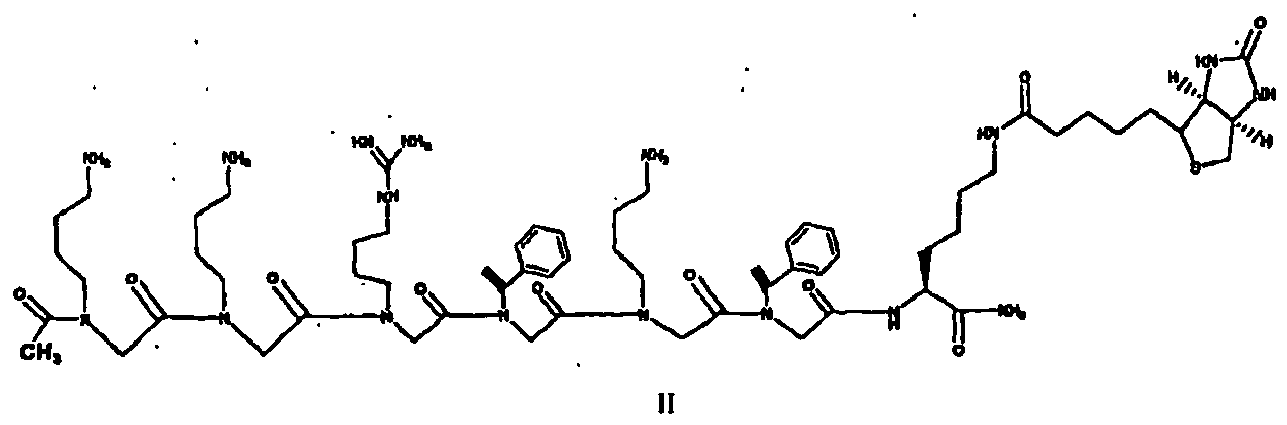
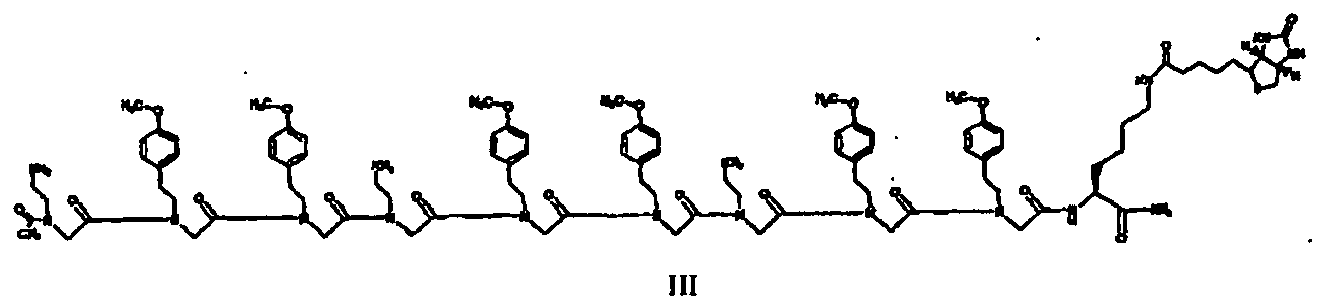


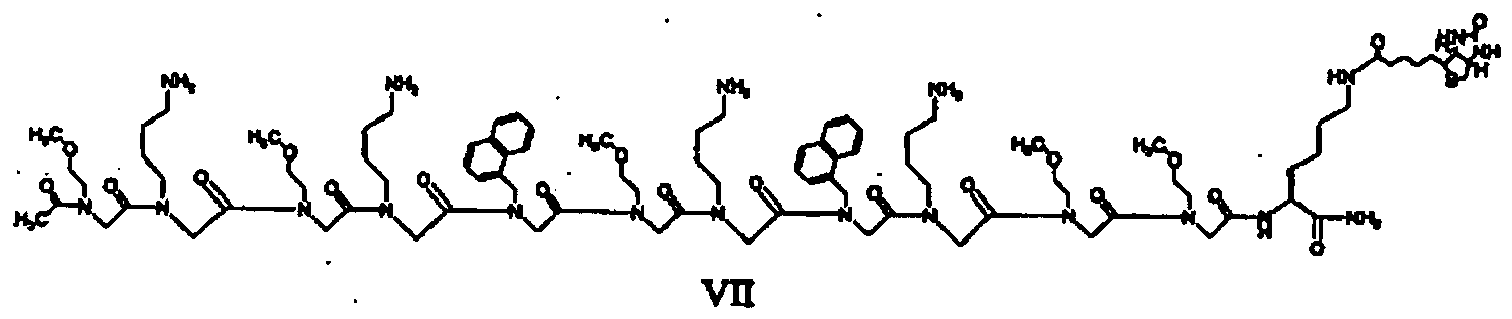
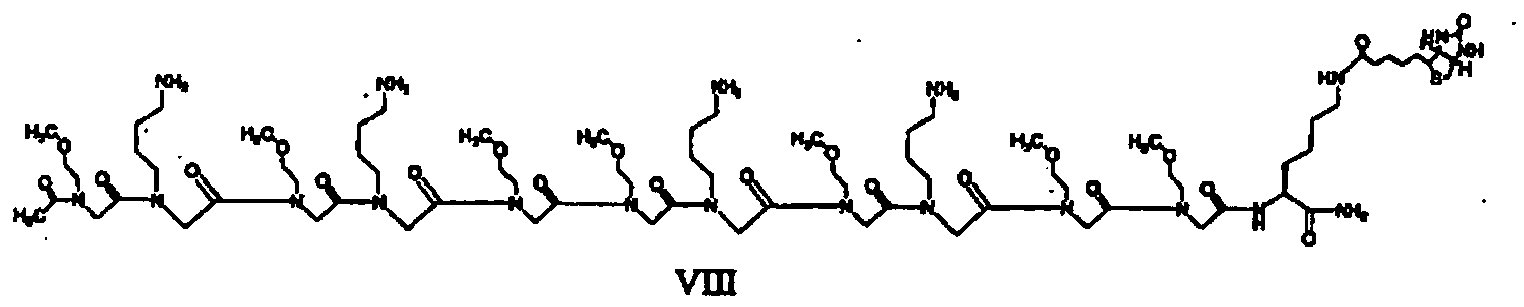


- Peptoidreagens, ausgewählt aus:


- Komplex, umfassend das Peptoidreagens nach Anspruch 1 oder 12 und ein pathogenes Prion.
- Zusammensetzung, umfassend das an einen festen Träger gebundene Peptoidreagens nach Anspruch 1 oder 12.
- Zusammensetzung, umfassend das Peptoidreagens nach Anspruch 1 oder 12 und eine biologische Probe.
- Verfahren zum Nachweis des Vorliegens eines pathogenen Prions in einer Probe, bei dem man die Probe mit einem ersten Peptoidreagens gemäß Anspruch 1 oder 12 unter Bedingungen in Kontakt bringt, die die Bindung des Peptoidreagens an das pathogene Prion, falls vorliegend, unter Bildung eines Komplexes gestatten, und die Bildung des Komplexes nachweist, wobei die Bildung des Komplexes das Vorliegen des pathogenen Prions anzeigt.
- Verfahren zum Nachweis des Vorliegens eines pathogenen Prions in einer Probe, bei dem man die Probe mit einem ersten Peptoidreagens gemäß Anspruch 1 oder 12 unter Bedingungen in Kontakt bringt, die die Bindung des ersten Peptoidreagens an das pathogene Prion, falls vorliegend, unter Bildung eines ersten Komplexes gestatten, den ersten Komplex mit einem zweiten, gegebenenfalls nachweisbar markierten, erfindungsgemäßen Peptoidreagens unter Bedingungen in Kontakt bringt, die die Bindung des zweiten Peptoidreagens an das pathogene Prion des ersten Komplexes unter Bildung eines zweiten Komplexes gestatten, und die Bildung des zweiten Komplexes nachweist, wobei die Bildung des zweiten Komplexes das Vorliegen des pathogenen Prions anzeigt.
- Verfahren zum Nachweis des Vorliegens eines pathogenen Prions in einer Probe, bei dem man die Probe mit einem ersten Peptoidreagens gemäß Anspruch 1 oder 12 unter Bedingungen in Kontakt bringt, die die Bindung des ersten Peptoidreagens an das pathogene Prion, falls vorliegend, unter Bildung eines ersten Komplexes gestatten, nicht gebundene Probe von dem ersten Komplex abtrennt, den ersten Komplex mit einem zweiten, gegebenenfalls nachweisbar markierten, erfindungsgemäßen Peptoidreagens unter Bedingungen in Kontakt bringt, die die Bindung des zweiten Peptoidreagens an das pathogene Prion des ersten Komplexes unter Bildung eines zweiten Komplexes gestatten, und die Bildung des zweiten Komplexes nachweist, wobei die Bildung des zweiten Komplexes das Vorliegen des pathogenen Prions anzeigt.
- Verfahren zum Nachweis des Vorliegens eines pathogenen Prions in einer Probe, bei dem man die Probe mit einem ersten Peptoidreagens gemäß Anspruch 1 oder 12 unter Bedingungen in Kontakt bringt, die die Bindung des ersten Peptoidreagens an das pathogene Prion, falls vorliegend, unter Bildung eines ersten Komplexes gestatten, nicht gebundene Probe von dem ersten Komplex abtrennt, das pathogene Prion von dem ersten Komplex dissoziiert, wodurch dissoziiertes pathogenes Prion bereitgestellt wird, das dissoziierte pathogene Prion mit einem zweiten, gegebenenfalls nachweisbar markierten, Peptoidreagens gemäß Anspruch 1 unter Bedingungen in Kontakt bringt, die die Bindung des zweiten Peptoidreagens an das dissoziierte pathogene Prion unter Bildung eines zweiten Komplexes gestatten, und die Bildung des zweiten Komplexes nachweist, wobei die Bildung des zweiten Komplexes das Vorliegen des pathogenen Prions anzeigt.
- Verfahren zum Nachweis des Vorliegens eines pathogenen Prions in einer Probe, bei dem man die Probe mit einem ersten Peptoidreagens gemäß Anspruch 1 oder 12 unter Bedingungen in Kontakt bringt, die die Bindung des ersten Peptoidreagens an das pathogene Prion, falls vorliegend, unter Bildung eines ersten Komplexes gestatten, den ersten Komplex mit einem gegebenenfalls nachweisbar markierten prionbindenden Reagens unter Bedingungen in Kontakt bringt, die die Bindung des prionbindenden Reagens an das pathogene Prion des ersten Komplexes unter Bildung eines zweiten Komplexes gestatten, und die Bildung des zweiten Komplexes nachweist, wobei die Bildung des zweiten Komplexes das Vorliegen des pathogenen Prions anzeigt.
- Verfahren zum Nachweis des Vorliegens eines pathogenen Prions in einer Probe, bei dem man die Probe mit einem ersten Peptoidreagens gemäß Anspruch 1 oder 12 unter Bedingungen in Kontakt bringt, die die Bindung des ersten Peptoidreagens an das pathogene Prion, falls vorliegend, unter Bildung eines ersten Komplexes gestatten, nicht gebundene Probe von dem ersten Komplex abtrennt, den ersten Komplex mit einem gegebenenfalls nachweisbar markierten prionbindenden Reagens unter Bedingungen in Kontakt bringt, die die Bindung des prionbindenden Reagens an das pathogene Prion des ersten Komplexes unter Bildung eines zweiten Komplexes gestatten, und die Bildung des zweiten Komplexes nachweist, wobei die Bildung des zweiten Komplexes das Vorliegen des pathogenen Prions anzeigt.
- Verfahren zum Nachweis des Vorliegens eines pathogenen Prions in einer Probe, bei dem man die Probe mit einem ersten Peptoidreagens gemäß Anspruch 1 oder 12 unter Bedingungen in Kontakt bringt, die die Bindung des ersten Peptoidreagens an das pathogene Prion, falls vorliegend, unter Bildung eines ersten Komplexes gestatten, nicht gebundene Probe von dem ersten Komplex abtrennt, das pathogene Prion von dem ersten Komplex dissoziiert, wodurch dissoziiertes pathogenes Prion bereitgestellt wird, das dissoziierte pathogene Prion mit einem gegebenenfalls nachweisbar markierten prionbindenden Reagens unter Bedingungen in Kontakt bringt, die die Bindung des prionbindenden Reagens an das dissoziierte pathogene Prion unter Bildung eines zweiten Komplexes gestatten, und die Bildung des zweiten Komplexes nachweist, wobei die Bildung des zweiten Komplexes das Vorliegen des pathogenen Prions anzeigt.
- Verfahren zum Nachweis des Vorliegens eines pathogenen Prions in einer Probe, bei dem man die Probe mit einem ersten Peptoidreagens gemäß Anspruch 1 oder 12 unter Bedingungen in Kontakt bringt, die die Bindung des ersten Peptoidreagens an das pathogene Prion, falls vorliegend, unter Bildung eines ersten Komplexes gestatten, nicht gebundene Probe von dem ersten Komplex abtrennt, das pathogene Prion von dem ersten Komplex dissoziiert, wodurch dissoziiertes pathogenes Prion bereitgestellt wird, das dissoziierte pathogene Prion mit einem prionbindenden Reagens unter Bedingungen in Kontakt bringt, die die Bindung des prionbindenden Reagens an das dissoziierte pathogene Prion unter Bildung eines zweiten Komplexes gestatten, und die Bildung des zweiten Komplexes unter Verwendung eines gegebenenfalls nachweisbar markierten zweiten prionbindenden Reagens nachweist, wobei die Bildung des zweiten Komplexes das Vorliegen des pathogenen Prions anzeigt.
- Verfahren zum Nachweis des Vorliegens eines pathogenen Prions in einer Probe, bei dem man die Probe mit einem prionbindenden Reagens unter Bedingungen in Kontakt bringt, die die Bindung des prionbindenden Reagens an das pathogene Prion, falls vorliegend, unter Bildung eines ersten Komplexes gestatten, nicht gebundene Probe von dem ersten Komplex abtrennt, den ersten Komplex mit einem gegebenenfalls nachweisbar markierten Peptoidreagens gemäß Anspruch 1 oder 12 unter Bedingungen in Kontakt bringt, die die Bindung des Peptoidreagens an das pathogene Prion des ersten Komplexes unter Bildung eines zweiten Komplexes gestatten, und die Bildung des zweiten Komplexes nachweist, wobei die Bildung des zweiten Komplexes das Vorliegen des pathogenen Prions anzeigt.
- Verfahren nach Anspruch 21 bis 25, wobei das prionbindende Reagens einen Anti-Prion-Antikörper umfasst.
- Verfahren zum Nachweis des Vorliegens eines pathogenen Prions in einer Probe, bei dem man die Probe mit einem ersten Peptoidreagens gemäß Anspruch 1 oder 12 unter Bedingungen in Kontakt bringt, die die Bindung des ersten Peptoidreagens an das pathogene Prion, falls vorliegend, unter Bildung eines Komplexes gestatten, nicht gebundene Probe von dem Komplex abtrennt, das pathogene Prion von dem Komplex dissoziiert, wodurch dissoziiertes pathogenes Prion bereitgestellt wird, das dissoziierte pathogene Prion mit einem zweiten festen Träger unter Bedingungen in Kontakt bringt, die das Haften des dissoziierten pathogenen Prions an dem zweiten festen Träger gestatten, und das haftende dissoziierte pathogene Prion unter Verwendung eines gegebenenfalls nachweisbar markierten prionbindenden Reagens nachweist, wobei Bindung des prionbindenden Reagens das Vorliegen des pathogenen Prions anzeigt.
- Verfahren nach Anspruch 27, wobei das Dissoziieren dadurch erfolgt, dass man den Komplex einem pH von 12 oder darüber oder von 2 oder darunter aussetzt.
- Verfahren nach Anspruch 28, bei dem man in einem weiteren Schritt den pH nach dem Dissoziieren neutralisiert.
- Verfahren nach Anspruch 27, wobei das dissoziierte pathogene Prion denaturiert ist.
- Verfahren nach Anspruch 27, wobei das prionbindende Reagens einen Anti-Prion-Antikörper umfasst.
- Verfahren zum Nachweis des Vorliegens eines pathogenen Prions in einer Probe, bei dem man die Probe mit einem ersten Peptoidreagens gemäß Anspruch 1 oder 12 unter Bedingungen in Kontakt bringt, die die Bindung des ersten Peptoidreagens an das pathogene Prion, falls vorliegend, unter Bildung eines ersten Komplexes gestatten, nicht gebundene Probe von dem ersten Komplex abtrennt, das pathogene Prion von dem ersten Komplex dissoziiert, wodurch dissoziiertes pathogenes Prion bereitgestellt wird, das dissoziierte pathogene Prion mit einem zweiten festen Träger, wobei der zweite feste Träger einen ersten Anti-Prion-Antikörper umfasst, unter Bedingungen in Kontakt bringt, die die Bindung des dissoziierten pathogenen Prions an den ersten Anti-Prion-Antikörper unter Bildung eines zweiten Komplexes gestatten, und das dissoziierte pathogene Prion des zweiten Komplexes mit einem gegebenenfalls nachweisbar markierten zweiten Anti-Prion-Antikörper nachweist, wobei eine Bindung des zweiten Anti-Prion-Antikörpers das Vorliegen des pathogenen Prions anzeigt.
- Verfahren nach Anspruch 32, wobei das Dissoziieren dadurch erfolgt, dass man den ersten Komplex einem pH von 12 oder darüber oder von 2 oder darunter aussetzt.
- Verfahren nach Anspruch 33, bei dem man in einem weiteren Schritt den pH nach dem Dissoziieren neutralisiert.
- Verfahren nach Anspruch 32, wobei das dissoziierte pathogene Prion denaturiert ist.
- Verfahren nach Anspruch 32, wobei das erste prionbindende Reagens einen Anti-Prion-Antikörper umfasst.
- Verfahren nach Anspruch 32, wobei das zweite prionbindende Reagens einen Anti-Prion-Antikörper umfasst.
- Peptoidreagens nach Anspruch 1 oder 12, wobei das Peptoidreagens mit einem Bildgebungsmittel verknüpft ist, zur Verwendung bei einem Verfahren zur Bestimmung eines Ortes einer mit Prionen verbundenen Krankheitsinfektion bei einem Tier, wobei man:(a) dem Tier das Peptoidreagens verabreicht; und(b) das Bildgebungsmittel nachweist, wobei der Nachweis des Bildgebungsmittels den Ort der Infektion bestimmt.
- Verfahren zur Isolierung eines pathogenen Prions aus einer Probe, bei dem man:(a) einen ein Peptoidreagens nach Anspruch 1 oder 12 umfassenden festen Träger mit der Probe unter Bedingungen in Kontakt bringt, die die Bindung des pathogenen Prions, falls es in der Probe vorliegt, an das Peptoidreagens unter Bildung eines Komplexes gestatten; und(b) nicht gebundene Probe von dem Komplex abtrennt, wodurch isoliertes pathogenes Prion bereitgestellt wird.
- Verfahren zur Reduzierung der Menge des pathogenen Prions in einer Probe, bei dem man:(a) einen ein Peptoidreagens nach Anspruch 1 oder 12 umfassenden festen Träger mit der Probe unter Bedingungen in Kontakt bringt, die die Bindung des pathogenen Prions, falls es in der Probe vorliegt, an das Peptoidreagens des festen Trägers unter Bildung eines Komplexes gestatten; und(b) nicht gebundene Probe von dem Komplex trennt, wodurch die Probe mit einer reduzierten Menge des pathogenen Prions bereitgestellt wird.
- Verfahren zur Herstellung eines von einem pathogenen Prion weitgehend freien Blutvorrats, wobei man:(a) das Vorliegen oder Fehlen von pathogenem Prion in mehreren Blutproben nachweist, wobei das Nachweisen die Bindung des pathogenen Prions, falls vorliegend, an ein Peptoidreagens nach Anspruch 1 oder 12 beinhaltet; und(b) die Proben, in denen das pathogene Prion nicht nachgewiesen wird, vereinigt, wodurch der von dem pathogenen Prion weitgehend freie Blutvorrat bereitgestellt wird.
- Verfahren zur Herstellung eines von einem pathogenen Prion weitgehend freien Lebensmittelvorrats, wobei man:(a) das Vorliegen oder Fehlen von pathogenem Prion in mehreren Lebensmittelproben nachweist, wobei das Nachweisen die Bindung des pathogenen Prions, falls vorliegend, an ein Peptoidreagens nach Anspruch 1 oder 12 beinhaltet; und(b) die Proben, in denen das pathogene Prion nicht nachgewiesen wird, vereinigt, wodurch der von dem pathogenen Prion weitgehend freie Lebensmittelvorrat bereitgestellt wird.
Priority Applications (1)
| Application Number | Priority Date | Filing Date | Title |
|---|---|---|---|
| EP20110171585 EP2383281A3 (de) | 2005-09-09 | 2006-09-08 | Prionspezifische Peptoidreagenzien |
Applications Claiming Priority (4)
| Application Number | Priority Date | Filing Date | Title |
|---|---|---|---|
| US71576105P | 2005-09-09 | 2005-09-09 | |
| US72668605P | 2005-10-14 | 2005-10-14 | |
| US75893406P | 2006-01-13 | 2006-01-13 | |
| PCT/US2006/035226 WO2007030804A1 (en) | 2005-09-09 | 2006-09-08 | Prion-specific peptoid reagents |
Related Child Applications (1)
| Application Number | Title | Priority Date | Filing Date |
|---|---|---|---|
| EP11171585.0 Division-Into | 2011-06-27 |
Publications (2)
| Publication Number | Publication Date |
|---|---|
| EP1931695A1 EP1931695A1 (de) | 2008-06-18 |
| EP1931695B1 true EP1931695B1 (de) | 2013-04-10 |
Family
ID=37651167
Family Applications (2)
| Application Number | Title | Priority Date | Filing Date |
|---|---|---|---|
| EP06814415.3A Not-in-force EP1931695B1 (de) | 2005-09-09 | 2006-09-08 | Prionspezifische Peptoidreagentien |
| EP20110171585 Withdrawn EP2383281A3 (de) | 2005-09-09 | 2006-09-08 | Prionspezifische Peptoidreagenzien |
Family Applications After (1)
| Application Number | Title | Priority Date | Filing Date |
|---|---|---|---|
| EP20110171585 Withdrawn EP2383281A3 (de) | 2005-09-09 | 2006-09-08 | Prionspezifische Peptoidreagenzien |
Country Status (14)
| Country | Link |
|---|---|
| US (2) | US7834144B2 (de) |
| EP (2) | EP1931695B1 (de) |
| JP (2) | JP5209477B2 (de) |
| KR (1) | KR20080048527A (de) |
| CN (1) | CN101356186A (de) |
| AU (1) | AU2006287299B2 (de) |
| BR (1) | BRPI0615618A2 (de) |
| CA (1) | CA2621767A1 (de) |
| DK (1) | DK1931695T3 (de) |
| ES (1) | ES2404940T3 (de) |
| IL (1) | IL189992A0 (de) |
| NZ (2) | NZ594844A (de) |
| WO (1) | WO2007030804A1 (de) |
| ZA (1) | ZA200802186B (de) |
Families Citing this family (25)
| Publication number | Priority date | Publication date | Assignee | Title |
|---|---|---|---|---|
| US20060035242A1 (en) * | 2004-08-13 | 2006-02-16 | Michelitsch Melissa D | Prion-specific peptide reagents |
| WO2006076683A2 (en) * | 2005-01-13 | 2006-07-20 | Novartis Vaccines And Diagnostics Inc. | Isolation and detection of pathogenic prions |
| US20090099343A1 (en) * | 2005-01-13 | 2009-04-16 | David Peretz | Isolation of pathogenic prions |
| EP1931695B1 (de) | 2005-09-09 | 2013-04-10 | Novartis AG | Prionspezifische Peptoidreagentien |
| FR2892820B1 (fr) * | 2005-11-03 | 2008-02-01 | Diagast Soc Par Actions Simpli | Procede magnetique d'immunodiagnostic pour la mise en evidence de complexe anticorps/antigene, en particulier de groupe sanguin |
| EP2129388B1 (de) * | 2007-02-23 | 2012-09-12 | The Research Foundation Of State University Of New York | Rna-target-verbindungen und verfahren zu ihrer herstellung und verwendung |
| US9260476B2 (en) | 2007-02-23 | 2016-02-16 | The Research Foundation For The State University Of New York | RNA targeting compounds and methods for making and using same |
| CA2684796A1 (en) * | 2007-04-04 | 2008-10-16 | Novartis Ag | Prion assay |
| EP2140272A1 (de) * | 2007-04-04 | 2010-01-06 | Novartis Ag | Prion-elisa |
| ES2442500T3 (es) * | 2007-10-02 | 2014-02-11 | Csl Limited | Método de purificación de anticuerpos terapéuticos y método de uso |
| US8445632B2 (en) * | 2008-02-08 | 2013-05-21 | The Regents Of The University Of California | Selective poly-N-substituted glycine antibiotics |
| BRPI0910550A2 (pt) * | 2008-04-30 | 2015-09-29 | Novartis Ag | ensaio para confôrmeros patogênicos |
| WO2010017412A1 (en) * | 2008-08-06 | 2010-02-11 | The Regents Of The University Of California | Novel biomimetic peptoid polymers |
| US8828413B2 (en) * | 2009-02-24 | 2014-09-09 | New York University | Peptoid oligomers, pharmaceutical compositions and methods of using the same |
| CA2764153C (en) | 2009-06-02 | 2021-07-27 | The Board Of Regents Of The University Of Texas System | Identification of small molecules recognized by antibodies in subjects with neurodegenerative diseases |
| JP2013510297A (ja) * | 2009-11-04 | 2013-03-21 | ノバルティス アーゲー | モノマーからのタンパク質凝集体の分離における結合試薬としての正に荷電した種 |
| US8952127B2 (en) | 2010-06-04 | 2015-02-10 | The Regents Of The University Of California | Peptoids useful for catalyzing the mineralization of calcium carbonate |
| WO2013043669A1 (en) * | 2011-09-21 | 2013-03-28 | The Board Of Regents Of The University Of Texas System | Peptoid compositions for the treatment of alzheimer's disease and polyglutamine expansion disorder |
| US10391068B2 (en) * | 2012-08-06 | 2019-08-27 | Trustees Of Boston University | Prion protein ligands as therapeutic agents for neurodegenerative disorders |
| US9764953B2 (en) | 2013-03-20 | 2017-09-19 | The Regents Of The University Of California | Peptoids useful for the mineralization of apatite |
| CN107529753A (zh) * | 2015-03-11 | 2018-01-02 | 卢莫斯制药公司 | 环肌酸及其类似物的合成 |
| CA3001065A1 (en) | 2015-10-14 | 2017-04-20 | Xiaoxi WEI | Compositions and methods for reducing ice crystal formation |
| JP7026643B2 (ja) * | 2016-03-09 | 2022-02-28 | マイク-アン、エルエルシー | ペプトイド親和性リガンド |
| CN110730786B (zh) * | 2017-04-12 | 2025-01-07 | 先时迈纳米生物科技股份有限公司 | 类肽聚合物及使用方法 |
| US12049443B2 (en) | 2018-12-10 | 2024-07-30 | Provivi, Inc. | Synthesis of conjugated diene pheromones and related compounds |
Citations (1)
| Publication number | Priority date | Publication date | Assignee | Title |
|---|---|---|---|---|
| US5965695A (en) * | 1990-05-15 | 1999-10-12 | Chiron Corporation | Modified peptide and peptide libraries with protease resistance, derivatives thereof and methods of producing and screening such |
Family Cites Families (81)
| Publication number | Priority date | Publication date | Assignee | Title |
|---|---|---|---|---|
| US4806627A (en) | 1987-05-29 | 1989-02-21 | Research Foundation Of Mental Hygiene Inc. | Hybrid cell lines producing monoclonal antibodies dircted against scrapie-associated fibril proteins |
| IE66205B1 (en) * | 1990-06-14 | 1995-12-13 | Paul A Bartlett | Polypeptide analogs |
| AU8337291A (en) * | 1990-08-06 | 1992-03-02 | Cetus Corporation | Methods for the identification of cytokine convertase inhibitors |
| NZ246059A (en) | 1991-12-03 | 1995-08-28 | Proteus Molecular Design | Synthetic polypeptides with at least one antigenic site of a prion protein, methods of their use and manufacture, antibodies thereto, compositions and kits |
| AU4376093A (en) | 1992-05-15 | 1993-12-13 | Instituto Nazionale Neurologico C. Besta | Soluble prion polypeptides, and methods for detecting and purifying thereof |
| HUT72614A (en) * | 1992-09-24 | 1996-05-28 | Chiron Corp | Synthesis of n-substituted oligomers |
| US5877278A (en) | 1992-09-24 | 1999-03-02 | Chiron Corporation | Synthesis of N-substituted oligomers |
| US5831005A (en) | 1992-09-24 | 1998-11-03 | Chiron Corporation | Synthesis of N-substituted oligomers |
| US5948763A (en) * | 1995-06-07 | 1999-09-07 | New York University | Peptides and pharmaceutical compositions thereof for treatment of disorders or diseases associated with abnormal protein folding into amyloid or amyloid-like deposits |
| EP1416280A3 (de) * | 1995-09-14 | 2005-08-10 | The Regents of the University of California | Antikörper spezifisch für natives PrPsc |
| US5750361A (en) | 1995-11-02 | 1998-05-12 | The Regents Of The University Of California | Formation and use of prion protein (PRP) complexes |
| US5695005A (en) | 1995-12-28 | 1997-12-09 | Chen; Chia-Hsien | Fluid dynamic crossflow cooling tower |
| AU713529B2 (en) | 1996-04-03 | 1999-12-02 | Stichting Dienst Landbouwkundig Onderzoek | Method for the detection of prion diseases |
| US6586193B2 (en) | 1996-04-25 | 2003-07-01 | Genicon Sciences Corporation | Analyte assay using particulate labels |
| US6251433B1 (en) | 1996-08-13 | 2001-06-26 | Chiron Corporation | Polycationic polymers |
| PT909388E (pt) | 1997-02-06 | 2004-01-30 | Enfer Technology Ltd | Ensaios imunologicos para encefalopatias espongiformes |
| EP0861900A1 (de) * | 1997-02-21 | 1998-09-02 | Erziehungsdirektion Of The Canton Zurich | Immunologischer Nachweis von Prionen |
| US6787319B2 (en) * | 1997-04-16 | 2004-09-07 | American Home Products Corp. | β-amyloid peptide-binding proteins and polynucleotides encoding the same |
| US7005295B1 (en) * | 1997-04-16 | 2006-02-28 | Wyeth | β-amyloid peptide-binding proteins and polynucleotides encoding the same |
| ES2329955T3 (es) | 1997-04-28 | 2009-12-02 | Novartis Vaccines And Diagnostics, Inc. | Aparato para la sintesis de oligomeros, especialmente peptoides, con reciclado de reactivos. |
| DE19741607A1 (de) | 1997-09-20 | 1999-03-25 | Prionics Ag | Synthetische Polypeptide zur Diagnose und Therapie von Prionerkrankungen |
| US6165784A (en) | 1997-10-14 | 2000-12-26 | The United States Of America As Represented By The Secretary Of Agriculture | Antibodies for the detection of prion protein as an indication of transmissible spongiform encephalopathies |
| AU3642499A (en) * | 1998-04-14 | 1999-11-01 | Sugen, Inc. | Ste20-related protein kinases |
| US6211149B1 (en) * | 1998-08-03 | 2001-04-03 | The United States Of America As Represented By The Department Of Health And Human Services | Inhibitors of formation of protease resistant prion protein |
| US6528269B1 (en) | 1998-06-22 | 2003-03-04 | Case Western Reserve University | Immunological agents specific for prion protein (PRP) |
| FI982480A0 (fi) | 1998-11-17 | 1998-11-17 | Wallac Oy | Immunomääritys nisäkkäiden tarttuvan spongiomuotoisen aivotaudin määrittämiseksi |
| CA2361013A1 (en) | 1999-01-25 | 2000-07-27 | Minerva Biotechnologies Corporation | Rapid and sensitive detection of aberrant protein aggregation in neurodegenerative diseases |
| US6551843B1 (en) | 1999-01-29 | 2003-04-22 | Immunivest Corporation | Methods for enhancing binding interactions between members of specific binding pairs |
| MXPA01013186A (es) | 1999-06-23 | 2002-08-12 | Caprion Pharmaceuticals Inc | Peptidos de la proteina prion y sus usos. |
| US6261790B1 (en) | 1999-07-15 | 2001-07-17 | The United States Of America As Represented By The Secretary Of Agriculture | Monoclonal antibodies and antibody cocktail for detection of prion protein as an indication of transmissible spongiform encephalopathies |
| CA2379237A1 (en) | 1999-07-27 | 2001-02-01 | Imperial College Innovations Limited | Fragments of cellular prion protein and methods useful in the diagnosis and treatment of prion diseases |
| CA2385743A1 (en) | 1999-09-28 | 2001-04-05 | Universitat Zurich | Factors having prion-binding activity in serum and plasma and agents to detect transmissible spongiform encephalopathitis |
| FR2801106B1 (fr) * | 1999-11-12 | 2007-10-05 | Commissariat Energie Atomique | Procede de diagnostic d'une esst provoquee par une souche d'atnc dans un echantillon biologique et son utilisation dans le diagnostic differentiel des differentes souches d'atnc |
| JP2003523348A (ja) * | 2000-02-16 | 2003-08-05 | ノースウェスタン ユニバーシティ | ポリペプトイド肺サーファクタント |
| AU2001251358A1 (en) * | 2000-04-05 | 2001-10-23 | V.I. Technologies, Inc. | Prion-binding ligands and methods of using same |
| AU6887101A (en) | 2000-06-20 | 2002-01-02 | Caprion Pharmaceuticals, Inc. | Copolymers and methods of treating prion-related diseases |
| MXPA03000226A (es) | 2000-07-07 | 2004-05-21 | Applied Research Systems | Diagnosticos tempranos de enfermedades conformacionales. |
| US6537548B1 (en) | 2000-07-27 | 2003-03-25 | The Regents Of The University Of California | Antibodies specific for ungulate PrP |
| US20030092613A1 (en) | 2000-08-14 | 2003-05-15 | Lee Daniel H. S. | Alpha7 nicotinic receptor peptides as ligands for beta amyloid peptides |
| EP1404867B1 (de) | 2000-12-23 | 2008-02-27 | Novartis Vaccines and Diagnostics, Inc. | Screeningverfahren für die oligonukleotidtransfektion |
| GB0103508D0 (en) | 2001-02-13 | 2001-03-28 | Univ Dundee | Screening method and agents |
| EP1395833B1 (de) | 2001-05-31 | 2013-02-27 | Adlyfe, Inc. | Verfahren zum erkennen von inkorrekt gefalteten proteinen |
| US20050026165A1 (en) * | 2001-05-31 | 2005-02-03 | Cindy Orser | Detection of conformationally altered proteins and prions |
| CN100579332C (zh) | 2001-07-19 | 2010-01-06 | 东丽株式会社 | 电路基板、电路基板用构件及其制造方法和柔性薄膜的层压方法 |
| CA2466841A1 (en) * | 2001-11-21 | 2003-06-05 | New York University | Synthetic immunogenic but non-deposit-forming polypeptides and peptides homologous to amyloid .beta., prion protein, amylin, .alpha.-synuclein, or polyglutamine repeats for induction of an immune response thereto |
| WO2003050139A2 (en) | 2001-12-10 | 2003-06-19 | Applied Research Systems Ars Holding N.V. | Prion inhibiting peptides and derivatives thereof |
| US20040052928A1 (en) * | 2002-09-06 | 2004-03-18 | Ehud Gazit | Peptides and methods using same for diagnosing and treating amyloid-associated diseases |
| CA2869088A1 (en) * | 2002-02-07 | 2003-08-14 | Massachusetts Institute Of Technology | Anti-pathogen treatments |
| JP4550425B2 (ja) | 2002-02-28 | 2010-09-22 | マイクロセンズ バイオファージ リミテッド | 異常型プリオンタンパク質の結合 |
| US7939641B2 (en) | 2002-04-09 | 2011-05-10 | The Scripps Research Institute | Motif-grafted hybrid polypeptides and uses thereof |
| US20040208919A1 (en) * | 2002-06-13 | 2004-10-21 | Nicolau Yves C. | Vaccination against prion diseases |
| DE10230141B4 (de) * | 2002-07-04 | 2004-07-15 | Priontype Gmbh | Verfahren und Kit zur Anreicherung und zum Nachweis von veränderten Prion-Proteinen (PrPSc) |
| EP1382971A1 (de) | 2002-07-17 | 2004-01-21 | Pepscan Systems B.V. | Nachweis von Prion Erkrankung |
| US20060057636A1 (en) | 2002-08-21 | 2006-03-16 | Peter Heegaard | Composite peptide compounds for diagnosis and treatment of diseases caused by prion proteins |
| US20040072236A1 (en) | 2002-09-27 | 2004-04-15 | Neil Cashman | PrPSc -interacting molecules and uses thereof |
| DE03799419T1 (de) | 2002-10-10 | 2005-04-07 | The Regents Of The University Of California, Oakland | Verwendung monoklonaler antikörper zur unterscheidung von proteinkonformationsisoformen |
| DE60219215T2 (de) | 2002-10-23 | 2008-01-03 | Centre For Research And Technology Hellas/Intitute Of Agrobiotechnology In.A, Thermi | Prionen-bindende peptidsequenzen |
| WO2004046728A1 (en) | 2002-11-18 | 2004-06-03 | Prionics Ag | Method for the detection of prpsc |
| CA2836951C (en) * | 2002-12-03 | 2017-01-10 | North Carolina State University | Prion protein ligands and methods of use |
| EP1457500A1 (de) | 2003-03-14 | 2004-09-15 | University of Zurich | Lösliche Prionen-Hybrid-Proteine und deren Verwendung zur Diagnose, Behandlung und Prevention von transmissibler spongiformer Encephalopathie |
| NZ543371A (en) | 2003-04-04 | 2008-04-30 | Pathogen Removal And Diagnosti | Prion protein binding materials and methods of use |
| WO2004092197A2 (en) | 2003-04-07 | 2004-10-28 | The Regents Of The University Of California | Amyloid-specific peptides and uses thereof |
| AU2004229535A1 (en) | 2003-04-14 | 2004-10-28 | Pathogen Removal And Diagnostic Technologies, Inc. | Method for identifying ligands specific for structural isoforms of proteins |
| US20060035242A1 (en) | 2004-08-13 | 2006-02-16 | Michelitsch Melissa D | Prion-specific peptide reagents |
| NZ580256A (en) * | 2003-08-13 | 2011-07-29 | Novartis Vaccines & Diagnostic | Prion-specific peptide reagents comprising the sequence KKRPKPGG |
| JP3910569B2 (ja) * | 2003-08-19 | 2007-04-25 | 独立行政法人科学技術振興機構 | アミロイドβ蛋白質のアミロイド線維化を増幅するための試薬 |
| CN1906308B (zh) * | 2003-12-19 | 2011-09-14 | 诺华疫苗和诊断公司 | 小干扰rna的细胞转染制剂、相关组合物以及制备和使用方法 |
| SE0400274D0 (sv) | 2004-02-09 | 2004-02-09 | Affibody Ab | New polypeptide |
| JP4773697B2 (ja) | 2004-06-30 | 2011-09-14 | ルネサスエレクトロニクス株式会社 | Soi基板およびその製造方法ならびに半導体装置 |
| DE102004043782A1 (de) | 2004-09-08 | 2006-03-09 | Heinrich-Heine-Universität Düsseldorf | Polypeptide und Verfahren zur spezifischen Bindung von Prionen |
| US20060057671A1 (en) * | 2004-09-10 | 2006-03-16 | Orser Cindy S | Immobilized probes and methods of detecting conformationally altered prion proteins |
| AU2005209592B2 (en) | 2004-09-30 | 2012-07-12 | Ortho-Clinical Diagnostics, Inc. | Peptides for discrimination of prions |
| US7482172B2 (en) * | 2005-09-19 | 2009-01-27 | Ortho-Clinical Diagnostics, Inc. | Peptides for discrimination of prions |
| JP5162250B2 (ja) | 2005-01-13 | 2013-03-13 | ノバルティス バクシンズ アンド ダイアグノスティックス,インコーポレーテッド | プリオン特異的ペプチド試薬を使用するelisaアッセイ |
| US20090099343A1 (en) * | 2005-01-13 | 2009-04-16 | David Peretz | Isolation of pathogenic prions |
| AU2006214463B2 (en) | 2005-02-15 | 2012-08-30 | Presympto, Inc. | Method for detecting misfolded proteins and prions |
| GB0503434D0 (en) | 2005-02-18 | 2005-03-30 | Senexis Ltd | Amyloid-binding peptides, analogues and uses thereof |
| EP1931695B1 (de) | 2005-09-09 | 2013-04-10 | Novartis AG | Prionspezifische Peptoidreagentien |
| WO2007145589A1 (en) | 2006-06-15 | 2007-12-21 | Per Arvidsson | Peptides that are capable of binding to amyloid-beta peptide. |
| EP2156181B1 (de) | 2006-07-28 | 2015-11-04 | Adlyfe, Inc. | Peptidsonden für diagnostik und therapie |
| CA2719878C (en) | 2007-04-26 | 2017-08-29 | Yale University | Prion protein as a receptor for amyloid-beta oligomers |
-
2006
- 2006-09-08 EP EP06814415.3A patent/EP1931695B1/de not_active Not-in-force
- 2006-09-08 AU AU2006287299A patent/AU2006287299B2/en not_active Ceased
- 2006-09-08 ES ES06814415T patent/ES2404940T3/es active Active
- 2006-09-08 US US11/518,091 patent/US7834144B2/en not_active Expired - Fee Related
- 2006-09-08 CA CA002621767A patent/CA2621767A1/en not_active Abandoned
- 2006-09-08 KR KR1020087008427A patent/KR20080048527A/ko not_active Abandoned
- 2006-09-08 EP EP20110171585 patent/EP2383281A3/de not_active Withdrawn
- 2006-09-08 DK DK06814415.3T patent/DK1931695T3/da active
- 2006-09-08 BR BRPI0615618-5A patent/BRPI0615618A2/pt not_active IP Right Cessation
- 2006-09-08 WO PCT/US2006/035226 patent/WO2007030804A1/en not_active Ceased
- 2006-09-08 JP JP2008530008A patent/JP5209477B2/ja not_active Expired - Fee Related
- 2006-09-08 CN CNA2006800331296A patent/CN101356186A/zh active Pending
- 2006-09-08 NZ NZ594844A patent/NZ594844A/xx not_active IP Right Cessation
- 2006-09-08 NZ NZ566020A patent/NZ566020A/xx not_active IP Right Cessation
-
2008
- 2008-03-06 IL IL189992A patent/IL189992A0/en unknown
- 2008-03-07 ZA ZA200802186A patent/ZA200802186B/xx unknown
-
2010
- 2010-10-07 US US12/924,872 patent/US20120027677A1/en not_active Abandoned
-
2012
- 2012-06-01 JP JP2012126346A patent/JP2012162571A/ja not_active Withdrawn
Patent Citations (1)
| Publication number | Priority date | Publication date | Assignee | Title |
|---|---|---|---|---|
| US5965695A (en) * | 1990-05-15 | 1999-10-12 | Chiron Corporation | Modified peptide and peptide libraries with protease resistance, derivatives thereof and methods of producing and screening such |
Non-Patent Citations (2)
| Title |
|---|
| ILARIA PERETTO ET AL: "Cell penetrable peptoid carrier vehicles: synthesis and evaluation", CHEMICAL COMMUNICATIONS - CHEMCOM, ROYAL SOCIETY OF CHEMISTRY, GB, vol. 2003, no. 18, 1 January 2003 (2003-01-01), pages 2312 - 2313, XP002447845, ISSN: 1359-7345 * |
| STATZ A R ET AL: "New peptidomimetic polymers for antifouling surfaces", JOURNAL OF THE AMERICAN CHEMICAL SOCIETY, AMERICAN CHEMICAL SOCIETY, NEW YORK, US LNKD- DOI:10.1021/JA0522534, vol. 127, no. 22, 1 January 2005 (2005-01-01), pages 7972 - 7973, XP002541457, ISSN: 0002-7863, [retrieved on 20050513] * |
Also Published As
| Publication number | Publication date |
|---|---|
| EP2383281A2 (de) | 2011-11-02 |
| JP2009507833A (ja) | 2009-02-26 |
| BRPI0615618A2 (pt) | 2011-05-24 |
| CN101356186A (zh) | 2009-01-28 |
| EP2383281A3 (de) | 2012-01-04 |
| US20120027677A1 (en) | 2012-02-02 |
| US20070087972A1 (en) | 2007-04-19 |
| ZA200802186B (en) | 2008-12-31 |
| US7834144B2 (en) | 2010-11-16 |
| ES2404940T3 (es) | 2013-05-29 |
| CA2621767A1 (en) | 2007-03-15 |
| JP5209477B2 (ja) | 2013-06-12 |
| KR20080048527A (ko) | 2008-06-02 |
| NZ566020A (en) | 2012-08-31 |
| EP1931695A1 (de) | 2008-06-18 |
| AU2006287299A1 (en) | 2007-03-15 |
| NZ594844A (en) | 2013-04-26 |
| WO2007030804A1 (en) | 2007-03-15 |
| JP2012162571A (ja) | 2012-08-30 |
| IL189992A0 (en) | 2008-08-07 |
| AU2006287299B2 (en) | 2012-08-23 |
| DK1931695T3 (da) | 2013-07-01 |
Similar Documents
| Publication | Publication Date | Title |
|---|---|---|
| US20120027677A1 (en) | Prion-specific peptoid reagents | |
| Zheng et al. | Robust chemical synthesis of membrane proteins through a general method of removable backbone modification | |
| US20040186273A1 (en) | Prion-binding ligands and methods of using same | |
| JP4533750B2 (ja) | PrPSc相互作用分子とその用途 | |
| CN100558395C (zh) | 杂交肽调制免役反应 | |
| US20110189692A1 (en) | Assay for pathogenic conformers | |
| JP2000508623A (ja) | ペプチド誘導体 | |
| JP2004501061A (ja) | 熱ショックタンパク質60のフラグメントおよびアンタゴニスト | |
| CN101282989A (zh) | 用于诊断风湿性疾病的方法 | |
| AU696637B2 (en) | Alpha b crystallin for use in diagnosis and therapy of auto-immune diseases in particular multiple sclerosis | |
| Li et al. | A Two‐Step Strategy for Structure–Activity Relationship Studies of N‐Methylated Aβ42 C‐Terminal Fragments as Aβ42 Toxicity Inhibitors | |
| AU2012244255A1 (en) | Prion-specific peptoid reagents | |
| HK1163124A (en) | Prion-specific peptoid reagents | |
| MX2008003147A (en) | Prion-specific peptoid reagents | |
| US20040022777A1 (en) | Fragments and antagonists of heat shock protein 60 | |
| AU2003272695B2 (en) | PrPsc -Interacting molecules and uses thereof |
Legal Events
| Date | Code | Title | Description |
|---|---|---|---|
| PUAI | Public reference made under article 153(3) epc to a published international application that has entered the european phase |
Free format text: ORIGINAL CODE: 0009012 |
|
| 17P | Request for examination filed |
Effective date: 20080327 |
|
| AK | Designated contracting states |
Kind code of ref document: A1 Designated state(s): AT BE BG CH CY CZ DE DK EE ES FI FR GB GR HU IE IS IT LI LT LU LV MC NL PL PT RO SE SI SK TR |
|
| DAX | Request for extension of the european patent (deleted) | ||
| REG | Reference to a national code |
Ref country code: HK Ref legal event code: DE Ref document number: 1112249 Country of ref document: HK |
|
| 17Q | First examination report despatched |
Effective date: 20090616 |
|
| DAC | Divisional application: reference to earlier application (deleted) | ||
| REG | Reference to a national code |
Ref country code: DE Ref legal event code: R079 Ref document number: 602006035639 Country of ref document: DE Free format text: PREVIOUS MAIN CLASS: C07K0005000000 Ipc: C07K0007060000 |
|
| GRAP | Despatch of communication of intention to grant a patent |
Free format text: ORIGINAL CODE: EPIDOSNIGR1 |
|
| RIC1 | Information provided on ipc code assigned before grant |
Ipc: C07K 14/47 20060101ALI20121009BHEP Ipc: G01N 33/68 20060101ALI20121009BHEP Ipc: G01N 33/50 20060101ALI20121009BHEP Ipc: C07K 7/08 20060101ALI20121009BHEP Ipc: A61K 38/08 20060101ALI20121009BHEP Ipc: A61K 31/16 20060101ALI20121009BHEP Ipc: C07K 7/06 20060101AFI20121009BHEP Ipc: A61K 38/10 20060101ALI20121009BHEP Ipc: A61P 25/28 20060101ALI20121009BHEP |
|
| RIN1 | Information on inventor provided before grant (corrected) |
Inventor name: SHIMIZU, ROBERT, M. Inventor name: CONNOLLY, MICHAEL, D. Inventor name: GAO, MAN Inventor name: ZUCKERMANN, RONALD Inventor name: PERETZ, DAVID Inventor name: TIMOTEO, GULLIVER |
|
| GRAS | Grant fee paid |
Free format text: ORIGINAL CODE: EPIDOSNIGR3 |
|
| GRAA | (expected) grant |
Free format text: ORIGINAL CODE: 0009210 |
|
| AK | Designated contracting states |
Kind code of ref document: B1 Designated state(s): AT BE BG CH CY CZ DE DK EE ES FI FR GB GR HU IE IS IT LI LT LU LV MC NL PL PT RO SE SI SK TR |
|
| REG | Reference to a national code |
Ref country code: GB Ref legal event code: FG4D |
|
| REG | Reference to a national code |
Ref country code: AT Ref legal event code: REF Ref document number: 605969 Country of ref document: AT Kind code of ref document: T Effective date: 20130415 Ref country code: CH Ref legal event code: NV Representative=s name: E. BLUM AND CO. AG PATENT- UND MARKENANWAELTE , CH Ref country code: CH Ref legal event code: EP |
|
| REG | Reference to a national code |
Ref country code: IE Ref legal event code: FG4D |
|
| REG | Reference to a national code |
Ref country code: ES Ref legal event code: FG2A Ref document number: 2404940 Country of ref document: ES Kind code of ref document: T3 Effective date: 20130529 |
|
| REG | Reference to a national code |
Ref country code: DE Ref legal event code: R096 Ref document number: 602006035639 Country of ref document: DE Effective date: 20130606 |
|
| REG | Reference to a national code |
Ref country code: SE Ref legal event code: TRGR |
|
| REG | Reference to a national code |
Ref country code: DK Ref legal event code: T3 |
|
| REG | Reference to a national code |
Ref country code: NL Ref legal event code: T3 |
|
| PG25 | Lapsed in a contracting state [announced via postgrant information from national office to epo] |
Ref country code: SI Free format text: LAPSE BECAUSE OF FAILURE TO SUBMIT A TRANSLATION OF THE DESCRIPTION OR TO PAY THE FEE WITHIN THE PRESCRIBED TIME-LIMIT Effective date: 20130410 |
|
| REG | Reference to a national code |
Ref country code: AT Ref legal event code: MK05 Ref document number: 605969 Country of ref document: AT Kind code of ref document: T Effective date: 20130410 |
|
| REG | Reference to a national code |
Ref country code: LT Ref legal event code: MG4D |
|
| PG25 | Lapsed in a contracting state [announced via postgrant information from national office to epo] |
Ref country code: FI Free format text: LAPSE BECAUSE OF FAILURE TO SUBMIT A TRANSLATION OF THE DESCRIPTION OR TO PAY THE FEE WITHIN THE PRESCRIBED TIME-LIMIT Effective date: 20130410 Ref country code: PT Free format text: LAPSE BECAUSE OF FAILURE TO SUBMIT A TRANSLATION OF THE DESCRIPTION OR TO PAY THE FEE WITHIN THE PRESCRIBED TIME-LIMIT Effective date: 20130812 Ref country code: BE Free format text: LAPSE BECAUSE OF FAILURE TO SUBMIT A TRANSLATION OF THE DESCRIPTION OR TO PAY THE FEE WITHIN THE PRESCRIBED TIME-LIMIT Effective date: 20130410 Ref country code: IS Free format text: LAPSE BECAUSE OF FAILURE TO SUBMIT A TRANSLATION OF THE DESCRIPTION OR TO PAY THE FEE WITHIN THE PRESCRIBED TIME-LIMIT Effective date: 20130810 Ref country code: LT Free format text: LAPSE BECAUSE OF FAILURE TO SUBMIT A TRANSLATION OF THE DESCRIPTION OR TO PAY THE FEE WITHIN THE PRESCRIBED TIME-LIMIT Effective date: 20130410 Ref country code: AT Free format text: LAPSE BECAUSE OF FAILURE TO SUBMIT A TRANSLATION OF THE DESCRIPTION OR TO PAY THE FEE WITHIN THE PRESCRIBED TIME-LIMIT Effective date: 20130410 Ref country code: GR Free format text: LAPSE BECAUSE OF FAILURE TO SUBMIT A TRANSLATION OF THE DESCRIPTION OR TO PAY THE FEE WITHIN THE PRESCRIBED TIME-LIMIT Effective date: 20130711 |
|
| PG25 | Lapsed in a contracting state [announced via postgrant information from national office to epo] |
Ref country code: PL Free format text: LAPSE BECAUSE OF FAILURE TO SUBMIT A TRANSLATION OF THE DESCRIPTION OR TO PAY THE FEE WITHIN THE PRESCRIBED TIME-LIMIT Effective date: 20130410 Ref country code: BG Free format text: LAPSE BECAUSE OF FAILURE TO SUBMIT A TRANSLATION OF THE DESCRIPTION OR TO PAY THE FEE WITHIN THE PRESCRIBED TIME-LIMIT Effective date: 20130710 Ref country code: CY Free format text: LAPSE BECAUSE OF FAILURE TO SUBMIT A TRANSLATION OF THE DESCRIPTION OR TO PAY THE FEE WITHIN THE PRESCRIBED TIME-LIMIT Effective date: 20130410 Ref country code: LV Free format text: LAPSE BECAUSE OF FAILURE TO SUBMIT A TRANSLATION OF THE DESCRIPTION OR TO PAY THE FEE WITHIN THE PRESCRIBED TIME-LIMIT Effective date: 20130410 |
|
| PG25 | Lapsed in a contracting state [announced via postgrant information from national office to epo] |
Ref country code: CZ Free format text: LAPSE BECAUSE OF FAILURE TO SUBMIT A TRANSLATION OF THE DESCRIPTION OR TO PAY THE FEE WITHIN THE PRESCRIBED TIME-LIMIT Effective date: 20130410 Ref country code: EE Free format text: LAPSE BECAUSE OF FAILURE TO SUBMIT A TRANSLATION OF THE DESCRIPTION OR TO PAY THE FEE WITHIN THE PRESCRIBED TIME-LIMIT Effective date: 20130410 Ref country code: SK Free format text: LAPSE BECAUSE OF FAILURE TO SUBMIT A TRANSLATION OF THE DESCRIPTION OR TO PAY THE FEE WITHIN THE PRESCRIBED TIME-LIMIT Effective date: 20130410 |
|
| PLBE | No opposition filed within time limit |
Free format text: ORIGINAL CODE: 0009261 |
|
| STAA | Information on the status of an ep patent application or granted ep patent |
Free format text: STATUS: NO OPPOSITION FILED WITHIN TIME LIMIT |
|
| PG25 | Lapsed in a contracting state [announced via postgrant information from national office to epo] |
Ref country code: RO Free format text: LAPSE BECAUSE OF FAILURE TO SUBMIT A TRANSLATION OF THE DESCRIPTION OR TO PAY THE FEE WITHIN THE PRESCRIBED TIME-LIMIT Effective date: 20130410 |
|
| 26N | No opposition filed |
Effective date: 20140113 |
|
| REG | Reference to a national code |
Ref country code: HK Ref legal event code: WD Ref document number: 1112249 Country of ref document: HK |
|
| REG | Reference to a national code |
Ref country code: DE Ref legal event code: R097 Ref document number: 602006035639 Country of ref document: DE Effective date: 20140113 |
|
| PG25 | Lapsed in a contracting state [announced via postgrant information from national office to epo] |
Ref country code: MC Free format text: LAPSE BECAUSE OF FAILURE TO SUBMIT A TRANSLATION OF THE DESCRIPTION OR TO PAY THE FEE WITHIN THE PRESCRIBED TIME-LIMIT Effective date: 20130410 |
|
| REG | Reference to a national code |
Ref country code: FR Ref legal event code: PLFP Year of fee payment: 9 |
|
| PGFP | Annual fee paid to national office [announced via postgrant information from national office to epo] |
Ref country code: IE Payment date: 20150305 Year of fee payment: 9 Ref country code: NL Payment date: 20150316 Year of fee payment: 9 Ref country code: ES Payment date: 20150227 Year of fee payment: 9 Ref country code: CH Payment date: 20150306 Year of fee payment: 9 Ref country code: DK Payment date: 20150316 Year of fee payment: 9 Ref country code: IT Payment date: 20150305 Year of fee payment: 9 |
|
| PGFP | Annual fee paid to national office [announced via postgrant information from national office to epo] |
Ref country code: SE Payment date: 20150309 Year of fee payment: 9 Ref country code: GB Payment date: 20150309 Year of fee payment: 9 |
|
| PG25 | Lapsed in a contracting state [announced via postgrant information from national office to epo] |
Ref country code: TR Free format text: LAPSE BECAUSE OF FAILURE TO SUBMIT A TRANSLATION OF THE DESCRIPTION OR TO PAY THE FEE WITHIN THE PRESCRIBED TIME-LIMIT Effective date: 20130410 |
|
| PG25 | Lapsed in a contracting state [announced via postgrant information from national office to epo] |
Ref country code: LU Free format text: LAPSE BECAUSE OF NON-PAYMENT OF DUE FEES Effective date: 20130908 Ref country code: HU Free format text: LAPSE BECAUSE OF FAILURE TO SUBMIT A TRANSLATION OF THE DESCRIPTION OR TO PAY THE FEE WITHIN THE PRESCRIBED TIME-LIMIT; INVALID AB INITIO Effective date: 20060908 |
|
| PGFP | Annual fee paid to national office [announced via postgrant information from national office to epo] |
Ref country code: DE Payment date: 20150327 Year of fee payment: 9 |
|
| PGFP | Annual fee paid to national office [announced via postgrant information from national office to epo] |
Ref country code: FR Payment date: 20150330 Year of fee payment: 9 |
|
| REG | Reference to a national code |
Ref country code: DE Ref legal event code: R119 Ref document number: 602006035639 Country of ref document: DE |
|
| REG | Reference to a national code |
Ref country code: DK Ref legal event code: EBP Effective date: 20150930 |
|
| PG25 | Lapsed in a contracting state [announced via postgrant information from national office to epo] |
Ref country code: IT Free format text: LAPSE BECAUSE OF NON-PAYMENT OF DUE FEES Effective date: 20150908 |
|
| REG | Reference to a national code |
Ref country code: CH Ref legal event code: PL |
|
| REG | Reference to a national code |
Ref country code: SE Ref legal event code: EUG |
|
| GBPC | Gb: european patent ceased through non-payment of renewal fee |
Effective date: 20150908 |
|
| PG25 | Lapsed in a contracting state [announced via postgrant information from national office to epo] |
Ref country code: SE Free format text: LAPSE BECAUSE OF NON-PAYMENT OF DUE FEES Effective date: 20150909 |
|
| REG | Reference to a national code |
Ref country code: NL Ref legal event code: MM Effective date: 20151001 |
|
| REG | Reference to a national code |
Ref country code: IE Ref legal event code: MM4A |
|
| REG | Reference to a national code |
Ref country code: FR Ref legal event code: ST Effective date: 20160531 |
|
| PG25 | Lapsed in a contracting state [announced via postgrant information from national office to epo] |
Ref country code: GB Free format text: LAPSE BECAUSE OF NON-PAYMENT OF DUE FEES Effective date: 20150908 Ref country code: DE Free format text: LAPSE BECAUSE OF NON-PAYMENT OF DUE FEES Effective date: 20160401 Ref country code: IE Free format text: LAPSE BECAUSE OF NON-PAYMENT OF DUE FEES Effective date: 20150908 Ref country code: CH Free format text: LAPSE BECAUSE OF NON-PAYMENT OF DUE FEES Effective date: 20150930 Ref country code: LI Free format text: LAPSE BECAUSE OF NON-PAYMENT OF DUE FEES Effective date: 20150930 |
|
| PG25 | Lapsed in a contracting state [announced via postgrant information from national office to epo] |
Ref country code: NL Free format text: LAPSE BECAUSE OF NON-PAYMENT OF DUE FEES Effective date: 20151001 Ref country code: FR Free format text: LAPSE BECAUSE OF NON-PAYMENT OF DUE FEES Effective date: 20150930 |
|
| PG25 | Lapsed in a contracting state [announced via postgrant information from national office to epo] |
Ref country code: DK Free format text: LAPSE BECAUSE OF NON-PAYMENT OF DUE FEES Effective date: 20150930 |
|
| PG25 | Lapsed in a contracting state [announced via postgrant information from national office to epo] |
Ref country code: ES Free format text: LAPSE BECAUSE OF NON-PAYMENT OF DUE FEES Effective date: 20150909 |
|
| REG | Reference to a national code |
Ref country code: ES Ref legal event code: FD2A Effective date: 20180706 |