EP1932842A1 - Verbindung mit einer an einen aromatischen heterocyclischen ring gebundenen oxadiazolringstruktur und organisches elektrolumineszentes gerät - Google Patents
Verbindung mit einer an einen aromatischen heterocyclischen ring gebundenen oxadiazolringstruktur und organisches elektrolumineszentes gerät Download PDFInfo
- Publication number
- EP1932842A1 EP1932842A1 EP06797874A EP06797874A EP1932842A1 EP 1932842 A1 EP1932842 A1 EP 1932842A1 EP 06797874 A EP06797874 A EP 06797874A EP 06797874 A EP06797874 A EP 06797874A EP 1932842 A1 EP1932842 A1 EP 1932842A1
- Authority
- EP
- European Patent Office
- Prior art keywords
- group
- organic
- substituted
- compound
- layer
- Prior art date
- Legal status (The legal status is an assumption and is not a legal conclusion. Google has not performed a legal analysis and makes no representation as to the accuracy of the status listed.)
- Withdrawn
Links
- 0 **1c(C(*2)=Nc3c2cccc3)[o]c(-c2cccc(C3=**CI=C(C(*4)=Nc5c4cccc5)O3)c2)*1 Chemical compound **1c(C(*2)=Nc3c2cccc3)[o]c(-c2cccc(C3=**CI=C(C(*4)=Nc5c4cccc5)O3)c2)*1 0.000 description 1
- OCLJGXVHDDLAIU-QNKGDIEWSA-N Ic(c(/C=C(\C=[IH])/c1nnc(-c2cccc(-c3nnc(-c4cnc(ccc(-c5ccccc5)c5)c5c4)[o]3)c2)[o]1)c1)ccc1-c1ccccc1 Chemical compound Ic(c(/C=C(\C=[IH])/c1nnc(-c2cccc(-c3nnc(-c4cnc(ccc(-c5ccccc5)c5)c5c4)[o]3)c2)[o]1)c1)ccc1-c1ccccc1 OCLJGXVHDDLAIU-QNKGDIEWSA-N 0.000 description 1
- JDLWQJKXTLBTEW-UHFFFAOYSA-N N#Cc(cc1)ccc1-c1cc(-c2nnc(-c3nc(cccc4)c4cc3)[o]2)cc(-c2nnc(-c3nc(cccc4)c4cc3)[o]2)c1 Chemical compound N#Cc(cc1)ccc1-c1cc(-c2nnc(-c3nc(cccc4)c4cc3)[o]2)cc(-c2nnc(-c3nc(cccc4)c4cc3)[o]2)c1 JDLWQJKXTLBTEW-UHFFFAOYSA-N 0.000 description 1
- PIWCLUYECYRIEZ-UHFFFAOYSA-N c(cc1)cc(cc2)c1nc2-c1nnc(-c2ccc(cc(cc3)-c4nnc(-c5nc(cccc6)c6cc5)[o]4)c3c2)[o]1 Chemical compound c(cc1)cc(cc2)c1nc2-c1nnc(-c2ccc(cc(cc3)-c4nnc(-c5nc(cccc6)c6cc5)[o]4)c3c2)[o]1 PIWCLUYECYRIEZ-UHFFFAOYSA-N 0.000 description 1
- MGBIOKKKWKDYGN-UHFFFAOYSA-N c(cc1)ccc1-c1cc(-c2nnc(-c3nc(c(nccc4)c4cc4)c4cc3)[o]2)cc(-c2nnc(-c3ccc(ccc4c5nccc4)c5n3)[o]2)c1 Chemical compound c(cc1)ccc1-c1cc(-c2nnc(-c3nc(c(nccc4)c4cc4)c4cc3)[o]2)cc(-c2nnc(-c3ccc(ccc4c5nccc4)c5n3)[o]2)c1 MGBIOKKKWKDYGN-UHFFFAOYSA-N 0.000 description 1
Images


Classifications
-
- C—CHEMISTRY; METALLURGY
- C07—ORGANIC CHEMISTRY
- C07D—HETEROCYCLIC COMPOUNDS
- C07D413/00—Heterocyclic compounds containing two or more hetero rings, at least one ring having nitrogen and oxygen atoms as the only ring hetero atoms
- C07D413/02—Heterocyclic compounds containing two or more hetero rings, at least one ring having nitrogen and oxygen atoms as the only ring hetero atoms containing two hetero rings
- C07D413/04—Heterocyclic compounds containing two or more hetero rings, at least one ring having nitrogen and oxygen atoms as the only ring hetero atoms containing two hetero rings directly linked by a ring-member-to-ring-member bond
-
- H—ELECTRICITY
- H10—SEMICONDUCTOR DEVICES; ELECTRIC SOLID-STATE DEVICES NOT OTHERWISE PROVIDED FOR
- H10K—ORGANIC ELECTRIC SOLID-STATE DEVICES
- H10K85/00—Organic materials used in the body or electrodes of devices covered by this subclass
- H10K85/60—Organic compounds having low molecular weight
- H10K85/649—Aromatic compounds comprising a hetero atom
- H10K85/656—Aromatic compounds comprising a hetero atom comprising two or more different heteroatoms per ring
- H10K85/6565—Oxadiazole compounds
-
- C—CHEMISTRY; METALLURGY
- C07—ORGANIC CHEMISTRY
- C07D—HETEROCYCLIC COMPOUNDS
- C07D413/00—Heterocyclic compounds containing two or more hetero rings, at least one ring having nitrogen and oxygen atoms as the only ring hetero atoms
- C07D413/14—Heterocyclic compounds containing two or more hetero rings, at least one ring having nitrogen and oxygen atoms as the only ring hetero atoms containing three or more hetero rings
-
- C—CHEMISTRY; METALLURGY
- C07—ORGANIC CHEMISTRY
- C07D—HETEROCYCLIC COMPOUNDS
- C07D417/00—Heterocyclic compounds containing two or more hetero rings, at least one ring having nitrogen and sulfur atoms as the only ring hetero atoms, not provided for by group C07D415/00
- C07D417/14—Heterocyclic compounds containing two or more hetero rings, at least one ring having nitrogen and sulfur atoms as the only ring hetero atoms, not provided for by group C07D415/00 containing three or more hetero rings
-
- C—CHEMISTRY; METALLURGY
- C07—ORGANIC CHEMISTRY
- C07D—HETEROCYCLIC COMPOUNDS
- C07D471/00—Heterocyclic compounds containing nitrogen atoms as the only ring hetero atoms in the condensed system, at least one ring being a six-membered ring with one nitrogen atom, not provided for by groups C07D451/00 - C07D463/00
- C07D471/02—Heterocyclic compounds containing nitrogen atoms as the only ring hetero atoms in the condensed system, at least one ring being a six-membered ring with one nitrogen atom, not provided for by groups C07D451/00 - C07D463/00 in which the condensed system contains two hetero rings
- C07D471/04—Ortho-condensed systems
-
- C—CHEMISTRY; METALLURGY
- C07—ORGANIC CHEMISTRY
- C07D—HETEROCYCLIC COMPOUNDS
- C07D519/00—Heterocyclic compounds containing more than one system of two or more relevant hetero rings condensed among themselves or condensed with a common carbocyclic ring system not provided for in groups C07D453/00 or C07D455/00
-
- C—CHEMISTRY; METALLURGY
- C09—DYES; PAINTS; POLISHES; NATURAL RESINS; ADHESIVES; COMPOSITIONS NOT OTHERWISE PROVIDED FOR; APPLICATIONS OF MATERIALS NOT OTHERWISE PROVIDED FOR
- C09K—MATERIALS FOR MISCELLANEOUS APPLICATIONS, NOT PROVIDED FOR ELSEWHERE
- C09K11/00—Luminescent materials, e.g. electroluminescent or chemiluminescent
- C09K11/06—Luminescent materials, e.g. electroluminescent or chemiluminescent containing organic luminescent materials
-
- H—ELECTRICITY
- H05—ELECTRIC TECHNIQUES NOT OTHERWISE PROVIDED FOR
- H05B—ELECTRIC HEATING; ELECTRIC LIGHT SOURCES NOT OTHERWISE PROVIDED FOR; CIRCUIT ARRANGEMENTS FOR ELECTRIC LIGHT SOURCES, IN GENERAL
- H05B33/00—Electroluminescent light sources
- H05B33/12—Light sources with substantially two-dimensional [2D] radiating surfaces
- H05B33/14—Light sources with substantially two-dimensional [2D] radiating surfaces characterised by the chemical or physical composition or the arrangement of the electroluminescent material, or by the simultaneous addition of the electroluminescent material in or onto the light source
-
- C—CHEMISTRY; METALLURGY
- C09—DYES; PAINTS; POLISHES; NATURAL RESINS; ADHESIVES; COMPOSITIONS NOT OTHERWISE PROVIDED FOR; APPLICATIONS OF MATERIALS NOT OTHERWISE PROVIDED FOR
- C09K—MATERIALS FOR MISCELLANEOUS APPLICATIONS, NOT PROVIDED FOR ELSEWHERE
- C09K2211/00—Chemical nature of organic luminescent or tenebrescent compounds
- C09K2211/10—Non-macromolecular compounds
- C09K2211/1018—Heterocyclic compounds
- C09K2211/1025—Heterocyclic compounds characterised by ligands
- C09K2211/1029—Heterocyclic compounds characterised by ligands containing one nitrogen atom as the heteroatom
-
- C—CHEMISTRY; METALLURGY
- C09—DYES; PAINTS; POLISHES; NATURAL RESINS; ADHESIVES; COMPOSITIONS NOT OTHERWISE PROVIDED FOR; APPLICATIONS OF MATERIALS NOT OTHERWISE PROVIDED FOR
- C09K—MATERIALS FOR MISCELLANEOUS APPLICATIONS, NOT PROVIDED FOR ELSEWHERE
- C09K2211/00—Chemical nature of organic luminescent or tenebrescent compounds
- C09K2211/10—Non-macromolecular compounds
- C09K2211/1018—Heterocyclic compounds
- C09K2211/1025—Heterocyclic compounds characterised by ligands
- C09K2211/1029—Heterocyclic compounds characterised by ligands containing one nitrogen atom as the heteroatom
- C09K2211/1037—Heterocyclic compounds characterised by ligands containing one nitrogen atom as the heteroatom with sulfur
-
- C—CHEMISTRY; METALLURGY
- C09—DYES; PAINTS; POLISHES; NATURAL RESINS; ADHESIVES; COMPOSITIONS NOT OTHERWISE PROVIDED FOR; APPLICATIONS OF MATERIALS NOT OTHERWISE PROVIDED FOR
- C09K—MATERIALS FOR MISCELLANEOUS APPLICATIONS, NOT PROVIDED FOR ELSEWHERE
- C09K2211/00—Chemical nature of organic luminescent or tenebrescent compounds
- C09K2211/10—Non-macromolecular compounds
- C09K2211/1018—Heterocyclic compounds
- C09K2211/1025—Heterocyclic compounds characterised by ligands
- C09K2211/1044—Heterocyclic compounds characterised by ligands containing two nitrogen atoms as heteroatoms
-
- C—CHEMISTRY; METALLURGY
- C09—DYES; PAINTS; POLISHES; NATURAL RESINS; ADHESIVES; COMPOSITIONS NOT OTHERWISE PROVIDED FOR; APPLICATIONS OF MATERIALS NOT OTHERWISE PROVIDED FOR
- C09K—MATERIALS FOR MISCELLANEOUS APPLICATIONS, NOT PROVIDED FOR ELSEWHERE
- C09K2211/00—Chemical nature of organic luminescent or tenebrescent compounds
- C09K2211/10—Non-macromolecular compounds
- C09K2211/1018—Heterocyclic compounds
- C09K2211/1025—Heterocyclic compounds characterised by ligands
- C09K2211/1044—Heterocyclic compounds characterised by ligands containing two nitrogen atoms as heteroatoms
- C09K2211/1048—Heterocyclic compounds characterised by ligands containing two nitrogen atoms as heteroatoms with oxygen
-
- H—ELECTRICITY
- H10—SEMICONDUCTOR DEVICES; ELECTRIC SOLID-STATE DEVICES NOT OTHERWISE PROVIDED FOR
- H10K—ORGANIC ELECTRIC SOLID-STATE DEVICES
- H10K50/00—Organic light-emitting devices
- H10K50/10—OLEDs or polymer light-emitting diodes [PLED]
- H10K50/11—OLEDs or polymer light-emitting diodes [PLED] characterised by the electroluminescent [EL] layers
-
- H—ELECTRICITY
- H10—SEMICONDUCTOR DEVICES; ELECTRIC SOLID-STATE DEVICES NOT OTHERWISE PROVIDED FOR
- H10K—ORGANIC ELECTRIC SOLID-STATE DEVICES
- H10K50/00—Organic light-emitting devices
- H10K50/10—OLEDs or polymer light-emitting diodes [PLED]
- H10K50/14—Carrier transporting layers
-
- H—ELECTRICITY
- H10—SEMICONDUCTOR DEVICES; ELECTRIC SOLID-STATE DEVICES NOT OTHERWISE PROVIDED FOR
- H10K—ORGANIC ELECTRIC SOLID-STATE DEVICES
- H10K85/00—Organic materials used in the body or electrodes of devices covered by this subclass
- H10K85/60—Organic compounds having low molecular weight
- H10K85/649—Aromatic compounds comprising a hetero atom
- H10K85/654—Aromatic compounds comprising a hetero atom comprising only nitrogen as heteroatom
-
- H—ELECTRICITY
- H10—SEMICONDUCTOR DEVICES; ELECTRIC SOLID-STATE DEVICES NOT OTHERWISE PROVIDED FOR
- H10K—ORGANIC ELECTRIC SOLID-STATE DEVICES
- H10K85/00—Organic materials used in the body or electrodes of devices covered by this subclass
- H10K85/60—Organic compounds having low molecular weight
- H10K85/649—Aromatic compounds comprising a hetero atom
- H10K85/655—Aromatic compounds comprising a hetero atom comprising only sulfur as heteroatom
-
- H—ELECTRICITY
- H10—SEMICONDUCTOR DEVICES; ELECTRIC SOLID-STATE DEVICES NOT OTHERWISE PROVIDED FOR
- H10K—ORGANIC ELECTRIC SOLID-STATE DEVICES
- H10K85/00—Organic materials used in the body or electrodes of devices covered by this subclass
- H10K85/60—Organic compounds having low molecular weight
- H10K85/649—Aromatic compounds comprising a hetero atom
- H10K85/656—Aromatic compounds comprising a hetero atom comprising two or more different heteroatoms per ring
-
- H—ELECTRICITY
- H10—SEMICONDUCTOR DEVICES; ELECTRIC SOLID-STATE DEVICES NOT OTHERWISE PROVIDED FOR
- H10K—ORGANIC ELECTRIC SOLID-STATE DEVICES
- H10K85/00—Organic materials used in the body or electrodes of devices covered by this subclass
- H10K85/60—Organic compounds having low molecular weight
- H10K85/649—Aromatic compounds comprising a hetero atom
- H10K85/657—Polycyclic condensed heteroaromatic hydrocarbons
-
- H—ELECTRICITY
- H10—SEMICONDUCTOR DEVICES; ELECTRIC SOLID-STATE DEVICES NOT OTHERWISE PROVIDED FOR
- H10K—ORGANIC ELECTRIC SOLID-STATE DEVICES
- H10K85/00—Organic materials used in the body or electrodes of devices covered by this subclass
- H10K85/60—Organic compounds having low molecular weight
- H10K85/649—Aromatic compounds comprising a hetero atom
- H10K85/657—Polycyclic condensed heteroaromatic hydrocarbons
- H10K85/6572—Polycyclic condensed heteroaromatic hydrocarbons comprising only nitrogen in the heteroaromatic polycondensed ring system, e.g. phenanthroline or carbazole
Definitions
- This invention relates to a compound and a device suitable for an organic electroluminescence (EL) device which is a self-luminescent device suitable for various display apparatuses and to a device. More specifically, the invention relates to a compound having an oxadiazole ring structure bonded with an aromatic heterocycle and to an organic EL device using the compound.
- EL organic electroluminescence
- organic EL devices are self-luminescent devices, they are bright, excellent in visibility, and capable of giving clear display as compared to liquid crystal devices, and studies thereon have actively been conducted.
- Patent Document 1 JP-A-8-48656
- Patent Document 2 Japanese Patent No. 3194657
- Non-Patent Document 1 Preprints for 9th Workshop of Japan Applied Physics, pages 55 to 61 (2001 )
- Non-Patent Document 2 for example.
- Non-Patent Document 2 Preprints for 9th Workshop of Japan Applied Physics, pages 23 to 31 (2001 )
- the emitting layer may be produced by doping a compound having carrier transport property, which is generally called a host material, with a fluorescent material or phosphorescent material.
- a compound having carrier transport property which is generally called a host material
- a fluorescent material or phosphorescent material As disclosed in the above-mentioned workshop preprints, selection of an organic material in an organic EL device greatly influences on various properties of the device, such as efficiency and durability.
- Alq tris(8-hydroxyquinoline)aluminum
- PBD 2-(4-biphenylyl)-5-(4-t-butylphenyl)-1,3,4-oxadiazole
- Non-Patent Document 3 Jpn. J. Appl. Phys., 27, L269 (1988 )
- An object of this invention is to provide an organic compound having excellent properties as a material for organic EL devices, such as enabling easy electron transfer and having high stability in a thin film state, and also to provide an organic EL device having good efficiency and durability by using the compound.
- the inventors designed and chemically synthesized novel organic compounds in which an aromatic heterocycle is bonded to an oxadiazole ring, experimentally produced various organic EL devices by using the compounds, and conducting characteristics evaluations of the devices, thereby accomplishing this invention.
- this invention provides a compound represented by the general formula (1) comprising an oxadiazole ring structure bonded with an aromatic heterocycle:
- Ar represents a substituted or unsubstituted aromatic hydrocarbon group, a substituted or unsubstituted aromatic heterocyclic group, or a substituted or unsubstituted condensed polycyclic aromatic group;
- A represents a substituted or unsubstituted aromatic heterocyclic group; and
- n represents an integer of 1 to 3.
- this invention provides an organic EL device comprising a pair of electrodes and at least one organic layer sandwiched therebetween, comprising the compound as a constituting material of the at least one organic layer.
- aromatic hydrocarbon group, the aromatic heterocyclic group, or the condensed polycyclic aromatic group in the substituted or unsubstituted aromatic hydrocarbon group, the substituted or unsubstituted aromatic heterocyclic group, or the substituted or unsubstituted condensed polycyclic aromatic group represented by Ar in the general formula (1) include a phenyl group, a biphenyl group, a terphenyl group, a tetrakisphenyl group, a styryl group, a naphthyl group, an anthryl group, an acenaphthenyl group, a fluorenyl group, a phenanthryl group, an indenyl group, a pyrenyl group, a pyridyl group, a pyrimidyl group, a furanyl group, a pyronyl group, a thiophenyl group, a quinolyl group, a benzofurany
- substituent group in the substituted aromatic hydrocarbon group, the substituted aromatic heterocyclic group, or the substituted condensed polycyclic aromatic group represented by Ar in the general formula (1) include a fluorine atom, a chlorine atom, a cyano group, a hydroxide group, a nitro group, an alkyl group, an alkoxy group, an amino group, a substituted amino group, a trifluoromethyl group, a phenyl group, a naphthyl group, an aralkyl group, a phenyl group having a substituted group, a naphthyl group having a substituted group, an aralkyl group having a substituted group, and the like.
- substituted or unsubstituted aromatic heterocyclic group represented by A in the general formula (1) include a phenanthryl group, a pyronyl group, a furanyl group, a pyrazolyl group, an oxazolyl group, a thiazolyl group, a pyrimidyl group, a triazyl group, a thiophenyl group, a quinolyl group, a quinoxalyl group, a benzofuranyl group, a benzothiophenyl group, a benzooxazolyl group, a benzothiazolyl group, a benzoimidazolyl group, a dibenzofuranyl group, a dibenzothiophenyl group, a carbazolyl group, an indolyl group, an indenyl group, a pyrenyl group, and the like.
- substituent group in the substituted aromatic heterocyclic group represented by A in the general formula (1) include a fluorine atom, a chlorine atom, a cyano group, a hydroxide group, a nitro group, an alkyl group, an alkoxy group, an amino group, a substituted amino group, a trifluoromethyl group, a phenyl group, a tolyl group, a naphthyl group, an aralkyl group, a phenyl group having a substituted group, a naphthyl group having a substituted group, and the like.
- the compound represented by general formula (1) having an oxadiazole ring structure bonded with an aromatic heterocycle enables easy electron transfer and is stable in a thin film state.
- the compound of this invention represented by the general formula (1) and having an oxadiazole ring structure bonded with an aromatic heterocycle may be used as a constituting material of an electron transport layer of an organic EL device.
- an effect of increasing luminance of luminescence at the same driving voltage and an effect of improving durability of the organic EL device are obtained.
- the compound of this invention represented by the general formula (1) and having an oxadiazole ring structure bonded with an aromatic heterocycle may be used as a constituting material of a hole blocking layer of an organic EL device.
- the compound of this invention represented by the general formula (1) and having an oxadiazole ring structure bonded with an aromatic heterocycle may be used as a constituting material of an emitting layer of an organic EL device.
- the organic EL device of this invention uses the compound having an oxadiazole ring structure bonded with an aromatic heterocycle, which provides rapid electron transfer and stable thin film state, it becomes possible to realize an increase in luminance of luminescence and enhancement of durability.
- This invention relates to a compound having an oxadiazole ring structure bonded with an aromatic heterocycle, which is useful as a constituting material of an electron transport layer, a hole blocking layer, or an emitting layer of an organic EL device, and also relates to an organic EL device produced by using the compound.
- this invention it becomes possible to reduce a driving voltage and to enhance durability of conventional organic EL devices.
- the compounds having an oxadiazole ring structure bonded with an aromatic heterocycle according to the invention are novel compounds, and these compounds can be synthesized, for example, by condensing various tetrazole derivatives of aromatic heterocycles with various aromatic acid chlorides (see Patent Document 3 and Non-Patent Documents 4 to 7, for example).
- the various tetrazole derivatives of aromatic heterocycles can be synthesized, for example, by tetrazolation using a corresponding aromatic heterocyclic nitrile compound as a raw material (see Patent Document 3 and Non-Patent Document 8, for example).
- Various aromatic heterocyclic nitrile compounds can be derived, for example, from a corresponding carboxylic acid (see Non-Patent Documents 9 and 10, for example), or can be synthesized by nitrilation after halogenation (see Patent Document 4, for example) or by direct nitrilation (see Non-Patent Documents 11 and 12, for example). Alternatively, commercially available products may be used.
- Each of the various aromatic acid chlorides may be derived, for example, from a corresponding aromatic carboxylic acid. Alternatively, commercially available products may be used.
- Patent Document 3 Japanese Patent No. 3520880
- Patent Document 4 JP-A-2004-175691
- Non-Patent Document 4 Angew, Chem., 72, 366 (1960 )
- Non-Patent Document 5 Chem., Ber., 93, 2106 (1960 )
- Non-Patent Document 6 Tetrahedron, 11, 241 (1960 )
- Non-Patent Document 7 Chem., Ber., 98, 2966 (1965 )
- Non-Patent Document 8 Synthesis, 71 (1973 )
- Non-Patent Document 9 Jikken Kagaku Kouza 20 (4th edition, edited by The Chemical Society of Japan), pages 437 to 471
- Non-Patent Document 10 Jikken Kagaku Kouza 22 (4th edition, edited by The Chemical Society of Japan), pages 137 to 173
- Non-Patent Document 11 J. Heterocyclic Chem., 23, 989 (1986 )
- Non-Patent Document 12 J. Org. Chem., 30, 288 (1965 )
- Examples of the structure of the organic EL device of this invention include a structure wherein an anode, a hole injection layer, a hole transport layer, an emitting layer, a hole blocking layer, an electron transport layer, an electron injection layer, and a cathode are formed in this order on a substrate.
- anode a hole injection layer, a hole transport layer, an emitting layer, a hole blocking layer, an electron transport layer, an electron injection layer, and a cathode are formed in this order on a substrate.
- the multi-layer structure it is possible to omit an organic layer(s) and to use a single material for serving as plural layers in combination.
- an electrode material having a large work function such as ITO and gold may be used.
- a material such as copper phthalocyanine (hereinafter abbreviated as CuPc), a triphenylamine derivative of starburst type, and a tris[p-N-phenyl- ⁇ -naphthylamino]phenyl]amine and a coating type material may be used.
- various triphenylamine tetramers including benzidine derivatives such as N,N'-diphenyl-N,N'-di(m-tolyl)benzidine and N,N'-diphenyl-N,N'-di( ⁇ -naphthyl)benzidine (hereinafter abbreviated as NPD), and N,N'-bis(4-diphenylamino-4'-biphenyl)-N,N'-diphenyl(1,1'-biphenyl)-4,4'-diamine (hereinafter abbreviated as EL022) and the like may be used.
- benzidine derivatives such as N,N'-diphenyl-N,N'-di(m-tolyl)benzidine and N,N'-diphenyl-N,N'-di( ⁇ -naphthyl)benzidine (hereinafter abbreviated as NPD)
- NPD N,N'-bis(4-dip
- a quinolinium complex As the emitting layer, the hole blocking layer, and the electron transport layer of the organic EL device, a quinolinium complex, a carbazole derivative, a polydialkylfluorene derivative, and the like may be used as well as the compound having an oxadiazole ring structure bonded with an aromatic heterocycle.
- a high performance organic EL device by using a conventional luminescent material such as a quinolinium complex or a styryl derivative for the emitting layer and using the compound having an oxadiazole ring structure bonded with an aromatic heterocycle as the hole blocking layer, the electron transport layer, or the electron injection layer. Also, it is possible to produce a high performance organic EL device by adding a dopant which is a fluorescent material such as quinacridone, coumarin or rubrene, or a phosphorescent material such as an iridium complex of phenylpyridine as the host material of the emitting layer.
- a dopant which is a fluorescent material such as quinacridone, coumarin or rubrene, or a phosphorescent material such as an iridium complex of phenylpyridine as the host material of the emitting layer.
- a layer obtained by overlaying or codepositing a conventional electron transport material on the compound having an oxadiazole ring structure bonded with an aromatic heterocycle may be used as the electron transport layer.
- the organic EL device may have an electron injection layer.
- the electron injection layer lithium fluoride and the like may be used.
- an electrode material having a low work function such as an alloy of aluminum, magnesium, and silver may be used.
- the melting point and the glass transition point of the compound (2) of Example 1 were measured by a high sensitivity differential scanning calorimeter (DSC3100S; product of Bruker AXS K.K.). The melting point was 199°C, and the glass transition point was 178°C.
- the compound (2) of Example 1 has a high glass transition point and is stable in its thin film state.
- a vapor deposition film having a film thickness of 100 nm was formed on an ITO substrate by using the compound (2) of Example 1, and a work function thereof was measured by an atmospheric photoelectron spectrometer (AC3; product of Riken Keiki Co., Ltd.). The work function was 6.09 eV.
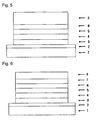
- An organic EL device was obtained by vapor-depositing, on a glass substrate 1 on which an ITO electrode had been formed as a transparent anode 2, a hole injection 3, a hole transport layer 4, an emitting layer 5, a hole blocking layer-cum-electron transport layer 6, and a cathode (aluminum electrode) 8 in this order as shown in Fig. 5 .
- the glass substrate 1 on which an ITO film having a film thickness of 150 nm had been formed was washed with an organic solvent and then subjected to washing of its surface by an oxygen plasma treatment.
- the glass substrate was placed in a vacuum vapor deposition machine, followed by pressure reduction to below 0.001 Pa.
- the thus-obtained organic EL device generated stable green luminescence and exhibited luminescence of 1,070 cd/m 2 at a driving voltage of 7.0 V and luminescence of 3,600 cd/m 2 at a driving voltage of 8.0 V.
- a ratio obtained by dividing the number of photons emitted from the organic EL device by the number of electrons injected into the organic EL device is called an external quantum efficiency.
- the external quantum efficiencies of this device at 10,000 cd/m 2 , 15,000 cd/m 2 , and 20,000 cd/m 2 were 1.05%, 1.03%, and 0.99%, respectively.
- a maximum luminance before breakpoint was evaluated by increasing the load of the current density by increasing the driving voltage. Since the maximum luminance measured by the method reflects electrical stability of the device, the maximum luminance serves as an index of the durability of the organic EL device.
- the device exhibited the maximum luminance of 27,000 cd/m 2 at 9.6 V, and then the luminance of luminescence was diminished to reach the breakpoint.
- an organic EL device was produced under the same conditions as in Example 6 except for using Alq as the material for a hole blocking layer-cum-electron transport layer 6, and the characteristics thereof were examined. Specifically, about 60 nm of Alq was formed as the hole blocking layer-cum-electron transport layer 5 and 6 at a vapor deposition rate of 6 nm/min.
- the thus-obtained organic EL device exhibited luminescence of 490 cd/m 2 at a driving voltage of 7.0 V and luminescence of 1,680 cd/m 2 at a driving voltage of 8.0 V.
- External quantum efficiencies of the device at 10,000 cd/m 2 and 15,000 cd/m 2 were 0.92% and 0.59%, respectively.
- the device exhibited the maximum luminance of 15,200 cd/m 2 at 10.8 V, and then the luminance of luminescence was diminished to reach the breakpoint.
- the organic EL device obtained by using PhenOXDm (2) which is the compound of Example 1 having an oxadiazole ring structure bonded with an aromatic heterocycle has a stable luminescent efficiency as compared to the device obtained by using Alq which is an ordinary used electron transport material. Also, the luminance of luminescence of the device was about twice at the identical voltage, and that the maximum luminance before breakpoint of the device was also about twice. From the foregoing results, it is apparent that the organic EL device of this invention achieves good device efficiency, high electrical stability, and good durability as compared to the device using Alq.
- An organic EL device was produced under the same conditions as in Example 6 except for using 2QOXDm (14) which is the compound of Example 4 as the material for the hole blocking layer-cum-electron transport layer 6, and the characteristics thereof were examined. About 30 nm of 2QOXDm (14) was formed as the hole blocking layer-cum-electron transport layer 6 at a vapor deposition rate of 3 nm/min. The thus-obtained organic EL device exhibited green luminescence of 700 cd/m 2 at 7.0 V and green luminescence of 2,140 cd/m 2 at 8.0 V.
- 2QOXDm (14) is the compound of Example 4 as the material for the hole blocking layer-cum-electron transport layer 6, and the characteristics thereof were examined. About 30 nm of 2QOXDm (14) was formed as the hole blocking layer-cum-electron transport layer 6 at a vapor deposition rate of 3 nm/min.
- the thus-obtained organic EL device exhibited green luminescence
- An organic EL device was obtained by vapor-depositing, on a glass substrate 1 on which an ITO electrode had been formed as a transparent anode 2, a hole injection layer 3, a hole transport layer 4, an emitting layer 5, a hole blocking layer-cum-electron transport layer 6, an electron injection layer 7, and a cathode 8 in this order as shown in Fig. 6 .
- the glass substrate 1 on which an ITO film having a film thickness of 150 nm had been formed was washed with an organic solvent and then subjected to washing of its surface by an oxygen plasma treatment.
- the glass substrate was placed in a vacuum vapor deposition machine, followed by pressure reduction to below 0.001 Pa.
- the thus-obtained organic EL device exhibited luminescence of 710 cd/m 2 at a driving voltage of 7.0 V and green luminescence of 2,520 cd/m 2 at a driving voltage of 8.0 V.
- the organic EL device of this invention is excellent as compared to the device using Alq which is used as an ordinary electron transport material.
- the compound of this invention having an oxadiazole ring structure bonded with an aromatic heterocycle is excellent as a compound for organic EL devices since it enables easy electron transfer and is stable in its thin film state.
- By producing an organic EL device using the compound it is possible to increase luminance of luminescence comparing at the same driving voltage and to improve durability.
Landscapes
- Chemical & Material Sciences (AREA)
- Organic Chemistry (AREA)
- Engineering & Computer Science (AREA)
- Materials Engineering (AREA)
- Physics & Mathematics (AREA)
- Spectroscopy & Molecular Physics (AREA)
- Electroluminescent Light Sources (AREA)
- Plural Heterocyclic Compounds (AREA)
- Nitrogen Condensed Heterocyclic Rings (AREA)
- Heterocyclic Carbon Compounds Containing A Hetero Ring Having Nitrogen And Oxygen As The Only Ring Hetero Atoms (AREA)
Applications Claiming Priority (2)
| Application Number | Priority Date | Filing Date | Title |
|---|---|---|---|
| JP2005263687 | 2005-09-12 | ||
| PCT/JP2006/318082 WO2007032357A1 (ja) | 2005-09-12 | 2006-09-12 | 芳香族複素環が結合したオキサジアゾール環構造を有する化合物および有機エレクトロルミネッセンス素子 |
Publications (2)
| Publication Number | Publication Date |
|---|---|
| EP1932842A1 true EP1932842A1 (de) | 2008-06-18 |
| EP1932842A4 EP1932842A4 (de) | 2011-03-30 |
Family
ID=37864948
Family Applications (1)
| Application Number | Title | Priority Date | Filing Date |
|---|---|---|---|
| EP06797874A Withdrawn EP1932842A4 (de) | 2005-09-12 | 2006-09-12 | Verbindung mit einer an einen aromatischen heterocyclischen ring gebundenen oxadiazolringstruktur und organisches elektrolumineszentes gerät |
Country Status (7)
| Country | Link |
|---|---|
| US (1) | US8247087B2 (de) |
| EP (1) | EP1932842A4 (de) |
| JP (1) | JP5291340B2 (de) |
| KR (1) | KR101327047B1 (de) |
| CN (1) | CN101263137A (de) |
| TW (1) | TW200720263A (de) |
| WO (1) | WO2007032357A1 (de) |
Cited By (6)
| Publication number | Priority date | Publication date | Assignee | Title |
|---|---|---|---|---|
| EP2161272A1 (de) * | 2008-09-05 | 2010-03-10 | Basf Se | Phenanthroline |
| EP2194055A1 (de) * | 2008-12-03 | 2010-06-09 | Novaled AG | Verbrückte Pyridochinazolin- oder Phenathronlin-Verbindungen und organisches Halbleitermaterial mit dieser Verbindung |
| US8277957B2 (en) | 2009-08-28 | 2012-10-02 | Industrial Technology Research Institute | Quinoxaline derivatives and organic light-emitting diodes comprising the same |
| US8486544B2 (en) | 2009-08-28 | 2013-07-16 | Industrial Technology Research Institute | Quinoxaline derivatives and organic light-emitting diodes comprising the same |
| CN112125924A (zh) * | 2020-09-15 | 2020-12-25 | 吉林大学 | 一种螺旋寡聚物、仿生离子通道、制备方法、应用 |
| US11569466B2 (en) | 2016-07-28 | 2023-01-31 | Semiconductor Energy Laboratory Co., Ltd. | Light-emitting element, light-emitting device, electronic device, and lighting device |
Family Cites Families (17)
| Publication number | Priority date | Publication date | Assignee | Title |
|---|---|---|---|---|
| FR1473521A (fr) | 1966-03-23 | 1967-03-17 | Daimler Benz Ag | Voiture automobile avec dispositifs pour la mesure de rayons radio-actifs |
| GB1222970A (en) * | 1967-08-15 | 1971-02-17 | Ici Ltd | New oxadiazole compounds |
| DE2509514A1 (de) | 1975-03-05 | 1976-09-16 | Hoechst Ag | Neue benzofuran-derivate, verfahren zu deren herstellung und verwendung als optische aufheller |
| JPH03194657A (ja) | 1989-12-22 | 1991-08-26 | Mitsubishi Electric Corp | 図形処理装置 |
| JPH05255664A (ja) * | 1992-03-12 | 1993-10-05 | Fuji Electric Co Ltd | 有機薄膜発光素子 |
| US5378519A (en) * | 1992-04-28 | 1995-01-03 | Canon Kabushiki Kaisha | Electroluminescent device |
| JP3482446B2 (ja) * | 1993-10-12 | 2003-12-22 | 株式会社リコー | 電界発光素子 |
| JP3194657B2 (ja) | 1993-11-01 | 2001-07-30 | 松下電器産業株式会社 | 電界発光素子 |
| JP3828595B2 (ja) | 1994-02-08 | 2006-10-04 | Tdk株式会社 | 有機el素子 |
| JP3518816B2 (ja) * | 1994-06-16 | 2004-04-12 | 株式会社リコー | オキサジアゾール化合物およびその製造方法 |
| JP3537869B2 (ja) * | 1994-06-16 | 2004-06-14 | 株式会社リコー | オキサジアゾール化合物およびその製造方法 |
| JPH08176148A (ja) * | 1994-12-27 | 1996-07-09 | Chisso Corp | ヘテロ環を有するオキサジアゾール誘導体 |
| JP3412076B2 (ja) * | 1995-03-08 | 2003-06-03 | 株式会社リコー | 有機el素子 |
| WO2002043449A1 (en) * | 2000-11-24 | 2002-05-30 | Toray Industries, Inc. | Luminescent element material and luminescent element comprising the same |
| EP1607392A1 (de) | 2003-03-17 | 2005-12-21 | Hirose Engineering Co., Ltd. | Blaulicht emittierende verbindung, verfahren zu deren herstellung und licht emittierende vorrichtung, bei der diese verwendet wird |
| US20050146263A1 (en) * | 2003-09-25 | 2005-07-07 | Kelly Stephen M. | Lighting elements, devices and methods |
| CN1938297B (zh) | 2004-03-25 | 2011-09-14 | 保土谷化学工业株式会社 | 具有取代有吡啶基的噁二唑环结构的化合物和有机电致发光装置 |
-
2006
- 2006-09-12 TW TW095133694A patent/TW200720263A/zh unknown
- 2006-09-12 JP JP2007535490A patent/JP5291340B2/ja not_active Expired - Fee Related
- 2006-09-12 KR KR1020087006051A patent/KR101327047B1/ko not_active Expired - Fee Related
- 2006-09-12 WO PCT/JP2006/318082 patent/WO2007032357A1/ja not_active Ceased
- 2006-09-12 EP EP06797874A patent/EP1932842A4/de not_active Withdrawn
- 2006-09-12 CN CNA2006800332922A patent/CN101263137A/zh active Pending
- 2006-09-12 US US12/066,508 patent/US8247087B2/en not_active Expired - Fee Related
Non-Patent Citations (3)
| Title |
|---|
| JÜRGEN SAUER ET AL: '3,6-Bis(2H-tetrazol-5-yl)-1,2,4,5-tetrazin e: A Versatile Bifunctional Building Block for the Synthesis of Linear Oligoheterocycles' EUROPEAN JOURNAL OF ORGANIC CHEMISTRY 22 January 2001, pages 697 - 706, XP055021334 DOI: 10.1002/1099-0690(200102)2001:4<697::AID-EJ OC697>3.0.CO;2-N * |
| No further relevant documents disclosed * |
| See also references of WO2007032357A1 * |
Cited By (9)
| Publication number | Priority date | Publication date | Assignee | Title |
|---|---|---|---|---|
| EP2161272A1 (de) * | 2008-09-05 | 2010-03-10 | Basf Se | Phenanthroline |
| EP2194055A1 (de) * | 2008-12-03 | 2010-06-09 | Novaled AG | Verbrückte Pyridochinazolin- oder Phenathronlin-Verbindungen und organisches Halbleitermaterial mit dieser Verbindung |
| WO2010063461A1 (en) * | 2008-12-03 | 2010-06-10 | Novaled Ag | Bridged pyridoquinazoline or phenanthroline compounds and organic semiconduting material comprising that compound |
| US8475686B2 (en) | 2008-12-03 | 2013-07-02 | Novaled Ag | Bridged pyridoquinazoline or phenanthroline compounds and organic semiconducting material comprising that compound |
| US8277957B2 (en) | 2009-08-28 | 2012-10-02 | Industrial Technology Research Institute | Quinoxaline derivatives and organic light-emitting diodes comprising the same |
| US8486544B2 (en) | 2009-08-28 | 2013-07-16 | Industrial Technology Research Institute | Quinoxaline derivatives and organic light-emitting diodes comprising the same |
| US11569466B2 (en) | 2016-07-28 | 2023-01-31 | Semiconductor Energy Laboratory Co., Ltd. | Light-emitting element, light-emitting device, electronic device, and lighting device |
| US12588408B2 (en) | 2016-07-28 | 2026-03-24 | Semiconductor Energy Laboratory Co., Ltd. | Light-emitting element, light-emitting device, electronic device, and lighting device |
| CN112125924A (zh) * | 2020-09-15 | 2020-12-25 | 吉林大学 | 一种螺旋寡聚物、仿生离子通道、制备方法、应用 |
Also Published As
| Publication number | Publication date |
|---|---|
| WO2007032357A1 (ja) | 2007-03-22 |
| JPWO2007032357A1 (ja) | 2009-03-19 |
| JP5291340B2 (ja) | 2013-09-18 |
| US8247087B2 (en) | 2012-08-21 |
| KR20080044283A (ko) | 2008-05-20 |
| KR101327047B1 (ko) | 2013-11-07 |
| TW200720263A (en) | 2007-06-01 |
| US20090230849A1 (en) | 2009-09-17 |
| CN101263137A (zh) | 2008-09-10 |
| EP1932842A4 (de) | 2011-03-30 |
Similar Documents
| Publication | Publication Date | Title |
|---|---|---|
| US7977671B2 (en) | Compound having oxadiazole ring structure substituted with pyridyl group and organic electroluminescence device | |
| KR101411135B1 (ko) | 치환된 피리딜기가 연결된 피리도인돌환 구조를 갖는 화합물 및 유기 전계발광 소자 | |
| EP2540707A1 (de) | Substituierte pyridylverbindung und organisches elektrolumineszentes element | |
| KR101747976B1 (ko) | 벤조트리아졸환 구조를 갖는 화합물 및 유기 전계발광 소자 | |
| KR101786129B1 (ko) | 치환된 안트라센환 구조와 피리도인돌환 구조를 갖는 화합물 및 유기 전계 발광소자 | |
| KR101567112B1 (ko) | 치환된 피리딜기와 피리도인돌환 구조가 페닐렌기를 개재시켜 연결된 화합물 및 유기 전계 발광 소자 | |
| US20130285025A1 (en) | Compound having triazole ring structure substituted with pyridyl group and organic electroluminescent device | |
| KR20100014416A (ko) | 치환된 비피리딜기와 피리도인돌환 구조가 페닐렌기를 통해 연결된 화합물 및 유기 전계발광 소자 | |
| KR20100115763A (ko) | 치환된 피리딜기가 연결된 피리도인돌환 구조를 갖는 화합물 및 유기 전계 발광 소자 | |
| JPWO2010084729A1 (ja) | ピリジル基が連結したトリアゾール環構造を有する化合物および有機エレクトロルミネッセンス素子 | |
| US8247087B2 (en) | Compound having oxadiazole ring structure bonded with aromatic heterocyclic ring and organic electroluminescent device | |
| KR101327062B1 (ko) | 피리딜기로 치환된 티아디아졸환 구조를 갖는 화합물 및 유기 전계 발광 소자 | |
| KR102931947B1 (ko) | 벤조트리아졸 고리 구조를 갖는 화합물 및 유기 일렉트로 루미네선스 소자 | |
| JP4879734B2 (ja) | ピリジル基で置換されたオキサジアゾール環構造を有する化合物および有機エレクトロルミネッセンス素子 |
Legal Events
| Date | Code | Title | Description |
|---|---|---|---|
| PUAI | Public reference made under article 153(3) epc to a published international application that has entered the european phase |
Free format text: ORIGINAL CODE: 0009012 |
|
| 17P | Request for examination filed |
Effective date: 20080311 |
|
| AK | Designated contracting states |
Kind code of ref document: A1 Designated state(s): DE FR GB |
|
| RBV | Designated contracting states (corrected) |
Designated state(s): DE FR GB |
|
| RIN1 | Information on inventor provided before grant (corrected) |
Inventor name: YOKOYAMA, NORIMASA Inventor name: ICHIKAWA, MUSUBU Inventor name: HAYASHI, SHUICHI Inventor name: TANIGUCHI, YOSHIO Inventor name: MIKI, TETSUZO Inventor name: KUSANO, SHIGERU |
|
| A4 | Supplementary search report drawn up and despatched |
Effective date: 20110302 |
|
| 17Q | First examination report despatched |
Effective date: 20120323 |
|
| DAX | Request for extension of the european patent (deleted) | ||
| STAA | Information on the status of an ep patent application or granted ep patent |
Free format text: STATUS: THE APPLICATION IS DEEMED TO BE WITHDRAWN |
|
| 18D | Application deemed to be withdrawn |
Effective date: 20140304 |