EP1932944B1 - Boite metallique en aluminium sans soudure enduite de resine et couvercle en alliage d'aluminium enduit de resine - Google Patents
Boite metallique en aluminium sans soudure enduite de resine et couvercle en alliage d'aluminium enduit de resine Download PDFInfo
- Publication number
- EP1932944B1 EP1932944B1 EP06783210.5A EP06783210A EP1932944B1 EP 1932944 B1 EP1932944 B1 EP 1932944B1 EP 06783210 A EP06783210 A EP 06783210A EP 1932944 B1 EP1932944 B1 EP 1932944B1
- Authority
- EP
- European Patent Office
- Prior art keywords
- aluminum alloy
- resin
- organic
- weight
- compound
- Prior art date
- Legal status (The legal status is an assumption and is not a legal conclusion. Google has not performed a legal analysis and makes no representation as to the accuracy of the status listed.)
- Ceased
Links
Images

Classifications
-
- C—CHEMISTRY; METALLURGY
- C09—DYES; PAINTS; POLISHES; NATURAL RESINS; ADHESIVES; COMPOSITIONS NOT OTHERWISE PROVIDED FOR; APPLICATIONS OF MATERIALS NOT OTHERWISE PROVIDED FOR
- C09D—COATING COMPOSITIONS, e.g. PAINTS, VARNISHES OR LACQUERS; FILLING PASTES; CHEMICAL PAINT OR INK REMOVERS; INKS; CORRECTING FLUIDS; WOODSTAINS; PASTES OR SOLIDS FOR COLOURING OR PRINTING; USE OF MATERIALS THEREFOR
- C09D5/00—Coating compositions, e.g. paints, varnishes or lacquers, characterised by their physical nature or the effects produced; Filling pastes
- C09D5/08—Anti-corrosive paints
-
- C—CHEMISTRY; METALLURGY
- C23—COATING METALLIC MATERIAL; COATING MATERIAL WITH METALLIC MATERIAL; CHEMICAL SURFACE TREATMENT; DIFFUSION TREATMENT OF METALLIC MATERIAL; COATING BY VACUUM EVAPORATION, BY SPUTTERING, BY ION IMPLANTATION OR BY CHEMICAL VAPOUR DEPOSITION, IN GENERAL; INHIBITING CORROSION OF METALLIC MATERIAL OR INCRUSTATION IN GENERAL
- C23C—COATING METALLIC MATERIAL; COATING MATERIAL WITH METALLIC MATERIAL; SURFACE TREATMENT OF METALLIC MATERIAL BY DIFFUSION INTO THE SURFACE, BY CHEMICAL CONVERSION OR SUBSTITUTION; COATING BY VACUUM EVAPORATION, BY SPUTTERING, BY ION IMPLANTATION OR BY CHEMICAL VAPOUR DEPOSITION, IN GENERAL
- C23C22/00—Chemical surface treatment of metallic material by reaction of the surface with a reactive liquid, leaving reaction products of surface material in the coating, e.g. conversion coatings, passivation of metals
- C23C22/05—Chemical surface treatment of metallic material by reaction of the surface with a reactive liquid, leaving reaction products of surface material in the coating, e.g. conversion coatings, passivation of metals using aqueous solutions
- C23C22/06—Chemical surface treatment of metallic material by reaction of the surface with a reactive liquid, leaving reaction products of surface material in the coating, e.g. conversion coatings, passivation of metals using aqueous solutions using aqueous acidic solutions with pH less than 6
- C23C22/07—Chemical surface treatment of metallic material by reaction of the surface with a reactive liquid, leaving reaction products of surface material in the coating, e.g. conversion coatings, passivation of metals using aqueous solutions using aqueous acidic solutions with pH less than 6 containing phosphates
-
- B—PERFORMING OPERATIONS; TRANSPORTING
- B32—LAYERED PRODUCTS
- B32B—LAYERED PRODUCTS, i.e. PRODUCTS BUILT-UP OF STRATA OF FLAT OR NON-FLAT, e.g. CELLULAR OR HONEYCOMB, FORM
- B32B1/00—Layered products having a non-planar shape
-
- B—PERFORMING OPERATIONS; TRANSPORTING
- B32—LAYERED PRODUCTS
- B32B—LAYERED PRODUCTS, i.e. PRODUCTS BUILT-UP OF STRATA OF FLAT OR NON-FLAT, e.g. CELLULAR OR HONEYCOMB, FORM
- B32B15/00—Layered products comprising a layer of metal
- B32B15/04—Layered products comprising a layer of metal comprising metal as the main or only constituent of a layer, which is next to another layer of the same or of a different material
- B32B15/08—Layered products comprising a layer of metal comprising metal as the main or only constituent of a layer, which is next to another layer of the same or of a different material of synthetic resin
-
- B—PERFORMING OPERATIONS; TRANSPORTING
- B32—LAYERED PRODUCTS
- B32B—LAYERED PRODUCTS, i.e. PRODUCTS BUILT-UP OF STRATA OF FLAT OR NON-FLAT, e.g. CELLULAR OR HONEYCOMB, FORM
- B32B15/00—Layered products comprising a layer of metal
- B32B15/20—Layered products comprising a layer of metal comprising aluminium or copper
-
- B—PERFORMING OPERATIONS; TRANSPORTING
- B32—LAYERED PRODUCTS
- B32B—LAYERED PRODUCTS, i.e. PRODUCTS BUILT-UP OF STRATA OF FLAT OR NON-FLAT, e.g. CELLULAR OR HONEYCOMB, FORM
- B32B27/00—Layered products comprising a layer of synthetic resin
- B32B27/06—Layered products comprising a layer of synthetic resin as the main or only constituent of a layer, which is next to another layer of the same or of a different material
-
- B—PERFORMING OPERATIONS; TRANSPORTING
- B32—LAYERED PRODUCTS
- B32B—LAYERED PRODUCTS, i.e. PRODUCTS BUILT-UP OF STRATA OF FLAT OR NON-FLAT, e.g. CELLULAR OR HONEYCOMB, FORM
- B32B27/00—Layered products comprising a layer of synthetic resin
- B32B27/36—Layered products comprising a layer of synthetic resin comprising polyesters
-
- B—PERFORMING OPERATIONS; TRANSPORTING
- B32—LAYERED PRODUCTS
- B32B—LAYERED PRODUCTS, i.e. PRODUCTS BUILT-UP OF STRATA OF FLAT OR NON-FLAT, e.g. CELLULAR OR HONEYCOMB, FORM
- B32B7/00—Layered products characterised by the relation between layers; Layered products characterised by the relative orientation of features between layers, or by the relative values of a measurable parameter between layers, i.e. products comprising layers having different physical, chemical or physicochemical properties; Layered products characterised by the interconnection of layers
- B32B7/04—Interconnection of layers
- B32B7/12—Interconnection of layers using interposed adhesives or interposed materials with bonding properties
-
- C—CHEMISTRY; METALLURGY
- C09—DYES; PAINTS; POLISHES; NATURAL RESINS; ADHESIVES; COMPOSITIONS NOT OTHERWISE PROVIDED FOR; APPLICATIONS OF MATERIALS NOT OTHERWISE PROVIDED FOR
- C09D—COATING COMPOSITIONS, e.g. PAINTS, VARNISHES OR LACQUERS; FILLING PASTES; CHEMICAL PAINT OR INK REMOVERS; INKS; CORRECTING FLUIDS; WOODSTAINS; PASTES OR SOLIDS FOR COLOURING OR PRINTING; USE OF MATERIALS THEREFOR
- C09D161/00—Coating compositions based on condensation polymers of aldehydes or ketones; Coating compositions based on derivatives of such polymers
- C09D161/04—Condensation polymers of aldehydes or ketones with phenols only
- C09D161/06—Condensation polymers of aldehydes or ketones with phenols only of aldehydes with phenols
-
- C—CHEMISTRY; METALLURGY
- C09—DYES; PAINTS; POLISHES; NATURAL RESINS; ADHESIVES; COMPOSITIONS NOT OTHERWISE PROVIDED FOR; APPLICATIONS OF MATERIALS NOT OTHERWISE PROVIDED FOR
- C09D—COATING COMPOSITIONS, e.g. PAINTS, VARNISHES OR LACQUERS; FILLING PASTES; CHEMICAL PAINT OR INK REMOVERS; INKS; CORRECTING FLUIDS; WOODSTAINS; PASTES OR SOLIDS FOR COLOURING OR PRINTING; USE OF MATERIALS THEREFOR
- C09D5/00—Coating compositions, e.g. paints, varnishes or lacquers, characterised by their physical nature or the effects produced; Filling pastes
- C09D5/08—Anti-corrosive paints
- C09D5/082—Anti-corrosive paints characterised by the anti-corrosive pigment
- C09D5/084—Inorganic compounds
-
- C—CHEMISTRY; METALLURGY
- C22—METALLURGY; FERROUS OR NON-FERROUS ALLOYS; TREATMENT OF ALLOYS OR NON-FERROUS METALS
- C22C—ALLOYS
- C22C21/00—Alloys based on aluminium
-
- C—CHEMISTRY; METALLURGY
- C22—METALLURGY; FERROUS OR NON-FERROUS ALLOYS; TREATMENT OF ALLOYS OR NON-FERROUS METALS
- C22C—ALLOYS
- C22C21/00—Alloys based on aluminium
- C22C21/06—Alloys based on aluminium with magnesium as the next major constituent
-
- C—CHEMISTRY; METALLURGY
- C23—COATING METALLIC MATERIAL; COATING MATERIAL WITH METALLIC MATERIAL; CHEMICAL SURFACE TREATMENT; DIFFUSION TREATMENT OF METALLIC MATERIAL; COATING BY VACUUM EVAPORATION, BY SPUTTERING, BY ION IMPLANTATION OR BY CHEMICAL VAPOUR DEPOSITION, IN GENERAL; INHIBITING CORROSION OF METALLIC MATERIAL OR INCRUSTATION IN GENERAL
- C23C—COATING METALLIC MATERIAL; COATING MATERIAL WITH METALLIC MATERIAL; SURFACE TREATMENT OF METALLIC MATERIAL BY DIFFUSION INTO THE SURFACE, BY CHEMICAL CONVERSION OR SUBSTITUTION; COATING BY VACUUM EVAPORATION, BY SPUTTERING, BY ION IMPLANTATION OR BY CHEMICAL VAPOUR DEPOSITION, IN GENERAL
- C23C22/00—Chemical surface treatment of metallic material by reaction of the surface with a reactive liquid, leaving reaction products of surface material in the coating, e.g. conversion coatings, passivation of metals
- C23C22/05—Chemical surface treatment of metallic material by reaction of the surface with a reactive liquid, leaving reaction products of surface material in the coating, e.g. conversion coatings, passivation of metals using aqueous solutions
- C23C22/06—Chemical surface treatment of metallic material by reaction of the surface with a reactive liquid, leaving reaction products of surface material in the coating, e.g. conversion coatings, passivation of metals using aqueous solutions using aqueous acidic solutions with pH less than 6
- C23C22/34—Chemical surface treatment of metallic material by reaction of the surface with a reactive liquid, leaving reaction products of surface material in the coating, e.g. conversion coatings, passivation of metals using aqueous solutions using aqueous acidic solutions with pH less than 6 containing fluorides or complex fluorides
- C23C22/36—Chemical surface treatment of metallic material by reaction of the surface with a reactive liquid, leaving reaction products of surface material in the coating, e.g. conversion coatings, passivation of metals using aqueous solutions using aqueous acidic solutions with pH less than 6 containing fluorides or complex fluorides containing also phosphates
- C23C22/361—Chemical surface treatment of metallic material by reaction of the surface with a reactive liquid, leaving reaction products of surface material in the coating, e.g. conversion coatings, passivation of metals using aqueous solutions using aqueous acidic solutions with pH less than 6 containing fluorides or complex fluorides containing also phosphates containing titanium, zirconium or hafnium compounds
-
- B—PERFORMING OPERATIONS; TRANSPORTING
- B05—SPRAYING OR ATOMISING IN GENERAL; APPLYING FLUENT MATERIALS TO SURFACES, IN GENERAL
- B05D—PROCESSES FOR APPLYING FLUENT MATERIALS TO SURFACES, IN GENERAL
- B05D2202/00—Metallic substrate
- B05D2202/20—Metallic substrate based on light metals
- B05D2202/25—Metallic substrate based on light metals based on Al
-
- B—PERFORMING OPERATIONS; TRANSPORTING
- B05—SPRAYING OR ATOMISING IN GENERAL; APPLYING FLUENT MATERIALS TO SURFACES, IN GENERAL
- B05D—PROCESSES FOR APPLYING FLUENT MATERIALS TO SURFACES, IN GENERAL
- B05D7/00—Processes, other than flocking, specially adapted for applying liquids or other fluent materials to particular surfaces or for applying particular liquids or other fluent materials
- B05D7/50—Multilayers
- B05D7/51—One specific pretreatment, e.g. phosphatation, chromatation, in combination with one specific coating
-
- Y—GENERAL TAGGING OF NEW TECHNOLOGICAL DEVELOPMENTS; GENERAL TAGGING OF CROSS-SECTIONAL TECHNOLOGIES SPANNING OVER SEVERAL SECTIONS OF THE IPC; TECHNICAL SUBJECTS COVERED BY FORMER USPC CROSS-REFERENCE ART COLLECTIONS [XRACs] AND DIGESTS
- Y10—TECHNICAL SUBJECTS COVERED BY FORMER USPC
- Y10T—TECHNICAL SUBJECTS COVERED BY FORMER US CLASSIFICATION
- Y10T428/00—Stock material or miscellaneous articles
- Y10T428/13—Hollow or container type article [e.g., tube, vase, etc.]
- Y10T428/1352—Polymer or resin containing [i.e., natural or synthetic]
-
- Y—GENERAL TAGGING OF NEW TECHNOLOGICAL DEVELOPMENTS; GENERAL TAGGING OF CROSS-SECTIONAL TECHNOLOGIES SPANNING OVER SEVERAL SECTIONS OF THE IPC; TECHNICAL SUBJECTS COVERED BY FORMER USPC CROSS-REFERENCE ART COLLECTIONS [XRACs] AND DIGESTS
- Y10—TECHNICAL SUBJECTS COVERED BY FORMER USPC
- Y10T—TECHNICAL SUBJECTS COVERED BY FORMER US CLASSIFICATION
- Y10T428/00—Stock material or miscellaneous articles
- Y10T428/13—Hollow or container type article [e.g., tube, vase, etc.]
- Y10T428/1352—Polymer or resin containing [i.e., natural or synthetic]
- Y10T428/1355—Elemental metal containing [e.g., substrate, foil, film, coating, etc.]
- Y10T428/1359—Three or more layers [continuous layer]
-
- Y—GENERAL TAGGING OF NEW TECHNOLOGICAL DEVELOPMENTS; GENERAL TAGGING OF CROSS-SECTIONAL TECHNOLOGIES SPANNING OVER SEVERAL SECTIONS OF THE IPC; TECHNICAL SUBJECTS COVERED BY FORMER USPC CROSS-REFERENCE ART COLLECTIONS [XRACs] AND DIGESTS
- Y10—TECHNICAL SUBJECTS COVERED BY FORMER USPC
- Y10T—TECHNICAL SUBJECTS COVERED BY FORMER US CLASSIFICATION
- Y10T428/00—Stock material or miscellaneous articles
- Y10T428/13—Hollow or container type article [e.g., tube, vase, etc.]
- Y10T428/1352—Polymer or resin containing [i.e., natural or synthetic]
- Y10T428/1386—Natural or synthetic rubber or rubber-like compound containing
-
- Y—GENERAL TAGGING OF NEW TECHNOLOGICAL DEVELOPMENTS; GENERAL TAGGING OF CROSS-SECTIONAL TECHNOLOGIES SPANNING OVER SEVERAL SECTIONS OF THE IPC; TECHNICAL SUBJECTS COVERED BY FORMER USPC CROSS-REFERENCE ART COLLECTIONS [XRACs] AND DIGESTS
- Y10—TECHNICAL SUBJECTS COVERED BY FORMER USPC
- Y10T—TECHNICAL SUBJECTS COVERED BY FORMER US CLASSIFICATION
- Y10T428/00—Stock material or miscellaneous articles
- Y10T428/31504—Composite [nonstructural laminate]
-
- Y—GENERAL TAGGING OF NEW TECHNOLOGICAL DEVELOPMENTS; GENERAL TAGGING OF CROSS-SECTIONAL TECHNOLOGIES SPANNING OVER SEVERAL SECTIONS OF THE IPC; TECHNICAL SUBJECTS COVERED BY FORMER USPC CROSS-REFERENCE ART COLLECTIONS [XRACs] AND DIGESTS
- Y10—TECHNICAL SUBJECTS COVERED BY FORMER USPC
- Y10T—TECHNICAL SUBJECTS COVERED BY FORMER US CLASSIFICATION
- Y10T428/00—Stock material or miscellaneous articles
- Y10T428/31504—Composite [nonstructural laminate]
- Y10T428/31678—Of metal
- Y10T428/31681—Next to polyester, polyamide or polyimide [e.g., alkyd, glue, or nylon, etc.]
-
- Y—GENERAL TAGGING OF NEW TECHNOLOGICAL DEVELOPMENTS; GENERAL TAGGING OF CROSS-SECTIONAL TECHNOLOGIES SPANNING OVER SEVERAL SECTIONS OF THE IPC; TECHNICAL SUBJECTS COVERED BY FORMER USPC CROSS-REFERENCE ART COLLECTIONS [XRACs] AND DIGESTS
- Y10—TECHNICAL SUBJECTS COVERED BY FORMER USPC
- Y10T—TECHNICAL SUBJECTS COVERED BY FORMER US CLASSIFICATION
- Y10T428/00—Stock material or miscellaneous articles
- Y10T428/31504—Composite [nonstructural laminate]
- Y10T428/31678—Of metal
- Y10T428/31692—Next to addition polymer from unsaturated monomers
Definitions
- the present invention relates to a resin coated seamless aluminum can and a resin coated aluminum alloy can lid having corrosion resistance and adhesiveness which are manufactured by forming an organic-inorganic composite resin coated layer on at least one-side surface of an aluminum alloy sheet and by further forming a resin coated layer on the organic-inorganic composite resin coated layer.
- an aluminum sheet or an aluminum alloy sheet is used.
- aluminum exhibits excellent formability and excellent flavor keeping property as a can body material and can lid material
- aluminum has a drawback that aluminum exhibits less corrosion resistance compared to a surface-treated steel material.
- a chromium-phosphate-based surface treatment agent has been used for applying surface treatment to the aluminum sheet.
- a chemical conversion coating formed on the aluminum sheet by the chromium-phosphate-based surface treatment agent exhibits the excellent corrosion resistance peculiar to the film and also exhibits excellent corrosion resistance and adhesiveness after coating various resin-based coating materials. Accordingly, the aluminum sheet coated with the chemical conversion coating has been used in broad application fields of aluminum material such as an architectural material, a household electrical appliance, a fin material, a car evaporator or a beverage can material.
- the non-chromium surface treatment agent used for forming the beverage can body for example, the non-chromium surface treatment agent of a system which uses zirconium or titanium compound and phosphate compound.
- the chemical conversion coating formed of these systems exhibits less corrosion resistance and adhesiveness after coating compared to the film formed using the chromium-phosphate-based surface treatment agent and hence, the chemical conversion coating is not used in broad applications.
- JP-A-10-46101 discloses aluminum-use surface treatment agent containing a phosphate-based compound and/or an organosilicon compound and organic compound polymer.
- the surface treatment agent used in such a technique leads to insufficient adhesiveness between a metallic material and a coating material and insufficient corrosion resistance of a coating material.
- JP-A-2000-6967 discloses a polyester resin coated aluminum seamless can having a composite formed coated film made of phosphoric acid or zirconium phosphate and an organic resin.
- JP-A-2000-6967 discloses a polyester resin coated aluminum seamless can having a composite formed coated film made of phosphoric acid or zirconium phosphate and an organic resin.
- an aluminum alloy sheet material on which a thermoplastic resin layer is formed is formed by molding by applying strict forming such as deep drawing or drawing and ironing after the formation of the composite formed coated film, the formed can cannot acquire satisfying corrosion resistance and satisfying adhesiveness with a thermoplastic resin layer.
- JP-B-56-33468 discloses an aluminum-use surface treatment agent containing zirconium and/or titanium, phosphate and a fluoric material.
- the surface treatment agent used in such a technique leads to insufficient adhesiveness between a metallic material and a coating material and insufficient corrosion resistance of a coating material.
- JP-B-63-30218 discloses a non-chromium-based surface treatment agent containing water-soluble titanium and/or a zirconium compound, tannin and/or water-soluble or water-dispersing polymer.
- a non-chromium-based surface treatment agent leads to insufficient corrosion resistance of a coating material.
- JP-A-2002-275648 discloses a metal surface treatment agent containing a water-soluble zirconium compound, a water-soluble or water-dispersing acrylic resin, and a water-soluble or water-dispersing thermosetting cross-linking material.
- JP-A-2003-239079 discloses a metal-surface chemical conversion treatment agent containing zirconium ion and an organic phosphoric acid compound, and pH of the water solution is set to equal to or larger than 1.8 and equal to or smaller than 4.0.
- a formed can formed by using either one of these surface treatment agents cannot acquire sufficient corrosion resistance and sufficient adhesiveness.
- WO 2004/053183 A2 discloses a non-chrome pretreatment for can-end stock aluminium. Said treatment uses a composition comprising a fluoroacid (e.g. H2ZrF6), a water soluble organic carboxylic acid, a source of phosphate ions, an organic component such as an amino-phenolic polymer, and optionally metal-containing component, said metal including Zr.
- a fluoroacid e.g. H2ZrF6
- the present invention has been made to overcome these drawbacks which these prior arts possess.
- a resin coated seamless aluminum can described in claim 1 is characterized in that an organic-inorganic composite surface treatment layer made of a zirconium compound, a phosphorus compound and an organic compound is formed on at least one-side surface of an aluminum alloy sheet, wherein an adhesion quantity of the zirconium compound is 2 to 20 mg/m 2 expressed in terms of zirconium atoms, an adhesion quantity of the phosphorus compound is 1 to 10 mg/m 2 expressed in terms of phosphorus atoms and an adhesion quantity of the organic compound is 5 to 60 mg/m 2 expressed in terms of carbon atoms, the organic compound is formed of an organic polymer having structure units expressed by the following formula (I), and an average molecular weight of the organic compound is 1,000 to 100,000 when all X are hydrogen atoms, and a thermoplastic resin layer is further formed on the organic-inorganic composite surface treatment layer.
- an adhesion quantity of the zirconium compound is 2 to 20 mg/m 2 expressed in terms of zirconium atoms
- X in respective structural units are independently constituted of a hydrogen atom or a Z group expressed by the following formula (II) and an introducing ratio of the Z group per one benzene ring is 0.3 to 1.0.
- R1 and R2 independently indicate a hydrogen atom, a C1 to C10 alkyl group or a C1 to C10 hydroxyalkyl group.
- a resin coated seamless aluminum can described in claim 2 is, in the resin coated seamless aluminum can of claim 1, characterized in that the aluminum alloy sheet is an aluminum alloy sheet containing 0.2 to 5.5% by weight of Mg, 0.05 to 1% by weight of Si, 0.05 to 1% by weight of Fe, 0.01 to 0.35% by weight of Cu, 0.01 to 2% by weight of Mn, and 0.01 to 0.4% by weight of Cr.
- the aluminum alloy sheet is an aluminum alloy sheet containing 0.2 to 5.5% by weight of Mg, 0.05 to 1% by weight of Si, 0.05 to 1% by weight of Fe, 0.01 to 0.35% by weight of Cu, 0.01 to 2% by weight of Mn, and 0.01 to 0.4% by weight of Cr.
- a resin coated seamless aluminum can described in claim 3 is, in the resin coated seamless aluminum can of claim 1 or 2, characterized in that the thermoplastic resin is a polyester-based resin.
- a resin coated seamless aluminum can described in claim 4 is, in the resin coated seamless aluminum can of any one of claims 1 to 3, characterized in that the aluminum can is formed by applying deep drawing or drawing and ironing to a resin coated aluminum alloy sheet, applying neck-in forming to the resin coated aluminum alloy sheet after heat setting, narrowing a mouth of a neck-in formed body to a predetermined diameter, and applying flange forming to the neck-in formed body.
- a resin coated aluminum alloy can lid formed of an aluminum alloy sheet described in claim 5 is characterized in that an organic-inorganic composite surface treatment layer including a zirconium compound, a phosphorus compound and an organic compound is formed on at least one-side surface of an aluminum alloy sheet, wherein a quantity of the zirconium compound is 2 to 20 mg/m 2 expressed in terms of zirconium atoms, a quantity of the phosphorus compound is 1 to 10 mg/m 2 expressed in terms of phosphorus atoms and a quantity of the organic compound is 5 to 60 mg/m 2 expressed in terms of carbon atoms, the organic compound is formed of an organic polymer having structure units expressed by the following formula (I), and an average molecular weight of the organic polymer is 1,000 to 100,000 when all X are hydrogen atoms, and an organic resin coated layer is further formed on the organic-inorganic composite surface treatment layer.
- an organic-inorganic composite surface treatment layer including a zirconium compound, a phosphorus compound and an organic compound is formed on at least
- X in respective structural units are independently constituted of a hydrogen atom or a Z group expressed by the following formula (II) and an introducing ratio of the Z group per one benzene ring is 0.3 to 1.0.
- R1 and R2 independently indicate a hydrogen atom, a C1 to C10 alkyl group or a C1 to C10 hydroxyalkyl group.
- a resin coated aluminum alloy can lid described in claim 6 is, in the resin coated aluminum alloy can lid of claim 5, characterized in that the aluminum alloy sheet is an aluminum alloy sheet containing 0.2 to 5.5% by weight of Mg, 0.05 to 1% by weight of Si, 0.05 to 1% by weight of Fe, 0.01 to 0.35% by weight of Cu, 0.01 to 2% by weight of Mn, and .0.01 to 0.4% by weight of Cr.
- a resin coated aluminum alloy can lid described in claim 7 is, in the resin coated aluminum alloy can lid of claim 5 or 6, characterized in that the organic resin coated layer formed on the surface treatment layer is a coated film.
- a resin coated aluminum alloy can lid described in claim 8 is, in the resin coated aluminum alloy can lid of claim 5 or 6, characterized in that the organic resin coated layer formed on the surface treatment layer is a thermoplastic resin.
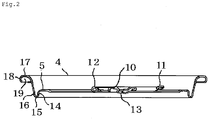
- Figs. 1 , 2 indicate following parts. 4: easy-to-open can lid, 5: center panel part, 6: reinforcing annular groove, 7: score, 8: trimming part to be opened, 9: tab tip for unsealing, 10: rivet
- a resin coated seamless aluminum can and a resin coated aluminum alloy can lid of the present invention is characterized in that an organic-inorganic composite surface treatment layer made of a zirconium compound, a phosphorus compound and an organic compound is formed on at least one-side surface of an aluminum alloy sheet, wherein an adhesion quantity of the zirconium compound is 2 to 20 mg/m 2 expressed in terms of zirconium atoms, an adhesion quantity of the phosphorus compound is 1 to 10 mg/m 2 expressed in terms of phosphorus atoms and an adhesion quantity of the organic compound is 5 to 60 mg/m 2 expressed in terms of carbon atoms, the organic compound is formed of an organic polymer having structure units expressed by the following formula (I), and an average molecular weight of the organic compound is 1,000 to 100,000 when all X are hydrogen atoms, and a thermoplastic resin layer (or an organic resin coated layer in case of the can lid) is further formed on the organic-inorganic composite surface treatment layer.
- an organic-inorganic composite surface treatment layer made
- X in respective structural units are independently constituted of a hydrogen atom or a Z group expressed by the following formula (II) and an introducing ratio of the Z group per one benzene ring is 0.3 to 1.0.
- R1 and R2 independently indicate a hydrogen atom, a C1 to C10 alkyl group or a C1 to C10 hydroxyalkyl group.
- the content of the present invention is explained in detail hereinafter.
- the aluminum alloy sheet is an aluminum alloy sheet containing 0.2 to 5.5% by weight of Mg, 0.05 to 1% by weight of Si, 0.05 to 1% by weight of Fe, 0.01 to 0.35% by weight of Cu, 0.01 to 2% by weight of Mn, and 0.01 to 0.4% by weight of Cr.
- the above-mentioned alloy composition is set due to following reasons.
- Mg is added to enhance strength of the aluminum alloy sheet.
- the reason that the content of Mg is limited to 0.2 to 5.5% by weight is that the desired strength cannot be obtained when the content of Mg is less than 0.2% by weight, and edge cracks are increased at the time of rolling when the content of Mg exceeds 5.5% by weight.
- Si and Fe are added to improve the formability.
- the reason that the content of Si is limited to 0.05 to 1% by weight and the content of Fe is limited to 0.05 to 1% by weight is as follows. That is, both components are unavoidably included as components of the aluminum alloy sheet. It is difficult in usual treatment to restrict the content of Si and the content of Fe to less than 0.05% by weight. Further, when the content of Si or Fe exceeds 1% by weight, macro crystals is liable to be easily generated and hence, the formability is deteriorated.
- Cu is added to improve the strength.
- the reason that the content of Cu is limited to 0.01 to 0.35% by weight is that the strength becomes poor when Cu is not added and cracks occur at the time of casting when the content of Cu exceeds an upper limit.
- Mn and Cr are added to improve strength and heat resistance. Mn and Cr are added also to enhance a limit drawing ratio and to form crystal particles into microstructure.
- the reason that the content of Mn is set to 0.01 to 2% by weight and the content of Cr is set to 0.01 to 0.4% by weight is that when the contents of Mn and Cr are less than lower limits, the above-mentioned advantageous effects are small, while when the contents of Mn and Cr exceeds upper limits, the limit drawing ratio is decreased thus giving rise to the occurrence of cracks in a can manufacturing step and a can lid manufacturing step.
- the aluminum alloy sheet having a thickness of 0.15 to 0.40mm in general, and a thickness of 0.20 to 0.30mm preferably.
- the can or the can lid cannot be easily formed and, at the same time, cannot acquire desired strength.
- the thickness of the aluminum alloy sheet exceeds 0.40mm, the manufacture of the can or the can lid is deteriorated economically.
- an aluminum sheet specifically, an aluminum sheet, an aluminum-copper alloy sheet, an aluminum-manganese alloy sheet, an aluminum-silicon alloy sheet, an aluminum-magnesium alloy sheet, an aluminum-magnesium-silicon alloy sheet, an aluminum-zinc alloy sheet, an aluminum-zinc-magnesium alloy sheet and the like can be named.
- an aluminum alloy material 5182, an aluminum alloy material 5021, an aluminum alloy material 5022, an aluminum alloy material 5052, an aluminum alloy material 3004, an aluminum alloy material 3005, an aluminum alloy material 3104, an aluminum alloy material 1100 or the like are preferably used.
- the shape of the aluminum material sheet is preferably formed into a shape which facilitates the lamination of a film.
- the aluminum material sheet may be formed into a plate shape, a sheet shape or a coil shape.
- the organic-inorganic composite surface treatment layer mainly aims at the acquisition of two advantageous effects, that is, imparting of corrosion resistance and imparting of adhesiveness with an aluminum material and a thermoplastic resin (coated film). It is preferable to use an organic polymer expressed by the following formula (I) in the formation of the organic-inorganic composite surface treatment layer.
- X in respective structural units are independently constituted of a hydrogen atom or a Z group expressed by the following formula (II) and an introducing ratio of the Z group per one benzene ring is 0.3 to 1.0.
- R1 and R2 shown in the formula (II) are independently constituted of a hydrogen atom, a C1 to C10 alkyl group or a C1 to C10 hydroxyalkyl group.
- the alkyl group or the hydroxyalkyl group of equal to or more than C11 has micro-porous portions and a dense film is not formed and hence, the corrosion resistance is deteriorated. Further, since the alkyl group portion is long, hydrophobicity is increased and hence, adhesiveness with the film is decreased.
- the introducing ratio of the Z group indicated by X per one benzene ring is preferably 0.3 to 1.0.
- the adhesiveness is insufficient.
- the introducing ratio of the Z group exceeds 1.0, the water solution becomes excessive and the formation of surface film becomes difficult.
- the introducing ratio of the Z group is calculated using a generally-used method and is not particularly limited.
- the organic compound may be completely burnt by CHNS-O elemental analysis and the generated gases (CO 2 , H 2 0, N 2 and SO 2 ) may be measured to perform determination of respective elements so as to calculate the introducing ratio of the Z group.
- the molecular weight of the organic polymer is preferably set to a value which falls within a range from 1,000 to 100,000 when all of the above-mentioned X are hydrogen atoms.
- the molecular weight of the organic polymer is less than 1,000, the heating product exhibits insufficient flexibility and, cohesive failure occurs in the inside of the organic-inorganic composite coated film and the adhesiveness becomes insufficient at the time of forming.
- the molecular weight of the organic polymer is more than 100,000, the organic polymer does not sufficiently act with the inorganic components which constitute the film and hence, the corrosion resistance becomes insufficient.
- the molecular weight of the organic polymer is more preferably set to a value which falls within a range from 1,000 to 10,000.
- organic polymer an organic polymer having one kind of average molecular weight may be used and, alternatively, a polymer having two or more kinds of average molecular weight may be used.
- the molecular weight can be measured using gel permeation chromatography after the coated film is peeled off.
- the adhesion quantity of the organic substance in the inside of the organic-inorganic composite coated film influences the corrosion resistance and the adhesion quantity of the organic-inorganic composite film.
- the adhesion quantity of the organic substance is preferably set to a value which falls within a range from 5 to 60 mg/m 2 expressed in terms of carbon atoms.
- the adhesion quantity of carbon is less than 5 mg/m 2 , carbon cannot sufficiently cover the surface of the aluminum alloy and hence, the organic-inorganic composite film cannot acquire sufficient adhesiveness and sufficient corrosion resistance.
- the above-mentioned adhesion quantity of carbon can be measured using commercially-available surface carbon analytical equipment.
- the surface carbon analytical equipment adopts a principle that a temperature of a sample is raised, carbon which exists on the surface of the sample is oxidized and gasified, and the gas is determined using IR (infrared absorption).
- the measurement condition may be any condition provided that the carbon on the surface of the sample can be oxidized and gasified. However, generally, it is preferable that the measurement is performed under a condition at a temperature of 400 to 500°C for 5 to 10 minutes.
- the polymer expressed by the formula (I) can be manufactured by an ordinary method.
- the polymer expressed by the formula (I) is manufactured by performing polycondensation on a phenolic compound or a naphthol compound with formaldehyde and, subsequently, by introducing a functional group X using formaldehyde and amine.
- Formalin is generally used as formaldehyde.
- the molecular weight of the polymer is not particularly limited, when all X are hydrogen atoms, it is suitable to set the molecular weight of the polymer to approximately 1,000 to 100,000 and, preferably to approximately 1,000 to 10,000.
- the organic-inorganic composite surface treatment layer (hereinafter referred to as "surface treatment film” in some cases) includes a zirconium compound.
- An adhesion quantity of the zirconium compound influences corrosion resistance and adhesiveness.
- the adhesion quantity of the zirconium compound is preferably set to a value which falls within a range from 2 to 20mg/m 2 expressed in terms of zirconium atoms.
- zirconium cannot sufficiently cover a surface of the aluminum alloy and hence, the organic-inorganic composite surface treatment layer exhibits insufficient corrosion resistance.
- the adhesion quantity of zirconium exceeds 20mg/m 2 , cohesive failure easily occurs in the inside of the surface treated film at the time of forming and hence, there arises a possibility that adhesiveness is deteriorated.
- zirconium compound used for the surface treatment film is not specifically limited provided that the compound contains zirconium.
- a water-soluble zirconium compound containing fluorine may preferably be used because of the stability in pH thereof and the excellent film formability thereof.
- water-soluble zirconium compound containing fluorine is not limited specifically, for example, H 2 ZrF 6 , (NH 4 ) 2 ZrF 6 , K 2 ZrF 6 , Na 2 ZrF 6 , Li 2 ZrF 6 or the like can be named. These compounds may be used in a single form or in combination of two or more kinds of the compounds.
- the organic-inorganic composite surface treatment layer (surface treatment film) includes a phosphorus compound.
- the adhesion quantity of the phosphorus compound is preferably set to a value which falls within a range from 1 to 10mg/m 2 expressed in terms of phosphorous atoms.
- the adhesion quantity of phosphorus is less than 1mg/m 2 , due to the same reason as described above with respect to the adhesion quantity of zirconium, the organic-inorganic composite surface treatment layer exhibits insufficient corrosion resistance.
- the adhesion quantity of phosphor exceeds 10mg/m 2 , there arises a possibility that the adhesiveness is deteriorated.
- the above-mentioned phosphorus compound in the surface treatment film is preferably a phosphoric-acid-based chemical compound from a viewpoint of enhancing the adhesiveness between the organic resin layer and a metal material.
- a phosphoric-acid-based chemical compound which can be used for the above-mentioned object, a phosphoric acid or a salt thereof, a condensed phosphoric acid or salt thereof, zirconium phosphate, titanium phosphate or the like can be named.
- the salt an alkali metal salt such as an ammonium salt, a sodium salt, a potassium salt or the like can be named.
- an organic silicon compound can be mixed for improving the adhesiveness.
- organic silicon compound vinyl ethoxy silane, ⁇ -aminopropyltriethoxysilane, N-( ⁇ -aminoethyl)- ⁇ -aminopropyltriethoxysilane, ⁇ -mercapto propyl trimethoxysilane, ⁇ -glycidoxypropyltrimethoxysilane, ⁇ -methacryloxypropyltrimethoxysilane or the like can be named.
- the adhesion quantity of the zirconium compound and the adhesion quantity of the phosphorus compound can be determined using a commercially-available X-ray fluorescence analyzer. That is, a plurality of samples whose adhesion quantities of zirconium and phosphorus are known differ from each other in adhesiveness are measured, and a calibration curve of strength-adhesion quantity is obtained based on measured strengths. Under the similar conditions, a sample is cut out from a coated metal material of the present invention and the strength of the sample is measured. By converting the measured strength into the adhesion quantity based on the calibration curve, the adhesion quantity of the zirconium compound and the adhesion quantity of the phosphorus compound can be measured.
- the film thickness is preferably set to a value which falls within a range from 15 to 300nm, and is more preferably set to a value which falls within a range from 50 to 300nm.
- the film thickness is less than 5nm, the organic-inorganic composite surface treatment layer cannot acquire excellent adhesiveness with a coated film or a lamination film.
- the film thickness exceeds 500nm, there exists a high possibility that a color tone of the metal material is deteriorated.
- the organic-inorganic composite surface treatment layer preferably covers 90% or more of a surface of the aluminum alloy material. When the coverage of the organic-inorganic composite surface treated layer is less than 90%, the film is easily peeled off at the time of processing.
- the film thickness and the coverage of the organic-inorganic composite surface treatment layer can be determined using commercially-available XPS (X-ray photoelectron spectroscopy analysis) equipment using an ordinary method.
- the XPS is a device which excites a sample using X rays in a ultra-high vacuum (10 -5 Pa or less) and analyzes photoelectrons emitted at the time of excitation.
- a ratio of atoms present on a surface of the organic-inorganic composite surface treated layer can be calculated using .an intensity of the photoelectrons and a sensitivity coefficient.
- the organic-inorganic composite surface treatment layer can be acquired by applying a film treatment using an organic-inorganic composite surface treatment liquid to an aluminum alloy sheet.
- the treatment liquid is prepared by dissolving polymer, a zirconium compound and a phosphorus compound into water which constitutes a solvent.
- a solvent a solvent for a treatment liquid.
- the treatment liquid contains water soluble polymer for forming a film made of an organic compound. Phosphate ion and complex fluoride of zirconium may preferably coexist with the water soluble polymer. Further, pH of the treatment liquid is preferably adjusted to a value which allows the water-soluble polymer, the phosphate and the complex fluoride to easily precipitate.
- the treatment is performed by bringing the treatment liquid into contact with the aluminum alloy sheet. During treatment, the aluminum surface is etched by the fluorine compound, and pH is increased on an interface between the treatment liquid and the aluminum surface. Accordingly, the water soluble polymer and phosphorus compound which coexist are deposited on the surface of the aluminum alloy sheet to form a film.
- the aluminum alloy sheet treated by the surface treatment is cleaned with water for removing unreacted products. Further, the aluminum sheet is cleaned with deionized water or the like and, thereafter, the aluminum sheet is dried thus acquitting the surface treated aluminum alloy sheet.
- the polymer concentration may preferably be set to a value which falls within a range from 100 to 10,000mg/L, and more preferably, a value which falls within a range from 300 to 3, 000mg/L.
- the polymer concentration is less than 100mg/L, a film is not formed sufficiently.
- the polymer concentration exceeds 10, 000mg/L, the manufacturing cost is pushed up.
- a content of the zirconium compound is, in terms of zirconium, set to a value which falls within a range from 100 to 10,000mg/L, and more preferably, a value which falls within a range from 300 to 1,000mg/L.
- the content of the zirconium compound is less than 100mg/L, a sufficient quantity of zirconium film cannot be acquired by the treatment for a short time, and there exists a possibility that the adhesiveness and the corrosion resistance are decreased.
- the content of the zirconium compound exceeds 10,000mg/L, the enhancement of properties and the shortening of treatment time cannot be recognized and, at the same time, a manufacturing cost is pushed up.
- a content of the phosphorous compound is, in terms of phosphorous, set to a value which falls within a range from 100 to 10,000mg/L, and more preferably, a value which falls within a range from 300 to 1,000mg/L.
- the content of the phosphorous compound is less than 100mg/L, a proper quantity of phosphorous film cannot be acquired in a formed film and there exists a possibility that the coated-film adhesiveness after coating is lowered.
- the phosphorous compound exceeds 10,000mg/L, the phosphorous compound is merely present excessively and no enhancement of the adhesiveness and the corrosion resistance are recognized and the manufacturing cost is pushed up.
- pH of the above-mentioned treatment liquid is set to a value which falls within a range from a lower limit of 2.5 to an upper limit of 5.5.
- pH of the treatment liquid is less than 2.5, etching of a surface of metal is excessively accelerated and hence, the film appearance is deteriorated and, at the same time, the corrosion resistance of the acquired film is also deteriorated.
- pH of the treatment liquid exceeds 5.5, a chemical conversion reaction does not advance in a satisfying manner thus making the formation of the chemical conversion film difficult.
- the lower limit is preferably 2.8 and the upper limit is preferably 4.0.
- an etching auxiliary agent As the organic-inorganic composite surface treatment liquid, an etching auxiliary agent, a chelating reagent, or a pH modifier can be used in addition to the above-mentioned components when necessary.
- etching auxiliary agent for example, a hydrogen peroxide, a hydrofluoric acid, a hydrofluoric acid salt, a fluoridation boric acid or the like can be named.
- a complex of the zirconium named as the water-soluble zirconium compound is used as a supply source of the fluorine ion, a quantity of generated fluoric ion is insufficient and hence, it is desirable to use the above-mentioned fluoric compound in common.
- chelating reagent for example, an acid which forms the complex with aluminum and metal salt thereof such as a citric acid, a tartaric acid or a gluconic acid can be named.
- an acid or a salt base which does not adversely affect the surface treatment
- a phosphoric acid for example, a condensation phosphoric acid, a hydrofluoric acid, a nitric acid, a perchloric acid, a sulfuric acid, a sodium nitrate, an ammonium hydroxide or a sodium hydroxide or ammonia
- a phosphoric acid for example, a condensation phosphoric acid, a hydrofluoric acid, a nitric acid, a perchloric acid, a sulfuric acid, a sodium nitrate, an ammonium hydroxide or a sodium hydroxide or ammonia
- the resin coated seamless aluminum can or the resin coated aluminum alloy can lid of the present invention can be manufactured by applying coating treatment with the prepared organic-inorganic composite surface treatment liquid thus forming the chemical-conversion-treated aluminum sheet, by forming an organic resin layer to a surface of the chemical-conversion-treated aluminum alloy sheet, and by forming the resin-coated aluminum alloy sheet into a seamless can or a can lid.
- coating treatment with the prepared organic-inorganic composite surface treatment liquid thus forming the chemical-conversion-treated aluminum sheet
- an organic resin layer to a surface of the chemical-conversion-treated aluminum alloy sheet
- the resin-coated aluminum alloy sheet into a seamless can or a can lid.
- Steps of forming a film on aluminum alloy sheet by applying organic-inorganic composite surface treatment liquid to the aluminum alloy sheet is explained.
- a degreasing method is not particularly limited and may adopt solvent degreasing, alkali degreasing or acidic degreasing used in general.
- the aluminum alloy sheet prior to the above-mentioned treatment of aluminum alloy sheet, first of all, it is preferable to perform a step in which the aluminum alloy sheet is cleaned with an acid. Further, prior to the above-mentioned acid-cleaning step, it is preferable to perform a step in which the aluminum alloy sheet is cleaned with alkali.
- the best mode is a method which sequentially performs the respective steps in order of alkali cleaning, water cleaning, acid cleaning, water cleaning, non-chromic metal surface treatment, water cleaning and drying.
- the above-mentioned alkali cleaning treatment is not particularly limited. For example, it is possible to perform conventional treatments which are used for alkali cleaning treatment of metal such as aluminum or aluminum alloy. Usually, in the above-mentioned alkali cleaning treatment, the alkali cleaning is performed using an alkaline cleaner. Further, the acid cleaning is performed using an acid cleaner.
- the alkaline cleaner is not particularly limited and an alkaline cleaner used in usual alkaline cleaning can be used.
- "Fine Cleaner 4377" (Trademark) made by Nihon Parkerizing Co., Ltd. or the like can be named.
- the above-mentioned acid cleaner is not particularly limited and, for example, an inorganic acid such as a phosphoric acid, a sulfuric acid, a hydrochloric acid, or "Pal Clean 500" made by Nihon Parkerizing Co., Ltd. or the like can be named.
- the above-mentioned acid cleaning treatment and the above-mentioned alkali cleaning treatment are usually performed by a spray method. After performing the above-mentioned acid cleaning or alkali cleaning, for removing the acid cleaning agent or the alkali cleaning agent remaining on a surface of a base material, water cleaning treatment is performed.
- the film can be formed by bringing the above-mentioned organic-inorganic composite surface treatment liquid into contact with the surface of the aluminum alloy sheet thus making the organic-inorganic composite surface treatment liquid react with the surface of the aluminum alloy sheet.
- the method of treating the aluminum alloy sheet is not particularly limited provided that a method which brings the treatment liquid into contact with the aluminum alloy sheet is used. That is, a usual method such as a roll coating method, a spray method, an immersion method or the like can be used. Among these methods, it is preferable to use the spray method.
- the treatment temperature is less than 30°C, a reaction speed is lowered and the precipitation of film is deteriorated. Accordingly, the acquisition of a sufficient quantity of film necessitates the extension of the treatment time thus lowering productivity.
- the treatment temperature exceeds 80°C, there arises a possibility that energy loss is increased.
- the above-mentioned lower limit may more preferably be 50°C, and the above-mentioned upper limit may more preferably be 70°C.
- the treatment time In performing the above-mentioned treatment of aluminum alloy sheet by a spraymethod, it is preferable to set the treatment time within a range having a lower limit of 1 second and an upper limit of 20 seconds.
- the treatment time When the treatment time is less than 1 second, a quantity of formed film is insufficient and hence, there arises a possibility of lowering of corrosion resistance and adhesiveness.
- the treatment time exceeds 20 seconds, etching at the time of forming the film excessively advances thus giving rise to a possibility of lowering of adhesiveness and corrosion resistance.
- the above-mentioned lower limit may more preferably be 3 seconds
- the above-mentioned upper limit may more preferably be 8 seconds.
- water cleaning treatment may be performed when necessary.
- the water cleaning treatment is performed once or more to prevent the appearance of film and the like from being adversely affected. In this case, it is preferable to perform the final water cleaning using deionized water.
- This water cleaning treatment may be either spray water cleaning or immersion water cleaning, and the aluminum alloy sheet may also be washed with water by combining spray water cleaning and immersion water cleaning.
- drying by heating may preferably used.
- the drying by heating may be performed by oven drying and/or forced circulation of hot air.
- the drying by heating is performed for 6 to 60 seconds at a temperature of 40 to 120°C.
- polymer may be further polymerized on the surface of the aluminum alloy sheet.
- the drying temperature is set to 180°C or more.
- the degree of polymerization becomes larger than a value in the surface treatment liquid. Further, since the above-mentioned Z group is eliminated, the substituent number of Z group also becomes smaller than a value (0.3 to 1.0) in the surface treatment liquid.
- An adhesion quantity of carbon, an adhesion quantity of phosphorous and an adhesion quantity of zirconium attributed to the organic compound can be adjusted based on the concentration of water-soluble polymer in the treatment liquid or the concentration, the treatment temperature, the treatment time and the like of the phosphorous compound.
- a film thickness, a film adhesion quantity and coverage of the organic-inorganic composite surface treatment layer, and an adhesion quantity of a zirconium compound or a phosphorous compound may be suitably adjusted to fall within ranges explained in conjunction with the coating metal material of the present invention.
- the adjustment can be performed by adjusting the concentration of polymer in the above-mentioned aqueous composition, the concentration of an etchant, the concentration, the treatment temperature, the treatment time and the like of the phosphorous compound.
- an organic resin coated layer is formed on the above-mentioned organic-inorganic composite surface treatment layer.
- a thermoplastic resin layer is formed on the organic-inorganic composite surface treatment layer in case of the can, and a coated film (coated film being described later) or the thermoplastic resin layer is formed on the organic-inorganic composite surface treatment layer in case of the can lid.
- polyester-based resin can be named.
- the thermoplastic polyester resin is not specifically limited and, for example, the thermoplastic polyester-based resin which is constituted of a constituent unit such as an ethylene terephthalate unit, an ethylene naphthalate unit, an ethylene iso phthalate unit, a butylene terephthalate unit or 1, 4-cyclohexane di- methanol terephthalate unit can be named.
- a thermoplastic polyester-based copolymer resin having two or more of the above-mentioned constituent units, or a thermoplastic polyester resin which is a mixture of two or more kinds of thermoplastic polyester resins may also be used.
- polyester-based resins it is preferable to use a polyethylene terephthalate resin, a polyethylene terephthalate / polyethylene iso phthalate copolymer resin, a polyethylene terephthalate/polybutylene terephthalate copolymer resin, polyethylene terephthalate/ polyethylenenaphthalate copolymer resin or the like which is constituted of the ethylene terephthalate unit.
- the thermoplastic polyester resin preferably has a melting point of 130°C to 255°C.
- the melting point is less than 130°C, the retort resistance is deteriorated, while when the melting point exceeds 255°C, the lamination of the organic resin coated layer to metal becomes difficult.
- the lamination of the above-mentioned thermoplastic polyester resin may be performed by forming the thermoplastic polyester resin into a film and, thereafter, by laminating the film to metal.
- the lamination of the above-mentioned thermoplastic polyester resin may be carried out by an extrusion lamination method in which the above-mentioned thermoplastic polyester resin in a molten state by heating is extruded into a film shape through a narrow slit having an extruding width of an extruder and directly laminating the extruded thermoplastic polyester resin to a metal sheet.
- the above-mentioned film is not specifically limited, and the film may be a non-stretched film, a uniaxially stretched film or a bi-axially stretched film, for example.
- the above-mentioned thermoplastic resin may be formed on the organic-inorganic composite surface treated layer by way of an adhesion primer layer of an epoxy phenol resin, an epoxy acrylic resin, a polyester phenolic resin, a polyester amino resin, a polyester urethane resin or the like.
- the adhesion primer exhibits excellent adhesiveness to both of a metal material and a film.
- a coating material containing a phenol resin and an epoxy resin at a weight ratio of 50: 50 to 1: 99, particularly at a weight ratio of 40:60 to 5:95 is preferable since the coating material exhibits both excellent adhesiveness and excellent corrosion resistance.
- the adhesion primer layer may preferably have a thickness of 0.01 to 10 ⁇ m in general.
- the adhesion primer layer may be preliminarily formed on the aluminum alloy sheet or on the above-mentioned polyester film.
- thermosetting resin coating material such as a phenol-formaldehyde resin, a furan-formaldehyde resin, a xylene-formaldehyde resin, a ketone-formaldehyde resin, a urea formaldehyde resin, a melamine-formaldehyde resin, an alkyd resin, an unsaturated polyester resin, an epoxy resin, a bismaleimide resin, a triaryl cyanurate resin, a thermosetting acrylic resin, a silicone resin, or an oiliness resin, for example, or a thermoplastic resin coating compound such as a vinyl chloride-vinyl acetate copolymer, a partial saponification product of the vinyl chloride-vinyl acetate copolymer, a vinyl chloride-maleic acid copolymer, a vinyl chloride-maleic acid-vinyl acetate copolymer, an acrylic polymer or saturated polyester resin can be named.
- resin coating materials may be used in a single form or in combination of two or more kinds of the coating materials.
- an epoxy acrylic coating material, an epoxy phenolic coating material, a polyester-based coating material, an epoxy urea-based coating material, a vinyl organosol-based coating material or the like can be preferably used.
- a favorable dry-coated-film mass of the coated film made of an epoxy acrylic coating material, an epoxy phenolic coating material, a polyester-based coating material, an epoxy urea-based coating material or a vinyl organosol-based coating material is described hereinafter.
- the dry-coated-film mass of the epoxy acrylic coating material is preferably 10 to 160mg/dm 2 .
- the dry-coated-film mass of the coated film made of the epoxy phenol coating material and the polyester-based coating material is preferably 30 to 140mg/dm 2 .
- the dry-coated-film mass of the coated film made of the epoxy urea-based coating material is preferably 30 to 70mg/dm 2 .
- the dry-coated-film mass of the coated film made of the vinyl organosol-based coating material is preferably 30 to 160mg/dm 2 .
- the above-mentioned coated film is applied to a surface of the organic-inorganic composite surface treatment layer using a method such as roller coating, blade coating or spray coating. Further, the coated film is baked by a hot-air oven, an infrared heating furnace or the like thus producing an aluminum-alloy-can-lid material.
- a dry condition and a coated film weight after drying is shown in Table 1.
- the resin coated seamless aluminum can of the present invention may be formed by a known forming method using the above-mentioned aluminum alloy body material.
- a coated aluminum sheet or coil is formed into a predetermined shape or size by blanking and is subsequently or simultaneously formed into a can body by a press mold.
- the coated aluminum sheet or coil is applied to a seamless can formed by drawing or drawing-ironing.
- the resin coated seamless aluminum can be also manufactured using a conventional known means such as drawing/redrawing, bending and stretching by drawing or redrawing (thinning drawing or stretching), bending and stretching/ironing by drawing and redrawing or drawing/ironing.
- thinning of a side wall portion is performed by bending and stretching and/or ironing.
- thinning of the side wall portion is performed by bending and stretching and/or ironing such that a thickness of the side wall portion is preferably set to a value which falls within a range from 20 to 95% of an original sheet thickness of a lamination sheet, and more particularly to a value which falls within a range from 30 to 90% of the original sheet thickness of a lamination sheet.
- the produced can is subjected to heat treatment at least in one stage so as to perform orientation crystallization of a polyester-based resin layer of a can body portion, a residual strain generated by the above-mentioned forming is removed, and a lubricant used at the time of forming is evaporated from a surface of the can, and printed ink printed on the surface is dried and cured.
- a container after heat treatment is quenched or cooled and, thereafter, when necessary, neck-in forming is applied to the can in one stage or in a multiple stages, and flange forming is applied to the can thus forming a seamed can.
- neck-in forming is applied to the can in one stage or in a multiple stages
- flange forming is applied to the can thus forming a seamed can.
- the aluminum alloy can lid of the present invention is formed by a known forming method such as a press forming method using the above-mentioned aluminum alloy can lid material.
- the coated aluminum sheet or coil is formed into a predetermined shape and size by blanking and, subsequently or simultaneously, the coated aluminum sheet or coil is formed into a lid by a press mold.
- the coated aluminum sheet or coil is applicable to a stay-on-tab-type easy-to-open lid or a full-open-type easy-to-open lid.
- a quantitative analysis of elements C,H,N,S contained in the prepared polymer are determined using an EA1108-type elemental analyzer made by FISONS Inc. Based on a result of the quantitative analysis, Z group introducing ratio is calculated.
- Ion-exchanged water at room temperature is filled in a vessel equipped with an agitator. While agitating the ion-exchanged water at a room temperature, 71g/L of 40% zirconium fluoride hydrogen acid (containing 17.6% as Zr), 15g/L of 85% phosphate and 9g/L of 55% hydrofluoric acid are added to the ion-exchanged water, and the above-mentioned 40g/L of polymer is dissolved in the ion-exchanged water with agitation. Then, the ion-exchanged water is diluted to 4% and, thereafter, ammonium is added to the ion-exchanged water to set pH to 3.0 thus acquiring a pale yellow aqueous solution.
- the water-soluble polymer of this embodiment is substantially equal to the water-soluble polymer of the embodiment 1.
- a content of zirconium, a content of phosphorous, polymer concentration, pH, average molecular weight of polymer, and the Z-group introducing ratio of polymer are changed as shown in Table and other conditions are set substantially equal to the embodiment 1.
- a commercially-available aluminum-manganese alloy sheet (kind: JIS A3004, sheet thickness: 0.3mm, sheet size: 200x300mm in case of can, kind: JIS A5182, sheet thickness: 0.25mm, sheet size: 200x300mm in case of can lid) is subject to spray treatment under conditions in which agent concentration is 20g/L, treatment temperature is 60°C and treatment time is 7 seconds using a commercially-available strong alkaline degreasing agent "FINE CLEANER 4377" (trademark, made by Nihon Parkerizing Co., Ltd.). Thereafter, an alkali content remaining on a surface of the aluminum-manganese alloy sheet is cleaned with service-water.
- the produced aluminum alloy sheet is subjected to spray treatment using the surface treatment agent of the embodiment and the comparison example at a temperature of 50°C to 60°C and treatment time of 1 to 5 seconds. Thereafter, unreacted products are cleaned with service-water, and the aluminum alloy sheet is further cleaned with deionized water of 3,000,000 ⁇ or more. Thereafter, the aluminum alloy sheet is dried at a temperature of 80°C thus producing a surface-treated metal sheet which forms the organic-inorganic composite surface treatment layer.
- AODINE N-405" (comparison example 9: zirconium phosphate treatment agent) made by Nihon Parkerizing Co., Ltd.
- ACHROM K702 (comparison example 10: phosphoric chromate treatment agent) made by Nihon Parkerizing Co., Ltd. are used.
- the surface-treated metal sheet which forms a chemical conversion film thereon is produced under the conditions as same as the conditions of the above-mentioned cleaning step or spray treatment.
- the adhesion quantities (mg/m 2 ) of zirconium, phosphorus and chromium in the above-mentioned background film are measured using the X-ray fluorescence analyzer "XRF-1700" made by SHIMADZU CORPORATION.
- the adhesion quantity (mg/m 2 ) of carbon is measured using the Multiphase Carbon and Hydrogen/Moisture "RC412" made by LECO Corporation. The sample size is 32 cm 2 and the measurement is performed at a temperature of 400°C for 8 minutes. A result of the measurement is shown in Table 2.
- composition of non-chromium metal surface treatment mass of coated film (mg/m 2 ) organic polymer inorganic content pH C Zr P Average molecular weight [X as hydrogen] Z group introduction ratio (piece/benzene ring) concentration (mg/L) Zr concentration (mg/L) P concentration (mg/L) 1 3000 0.5 1500 500 500 3.0 35 10 5 2 1500 0.5 1500 500 500 3.0 20 10 5 3 1000 0.3 1500 500 500 3.0 16 10 5 4 7000 0.5 1500 500 500 3.0 40 10 5 5 10000 0.7 1500 500 500 3.0 42 10 5 6 100000 1 1500 500 500 3.0 58 10 5 7 3000 0.5 100 100 100 3.0 5 2 1 Embodiment 8 3000 0.5 300 300 300 3.0 16 6 3 9 3000 0.5 1000 700 700 3.0 34 8 4 10 3000 0.5 3000 1000 1000 3.0 48 16 8 11 3000 0.5 10000 10000 10000 3.0 60 20 10 12 3000 0.5 1500 500 500 2.5 40 20 10 13 3000 0.5 1500 500 500 500 500 500 500
- thermoplastic resin layer (Formation of thermoplastic resin layer)
- a polyethylene terephthalate resin film, a polyethylene terephthalate/polyethylene iso phthalate copolymer resin film, a polyethylene terephthalate/ polybutylene terephthalate copolymer resin film or a polyethylene terephthalate/ polyethylenenaphthalate copolymer resin film is thermally laminated at a lamination roll temperature of 150°C and at a sheet feeding speed of 150m/min and, thereafter, the resin-coated surface-treated metal sheet is immediately cooled with water.
- an epoxy phenol-based primer having a thickness of 1 ⁇ m is applied to a lamination surface side thereof.
- an epoxy acrylic coating material, an epoxy phenolic coating material, a polyester-based coating material, an epoxy urea-based coating material or a vinyl organosol-based coatingmaterial is appliedusing a roller coater. Thereafter, the surface-treated metal sheet is baked in a hot-air oven under conditions shown in Table 1 thus acquiring the aluminum alloy can lid material to which the coated film is applied.
- the produced resin-coated seamless aluminum can material is formed into a disc shape having a diameter of 166mm by blanking in the direction in a state that the above-mentioned resin-coated surface is provided to at least a can-body surface to be evaluated and shown below, and is formed into a shallow-drawn cup by drawing. Then, the shallow-drawn cup is formed into the can body by redrawing and ironing, and deep-drawing and ironing.
- Various characteristics of this can body are as follows.
- the can body is formed by doming using an ordinary method, is subject to heat treatment at a temperature of 220°C and, thereafter, is gradually cooled. After cooling, trimming of an opening end peripheral portion, printing on an outer surface of a can barrel and baking and drying of printing, neck-forming and flange-forming are performed thus producing a seamless can body for two-piece can having a capacity of 350ml. No problem arises in producing the seamless can body. Then, the can body is evaluated as follows.
- the produced resin-coated aluminum alloy can lid material is formed into a disc having a diameter of 68. 7mm by blanking in the direction in a state that the above-mentioned resin-coated surface is provided at least to an inner-surface side of the lid. Then, by forming a partially-opening-type score (opening width: 22mm, remaining score thickness: 110 ⁇ m, score width: 20 ⁇ m) on an outer surface side of the lid and by riveting and attaching a tab for opening on the outer surface of the lid, an SOT lid is produced.
- a partially-opening-type score opening width: 22mm, remaining score thickness: 110 ⁇ m, score width: 20 ⁇ m
- a surface of the resin coated seamless aluminum can body obtained by the above-mentioned manner is evaluated with naked eyes.
- the manufactured thermoplastic resin coated aluminum alloy can body is filled with distilled water, and a lid is seamed to the can body thus forming a can. Thereafter, a retort treatment is applied to the can at a temperature of 130°C for 30 minutes. After returning the temperature of the can to room temperature, the presence or the non-presence of peeling-off of an outer surface film in the vicinity of a seamed portion is evaluated with naked eyes.
- the manufactured thermoplastic resin coated aluminum alloy can body is filled with carbonated water, and a lid is seamed to the can body.
- the seamed can is stored for two weeks at a temperature of 37°C and, thereafter, is stored for two days at a temperature of 5°C.
- the can body is left at rest in a horizontal posture with a temperature kept at 5°C.
- the can body is deformed by an impact. That is, to deform the can body the impact, a weight of 1Kg having a radius of 65.5mm and a spherical surface is dropped from the height of 40mm onto an upper surface portion of the can body such that the spherical surface of the weight hit the can. Thereafter, the can is opened.
- the electric conduction measurement is performed as follows. A sponge containing 1% of NaCl solution is brought into contact with a portion deformed by the impact, a voltage of 6.0V is applied between an electrode (cathode electrode) in the inside of the sponge and the can body, and a current which flows between the electrode and the can body is measured. When an average current value is smaller than 0.1mA, "Good” is given, while when the average current value is larger than 0.1mA, "Bad” is given. The evaluation result is collectively shown in Table 3.
- the manufactured thermoplastic resin coated aluminum alloy can body is filled with 350g of Coca-Cola as a content, and a lid is seamed to the can body in accordance with an ordinary method.
- the can body is stored for three months at a temperature of 37°C in an upright posture and, thereafter, a seamed portion is cut off using a can opener, and the lid is separated from the can body. Then, a corroded state of an inner surface of the can body is observed using a microscope, and the corrosion resistance of the can body is evaluated.
- the evaluation result is collectively shown in Table 3.
- the manufactured thermoplastic resin coated aluminum alloy can body is filled with 350g of hiLiki lemon as a content, and a lid is seamed to the can body in accordance with an ordinary method.
- the can body is stored for three months at a temperature of 37°C in an upright posture and, thereafter, is stored for two days at a temperature of 5°C. Then, the can body is left at rest in a horizontal posture with a temperature kept at 5°C. Then, the can body is deformed by an impact. That is, to deform the can body by the impact, a weight of 1Kg having a radius of 65.5mm and a spherical surface is dropped from the height of 40mm onto an upper surface portion of the can body such that the spherical surface of the weight hit the can.
- the can body is stored for three months at a temperature of 37°C in an upright posture. Thereafter, a seamed portion is cut off using a can opener, and the lid is separated from the can body. Then, a corroded state of an inner surface of the can body is observed using a microscope, and the corrosion resistance of the can body is evaluated.
- thermoplastic resin-coated can body film appearance flaw resistance delamination evaluation impact resistance adhesiveness test pack Test I pack Test II kinds of resin 1 Good Good Good NA NA copolyester resin (polyethylene terephthalate/polyethylene isophthalate (weight ratio 89/11)) 2 Good Good Good NA NA 3 Good Good Good NA NA 4 Good Good Good NA NA 5 Good Good Good NA NA polyethylene terephthalate resin//epoxy phenolic resin primer 6 Good Good Good NA NA NA 7 Good Good Good NA NA Embodiment 8 Good Good Good NA NA 9 Good Good Good NA NA copolyester resin (polyethylene terephthalate/polybutylene terephthalate (weight ratio 89/11)) 10 Good Good Good NA NA 11 Good Good Good NA NA 12 Good Good Good NA NA 13 Good Good Good NA NA copolyester resin (polyethylene terephthalate/polyethylene naphthalate (weight ratio 89/11)) 14 Good Good Good NA NA 15 Good Good Good NA NA 16 Good Good Good NA NA 1 Good Bad
- a surface of the resin coated aluminum alloy can lid obtained by the above-mentioned manner is evaluated with naked eyes.
- thermoplastic resin coated aluminum alloy can lid obtained by the above-mentioned manner, a retort sterilization treatment (130°C for 50 minutes) is performed. Thereafter, an opening is actually formed in the can lid, and generation of feathering at an opening portion is evaluated.
- a coated film coated aluminum alloy can lid obtained by the above-mentioned manner a boiling treatment (for 30 minutes) is performed. Thereafter, an opening is actually formed in the can lid, and the generation of feathering at an opening portion is evaluated.
- a length of the average feathering is not less than 0.5mm and less than 1.0mm, “Fair” is given.
- a length of the average feathering is not less than 1.0mm, “Bad” is given.
- Table 4 A usable range of the can lid as a product is the can lid indicated by "Good” and "Fair”.
- thermoplastic resin coated aluminum alloy can lid obtained by the above-mentioned manner, a retort sterilization treatment (130°C for 50 minutes) is performed. Thereafter, an opening property is evaluated.
- a coated film coated aluminum alloy can lid obtained by the above-mentioned manner, a boiling treatment (for 30 minutes) is performed. Thereafter, an opening property is evaluated.
- the evaluation result is described with a formula, that is, number of defective opening due to occurrence of cracks / number of opening.
- the evaluation result is collectively shown in Table 4.
- a welded can body for a general food can is filled with corn soup as a content, and thermoplastic resin coated aluminum alloy can lid obtained by the above-mentioned manner is seamed to the can body in accordance with an ordinary method.
- the sterilization treatment is applied to the seamed can at a temperature of 130°C for 90 minutes.
- the seamed can is stored for two months in an up-side-down posture at a temperature of 55°C and, thereafter, a seamed portion is cut off using a can opener, and the lid is separated from the can body. Then, a corroded state of an inner surface of the lid is observed using a microscope, and the corrosion resistance of the lid is evaluated.
- a steel-made drawn and ironed can body is filled with Coca-Cola (trademark) as a content, and the coated aluminum alloy can lid obtained by the above-mentioned manner is seamed to the can body in accordance with an ordinary method.
- the seamed can is stored for three months in an inversed posture at a temperature of 37°C and, thereafter, a seamed portion is cut off using a can opener, and the lid is separated from the can body. Then, a corroded state of an inner surface of the lid is observed using a microscope, and the corrosion resistance of the lid is evaluated.
- the evaluation result is collectively shown in Table 4.
- the resin coated seamless aluminum can and the can lid obtained by the embodiments exhibit all of excellent adhesiveness, excellent opening property and excellent corrosion resistance.
- the present invention overcomes these drawbacks which these prior arts possess, and is used as a can body or a can lid of a food can or the like which exhibits favorable corrosion resistance even when the can body or the can lid is formed by molding by applying strict forming without using chromium on a surface treated layer, and exhibits excellent adhesiveness with coating material or a thermoplastic lamination film at the time of forming the can. Accordingly, the present invention has an extremely large industrial applicability.
Landscapes
- Chemical & Material Sciences (AREA)
- Engineering & Computer Science (AREA)
- Materials Engineering (AREA)
- Organic Chemistry (AREA)
- Mechanical Engineering (AREA)
- Metallurgy (AREA)
- Life Sciences & Earth Sciences (AREA)
- Wood Science & Technology (AREA)
- General Chemical & Material Sciences (AREA)
- Chemical Kinetics & Catalysis (AREA)
- Inorganic Chemistry (AREA)
- Laminated Bodies (AREA)
Claims (8)
- Boîte en aluminium sans soudure, enduite de résine, ayant d'excellentes caractéristiques de résistance à la corrosion et d'adhérence, dans laquelle
une couche de traitement de surface en composite organique-inorganique faite d'un composé du zirconium, d'un composé du phosphore et d'un composé organique est formée sur au moins une surface latérale d'une tôle en alliage d'aluminium, dans laquelle la quantité d'adhérence du composé du zirconium est de 2 à 20 mg/m2 exprimée en termes d'atomes de zirconium, la quantité d'adhérence du composé du phosphore est de 1 à 10 mg/m2 exprimée en termes d'atomes de phosphore et la quantité d'adhérence du composé organique est de 5 à 60 mg/m2 exprimée en termes d'atomes de carbone, le composé organique est formé d'un polymère organique ayant des motifs structuraux représentés par la formule (I) qui suit, et la masse moléculaire moyenne du polymère organique est de 1 000 à 100 000 quand tous les X sont des atomes d'hydrogène, et
une couche de résine thermoplastique est en outre formée sur la couche de traitement de surface en composite organique-inorganique ;

- Boîte en aluminium sans soudure enduite de résine selon la revendication 1, dans laquelle la tôle en alliage d'aluminium est une tôle en alliage d'aluminium contenant 0,2 à 5,5 % en poids de Mg, 0,05 à 1 % en poids de Si, 0,05 à 1 % en poids de Fe, 0,01 à 0,35 % en poids de Cu, 0,01 à 2 % en poids de Mn, et 0,01 à 0,4 % en poids de Cr.
- Boîte en aluminium sans soudure enduite de résine selon la revendication 1 ou 2, dans laquelle la résine thermoplastique est une résine à base de polyester.
- Boîte en aluminium sans soudure enduite de résine selon l'une quelconque des revendications 1 à 3, laquelle boîte en aluminium est formée par moulage par application d'un emboutissage profond ou d'un emboutissage et d'un étirage à une tôle en alliage d'aluminium enduite de résine, cuisson de la coupelle, application d'une rétreinte à la coupelle cuite à un diamètre prédéterminé, et application d'un bordage sur le corps formé par rétreinte.
- Couvercle de boîte en alliage aluminium enduit de résine formé d'une tôle en alliage d'aluminium et ayant d'excellentes caractéristiques de résistance à la corrosion et d'adhérence, dans lequel
une couche de traitement de surface en composite organique-inorganique faite d'un composé du zirconium, d'un composé du phosphore et d'un composé organique est formée sur au moins une surface latérale d'une tôle en alliage d'aluminium, dans laquelle la quantité d'adhérence du composé du zirconium est de 2 à 20 mg/m2 exprimée en termes d'atomes de zirconium, la quantité d'adhérence du composé du phosphore est de 1 à 10 mg/m2 exprimée en termes d'atomes de phosphore et la quantité d'adhérence du composé organique est de 5 à 60 mg/m2 exprimée en termes d'atomes de carbone,
le composé organique est formé d'un polymère organique ayant des motifs structuraux représentés par la formule (I) qui suit, et la masse moléculaire moyenne du polymère organique est de 1 000 à 100 000 quand tous les X sont des atomes d'hydrogène, et
une couche enduite de résine organique est en outre formée sur la couche de traitement de surface en composite organique-inorganique ;

- Couvercle de boîte en alliage aluminium enduit de résine selon la revendication 5, dans lequel la tôle en alliage d'aluminium est une tôle en alliage d'aluminium contenant 0,2 à 5,5 % en poids de Mg, 0,05 à 1 % en poids de Si, 0,05 à 1 % en poids de Fe, 0,01 à 0,35 % en poids de Cu, 0,01 à 2 % en poids de Mn, et 0,01 à 0,4 % en poids de Cr.
- Couvercle de boîte en alliage aluminium enduit de résine selon la revendication 5 ou 6, dans lequel la couche enduite de résine organique formée sur la couche de traitement de surface est un film enduit.
- Couvercle de boîte en alliage aluminium enduit de résine selon la revendication 5 ou 6, dans lequel la couche enduite de résine organique formée sur la couche de traitement de surface est une résine thermoplastique.
Applications Claiming Priority (3)
| Application Number | Priority Date | Filing Date | Title |
|---|---|---|---|
| JP2005263099A JP5311266B2 (ja) | 2005-09-09 | 2005-09-09 | 耐食性、密着性に優れる樹脂被覆シームレスアルミニウム缶 |
| JP2005263098A JP4915068B2 (ja) | 2005-09-09 | 2005-09-09 | 耐食性、密着性に優れるアルミニウム合金缶蓋及びその製造方法 |
| PCT/JP2006/317681 WO2007029755A1 (fr) | 2005-09-09 | 2006-09-06 | Boite metallique en aluminium sans soudure enduite de resine et couvercle en alliage d’aluminium enduit de resine |
Publications (3)
| Publication Number | Publication Date |
|---|---|
| EP1932944A1 EP1932944A1 (fr) | 2008-06-18 |
| EP1932944A4 EP1932944A4 (fr) | 2015-12-02 |
| EP1932944B1 true EP1932944B1 (fr) | 2020-01-08 |
Family
ID=37835872
Family Applications (1)
| Application Number | Title | Priority Date | Filing Date |
|---|---|---|---|
| EP06783210.5A Ceased EP1932944B1 (fr) | 2005-09-09 | 2006-09-06 | Boite metallique en aluminium sans soudure enduite de resine et couvercle en alliage d'aluminium enduit de resine |
Country Status (5)
| Country | Link |
|---|---|
| US (1) | US8349419B2 (fr) |
| EP (1) | EP1932944B1 (fr) |
| KR (1) | KR101275591B1 (fr) |
| EG (1) | EG25990A (fr) |
| WO (1) | WO2007029755A1 (fr) |
Families Citing this family (20)
| Publication number | Priority date | Publication date | Assignee | Title |
|---|---|---|---|---|
| JP5192733B2 (ja) * | 2007-05-31 | 2013-05-08 | 日本ペイント株式会社 | 缶用下地処理方法 |
| JP5240489B2 (ja) * | 2007-05-31 | 2013-07-17 | 東洋製罐グループホールディングス株式会社 | 樹脂被覆アルミニウム合金板及びそれを用いた成形体 |
| JP5077651B2 (ja) * | 2007-05-31 | 2012-11-21 | 東洋製罐株式会社 | 樹脂被覆金属板及びそれを用いた成形体 |
| ITBO20090348A1 (it) * | 2009-05-28 | 2010-11-29 | Luciano Scarpellini | Composizione, procedimento ed impianto per il trattamento superficiale di metallo laminato |
| KR20160120799A (ko) | 2011-09-16 | 2016-10-18 | 볼 코포레이션 | 재생 알루미늄 스크랩을 사용한 충격 압출 용기 |
| EP2623639A1 (fr) * | 2012-02-02 | 2013-08-07 | Hydro Aluminium Deutschland GmbH | Bande d'alliage en aluminium ayant une surface avec un aspect visuel amélioré et son procédé de fabrication |
| HUE059164T2 (hu) | 2013-04-09 | 2022-10-28 | Ball Corp | Ütvesajtolt alumínium palack menetes nyakkal, amely visszajáratott alumíniumból és ötvözeteibõl van kialakítva, és eljárás annak elõállítására |
| JP6303299B2 (ja) * | 2013-06-21 | 2018-04-04 | 東洋製罐株式会社 | 熱可塑性樹脂被覆金属板及びこれから成る缶体並びに缶蓋 |
| JP6244729B2 (ja) | 2013-08-07 | 2017-12-13 | 東洋製罐株式会社 | 樹脂被覆シームレスアルミニウム缶 |
| KR20150058859A (ko) * | 2013-11-21 | 2015-05-29 | 삼성전자주식회사 | 금속 대상체의 피막 형성 조성물, 피막 및 이의 제조방법. |
| CN104312395A (zh) * | 2014-11-11 | 2015-01-28 | 合肥皖为电气设备工程有限责任公司 | 一种减噪抗静电防锈漆及其制备方法 |
| CN104277700A (zh) * | 2014-11-11 | 2015-01-14 | 合肥皖为电气设备工程有限责任公司 | 一种防腐抗氧化环保防锈漆及其制备方法 |
| EP3275646B1 (fr) | 2015-03-27 | 2019-11-06 | Toyo Seikan Group Holdings, Ltd. | Plaque de métal enrobée de résine organique et traitée en surface |
| WO2016186138A1 (fr) | 2015-05-21 | 2016-11-24 | 東洋製罐グループホールディングス株式会社 | Tôle métallique à surface traitée et tôle métallique à surface traitée revêtue de résine organique |
| US20180044155A1 (en) | 2016-08-12 | 2018-02-15 | Ball Corporation | Apparatus and Methods of Capping Metallic Bottles |
| MX2019007930A (es) | 2016-12-30 | 2020-02-05 | Ball Corp | Aleacion de aluminio para contenedores extruidos por impacto y metodo para hacer los mismos. |
| WO2018152230A1 (fr) | 2017-02-16 | 2018-08-23 | Ball Corporation | Appareil et procédés de formation et d'application de fermetures inviolables sur le col fileté de récipients métalliques |
| AU2018334223B2 (en) | 2017-09-15 | 2021-11-11 | Ball Corporation | System and method of forming a metallic closure for a threaded container |
| CN113929035A (zh) * | 2021-07-28 | 2022-01-14 | 厦门保沣实业有限公司 | 易拉盖防爆舌、泄露加工工艺及其生产出的易拉盖 |
| MX2024009465A (es) | 2022-02-04 | 2024-08-09 | Ball Corp | Metodo para formar un rizo y contenedor metalico roscado que incluye el mismo. |
Family Cites Families (17)
| Publication number | Priority date | Publication date | Assignee | Title |
|---|---|---|---|---|
| CA1098253A (fr) | 1976-04-05 | 1981-03-31 | Timm L. Kelly | Revetement de protection comportant du zirconium et du titane pour surfaces en aluminium |
| JPS5993636A (ja) | 1982-11-22 | 1984-05-30 | 東洋製罐株式会社 | 塗膜密着性に優れた罐体の製造方法 |
| JPH09136062A (ja) * | 1995-11-10 | 1997-05-27 | Nippon Parkerizing Co Ltd | 樹脂被覆アルミニウム合金製缶 |
| US20020037403A1 (en) * | 1996-08-01 | 2002-03-28 | Henkel Corporation | Metal-coating-film laminate system and a method of use of the coating in a film laminating process |
| JPH1046101A (ja) * | 1996-08-01 | 1998-02-17 | Nippon Parkerizing Co Ltd | 金属材料の表面にフィルムラミネート用下地皮膜を形成させた被覆金属材料、およびその製造方法 |
| JPH1135880A (ja) | 1997-07-11 | 1999-02-09 | Nippon Parkerizing Co Ltd | アルミニウム系材料用水性表面処理液およびそれを用いる表面処理方法 |
| JPH11229156A (ja) * | 1998-02-18 | 1999-08-24 | Nippon Parkerizing Co Ltd | アルミニウム合金製処理缶およびその処理方法 |
| JP3986170B2 (ja) | 1998-06-26 | 2007-10-03 | 大和製罐株式会社 | ポリエステル樹脂被覆アルミニウムシームレス缶およびその製造方法 |
| JP4103974B2 (ja) | 1998-06-26 | 2008-06-18 | 大和製罐株式会社 | ポリエステル樹脂被覆アルミニウムシームレス缶およびその製造方法 |
| JP2000325872A (ja) | 1999-05-17 | 2000-11-28 | Hokkai Can Co Ltd | 金属缶体 |
| JP4631111B2 (ja) * | 1999-10-26 | 2011-02-16 | 東洋製罐株式会社 | アルミニウム製缶材料、缶及び缶蓋 |
| JP4652592B2 (ja) | 2001-03-15 | 2011-03-16 | 日本ペイント株式会社 | 金属表面処理剤 |
| JP5241048B2 (ja) | 2001-05-16 | 2013-07-17 | 東洋製罐グループホールディングス株式会社 | 金属包装体用塗料及びその塗料を用いた金属包装体 |
| JP4000558B2 (ja) | 2002-02-15 | 2007-10-31 | 日本ペイント株式会社 | クロムフリー金属表面処理剤 |
| US6881279B2 (en) * | 2002-12-11 | 2005-04-19 | Henkel Corporation | High performance non-chrome pretreatment for can-end stock aluminum |
| US20080057336A1 (en) * | 2004-06-22 | 2008-03-06 | Toyo Seikan Kaisha, Ltd | Surface-Treated Metal Materials, Method of Treating the Surfaces Thereof, Resin-Coated Metal Materials, Cans and Can Lids |
| KR101357991B1 (ko) * | 2006-03-06 | 2014-02-03 | 도요세이칸 그룹 홀딩스 가부시키가이샤 | 고온 개구성이 우수한 이지 오픈 뚜껑 |
-
2006
- 2006-09-06 KR KR1020087006924A patent/KR101275591B1/ko not_active Expired - Fee Related
- 2006-09-06 US US12/066,123 patent/US8349419B2/en not_active Expired - Fee Related
- 2006-09-06 WO PCT/JP2006/317681 patent/WO2007029755A1/fr not_active Ceased
- 2006-09-06 EP EP06783210.5A patent/EP1932944B1/fr not_active Ceased
-
2008
- 2008-03-05 EG EG2008030374A patent/EG25990A/xx active
Non-Patent Citations (1)
| Title |
|---|
| None * |
Also Published As
| Publication number | Publication date |
|---|---|
| US20090220714A1 (en) | 2009-09-03 |
| KR101275591B1 (ko) | 2013-07-05 |
| EP1932944A4 (fr) | 2015-12-02 |
| EG25990A (en) | 2012-11-26 |
| KR20080042139A (ko) | 2008-05-14 |
| WO2007029755A1 (fr) | 2007-03-15 |
| EP1932944A1 (fr) | 2008-06-18 |
| US8349419B2 (en) | 2013-01-08 |
Similar Documents
| Publication | Publication Date | Title |
|---|---|---|
| EP1932944B1 (fr) | Boite metallique en aluminium sans soudure enduite de resine et couvercle en alliage d'aluminium enduit de resine | |
| EP2159045B1 (fr) | Feuille d'alliage d'aluminium revêtue de résine et objet obtenu à partir de ladite feuille | |
| EP2159046B1 (fr) | Feuille métallique revêtue de résine et objet obtenu à partir de ladite feuille | |
| EP1780312B1 (fr) | Materiau metallique traite en surface et methode de traitement de surface de ce materiau, materiau metallique revetu de resine, cannette metallique et couvercle | |
| JP4487651B2 (ja) | 表面処理金属材料及びその表面処理方法、並びに樹脂被覆金属材料、金属缶、金属蓋 | |
| WO2010140711A1 (fr) | Feuille d'acier pour contenants qui présente d'excellentes performances pour les couches organiques et son procédé de fabrication | |
| EP2071055B1 (fr) | Tôle d'acier pour récipient et son procédé de fabrication | |
| CN101258265B (zh) | 树脂涂层无缝铝罐以及树脂涂层铝合金罐盖 | |
| JPH1046101A (ja) | 金属材料の表面にフィルムラミネート用下地皮膜を形成させた被覆金属材料、およびその製造方法 | |
| JP5311266B2 (ja) | 耐食性、密着性に優れる樹脂被覆シームレスアルミニウム缶 | |
| JP5436741B2 (ja) | 耐食性、密着性に優れるアルミニウム合金缶蓋及びその製造方法 | |
| EP1939100A1 (fr) | Couvercle a ouverture facile | |
| JP6553936B2 (ja) | 包装容器用アルミニウム合金板の製造方法 | |
| JP4352227B2 (ja) | 耐食性、密着性に優れる樹脂被覆アルミニウム合金製缶体及びその成形方法 | |
| JP2004035988A (ja) | 塗膜密着性に優れたノンクロム型アルミニウム下地処理材 |
Legal Events
| Date | Code | Title | Description |
|---|---|---|---|
| PUAI | Public reference made under article 153(3) epc to a published international application that has entered the european phase |
Free format text: ORIGINAL CODE: 0009012 |
|
| 17P | Request for examination filed |
Effective date: 20080311 |
|
| AK | Designated contracting states |
Kind code of ref document: A1 Designated state(s): DE FR GB PL |
|
| RBV | Designated contracting states (corrected) |
Designated state(s): DE FR GB PL |
|
| DAX | Request for extension of the european patent (deleted) | ||
| RAP1 | Party data changed (applicant data changed or rights of an application transferred) |
Owner name: TOYO SEIKAN KAISHA, LTD. |
|
| RA4 | Supplementary search report drawn up and despatched (corrected) |
Effective date: 20151102 |
|
| RIC1 | Information provided on ipc code assigned before grant |
Ipc: C23C 22/07 20060101AFI20151027BHEP Ipc: C22C 21/00 20060101ALI20151027BHEP Ipc: C22C 21/06 20060101ALI20151027BHEP Ipc: C09D 161/06 20060101ALI20151027BHEP Ipc: C09D 5/08 20060101ALI20151027BHEP |
|
| 17Q | First examination report despatched |
Effective date: 20180406 |
|
| REG | Reference to a national code |
Ref country code: DE Ref legal event code: R079 Ref document number: 602006059040 Country of ref document: DE Free format text: PREVIOUS MAIN CLASS: C23C0022070000 Ipc: B32B0007120000 |
|
| RIC1 | Information provided on ipc code assigned before grant |
Ipc: C23C 22/07 20060101ALI20181026BHEP Ipc: B32B 7/12 20060101AFI20181026BHEP Ipc: B32B 27/06 20060101ALI20181026BHEP Ipc: C22C 21/06 20060101ALI20181026BHEP Ipc: C09D 5/08 20060101ALI20181026BHEP Ipc: B32B 1/02 20060101ALI20181026BHEP Ipc: B32B 15/08 20060101ALI20181026BHEP Ipc: C22C 21/00 20060101ALI20181026BHEP Ipc: B32B 27/36 20060101ALI20181026BHEP Ipc: B32B 15/20 20060101ALI20181026BHEP Ipc: C09D 161/06 20060101ALI20181026BHEP |
|
| GRAP | Despatch of communication of intention to grant a patent |
Free format text: ORIGINAL CODE: EPIDOSNIGR1 |
|
| INTG | Intention to grant announced |
Effective date: 20181212 |
|
| GRAJ | Information related to disapproval of communication of intention to grant by the applicant or resumption of examination proceedings by the epo deleted |
Free format text: ORIGINAL CODE: EPIDOSDIGR1 |
|
| GRAP | Despatch of communication of intention to grant a patent |
Free format text: ORIGINAL CODE: EPIDOSNIGR1 |
|
| INTC | Intention to grant announced (deleted) | ||
| INTG | Intention to grant announced |
Effective date: 20190604 |
|
| GRAS | Grant fee paid |
Free format text: ORIGINAL CODE: EPIDOSNIGR3 |
|
| GRAJ | Information related to disapproval of communication of intention to grant by the applicant or resumption of examination proceedings by the epo deleted |
Free format text: ORIGINAL CODE: EPIDOSDIGR1 |
|
| GRAL | Information related to payment of fee for publishing/printing deleted |
Free format text: ORIGINAL CODE: EPIDOSDIGR3 |
|
| INTC | Intention to grant announced (deleted) | ||
| GRAR | Information related to intention to grant a patent recorded |
Free format text: ORIGINAL CODE: EPIDOSNIGR71 |
|
| GRAC | Information related to communication of intention to grant a patent modified |
Free format text: ORIGINAL CODE: EPIDOSCIGR1 |
|
| GRAJ | Information related to disapproval of communication of intention to grant by the applicant or resumption of examination proceedings by the epo deleted |
Free format text: ORIGINAL CODE: EPIDOSDIGR1 |
|
| GRAR | Information related to intention to grant a patent recorded |
Free format text: ORIGINAL CODE: EPIDOSNIGR71 |
|
| GRAS | Grant fee paid |
Free format text: ORIGINAL CODE: EPIDOSNIGR3 |
|
| GRAJ | Information related to disapproval of communication of intention to grant by the applicant or resumption of examination proceedings by the epo deleted |
Free format text: ORIGINAL CODE: EPIDOSDIGR1 |
|
| GRAL | Information related to payment of fee for publishing/printing deleted |
Free format text: ORIGINAL CODE: EPIDOSDIGR3 |
|
| GRAR | Information related to intention to grant a patent recorded |
Free format text: ORIGINAL CODE: EPIDOSNIGR71 |
|
| GRAS | Grant fee paid |
Free format text: ORIGINAL CODE: EPIDOSNIGR3 |
|
| GRAA | (expected) grant |
Free format text: ORIGINAL CODE: 0009210 |
|
| INTG | Intention to grant announced |
Effective date: 20191118 |
|
| INTG | Intention to grant announced |
Effective date: 20191128 |
|
| RIN1 | Information on inventor provided before grant (corrected) |
Inventor name: TAKAGI, NAOYUKI Inventor name: TADAKI, YASUFUMI Inventor name: KANAZAWA, SEITAROU Inventor name: NISHIDA, KAZUHIRO Inventor name: FUJITA, SATOSHI Inventor name: SUE, TOSHIO |
|
| AK | Designated contracting states |
Kind code of ref document: B1 Designated state(s): DE FR GB PL |
|
| REG | Reference to a national code |
Ref country code: GB Ref legal event code: FG4D |
|
| REG | Reference to a national code |
Ref country code: DE Ref legal event code: R096 Ref document number: 602006059040 Country of ref document: DE |
|
| REG | Reference to a national code |
Ref country code: DE Ref legal event code: R097 Ref document number: 602006059040 Country of ref document: DE |
|
| PLBE | No opposition filed within time limit |
Free format text: ORIGINAL CODE: 0009261 |
|
| STAA | Information on the status of an ep patent application or granted ep patent |
Free format text: STATUS: NO OPPOSITION FILED WITHIN TIME LIMIT |
|
| 26N | No opposition filed |
Effective date: 20201009 |
|
| PG25 | Lapsed in a contracting state [announced via postgrant information from national office to epo] |
Ref country code: PL Free format text: LAPSE BECAUSE OF FAILURE TO SUBMIT A TRANSLATION OF THE DESCRIPTION OR TO PAY THE FEE WITHIN THE PRESCRIBED TIME-LIMIT Effective date: 20200108 |
|
| PGFP | Annual fee paid to national office [announced via postgrant information from national office to epo] |
Ref country code: GB Payment date: 20230920 Year of fee payment: 18 |
|
| PGFP | Annual fee paid to national office [announced via postgrant information from national office to epo] |
Ref country code: FR Payment date: 20230928 Year of fee payment: 18 Ref country code: DE Payment date: 20230920 Year of fee payment: 18 |
|
| REG | Reference to a national code |
Ref country code: DE Ref legal event code: R119 Ref document number: 602006059040 Country of ref document: DE |
|
| GBPC | Gb: european patent ceased through non-payment of renewal fee |
Effective date: 20240906 |
|
| PG25 | Lapsed in a contracting state [announced via postgrant information from national office to epo] |
Ref country code: DE Free format text: LAPSE BECAUSE OF NON-PAYMENT OF DUE FEES Effective date: 20250401 |
|
| PG25 | Lapsed in a contracting state [announced via postgrant information from national office to epo] |
Ref country code: GB Free format text: LAPSE BECAUSE OF NON-PAYMENT OF DUE FEES Effective date: 20240906 |
|
| PG25 | Lapsed in a contracting state [announced via postgrant information from national office to epo] |
Ref country code: FR Free format text: LAPSE BECAUSE OF NON-PAYMENT OF DUE FEES Effective date: 20240930 |