EP1933076A2 - Pied de machine doté d'un dispositif de mesure de la force appliquée - Google Patents
Pied de machine doté d'un dispositif de mesure de la force appliquée Download PDFInfo
- Publication number
- EP1933076A2 EP1933076A2 EP07121972A EP07121972A EP1933076A2 EP 1933076 A2 EP1933076 A2 EP 1933076A2 EP 07121972 A EP07121972 A EP 07121972A EP 07121972 A EP07121972 A EP 07121972A EP 1933076 A2 EP1933076 A2 EP 1933076A2
- Authority
- EP
- European Patent Office
- Prior art keywords
- machine
- foot
- foot part
- processing device
- placement
- Prior art date
- Legal status (The legal status is an assumption and is not a legal conclusion. Google has not performed a legal analysis and makes no representation as to the accuracy of the status listed.)
- Withdrawn
Links
- NJPPVKZQTLUDBO-UHFFFAOYSA-N novaluron Chemical compound C1=C(Cl)C(OC(F)(F)C(OC(F)(F)F)F)=CC=C1NC(=O)NC(=O)C1=C(F)C=CC=C1F NJPPVKZQTLUDBO-UHFFFAOYSA-N 0.000 title 1
- 238000000034 method Methods 0.000 claims abstract description 18
- 239000000969 carrier Substances 0.000 claims description 11
- 230000006835 compression Effects 0.000 claims description 7
- 238000007906 compression Methods 0.000 claims description 7
- 238000003754 machining Methods 0.000 claims description 3
- 238000005259 measurement Methods 0.000 abstract 1
- 230000008901 benefit Effects 0.000 description 12
- 239000000758 substrate Substances 0.000 description 8
- 238000009434 installation Methods 0.000 description 6
- 238000013016 damping Methods 0.000 description 3
- 230000009471 action Effects 0.000 description 2
- 238000005452 bending Methods 0.000 description 1
- 230000005540 biological transmission Effects 0.000 description 1
- 230000008859 change Effects 0.000 description 1
- 230000001419 dependent effect Effects 0.000 description 1
- 238000006073 displacement reaction Methods 0.000 description 1
- 238000005553 drilling Methods 0.000 description 1
- 238000005516 engineering process Methods 0.000 description 1
- 210000003746 feather Anatomy 0.000 description 1
- 230000005484 gravity Effects 0.000 description 1
- 239000000463 material Substances 0.000 description 1
- 230000008569 process Effects 0.000 description 1
- 230000009467 reduction Effects 0.000 description 1
- 239000007787 solid Substances 0.000 description 1
Images

Classifications
-
- F—MECHANICAL ENGINEERING; LIGHTING; HEATING; WEAPONS; BLASTING
- F16—ENGINEERING ELEMENTS AND UNITS; GENERAL MEASURES FOR PRODUCING AND MAINTAINING EFFECTIVE FUNCTIONING OF MACHINES OR INSTALLATIONS; THERMAL INSULATION IN GENERAL
- F16M—FRAMES, CASINGS OR BEDS OF ENGINES, MACHINES OR APPARATUS, NOT SPECIFIC TO ENGINES, MACHINES OR APPARATUS PROVIDED FOR ELSEWHERE; STANDS; SUPPORTS
- F16M7/00—Details of attaching or adjusting engine beds, frames, or supporting-legs on foundation or base; Attaching non-moving engine parts, e.g. cylinder blocks
-
- A—HUMAN NECESSITIES
- A47—FURNITURE; DOMESTIC ARTICLES OR APPLIANCES; COFFEE MILLS; SPICE MILLS; SUCTION CLEANERS IN GENERAL
- A47B—TABLES; DESKS; OFFICE FURNITURE; CABINETS; DRAWERS; GENERAL DETAILS OF FURNITURE
- A47B91/00—Feet for furniture in general
- A47B91/02—Adjustable feet
- A47B91/022—Adjustable feet using screw means
- A47B91/024—Foot attached to a rotating bolt supported in an internal thread
Definitions
- the present invention relates to a machine base for a processing apparatus, in particular for a placement machine for automatic placement of component carriers with components.
- the present invention further relates to a processing apparatus with at least one such machine base.
- the present invention relates to a method for setting up a processing device, in particular for setting up a placement for automatic placement of component carriers with components.
- a machine base 510 for a processing device is known, as exemplified in FIG. 5 is shown.
- a designed as a threaded rod body 581 of the machine base 510 can be screwed into a threaded hole 503a of a machine chassis 503.
- the threaded bore 503a has an internal thread 504 for this purpose.
- a lock nut 535 is further screwed by means of which a set by a corresponding rotation of the threaded rod 581 stationary height of the chassis 503 can be fixed.
- the means for supporting comprises a foot-like support member having a vertical shaft which is fixed in height adjustable in a support bearing of the chassis.
- the support bearing is with at least one horizontally exciting Provided clamping device which jams the shaft backlash with the support bearing.
- the shaft is formed smooth cylindrical and received in a loop-like slotted bore of the chassis.
- the placement machine has a machine base, which comprises a resilient support provided with damping elements.
- spring elements of the machine base are deformed, so that a chassis of the placement can move relative to a fixed footprint. In this way, a vibration transmission from the placement on the footprint is avoided.
- the damping elements cause a damping of the vibrations of the placement, so that a resonance-like rocking of the vibrations of the placement machine is avoided.
- each machine base should take a Aufsetzkraft, resulting from the mass and the mass distribution of the placement.
- the machine feet are usually clamped by a fitter on subjective criteria using a wrench and fixed with a lock nut.
- a uniform load distribution depends directly on the skill and experience of the fitter.
- the invention has for its object to provide a machine base, a processing device and a method for setting up a processing device, which allow the most stress-free and at the same time easy installation of a processing device.
- Independent claim 1 describes a machine base for a processing device.
- the machine base is particularly suitable for a placement machine for automatic placement of component carriers with components.
- the described machine base comprises (a) a first foot part adapted to be supported on a substrate, (b) a second foot part which can be coupled to a chassis of the machining device, and (c) a measuring device which is arranged between the first foot part and the second one Foot piece is arranged and which is arranged for measuring and displaying the force acting between the first foot part and the second foot part Aufsetzkraft.
- the described machine base is based on the finding that when setting up a processing device or processing machine, the placement force acting on the machine base can be determined in a simple manner and read out at the same time. By a corresponding height adjustment or height correction of the individual machine feet thus uneven loading of the processing device can be avoided in a simple manner. An unwanted distortion of the processing device itself can thus be counteracted early in an effective manner.
- all machine feet used for setting up a processing device can be equipped with the described measuring device.
- the placement force in this case results from a simple difference consideration of the contact forces measured by the machine feet and the total weight of the processing device.
- the substrate is, for example, the floor of a machine shop in which the processing device is set up. Especially with heavy processing equipment, the substrate is a solid and stable foundation.
- the machine base additionally comprises a seating force adjusting device.
- the lay-up force adjusting device is adapted for height adjustment of the second foot part with respect to the chassis and / or height adjustment of the first foot part with respect to the ground. This has the advantage that the placement force acting on the machine base can be adjusted by a simple height adjustment.
- the altitude between the first foot part and the second foot part can change. This changed altitude is then detected by the measuring device.
- the Aufsetzkraft-adjusting device on a receiving thread is formed on the second foot part and can be screwed into the chassis of the processing device. This has the advantage that can be adjusted by a simple rotation of the receiving thread or the second foot both the placement force and a height adjustment of the processing device can be made. The height of the second foot is adjusted in relation to the chassis.
- a simple rotation of the receiving thread can be achieved for example by a tightening element, which can be brought into engagement with a suitable tightening instrument.
- the tightening element can be connected in a rigid manner with the receiving thread or with the second foot part.
- the tightening element is, for example, a hexagon outer contour.
- a suit instrument for example, an ordinary wrench or an ordinary wrench is suitable.
- the described receiving thread has the advantage that the machine base can be designed to be compatible with conventional machine feet. This can be retrofitted or modified without great effort even already in operation placement or even be delivered to placement machines that at least one Friedsetzkraft measuring machine foot is used for safe placement of the placement.
- the machine base in addition to a fixing element, which for fixing the receiving thread is set up relative to the chassis.
- the fixing element is, for example, a lock nut, which can be screwed to the receiving thread against the chassis.
- the measuring device on a spring element.
- This has the advantage that the respective contact force can be determined in a simple manner with knowledge of the spring characteristic based on the compression of the spring element.
- the spring characteristic is described, for example, by Hook's law.
- the spring element may be a spring, in particular a helical spring, which is introduced between the first foot part and the second foot part.
- the spring may have a suitable spring constant depending on the expected landing forces.
- the spring element may also be any other component having a certain elasticity, such as, for example, a correspondingly shaped rubber.
- the use of a spring has the advantage that the height adjustment path of the measuring machine foot increases considerably, in particular with a soft spring constant compared to a rigid machine foot.
- the measuring device additionally has a display scale, by means of which a compression of the spring element can be read. This means that by means of the display scale the relative height shift between the first foot part and the second foot part can be read.
- the indicator scale may be attached to the first foot part or, alternatively, to the second foot part.
- the two foot parts are displaced relative to one another such that, provided the display scale is attached to the first foot part, a reference element associated with the second foot part and rigidly connected to the second foot part acts as a pointer for the indicator scale. If the display scale is attached to the second foot part, a reference element which is rigidly connected to the first foot part acts as a pointer for the display scale.
- the reference element may be a suitable edge or a projection of the second foot part or of the first foot part.
- the machine base in addition to a clamping element, which is adapted to fix the first foot part relative to the second foot part.
- the clamping element can thus be made between the two foot parts a mechanically rigid connection. This fixation is preferably carried out after a previous adjustment of the placement forces, so that the processing device is placed in a tension-free state on the ground.
- the relative fixation of the two foot parts to each other in a mechanically rigid manner has the advantage that during operation of the processing device unwanted springs or swinging of the machine base is prevented.
- the processing device remains safe and firmly placed on the ground. This also applies to the operation of a mechanically highly dynamic machining device, in which comparatively large masses are moved jerkily, so that large pulses are transmitted to the footprint of the processing device via the machine base.
- the second foot part on a clamping sleeve, within which at least a part of the first foot part is guided.
- the first foot part has a clamping sleeve, within which at least a part of the second foot part is guided.
- the two foot parts are largely freely displaced against each other.
- the effective placement force can thus be accurately determined by the arranged between the two foot parts measuring device.
- a closed state of the clamping sleeve relative displacement of the two foot parts is excluded, so that in a simple and reliable manner, the above-described rigid connection between the first foot part and the second foot part can be made.
- the closing of the clamping sleeve can be done in a known manner, for example by means of laterally disposed Allen screws.
- Independent claim 9 describes a processing device and in particular a placement machine for equipping component carriers with components.
- the processing apparatus comprises (a) a chassis and (b) at least one machine base according to one of the embodiments described above.
- the mentioned processing device is based on the finding that the processing device is set up in such a way by the use of the machine feet described above can be that all machine feet are loaded according to the weight distribution of the processing device. In the case of a processing device with a largely uniform weight distribution while all machine feet are equally burdened. In this way, both a stress-free installation and a tension-free operation of the processing device can be ensured.
- a tension-free installation of a placement machine has the advantage that a high placement accuracy can be ensured over a longer period.
- a method for setting up a processing device is specified, which is particularly suitable for setting up a placement for automatic placement of component carriers with components.
- the processing device to be set up has four machine feet. Three of the four machine feet are rigid machine feet that are adjustable in height. One of the four machine feet is a measuring machine foot according to one of the embodiments described above.
- the method comprises the steps of: (a) height-adjusting the three rigid machine feet such that the measuring machine foot is at least partially unloaded and the processing device is oriented horizontally, and (b) adjusting the measuring machine foot so that the measuring device of the measuring machine foot a predetermined contact force is measured and displayed.
- the mentioned method is based on the finding that a suitable load of all machine feet can already be realized in a simple manner using only one measuring machine foot. A suitable load on the respective machine feet automatically leads to a reduction of vibrations, which in turn results in an assembly machine to improve the placement accuracy.
- suitable load in this context means that the respective machine feet are loaded with a placement force, which results from an optionally uneven mass distribution of the processing device.
- a uniform mass distribution of the processing device is a suitable load if and only if each of the machine feet carries exactly one quarter of the total weight of the processing device.
- An incomplete but only partial unloading of the measuring machine base has the advantage that the processing device is always in a stable position when setting up.
- An unintentional tilting of the processing device about a tilting axis, in which the processing device falls on the measuring machine foot and the diagonally opposite machine base hangs in the air, can thus be prevented.
- the named method can also be carried out with already set up processing devices.
- a simple check of the force load and optionally a readjustment of the individual machine feet can be performed directly at the installation of the respective processing device.
- no additional machine resources such as sensors, actuators, electronic or electrical components or computer capacities are required for carrying out the method.
- the said method can thus be carried out in a simple manner, so that regardless of the skill of an operator or a fitter, a precisely defined and reproducible installation state of the processing device can always be ensured.
- the method additionally comprises the following step: calculating the predetermined placement force based on the weight force and the mass distribution of the processing device.
- the method additionally comprises the following step: fixing the first foot part relative to the second foot part.
- fixing for example by means of a clamping element, a mechanically rigid connection can be made between the two foot parts.
- This fixation is preferably carried out after adjusting the measuring machine foot, so that the processing device is in an optimal, low-voltage and reproduced installation state.
- the relative fixation of the two foot parts to each other in a mechanically rigid manner also has the advantage that during operation of the processing device unwanted springs or swinging of the machine base is prevented.
- the processing device thus remains safe and firmly placed on the respective substrate.
- FIG. 1 a placement machine 100 is shown for equipping substrates 2 with electronic components.
- the placement machine 100 comprises a chassis 103, on the upper side of which there is a transport path 108 for substrates or component carriers 102 to be loaded.
- the component carriers 102 located on the transport path 108 are equipped with electronic components by means of a placement head 106 which can be moved along a y-direction on a carrier arm 105.
- the placement head 106 has a plurality of component holding devices 107, which are designed according to the embodiment shown here as suction pipettes. By a corresponding pneumatic loading of the suction pipettes 107, the components are temporarily absorbed. The components can thus be removed from a component feeder (not shown), transported and placed on the substrate 102 at a placement position defined by corresponding component pads.
- machine feet 110 are attached, by means of which the placement machine 100 can be positioned on a substrate or on a footprint 190.
- the machine feet 110 are height-adjustable in order to enable a level alignment and a secure position of the placement machine 100 on the ground 190.
- high dynamic forces are generated which must be diverted as far as possible to the ground 190 via the chassis 103 and the machine feet 110. Natural vibrations of the placement machine 100 can thus be prevented.
- FIG. 2 shows a perspective view of a machine base 210, which has a first foot part 220 and a second foot part 230.
- the first foot part 220 is formed on its underside such that the machine base 210 can be safely placed on a footprint, not shown.
- the second foot part 230 has on its upper side a cylindrical shaft 231 formed as a threaded rod, which is provided with a receiving thread 232.
- a threaded rod 231 By means of the threaded rod 231, the second foot part 230 in a matching, having an internal thread receiving bore of an in FIG. 2 Chassis not shown are screwed.
- a tightening element 233 is formed on the second foot part 230.
- the tightening element is an external hexagon 233.
- An external wrench 233 can engage an ordinary wrench, so that the threaded rod 231 can be screwed into the chassis in a simple and energy-saving manner.
- the machine base 210 further includes a fixing member 235 which is provided for fixing the threaded rod 231 relative to the chassis.
- the fixing element is a lock nut 235, which can be screwed to the receiving thread 232 against the chassis.
- the second foot part 230 further has a clamping sleeve 240, in which a part of the first foot part 220 is inserted.
- the clamping sleeve 240 has an opening slot 241.
- the first foot part 220 is displaceable relative to the second foot part 230.
- the two foot parts 220 and 230 are rigidly fixed relative to each other. This fixation is achieved according to the embodiment of the invention shown here by tightening two laterally mounted clamping elements 242.
- the clamping elements are according to the embodiment shown here conventional Allen screws 242nd
- FIG. 2 Within the clamping sleeve 240 is located in FIG. 2 not shown spring element which is compressed more or less depending on the force acting on the machine base 210 Aufsetzkraft. By means of a display scale 225, this compression is displayed. Thus, from the outside In a simple way, the force acting on the machine base 210 Aufsetzkraft be read. Thus, the spring element and the display scale 225 together constitute a contact force measuring device of the machine base 210.
- the effective height of the machine base 210 is adjusted. Taking into account the loads of an assembly machine to be set up, which loads are borne by further machine feet, the placement force acting on the machine base 210 automatically changes. This also changes the compression of the spring element.
- the receiving thread 232 and the threaded rod 231 and the external hexagon 233 thus constitute a Aufsetzkraft-adjusting device.
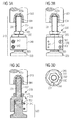
- FIGS. 3a, 3b, 3c and 3d put different views of the in FIG. 2 represented machine foot 210, which is now provided with the reference numeral 310. It shows FIG. 3a a first side view, FIG. 3b a second side view, Figure 3c a cross-sectional view and 3d figure a top view.
- the cylindrical shaft 331 designed as a threaded rod is screwed into a bore 303a of the chassis 303 provided with an internal thread 304.
- the threaded rod 331 is assigned to a second foot part 330 of the machine foot 310.
- a lock nut 335 which cooperates with a receiving thread 332 of the threaded rod 331, serves as a fixing element, so that the threaded rod 331 can be fixed relative to the chassis 303.
- a tightening element 333 designed as an external hexagon is integrally formed on the threaded rod 331, so that the threaded rod 331 can be rotated in a force-saving manner relative to the chassis by means of a conventional wrench and the height of the machine base 310 can thus be varied.
- the second foot part 330 further has a clamping sleeve 340.
- the clamping sleeve 340 is provided with an opening slot 341, so that the inner diameter of the clamping sleeve 340 depends on the widening of the opening slot 341.
- the inner diameter of the clamping sleeve 340 can be reduced such that a first foot 320 is locked in the clamping sleeve 340.
- the first foot part 320 in the clamping sleeve 340 is displaceable.
- a spring element 350 designed as a helical spring, which is compressed more or less strongly depending on the contact force acting on the machine base 310. By means of the display scale 325 this compression is displayed.
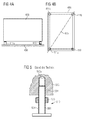
- FIG. 4a shows a side view of a placement machine 400, which is placed on a footprint 490.
- the placement machine 400 has a total of four machine feet. Three of the four machine feet are conventional height-adjustable rigid machine feet. One of the machine feet is a landing force measuring machine foot. In the side view shown, only a rigid machine foot 411a and the measuring machine foot 410 can be seen.
- FIG. 4b shows in a plan view of a schematic representation of the chassis 403 of the placement machine 400 and attached to the chassis 403 four machine feet.
- three rigid but height-adjustable machine feet 411a, 411b and 411c are shown.
- the three rigid machine feet 411a, 411b, 411c are adjusted in height so that (a) the measuring machine foot 410 is unloaded and (b) the automatic placement machine 400 is oriented horizontally.
- a conventional spirit level can be used for horizontal alignment. Relieving the measuring machine foot 410 results in that the weight of the placement machine 400 is substantially distributed over the three rigid machine feet 411a, 411b, 411c.
- the measuring machine foot 410 can be adjusted to support a very small but non-zero load.
- the measuring machine foot 410 by means of a defined unscrewing of the threaded rod 331 from the threaded hole 303a (see FIGS. 3a-3c ) is adjusted so that the measuring device of the measuring machine foot 410 indicates a predetermined placement force.
- the predetermined placement force results from the total mass of the placement machine 400 and an optionally nonuniform mass distribution of the placement machine 400. With a uniform mass distribution of the placement 400, the predetermined placement force is exactly where each of the machine feet 410, 411a, 411b and 411c exactly one quarter the entire weight of the placement machine 400 carries.
- the predetermined seating force may be calculated in advance based on the weight and mass distribution of the placement machine 400.
- a known placement force of the measuring machine foot 410 only a single fixed setting mark can be used on the machine foot 410, which indicates the predetermined placement force.
- a comparatively complex and expensive display scale formed on the machine base or is appropriate, is therefore no longer mandatory.
- the measuring machine base is fixed in such a way that the first foot part and the second foot part are clamped together. According to the embodiment described here, this is done by closing the in the FIGS. 3a and 3b shown clamping sleeve 340. Thus, a mechanically rigid connection is made between the two foot parts.
- the placement machine 400 is thus positioned so that due to the uniform load of the individual machine feet 410, 411a, 411b, 411c no mechanical stresses occur and that due to the rigid fixation of the two foot parts to each other a feathers or swinging of the placement machine 400 even at a highly dynamic Operation is excluded.
Landscapes
- Engineering & Computer Science (AREA)
- General Engineering & Computer Science (AREA)
- Mechanical Engineering (AREA)
- Machine Tool Units (AREA)
- Force Measurement Appropriate To Specific Purposes (AREA)
Applications Claiming Priority (1)
| Application Number | Priority Date | Filing Date | Title |
|---|---|---|---|
| DE102006058568 | 2006-12-12 |
Publications (2)
| Publication Number | Publication Date |
|---|---|
| EP1933076A2 true EP1933076A2 (fr) | 2008-06-18 |
| EP1933076A3 EP1933076A3 (fr) | 2009-04-29 |
Family
ID=39167626
Family Applications (1)
| Application Number | Title | Priority Date | Filing Date |
|---|---|---|---|
| EP07121972A Withdrawn EP1933076A3 (fr) | 2006-12-12 | 2007-11-30 | Pied de machine doté d'un dispositif de mesure de la force appliquée |
Country Status (1)
| Country | Link |
|---|---|
| EP (1) | EP1933076A3 (fr) |
Citations (2)
| Publication number | Priority date | Publication date | Assignee | Title |
|---|---|---|---|---|
| EP0932331A1 (fr) | 1998-01-27 | 1999-07-28 | FUJI MACHINE Mfg. Co., Ltd. | Appareil de montage de composants électriques équippé d'un dispositif amortisseur |
| DE19949847C1 (de) | 1999-10-15 | 2001-06-13 | Siemens Ag | Einrichtung zum Abstützen eines Chassis |
Family Cites Families (6)
| Publication number | Priority date | Publication date | Assignee | Title |
|---|---|---|---|---|
| US3764098A (en) * | 1971-02-16 | 1973-10-09 | Westinghouse Electric Corp | Turbine with load force determining device |
| US4047427A (en) * | 1976-01-26 | 1977-09-13 | Vibro/Dynamics Corporation | Load-sensing and adjusting method for operable machines |
| GB1558101A (en) * | 1976-04-26 | 1979-12-19 | Vibro Dynamics Corp | Load sensing support system |
| DE2758340A1 (de) * | 1977-12-27 | 1979-07-05 | Pfister Waagen Gmbh | Hydrostatische stellvorrichtung |
| DE19610092A1 (de) * | 1996-03-15 | 1997-09-18 | Focke & Co | Verfahren und Einrichtung zum Ausrichten von Maschinen |
| NL1002661C2 (nl) * | 1996-03-20 | 1997-09-23 | Elbert Christoffel Edward Rich | Stelvoet voorzien van afdichtmiddelen. |
-
2007
- 2007-11-30 EP EP07121972A patent/EP1933076A3/fr not_active Withdrawn
Patent Citations (2)
| Publication number | Priority date | Publication date | Assignee | Title |
|---|---|---|---|---|
| EP0932331A1 (fr) | 1998-01-27 | 1999-07-28 | FUJI MACHINE Mfg. Co., Ltd. | Appareil de montage de composants électriques équippé d'un dispositif amortisseur |
| DE19949847C1 (de) | 1999-10-15 | 2001-06-13 | Siemens Ag | Einrichtung zum Abstützen eines Chassis |
Also Published As
| Publication number | Publication date |
|---|---|
| EP1933076A3 (fr) | 2009-04-29 |
Similar Documents
| Publication | Publication Date | Title |
|---|---|---|
| EP2153183B1 (fr) | Guidage de parallélogramme réglable, en particulier pour un instrument de mesure gravimétrique | |
| EP2860501B1 (fr) | Cellule de pesée dotée d'un dispositif de correction d'erreurs de charge excentriques et procédé de correction d'erreurs de charge excentriques | |
| EP1496342B1 (fr) | Balance avec un dispostif formant pied d'appui | |
| DE69413383T2 (de) | Anordnung zum kontrollieren der dimensionen eines mechanischen stucks | |
| EP2408590B1 (fr) | Procédé et dispositif pour installer une machine | |
| DE102017110930B4 (de) | Magnettopf für eine Tauchspulenanordnung einer elektronischen Waage | |
| DE102011000554B4 (de) | Wägezelle sowie Verfahren zum Justieren einer Wägezelle | |
| DE112020005185T5 (de) | Systeme und verfahren zum abschätzen von hubkraft | |
| EP0801259B1 (fr) | Procédé et dispositif de positionnement de machines | |
| DE2718543A1 (de) | Lastfuehler | |
| DE102016015047B4 (de) | Teleskopbalken zum Sichern von Ladegut | |
| DE202017006219U1 (de) | Nivelliervorrichtung | |
| CH683717A5 (de) | Präzisionswaage. | |
| EP3159551A1 (fr) | Dispositif de serrage | |
| DE19925079A1 (de) | Drehmomentprüfgerät | |
| DE19754681A1 (de) | In einem Rastermodus abtastende Vorrichtung mit einer Kompensation des Störeinflusses vonmechanischen Schwingungen auf dem Abtastvorgang | |
| DE10359460A1 (de) | Wägezelle | |
| EP1785704A1 (fr) | Module de pesage | |
| DE2938507C2 (fr) | ||
| DE202015105671U1 (de) | Bruchkammer zum Messen einer Härte eines Prüflings | |
| EP3091268B1 (fr) | Dispositif d'alignement de moteurs, de machines et de pieces de machines | |
| DE102007035949B4 (de) | Nivelliereinrichtung zur Einstellung der horizontalen Lage einer Vorrichtung sowie mobile Wiegeeinrichtung mit solcher Nivelliereinrichtung | |
| CH636198A5 (en) | Device for the spring-assisted introduction of a force to be measured into a measurement body which can be subjected to a bending load | |
| CH683420A5 (de) | Vorrichtung zum Halten und Positionieren einer Substratkassette. | |
| DE3526137C2 (de) | Testkopf-Manipulator |
Legal Events
| Date | Code | Title | Description |
|---|---|---|---|
| PUAI | Public reference made under article 153(3) epc to a published international application that has entered the european phase |
Free format text: ORIGINAL CODE: 0009012 |
|
| AK | Designated contracting states |
Kind code of ref document: A2 Designated state(s): AT BE BG CH CY CZ DE DK EE ES FI FR GB GR HU IE IS IT LI LT LU LV MC MT NL PL PT RO SE SI SK TR |
|
| AX | Request for extension of the european patent |
Extension state: AL BA HR MK RS |
|
| PUAL | Search report despatched |
Free format text: ORIGINAL CODE: 0009013 |
|
| AK | Designated contracting states |
Kind code of ref document: A3 Designated state(s): AT BE BG CH CY CZ DE DK EE ES FI FR GB GR HU IE IS IT LI LT LU LV MC MT NL PL PT RO SE SI SK TR |
|
| AX | Request for extension of the european patent |
Extension state: AL BA HR MK RS |
|
| RAP1 | Party data changed (applicant data changed or rights of an application transferred) |
Owner name: SIEMENS ELECTRONICS ASSEMBLY SYSTEMS GMBH & CO. KG |
|
| 17P | Request for examination filed |
Effective date: 20090907 |
|
| 17Q | First examination report despatched |
Effective date: 20091015 |
|
| AKX | Designation fees paid |
Designated state(s): AT BE BG CH CY CZ DE DK EE ES FI FR GB GR HU IE IS IT LI LT LU LV MC MT NL PL PT RO SE SI SK TR |
|
| GRAP | Despatch of communication of intention to grant a patent |
Free format text: ORIGINAL CODE: EPIDOSNIGR1 |
|
| RAP1 | Party data changed (applicant data changed or rights of an application transferred) |
Owner name: ASM ASSEMBLY SYSTEMS GMBH & CO. KG |
|
| STAA | Information on the status of an ep patent application or granted ep patent |
Free format text: STATUS: THE APPLICATION IS DEEMED TO BE WITHDRAWN |
|
| 18D | Application deemed to be withdrawn |
Effective date: 20110715 |