EP1933414A2 - Dispositif d'antenne ayant une bonne symétrie de caractéristiques de direction - Google Patents
Dispositif d'antenne ayant une bonne symétrie de caractéristiques de direction Download PDFInfo
- Publication number
- EP1933414A2 EP1933414A2 EP07023677A EP07023677A EP1933414A2 EP 1933414 A2 EP1933414 A2 EP 1933414A2 EP 07023677 A EP07023677 A EP 07023677A EP 07023677 A EP07023677 A EP 07023677A EP 1933414 A2 EP1933414 A2 EP 1933414A2
- Authority
- EP
- European Patent Office
- Prior art keywords
- antenna device
- power feed
- ground pattern
- parasitic radiation
- short side
- Prior art date
- Legal status (The legal status is an assumption and is not a legal conclusion. Google has not performed a legal analysis and makes no representation as to the accuracy of the status listed.)
- Withdrawn
Links
- 230000005855 radiation Effects 0.000 claims abstract description 57
- 230000003071 parasitic effect Effects 0.000 claims abstract description 53
- 239000000758 substrate Substances 0.000 claims abstract description 14
- 239000004020 conductor Substances 0.000 claims abstract description 6
- 239000002184 metal Substances 0.000 claims abstract description 6
- 238000000059 patterning Methods 0.000 claims abstract description 4
- 238000000926 separation method Methods 0.000 claims abstract description 4
- 238000005516 engineering process Methods 0.000 description 3
- 230000000694 effects Effects 0.000 description 2
- 239000011888 foil Substances 0.000 description 2
- 238000004904 shortening Methods 0.000 description 1
Images


Classifications
-
- H—ELECTRICITY
- H01—ELECTRIC ELEMENTS
- H01Q—ANTENNAS, i.e. RADIO AERIALS
- H01Q1/00—Details of, or arrangements associated with, antennas
- H01Q1/36—Structural form of radiating elements, e.g. cone, spiral, umbrella; Particular materials used therewith
- H01Q1/38—Structural form of radiating elements, e.g. cone, spiral, umbrella; Particular materials used therewith formed by a conductive layer on an insulating support
-
- H—ELECTRICITY
- H01—ELECTRIC ELEMENTS
- H01Q—ANTENNAS, i.e. RADIO AERIALS
- H01Q1/00—Details of, or arrangements associated with, antennas
- H01Q1/12—Supports; Mounting means
- H01Q1/22—Supports; Mounting means by structural association with other equipment or articles
- H01Q1/24—Supports; Mounting means by structural association with other equipment or articles with receiving set
-
- H—ELECTRICITY
- H01—ELECTRIC ELEMENTS
- H01Q—ANTENNAS, i.e. RADIO AERIALS
- H01Q1/00—Details of, or arrangements associated with, antennas
- H01Q1/12—Supports; Mounting means
- H01Q1/22—Supports; Mounting means by structural association with other equipment or articles
- H01Q1/24—Supports; Mounting means by structural association with other equipment or articles with receiving set
- H01Q1/241—Supports; Mounting means by structural association with other equipment or articles with receiving set used in mobile communications, e.g. GSM
- H01Q1/242—Supports; Mounting means by structural association with other equipment or articles with receiving set used in mobile communications, e.g. GSM specially adapted for hand-held use
- H01Q1/243—Supports; Mounting means by structural association with other equipment or articles with receiving set used in mobile communications, e.g. GSM specially adapted for hand-held use with built-in antennas
-
- H—ELECTRICITY
- H01—ELECTRIC ELEMENTS
- H01Q—ANTENNAS, i.e. RADIO AERIALS
- H01Q21/00—Antenna arrays or systems
- H01Q21/06—Arrays of individually energised antenna units similarly polarised and spaced apart
- H01Q21/20—Arrays of individually energised antenna units similarly polarised and spaced apart the units being spaced along or adjacent to a curvilinear path
- H01Q21/205—Arrays of individually energised antenna units similarly polarised and spaced apart the units being spaced along or adjacent to a curvilinear path providing an omnidirectional coverage
-
- H—ELECTRICITY
- H01—ELECTRIC ELEMENTS
- H01Q—ANTENNAS, i.e. RADIO AERIALS
- H01Q21/00—Antenna arrays or systems
- H01Q21/29—Combinations of different interacting antenna units for giving a desired directional characteristic
-
- H—ELECTRICITY
- H01—ELECTRIC ELEMENTS
- H01Q—ANTENNAS, i.e. RADIO AERIALS
- H01Q9/00—Electrically-short antennas having dimensions not more than twice the operating wavelength and consisting of conductive active radiating elements
- H01Q9/04—Resonant antennas
- H01Q9/0407—Substantially flat resonant element parallel to ground plane, e.g. patch antenna
- H01Q9/0421—Substantially flat resonant element parallel to ground plane, e.g. patch antenna with a shorting wall or a shorting pin at one end of the element
-
- H—ELECTRICITY
- H01—ELECTRIC ELEMENTS
- H01Q—ANTENNAS, i.e. RADIO AERIALS
- H01Q9/00—Electrically-short antennas having dimensions not more than twice the operating wavelength and consisting of conductive active radiating elements
- H01Q9/04—Resonant antennas
- H01Q9/30—Resonant antennas with feed to end of elongated active element, e.g. unipole
- H01Q9/42—Resonant antennas with feed to end of elongated active element, e.g. unipole with folded element, the folded parts being spaced apart a small fraction of the operating wavelength
Definitions
- the present invention relates to an antenna device in which a ground pattern and a pattern antenna are parallel arranged on a printed substrate, and more particularly to an antenna device in which a pattern antenna is arranged in the vicinity of a short side portion of a ground pattern of an approximately rectangular shape.
- short distance wireless technologies of Bluetooth (trademark) and the like have been commercialized to perform wireless data communication between a plurality of electronic devices at home and the like.
- a digital camera when an image captured by a digital camera is downloaded to a personal computer (so-called PC) or printed by a printer if these short distance wireless technologies are adopted, the digital camera does not need to be connected to an opposite electronic device through a cable since desired image data can be transmitted from an antenna device embedded in the digital camera to an opposite PC or printer.
- a remote operation of the player may be performed through an antenna device embedded in a terminal controller of a headphone and simultaneously a music reproduced by the player can be listened to through the headphone.
- the antenna device to be used in this short distance wireless communication as described above a structure capable of being cost-effectively produced in a compact size is preferable.
- an antenna device capable of satisfying these requirements there is a well-known structure in which a ground pattern and a pattern antenna of a predetermined shape are conventionally formed by a metal foil or the like on a printed substrate.
- the pattern antenna is arranged adjacent to one side end portion of the ground pattern, and operates as, for example, an inverse F type antenna when a power feed signal is supplied to a feed point (for example, see JP-A-2004-343285 (Pages 3 and 4, Fig. 1 )).
- a radiation element configures the pattern antenna, arranged in the vicinity of the one side end portion of the ground pattern, to which the power feed signal is supplied.
- the pattern antenna is adjacent to the short side portion of the approximately rectangular shape of the ground pattern, an antenna gain is lowered at both end sides in a longitudinal direction of the ground pattern. This is because a high-frequency current easily flows into the ground pattern in the longitudinal direction when the pattern antenna is powered on and excited. If a casing for containing the printed substrate has an elongate shape, the ground pattern is mostly formed in an approximately rectangular shape.
- the antenna device in which the casing has the elongate shape and the gain is low at both the end sides in the longitudinal direction of the ground pattern is not necessarily convenient for use. That is, when users holding the casing of the elongate shape perform short distance wireless communication (data communication) with an opposite electronic device, many users cause one end side in the longitudinal direction of the casing to be toward the opposite device. Accordingly, when the antenna gain is low in this direction, communication error may easily occur.
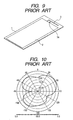
- a ground pattern 2 of a smaller rectangular shape and an inverse F type pattern antenna 3 adjacent to a short side portion of the ground pattern 2 are arranged on a printed substrate 1 of a rectangular shape and electric waves are radiated from the pattern antenna 3 by supplying a power feed signal to a power feed portion 3a as shown in Fig. 9 , directional characteristics within a flat surface along the printed substrate 1 are formed as shown in Fig. 10 .
- an azimuth angle of 0 degree is present in a side of the ground pattern 2 as viewed from the pattern antenna 3. That is, it can be seen that a straight-line direction connecting azimuth angles of 0 and -180 degrees corresponds to the longitudinal direction of the ground pattern 2 and a sufficient gain is not obtained in this direction.
- a gain of the antenna device shown in Fig. 9 is extremely lowered in a specific direction (at the azimuth angle of 120 or -90 degrees). Accordingly, there is a problem in that it is difficult to practically realize an omnidirectional antenna device available in any direction. For this reason, for example, there is a worry that a music being listened to is interrupted in mid course when the antenna device is in a specific direction in a headphone or the like in which the music is listened to through the antenna device.
- the present invention has been made in view of the above-mentioned circumstance in the prior art, and an object of the invention is to provide an antenna device suitable for short distance wireless communication that can have a good symmetry of directional characteristics and increase a gain at both end sides in a longitudinal direction of a ground pattern.
- an antenna device formed by patterning a metal conductor on a printed substrate, including: a ground pattern of an approximately rectangular shape; a power feed element that has a power feed point to which a power feed signal is supplied and is arranged adjacent to one short side portion of the ground pattern; a correction pattern that projects from the short side portion of the ground pattern and is located lateral to the power feed element; and a parasitic radiation element that extends along the short side portion and is arranged at a separation position facing the short side portion of the ground pattern through the power feed element and the correction pattern, wherein an electrical length of the parasitic radiation element is set to be approximately 1/2 of a resonant length and the parasitic radiation element is configured to excite the power feed element when feeding power.
- the antenna device configured as described above, it is difficult for a high-frequency current flowing in a longitudinal direction to occur in the ground pattern since the power feed element and the correction pattern are parallel arranged in an area between the ground pattern and the parasitic radiation element and power is not directly fed to the parasitic radiation element but is fed to the parasitic radiation element through the power feed element. Since the parasitic radiation element excited by the power feed element operates as a dipole antenna, it is easy to make directional characteristics similar to those of the dipole antenna.
- the directional characteristics of electric waves radiated from the parasitic radiation element can be easily set to be approximately symmetrical with respect to a straight line for bisecting the parasitic radiation element through an intermediate between the power feed element and the correction pattern. Therefore, an antenna device can be easily realized which can have a good symmetry of directional characteristics and increase a gain at both end sides in a longitudinal direction of a ground pattern.
- the parasitic radiation element operating as the dipole antenna also radiates the electric waves to spaces at both the end sides in the extension direction when the capacity is loaded between the projection portion and the ground pattern by causing both end portions in the extension direction of the parasitic radiation element to project to the short side portion of the ground pattern. For this reason, the effect of extremely lowering a gain in a specific direction is difficult to occur.
- An omnidirectional antenna device available in any direction can be practically easily realized.
- a C component capacitortance
- the parasitic radiation element can be miniaturized and therefore the miniaturization of the overall antenna device can be easily promoted.
- the miniaturization of the overall antenna device can be easily promoted by shortening the total length of the parasitic radiation element since an L component (inductance) increases in an area where a current of the parasitic radiation element increases when the parasitic radiation element is patterned in a shape in which the approximately center portion has a narrow width in the extension direction of the parasitic radiation element.
- the parasitic radiation element is easily excited when the power feed element is an inverse L type or a loop type.
- the symmetry of directional characteristics is better when the correction pattern is formed in an outer shape approximately equal to that of the power feed element.
- an antenna device of the present invention it is difficult for a high-frequency current flowing in a longitudinal direction to occur in a ground pattern when feeding power and a parasitic radiation element excited by a power feed element can operate as a dipole antenna, and the symmetry of directional characteristics is easily ensured by a correction pattern. Therefore, a gain can increase at both end sides in the longitudinal direction of the ground pattern of an approximately rectangular shape and an antenna device suitable for short distance wireless communication can be easily realized.
- Fig. 1 is a perspective view of an antenna device according to a first embodiment of the present invention
- Fig. 2 is a plan view of main parts of the antenna device shown in Fig. 1
- Fig. 3 is a characteristic view showing directivity of the antenna device shown in Fig. 1 .
- an antenna device 10 is formed by patterning a metal conductor such as a metal foil or the like on a printed substrate 11 of a rectangular shape.
- the antenna device 10 is provided with a ground pattern 12 of a rectangular shape smaller than that of the printed substrate 11, a power feed element 13 arranged adjacent to one short side portion 12a of the ground pattern 12, a correction pattern 14 which projects from the short side portion 12a of the ground pattern 12 and is located lateral to the power feed element 13, and a parasitic radiation element 15 that extends along the short side portion 12a and is arranged at a separation position facing the short side portion 12a of the ground pattern 12 through the power feed element 13 and the correction pattern 14.
- a transmitting and receiving circuit or various electronic components are installed in the printed substrate 11 and a power feed line drawn from the transmitting and receiving circuit is connected to a power feed point 13a of the power feed element 13.
- Fig. 3 shows directional characteristics of the antenna device 10 within a flat surface along the printed substrate 11.
- an azimuth angle of 0 degree is present in a side of the ground pattern 12 as viewed from the parasitic radiation element 15.
- a straight-line direction connecting azimuth angles of 0 and -180 degrees corresponds to the longitudinal direction of the ground pattern 12.
- the power feed element 13 is patterned as a strip-shaped conductor extending along three sides of the rectangular shape. One end portion of the power feed element 13 has the power feed point 13a and the other end portion is connected to the short side portion 12a of the ground pattern 12.
- the correction pattern 14 is patterned as a strip-shaped conductor whose shape is approximately equal to that of the power feed element 13, but both end portions of the correction pattern 14 are connected to the short side portion 12a of the ground pattern 12.
- the parasitic radiation element 15 is adjacent to the power feed element 13 or the correction pattern 14 at a predetermined distance therefrom, and simultaneously extends in a straight-line shape along the short side portion 12a of the ground pattern 12.
- An electrical length of the parasitic radiation element 15 is set to be approximately 1/2 of a resonant length.
- the antenna device 10 configured as described above, it is difficult for a high-frequency current flowing in a longitudinal direction to occur in the ground pattern 12 since the power feed element 13 and the correction pattern 14 are parallel arranged in an approximately symmetrical form in an area between the ground pattern 12 and the parasitic radiation element 15 and power is not directly fed to the parasitic radiation element 15 but is fed to the parasitic radiation element 15 through the power feed element 13. Since the parasitic radiation element 15 excited by the power feed element 13 operates as the dipole antenna, its directional characteristics are similar to those of the dipole antenna.
- the antenna device 10 Since one side in the extension direction of the parasitic radiation element 15 is electromagnetically coupled to the power feed element 13, the other side is electromagnetically coupled to the correction pattern 14, and the correction pattern 14 is formed in an outer shape approximately equal to that of the power feed element 13, the directional characteristics of electric waves radiated from the parasitic radiation element 15 are approximately symmetrical with respect to a straight line for bisecting the parasitic radiation element 15 through an intermediate between the power feed element 13 and the correction pattern 14. As shown in Fig. 3 , the symmetry of directional characteristics of the antenna device 10 is good and the gain specifically increases at both the end sides in the longitudinal direction of the ground pattern 12. Therefore, the antenna device 10 is suitable to be used for short distance wireless communication.
- Fig. 4 is a perspective view of an antenna device according to a second embodiment of the present invention
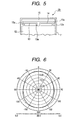
- Fig. 5 is a plan view of main parts of the antenna device
- Fig. 6 is a characteristic view showing directivity of the antenna device shown in Fig. 4 . Since parts corresponding to those of Figs. 1 and 2 are assigned the same reference numerals, a repeated description is omitted.
- a shape of a parasitic radiation element 15 is different from that of the above-described first embodiment (of the antenna device 10). That is, in the antenna device 20 according to this embodiment, a sub radiation portion 15a projecting to a short side portion 12a of a ground pattern 12 is arranged at both end portions in an extension direction of the parasitic radiation element 15, such that a capacity is loaded between the sub radiation element 15a and the ground pattern 12. Accordingly, the parasitic radiation element 15 operating as a dipole antenna also radiates electric waves to spaces at both end sides in the extension direction. As shown in Fig. 6 , directional characteristics in which a dip is small can be obtained. Fig.
- FIG. 6 shows directional characteristics of the antenna device 20 within a flat surface along a printed substrate 11.
- an azimuth angle of 0 degree is present in a side of the ground pattern 12 as viewed from the parasitic radiation element 15.
- a straight-line direction connecting azimuth angles of 0 and -180 degrees corresponds to the longitudinal direction of the ground pattern 12.
- the antenna device 20 can be used in any direction and can be distinctly suitable for short distance wireless communication since the effect of extremely lowering a gain in a specific direction does not occur and omnidirectivity can be practically realized.
- the parasitic radiation element 15 in which the sub radiation portion 15a is arranged at both the end portions in the extension direction can be miniaturized since a C component (capacitance) increases in an area where a voltage increases. Therefore, the miniaturization of the overall antenna device 20 can be easily promoted.
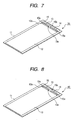
- Fig. 7 is a perspective view of an antenna device according to a third embodiment of the present invention. Since parts corresponding to those of Fig. 4 are assigned the same reference numerals, a repeated description is omitted.
- An antenna device 30 shown in Fig. 7 is different from the second embodiment (of the antenna device 20) as described above in that a center portion in an extension direction of a parasitic radiation element 15 and its neighborhood have a slightly narrow width by providing a notch portion 15b in the parasitic radiation element 15. Accordingly, the miniaturization of the parasitic radiation element 15 can be promoted since an L component (inductance) increases in an area where a current increases. Therefore, the further miniaturization of the antenna device 30 can be easily promoted.
- Fig. 8 is a perspective view of an antenna device according to a fourth embodiment of the present invention. Since parts corresponding to those of Fig. 7 are assigned the same reference numerals, a repeated description is omitted.
- a center portion in an extension direction has a specifically narrow width and also a neighborhood of the center portion has a slightly narrow width since there is provided a notch portion 15c locally deeper than the notch portion 15b of the third embodiment (of the antenna device 30) as described above. Accordingly, since the further miniaturization of the parasitic radiation element 15 can be promoted, the antenna device 40 can be easily miniaturized.
- an end portion of a side separated from a power feed point 13a of a power feed element 13 is not connected to a ground pattern 12, and operates as an inverse L type power feed element 13.
- the directional characteristics of electric waves radiated from the parasitic radiation element 15 are almost identical even when the power feed element 13 is the inverse L type and the loop type.
Landscapes
- Engineering & Computer Science (AREA)
- Computer Networks & Wireless Communication (AREA)
- Details Of Aerials (AREA)
- Aerials With Secondary Devices (AREA)
- Support Of Aerials (AREA)
- Waveguide Aerials (AREA)
Applications Claiming Priority (1)
| Application Number | Priority Date | Filing Date | Title |
|---|---|---|---|
| JP2006334886A JP4378378B2 (ja) | 2006-12-12 | 2006-12-12 | アンテナ装置 |
Publications (2)
| Publication Number | Publication Date |
|---|---|
| EP1933414A2 true EP1933414A2 (fr) | 2008-06-18 |
| EP1933414A3 EP1933414A3 (fr) | 2008-09-24 |
Family
ID=39166759
Family Applications (1)
| Application Number | Title | Priority Date | Filing Date |
|---|---|---|---|
| EP07023677A Withdrawn EP1933414A3 (fr) | 2006-12-12 | 2007-12-06 | Dispositif d'antenne ayant une bonne symétrie de caractéristiques de direction |
Country Status (5)
| Country | Link |
|---|---|
| US (1) | US7746286B2 (fr) |
| EP (1) | EP1933414A3 (fr) |
| JP (1) | JP4378378B2 (fr) |
| KR (1) | KR100960394B1 (fr) |
| TW (1) | TW200841518A (fr) |
Cited By (2)
| Publication number | Priority date | Publication date | Assignee | Title |
|---|---|---|---|---|
| GB2484540A (en) * | 2010-10-15 | 2012-04-18 | Antenova Ltd | A multi-mode loop antenna for mobile handset applications |
| GB2486362B (en) * | 2009-08-27 | 2015-02-25 | Murata Manufacturing Co | Flexible substrate antenna and antenna device |
Families Citing this family (18)
| Publication number | Priority date | Publication date | Assignee | Title |
|---|---|---|---|---|
| US8989837B2 (en) | 2009-12-01 | 2015-03-24 | Kyma Medical Technologies Ltd. | Methods and systems for determining fluid content of tissue |
| JP5338414B2 (ja) * | 2009-03-23 | 2013-11-13 | ソニー株式会社 | 電子機器 |
| US8427337B2 (en) * | 2009-07-10 | 2013-04-23 | Aclara RF Systems Inc. | Planar dipole antenna |
| CA2782499A1 (fr) * | 2009-12-01 | 2011-06-09 | Kyma Medical Technologies Ltd. | Localisation de caracteristiques dans le cur a l'aide de systeme d'imagerie radiofrequence |
| JP5306158B2 (ja) * | 2009-12-07 | 2013-10-02 | アルプス電気株式会社 | アンテナ装置 |
| WO2012011066A1 (fr) | 2010-07-21 | 2012-01-26 | Kyma Medical Technologies Ltd. | Diélectromètre implantable |
| US8489162B1 (en) * | 2010-08-17 | 2013-07-16 | Amazon Technologies, Inc. | Slot antenna within existing device component |
| US9306276B2 (en) * | 2011-07-13 | 2016-04-05 | Qualcomm Incorporated | Wideband antenna system with multiple antennas and at least one parasitic element |
| CN103515699B (zh) * | 2012-06-29 | 2016-10-05 | 联想(北京)有限公司 | 天线和用于形成天线的方法 |
| US9912065B2 (en) * | 2012-11-15 | 2018-03-06 | Samsung Electronics Co., Ltd. | Dipole antenna module and electronic apparatus including the same |
| EP3063832B1 (fr) | 2013-10-29 | 2022-07-06 | Zoll Medical Israel Ltd. | Systèmes et dispositifs d'antenne, et procédés de fabrication associés |
| US11013420B2 (en) | 2014-02-05 | 2021-05-25 | Zoll Medical Israel Ltd. | Systems, apparatuses and methods for determining blood pressure |
| WO2016040337A1 (fr) | 2014-09-08 | 2016-03-17 | KYMA Medical Technologies, Inc. | Systèmes et procédés de surveillance et de diagnostic |
| JP2015045655A (ja) * | 2014-10-27 | 2015-03-12 | キマ メディカル テクノロジーズ リミテッド | 無線周波数撮像を用いる心臓内の特徴の位置特定 |
| CN106605335B (zh) * | 2014-12-08 | 2020-03-31 | 松下知识产权经营株式会社 | 天线以及电气设备 |
| US10548485B2 (en) | 2015-01-12 | 2020-02-04 | Zoll Medical Israel Ltd. | Systems, apparatuses and methods for radio frequency-based attachment sensing |
| EP3664694B1 (fr) | 2017-08-10 | 2025-12-10 | ZOLL Medical Israel Ltd. | Système de surveillance physiologique de patients |
| US11114773B2 (en) * | 2018-12-28 | 2021-09-07 | Flex Ltd. | Devices, systems, and methods for directional antennas that protect sensitive zones |
Citations (2)
| Publication number | Priority date | Publication date | Assignee | Title |
|---|---|---|---|---|
| JP2004343285A (ja) | 2003-05-14 | 2004-12-02 | Sharp Corp | アンテナユニット |
| JP2006334886A (ja) | 2005-06-01 | 2006-12-14 | Makita Corp | 切断機の案内装置 |
Family Cites Families (15)
| Publication number | Priority date | Publication date | Assignee | Title |
|---|---|---|---|---|
| JP3165005B2 (ja) * | 1995-06-07 | 2001-05-14 | 株式会社日立国際電気 | 携帯無線機 |
| US6091366A (en) * | 1997-07-14 | 2000-07-18 | Hitachi Cable Ltd. | Microstrip type antenna device |
| GB2377082A (en) | 2001-06-29 | 2002-12-31 | Nokia Corp | Two element antenna system |
| JP2003110329A (ja) * | 2001-07-25 | 2003-04-11 | Matsushita Electric Ind Co Ltd | 内蔵アンテナ装置 |
| JP2003198410A (ja) | 2001-12-27 | 2003-07-11 | Matsushita Electric Ind Co Ltd | 通信端末装置用アンテナ |
| JP4087623B2 (ja) | 2002-03-12 | 2008-05-21 | マスプロ電工株式会社 | 平面アンテナ |
| TWI258246B (en) * | 2002-03-14 | 2006-07-11 | Sony Ericsson Mobile Comm Ab | Flat built-in radio antenna |
| FI114836B (fi) * | 2002-09-19 | 2004-12-31 | Filtronic Lk Oy | Sisäinen antenni |
| JP2004201278A (ja) * | 2002-12-06 | 2004-07-15 | Sharp Corp | パターンアンテナ |
| TWI268009B (en) * | 2003-05-16 | 2006-12-01 | Hon Hai Prec Ind Co Ltd | Dual band antenna and method for making the same |
| JP3886932B2 (ja) * | 2003-06-04 | 2007-02-28 | 太陽誘電株式会社 | アンテナ実装基板及びそれを備えたpcカード |
| US6977616B2 (en) * | 2003-09-01 | 2005-12-20 | Alps Electric Co., Ltd. | Dual-band antenna having small size and low-height |
| JP4082341B2 (ja) * | 2003-12-02 | 2008-04-30 | トヨタ自動車株式会社 | アンテナ装置 |
| TWI229473B (en) * | 2004-01-30 | 2005-03-11 | Yageo Corp | Dual-band inverted-F antenna with shorted parasitic elements |
| TW200614593A (en) * | 2004-10-28 | 2006-05-01 | Wistron Neweb Corp | Antenna for portable electronic device |
-
2006
- 2006-12-12 JP JP2006334886A patent/JP4378378B2/ja not_active Expired - Fee Related
-
2007
- 2007-11-20 US US11/943,524 patent/US7746286B2/en not_active Expired - Fee Related
- 2007-11-28 TW TW096145164A patent/TW200841518A/zh unknown
- 2007-12-06 EP EP07023677A patent/EP1933414A3/fr not_active Withdrawn
- 2007-12-11 KR KR1020070128048A patent/KR100960394B1/ko not_active Expired - Fee Related
Patent Citations (2)
| Publication number | Priority date | Publication date | Assignee | Title |
|---|---|---|---|---|
| JP2004343285A (ja) | 2003-05-14 | 2004-12-02 | Sharp Corp | アンテナユニット |
| JP2006334886A (ja) | 2005-06-01 | 2006-12-14 | Makita Corp | 切断機の案内装置 |
Cited By (4)
| Publication number | Priority date | Publication date | Assignee | Title |
|---|---|---|---|---|
| GB2486362B (en) * | 2009-08-27 | 2015-02-25 | Murata Manufacturing Co | Flexible substrate antenna and antenna device |
| US9608319B2 (en) | 2009-08-27 | 2017-03-28 | Murata Manufacturing Co., Ltd. | Flexible substrate antenna and antenna device |
| GB2484540A (en) * | 2010-10-15 | 2012-04-18 | Antenova Ltd | A multi-mode loop antenna for mobile handset applications |
| GB2484540B (en) * | 2010-10-15 | 2014-01-29 | Microsoft Corp | A loop antenna for mobile handset and other applications |
Also Published As
| Publication number | Publication date |
|---|---|
| KR100960394B1 (ko) | 2010-05-28 |
| US20080136712A1 (en) | 2008-06-12 |
| US7746286B2 (en) | 2010-06-29 |
| KR20080054358A (ko) | 2008-06-17 |
| EP1933414A3 (fr) | 2008-09-24 |
| TW200841518A (en) | 2008-10-16 |
| JP4378378B2 (ja) | 2009-12-02 |
| JP2008148141A (ja) | 2008-06-26 |
Similar Documents
| Publication | Publication Date | Title |
|---|---|---|
| US7746286B2 (en) | Antenna device having good symmetry of directional characteristics | |
| USRE48738E1 (en) | Mobile terminal | |
| JP2990083B2 (ja) | 移動通信用アンテナ装置 | |
| JP5458981B2 (ja) | マルチバンドアンテナ及び電子機器 | |
| JP2014236323A (ja) | アンテナ装置とこのアンテナ装置を備えた電子機器 | |
| JP2007159140A (ja) | 摺動型移動通信端末装置用アンテナ | |
| JP4880439B2 (ja) | アンテナエレメント | |
| JP2004128740A (ja) | 放射電極エレメント、および該エレメントで構成される多周波アンテナ | |
| CN215342969U (zh) | 天线装置及电子设备 | |
| JP4371944B2 (ja) | 折畳み式通信端末装置 | |
| JP2005318333A (ja) | アンテナ | |
| JP2011120072A (ja) | 携帯無線機 | |
| JP4527671B2 (ja) | 広帯域アンテナエレメント | |
| JP4419679B2 (ja) | カード型情報端末装置 | |
| JP2005159908A (ja) | アンテナ | |
| JP2006014265A (ja) | 広帯域エレメント、および該エレメントを含む広帯域アンテナ | |
| JP4989662B2 (ja) | Rfタグ読み書き装置 | |
| JP2007235752A (ja) | 広帯域アンテナエレメント | |
| JP2007129597A (ja) | 多周波アンテナ | |
| JP4823028B2 (ja) | アンテナエレメント | |
| JP2004266573A (ja) | 多周波アンテナ素子及び多周波アンテナ | |
| JP2008124797A (ja) | Gnd共有アンテナ | |
| JP2005229212A (ja) | アンテナシステム | |
| KR20130017033A (ko) | 이동 단말기 | |
| JP2008154013A (ja) | アンテナエレメント |
Legal Events
| Date | Code | Title | Description |
|---|---|---|---|
| PUAI | Public reference made under article 153(3) epc to a published international application that has entered the european phase |
Free format text: ORIGINAL CODE: 0009012 |
|
| AK | Designated contracting states |
Kind code of ref document: A2 Designated state(s): AT BE BG CH CY CZ DE DK EE ES FI FR GB GR HU IE IS IT LI LT LU LV MC MT NL PL PT RO SE SI SK TR |
|
| AX | Request for extension of the european patent |
Extension state: AL BA HR MK RS |
|
| PUAL | Search report despatched |
Free format text: ORIGINAL CODE: 0009013 |
|
| AK | Designated contracting states |
Kind code of ref document: A3 Designated state(s): AT BE BG CH CY CZ DE DK EE ES FI FR GB GR HU IE IS IT LI LT LU LV MC MT NL PL PT RO SE SI SK TR |
|
| AX | Request for extension of the european patent |
Extension state: AL BA HR MK RS |
|
| RIC1 | Information provided on ipc code assigned before grant |
Ipc: H01Q 21/20 20060101ALI20080820BHEP Ipc: H01Q 9/42 20060101ALI20080820BHEP Ipc: H01Q 9/04 20060101ALI20080820BHEP Ipc: H01Q 5/01 20060101ALI20080820BHEP Ipc: H01Q 21/29 20060101ALI20080820BHEP Ipc: H01Q 1/24 20060101ALI20080820BHEP Ipc: H01Q 1/38 20060101AFI20080319BHEP |
|
| AKX | Designation fees paid | ||
| 17P | Request for examination filed |
Effective date: 20081105 |
|
| RBV | Designated contracting states (corrected) |
Designated state(s): DE FR GB |
|
| STAA | Information on the status of an ep patent application or granted ep patent |
Free format text: STATUS: THE APPLICATION HAS BEEN WITHDRAWN |
|
| 18W | Application withdrawn |
Effective date: 20110518 |