EP1933496A2 - Verbessertes DES und andere kryptographische Verfahren mit Verlustminimierung für Chipkarten und andere Verschlüsselungssysteme - Google Patents
Verbessertes DES und andere kryptographische Verfahren mit Verlustminimierung für Chipkarten und andere Verschlüsselungssysteme Download PDFInfo
- Publication number
- EP1933496A2 EP1933496A2 EP08006143A EP08006143A EP1933496A2 EP 1933496 A2 EP1933496 A2 EP 1933496A2 EP 08006143 A EP08006143 A EP 08006143A EP 08006143 A EP08006143 A EP 08006143A EP 1933496 A2 EP1933496 A2 EP 1933496A2
- Authority
- EP
- European Patent Office
- Prior art keywords
- key
- cryptographic
- result
- des
- random
- Prior art date
- Legal status (The legal status is an assumption and is not a legal conclusion. Google has not performed a legal analysis and makes no representation as to the accuracy of the status listed.)
- Withdrawn
Links
Images

Classifications
-
- H—ELECTRICITY
- H04—ELECTRIC COMMUNICATION TECHNIQUE
- H04L—TRANSMISSION OF DIGITAL INFORMATION, e.g. TELEGRAPHIC COMMUNICATION
- H04L9/00—Cryptographic mechanisms or cryptographic arrangements for secret or secure communications; Network security protocols
- H04L9/06—Cryptographic mechanisms or cryptographic arrangements for secret or secure communications; Network security protocols the encryption apparatus using shift registers or memories for block-wise or stream coding, e.g. DES systems or RC4; Hash functions; Pseudorandom sequence generators
- H04L9/0618—Block ciphers, i.e. encrypting groups of characters of a plain text message using fixed encryption transformation
- H04L9/0625—Block ciphers, i.e. encrypting groups of characters of a plain text message using fixed encryption transformation with splitting of the data block into left and right halves, e.g. Feistel based algorithms, DES, FEAL, IDEA or KASUMI
-
- H—ELECTRICITY
- H04—ELECTRIC COMMUNICATION TECHNIQUE
- H04L—TRANSMISSION OF DIGITAL INFORMATION, e.g. TELEGRAPHIC COMMUNICATION
- H04L9/00—Cryptographic mechanisms or cryptographic arrangements for secret or secure communications; Network security protocols
- H04L9/002—Countermeasures against attacks on cryptographic mechanisms
- H04L9/003—Countermeasures against attacks on cryptographic mechanisms for power analysis, e.g. differential power analysis [DPA] or simple power analysis [SPA]
-
- G—PHYSICS
- G06—COMPUTING OR CALCULATING; COUNTING
- G06F—ELECTRIC DIGITAL DATA PROCESSING
- G06F2207/00—Indexing scheme relating to methods or arrangements for processing data by operating upon the order or content of the data handled
- G06F2207/72—Indexing scheme relating to groups G06F7/72 - G06F7/729
- G06F2207/7219—Countermeasures against side channel or fault attacks
-
- H—ELECTRICITY
- H04—ELECTRIC COMMUNICATION TECHNIQUE
- H04L—TRANSMISSION OF DIGITAL INFORMATION, e.g. TELEGRAPHIC COMMUNICATION
- H04L2209/00—Additional information or applications relating to cryptographic mechanisms or cryptographic arrangements for secret or secure communication H04L9/00
- H04L2209/08—Randomization, e.g. dummy operations or using noise
-
- H—ELECTRICITY
- H04—ELECTRIC COMMUNICATION TECHNIQUE
- H04L—TRANSMISSION OF DIGITAL INFORMATION, e.g. TELEGRAPHIC COMMUNICATION
- H04L2209/00—Additional information or applications relating to cryptographic mechanisms or cryptographic arrangements for secret or secure communication H04L9/00
- H04L2209/12—Details relating to cryptographic hardware or logic circuitry
Definitions
- the method and apparatus of the invention relate generally to securing cryptographic systems against external attacks and, more specifically, to preventing attacks that involve the external monitoring of cryptographic operations.
- This invention describes processes in which secrets (e.g., keys and/or messages) are divided into separate portions, which are then separately mutated, while maintaining mathematical relationships between or among the portions that are used for performing secure cryptographic operations.
- secrets e.g., keys and/or messages
- mutation key management devices introduce randomness or other unpredictability into their internal state. By changing the secret portions information collected by attackers about them can be made obsolete. If information is invalidated faster than it can be collected by attackers, a system can be made secure.
- permutations of the message are performed by manipulating M1P and M2P. Only the permutation arrays are manipulated; the parameter data bits in M1 and M2 do not heed to be accessed or modified. Permutations (such as IP, PC1, E, P, and FP, which are defined as part of the standard DES algorithm definition) can thus be made safe against leakage. For XOR operations, halves of the input parameters are processed separately.
- an attacker can gather data by observing a series of operations, perform statistical analysis on the observations, and use the results to determine the key.
- an attacker monitors a physical property, such as power consumption, of a secure token as it performs a cryptographic operation.
- the attacker collects a small amount of data related to the key each time the token is observed performing a cryptographic operation involving the key.
- the attacker increases the amount of information known about the key by collecting and statistically correlating (or combining) data from multiple observations of the token as it performs operations involving the key (or related key).
- such observations may contain signal (i.e., information correlated usefully to the key). However, such observations also contain noise (i.e.. information and error that hinder or are irrelevant to determination of the key).
- the quality of the information gained from these observations is characterized by a "signal to noise" (or S/N) ratio, which is a measure of the magnitude of the signal compared to the amount of noise.
- the number of operations that the attacker must analyze to recover the key depends on the measurement and analysis techniques, but is generally inversely proportional to the square of the S/N ratio.
- the constant of proportionality also depends upon the amount of confidence the attacker requires. For example, a relatively low confidence level may be acceptable to an attacker willing to do an optimized brute force search using statistical information about key bit values. Decreasing the signal by a factor of 15 and increasing the amount of measurement noise by a factor of 20 will reduce the signal-to-noise ratio by a factor of 300. This will generally mean that an attacker will require roughly 90,000 times as many observations to extract the same amount of information about the key. An attack requiring 1,000 observations to recover a key before the S/N reduction would now require on the order of 90 million observations to gain the same level of confidence in the recovered key.
- a principal objective of the invention is to make cryptosystems that are difficult to attack successfully, for example by increasing the number of observations required by an attacker to compromise a key.
- a system designer can make the so-called work function (effort required) to break a system larger.
- the number of samples required to gain any significant amount of useful key information should exceed the maximum number of transactions that can be performed using the key, exceed the number of transactions that can be performed by the device (e.g., before the key expires), or else be so large that monitoring attacks are of comparable or greater difficulty than brute force and other known attacks.
- the Data Encryption Standard (DES) is widely used as a cryptographic primitive for data encryption, pseudorandom number generation, MACs, and other cryptographic operations.
- the basic DES encryption algorithm uses a 56-bit key to transform a 64-bit plaintext block into a 64-bit ciphertext block.
- the corresponding decryption operation uses the same key to transform ciphertext blocks into their corresponding plaintexts.
- This discussion will assume the reader has a detailed understanding of the well-known DES algorithm, which need not be discussed in detail here. For more information about DES (and other cryptographic algorithms), see Applied Cryptography by Bruce Schneier or the Handbook of Applied Cryptography by Menezes et al.
- the DES implementation of the invention incorporates one or more novel features (as will be described below in an exemplary embodiment of the invention) to provide resistance to external monitoring attacks.
- the invention may be used to address various sources of information leakage such as, without limitation:
- determining a message's plaintext can be as useful as finding the key, and the attacks may be used to do this.
- statistical analysis may be used to extract useful signals from measurements.
- a computer can digitally filter a signal to average out noise, identify frequency components of interest, etc.
- Analog filtering techniques may also be used (such as using a high-pass and/or low-pass filters, tuners, etc. to isolate signals of interest).
- the exemplary leak-minimized DES implementation of the invention addresses these and other weaknesses via a number of security-enhancing techniques that, although used together in the exemplary embodiment, may be deployed individually or in various combinations, as will be appreciated by those skilled in the art.
- the implementation will be fully described below with regard to encryption only. However, those skilled in the art will readily appreciate how to apply the principles demonstrated here to decryption operations because encryption and decryption are extremely similar and use the same Feistel "F" function. For the convenience of the reader, certain differences between the two implementations will be noted where they are significant. Finally, those skilled in the art will also appreciate that the techniques demonstrated here can also be applied to combined encryption/decryption DES functions.
- the inputs to the DES function are encoded in a different form than usual.
- Standard DES implementations use a 56-bit key K (commonly stored as 8 bytes with an ignored parity bit in each byte) and a 64-bit plaintext message M.
- K commonly stored as 8 bytes with an ignored parity bit in each byte
- M 64-bit plaintext message
- the process of loading a key or message into a standard DES implementation can leak information about the key or plaintext.
- M1 is set to equal a 64-bit random value
- random permutations M I P and M2P are created and their inverses are applied to M1 and M2, respectively.
- the permuted keys and messages are then used, rather than the standard key and message, during the course of cryptographic operations.
- H(X) is the Hamming Weight of X
- (b) the probability that any specific bit in either K1 or K2 is a 1 is 0.5
- the two parts of the ciphertext may be recombined to form the same encrypted/decrypted quantity that would have been produced by a standard DES protocol.
- the splitting may be simply performed when the key or message is used.
- the leak-minimizing DES implementation must be initialized before it can be used. Such initialization can occur at any time before the leak minimizing cryptographic operations are used, including, without limitation, when the device is manufactured, personalized, installed, activated, downloaded, first used, keyed, etc.
- Initialization provides starting values for the permutations, S tables, and associated parameters.
- the following parameters are initialized, in no particular order (i.e., one order is shown for convenience, but the actual order of initialization does not matter):
- each device be initialized with unique random parameters (S_TABLE, etc.), cost constraints or other considerations may sometimes make it necessary to initialize multiple devices identically. Similarly, if multiple devices share a key, it is preferable (but not required) that the key be initialized in each with a unique set of key parameters (K1, K2, K1P, K2P).
- the tables are preferably periodically updated so that attackers will not be able to obtain the table contents by analysis of measurements.
- the updating process should preferably introduce fresh entropy into the tables faster than information leaks out.
- Such an update process can require a significant amount of time, particularly if the S tables are stored in memory such as some EEPROM that is slow to update.
- the update can occur gradually, so that a portion of the S table is updated at a time. Idle time, if available, can also be used for table updates.
- each of the main arrays (S_INPUT_MASK, S_MPUT_PERM, S_OUTPUT_ORDER, and S_TABLE) contain 9 elements (one more than the required eight), such that an extra element is always available for preparing new (updated) tables.
- the table update process transforms any one of the 8 active parameter sets, places the result into free array entries, then updates S_ORDER_TABLE and S_OUTPUT_MASK when the updated tables are ready to use.
- an input index (m) and an output index (n) are selected, where m is an index to the existing entry to be updated in each of the arrays and n is an index to the free array entries where the updated values will be placed.
- the device creates and stores new values for the parameters at S_INPUT_MASK[n], S_INPUT_PERM[n][0..5], S_OUTPUT_ORDER[n][0..7], and S_OUTPUT_MASK.
- the new S_OUTPUT_MASK has new random bits in the position corresponding to S_ORDER_TABLE[m], but the other bits are not changed.
- the device translates the S_TABLE[m][0..63] into S_TABLE[n][0..63], compensating for the old parameter set (S_INPUT_MASK[m], S_INPUT_PERM[m][0..5], S_OUTPUT_ORDER[m][0..7], and S_OUTPUT_MASK) and incorporating the changes appropriate for the new parameter set (S_INPUT_MASK[n], S_INPUT_PERM[n][0..5], S_OUTPUT_ORDER[n][0..7], and the new S_OUTPUT_MASK).
- S_ORDER_TABLE is updated by replacing the value m with the value n.
- S_OUTPUT_MASK is replaced with its new value.
- the update to S_ORDER_TABLE and to S_OUTPUT_MASK is preferably done as a single reliable memory update, since update of only one could cause incorrect operation. If unreliable memory updates are used during other memory updates, the new table should be checked against the old one for correctness. Additionally, a test operation can be performed using a test key to verify correct operation before important keys are used with the implementation. Alternatively or additionally, complete and error-free write operations may be used for table update operations, although these memory updates are typically much slower than standard unverified memory updates.
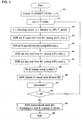
- FIG. 1 shows an exemplary DES encryption process of the invention.
- a transformed key is obtained, similarly encoded as K1, K2, K1P, and K2P. If the message and key are not available in this form, they are converted thereto.
- key and message update processes are performed.
- a failure counter C is incremented and checked against a threshold value. If the threshold is reached, the operation fails and terminates. Otherwise, the input parameters for the key (K1, K2, K1P, K2P) and message (M1, M2. M1P, M2P) are updated.
- the update process consists of two basic operations: reordering and randomizing. Reordering updates the positions of data bit and permutation entries. Exchanging pairs of elements in K1P (or K2P) and the complementary pair of bits in K1 (or K2) does not change the effective value of the message but does reorder its encoding. Randomizing blinds the data bit values, in this embodiment through an XOR operation.
- the PC1 I permutation which is a part of the standard DES algorithm, is applied to the input key.
- the permutation operation can be applied by manipulating only the permutation tables themselves (K1P and K2P) and do not necessarily need to involve the data.
- K1P and K2P keys that will be used often may be stored with this permutation already applied.
- PC2 can also be applied at this step to simplify the permutation operation required in each round by enabling the combining of PC2 with the shift operations. (The remaining 8 unused key bits are stored to the right of the 48 output bits of PC2 to maintain the 56 bit key length.)
- additional reordering or randomizing of the key (as was performed at step 110) can be performed.
- the round counter is initialized to zero.
- the key and message parameters are updated, as in step 110.
- the round key is prepared by permuting the key (K1, K2. K1P. K2P) to separate the 6 key bits required for each of the 8 S operations. If the PC 1 step above is optimized, this step combines the round key left rotates (or right key rotates when decrypting) and PC2 operation in a single 56-to-56 permutation. The complete permutation performed is equivalent to performing PC2 inverse, followed by the round rotate operation, followed by a PC2 forward permutation. As noted previously, the encoding for the round subkey places the 48 key bits used in the round operation at the left of the key register, and places the remaining 8 (unused) key bits at the right.
- the number of shifts is a function of the round: rounds 0, 1, 8, and 15 - or 1, 2, 9, and 16 if numbering with round 1 as the first round - have one shift; the others have two.
- a different permutation operation or an extra permutation operation is used in rounds with two shifts.
- additional reordering or randomizing of the key may be performed at this step. (If decrypting, this step can be performed after the S table lookups, or the PC1 permutation step will need to be adjusted to compensate for applying this permutation before the S lookups. Also, as noted, the PC2/rotate key permutation needs to incorporate a rotate to the right.)
- the round operations are performed, as detailed in FIG. 2 .
- the device produces a random S_ORDER_PERM[0...7] containing 8 elements with the values 0...7 in random order.
- the loop counter i is initialized to zero.
- step 230 using the permutation M1P for bit selection, the six input bits from M1 corresponding to the current S operation are extracted and XORed onto q.
- the six bit extraction and XOR operations are performed in random order.
- the selected bits correspond to the group of six bits selected by the E expansion operation for the current S index. Bits are placed in q in the order specified by S_INPUT_PERM[j].
- Step 235 is similar to step 230, except that the appropriate six bits of M2 are selected using M2P.
- step 240 using the permutation K1P for bit selection, the six key bits input into the S operation are selected from K1.
- the six bit extraction and XOR operations are performed in random order.
- the selected bits correspond to the six key bits used in the current S operation of the current round. (If the key permutations performed previously at steps 120 and 140 of FIG. 1 place the round's PC2 permutation results as adjacent bits in M1P, then j is used as an index to the appropriate block of six bits in KIP.) Bits are placed in q in the order specified by S_INPUT_PERM[j]. Step 245 is similar to step 240. except that the appropriate six bits of K2 are selected using K2P.
- the S table entry may be updated by XORing the left and right halves of the S table entry with a random 4-bit constant, permuted according to the inverse of the S_OUTPUT_ORDER permutations for the left and right half of the S result.
- step 270 the loop counter i is incremented.
- step 275 i is checked to determine whether more of the round's 8 S table lookups need to be performed. If so, processing continues at step 210.
- step 280 the value of S_OUTPUT_MASK is XORed onto M2 (of course, adjusted according to M2P). Also at step 280, the right and left halves of the data are exchanged in M1, M1P. Note that the exchange may be implemented as a bit permutation which, as described previously, can be accomplished by only changing M1P. Similarly, the left and right halves of M2, M2P are exchanged. Additional reordering or randomizing of the message, for example as described at step 110 of FIG. 1 , is recommended at this point. Finally, updates to the S_TABLE are performed as was described in the previous section, "Leak-Minimizing DES: Initialization and S Updates". At step 290, the process of FIG. 2 completes.
- step 150 the round counter is incremented.
- step 155 the round counter value is checked to determine whether all 16 rounds have been completed. If rounds remain, processing continues at step 135.
- the final permutation is performed on the message at step 160.
- the permutation operation can be applied by only manipulating the permutation tables themselves (M1P and M2P) and do not necessarily need to involve the data.
- additional reordering or randomizing of the data may be performed.
- the result contained in (M1, M2, M1P, M2P) is returned. If the result is non-secret (e.g., ciphertext), the standard DES ciphertext is produced by computing M1P ⁇ M1 ⁇ XOR M2P ⁇ M2 ⁇ .
- the S tables and associated parameters are updated.
- the rate and frequency at which updates are performed is a design parameter that depends on several factors. For example, table updates take time, particularly if the device's memory updates are slow, so less frequent table updates may be desirable for some high-performance implementations.
- the lifetime of the device's memory may also require that the update rate be limited. For example, EEPROM memories may fail if they are updated too many times.
- devices with higher leakage rates may need to have their tables updated more often. For example, by using multiple redundant tables or splitting operands into more than two parts, effective leakage rates are reduced, and the table update rates can decrease.
- the device's security requirements can dictate the update frequency (e.g., more frequent updates can make attacks more difficult).
- DES is often strengthened using the triple DES construction, whereby three DES operations are performed on each data block.
- Leak minimizing triple DES may be implemented using three iterations of leak-minimizing single DES.
- the two components comprising the first DES output may be used directly as the input to the second DES operation, and the second DES output components may be used directly as the input to the third DES operation.
- the final permutation on the first and second DES operations is unnecessary if the initial permutation is omitted on the second and third DES operations.
- DES-X is known in the background art and is occasionally used as a way to strengthen DES against brute force attacks.
- DES-X involves XORing the plaintext with a 64-bit secret value (KX), using the normal DES algorithm with a secret DES key (KY) to encrypt the XOR result, and XORing the DES result with a third secret value (KZ).
- KX 64-bit secret value
- KY secret DES key
- KZ secret value
- the XOR secrets KX and KZ
- KZ can, for example, be stored as two components each (KX1, KX2 and KZ1, KZ2).
- KX1 is XORed onto one of the message halves (e.g., M1 with permutation through MP1) and KX2 onto the other.
- the DES operation is performed using a leak-minimizing implementation.
- the message result halves are XORed with KZ1 and KZ2.
- KX1 and KX2. or KZ1 and KZ2 a random number is produced and XORed onto both.
- XOR key components can optionally have associated permutations.
- Cryptographic operations should normally be checked to ensure that incorrect computations do not compromise keys or enable other attacks.
- Cryptographic implementations of the present invention can be, and in a preferred embodiment of the invention are, combined with error-detection and/or error-correction logic to ensure that cryptographic operations are performed correctly.
- a simple and effective technique is to perform cryptographic operations twice, ideally using two independent hardware processors and implementations, with a comparator to verify that both produce identical results. If the results produced by the two units do not match, the comparator will prevent the defective processing result from being used. In situations where security is more important than reliability, the comparator may make the device self-destruct if serious errors occur.
- the comparator can cause a self-destruct if the two defective DES operations occur sequentially or once five defective DES results occur during the lifetime of the device.
- redundancy is not necessary.
- self-checking functions can be incorporated into the cryptosystem implementation itself or verification can be performed after the operations.
- the message bits can be stored in 128-bit arrays where the bits are intermingled (as opposed to having separated halves), keys can be manipulated in 64-bit form instead of 56-bit form, orderings can be reversed or permuted (including in ways that do not change the final result of the computation).
- other bit operations can be applied.
- other splitting and/or blinding functions can be used.
- permutation tables can be eliminated while maintaining randomness in table orders by encoding tables such that XORing with a mask (or applying another index unmasking function) yields the final pointer to the data.
Landscapes
- Engineering & Computer Science (AREA)
- Computer Security & Cryptography (AREA)
- Computer Networks & Wireless Communication (AREA)
- Signal Processing (AREA)
- Storage Device Security (AREA)
Applications Claiming Priority (2)
| Application Number | Priority Date | Filing Date | Title |
|---|---|---|---|
| US8782698P | 1998-06-03 | 1998-06-03 | |
| EP99951367.4A EP1090480B1 (de) | 1998-06-03 | 1999-06-03 | Verbesserungen zu des und anderen kryptographischen verfahren mit leckminimisierung für chipkarten und andere kryptosysteme |
Related Parent Applications (3)
| Application Number | Title | Priority Date | Filing Date |
|---|---|---|---|
| EP99951367.4 Division | 1999-06-03 | ||
| EP99951367.4A Division EP1090480B1 (de) | 1998-06-03 | 1999-06-03 | Verbesserungen zu des und anderen kryptographischen verfahren mit leckminimisierung für chipkarten und andere kryptosysteme |
| EP99951367.4A Division-Into EP1090480B1 (de) | 1998-06-03 | 1999-06-03 | Verbesserungen zu des und anderen kryptographischen verfahren mit leckminimisierung für chipkarten und andere kryptosysteme |
Publications (2)
| Publication Number | Publication Date |
|---|---|
| EP1933496A2 true EP1933496A2 (de) | 2008-06-18 |
| EP1933496A3 EP1933496A3 (de) | 2012-06-13 |
Family
ID=39399165
Family Applications (1)
| Application Number | Title | Priority Date | Filing Date |
|---|---|---|---|
| EP08006143A Withdrawn EP1933496A3 (de) | 1998-06-03 | 1999-06-03 | Verbessertes DES und andere kryptographische Verfahren mit Verlustminimierung für Chipkarten und andere Verschlüsselungssysteme |
Country Status (1)
| Country | Link |
|---|---|
| EP (1) | EP1933496A3 (de) |
Cited By (2)
| Publication number | Priority date | Publication date | Assignee | Title |
|---|---|---|---|---|
| CN105025037A (zh) * | 2015-08-14 | 2015-11-04 | 武汉天喻信息产业股份有限公司 | 抗cpa攻击的密文分组链接模式mac算法的实现方法 |
| US9773111B2 (en) | 2012-08-14 | 2017-09-26 | Empire Technology Development Llc | Software-based side-channel attack prevention |
Family Cites Families (1)
| Publication number | Priority date | Publication date | Assignee | Title |
|---|---|---|---|---|
| NL8901323A (nl) * | 1989-05-26 | 1990-12-17 | Nederland Ptt | Werkwijze voor het vercijferen van een reeks telkens uit tenminste een symbool bestaande boodschappen. |
-
1999
- 1999-06-03 EP EP08006143A patent/EP1933496A3/de not_active Withdrawn
Non-Patent Citations (6)
| Title |
|---|
| BRUCE SCHNEIER, APPLIED CRYPTOGRAPHY |
| BRUCE SCHNEIER: "Applied Crvptography", 1996, WILEY AND SONS, INC. |
| E. BIHAM; A. SHAMIR: "Advances in Cryptology - CRYPTO", vol. 97, 1997, SPRINGER-VERLAG, article "Differential Fault Analysis of Secret Key Cryptosystems", pages: 513 - 525 |
| MENEZES ET AL.: "the Handbook of Applied Cryptography", 1997, CRC PRESS, INC. |
| MENEZES, THE HANDBOOK OF APPLIED CRYPTOGRAPHY |
| P. KOCHER: "Advances in Crvptology - CRYPTO", vol. 96, SPRINGER-VERLAA, article "Timing Attacks on Implementations of Diffie-Hellman, RSA. DSS, and Other Systems", pages: 104 - 113 |
Cited By (3)
| Publication number | Priority date | Publication date | Assignee | Title |
|---|---|---|---|---|
| US9773111B2 (en) | 2012-08-14 | 2017-09-26 | Empire Technology Development Llc | Software-based side-channel attack prevention |
| CN105025037A (zh) * | 2015-08-14 | 2015-11-04 | 武汉天喻信息产业股份有限公司 | 抗cpa攻击的密文分组链接模式mac算法的实现方法 |
| CN105025037B (zh) * | 2015-08-14 | 2018-08-21 | 武汉天喻信息产业股份有限公司 | 抗cpa攻击的密文分组链接模式mac算法的实现方法 |
Also Published As
| Publication number | Publication date |
|---|---|
| EP1933496A3 (de) | 2012-06-13 |
Similar Documents
| Publication | Publication Date | Title |
|---|---|---|
| EP1090480B1 (de) | Verbesserungen zu des und anderen kryptographischen verfahren mit leckminimisierung für chipkarten und andere kryptosysteme | |
| CN100390695C (zh) | 更少信息泄露的设备与方法 | |
| EP1084543B1 (de) | Verwendung von unvorhersagbarer Information zur Leckminimierung von chipkarten und anderen Kryptosystemen | |
| US9940772B2 (en) | Payment smart cards with hierarchical session key derivation providing security against differential power analysis and other attacks | |
| US20040025032A1 (en) | Method and system for resistance to statiscal power analysis | |
| US7194633B2 (en) | Device and method with reduced information leakage | |
| US8296577B2 (en) | Cryptographic bus architecture for the prevention of differential power analysis | |
| US20150052368A1 (en) | Differential power analysis - resistant cryptographic processing | |
| Daemen et al. | Bitslice ciphers and power analysis attacks | |
| HK1116961A (en) | Improved des and other cryptographic processes with leak minimization for smartcards and other cryptosystems | |
| EP1926241A2 (de) | Verwendung von unvorhersagbarer Information zur Leckminimierung von Chipkarten und anderen Kryptosystemen | |
| AU2002348963A1 (en) | Device and method with reduced information leakage | |
| CA2397615A1 (en) | Method and system for resistance to statistical power analysis | |
| HK1150479B (en) | Using unpredictable information to resist discovery of secrets by external monitoring | |
| HK1117291A (en) | Using unpredictable information to minimize leakage from smartcards and other cryptosystems |
Legal Events
| Date | Code | Title | Description |
|---|---|---|---|
| PUAI | Public reference made under article 153(3) epc to a published international application that has entered the european phase |
Free format text: ORIGINAL CODE: 0009012 |
|
| AC | Divisional application: reference to earlier application |
Ref document number: 1090480 Country of ref document: EP Kind code of ref document: P |
|
| AK | Designated contracting states |
Kind code of ref document: A2 Designated state(s): AT BE CH CY DE DK ES FI FR GB GR IE IT LI LU MC NL PT SE |
|
| AX | Request for extension of the european patent |
Extension state: AL LT LV MK RO SI |
|
| REG | Reference to a national code |
Ref country code: HK Ref legal event code: DE Ref document number: 1116961 Country of ref document: HK |
|
| RIN1 | Information on inventor provided before grant (corrected) |
Inventor name: KOCHER, PAULC/O CRYPTOGRAPHY RESEARCH, INC. Inventor name: JUN, BENJAMIN Inventor name: JAFFE, JOSHUA |
|
| RIC1 | Information provided on ipc code assigned before grant |
Ipc: H04L 9/06 20060101AFI20120119BHEP |
|
| PUAL | Search report despatched |
Free format text: ORIGINAL CODE: 0009013 |
|
| AK | Designated contracting states |
Kind code of ref document: A3 Designated state(s): AT BE CH CY DE DK ES FI FR GB GR IE IT LI LU MC NL PT SE |
|
| AX | Request for extension of the european patent |
Extension state: AL LT LV MK RO SI |
|
| RIC1 | Information provided on ipc code assigned before grant |
Ipc: H04L 9/06 20060101AFI20120508BHEP |
|
| 17P | Request for examination filed |
Effective date: 20121213 |
|
| AKX | Designation fees paid |
Designated state(s): AT BE CH CY DE DK ES FI FR GB GR IE IT LI LU MC NL PT SE |
|
| 17Q | First examination report despatched |
Effective date: 20160304 |
|
| RAP1 | Party data changed (applicant data changed or rights of an application transferred) |
Owner name: CRYPTOGRAPHY RESEARCH, INC. |
|
| RIN1 | Information on inventor provided before grant (corrected) |
Inventor name: JAFFE, JOSHUA Inventor name: KOCHER, PAUL Inventor name: JUN, BENJAMIN |
|
| REG | Reference to a national code |
Ref country code: HK Ref legal event code: WD Ref document number: 1116961 Country of ref document: HK |
|
| STAA | Information on the status of an ep patent application or granted ep patent |
Free format text: STATUS: THE APPLICATION IS DEEMED TO BE WITHDRAWN |
|
| 18D | Application deemed to be withdrawn |
Effective date: 20191023 |