EP1935549A2 - Dispositif et procédé de soudage par résistance - Google Patents
Dispositif et procédé de soudage par résistance Download PDFInfo
- Publication number
- EP1935549A2 EP1935549A2 EP07024502A EP07024502A EP1935549A2 EP 1935549 A2 EP1935549 A2 EP 1935549A2 EP 07024502 A EP07024502 A EP 07024502A EP 07024502 A EP07024502 A EP 07024502A EP 1935549 A2 EP1935549 A2 EP 1935549A2
- Authority
- EP
- European Patent Office
- Prior art keywords
- sheet
- resistance
- resistance welding
- welding device
- type
- Prior art date
- Legal status (The legal status is an assumption and is not a legal conclusion. Google has not performed a legal analysis and makes no representation as to the accuracy of the status listed.)
- Ceased
Links
- 238000003466 welding Methods 0.000 title claims abstract description 92
- 238000000034 method Methods 0.000 title claims abstract description 87
- 229910052751 metal Inorganic materials 0.000 claims abstract description 19
- 239000002184 metal Substances 0.000 claims abstract description 19
- 230000008569 process Effects 0.000 claims description 40
- 239000000463 material Substances 0.000 claims description 9
- 238000010438 heat treatment Methods 0.000 claims description 7
- 238000012545 processing Methods 0.000 claims description 5
- 238000004364 calculation method Methods 0.000 claims description 2
- 230000003247 decreasing effect Effects 0.000 claims 1
- 238000003825 pressing Methods 0.000 claims 1
- 229910000831 Steel Inorganic materials 0.000 description 16
- 239000010959 steel Substances 0.000 description 16
- 238000011161 development Methods 0.000 description 7
- 230000018109 developmental process Effects 0.000 description 7
- 238000012360 testing method Methods 0.000 description 7
- 229910001335 Galvanized steel Inorganic materials 0.000 description 5
- 239000008397 galvanized steel Substances 0.000 description 5
- 0 *CCCC1*CCCC1 Chemical compound *CCCC1*CCCC1 0.000 description 4
- 229910000712 Boron steel Inorganic materials 0.000 description 3
- 230000008859 change Effects 0.000 description 3
- 238000001514 detection method Methods 0.000 description 3
- 238000011156 evaluation Methods 0.000 description 3
- 238000005259 measurement Methods 0.000 description 3
- 230000006978 adaptation Effects 0.000 description 2
- 230000002411 adverse Effects 0.000 description 2
- 238000010276 construction Methods 0.000 description 2
- 230000005611 electricity Effects 0.000 description 2
- 230000008439 repair process Effects 0.000 description 2
- HCHKCACWOHOZIP-UHFFFAOYSA-N Zinc Chemical compound [Zn] HCHKCACWOHOZIP-UHFFFAOYSA-N 0.000 description 1
- 230000002776 aggregation Effects 0.000 description 1
- 238000004220 aggregation Methods 0.000 description 1
- 229910052782 aluminium Inorganic materials 0.000 description 1
- XAGFODPZIPBFFR-UHFFFAOYSA-N aluminium Chemical compound [Al] XAGFODPZIPBFFR-UHFFFAOYSA-N 0.000 description 1
- 238000013459 approach Methods 0.000 description 1
- 230000008901 benefit Effects 0.000 description 1
- 239000011248 coating agent Substances 0.000 description 1
- 238000000576 coating method Methods 0.000 description 1
- 230000006378 damage Effects 0.000 description 1
- 230000007547 defect Effects 0.000 description 1
- 230000006866 deterioration Effects 0.000 description 1
- 230000004069 differentiation Effects 0.000 description 1
- 238000002847 impedance measurement Methods 0.000 description 1
- 230000006698 induction Effects 0.000 description 1
- 238000012067 mathematical method Methods 0.000 description 1
- 150000002739 metals Chemical class 0.000 description 1
- 238000013386 optimize process Methods 0.000 description 1
- 238000003856 thermoforming Methods 0.000 description 1
- 229910052725 zinc Inorganic materials 0.000 description 1
- 239000011701 zinc Substances 0.000 description 1
Images




Classifications
-
- B—PERFORMING OPERATIONS; TRANSPORTING
- B23—MACHINE TOOLS; METAL-WORKING NOT OTHERWISE PROVIDED FOR
- B23K—SOLDERING OR UNSOLDERING; WELDING; CLADDING OR PLATING BY SOLDERING OR WELDING; CUTTING BY APPLYING HEAT LOCALLY, e.g. FLAME CUTTING; WORKING BY LASER BEAM
- B23K11/00—Resistance welding; Severing by resistance heating
- B23K11/24—Electric supply or control circuits therefor
- B23K11/25—Monitoring devices
- B23K11/252—Monitoring devices using digital means
- B23K11/256—Monitoring devices using digital means the measured parameter being the inter-electrode electrical resistance
Definitions
- the invention relates to a resistance welding device, a method for joining components, in particular for resistance welding, and a method for determining the type of a sheet metal.
- Welding methods in particular resistance welding methods are known.
- resistance welding the components to be connected are traversed by electric current and melted by resistance heating in the welding zone.
- the invention relates to spot welding, which serves for the point-to-point connection of sheets and wherein the current is supplied via pressure electrodes.
- the subject of the invention can also be used for seam welding.
- the invention can also be extended to other thermal welding methods, such as induction welding or ultrasonic welding.
- Process parameters are understood as meaning, in particular, the current intensity, the course of the current intensity, the applied welding voltage, the voltage / current profile, in particular individual or intermittent current / voltage surges, the pressure exerted by the electrodes on the components, etc.
- the sheets should be heated to such an extent that a weld nugget or, in the case of seam welding, a weld forms.
- spot welding as the lower limit is a diameter of the spot weld of about 4 ⁇ ⁇ t, where t is the plate thickness, as yet considered sufficient.
- Too low a welding current or too short a process time usually leads to an insufficient connection of the components, whereas in particular an excessively high amperage or a too small contact pressure can lead to splashes.
- the welder In order to be able to join these new sheets, the welder must know the type, for example the designation, the quality, the surface coating etc. of the sheet, in order to adapt the process parameters accordingly. For example, multiphase steels are less weldable, as is the case with conventional soft deep-drawn sheets, because the high- and high-strength sheets have a reduced welding area, within which the welding process is considered to be proper.
- the welder usually has no information on the process parameters and therefore either has to carry out complex test welds, which results in the destruction of test components, or he uses process parameters which refer to soft deep-drawn sheets, which can lead to welding defects, especially in the case of ultra-high strength sheets.
- German patent DE 103 34 478 B4 shows a method and apparatus for resistance welding, wherein in a test phase, a process impedance is determined and compared with a target impedance. When a set impedance is exceeded, a preheating phase is initiated, in which the sheets are burned free and thus prepared for setting the welding point.
- this method does not allow adjustment of the process parameters on certain types of sheet.
- the method for resistance welding described in this document can even lead to a significant deterioration in the quality of the welding point, especially in the case of ultra-high strength sheets, because it can lead to an excessive energy input, which adversely affects the material properties.
- the invention is based on the object to reduce the mentioned disadvantages of the prior art.
- Another object of the invention is to provide a resistance welding device, which allows a largely automatic adjustment of the process parameters.
- the object of the invention is already achieved by a resistance welding device, a method for joining components and a method for determining the type of a sheet according to one of the independent claims.
- the invention comprises a resistance welding device which has at least two electrodes for resistance welding.
- the invention relates to a spot welder, but also roller seam welders are the subject of the invention.
- the welder may be a 50 Hz AC welder, a welder with a DC source, or a medium frequency inverter power source.
- the resistance welding device has means to record and / or display an impedance curve of at least one sheet to be welded.
- an impedance curve is usually understood the course of the impedance in a given time interval.
- the impedance curve can be determined by a quotient of current and voltage. In the simplest case voltage and current curves can be divided with each other.
- the means for displaying the impedance curve preferably comprise a display and / or a printer.
- the means for recording the impedance curve preferably comprise a data memory.
- the voltage curve does not necessarily have to be measured directly at the electrode tip, but can also be measured, for example, at the electrode connection in the welding device itself. Although this may due to the inductances of the welding guns to a change in the impedance curve However, the possibility of determining the type of sheet is thereby not adversely affected.
- the welder can use a manual and compare the impedance curve on the workpiece with the printed reference impedance runs.
- the reference impedance curves can also be stored in the device itself, as provided in a special object of the invention, and also be displayed on a display, for example, for a quick comparison.
- the invention relates to a resistance welding apparatus and a method for determining the type of a sheet to be welded, wherein an impedance curve is recorded, which is compared with Referenzimpedanzvertrainn and so the type of a sheet to be welded is determined.
- the recorded and stored or output impedance curves can be used directly for the evaluation or compared with reference impedance curves, for example in a present in paper manual.
- an automatic processing is ideally enabled, so that the device itself recognizes what type of sheet it is or the welder on the basis of a comparison of the measured impedance curve with difference-impedance curves makes suggestions as to what type of sheet it might be.
- processing for example, by a microcontroller can be done either in the device itself or in a microcontroller connected to the device, which is then part of the resistance welding device within the meaning of the invention.
- the determination of a sheet metal type is preferably carried out automatically by comparing reference impedance profiles with the measured impedance profile.
- the comparison of reference impedance profiles with the measured impedance profile is performed in such a way that the reference or coordinate system of the curve of the measured impedance profile is divided into a limited number of fields.
- a classification is understood, which characterizes a welded sheet genus. Different graduations are conceivable, for example, as a rough classification, soft deep-drawn sheets, multiphase "aluminum sheets, coated steel sheets, etc.
- the invention also allows the differentiated differentiation of various steel sheets, especially of drill steel, complex phase steels, Dual-phase steels etc ..
- the resistance welding device according to the invention is particularly suitable for processing high-strength and ultra-high-strength steels.
- the resistance welding device has means for measuring the electrode spacing.
- the sheet thickness is an important material size for setting the process parameters of the welding process. By measuring the electrode spacing, the sheet thickness does not have to be measured and entered manually, but can be determined by means of the welding tongs, which makes it possible, in particular with automatic adjustment of the process parameters, to omit manual inputs.
- the resistance welding device further comprises means for measuring the contact pressure of the electrodes.
- the contact pressure of the electrodes also greatly influences the impedance curve. If the contact pressure is taken into account when determining the type of sheet, a higher accuracy of the measurement is possible. Furthermore, even if the contact force of the electrodes is too low, the device can output an error message and cause the welder to change the contact force.
- the resistance welding device has a data memory in which process parameters such as, in particular, welding current and welding time for the processing of a plurality of sheet types, sheet metal combinations and / or sheet thicknesses can be stored. This makes it possible, solely by the Input of sheet thickness and sheet type for each sheet optimized process parameters to select. The resistance welder then selects the appropriate process parameters for the set sheet metal combination. In an automatic determination of the sheet types and thicknesses even no manual intervention is required.
- the invention further relates to a method for joining components, in particular for resistance welding, wherein the method is preferably carried out by means of a resistance welding device according to the invention.
- a voltage is applied at least on a part to be joined by means of two electrodes, so that a current flows, which leads at least to a heating of the part to be joined.
- a current-time and / or voltage-time profile is measured, via which the resistance or impedance profile of the component can be determined.
- Material properties of the component to be joined, in particular the type of component to be joined, can be determined via the current-time and / or voltage-time profile, in particular via an impedance curve determined thereupon.
- the process parameters of the joining process can be determined.
- the process parameters include, in particular, the current-time profile.
- the most important factor in setting welding spots is the energy that is supplied to the spot weld.
- the process parameters include pulsing the welding current to achieve optimum results.
- the resistance profile in particular the impedance curve, is preferably displayed on a screen.
- the thickness of the component or components is measured. These thicknesses, in particular sheet thicknesses, are then taken into account in the determination of the process parameters.
- the components to be joined are brought into the final welding position. Then it is preferably applied by means of the electrodes of a spot welder voltage to both components to be joined. It is therefore not included in the impedance curve of the individual sheets in advance, but it is an impedance curve of the two or more components, in particular during the welding, determined.
- a microcontroller it is provided to close the resistance profile of the two or more components on the resistance profile of the individual components, in particular of the individual sheets.
- This approach has the advantage that can be dispensed with a single testing of both sheets and so the Method can be applied directly to the weld.
- the calculation of the impedance profiles of the individual components preferably takes place again taking into account reference resistance characteristics.
- a voltage is preferably applied, which leads to a current which heats the part to be joined between the electrodes to at least 300 ° C.
- test point can both sit at a point at which a weld point is to be set, as well as at any other point of the sheet.
- the invention relates to a method for determining the type of sheet in which by means of at least two electrodes, a voltage is applied to the sheet, so that flows through the sheet, a current that leads at least to a heating of the sheet, the resistance profile is measured at least in sections during the voltage application and then the type of sheet is determined by a comparison with ReferenzwiderstandsverInstitutn.
- the method of determining a sheet may be combined with any of the features of the component joining method or the resistance safety apparatus described above.
- the current source used is preferably the standard current source of the resistance welding device. Alternatively, special measuring current sources are provided. It is flowed through the sheet to be tested, a current which is preferably more than 1 kA.
- two sheets which are to be welded in particular, can be tested. Since such an impedance profile of both connected in series sheets is obtained, an electronic evaluation is then usually required.
- a resistance welding device 1 which comprises two electrodes 2.
- a spot welding connection is to be set, with which the sheets 3 and 4 are connected.
- the electrodes 2 are not yet placed on the sheets 3, 4 in the illustration A.
- a first step B the electrodes 2 are placed on the upper sheet 3. Then, a voltage is applied, so that a current flows, which heats the sheet 3. Preferably, however, no current is selected which leads to such a high level of heating that the sheet changes its state of aggregation at the welding point.
- a voltage is applied, so that a current flows, which heats the sheet 3.
- no current is selected which leads to such a high level of heating that the sheet changes its state of aggregation at the welding point.
- the type of sheet 3 are determined (not shown).
- step C the second lower sheet 4 is tested accordingly, so also measured an impedance curve and determines the type of sheet.
- the process parameters of the joining process in the resistance welder 1 are set (not shown) and as shown in step D, the sheets 3, 4 are welded, so that a nugget 5 forms.
- Fig. 2 shows schematically the impedance curves of different types of steel.
- the x-axis 6 is the time in which current flows, again, whereas the y-axis 7 represents the impedance.
- Curve 9 shows the typical impedance curve of an uncoated soft deep drawing steel.
- the hot-dip galvanized steel sheet 8 has a lower impedance than the thermoforming sheet 9.
- the impedance drop in the initial phase is particularly pronounced in the hot-dip galvanized steel sheet, since the zinc has a very good heat conduction.
- the high-strength drill steel 10 has a much higher impedance and the drop in impedance during heating of the sheet is much flatter.
- a relatively simple automatic determination of the sheet can, for example, by classification of in Fig. 2 Coordinate system shown in boxes (not shown) take place.
- the curves 8, 9 and 10 go through different fields because of their different course, whereby an automatic detection is possible.
- the fields need not be regularly distributed, but it is sufficient to set fields at characteristic points of the impedance curve.
- the sheet type can be determined. If the curve then runs through the field 30, then it is soft deep-drawing steel. If the curve passes on the right side of the field, then it is a high-strength boron steel, while it is a hot-dip galvanized steel when the curve on the left passes the field 30.
- the current for picking up the impedance curve can also be adapted to the sheet thickness so as not to overly load energy into the sheet during the test phase entered.
- the sheet thickness is an important criterion for the shape of the curve.
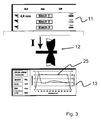
- the electrodes are placed on the one sheet and it flows a current 12th
- an impedance characteristic is also output on the resistance welding device in a display.
- the current profile 25 is indicated on the display. This serves as a control that sufficient contact of the electrodes was present throughout the measurement.
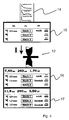
- reference impedance curves 14 can then be displayed, which compares the welder with the measured impedance curve 13 and thus determines the type of sheet to be welded.
- the welder selects a soft deep-drawing sheet 15 as the first sheet.
- a third sheet can also be tested and selected 17.
- the resistance welding device adapts the process parameters of the welding process itself on the basis of the sheet thicknesses and on the basis of the sheet types entered, that is to say the welder does not need to select current intensity, current profile and current duration.
- a to C The individual process steps are labeled A to C.
- a resistance welding device 1 with two electrodes 2 is provided in order to weld two sheets 3, 4 to be welded by a point connection.
- the impedance curve of a single sheet to be tested is not recorded here in step B, but the electrodes 2 are placed directly on the weld and the impedance curve of both sheets is thus recorded.
- the resistance welding device 1 which preferably has means for measuring the electrode spacing (not shown), can now perform an automatic adaptation of the process parameters, and in step C, a weld nugget 5 is melted. In this case, the electrodes 2 of the resistance welding device 1 need not be lifted off the weld.
- the energy which has already been introduced into the sheet by the impedance measurement is preferably taken into account, that is, if the electrodes are not lifted off again, less energy is supplied to the sheet.
- a metal sheet is clamped between the electrodes 18. Thereafter, a voltage is applied to the electrodes, so that a current flows 19.
- an impedance curve is determined and displayed 20.
- the indicated impedance curve is compared with reference impedance curves 21 and determined by the comparison sheet type 22. After determining the type of the first sheet then a second or further sheet can be clamped and be started again at step 18.
- the appropriate process parameters are either manual or automatically selected 23 and then performed the welding process with the selected process parameters 24.
- the invention thus enables, in particular during repair welding, a precise adaptation of the process parameters to the types of sheet metal to be welded. It is not necessary that the welder knows the type of sheets used.
Landscapes
- Engineering & Computer Science (AREA)
- Mechanical Engineering (AREA)
- Resistance Welding (AREA)
Applications Claiming Priority (1)
| Application Number | Priority Date | Filing Date | Title |
|---|---|---|---|
| DE102006060197A DE102006060197A1 (de) | 2006-12-18 | 2006-12-18 | Vorrichtung und Verfahren zum Widerstandsschweißen |
Publications (2)
| Publication Number | Publication Date |
|---|---|
| EP1935549A2 true EP1935549A2 (fr) | 2008-06-25 |
| EP1935549A3 EP1935549A3 (fr) | 2010-10-20 |
Family
ID=39223057
Family Applications (1)
| Application Number | Title | Priority Date | Filing Date |
|---|---|---|---|
| EP07024502A Ceased EP1935549A3 (fr) | 2006-12-18 | 2007-12-18 | Dispositif et procédé de soudage par résistance |
Country Status (2)
| Country | Link |
|---|---|
| EP (1) | EP1935549A3 (fr) |
| DE (1) | DE102006060197A1 (fr) |
Cited By (1)
| Publication number | Priority date | Publication date | Assignee | Title |
|---|---|---|---|---|
| CN111055002A (zh) * | 2018-10-16 | 2020-04-24 | 罗伯特·博世有限公司 | 用于运行电阻焊接装置的装置和方法 |
Citations (1)
| Publication number | Priority date | Publication date | Assignee | Title |
|---|---|---|---|---|
| DE10334478B4 (de) | 2003-07-29 | 2006-04-13 | Adam Opel Ag | Verfahren und Vorrichtung zum Widerstandsschweißen |
Family Cites Families (7)
| Publication number | Priority date | Publication date | Assignee | Title |
|---|---|---|---|---|
| DE2010878C3 (de) * | 1970-03-07 | 1979-03-08 | Volkswagenwerk Ag, 3180 Wolfsburg | Verfahren zur Überwachung eines Widerstandspunk tschweißvorganges |
| FR2480651B1 (fr) * | 1980-04-21 | 1985-09-06 | Nissan Motor | Procede et systeme pour commander un soudage electrique par resistance |
| JPS571582A (en) * | 1980-06-02 | 1982-01-06 | Nissan Motor Co Ltd | Method for assessing quality of weld zone in resistance welding |
| JPH0815669B2 (ja) * | 1988-07-06 | 1996-02-21 | 日本電装株式会社 | 抵抗溶接用制御装置 |
| JPH0759351B2 (ja) * | 1992-06-10 | 1995-06-28 | 株式会社ナ・デックス | 溶接コントローラ |
| US6359249B1 (en) * | 1995-04-19 | 2002-03-19 | Dct, Inc. | No wat welding system |
| TW471987B (en) * | 2000-12-04 | 2002-01-11 | Essor Internat Inc | Spot welding quality monitoring device and its method |
-
2006
- 2006-12-18 DE DE102006060197A patent/DE102006060197A1/de not_active Withdrawn
-
2007
- 2007-12-18 EP EP07024502A patent/EP1935549A3/fr not_active Ceased
Patent Citations (1)
| Publication number | Priority date | Publication date | Assignee | Title |
|---|---|---|---|---|
| DE10334478B4 (de) | 2003-07-29 | 2006-04-13 | Adam Opel Ag | Verfahren und Vorrichtung zum Widerstandsschweißen |
Cited By (2)
| Publication number | Priority date | Publication date | Assignee | Title |
|---|---|---|---|---|
| CN111055002A (zh) * | 2018-10-16 | 2020-04-24 | 罗伯特·博世有限公司 | 用于运行电阻焊接装置的装置和方法 |
| CN111055002B (zh) * | 2018-10-16 | 2023-11-21 | 罗伯特·博世有限公司 | 用于运行电阻焊接装置的装置和方法 |
Also Published As
| Publication number | Publication date |
|---|---|
| EP1935549A3 (fr) | 2010-10-20 |
| DE102006060197A1 (de) | 2008-06-26 |
Similar Documents
| Publication | Publication Date | Title |
|---|---|---|
| EP2269760B1 (fr) | Procédé et dispositif de soudage destinés à déterminer la force du flux de soudage lors du soudage de dormants de récipient | |
| DE69531333T2 (de) | Verfahren zum automatischen Verbinden von galvanisierten Stahlblechen durch Punktschweissen | |
| DE3121497C2 (de) | Verfahren und Vorrichtung zur Qualitätsermittlung beim Widerstandsschweißen | |
| EP3030373B1 (fr) | Procédé et dispositif de soudage par résistance de tôles sandwich | |
| DE2555792A1 (de) | Verfahren zur qualitaetssicherung der schweissverbindungen beim elektrischen widerstandspunktschweissen | |
| EP1249298B1 (fr) | Procédé et appareil pour évaluer la qualité, contrôler et surveiller des procédés de soudage | |
| DE102012000462A1 (de) | Verfahren und Vorrichtung zur Kraftregulierung beim Wiederstandsschweißen | |
| DE2010878C3 (de) | Verfahren zur Überwachung eines Widerstandspunk tschweißvorganges | |
| DE102008028385A1 (de) | Mess- und Steuerverfahren zum Widerstandsschweißen | |
| EP0715555B1 (fr) | Procede permettant de determiner un intervalle de temps d'evaluation et procede permettant d'evaluer la qualite d'une soudure par points sur la base des variations de temperature pendant l'intervalle de temps d'evaluation | |
| WO2016016448A1 (fr) | Serre-flan, dispositif de soudage et procédé de surveillance de la présence et/ou de la qualité d'un assemblage | |
| DE102013216966A1 (de) | Erkennen von Schweißspritzern durch Widerstandsmessung | |
| EP1318886B1 (fr) | Procede et dispositif pour determiner les parametres d'une installation de soudage | |
| EP3138652B1 (fr) | Procédé de soudure électrique | |
| EP1935549A2 (fr) | Dispositif et procédé de soudage par résistance | |
| DE102008005113B4 (de) | Verfahren zur Sicherung der Schweißqualität von Schweißpunkten beim Widerstandspunktschweißen einer bestimmten Materialkombination | |
| DE10331617B4 (de) | Verfahren und Vorrichtung zur Erfassung und Überwachung der Eigenschaften von Komponenten oder Teilen im Sekundärstromkreis von Widerstandsschweißanlagen | |
| DE10334478B4 (de) | Verfahren und Vorrichtung zum Widerstandsschweißen | |
| EP1641587A1 (fr) | Procede et dispositif permettant d'obtenir des informations pour valuer la qualite d'une soudure par resistance et / ou pour commander ou reguler un procede de soudage par re sistance | |
| DE2315184B1 (de) | Verfahren zum Überwachen oder/und Regeln von elektrischen Widerstandsschweißvorgängen | |
| DE4203190C1 (en) | Regulation and quality assessing of welding esp. spot welding - has ultrasonic detecting probe attached to welding electrode to record noise emission level at weld location | |
| DE102011018653A1 (de) | Widerstands-Schweißvorrichtung | |
| EP0715556B1 (fr) | Procede et dispositif permettant de determiner la temperature d'une soudure par points et leur utilisation pour evaluer la qualite de ladite soudure par points | |
| EP1181127B1 (fr) | Procede de soudage electrique par resistance | |
| DE102004054856B4 (de) | Verfahren und Vorrichtung zum Bestimmen des elektrischen Widerstands eines Metallflachprodukts |
Legal Events
| Date | Code | Title | Description |
|---|---|---|---|
| PUAI | Public reference made under article 153(3) epc to a published international application that has entered the european phase |
Free format text: ORIGINAL CODE: 0009012 |
|
| AK | Designated contracting states |
Kind code of ref document: A2 Designated state(s): AT BE BG CH CY CZ DE DK EE ES FI FR GB GR HU IE IS IT LI LT LU LV MC MT NL PL PT RO SE SI SK TR |
|
| AX | Request for extension of the european patent |
Extension state: AL BA HR MK RS |
|
| PUAL | Search report despatched |
Free format text: ORIGINAL CODE: 0009013 |
|
| AK | Designated contracting states |
Kind code of ref document: A3 Designated state(s): AT BE BG CH CY CZ DE DK EE ES FI FR GB GR HU IE IS IT LI LT LU LV MC MT NL PL PT RO SE SI SK TR |
|
| AX | Request for extension of the european patent |
Extension state: AL BA HR MK RS |
|
| 17P | Request for examination filed |
Effective date: 20110331 |
|
| AKX | Designation fees paid |
Designated state(s): DE FR IT |
|
| 17Q | First examination report despatched |
Effective date: 20120329 |
|
| STAA | Information on the status of an ep patent application or granted ep patent |
Free format text: STATUS: THE APPLICATION HAS BEEN REFUSED |
|
| 18R | Application refused |
Effective date: 20141016 |