EP1936362A1 - Elément de test avec référencement - Google Patents
Elément de test avec référencement Download PDFInfo
- Publication number
- EP1936362A1 EP1936362A1 EP06026395A EP06026395A EP1936362A1 EP 1936362 A1 EP1936362 A1 EP 1936362A1 EP 06026395 A EP06026395 A EP 06026395A EP 06026395 A EP06026395 A EP 06026395A EP 1936362 A1 EP1936362 A1 EP 1936362A1
- Authority
- EP
- European Patent Office
- Prior art keywords
- reaction
- area
- analyte
- areas
- detection
- Prior art date
- Legal status (The legal status is an assumption and is not a legal conclusion. Google has not performed a legal analysis and makes no representation as to the accuracy of the status listed.)
- Granted
Links
Images

Classifications
-
- A—HUMAN NECESSITIES
- A61—MEDICAL OR VETERINARY SCIENCE; HYGIENE
- A61B—DIAGNOSIS; SURGERY; IDENTIFICATION
- A61B5/00—Measuring for diagnostic purposes; Identification of persons
- A61B5/145—Measuring characteristics of blood in vivo, e.g. gas concentration or pH-value ; Measuring characteristics of body fluids or tissues, e.g. interstitial fluid or cerebral tissue
- A61B5/1455—Measuring characteristics of blood in vivo, e.g. gas concentration or pH-value ; Measuring characteristics of body fluids or tissues, e.g. interstitial fluid or cerebral tissue using optical sensors, e.g. spectral photometrical oximeters
-
- A—HUMAN NECESSITIES
- A61—MEDICAL OR VETERINARY SCIENCE; HYGIENE
- A61B—DIAGNOSIS; SURGERY; IDENTIFICATION
- A61B5/00—Measuring for diagnostic purposes; Identification of persons
- A61B5/14—Devices for taking samples of blood ; Measuring characteristics of blood in vivo, e.g. gas concentration within the blood, pH-value of blood
-
- A—HUMAN NECESSITIES
- A61—MEDICAL OR VETERINARY SCIENCE; HYGIENE
- A61B—DIAGNOSIS; SURGERY; IDENTIFICATION
- A61B5/00—Measuring for diagnostic purposes; Identification of persons
- A61B5/145—Measuring characteristics of blood in vivo, e.g. gas concentration or pH-value ; Measuring characteristics of body fluids or tissues, e.g. interstitial fluid or cerebral tissue
- A61B5/14532—Measuring characteristics of blood in vivo, e.g. gas concentration or pH-value ; Measuring characteristics of body fluids or tissues, e.g. interstitial fluid or cerebral tissue for measuring glucose, e.g. by tissue impedance measurement
-
- G—PHYSICS
- G01—MEASURING; TESTING
- G01N—INVESTIGATING OR ANALYSING MATERIALS BY DETERMINING THEIR CHEMICAL OR PHYSICAL PROPERTIES
- G01N21/00—Investigating or analysing materials by the use of optical means, i.e. using sub-millimetre waves, infrared, visible or ultraviolet light
- G01N21/84—Systems specially adapted for particular applications
- G01N21/8483—Investigating reagent band
-
- G—PHYSICS
- G01—MEASURING; TESTING
- G01N—INVESTIGATING OR ANALYSING MATERIALS BY DETERMINING THEIR CHEMICAL OR PHYSICAL PROPERTIES
- G01N21/00—Investigating or analysing materials by the use of optical means, i.e. using sub-millimetre waves, infrared, visible or ultraviolet light
- G01N21/84—Systems specially adapted for particular applications
- G01N21/86—Investigating moving sheets
-
- G—PHYSICS
- G01—MEASURING; TESTING
- G01N—INVESTIGATING OR ANALYSING MATERIALS BY DETERMINING THEIR CHEMICAL OR PHYSICAL PROPERTIES
- G01N21/00—Investigating or analysing materials by the use of optical means, i.e. using sub-millimetre waves, infrared, visible or ultraviolet light
- G01N21/84—Systems specially adapted for particular applications
- G01N21/8483—Investigating reagent band
- G01N2021/8488—Investigating reagent band the band presenting reference patches
Definitions
- the analysis carried out after the lancing process is frequently carried out in a small, portable measuring device, a so-called "handheld device", in which blood-wetted test elements are analyzed.
- These handheld devices are particularly important in the diagnosis of diabetes disorders.
- the measurement in these devices is carried out mainly electrochemically or optically.
- the sample is illuminated with light and the reflected light detected to determine the analyte concentration.
- test elements such as test strips are used, which are wetted on a detection area, which is part of the test element, with the sample, such as blood or interstitial fluid.
- the sample then reacts with the reagents applied in or on the detection area. This can lead to a color change or even in an electrochemical reaction to changes in charge, which can then be detected.
- the wetted area of the detection area is optimally evaluated. This is possible in addition to the sufficient illumination and detection through the use of reference areas. Referencing can be done in different ways. Thus, a reference region separated from the detection region can be used, whereby technical effects such as properties of the light source or of the detector as well as certain properties of the test element can be compensated. To refer to the To make sample properties, the reference range should be similar to the detection area.
- a reflectometric system is used to determine light intensities of a colored spot using the surrounding area surrounding the spot for referencing.
- the disadvantage of this method is that the background signal for referencing is not wetted by the sample and therefore has different optical properties than the sample wetted area.
- the US patent number US 6,249,593 B1 describes a system for detecting an analyte on a test carrier.
- the analyte is bound to a receptor immobilized on the test carrier.
- a part of the test carrier that does not contain an immobilized receptor is used as a reference. Also in this document, determination of the analyte requires binding to an immobilized component.
- the object is to develop an analysis system for determining the concentration of an analyte, which does not require irreversible binding of the analyte to the test carrier.
- a system for determining the concentration of an analyte in a liquid by absorption measurement including a test element with a detection region containing at least one reaction region with reagents for detection of the analyte, which cause a change in the absorption behavior on reaction with the analyte, and the detection area at least one Reference range contains. Furthermore, the system includes a detection unit for spatially resolved detection of light intensities received from the detection area and an evaluation unit for evaluation of signals of the detection unit. The system is characterized in that the at least one reference region is such that the absorption behavior does not change substantially upon wetting.
- the detection area can take various forms. For example, it can be square or round. A preferred form of the detection area is square or rectangular. In this case, the detection area has a length and a width. The area spanned by the length and width has at least one reaction area as well as at least one reference area.
- the at least one reaction region differs from the at least one reference region in that there is essentially no change in the optical absorption behavior by the analyte in the reference region. This is preferably made possible by the fact that the reference region has no reagents which can react with the analyte. Another possibility for keeping the change in the absorption behavior in the at least one reference region as low as possible is to avoid the wetting of the at least one reference region with the sample.
- the non-contact of the sample with the reference region is achieved by the geometric arrangement of the reference region in relation to the reaction region.
- the reference region can also be arranged offset in height relative to the reaction region, so that the reference region is not brought into contact with sample when it is applied to the detection region.
- the reference area may be far enough away from the application position that the sample liquid does not come into contact with the reference area due to the selected distance between the reference area and the place of application can occur.
- liquid sample which has for example been taken up by a needle structure
- liquid sample is applied by targeted contacting of the detection area with the needle structure.
- targeted (e.g., automated) contacting of the detection area with the needle structure it can be achieved that only selected areas of the detection area come into contact with liquid.
- the sample comes into contact with both the reaction region and the reference region.
- the reaction area is like this ensure that the absorption behavior does not change substantially upon wetting.
- the minimal change in absorbance behavior in the reference ranges is due to the properties of the sample, which is added as a liquid (such as serum, blood or urine) to the detection area.
- properties include, for example, the refractive index, which changes on the detection area upon application of a liquid to the detection area, since the air displaced by the liquid has a different refractive index than the discontinued liquid.
- solid constituents or dyes as well as other constituents of the liquid sample are among the properties which influence the absorption behavior, without it being concluded that the presence of an analyte.
- the change in the absorption behavior in the reference region in this case has only a fraction of the absorption change due to the change in the analyte in the reagent region, it can be said that the adsorption behavior is essentially unchanged.
- the change in the absorption behavior in the reference ranges is not more than 30%, more preferably not more than 5%, particularly preferably not more than 1% of the original absorption.
- a plurality of reaction areas and a plurality of reference areas are alternately arranged in two dimensions. Alternating in two dimensions means that the detection area on the surface on which the reaction areas and the reference areas are arranged alternately has at least one reaction area and at least one reference area. This is independent of the plane from which is looked at the surface.
- the two dimensions span the base area of the detection area and the axes of the two dimensions are arranged at right angles to each other. As a result, at least one reaction area and at least one reference area are arranged both in the one dimension and in the second dimension.
- the individual areas can have different shapes and sizes.
- a reaction of the analyte with reagents for detecting the analyte takes place at least in the at least one reaction area.
- the optical absorption behavior of the wetted with sample liquid at least one reaction region changes.
- the reagents contain at least one enzyme, which is preferably immobilized on the detection area. Part of the reaction products of this enzymatic reaction may serve as an intermediate for a further enzymatic reaction, or an end product of the enzymatic reaction may itself alter the absorption behavior in the reaction region.
- a dye forms during the course of the reaction changed the absorption behavior of the reaction area.
- the change in optical absorption behavior occurs due to the reaction of the analyte with at least one reagent in the reaction region.
- the absorption at the irradiated wavelength can thereby increase or decrease.
- absorption increases because, in a preferred reaction, a dye is formed which absorbs light at the irradiated wavelength.
- the light that is reflected or transmitted by the detection area can be detected by means of a detector.
- the reference range in structure and behavior towards the analyte can be made very similar to the reaction range.
- the first three variants can ensure that the properties of the sample are taken into account during referencing, which increases the accuracy of the measurement results. These are particularly preferably used in systems which have the smallest possible test elements or detection areas, since the measurement signals in miniaturized systems are very small and thus error-prone. By referencing as identical as possible areas of the detection area, in which both irregularities of the test element and the sample are taken into account, the sample amount can be very small in order to be evaluated with sufficient accuracy.
- the arrangement and / or shape of the reagent and the reference regions can be chosen randomly or evenly.
- the reaction and reference regions have different sizes, more preferably the at least one reference region is smaller than the at least one reaction region.
- a plurality of reagent and reference regions are regularly arranged. Reaction and reference regions may have the same size and / or the same volume. In order to be able to evaluate the smallest possible sample volumes, the area of the reaction and reference regions should be as small as possible. Since the detection area is only a few square millimeters in size, the preferred area of reaction or reference areas is also a few square millimeters.
- the smallest possible size of a detection area depends on the one hand on the choice of the production method for the reaction and reference area and on the other hand on the accuracy of the detection. If a high-resolution detection system is used, very small areas can be visually distinguished.
- the area of the reaction or reference region is ⁇ 1 mm 2 .
- at least a part of a reaction area and a part of a reference area should be wetted with the sample. The smaller the ranges chosen, the less sample liquid is needed to detect the analyte, to obtain both sufficient signal of a sufficiently wetted reaction area and a sufficiently wetted reference area.
- reaction areas and reference areas are arranged alternately in 2 dimensions, as described for a preferred embodiment, the wetting of a single reaction and reference area is sufficient to make a concentration determination of the analyte.
- the reaction or reference regions can be selected as small as possible so that at least one reaction region and one reference region are sufficiently wetted when the sample is applied.
- the detection area can be continuously coated with reagents, which can then be converted by laser irradiation and / or changing their chemical composition partly in reference areas.
- the reference range should be designed as closely as possible to the reaction area.
- the reaction products can usually diffuse away from the reaction site, since the analyte is not bound to the carrier.
- reaction areas and reference areas are usually not applied in close proximity to each other on the test element.
- the immediate vicinity of the reaction and reference regions is only possible if the analyte is fixed to a carrier, as occurs in immunological reactions, as in US 6,249,593 B1 is described, wherein the analyte is bound together with the detection reagent to the immobilized reactant.
- reaction product eg dye
- the reaction product eg dye
- various measures can be taken.
- the enzyme can be immobilized in the reaction region, which results in a spatial limitation of the reaction products.
- the dye forming can be made water-insoluble. As a result, the change in the absorption behavior is limited to the reaction areas. In this way, the reaction areas and reference areas can be arranged in the immediate vicinity and made very small, since diffusion of reagents to be detected is prevented.
- the reaction of the analyte with reagent in the Reference areas are prevented by a substance is introduced in a part of the reference area, which prevents the penetration of the analyte in this area.
- a substance is introduced in a part of the reference area, which prevents the penetration of the analyte in this area.
- This may be a membrane that is permeable to water molecules but prevents the penetration of larger molecules such as the analyte.
- the penetration of liquid can generally be prevented. This can be done for example by a hydrophobic substance, such as a hydrophobic plastic or a synthetic resin, which prevents the penetration of liquid and thus also of analyte.
- plastics and synthetic resins are well known in the art.
- a component in the reaction chain is preferably immobilized. This is particularly preferably the component which is at the end of the reaction chain from which the substance which changes the absorption behavior forms.
- the glucose-specific enzyme such as GOD, GlucDOR or GlucDH is immobilized in the reaction areas alternately to the reference areas in a checkered pattern on a film of the detection area.
- the reaction areas can be printed with all the necessary reagents, while in the reference areas, a portion of the reagents is not applied.
- the detection region can be printed analogously to the reaction regions, with subsequent deactivation of the reference regions, so that the enzymes can no longer react with the analyte in the reference regions. This deactivation can take place, for example, by irradiation with laser light or by specific task of inactivating substances such as acids or bases.
- a substance can also be added to the reference regions, which irreversibly binds to the enzyme and blocks it for reaction with the analyte.
- the illumination of the detection area can be done by one or more light sources.
- the detection area can be homogeneously illuminated or only in partial areas.
- a homogeneous illumination of the detection area can be improved by the use of a frosted glass or other scattering units.
- An alternative to illuminating the detection area with at least one light source is the use of ambient light (sunlight or artificial lighting) for Illumination of the detection area. Since the ambient light is multispectral, a filter between the test element and the detector can be used to detect only a specific wavelength range.
- the system for sequential illumination of the test element can be provided with different illumination units.
- a light source for example, a simple laser diode combined with a reflector which is adjustable by micromechanics serve. With the help of the reflector, the light beam can scan the test element completely.
- a laser array can be used, preferably a VCSEL array (Vertical Cavity Surface Emitting Laser). Each laser in the array is individually addressable.
- the advantage of the VCSEL is that the light is emitted with low beam divergence.
- These laser structures have a beam divergence of about 5-8 °. In this way, not only a small area to be irradiated, in addition, the amount of light on this area is very high.
- the illumination unit may consist of a monochrome or multispectral, coherent or incoherent radiation source.
- the radiation from the illumination unit serves to penetrate the detection area in order to measure the color reaction of a reagent with the analyte.
- the lighting unit consists of one or more LEDs whose light at the sample location either provides for a specially selected spatial intensity distribution or for a homogeneous illumination.
- light having a wavelength of about 660 nm is used. This can be implemented by the choice of the light source or by the incorporation of imaging units such as filters, which are translucent only for a defined wavelength range.
- An imaging unit can be installed between the illumination unit and the detection area.
- This imaging unit consists of optical elements such as lenses, filters, mirrors, apertures, prisms, optical fibers or holographic elements. This ensures illumination of the detection area.
- Another imaging unit is used to project the irradiated sample body onto the detection unit.
- This imaging unit also consists of imaging optical elements such as lenses, filters, mirrors, prisms, apertures, optical fibers or holographic elements.
- a micro-optical lens array can be used in which each individual element images defined spatial areas of the test element on individual elements of the detection unit. When using a multispectral light source, it makes sense to attach a filter in front of the detector or in front of the test element.
- Detection units for use in the present invention may consist of a sheet or line-shaped element which is both spatially and temporally resolved Measurement of the scattered radiation that is imaged by the detection area allows.
- this element is a two-dimensional CMOS array, a CCD array or a line-shaped diode array, in which the spatially resolved image of the detection area is performed by means of a scanning process.
- CMOS array complementary metal-oxide-d-sonic crystal display
- CCD array CCD array
- line-shaped diode array in which the spatially resolved image of the detection area is performed by means of a scanning process.
- a simple photodiode without spatial resolution can be sufficient. This can be used for example in combination with a spatially resolved irradiation of the detection area.
- a test element which includes at least one reaction region and at least one reference region, wherein when the reference region is wetted there is essentially no change in the absorption behavior by the analyte and / or the sample.
- detection systems can be used as already described.
- reference areas and reaction areas makes it possible to simultaneously illuminate and / or detect and / or evaluate these areas. There is no need for separate illumination or detection of the different areas.
- the size and shape of the at least one reference or at least one reaction region ensures that at least part of the reference and a part of the reaction area can be used for analysis.
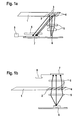
- FIGS. 1 a and 1b show systems showing a test element (1) with a detection area (2) containing a plurality of reference (4) and reaction areas (3).
- This system is shown only by way of example with several reference and reaction areas, it is also conceivable systems containing only a reference (4) - and a reaction area (3).
- the test element (1) is arranged in the system such that the detection area (2) is at least partially illuminated by a lighting unit (6) and the light reflected from the detection area (2) is picked up by a detector (7).
- the signals received by the detector (7) can be further processed and evaluated in an evaluation unit (8).
- the illumination or detection is spatially resolved, whereby a differentiation of the detection area in reaction areas (3) or reference areas (4) can take place.
- the evaluation unit (8) then the signals of the reaction areas (3) and the reference areas (4) can be set in relation and evaluated with an algorithm.
- FIG. 1b a system is shown, which in turn contains a test element (1) and a lighting unit (6) and a detector (7), wherein the detector is arranged on the opposite side of the test element (1) in contrast to the lighting unit.
- the detector is arranged on the opposite side of the test element (1) in contrast to the lighting unit.
- the illumination and / or detection is carried out in a spatially resolved manner, whereby the reaction areas (3) and reference areas (4) can be distinguished from each other.
- imaging units (5) can be, for example, lenses, diaphragms or filters.
- FIGS. 2a and 2b the schematic structure of a detection area (2) of a test element (1) is shown.
- the test element (1) preferably has a carrier film (11) on which reagents (12) can be immobilized.
- the reagent (12) is not immobilized over the entire area of the detection area (2), but areas with immobilized reagent, the so-called reaction areas (3), alternate with reference areas (4) in which no reagent is immobilized.
- FIG. 2 A a very regular arrangement of reaction areas (3) and reference areas (4) is shown, whereas in FIG. 2 b a likewise alternating variant of reaction areas (3) and reference areas (4) is shown, but in which the size of the areas can vary.
Landscapes
- Health & Medical Sciences (AREA)
- Life Sciences & Earth Sciences (AREA)
- Physics & Mathematics (AREA)
- Pathology (AREA)
- General Health & Medical Sciences (AREA)
- Molecular Biology (AREA)
- Surgery (AREA)
- Veterinary Medicine (AREA)
- Biomedical Technology (AREA)
- Heart & Thoracic Surgery (AREA)
- Medical Informatics (AREA)
- Biophysics (AREA)
- Animal Behavior & Ethology (AREA)
- Engineering & Computer Science (AREA)
- Public Health (AREA)
- Optics & Photonics (AREA)
- Spectroscopy & Molecular Physics (AREA)
- Chemical & Material Sciences (AREA)
- Analytical Chemistry (AREA)
- Biochemistry (AREA)
- General Physics & Mathematics (AREA)
- Immunology (AREA)
- Emergency Medicine (AREA)
- Hematology (AREA)
- Investigating Or Analysing Materials By The Use Of Chemical Reactions (AREA)
- Investigating Or Analysing Biological Materials (AREA)
- Investigating Or Analysing Materials By Optical Means (AREA)
Priority Applications (8)
| Application Number | Priority Date | Filing Date | Title |
|---|---|---|---|
| EP06026395.1A EP1936362B1 (fr) | 2006-12-20 | 2006-12-20 | Elément de test avec référencement |
| MX2009006159A MX2009006159A (es) | 2006-12-20 | 2007-12-20 | Elemento de prueba con referencia. |
| CA002671520A CA2671520A1 (fr) | 2006-12-20 | 2007-12-20 | Element de test dote d'une reference |
| PCT/EP2007/011233 WO2008074504A1 (fr) | 2006-12-20 | 2007-12-20 | Élément de test doté d'une référence |
| JP2009541888A JP2010513885A (ja) | 2006-12-20 | 2007-12-20 | 参照つき検査素子 |
| KR1020097012874A KR20090086443A (ko) | 2006-12-20 | 2007-12-20 | 참조설정을 갖는 시험 요소 |
| CNA2007800471474A CN101563596A (zh) | 2006-12-20 | 2007-12-20 | 具有参照的测试元件 |
| US12/488,153 US8173439B2 (en) | 2006-12-20 | 2009-06-19 | Measurement system with optical referencing |
Applications Claiming Priority (1)
| Application Number | Priority Date | Filing Date | Title |
|---|---|---|---|
| EP06026395.1A EP1936362B1 (fr) | 2006-12-20 | 2006-12-20 | Elément de test avec référencement |
Publications (2)
| Publication Number | Publication Date |
|---|---|
| EP1936362A1 true EP1936362A1 (fr) | 2008-06-25 |
| EP1936362B1 EP1936362B1 (fr) | 2020-03-18 |
Family
ID=38042609
Family Applications (1)
| Application Number | Title | Priority Date | Filing Date |
|---|---|---|---|
| EP06026395.1A Active EP1936362B1 (fr) | 2006-12-20 | 2006-12-20 | Elément de test avec référencement |
Country Status (8)
| Country | Link |
|---|---|
| US (1) | US8173439B2 (fr) |
| EP (1) | EP1936362B1 (fr) |
| JP (1) | JP2010513885A (fr) |
| KR (1) | KR20090086443A (fr) |
| CN (1) | CN101563596A (fr) |
| CA (1) | CA2671520A1 (fr) |
| MX (1) | MX2009006159A (fr) |
| WO (1) | WO2008074504A1 (fr) |
Cited By (5)
| Publication number | Priority date | Publication date | Assignee | Title |
|---|---|---|---|---|
| WO2010054645A3 (fr) * | 2008-11-14 | 2010-08-05 | Optricon Gmbh | Appareil et procédé d'analyse et d'évaluation d'une bandelette de test |
| EP2306178A1 (fr) * | 2009-09-30 | 2011-04-06 | Roche Diagnostics GmbH | Procédé de commande d'une unité de mesure photométrique d'un appareil de mesure pour la production et l'examen d'un échantillon de liquide corporel et système de mesure |
| DE102017202640A1 (de) | 2017-02-20 | 2018-08-23 | Robert Bosch Gmbh | Mikrospektrometer, Verfahren und Steuergerät zum Betreiben eines Mikrospektrometers |
| CN109298179A (zh) * | 2018-11-29 | 2019-02-01 | 福州大学 | 一种免疫层析检测系统及其背景识别方法 |
| CN112997068A (zh) * | 2018-10-31 | 2021-06-18 | 豪夫迈·罗氏有限公司 | 用于测量体液样品中的分析物浓度的设备和方法 |
Families Citing this family (20)
| Publication number | Priority date | Publication date | Assignee | Title |
|---|---|---|---|---|
| US7004928B2 (en) | 2002-02-08 | 2006-02-28 | Rosedale Medical, Inc. | Autonomous, ambulatory analyte monitor or drug delivery device |
| WO2007041355A2 (fr) | 2005-09-30 | 2007-04-12 | Intuity Medical, Inc. | Agents catalytiques pour extraire un échantillon de liquide biologique |
| US8801631B2 (en) | 2005-09-30 | 2014-08-12 | Intuity Medical, Inc. | Devices and methods for facilitating fluid transport |
| US9833183B2 (en) | 2008-05-30 | 2017-12-05 | Intuity Medical, Inc. | Body fluid sampling device—sampling site interface |
| WO2009148624A1 (fr) | 2008-06-06 | 2009-12-10 | Intuity Medical, Inc. | Dispositif de mesure et mode de fonctionnement |
| EP3639744B1 (fr) | 2008-06-06 | 2021-11-24 | Intuity Medical, Inc. | Appareil de mesure du sucre sanguin et methode d'utilisation |
| CN102209898B (zh) * | 2008-11-07 | 2014-08-27 | 霍夫曼-拉罗奇有限公司 | 光度反应膜的细粒填充剂 |
| US8919605B2 (en) | 2009-11-30 | 2014-12-30 | Intuity Medical, Inc. | Calibration material delivery devices and methods |
| US10330667B2 (en) | 2010-06-25 | 2019-06-25 | Intuity Medical, Inc. | Analyte monitoring methods and systems |
| US20120038820A1 (en) * | 2010-08-16 | 2012-02-16 | Gangaswamy Kempahonnaiah | Rapid Test Quantitative Reader |
| US8468680B2 (en) * | 2010-08-24 | 2013-06-25 | Roche Diagnostics Operations, Inc. | Biosensor test member and method for making the same |
| WO2013020103A1 (fr) | 2011-08-03 | 2013-02-07 | Intuity Medical, Inc. | Dispositifs et procédés pour le prélèvement et l'analyse de liquides organiques |
| WO2013118107A1 (fr) * | 2012-02-08 | 2013-08-15 | Hewlett Packard Indigo B.V. | Calcul de la densité optique d'un fluide se déplaçant à travers un espace |
| EP2781919A1 (fr) | 2013-03-19 | 2014-09-24 | Roche Diagniostics GmbH | Procédé/dispositif permettant de générer une valeur corrigée de concentration d'un analyte dans un échantillon d'un fluide corporel |
| US10729386B2 (en) | 2013-06-21 | 2020-08-04 | Intuity Medical, Inc. | Analyte monitoring system with audible feedback |
| JP6331191B2 (ja) * | 2013-09-20 | 2018-05-30 | 国立大学法人九州大学 | 光測定装置、光測定方法、フィルタ部材及びフィルタ部材を生産する方法 |
| CN103792369A (zh) * | 2014-02-10 | 2014-05-14 | 爱德检测科技有限公司 | 一种生物蛋白包被工艺 |
| GB2523135A (en) * | 2014-02-13 | 2015-08-19 | Molecular Vision Ltd | Assay device |
| NL2021691B1 (en) * | 2018-09-24 | 2020-05-07 | Lely Patent Nv | Milking system with detection system |
| WO2020257809A1 (fr) * | 2019-06-20 | 2020-12-24 | Essenlix Corporation | Porte-échantillon à transmission optique amélioré et analyse à de multiples longueurs d'onde |
Citations (6)
| Publication number | Priority date | Publication date | Assignee | Title |
|---|---|---|---|---|
| EP0469377A2 (fr) * | 1990-08-02 | 1992-02-05 | Roche Diagnostics GmbH | Dispositif et procédé pour la détermination d'une analyte dans un échantillon liquide |
| US5132097A (en) * | 1987-02-11 | 1992-07-21 | G.D. Research | Apparatus for analysis of specific binding complexes |
| US5485527A (en) * | 1985-11-04 | 1996-01-16 | Becton Dickinson And Company | Apparatus and method for analyses of biological specimens |
| US6249593B1 (en) * | 1993-02-26 | 2001-06-19 | Ey Laboratories, Inc. | Optical specimen analysis system and method |
| EP1359409A2 (fr) * | 2002-05-01 | 2003-11-05 | Lifescan, Inc. | Appareils et méthodes pour la détermination des concentrations des analytes |
| WO2006096210A2 (fr) * | 2005-03-03 | 2006-09-14 | Siemens Medical Solutions Diagnostics | Tete de lecture optique miniature pour un dispositif de diagnostic optique |
Family Cites Families (14)
| Publication number | Priority date | Publication date | Assignee | Title |
|---|---|---|---|---|
| JPS51114985A (en) * | 1975-04-01 | 1976-10-09 | Kyoto Daiichi Kagaku:Kk | Mothod to analyse urine, etc. |
| US5408535A (en) * | 1993-09-07 | 1995-04-18 | Miles Inc. | Video test strip reader and method for evaluating test strips |
| WO1999040536A1 (fr) | 1998-02-10 | 1999-08-12 | Ey Laboratories, Inc. | Systeme de reflectometrie avec compensation pour topologie de supports d'echantillons et avec elimination synchrone du bruit de reseau |
| WO2000020535A1 (fr) | 1998-10-05 | 2000-04-13 | Sasol Technology (Pty) Ltd | Procede de production de distillats moyens et distillats moyens produits par ce procede |
| ATE423830T1 (de) | 1999-04-06 | 2009-03-15 | Sasol Tech Pty Ltd | Synthetischer naphtha-brennstoff |
| US6420128B1 (en) * | 2000-09-12 | 2002-07-16 | Lifescan, Inc. | Test strips for detecting the presence of a reduced cofactor in a sample and method for using the same |
| US6993172B2 (en) | 2001-06-29 | 2006-01-31 | Agilent Technologies, Inc. | Method and system for automated outlying feature and outlying feature background detection during processing of data scanned from a molecular array |
| EP1350831A1 (fr) | 2002-04-05 | 2003-10-08 | Engelhard Corporation | Traitement à l' hydrogène d' une charge d' hydrocarbures |
| ATE470696T1 (de) | 2002-04-15 | 2010-06-15 | Shell Int Research | Methode zum erhöhen der cetanzahl von gasöl |
| WO2005021688A1 (fr) | 2003-09-03 | 2005-03-10 | Shell Internationale Research Maatschappij B.V. | Compositions de combustible comprenant un combustible derive de fischer-tropsch |
| CN1852967A (zh) | 2003-09-17 | 2006-10-25 | 国际壳牌研究有限公司 | 石油和费-托衍生的煤油共混物 |
| US7283245B2 (en) * | 2004-01-20 | 2007-10-16 | General Electric Company | Handheld device with a disposable element for chemical analysis of multiple analytes |
| WO2005086854A2 (fr) | 2004-03-09 | 2005-09-22 | Freedom Scientific, Inc. | Amelioration de vision affaiblie pour interface utilisateur graphique |
| EP1710565A1 (fr) * | 2005-04-05 | 2006-10-11 | F. Hoffmann-La Roche Ag | Système optique mobile pour diagnostics |
-
2006
- 2006-12-20 EP EP06026395.1A patent/EP1936362B1/fr active Active
-
2007
- 2007-12-20 JP JP2009541888A patent/JP2010513885A/ja not_active Withdrawn
- 2007-12-20 WO PCT/EP2007/011233 patent/WO2008074504A1/fr not_active Ceased
- 2007-12-20 MX MX2009006159A patent/MX2009006159A/es not_active Application Discontinuation
- 2007-12-20 CN CNA2007800471474A patent/CN101563596A/zh active Pending
- 2007-12-20 CA CA002671520A patent/CA2671520A1/fr not_active Abandoned
- 2007-12-20 KR KR1020097012874A patent/KR20090086443A/ko not_active Abandoned
-
2009
- 2009-06-19 US US12/488,153 patent/US8173439B2/en active Active
Patent Citations (6)
| Publication number | Priority date | Publication date | Assignee | Title |
|---|---|---|---|---|
| US5485527A (en) * | 1985-11-04 | 1996-01-16 | Becton Dickinson And Company | Apparatus and method for analyses of biological specimens |
| US5132097A (en) * | 1987-02-11 | 1992-07-21 | G.D. Research | Apparatus for analysis of specific binding complexes |
| EP0469377A2 (fr) * | 1990-08-02 | 1992-02-05 | Roche Diagnostics GmbH | Dispositif et procédé pour la détermination d'une analyte dans un échantillon liquide |
| US6249593B1 (en) * | 1993-02-26 | 2001-06-19 | Ey Laboratories, Inc. | Optical specimen analysis system and method |
| EP1359409A2 (fr) * | 2002-05-01 | 2003-11-05 | Lifescan, Inc. | Appareils et méthodes pour la détermination des concentrations des analytes |
| WO2006096210A2 (fr) * | 2005-03-03 | 2006-09-14 | Siemens Medical Solutions Diagnostics | Tete de lecture optique miniature pour un dispositif de diagnostic optique |
Cited By (8)
| Publication number | Priority date | Publication date | Assignee | Title |
|---|---|---|---|---|
| WO2010054645A3 (fr) * | 2008-11-14 | 2010-08-05 | Optricon Gmbh | Appareil et procédé d'analyse et d'évaluation d'une bandelette de test |
| US8848988B2 (en) | 2008-11-14 | 2014-09-30 | Optricon Gmbh | Appliance and method for evaluation and assessment of a test strip |
| EP2306178A1 (fr) * | 2009-09-30 | 2011-04-06 | Roche Diagnostics GmbH | Procédé de commande d'une unité de mesure photométrique d'un appareil de mesure pour la production et l'examen d'un échantillon de liquide corporel et système de mesure |
| WO2011038839A1 (fr) * | 2009-09-30 | 2011-04-07 | Roche Diagnostics Gmbh | Procédé de commande d'une unité de mesure photométrique d'un appareil de mesure pour obtenir et analyser un échantillon de liquide corporel ainsi que système de mesure |
| DE102017202640A1 (de) | 2017-02-20 | 2018-08-23 | Robert Bosch Gmbh | Mikrospektrometer, Verfahren und Steuergerät zum Betreiben eines Mikrospektrometers |
| CN112997068A (zh) * | 2018-10-31 | 2021-06-18 | 豪夫迈·罗氏有限公司 | 用于测量体液样品中的分析物浓度的设备和方法 |
| CN109298179A (zh) * | 2018-11-29 | 2019-02-01 | 福州大学 | 一种免疫层析检测系统及其背景识别方法 |
| CN109298179B (zh) * | 2018-11-29 | 2023-09-01 | 福州大学 | 一种免疫层析检测系统及其背景识别方法 |
Also Published As
| Publication number | Publication date |
|---|---|
| JP2010513885A (ja) | 2010-04-30 |
| US20090304247A1 (en) | 2009-12-10 |
| KR20090086443A (ko) | 2009-08-12 |
| US8173439B2 (en) | 2012-05-08 |
| EP1936362B1 (fr) | 2020-03-18 |
| CN101563596A (zh) | 2009-10-21 |
| MX2009006159A (es) | 2009-06-19 |
| WO2008074504A1 (fr) | 2008-06-26 |
| CA2671520A1 (fr) | 2008-06-26 |
Similar Documents
| Publication | Publication Date | Title |
|---|---|---|
| EP1936362B1 (fr) | Elément de test avec référencement | |
| DE60035174T2 (de) | Invasives verfahren zur in vivo analytvermessung | |
| DE60018537T2 (de) | Teststreifen zur Bestimmung eines Analyts in eine flüssige Probe | |
| WO2007115732A1 (fr) | Analyse de données optiques à l'aide d'histogrammes | |
| DE10101576B4 (de) | Optischer Sensor und Sensorfeld | |
| DE69511533T2 (de) | Vorrichtung und methode zur bestimmung von bestandteilen in körperflüssigkeiten | |
| DE69913103T2 (de) | Optischer sensor und funktionsmethode | |
| DE60128279T2 (de) | Optischer Sensor zum Nachweis mehrerer Analyte | |
| DE3752241T2 (de) | Messapparat und Kit zur Bestimmung der Konzentration eines in einer Vollblutsprobe enthaltenen Analytes | |
| DE69503792T2 (de) | Analysegerät mit schlangenförmig ausgebildeter teststreifenführung | |
| EP0659055B1 (fr) | Procede et dispositif d'analyse de glucose dans une matrice biologique | |
| DE69803310T2 (de) | Analytisches gerät mit kapillarreagenzträger | |
| DE60314042T2 (de) | Vorrichtungen und Methoden zur Bestimmung von Konzentrationen von Analyten | |
| EP2794909B1 (fr) | Procédé de détermination d'une concentration d'analyte | |
| EP1411346A2 (fr) | Procédé de détection et compensation d'un dosage insuffisant des bandes de test | |
| EP0606327B1 (fr) | MEMBRANE DETECTRICE POUR L'AFFICHAGE DU pH D'UN ECHANTILLON, SA FABRICATION ET SON UTILISATION | |
| DE19628562A1 (de) | Analysesystem mit Mitteln zur Erkennung von Unterdosierungen | |
| EP2464290B1 (fr) | Element test pour l'analyse d'un liquide corporel | |
| DE19611347A1 (de) | System zur quantitativen ortsaufgelösten Auswertung von Testelementen | |
| EP1843147A1 (fr) | Analyse avec résolution spatiale de données optiques d'un élément d'analyse | |
| DE19630160A1 (de) | Analysesystem mit Mitteln zur Erkennung von Unterdosierungen | |
| WO2019008461A1 (fr) | Dispositif et procédé pour acquérir des informations au moins 2d relatives à des analytes et élément de détection à cet effet | |
| WO2005019822A1 (fr) | Procede et dispositif de detection d'analytes | |
| DE102007054309A1 (de) | Optische Anordnung zur Erhöhung der Wechselwirkungslänge in stark steuernder Matrix | |
| DE10063983A1 (de) | Verfahren und Vorrichtung zum Nachweis von Zuckerkonzentrationen |
Legal Events
| Date | Code | Title | Description |
|---|---|---|---|
| PUAI | Public reference made under article 153(3) epc to a published international application that has entered the european phase |
Free format text: ORIGINAL CODE: 0009012 |
|
| AK | Designated contracting states |
Kind code of ref document: A1 Designated state(s): AT BE BG CH CY CZ DE DK EE ES FI FR GB GR HU IE IS IT LI LT LU LV MC NL PL PT RO SE SI SK TR |
|
| AX | Request for extension of the european patent |
Extension state: AL BA HR MK RS |
|
| 17P | Request for examination filed |
Effective date: 20081229 |
|
| AKX | Designation fees paid |
Designated state(s): AT BE BG CH CY CZ DE DK EE ES FI FR GB GR HU IE IS IT LI LT LU LV MC NL PL PT RO SE SI SK TR |
|
| 17Q | First examination report despatched |
Effective date: 20090320 |
|
| RAP1 | Party data changed (applicant data changed or rights of an application transferred) |
Owner name: F.HOFFMANN-LA ROCHE AG Owner name: ROCHE DIABETES CARE GMBH |
|
| STAA | Information on the status of an ep patent application or granted ep patent |
Free format text: STATUS: EXAMINATION IS IN PROGRESS |
|
| RIC1 | Information provided on ipc code assigned before grant |
Ipc: A61B 5/1455 20060101ALN20181115BHEP Ipc: G01N 21/84 20060101ALI20181115BHEP Ipc: G01N 21/86 20060101AFI20181115BHEP Ipc: A61B 5/145 20060101ALN20181115BHEP |
|
| RIC1 | Information provided on ipc code assigned before grant |
Ipc: G01N 21/86 20060101AFI20181128BHEP Ipc: A61B 5/1455 20060101ALN20181128BHEP Ipc: G01N 21/84 20060101ALI20181128BHEP Ipc: A61B 5/145 20060101ALN20181128BHEP |
|
| RIC1 | Information provided on ipc code assigned before grant |
Ipc: A61B 5/145 20060101ALN20181218BHEP Ipc: G01N 21/84 20060101ALI20181218BHEP Ipc: G01N 21/86 20060101AFI20181218BHEP Ipc: A61B 5/1455 20060101ALN20181218BHEP |
|
| RIC1 | Information provided on ipc code assigned before grant |
Ipc: G01N 21/84 20060101ALI20190111BHEP Ipc: G01N 21/86 20060101AFI20190111BHEP Ipc: A61B 5/1455 20060101ALN20190111BHEP Ipc: A61B 5/145 20060101ALN20190111BHEP |
|
| GRAP | Despatch of communication of intention to grant a patent |
Free format text: ORIGINAL CODE: EPIDOSNIGR1 |
|
| STAA | Information on the status of an ep patent application or granted ep patent |
Free format text: STATUS: GRANT OF PATENT IS INTENDED |
|
| INTG | Intention to grant announced |
Effective date: 20190226 |
|
| GRAS | Grant fee paid |
Free format text: ORIGINAL CODE: EPIDOSNIGR3 |
|
| GRAJ | Information related to disapproval of communication of intention to grant by the applicant or resumption of examination proceedings by the epo deleted |
Free format text: ORIGINAL CODE: EPIDOSDIGR1 |
|
| GRAL | Information related to payment of fee for publishing/printing deleted |
Free format text: ORIGINAL CODE: EPIDOSDIGR3 |
|
| STAA | Information on the status of an ep patent application or granted ep patent |
Free format text: STATUS: EXAMINATION IS IN PROGRESS |
|
| GRAP | Despatch of communication of intention to grant a patent |
Free format text: ORIGINAL CODE: EPIDOSNIGR1 |
|
| INTC | Intention to grant announced (deleted) | ||
| STAA | Information on the status of an ep patent application or granted ep patent |
Free format text: STATUS: GRANT OF PATENT IS INTENDED |
|
| RIC1 | Information provided on ipc code assigned before grant |
Ipc: G01N 21/84 20060101ALI20190916BHEP Ipc: A61B 5/145 20060101ALN20190916BHEP Ipc: G01N 21/86 20060101AFI20190916BHEP Ipc: A61B 5/1455 20060101ALN20190916BHEP |
|
| INTG | Intention to grant announced |
Effective date: 20191010 |
|
| GRAA | (expected) grant |
Free format text: ORIGINAL CODE: 0009210 |
|
| STAA | Information on the status of an ep patent application or granted ep patent |
Free format text: STATUS: THE PATENT HAS BEEN GRANTED |
|
| AK | Designated contracting states |
Kind code of ref document: B1 Designated state(s): AT BE BG CH CY CZ DE DK EE ES FI FR GB GR HU IE IS IT LI LT LU LV MC NL PL PT RO SE SI SK TR |
|
| REG | Reference to a national code |
Ref country code: GB Ref legal event code: FG4D Free format text: NOT ENGLISH |
|
| REG | Reference to a national code |
Ref country code: DE Ref legal event code: R096 Ref document number: 502006016400 Country of ref document: DE |
|
| REG | Reference to a national code |
Ref country code: AT Ref legal event code: REF Ref document number: 1246484 Country of ref document: AT Kind code of ref document: T Effective date: 20200415 Ref country code: IE Ref legal event code: FG4D Free format text: LANGUAGE OF EP DOCUMENT: GERMAN |
|
| PG25 | Lapsed in a contracting state [announced via postgrant information from national office to epo] |
Ref country code: FI Free format text: LAPSE BECAUSE OF FAILURE TO SUBMIT A TRANSLATION OF THE DESCRIPTION OR TO PAY THE FEE WITHIN THE PRESCRIBED TIME-LIMIT Effective date: 20200318 |
|
| REG | Reference to a national code |
Ref country code: NL Ref legal event code: MP Effective date: 20200318 |
|
| PG25 | Lapsed in a contracting state [announced via postgrant information from national office to epo] |
Ref country code: SE Free format text: LAPSE BECAUSE OF FAILURE TO SUBMIT A TRANSLATION OF THE DESCRIPTION OR TO PAY THE FEE WITHIN THE PRESCRIBED TIME-LIMIT Effective date: 20200318 Ref country code: LV Free format text: LAPSE BECAUSE OF FAILURE TO SUBMIT A TRANSLATION OF THE DESCRIPTION OR TO PAY THE FEE WITHIN THE PRESCRIBED TIME-LIMIT Effective date: 20200318 Ref country code: BG Free format text: LAPSE BECAUSE OF FAILURE TO SUBMIT A TRANSLATION OF THE DESCRIPTION OR TO PAY THE FEE WITHIN THE PRESCRIBED TIME-LIMIT Effective date: 20200618 Ref country code: GR Free format text: LAPSE BECAUSE OF FAILURE TO SUBMIT A TRANSLATION OF THE DESCRIPTION OR TO PAY THE FEE WITHIN THE PRESCRIBED TIME-LIMIT Effective date: 20200619 |
|
| REG | Reference to a national code |
Ref country code: LT Ref legal event code: MG4D |
|
| PG25 | Lapsed in a contracting state [announced via postgrant information from national office to epo] |
Ref country code: NL Free format text: LAPSE BECAUSE OF FAILURE TO SUBMIT A TRANSLATION OF THE DESCRIPTION OR TO PAY THE FEE WITHIN THE PRESCRIBED TIME-LIMIT Effective date: 20200318 |
|
| PG25 | Lapsed in a contracting state [announced via postgrant information from national office to epo] |
Ref country code: PT Free format text: LAPSE BECAUSE OF FAILURE TO SUBMIT A TRANSLATION OF THE DESCRIPTION OR TO PAY THE FEE WITHIN THE PRESCRIBED TIME-LIMIT Effective date: 20200812 Ref country code: EE Free format text: LAPSE BECAUSE OF FAILURE TO SUBMIT A TRANSLATION OF THE DESCRIPTION OR TO PAY THE FEE WITHIN THE PRESCRIBED TIME-LIMIT Effective date: 20200318 Ref country code: RO Free format text: LAPSE BECAUSE OF FAILURE TO SUBMIT A TRANSLATION OF THE DESCRIPTION OR TO PAY THE FEE WITHIN THE PRESCRIBED TIME-LIMIT Effective date: 20200318 Ref country code: LT Free format text: LAPSE BECAUSE OF FAILURE TO SUBMIT A TRANSLATION OF THE DESCRIPTION OR TO PAY THE FEE WITHIN THE PRESCRIBED TIME-LIMIT Effective date: 20200318 Ref country code: SK Free format text: LAPSE BECAUSE OF FAILURE TO SUBMIT A TRANSLATION OF THE DESCRIPTION OR TO PAY THE FEE WITHIN THE PRESCRIBED TIME-LIMIT Effective date: 20200318 Ref country code: IS Free format text: LAPSE BECAUSE OF FAILURE TO SUBMIT A TRANSLATION OF THE DESCRIPTION OR TO PAY THE FEE WITHIN THE PRESCRIBED TIME-LIMIT Effective date: 20200718 Ref country code: CZ Free format text: LAPSE BECAUSE OF FAILURE TO SUBMIT A TRANSLATION OF THE DESCRIPTION OR TO PAY THE FEE WITHIN THE PRESCRIBED TIME-LIMIT Effective date: 20200318 |
|
| REG | Reference to a national code |
Ref country code: DE Ref legal event code: R097 Ref document number: 502006016400 Country of ref document: DE |
|
| PLBE | No opposition filed within time limit |
Free format text: ORIGINAL CODE: 0009261 |
|
| STAA | Information on the status of an ep patent application or granted ep patent |
Free format text: STATUS: NO OPPOSITION FILED WITHIN TIME LIMIT |
|
| PG25 | Lapsed in a contracting state [announced via postgrant information from national office to epo] |
Ref country code: IT Free format text: LAPSE BECAUSE OF FAILURE TO SUBMIT A TRANSLATION OF THE DESCRIPTION OR TO PAY THE FEE WITHIN THE PRESCRIBED TIME-LIMIT Effective date: 20200318 Ref country code: ES Free format text: LAPSE BECAUSE OF FAILURE TO SUBMIT A TRANSLATION OF THE DESCRIPTION OR TO PAY THE FEE WITHIN THE PRESCRIBED TIME-LIMIT Effective date: 20200318 Ref country code: DK Free format text: LAPSE BECAUSE OF FAILURE TO SUBMIT A TRANSLATION OF THE DESCRIPTION OR TO PAY THE FEE WITHIN THE PRESCRIBED TIME-LIMIT Effective date: 20200318 |
|
| 26N | No opposition filed |
Effective date: 20201221 |
|
| PG25 | Lapsed in a contracting state [announced via postgrant information from national office to epo] |
Ref country code: PL Free format text: LAPSE BECAUSE OF FAILURE TO SUBMIT A TRANSLATION OF THE DESCRIPTION OR TO PAY THE FEE WITHIN THE PRESCRIBED TIME-LIMIT Effective date: 20200318 |
|
| PG25 | Lapsed in a contracting state [announced via postgrant information from national office to epo] |
Ref country code: SI Free format text: LAPSE BECAUSE OF FAILURE TO SUBMIT A TRANSLATION OF THE DESCRIPTION OR TO PAY THE FEE WITHIN THE PRESCRIBED TIME-LIMIT Effective date: 20200318 |
|
| REG | Reference to a national code |
Ref country code: CH Ref legal event code: PL |
|
| GBPC | Gb: european patent ceased through non-payment of renewal fee |
Effective date: 20201220 |
|
| PG25 | Lapsed in a contracting state [announced via postgrant information from national office to epo] |
Ref country code: MC Free format text: LAPSE BECAUSE OF FAILURE TO SUBMIT A TRANSLATION OF THE DESCRIPTION OR TO PAY THE FEE WITHIN THE PRESCRIBED TIME-LIMIT Effective date: 20200318 |
|
| REG | Reference to a national code |
Ref country code: BE Ref legal event code: MM Effective date: 20201231 |
|
| PG25 | Lapsed in a contracting state [announced via postgrant information from national office to epo] |
Ref country code: IE Free format text: LAPSE BECAUSE OF NON-PAYMENT OF DUE FEES Effective date: 20201220 Ref country code: LU Free format text: LAPSE BECAUSE OF NON-PAYMENT OF DUE FEES Effective date: 20201220 Ref country code: FR Free format text: LAPSE BECAUSE OF NON-PAYMENT OF DUE FEES Effective date: 20201231 |
|
| PG25 | Lapsed in a contracting state [announced via postgrant information from national office to epo] |
Ref country code: LI Free format text: LAPSE BECAUSE OF NON-PAYMENT OF DUE FEES Effective date: 20201231 Ref country code: GB Free format text: LAPSE BECAUSE OF NON-PAYMENT OF DUE FEES Effective date: 20201220 Ref country code: CH Free format text: LAPSE BECAUSE OF NON-PAYMENT OF DUE FEES Effective date: 20201231 |
|
| REG | Reference to a national code |
Ref country code: AT Ref legal event code: MM01 Ref document number: 1246484 Country of ref document: AT Kind code of ref document: T Effective date: 20201220 |
|
| PG25 | Lapsed in a contracting state [announced via postgrant information from national office to epo] |
Ref country code: AT Free format text: LAPSE BECAUSE OF NON-PAYMENT OF DUE FEES Effective date: 20201220 |
|
| PG25 | Lapsed in a contracting state [announced via postgrant information from national office to epo] |
Ref country code: TR Free format text: LAPSE BECAUSE OF FAILURE TO SUBMIT A TRANSLATION OF THE DESCRIPTION OR TO PAY THE FEE WITHIN THE PRESCRIBED TIME-LIMIT Effective date: 20200318 Ref country code: CY Free format text: LAPSE BECAUSE OF FAILURE TO SUBMIT A TRANSLATION OF THE DESCRIPTION OR TO PAY THE FEE WITHIN THE PRESCRIBED TIME-LIMIT Effective date: 20200318 |
|
| PG25 | Lapsed in a contracting state [announced via postgrant information from national office to epo] |
Ref country code: BE Free format text: LAPSE BECAUSE OF NON-PAYMENT OF DUE FEES Effective date: 20201231 |
|
| PGFP | Annual fee paid to national office [announced via postgrant information from national office to epo] |
Ref country code: DE Payment date: 20231121 Year of fee payment: 18 |
|
| REG | Reference to a national code |
Ref country code: DE Ref legal event code: R119 Ref document number: 502006016400 Country of ref document: DE |
|
| PG25 | Lapsed in a contracting state [announced via postgrant information from national office to epo] |
Ref country code: DE Free format text: LAPSE BECAUSE OF NON-PAYMENT OF DUE FEES Effective date: 20250701 |
|
| PG25 | Lapsed in a contracting state [announced via postgrant information from national office to epo] |
Ref country code: IS Free format text: LAPSE BECAUSE OF NON-PAYMENT OF DUE FEES Effective date: 20200718 |