EP1936414A2 - Kleines optisches Gehäuse mit mehreren optisch ausgerichteten, gelöteten Elementen darin - Google Patents
Kleines optisches Gehäuse mit mehreren optisch ausgerichteten, gelöteten Elementen darin Download PDFInfo
- Publication number
- EP1936414A2 EP1936414A2 EP07254671A EP07254671A EP1936414A2 EP 1936414 A2 EP1936414 A2 EP 1936414A2 EP 07254671 A EP07254671 A EP 07254671A EP 07254671 A EP07254671 A EP 07254671A EP 1936414 A2 EP1936414 A2 EP 1936414A2
- Authority
- EP
- European Patent Office
- Prior art keywords
- optical fiber
- sealed container
- solder
- base member
- optical
- Prior art date
- Legal status (The legal status is an assumption and is not a legal conclusion. Google has not performed a legal analysis and makes no representation as to the accuracy of the status listed.)
- Withdrawn
Links
- 230000003287 optical effect Effects 0.000 title claims abstract description 43
- 239000013307 optical fiber Substances 0.000 claims abstract description 83
- 238000004519 manufacturing process Methods 0.000 claims abstract description 10
- 229910001220 stainless steel Inorganic materials 0.000 claims abstract description 6
- 239000010935 stainless steel Substances 0.000 claims abstract description 6
- 229910000679 solder Inorganic materials 0.000 claims description 34
- 239000000835 fiber Substances 0.000 claims description 22
- 238000005476 soldering Methods 0.000 claims description 12
- 239000000463 material Substances 0.000 claims description 8
- 238000000034 method Methods 0.000 claims description 8
- 238000002844 melting Methods 0.000 claims description 7
- 230000008018 melting Effects 0.000 claims description 7
- 238000001816 cooling Methods 0.000 claims description 6
- 239000002178 crystalline material Substances 0.000 claims description 4
- 239000013078 crystal Substances 0.000 abstract description 25
- 238000013461 design Methods 0.000 abstract description 4
- 239000000853 adhesive Substances 0.000 description 5
- 230000001070 adhesive effect Effects 0.000 description 5
- NJPPVKZQTLUDBO-UHFFFAOYSA-N novaluron Chemical compound C1=C(Cl)C(OC(F)(F)C(OC(F)(F)F)F)=CC=C1NC(=O)NC(=O)C1=C(F)C=CC=C1F NJPPVKZQTLUDBO-UHFFFAOYSA-N 0.000 description 5
- 239000011521 glass Substances 0.000 description 4
- 238000003466 welding Methods 0.000 description 4
- 238000001914 filtration Methods 0.000 description 3
- 238000003780 insertion Methods 0.000 description 3
- 230000037431 insertion Effects 0.000 description 3
- GQYHUHYESMUTHG-UHFFFAOYSA-N lithium niobate Chemical compound [Li+].[O-][Nb](=O)=O GQYHUHYESMUTHG-UHFFFAOYSA-N 0.000 description 3
- 238000004806 packaging method and process Methods 0.000 description 3
- 230000008569 process Effects 0.000 description 3
- 239000004593 Epoxy Substances 0.000 description 2
- 230000002411 adverse Effects 0.000 description 2
- 238000000429 assembly Methods 0.000 description 2
- 238000005452 bending Methods 0.000 description 2
- 239000011248 coating agent Substances 0.000 description 2
- 238000000576 coating method Methods 0.000 description 2
- 229910052751 metal Inorganic materials 0.000 description 2
- 239000002184 metal Substances 0.000 description 2
- 238000012544 monitoring process Methods 0.000 description 2
- 230000004044 response Effects 0.000 description 2
- 229910052769 Ytterbium Inorganic materials 0.000 description 1
- QCWXUUIWCKQGHC-UHFFFAOYSA-N Zirconium Chemical compound [Zr] QCWXUUIWCKQGHC-UHFFFAOYSA-N 0.000 description 1
- 230000001154 acute effect Effects 0.000 description 1
- 238000004026 adhesive bonding Methods 0.000 description 1
- 230000000712 assembly Effects 0.000 description 1
- 239000000919 ceramic Substances 0.000 description 1
- 230000008859 change Effects 0.000 description 1
- 238000004891 communication Methods 0.000 description 1
- 230000008602 contraction Effects 0.000 description 1
- 230000008878 coupling Effects 0.000 description 1
- 238000010168 coupling process Methods 0.000 description 1
- 238000005859 coupling reaction Methods 0.000 description 1
- 230000003247 decreasing effect Effects 0.000 description 1
- 238000000151 deposition Methods 0.000 description 1
- 238000011161 development Methods 0.000 description 1
- 238000010586 diagram Methods 0.000 description 1
- 238000006073 displacement reaction Methods 0.000 description 1
- 238000005538 encapsulation Methods 0.000 description 1
- 125000003700 epoxy group Chemical group 0.000 description 1
- 239000003365 glass fiber Substances 0.000 description 1
- JVPLOXQKFGYFMN-UHFFFAOYSA-N gold tin Chemical compound [Sn].[Au] JVPLOXQKFGYFMN-UHFFFAOYSA-N 0.000 description 1
- 238000000227 grinding Methods 0.000 description 1
- 230000006872 improvement Effects 0.000 description 1
- 229910052738 indium Inorganic materials 0.000 description 1
- APFVFJFRJDLVQX-UHFFFAOYSA-N indium atom Chemical compound [In] APFVFJFRJDLVQX-UHFFFAOYSA-N 0.000 description 1
- 239000007769 metal material Substances 0.000 description 1
- 239000005304 optical glass Substances 0.000 description 1
- 238000005498 polishing Methods 0.000 description 1
- 229920000647 polyepoxide Polymers 0.000 description 1
- 229920000642 polymer Polymers 0.000 description 1
- 238000006116 polymerization reaction Methods 0.000 description 1
- 230000000284 resting effect Effects 0.000 description 1
- 238000007789 sealing Methods 0.000 description 1
- 238000012360 testing method Methods 0.000 description 1
- NAWDYIZEMPQZHO-UHFFFAOYSA-N ytterbium Chemical compound [Yb] NAWDYIZEMPQZHO-UHFFFAOYSA-N 0.000 description 1
- 229910052726 zirconium Inorganic materials 0.000 description 1
Images

Classifications
-
- G—PHYSICS
- G02—OPTICS
- G02B—OPTICAL ELEMENTS, SYSTEMS OR APPARATUS
- G02B6/00—Light guides; Structural details of arrangements comprising light guides and other optical elements, e.g. couplings
- G02B6/24—Coupling light guides
- G02B6/42—Coupling light guides with opto-electronic elements
- G02B6/4201—Packages, e.g. shape, construction, internal or external details
-
- G—PHYSICS
- G02—OPTICS
- G02B—OPTICAL ELEMENTS, SYSTEMS OR APPARATUS
- G02B6/00—Light guides; Structural details of arrangements comprising light guides and other optical elements, e.g. couplings
- G02B6/24—Coupling light guides
- G02B6/42—Coupling light guides with opto-electronic elements
- G02B6/4201—Packages, e.g. shape, construction, internal or external details
- G02B6/4219—Mechanical fixtures for holding or positioning the elements relative to each other in the couplings; Alignment methods for the elements, e.g. measuring or observing methods especially used therefor
- G02B6/4236—Fixing or mounting methods of the aligned elements
- G02B6/4238—Soldering
-
- G—PHYSICS
- G02—OPTICS
- G02B—OPTICAL ELEMENTS, SYSTEMS OR APPARATUS
- G02B6/00—Light guides; Structural details of arrangements comprising light guides and other optical elements, e.g. couplings
- G02B6/24—Coupling light guides
- G02B6/42—Coupling light guides with opto-electronic elements
- G02B6/4201—Packages, e.g. shape, construction, internal or external details
- G02B6/4219—Mechanical fixtures for holding or positioning the elements relative to each other in the couplings; Alignment methods for the elements, e.g. measuring or observing methods especially used therefor
- G02B6/4236—Fixing or mounting methods of the aligned elements
- G02B6/424—Mounting of the optical light guide
-
- G—PHYSICS
- G02—OPTICS
- G02B—OPTICAL ELEMENTS, SYSTEMS OR APPARATUS
- G02B6/00—Light guides; Structural details of arrangements comprising light guides and other optical elements, e.g. couplings
- G02B6/24—Coupling light guides
- G02B6/42—Coupling light guides with opto-electronic elements
- G02B6/4201—Packages, e.g. shape, construction, internal or external details
- G02B6/4266—Thermal aspects, temperature control or temperature monitoring
- G02B6/4267—Reduction of thermal stress, e.g. by selecting thermal coefficient of materials
-
- G—PHYSICS
- G02—OPTICS
- G02B—OPTICAL ELEMENTS, SYSTEMS OR APPARATUS
- G02B6/00—Light guides; Structural details of arrangements comprising light guides and other optical elements, e.g. couplings
- G02B6/24—Coupling light guides
- G02B6/42—Coupling light guides with opto-electronic elements
- G02B6/4201—Packages, e.g. shape, construction, internal or external details
- G02B6/4266—Thermal aspects, temperature control or temperature monitoring
- G02B6/4268—Cooling
-
- G—PHYSICS
- G02—OPTICS
- G02B—OPTICAL ELEMENTS, SYSTEMS OR APPARATUS
- G02B6/00—Light guides; Structural details of arrangements comprising light guides and other optical elements, e.g. couplings
- G02B6/24—Coupling light guides
- G02B6/42—Coupling light guides with opto-electronic elements
- G02B6/4201—Packages, e.g. shape, construction, internal or external details
- G02B6/4266—Thermal aspects, temperature control or temperature monitoring
- G02B6/4268—Cooling
- G02B6/4271—Cooling with thermo electric cooling
-
- G—PHYSICS
- G02—OPTICS
- G02B—OPTICAL ELEMENTS, SYSTEMS OR APPARATUS
- G02B6/00—Light guides; Structural details of arrangements comprising light guides and other optical elements, e.g. couplings
- G02B6/24—Coupling light guides
- G02B6/36—Mechanical coupling means
- G02B6/3628—Mechanical coupling means for mounting fibres to supporting carriers
-
- G—PHYSICS
- G02—OPTICS
- G02B—OPTICAL ELEMENTS, SYSTEMS OR APPARATUS
- G02B6/00—Light guides; Structural details of arrangements comprising light guides and other optical elements, e.g. couplings
- G02B6/24—Coupling light guides
- G02B6/42—Coupling light guides with opto-electronic elements
- G02B6/4201—Packages, e.g. shape, construction, internal or external details
- G02B6/4248—Feed-through connections for the hermetical passage of fibres through a package wall
Definitions
- This invention relates to a substantially thermally stable small optical package that houses a plurality of optically aligned elements forming an optical component, wherein the elements are all directly soldered to a base member or directly soldered to a supporting member soldered to a common base member.
- optical devices and components operational within optical systems are typically subjected to various thermal and mechanical loads and or stresses during their lifetime.
- An example of such optical devices is an optical filter assembly.
- An assembly of this type comprises two optical glass fibers inserted into capillary ferrules to produce fiber-ferrule sub-assemblies aligned with an optical filter assembly.
- the optical components of the filter assembly generally have graded-index (GRIN) lenses embedded into an insulating glass tube, which in turn are mechanically protected by a metal housing.
- GRIN graded-index
- Input glass ferrules generally employ one of two designs.
- a single capillary suitable for containing multiple glass fibers or separate circular capillaries for each fiber have been used, each with relatively short fiber-receiving conical lead-in ends.
- the optical fiber is subjected to an unwanted S-bending over the short conical end. This excessive micro bending increases the insertion losses.
- Fiber-ferrule subassemblies employing such ferrules are manufactured by inserting the optical fibers stripped of their polymer coating into the respective ferrule capillaries; epoxy bonding the fibers into the ferrule capillaries, including the conical end portions; grinding and polishing an angled facet on the fiber-ferrule; and depositing on the polished surface an anti-reflection (AR) coating.
- AR anti-reflection
- adhesives are used to secure fiber-ferrules to a base or support member within their package.
- these fiber-ferrules are laser welded to a support member.
- a precise alignment achieved during initial assembly of a filter prior to final packaging can be easily decreased due to the adhesive curing process and the high temperature thermal cycles associated with laser welding during the final packaging of the components.
- Such manufacturing processes and resulting components have several problems resulting from stresses on the optical components due to the thermal contraction as a result of a thermal mismatch between the glass and metal materials, polymerization shrinkage in adhesive bonds, and structural constraints induced by bonding during encapsulation. These stresses lead to displacements of optical components during bonding, resulting in 0.3 to 1 dB or greater increases in the insertion loss.
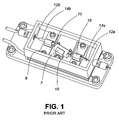
- Fig. 1 is a diagram of an optical package that is the result of years of development in an attempt to automate the assembly process and to lessen manufacturing costs while providing a relatively small, thermally stable optically packaged component. The goal was to provide a packaged component wherein performance would not significantly degrade over the expected lifetime of the device. Problems related to cost, and reliability have resulted in the abandonment of this solution.
- a non-linear frequency doubling crystal 10 performs filtering of an input signal and outputs a frequency doubled optical signal.
- optical fibers 12a and 12b held in sleeves must be precisely aligned so that light launched from the input fiber 12a to its output and through the frequency doubling crystal 10 must couple without undue loss into the output receiving optical fiber 12b and provide optimum filtering through the crystal 10.
- a frequency doubling optical component having an input optical fiber 12a held in an optical sleeve or ferrule 14a, optically coupled to a frequency doubling crystal 10, and optically coupled to an output optical fiber 12b.
- the optical sleeve 14a is held down in a fixed position by clamp 16 which is laser welded to a base member beneath.
- the optical crystal is secured to a holder 18 which is clamped to the base by a clamp 7.
- Bolts 9 secure sub-base members to the package. It is evident that the numerous interfaces between elements within the package increase the likelihood of misalignment of components. Furthermore, having this many elements and fasteners within this package lessens available space for other components.
- the package shown in Fig. 1 is conveniently shown before the top is positioned and hermetically seals the package.
- an optical fiber is housed within a sleeve and the sleeve is bonded to a base member, there is a possibility that there will be relative movement of the optical fiber and the sleeve. Furthermore, there is the possibility that there will be relative movement between the optical sleeve and the base member.
- the optical fiber is directly bonded to the base member, there is only the possibility of relative movement between the optical fiber and the base member. In this regard, it is preferable lessen the number of interfaces.
- a sealed container comprising;
- a method of manufacturing a sealed container comprising:
- Fig. 1 is a view illustrating a conventional packaged component having a plurality of interfaces.
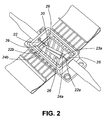
- Fig. 2 is a view of a packaged component in accordance with an embodiment of this invention wherein fewer parts and interfaces are required and wherein a filter is soldered to the package base.
- Fig. 3 is a schematic side view of a base member having an input lensed optical fiber optically aligned with an output optical lensed fiber having a PPLN (poled lithium niobate) crystal there between wherein the optical fibers and the crystal are soldered to their supporting members.
- PPLN poled lithium niobate
- Fig. 4 is a top view of the components shown in Fig. 3 .
- Fig. 2 a photograph of a non-sealed container in accordance with the invention is shown, prior to placing and hermetically sealing a lid in place over the device.
- the device of Fig. 2 provides the same functionality as the device of Fig. 1 .
- the device of Fig. 1 requires the thermal electric cooler to be outside of the package due to the limited space.
- an input optical fiber 22a is shown soldered in place on a base 21 precisely aligned with the non-linear frequency doubling crystal 20 and with the output optical fiber 22b.
- the solder ball made of AuSn (gold tin) 24a is shown resting upon a low pedestal 23a is preferably a Zr02 ceramic such as ytterbium stabilized zirconium, which is also soldered to the base 21 of the container. Only solder is present between the optical fiber 22a and an upper end of the pedestal 23a, and only solder is present between the lower end of the pedestal 23a and the base 21 of the container.
- the frequency doubling crystal 20 is also directly soldered to the base 21 upon which it rests, so that the planar lower surface of the crystal 20 securely mates with the container having only solder there between. This solder is applied by using a reflow technique.
- a similar arrangement is shown at the output end wherein optical fiber 22b is directly soldered to its respective pedestal 23b, which is directly soldered to the base 21 of the package. No ferrules are required to house and hold the optical fibers 22a and 22b, lessening the possibility of misalignment.
- a thermal electric cooler (TEC) 25 is disposed beneath the base 21 and within the package, so that efficient cooling and a more rapid cooling response time can be obtained. Electrodes 29 are provided to power the TEC 25. This particular device requires the temperature to be maintained at a predetermined temperature that is within +/-.01 C.
- a thermistor 26 is also disposed within the package on the base 21 for temperature monitoring.
- CTE coefficient of thermal expansion
- Figs. 3 and 4 illustrate the optical input and output optical fibers 32a, 32b, the pedestals or optical fiber mounts 33a and 33b, and the periodically poled lithium niobate frequency doubling crystal 30 in more detail.
- the optical fiber 32a has an output end adjacent to the crystal 30 shown to have a pointed or chiseled lens tip to focus and couple light from the fiber 32a to a region near the surface of the crystal 30. Furthermore, optical fiber 32a is securely mounted to the pedestal 33a via a single solder ball 34a, made of a solder with a relatively high melting temperature T h 295 C.
- the fiber mount 33a is secured to the base member 31 by way of having a very thin layer of solder between the mount 33a and the base member 31.
- a solder reflow technique is used to fixedly attach the base member 31 with the fiber mount 33a.
- the frequency doubling crystal 30 is also soldered to the base member 31; however, with a lower melting temperature solder, e.g.
- BiSn solder having a melting temperature of approximately 160C well below Th.
- the crystal 30 can be relatively moved and aligned during manufacture without the risk of moving the fiber mounts 32a and 32b, which are first secured to the base 31 with high melting temperature solder of about 295C, e.g. AuSn solder.
- the base member 31 which preferably consists of stainless steel, has a coefficient of thermal expansion (CTE) that is substantially matched to the CTE of the crystal 30 to less than 5 ppm/K.
- CTE coefficient of thermal expansion
- PPLN periodically poled lithium niobate
- SST403 is smaller than 2ppm/k. If the CTE of the crystal 30 was not suitably matched to the CTE of the base member, the crystal 20 would be adversely stressed upon cooling down from the 160 °C soldering temperature.
- this device can be manufactured using various alignment techniques, such as moving one optical fiber, e.g. 32a, while keeping the other optical fiber, e.g. 32b, and the crystal 30 fixed by first securing them with solder to the base 31. Preferably this is done while applying a signal to the device via one of the optical fibers and monitoring power at the output end. Once an optimum alignment is achieved the output fiber capturing the test light can be soldered in place.
- this invention provides a method and device wherein two optical fibers are aligned with an optical element where all three are fixed to a common base using solder.
Landscapes
- Physics & Mathematics (AREA)
- General Physics & Mathematics (AREA)
- Optics & Photonics (AREA)
- Optical Couplings Of Light Guides (AREA)
Applications Claiming Priority (1)
| Application Number | Priority Date | Filing Date | Title |
|---|---|---|---|
| US86997206P | 2006-12-14 | 2006-12-14 |
Publications (1)
| Publication Number | Publication Date |
|---|---|
| EP1936414A2 true EP1936414A2 (de) | 2008-06-25 |
Family
ID=39269298
Family Applications (1)
| Application Number | Title | Priority Date | Filing Date |
|---|---|---|---|
| EP07254671A Withdrawn EP1936414A2 (de) | 2006-12-14 | 2007-12-01 | Kleines optisches Gehäuse mit mehreren optisch ausgerichteten, gelöteten Elementen darin |
Country Status (3)
| Country | Link |
|---|---|
| US (1) | US20080144997A1 (de) |
| EP (1) | EP1936414A2 (de) |
| CN (1) | CN101226317A (de) |
Families Citing this family (6)
| Publication number | Priority date | Publication date | Assignee | Title |
|---|---|---|---|---|
| CN104009378B (zh) * | 2014-05-15 | 2017-03-29 | 深圳大学 | 一种基于绿光光纤激光器泵浦的可见光超连续谱光源 |
| JP2016161654A (ja) * | 2015-02-27 | 2016-09-05 | 住友大阪セメント株式会社 | 補強部材を用いた基板加工方法、及び補強部材により補強された基板より成る機能素子 |
| CN109164606A (zh) * | 2018-09-19 | 2019-01-08 | 中国电子科技集团公司第二十六研究所 | 一种具有高性能稳定性的光纤声光器件 |
| JP2019117397A (ja) * | 2019-03-08 | 2019-07-18 | 住友大阪セメント株式会社 | 基板加工方法 |
| WO2021053764A1 (ja) * | 2019-09-18 | 2021-03-25 | 日本電信電話株式会社 | 光モジュール用パッケージ |
| CN115629443A (zh) * | 2022-12-07 | 2023-01-20 | 武汉光谷航天三江激光产业技术研究院有限公司 | 一种大芯径高功率光纤光栅的封装结构及封装方法 |
Family Cites Families (7)
| Publication number | Priority date | Publication date | Assignee | Title |
|---|---|---|---|---|
| US5026138A (en) * | 1989-08-29 | 1991-06-25 | Gte Laboratories Incorporated | Multi-fiber alignment package for tilted facet optoelectronic components |
| FR2655161B1 (fr) * | 1989-11-30 | 1992-12-24 | Cit Alcatel | Dispositif a double couplage optique, notamment pour systeme de transmission a fibres optiques. |
| JP3409781B2 (ja) * | 2000-09-05 | 2003-05-26 | 住友電気工業株式会社 | 光半導体モジュールの製造方法 |
| US20020151113A1 (en) * | 2001-04-13 | 2002-10-17 | Hung Henry H. | Apparatus and method for suppressing false resonances in fiber optic modulators |
| US6773171B2 (en) * | 2003-01-14 | 2004-08-10 | Intel Corporation | Optoelectronic housings and methods of assembling optoelectronic packages |
| TWI278075B (en) * | 2004-08-17 | 2007-04-01 | Toshiba Corp | LSI package with interface module, transmission line package, and ribbon optical transmission line |
| JP4197668B2 (ja) * | 2004-08-17 | 2008-12-17 | 株式会社東芝 | インターフェイスモジュール付lsiパッケージとインターフェイスモジュール及び接続保持機構 |
-
2007
- 2007-12-01 EP EP07254671A patent/EP1936414A2/de not_active Withdrawn
- 2007-12-10 US US11/953,448 patent/US20080144997A1/en not_active Abandoned
- 2007-12-14 CN CNA2007103012053A patent/CN101226317A/zh active Pending
Also Published As
| Publication number | Publication date |
|---|---|
| US20080144997A1 (en) | 2008-06-19 |
| CN101226317A (zh) | 2008-07-23 |
Similar Documents
| Publication | Publication Date | Title |
|---|---|---|
| KR920010947B1 (ko) | 광결합장치와 그 제조방법, 발광장치와 그 조립방법 및 렌즈홀더 | |
| US5627931A (en) | Optoelectronic transducer | |
| US4948219A (en) | Method of connecting optical fibers and connection aids and fiber holders employed therewith, and optical waveguide modules employing same | |
| CN1275062C (zh) | 光学元件在光电包装中的固定 | |
| US20080144997A1 (en) | Small Optical Package Having Multiple Optically Aligned Soldered Elements Therein | |
| US6019522A (en) | Optical part packaging method and collimator assembly method | |
| CN101216575B (zh) | 保偏光纤尾纤组件 | |
| US6603906B2 (en) | Multi-port optical power monitoring package and method of manufacturing | |
| JP3518491B2 (ja) | 光結合装置 | |
| US6513992B2 (en) | Planar fiber optical housing | |
| JPS60136387A (ja) | 光素子モジユ−ル | |
| US6550984B2 (en) | Integrated optical component with photodetector for automated manufacturing platform | |
| JP5324371B2 (ja) | 光接続部品及び光接続方法 | |
| JP2013231895A (ja) | 光モジュール | |
| JP5291033B2 (ja) | 光部品 | |
| JP3301197B2 (ja) | 並列伝送モジュール及びその製法 | |
| Becker et al. | Rugged, low-cost pigtailing approach for LiNbO/sub 3/integrated optic devices | |
| JP4364016B2 (ja) | アレイ型受光部品 | |
| CN117250696A (zh) | 基于压电单晶逆压电效应的高速法布里珀罗可调滤波器 | |
| JP2003215514A (ja) | 光可変減衰装置およびその製造方法ならびに光モジュール | |
| JPH07120639A (ja) | 導波路モジュールの製造方法及び光導波路モジュール | |
| KR100470912B1 (ko) | 마이크로 옵틱스 광 필터의 패키징 제조방법 | |
| KR100319911B1 (ko) | 광패키지및그광섬유고정방법 | |
| JPH04152308A (ja) | 光ファイバ装置及び光ファイバ固定方法 | |
| JPS6059309A (ja) | 光学素子結合モジユ−ル |
Legal Events
| Date | Code | Title | Description |
|---|---|---|---|
| PUAI | Public reference made under article 153(3) epc to a published international application that has entered the european phase |
Free format text: ORIGINAL CODE: 0009012 |
|
| AK | Designated contracting states |
Kind code of ref document: A2 Designated state(s): AT BE BG CH CY CZ DE DK EE ES FI FR GB GR HU IE IS IT LI LT LU LV MC MT NL PL PT RO SE SI SK TR |
|
| AX | Request for extension of the european patent |
Extension state: AL BA HR MK RS |
|
| STAA | Information on the status of an ep patent application or granted ep patent |
Free format text: STATUS: THE APPLICATION IS DEEMED TO BE WITHDRAWN |
|
| 18D | Application deemed to be withdrawn |
Effective date: 20100701 |