EP1936577A2 - Système et procédé améliorés de notification d'intrusion multimédia - Google Patents
Système et procédé améliorés de notification d'intrusion multimédia Download PDFInfo
- Publication number
- EP1936577A2 EP1936577A2 EP07024704A EP07024704A EP1936577A2 EP 1936577 A2 EP1936577 A2 EP 1936577A2 EP 07024704 A EP07024704 A EP 07024704A EP 07024704 A EP07024704 A EP 07024704A EP 1936577 A2 EP1936577 A2 EP 1936577A2
- Authority
- EP
- European Patent Office
- Prior art keywords
- mobile device
- image data
- location
- particular mobile
- motion
- Prior art date
- Legal status (The legal status is an assumption and is not a legal conclusion. Google has not performed a legal analysis and makes no representation as to the accuracy of the status listed.)
- Withdrawn
Links
Images




Classifications
-
- G—PHYSICS
- G08—SIGNALLING
- G08B—SIGNALLING SYSTEMS, e.g. PERSONAL CALLING SYSTEMS; ORDER TELEGRAPHS; ALARM SYSTEMS
- G08B13/00—Burglar, theft or intruder alarms
- G08B13/18—Actuation by interference with heat, light, or radiation of shorter wavelength; Actuation by intruding sources of heat, light, or radiation of shorter wavelength
- G08B13/189—Actuation by interference with heat, light, or radiation of shorter wavelength; Actuation by intruding sources of heat, light, or radiation of shorter wavelength using passive radiation detection systems
- G08B13/194—Actuation by interference with heat, light, or radiation of shorter wavelength; Actuation by intruding sources of heat, light, or radiation of shorter wavelength using passive radiation detection systems using image scanning and comparing systems
- G08B13/196—Actuation by interference with heat, light, or radiation of shorter wavelength; Actuation by intruding sources of heat, light, or radiation of shorter wavelength using passive radiation detection systems using image scanning and comparing systems using television cameras
- G08B13/19678—User interface
- G08B13/19684—Portable terminal, e.g. mobile phone, used for viewing video remotely
-
- G—PHYSICS
- G08—SIGNALLING
- G08B—SIGNALLING SYSTEMS, e.g. PERSONAL CALLING SYSTEMS; ORDER TELEGRAPHS; ALARM SYSTEMS
- G08B13/00—Burglar, theft or intruder alarms
- G08B13/18—Actuation by interference with heat, light, or radiation of shorter wavelength; Actuation by intruding sources of heat, light, or radiation of shorter wavelength
- G08B13/189—Actuation by interference with heat, light, or radiation of shorter wavelength; Actuation by intruding sources of heat, light, or radiation of shorter wavelength using passive radiation detection systems
- G08B13/194—Actuation by interference with heat, light, or radiation of shorter wavelength; Actuation by intruding sources of heat, light, or radiation of shorter wavelength using passive radiation detection systems using image scanning and comparing systems
- G08B13/196—Actuation by interference with heat, light, or radiation of shorter wavelength; Actuation by intruding sources of heat, light, or radiation of shorter wavelength using passive radiation detection systems using image scanning and comparing systems using television cameras
- G08B13/19654—Details concerning communication with a camera
- G08B13/19658—Telephone systems used to communicate with a camera, e.g. PSTN, GSM, POTS
-
- G—PHYSICS
- G08—SIGNALLING
- G08B—SIGNALLING SYSTEMS, e.g. PERSONAL CALLING SYSTEMS; ORDER TELEGRAPHS; ALARM SYSTEMS
- G08B13/00—Burglar, theft or intruder alarms
- G08B13/18—Actuation by interference with heat, light, or radiation of shorter wavelength; Actuation by intruding sources of heat, light, or radiation of shorter wavelength
- G08B13/189—Actuation by interference with heat, light, or radiation of shorter wavelength; Actuation by intruding sources of heat, light, or radiation of shorter wavelength using passive radiation detection systems
- G08B13/194—Actuation by interference with heat, light, or radiation of shorter wavelength; Actuation by intruding sources of heat, light, or radiation of shorter wavelength using passive radiation detection systems using image scanning and comparing systems
- G08B13/196—Actuation by interference with heat, light, or radiation of shorter wavelength; Actuation by intruding sources of heat, light, or radiation of shorter wavelength using passive radiation detection systems using image scanning and comparing systems using television cameras
- G08B13/19695—Arrangements wherein non-video detectors start video recording or forwarding but do not generate an alarm themselves
Definitions
- the invention relates to a system and method for enhanced multimedia notification of an intrusion of the type typically monitored by a burglar alarm system, and more particularly to a multimedia notification system and method that provides a remote location with multimedia information upon detection of an intrusion.
- Yamamoto et al. In the system of Yamamoto et al., several camera devices constantly monitor the sites.
- the camera devices of Yamamoto et al. have motion detecting functions and provide unusual status reporting signals and necessary image information to the communications device when the movements of an intruder have been detected. More particularly, Yamamoto et al., discloses that when an image of a moving intruder is imaged in camera image-receiving component, the presence of the intruder can be detected from the information relating to movement in the image data in data-processing component which has received the corresponding image data.
- the communication device of Yamamoto et al. communicates with and is connected to a server that serves as an information center via the internet line when unusual status signals have been received.
- the information from the camera devices is also sent to server.
- the server of Yamamoto et al. automatically notifies the user by a predetermined user-selected method, after which, the notified user can confirm the information by accessing the web site later.
- Col. 5 of Yamamoto et al., lines 60 - 62 disclose that the means of notification can be an electronic mail using internet line 80 to deliver mail to user terminal 28, portable telephone through the telephone company 65 or a telephone 66 in a fixed position. (See FIG. 1 .)
- Yamamoto et al. discloses providing notification to a portable telephone, through the telephone company, but does not disclose transmitting images to, or viewing images on, the user's portable phone.
- MMS Multimedia Messaging Service
- MMS enabled mobile devices include content types that should conform to the MMS standards, for example, MPEG-4 video and AVI format.
- MPEG-4 video and AVI format are examples of multimedia data
- mobile cell phones follow the standards defined by the OMA.
- image viewing format characteristics e.g., screen size, frames per second, and how the video should be delivered to the cell phone/handset.
- a standard MPEG-4 or AVI sent to mobile devices of different types may still display differently on each device, depending on the image viewing format characteristics of the particular device.
- an intrusion detection system that provides a user with useful multimedia information, wherein the camera(s) need not run continuously.
- an intrusion detection system wherein at least image and/or audio data from the captured multimedia information can be provided to a mobile user device, regardless of device type.
- image and/or audio information is captured in response to the detection of motion in a monitored area, which image and/or audio information is, ultimately, formatted for viewing and/or listening on a mobile device of the user and is provided to the user in that format.
- FIG. 1 there is shown a simplified diagram of a system 10 for remotely providing multimedia information to a user that allows the user to evaluate whether an intrusion has occurred.
- multimedia can include image, audio and/or video content, among other types of content.
- a home 15 that is protected by, as will be shown in the present example, a wireless low powered alarm system that is capable of detecting motion.
- a home is shown, this is not meant to be limiting, as other locations can be monitored with the present system, including, a store, business, warehouse, construction site, apartment complex, garage, etc.
- the present intrusion monitoring system can be used with "items" as well.
- such system can send multimedia information to a user reporting information on, for example, a person who opened a particular briefcase, suitcase, vehicle, etc.
- a house 15 is described herein.
- House 15 includes one or more motion-detecting camera assemblies 20, therein (as represented by the dotted lines), each of which includes a motion-detecting portion (22 of Fig. 2 ) and a camera (21 of Fig. 2 ).
- the motion detecting camera assemblies 20 can additionally include circuitry for capturing other types of information, including audio information, in response to the detection of motion, if desired.
- the motion detecting camera assemblies 20 can additionally include one or more infrared LEDs (23 of Fig. 2 ), for providing night illumination.
- the motion-detecting portion 22 can include a passive IR sensor that detects IR light reflected from the infrared LEDs 23.
- the camera 21 of each motion-detecting camera assembly 20 is designed to capture image information when triggered by the detection of motion within the viewing area or range of the motion detection portion 22. For example, upon detection of any type of movement by the sensor 22, the camera 21 can be triggered to automatically record a limited amount of image data. In one particular embodiment, the camera 21 may capture one or more still images. In another particular embodiment, the camera 21 will capture image data in the form of a video clip, for a limited period of time. For example, in one particular embodiment, the camera records about ten (10) seconds worth of video of whatever is in the camera's "view", so as to include the intrusion that triggered the motion.
- audio/sound recording circuitry is included within the motion detecting camera assemblies 20, that circuitry would be actuated by the detection of motion by the sensor 22, in order to capture a limited amount of audio information (for example, ten seconds of audio) coincident with the detected motion.
- the motion-detecting camera assemblies 20 do not use a great deal of energy. As such, in one particular embodiment of the invention, the motion-detecting camera assemblies 20 are powered by batteries, thus avoiding the requirement for an AC power connection and enhancing the portability of the assemblies 20.
- the motion-detecting camera assemblies 20 include communication circuitry for communicating an indication of the detection of motion and the captured image and/or audio data to outside of the assemblies 20. More particularly, in one preferred embodiment, image data captured by the camera 21 is sent to a control unit or panel 30, additionally located on the premises of house 15. This panel 30 may be either portable or fixed to the premises, and may be connected to the motion-detecting camera assemblies 20 and/or other sensors by wires or by wireless connections as known in the art. In one particular embodiment of the present invention, the image data is transmitted wirelessly, using a low power RF (Radio Frequency) connection from the motion-detecting camera assembly 20 to the panel 30. Similarly, captured audio information can be sent to the panel 30 with the image data.
- RF Radio Frequency
- the panel 30 may be used to selectively arm the motion-detecting camera assemblies 20 and to relay information from those assemblies 20 to a remote location 50. If desired, the panel 30 may be omitted, and the assemblies 20 can include circuitry (such as telephone circuitry) that permits them to transmit alarm information directly to a remote location 50.
- circuitry such as telephone circuitry
- the panel 30 sends the image and/or audio information from the camera 21 to a remote central station, via a communications network 40.
- the camera 21 processes the image and/or audio data prior to transmission.
- an image processor in the camera 21 formats the captured image data in a defined file format, such as MPEG or MPEG2 for video, and/or JPEG for still images.
- captured audio information can be processed and compressed/formatted (i.e., AVI, MP3, etc.) by circuitry within the motion detecting camera assembly 20, prior to transmission to the panel 30.
- raw image and/or audio data can be sent to the control panel 30 and/or the remote location 50 for processing in those locations.
- the camera 21 captures a ten (10) second long video clip and/or ten seconds of audio information, and formats it as a file in accordance with the MPEG compression standard, which file is then transmitted to the panel 30.
- the panel 30 then sends the MPEG file to the remote location 50, via the communications network 40.
- the communications network 40 is a publicly available network, such as a public switched telephone network, a cellular or other mobile network, a publicly available satellite network and combinations thereof. Note, however, that a private communications link between each home 15 and the remote location 50 could additionally be used, if desired.
- the remote location 50 is a monitoring center affiliated with a service provider, which monitoring center monitors a plurality of locations, such as a plurality of homes 15. Note that, although one monitoring center is shown, more than one monitoring center 50 can be part of the system 10, for example, supporting different geographic zones and/or regions.
- the alarm indication and image data from the home 15 is routed to the appropriate monitoring center affiliated with the service provider for the alarm system in the home 15.
- the image and/or audio data is received at the monitoring center 50 wherein it can be viewed/heard by the monitoring center personnel, in order to make a decision whether to dispatch local law enforcement or other security personnel.
- the image and/or audio data received at the monitoring center 50 is further processed/reformatted on computers and/or servers 60 affiliated with the service provider for transmission through a mobile network 70.
- the present invention converts the multimedia data, including the image data captured by the camera 21 and/or any audio data, into a format that is useful to the user or end-user of the present system, in dependence upon the particular format characteristics defined by the particular type and model of mobile device 80 associated with the user.
- a "user” or “end-user”, as defined herein is either the actual owner of the home 15 (or other location), or a pre-designated recipient of communications from the service provider about the intrusion status of the home 15 or other location.
- the "user” or “end-user” is intended to be the consumer who contracted with the service provider, or a representative of the consumer, and not an employee of the service provider.
- the user or end-user has agreed to receive communications from the service provider on one or more of a mobile device 80 associated with the user, and pre-informed the service provider of the type and/or model of the designated mobile device 80.
- a mobile device 80 associated with the user, and pre-informed the service provider of the type and/or model of the designated mobile device 80.
- at least one particular mobile device 80 is, in actuality, associated with each particular monitored location, such as the home 15.
- Computer(s) and/or server(s) 60 affiliated with the service provider include databases of users to be contacted upon an alarm condition occurring at locations supervised by the service provider, with at least one user associated with each supervised location.
- the database relating to the user includes identification information that identifies the one (1) or more mobile device(s) 80 (i.e., the particular make and model of mobile telephone, smartphone, PDA, etc.), worldwide, associated with the user, so the service provider knows where to send or forward information about the detected intrusion, including image data received from the camera 21.
- the identification information included in the database includes information that identifies the type and model of mobile device 80, designated to receive information about alarm conditions at a particular location. Such identification information can be information previously accumulated from the user.
- the database will additionally include information and/or look-up tables relating each available type and model of mobile device with certain image and/or audio data format characteristics (e.g., screen size, frames per second, and how the images and/or audio should be delivered to the device/cell phone/handset). Because each type and model of mobile device 80 has different format characteristics, the system of the present invention utilizes computers 60 to reformat the received image and/or audio data, according to the format characteristics of the particular type and model of mobile device 80 designated to receive the image and/or audio data.
- the reformatted image and/or audio data is provided to a particularly targeted one of the mobile devices 80, via the mobile network 70, usually via a local cell tower 90.
- a variety of different mobile devices 80 that can receive image and audio data i.e., smartphones, mobile phones, PDAs, Tablet PCs, etc.
- the reformatted multimedia data can be provided to a user automatically or in response to a request from that user for the data.
- FIG. 1 - 3 there will be described a method of operation 100 of an intrusion detection system, in accordance with one particular embodiment of the present invention.
- the alarm system including at least one motion-detecting camera assembly is armed. Step 110. This can be done at the panel 30, or, if no panel 30 is used, at each of the assemblies 20.
- Each motion-detecting camera assembly 20 remains passive (step 120) until the motion-detecting portion 22 detects motion.
- the camera 21 associated with that sensor 22 is activated to capture a pre-set amount of image data.
- Step 130 For example, is discussed above, in one particularly preferred embodiment, the camera 21 is pre-set to record video for a predetermined amount of time (i.e., at least ten (10) seconds).
- the camera can capture other amounts of video or can capture a predetermined (pre-programmed) number of still images (i.e., more or less image data can be captured and/or sent). Additionally, or alternatively, as noted above, the motion-detecting assembly 20 can capture a limited amount of audio information in response to the detection of motion, if desired.
- the captured image data and/or audio data is transmitted to panel 30 on the premises.
- Step 140 if the communication circuitry in the motion-detecting camera assembly 20 includes sufficient circuitry to communicate directly with the central station 50, via the communication network 40, step 140, as well as panel 30, may be omitted.
- the panel 30 is hidden on the premises of home 15 and the assemblies 20 send the captured image data and/or audio data to the panel 30, via wireless communication circuitry located in the assembly 20 and the panel 30.
- the panel 30 is provided with the equipment and information necessary to communicate the received image data to the central station 50, via a communications network 40.
- the panel 30 can include wireless communication circuitry that initiates a call over a mobile network using GSM or GPRS protocols.
- the panel 30 can be connected to a landline on the premises that is connected to the public switched telephone network.
- the panel can be connected to the monitoring center via a WAN, LAN and/or Internet connection.
- further communications networks, and/or combinations thereof can be used as the communications network 40.
- Panel 30 includes software, known in the art, that will take the image data from camera 21 and, if available, audio data from audio capture circuitry in the assemblies 20, and transmit it to the monitoring center.
- the camera 21 processes the image data and/or audio data and prepares it into a standardized format, such as in accordance with the MPEG, AVI and/or JPEG compression standards, prior to sending it to the panel 30.
- the raw image and/or audio data can be provided to the panel 30, and the panel 30 can process it in accordance with some form of image standard.
- the raw image data and/or audio data could be provided to the monitoring center 50, or the image and/or audio data could be provided in an encoded or encrypted format.
- the panel 30 additionally provides with the alarm and multimedia data information identifying the particular location from which the alarm and image and/or audio or other multimedia data are being transmitted.
- the computers/servers affiliated with the monitoring center decode and/or decrypt the received information and search it for identification information that identifies from where the alarm and multimedia information came.
- the computers/servers 60 use the identification information to find in the database the information identifying the one or more mobile devices, worldwide, designated as being associated with the particular location from which the alarm was transmitted. Based on rules programmed into the system, the computers/servers 60 select at least one mobile device to which the received image data and/or audio data should be transmitted.
- the computers/servers 60 reformat the received image data for display on the at least one mobile device selected, based on the particular format characteristics (e.g., screen size, frames per second, and how the video and/or audio should be delivered to the device/cell phone/handset) of the at least one mobile device.
- the monitoring center can also store the received information in memory devices associated with the computers/servers 60, and particularly, will store all image data and/or other multimedia content received at or near the time of the alarm. This stored data can be indexed/catalogued for later viewing (i.e., short or long term) by the user, over the user's mobile device at a later time.
- the image data and/or audio data can be stored in a format that can be made available to the user, and/or to others, over the Internet for viewing at a later time, or even multiple later times.
- the image data and/or audio data, reformatted to be usefully displayed and/or heard on the particular designated at least one device, in accordance with rules defined for the model and type of device of the at least one device is transmitted to the at least one device, via the mobile network 70.
- Step 170 this would be a GSM Data Network, a GPRS Network, a Code Division Multiple Access (CDMA) Network, or any other network permitting connection with a mobile device.
- CDMA Code Division Multiple Access
- the computer can transmit a text message to the user's device informing the user of the alarm and of the availability of the reformatted multimedia data file. The user can then choose to download the multimedia file to the device.
- the image and/or audio data could be delivered from the camera 21 to the mobile device 80, in the required format, within a very short period of time.
- the image file would be delivered from the camera to the mobile device within forty-five seconds to a few minutes of the image data being captured.
- the user After receiving and viewing/hearing the image and/or audio data on the mobile device, the user is able to make an informed decision, based on the content of the image file, as to what action to take (e.g., was the alarm caused by a pet, or was there a real, unauthorized intrusion event). For example, upon viewing an image file on the mobile device, the user could notify the police to come to the protected premises. Alternately, upon viewing an image file, the user could decide that the alarm was caused by a friendly party, in which case, no action would be taken by the user. As such, the user is making the final intrusion determination, based on the user's own subjective knowledge and parameters.
- the system can be utilized to provide the user with information regarding a "desired" alarm event (i.e., a child coming home from school and entering the home).
- a "desired" alarm event i.e., a child coming home from school and entering the home.
- the alarm is beneficial, and not intended to trigger the dispatch of law enforcement to the location.
- the system of the present invention provides multimedia information associated with an alarm condition to a user's mobile device, in a format that is optimized for that particular mobile device. This permits the user (i.e., the most knowledgeable party about visitors to the property) to be the ultimate decision maker, and takes the final alarm determination decision away from an automated system or an employee of the service provider who may be monitoring the alarm and image data.
- the mobile device receives the video by a WAP push method.
- WAP push enables rich content to be delivered to a device by specifying the URL (binary SMS) of a precompiled MMS host on a content provider's web server.
- Fig. 4 demonstrates the downloading of a video clip, from the computers/servers associated with a monitoring station. Note that, if desired, captured audio information can accompany the video clip. Additionally, if further desired, image data can be omitted and audio data, only, could be provided to the user for downloading. However, in the present embodiments, it is most preferred that image data (alone, or accompanied by audio) be provided to the user.
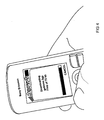
- Figs. 5 and 6 show a captured image frame from the video clip downloaded in Fig. 4 .
- message "Play" on the display of the mobile device, in a position corresponding to a physical button on the particular device, indicates to the user how the video to be started and stopped, thus permitting a still image to be frozen on the screen of the mobile device.
- a meter at the top of the mobile device screen indicates to the user the amount of video that has been displayed, and the amount of video yet to be displayed in the downloaded video clip.
- a WAP push link was sent to a particular mobile device (for example, in a text message), indicating that receipt of an alarm on a certain day, at a certain time, and additionally indicating that a video taken at the time and location of the alarm is available for viewing.
- the user selects the link to initiate the connection of the mobile device to the link provided, connecting the phone to the URL from the link, via the mobile network.
- connecting to the link initiates the downloading of the getmms.3gp file containing seventy-two kilobytes.
- the database maintained on behalf of the service provider is either pre-informed of this information, or detects this information view a communication with the user.
- computers/servers associated with the service provider reformat the image data file for display on the particular model of Sony Ericsson cellular telephone, in the present example, that the database says will be receiving and displaying it.
- the system of the present invention can download the entire multimedia data file (i.e., and not just a link), to the mobile device. This would eliminate the step of requiring the computer to initiate the download from the service provider's computer/server by connecting, via a link. If desired, a text message informing a user of the alarm condition and of the presently accessible multimedia file can additionally be sent to the mobile device.
- the present invention utilizes motion detection to capture multimedia data (i.e., image and/or audio data) and transmit it to a monitoring center, via a communications network.
- multimedia data i.e., image and/or audio data
- the multimedia data is decoded at the monitoring center and reformatted to be compatible with the user's particular mobile device, based on the particular types of requirements that the user's mobile device have, in order to receive the information in a format that the mobile device can understand and display to the user in an optimally meaningful way.
Landscapes
- Engineering & Computer Science (AREA)
- Physics & Mathematics (AREA)
- General Physics & Mathematics (AREA)
- Multimedia (AREA)
- Human Computer Interaction (AREA)
- Alarm Systems (AREA)
- Burglar Alarm Systems (AREA)
- Telephonic Communication Services (AREA)
Applications Claiming Priority (3)
| Application Number | Priority Date | Filing Date | Title |
|---|---|---|---|
| US87106006P | 2006-12-20 | 2006-12-20 | |
| US89472907P | 2007-03-14 | 2007-03-14 | |
| US11/959,039 US20080151050A1 (en) | 2006-12-20 | 2007-12-18 | Enhanced Multimedia Intrusion Notification System and Method |
Publications (2)
| Publication Number | Publication Date |
|---|---|
| EP1936577A2 true EP1936577A2 (fr) | 2008-06-25 |
| EP1936577A3 EP1936577A3 (fr) | 2010-05-19 |
Family
ID=39277350
Family Applications (1)
| Application Number | Title | Priority Date | Filing Date |
|---|---|---|---|
| EP07024704A Withdrawn EP1936577A3 (fr) | 2006-12-20 | 2007-12-20 | Système et procédé améliorés de notification d'intrusion multimédia |
Country Status (2)
| Country | Link |
|---|---|
| US (1) | US20080151050A1 (fr) |
| EP (1) | EP1936577A3 (fr) |
Cited By (1)
| Publication number | Priority date | Publication date | Assignee | Title |
|---|---|---|---|---|
| CN106415679A (zh) * | 2014-06-09 | 2017-02-15 | 朴相来 | 影像热射线装置及利用其的侵入感知系统 |
Families Citing this family (25)
| Publication number | Priority date | Publication date | Assignee | Title |
|---|---|---|---|---|
| US11082664B2 (en) | 2004-07-06 | 2021-08-03 | Tseng-Lu Chien | Multiple functions LED night light |
| JP4899534B2 (ja) * | 2006-02-28 | 2012-03-21 | ソニー株式会社 | 監視カメラ |
| US20080233984A1 (en) * | 2007-03-23 | 2008-09-25 | Jeffrey Michael Franklin | Cross-carrier content upload, social network and promotional platform |
| US8547433B2 (en) * | 2008-11-09 | 2013-10-01 | Haim Amir | Extended life video camera system and method |
| US8736678B2 (en) * | 2008-12-11 | 2014-05-27 | At&T Intellectual Property I, L.P. | Method and apparatus for vehicle surveillance service in municipal environments |
| US8325133B1 (en) * | 2009-01-07 | 2012-12-04 | Sprint Communications Company L.P. | Secure opportunistic use of external interfaces |
| US20100203920A1 (en) * | 2009-02-06 | 2010-08-12 | Ted Walter Gregory | Personal communication device with integrated alarm |
| US8791976B2 (en) * | 2009-03-16 | 2014-07-29 | Avaya Inc. | Method for initiating automatic telecommunication sessions |
| CN102025975A (zh) * | 2009-09-23 | 2011-04-20 | 鸿富锦精密工业(深圳)有限公司 | 自动监控方法和系统 |
| US20120019658A1 (en) * | 2010-01-19 | 2012-01-26 | Mironichev Sergei Y | Smart coordinator and video safeguard system |
| US10230880B2 (en) | 2011-11-14 | 2019-03-12 | Tseng-Lu Chien | LED light has built-in camera-assembly for colorful digital-data under dark environment |
| US11632520B2 (en) | 2011-11-14 | 2023-04-18 | Aaron Chien | LED light has built-in camera-assembly to capture colorful digital-data under dark environment |
| US10326921B2 (en) * | 2011-11-14 | 2019-06-18 | Tseng-Lu Chien | Light device has built-in camera and related digital data device's functions |
| US10264170B2 (en) | 2011-11-14 | 2019-04-16 | Tseng-Lu Chien | LED light has adjustable-angle sensor to cover 180 horizon detect-range |
| US10076109B2 (en) | 2012-02-14 | 2018-09-18 | Noble Research Institute, Llc | Systems and methods for trapping animals |
| US9166732B2 (en) * | 2012-04-19 | 2015-10-20 | At&T Mobility Ii Llc | Facilitation of security employing a femto cell access point |
| US20140297784A1 (en) * | 2013-03-29 | 2014-10-02 | Lucy Ma Zhao | Cross Platform Application Transactions |
| US20220261465A1 (en) * | 2013-11-21 | 2022-08-18 | Yevgeny Levitov | Motion-Triggered Biometric System for Access Control |
| US20150146012A1 (en) * | 2013-11-27 | 2015-05-28 | Sprint Communications Company L.P. | Video presentation quality display in a wireless communication device |
| US9865103B2 (en) * | 2014-02-17 | 2018-01-09 | General Electric Company | Imaging system and method |
| US9237743B2 (en) | 2014-04-18 | 2016-01-19 | The Samuel Roberts Noble Foundation, Inc. | Systems and methods for trapping animals |
| KR101638879B1 (ko) * | 2014-11-06 | 2016-07-12 | 주식회사 아이디스 | 위젯을 통해 보안 매체와 연동 가능한 모바일 장치 |
| CN104780346A (zh) * | 2015-03-19 | 2015-07-15 | 四川长虹电器股份有限公司 | 轻量级的视频信息处理方法及系统 |
| US11527137B2 (en) | 2018-07-27 | 2022-12-13 | Entry Shield Security Llc | Metal detection in a high flow traffic observation environment |
| US11301907B2 (en) | 2018-11-14 | 2022-04-12 | At&T Intellectual Property I, L.P. | Dynamic image service |
Citations (4)
| Publication number | Priority date | Publication date | Assignee | Title |
|---|---|---|---|---|
| US7034681B2 (en) | 2000-11-30 | 2006-04-25 | Agilent Technologies, Inc. | Home security video system using internet technique |
| US20070066311A1 (en) | 2005-09-22 | 2007-03-22 | Jean-Michel Reibel | Spread spectrum wireless communication and monitoring arrangement and method |
| US20070063840A1 (en) | 2005-09-22 | 2007-03-22 | Keith Jentoft | Security monitoring arrangement and method using a common field of view |
| US20070257195A1 (en) | 2005-09-22 | 2007-11-08 | Jean-Michel Reibel | Integrated Motion-Image Monitoring Method and Device |
Family Cites Families (17)
| Publication number | Priority date | Publication date | Assignee | Title |
|---|---|---|---|---|
| JP2000059758A (ja) * | 1998-08-05 | 2000-02-25 | Matsushita Electric Ind Co Ltd | 監視カメラ装置、監視装置、及びこれらを用いた遠隔監視システム |
| US7312813B1 (en) * | 2000-02-14 | 2007-12-25 | Nokia Corporation | Wireless application protocol television |
| JP4750927B2 (ja) * | 2000-06-30 | 2011-08-17 | 日本ネットワークサービス株式会社 | 遠隔監視方法および監視制御サーバ |
| US7113090B1 (en) * | 2001-04-24 | 2006-09-26 | Alarm.Com Incorporated | System and method for connecting security systems to a wireless device |
| US7161479B2 (en) * | 2002-08-12 | 2007-01-09 | Sobol Raymond J | Portable instantaneous wireless even based photo identification and alerting security system |
| AU2003286491A1 (en) * | 2002-10-18 | 2004-05-04 | Global Epoint, Inc. | Video and telemetry apparatus and methods |
| US7019644B2 (en) * | 2003-02-04 | 2006-03-28 | Barrie Robert P | Mobile object monitoring system |
| US7577199B1 (en) * | 2003-06-19 | 2009-08-18 | Nvidia Corporation | Apparatus and method for performing surveillance using motion vectors |
| FR2859851A1 (fr) * | 2003-09-11 | 2005-03-18 | France Telecom | Systeme d'acces a des fichiers multimedias depuis un terminal mobile |
| GB2416897A (en) * | 2004-07-29 | 2006-02-08 | Visible Vigilance Ltd | A Remote Monitoring System |
| US7190263B2 (en) * | 2004-09-20 | 2007-03-13 | Motorola, Inc. | Utilizing a portable electronic device to detect motion |
| US20060192659A1 (en) * | 2005-02-15 | 2006-08-31 | Fazio Michele P | Spy guard system, photo vision and/or message notification system |
| JP4362728B2 (ja) * | 2005-09-20 | 2009-11-11 | ソニー株式会社 | 制御装置、監視カメラシステム、およびその制御プログラム |
| US20070091177A1 (en) * | 2005-10-24 | 2007-04-26 | The Regents Of The University Of California | Remote unattended camera and computer integrated security system |
| US20070185989A1 (en) * | 2006-02-07 | 2007-08-09 | Thomas Grant Corbett | Integrated video surveillance system and associated method of use |
| US20070289012A1 (en) * | 2006-06-13 | 2007-12-13 | Leemon Baird | Remotely controllable security system |
| US20080136914A1 (en) * | 2006-12-07 | 2008-06-12 | Craig Carlson | Mobile monitoring and surveillance system for monitoring activities at a remote protected area |
-
2007
- 2007-12-18 US US11/959,039 patent/US20080151050A1/en not_active Abandoned
- 2007-12-20 EP EP07024704A patent/EP1936577A3/fr not_active Withdrawn
Patent Citations (4)
| Publication number | Priority date | Publication date | Assignee | Title |
|---|---|---|---|---|
| US7034681B2 (en) | 2000-11-30 | 2006-04-25 | Agilent Technologies, Inc. | Home security video system using internet technique |
| US20070066311A1 (en) | 2005-09-22 | 2007-03-22 | Jean-Michel Reibel | Spread spectrum wireless communication and monitoring arrangement and method |
| US20070063840A1 (en) | 2005-09-22 | 2007-03-22 | Keith Jentoft | Security monitoring arrangement and method using a common field of view |
| US20070257195A1 (en) | 2005-09-22 | 2007-11-08 | Jean-Michel Reibel | Integrated Motion-Image Monitoring Method and Device |
Cited By (1)
| Publication number | Priority date | Publication date | Assignee | Title |
|---|---|---|---|---|
| CN106415679A (zh) * | 2014-06-09 | 2017-02-15 | 朴相来 | 影像热射线装置及利用其的侵入感知系统 |
Also Published As
| Publication number | Publication date |
|---|---|
| EP1936577A3 (fr) | 2010-05-19 |
| US20080151050A1 (en) | 2008-06-26 |
Similar Documents
| Publication | Publication Date | Title |
|---|---|---|
| EP1936577A2 (fr) | Système et procédé améliorés de notification d'intrusion multimédia | |
| CA2643610C (fr) | Systeme et procede d'acquisition et de diffusion de donnees a distance | |
| US7840203B2 (en) | Process and system for automatically transmitting audio/video content from an electronic device to desired recipient(s) | |
| US7129848B2 (en) | Remote monitoring method and system | |
| JP3945193B2 (ja) | 情報通知システムおよび情報通知装置 | |
| US20150381536A1 (en) | Method and system for prompt video-data message transfer to personal devices | |
| US20110187895A1 (en) | Intelligent video compacting agent | |
| WO2010048243A2 (fr) | Transmission en continu de données de téléphone cellulaire pour surveillance et sécurité personnelle | |
| WO2008091566A1 (fr) | Transmission automatique et/ou contenu vidéo pour un ou plusieurs destinataire(s) souhaité(s) | |
| JP3915438B2 (ja) | 遠隔監視システム、遠隔監視方法、遠隔監視プログラム、及びこれを記録したコンピュータ読み取り可能な記録媒体 | |
| US10448086B2 (en) | Sharing video footage from audio/video recording and communication devices to smart TV devices | |
| US20060152594A1 (en) | Mobile communication device having call-triggered image taking and sending capability and method of operation thereof | |
| US20120019658A1 (en) | Smart coordinator and video safeguard system | |
| JP2004341565A (ja) | インターネット利用による警備システム | |
| WO2004012457A1 (fr) | Système de surveillance télécommandé | |
| US20050086698A1 (en) | Automatic monitoring and alerting device | |
| US20040008257A1 (en) | Monitoring service process using communication network | |
| KR100782734B1 (ko) | 이동통신망을 이용한 보안 감시정보 제공 시스템 및 그방법 | |
| KR20100043579A (ko) | 인터넷 tv를 이용한 방범 서비스 방법 및 그 시스템 | |
| KR20080082689A (ko) | 인터넷을 이용한 실시간 감시 서버 | |
| KR101458365B1 (ko) | 영상기기 보이스 알람 시스템 및 그 운용방법 | |
| KR101583405B1 (ko) | 경비기능을 갖춘 이종기기 통합장치 | |
| JP3752517B2 (ja) | 監視情報供給システム | |
| KR20040004971A (ko) | 네트워크를 이용한 보안 경보 시스템 및 그 보안 경보 방법 | |
| KR20080064345A (ko) | 휴대형단말기를 이용한 원격 모니터 시스템 |
Legal Events
| Date | Code | Title | Description |
|---|---|---|---|
| PUAI | Public reference made under article 153(3) epc to a published international application that has entered the european phase |
Free format text: ORIGINAL CODE: 0009012 |
|
| AK | Designated contracting states |
Kind code of ref document: A2 Designated state(s): AT BE BG CH CY CZ DE DK EE ES FI FR GB GR HU IE IS IT LI LT LU LV MC MT NL PL PT RO SE SI SK TR |
|
| AX | Request for extension of the european patent |
Extension state: AL BA HR MK RS |
|
| PUAL | Search report despatched |
Free format text: ORIGINAL CODE: 0009013 |
|
| AK | Designated contracting states |
Kind code of ref document: A3 Designated state(s): AT BE BG CH CY CZ DE DK EE ES FI FR GB GR HU IE IS IT LI LT LU LV MC MT NL PL PT RO SE SI SK TR |
|
| AX | Request for extension of the european patent |
Extension state: AL BA HR MK RS |
|
| STAA | Information on the status of an ep patent application or granted ep patent |
Free format text: STATUS: THE APPLICATION IS DEEMED TO BE WITHDRAWN |
|
| 18D | Application deemed to be withdrawn |
Effective date: 20100701 |