EP1936975A1 - Procédé et dispositif pour le traitement d'images sources afin de générer un repliement de spectre - Google Patents
Procédé et dispositif pour le traitement d'images sources afin de générer un repliement de spectre Download PDFInfo
- Publication number
- EP1936975A1 EP1936975A1 EP06301275A EP06301275A EP1936975A1 EP 1936975 A1 EP1936975 A1 EP 1936975A1 EP 06301275 A EP06301275 A EP 06301275A EP 06301275 A EP06301275 A EP 06301275A EP 1936975 A1 EP1936975 A1 EP 1936975A1
- Authority
- EP
- European Patent Office
- Prior art keywords
- frequency
- delivered
- modulation
- pictures
- value
- Prior art date
- Legal status (The legal status is an assumption and is not a legal conclusion. Google has not performed a legal analysis and makes no representation as to the accuracy of the status listed.)
- Withdrawn
Links
- 238000000034 method Methods 0.000 title claims abstract description 29
- 238000005070 sampling Methods 0.000 claims description 7
- 230000000694 effects Effects 0.000 description 9
- 230000010354 integration Effects 0.000 description 8
- 230000005284 excitation Effects 0.000 description 7
- 210000001525 retina Anatomy 0.000 description 7
- 230000035945 sensitivity Effects 0.000 description 7
- 238000001228 spectrum Methods 0.000 description 6
- 230000006870 function Effects 0.000 description 4
- 230000008447 perception Effects 0.000 description 4
- 230000009977 dual effect Effects 0.000 description 3
- 238000001914 filtration Methods 0.000 description 2
- 230000002123 temporal effect Effects 0.000 description 2
- 239000013598 vector Substances 0.000 description 2
- 238000003491 array Methods 0.000 description 1
- 230000006399 behavior Effects 0.000 description 1
- 230000005540 biological transmission Effects 0.000 description 1
- 239000003086 colorant Substances 0.000 description 1
- 238000010586 diagram Methods 0.000 description 1
- 238000013178 mathematical model Methods 0.000 description 1
- 230000008929 regeneration Effects 0.000 description 1
- 238000011069 regeneration method Methods 0.000 description 1
- 230000002207 retinal effect Effects 0.000 description 1
- 230000003595 spectral effect Effects 0.000 description 1
- 230000004936 stimulating effect Effects 0.000 description 1
- 230000001360 synchronised effect Effects 0.000 description 1
Images



Classifications
-
- H—ELECTRICITY
- H04—ELECTRIC COMMUNICATION TECHNIQUE
- H04N—PICTORIAL COMMUNICATION, e.g. TELEVISION
- H04N5/00—Details of television systems
- H04N5/76—Television signal recording
- H04N5/91—Television signal processing therefor
- H04N5/913—Television signal processing therefor for scrambling ; for copy protection
-
- H—ELECTRICITY
- H04—ELECTRIC COMMUNICATION TECHNIQUE
- H04N—PICTORIAL COMMUNICATION, e.g. TELEVISION
- H04N5/00—Details of television systems
- H04N5/222—Studio circuitry; Studio devices; Studio equipment
- H04N5/262—Studio circuits, e.g. for mixing, switching-over, change of character of image, other special effects ; Cameras specially adapted for the electronic generation of special effects
-
- H—ELECTRICITY
- H04—ELECTRIC COMMUNICATION TECHNIQUE
- H04N—PICTORIAL COMMUNICATION, e.g. TELEVISION
- H04N5/00—Details of television systems
- H04N5/76—Television signal recording
- H04N5/91—Television signal processing therefor
- H04N5/913—Television signal processing therefor for scrambling ; for copy protection
- H04N2005/91392—Television signal processing therefor for scrambling ; for copy protection using means for preventing making copies of projected video images
Definitions
- the present invention is in the field of content protection, most particularly in cinema venues where a camcorder acquisition followed by immediate illegal distribution creates important revenue losses for the content owners. More particularly, the invention relates to a method and a device for processing a sequence of source pictures to generate artifacts due to aliasing when these pictures are captured by a video capturing device. This method modifies the screened cinema pictures and defeat camcording opportunities in movie theaters without any incidence for the viewing human audience.
- the patent application WO 05/027529 aims to combat the copying of source pictures by means of a camera while they are being displayed, for example using a camcorder in a movie theatre.
- the pixels whose colour is modified represent an anti-piracy pattern, for example the text "ILLEGAL COPY".
- the processed pictures are displayed at a high frequency that makes the pattern invisible to the human eye but visible in the sequence filmed by the camcorder.
- Such a solution requires a modulation of the colour of the pixels at a frequency higher than the colour flicker frequency, which is of around 10/20 Hz, and is applied to projection systems having a refresh frequency of at least 100 Hz. It is also possible to modulate the luminance or the brightness of the pixels instead of their colour and to use modulation frequencies which are not half of the refresh frequency of the projection system but the modulation frequency should be higher than the color flicker frequency (for a modulation in colour) or the luminance flicker frequency (for a modulation in luminance).
- the principle of the invention is based on human eye's sensitivity to flicker and the way it relates to both flicker frequency and signal energy. It consists in modulating a video source in amplitude with at least two carrier waves to generate temporal aliasing artifacts on camcorder copies without disturbing direct vision for a human eye.
- the invention concerns a method for processing a sequence of source pictures to generate artifacts due to aliasing when said source pictures are captured by a video capturing device, said method comprising a first time modulation step for modulating temporally at a first modulation frequency the brightness of pixels of each picture of the sequence around a brightness to be displayed for said picture.
- it further comprises a second time modulation step for modulating temporally at a second modulation frequency different from the first modulation frequency the brightness of pixels of each picture of the sequence around a brightness value to be displayed for said picture, said first and second modulation frequencies being determined in order not to be visible to the human eye and contributing to generate aliasing artifact at a predetermined aliasing frequency.
- the pixels whose brightness is modulated are pixels of the source pictures that used for displaying an anti-copy pattern.
- all pixels of the anti-copy pattern are modulated by the first modulation frequency and the second modulation frequency.
- a first part of the pixels of the anti-copy pattern are modulated by the first modulation frequency and a second part is modulated by the second modulation frequency.
- the brightness of the pixels of the source pictures comprising a first component and a second component
- the first component of pixels of source pictures is modulated at the first modulation frequency
- the second component of pixels of source pictures is modulated at the second frequency.
- the first component is for example luminance and the second component is chrominance.
- the invention concerns also a device for processing a sequence of source pictures to generate artifacts due to aliasing when said source pictures are captured by a video capturing device, said source pictures being received at a first refresh frequency and delivered at a second refresh frequency, comprising
- the signal m(t) designates the signal representative of the light-induced charges entering and being integrated by a sensor cell of a CCD/CMOS array of the camcorder device.
- the signal m shut ( t ) is then sampled for storage purposes. It has to be noted that the shutter command signals' periodicity is most likely synchronized to the sampling process, especially when using CCD sensor arrays, which readout process involves a complete initialization of their photocells.
- a video signal has to satisfy the following constraints:
- Shutter spectrum and aliasing frequencies can be determined using the Fourier transform of the equation (2):
- the abrupt truncation of light integration by CCD/CMOS array sensors command signals introduces severe sidelobe effects during the low pass filtering process, meaning, despite the low pass behaviour of this filter, that spectral content over the 1 T cutoff limit can pass through the shutter.
- Sidelobe peaks of the cardinal sine function can be determined using the following table.
- the alias generating frequencies satisfying the constraints given previously are identified in the figure 1 by black areas. These frequencies are located around the sidelobe peaks (highest shutter gain areas) in the [25, ⁇ [Hz frequency band (Shannon-Nyquist theorem violation).
- the equation (6) is the expression of an amplitude-modulated (AM) signal, with the original signal m(t) being added to the modulated spectrum m(t)cos(2 ⁇ f m t), to be opposed to classical AM schemes in transmission where only the carrier wave cos(2 ⁇ f m t) can be added to the modulated signal to avoid carrier regeneration on reception before the demodulation process.
- AM amplitude-modulated
- the invention in order to have a modulation effect which is strong enough to generate aliasing artefacts yet invisible enough for the audience not to be disturbed, it is proposed to use a multi-carrier modulation scheme, based on at least two modulation frequencies f m1 and f m2 , instead of using a single-carrier modulation scheme as used up to now.
- the first frequency f m1 (the lowest frequency) allows to introduce as much effect as possible for a low flicker rate and goes through significant shutter gains (for example, over -12 dB).
- the second frequency f m2 allows generating even more disturbance with the remaining bits of signal energy.
- m MOD t m t + A ⁇ 1 ⁇ cos ( 2 ⁇ ⁇ f m ⁇ 1 ⁇ t ) + A ⁇ 2 ⁇ cos ( 2 ⁇ ⁇ f m ⁇ 2 ⁇ t )
- the two modulation frequencies f m1 and f m2 are selected to contribute to generate aliasing at a predetermined frequency f a .
- all pixels of the anti-copy pattern to be introduced in the source pictures are modulated by two modulation frequencies f m1 and f m2 .
- a first part of the pixels of the anti-copy pattern to be introduced in the source pictures are modulated by the modulation frequency f m1 and a second part of the pixels of the anti-copy pattern (different from the first part) are modulated by the modulation frequency f m2 .
- the luminance of the pixels of the anti-copy pattern to be introduced in the source pictures is modulated at the first modulation frequency and the chrominance of these pixels is modulated at the second frequency.
- FIG. 2 shows Kelly's Temporal Contrast Sensitivity (TCS) function for various adapting fields.
- TCS Temporal Contrast Sensitivity
- the phase opposition (+ ⁇ ) on the carrier 2 allows to cancel the e -j ⁇ fT -induced phase opposition between odd and even lobes on the shutter spectrum (see equation (3)).
- Figure 2 is unlikely to be representative of human perception in a movie theater, which has different vision conditions than those used during flicker sensitivity tests.
- this multi-carrier modulation scheme is to be applied to either one or several components of the video signal in the XYZ color space, as long as modulation indices ensure that every modulated value is located inside the gamut of the display device.
- FIG. 3 shows the sensitivity of a human eye to color flicker. More particularly, Figure 3 shows the threshold modulation indices for two retina excitations (4,5 trolands and 45 trolands), for 4 colors (blue 455 nm, green 512 nm, red 641 nm, red 689 nm) and for a modulation frequency range [1 Hz,20Hz]. For a given retina excitation, a given color and a given modulation frequency, the modulation index must be above the corresponding sensitivity curve (the modulation is lower than the modulation index given by the curve) to ensure invisibility of the flicker in the movie theater.
- m MOD t X t . 1 + A ⁇ 1 ⁇ cos 2 ⁇ ⁇ f m ⁇ 1 ⁇ t Y t . 1 + A ⁇ 2 ⁇ cos 2 ⁇ ⁇ f m ⁇ 2 ⁇ t Z t . 1 + A ⁇ 3 ⁇ cos 2 ⁇ ⁇ f m ⁇ 1 ⁇ t
- A1, A2 and A3 are modulation indices that are carefully selected to make sure that all modulated vectors are in the display device gamut. For a given modulation frequency, a given color and a given retina excitation, a valid modulation index A is located over the corresponding sensitivity curve of the Figure 3 .
- Another condition is to make sure that all selected XYZ vectors from X(1-A1) to X(1+A1), Y(1-A2) to Y(1 +A2) and Z(1-A3) to Z(1 +A3) are located inside the display gamut.
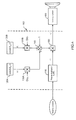
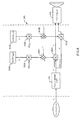
- Figures 4 , 5 and 6 are block diagrams of three exemplary circuit implementations of the inventive method.
- Figure 4 shows a device 100 for implementing the inventive method where all the pixels of the anti-copy pattern (for example ILLEGAL COPY) are modulated by both modulation frequencies f m1 and f m2 .
- the device comprises:
- Figure 5 shows a device 200 for implementing the inventive method where a part of pixels of the anti-copy pattern, the pixels belonging to a set E 1 , are modulated at the modulation frequency f m1 and the remaining pixels of the anti-copy pattern are modulated at the modulation frequency f m2 .
- the source pictures are received at a refresh frequency F r .
- the device comprises:
- the brightness of the anti-copy pattern pixels of the pictures is modulated. It can be either the luminance or the chrominance of the pixels.
- Figure 6 proposes a circuit implementation where the luminance of the anti-copy pattern pixels is modulated at a first frequency and the chrominance of these pixels is modulated at a second modulation frequency.
- the source pictures are received at a refresh frequency F r .
- the device comprises:
Landscapes
- Engineering & Computer Science (AREA)
- Multimedia (AREA)
- Signal Processing (AREA)
- Control Of Indicators Other Than Cathode Ray Tubes (AREA)
- Television Systems (AREA)
- Transforming Electric Information Into Light Information (AREA)
- Projection Apparatus (AREA)
Priority Applications (6)
| Application Number | Priority Date | Filing Date | Title |
|---|---|---|---|
| EP06301275A EP1936975A1 (fr) | 2006-12-20 | 2006-12-20 | Procédé et dispositif pour le traitement d'images sources afin de générer un repliement de spectre |
| KR1020097012869A KR20090091785A (ko) | 2006-12-20 | 2007-12-14 | 에일리어싱을 생성하도록 소스 픽처를 처리하는 방법 및 장치 |
| PCT/EP2007/064012 WO2008074754A1 (fr) | 2006-12-20 | 2007-12-14 | Procédé et dispositif pour traiter des images source afin de générer une distorsion de repliement |
| CNA200780047724XA CN101569185A (zh) | 2006-12-20 | 2007-12-14 | 用于处理源画面以生成混叠的方法和设备 |
| EP07857646A EP2095634A1 (fr) | 2006-12-20 | 2007-12-14 | Procédé et dispositif pour traiter des images source afin de générer une distorsion de repliement |
| US12/448,438 US20100027968A1 (en) | 2006-12-20 | 2007-12-14 | Method and device for processing source pictures to generate aliasing |
Applications Claiming Priority (1)
| Application Number | Priority Date | Filing Date | Title |
|---|---|---|---|
| EP06301275A EP1936975A1 (fr) | 2006-12-20 | 2006-12-20 | Procédé et dispositif pour le traitement d'images sources afin de générer un repliement de spectre |
Publications (1)
| Publication Number | Publication Date |
|---|---|
| EP1936975A1 true EP1936975A1 (fr) | 2008-06-25 |
Family
ID=37943955
Family Applications (2)
| Application Number | Title | Priority Date | Filing Date |
|---|---|---|---|
| EP06301275A Withdrawn EP1936975A1 (fr) | 2006-12-20 | 2006-12-20 | Procédé et dispositif pour le traitement d'images sources afin de générer un repliement de spectre |
| EP07857646A Withdrawn EP2095634A1 (fr) | 2006-12-20 | 2007-12-14 | Procédé et dispositif pour traiter des images source afin de générer une distorsion de repliement |
Family Applications After (1)
| Application Number | Title | Priority Date | Filing Date |
|---|---|---|---|
| EP07857646A Withdrawn EP2095634A1 (fr) | 2006-12-20 | 2007-12-14 | Procédé et dispositif pour traiter des images source afin de générer une distorsion de repliement |
Country Status (5)
| Country | Link |
|---|---|
| US (1) | US20100027968A1 (fr) |
| EP (2) | EP1936975A1 (fr) |
| KR (1) | KR20090091785A (fr) |
| CN (1) | CN101569185A (fr) |
| WO (1) | WO2008074754A1 (fr) |
Cited By (1)
| Publication number | Priority date | Publication date | Assignee | Title |
|---|---|---|---|---|
| WO2019137097A1 (fr) * | 2018-01-12 | 2019-07-18 | Boe Technology Group Co., Ltd. | Procédé d'affichage vidéo, appareil d'affichage vidéo et produit programme informatique |
Families Citing this family (8)
| Publication number | Priority date | Publication date | Assignee | Title |
|---|---|---|---|---|
| EP1931143A1 (fr) * | 2006-12-06 | 2008-06-11 | Thomson Licensing | Procédé et dispositif de traitement d'une séquence source d'images |
| WO2009139746A1 (fr) * | 2008-05-15 | 2009-11-19 | Thomson Licensing | Procédé, appareil et système de protection anti-piratage pour cinéma numérique |
| KR101012855B1 (ko) | 2009-05-25 | 2011-02-08 | (주)한양정보통신 | 보안성을 강화한 안티 엘리어싱 기반의 폰트 표시방법 및 폰트 표시 시스템 |
| EP2894919B1 (fr) * | 2012-09-27 | 2020-01-15 | Huawei Technologies Co., Ltd. | Procédé et dispositif pour attribuer des canaux de commande candidats |
| KR20140060405A (ko) | 2012-11-09 | 2014-05-20 | 삼성전자주식회사 | 수신 신호 분리 방법 및 장치 |
| CN103092340B (zh) * | 2012-12-26 | 2016-03-02 | 北京大学 | 一种脑-机接口视觉刺激方法及信号识别方法 |
| KR101797042B1 (ko) * | 2015-05-15 | 2017-11-13 | 삼성전자주식회사 | 의료 영상 합성 방법 및 장치 |
| CN117253135B (zh) * | 2023-10-07 | 2026-04-03 | 号百信息服务有限公司 | 证件照图片篡改识别的方法、装置、电子设备及存储介质 |
Citations (3)
| Publication number | Priority date | Publication date | Assignee | Title |
|---|---|---|---|---|
| WO2001056279A2 (fr) * | 2000-01-28 | 2001-08-02 | Sarnoff Corporation | Mesures de lutte contre la piraterie audiovisuelle |
| EP1237369A2 (fr) * | 2001-02-28 | 2002-09-04 | Eastman Kodak Company | Protection contre la copie pour données d'image animée numériques |
| EP1372342A1 (fr) * | 2002-06-11 | 2003-12-17 | Sony Corporation | Appareil de modulation de l'état optique, système d'affichage et procédé de modulation de l'état optique. |
Family Cites Families (4)
| Publication number | Priority date | Publication date | Assignee | Title |
|---|---|---|---|---|
| US7030956B2 (en) * | 2002-03-11 | 2006-04-18 | Sony Corporation | Optical intensity modulation method and system, and optical state modulation apparatus |
| US7116374B2 (en) * | 2003-08-26 | 2006-10-03 | Koplar Interactive Systems International, L.L.C. | Method and system for enhanced modulation of video signals |
| FR2859857A1 (fr) * | 2003-09-17 | 2005-03-18 | Thomson Licensing Sa | Procedes de traitement et d'affichage d'images et appareil d 'affichage utilisant les procedes |
| EP1814073A1 (fr) * | 2006-01-26 | 2007-08-01 | THOMSON Licensing | Procédé et appareil de traitement d'une séquence d'images video |
-
2006
- 2006-12-20 EP EP06301275A patent/EP1936975A1/fr not_active Withdrawn
-
2007
- 2007-12-14 CN CNA200780047724XA patent/CN101569185A/zh active Pending
- 2007-12-14 EP EP07857646A patent/EP2095634A1/fr not_active Withdrawn
- 2007-12-14 US US12/448,438 patent/US20100027968A1/en not_active Abandoned
- 2007-12-14 KR KR1020097012869A patent/KR20090091785A/ko not_active Withdrawn
- 2007-12-14 WO PCT/EP2007/064012 patent/WO2008074754A1/fr not_active Ceased
Patent Citations (3)
| Publication number | Priority date | Publication date | Assignee | Title |
|---|---|---|---|---|
| WO2001056279A2 (fr) * | 2000-01-28 | 2001-08-02 | Sarnoff Corporation | Mesures de lutte contre la piraterie audiovisuelle |
| EP1237369A2 (fr) * | 2001-02-28 | 2002-09-04 | Eastman Kodak Company | Protection contre la copie pour données d'image animée numériques |
| EP1372342A1 (fr) * | 2002-06-11 | 2003-12-17 | Sony Corporation | Appareil de modulation de l'état optique, système d'affichage et procédé de modulation de l'état optique. |
Non-Patent Citations (2)
| Title |
|---|
| "Operating Manual Arbitrary and Function Generator R&S AM 300", February 2005 (2005-02-01), pages 1-34,1-35,6-134 - 6-144, XP002431351, Retrieved from the Internet <URL:http://www.rohde-schwarz.de/WWW/DownCent.nsf/file/AM300_BH_GB_V3_02-2005.pdf/$file/AM300_BH_GB_V3_02-2005.pdf> [retrieved on 20070425] * |
| "Software Manual Waveform Composer Software R&S AM300-K2", February 2004 (2004-02-01), XP002431352, Retrieved from the Internet <URL:http://www.rohde-schwarz.de/WWW/DownCent.nsf/file/AM300_K2_BH_D_3.pdf/$file/AM300_K2_BH_D_3.pdf> [retrieved on 20070425] * |
Cited By (2)
| Publication number | Priority date | Publication date | Assignee | Title |
|---|---|---|---|---|
| WO2019137097A1 (fr) * | 2018-01-12 | 2019-07-18 | Boe Technology Group Co., Ltd. | Procédé d'affichage vidéo, appareil d'affichage vidéo et produit programme informatique |
| US10911713B2 (en) | 2018-01-12 | 2021-02-02 | Boe Technology Group Co., Ltd. | Video displaying method, video displaying apparatus, and computer-program product |
Also Published As
| Publication number | Publication date |
|---|---|
| KR20090091785A (ko) | 2009-08-28 |
| WO2008074754A1 (fr) | 2008-06-26 |
| US20100027968A1 (en) | 2010-02-04 |
| CN101569185A (zh) | 2009-10-28 |
| EP2095634A1 (fr) | 2009-09-02 |
Similar Documents
| Publication | Publication Date | Title |
|---|---|---|
| US20100027968A1 (en) | Method and device for processing source pictures to generate aliasing | |
| CA2503835C (fr) | Techniques permettant d'alterer imperceptiblement le spectre d'une image affichee de maniere a dissuader la copie | |
| US7043019B2 (en) | Copy protection for digital motion picture image data | |
| Zhang et al. | Kaleido: You can watch it but cannot record it | |
| US8130258B2 (en) | Method for processing a video sequence and apparatus implementing said method | |
| US7324646B1 (en) | Method and apparatus for film anti-piracy | |
| WO2007041839A1 (fr) | Procedes et systemes d'affichage d'images avec une compensation de l'intensite des sous-trames | |
| EP1665811B1 (fr) | Procedes de traitement et d'affichage d'images et dispositif de visualisation faisant appel auxdits procedes | |
| JPH04368085A (ja) | 映像信号処理装置 | |
| CN110806845B (zh) | 图像显示控制方法、系统及存储介质 | |
| US7822202B2 (en) | Method and device for processing a sequence of video images | |
| KR20090085637A (ko) | 소스 화상들의 시퀀스를 처리하기 위한 방법 및 디바이스 | |
| WO2001056279A2 (fr) | Mesures de lutte contre la piraterie audiovisuelle | |
| JPS62253285A (ja) | カラ−ビデオ信号の処理方法及び装置 | |
| US20110064218A1 (en) | Method, apparatus and system for anti-piracy protection in digital cinema | |
| EP1968315A1 (fr) | Système de projection basé sur un métamérisme | |
| JP2000261694A (ja) | 映像フリッカ防止装置 | |
| JP2000350235A (ja) | 映像信号処理装置および映像信号処理方法 |
Legal Events
| Date | Code | Title | Description |
|---|---|---|---|
| PUAI | Public reference made under article 153(3) epc to a published international application that has entered the european phase |
Free format text: ORIGINAL CODE: 0009012 |
|
| AK | Designated contracting states |
Kind code of ref document: A1 Designated state(s): AT BE BG CH CY CZ DE DK EE ES FI FR GB GR HU IE IS IT LI LT LU LV MC NL PL PT RO SE SI SK TR |
|
| AX | Request for extension of the european patent |
Extension state: AL BA HR MK RS |
|
| AKX | Designation fees paid | ||
| REG | Reference to a national code |
Ref country code: DE Ref legal event code: 8566 |
|
| STAA | Information on the status of an ep patent application or granted ep patent |
Free format text: STATUS: THE APPLICATION IS DEEMED TO BE WITHDRAWN |
|
| 18D | Application deemed to be withdrawn |
Effective date: 20081230 |