EP1938896A1 - Carbone particulaire servant de support aux particules fines, processus de fabrication correspondant et electrodes pour piles a combustible - Google Patents
Carbone particulaire servant de support aux particules fines, processus de fabrication correspondant et electrodes pour piles a combustible Download PDFInfo
- Publication number
- EP1938896A1 EP1938896A1 EP06810524A EP06810524A EP1938896A1 EP 1938896 A1 EP1938896 A1 EP 1938896A1 EP 06810524 A EP06810524 A EP 06810524A EP 06810524 A EP06810524 A EP 06810524A EP 1938896 A1 EP1938896 A1 EP 1938896A1
- Authority
- EP
- European Patent Office
- Prior art keywords
- particles
- carbon particles
- particle
- fine
- supporting
- Prior art date
- Legal status (The legal status is an assumption and is not a legal conclusion. Google has not performed a legal analysis and makes no representation as to the accuracy of the status listed.)
- Withdrawn
Links
Images


Classifications
-
- B—PERFORMING OPERATIONS; TRANSPORTING
- B01—PHYSICAL OR CHEMICAL PROCESSES OR APPARATUS IN GENERAL
- B01J—CHEMICAL OR PHYSICAL PROCESSES, e.g. CATALYSIS OR COLLOID CHEMISTRY; THEIR RELEVANT APPARATUS
- B01J23/00—Catalysts comprising metals or metal oxides or hydroxides, not provided for in group B01J21/00
- B01J23/002—Mixed oxides other than spinels, e.g. perovskite
-
- B—PERFORMING OPERATIONS; TRANSPORTING
- B01—PHYSICAL OR CHEMICAL PROCESSES OR APPARATUS IN GENERAL
- B01J—CHEMICAL OR PHYSICAL PROCESSES, e.g. CATALYSIS OR COLLOID CHEMISTRY; THEIR RELEVANT APPARATUS
- B01J23/00—Catalysts comprising metals or metal oxides or hydroxides, not provided for in group B01J21/00
- B01J23/38—Catalysts comprising metals or metal oxides or hydroxides, not provided for in group B01J21/00 of noble metals
- B01J23/54—Catalysts comprising metals or metal oxides or hydroxides, not provided for in group B01J21/00 of noble metals combined with metals, oxides or hydroxides provided for in groups B01J23/02 - B01J23/36
- B01J23/56—Platinum group metals
- B01J23/58—Platinum group metals with alkali- or alkaline earth metals
-
- B—PERFORMING OPERATIONS; TRANSPORTING
- B01—PHYSICAL OR CHEMICAL PROCESSES OR APPARATUS IN GENERAL
- B01J—CHEMICAL OR PHYSICAL PROCESSES, e.g. CATALYSIS OR COLLOID CHEMISTRY; THEIR RELEVANT APPARATUS
- B01J23/00—Catalysts comprising metals or metal oxides or hydroxides, not provided for in group B01J21/00
- B01J23/38—Catalysts comprising metals or metal oxides or hydroxides, not provided for in group B01J21/00 of noble metals
- B01J23/54—Catalysts comprising metals or metal oxides or hydroxides, not provided for in group B01J21/00 of noble metals combined with metals, oxides or hydroxides provided for in groups B01J23/02 - B01J23/36
- B01J23/56—Platinum group metals
- B01J23/63—Platinum group metals with rare earths or actinides
-
- B—PERFORMING OPERATIONS; TRANSPORTING
- B01—PHYSICAL OR CHEMICAL PROCESSES OR APPARATUS IN GENERAL
- B01J—CHEMICAL OR PHYSICAL PROCESSES, e.g. CATALYSIS OR COLLOID CHEMISTRY; THEIR RELEVANT APPARATUS
- B01J23/00—Catalysts comprising metals or metal oxides or hydroxides, not provided for in group B01J21/00
- B01J23/70—Catalysts comprising metals or metal oxides or hydroxides, not provided for in group B01J21/00 of the iron group metals or copper
- B01J23/89—Catalysts comprising metals or metal oxides or hydroxides, not provided for in group B01J21/00 of the iron group metals or copper combined with noble metals
- B01J23/8933—Catalysts comprising metals or metal oxides or hydroxides, not provided for in group B01J21/00 of the iron group metals or copper combined with noble metals also combined with metals, or metal oxides or hydroxides provided for in groups B01J23/02 - B01J23/36
- B01J23/894—Catalysts comprising metals or metal oxides or hydroxides, not provided for in group B01J21/00 of the iron group metals or copper combined with noble metals also combined with metals, or metal oxides or hydroxides provided for in groups B01J23/02 - B01J23/36 with rare earths or actinides
-
- B—PERFORMING OPERATIONS; TRANSPORTING
- B01—PHYSICAL OR CHEMICAL PROCESSES OR APPARATUS IN GENERAL
- B01J—CHEMICAL OR PHYSICAL PROCESSES, e.g. CATALYSIS OR COLLOID CHEMISTRY; THEIR RELEVANT APPARATUS
- B01J35/00—Catalysts, in general, characterised by their form or physical properties
- B01J35/40—Catalysts, in general, characterised by their form or physical properties characterised by dimensions, e.g. grain size
- B01J35/45—Nanoparticles
-
- H—ELECTRICITY
- H01—ELECTRIC ELEMENTS
- H01M—PROCESSES OR MEANS, e.g. BATTERIES, FOR THE DIRECT CONVERSION OF CHEMICAL ENERGY INTO ELECTRICAL ENERGY
- H01M4/00—Electrodes
- H01M4/86—Inert electrodes with catalytic activity, e.g. for fuel cells
- H01M4/8605—Porous electrodes
-
- H—ELECTRICITY
- H01—ELECTRIC ELEMENTS
- H01M—PROCESSES OR MEANS, e.g. BATTERIES, FOR THE DIRECT CONVERSION OF CHEMICAL ENERGY INTO ELECTRICAL ENERGY
- H01M4/00—Electrodes
- H01M4/86—Inert electrodes with catalytic activity, e.g. for fuel cells
- H01M4/88—Processes of manufacture
- H01M4/8803—Supports for the deposition of the catalytic active composition
- H01M4/8814—Temporary supports, e.g. decal
-
- H—ELECTRICITY
- H01—ELECTRIC ELEMENTS
- H01M—PROCESSES OR MEANS, e.g. BATTERIES, FOR THE DIRECT CONVERSION OF CHEMICAL ENERGY INTO ELECTRICAL ENERGY
- H01M4/00—Electrodes
- H01M4/86—Inert electrodes with catalytic activity, e.g. for fuel cells
- H01M4/88—Processes of manufacture
- H01M4/8875—Methods for shaping the electrode into free-standing bodies, like sheets, films or grids, e.g. moulding, hot-pressing, casting without support, extrusion without support
-
- H—ELECTRICITY
- H01—ELECTRIC ELEMENTS
- H01M—PROCESSES OR MEANS, e.g. BATTERIES, FOR THE DIRECT CONVERSION OF CHEMICAL ENERGY INTO ELECTRICAL ENERGY
- H01M4/00—Electrodes
- H01M4/86—Inert electrodes with catalytic activity, e.g. for fuel cells
- H01M4/88—Processes of manufacture
- H01M4/8878—Treatment steps after deposition of the catalytic active composition or after shaping of the electrode being free-standing body
- H01M4/8882—Heat treatment, e.g. drying, baking
-
- H—ELECTRICITY
- H01—ELECTRIC ELEMENTS
- H01M—PROCESSES OR MEANS, e.g. BATTERIES, FOR THE DIRECT CONVERSION OF CHEMICAL ENERGY INTO ELECTRICAL ENERGY
- H01M4/00—Electrodes
- H01M4/86—Inert electrodes with catalytic activity, e.g. for fuel cells
- H01M4/88—Processes of manufacture
- H01M4/8878—Treatment steps after deposition of the catalytic active composition or after shaping of the electrode being free-standing body
- H01M4/8896—Pressing, rolling, calendering
-
- H—ELECTRICITY
- H01—ELECTRIC ELEMENTS
- H01M—PROCESSES OR MEANS, e.g. BATTERIES, FOR THE DIRECT CONVERSION OF CHEMICAL ENERGY INTO ELECTRICAL ENERGY
- H01M4/00—Electrodes
- H01M4/86—Inert electrodes with catalytic activity, e.g. for fuel cells
- H01M4/90—Selection of catalytic material
- H01M4/9016—Oxides, hydroxides or oxygenated metallic salts
-
- H—ELECTRICITY
- H01—ELECTRIC ELEMENTS
- H01M—PROCESSES OR MEANS, e.g. BATTERIES, FOR THE DIRECT CONVERSION OF CHEMICAL ENERGY INTO ELECTRICAL ENERGY
- H01M4/00—Electrodes
- H01M4/86—Inert electrodes with catalytic activity, e.g. for fuel cells
- H01M4/90—Selection of catalytic material
- H01M4/92—Metals of platinum group
- H01M4/923—Compounds thereof with non-metallic elements
-
- H—ELECTRICITY
- H01—ELECTRIC ELEMENTS
- H01M—PROCESSES OR MEANS, e.g. BATTERIES, FOR THE DIRECT CONVERSION OF CHEMICAL ENERGY INTO ELECTRICAL ENERGY
- H01M4/00—Electrodes
- H01M4/86—Inert electrodes with catalytic activity, e.g. for fuel cells
- H01M4/90—Selection of catalytic material
- H01M4/92—Metals of platinum group
- H01M4/925—Metals of platinum group supported on carriers, e.g. powder carriers
- H01M4/926—Metals of platinum group supported on carriers, e.g. powder carriers on carbon or graphite
-
- B—PERFORMING OPERATIONS; TRANSPORTING
- B01—PHYSICAL OR CHEMICAL PROCESSES OR APPARATUS IN GENERAL
- B01J—CHEMICAL OR PHYSICAL PROCESSES, e.g. CATALYSIS OR COLLOID CHEMISTRY; THEIR RELEVANT APPARATUS
- B01J21/00—Catalysts comprising the elements, oxides, or hydroxides of magnesium, boron, aluminium, carbon, silicon, titanium, zirconium, or hafnium
- B01J21/18—Carbon
-
- B—PERFORMING OPERATIONS; TRANSPORTING
- B01—PHYSICAL OR CHEMICAL PROCESSES OR APPARATUS IN GENERAL
- B01J—CHEMICAL OR PHYSICAL PROCESSES, e.g. CATALYSIS OR COLLOID CHEMISTRY; THEIR RELEVANT APPARATUS
- B01J2523/00—Constitutive chemical elements of heterogeneous catalysts
-
- B—PERFORMING OPERATIONS; TRANSPORTING
- B01—PHYSICAL OR CHEMICAL PROCESSES OR APPARATUS IN GENERAL
- B01J—CHEMICAL OR PHYSICAL PROCESSES, e.g. CATALYSIS OR COLLOID CHEMISTRY; THEIR RELEVANT APPARATUS
- B01J35/00—Catalysts, in general, characterised by their form or physical properties
- B01J35/20—Catalysts, in general, characterised by their form or physical properties characterised by their non-solid state
- B01J35/23—Catalysts, in general, characterised by their form or physical properties characterised by their non-solid state in a colloidal state
-
- H—ELECTRICITY
- H01—ELECTRIC ELEMENTS
- H01M—PROCESSES OR MEANS, e.g. BATTERIES, FOR THE DIRECT CONVERSION OF CHEMICAL ENERGY INTO ELECTRICAL ENERGY
- H01M8/00—Fuel cells; Manufacture thereof
- H01M8/10—Fuel cells with solid electrolytes
- H01M2008/1095—Fuel cells with polymeric electrolytes
-
- Y—GENERAL TAGGING OF NEW TECHNOLOGICAL DEVELOPMENTS; GENERAL TAGGING OF CROSS-SECTIONAL TECHNOLOGIES SPANNING OVER SEVERAL SECTIONS OF THE IPC; TECHNICAL SUBJECTS COVERED BY FORMER USPC CROSS-REFERENCE ART COLLECTIONS [XRACs] AND DIGESTS
- Y02—TECHNOLOGIES OR APPLICATIONS FOR MITIGATION OR ADAPTATION AGAINST CLIMATE CHANGE
- Y02E—REDUCTION OF GREENHOUSE GAS [GHG] EMISSIONS, RELATED TO ENERGY GENERATION, TRANSMISSION OR DISTRIBUTION
- Y02E60/00—Enabling technologies; Technologies with a potential or indirect contribution to GHG emissions mitigation
- Y02E60/30—Hydrogen technology
- Y02E60/50—Fuel cells
-
- Y—GENERAL TAGGING OF NEW TECHNOLOGICAL DEVELOPMENTS; GENERAL TAGGING OF CROSS-SECTIONAL TECHNOLOGIES SPANNING OVER SEVERAL SECTIONS OF THE IPC; TECHNICAL SUBJECTS COVERED BY FORMER USPC CROSS-REFERENCE ART COLLECTIONS [XRACs] AND DIGESTS
- Y10—TECHNICAL SUBJECTS COVERED BY FORMER USPC
- Y10T—TECHNICAL SUBJECTS COVERED BY FORMER US CLASSIFICATION
- Y10T428/00—Stock material or miscellaneous articles
- Y10T428/29—Coated or structually defined flake, particle, cell, strand, strand portion, rod, filament, macroscopic fiber or mass thereof
- Y10T428/2982—Particulate matter [e.g., sphere, flake, etc.]
- Y10T428/2991—Coated
Definitions
- the present application was filed claiming the priority under the Paris Convention based on the Japanese Patent Application No. 2005-277021 titled "FINE PARTICLE-SUPPORTING CARBON PARTICLES AND MANUFACTURING THEREOF” filed on September 26, 2005, the entire content of which is herein incorporated by reference.
- the present invention relates to fine particle-supporting carbon particles and the manufacturing of the same.
- the invention pertains to fine particle-supporting carbon particles which support thereon fine particles of a perovskite type composite metal oxide, and the manufacturing of the same, and to a fuel cell electrode using the same carbon particles.
- Metal particle-, alloy particle- or metal oxide particle-supporting particles hitherto have been widely used as a variety of catalysts for deodorization, antibacteria, cleansing of automobile exhaust gases, fuel cells and reduction of NOx.
- the support particles metal oxides such as titanium oxide, zirconium oxide, iron oxide, nickel oxide, cobalt oxide, etc. and carbon are mainly used.
- catalysts which comprise carbon particles having electric conductivity as supports are useful as the electrocatalysts of fuel cells.
- Patent Publication 1 discloses that catalysts obtained by supporting noble metals such as Pt, Pd, Rh, etc. on the pervskite composite metal oxides as supports can show superior catalytic actions even at high temperatures exceeding 500°C.
- Patent Publication 3 discloses that peroviskite composite metal oxides (represented by the formula: ABO 3 ) which are partially substituted at their sites B by noble metals such as Pt, Pd and Rh can show superior catalytic actions also at low temperatures as well as high temperatures and are further enhanced in sulfur-tolerance.
- Patent Publication 4 discloses catalysts for cleansing exhaust gases, and these catalysts are prepared by supporting platinum-containing structural substances on alumina supports.
- a catalyst comprising a platinum structural substance of the formula: SrPtO 3 supported on an aluminum support is disclosed in Example 6.
- perovskite type composite metal oxides containing transition metal elements such as iron, cobalt and nickel have been practically used as catalysts for the air electrodes of solid oxide type fuel cells (or SOFC).
- the solid oxide type fuel cells are used under service environments as high as about 800 to about 1,000°C. It is known that, under such high temperature conditions, the transition metal elements themselves contained in these perovskite type composite metal oxides function as catalysts having oxygen-decomposing actions.
- the following methods ⁇ 1> and ⁇ 2> are generally employed to support the perovskite type composite metal oxide on the surfaces of supports.
- ⁇ Method 1> An aqueous solution containing a metal salt is applied to supports and is dried; and the coated supports are then subjected to a heat treatment at a high temperature to deposit the metal salt on the surfaces of the supports.
- ⁇ Method 2> Fine particles of a perovskite type composite metal oxide are prepared in advance and are dispersed to obtain a dispersion thereof, and the fine particles are fixed on the surfaces of supports from the dispersion.
- Patent Publication 5 discloses the following method: before supporting the fine particles of a perovskite type composite metal oxide on supports, the fine particles of the perovskite type composite metal oxide which contains Pd in the crystal lattice are prepared in advance; a slurry of such fine particles is applied to the supports; and the coated supports are subjected to a heat treatment.
- the prepared perovskite type composite metal oxide particles are of submicron size, and the supports have areas sufficient to receive the applied slurry.
- Patent Publication 6 discloses the method of supporting metal oxide particles on carbon materials by way of a plasma treatment using microwave. Specifically, particles of titanium oxide, nickel oxide or cobalt oxide supported on carbons are exemplified. It is described in this patent publication that this method can be applied to perovskite type composite metal oxides. According to this method, it is possible to support, on a carbon support, a metal oxide whose oxidation temperature is high enough to burn carbon as the support to make it difficult to support such a metal oxide on the carbon. However, a special apparatus is needed to carry out a plasma treatment.
- the perovskite type composite metal oxides themselves are known substances and have been utilized as catalysts for solid oxide type fuel cells.
- the perovskite type composite metal oxides of which the constituent elements are partially substituted by noble metals, particularly palladium, are known materials utilized as catalysts for cleansing exhaust gases.
- any catalyst that comprises carbon particles, such as carbon black, having electric conductivity and easily available at lower costs, and perovskite type composite metal oxide particles supported thereon.
- the existing perovskite type composite metal oxide particles are applied to catalysts for cleansing exhaust gases, and therefore, the perovskite type composite metal oxide particles themselves are used as supports. Even when the perovskite type composite metal oxide particles are supported on supports, alumina or cerium type heat resistant oxides are used as the supports.
- perovskite type composite metal oxide particles of which the constituent elements are partially substituted by noble metals are utilized in the electrocatalysts of solid polymer type fuel cells (or PEFC). This is because polymeric materials are used as electrolytes in case of the solid polymer type fuel cells, so that it is needed to actuate the fuel cells at low temperatures up to 300°C or lower.
- the perovskite type composite metal oxides useful for the solid oxide type fuel cells (or SOFC) are hard to exhibit their catalytic actions, and the noble metal elements are hard to exhibit their superior properties as the electrocatalysts at such low temperatures, if not present in the states of metals, so that the noble metals which are substituted and are present in the forms of ions are not effective as the catalysts.
- perovskite type oxide particles the required properties of the catalysts comprising the perovskite type oxide particles or the perovskite type composite oxide particles (hereinafter optionally referred as “perovskite type oxide particles") differ depending on the applications thereof. This point is particularly significant as the problem to be solved. Therefore, this point will be described in detail as below.
- perovskite type oxide particles When used as the catalyst for cleansing exhaust gases, such particles are exposed to an atmosphere of specific conditions under a service environment to thereby exhibit functions as the catalyst. Only under such a situation, the substituted palladium element in the form of a metal is deposited to be utilized.
- These perovskite type oxide particles are generally of micron size, and are, in many cases, as small as at least several hundreds nanometers in size.
- a catalyst for cleansing exhaust gases which comprises the conventional perovskite type oxide particles, allows a noble metal element to deposit in the form of fine metal particles only when used, by making use of the above-described mechanism.
- the present inventors also have contemplated that the unstable bonds on the surface of a perovskite type oxide are utilized in order to cause the reactions by too low an energy as described above to thereby exhibit the properties as an electrocatalyst.
- the perovskite type oxide particles of the size used as the above-described catalyst for cleansing exhaust gases are small in the ratio of the activated surface area, and most of them behave as a bulk. Therefore, it is impossible to cause such perovskite type oxide particles to exhibit a catalytic function under application of a voltage of about 1 V.
- the perovskite type oxide particles hitherto have not been used as or considered to be used as the electrocatalysts of solid polymer type fuel cells or the like.
- lots of syntheses of perovskite type oxide particles have long been conducted.
- fine perovskite type oxide particles suitable for use as the electrocatalysts of fuel cells or the like have not yet been realized.
- the fact is that the perovskite type oxide particles for other applications such as the catalysts for cleansing exhaust gases have been synthesized so far.
- any of the conventional perovskite type oxide particles singly obtained is of submicron size which is from about 30 to about 50 nm at the smallest, except for the examples of a crystal integrated with a medium, which is grown in the void of porous silica.
- ⁇ the method 1> and ⁇ the method 2> described above as the method employed to support the perovskite type composite oxide particles on the surfaces of supports suffer from the following problems. That is, ⁇ the method 1> is employed to support the perovskite type oxide particles on flat supports having certain areas, and thus is not suitable for particle-shaped supports. In case of ⁇ the method 2>, it is needed to prepare the fine particles of a perovskite type composite metal oxide in advance.
- a main object of the present invention is therefore to provide carbon particles which support thereon fine particles of perovskite type composite oxide, usable as catalysts which can be used under a relatively low temperature atmosphere (300°C or lower) as in case of the electrocatalysts of solid polymer type fuel cells (PEFC), and which are also required to have electric conductivity, while the fine particle-supporting carbon particles of the present invention are not intended to be used as catalysts which are assumed to be used under a high temperature atmosphere (from 800 to 1,000°C) as in case of the electrocatalysts of solid oxide fuel cells (SOFC) or the catalysts for cleansing exhaust gases from automobile engines.
- a relatively low temperature atmosphere 300°C or lower
- the electrocatalysts of solid polymer type fuel cells (PEFC) and which are also required to have electric conductivity
- the fine particle-supporting carbon particles of the present invention are not intended to be used as catalysts which are assumed to be used under a high temperature atmosphere (from 800 to 1,000°C) as in case of the electro
- Another main object of the present invention is to provide a process for manufacturing the same particles.
- the present invention is intended to provide carbon particles supporting thereon fine perovskite type composite oxide particles, which can be used as a substitute for the existing platinum-supporting carbon particles or platinum metal particles generally used in the electrocatalysts of solid polymer type fuel cells, and which can be markedly reduced in the amount of platinum as compared with such existing platinum-supporting carbon particles or the like, and to provide a process for manufacturing the same particles.
- perovskite type composite oxide particle-supporting carbon particles can exhibit properties as the electrocatalyst of a fuel cell or the like at a low temperature of not higher than 300°C by the following measures: that is, the particles of a perovskite type composite oxide containing a noble metal element such as platinum or the like in the crystal lattice are supported on carbon particles, and other than this, the particle diameter of the perovskite type composite oxide particles to be supported is reduced to thereby increase the ratio of the activated surface areas of the particles, so that the particles reduced to a size of such a fine particle are not allowed to be present as a bulk of aggregate of the particles.
- the carbon particles which support thereon such fine perovskite type composite oxide particles can exhibit the properties as the electrocatalyst of a fuel cell at a low temperature of not higher than 300°C.
- fine particle-supporting carbon particles wherein particles of a perovskite type composite oxide which contains a noble metal element in the crystal lattice and has an average crystallite size of from 1 to 20 nm are supported on the carbon particles.
- the present inventors also have intensively studied to manufacture fine particle-supporting carbon particles which have specific properties usable as the above-described electrocatalyst. As a result, they have found out a technique to reduce noble metal-containing perovskite type composite oxide particles to a nanometer size, and have succeeded in supporting such reduced perovskite type composite oxide particles, kept in a monodispersed state, on carbon particles having electric conductivity.
- a process for manufacturing fine particle-supporting carbon particles comprises the steps of, firstly, preparing a solution which contains a metal constituting a fine particle of a perovikite type composite oxide, and complex ions of a noble metal; dispersing carbon particles in the resulting solution to adsorb the complex ions of the metal onto the carbon particles; and subjecting such carbon particles to a heat treatment.
- the fine particles of the perovskite type composite oxide kept in a state of a monodispersion of primary particles can be supported on the carbon particles.
- the term "monodispersion" used in the present invention means a state of a dispersion of primary particles.
- noble metal-containing perovskite type oxide particles usable in the electrocatalysts of solid polymer type fuel cells for use in automobiles, etc., in other words, fine particle-supporting carbon particles usable as substitutes for the existing platinum particle-supporting carbon particles.
- the use of the platinum particle-supporting carbon particles is disadvantageous in view of cost and also leads to the exhaustion of platinum.
- To decrease of the amount of platinum to be used is one of urgent problems to be solved. Under such a situation, the present invention is useful as an important measure to solve such a problem.
- fine particle-supporting carbon particles which support thereon fine particles of a perovskite type composite metal oxide with an average crystallite size of from 1 to 20 nm (from 1 nm inclusive to 20 nm inclusive) which hitherto have been impossible to provide by any of the existing manufacturing processes.
- fine particle-supporting carbon particles are manufactured by the steps of previously preparing a solution containing complex ions of a metal (i.e., a metal constituting an intended perovskite type composite oxide particle); dispersing carbon particles in the resulting solution to adsorb the complex ions of the metal onto the surfaces of the carbon particles; drying the dispersion to deposit the precursor of fine metal oxide particles on the surfaces of the carbon particles; and subjecting the dried such carbon particles to a heat treatment.
- a metal i.e., a metal constituting an intended perovskite type composite oxide particle
- the fine particles By adsorbing the complex ions of the metal onto the surfaces of the carbon particles as described above, the fine particles, with an average crystallite size of from 1 to 20 nm, of the perovskite type composite oxide which contains the noble metal element in the crystal lattice, kept in a monodispersion of the primary particles, can be supported on the carbon supports.
- the fine particle-supporting carbon particles thus obtained are used as a functional material usable in electrocatalysts of fuel cells or the like.
- noble metal elements useful as the electrocatalysts of fuel cells which are in states of ions but not metals, are contained in the crystal lattices of perovskitye type composite oxides. Consequently, in use, the noble metal particles are not stuck to one another or are not grown. Therefore, the fine particle-supporting carbon particles of the present invention are expected to be used as electrocatalysts with superior durability.
- a solution containing the complex ions of a metal which constitutes a perovskite type composite oxide of the formula: ABO 3 is prepared.
- the metal represented by A there are exemplified divalent or trivalent metal elements such as La, Sr, Ce, Ca, Y, Er, Pr, Nd, Sm, Eu, Mg, Ba and the like. While at least one element is selected from the above metal elements, such a metal element is not particularly limited to the above metal elements, in so far as it can constitute a perovskite structure.
- the metal represented by B comprises at least one transition metal element selected from Fe, Co, Mn, Cu, Ti, Cr, Ni, Nb, Pb, Bi, Sb, Mo and the like, and at least one noble metal element, or comprises at least one noble metal element described above.
- the noble metal element contained in the site B there are given Pt, Ru, Pd, Au and the like, from which at least one element is selected.
- the total content of the noble metal element(s) in the site B is preferably from 4 to 100 at. % of the elements in the site B. When the total content of the noble metal element(s) in the site B is smaller than the lower limit, the weight of the noble metal(s) to the carbon particle as the support becomes too small, which makes it difficult to exhibit the catalytic action.
- inorganic complexes such as the complexes of chlorides and the complexes of amine nitrate, or complexes containing organic substances such as the complexes of citric acid, complexes of malic acid and the complexes of picolinic acid, from which a suitable one to be present as ions thereof in a solution is selected in accordance with a metal element to be used.
- a metal other than the intended metal for example, when a complex of a metal salt such as rubinium salt or cesium salt selected from the existing complex compounds is simply dissolved, undesirably, a metal element other than the intended metal is contained in the solution.
- the complexes of citric acid and malic acid are particularly preferred among the above complexes, since the adsorption efficiency of these complexes onto the surfaces of the carbon particles is good, and since the metal elements are crosslinked to each other to make it easy to form a perovskite structure.
- carbon particles with an average particle diameter of from 20 to 70 nm are dispersed in the solution containing the ions of the above metal complex.
- the carbon particles are not particularly limited. However, for example, carbon particles of acetylene black such as DENKA BLACK available from DENKA, furnace black such as VULCAN® from CABOT, or ketjenblack are preferably used.
- the use of carbon particles with an average particle diameter of smaller than 20 nm arises no problem in the properties of a final product as a catalyst. However, the aggregation of such carbon particles more certainly occurs as the particle diameter becomes smaller, which undesirably makes it hard to uniformly disperse such carbon particles in the course of the synthesis.
- the average particle diameter of the carbon particles is larger than 70 nm, the properties of the final product as the catalyst are not perfectly lost, however, the specific surface areas thereof become smaller, for which the catalytic action undesirably becomes lower.
- the average particle diameter of the carbon particles is determined by averaging the particle diameters of 100 carbon particles on a transmission electron microscopic (TEM) photograph.
- the carbon particles are dispersed in the solution so that the content of the metal elements in the solution can be adjusted so as to control the amount of the perovskite type composite oxide in the final product, i.e., the fine particle-supporting carbon particles to 5 to 50% by weight. No problem arises even when the amount of the fine particles supported on the carbon particles is smaller than 5% by weight. However, when such fine particle-supporting particles are used, for example, the amount of platinum in a catalyst as a whole becomes smaller, which is likely to make it hard to exhibit the function of platinum.
- the complex ions of the metal(s) are adsorbed onto the surfaces of the carbon particles as described above, and such carbon particles are then dried so that the fine particles of the precursor of the perovskite type composite oxide are deposited on the surfaces of the carbon particles.
- the metal complex particles adsorbed onto the surface of the carbon particles are in the state of ions and are dispersed in a molecular level in the solution. Therefore, the metal complex particles kept in this dispersed state can be adsorbed onto the adsorption points of the carbon particles.
- the atmosphere for drying the carbon particles is not limited, and it may be of an air or in vacuum. However, drying in an air is preferable since it is the simplest and costs lower.
- the fine particle-supporting carbon particles thus obtained are further subjected to a heat treatment.
- the heat treatment is carried out under an atmosphere of an inert gas such as nitrogen, argon or the like.
- the carbon particles as the supports are likely to be burnt.
- the heat treatment is carried out under a reducing atmosphere, the precursor particles adsorbed onto the carbon particles are not likely to form the perovskite type composite oxide.
- the temperature for the heat treatment is preferably from 500 to 1,000°C, more preferably from 550 to 700°C. The most preferable temperature for the heat treatment changes depending on the crystallization temperature of the perovskite type composite oxide, and therefore changes depending on the selection of the constituent elements A and B (including noble metal elements).
- a perovskite structure can not be formed at not higher than 500°C, and such constituent elements are sintered at a high temperature of not lower than 1,000°C, which makes it difficult to keep the perovskite type composite oxide particles of nanometer size. In this sense, it is most preferably to carry out the heat treatment at the lowest temperature for crystallizing the perovzkite composite oxide.
- the fine particle-supporting carbon particles with an average particle diameter of from 20 to 80 nm which support thereon the fine particles of the perovskite type composite oxide containing the noble metal element in the crystal lattice and with an average crystallite size of from 1 to 20 nm.
- the average particles size of the fine particle-supporting carbon particles is determined by averaging the particle diameters of 100 particles observed on the TEM photograph.
- the above-described perovskite type composite oxide particles with an average crystallite size of smaller than 1 nm also can exhibit the function as a catalyst.
- too small a number of lattice points make it hard to cause stable bonds, which leads to difficulty to keep the perovskite structure and simultaneously leads to difficulty to stably manufacture the perovskite type composite oxide particles for these reasons.
- the above-described perovskite type composite oxide particles with an average crystallite size of not smaller than 20 nm do not lose the function as a catalyst. However, such particles can not have a sufficient specific surface area and thus tend to degrade in the function as the catalyst.
- the average crystallite size of the fine particles of the perovskite type composite oxide containing the noble metal element in the crystal lattice is preferably from 1 to 20 nm.
- the average particle diameter of the fine particles supported on the carbon particles can be determined from the average crystallite size found by the X-ray powder diffraction spectrum other than from the TEM photograph.
- the average particle diameter of the fine particles supported on the carbon particles can be determined from the average crystallite size found by the X-ray powder diffraction spectrum other than from the TEM photograph.
- an error in measurement of particle diameters by way of visual observation of a TEM photograph is large, and therefore, it is preferable to determine the particle diameter from an average crystallite size.
- the particles include coarse particles having polycrystalline structures, there is possibility to measure the sizes of the crystallites contained in such coarse particles. Therefore, it is necessary to confirm conformity between the particle diameter found from the average crystallite size and the particle diameter observed with TEM.
- MEA membrane electrode assembly
- Fig. 1 shows the schematic cross section of a membrane electrode assembly (MEA) for a fuel cell.
- This membrane electrode assembly 10 comprises an air electrode 2 disposed on one side of a solid polymer electrolytic membrane 1 in the thickness direction, a fuel electrode 3 disposed on the other side thereof, a gas-diffusion layer 4 for the air electrode, disposed outside the air electrode 2, and a gas-diffusion layer 5 for the fuel electrode, disposed outside the fuel electrode 3.
- the solid polymer electrolytic membrane 1 there can be used polyperfluorosulfonic acid resin membranes such as "Nafion®" of DuPont, "Flemion®” of Asahi Glass Company Ltd., “Asiplex®” of Asahi Chemical Industry Co., Ltd., etc.
- the gas-diffusion layers 4 and 5 porous carbon cloths or carbon sheets can be used. The following general method can be employed to manufacture this membrane electrode assembly 10.
- Catalyst-supporting carbon particles, a polymer material, and if needed, a binder are mixed into a solvent comprising a lower alcohol such as ethanol or propanol as a main component, and they are dispersed with a general disperser such as a magnetic stirrer, ball mill, ultrasonic disperser or the like to prepare a catalytic coating.
- a general disperser such as a magnetic stirrer, ball mill, ultrasonic disperser or the like to prepare a catalytic coating.
- the amount of the solvent is adjusted to optimize the viscosity of the coating in accordance with the coating method.
- the obtained catalytic coating is used to form the air electrode 2 or the fuel electrode 3.
- the following three methods (1) to (3) are employed. Any of these methods may be employed as the means for evaluating the fine particle-supporting carbon particles of the present invention. However, it is important that any of the methods should be consistently employed for the evaluation, when the comparative evaluation of the particles is made.
- a bar coater or the like is used to uniformly apply the obtained catalytic coating to a releasable substrate such as a polytetrafluoroethylene (PTFE) film, polyethylene terephthalate (PET) film, polyimide film, PTFE coated polyimide film, PTFE coated silicon sheet, PTFE coated glass cloth or the like; and the catalytic coating is dried to form an electrode membrane on the releasable substrate.
- the electrode membrane is peeled off and is cut into pieces with predetermined electrode sizes. Two kinds of such electrode membranes are prepared to be used as an air electrode and a fuel electrode, respectively.
- the electrode membranes are jointed on both sides of a solid polymer electrolytic membrane by hot press or hot roll press; and then, the gas-diffusion layers are disposed outside the air electrode and the fuel electrode, respectively, and all of them are integrated by hot press to provide a membrane electrode assembly.
- the obtained catalytic coating is applied to a gas-diffusion layer for an air electrode and a gas-diffusion layer for a fuel electrode, respectively, and is then dried to form an air electrode and a fuel electrode.
- spray coating or screen printing is employed as the coating method.
- the gas-diffusion layers having these electrode membranes formed thereon, respectively, are allowed to hold a solid polymer electrolytic membrane therebetween, and all of them are integrated by hot press to provide a membrane electrode assembly.
- the obtained catalytic coating is applied to both sides of a solid polymer electrolytic membrane by spray coating or the like, and is then dried to form an air electrode and a fuel electrode. After that, gas-diffusion layers are formed outside the air electrode and the fuel electrode, and all of them are integrated by hot press to provide a membrane electrode assembly.
- VULCAN XC-72® carbon black with an average particle diameter of 30 nm available from CABOT, unless otherwise specified
- 10 g carbon black with an average particle diameter of 30 nm available from CABOT, unless otherwise specified
- the resultant dispersion was stirred for 2 hours to adsorb the complex ions onto the surfaces of the VULCAN particles.
- the dispersion was left to stand alone for about 10 hours, and then was filtered and rinsed and dried at 90°C to obtain carbon particles (powder) each supporting a compound of lanthanum and iron thereon.
- the resultant carbon particles were subjected to a heat treatment at 600°C under a nitrogen atmosphere to obtain carbon particles which supported thereon fine particles of a perovskite type composite oxide: LaFeO 3 .
- Hydrogen hexachloroplatinate hexahydrate (0.26 g) was dissolved in ethanol (50 ml) to prepare an ethanol solution containing platinum ions.
- the carbon particles (powder) which supported thereon LaFeO 3 obtained as above were impregnated with this ethanol solution and dried at 60°C, and were then subjected to a heat treatment at 550°C under a nitrogen atmosphere, to obtain carbon particles which supported thereon fine particles of a perovskite type composite oxide containing a platinum element: La(Fe 0.95 Pt 0.05 )O 3 .
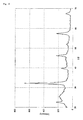
- the definite peaks of the single phase of a perovskite structure as shown in Fig. 1 were observed, and it was confirmed that the lattice constant slightly changed in comparison with the lattice constant of the perovskite structure containing no platinum element. Since no peak showing a structure attributed to platinum was not observed in spite of containing the platinum element, it was found that the platinum element was taken into the lattice of the perovskite structure.
- the average crystallite size determined from the half value width of the diffraction peak was 11.2 nm.
- Carbon particles supporting fine particles of a perovskite type composite oxide containing a platinum element: La(Fe 0.95 Pt 0.05 )O 3 were obtained in the same manner as in Example 1, except that, in the process for manufacturing the fine particle-supporting carbon particles of Example 1, VULCAN XC-72 (3.75 g) was added to the aqueous solution containing citrate complex ions of lanthanum and iron.
- the carbon particles supporting the La(Fe 0.95 Pt 0.05 )O 3 thereon, thus obtained, were subjected to a X-ray powder diffraction spectrometry.
- the definite peaks of the single phase of a perovskite structure were observed as in Example 1, and it was confirmed that the platinum element was taken into the lattice of the perovskite structure.
- the lattice constant was found to slightly change in comparison with the lattice constant of the perovskite structure containing no platinum element.
- the average crystallite size determined from the half value width of the diffraction peak was 10.5 nm.
- TEM transmission electron microscope
- Carbon particles which supported thereon fine particles of a perovskite type composite oxide containing a platinum element: La(Fe 0.95 Pt 0.05 )O 3 were obtained in the same manner as in Example 1, except the following: in the process of Example 1, lanthanum nitrate (4.46 g) and iron nitrate (3.95 g), but not lanthanum chloride and iron chloride, were dissolved in water (100 ml); and an equivalent amount of citric acid in terms of lanthanum ions and iron ions was added to the above solution to prepare an aqueous solution containing the citrate complex ions of lanthanum and iron.
- the carbon particles supporting the La(Fe 0.9 Pt 0.05 )O 3 thereon, thus obtained, were subjected to a X-ray powder diffraction spectrometry.
- the definite peaks of the single phase of a perovskite structure were observed as in Example 1, and it was confirmed that the platinum element was taken into the lattice of the perovskite structure.
- the lattice constant was found to slightly change in comparison with the lattice constant of the perovskite structure containing no platinum element.
- the average crystallite size determined from the half value width of the diffraction peak was 9.5 nm.
- TEM transmission electron microscope
- Carbon particles which supported thereon fine particles of a perovskite type composite oxide containing a platinum element: La (Fe 0.95 Pt 0.05 )O 3 were obtained in the same manner as in Example 1, except the following: in the process of Example 1, the amount of water for use in the preparation of an aqueous solution containing citrate complex ions was changed to 50 ml from 100 ml; carbon particles supporting fine particles of a perovskite type composite oxide: LaFeO 3 were obtained from the above solution in the same manner as in Example 1; potassium chloroplatinate (0.25 g) was dissolved in water (50 ml) to prepare an aqueous solution containing platinum ions; and the above carbon particles (powder) supporting LaFeO 3 particle thereon were impregnated with this aqueous solution containing platinum ions.
- the carbon particles supporting La(Fe 0.95 Pt 0.05 )O 3 thereon, thus obtained, were subjected to a X-ray powder diffraction spectrometry.
- the definite peaks of the single phase of a perovskite structure were observed as in Example 1, and it was confirmed that the platinum element was taken into the lattice of the perovskite structure.
- the lattice constant was found to slightly change in comparison with the lattice constant of the perovskite structure containing no platinum element.
- the average crystallite size determined from the half value width of the diffraction peak was 17.8 nm.
- TEM transmission electron microscope
- Carbon particles supporting fine particles of a perovskite type composite oxide containing a platinum element: La(Fe 0.95 Pt 0.05 )O 3 were obtained in the same manner as in Example 1, except the following: in the process of Example 1, instead of the aqueous solution containing citrate complex ions, an aqueous solution containing citrate complex ions of lanthanum and iron was prepared by dissolving lanthanum chloride heptahydrate (3.71 g) and iron chloride hexahydrate (2.57 g) in an ethanol solution of ethanol (50 ml) and water (50 ml), and adding an equivalent amount of citric acid in terms of lanthanum ions and iron ions to the above solution.
- the carbon particles supporting the La(Fe 0.95 Pt 0.05 )O 3 thereon, thus obtained, were subjected to a X-ray powder diffraction spectrometry.
- the definite peaks of the single phase of a perovskite structure were observed as in Example 1, and it was confirmed that the platinum element was taken into the lattice of the perovskite structure.
- the lattice constant was found to slightly change in comparison with the lattice constant of the perovskite structure containing no platinum element.
- the average crystallite size determined from the half value width of the diffraction peak was 3.3 nm.
- TEM transmission electron microscope
- VULCAN XC-72 (12.45 g) was added to the aqueous solution containing the above-described citrate complex ions, and was dispersed therein by means of ultrasonic wave. The resultant dispersion was stirred for 2 hours to adsorb the complex ions onto the surfaces of the VULCAN particles. After that, the dispersion was left to stand alone for about 10 hours, and then was filtered and rinsed and dried at 90°C to obtain carbon particles (powder) each supporting a compound of lanthanum, iron and platinum thereon. The resultant carbon particles were subjected to a heat treatment at 600°C under a nitrogen atmosphere to obtain carbon particles which supported thereon fine particles of a perovskite type composite oxide: La(Fe 0.5 Pt 0.5 )O 3 .
- the definite peaks of the single phase of a perovskite structure were observed as in Example 1, and it was confirmed that the platinum element was taken into the perovskite structure.
- the lattice constant slightly changed in comparison with the lattice constant of the perovskite structure containing no platinum element.
- the average crystallite size determined from the half value width of the diffraction peak was 16.8 nm.
- TEM transmission electron microscope
- VULCAN XC-72 (2 g) was added to the aqueous solution containing the above-described citrate complex ions, and was dispersed therein by means of ultrasonic wave. The resultant dispersion was stirred for 2 hours to adsorb the complex ions onto the surfaces of the VULCAN particles. After that, the dispersion was left to stand alone for about 10 hours, and then was filtered and rinsed and dried at 90°C to obtain carbon particles (powder) each supporting a compound of lanthanum and platinum thereon. The resultant carbon particles were subjected to a heat treatment at 750°C under a nitrogen atmosphere to obtain carbon particles which supported thereon fine particles of a perovskite type composite oxide: LaPtO 3 .
- the carbon particles supporting the LaPtO 3 fine particles thereon, thus obtained, were subjected to a X-ray powder diffraction spectrometry.
- a X-ray powder diffraction spectrometry As a result, the definite peaks of the single phase of a perovskite structure were observed.
- the average crystallite size determined from the half value width of the diffraction peak was 18.2 nm.
- TEM transmission electron microscope
- VULCAN XC-72 (10 g) was added to the aqueous solution containing the above-described citrate complex ions, and was dispersed therein by means of ultrasonic wave. The resultant dispersion was stirred for 2 hours to adsorb the complex ions onto the surfaces of the VULCAN particles. After that, the dispersion was left to stand alone for about 10 hours, and then was filtered and rinsed and dried at 90°C to obtain carbon particles (powder) each supporting a compound of lanthanum, iron and cobalt thereon. The resultant carbon particles were subjected to a heat treatment at 600°C under a nitrogen atmosphere to obtain carbon particles which supported thereon fine particles of a perovskite type composite oxide: La(Fe 0.6 Co 0.4 )O 3 .
- the definite peaks of the single phase of a perovskite structure were observed, and it was confirmed that the platinum element was taken into the lattice of the perovskite structure.
- the lattice constant was found to slightly change in comparison with the lattice constant of the perovskite structure containing no platinum element.
- the average crystallite size determined from the half value width of the diffraction peak was 12.2 nm.
- TEM transmission electron microscope
- Carbon particles supporting fine particles of a perovskite type composite oxide containing a platinum element: Ce(Fe 0.95 Pt 0.05 )O 3 were obtained as follows: in the process of Example 1, CeFeO 3 -supporting carbon particles were obtained in the same manner as in Example 1, except that cerium chloride heptahydrate (3.73 g) was added in place of the lanthanum chloride heptahydrate; and then, the resulting carbon particles were treated to support platinum thereon, to obtain carbon particles supporting fine particles of the perovskite type composite oxide containing the platinum element: Ce(Fe 0.95 Pt 0.05 )O 3 .
- the carbon particles supporting the Ce(Fe 0.95 Pt 0.05 )O 3 thereon, thus obtained, were subjected to a X-ray powder diffraction spectrometry.
- the definite peaks of the single phase of a perovskite structure were observed, and it was confirmed that the platinum element was taken into the lattice of the perovskite structure.
- the average crystallite size determined from the half value width of the diffraction peak was 7.2 nm.
- TEM transmission electron microscope
- Carbon particles supporting fine particles of a perovskite type composite oxide containing a platinum element: (La 0.7 Sr 0.3 ) (Fe 0.95 Pt 0.05 )O 3 were obtained as follows: in the process of Example 1, carbon particles supporting particles of (La 0.7 Sr 0.3 )FeO 3 thereon were obtained in the same manner as in Example 1, except that lanthanum chloride heptahydrate (2.6 g) and strontium chloride hexahydrate (0.8 g) were added in place of the lanthanum chloride heptahydrate (3.71 g); and the resulting carbon particles were treated to support platinum thereon, to obtain the carbon particles supporting fine particles of the perovskite type composite oxide containing the platinum element: (La 0.7 Sr 0.3 ) (Fe 0.95 Pt 0.05 )O 3 .
- the carbon particles supporting the (La 0.7 Sr 0.3 ) (Fe 0.95 Pt 0.05 )O 3 thereon, thus obtained, were subjected to a X-ray powder diffraction spectrometry.
- the definite peaks of the single phase of a perovskite structure were observed, and it was confirmed that the platinum element was taken into the lattice of the perovskite structure.
- the average crystallite size determined from the half value width of the diffraction peak was 15.7 nm.
- TEM transmission electron microscope
- Carbon particles supporting fine particles of a perovskite type composite oxide were obtained in the same manner as in Example 7, except that an aqueous solution containing citrate complex ions of lanthanum, ruthenium and platinum was prepared by dissolving lanthanum chloride heptahydrate (0.48 g), ruthenium chloride (0.03 g) and Hydrogen hexachloroplatinate hexahydrate (0.61 g) in water (100 ml), and adding an equivalent amount of citric acid in terms of lanthanum ions, ruthenium ions and platinum ions to the solution.
- the carbon particles supporting the La(Pt 0.9 Ru 0.1 )O 3 thereon, thus obtained, were subjected to a X-ray powder diffraction spectrometry.
- the definite peaks of the single phase of a perovskite structure were observed, and it was confirmed that the platinum element and the ruthenium element were taken into the lattice of the perovskite structure.
- the average crystallite size determined from the half value width of the diffraction peak was 13.1 nm.
- TEM transmission electron microscope
- Carbon particles supporting fine particles of a perovskite type composite oxide SrRuO 3 were obtained in the same manner as in Example 7, except that an aqueous solution containing citrate complex ions of strontium and ruthenium was prepared by dissolving strontium chloride hexahydrate (0.34 g) and ruthenium chloride (0.27 g) in water (100 ml), and adding an equivalent amount of citric acid in terms of strontium ions and ruthenium ions to the solution.
- the carbon particles supporting the SrRuO 3 thereon, thus obtained, were subjected to a X-ray powder diffraction spectrometry.
- the definite peaks of the single phase of a perovskite structure were observed as in Example 1, and it was confirmed that the ruthenium element was taken into the lattice of the perovskite structure.
- the average crystallite size determined from the half value width of the diffraction peak was 11.8 nm.
- TEM transmission electron microscope
- Carbon particles supporting fine particles of a perovskite type composite oxide containing a platinum element: La(Fe 0.95 Pt 0.05 )O 3 were obtained in the same manner as in Example 1, except that, in the process of Example 1, VULCAN XC-72 (1.67 g) was added to an aqueous solution containing citrate complex ions of lanthanum and iron.
- the carbon particles supporting the La (Fe 0.95 Pt 0.05 )O 3 thereon, thus obtained, were subjected to a X-ray powder diffraction spectrometry.
- the definite peaks of the single phase of a perovskite structure were observed as in Example 1, and it was confirmed that the platinum element was taken into the lattice of the perovskite structure.
- the average crystallite size determined from the half value width of the diffraction peak was 87.3 nm.
- Carbon particles supporting fine particles were obtained in the same manner as in Example 1, except the following: in the process of Example 1, carbon particles (powder) each supporting thereon a compound of lanthanum and iron were obtained by adsorbing the complex ions of lanthanum and iron onto the surfaces of VULCAN particles, and were then subjected to a heat treatment at 450°C under a nitrogen atmosphere; and the resulting carbon particles were impregnated with an ethanol solution containing platinum ions, dried at 60°C and subjected to a heat treatment at 450°C under a nitrogen atmosphere.
- the carbon particles supporting the La(Fe 0.95 Pt 0.05 )O 3 thereon, thus obtained, were subjected to a X-ray powder diffraction spectrometry. As a result, no peak of a perovskite structure was observed, and the peak of carbon alone was observed. As a result of the observation with a transmission electron microscope (TEM), the fine particles of the metal oxide, with a size of about 2 nm, were found to be supported on the surfaces of the carbon particles.
- TEM transmission electron microscope
- the carbon particles supporting such fine particles, thus obtained, were subjected to a X-ray powder diffraction spectrometry.
- a X-ray powder diffraction spectrometry As a result, the peaks of the perovskite structure and the peak of the platinum metal were observed.
- the average crystallite sizes determined from the half value widths of the diffraction peaks were 14.6 nm and 5.6 nm, respectively.
- TEM transmission electron microscope
- Carbon particles supporting particles of a perovskite type composite oxide: LaFeO 3 were obtained in the same manner as in Example 1. The resulting carbon particles were not impregnated with platinum.
- the carbon particles supporting the LaFeO 3 particles thereon, thus obtained,' were subjected to a X-ray powder diffraction spectrometry.
- the definite peaks of the single phase of a perovskite structure were observed as in Example 1.
- the average crystallite size determined from the half value width of the diffraction peak was 9.8 nm.
- TEM transmission electron microscope
- Hydrogen hexachloroplatinate hexahydrate (2.70 g) was dissolved in ethanol (200 ml) to prepare an ethanol solution containing platinum ions.
- VULCAN XC-72 particles were impregnated with this platinum ion-containing ethanol solution, dried at 60°C and subjected to a heat treatment at 270°C in an air to obtain carbon particles supporting particles of platinum oxide: PtO.
- the carbon particles supporting the PtO particles thereon, thus obtained, were subjected to a X-ray powder diffraction spectrometry.
- a X-ray powder diffraction spectrometry As a result, the definite peaks of the single phase of the platinum oxide were observed.
- the average crystallite size determined from the half value width of the diffraction peak was 5.2 nm.
- TEM transmission electron microscope
- the particle diameter of the supported particles indicates the particle diameter of the supported oxide particles determined from the average crystallite size
- the particle diameter found using TEM indicates the approximate particle diameter of the supported oxide particles, which was visually confirmed through the observation with the TEM
- the average particle diameter indicates the average particle diameter of the fine particle-supporting carbon particles determined from an average of the particle diameters of 100 particles on a TEM photograph.
- membrane electrode assemblys (MEA) for fuel cells were assembled to evaluate the output features of fuel cells comprising the same MEAs, so as to evaluate the catalytic properties of the fine particle-supporting carbon particles of the above-described Examples and Comparative Examples.
- the compositions of the oxides for the fine particle-supporting carbon particles i.e., the composition of fine oxide particles supported on carbon particles
- the fine particle-supporting carbon particles were used in the air electrodes, and the following standard electrode membranes were used as the fuel electrodes, in order to make consistent evaluation.
- Nafion® manufactured by DuPont
- the catalytic coating was applied to a PTFE film so that the amount of the supported platinum could be 0.03 mg/cm 2 , and was dried.
- the dried layer of the catalytic coating was peeled off as an electrode membrane comprising the fine particle-supporting carbon particles.
- a catalytic coating was prepared in the same manner as above, using platinum-supporting carbon particles "10E50E®” (manufactured by Tanaka Kikinzoku Kogyo) which supported 50% by mass of platinum, and was then applied to a PTFE film so that the amount of the supported platinum could be 0.5 mg/cm 2 .
- the applied catalytic coating was dried and peeled off as a standard electrode membrane.
- a polyperfluorosulfonic acid resin membrane "Nafion 112®” (manufactured by DuPont) was cut into pieces with a predetermined size for use as a solid polymer electrolytic membrane.
- the electrode membrane comprising the fine particle-supporting carbon particles and the standard electrode membrane, prepared in advance, were laminated on both sides of the solid polymer electrolytic membrane, respectively, and the resulting lamination was hot-pressed at 160°C under a pressure of 4.4 MPa to joint these membranes.
- a non-woven carbon cloth which had been previously water-proofed (TGP-H-120 manufactured by Toray Industries, Inc.) and the solid polymer electrolytic membrane having the electrode membranes formed on its both sides were jointed to each other by hot press to obtain a membrane electrode assembly.
- the output feature of a fuel cell i.e., a maximum output density per unit amount of platinum
- a measuring system including the membrane electrode assembly was maintained at 60°C, and the measurement was conducted while supplying a hydrogen gas humidified and heated at 60°C to the fuel electrode side, and an air humidified and heated at 60°C to the air electrode side.
- Table 1 The results of the measurements are collectively shown in Table 1 above.
- the fine particle-supporting carbon particles obtained in Example 1 and Comparative Example 3 were selected as ones having typical compositions; and changes in the physical properties of these carbon particles in an air were measured. Prior to the measurements, the respective fine particle-supporting carbon particles were previsously oxidized at 150°C for 48 hours in an air.
- the respective fine particle-supporting carbon particles oxidized as above were subjected to X-ray powder diffraction spectrometry so as to examine their crystalline structures.
- the fine particle-supporting carbon particles of Example 1 had a perovskite structure and showed no change in its structure, in comparison with the structure thereof found before the oxidation treatment, while the fine particle-supporting carbon particles of Comparative Example 3 were observed to have two phases, i.e., a perovskite structure and a platinum metal structure before the oxidation treatment, and were observed to have three phases, i.e., a perovskite structure, a platinum metal structure and a platinum oxide structure (PtO) after the oxidation treatment.
- PtO platinum oxide structure
- the respective fine particle-supporting carbon particles were further observed with TEM.
- the fine particle-supporting carbon particles of Example 1 it was observed from the fine particle-supporting carbon particles of Example 1 that the particles with a size of about 10 nm were supported on the carbon particles, and that the particle size showed almost no change as compared with the particle size found before the oxidation treatment, while it was observed from the platinum particle-supporting carbon particles of Comparative Example 3 that the oxide particles with a size of about 15 nm and the platinum particles with a size of about 8 to about 9 nm were supported on the carbon particles, and that the particle diameter of the platinum particles was increased as compared with the size of about 5 nm found before the oxidation treatment.
- Example 1 the maximum output from the membrane electrode assembly comprising the fine particle-supporting carbon particles of Example 1 was 5.2 W/g-Pt, while the maximum output from the membrane electrode assembly comprising the fine particle-supporting carbon particles of Comparative Example 3 was 2.5 W/g-Pt.
- the fine particle-supporting carbon particles obtained in any of the Examples were observed to have a single phase of perovskite structure and to have an average crystallite size of not larger than 20 nm.
- the fine particle-supporting carbon particles obtained in Comparative Example 1 were observed to include coarse particles with a maximum size of 100 nm, since the perovskite type composite oxide particles which could not be supported on the surfaces of the carbon particles because of the excessive charged amounts were separated and deposited.
- the fine particle-supporting carbon particles of Comparative Example 2 were observed to fail to form a perovskite structure and to have only the structure of the carbon support, since the temperature for the heat treatment did not reach the crystallization temperature.
- the air electrode of the fuel cell comprising the fine particle-supporting carbon particles of Comparative Example 3 was evaluated to have equal or superior features to those of the air electrodes comprising the fine particle-supporting carbon particles of the respective Examples.
- the fine particle-supporting carbon particles of Example 1 oxidized in an air, showed almost no change in their crystalline structure and average particle diameter, while the platinum particle-supporting carbon particles of Comparative Example 3 showed a change in the crystalline structure, i.e., from the structure of "platinum metal” to the structure of "platinum metal + platinum oxide” and also showed an increase in the average particle diameter, accompanied by a remarkable decrease in the output feature.
- a platinum element in an oxide form intrinsically can not exhibit a catalytic function
- a platinum element introduced as a solid solution into an oxide having a perovskite structure can show an output feature and can have a catalytic function only when the particle diameter of such oxide particles is very fine.
- a platinum in the form of an oxide hitherto has been believed to exhibit no catalytic function, since the platinum oxide has no platinum-platinum bond.
- it has been firstly revealed that a platinum element introduced as a solid solution into an oxide of other element so as to be in the form of an oxide can exhibit a catalytic function.
- a platinum element in the form of an oxide is not likely to be degraded by further oxidization, and is not likely to be degraded because of coarse particles attributed to the aggregation of particles since there is no platinum-platinum metal bond. From these viewpoints, the present invention provides an important measure to achieve the subject matters, i.e., to prevent the degradation of a catalyst, and to improve the durability of the catalyst to thereby decrease the amount of the catalyst to be used.
Landscapes
- Chemical & Material Sciences (AREA)
- Engineering & Computer Science (AREA)
- Chemical Kinetics & Catalysis (AREA)
- Materials Engineering (AREA)
- Electrochemistry (AREA)
- General Chemical & Material Sciences (AREA)
- Organic Chemistry (AREA)
- Manufacturing & Machinery (AREA)
- Physics & Mathematics (AREA)
- Thermal Sciences (AREA)
- Catalysts (AREA)
- Inert Electrodes (AREA)
- Fuel Cell (AREA)
Applications Claiming Priority (2)
| Application Number | Priority Date | Filing Date | Title |
|---|---|---|---|
| JP2005277021 | 2005-09-26 | ||
| PCT/JP2006/318965 WO2007034946A1 (fr) | 2005-09-26 | 2006-09-25 | Carbone particulaire servant de support aux particules fines, processus de fabrication correspondant et electrodes pour piles a combustible |
Publications (2)
| Publication Number | Publication Date |
|---|---|
| EP1938896A1 true EP1938896A1 (fr) | 2008-07-02 |
| EP1938896A4 EP1938896A4 (fr) | 2010-10-20 |
Family
ID=37888988
Family Applications (1)
| Application Number | Title | Priority Date | Filing Date |
|---|---|---|---|
| EP06810524A Withdrawn EP1938896A4 (fr) | 2005-09-26 | 2006-09-25 | Carbone particulaire servant de support aux particules fines, processus de fabrication correspondant et electrodes pour piles a combustible |
Country Status (4)
| Country | Link |
|---|---|
| US (1) | US20100151362A1 (fr) |
| EP (1) | EP1938896A4 (fr) |
| CN (1) | CN101272855B (fr) |
| WO (1) | WO2007034946A1 (fr) |
Families Citing this family (5)
| Publication number | Priority date | Publication date | Assignee | Title |
|---|---|---|---|---|
| US8343888B2 (en) * | 2009-10-01 | 2013-01-01 | GM Global Technology Operations LLC | Washcoating technique for perovskite catalysts |
| WO2014021028A1 (fr) * | 2012-07-31 | 2014-02-06 | Agcセイミケミカル株式会社 | Procédé de production d'un matériau d'électrode à combustible pour pile à combustible à oxyde solide |
| US11515545B2 (en) * | 2018-03-29 | 2022-11-29 | Sakai Chemical Industry Co., Ltd. | Air electrode material powder for solid oxide fuel cells |
| CN112877713A (zh) * | 2021-01-21 | 2021-06-01 | 徐军莲 | 一种基于钙钛矿结构的氧化钌和钌酸锶的复合纳米片材料的制备方法 |
| CN114797849B (zh) * | 2022-02-16 | 2023-05-26 | 南京工业大学 | 一种双功能钙钛矿氧化物催化剂、制备方法及其应用 |
Family Cites Families (20)
| Publication number | Priority date | Publication date | Assignee | Title |
|---|---|---|---|---|
| EP0532024B1 (fr) * | 1991-09-12 | 1998-08-12 | Sakai Chemical Industry Co., Ltd., | Catalyseur pour la réduction catalytique d'oxydes d'azote |
| CN1087111A (zh) * | 1993-11-24 | 1994-05-25 | 林科 | 钙钛矿型稀土复合氧化物一氧化碳助燃剂及其制备方法 |
| US5670270A (en) * | 1995-11-16 | 1997-09-23 | The Dow Chemical Company | Electrode structure for solid state electrochemical devices |
| US5977017A (en) * | 1996-04-10 | 1999-11-02 | Catalytic Solutions, Inc. | Perovskite-type metal oxide compounds |
| US7255954B2 (en) * | 1998-08-27 | 2007-08-14 | Cabot Corporation | Energy devices |
| DE69932701T2 (de) * | 1999-03-19 | 2007-09-13 | Hitachi Global Storage Technologies Netherlands B.V. | Pinning-Lage für magnetische Anordnungen |
| ATE344539T1 (de) * | 1999-08-27 | 2006-11-15 | Umicore Ag & Co Kg | Elektrokatalysator für brennstoffzellen |
| JP2001269578A (ja) * | 2000-01-19 | 2001-10-02 | Toyota Motor Corp | 排気ガス浄化用触媒 |
| JP2001224963A (ja) * | 2000-02-16 | 2001-08-21 | Nissan Motor Co Ltd | 触媒組成物、その製造方法及びその使用方法 |
| SE0100927D0 (sv) * | 2001-03-16 | 2001-03-16 | Kth Holding Ab | Oxygen reduction electrode |
| US6733909B2 (en) * | 2001-05-03 | 2004-05-11 | Ford Motor Company | Fuel cell power plant with electrochemical enhanced carbon monoxide removal |
| JP4963147B2 (ja) * | 2001-09-17 | 2012-06-27 | 株式会社豊田中央研究所 | 燃料電池用電極触媒体およびその製造方法 |
| DE10211701A1 (de) * | 2002-03-16 | 2003-09-25 | Studiengesellschaft Kohle Mbh | Verfahren zur in situ Immobilisierung von wasserlöslichen nanodispergierten Metalloxid-Kolloiden |
| AU2003281203A1 (en) * | 2002-07-09 | 2004-01-23 | Cataler Corporation | Catalyst for clarifying exhaust gas |
| JP2004079244A (ja) * | 2002-08-12 | 2004-03-11 | Toshiba Corp | 燃料電池用触媒及び燃料電池 |
| US7566388B2 (en) * | 2002-12-17 | 2009-07-28 | Asahi Kasei Chemicals Corporation | Electrode catalyst for oxygen reduction and gas diffusion electrode |
| US7291417B2 (en) * | 2003-01-16 | 2007-11-06 | Hewlett-Packard Development Company, L.P. | Compositional and structural gradients for fuel cell electrode materials |
| JP2005190833A (ja) * | 2003-12-25 | 2005-07-14 | Electric Power Dev Co Ltd | 二次電池用電極 |
| US20060134506A1 (en) * | 2004-12-17 | 2006-06-22 | Kim Min S | Electrode catalyst for fuel cell |
| EP2037519A4 (fr) * | 2006-06-13 | 2012-12-26 | Toyota Motor Co Ltd | Fine particule d'oxyde de pérovskite, particule recouverte de pérovskite, matériau catalytique, matériau catalytique pour la réduction de l'oxygène, matériau catalytique pour pile à combustible et électrode pour pile à combustible |
-
2006
- 2006-09-25 WO PCT/JP2006/318965 patent/WO2007034946A1/fr not_active Ceased
- 2006-09-25 CN CN2006800351815A patent/CN101272855B/zh not_active Expired - Fee Related
- 2006-09-25 EP EP06810524A patent/EP1938896A4/fr not_active Withdrawn
- 2006-09-25 US US12/088,064 patent/US20100151362A1/en not_active Abandoned
Also Published As
| Publication number | Publication date |
|---|---|
| EP1938896A4 (fr) | 2010-10-20 |
| US20100151362A1 (en) | 2010-06-17 |
| CN101272855B (zh) | 2011-05-11 |
| WO2007034946A1 (fr) | 2007-03-29 |
| CN101272855A (zh) | 2008-09-24 |
Similar Documents
| Publication | Publication Date | Title |
|---|---|---|
| JP4875410B2 (ja) | 微粒子担持カーボン粒子およびその製造方法ならびに燃料電池用電極 | |
| US8007691B2 (en) | Fine particle of perovskite oxide, particle having deposited perovskite oxide, catalyst material, catalyst material for oxygen reduction, catalyst material for fuel cell, and electrode for fuel cell | |
| EP1524711B1 (fr) | Le catalyseur d'électrode pour le pile à combustible et la méthode pour la production de cela | |
| EP1920484B1 (fr) | Catalyseur supporté et pile à combustible | |
| JP5855023B2 (ja) | 触媒担体の製造方法、複合触媒の製造方法、複合触媒、およびこれを用いた燃料電池 | |
| CN105322187B (zh) | 合成作为核‑壳电催化剂的稳定核的合金纳米颗粒 | |
| KR101494432B1 (ko) | 연료전지용 전극 촉매, 그 제조방법 및 이를 이용한 연료전지 | |
| EP3855542B1 (fr) | Couche de catalyseur d'anode pour pile à combustible et pile à combustible l'utilisant | |
| JP5214117B2 (ja) | ペロブスカイト型酸化物微粒子、ペロブスカイト型酸化物担持粒子、触媒材料、燃料電池用電極 | |
| JP2020087644A (ja) | 水素欠乏耐性燃料電池用アノード触媒 | |
| EP3020475B1 (fr) | Catalyseur de réduction d'oxygène, son application et son procédé de production | |
| JP4879658B2 (ja) | 微粒子担持カーボン粒子およびその製造方法ならびに燃料電池用電極 | |
| EP1938896A1 (fr) | Carbone particulaire servant de support aux particules fines, processus de fabrication correspondant et electrodes pour piles a combustible | |
| EP1941943A1 (fr) | Particule de carbone a support microparticulaire, procede de fabrication et electrode de pile a combustible | |
| JP2008123860A (ja) | 金属酸化物担持カーボン及びそれを用いた燃料電池用電極 | |
| CN114797996A (zh) | 负载合金细颗粒的催化剂、合金细颗粒、燃料电池及它们的制造方法、电极 | |
| JP2007115668A (ja) | 微粒子担持カーボン粒子およびその製造方法ならびに燃料電池用電極 | |
| JPH10144337A (ja) | 固体電解質型燃料電池の燃料電極およびその製造方法 | |
| JP2007194138A (ja) | 微粒子担持カーボン粒子およびその製造方法、ならびに固体電解質型燃料電池用電極 | |
| CN101272854A (zh) | 载持微粒子的碳粒子、其制造方法以及燃料电池用电极 | |
| JP2010238546A (ja) | 微粒子担持金属酸化物触媒及びその製造方法並びに燃料電池用電極 | |
| JP2007194139A (ja) | 微粒子担持カーボン粒子およびその製造方法、ならびに固体電解質型燃料電池用電極 | |
| JP2007194140A (ja) | 微粒子担持カーボン粒子およびその製造方法、ならびに固体電解質型燃料電池用電極 |
Legal Events
| Date | Code | Title | Description |
|---|---|---|---|
| PUAI | Public reference made under article 153(3) epc to a published international application that has entered the european phase |
Free format text: ORIGINAL CODE: 0009012 |
|
| 17P | Request for examination filed |
Effective date: 20080415 |
|
| AK | Designated contracting states |
Kind code of ref document: A1 Designated state(s): DE GB IT |
|
| DAX | Request for extension of the european patent (deleted) | ||
| RBV | Designated contracting states (corrected) |
Designated state(s): DE GB IT |
|
| A4 | Supplementary search report drawn up and despatched |
Effective date: 20100921 |
|
| 17Q | First examination report despatched |
Effective date: 20110610 |
|
| RAP1 | Party data changed (applicant data changed or rights of an application transferred) |
Owner name: HITACHI MAXELL, LTD. Owner name: TOYOTA JIDOSHA KABUSHIKI KAISHA |
|
| RAP1 | Party data changed (applicant data changed or rights of an application transferred) |
Owner name: TOYOTA JIDOSHA KABUSHIKI KAISHA |
|
| STAA | Information on the status of an ep patent application or granted ep patent |
Free format text: STATUS: THE APPLICATION IS DEEMED TO BE WITHDRAWN |
|
| 18D | Application deemed to be withdrawn |
Effective date: 20140415 |