EP1939936A2 - Elektronische Komponente - Google Patents
Elektronische Komponente Download PDFInfo
- Publication number
- EP1939936A2 EP1939936A2 EP07025026A EP07025026A EP1939936A2 EP 1939936 A2 EP1939936 A2 EP 1939936A2 EP 07025026 A EP07025026 A EP 07025026A EP 07025026 A EP07025026 A EP 07025026A EP 1939936 A2 EP1939936 A2 EP 1939936A2
- Authority
- EP
- European Patent Office
- Prior art keywords
- substrate
- conductive pattern
- electronic component
- semiconductor chip
- principal surface
- Prior art date
- Legal status (The legal status is an assumption and is not a legal conclusion. Google has not performed a legal analysis and makes no representation as to the accuracy of the status listed.)
- Withdrawn
Links
Images




Classifications
-
- H—ELECTRICITY
- H10—SEMICONDUCTOR DEVICES; ELECTRIC SOLID-STATE DEVICES NOT OTHERWISE PROVIDED FOR
- H10W—GENERIC PACKAGES, INTERCONNECTIONS, CONNECTORS OR OTHER CONSTRUCTIONAL DETAILS OF DEVICES COVERED BY CLASS H10
- H10W40/00—Arrangements for thermal protection or thermal control
-
- H—ELECTRICITY
- H10—SEMICONDUCTOR DEVICES; ELECTRIC SOLID-STATE DEVICES NOT OTHERWISE PROVIDED FOR
- H10W—GENERIC PACKAGES, INTERCONNECTIONS, CONNECTORS OR OTHER CONSTRUCTIONAL DETAILS OF DEVICES COVERED BY CLASS H10
- H10W40/00—Arrangements for thermal protection or thermal control
- H10W40/70—Fillings or auxiliary members in containers or in encapsulations for thermal protection or control
- H10W40/73—Fillings or auxiliary members in containers or in encapsulations for thermal protection or control for cooling by change of state
-
- H—ELECTRICITY
- H10—SEMICONDUCTOR DEVICES; ELECTRIC SOLID-STATE DEVICES NOT OTHERWISE PROVIDED FOR
- H10W—GENERIC PACKAGES, INTERCONNECTIONS, CONNECTORS OR OTHER CONSTRUCTIONAL DETAILS OF DEVICES COVERED BY CLASS H10
- H10W40/00—Arrangements for thermal protection or thermal control
- H10W40/40—Arrangements for thermal protection or thermal control involving heat exchange by flowing fluids
- H10W40/47—Arrangements for thermal protection or thermal control involving heat exchange by flowing fluids by flowing liquids, e.g. forced water cooling
-
- H—ELECTRICITY
- H10—SEMICONDUCTOR DEVICES; ELECTRIC SOLID-STATE DEVICES NOT OTHERWISE PROVIDED FOR
- H10W—GENERIC PACKAGES, INTERCONNECTIONS, CONNECTORS OR OTHER CONSTRUCTIONAL DETAILS OF DEVICES COVERED BY CLASS H10
- H10W90/00—Package configurations
- H10W90/701—Package configurations characterised by the relative positions of pads or connectors relative to package parts
- H10W90/721—Package configurations characterised by the relative positions of pads or connectors relative to package parts of bump connectors
- H10W90/724—Package configurations characterised by the relative positions of pads or connectors relative to package parts of bump connectors between a chip and a stacked insulating package substrate, interposer or RDL
Definitions
- the present invention relates to an electronic component formed using a silicon substrate.
- a substrate formed using an organic material is becoming mainstream instead of a substrate formed using a ceramic material.
- the substrate formed using the resinmaterial facilitates formation of a multilayer wiring structure or a fine shape as compared with the substrate formed using the ceramic material, and is suitable in the case of mounting a semiconductor chip miniaturized and highly integrated.
- a semiconductor chip mounted in a substrate is mainly constructed of silicon, so that there are cases where a difference between the semiconductor chip and the substrate in a thermal expansion coefficient becomes a problem particularly when a heat release value of the semiconductor chip is large.
- the substrate is made of resin material
- a large stress is applied to a portion of an electrical connection between the semiconductor chip and the substrate by the difference between the semiconductor chip and the substrate in a thermal expansion coefficient.
- problems such as a decrease in a resistance value or a broken wire of the portion of electrical connection between the semiconductor chip and the substrate occur and reliability of the package decreases.
- the overall problem of the invention is to provide a new and useful electronic component for solving the problems described above.
- a concrete problemof the invention is to provide a reliable electronic component capable of mounting a high-performance semiconductor chip.
- an electronic component including:
- a reliable electronic component capable of mounting a high-performance semiconductor chip can be provided.
- An electronic component includes a substrate made of silicon and having a flow path for circulating refrigerant, a conductive pattern formed on a first principal surface of the substrate, a via plug penetrating the substrate and connected to the conductive pattern, and an external connection terminal which is installed on a second principal surface of the substrate and is elastically deformable.
- the substrate is formed of silicon. Accordingly, when a semiconductor chip mainly constructed of silicon is mounted on the substrate, a difference between the substrate and the semiconductor chip in a thermal expansion coefficient reduces. Therefore, fears of causing a decrease in a resistance value and a broken wire of the portion of electrical connection between the substrate and the semiconductor chip, etc. are reduced. As a result, an effect of improving reliability of connection is obtained.
- the flow path is formed in the substrate, so that the amount of cooling of the substrate is increased. Accordingly, temperature of the substrate is maintained low and further, the amount of cooling the semiconductor chip through the substrate can be increased. As a result of this, in the electronic component, occurrence of malfunction in the semiconductor chip due to heat generation is suppressed and also occurrence of a broken wire of the electrical connection portion resulting from thermal expansion is suppressed, and reliability improves.
- the external connection terminal of the substrate deforms elastically. Accordingly, stress applied to the substrate, the external connection terminal, etc. resulting from a difference between the substrate and a motherboard, to which the substrate is mounted, in a thermal expansion coefficient is eased and reliability of connection between the substrate and the motherboard improves.
- Fig. 1 is a sectional diagram schematically showing a configuration of an electronic component according to a first embodiment of the invention.
- an electronic component 100 according to the present embodiment has a substrate (interposer) 101 made of silicon for mounting a semiconductor chip and respectively forming conductive patterns on a first principal surface 101A of the substrate 101 and a second principal surface 101B opposite to the first principal surface.
- substrate interposer
- a power source system conductive pattern 110 formed in correspondence with the vicinity of a center of the mounted semiconductor chip; and a signal system conductive pattern 120 formed in correspondence with the peripheral edge of the semiconductor chip are formed on the first principal surface 101A, on which the semiconductor chip is mounted, of the substrate 101.
- Power source system lines (a power source line, a ground line, etc.) of the semiconductor chip are connected to the power source system conductive pattern 110, and a signal line of the semiconductor chip is connected to the signal system conductive pattern 120.
- Plural insulating layers 105, 106 made of an inorganic material such as SiO 2 are laminated on the first principal surface 101A, and at least parts of the conductive patterns 110, 120 are formed so as to be buried in the insulating layers 105, 106.
- the power source system conductive pattern 110 is constructed by plural conductive patterns (via plugs) 111 penetrating the plural insulating layers 105, 106 laminated on the first principal surface 101A.
- the signal system conductive pattern 120 is constructed by combination of plural pattern wirings and plural via plugs.
- the signal system conductive pattern 120 constitutes the so-called multilayer wiring structure and includes:
- a solder resist layer (insulating layer) 107 in which openings for exposing at least parts of the conductive pattern 111 and the conductive pattern 125 are formed, is formed on the insulating layer 106. Flip chip bonding of a semiconductor chip mounted in the electronic component 100 is made to the conductive pattern 125 and the conductive patterns 111 exposed from the openings formed in the solder resist layer 107.
- a conductive pattern 130 is formed on the second principal surface 101B of the substrate 101. Electrical connection between the conductive pattern 130 and the conductive pattern 121 and electrical connection between the conductive pattern 130 and the conductive pattern 111 are respectively made by via plugs 102 penetrating the substrate 101. Insulating films 103 made of, for example, a silicon oxide film are formed between the via plugs 102 and the substrate 101, and the substrate 101 is insulated from the via plugs 102. Also, insulating films formed between the conductive patterns 121, 111 and the substrate 101 or between the conductive pattern 130 and the substrate 101 are omitted in the drawing.
- a solder resist layer (insulating layer) 108 is formed so as to cover the second principal surface 101B, and an external connection terminal 140 is connected to the conductive pattern 130 exposed fromopenings formed in the solder resist layer 108. That is, the external connection terminal 140 formed on the side of the second principal surface 101B is configured to be connected to the conductive pattern formed on the side of the first principal surface through the conductive pattern 130 and the via plugs 102.
- the substrate 101 is made of silicon.
- a semiconductor chip mainly constructed of silicon is mounted on the substrate 101, a difference between the substrate 101 and the semiconductor chip in a thermal expansion coefficient reduces. Therefore, fears of causing a decrease in a resistance value, a broken wire of the portion of electrical connection between the substrate 101 and the mounted semiconductor chip, etc. reduce, and an effect of improving reliability of connection is obtained.
- a flow path 104 for circulating the refrigerant is formed in the substrate 101.
- the amount of cooling of the substrate 101 increases and a temperature of the substrate 101 is maintained low.
- the amount of cooling the semiconductor chip mounted through the substrate 101 can be increased.
- the respective flow path 104 is provided between the via plugs 102.
- flip chip bonding of the semiconductor chip is performed face down with respect to the first principal surface 101A (described below in Fig. 2 ). That is, in the electronic component 100, the mounted semiconductor chip can be cooled from the side of a device surface and thus cooling efficiency of the mounted semiconductor chip improves.
- a semiconductor chip is connected so that a device surface corresponds to the substrate 101 cooled by the flow path 104 (see Fig. 2 ).
- a device formed in the chip resulting in a main heat source of the semiconductor chip, can be cooled efficiently.
- an opening of the flow path 104 formed in a channel shape may be constructed so as to be closed by the insulating layer 105.
- the flow path 104 is constructed so as to include the portion formed between the via plugs 102, cooling efficiency through the via plugs 102 improves and it is preferable.
- the refrigerant water, alcohol and fluorine based liquid are adaptable.
- one of the features of the structure described above is that, between the semiconductor chip and the substrate 101, a part of the heat transferring path also functions as an electrical connection.
- the conductive patterns on the first principal surface 101A are formed as described below so as to be preferable respectively by the path of cooling and the path of electrical connection of the bonded semiconductor chip.
- an electrical resistance value of the power source system conductive pattern 110 formed in correspondence with the vicinity of the center of the mounted semiconductor chip is smaller than that of the signal system conductive pattern 120 formed in the peripheral edge of the semiconductor chip. Also, the amount of heat dissipation from the power source system conductive pattern 110 to the substrate 101 is larger than the amount of heat dissipation from the signal system conductive pattern 120 to the substrate 101.
- the power source system conductive pattern 110 is constructed by the plural conductive patterns (via plugs) 111 penetrating the plural insulating layers 105, 106 laminated on the first principal surface 101A as described above.
- the signal system conductive pattern 120 is constructed by combination of plural pattern wirings and plural via plugs, and forms a multilayer wiring structure.
- the power source system conductive pattern 110 is constructed so that an electrical connection path from the mounted semiconductor chip to the first principal surface 101A becomes shorter than that of the signal system conductive pattern 120.
- an electrical resistance value of the power source system conductive pattern 110 becomes smaller than that of the signal system conductive pattern 120.
- a cross-sectional area (area of the case of being viewed from the plane) of the power source system conductive pattern 110 is larger than that of the signal system conductive pattern 120.
- a resistance value of the power source system conductive pattern 110 becomes small.
- the amount of heat dissipation from the power source system conductive pattern 110 to the substrate 101 in the case of cooling the mounted semiconductor chip becomes larger than the amount of heat dissipation from the signal system conductive pattern 120 to the substrate 101.
- the vicinity of the center is resistant to being cooled than the peripheral edge and temperature of the vicinity of the center tends to become higher than that of the peripheral edge, so that the structure described above is preferable in the case of improving cooling efficiency of the semiconductor chip.
- Diameters (widths) of the conductive patterns (via plugs) 111 constructing the power source system conductive pattern 110 are formed in, for example, about 10 to 100 ⁇ m.
- widths of the conductive patterns (pattern wirings) 121, 123 constructing the signal system conductive pattern 120 are formed in about 1 to 5 ⁇ m.
- diameters of the conductive patterns (via plugs) 122, 124 constructing the signal system conductive pattern 120 are formed in about 3 ⁇ m.
- the insulating layers (interlayer insulating layers) 105, 106 in which the conductive patterns 110, 120, etc. are formed by, for example, SiO 2 . Since a withstand voltage value of SiO 2 is higher than that of resin material, the insulating layers 105, 106 can be thinned. For example, when the interlayer insulating layer is constructed of resin material, a thickness of one layer was about 30 to 40 ⁇ m, but when SiO 2 is used, a thickness of one layer of the interlayer insulating layers can be thinned to about 1 ⁇ m. Also, SiO 2 facilitates microfabrication, so that miniaturization of a multilayer wiring structure formed is facilitated as compared with the case using the resin material. Also, the insulating layers 105, 106 can be formed using the resin material according to the wiring structure formed.
- the external connection terminal 140 installed on the side of the second principal surface of the substrate 101 is elastically deformable.
- the external connection terminal 140 is constructed by a connection terminal 141 formed by folding a band-like or linear elastic body, and joining means (solder) 142 for connecting the connection terminal 141 to the conductive pattern 130.
- connection terminal 141 is constructed by, for example, folding both ends of a band-like or linear elastic body in different directions. Also, the shapes of the connection terminal 141 or the folding directions of the connection terminal 141 are not limited to the case shown in the present drawings, and may be modified and changed variously (described below in Fig. 4 ).
- one end opposite to the end connected to the conductive pattern 130 of the connection terminal 141 could be connected to an electrode pad etc. of the motherboard.
- the external connection terminal 140 is elastically deformable, stress applied to the substrate 101 or the external connection terminal 140 is eased and reliability of electrical connection between the substrate 101 and the motherboard improves.
- the substrate 101 is made of silicon, so that there is a fear that a difference in a thermal expansion coefficient between the substrate 101 and the motherboard formed by resin material increases while a difference between the substrate 101 and the mounted semiconductor chip in a thermal expansion coefficient decreases.
- both of the reliability of electrical connection between the substrate 101 and the mounted semiconductor chip and the reliability of electrical connection between the substrate 101 and the motherboard improve.
- a passive element may be formed so that at least a part of the passive element is buried in the insulating layer 105 or the insulating layer 106 constructing a multilayer wiring structure.
- the insulating layer 105, 106 is constructed by SiO 2 , it becomes easy to incorporate the passive element into the multilayer wiring structure and it is preferable.
- a passive element 160 made of, for example, a capacitor is formed on the first principal surface 101A so as to be connected to the conductive pattern 121 and the passive element 160 is configured to be covered with the insulating layer 105.
- a dielectric constant of a dielectric layer used in the capacitor be high.
- a formed temperature is high (for example, about 800 °C) in the so-called high-dielectric constant materials such as BST or PZT with a high dielectric constant.
- a formed temperature for example, about 800 °C
- the capacitor can be formed using such high-dielectric constant materials and the capacitor can be thinned.
- the passive element is thinned, so that the passive element can be installed on the side of the first principal surface 101A, and a path of connection between the passive element and the mounted semiconductor chip can be shortened.
- the via plug 102 and the conductive patterns 111, 121 to 125, 130 are formed by, for example, Cu.
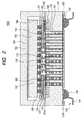
- Fig. 2 is a diagram schematically showing an electronic component (semiconductor device) 100A made by mounting a semiconductor chip 150 on the electronic component 100 according to the first embodiment.
- the same numerals are assigned to the portions described above and the description is omitted (similar matters apply to the following embodiments).
- flip chip bonding of the semiconductor chip 150 is performed face down so that a device surface corresponds to a substrate 101 cooled by a flow path 104.
- flip chip bonding of the semiconductor chip 150 is made to conductive patterns 111, 125 exposed from openings formed in a solder resist layer 107 through bumps 151.
- a stiffener 152 is installed on the substrate 101.
- the stiffener 152 is joined to the peripheral edge of the substrate 101 with a quadrangle in the case of being viewed from the plane, warpage of the substrate 101 is suppressed and it is preferable.
- the stiffener 152 is made of silicon
- the stiffener 152 can be directly joined to the substrate 101 made of silicon and it is preferable.
- both of the stiffener 152 and the substrate 101 are made of silicon, a difference between the stiffener and the substrate in a thermal expansion coefficient decreases and it is preferable.
- the stiffener 152 may be constructed so as to have a surface corresponding to the semiconductor chip 150 and join the surface corresponding to the semiconductor chip 150 to the semiconductor chip 150 by a joining material 153. That is, the stiffener 152 may be constructed so as to be joined to both of the substrate 101 and the semiconductor chip 150. In this case, the semiconductor chip 150 is cooled by the substrate 101 (flow path 104) through the stiffener 152.
- the stiffener 152 has both of a function of suppressing warpage of the substrate 101 and a function of cooling the semiconductor chip 150 as a heat spreader.
- stiffener heat spreader
- the stiffener may be constructed using other materials such as a metal material (Cu, Al or etc.).
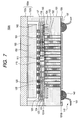
- the stiffener 152 as shown in Fig. 2 is integrally provided, the stiffener 152 may have a separated structure. That is, as shown in Fig.7 , the stiffener 152A has a top plate 152a contacting with the semiconductor chip 150 and a joint frame 152b which is provided between the top plate 152a and the substrate 101 so as to surround the conductive patterns 121 through 125 and joins the top plate 152a to the substrate 101.
- the joint frame 152b is preferably made of Si. Because the substrate 101 is made of Si, it is desirable that the difference in the thermal expansion coefficient between the substrate 101 and the joint frame 152b is small.
- the top plate 152a may be made of Si or metal such as Cu or Al.
- the top plate 152a In addition to the function of preventing warpage of the substrate 101, the top plate 152a also functions as transferring the heat from the semiconductor chip 150 to the substrate 101 provided with the flow path 104 via the joint frame 152.
- the top plate 152a may be made of metal having good thermal conductivity.
- the joining material 153 may be provided between the top plate 152a and the semiconductor chip 150.
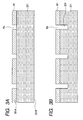
- a resist pattern M1 having openings Ma is formed on a first principal surface 201A (corresponding to the first principal surface 101A) of a substrate 201 (corresponding to the substrate 101) made of silicon.
- the resist pattern M1 is formed by patterning a resist layer formed by pasting of a resist on a film or application of a liquid resist by a photolithography method.
- a second principal surface 201B (corresponding to the second principal surface 101B) is formed on the side opposite to the first principal surface 201A of the substrate 201.
- the substrate 201 is etched by, for example, RIE (reactive ion etching) and a flow path 204 (corresponding to the flow path 104) for circulating a refrigerant is formed.
- RIE reactive ion etching
- the mask pattern M1 is peeled.
- via holes penetrating the substrate 201 are formed and via plugs 202 (corresponding to the via plugs 102) for burying the via holes are formed by a well known Cu plating method.
- an insulating layer 205 (corresponding to the insulating layer 105) is formed on the first principal surface of the substrate 201 so as to close openings of the flow path 204 formed in a channel shape.
- an insulating layer made of SiO 2 may be formed by a CVD (Chemical Vapor Deposition) method or an insulating layer made of resin material such as epoxy may be formed by laminate.
- the insulating layer 205 when the insulating layer 205 is formed by the CVD method, the insulating layer 205 can be formed so as to close the openings of the flow path 204 by performing CVD by a condition that coverage becomes worse so that SiO 2 does not flow in the inside of the flow path 204 where possible.
- the insulating layer 205 when the insulating layer 205 is formed by the laminate of a film-shaped resin, the insulating layer 205 can be formed by pasting a partially cured film-shaped resin on the substrate 201 using a roll laminator and further heating and curing (substantially completely curing) the resin after pasting.
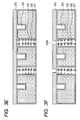
- the insulating layer 205 made of SiO 2 is etched by RIE and openings 205a are formed and parts of the via plugs 202 are exposed from the openings 205a. Also, when the insulating layer 205 is made of resin material, the openings 205a are formed by laser.
- conductive patterns (via plugs) 222 (corresponding to the conductive pattern 122) for burying the openings 205a and a conductive pattern (pattern wiring) 223 (corresponding to the conductive pattern 123) connected to the conductive patterns 222 and also formed on the insulating layer 205 are formed by a well known semi-additive method.
- steps similar to the steps of Figs. 3E to 3F are further performed and an insulating layer 206 (corresponding to the insulating layer 106) for covering the conductive pattern 223 is formed and openings are formed in the insulating layer 206.
- conductive patterns (via plugs) 224 (corresponding to the conductive pattern 124) for burying the openings and a conductive pattern (pattern wiring) 225 (corresponding to the conductive pattern 125) connected to the conductive patterns 224 and also formed on the insulating layer 206 are again formed by the well known semi-additive method.
- a solder resist layer 207 (corresponding to the solder resist layer 107) is formed so as to cover the insulating layer 206 and the conductive pattern 222. Also, openings 207a are formed in the solder resist layer 207 so that a part of the conductive pattern 225 is exposed.
- connection layer 207a made of a laminated structure of, for example, an Ni layer and an Au layer may be formed on the conductive pattern 225 exposed from the openings 207a.
- connection terminal 241 (corresponding to the connection terminal 141) constructed by, for example, folding both ends of a band-like or linear elastic body in different directions is connected to the via plugs 202 by joining means 242 (corresponding to the joining means 142) and an external connection terminal 240 (corresponding to the external connection terminal 140) is formed.
- an electronic component 200 (corresponding to the electronic component 100) can be formed.
- the electronic component 200 according to the embodiment has a construction in which the conductive patterns 111, 121, 130, etc. of the electronic component 100 are omitted, but the construction of the conductive patterns may be modified and changed variously.
- the external connection terminal 240 installed on the second principal surface side is directly connected to the via plugs 202 penetrating the substrate 201 rather than the conductive pattern in the case of the embodiment, but may be constructed by omitting a conductive pattern formed on the second principal surface as described in the embodiment.
- a step shown in Fig. 3J is further performed and a semiconductor chip may be mounted on the electronic component described above.
- flip chip bonding of a semiconductor chip 250 is made to the conductive pattern 225 through bumps 251.
- a stiffener 252 (corresponding to the stiffener 152) made of, for example, silicon may be joined on the substrate 201. Also, a surface corresponding to the semiconductor chip 250 of the stiffener 252 may be constructed so as to be joined to the semiconductor chip 250 by a joining material 253 in a manner similar to the case of the second embodiment (electronic component 100A).
- an electronic component 200A (corresponding to the electronic component 100A) made by mounting the semiconductor chip 250 on the electronic component 200 can be manufactured.
- Electrodes (an upper electrode and a lower electrode) of the capacitor can be formed by a method similar to that of the conductive pattern.
- the high-dielectric layer of the capacitor can be formed by curing at about 800 °C and pattern etching after PZT or BST is applied by spin coat.
- the high-dielectric layer can be formed by pattern etching after a PZT or BST film is formed by an aerosol deposition method.
- an elastically deformable external connection terminal which is installed on an electronic component is not limited to the shape (structure) described in the embodiments, and can be modified and changed variously, for example, as described below.
- Figs. 4 to 6 are diagrams schematically showing modified examples of the external connection terminals installed on the electronic component. However, in the following diagrams, joining means for joining a connection terminal such as solder is omitted.
- the external connection terminal 140A may be constructed by a cylindrical elastic body as shown in Fig. 4 . In this case, the external connection terminal 140A contracts in a buckling direction.
- the external connection terminal 140B, 140C may be, for example, an S-shaped elastic body as shown in Fig. 5 or a swirl (spiral) elastic body as shown in shown in Fig. 6 .
- the elastic body is not limited to the shapes (structures) described above, and may be changed variously according to specifications and structures of a substrate or a motherboard.
- the insulating layers (insulating layers 105, 106, 205, 206, etc.) formed on the substrate
- inorganic materials other than SiO 2 may be used and, for example, SiN (siliconnitride film) ormaterials inwhichC (carbon), nitrogen (N), etc. are added to SiO 2 may be used.
- a material constructing the conductive pattern or the via plug is not limited to Cu, and metals such as Al, W, Ti or Ta, nitride of these metals, or alloy materials including these metals may be used.
- a reliable electronic component capable of mounting a high-performance semiconductor chip can be provided.
Landscapes
- Cooling Or The Like Of Semiconductors Or Solid State Devices (AREA)
- Production Of Multi-Layered Print Wiring Board (AREA)
- Coupling Device And Connection With Printed Circuit (AREA)
- Internal Circuitry In Semiconductor Integrated Circuit Devices (AREA)
- Wire Bonding (AREA)
Applications Claiming Priority (1)
| Application Number | Priority Date | Filing Date | Title |
|---|---|---|---|
| JP2006349795A JP2008160019A (ja) | 2006-12-26 | 2006-12-26 | 電子部品 |
Publications (2)
| Publication Number | Publication Date |
|---|---|
| EP1939936A2 true EP1939936A2 (de) | 2008-07-02 |
| EP1939936A3 EP1939936A3 (de) | 2009-02-11 |
Family
ID=39301481
Family Applications (1)
| Application Number | Title | Priority Date | Filing Date |
|---|---|---|---|
| EP07025026A Withdrawn EP1939936A3 (de) | 2006-12-26 | 2007-12-21 | Elektronische Komponente |
Country Status (5)
| Country | Link |
|---|---|
| US (1) | US20080150109A1 (de) |
| EP (1) | EP1939936A3 (de) |
| JP (1) | JP2008160019A (de) |
| KR (1) | KR20080060185A (de) |
| TW (1) | TW200830493A (de) |
Families Citing this family (13)
| Publication number | Priority date | Publication date | Assignee | Title |
|---|---|---|---|---|
| JP2008159619A (ja) * | 2006-12-20 | 2008-07-10 | Shinko Electric Ind Co Ltd | 半導体装置 |
| JP2009231635A (ja) * | 2008-03-24 | 2009-10-08 | Shinko Electric Ind Co Ltd | 配線基板及びその製造方法、及び半導体装置及びその製造方法 |
| JP5236377B2 (ja) * | 2008-07-16 | 2013-07-17 | シャープ株式会社 | 半導体装置および表示装置 |
| JP5590869B2 (ja) * | 2009-12-07 | 2014-09-17 | 新光電気工業株式会社 | 配線基板及びその製造方法並びに半導体パッケージ |
| JP5514559B2 (ja) | 2010-01-12 | 2014-06-04 | 新光電気工業株式会社 | 配線基板及びその製造方法並びに半導体パッケージ |
| JP2011155149A (ja) * | 2010-01-27 | 2011-08-11 | Shinko Electric Ind Co Ltd | 配線基板及びその製造方法並びに半導体パッケージ |
| JP2012142532A (ja) | 2010-12-15 | 2012-07-26 | Fujitsu Ltd | 半導体装置、冷却装置及び冷却装置の製造方法 |
| US9236322B2 (en) | 2012-04-11 | 2016-01-12 | Taiwan Semiconductor Manufacturing Company, Ltd. | Methods and apparatus for heat spreader on silicon |
| US9245836B2 (en) | 2012-06-28 | 2016-01-26 | Soitec | Interposers including fluidic microchannels and related structures and methods |
| US9607951B2 (en) | 2013-08-05 | 2017-03-28 | Mediatek Singapore Pte. Ltd. | Chip package |
| US9755030B2 (en) * | 2015-12-17 | 2017-09-05 | International Business Machines Corporation | Method for reduced source and drain contact to gate stack capacitance |
| JP6741147B2 (ja) * | 2017-03-31 | 2020-08-19 | 株式会社村田製作所 | 生体センサ |
| CN113192915B (zh) * | 2021-04-26 | 2024-02-27 | 武汉新芯集成电路制造有限公司 | 三维集成电路模块及制作方法 |
Family Cites Families (20)
| Publication number | Priority date | Publication date | Assignee | Title |
|---|---|---|---|---|
| JPS59202654A (ja) * | 1983-05-02 | 1984-11-16 | Nippon Telegr & Teleph Corp <Ntt> | 集積回路パツケ−ジ |
| US5829128A (en) * | 1993-11-16 | 1998-11-03 | Formfactor, Inc. | Method of mounting resilient contact structures to semiconductor devices |
| US5040052A (en) * | 1987-12-28 | 1991-08-13 | Texas Instruments Incorporated | Compact silicon module for high density integrated circuits |
| EP0529837B1 (de) * | 1991-08-26 | 1996-05-29 | Sun Microsystems, Inc. | Verfahren und Apparat zum Kühlen von Mehrchip-Moduln durch die vollständige Wärmerohr-Technologie |
| US6911727B1 (en) * | 1995-06-06 | 2005-06-28 | Analog Devices, Inc. | Package for sealing an integrated circuit die |
| DE19626227C2 (de) * | 1996-06-29 | 1998-07-02 | Bosch Gmbh Robert | Anordnung zur Wärmeableitung bei Chipmodulen auf Mehrschicht-Keramikträgern, insbesondere für Multichipmodule, und Verfahren zu ihrer Herstellung |
| US5870823A (en) * | 1996-11-27 | 1999-02-16 | International Business Machines Corporation | Method of forming a multilayer electronic packaging substrate with integral cooling channels |
| US5901037A (en) * | 1997-06-18 | 1999-05-04 | Northrop Grumman Corporation | Closed loop liquid cooling for semiconductor RF amplifier modules |
| US6358771B1 (en) * | 1998-07-02 | 2002-03-19 | Analog Devices, Inc. | Low oxygen assembly of glass sealed packages |
| US6392296B1 (en) * | 1998-08-31 | 2002-05-21 | Micron Technology, Inc. | Silicon interposer with optical connections |
| US6617681B1 (en) * | 1999-06-28 | 2003-09-09 | Intel Corporation | Interposer and method of making same |
| WO2002007312A2 (en) * | 2000-07-13 | 2002-01-24 | Isothermal Systems Research, Inc. | Power semiconductor switching devices, power converters, integrated circuit assemblies, integrated circuitry, power current switching methods, methods of forming a power semiconductor switching device, power conversion methods, power semiconductor switching device packaging methods, and methods of forming a power transistor |
| US6586279B1 (en) * | 2000-11-17 | 2003-07-01 | Sun Microsystems, Inc. | Method of integrating a heat spreader and a semiconductor, and package formed thereby |
| JP3815239B2 (ja) * | 2001-03-13 | 2006-08-30 | 日本電気株式会社 | 半導体素子の実装構造及びプリント配線基板 |
| WO2004049424A2 (en) * | 2001-09-02 | 2004-06-10 | Micro Components Ltd | Microelectronic packaging and components |
| US7006354B2 (en) * | 2001-10-26 | 2006-02-28 | Fujikura Ltd. | Heat radiating structure for electronic device |
| US6606251B1 (en) * | 2002-02-07 | 2003-08-12 | Cooligy Inc. | Power conditioning module |
| US20040108588A1 (en) * | 2002-09-24 | 2004-06-10 | Cookson Electronics, Inc. | Package for microchips |
| JP4819320B2 (ja) * | 2003-05-28 | 2011-11-24 | 株式会社オクテック | 半導体装置の製造方法 |
| US7168484B2 (en) * | 2003-06-30 | 2007-01-30 | Intel Corporation | Thermal interface apparatus, systems, and methods |
-
2006
- 2006-12-26 JP JP2006349795A patent/JP2008160019A/ja active Pending
-
2007
- 2007-12-21 EP EP07025026A patent/EP1939936A3/de not_active Withdrawn
- 2007-12-21 US US11/962,232 patent/US20080150109A1/en not_active Abandoned
- 2007-12-26 KR KR1020070137469A patent/KR20080060185A/ko not_active Withdrawn
- 2007-12-26 TW TW096150217A patent/TW200830493A/zh unknown
Also Published As
| Publication number | Publication date |
|---|---|
| JP2008160019A (ja) | 2008-07-10 |
| TW200830493A (en) | 2008-07-16 |
| KR20080060185A (ko) | 2008-07-01 |
| US20080150109A1 (en) | 2008-06-26 |
| EP1939936A3 (de) | 2009-02-11 |
Similar Documents
| Publication | Publication Date | Title |
|---|---|---|
| US20080150109A1 (en) | Electronic component | |
| KR101709959B1 (ko) | 범프 구조물, 이를 갖는 반도체 패키지 및 반도체 패키지의 제조 방법 | |
| US7944039B2 (en) | Semiconductor device and method of manufacturing the same | |
| US8058563B2 (en) | Interposer and method for manufacturing interposer | |
| JP4992158B2 (ja) | 3次元アルミニウムパッケージモジュール及びその製造方法 | |
| US7569924B2 (en) | Semiconductor device and manufacturing method thereof | |
| JP2003522401A (ja) | 積層型集積回路パッケージ | |
| US20140264792A1 (en) | Semiconductor packages and methods of packaging semiconductor devices | |
| US8997344B2 (en) | Method for manufacturing interposer | |
| US8288865B2 (en) | Semiconductor module having semiconductor device mounted on device mounting substrate | |
| US20050035464A1 (en) | [electrical package and manufacturing method thereof] | |
| US7943863B2 (en) | Wiring substrate and manufacturing method thereof, and semiconductor device | |
| US20060215377A1 (en) | Flexible circuit substrate and method of manufacturing the same | |
| US20120115323A1 (en) | Semiconductor device manufacturing method and semiconductor device | |
| WO2005114728A1 (ja) | 半導体装置並びに配線基板及びその製造方法 | |
| US8188378B2 (en) | Interposer and method for manufacturing interposer | |
| US20080315367A1 (en) | Wiring substrate | |
| KR100361084B1 (ko) | 반도체 패키지 및 그 제조방법 | |
| US20040141298A1 (en) | Ball grid array package construction with raised solder ball pads | |
| US20040256715A1 (en) | Wiring board, semiconductor device and process of fabricating wiring board | |
| JP2011119481A (ja) | 半導体装置および半導体装置の製造方法 | |
| US7193297B2 (en) | Semiconductor device, method for manufacturing the same, circuit substrate and electronic device | |
| US12610838B2 (en) | Component-embedded packaging structure | |
| JP4844392B2 (ja) | 半導体装置及び配線基板 | |
| US20100164061A1 (en) | Semiconductor chip, semiconductor mounting module, mobile communication device, and process for producing semiconductor chip |
Legal Events
| Date | Code | Title | Description |
|---|---|---|---|
| PUAI | Public reference made under article 153(3) epc to a published international application that has entered the european phase |
Free format text: ORIGINAL CODE: 0009012 |
|
| AK | Designated contracting states |
Kind code of ref document: A2 Designated state(s): AT BE BG CH CY CZ DE DK EE ES FI FR GB GR HU IE IS IT LI LT LU LV MC MT NL PL PT RO SE SI SK TR |
|
| AX | Request for extension of the european patent |
Extension state: AL BA HR MK RS |
|
| PUAL | Search report despatched |
Free format text: ORIGINAL CODE: 0009013 |
|
| AK | Designated contracting states |
Kind code of ref document: A3 Designated state(s): AT BE BG CH CY CZ DE DK EE ES FI FR GB GR HU IE IS IT LI LT LU LV MC MT NL PL PT RO SE SI SK TR |
|
| AX | Request for extension of the european patent |
Extension state: AL BA HR MK RS |
|
| RIC1 | Information provided on ipc code assigned before grant |
Ipc: H01L 23/473 20060101ALI20090107BHEP Ipc: H01L 23/427 20060101AFI20080423BHEP |
|
| AKX | Designation fees paid | ||
| 18D | Application deemed to be withdrawn |
Effective date: 20090812 |
|
| REG | Reference to a national code |
Ref country code: DE Ref legal event code: 8566 |