EP1940141A1 - Dispositif d'enregistrement d'une image et procédé d'évaluation de données d'image - Google Patents
Dispositif d'enregistrement d'une image et procédé d'évaluation de données d'image Download PDFInfo
- Publication number
- EP1940141A1 EP1940141A1 EP08151277A EP08151277A EP1940141A1 EP 1940141 A1 EP1940141 A1 EP 1940141A1 EP 08151277 A EP08151277 A EP 08151277A EP 08151277 A EP08151277 A EP 08151277A EP 1940141 A1 EP1940141 A1 EP 1940141A1
- Authority
- EP
- European Patent Office
- Prior art keywords
- sensor means
- detection area
- image
- detection
- imaging means
- Prior art date
- Legal status (The legal status is an assumption and is not a legal conclusion. Google has not performed a legal analysis and makes no representation as to the accuracy of the status listed.)
- Ceased
Links
Images




Classifications
-
- G—PHYSICS
- G01—MEASURING; TESTING
- G01N—INVESTIGATING OR ANALYSING MATERIALS BY DETERMINING THEIR CHEMICAL OR PHYSICAL PROPERTIES
- G01N21/00—Investigating or analysing materials by the use of optical means, i.e. using sub-millimetre waves, infrared, visible or ultraviolet light
- G01N21/84—Systems specially adapted for particular applications
- G01N21/88—Investigating the presence of flaws or contamination
- G01N21/89—Investigating the presence of flaws or contamination in moving material, e.g. running paper or textiles
- G01N21/892—Investigating the presence of flaws or contamination in moving material, e.g. running paper or textiles characterised by the flaw, defect or object feature examined
- G01N21/898—Irregularities in textured or patterned surfaces, e.g. textiles, wood
-
- H—ELECTRICITY
- H04—ELECTRIC COMMUNICATION TECHNIQUE
- H04N—PICTORIAL COMMUNICATION, e.g. TELEVISION
- H04N23/00—Cameras or camera modules comprising electronic image sensors; Control thereof
- H04N23/80—Camera processing pipelines; Components thereof
-
- G—PHYSICS
- G01—MEASURING; TESTING
- G01N—INVESTIGATING OR ANALYSING MATERIALS BY DETERMINING THEIR CHEMICAL OR PHYSICAL PROPERTIES
- G01N21/00—Investigating or analysing materials by the use of optical means, i.e. using sub-millimetre waves, infrared, visible or ultraviolet light
- G01N21/84—Systems specially adapted for particular applications
- G01N21/88—Investigating the presence of flaws or contamination
- G01N21/89—Investigating the presence of flaws or contamination in moving material, e.g. running paper or textiles
- G01N21/8901—Optical details; Scanning details
-
- G—PHYSICS
- G06—COMPUTING OR CALCULATING; COUNTING
- G06T—IMAGE DATA PROCESSING OR GENERATION, IN GENERAL
- G06T7/00—Image analysis
- G06T7/0002—Inspection of images, e.g. flaw detection
- G06T7/0004—Industrial image inspection
- G06T7/001—Industrial image inspection using an image reference approach
-
- H—ELECTRICITY
- H04—ELECTRIC COMMUNICATION TECHNIQUE
- H04N—PICTORIAL COMMUNICATION, e.g. TELEVISION
- H04N23/00—Cameras or camera modules comprising electronic image sensors; Control thereof
- H04N23/58—Means for changing the camera field of view without moving the camera body, e.g. nutating or panning of optics or image sensors
-
- H—ELECTRICITY
- H04—ELECTRIC COMMUNICATION TECHNIQUE
- H04N—PICTORIAL COMMUNICATION, e.g. TELEVISION
- H04N23/00—Cameras or camera modules comprising electronic image sensors; Control thereof
- H04N23/60—Control of cameras or camera modules
- H04N23/69—Control of means for changing angle of the field of view, e.g. optical zoom objectives or electronic zooming
-
- G—PHYSICS
- G06—COMPUTING OR CALCULATING; COUNTING
- G06T—IMAGE DATA PROCESSING OR GENERATION, IN GENERAL
- G06T2207/00—Indexing scheme for image analysis or image enhancement
- G06T2207/30—Subject of image; Context of image processing
- G06T2207/30108—Industrial image inspection
- G06T2207/30144—Printing quality
Definitions
- This document relates to apparatus for capturing an image and method for evaluating image data.
- Apparatuses for capturing an image and methods for evaluating image data can be used, for example, in installations for producing material webs, for example printed paper webs, film webs or textile webs.
- a detection means 110 can capture an image 100 on a printed material web 101.
- the capture of the image occurs at a sampling time.
- Pictures can be acquired one after the other at different sampling times, for example transversely to web direction A during a transverse movement via a rail system 161 operated by a motor 160.
- the scanning can take place in material web direction A, for example by moving material web 101 in material web direction A.
- the image data can be transmitted via a line 162 to a control and processing unit 163, in which the image data are processed.
- the results may then be determined by means of an output unit 164, such as a Screen to be displayed to the user.
- the display can serve, for example, to assess the print quality of the printed material web 101.
- Via an input unit 165 such as a keyboard, commands can be transmitted to the control and processing unit 163, and thus also to the detection means 110.
- the control and processing unit 163 may also communicate commands to the motor 160.
- An exemplary device includes a variable focal length zoom lens that can detect different areas of an image by moving lens elements in the lens. Zoom lenses can be structurally more complex, cost-intensive and poorer in image quality than fixed fixed focal length lenses.
- Apparatuses for capturing an image and methods for evaluating image data are disclosed.
- an apparatus for capturing an image in an image plane comprises a first sensor means and a first imaging means and at least a second sensor means and at least one second imaging means.
- the device is suitable for detecting a first detection area and at least one second detection area in the image plane.
- the apparatus or method may include one or more of the following features.
- the sensor means and the Imaging means may be arranged such that the second detection area is smaller than the first detection area.
- the sensor means and the imaging means may be arranged such that the second detection area comprises a partial area of the first detection area.
- the sensor means and the imaging means may be arranged such that the second detection area is arranged within the first detection area.
- the first imaging means may comprise a first optical axis and the second imaging means may comprise a second optical axis.
- the first sensor means may be arranged such that a center of the first sensor means has an offset to the first optical axis.
- the first sensor means may be arranged such that a center of the first sensor means is located on a line passing through a center of the first detection area and a center of the first imaging means.
- the second sensor means may be arranged centered to the second optical axis.
- the first sensor means and the first imaging means may be arranged such that the first detection area is imaged by the first imaging means and detected by the first sensor means.
- the second sensor means and the second imaging means may be arranged such that the second detection area is imaged by the second imaging means and detected by the second sensor means.
- the second sensor means may be arranged such that a center of the second sensor means has an offset to the second optical axis.
- the second sensor means may be arranged such that a center of the second sensor means is located on a line passing through a center of the second detection area and a center of the second imaging means.
- the first sensor means may be arranged centered to the first optical axis.
- the first sensor means and the first imaging means may be arranged such that the second detection area is imaged by the first imaging means and detected by the first sensor means.
- the second sensor means and the second imaging means may be arranged such that the first detection area is imaged by the second imaging means and detected by the second sensor means.
- the first optical axis and the second optical axis may be parallel to each other.
- the first sensor means may be arranged in a plane parallel to the image plane.
- the second sensor means may be arranged in a plane parallel to the image plane.
- the first imaging means and the second imaging means may have different focal lengths.
- the first imaging means may have a shorter focal length than the second imaging means.
- the device may be configured such that the second sensor means detects an enlarged image (a smaller image detail) compared to the first sensor means.
- the image can be on a web.
- the first and / or the second imaging means may comprise a lens.
- the first and / or the second imaging means may be a fixed objective.
- the first and / or the second sensor means may be a CMOS chip.
- a method for evaluating image data comprises providing a first detection means and at least one second detection means for capturing an image in an image plane. The method further comprises detecting a first detection area to obtain first image data and detecting at least one second detection area to obtain second image data. Finally, the method comprises evaluating the first and / or the second image data.
- the method or apparatus may include one or more of the following features.
- the evaluation may include calculating image data of a display area from the first and / or the second image data (digital zooming).
- the evaluation may comprise calculating image data continuously in the size of increasing or decreasing display areas from the first and / or second image data (continuous digital zooming).
- the method may include evaluating the second image data if the presentation area is within the second detection area.
- the method may comprise evaluating the first image data if the presentation area is within the first detection area and outside the second detection area.
- the method may further comprise detecting a color reference to obtain color reference data.
- the evaluation may include determining color correction data using the color reference data.
- the evaluation may include color correcting image data using the color correction data.
- Detecting the first or second detection area may include detecting the color reference.
- the color reference may be located in an edge area of the first detection area.
- the first image data may have a first resolution and the second image data may have a second resolution.
- the first resolution may be smaller than the second resolution.
- the first detection means may comprise the first sensor means and the first imaging means.
- the second detection means may comprise the second sensor means and the second imaging means.
- the detection of the first detection area can be performed with the first detection means.
- the detection of the second detection area can be performed with the second detection means.
- the evaluation of the first and / or the second image data can take place in a processing unit.
- the outputting of the display area can be carried out with the aid of an output unit.
- Embodiments may provide any, all, or none of the following advantages.
- the device can detect two differently sized detection areas, for example a zoom area and a wide-angle area, by means of two fixed objectives. Furthermore, two different resolutions can be provided, making it possible to digitally zoom within a large image area to provide a sufficiently high resolution without using a zoom lens. Also, a color correction of image data for any selected display area is possible.
- an apparatus for capturing an image comprises a detection means arranged along a main axis for capturing the image and an illumination means for producing diffuse light.
- the exposure means comprises a light guide means and at least one light source, which is arranged such that its emitted light is coupled into the light guide means and propagates in the light guide means.
- the optical waveguide means is configured such that the light propagating in the optical waveguide means diffusely exits in at least one surface region of the optical waveguide means.
- the device may include one or more of the following features.
- the light guide means may comprise a flat plate. In such a case, the light guide means may be arranged such that the planar plate is arranged in a plane parallel to an object plane, a plane in which the image is located.
- the optical waveguide can be designed such that, with the exception of the surface regions in which the emitted light is coupled in, and the surface regions in which the propagating light emerges diffusely, the surface regions of the optical waveguide means have a mirroring or reflector layer.
- the surface areas on which the emitted light is coupled can be smooth, in particular polished.
- the optical fiber means may be made of a material having scattering particles such that the propagating light diffuses out in the at least one surface region.
- the light guide means may be made of transparent material, in particular acrylic glass.
- the optical fiber means may be configured such that the detecting means detects the image through the optical fiber means.
- the optical fiber means may be configured such that a recess is located in an area in which the detection means detects the image.
- the optical fiber means may be disposed between the detection means and the image.
- the light guide means can also be arranged on the side opposite the detection means side of the image.
- the exposure means may comprise at least two optical fiber means and at least one switching means for selectively blocking or transmitting in one of the optical fiber means propagating light. In such a case, the at least two optical fiber means and the at least one switching means may be arranged alternately to one another.
- the exposure means may be configured such that the at least two lightguide means have a triangular shape.
- the at least two optical fiber means and the at least one switching means may be arranged around a central point forming a closed surface.
- the exposure means may comprise at least a first and a second light source.
- the first and second light sources may be disposed on opposite sides of the light guide means.
- the first and second light sources may be light sources of various types.
- the apparatus may include control means for selectively turning on / off the first or second light source.
- the image may be on a web and the at least one light source may be a gas discharge lamp, in particular a flash tube.
- Embodiments may provide any, all, or none of the following advantages.
- the device can provide a uniform illumination in the detection of an image, whereby also a good image quality can be achieved. Shadowing when capturing the image on a background sheet, such as glossy, highly transparent film webs, can be reliably prevented due to the same detection and exposure direction.
- the device can be realized in a compact design and can have a low installation depth.
- the detection means and the exposure means can form a unit which can be easily used.
- the device can be used in a variety of ways without having to develop an individual and complex lighting concept for each application.
- the device can also be easily provided in various sizes.
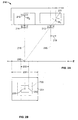
- FIG. 2A shows an apparatus 210 for capturing an image in an image plane E.
- the image may be on a printed web, such as a paper or film web, for example. However, the image may also be on pieces of material, such as sheets of paper or blanks.
- the device comprises a first sensor means 211 and a first imaging means 213 as well as a second sensor means 212 and a second imaging means 214.
- the first sensor means 211 and the second sensor means 212 are each arranged in a plane parallel to the image plane E.
- the first imaging means 213 and the second imaging means 214 are located between the image plane E and the first sensor means 211 and the second sensor means 212, respectively.
- the apparatus can detect a first detection area 231 and a second detection area 232 in the image plane E. In FIG. 2A the second detection area 232 (zoom area) is smaller than the first detection area 231 (wide angle area).
- FIG. 2 B shows a plan view of the in FIG. 2A shown capture area in the image plane E (from the perspective of FIG. 2A shown device 210).
- the second detection area 232 comprises a partial area of the first detection area 231 and is arranged within the first 231 detection area.
- the center of the first detection area 231 and the center of the second detection area 232 coincide at a central point 230, that is, the second detection area 232 is located at the center of the first detection area around a central point 230. It should be understood that any other positioning of the second detection area is possible partially or entirely within the first detection area, for example in an edge area of the first detection area.
- the detection of the image in the image plane can be done by using a CMOS chip, such as a CMOS matrix chip, as first and / or second sensor means. It should be understood that detection by any other suitable type of sensor means, such as a CCD chip, is also possible.
- the first imaging means 211 comprises a first optical axis 215, which is shown with a vertical dashed line and which passes through the center of the imaging means 213.
- the second imaging means 212 comprises a second optical axis 216 FIG. 2A
- the first optical axis 215 and the second optical axis 216 are parallel to each other.
- the first and / or second imaging means may be one or more lenses or one or more lenses include.
- An imaging means may for example also be understood as a lens system or a lens.
- the first and second imaging means 213 and 214 shown are each a fixed lens.
- a 20mm lens can be used as the first imaging tool and an 8mm lens as the second imaging tool. It should be understood, however, that the choice of imaging means may be dependent on the particular application.
- the first sensor means 211 is arranged such that the center M1 of the first sensor means 211 has an offset 219 to the first optical axis 215.
- the offset 219 is in FIG. 2A is shown as a distance between the first optical axis 215 passing through the center of the first imaging means 213 and the vertical dashed line passing through the center M1.
- the center M1 of the first sensor means 211 is located on a line which passes through a center 230 of the first detection area 231 and a center of the first imaging means 213. It is thus possible to detect two differently sized detection areas, for example a zoom area and a wide-angle area, by means of two fixed objectives.
- the position and thus the offset of the first sensor means 211 can be calculated by radiation set.
- the size of the offset depends on the particular construction of the device (such as distance to the image plane E). By way of example only, the size of the offset may be less than 1 mm, for example 0.7 mm.
- the first imaging means 213 and the second imaging means 214 have different focal lengths.
- the first imaging means has a focal length B1 and the second imaging means 214 has a focal length B2.
- the first imaging means 213 has a shorter focal length than the second imaging means 214, that is, the focal length B1 is smaller than the focal length B2.
- the first sensor means 211 and the first imaging means 213 with the shorter focal length B1 are arranged such that the first detection area 231, as in FIG FIG. 2A and 2B the wide-angle region represented by the first imaging means 213 and detected by the first sensor means 211 is shown.
- the second sensor means 212 and the second imaging means 214 are arranged such that the second detection area 232, as in FIG FIG.
- the zoom range represented by the second imaging means 214 and detected by the second sensor means 212 is shown.
- the second sensor means 212 detects an enlarged image compared to the first sensor means 211, that is, the second sensor means 212 detects a smaller image detail (zoom) than the first sensor means 211.
- the first sensor means 211 and the second sensor means 212 are respectively in FIG a plane parallel to the image plane E is arranged. As shown, these planes are preferably two different planes.
- the two detection means are arranged in different planes due to the different focal lengths B1 and B2. Depending on the particular construction, however, the two levels can also form the same level.
- the second sensor means 212 may be located centered to the second optical axis 216, as in FIG FIG. 2A and 2B and FIG. 3 shown.
- the center M2 of the second detection means 212 lies on the optical axis 216 of the second detection means.
- the second sensor means may also have an optical axis offset in the same manner as described above with respect to the first detection means.
- the second sensor means is arranged such that the center of the second sensor means has an offset to the second optical axis.
- the second sensor means is then arranged such that the center of the second sensor means is on a line passing through a center of the second detection area and a center of the second imaging means.
- more than one second sensor means and more than a second imaging means may be used to detect more than one second detection range.
- a total of three sensor means and three imaging means may be used to detect each one of three detection areas.
- the third detection area can then be arranged within the second detection area and the second detection area within the first detection area.
- several zoom areas can be realized.
- the first sensor means may be arranged centered to the first optical axis and the second sensor means may have an offset to the second optical axis. Likewise, as described above, both detection means may have an offset to the respective optical axis. Also, the second detection area may be imaged by the first imaging means and detected by the first sensor means and correspondingly the first detection area imaged by the second imaging means and detected by the second sensor means.
- the first detection means comprises the first sensor means 211 and the first imaging means 213.
- the second detection means respectively comprise the second sensor means 212 and the second imaging means 214. Detection of the first detection area 231 is performed with the first detection means and detection of the second detection area 232 becomes performed with the second detection means.
- the second detection area 232 is located in FIG. 2A and 2B within the first detection area 231.
- the second detection means 212 detects an enlarged image (a smaller image area) as compared with the first detection means 211. If the first image data has a first resolution and the second image data has a second resolution, the first resolution is smaller than the second resolution. There are thus provided two different resolutions which can be used in image processing.
- the resolution of the image data may be expressed as the number of pixels relative to a unit of physical length, such as dpi (dots per inch) or ppi (pixels per inch).
- the first and second image data may be stored together in a storage unit.
- evaluating may include calculating image data of a FIG. 2 B illustrated display area 233 of the first and / or the second image data include (digital zooming).
- the selection of the first and / or the second image data can take place in a processing unit, which then for example reads the image data accordingly from the memory unit.
- the selection can be made automatically or by a user. If the selection is automatic, it can be designed as follows.
- the display area 233 is within the second detection area 232 (in FIG FIG. 2 B not shown)
- the second image data is evaluated to calculate image data of the display area 233.
- the display area 233 is within the first detection area 231 and outside of the second detection area 232 (as in FIG FIG.
- the first image data are evaluated to calculate image data of the display area 233.
- the zooming is therefore not optical, such as with a zoom lens, but digitally. By providing two different resolutions, it is possible to digitally zoom within a large image area to provide a sufficiently high resolution without using a zoom lens.
- the evaluation and calculation of image data of the presentation area 233 from the first and / or the second image data can be carried out in a processing unit.
- the image data of the desired display area 233 can be determined by conventional image processing methods. For example, the calculation can be carried out by determining interpolation values between the individual pixel values of the first and / or second image data.
- the desired display area can then be output by means of an output unit, such as a monitor.
- a picture-in-picture function is also possible by displaying a display area determined from the first picture data in a large window on the output unit, and a display area determined from the second picture data in a small window on the output unit, or vice versa.
- the presentation area 233 may be predetermined or freely selected by the user. Also, continuously increasing in size (zoom out) or decreasing (zoom in) display areas 233 may be used and their image data may then be successively calculated from the first and / or the second image data (continuous digital zooming). In the case where the display areas continuously decrease in size, as soon as the display area 233 falls within the second detection area 232, the evaluation of the first low-resolution image data may be switched to the higher-resolution second image data. It is thus possible to continuously zoom digitally within a large image area while providing a sufficiently high resolution without time delay.
- the method may include detecting a color reference, such as a color reference strip, to obtain color reference data (color calibration).
- the detection of the color reference can take place during the detection of the first or the second detection area.
- the color reference may be in an edge region of the in FIG. 2 B shown first detection area 231 are located.
- the color reference may, for example, in the first detection means (see FIG. 2A ) and imaged on an edge area of the first detection area 231.
- color correction data can then be determined with the aid of the color reference data, for example by comparing the color reference data with the image data. If a deviation of the image data from the color reference data is determined, then the image data can be correspondingly color-corrected for any selected display area. With a zoom lens, this would not be possible because, if the color reference is in a border area, not every selected viewport would capture that color reference. By using two detection means comprising fixed lenses, as described above, a color correction can be provided for each selected display area.
- FIG. 4 shows an apparatus 210 for capturing an image in an image plane (not shown) having two imaging means or objectives 213 and 214 and an exposure means 220.
- a first detection area wide angle area
- a second detection area zoom range
- the selection of the first and / or second detection range can be done automatically or by a user via a control unit.
- the image may be exposed by means of the exposure means 220.
- Exposure means 220 shown comprises a light guide means 221 which has a continuous recess 241 in a region in which the first objective 213 and the second objective 214 are arranged. Exposure means will be described in more detail below.
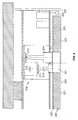
- FIG. 5 shows an apparatus for capturing an image 200 with a detection means 210 and an exposure means 220.
- the image is on an object 201, such as a web of material, in an object plane E.
- the image may be a still image, a video image, or any of the images other appropriate form of a picture.
- the detection means is arranged along a major axis H.
- the detection means may be, for example, a CCD or CMOS camera or any other suitable type of detection means.
- the light source 222 is arranged such that its emitted light is coupled into the light guide means 221 and propagates in the light guide means 221.
- the light propagating in the optical fiber means 221 then diffuses in a surface region 223, or side 223, of the optical fiber means 221 facing the image 200.
- a uniform illumination can be provided in the detection of the image 200, whereby also a good image quality can be achieved.
- Walls 290 having a diffuse white surface which provide a channel between the exposure means 220 and the image 200, are shown.
- the diffused light can be optimally directed to the area to be illuminated and the luminous intensity in this area can be increased.
- a very good reproduction of holograms or reflective surfaces can be ensured.
- the optical fiber means 221 is a flat plate and is centered about the main axis H of the detection means 210.
- the flat plate is located in a plane parallel to an object plane E, which in turn can be achieved a uniform illumination.
- the exposure means is easy and can be produced in a variety of sizes.
- the device can be easily provided in various sizes.
- the light guide means may also be arranged eccentrically about the main axis of the detection means.
- the optical fiber means can also be arranged away from or next to the detection means, as long as this arrangement an optimal illumination corresponding to the application can be achieved.
- the light source 222 is arranged in the vicinity of the surface regions 224, the side 224, of the plate 221.
- a reflector 227 is arranged around the light source 222.
- the reflector 227 reflects the light emitted by the light source 222, which is emitted in the remaining spatial directions and which could not be coupled into the light guide means without the presence of the reflector.
- the reflector 227 may be formed, for example, round, so as to achieve an optimal reflection of the light on the side 224 out. If the reflector 227 has a parabolic shape, the light source 222 may be arranged, for example, near the focal point of the parabola.
- the surface regions 224 in which the emitted light is coupled in may be smooth, in particular polished or surface-treated in any other way.
- the coupled light propagates in the optical fiber means 221 (in FIG FIG. 5 indicated by arrows).
- the propagating light (total) is reflected.
- the light guide means may have a mirroring or reflector layer 228.
- other suitable means of inducing reflection may be used.
- a difference between mirror coating and reflector layer may consist in the amount of light which emerges on the side 223 diffuse.
- a reflector layer diffusely reflects the light in the light guide means 221, more light can diffuse out of the side 223 as compared to a mirror coating.
- a more uniform light distribution can be achieved by multiple reflection in the optical waveguide 221 with a mirror coating.
- a surface area of the optical fiber means may be both a partial area of one side and an entire side of the optical fiber means.
- the optical fiber means 221 of FIG. 5 is thus configured such that the propagating light is totally reflected at all surface areas or sides of the light guide means 221, for example by a mirror or reflector layer 228, 229, with the exception of the surface regions 224, in which the emitted light is coupled in, and the surface regions 223 in which the propagating light emerges diffusely.
- the light guide means 221 may be made of a material with scattering particles.
- the material of the optical fiber means itself may be, for example, a transparent polymer such as PMMA. However, the material may also be glass or the like.
- the scattering particles contained in the material of the optical fiber means may be, for example, organic and / or inorganic.
- the scattering particles have one of the refractive index of the optical fiber material deviating refractive index.
- the intensity of the light scattering depends inter alia on the size of the scattering particles and the difference between the refractive indices of the optical waveguide material and the scattering particles.
- the optical fiber means may also be of other suitable type, such as a special optical film or the like, when it is achieved that the light emerges diffusely.
- the light guide means 221 is arranged between the detection means 210 and the image 200.
- the light guide means 221 may be made of transparent material, in particular glass or acrylic glass.
- the detection means 210 as in FIG FIG. 5 shown capture the image 200 through the optical fiber 221 therethrough.
- the exposure means 220 may be directly attached to the detection means 210 or to a part carrying the detection means 210.
- the detection means 210 and the exposure means 220 can thus form a unit which can be easily used.
- the device can be used in a variety of ways without having to develop an individual and complex lighting concept for each application.
- the optical fiber means may also be configured such that there is a recess in the region in which the detection means 210 detects the image 200 (in FIG FIG. 5 this area is represented by two diagonal, dashed lines).
- this area is represented by two diagonal, dashed lines.
- a recess is located in the reflector layer 228.
- the recess may be continuous, as shown, but may also form only one cavity, as long as it is ensured that the detection means can capture the image.
- a thin reflector layer can also be provided, through which the detection means can detect the image.
- the recess may for example also be located directly in the light guide means. This recess can be located centrally in the optical waveguide means, However, it may also be located at any other suitable position in the optical fiber means.
- the light guide means is completely transparent or semi-transparent in the region in which the detection means detects the image.
- the light guide means 221 may not only be directly connected between the detection means 210 and the image 200 (as in FIG. 5 As already mentioned, it can be located in any position suitable for the respective application.
- an exposure means 220 ' may be disposed on the opposite side of the image 200 from the detection means 210.
- the exposure means 220 ' also comprises a light guide means 221' and a light source 222 ', which is arranged such that its emitted light is coupled into the light guide means 221' and propagated in the light guide means 221 '.
- a reflector 227 ' may be disposed about the light source 222'.
- This arrangement of the side of the image 200 opposite the detection means 210 can be used, for example, in the detection of an image on a transparent material web.
- the exposure means 220 ' may expose the web 201 from one side while the detecting means 210 takes the image from the other side (backside exposure).
- the use of a light background sheet and possible occurrence of shadowing can thus be avoided.
- a uniform illumination is achieved again.
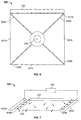
- FIG. 6 shows an exposure means 320 with four optical fiber means 321a-d and four switching means 325a-d.
- the optical fiber means 321a-d and the switching means 325a-d are in FIG. 6 arranged alternately to each other.
- the switching means 325a-d serve to selectively block or pass the light propagating in one of the optical fiber means 321a-d.
- the switching means may be, for example, LCDs or any other suitable type of light switching means.
- the light will coupled by means of a light source 322 on one side of the light guide means 321a.
- the coupled light propagates in the optical fiber means 325a and in the case where, for example, switching means 325d blocks light and switching means 325a transmits light, propagate into the optical fiber means 321b.
- switching means 325b again transmits light, the light can propagate into the switching means 321c and so on.
- selectively only certain areas of space can be illuminated, as may be important for the detection of textiles, for example.
- the lighting can thus be easily adjusted without having to develop an individual and complex lighting concept for each application.
- the four light guide means 321a-d have a triangular shape.
- the four triangular light guide means 321a-d and the four switching means 325a-d are arranged around a central point 340 and form a closed surface. In the region of the central point 340 there may be a recess through which the detection means can detect the image.
- the exposure means may comprise any number of optical fiber means, for example only 2 or even 8 or more optical fiber means.
- two rectangular exposure means may be arranged side by side separated by a switching means, or 8 triangular light guide means, analogous to FIG. 6 to be arranged in an octagon.
- the switching means may be arranged in a plane, but they may also be arranged in several planes forming an angle to one another.
- the in FIG. 6 be shown four light guide means forming a pyramid forming. Any suitable form of arrangement and configuration of the optical fiber means and switching means is possible.
- the illuminance can be selectively selected and be varied.
- the illuminance can be selected to be high enough that the acquisition means can capture the image with sufficiently high image quality only at the time of flashing.
- the function of an iris of the detection means can also be replaced.
- FIG. 7 shows an exposure means 420 with two light sources, a first light source 422a and a second light source 422b.
- the first and second light sources 422a and 422b are disposed on opposite sides 424a and 424b of a light guide means 421. On the sides 424a and 424b, respectively, the emitted light can be coupled into the light guide means 421. The light then propagates in the optical fiber means 421 and exits diffusely on the side 423 of the optical fiber means 421 (in FIG FIG. 7 indicated by arrows).
- the first and second light sources 422a and 422b may be light sources of the same but different types. If they are of different types, for example, one can be a UV light source and the other a white light source. These different light sources can then be used for different applications. In such a case, the device may include control means 450 for selectively turning on / off the first or second light source 422a, 422b.
- Light source may be, for example, a gas discharge lamp, in particular a flash tube, such as a xenon flash tube.
- a flash tube such as a xenon flash tube.
- the use of any suitable type of light source capable of generating a flash of light is possible.
- the flash can be in the range of a few microseconds, such as 1 to 100 microseconds, for example, 10 microseconds.
Landscapes
- Engineering & Computer Science (AREA)
- Physics & Mathematics (AREA)
- General Physics & Mathematics (AREA)
- Life Sciences & Earth Sciences (AREA)
- Textile Engineering (AREA)
- Multimedia (AREA)
- Signal Processing (AREA)
- Analytical Chemistry (AREA)
- General Health & Medical Sciences (AREA)
- Health & Medical Sciences (AREA)
- Quality & Reliability (AREA)
- Chemical & Material Sciences (AREA)
- Computer Vision & Pattern Recognition (AREA)
- Biochemistry (AREA)
- Theoretical Computer Science (AREA)
- Immunology (AREA)
- Pathology (AREA)
- Wood Science & Technology (AREA)
- Studio Devices (AREA)
- Length Measuring Devices By Optical Means (AREA)
- Image Input (AREA)
- Investigating Materials By The Use Of Optical Means Adapted For Particular Applications (AREA)
Priority Applications (8)
| Application Number | Priority Date | Filing Date | Title |
|---|---|---|---|
| EP19153489.0A EP3496379B1 (fr) | 2008-02-11 | 2008-02-11 | Dispositif d'enregistrement d'une image dans un plan d'image situé sur une bande de matériau |
| EP08151277A EP1940141A1 (fr) | 2008-02-11 | 2008-02-11 | Dispositif d'enregistrement d'une image et procédé d'évaluation de données d'image |
| US12/367,341 US20090206243A1 (en) | 2008-02-11 | 2009-02-06 | Image Capturing System and Method for the Analysis of Image Data |
| US12/367,351 US20090202148A1 (en) | 2008-02-11 | 2009-02-06 | Image Capturing System and Method for the Analysis of Image Data |
| TW098104119A TWI458965B (zh) | 2008-02-11 | 2009-02-10 | 用於影像資料之分析的影像擷取系統及方法 |
| KR1020090010562A KR101070082B1 (ko) | 2008-02-11 | 2009-02-10 | 이미지 데이터의 분석을 위한 이미지 캡쳐링 시스템 및 방법 |
| JP2009028494A JP4665038B2 (ja) | 2008-02-11 | 2009-02-10 | 画像データ解析のための画像キャプチャシステム及び方法 |
| CN200910008682XA CN101534389B (zh) | 2008-02-11 | 2009-02-11 | 图像拍摄系统及用于分析图像数据的方法 |
Applications Claiming Priority (1)
| Application Number | Priority Date | Filing Date | Title |
|---|---|---|---|
| EP08151277A EP1940141A1 (fr) | 2008-02-11 | 2008-02-11 | Dispositif d'enregistrement d'une image et procédé d'évaluation de données d'image |
Related Child Applications (1)
| Application Number | Title | Priority Date | Filing Date |
|---|---|---|---|
| EP19153489.0A Division EP3496379B1 (fr) | 2008-02-11 | 2008-02-11 | Dispositif d'enregistrement d'une image dans un plan d'image situé sur une bande de matériau |
Publications (1)
| Publication Number | Publication Date |
|---|---|
| EP1940141A1 true EP1940141A1 (fr) | 2008-07-02 |
Family
ID=39364788
Family Applications (2)
| Application Number | Title | Priority Date | Filing Date |
|---|---|---|---|
| EP08151277A Ceased EP1940141A1 (fr) | 2008-02-11 | 2008-02-11 | Dispositif d'enregistrement d'une image et procédé d'évaluation de données d'image |
| EP19153489.0A Active EP3496379B1 (fr) | 2008-02-11 | 2008-02-11 | Dispositif d'enregistrement d'une image dans un plan d'image situé sur une bande de matériau |
Family Applications After (1)
| Application Number | Title | Priority Date | Filing Date |
|---|---|---|---|
| EP19153489.0A Active EP3496379B1 (fr) | 2008-02-11 | 2008-02-11 | Dispositif d'enregistrement d'une image dans un plan d'image situé sur une bande de matériau |
Country Status (5)
| Country | Link |
|---|---|
| EP (2) | EP1940141A1 (fr) |
| JP (1) | JP4665038B2 (fr) |
| KR (1) | KR101070082B1 (fr) |
| CN (1) | CN101534389B (fr) |
| TW (1) | TWI458965B (fr) |
Cited By (4)
| Publication number | Priority date | Publication date | Assignee | Title |
|---|---|---|---|---|
| WO2014177326A1 (fr) * | 2013-04-29 | 2014-11-06 | Eltromat Gmbh | Dispositif pour acquérir une image d'une bande de matière à imprimer |
| EP3208572A1 (fr) * | 2016-02-22 | 2017-08-23 | Texmag GmbH Vertriebsgesellschaft | Dispositif de surveillance et/ou d'inspection de bande, utilisation d'un système en tant que diaphragme d'arrière-plan ou d'émetteur de lumière transmise dans le dispositif de surveillance et/ou d'inspection de bande et procédé de fonctionnement du dispositif de surveillance et/ou d'inspection de bande |
| DE102016220759A1 (de) * | 2016-10-21 | 2018-04-26 | Texmag Gmbh Vertriebsgesellschaft | Verfahren und Vorrichtung zur Kompensation eines Materialbahnversatzes bei der Materialbahninspektion |
| EP4012475A1 (fr) | 2020-12-14 | 2022-06-15 | BST eltromat International GmbH | Dispositif de capture d'images d'une surface |
Families Citing this family (2)
| Publication number | Priority date | Publication date | Assignee | Title |
|---|---|---|---|---|
| EP1940141A1 (fr) * | 2008-02-11 | 2008-07-02 | Texmag GmbH Vertriebsgesellschaft GmbH | Dispositif d'enregistrement d'une image et procédé d'évaluation de données d'image |
| US8665316B2 (en) * | 2009-11-24 | 2014-03-04 | Microsoft Corporation | Multi-resolution digital large format camera with multiple detector arrays |
Citations (7)
| Publication number | Priority date | Publication date | Assignee | Title |
|---|---|---|---|---|
| US5142357A (en) | 1990-10-11 | 1992-08-25 | Stereographics Corp. | Stereoscopic video camera with image sensors having variable effective position |
| EP0863656A2 (fr) | 1997-03-07 | 1998-09-09 | Dainippon Screen Mfg. Co., Ltd. | Appareil de balayage d'image et procédé de balayage d'images |
| US20020054217A1 (en) | 2000-11-07 | 2002-05-09 | Minolta Co., Ltd. | Method for connecting split images and image shooting apparatus |
| US6396561B1 (en) | 1998-11-10 | 2002-05-28 | Maniabarco N.V. | Method and device for exposing both sides of a sheet |
| US20040008773A1 (en) | 2002-06-14 | 2004-01-15 | Canon Kabushiki Kaisha | Multiple image processing and synthesis using background image extraction |
| US20060077255A1 (en) | 2004-08-10 | 2006-04-13 | Hui Cheng | Method and system for performing adaptive image acquisition |
| US20060175549A1 (en) | 2005-02-09 | 2006-08-10 | Miller John L | High and low resolution camera systems and methods |
Family Cites Families (10)
| Publication number | Priority date | Publication date | Assignee | Title |
|---|---|---|---|---|
| JPH11164181A (ja) | 1997-12-01 | 1999-06-18 | Copal Co Ltd | 電子部品認識装置 |
| JPH11295048A (ja) | 1998-04-06 | 1999-10-29 | Omron Corp | 画像処理装置 |
| JPH11331552A (ja) | 1998-05-19 | 1999-11-30 | Dainippon Printing Co Ltd | 画像入力方法及び装置 |
| JP2003018445A (ja) * | 2001-07-05 | 2003-01-17 | Fuji Photo Film Co Ltd | 画像撮像装置 |
| FI20040834A0 (fi) * | 2004-06-17 | 2004-06-17 | Petri Piirainen | Menetelmä kameran ja/tai näyttölaitteen värikalibroimiseksi |
| CN100376889C (zh) * | 2004-12-31 | 2008-03-26 | 张健 | 智能数码图文检测系统及其检测方法 |
| JP2006251683A (ja) * | 2005-03-14 | 2006-09-21 | Fujinon Corp | 立体画像撮影システム |
| JP2006295294A (ja) | 2005-04-06 | 2006-10-26 | Matsushita Electric Ind Co Ltd | カメラ装置システム |
| EP1940141A1 (fr) * | 2008-02-11 | 2008-07-02 | Texmag GmbH Vertriebsgesellschaft GmbH | Dispositif d'enregistrement d'une image et procédé d'évaluation de données d'image |
| US20090202148A1 (en) * | 2008-02-11 | 2009-08-13 | Texmag Gmbh Vertriebsgesellschaft | Image Capturing System and Method for the Analysis of Image Data |
-
2008
- 2008-02-11 EP EP08151277A patent/EP1940141A1/fr not_active Ceased
- 2008-02-11 EP EP19153489.0A patent/EP3496379B1/fr active Active
-
2009
- 2009-02-10 KR KR1020090010562A patent/KR101070082B1/ko active Active
- 2009-02-10 TW TW098104119A patent/TWI458965B/zh active
- 2009-02-10 JP JP2009028494A patent/JP4665038B2/ja active Active
- 2009-02-11 CN CN200910008682XA patent/CN101534389B/zh active Active
Patent Citations (7)
| Publication number | Priority date | Publication date | Assignee | Title |
|---|---|---|---|---|
| US5142357A (en) | 1990-10-11 | 1992-08-25 | Stereographics Corp. | Stereoscopic video camera with image sensors having variable effective position |
| EP0863656A2 (fr) | 1997-03-07 | 1998-09-09 | Dainippon Screen Mfg. Co., Ltd. | Appareil de balayage d'image et procédé de balayage d'images |
| US6396561B1 (en) | 1998-11-10 | 2002-05-28 | Maniabarco N.V. | Method and device for exposing both sides of a sheet |
| US20020054217A1 (en) | 2000-11-07 | 2002-05-09 | Minolta Co., Ltd. | Method for connecting split images and image shooting apparatus |
| US20040008773A1 (en) | 2002-06-14 | 2004-01-15 | Canon Kabushiki Kaisha | Multiple image processing and synthesis using background image extraction |
| US20060077255A1 (en) | 2004-08-10 | 2006-04-13 | Hui Cheng | Method and system for performing adaptive image acquisition |
| US20060175549A1 (en) | 2005-02-09 | 2006-08-10 | Miller John L | High and low resolution camera systems and methods |
Cited By (9)
| Publication number | Priority date | Publication date | Assignee | Title |
|---|---|---|---|---|
| WO2014177326A1 (fr) * | 2013-04-29 | 2014-11-06 | Eltromat Gmbh | Dispositif pour acquérir une image d'une bande de matière à imprimer |
| US9358815B2 (en) | 2013-04-29 | 2016-06-07 | Eltromat Gmbh | Arrangement for capturing an image of a printing substrate web |
| EP3208572A1 (fr) * | 2016-02-22 | 2017-08-23 | Texmag GmbH Vertriebsgesellschaft | Dispositif de surveillance et/ou d'inspection de bande, utilisation d'un système en tant que diaphragme d'arrière-plan ou d'émetteur de lumière transmise dans le dispositif de surveillance et/ou d'inspection de bande et procédé de fonctionnement du dispositif de surveillance et/ou d'inspection de bande |
| US20170241915A1 (en) * | 2016-02-22 | 2017-08-24 | Texmag Gmbh Vertriebsgesellschaft | Inspection And/Or Web Observation Apparatus, Use Of An Arrangement As A Background Panel Or Transmitted-Light Transmitter In The Inspection And/Or Web Observation Apparatus, And Method For Operating The Inspection And/Or Web Observation Apparatus |
| US10809204B2 (en) * | 2016-02-22 | 2020-10-20 | Texmag Gmbh Vertriebsgesellschaft | Inspection and/or web observation apparatus, use of an arrangement as a background panel or transmitted-light transmitter in the inspection and/or web observation apparatus, and method for operating the inspection and/or web observation |
| DE102016220759A1 (de) * | 2016-10-21 | 2018-04-26 | Texmag Gmbh Vertriebsgesellschaft | Verfahren und Vorrichtung zur Kompensation eines Materialbahnversatzes bei der Materialbahninspektion |
| EP4012475A1 (fr) | 2020-12-14 | 2022-06-15 | BST eltromat International GmbH | Dispositif de capture d'images d'une surface |
| WO2022128460A1 (fr) | 2020-12-14 | 2022-06-23 | Bst Gmbh | Dispositif d'acquisition d'images d'une surface |
| US12372766B2 (en) | 2020-12-14 | 2025-07-29 | Bst Gmbh | Device for acquiring images of a surface |
Also Published As
| Publication number | Publication date |
|---|---|
| CN101534389A (zh) | 2009-09-16 |
| EP3496379A1 (fr) | 2019-06-12 |
| JP2009189013A (ja) | 2009-08-20 |
| EP3496379B1 (fr) | 2020-12-02 |
| JP4665038B2 (ja) | 2011-04-06 |
| TW201005284A (en) | 2010-02-01 |
| KR101070082B1 (ko) | 2011-10-04 |
| TWI458965B (zh) | 2014-11-01 |
| KR20090086911A (ko) | 2009-08-14 |
| CN101534389B (zh) | 2012-03-21 |
Similar Documents
| Publication | Publication Date | Title |
|---|---|---|
| EP2003443B1 (fr) | Dispositif d'enregistrement d'une image | |
| DE19510102C1 (de) | Konfokales Fluoreszenzmikroskop | |
| DE69223505T2 (de) | Eingebaute beleuchtungsvorrichtung fur prufung mit laufzeitintegration | |
| DE69723799T2 (de) | Vorrichtung zur Bildaufnahme und Bildverarbeitung | |
| DE10212916B4 (de) | Optischer Versetzungssensor und Verfahren zum Verarbeiten von Bildern unter Verwendung eines optischen Versetzungssensors | |
| DE4031633C2 (fr) | ||
| EP3496379B1 (fr) | Dispositif d'enregistrement d'une image dans un plan d'image situé sur une bande de matériau | |
| DE112010003742T5 (de) | Hochschnelles, hochauflösendes, dreidimensionales Solarzellenprüfsystem | |
| EP2172799A1 (fr) | Système optique pour un microscope à foyer commun | |
| EP3283917B1 (fr) | Procédé et dispositif d'analyse d'un échantillon | |
| DE102012100726A1 (de) | Bildlesevorrichtung | |
| EP3208572B1 (fr) | Dispositif de surveillance et/ou d'inspection de bande, utilisation d'un système en tant que diaphragme d'arrière-plan ou d'émetteur de lumière transmise dans le dispositif de surveillance et/ou d'inspection de bande et procédé de fonctionnement du dispositif de surveillance et/ou d'inspection de bande | |
| EP0845187A2 (fr) | Systeme d'endoscopie video | |
| DE60037682T2 (de) | Abbildungsvorrichtung | |
| WO2018024550A1 (fr) | Dispositif et procédé pour déterminer un angle d'image double et/ou un angle de visée | |
| EP0466979B1 (fr) | Arrangement pour la génération des images simultanée à foyer commun | |
| WO2020057695A1 (fr) | Écran comprenant un capteur matriciel intégré et procédé pour l'enregistrement optique de la structure papillaire d'au moins un doigt au moyen de l'écran | |
| DE3128189A1 (de) | "bildlesegeraet" | |
| DE4111512C2 (de) | Lichtumlenkende und lichtstreuende Vorrichtung für eine Abgleichvorrichtung | |
| AT406528B (de) | Verfahren und einrichtung zur feststellung, insbesondere zur visualisierung, von fehlern auf der oberfläche von gegenständen | |
| DE112019000982T5 (de) | Laserlichtausgabe-Steuervorrichtung und Laserabtast-Anzeigevorrichtung | |
| EP0899539B1 (fr) | Procédé ainsi que dispositif pour obtenir des informations sur au moins une extrémité d' une fibre optique | |
| DE102004059951A1 (de) | Vorrichtung zur Untersuchung von Dokumenten | |
| DE112024000319T5 (de) | Inspektionseinrichtung | |
| DE102015105128A1 (de) | Verfahren und Vorrichtung zur Messung des Glanzgrads und/oder der Mattheit von Gegenständen |
Legal Events
| Date | Code | Title | Description |
|---|---|---|---|
| PUAI | Public reference made under article 153(3) epc to a published international application that has entered the european phase |
Free format text: ORIGINAL CODE: 0009012 |
|
| AK | Designated contracting states |
Kind code of ref document: A1 Designated state(s): AT BE BG CH CY CZ DE DK EE ES FI FR GB GR HR HU IE IS IT LI LT LU LV MC MT NL NO PL PT RO SE SI SK TR |
|
| AX | Request for extension of the european patent |
Extension state: AL BA MK RS |
|
| 17P | Request for examination filed |
Effective date: 20080911 |
|
| RAP1 | Party data changed (applicant data changed or rights of an application transferred) |
Owner name: TEXMAG GMBH VERTRIEBSGESELLSCHAFT |
|
| AKX | Designation fees paid |
Designated state(s): AT BE BG CH CY CZ DE DK EE ES FI FR GB GR HR HU IE IS IT LI LT LU LV MC MT NL NO PL PT RO SE SI SK TR |
|
| 17Q | First examination report despatched |
Effective date: 20110926 |
|
| APBK | Appeal reference recorded |
Free format text: ORIGINAL CODE: EPIDOSNREFNE |
|
| APBN | Date of receipt of notice of appeal recorded |
Free format text: ORIGINAL CODE: EPIDOSNNOA2E |
|
| APBR | Date of receipt of statement of grounds of appeal recorded |
Free format text: ORIGINAL CODE: EPIDOSNNOA3E |
|
| APAV | Appeal reference deleted |
Free format text: ORIGINAL CODE: EPIDOSDREFNE |
|
| APBT | Appeal procedure closed |
Free format text: ORIGINAL CODE: EPIDOSNNOA9E |
|
| STAA | Information on the status of an ep patent application or granted ep patent |
Free format text: STATUS: THE APPLICATION HAS BEEN REFUSED |
|
| 18R | Application refused |
Effective date: 20190205 |