EP1940175A1 - Appareil de codage d'image et procédé d'accès mémoire - Google Patents
Appareil de codage d'image et procédé d'accès mémoire Download PDFInfo
- Publication number
- EP1940175A1 EP1940175A1 EP07118468A EP07118468A EP1940175A1 EP 1940175 A1 EP1940175 A1 EP 1940175A1 EP 07118468 A EP07118468 A EP 07118468A EP 07118468 A EP07118468 A EP 07118468A EP 1940175 A1 EP1940175 A1 EP 1940175A1
- Authority
- EP
- European Patent Office
- Prior art keywords
- block
- pixel
- frame
- memory
- unit
- Prior art date
- Legal status (The legal status is an assumption and is not a legal conclusion. Google has not performed a legal analysis and makes no representation as to the accuracy of the status listed.)
- Withdrawn
Links
Images

Classifications
-
- H—ELECTRICITY
- H04—ELECTRIC COMMUNICATION TECHNIQUE
- H04N—PICTORIAL COMMUNICATION, e.g. TELEVISION
- H04N19/00—Methods or arrangements for coding, decoding, compressing or decompressing digital video signals
- H04N19/50—Methods or arrangements for coding, decoding, compressing or decompressing digital video signals using predictive coding
- H04N19/503—Methods or arrangements for coding, decoding, compressing or decompressing digital video signals using predictive coding involving temporal prediction
- H04N19/51—Motion estimation or motion compensation
- H04N19/523—Motion estimation or motion compensation with sub-pixel accuracy
-
- H—ELECTRICITY
- H04—ELECTRIC COMMUNICATION TECHNIQUE
- H04N—PICTORIAL COMMUNICATION, e.g. TELEVISION
- H04N19/00—Methods or arrangements for coding, decoding, compressing or decompressing digital video signals
- H04N19/50—Methods or arrangements for coding, decoding, compressing or decompressing digital video signals using predictive coding
- H04N19/503—Methods or arrangements for coding, decoding, compressing or decompressing digital video signals using predictive coding involving temporal prediction
- H04N19/51—Motion estimation or motion compensation
-
- H—ELECTRICITY
- H04—ELECTRIC COMMUNICATION TECHNIQUE
- H04N—PICTORIAL COMMUNICATION, e.g. TELEVISION
- H04N19/00—Methods or arrangements for coding, decoding, compressing or decompressing digital video signals
- H04N19/42—Methods or arrangements for coding, decoding, compressing or decompressing digital video signals characterised by implementation details or hardware specially adapted for video compression or decompression, e.g. dedicated software implementation
- H04N19/43—Hardware specially adapted for motion estimation or compensation
- H04N19/433—Hardware specially adapted for motion estimation or compensation characterised by techniques for memory access
-
- H—ELECTRICITY
- H04—ELECTRIC COMMUNICATION TECHNIQUE
- H04N—PICTORIAL COMMUNICATION, e.g. TELEVISION
- H04N19/00—Methods or arrangements for coding, decoding, compressing or decompressing digital video signals
- H04N19/60—Methods or arrangements for coding, decoding, compressing or decompressing digital video signals using transform coding
- H04N19/61—Methods or arrangements for coding, decoding, compressing or decompressing digital video signals using transform coding in combination with predictive coding
Definitions
- the present invention relates to an image encoding apparatus and a memory access method which can reduce the number of times a memory is accessed for encoding, and thus can realize low-power encoding in the interpolation of color difference signals.
- image compression is based on a number of compression standards, including MPEG and H.26x, and such image compression techniques are widely used for video players, VODs, video telephones, DMB, etc.
- image compression techniques are widely used for video players, VODs, video telephones, DMB, etc.
- wireless communication e.g. 2.5G/3G
- Moving image compression standards including MPEG- or H.26x-series moving image codecs, adopt a compression scheme based on motion estimation/compensation and transformation.
- information regarding the motion vector of each block must be encoded and transmitted.
- how the motion vector is encoded may greatly affect the compression efficiency.
- Images are generally encoded in the following manner: a digital image signal is subjected to DCT (Discrete Cosine Transform); a DCT coefficient is quantized so as to perform VLC (Variable Length Coding); the quantized DCT coefficient is inversely quantized and subjected to inverse DCT so that the image is restored and stored in a memory; the stored image and the next frame image are used to obtain a motion vector; and the motion vector is subjected to VLC so as to constitute a bit stream together with the encoded image information and transmit it.
- DCT Discrete Cosine Transform
- VLC Very Length Coding
- Methods for compressing and encoding images are based on spatial redundancy and/or temporal redundancy.
- the temporal redundancy with regard to the previous frame can be efficiently eliminated by using the motion vector of macro blocks.
- the codec searches for a macro block most similar to the macro block of the current frame from a previous frame (i.e., reference frame).
- the codec calculates the square of distance between two vectors and searches for a macro block having the smallest square. In this manner, the redundancy between frames is efficiently eliminated so as to improve the compression efficiency.
- terrestrial/satellite DMBs as well as a video telephone system capable of providing communication with an image, have been developed.
- H.264 is a high-efficiency compression technology and is based on a unit of network abstraction layer (NAL). Types of NALs including video data may be largely classified into an instantaneous decoding refresh (IDR) NAL and a non-IDR NAL.
- the IDR NAL is a random accessible point, in which the temporal redundancy is not used but only the spatial redundancy is used for compression, and frames input before an IDR NAL are all removed in a frame buffer so as not to be used as a reference for compression any more.
- the non-IDR NAL includes an I-type slice, a P-type slice and a B-type slice.
- the P-type slice and B-type slice are in a state compressed by the same predictive encoding as that of the existing codec.
- the I-type slice is in a state compressed by using only the spatial redundancy as in the basic IDR, but there is a difference in that contents in a frame buffer are not removed in the case of the I-type slice.
- contents in the frame buffer are not removed is that a P-type NAL or B-type NAL following an I-type slice may refer to contents before the I-type slice.
- an IDR frame having an IDR NAL can serve as a random accessible point used in a variable-speed reproduction (FF/REW) mode for a moving image reproduction
- a non-IDR frame having a non-IDR NAL is not utilized as a random accessible point even though the non-IDR frame is an I frame using only a spatial redundancy. This is because, as described above, it is probable that NALs following an I frame are subjected to predictive encoding based on contents before the I frame.
- the motion compensation method according to such an H.264-based moving image compression standard supports various block sizes of 16 ⁇ 16 to 4 ⁇ 4, unlike other standards.
- One macro block may be divided into sub-blocks of 16 ⁇ 16, 16 ⁇ 8, 8 ⁇ 16, 8 ⁇ 8, 8 ⁇ 4, 4 ⁇ 8 and 4 ⁇ 4 in terms of luminance components (Y), and may be divided into sub-blocks of 8 ⁇ 8, 8 ⁇ 4, 4 ⁇ 8, 4 ⁇ 4, 4 ⁇ 2, 2 ⁇ 4 and 2 ⁇ 2 in terms of chromaticity components (Cb and Cr), which are half the size of the luminance components, respectively.
- a motion prediction of an integer pixel accuracy is performed, and then a motion prediction of a sub-pixel accuracy is performed to improve the performance.
- the sub-pixels of the luminance blocks are interpolated by using a filter
- the sub-pixels of the chromaticity blocks are interpolated by using adjacent integer pixels.
- a reference block is required for each size, in which reference blocks having the sizes of 21 ⁇ 21 to 9 ⁇ 9 are required in the case of the luminance blocks, and reference blocks having the sizes of 9 ⁇ 9 to 3 ⁇ 3 are required in the case of the chromaticity blocks, so that it takes a long time to read such reference blocks. That is, since the reference blocks for motion compensation also have various sizes in accordance with sub-blocks having various sizes, it takes a considerably long time to access a memory and to retrieve therefrom the reference blocks for motion compensation.
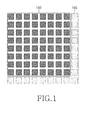
- FIG. 1 shows a part of the pixels included in a predetermined motion prediction block.
- hatched squares represent an 8 ⁇ 8 block 150
- dotted squares represent integer pixels 160 used for sub-pixel interpolation.
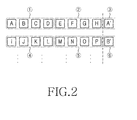
- FIG. 2 is a view illustrating a memory access method for sub-pixel interpolation in a conventional video encoding apparatus.
- FIG. 2 shows an example of accessing integer pixels in a memory.
- A' and B' represent integer pixels of a neighbor block.
- a memory access is performed four pixels by four pixels.
- A, B, C and D "1" and I, J, K and L “4" are loaded and sub-pixels in each pixel are interpolated.
- E, F, G and H “2” and M, N, O and P "5" are loaded and sub-pixels in each pixel are interpolated, and then A' 3 and B' 6 are loaded.
- nine integer pixels per line are loaded. In the case of a conventional motion compensation apparatus, loading nine integer pixels requires at least three times as much memory access.
- a block for a chromaticity signal is determined to be an 8 ⁇ 8 block 150.
- the memory access for obtaining integer pixels for sub-pixel interpolation must be performed three times per line. Consequently, a total of 27 times more memory accesses is required to access the entire block 150.
- the number of memory access times required per block 150 is as follows:
- sub-pixel interpolation is used as an inter mode between all screens, and most frames are encoded in the inter mode, the sub-pixel interpolation is very widely used.
- reference blocks are stored in a memory in advance, and then a reference block according to the reference index and motion vector of each block is read.
- a reference block there may be a plurality of reference images.
- an apparatus such as a mobile phone, a PDA, etc., based on portability and mobility, stores reference images not in a high-speed internal memory but in a low-speed external memory due to a limitation in the size of the internal memory. The apparatus then accesses the external memory and reads a corresponding reference image whenever a motion is compensated, so that it takes a long time to read a reference block.
- an image encoding apparatus for encoding image data, the apparatus comprising:
- FIG. 3 is a block diagram illustrating the configuration of an image encoding apparatus according to an embodiment of the present invention.
- the image encoding apparatus 400 performs an intra-frame compression and an inter-frame compression, for example, according to a compression sequence of I, P and B frames.
- pixel data of an I frame is not influenced by a subtraction unit 402 and is output to a discrete cosine transform (DCT) operation unit 404.
- the DCT operation unit 404 performs a DCT operation on a 4 ⁇ 4 pixel block by a 4 ⁇ 4 pixel block (or, an 8 ⁇ 8 pixel block by an 8 ⁇ 8 pixel block in the case of a high profile).
- a quantization unit 406 quantizes the DCT data.
- a variable-length coding (VLC) unit 408 performs a statistical encoding operation on the quantized data through variable-length coding, and multiplexes the statistically encoded image data, a motion vector applied from a motion prediction unit 418, and additional information such as a macro block type, and then outputs the multiplexed data.
- VLC variable-length coding
- a compressed I frame output from the quantization unit 406 is inverse-quantized by an inverse quantization unit 410, is decompressed through an inverse DCT operation by an inverse DCT operation unit 412, and then is applied to an addition unit 414.
- the decompressed I frame is not influenced by the addition unit 414, and is transferred to a memory unit 416, which serves as a buffer, as is.
- the decompressed I frame is stored in the memory unit 416 for use in the predictive compression of P and B frames.
- the predictive encoding of P and B frames is performed in a similar manner as that of the predictive compression.
- Image frames stored in the memory unit 416 are provided to the motion prediction unit 418.
- the motion prediction unit 418 detects a motion vector by using a currently-input image frame and a reference frame stored in the memory unit 416, and outputs the motion vector to the VLC unit 408 and a motion correction unit 420.
- the motion correction unit 420 reads a block corresponding to the motion vector predicted by the motion prediction unit 418 from the memory unit 416, and provides the read block to the subtraction unit 402.
- the subtraction unit 402 subtracts the predicted block, which has been obtained from the memory unit 416 through the motion correction unit 420, from a block corresponding to a frame to be currently compressed, in which the subtraction operation is performed in a relation of pixel to pixel.
- a difference or residue obtained through the subtraction by the subtraction unit 402 is applied to the DCT operation unit 404.
- a compressed P frame is decoded by the inverse quantization unit 410 and inverse DCT operation unit 412, and the decoded data are applied to a first input terminal of the addition unit 414.
- each block of the reference image frame stored in the memory unit 416 is accessed for prediction of a current frame, and an accessed block is applied through the motion correction unit 420 to a second input terminal of the addition unit 414.
- the addition unit 414 adds an encoded difference or residue output to data output from the motion correction unit 420, thereby restoring an original image.
- a P frame restored by the addition unit 414 is stored in the memory unit 416 for use in predictive encoding/decoding of P and B frames in the future.
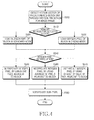
- FIG. 4 is a flowchart illustrating a memory access method in an image encoding apparatus according to an embodiment of the present invention.
- the motion prediction unit 418 divides a currently input image frame into macro blocks, finds a reference frame most similar to the currently input image by comparing the currently input image frame with reference frames stored in the memory, and detects a motion vector (MV) of a predetermined block unit 150 for an image frame to be currently encoded (step 500).
- the motion prediction may be performed in the same manner as in the MPEG-2 or MPEG-4, in the block unit 150. Accordingly, the motion vector of the block unit 150 is obtained.
- the motion prediction unit 418 loads an integer pixel of the corresponding block 150 of the motion vector and accesses the memory unit 416 (step 510).
- the motion correction unit 420 performs a motion correction operation with respect to a block to be compressed, by using the motion vector detected in the block unit 150.
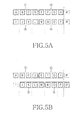
- FIGs. 5A and 5B are views illustrating a memory access method for sub-pixel interpolation in the image encoding apparatus according to an embodiment of the present invention.
- the motion prediction unit 418 which generally loads pixels in a unit of four pixels, loads pixels A, B, C and D "1" and pixels I, J, K and L "3", loads pixels E, F, G and H "2" and pixels M, N, O and P "4" in a normal mode, and interpolates sub-pixels in each pixel (step 520).
- A' and B' represent integer pixels of a neighbor block. In this case, since pixels A' and B' have not been loaded, it is impossible to interpolate sub-pixels between pixels H, A', P and B'. Therefore, the motion prediction unit 418 first interpolates the neighbor pixels A' and B', and then performs the sub-pixel interpolation.
- the motion prediction unit 418 loads pixels A, B, C and D "1” and pixels J, K, L and M “3", loads pixels E, F, G and H "2" and pixels N, O, P and B' "4" in a zigzag mode, and interpolates sub-pixels in each pixel (step 530).
- the motion prediction unit 418 since pixels I and A' have not been accessed, it is impossible to interpolate sub-pixels between pixels A, B, I and J and sub-pixels between pixels H, A', P and B'. Therefore, the motion prediction unit 418 first interpolates pixels A' and I by means of neighbor pixels, and then performs the sub-pixel interpolation.
- the integer pixels are replaced by neighbor pixels, in which a neighbor pixel is used for the integer pixel interpolation based on Equation 1 (step 540).
- Equation 2 The average of neighbor pixels is used based on Equation 2 (step 550).
- I ( A + B + J + K + 2 ) > > 2
- a gradient of a neighbor pixel is used, that is, a change in the value of a neighbor pixel based on Equation 3 (step 560).
- Integer pixels interpolated in such a manner are used to perform sub-pixel interpolation. Even when any one of 8 ⁇ 4, 4 ⁇ 8 and 4 ⁇ 4 blocks is selected, the aforementioned schemes can be applied. Thereafter, in the case of an 8 ⁇ 8 and 8 ⁇ 4 block, nine integer pixels per line are required for sub-pixel interpolation. Since 32 bits of data can be accessed at one time, it is possible to access four integer pixels at one time. Therefore, as shown in FIG. 4, at least three memory accesses per line are required. Similarly, in the case of a 4 ⁇ 8 and 4 ⁇ 4 block, five integer pixels per line are required, so that at least two times the memory accesses per line is required. The number of memory access times required per block is as follows:
- the number of memory access times is reduced to 76% in the case of the 8 ⁇ 8 and 8 ⁇ 4 block, and to 50% in the case of the 4 ⁇ 8 and 4 ⁇ 4 block.
- the number of memory access times is very important in a video encoding apparatus.
- a memory access uses a cycle which is several to dozens times as long as that of a general command.
- the color difference signal interpolation considering memory access is very efficient in achieving low-power encoding.
- the number of memory access times required for encoding can be reduced, so that it is possible to efficiently achieve low-power encoding because interpolation of a color difference signal is widely used in encoding.
Landscapes
- Engineering & Computer Science (AREA)
- Multimedia (AREA)
- Signal Processing (AREA)
- Compression Or Coding Systems Of Tv Signals (AREA)
Applications Claiming Priority (1)
| Application Number | Priority Date | Filing Date | Title |
|---|---|---|---|
| KR1020060099870A KR100827093B1 (ko) | 2006-10-13 | 2006-10-13 | 영상 부호화 방법 및 장치 |
Publications (1)
| Publication Number | Publication Date |
|---|---|
| EP1940175A1 true EP1940175A1 (fr) | 2008-07-02 |
Family
ID=39303090
Family Applications (1)
| Application Number | Title | Priority Date | Filing Date |
|---|---|---|---|
| EP07118468A Withdrawn EP1940175A1 (fr) | 2006-10-13 | 2007-10-15 | Appareil de codage d'image et procédé d'accès mémoire |
Country Status (3)
| Country | Link |
|---|---|
| US (1) | US20080089418A1 (fr) |
| EP (1) | EP1940175A1 (fr) |
| KR (1) | KR100827093B1 (fr) |
Families Citing this family (8)
| Publication number | Priority date | Publication date | Assignee | Title |
|---|---|---|---|---|
| WO2009122659A1 (fr) * | 2008-03-31 | 2009-10-08 | パナソニック株式会社 | Dispositif de décodage d'image, procédé de décodage d'image, circuit intégré et dispositif de réception |
| EP2509319A4 (fr) * | 2009-12-01 | 2013-07-10 | Humax Co Ltd | Procédé et appareil pour coder/décoder des images de haute résolution |
| KR101847072B1 (ko) | 2010-04-05 | 2018-04-09 | 삼성전자주식회사 | 영상 부호화 방법 및 장치, 비디오 복호화 방법 및 장치 |
| US8437581B2 (en) * | 2011-03-04 | 2013-05-07 | General Instrument Corporation | Method and system for interpolating fractional video pixels |
| US20120230407A1 (en) | 2011-03-11 | 2012-09-13 | General Instrument Corporation | Interpolation Filter Selection Using Prediction Index |
| WO2012178178A2 (fr) | 2011-06-24 | 2012-12-27 | General Instrument Corporation | Sélection de décalages de phases pour filtres d'interpolation permettant une compensation de mouvement |
| BR112013033743A2 (pt) | 2011-07-01 | 2019-09-24 | Motorola Mobility Inc | filtro de interpolação de subpixel conjunto para predição temporal |
| US10009622B1 (en) | 2015-12-15 | 2018-06-26 | Google Llc | Video coding with degradation of residuals |
Citations (2)
| Publication number | Priority date | Publication date | Assignee | Title |
|---|---|---|---|---|
| EP1418763A1 (fr) * | 2002-07-15 | 2004-05-12 | Mitsubishi Denki Kabushiki Kaisha | Dispositif de codage d'image, procede de codage d'image, dispositif de decodage d'image, procede de decodage d'image, et dispositif de communication |
| EP1469682A1 (fr) * | 2002-01-24 | 2004-10-20 | Hitachi, Ltd. | Codage et decodage de signal d'image animee et appareil a cet effet |
Family Cites Families (19)
| Publication number | Priority date | Publication date | Assignee | Title |
|---|---|---|---|---|
| US6236682B1 (en) * | 1993-03-08 | 2001-05-22 | Sony Corporation | Video motion vector detection including rotation and/or zoom vector generation |
| US6950469B2 (en) * | 2001-09-17 | 2005-09-27 | Nokia Corporation | Method for sub-pixel value interpolation |
| KR100441509B1 (ko) * | 2002-02-25 | 2004-07-23 | 삼성전자주식회사 | 주사포맷변환장치 및 방법 |
| GB2387056A (en) * | 2002-03-28 | 2003-10-01 | Sony Uk Ltd | Differential encoding and decoding |
| FR2844131B1 (fr) * | 2002-09-03 | 2004-11-12 | St Microelectronics Sa | Procede et dispositif d'interpolation d'images avec compensation du mouvement |
| US7221708B1 (en) * | 2002-12-16 | 2007-05-22 | Emblaze V Con Ltd | Apparatus and method for motion compensation |
| US7653133B2 (en) * | 2003-06-10 | 2010-01-26 | Rensselaer Polytechnic Institute (Rpi) | Overlapped block motion compression for variable size blocks in the context of MCTF scalable video coders |
| US8107535B2 (en) * | 2003-06-10 | 2012-01-31 | Rensselaer Polytechnic Institute (Rpi) | Method and apparatus for scalable motion vector coding |
| TWI227641B (en) * | 2003-11-11 | 2005-02-01 | Mediatek Inc | Method and related apparatus for motion estimation |
| EP1578137A2 (fr) * | 2004-03-17 | 2005-09-21 | Matsushita Electric Industrial Co., Ltd. | Appareil de codage vidéo avec une méthode d' interpolation à multiples étapes |
| EP1578134A1 (fr) * | 2004-03-18 | 2005-09-21 | STMicroelectronics S.r.l. | Procédés et dispositifs pour coder/décoder de signaux, et produit de programme d'ordinateur associé |
| JP4419062B2 (ja) * | 2004-03-29 | 2010-02-24 | ソニー株式会社 | 画像処理装置および方法、記録媒体、並びにプログラム |
| KR100687711B1 (ko) * | 2004-11-22 | 2007-02-27 | 한국전자통신연구원 | 동영상 부호화를 위한 1/4 화소 탐색 방법 |
| US7929606B2 (en) * | 2005-01-21 | 2011-04-19 | Lg Electronics Inc. | Method and apparatus for encoding/decoding video signal using block prediction information |
| US7965773B1 (en) * | 2005-06-30 | 2011-06-21 | Advanced Micro Devices, Inc. | Macroblock cache |
| JP4752407B2 (ja) * | 2005-09-09 | 2011-08-17 | ソニー株式会社 | 画像処理装置および方法、プログラム、並びに記録媒体 |
| US8761259B2 (en) * | 2005-09-22 | 2014-06-24 | Qualcomm Incorporated | Multi-dimensional neighboring block prediction for video encoding |
| US8559514B2 (en) * | 2006-07-27 | 2013-10-15 | Qualcomm Incorporated | Efficient fetching for motion compensation video decoding process |
| KR100757832B1 (ko) * | 2006-09-14 | 2007-09-11 | 엘지전자 주식회사 | 1/4픽셀 움직임 벡터를 이용한 동영상 압축방법 |
-
2006
- 2006-10-13 KR KR1020060099870A patent/KR100827093B1/ko not_active Expired - Fee Related
-
2007
- 2007-09-26 US US11/904,088 patent/US20080089418A1/en not_active Abandoned
- 2007-10-15 EP EP07118468A patent/EP1940175A1/fr not_active Withdrawn
Patent Citations (2)
| Publication number | Priority date | Publication date | Assignee | Title |
|---|---|---|---|---|
| EP1469682A1 (fr) * | 2002-01-24 | 2004-10-20 | Hitachi, Ltd. | Codage et decodage de signal d'image animee et appareil a cet effet |
| EP1418763A1 (fr) * | 2002-07-15 | 2004-05-12 | Mitsubishi Denki Kabushiki Kaisha | Dispositif de codage d'image, procede de codage d'image, dispositif de decodage d'image, procede de decodage d'image, et dispositif de communication |
Non-Patent Citations (5)
| Title |
|---|
| "Real-Time Software Implementation of H.264 Baseline Profile Video Encoder for Mobile and Handheld Devices", ACOUSTICS, SPEECH AND SIGNAL PROCESSING, 2006. ICASSP 2006 PROCEEDINGS . 2006 IEEE INTERNATIONAL CONFERENCE ON TOULOUSE, FRANCE 14-19 MAY 2006, PISCATAWAY, NJ, USA,IEEE, 1 January 2006 (2006-01-01), pages V - V, XP031101544, ISBN: 978-1-4244-0469-8 * |
| CHUAN-YUNG TSAI ET AL: "Bandwidth optimized motion compensation hardware design for H.264/AVC HDTV decoder", CIRCUITS AND SYSTEMS, 2005. 48TH MIDWEST SYMPOSIUM ON CINICINNATI, OHIO AUGUST 7-10, 2005, PISCATAWAY, NJ, USA,IEEE, 7 August 2005 (2005-08-07), pages 1199 - 1202, XP010895358, ISBN: 978-0-7803-9197-0 * |
| DIAS T ET AL: "Efficient motion vector refinement architecture for sub-pixel motion estimation systems", SIGNAL PROCESSING SYSTEMS DESIGN AND IMPLEMENTATION, 2005. IEEE WORKSH OP ON ATHENS, GREECE NOVEMBER 2 - 4, 2005, PISCATAWAY, NJ, USA,IEEE, 2 November 2005 (2005-11-02), pages 313 - 318, XP010882588, ISBN: 978-0-7803-9333-2 * |
| MO LI ET AL: "The high throughput and low memory access design of sub-pixel interpolation for H.264/AVC HDTV decoder", SIGNAL PROCESSING SYSTEMS DESIGN AND IMPLEMENTATION, 2005. IEEE WORKSH OP ON ATHENS, GREECE NOVEMBER 2 - 4, 2005, PISCATAWAY, NJ, USA,IEEE, 2 November 2005 (2005-11-02), pages 296 - 301, XP010882585, ISBN: 978-0-7803-9333-2 * |
| SATO K ET AL: "Adaptive mc interpolation for memory access reduction in JVT video coding", SIGNAL PROCESSING AND ITS APPLICATIONS, 2003. PROCEEDINGS. SEVENTH INT ERNATIONAL SYMPOSIUM ON JULY 1-4, 2003, PISCATAWAY, NJ, USA,IEEE, vol. 1, 1 July 2003 (2003-07-01), pages 77 - 80, XP010653133, ISBN: 978-0-7803-7946-6 * |
Also Published As
| Publication number | Publication date |
|---|---|
| US20080089418A1 (en) | 2008-04-17 |
| KR20080033754A (ko) | 2008-04-17 |
| KR100827093B1 (ko) | 2008-05-02 |
Similar Documents
| Publication | Publication Date | Title |
|---|---|---|
| US7924925B2 (en) | Flexible macroblock ordering with reduced data traffic and power consumption | |
| US8170097B2 (en) | Extension to the AVC standard to support the encoding and storage of high resolution digital still pictures in series with video | |
| RU2409005C2 (ru) | Способ масштабируемого кодирования и декодирования видеосигнала | |
| CN108924553B (zh) | 视频编码、解码方法、装置、计算机设备和存储介质 | |
| US20090141809A1 (en) | Extension to the AVC standard to support the encoding and storage of high resolution digital still pictures in parallel with video | |
| US20110032991A1 (en) | Image encoding device, image decoding device, image encoding method, and image decoding method | |
| EP1940175A1 (fr) | Appareil de codage d'image et procédé d'accès mémoire | |
| JP2009260977A (ja) | 不可逆圧縮及び可逆圧縮を組み合わせて用いたビデオデータ圧縮 | |
| US20090010326A1 (en) | Method and apparatus for parallel video decoding | |
| US8767828B2 (en) | System for low resolution power reduction with compressed image | |
| US20120014450A1 (en) | System for low resolution power reduction with deblocking flag | |
| US20240121403A1 (en) | Metadata for signaling information representative of an energy consumption of a decoding process | |
| EP1919213B1 (fr) | Procédé d'interpolation d'un signal de chrominance dans un codeur et décodeur vidéo | |
| EP1879388B1 (fr) | Dispositif d' enregistrement d'informations video, procede d'enregistrement d'informations video, programme d'enregistrement d'informations video et support d'enregistrement contenant le programme d'enregistrement d'informations video | |
| CN100446572C (zh) | 译码数字影像位流所含画面的方法及其数字影像译码系统 | |
| JP2006217560A (ja) | 参考フレームバッファメモリのサイズとアクセス量を減らす方法 | |
| US20130083858A1 (en) | Video image delivery system, video image transmission device, video image delivery method, and video image delivery program | |
| KR101147744B1 (ko) | 비디오 트랜스 코딩 방법 및 장치와 이를 이용한 pvr | |
| US20060133512A1 (en) | Video decoder and associated methods of operation | |
| US20080031335A1 (en) | Motion Detection Device | |
| US9313523B2 (en) | System for low resolution power reduction using deblocking | |
| US20070133689A1 (en) | Low-cost motion estimation apparatus and method thereof | |
| US20120014445A1 (en) | System for low resolution power reduction using low resolution data | |
| US20050141608A1 (en) | Pipeline-type operation method for a video processing apparatus and bit rate control method using the same | |
| GB2398951A (en) | Storage of slices of video frames |
Legal Events
| Date | Code | Title | Description |
|---|---|---|---|
| PUAI | Public reference made under article 153(3) epc to a published international application that has entered the european phase |
Free format text: ORIGINAL CODE: 0009012 |
|
| 17P | Request for examination filed |
Effective date: 20071015 |
|
| AK | Designated contracting states |
Kind code of ref document: A1 Designated state(s): AT BE BG CH CY CZ DE DK EE ES FI FR GB GR HU IE IS IT LI LT LU LV MC MT NL PL PT RO SE SI SK TR |
|
| AX | Request for extension of the european patent |
Extension state: AL BA HR MK RS |
|
| 17Q | First examination report despatched |
Effective date: 20080807 |
|
| AKX | Designation fees paid |
Designated state(s): DE FR GB |
|
| STAA | Information on the status of an ep patent application or granted ep patent |
Free format text: STATUS: THE APPLICATION IS DEEMED TO BE WITHDRAWN |
|
| 18D | Application deemed to be withdrawn |
Effective date: 20081218 |