EP1940784B1 - Verwendung von halogenaktiven aromatischen Sulfonamidverbindungen zur Geruchsbekämpfung - Google Patents
Verwendung von halogenaktiven aromatischen Sulfonamidverbindungen zur Geruchsbekämpfung Download PDFInfo
- Publication number
- EP1940784B1 EP1940784B1 EP06802339.9A EP06802339A EP1940784B1 EP 1940784 B1 EP1940784 B1 EP 1940784B1 EP 06802339 A EP06802339 A EP 06802339A EP 1940784 B1 EP1940784 B1 EP 1940784B1
- Authority
- EP
- European Patent Office
- Prior art keywords
- odor
- solution
- compounds
- wetting agent
- sulfonamide
- Prior art date
- Legal status (The legal status is an assumption and is not a legal conclusion. Google has not performed a legal analysis and makes no representation as to the accuracy of the status listed.)
- Not-in-force
Links
- LYBHLLQQEXUXPZ-UHFFFAOYSA-N NN(S(c(cccc1)c1Cl)(=O)=O)Cl Chemical compound NN(S(c(cccc1)c1Cl)(=O)=O)Cl LYBHLLQQEXUXPZ-UHFFFAOYSA-N 0.000 description 1
Classifications
-
- A—HUMAN NECESSITIES
- A01—AGRICULTURE; FORESTRY; ANIMAL HUSBANDRY; HUNTING; TRAPPING; FISHING
- A01N—PRESERVATION OF BODIES OF HUMANS OR ANIMALS OR PLANTS OR PARTS THEREOF; BIOCIDES, e.g. AS DISINFECTANTS, AS PESTICIDES OR AS HERBICIDES; PEST REPELLANTS OR ATTRACTANTS; PLANT GROWTH REGULATORS
- A01N59/00—Biocides, pest repellants or attractants, or plant growth regulators containing elements or inorganic compounds
-
- A—HUMAN NECESSITIES
- A01—AGRICULTURE; FORESTRY; ANIMAL HUSBANDRY; HUNTING; TRAPPING; FISHING
- A01N—PRESERVATION OF BODIES OF HUMANS OR ANIMALS OR PLANTS OR PARTS THEREOF; BIOCIDES, e.g. AS DISINFECTANTS, AS PESTICIDES OR AS HERBICIDES; PEST REPELLANTS OR ATTRACTANTS; PLANT GROWTH REGULATORS
- A01N41/00—Biocides, pest repellants or attractants, or plant growth regulators containing organic compounds containing a sulfur atom bound to a hetero atom
- A01N41/02—Biocides, pest repellants or attractants, or plant growth regulators containing organic compounds containing a sulfur atom bound to a hetero atom containing a sulfur-to-oxygen double bond
- A01N41/04—Sulfonic acids; Derivatives thereof
- A01N41/06—Sulfonic acid amides
-
- A—HUMAN NECESSITIES
- A01—AGRICULTURE; FORESTRY; ANIMAL HUSBANDRY; HUNTING; TRAPPING; FISHING
- A01N—PRESERVATION OF BODIES OF HUMANS OR ANIMALS OR PLANTS OR PARTS THEREOF; BIOCIDES, e.g. AS DISINFECTANTS, AS PESTICIDES OR AS HERBICIDES; PEST REPELLANTS OR ATTRACTANTS; PLANT GROWTH REGULATORS
- A01N41/00—Biocides, pest repellants or attractants, or plant growth regulators containing organic compounds containing a sulfur atom bound to a hetero atom
- A01N41/02—Biocides, pest repellants or attractants, or plant growth regulators containing organic compounds containing a sulfur atom bound to a hetero atom containing a sulfur-to-oxygen double bond
- A01N41/04—Sulfonic acids; Derivatives thereof
- A01N41/08—Sulfonic acid halides; alpha-Hydroxy-sulfonic acids; Amino-sulfonic acids; Thiosulfonic acids; Derivatives thereof
-
- A—HUMAN NECESSITIES
- A61—MEDICAL OR VETERINARY SCIENCE; HYGIENE
- A61K—PREPARATIONS FOR MEDICAL, DENTAL OR TOILETRY PURPOSES
- A61K31/00—Medicinal preparations containing organic active ingredients
- A61K31/16—Amides, e.g. hydroxamic acids
- A61K31/18—Sulfonamides
-
- A—HUMAN NECESSITIES
- A61—MEDICAL OR VETERINARY SCIENCE; HYGIENE
- A61K—PREPARATIONS FOR MEDICAL, DENTAL OR TOILETRY PURPOSES
- A61K31/00—Medicinal preparations containing organic active ingredients
- A61K31/63—Compounds containing para-N-benzenesulfonyl-N-groups, e.g. sulfanilamide, p-nitrobenzenesulfonyl hydrazide
-
- A—HUMAN NECESSITIES
- A61—MEDICAL OR VETERINARY SCIENCE; HYGIENE
- A61K—PREPARATIONS FOR MEDICAL, DENTAL OR TOILETRY PURPOSES
- A61K31/00—Medicinal preparations containing organic active ingredients
- A61K31/74—Synthetic polymeric materials
-
- C—CHEMISTRY; METALLURGY
- C07—ORGANIC CHEMISTRY
- C07C—ACYCLIC OR CARBOCYCLIC COMPOUNDS
- C07C311/00—Amides of sulfonic acids, i.e. compounds having singly-bound oxygen atoms of sulfo groups replaced by nitrogen atoms, not being part of nitro or nitroso groups
- C07C311/48—Amides of sulfonic acids, i.e. compounds having singly-bound oxygen atoms of sulfo groups replaced by nitrogen atoms, not being part of nitro or nitroso groups having nitrogen atoms of sulfonamide groups further bound to another hetero atom
-
- C—CHEMISTRY; METALLURGY
- C02—TREATMENT OF WATER, WASTE WATER, SEWAGE, OR SLUDGE
- C02F—TREATMENT OF WATER, WASTE WATER, SEWAGE, OR SLUDGE
- C02F1/00—Treatment of water, waste water, or sewage
-
- C—CHEMISTRY; METALLURGY
- C02—TREATMENT OF WATER, WASTE WATER, SEWAGE, OR SLUDGE
- C02F—TREATMENT OF WATER, WASTE WATER, SEWAGE, OR SLUDGE
- C02F2303/00—Specific treatment goals
- C02F2303/02—Odour removal or prevention of malodour
Definitions
- Halo active aromatic sulfonamide organic compounds have been known for well over one hundred years. These compounds have been put to a wide range of uses, which include fungicides, biocides, odor control agents, drug reaction intermediates, etc.
- a widely used sulfonamide organic compound is Chloramine-T.
- This invention relates to uses for a new class of halo active aromatic sulfonamide organic compounds which have enhanced properties and minimal side effects as compared to the compounds of the prior art. In a broad context this invention relates to the use of halo active sulfonamide compounds in odor control.
- the new halo active aromatic sulfonamide compounds of this invention are used as a biocide, fungicide, odor control agent, or as a teat cleanser
- solutions of the sulfonamide compound are brought into contact with the surface being treated. This contact is usually affected by spraying, washing, dipping, and/or mixing in such a manner as to contact the effected surface or substrate with an aqueous formulation of the desired sulfonamide compound or a blended mixture of same.
- U.S. Pat. No. 6,296,841 discloses the use of Chloramine-T as an odor control agent wherein the Chloramine-T is used with a wetting agent
- the disclosure relates primarily to domestic odor control.
- a related U.S. Pat. No. 6,743,420 B2 discloses the use of Chloramine-T as an odor control agent wherein the Chloramine-T is used with and without a wetting agent.
- the disclosure of this patent relates to domestic and industrial odor control.
- US 2004/0265265 A1 discloses halo active aromatic sulfonamide compounds for controlling unwanted odors.
- This invention relates to odor control.
- odors were often masked using perfume type substances or by encapsulating odorous molecule.
- This prior art method of odor control does not destroy or modify the odorous molecule, it only masked the odor.
- odors are not controlled by masking or encapsulating but instead odors are controlled by altering or destroying the odor causing molecule.
- Odor control is affected in accordance with this invention by treating the odorous substrate with new halo active aromatic sulfonamide organic compounds in a process according to claim 1.
- These compounds are effective on a wide range of odorous substances as they have the ability to react with odorous molecules, for example aliphatic, aromatic or heterocyclic oxygen, aliphatic, aromatic or heterocyclic sulfur and/or aliphatic, aromatic or heterocyclic nitrogen containing compounds and/or mixtures thereof, in such a manner as to convert these odorous compounds to a non odorous format.
- Halo active aromatic sulfonamide organic compounds have been known and used for over one hundred years.
- Chloramine-T is an example of an old sulfonamide organic compound which has been used In many applications.
- the usefulness of Chloramine-T is predicated on its ability to release an active Cl+ ion when needed on demand, immediately after which, it simultaneously generates an active aromatic sulfo nitrene companion ion.
- the active Cl+ ion starts the conversion process of the odor molecule, it is immediately assisted by the companion aromatic sulfo nitrene which completes the conversion process. This process makes the halo active aromatic sulfonamides useful in the odor control, biocidal and fungicidal arts.
- the latent halogen cation ion, prior to release by halo active aromatic sulfonamide organic compounds, in accordance with this invention, is relativity covalent. This relative covalency assists to prevent the Cl+ ion from prematurely reacting and as such prevents the active molecule from having detrimental bleaching properties, by remaining bonded until encountering the odor molecule.
- the new halo active aromatic sulfonamide compounds as used in this invention have excellent odor control properties. In addition many of these compounds have very low toxicity properties which make them attractive for usage, as odor control agents, in human, animal and aquatic environments.
- the subject invention relates to a process for odor control which comprises treating a substrate containing an odorous substance, with a solution containing, an effective amount of an active aromatic N-halosulfonamide, according to the formulae defined in claim 1.
- chloro active sulfonamides are preferred.
- the new halo active aromatic sulfonamide compounds which contain at least one halo active sulfonamide group, used in the process in accordance with this invention, are in accordance with the Formulas diclosed further down.
- the compounds of Formulas as used in the process according to the present invention are very soluble in water. This property allows for easy compounding of odor control compositions and allows high percentages of the compounds to be formulated into the useful solution products.
- the activity of the aromatic chlorosulfonamido group of the compounds of Formulas as used in the process according to the present invention is regulated by the selection of specific groups.
- Groups adjacent to the chlorosulfonamido group can cause steric effects and therefore change activity and/or cause stability changes on the chlorosulfonamido group.
- the various groups can be effected differently. Specific increases or decreases in activity and, stability may be noted.
- the usefulness of specific aromatic chlorosulfonamido groups may be affected by their different and unique inductive or resonance effects.
- Bleach is commonly used as a source of Cl+ cations which are effective as deodorizes. Because of the problems associated with the use of bleach, i.e. the discoloration of the substrate, and its heavy non discrete oxidizing power, it is generally not suitable for use as a deodorizer. In addition the Cl+ cation which is produced by bleach is much more ionic and non discrete in its reactions when compared to the Cl+ cation produced by the compounds of Formulas as used in the process according to the present invention.
- the compounds of Formulas as used in the process according to the present invention liberate the Cl+ ion, a companion ion an aromatic sulfo nitrene, is released which also is intimately involved in a reaction to convert the odorous molecule to a non-odorous state. That is when compared to the Cl+ cation produced by bleach, the Cl+ cation produced by the compounds of Formulas as used in the process according to the present invention is much more covalent and less ionic and therefore is very selective in its initial reaction as a deodorizer, hence, it will attack the odor source and not the substrate.
- the bleaching side effects resulting from the Cl+ cation produced by the compounds of Formulas as used in the process according to the present invention do not cause the bleaching problems produced by bleach. Therefore, the Cl+ cation produced by the compounds of Formulas as used in the process according to the present invention can be used to deodorize as they do not have side effects such as strong bleach smell etc. Generally it could be said that the compounds of Formulas as used in the process according to the present invention are more stable than bleach and have a higher selectivity as a Cl+ source as compared to the Cl+ cation produced by bleach.
- N-halogenated aromatic sulfonamide when activated by an attack on an odorous molecule by its Cl+, further produces an active aromatic sulfo nitrene which also modifies the odor causing molecule in such a manner that it is no longer an odorous molecule.
- the compounds of Formulas according to the present invention are superior deodorizing agents because they are more selective, more covalent Cl+ and because the backbone companion ion, the aromatic sulfonitrene, remaining after the Cl+ cation is released from the compounds of Formulas according to the present invention, is itself very selective but very active and immediately contributes its odor controlling power.
- This backbone companion ion has the ability to further react with the odor containing molecule thereby permanently removing it as a potential source of odor.
- the chemical moiety which remains after the Cl+ cation is removed from bleach has no ability to react with odor causing molecules.
- the compounds as used in the process according to the present invention are halo active aromatic sulfonamide compounds that are useful as odor control agents in accordance with this invention and have the following formulas:
- wetting agents with various solutions in order to reduce surface tension is common in the prior art.
- wetting agents are commonly added to herbical solutions to allow the herbicide to wet out plant leaves, likewise the use of wetting agents with insecticides is common.
- odor causing molecules are mercaptans, sulfides, nitrogen and/or oxygen based compounds.
- the compounds of Formulas according to the present invention are excellent agents for eliminating odors which are mercaptan, sulfides, nitrogen and/or oxygen based compounds since both the Cl+ cation and the aromatic sulfo nitrene made available by the compounds of Formulas according to the present invention react with and modify the odor causing molecules to create a chemical moiety which has no odor.
- the compounds of Formulas according to the present invention In order for the compounds of Formulas according to the present invention to be effective they must come into contact with the substance which is responsible for the odor. If the substance which is responsible for the odor is in an environment which makes access difficult, i.e. pet stains in a carpet, a means must be provided for bringing the selected compound of Formulas according to the present invention into contact with the odor causing substance. In many instances when aqueous solution is used as the delivering medium the solution tends to bead up on the substrate. Therefore, when the water component of the solution evaporates the substance in solution is deposited only in localized areas.
- a substance is added to the solutions of this invention to reduce the surface tension of the solution.
- the selected compound of Formulas according to the present invention functions in part by the reaction of the Cl+ moiety with the odor causing molecule.
- One aspect of this invention is concerned with the fact that many substances which are suitable for reducing the surface tension of the solution may adversely affect the formation of the Cl+ moiety, from the compounds of Formulas according to the present invention, or degrade said Cl+ moiety once it is formed.
- Suitable substances which are useful for reducing the surface tension of the odor control solutions of this invention are synthetic and natural wetting agents.
- Wetting agents are generally classified as cationic, anionic, amphoteric and nonionic. Because there are thousands of natural and synthetic wetting agents it is impossible to make generalizations as to which wetting agent would be effective in the composition of this invention. With this caveat it can be said that generally the most preferred wetting agents for use in accordance with odor control compositions are anionic wetting agents, with the next preferred class of wetting agents being a nonionic wetting agents.
- Amphoteric and cationic wetting agents are least preferred for use with the wetting agent embodiment of this invention.
- the concentration of the wetting agent used in accordance with the odor control solutions of this invention can be from about 0.1 to 5%.
- a more preferred concentration for the wetting agent is from about 0.5 to about 1.5%.
- a factor in choosing the concentration of the wetting agent is the degree to which it foams. If undesirable foaming occurs anti foamers may be added to the solution.
- the pH of a solution of the compounds of Formulas according to the present invention should be between 6-14, with a more preferred pH range being between 8-9.5 with a most preferred range being between 8.5-9.
- the pH range for odor control solutions for use in the invention can be from about 6-14. Bellow a pH of 6 the compounds of Formulas according to the present invention tend to decompose due to the acidic nature of the medium. While the solutions of this invention are effective above a pH of 10.0 solutions having a pH of above 10.0 can only be used for industrial applications, due to their caustic nature.
- Aromatic N-Halo active sulfonamide solutions for use in this invention exhibit excellent stability at a pH range of 8-9.5. This stability is important in the domestic applications of this invention where long shelf life is very desirable.
- Buffering agents which are suitable for use in accordance with this invention are sodium bicarbonate, potassium bicarbonate, sodium carbonate, potassium carbonate, acetate buffers (such as sodium acetate), phosphate buffers (such as tri and di sodium phosphate and mixtures thereof, pH blended phosphates, sulfate buffers (such as di and tri sodium sulfate and mixtures thereof.
- Buffered solutions are advantageous in that the active ingredients of the odor control solution of this invention can be shipped in powdered form and mixed by the consumer with no adverse effect.
- the concentration of the buffering agent can be from 0.1 % up to the limit of solubility.
- the preferred range for the concentration of the buffering agent is from about 5% to about 200% of the active compound in solution. A more preferred range is from about 5% to about 50% with a most preferred concentration being 25-50%.
- the buffering of the solution compensates for any change in pH that may result from the conditions of application, the type of substrate, or industrial waste and the nature of the odor causing molecule.
- the concentration of a compound of Formula according to the present invention be about 5-100%.
- concentration of the active ingredient can be from about 0.25 to about 2.0%, with a more preferred range being from about 0.5 to about 1.0% percent, with the most preferred concentration being 0.75%.
- Industrial applications for the use of the composition and process of this invention relate to controlling odors which are emitted from a wide variety of industrial sludges such as sewerage treatment sludges, paper making sludges, waste from animal grow outs, animal processing, animal habitats etc.
- Paper mills for example are notorious for creating foul odors.
- the Kraft paper making process produces an odor which is often categorized as a rotten egg smell.
- society was tolerant of these odors as society often took the position that the smell of a paper mill was the smell of money.
- the odor of a paper mill is primarily based on odorous mercaptans, which the human nose can detect at concentrations which approach one part per billion.
- These paper mill odors originate from the basic chemistry of the paper making process and can be associated with stack gases, holding ponds which are used to hold the sludge which is a byproduct of the paper making process, and from the sludge which results from the treatment of the paper mill stack gases or from solid press.
- Odors originating with paper mills can often be detected by humans at distances which can exceed twenty miles. While in the past society was tolerant of these odors in recent times society has become much less tolerant, therefore it is important that these odors be eliminated.
- the process and composition of this invention are particularly suited to eliminating paper mill odors due to the ability of the compounds of Formulas according to the present invention to react with odorous mercaptans.
- paper mill odors can be effectively controlled using solutions of compounds of Formulas according to the present invention.
- the preferred solvent is water, however, other solvents can be used.
- the solutions which are used to treat Kraft paper mill stack gases or sludge can have a concentration of the compounds of Formula according to the present invention from about 3 to about 100 percent with a more preferred range being from about 5 to about 12 percent with a most preferred concentration being 8 percent. All concentrations are by weight percent.
- the solution be buffered to a pH of about 9.
- buffering agents While a wide variety of buffering agents can be used, the preferred buffering agents for use in treating paper mill sludge are potassium or sodium bicarbonate.
- the treating solutions for paper mill sludge may incorporate a wetting agent, it is preferred that the solution incorporate a nonionic wetting agent at a concentration of from about 0.1 to about 5 weight percent
- a wetting agent for use in conjunction with paper mill sludge treating compositions is an anlomic wetting agent sold under the trademark Avanel S-74 by the BASF Chemical Co. of Mt. Olive, N.J. The applicant believes that Avanel S-74 is sulfate capped alkyl ethoxylate, where the wetting agent contains 3 units of ethoxylate and the alkyl is a C8 alkyl.
- the deodorizing compositions of this invention further incorporate small percentages of a low molecular weight alcohol, the activity of the deodorizing compound is enhanced.
- An example of a suitable alcohol which is useful in conjunction with this aspect of the invention is t-butanol.
- the effect of the alcohol can manifest itself in many ways.
- the alcohol enhances the odor removal activity of the active aromatic N-halo sulfonamide group.
- the alcohol also can make the formulation less difficult, the alcohol can add surface activity, the alcohol can aid in disinfection, the alcohol can enable the use of a more favorable blend of fragrances, surface active compounds and the like, lastly, the alcohol can help stabilize the formulation, etc.
- the type of alcohol used however is somewhat limited: T-Butanol or related tertiary alcohols are preferred because they do not contain hydrogen atoms alpha to the oxygen alcohol moiety, and therefore offer a more stable formulations.
- the alpha hydrogens can detract from the stability of the formulations due to interaction with the active halogen contained in the active aromatic halo sulfonamide.
- alcohols containing alpha hydrogens such as ethanol and isopropanol, were found to be stable in these odor control formulations.
- the halo active sulfonamids are stable at high concentrations of alcohols (>50%) at pH>10.
- the alcohol can be present at concentrations of from about 0.1 to about 80 weight percent, a more preferred range is from about 0.1 to about 2.0 weight percent with a most preferred range being from about 0.2 to about 1.0 weight percent.
- Deodorizing compounds in accordance with this invention can further incorporate small percentages of compatible fragrances, i.e. pine, orange, lemon fragrances.
- odorous test reagents For purposes of conducting the test in accordance with the below listed Examples a series of odorous test reagents were prepared.
- the utilized odorous test reagents are in accordance with the following:
- DMSO dimethyl sulfoxide 1 g was used for each test.
- the testing protocol for Examples 1 thru 13 and comparative Examples 1 thru 9 involved is as follows: The defined odorous reagents were added to a beaker, watch glass, or petri dish. For each aromatic sulfonamide derivative, 3 grams of the formulated odor control solution defined above were sprayed with a trigger sprayer, separately onto each odor (onion, garlic, fox urine, rotten egg. Odor evaluations were then made by a six person human panel.
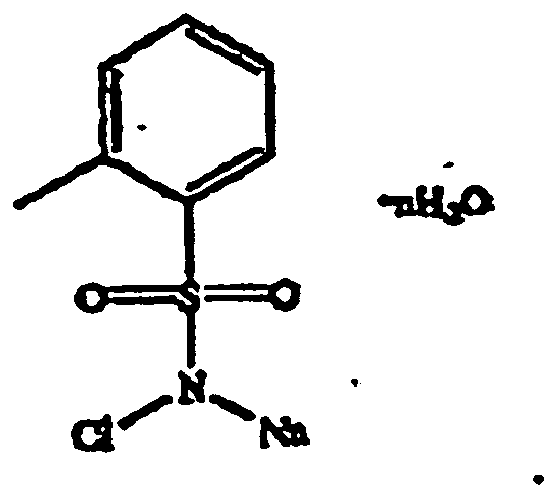
- halo aromatic sulfonamide compound tested is as follows:
- halo active aromatic sulfonamide compound tested is as follows:
- halo active aromatic sulfonamide compound tested is as follows:
- halo active aromatic sulfonamide compound tested is as follows:
- halo active aromatic sulfonamide compound tested is as follows:
- halo aromatic sulfonamide compound tested is as follows:
- halo active aromatic sulfonamide compound tested is as follows:
- halo active aromatic sulfonamide compound tested is as follows:
- halo active aromatic sulfonamide compound tested is as follows:
- halo active aromatic sulfonamide compound tested is as follows:
- halo active aromatic sulfonamide compound tested is as follows:
- halo active aromatic sulfonamide compound tested is as follows:
- Garbage disposal odor removal A used garbage disposal which was found to have residual unpleasant odor after water was continuously run through the disposal for 3 minutes. The garbage disposal was treated with 5 trigger pulls (approximately 4.3 g) of the following solution: Formulation w/w% N-chloro-4-carboxybenzenesulfonamide disodium salt 1% Avenal S-74 0.03% Sodium Bicarbonate 0.2% Fragrance 0.1% Water 98.7%
- a 6 person panel evaluated the odor immediately after application of the solution and found no objectionable odor remained. Water was run through the disposal for approximately 3 minutes and the odor was again evaluated by the panel which found no unpleasant odor.
- Dog odor Dog odor.
- a used dog bed (approx 30" diameter) containing disagreeable odor was sprayed with 10 trigger pulls (approx. 8.5 g) of the formulation.
- a 6 person panel determined that all disagreeable odor was immediately eliminated.
- the formulation utilized is as follows. Formulation w/w% N-chloro-4-carboxybenzenesulfonamide disodium salt 0.6% N-chloro-4-tolylsulfonamide sodium salt, aka Chloramine-T 0.3% Avenal S-74 0.03% Sodium Bicarbonate 0.2% t-Butanol 0.5% Fragrance 0.1% Water 98.3%
- Cat odor Used cat litter boxes (approx. 20".times.16”) all of which had an unpleasant odor were sprayed with 5 trigger pulls (approx. 4.3 g) of the formulation.
- the litter boxes were evaluated by a panel of 6 humans, after treatment the panel found that the unpleasant odors were eliminated.
- the formulation utilized is as follows: Formulation w/w% N-chloro-4-carboxybenzenesulfonamide disodium salt 0.6% N-chloro-4-tolylsulfonamide sodium salt, aka Chloramine-T 0.15% Avenal S-74 0.03% Sodium Bicarbonate 0.2% t-Butanol 0.5% Fragrance 0.1% Water 98.4%
- the formulation utilized is as follows: Formulation w/w% N-chloro-4-carboxybenzenesulfonamide disodium salt 0.6% N-chloro-4-tolylsulfonamide sodium salt, aka Chloramine-T 0.3% Avenal S-74 0.03% Sodium Bicarbonate 0.2% t-Butanol 2% Water 96.9%
- a base sulfonamide formulation was prepared in accordance with the following formulation: Formulation w/w% N-chloro-4-carboxybenzenesulfonamide disodium salt 1% Avenal S-74 0.03% Sodium Bicarbonate 0.2% t-Butanol 1% Water 97.8%
- the pH of 20 ml sample of the base formulation is 8.7.
- the temperature of the sample was raised to 50 degree. C. and the sample was allowed to stand for 30 days. At the end of this period it was found that 99.5% of the N-chloro-4-carboxybenzene sulfonamide disodium salt remained.
- Examples 1 to 3 demonstrate that sulfonamide compounds when used in accordance with this invention exhibit substantial odor control properties. As can be seen from the data of the Examples in all instances the various odors were mitigated to an acceptable level.
- Comparative Examples 10-17 demonstrate the effect of pH on , various sulfonamide formulations and the effect of the addition of various low molecular weight alcohols to the formulations.
Landscapes
- Health & Medical Sciences (AREA)
- Life Sciences & Earth Sciences (AREA)
- Chemical & Material Sciences (AREA)
- General Health & Medical Sciences (AREA)
- Environmental Sciences (AREA)
- Pharmacology & Pharmacy (AREA)
- Dentistry (AREA)
- Plant Pathology (AREA)
- Wood Science & Technology (AREA)
- Zoology (AREA)
- Pest Control & Pesticides (AREA)
- Agronomy & Crop Science (AREA)
- Medicinal Chemistry (AREA)
- Engineering & Computer Science (AREA)
- Epidemiology (AREA)
- Animal Behavior & Ethology (AREA)
- Public Health (AREA)
- Veterinary Medicine (AREA)
- Organic Chemistry (AREA)
- Inorganic Chemistry (AREA)
- Organic Low-Molecular-Weight Compounds And Preparation Thereof (AREA)
- Disinfection, Sterilisation Or Deodorisation Of Air (AREA)
- Agricultural Chemicals And Associated Chemicals (AREA)
Claims (23)
- Verfahren zum Bekämpfen von Gerüchen, die von einem Geruch verursachenden Material abgegeben werden, umfassend das Behandeln des Materials mit einer Lösung, die eine wirksame Menge einer halogenaktiven aromatischen Sulfonamidverbindung enthält, die aus der Gruppe ausgewählt ist, bestehend aus einer Verbindung mit der Formel:


- Verfahren nach Anspruch 1, wobei die Lösung ferner eine wirksame Menge eines Benetzungsmittels enthält, das im wesentlichen nicht mit der Sulfonamidverbindung reagiert.
- Verfahren nach Anspruch 1, wobei das Material ein Bestandteil ist, der aus der Gruppe ausgewählt ist, bestehend aus Schlamm von einer Papierfabrik oder von der Abwasserbehandlung.
- Verfahren nach Anspruch 2, wobei das Material Schlamm aus einer Kraftpapiermühle ist.
- Verfahren nach Anspruch 3, wobei das Material Schlamm aus einer Kraftpapiermühle ist.
- Verfahren nach Anspruch 1, wobei die Konzentration der Sulfonamidverbindung 0,5 bis 10 Gew.-% beträgt.
- Verfahren nach Anspruch 2, wobei die Konzentration der Sulfonamidverbindung 0,5 bis 10 Gew.-% beträgt.
- Verfahren nach Anspruch 3, wobei die Konzentration der Sulfonamidverbindung 0,5 bis 10 Gew.-% beträgt.
- Verfahren nach Anspruch 2, wobei das Benetzungsmittel ein anionisches oder nichtionisches Benetzungsmittel ist.
- Verfahren nach Anspruch 5, wobei das Benetzungsmittel ein anionisches oder nichtionisches Benetzungsmittel ist.
- Verfahren nach Anspruch 7, wobei das Benetzungsmittel AVANEL S-74 ist.
- Verfahren nach Anspruch 5, wobei das Benetzungsmittel ein anionisches Benetzungsmittel ist.
- Verfahren nach Anspruch 2, wobei die Lösung auf einen pH-Wert von 7 bis 10 gepuffert wird.
- Verfahren nach Anspruch 5, wobei die Lösung auf einen pH-Wert von 8 bis 9,5 gepuffert wird.
- Verfahren nach Anspruch 12, wobei die Lösung mit Natriumbicarbonat auf einen pH-Wert von 8,5 bis 9 gepuffert wird.
- Verfahren nach Anspruch 1, wobei die Lösung ferner eine wirksame Menge eines Alkohols mit geringem Molekulargewicht aufweist.
- Verfahren nach Anspruch 2, wobei die Lösung ferner eine wirksame Menge eines Alkohols mit geringem Molekulargewicht aufweist.
- Verfahren nach Anspruch 6, wobei die Lösung ferner eine wirksame Menge eines Alkohols mit geringem Molekulargewicht aufweist.
- Verfahren nach Anspruch 7, wobei die Lösung ferner eine wirksame Menge eines Alkohols mit geringem Molekulargewicht aufweist.
- Verfahren nach Anspruch 16 oder 17, wobei der pH-Wert der Lösung auf pH = 7 bis 10 gepuffert wird.
- Verfahren nach Anspruch 18 oder 19, wobei der pH-Wert der Lösung auf pH = 8 bis 9,5 gepuffert wird.
- Verfahren nach Anspruch 20, wobei der pH-Wert der Lösung auf pH = 8 bis 9,5 gepuffert wird.
- Verfahren nach einem der Ansprüche 16 bis 19, wobei der pH-Wert der Lösung auf einen pH-Wert von mehr als 10 gepuffert wird.
Applications Claiming Priority (2)
| Application Number | Priority Date | Filing Date | Title |
|---|---|---|---|
| US11/216,495 US7629492B2 (en) | 2002-02-19 | 2005-08-31 | Halo active aromatic sulfonamide organic compounds and odor control uses therefor |
| PCT/US2006/033248 WO2007027524A2 (en) | 2005-08-31 | 2006-08-25 | Halo active aromatic sulfonamide organic compounds and odor control uses therefor |
Publications (3)
| Publication Number | Publication Date |
|---|---|
| EP1940784A2 EP1940784A2 (de) | 2008-07-09 |
| EP1940784A4 EP1940784A4 (de) | 2010-09-22 |
| EP1940784B1 true EP1940784B1 (de) | 2013-09-18 |
Family
ID=37809385
Family Applications (1)
| Application Number | Title | Priority Date | Filing Date |
|---|---|---|---|
| EP06802339.9A Not-in-force EP1940784B1 (de) | 2005-08-31 | 2006-08-25 | Verwendung von halogenaktiven aromatischen Sulfonamidverbindungen zur Geruchsbekämpfung |
Country Status (3)
| Country | Link |
|---|---|
| US (2) | US7629492B2 (de) |
| EP (1) | EP1940784B1 (de) |
| WO (1) | WO2007027524A2 (de) |
Families Citing this family (15)
| Publication number | Priority date | Publication date | Assignee | Title |
|---|---|---|---|---|
| US7939055B2 (en) * | 2002-02-19 | 2011-05-10 | Schneider Charles A | Polymeric aromatic N-halo sulfonamides |
| US8759399B2 (en) | 2002-02-19 | 2014-06-24 | David J. Schneider | Halo active aromatic sulfonamide organic compounds and uses therefor |
| US9040587B2 (en) | 2002-02-19 | 2015-05-26 | David J. Schneider | Halo active aromatic sulfonamide organic compounds and uses therefor |
| US7513915B2 (en) * | 2002-11-22 | 2009-04-07 | Schneider Advanced Technologies, Inc. | Process for stain removal |
| US7824448B2 (en) | 2002-11-22 | 2010-11-02 | Schneider David J | Process for stain removal |
| CN106880866A (zh) * | 2009-02-24 | 2017-06-23 | 戴维·J·施奈德 | 控制气味的体液吸收部件 |
| US9987389B2 (en) | 2010-05-14 | 2018-06-05 | Rem Brands, Inc. | Articles with odor-controlling composition |
| WO2011143376A1 (en) * | 2010-05-14 | 2011-11-17 | Schneider David J | Low chlorine odor control compositions |
| US20120234849A1 (en) * | 2011-03-17 | 2012-09-20 | Stephanie Hughes | Waste container with odor control |
| WO2013176742A1 (en) * | 2012-05-24 | 2013-11-28 | Contact Marketing Solutions Innovative Technologies | Method for controlling odors associated with animal and plant byproducts |
| CN104288773A (zh) * | 2014-09-18 | 2015-01-21 | 张好勇 | 外用磺胺类药品的制备方法和外用磺胺类药品及其应用 |
| EP3256088B1 (de) * | 2015-02-09 | 2022-09-07 | Rem Brands, Inc. | Artikel mit geruchsbekämpfender zusammensetzung |
| US20230053770A1 (en) * | 2018-07-26 | 2023-02-23 | Rem Brands, Inc. | Animal litter and bedding |
| US20230056710A1 (en) * | 2018-07-26 | 2023-02-23 | Rem Brands, Inc. | Antimicrobial bedding product for pets and animals |
| US12344820B2 (en) * | 2019-12-30 | 2025-07-01 | Rem Brands, Inc. | Laundry detergent and fabric care compositions with sulfonamides for odor removal from fabrics |
Family Cites Families (8)
| Publication number | Priority date | Publication date | Assignee | Title |
|---|---|---|---|---|
| US2809937A (en) * | 1954-02-26 | 1957-10-15 | Colgate Palmolive Co | Germicidal detergent composition |
| JP3219698B2 (ja) * | 1996-09-06 | 2001-10-15 | クリーンケミカル株式会社 | 殺菌消毒液の製造方法 |
| US6296841B1 (en) * | 2000-01-04 | 2001-10-02 | H & S Chemical Co., Inc. | Odor control composition and process |
| JP4601191B2 (ja) * | 2001-03-13 | 2010-12-22 | エステー株式会社 | 固形ハロゲン剤組成物 |
| US7371368B2 (en) * | 2001-09-20 | 2008-05-13 | Schneider Advanced Technologies, Inc. | Odor control composition and process |
| US7465829B2 (en) * | 2002-02-19 | 2008-12-16 | Schneider Advanced Technologies, Inc. | Halo active aromatic sulfonamide organic compounds and uses therefor |
| US20040062742A1 (en) * | 2002-09-30 | 2004-04-01 | Winston Anthony E. | Deodorant product containing chlorinating agents and buffered alkaline salts |
| US7465823B2 (en) * | 2004-03-17 | 2008-12-16 | Celanese International Corporation | Utilization of acetic acid reaction heat in other process plants |
-
2005
- 2005-08-31 US US11/216,495 patent/US7629492B2/en not_active Expired - Lifetime
-
2006
- 2006-08-25 WO PCT/US2006/033248 patent/WO2007027524A2/en not_active Ceased
- 2006-08-25 EP EP06802339.9A patent/EP1940784B1/de not_active Not-in-force
-
2009
- 2009-10-28 US US12/607,188 patent/US8003823B2/en not_active Expired - Fee Related
Also Published As
| Publication number | Publication date |
|---|---|
| US8003823B2 (en) | 2011-08-23 |
| US20050287109A1 (en) | 2005-12-29 |
| US7629492B2 (en) | 2009-12-08 |
| EP1940784A4 (de) | 2010-09-22 |
| WO2007027524A2 (en) | 2007-03-08 |
| EP1940784A2 (de) | 2008-07-09 |
| US20100041761A1 (en) | 2010-02-18 |
| WO2007027524A3 (en) | 2007-09-13 |
Similar Documents
| Publication | Publication Date | Title |
|---|---|---|
| US8003823B2 (en) | Halo active aromatic sulfonamide organic compounds and odor control uses therefor | |
| US5403587A (en) | Disinfectant and sanitizing compositions based on essential oils | |
| EP2242518B1 (de) | Desodorisierende und desinfizierende zusammensetzungen | |
| US6743420B2 (en) | Odor control composition and process | |
| KR20080039833A (ko) | 생물 폐기물용 탈취 조성물 | |
| AU2019269525A1 (en) | An antimicrobial composition | |
| US6664254B1 (en) | Odor-eliminating composition | |
| US7465829B2 (en) | Halo active aromatic sulfonamide organic compounds and uses therefor | |
| JP2002154907A (ja) | 排水口用防虫除菌剤 | |
| US6667030B1 (en) | Odor control composition and process | |
| US7371368B2 (en) | Odor control composition and process | |
| EP1379286B1 (de) | Zusammensetzung und verfahren zur reduzierung von geruch und zur desinfektion | |
| US3978208A (en) | Deodorizing compositions | |
| EP1128852B1 (de) | Spray mit amphoterer zusammensetzung zur reduzierung von gerüchen | |
| JP2009292739A (ja) | 防臭剤 | |
| JP4669604B2 (ja) | 排水口用除菌剤 | |
| JP2002000711A (ja) | 消臭剤組成物 | |
| EP1922302B1 (de) | Biozide Verwendung von aktiven aromatischen Sulfonamid-Zusammensetzungen | |
| JPH053841B2 (de) | ||
| JPH07166200A (ja) | トイレ洗浄剤組成物 | |
| CA2355354A1 (fr) | Assainissement et desodorisation de l'air par brumisation | |
| JPH0232241B2 (ja) | Tennenseishodoku*satsukinzai | |
| JP2002154902A (ja) | 排水口用除菌剤 | |
| CA2627616A1 (en) | Formulation and method for treating animal waste | |
| JPH05310522A (ja) | 木酢酸液を主成分とする脱臭剤、殺菌剤および防かび剤 |
Legal Events
| Date | Code | Title | Description |
|---|---|---|---|
| PUAI | Public reference made under article 153(3) epc to a published international application that has entered the european phase |
Free format text: ORIGINAL CODE: 0009012 |
|
| 17P | Request for examination filed |
Effective date: 20080228 |
|
| AK | Designated contracting states |
Kind code of ref document: A2 Designated state(s): AT BE BG CH CY CZ DE DK EE ES FI FR GB GR HU IE IS IT LI LT LU LV MC NL PL PT RO SE SI SK TR |
|
| A4 | Supplementary search report drawn up and despatched |
Effective date: 20100823 |
|
| RIC1 | Information provided on ipc code assigned before grant |
Ipc: A01N 59/00 20060101ALN20100816BHEP Ipc: C07C 255/00 20060101ALI20100816BHEP Ipc: C02F 1/76 20060101ALI20100816BHEP Ipc: C07C 311/48 20060101ALN20100816BHEP Ipc: A61L 15/46 20060101ALI20100816BHEP Ipc: C07C 303/34 20060101AFI20080325BHEP |
|
| 17Q | First examination report despatched |
Effective date: 20110401 |
|
| DAX | Request for extension of the european patent (deleted) | ||
| GRAP | Despatch of communication of intention to grant a patent |
Free format text: ORIGINAL CODE: EPIDOSNIGR1 |
|
| RIC1 | Information provided on ipc code assigned before grant |
Ipc: C07C 311/48 20060101ALN20120808BHEP Ipc: A01N 41/06 20060101ALI20120808BHEP Ipc: A61K 31/63 20060101ALI20120808BHEP Ipc: C07C 303/34 20060101AFI20120808BHEP Ipc: C07C 255/00 20060101ALI20120808BHEP Ipc: C02F 1/76 20060101ALI20120808BHEP Ipc: A01N 59/00 20060101ALN20120808BHEP Ipc: A61K 31/18 20060101ALI20120808BHEP Ipc: A61L 15/46 20060101ALI20120808BHEP |
|
| RIC1 | Information provided on ipc code assigned before grant |
Ipc: C02F 1/76 20060101ALI20120822BHEP Ipc: A01N 59/00 20060101ALN20120822BHEP Ipc: A61K 31/18 20060101ALI20120822BHEP Ipc: C07C 311/48 20060101ALN20120822BHEP Ipc: C07C 303/34 20060101AFI20120822BHEP Ipc: A61L 15/46 20060101ALI20120822BHEP Ipc: A61K 31/63 20060101ALI20120822BHEP Ipc: C07C 255/00 20060101ALI20120822BHEP Ipc: A01N 41/06 20060101ALI20120822BHEP |
|
| GRAP | Despatch of communication of intention to grant a patent |
Free format text: ORIGINAL CODE: EPIDOSNIGR1 |
|
| RIC1 | Information provided on ipc code assigned before grant |
Ipc: A01N 41/06 20060101ALI20121212BHEP Ipc: A61K 31/63 20060101ALI20121212BHEP Ipc: A61L 15/46 20060101ALI20121212BHEP Ipc: C02F 1/76 20060101ALI20121212BHEP Ipc: C07C 255/00 20060101ALI20121212BHEP Ipc: A01N 59/00 20060101ALN20121212BHEP Ipc: C07C 303/34 20060101AFI20121212BHEP Ipc: A61K 31/18 20060101ALI20121212BHEP Ipc: C07C 311/48 20060101ALN20121212BHEP |
|
| GRAS | Grant fee paid |
Free format text: ORIGINAL CODE: EPIDOSNIGR3 |
|
| GRAA | (expected) grant |
Free format text: ORIGINAL CODE: 0009210 |
|
| AK | Designated contracting states |
Kind code of ref document: B1 Designated state(s): AT BE BG CH CY CZ DE DK EE ES FI FR GB GR HU IE IS IT LI LT LU LV MC NL PL PT RO SE SI SK TR |
|
| REG | Reference to a national code |
Ref country code: GB Ref legal event code: FG4D |
|
| REG | Reference to a national code |
Ref country code: CH Ref legal event code: EP |
|
| REG | Reference to a national code |
Ref country code: IE Ref legal event code: FG4D |
|
| REG | Reference to a national code |
Ref country code: AT Ref legal event code: REF Ref document number: 632689 Country of ref document: AT Kind code of ref document: T Effective date: 20131015 |
|
| REG | Reference to a national code |
Ref country code: DE Ref legal event code: R096 Ref document number: 602006038494 Country of ref document: DE Effective date: 20131114 |
|
| PG25 | Lapsed in a contracting state [announced via postgrant information from national office to epo] |
Ref country code: LT Free format text: LAPSE BECAUSE OF FAILURE TO SUBMIT A TRANSLATION OF THE DESCRIPTION OR TO PAY THE FEE WITHIN THE PRESCRIBED TIME-LIMIT Effective date: 20130918 Ref country code: SE Free format text: LAPSE BECAUSE OF FAILURE TO SUBMIT A TRANSLATION OF THE DESCRIPTION OR TO PAY THE FEE WITHIN THE PRESCRIBED TIME-LIMIT Effective date: 20130918 Ref country code: CY Free format text: LAPSE BECAUSE OF FAILURE TO SUBMIT A TRANSLATION OF THE DESCRIPTION OR TO PAY THE FEE WITHIN THE PRESCRIBED TIME-LIMIT Effective date: 20130626 |
|
| REG | Reference to a national code |
Ref country code: NL Ref legal event code: VDEP Effective date: 20130918 |
|
| REG | Reference to a national code |
Ref country code: AT Ref legal event code: MK05 Ref document number: 632689 Country of ref document: AT Kind code of ref document: T Effective date: 20130918 |
|
| REG | Reference to a national code |
Ref country code: LT Ref legal event code: MG4D |
|
| PG25 | Lapsed in a contracting state [announced via postgrant information from national office to epo] |
Ref country code: GR Free format text: LAPSE BECAUSE OF FAILURE TO SUBMIT A TRANSLATION OF THE DESCRIPTION OR TO PAY THE FEE WITHIN THE PRESCRIBED TIME-LIMIT Effective date: 20131219 Ref country code: LV Free format text: LAPSE BECAUSE OF FAILURE TO SUBMIT A TRANSLATION OF THE DESCRIPTION OR TO PAY THE FEE WITHIN THE PRESCRIBED TIME-LIMIT Effective date: 20130918 Ref country code: FI Free format text: LAPSE BECAUSE OF FAILURE TO SUBMIT A TRANSLATION OF THE DESCRIPTION OR TO PAY THE FEE WITHIN THE PRESCRIBED TIME-LIMIT Effective date: 20130918 Ref country code: SI Free format text: LAPSE BECAUSE OF FAILURE TO SUBMIT A TRANSLATION OF THE DESCRIPTION OR TO PAY THE FEE WITHIN THE PRESCRIBED TIME-LIMIT Effective date: 20130918 |
|
| PG25 | Lapsed in a contracting state [announced via postgrant information from national office to epo] |
Ref country code: BE Free format text: LAPSE BECAUSE OF FAILURE TO SUBMIT A TRANSLATION OF THE DESCRIPTION OR TO PAY THE FEE WITHIN THE PRESCRIBED TIME-LIMIT Effective date: 20130918 Ref country code: CY Free format text: LAPSE BECAUSE OF FAILURE TO SUBMIT A TRANSLATION OF THE DESCRIPTION OR TO PAY THE FEE WITHIN THE PRESCRIBED TIME-LIMIT Effective date: 20130918 |
|
| PG25 | Lapsed in a contracting state [announced via postgrant information from national office to epo] |
Ref country code: CZ Free format text: LAPSE BECAUSE OF FAILURE TO SUBMIT A TRANSLATION OF THE DESCRIPTION OR TO PAY THE FEE WITHIN THE PRESCRIBED TIME-LIMIT Effective date: 20130918 Ref country code: EE Free format text: LAPSE BECAUSE OF FAILURE TO SUBMIT A TRANSLATION OF THE DESCRIPTION OR TO PAY THE FEE WITHIN THE PRESCRIBED TIME-LIMIT Effective date: 20130918 Ref country code: RO Free format text: LAPSE BECAUSE OF FAILURE TO SUBMIT A TRANSLATION OF THE DESCRIPTION OR TO PAY THE FEE WITHIN THE PRESCRIBED TIME-LIMIT Effective date: 20130918 Ref country code: IS Free format text: LAPSE BECAUSE OF FAILURE TO SUBMIT A TRANSLATION OF THE DESCRIPTION OR TO PAY THE FEE WITHIN THE PRESCRIBED TIME-LIMIT Effective date: 20140118 Ref country code: SK Free format text: LAPSE BECAUSE OF FAILURE TO SUBMIT A TRANSLATION OF THE DESCRIPTION OR TO PAY THE FEE WITHIN THE PRESCRIBED TIME-LIMIT Effective date: 20130918 Ref country code: NL Free format text: LAPSE BECAUSE OF FAILURE TO SUBMIT A TRANSLATION OF THE DESCRIPTION OR TO PAY THE FEE WITHIN THE PRESCRIBED TIME-LIMIT Effective date: 20130918 |
|
| PG25 | Lapsed in a contracting state [announced via postgrant information from national office to epo] |
Ref country code: PL Free format text: LAPSE BECAUSE OF FAILURE TO SUBMIT A TRANSLATION OF THE DESCRIPTION OR TO PAY THE FEE WITHIN THE PRESCRIBED TIME-LIMIT Effective date: 20130918 Ref country code: AT Free format text: LAPSE BECAUSE OF FAILURE TO SUBMIT A TRANSLATION OF THE DESCRIPTION OR TO PAY THE FEE WITHIN THE PRESCRIBED TIME-LIMIT Effective date: 20130918 Ref country code: ES Free format text: LAPSE BECAUSE OF FAILURE TO SUBMIT A TRANSLATION OF THE DESCRIPTION OR TO PAY THE FEE WITHIN THE PRESCRIBED TIME-LIMIT Effective date: 20130918 |
|
| REG | Reference to a national code |
Ref country code: DE Ref legal event code: R097 Ref document number: 602006038494 Country of ref document: DE |
|
| PG25 | Lapsed in a contracting state [announced via postgrant information from national office to epo] |
Ref country code: PT Free format text: LAPSE BECAUSE OF FAILURE TO SUBMIT A TRANSLATION OF THE DESCRIPTION OR TO PAY THE FEE WITHIN THE PRESCRIBED TIME-LIMIT Effective date: 20140120 |
|
| PLBE | No opposition filed within time limit |
Free format text: ORIGINAL CODE: 0009261 |
|
| STAA | Information on the status of an ep patent application or granted ep patent |
Free format text: STATUS: NO OPPOSITION FILED WITHIN TIME LIMIT |
|
| 26N | No opposition filed |
Effective date: 20140619 |
|
| PG25 | Lapsed in a contracting state [announced via postgrant information from national office to epo] |
Ref country code: IT Free format text: LAPSE BECAUSE OF FAILURE TO SUBMIT A TRANSLATION OF THE DESCRIPTION OR TO PAY THE FEE WITHIN THE PRESCRIBED TIME-LIMIT Effective date: 20130918 |
|
| PG25 | Lapsed in a contracting state [announced via postgrant information from national office to epo] |
Ref country code: DK Free format text: LAPSE BECAUSE OF FAILURE TO SUBMIT A TRANSLATION OF THE DESCRIPTION OR TO PAY THE FEE WITHIN THE PRESCRIBED TIME-LIMIT Effective date: 20130918 |
|
| REG | Reference to a national code |
Ref country code: DE Ref legal event code: R097 Ref document number: 602006038494 Country of ref document: DE Effective date: 20140619 |
|
| PG25 | Lapsed in a contracting state [announced via postgrant information from national office to epo] |
Ref country code: LU Free format text: LAPSE BECAUSE OF FAILURE TO SUBMIT A TRANSLATION OF THE DESCRIPTION OR TO PAY THE FEE WITHIN THE PRESCRIBED TIME-LIMIT Effective date: 20140825 Ref country code: MC Free format text: LAPSE BECAUSE OF FAILURE TO SUBMIT A TRANSLATION OF THE DESCRIPTION OR TO PAY THE FEE WITHIN THE PRESCRIBED TIME-LIMIT Effective date: 20130918 |
|
| REG | Reference to a national code |
Ref country code: CH Ref legal event code: PL |
|
| PG25 | Lapsed in a contracting state [announced via postgrant information from national office to epo] |
Ref country code: LI Free format text: LAPSE BECAUSE OF NON-PAYMENT OF DUE FEES Effective date: 20140831 Ref country code: CH Free format text: LAPSE BECAUSE OF NON-PAYMENT OF DUE FEES Effective date: 20140831 |
|
| REG | Reference to a national code |
Ref country code: IE Ref legal event code: MM4A |
|
| PG25 | Lapsed in a contracting state [announced via postgrant information from national office to epo] |
Ref country code: IE Free format text: LAPSE BECAUSE OF NON-PAYMENT OF DUE FEES Effective date: 20140825 |
|
| PG25 | Lapsed in a contracting state [announced via postgrant information from national office to epo] |
Ref country code: BG Free format text: LAPSE BECAUSE OF FAILURE TO SUBMIT A TRANSLATION OF THE DESCRIPTION OR TO PAY THE FEE WITHIN THE PRESCRIBED TIME-LIMIT Effective date: 20130918 |
|
| REG | Reference to a national code |
Ref country code: FR Ref legal event code: PLFP Year of fee payment: 11 |
|
| PG25 | Lapsed in a contracting state [announced via postgrant information from national office to epo] |
Ref country code: TR Free format text: LAPSE BECAUSE OF FAILURE TO SUBMIT A TRANSLATION OF THE DESCRIPTION OR TO PAY THE FEE WITHIN THE PRESCRIBED TIME-LIMIT Effective date: 20130918 Ref country code: HU Free format text: LAPSE BECAUSE OF FAILURE TO SUBMIT A TRANSLATION OF THE DESCRIPTION OR TO PAY THE FEE WITHIN THE PRESCRIBED TIME-LIMIT; INVALID AB INITIO Effective date: 20060825 |
|
| REG | Reference to a national code |
Ref country code: FR Ref legal event code: PLFP Year of fee payment: 12 |
|
| REG | Reference to a national code |
Ref country code: FR Ref legal event code: PLFP Year of fee payment: 13 |
|
| P01 | Opt-out of the competence of the unified patent court (upc) registered |
Effective date: 20230522 |
|
| PGFP | Annual fee paid to national office [announced via postgrant information from national office to epo] |
Ref country code: GB Payment date: 20230712 Year of fee payment: 18 |
|
| PGFP | Annual fee paid to national office [announced via postgrant information from national office to epo] |
Ref country code: FR Payment date: 20230710 Year of fee payment: 18 Ref country code: DE Payment date: 20230711 Year of fee payment: 18 |
|
| REG | Reference to a national code |
Ref country code: DE Ref legal event code: R119 Ref document number: 602006038494 Country of ref document: DE |
|
| GBPC | Gb: european patent ceased through non-payment of renewal fee |
Effective date: 20240825 |
|
| PG25 | Lapsed in a contracting state [announced via postgrant information from national office to epo] |
Ref country code: DE Free format text: LAPSE BECAUSE OF NON-PAYMENT OF DUE FEES Effective date: 20250301 |
|
| PG25 | Lapsed in a contracting state [announced via postgrant information from national office to epo] |
Ref country code: GB Free format text: LAPSE BECAUSE OF NON-PAYMENT OF DUE FEES Effective date: 20240825 |
|
| PG25 | Lapsed in a contracting state [announced via postgrant information from national office to epo] |
Ref country code: FR Free format text: LAPSE BECAUSE OF NON-PAYMENT OF DUE FEES Effective date: 20240831 |