EP1941475B1 - Verfahren zur verarbeitung von beschleunigungsmessungen, beschleunigungsaufnehmer und mit derartigen aufnehmern ausgestattetes alarmsystem - Google Patents
Verfahren zur verarbeitung von beschleunigungsmessungen, beschleunigungsaufnehmer und mit derartigen aufnehmern ausgestattetes alarmsystem Download PDFInfo
- Publication number
- EP1941475B1 EP1941475B1 EP06830977A EP06830977A EP1941475B1 EP 1941475 B1 EP1941475 B1 EP 1941475B1 EP 06830977 A EP06830977 A EP 06830977A EP 06830977 A EP06830977 A EP 06830977A EP 1941475 B1 EP1941475 B1 EP 1941475B1
- Authority
- EP
- European Patent Office
- Prior art keywords
- value
- mode
- alarm
- acceleration measurements
- trigger
- Prior art date
- Legal status (The legal status is an assumption and is not a legal conclusion. Google has not performed a legal analysis and makes no representation as to the accuracy of the status listed.)
- Active
Links
Images

Classifications
-
- G—PHYSICS
- G01—MEASURING; TESTING
- G01P—MEASURING LINEAR OR ANGULAR SPEED, ACCELERATION, DECELERATION, OR SHOCK; INDICATING PRESENCE, ABSENCE, OR DIRECTION, OF MOVEMENT
- G01P15/00—Measuring acceleration; Measuring deceleration; Measuring shock, i.e. sudden change of acceleration
- G01P15/02—Measuring acceleration; Measuring deceleration; Measuring shock, i.e. sudden change of acceleration by making use of inertia forces using solid seismic masses
- G01P15/08—Measuring acceleration; Measuring deceleration; Measuring shock, i.e. sudden change of acceleration by making use of inertia forces using solid seismic masses with conversion into electric or magnetic values
- G01P15/0891—Measuring acceleration; Measuring deceleration; Measuring shock, i.e. sudden change of acceleration by making use of inertia forces using solid seismic masses with conversion into electric or magnetic values with indication of predetermined acceleration values
-
- G—PHYSICS
- G01—MEASURING; TESTING
- G01P—MEASURING LINEAR OR ANGULAR SPEED, ACCELERATION, DECELERATION, OR SHOCK; INDICATING PRESENCE, ABSENCE, OR DIRECTION, OF MOVEMENT
- G01P13/00—Indicating or recording presence, absence, or direction, of movement
-
- G—PHYSICS
- G01—MEASURING; TESTING
- G01P—MEASURING LINEAR OR ANGULAR SPEED, ACCELERATION, DECELERATION, OR SHOCK; INDICATING PRESENCE, ABSENCE, OR DIRECTION, OF MOVEMENT
- G01P15/00—Measuring acceleration; Measuring deceleration; Measuring shock, i.e. sudden change of acceleration
- G01P15/18—Measuring acceleration; Measuring deceleration; Measuring shock, i.e. sudden change of acceleration in two or more dimensions
-
- G—PHYSICS
- G08—SIGNALLING
- G08B—SIGNALLING SYSTEMS, e.g. PERSONAL CALLING SYSTEMS; ORDER TELEGRAPHS; ALARM SYSTEMS
- G08B13/00—Burglar, theft or intruder alarms
- G08B13/02—Mechanical actuation
- G08B13/08—Mechanical actuation by opening, e.g. of door, of window, of drawer, of shutter, of curtain, of blind
-
- G—PHYSICS
- G08—SIGNALLING
- G08B—SIGNALLING SYSTEMS, e.g. PERSONAL CALLING SYSTEMS; ORDER TELEGRAPHS; ALARM SYSTEMS
- G08B29/00—Checking or monitoring of signalling or alarm systems; Prevention or correction of operating errors, e.g. preventing unauthorised operation
- G08B29/18—Prevention or correction of operating errors
- G08B29/20—Calibration, including self-calibrating arrangements
- G08B29/24—Self-calibration, e.g. compensating for environmental drift or ageing of components
- G08B29/26—Self-calibration, e.g. compensating for environmental drift or ageing of components by updating and storing reference thresholds
Definitions
- the invention relates to a method for processing acceleration measurements delivered by an accelerometer, an accelerometric motion detection sensor implementing such a method and an alarm system equipped with such accelerometric sensors.
- An accelerometric sensor according to the invention is particularly but not exclusively intended to be integrated into an alarm system for the protection of movable objects (pictorial or sculptural works, valuable furniture, files, computer systems, household appliances, non-enclosed objects in a closed enclosure such as garden furniture, portable safes, ...) adapted to develop an alarm trigger signal responsive to any movement without authorization of the latter.
- He is known ( WO 01/37236 ), to equip objects whose protection is sought by sensors, called accelerometer sensors, equipped with accelerometers adapted to provide a signal representative of the acceleration of the object to which they are attached. It is also known to associate accelerometers, means for determining the frequency of the acceleration signal and to issue an alarm trigger signal if the signal frequency is representative of a movement resulting from an attempted theft of the signal. 'object.
- the frequency of a normal movement of a human is between 0.5Hz and 2Hz and can reach a maximum of 50 Hz.
- the alarm trigger signal is transmitted to a central unit connected to the sensor only if a frequency signal belongs to this frequency range, called human frequencies.
- the means for determining the frequency of the acceleration signal are replaced by means adapted to calculate the deviation of the amplitude of the acceleration signal from a threshold value.
- An alarm trigger signal is transmitted to the central unit if the amplitude of the acceleration exceeds this threshold value.
- the means for determining the frequencies of the acceleration signal comprise means for performing a spectral analysis of the acceleration signal, in particular by fast Fourier transform.
- the alarm trigger signal is then emitted when the signal frequency belongs to the above-mentioned range of human frequencies.
- the first solution is likely to trigger false alarm signals since a large amplitude value of the acceleration signal can come from a natural vibration phenomenon, such as a slamming door, vibrating floor, etc.
- the first solution is also likely not to detect slow movements, the latter may have small amplitudes below the threshold value.
- the second solution requires a large computing capacity, which implies the use of elaborate microprocessors. This important calculation requirement also induces a large energy consumption for the calculation of the signal spectrum.
- a sensor powered by electric batteries would require an over-frequent replacement of the latter to provide continuous protection, the battery life is at best a few months, given the relatively small volume required for such a sensor that must be discreet and must be able to be associated with various objects, including small sizes. For this reason, this solution is not used in practice.
- an accelerometer varies over time and depends on the environment in which it is installed.
- a known accelerometer sensor provides a response that depends on temperature, pressure, humidity, and other physical quantities and can not adapt to environmental conditions. Such a sensor is therefore little reliable for use in an alarm system.
- the object of the invention is thus to propose an accelerometric motion detection sensor and a method implemented in such a sensor, adapted to develop an alarm trigger signal in response to any displacement of the object on which it is applied. while optimizing energy management.
- the object of the invention is in particular to propose an accelerometric sensor having a sufficiently low power consumption to enable it to have a lifetime greater than 6 months, in particular of the order of one or more years, while it is powered by electric batteries of volume less than 250 cm 3 , typically of the order of 10 cm 3 .
- Such a sensor can thus be associated with objects of small sizes while providing durable protection.
- the invention also aims to provide a sensor capable of detecting unidirectional movements, as well as slow movements, particularly in the human frequency domain.
- the invention also aims to provide a motion detection sensor particularly suitable for the protection of movable objects.
- the invention also aims to provide a motion detection sensor that can be designed to be able to adapt autonomously to variations in environmental conditions by providing a constant response in terms of sensitivity and reliability.
- the invention also aims at providing a method for processing acceleration measurements delivered by an accelerometer making it possible to optimize resources and computational needs so as to save energy.
- the invention also aims at providing a method of processing the measurements provided by an accelerometer which improves the reliability with respect to false detections of movement.
- the invention also aims to propose a treatment method more particularly adapted to detect slow movements, especially in the field of human frequencies.
- a method according to the invention makes it possible to limit the computation and energy resource requirements by providing a first operating mode in which a state value is evaluated and compared with a threshold value, which, according to the result of this comparison, leads to either a standby Tk duration of the accelerometer, or a thorough analysis of acceleration measurements. Thorough analysis of acceleration measurements is only performed if a first test is verified. This test makes it possible in a simple and effective way to reject most situations that are clearly non-alarm situations, that is to say situations that are not representative of a displacement of the object on which the accelerometer is fixed. If first level analysis indicates a possible alarm situation, the method according to the invention enters a second mode of operation.
- the second mode of operation corresponds to an in-depth analysis mode because the sampling is finer, the average value of the time intervals T'k being less than the average value of the time intervals Tk.
- This alarm mode thus makes it possible to analyze more precisely than in the pre-alarm mode the acceleration measurements delivered by the accelerometer by sampling the acceleration signal which is finer than the sampling of the first operating mode, which makes it possible to confirm or invalidate the detection of a movement representative of an alarm triggering condition.
- said tripping value is calculated according to an odd function of at least a part of said acceleration measurements ⁇ ' k so as to render negligible said trigger values resulting of a vibratory phenomenon.
- An odd function is adapted to filter the high frequencies representative of a vibratory phenomenon. Any odd function of at least a part of the acceleration measurements ⁇ ' k can be used, in particular a Hanning function, a Blackman function, etc.
- said tripping value is calculated according to a polynomial function of at least a part of said acceleration measurements ⁇ ' k at odd powers so as to render negligible said trigger values resulting from a vibratory phenomenon.
- the pre-alarm mode makes it possible to evaluate the need to refine the analysis of the acceleration signal. Nevertheless, to limit the use of computational and energy resources, sampling of the pre-alarm mode is carried out without respecting Shannon Nyquist's criterion. This goes against the theory of information processing which states that a signal must be sampled at the frequency of Shannon Nyquist to lose no information. The inventors have discovered that this initial destructive sampling nevertheless makes it possible to perform a first sorting eliminating most of the situations that are not representative of a unidirectional displacement. Moreover, this first sorting remarkably limits the situations where the alarm mode is activated wrongly, that is to say where non-destructive sampling is carried out without final detection of a real unidirectional displacement.
- the period T is chosen in such a way that no unidirectional displacement situation is eliminated during this first sorting.
- the sampling is chosen so as not to lose any information of to precisely define whether the acceleration measurements delivered are representative or not of a unidirectional displacement.
- the sampling is then chosen so as to meet Shannon Nyquist's criterion. This two-level processing makes it easy and efficient to limit resource requirements and to ensure reliable detection of unidirectional movement.
- the detection of an alarm mode activation repeat leading to the same non-detection results of a one-way movement is indicative of a likely drift of the components used to deliver the acceleration measurements.
- the invention provides for this purpose representative value ranges of current situations and the possibility of switching to a calibration mode fms calibrate the components used to deliver the acceleration measurements if the measured trigger values indicate repeated untimely activations alarm mode without significant unidirectional movement.
- said state value, a function of at least a part of the acceleration measurements ⁇ k is defined by the absolute value of the sample ⁇ k .
- An accelerometric sensor thus provides means for detecting any displacement of a movement of the housing while limiting the use of computing and energy resources by the presence of two-level processing means and switching means of a level to another.
- the first module ensures that a state value is evaluated and compared with a threshold value, which according to the result of this comparison leads to a standby duration Tk of the accelerometer secured to the housing or to a thorough analysis acceleration measures. This test makes it possible in a simple and effective way to reject most situations that are clearly non-alarm situations, that is to say situations that are not representative of a displacement of the object on which the accelerometric sensor is fixed.
- the operating mode changing means activates the second module which ensures a thorough analysis of the measurements delivered by the accelerometer by a finer sampling, the average value of the intervals time T'k being less than the average value of time intervals Tk.
- a sensor according to the invention also comprises means for transmitting a signal representative of a detecting a motion if said trigger value is greater than said non-nominal displacement value.
- An accelerometric sensor thus ensures detection of any movement of the housing and is adapted to emit an alarm trigger signal if motion is detected.
- the transmission of the signal representative of the detection of a movement by the accelerometric sensor is done if said trigger value is greater than said non-nominal displacement value.
- This non-nominal displacement value can be evaluated and / or chosen differently according to the non-nominal displacements that it must make it possible to detect.
- This value must be representative of at least one non-nominal displacement for the considered use.
- this non-nominal displacement value can correspond to a given value of acceleration.
- a non-nominal displacement value is a set of predetermined values. The choice of these non-nominal displacement values thus makes it possible to parameterize a sensor according to the invention, for example by allowing certain movements and by prohibiting others.
- said means for calculating said alarm mode are adapted to calculate, at each instant, a trigger value according to a polynomial function of at least a part of the acceleration measurements ⁇ ' k at odd powers so as to render negligible said trigger values resulting from a vibratory phenomenon.
- a sensor according to the invention thus ensures integration of the acceleration measurements so as to obtain displacement measurements.
- the odd-power limitation ensures that the trip values are only representative of unidirectional displacements.
- a sensor according to the invention thus autonomously manages the drifts of these components related, in particular, to the environment.
- a sensor according to the invention comprises at least one sensor adapted to provide acceleration measurements in at least two directions.
- a sensor according to the invention comprises means for fixing the housing to a movable object so that any movement of said movable object causes the detection of a movement by said sensor.
- a sensor according to the invention thus makes it possible to protect any furniture object by attaching it to the latter, for example, by adhesive means, and by delivering an alarm triggering signal as soon as the movable object is moved.
- a sensor according to the invention is therefore particularly suitable for protecting pictorial or sculptural works, valuable furniture, files, computer systems, appliances, objects not enclosed in a closed enclosure such as garden furniture, portable safes, ...)
- the invention further relates to a method of processing acceleration measurements provided by an accelerometer, an accelerometer sensor for motion detection, and an alarm system comprising such sensors, characterized in combination by all or some of the features mentioned herein. above or below.
- an accelerometric sensor 1 comprising an accelerometer 2 capable of providing instantaneous acceleration measurements on two directions is used. x and there orthogonal.
- a method according to the invention aims to obtain from the acceleration measurements provided by the accelerometer associated with the sensor 1, information on the unidirectional displacement of said sensor 1 while limiting its computational and energy resource requirements.
- pre-alarm mode In a first mode of operation, called pre-alarm mode, at each instant k , the acceleration signal on each of the axes x and there defined by a sequence of instantaneous acceleration measurements is sampled according to a period of time T , which makes it possible to store, respectively, pluralities of samples ⁇ k and ⁇ k , representative of the acceleration measurements on the respective axes x and there .
- T a period of time
- a value m k said state value is calculated according to a function of the samples ⁇ k and compared to a threshold value.
- the state value m k is then a function of the samples x k . This value m k is compared with a threshold value ⁇ x predetermined.
- m k is a function of the samples x k . The form of m k must be chosen such that m k offers a good compromise between the computational cost and the discriminating capacity between a probable unidirectional displacement situation and a non-alert situation.
- the method goes into a second mode of operation, called alarm mode. This mode is likely to lead to the detection of an alarm condition. Otherwise, the method remains in the pre-alarm mode and the accelerometer can be put on standby until the moment k + 1, which saves the energy sources useful for the implementation of the process.
- the period T ' is advantageously chosen in such a way that it meets the Shannon Nyquist criterion.
- the sampling frequency of the alert mode is set at 100 Hz.
- this frequency Sampling may take other values.
- the period T ' may not respect the Shannon Nyquist criterion, by providing that the alarm mode comprises different sub-modes, each sub-mode being adapted to perform, like the pre-alarm mode, a test conditioning the transition to the next alarm sub-mode if the refined situation analysis still indicates a probable alarm condition.
- Each sub-mode samples the signal at a finer period, without necessarily meeting the Shannon Nyquist criterion.
- this triggering value A x is a polynomial function of the x ' k , at odd powers. This makes it possible to make A x negligible if the samples x ' k are representative of a vibratory phenomenon.
- the method then associates with this triggering value, an order or not for triggering an alarm signal.
- the triggering value A x is compared with a value S , the so-called non-nominal displacement value, predetermined by experience. If A x > S , then, the samples at the origin A x are representative of a unidirectional movement, which causes the emission of an alarm trigger signal.
- the method uses a plurality of non-nominal levels S i , for example with i ⁇ [0.9]. These predetermined levels are determined by experience and make it possible to adapt the level of alarm triggering to the type of environment to which the accelerometer is subjected.
- S 0 and S 1 correspond to non-significant trigger values
- S 2 corresponds to a stable environment without any vibration
- S 3 corresponds to a weakly vibratory environment, such as an area located in the vicinity of a railroad track, etc.
- the method evaluates in which interval [ S i , S i + 1 ] is the triggering value A x , and responds by transmitting an alarm trigger signal if the sensitivity threshold chosen is less than S i .
- a sensor implementing the method of the invention then comprises means for choosing the trigger level adapted to the type of object with which it is associated or according to another embodiment transmits to an associated central unit the non-nominal level i of the interval comprising the triggering value A x .
- An associated CPU then includes programmable means for determining whether it should actually activate the alarm for the received level. This allows in particular to have several sensors, each of which can be according to the object on which it is fixed, set to a clean level.
- the levels S 0 and S 1 make it possible to self-calibrate a sensor implementing a method according to the invention.
- These levels define so-called drift intervals. For example, if for a given number d 0 of consecutive instants, the triggering value A x belongs to the drift interval S 0 , this indicates that the method inadvertently goes from the pre-alarm mode to the alarm, resulting in, in particular, unnecessary consumption of system energy.
- the method then provides for a self-calibration of the system making it possible to readjust the threshold ⁇ x and the level R ⁇ so as to limit the unwanted passages in alarm mode.
- the values ⁇ x and ⁇ are also updated if for a given number of consecutive times the value of A trigger x belongs to the non-nominal S 0 or S range 1 and this by a statistical calculation.
- a method according to the invention thus makes it possible to develop a trigger signal in response to the detection of any unidirectional displacement of an accelerometric sensor according to the invention provided with an accelerometer.
- a method according to the invention also makes it possible to self-calibrate an accelerometric sensor according to the invention and thus makes it possible to overcome the inherent drifts related in particular to climatic changes.
- a method according to the invention also makes it possible to limit the false detections while limiting the computational load, and therefore the energy required.
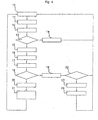
- the figure 4 is a schematic representation of the succession of steps implemented in a method according to the invention.
- step 10 the samples ⁇ k delivered by an accelerometer 2 are stored.
- step 11 the values x k are calculated.
- step 12 the state value m k is calculated.
- step 13 the state value m k is compared with the threshold value ⁇ x . If the threshold value ⁇ x is greater than the state value m k , a variable, called a flag, is set to zero in step 14. If the state value m k is greater than or equal to the threshold value ⁇ x , the samples ⁇ ' k are stored in step 15.
- step 16 the values x' k are calculated.
- step 17 the triggering value A x is calculated.
- step 18 the triggering value A x is compared with the predetermined values S i .
- step 22 the flag value is compared to a predetermined value d 0 . If d 0 is greater than said flag value, return to step 10. If the flag value is greater than d 0 , the value R ⁇ is calculated in step 23 and the threshold value ⁇ x is calculated at step 24 and return to step 10.
- step 21 If the value i is greater than 2, then the flag value is set to zero in step 20. The level i alarm is then triggered in step 21.
- An alarm trigger signal is issued if at least one trigger value A x or A y along one of the two axes belongs to an interval S i , and i greater than 2.
- the figure 1 is a schematic representation of an embodiment of a sensor according to the invention.
- the sensor 1 comprises a housing 3 on the inner wall of which an accelerometer 2 is attached.
- This accelerometer 2 can be a known accelerometer, for example of the integrated circuit type such as the ADXL 311 or ADXL 322 accelerometer sold by the company ANALOG DEVICES ( NORWOOD, USA).
- the housing 3 may be made by any means known per se and adapted to be integral with the accelerometer 2. That is to say that the housing must comprise at least a rigid portion on which can be fixed the accelerometer 2.
- the fixation of the accelerometer on the rigid part of the housing 3 can be achieved by adhesive means, by fastening means such as a screw / nut, rivet, or any other means adapted to maintain two rigid devices integral with one another. to the other.
- the housing 3 can be made of a rigid plastic material, metal, wood, etc.
- the housing 3 is advantageously made of a resistant material which does not absorb vibrations so that the housing 3 transmits to the accelerometer 2, integral with the housing 3, all the constraints it undergoes.
- the housing 3 is closed and encloses the accelerometer inside the housing 3.
- the sensor 1 also comprises means for processing the acceleration measurements provided by the accelerometer making it possible to detect unidirectional displacement.
- these processing means are digital.
- these means are analog, or a combination of digital and analog means. They comprise for example at least one microprocessor, at least one memory and at least one clock.
- the processing means comprise a first module, said pre-alarm module 4, corresponding to the pre-alarm mode, a second module, said alarm module corresponding to the alarm mode and a third module module, said calibration module 6 corresponding to the calibration mode.
- These modules are associated with a single memory or each with a dedicated memory. They can all be brought together in the same component (integrated circuit).
- the acceleration measurements are stored in a maneuvering memory, or in a volatile memory, or in a random access memory, or in a dynamic memory, or in a buffer memory or in an external memory, before to be processed and analyzed by the means of treatment.
- a module here and throughout the text, means a hardware element, or a subset of a software program, that can be compiled separately, either for independent use or to be assembled with other modules of a program, or a combination of a hardware element and a software subprogram.
- Each of the modules may comprise a dedicated microprocessor or a microprocessor common to all the modules.
- a particularly advantageous embodiment of the invention provides a single microprocessor, a single memory and a single program integrating the pre-alarm module 4, the alarm module 5 and the calibration module 6. The transition from one mode of operation to another is carried out for example by the modification of a field recorded at a predetermined memory address which regularly scrutinize the various modules concerned. Any other means of interacting with each other different software modules is also adapted to ensure the activation of each of the modules of a sensor according to the invention.
- the sensor 1 also comprises means for transmitting a signal representative of a detection of a movement.
- These means are preferably associated with the alarm module and may comprise at least one antenna adapted to transmit radio frequency signals to an alarm system central unit or may comprise own means for transmitting radio signals. alarm as an integrated siren or transmission of a message to a mobile phone, including the GSM type.
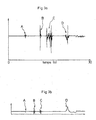
- the figure 3a presents an acceleration signal recorded by an accelerometric sensor according to the invention applied to an initially closed door.
- the signal has different distinct peaks corresponding to different actions performed on the door.
- Event A is three hits on the door.
- Event B is a knee kick in the door.
- Event C corresponds to the operation of the door handle without opening the door.
- Event D corresponds to the opening of the door.
- the figure 3b presents the variation over time of the values A x evaluated by the acceleration measurement processing means with a view to producing an alarm trigger signal. It follows that only the effective opening of the door generates successive values of A x exceeding a certain threshold.
- the choice of alarm levels S i , or non-nominal levels, thus allows the sensor to be adjusted to its specific use and ensures good discrimination between a door opening and a simple knee in the latter.
- An accelerometric sensor according to the invention is particularly adapted to the protection of movable objects, whatever the climatic, seismic and environmental conditions in which they are arranged.
- a sensor according to the invention is also particularly well suited to ensure efficient detection over time of any unidirectional movement.
- an accelerometer sensor according to the invention has, in normal use, a lifetime of more than one year.
- a sensor according to the invention is therefore particularly well suited to equip a museum, a second home or any building that can remain long without direct supervision.
- An accelerometric sensor is advantageously used in an alarm system according to the invention.
- An alarm system according to the invention comprises an alarm module adapted to control the emission of alarm signals by at least one device for transmitting alarm signals.
- the term "alarm signal-emitting device” is understood to mean any device adapted to make a striking occurrence of an alarm condition remarkable so as to attract attention.
- the alarm signal sending device may be an alarm siren adapted to emit a sound signal. Alternatively or in combination, it may be a beacon adapted to emit an alternating light signal. As a variant or in combination, it may be a portable telephone, in particular of the GSM type, adapted to receive a text message. Alternatively or in combination, it may be a computer connected to the Internet, a central office, etc.
Landscapes
- Physics & Mathematics (AREA)
- General Physics & Mathematics (AREA)
- Engineering & Computer Science (AREA)
- Computer Security & Cryptography (AREA)
- Emergency Alarm Devices (AREA)
- Air Bags (AREA)
Claims (12)
- Verfahren zur Verarbeitung von sofortigen, von einem Beschleunigungsmesser (2) gelieferten Beschleunigungsmessungen gemäß wenigstens einer Richtung zwecks Feststellung einer Auslösebedingung eines Alarmsignals, bei dem:- in einem ersten, als Modus vor dem Alarm bezeichneten Betriebsmodus Beschleunigungsmessungen γk im Anschluss an vorbestimmte Zeitintervalle Tk durchgeführt werden,- in jedem Moment wenigstens ein als Zustandswert bezeichneter Wert gemäß einer Funktion von wenigstens einem Teil der Beschleunigungsmessungen γk berechnet wird,- jeder Zustandswert mit einem Schwellenwert verglichen wird,dadurch gekennzeichnet, dass, wenn der genannte Zustandswert höher als der genannte Schwellenwert ist, ein zweiter, als Alarmmodus bezeichneter, vom ersten Betriebsmodus unterschiedlicher Betriebsmodus aktiviert wird, in dem:- Beschleunigungsmessungen γk' im Anschluss an vorbestimmte Zeitintervalle T'K realisiert werden, wobei der durchschnittliche Wert der Zeitintervalle T'k niedriger ist als der durchschnittliche Wert der Zeitintervalle Tk,- in jedem Moment wenigstens ein als Auslösewert bezeichneter Wert gemäß einer ungeraden Funktion wenigstens eines Teils der genannten Beschleunigungsmessungen γ'k berechnet wird,- der genannte Auslösewert mit wenigstens einem vorbestimmten, als nicht nominaler Verschiebungswert bezeichneten Wert verglichen wird,- wenn der genannte Auslösewert größer ist als der genannte nicht nominale Verschiebungswert, eine A-larmauslösebedingung überprüft wird.
- Verfahren gemäß Anspruch 1, dadurch gekennzeichnet, dass in dem Alarmmodus in jedem Moment der genannte Auslösewert gemäß einer Polynomfunktion wenigstens eines Teils der genannten Beschleunigungsmessungen γ'k mit ungeraden Potenzen derart berechnet wird, dass die genannten, aus einem Vibrationsphänomen resultierenden Auslösewerte vernachlässigbar werden.
- Verfahren gemäß Anspruch 1 oder 2, dadurch gekennzeichnet, dass:- die Perioden der Probennahme Tk des Modus vor dem Alarm als in der Zeit konstant mit dem Wert T gewählt werden, wobei der genannte Wert T nicht das Kriterium nach Shannon Nyquist einhält,- die Perioden der Probennahme T'k des Alarmmodus als in der Zeit konstant mit dem Wert T' gewählt werden, wobei der genannte Wert T' niedriger ist als T und das Kriterium nach Shannon Nyquist einhält.
- Verfahren gemäß Anspruch 1 bis 3, dadurch gekennzeichnet, dass, wenn im Alarmmodus die genannten berechneten Auslösewerte für eine bestimmte Anzahl von konsekutiven Momenten zu den vorbestimmten Intervallen von Werten gehören, die als Driftintervalle bezeichnet werden, ein dritter Betriebsmodus aktiviert wird, in dem:- das Mittel der Proben γ'k der genannten Beschleunigungsmittel des genannten Alarmmodus auf eine bestimmte, als Kalibrierungsmittel bezeichnete Zeitperiode berechnet wird,- ein neuer Schwellenwert des genannten ersten Betriebsmodus ausgehend von diesem Kalibrierungsmittel eingeschätzt wird,- der erste Betriebsmodus wieder aktiviert wird.
- Verfahren gemäß Anspruch 1 bis 4, dadurch gekennzeichnet, dass in dem genannten Modus vor dem Alarm der genannte Zustandswert als Funktion von wenigstens einem Teil der Beschleunigungsmessungen γk durch den absoluten Wert der Probe γk definiert wird.
- Messfühler der Bewegung, der Folgendes umfasst:- ein Gehäuse (3),- wenigstens einen Beschleunigungsmesser (2), der fest mit dem Gehäuse (1) verbunden ist und angepasst ist, um sofortige Beschleunigungsmessungen gemäß wenigstens einer Richtung zu liefern,- Anschlussmittel des Sensors an eine elektrische Energiequelle,- Verarbeitungsmittel der von wenigstens einem Beschleunigungsmesser (2) ausgegebenen Beschleunigungsmessungen mit einem ersten Modul (4), das einem ersten, als Modus vor dem Alarm bezeichneten Betriebsmodus entspricht und Folgendes umfasst:- Registrierungsmittel einer Vielzahl von Proben γk der sofortigen Beschleunigungsmessungen, die im Anschluss an vorbestimmte Zeitintervalle TK vorgenommen worden sind,- Berechnungsmittel in jedem Moment wenigstens eines als Zustandswert bezeichneten Wertes gemäß einer Funktion von wenigstens einem Teil der Beschleunigungsmessungen γk,- Vergleichsmittel in jedem Moment des genannten Zustandswertes mit einem Schwellenwert,dadurch gekennzeichnet, dass die Verarbeitungsmittel Folgendes umfassen:- ein zweites Modul (5), das einem zweiten, als Alarmmodus bezeichneten Betriebsmodus entspricht und Folgendes umfasst:- Registrierungsmittel einer Vielzahl von Mustern γ'k der Beschleunigungsmessungen, die im Anschluss an vorbestimmte Zeitintervalle T'k erfolgt sind, wobei der durchschnittliche Wert der T'k niedriger ist als der durchschnittliche Wert der Tk,- Berechnungsmittel in jedem Moment wenigstens eines als Auslösewert bezeichneten Wertes gemäß einer Polynomfunktion wenigstens eines Teils der Beschleunigungsmessungen γ'k mit ungleichen Potenzen,- Vergleichsmittel in jedem Moment des genannten Auslösewertes mit einem als nicht nominaler Verschiebungswert bezeichneten vorbestimmten Wert,- Änderungsmittel des Betriebsmodus, die angepasst sind, um von dem genannten Modus vor dem Alarm in den genannten Alarmmodus überzugehen, wenn der genannte Zustandswert zu einem bestimmten Moment höher ist als der genannte Schwellenwert.
- Sensor gemäß Anspruch 6, dadurch gekennzeichnet, dass er Ausgabemittel eines Signals umfasst, dass eine Feststellung einer Bewegung darstellt, wenn der genannte Auslösewert größer ist als der genannte nicht nominale Wert.
- Sensor gemäß Anspruch 6 oder 7, dadurch gekennzeichnet, dass die Verarbeitungsmittel ein drittes Modul (6) umfassen, das einem dritten, als Kalibrierungsmodus bezeichneten Betriebsmodus entsprechen und Folgendes umfasst:- Berechnungsmittel in jedem Moment des Mittels der Proben γ'k der genannten Beschleunigungsmessungen des genannten Alarmmodus, bezeichnet als Kalibrierungsdurchschnitt, über eine bestimmte Zeitperiode,- Zuteilungsmittel dieses Mittels zu dem genannten Schwellenwert.
- Sensor gemäß Anspruch 8, dadurch gekennzeichnet, dass die genannten Änderungsmittel des Betriebsmodus angepasst, um:- vom Alarmmodus zum Kalibrierungsmodus überzugehen, wenn die genannten Auslösewerte bei einer bestimmten Anzahl von Momenten zu vorbestimmten Intervallen von als Driftintervalle bezeichneten Intervallen gehören,- vom Kalibrierungsmodus in den Modus vor dem Alarm überzugehen, wenn die Zuteilungsmittel dem genannten Schwellenwert das genannte Kalibrierungsmittel zugeteilt haben.
- Sensor gemäß Anspruch 6 bis 9, dadurch gekennzeichnet, dass er wenigstens einen Beschleunigungsmesser (2) umfasst, der angepasst ist, um Beschleunigungsmessungen gemäß wenigstens zwei Richtungen zu liefern.
- Sensor gemäß Anspruch 6 bis 10, dadurch gekennzeichnet, dass er Mittel umfasst, um das Gehäuse (3) an einem mobilen Objekt derart zu befestigen, dass jede Verschiebung des genannten mobilen Objekts die Feststellung einer Bewegung durch den genannten Sensor nach sich ziehen kann.
- Alarmsystem, das Folgendes umfasst:- wenigstens einen Sensor (1) zur Feststellung der Bewegung gemäß Anspruch 6 bis 11,- eine Ausgabevorrichtung von Alarmsignalen,- ein Alarmauslösemodul, das angepasst ist, um die Ausgabe von Alarmsignalen durch wenigstens die Ausgabevorrichtung von Alarmsignalen zu steuern, wenn wenigstens ein Feststellungssensor der Bewegung ein Signal ausgibt, das eine Feststellung der Bewegung darstellt.
Applications Claiming Priority (2)
| Application Number | Priority Date | Filing Date | Title |
|---|---|---|---|
| FR0510869A FR2892517B1 (fr) | 2005-10-25 | 2005-10-25 | Procede de traitement des mesures d'acceleration delivrees par un accelerometre, capteur accelerometrique et systeme d'alarme equipe de tels capteurs. |
| PCT/FR2006/002359 WO2007048908A1 (fr) | 2005-10-25 | 2006-10-20 | Procede de traitement des mesures d'acceleration delivrees par un accelerometre, capteur accelerometrique et systeme d'alarme equipe de tels capteurs |
Publications (2)
| Publication Number | Publication Date |
|---|---|
| EP1941475A1 EP1941475A1 (de) | 2008-07-09 |
| EP1941475B1 true EP1941475B1 (de) | 2009-03-11 |
Family
ID=36603600
Family Applications (1)
| Application Number | Title | Priority Date | Filing Date |
|---|---|---|---|
| EP06830977A Active EP1941475B1 (de) | 2005-10-25 | 2006-10-20 | Verfahren zur verarbeitung von beschleunigungsmessungen, beschleunigungsaufnehmer und mit derartigen aufnehmern ausgestattetes alarmsystem |
Country Status (5)
| Country | Link |
|---|---|
| EP (1) | EP1941475B1 (de) |
| AT (1) | ATE425521T1 (de) |
| DE (1) | DE602006005702D1 (de) |
| FR (1) | FR2892517B1 (de) |
| WO (1) | WO2007048908A1 (de) |
Cited By (1)
| Publication number | Priority date | Publication date | Assignee | Title |
|---|---|---|---|---|
| US20170358182A1 (en) * | 2014-12-30 | 2017-12-14 | Myseat Sas | Apparatus and system for detecting equipment occupancy |
Families Citing this family (9)
| Publication number | Priority date | Publication date | Assignee | Title |
|---|---|---|---|---|
| US10114034B2 (en) * | 2011-01-10 | 2018-10-30 | Ingersoll-Rand Company | Door lock including sensor |
| FR3008798B1 (fr) | 2013-07-17 | 2015-09-04 | Myfox | Dispositif domotique de suivi du deplacement d'un battant pivotant et procede de fiabilisation d'un tel dispositif |
| FR3022636B1 (fr) * | 2014-06-20 | 2017-12-01 | Myfox | Dispositif domotique et procede economes en energie de suivi du deplacement d'un objet surveille |
| FR3022670B1 (fr) * | 2014-06-20 | 2016-07-01 | Myfox | Dispositif domotique de detection du deplacement d'un objet a initialisation autonome |
| US10006929B2 (en) | 2014-10-28 | 2018-06-26 | Koninklijke Philips N.V. | Method and apparatus for reliable detection of opening and closing events |
| US9576469B2 (en) * | 2014-12-30 | 2017-02-21 | Google Inc. | Systems and methods of adaptively adjusting a sensor of a security system |
| US9451060B1 (en) | 2015-10-15 | 2016-09-20 | Civiq Smartscapes, Llc | Techniques and apparatus for controlling access to components of a personal communication structure (PCS) |
| US10270918B2 (en) | 2015-10-15 | 2019-04-23 | Civiq Smartscapes, Llc | Method and apparatus for power and temperature control of compartments within a personal communication structure (PCS) |
| WO2017087496A1 (en) * | 2015-11-16 | 2017-05-26 | Civiq Smartscapes, Llc | Systems and techniques for vandalism detection in a personal communication structure (pcs) |
Family Cites Families (2)
| Publication number | Priority date | Publication date | Assignee | Title |
|---|---|---|---|---|
| US5870022A (en) * | 1997-09-30 | 1999-02-09 | Interactive Technologies, Inc. | Passive infrared detection system and method with adaptive threshold and adaptive sampling |
| WO2001037236A1 (en) * | 1999-11-11 | 2001-05-25 | Caveo Technology, Llc | Theft detection system and method |
-
2005
- 2005-10-25 FR FR0510869A patent/FR2892517B1/fr not_active Expired - Fee Related
-
2006
- 2006-10-20 DE DE602006005702T patent/DE602006005702D1/de active Active
- 2006-10-20 WO PCT/FR2006/002359 patent/WO2007048908A1/fr not_active Ceased
- 2006-10-20 EP EP06830977A patent/EP1941475B1/de active Active
- 2006-10-20 AT AT06830977T patent/ATE425521T1/de not_active IP Right Cessation
Cited By (2)
| Publication number | Priority date | Publication date | Assignee | Title |
|---|---|---|---|---|
| US20170358182A1 (en) * | 2014-12-30 | 2017-12-14 | Myseat Sas | Apparatus and system for detecting equipment occupancy |
| US10373448B2 (en) * | 2014-12-30 | 2019-08-06 | Myseat Sas | Apparatus and system for detecting equipment occupancy |
Also Published As
| Publication number | Publication date |
|---|---|
| DE602006005702D1 (de) | 2009-04-23 |
| FR2892517B1 (fr) | 2008-01-04 |
| FR2892517A1 (fr) | 2007-04-27 |
| EP1941475A1 (de) | 2008-07-09 |
| WO2007048908A1 (fr) | 2007-05-03 |
| ATE425521T1 (de) | 2009-03-15 |
Similar Documents
| Publication | Publication Date | Title |
|---|---|---|
| EP1941475B1 (de) | Verfahren zur verarbeitung von beschleunigungsmessungen, beschleunigungsaufnehmer und mit derartigen aufnehmern ausgestattetes alarmsystem | |
| FR2722462A1 (fr) | Procede de surveillance de l'interieur d'un vehicule automobile | |
| KR102422161B1 (ko) | 다중 스펙트럼 센서 기반 비상 상태 감지기 | |
| WO2009081018A1 (fr) | Installation de detection de personnes dans un espace delimite | |
| US20160203689A1 (en) | Object Displacement Detector | |
| EP2229665A1 (de) | Verfahren und vorrichtung zum detektieren einer kritischen situation eines subjekts | |
| FR3035510A1 (fr) | Moyen acoustique de detection, de localisation et d'evaluation automatique d'impacts subis par une structure | |
| EP3158343B1 (de) | Energieeffiziente domotikvorrichtung und verfahren zur verfolgung der bewegung eines zu überwachenden objekts | |
| FR3028343A1 (fr) | Procede de detection de chute d'un sujet humain et dispositif actimetrique correspondant | |
| FR2880719A1 (fr) | Systeme de detection et procede permettant de determiner un etat d'alarme dans celui-ci | |
| US7634387B2 (en) | Frequency envelope detection method for signal analysis | |
| FR2687240A1 (fr) | Dispositif de protection detectant la sollicitation du mecanisme d'une fermeture (serrure, verrou) et generant un signal d'information, d'alerte ou d'alarme. | |
| EP3528224B1 (de) | Vorrichtung und verfahren zur präsenz- und/oder bewegungserkennung durch infrarot-messung | |
| EP0345181A1 (de) | Detektions- und Stosswiedererkennungsverfahren und -vorrichtung durch Impedanzänderungsmessung | |
| FR2831673A1 (fr) | Dispositif de detection de passage | |
| EP3343783A1 (de) | Elektronischer detektionsschaltkreis für verglasung | |
| EP4575587B1 (de) | Verfahren und vorrichtung zur erkennung von erdbeben | |
| FR3116336A1 (fr) | Procédé de traitement d’un signal de mesure pour obtenir une signature et dispositif de mesure associé | |
| EP0772851B1 (de) | Feueralarmvorrichtung mit analogem sensor | |
| FR2892549A1 (fr) | Systeme d'alarme, unite centrale de systeme d'alarme et procede de protection d'une telle unite centrale | |
| EP3649627B1 (de) | Verfahren und vorrichtung zur detektion des eindringens | |
| Saha | On magnitude limits for point source detections | |
| EP0179681A1 (de) | Raumschutzvorrichtung | |
| FR2969800A1 (fr) | Procede et systeme de construction d'un graphe representant un batiment | |
| WO1996027862A1 (fr) | Procede de detection de bruits et dispositif acoustique de detection d'intrusion |
Legal Events
| Date | Code | Title | Description |
|---|---|---|---|
| PUAI | Public reference made under article 153(3) epc to a published international application that has entered the european phase |
Free format text: ORIGINAL CODE: 0009012 |
|
| 17P | Request for examination filed |
Effective date: 20080328 |
|
| AK | Designated contracting states |
Kind code of ref document: A1 Designated state(s): AT BE BG CH CY CZ DE DK EE ES FI FR GB GR HU IE IS IT LI LT LU LV MC NL PL PT RO SE SI SK TR |
|
| RTI1 | Title (correction) |
Free format text: METHOD FOR PROCESSING ACCELERATION MEASUREMENTS, ACCELERATION SENSOR AND ALARM SYSTEM EQUIPPED WITH SUCH SENSORS |
|
| GRAP | Despatch of communication of intention to grant a patent |
Free format text: ORIGINAL CODE: EPIDOSNIGR1 |
|
| GRAS | Grant fee paid |
Free format text: ORIGINAL CODE: EPIDOSNIGR3 |
|
| GRAA | (expected) grant |
Free format text: ORIGINAL CODE: 0009210 |
|
| AK | Designated contracting states |
Kind code of ref document: B1 Designated state(s): AT BE BG CH CY CZ DE DK EE ES FI FR GB GR HU IE IS IT LI LT LU LV MC NL PL PT RO SE SI SK TR |
|
| REG | Reference to a national code |
Ref country code: GB Ref legal event code: FG4D Free format text: NOT ENGLISH |
|
| REG | Reference to a national code |
Ref country code: CH Ref legal event code: EP |
|
| REG | Reference to a national code |
Ref country code: IE Ref legal event code: FG4D Free format text: LANGUAGE OF EP DOCUMENT: FRENCH |
|
| REF | Corresponds to: |
Ref document number: 602006005702 Country of ref document: DE Date of ref document: 20090423 Kind code of ref document: P |
|
| REG | Reference to a national code |
Ref country code: CH Ref legal event code: NV Representative=s name: LEMAN CONSULTING S.A. |
|
| PG25 | Lapsed in a contracting state [announced via postgrant information from national office to epo] |
Ref country code: LT Free format text: LAPSE BECAUSE OF FAILURE TO SUBMIT A TRANSLATION OF THE DESCRIPTION OR TO PAY THE FEE WITHIN THE PRESCRIBED TIME-LIMIT Effective date: 20090311 Ref country code: SI Free format text: LAPSE BECAUSE OF FAILURE TO SUBMIT A TRANSLATION OF THE DESCRIPTION OR TO PAY THE FEE WITHIN THE PRESCRIBED TIME-LIMIT Effective date: 20090311 Ref country code: FI Free format text: LAPSE BECAUSE OF FAILURE TO SUBMIT A TRANSLATION OF THE DESCRIPTION OR TO PAY THE FEE WITHIN THE PRESCRIBED TIME-LIMIT Effective date: 20090311 Ref country code: NL Free format text: LAPSE BECAUSE OF FAILURE TO SUBMIT A TRANSLATION OF THE DESCRIPTION OR TO PAY THE FEE WITHIN THE PRESCRIBED TIME-LIMIT Effective date: 20090311 |
|
| NLV1 | Nl: lapsed or annulled due to failure to fulfill the requirements of art. 29p and 29m of the patents act | ||
| PG25 | Lapsed in a contracting state [announced via postgrant information from national office to epo] |
Ref country code: SE Free format text: LAPSE BECAUSE OF FAILURE TO SUBMIT A TRANSLATION OF THE DESCRIPTION OR TO PAY THE FEE WITHIN THE PRESCRIBED TIME-LIMIT Effective date: 20090611 Ref country code: LV Free format text: LAPSE BECAUSE OF FAILURE TO SUBMIT A TRANSLATION OF THE DESCRIPTION OR TO PAY THE FEE WITHIN THE PRESCRIBED TIME-LIMIT Effective date: 20090311 Ref country code: AT Free format text: LAPSE BECAUSE OF FAILURE TO SUBMIT A TRANSLATION OF THE DESCRIPTION OR TO PAY THE FEE WITHIN THE PRESCRIBED TIME-LIMIT Effective date: 20090311 Ref country code: PL Free format text: LAPSE BECAUSE OF FAILURE TO SUBMIT A TRANSLATION OF THE DESCRIPTION OR TO PAY THE FEE WITHIN THE PRESCRIBED TIME-LIMIT Effective date: 20090311 |
|
| REG | Reference to a national code |
Ref country code: IE Ref legal event code: FD4D |
|
| PG25 | Lapsed in a contracting state [announced via postgrant information from national office to epo] |
Ref country code: PT Free format text: LAPSE BECAUSE OF FAILURE TO SUBMIT A TRANSLATION OF THE DESCRIPTION OR TO PAY THE FEE WITHIN THE PRESCRIBED TIME-LIMIT Effective date: 20090824 Ref country code: IE Free format text: LAPSE BECAUSE OF FAILURE TO SUBMIT A TRANSLATION OF THE DESCRIPTION OR TO PAY THE FEE WITHIN THE PRESCRIBED TIME-LIMIT Effective date: 20090311 Ref country code: ES Free format text: LAPSE BECAUSE OF FAILURE TO SUBMIT A TRANSLATION OF THE DESCRIPTION OR TO PAY THE FEE WITHIN THE PRESCRIBED TIME-LIMIT Effective date: 20090622 Ref country code: EE Free format text: LAPSE BECAUSE OF FAILURE TO SUBMIT A TRANSLATION OF THE DESCRIPTION OR TO PAY THE FEE WITHIN THE PRESCRIBED TIME-LIMIT Effective date: 20090311 Ref country code: CZ Free format text: LAPSE BECAUSE OF FAILURE TO SUBMIT A TRANSLATION OF THE DESCRIPTION OR TO PAY THE FEE WITHIN THE PRESCRIBED TIME-LIMIT Effective date: 20090311 |
|
| PG25 | Lapsed in a contracting state [announced via postgrant information from national office to epo] |
Ref country code: SK Free format text: LAPSE BECAUSE OF FAILURE TO SUBMIT A TRANSLATION OF THE DESCRIPTION OR TO PAY THE FEE WITHIN THE PRESCRIBED TIME-LIMIT Effective date: 20090311 Ref country code: IS Free format text: LAPSE BECAUSE OF FAILURE TO SUBMIT A TRANSLATION OF THE DESCRIPTION OR TO PAY THE FEE WITHIN THE PRESCRIBED TIME-LIMIT Effective date: 20090711 Ref country code: RO Free format text: LAPSE BECAUSE OF FAILURE TO SUBMIT A TRANSLATION OF THE DESCRIPTION OR TO PAY THE FEE WITHIN THE PRESCRIBED TIME-LIMIT Effective date: 20090311 |
|
| PLBE | No opposition filed within time limit |
Free format text: ORIGINAL CODE: 0009261 |
|
| STAA | Information on the status of an ep patent application or granted ep patent |
Free format text: STATUS: NO OPPOSITION FILED WITHIN TIME LIMIT |
|
| PG25 | Lapsed in a contracting state [announced via postgrant information from national office to epo] |
Ref country code: DK Free format text: LAPSE BECAUSE OF FAILURE TO SUBMIT A TRANSLATION OF THE DESCRIPTION OR TO PAY THE FEE WITHIN THE PRESCRIBED TIME-LIMIT Effective date: 20090311 Ref country code: BG Free format text: LAPSE BECAUSE OF FAILURE TO SUBMIT A TRANSLATION OF THE DESCRIPTION OR TO PAY THE FEE WITHIN THE PRESCRIBED TIME-LIMIT Effective date: 20090611 |
|
| 26N | No opposition filed |
Effective date: 20091214 |
|
| PG25 | Lapsed in a contracting state [announced via postgrant information from national office to epo] |
Ref country code: MC Free format text: LAPSE BECAUSE OF NON-PAYMENT OF DUE FEES Effective date: 20091031 |
|
| PG25 | Lapsed in a contracting state [announced via postgrant information from national office to epo] |
Ref country code: GR Free format text: LAPSE BECAUSE OF FAILURE TO SUBMIT A TRANSLATION OF THE DESCRIPTION OR TO PAY THE FEE WITHIN THE PRESCRIBED TIME-LIMIT Effective date: 20090612 |
|
| PG25 | Lapsed in a contracting state [announced via postgrant information from national office to epo] |
Ref country code: IT Free format text: LAPSE BECAUSE OF FAILURE TO SUBMIT A TRANSLATION OF THE DESCRIPTION OR TO PAY THE FEE WITHIN THE PRESCRIBED TIME-LIMIT Effective date: 20090311 |
|
| PG25 | Lapsed in a contracting state [announced via postgrant information from national office to epo] |
Ref country code: LU Free format text: LAPSE BECAUSE OF NON-PAYMENT OF DUE FEES Effective date: 20091020 |
|
| PG25 | Lapsed in a contracting state [announced via postgrant information from national office to epo] |
Ref country code: HU Free format text: LAPSE BECAUSE OF FAILURE TO SUBMIT A TRANSLATION OF THE DESCRIPTION OR TO PAY THE FEE WITHIN THE PRESCRIBED TIME-LIMIT Effective date: 20090912 |
|
| PG25 | Lapsed in a contracting state [announced via postgrant information from national office to epo] |
Ref country code: TR Free format text: LAPSE BECAUSE OF FAILURE TO SUBMIT A TRANSLATION OF THE DESCRIPTION OR TO PAY THE FEE WITHIN THE PRESCRIBED TIME-LIMIT Effective date: 20090311 |
|
| PG25 | Lapsed in a contracting state [announced via postgrant information from national office to epo] |
Ref country code: CY Free format text: LAPSE BECAUSE OF FAILURE TO SUBMIT A TRANSLATION OF THE DESCRIPTION OR TO PAY THE FEE WITHIN THE PRESCRIBED TIME-LIMIT Effective date: 20090311 |
|
| REG | Reference to a national code |
Ref country code: CH Ref legal event code: PFA Owner name: TAG TECHNOLOGIES Free format text: TAG TECHNOLOGIES#2, RUE DE LA DECOUVERTE, INNOPOLIS HALL B#31670 LABEGE (FR) -TRANSFER TO- TAG TECHNOLOGIES#2460 L'OCCITANE - REGENT PARK II - BATIMENT I#31670 LABEGE (FR) |
|
| REG | Reference to a national code |
Ref country code: FR Ref legal event code: CA Effective date: 20111201 |
|
| REG | Reference to a national code |
Ref country code: CH Ref legal event code: PFA Owner name: MYFOX, FR Free format text: FORMER OWNER: TAG TECHNOLOGIES, FR |
|
| REG | Reference to a national code |
Ref country code: DE Ref legal event code: R082 Ref document number: 602006005702 Country of ref document: DE Representative=s name: KEHL, ASCHERL, LIEBHOFF & ETTMAYR PATENTANWAEL, DE |
|
| REG | Reference to a national code |
Ref country code: FR Ref legal event code: CD Owner name: MYFOX, FR Effective date: 20130927 |
|
| REG | Reference to a national code |
Ref country code: DE Ref legal event code: R082 Ref document number: 602006005702 Country of ref document: DE Representative=s name: KEHL, ASCHERL, LIEBHOFF & ETTMAYR PATENTANWAEL, DE Effective date: 20130913 Ref country code: DE Ref legal event code: R081 Ref document number: 602006005702 Country of ref document: DE Owner name: MYFOX, FR Free format text: FORMER OWNER: TAG TECHNOLOGIES, LABEGE, FR Effective date: 20130913 |
|
| REG | Reference to a national code |
Ref country code: FR Ref legal event code: PLFP Year of fee payment: 10 |
|
| REG | Reference to a national code |
Ref country code: FR Ref legal event code: PLFP Year of fee payment: 11 |
|
| REG | Reference to a national code |
Ref country code: FR Ref legal event code: PLFP Year of fee payment: 12 |
|
| REG | Reference to a national code |
Ref country code: CH Ref legal event code: NV Representative=s name: IP PARTNERS J. WENGER, CH |
|
| REG | Reference to a national code |
Ref country code: FR Ref legal event code: PLFP Year of fee payment: 13 |
|
| PGFP | Annual fee paid to national office [announced via postgrant information from national office to epo] |
Ref country code: FR Payment date: 20220923 Year of fee payment: 17 |
|
| PGFP | Annual fee paid to national office [announced via postgrant information from national office to epo] |
Ref country code: GB Payment date: 20221027 Year of fee payment: 17 Ref country code: DE Payment date: 20221012 Year of fee payment: 17 |
|
| PGFP | Annual fee paid to national office [announced via postgrant information from national office to epo] |
Ref country code: CH Payment date: 20221024 Year of fee payment: 17 Ref country code: BE Payment date: 20221017 Year of fee payment: 17 |
|
| REG | Reference to a national code |
Ref country code: DE Ref legal event code: R119 Ref document number: 602006005702 Country of ref document: DE |
|
| REG | Reference to a national code |
Ref country code: CH Ref legal event code: PL |
|
| REG | Reference to a national code |
Ref country code: BE Ref legal event code: MM Effective date: 20231031 |
|
| GBPC | Gb: european patent ceased through non-payment of renewal fee |
Effective date: 20231020 |
|
| PG25 | Lapsed in a contracting state [announced via postgrant information from national office to epo] |
Ref country code: GB Free format text: LAPSE BECAUSE OF NON-PAYMENT OF DUE FEES Effective date: 20231020 |
|
| PG25 | Lapsed in a contracting state [announced via postgrant information from national office to epo] |
Ref country code: CH Free format text: LAPSE BECAUSE OF NON-PAYMENT OF DUE FEES Effective date: 20231031 |
|
| PG25 | Lapsed in a contracting state [announced via postgrant information from national office to epo] |
Ref country code: GB Free format text: LAPSE BECAUSE OF NON-PAYMENT OF DUE FEES Effective date: 20231020 Ref country code: FR Free format text: LAPSE BECAUSE OF NON-PAYMENT OF DUE FEES Effective date: 20231031 Ref country code: DE Free format text: LAPSE BECAUSE OF NON-PAYMENT OF DUE FEES Effective date: 20240501 Ref country code: CH Free format text: LAPSE BECAUSE OF NON-PAYMENT OF DUE FEES Effective date: 20231031 |
|
| PG25 | Lapsed in a contracting state [announced via postgrant information from national office to epo] |
Ref country code: BE Free format text: LAPSE BECAUSE OF NON-PAYMENT OF DUE FEES Effective date: 20231031 |