EP1942375A2 - Zusammensetzung zum Erzeugen eines lichtempfindlichen Polymerkomplexes und Verfahren zur Zubereitung des lichtempfindlichen Polymerkomplexes mit Silbernanopartikeln, welche diese Zusammensetzung benutzen - Google Patents
Zusammensetzung zum Erzeugen eines lichtempfindlichen Polymerkomplexes und Verfahren zur Zubereitung des lichtempfindlichen Polymerkomplexes mit Silbernanopartikeln, welche diese Zusammensetzung benutzen Download PDFInfo
- Publication number
- EP1942375A2 EP1942375A2 EP07150275A EP07150275A EP1942375A2 EP 1942375 A2 EP1942375 A2 EP 1942375A2 EP 07150275 A EP07150275 A EP 07150275A EP 07150275 A EP07150275 A EP 07150275A EP 1942375 A2 EP1942375 A2 EP 1942375A2
- Authority
- EP
- European Patent Office
- Prior art keywords
- silver
- composition
- photosensitive polymer
- set forth
- polymer complex
- Prior art date
- Legal status (The legal status is an assumption and is not a legal conclusion. Google has not performed a legal analysis and makes no representation as to the accuracy of the status listed.)
- Granted
Links
Images

Classifications
-
- G—PHYSICS
- G03—PHOTOGRAPHY; CINEMATOGRAPHY; ANALOGOUS TECHNIQUES USING WAVES OTHER THAN OPTICAL WAVES; ELECTROGRAPHY; HOLOGRAPHY
- G03F—PHOTOMECHANICAL PRODUCTION OF TEXTURED OR PATTERNED SURFACES, e.g. FOR PRINTING, FOR PROCESSING OF SEMICONDUCTOR DEVICES; MATERIALS THEREFOR; ORIGINALS THEREFOR; APPARATUS SPECIALLY ADAPTED THEREFOR
- G03F7/00—Photomechanical, e.g. photolithographic, production of textured or patterned surfaces, e.g. printing surfaces; Materials therefor, e.g. comprising photoresists; Apparatus specially adapted therefor
- G03F7/004—Photosensitive materials
- G03F7/038—Macromolecular compounds which are rendered insoluble or differentially wettable
-
- G—PHYSICS
- G03—PHOTOGRAPHY; CINEMATOGRAPHY; ANALOGOUS TECHNIQUES USING WAVES OTHER THAN OPTICAL WAVES; ELECTROGRAPHY; HOLOGRAPHY
- G03F—PHOTOMECHANICAL PRODUCTION OF TEXTURED OR PATTERNED SURFACES, e.g. FOR PRINTING, FOR PROCESSING OF SEMICONDUCTOR DEVICES; MATERIALS THEREFOR; ORIGINALS THEREFOR; APPARATUS SPECIALLY ADAPTED THEREFOR
- G03F7/00—Photomechanical, e.g. photolithographic, production of textured or patterned surfaces, e.g. printing surfaces; Materials therefor, e.g. comprising photoresists; Apparatus specially adapted therefor
- G03F7/004—Photosensitive materials
- G03F7/027—Non-macromolecular photopolymerisable compounds having carbon-to-carbon double bonds, e.g. ethylenic compounds
-
- G—PHYSICS
- G03—PHOTOGRAPHY; CINEMATOGRAPHY; ANALOGOUS TECHNIQUES USING WAVES OTHER THAN OPTICAL WAVES; ELECTROGRAPHY; HOLOGRAPHY
- G03F—PHOTOMECHANICAL PRODUCTION OF TEXTURED OR PATTERNED SURFACES, e.g. FOR PRINTING, FOR PROCESSING OF SEMICONDUCTOR DEVICES; MATERIALS THEREFOR; ORIGINALS THEREFOR; APPARATUS SPECIALLY ADAPTED THEREFOR
- G03F7/00—Photomechanical, e.g. photolithographic, production of textured or patterned surfaces, e.g. printing surfaces; Materials therefor, e.g. comprising photoresists; Apparatus specially adapted therefor
- G03F7/004—Photosensitive materials
- G03F7/0047—Photosensitive materials characterised by additives for obtaining a metallic or ceramic pattern, e.g. by firing
-
- G—PHYSICS
- G03—PHOTOGRAPHY; CINEMATOGRAPHY; ANALOGOUS TECHNIQUES USING WAVES OTHER THAN OPTICAL WAVES; ELECTROGRAPHY; HOLOGRAPHY
- G03F—PHOTOMECHANICAL PRODUCTION OF TEXTURED OR PATTERNED SURFACES, e.g. FOR PRINTING, FOR PROCESSING OF SEMICONDUCTOR DEVICES; MATERIALS THEREFOR; ORIGINALS THEREFOR; APPARATUS SPECIALLY ADAPTED THEREFOR
- G03F7/00—Photomechanical, e.g. photolithographic, production of textured or patterned surfaces, e.g. printing surfaces; Materials therefor, e.g. comprising photoresists; Apparatus specially adapted therefor
- G03F7/004—Photosensitive materials
- G03F7/027—Non-macromolecular photopolymerisable compounds having carbon-to-carbon double bonds, e.g. ethylenic compounds
- G03F7/028—Non-macromolecular photopolymerisable compounds having carbon-to-carbon double bonds, e.g. ethylenic compounds with photosensitivity-increasing substances, e.g. photoinitiators
- G03F7/0285—Silver salts, e.g. a latent silver salt image
-
- Y—GENERAL TAGGING OF NEW TECHNOLOGICAL DEVELOPMENTS; GENERAL TAGGING OF CROSS-SECTIONAL TECHNOLOGIES SPANNING OVER SEVERAL SECTIONS OF THE IPC; TECHNICAL SUBJECTS COVERED BY FORMER USPC CROSS-REFERENCE ART COLLECTIONS [XRACs] AND DIGESTS
- Y10—TECHNICAL SUBJECTS COVERED BY FORMER USPC
- Y10S—TECHNICAL SUBJECTS COVERED BY FORMER USPC CROSS-REFERENCE ART COLLECTIONS [XRACs] AND DIGESTS
- Y10S430/00—Radiation imagery chemistry: process, composition, or product thereof
- Y10S430/1053—Imaging affecting physical property or radiation sensitive material, or producing nonplanar or printing surface - process, composition, or product: radiation sensitive composition or product or process of making binder containing
- Y10S430/1055—Radiation sensitive composition or product or process of making
- Y10S430/114—Initiator containing
Definitions
- Example embodiments relate to a composition for forming a photosensitive polymer complex and applications thereof, the photosensitive polymer complex, an electronic device comprising the photosensitive polymer complex and a method of preparing a photosensitive polymer complex containing silver nanoparticles using the composition and a method of fabricating an electronic device comprising the photosensitive polymer complex.
- compositions for forming a photosensitive polymer complex which is used in a liquid form essentially comprising a multifunctional epoxy resin, a photoacid generator, an organic solvent, and a silver compound, or additionally comprising a multifunctional acrylate resin and a photoinitiator, or an additive, e.g., a surfactant, to increase the dispersibility and formability of silver nanoparticles in a resultant polymer pattern through photoreduction, in order to improve physical or chemical properties, e.g., heat resistance and wear resistance, and a method of preparing a photosensitive polymer complex containing silver nanoparticles using the composition.
- a surfactant e.g., a surfactant
- An inkjet printer which is an apparatus for printing an image by ejecting minute droplets of ink at desired positions on a printing medium, is inexpensive and is able to print many kinds of colors at a relatively high resolution, and therefore is widely used.
- This inkjet printer may include an inkjet head and an ink reservoir connected to the inkjet head.
- the inkjet head may include a chamber plate defining an ink flow path and an ink chamber, a heating resistor located in the ink chamber and a nozzle layer having a nozzle located to correspond to the heating resistor.
- the ink which is stored in the ink reservoir, passes through an ink supply inlet, flows along the ink flow path, and is then supplied into the ink chamber.
- the heating resistor When current is applied to the heating resistor, the heating resistor generates heat, and the heat thus generated is used to produce bubbles in the ink supplied into the ink chamber.
- the bubbles expand to thus apply pressure to the ink in the ink chamber. Consequently, the ink may be ejected through the nozzle by the pressure.
- the related art discloses a process of synthesizing UV curable urethane acrylate or epoxy acrylate containing silver nanoparticles using a monomer in which a silver salt is dissolved. Further, the related art discloses a method of manufacturing the head of an inkjet printer using a photocurable resin composition containing a photobase generator.
- the development of new techniques for solving the above problems is still required.
- Example embodiments have been made keeping in mind the above problems encountered in the related art.
- Example embodiments provide a composition for forming a photosensitive polymer complex, which is a liquid type obtained by adding a photocurable epoxy resin composition with a silver compound having high heat conductivity and mechanical strength and an organic solvent that is relatively highly miscible with the polymer resin, to improve heat resistance, wear resistance, and dispersibility.
- Example embodiments also provide the photosensitive polymer complex.
- Example embodiments provide an electronic device, comprising the photosensitive polymer complex containing silver nanoparticles, prepared using the above method.
- Example embodiments also provide a method of preparing a photosensitive polymer complex containing silver nanoparticles, in which the composition for forming a photosensitive polymer complex is applied, selectively exposed, and developed, so that the silver nanoparticles are uniformly dispersed and formed in the polymer pattern portion thereof through photoreduction and a method of fabricating the electronic device comprising the photosensitive polymer complex.
- Example embodiments provide a composition for forming a photosensitive polymer complex, comprising a multifunctional epoxy resin, a photoacid generator, an organic solvent, and a silver compound. Further, the composition may include a multifunctional acrylate resin and a photoinitiator. Furthermore, the composition may include at least one additive selected from the group consisting of a surfactant, a flow improver, a viscosity modifier, a filler, a silane coupling agent, a dye, a pigment, and a UV photosensitizer.
- a surfactant a flow improver, a viscosity modifier, a filler, a silane coupling agent, a dye, a pigment, and a UV photosensitizer.
- Example embodiments provide a method of preparing a photosensitive polymer complex containing silver nanoparticles, comprising applying the composition for forming a photosensitive polymer complex on the surface of a substrate, selectively exposing the applied film to light using a photomask having a desired pattern, and developing the exposed film using a developing solution.
- the preparation method may include post-baking the exposed film after selectively exposing the applied film to light, or post-curing the developed film after developing the exposed film.
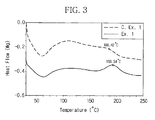
- FIGS. 1-3 represent non-limiting, example embodiments as described herein.
- FIG. 1 is a scanning electron micrograph showing the photosensitive polymer complex of Example 1 of example embodiments.
- FIGS. 2 and 3 are graphs showing the results of thermal analysis of the photosensitive polymer complexes of Example 1 and Comparative Example 1 of example embodiments, using TGA.
- Example embodiments will now be described in greater detail with reference to the accompanying drawings.
- the thicknesses and widths of layers are exaggerated for clarity.
- Example embodiments may, however, be embodied in many different forms and should not be construed as limited to the example embodiments set forth herein. Rather, these example embodiments are provided so that this disclosure will be thorough and complete, and will fully convey the scope of example embodiments to those skilled in the art.
- first, second, third etc. may be used herein to describe various elements, components, regions, layers and/or sections, these elements, components, regions, layers and/or sections should not be limited by these terms. These terms are only used to distinguish one element, component, region, layer or section from another region, layer or section. Thus, a first element, component, region, layer or section discussed below could be termed a second element, component, region, layer or section without departing from the teachings of example embodiments.
- spatially relative terms such as “beneath,” “below,” “lower,” “above,” “upper” and the like, may be used herein for ease of description to describe one element or feature's relationship to another element(s) or feature(s) as illustrated in the figures. It will be understood that the spatially relative terms are intended to encompass different orientations of the device in use or operation in addition to the orientation depicted in the figures. For example, if the device in the figures is turned over, elements described as “below” or “beneath” other elements or features would then be oriented “above” the other elements or features. Thus, the exemplary term “below” can encompass both an orientation of above and below. The device may be otherwise oriented (rotated 90 degrees or at other orientations) and the spatially relative descriptors used herein interpreted accordingly.
- Example embodiments are described herein with reference to cross-sectional illustrations that are schematic illustrations of idealized embodiments (and intermediate structures) of example embodiments. As such, variations from the shapes of the illustrations as a result, for example, of manufacturing techniques and/or tolerances, are to be expected. Thus, example embodiments should not be construed as limited to the particular shapes of regions illustrated herein but are to include deviations in shapes that result, for example, from manufacturing. For example, an implanted region illustrated as a rectangle will, typically, have rounded or curved features and/or a gradient of implant concentration at its edges rather than a binary change from implanted to non-implanted region.
- a buried region formed by implantation may result in some implantation in the region between the buried region and the surface through which the implantation takes place.
- the regions illustrated in the figures are schematic in nature and their shapes are not intended to illustrate the actual shape of a region of a device and are not intended to limit the scope of example embodiments.
- the composition for forming a photosensitive polymer complex may include a multifunctional epoxy resin, a photoacid generator, an organic solvent, and a silver compound.
- the composition may be a liquid type, in which a photocurable epoxy resin composition including the photoacid generator is added with the silver compound, having high heat conductivity and mechanical strength, and an organic solvent that is highly compatible with the polymer resin.
- a photosensitive polymer complex which has silver nanoparticles uniformly dispersed and formed in the polymer pattern portion thereof through photoreduction, and therefore is improved in terms of physical or chemical properties, e.g., heat resistance, heat conductivity, wear resistance, and dispersibility, may be prepared.
- the multifunctional epoxy resin may not be particularly limited, but may have two or more functions and may contain an oxirane group, and specific examples thereof may include, but may not be limited to, bisphenol A type epoxy resins, bisphenol F type epoxy resins, hydroquinone type epoxy resins, resorcinol type epoxy resins, and novolac type epoxy resins, which may be used alone or in mixtures of two or more thereof.
- the epoxy resin may include EPON 828, EPON 1004, EPON 1001F, EPON 1010, EPON SU-8, available from Shell Chemicals, DER-331, DER-332, DER-334, DEN-431, DEN-439, available from Dow Chemical Company, and ERL-4201, ERL-4289, ERL-0400, available from Union Carbide Corporation.
- the amount of the multifunctional epoxy resin may be determined according to an appropriate choice made by one skilled in the art depending on the end use and need, and may be set in the range of about 30 wt% ⁇ about 90 wt%, for example, about 50 wt% ⁇ about 75 wt%, based on the total amount of the composition for forming a photosensitive polymer complex. As such, when the amount of the epoxy resin is less than about 30 wt%, a tough film may not be obtained. On the other hand, when the amount exceeds about 90 wt%, improved heat conductivity may not be attained.
- any photoacid generator may be used as long as it produces an acid using light, and examples thereof may include, but may not be limited to, onium photoacid generators, ionic photoacid generators including diphenyl iodonium salts of hydroxyl-containing aromatic sulfonic acid, DNQ (diazonaphthoquinone) photoacid generators, nonionic photoacid generators including nitrobenzyl sulfonic acid, and polymer photoacid generators, which may be used alone or in mixtures of two or more thereof.
- onium photoacid generators ionic photoacid generators including diphenyl iodonium salts of hydroxyl-containing aromatic sulfonic acid
- DNQ diazonaphthoquinone
- nonionic photoacid generators including nitrobenzyl sulfonic acid
- polymer photoacid generators which may be used alone or in mixtures of two or more thereof.
- the onium photoacid generator may have a structure represented by each of Formulas 1 to 11 below, and the ionic photoacid generator including diphenyl iodonium salts of hydroxyl-containing aromatic sulfonic acid may have the structure represented by Formula 12 below.
- the DNQ (diazonaphthoquinone) photoacid generator may have the structure of Formula 13 below, and the nonionic photoacid generator including nitrobenzyl sulfonic acid may have the structure of Formula 14 below.
- the polymer photoacid generator may be a polymer having a molecular weight from about 500 to about 1,000,000, in which a sulfonium salt or iodonium salt is contained in the main chain or side chain thereof or an organic photoacid generating group is contained in the side chain thereof, thus generating acid with light: wherein R 6 and R 7 are each independently a linear, branched or cyclic C 1 ⁇ 10 alkyl group, and Z is a sulfonyl group or a carbonyl group.
- Examples of the compound having the structure of Formula 1 may include 1-cyclohexylsulfonyl-1-(1,1-dimethylethylsulfonyl)diazomethane, bis(1,1-dimethylethyl sulfonyl)diazomethane, bis(1-methylethylsulfonyl)methane, bis(cyclohexylsulfonyl)diazomethane, 1-cyclohexylsulfonyl-l-cyclohexylcarbonyldiazomethane, 1-diazo-1-cyclohexylsulfonyl-3,3'-dimethylbutan-2-one, 1-diazo-1-methylsulfonyl-4-phenyl butan-2-one, 1-diazo-1-(1,1-dimethylethylsulfonyl)-3,3-dimethyl -2-butanone and/or 1-acetyl
- Examples of the compound having the structure of Formula 2 may include bis(cyclohexylsulfonyl)diazomethane, bis(p-toluenesulfonyl)diazomethane, methylsulfonyl-p-toluenesulfonyldiazomethane, 1-diazo-1-(p-toluenesulfonyl)-3,3-dimethyl-2-butanone, bis(p-chlorobenzenesulfonyl)diazomethane, and/or cyclohexylsulfonyl-p-toluenesulfonyldiazomethane.
- R 10 and R 11 are each independently a hydrogen atom, a halogen atom, a linear or branched C 1 ⁇ 10 alkyl group, a C 1 ⁇ 12 phenylalkyl group, a phenyl group, or a tolyl group.
- Examples of the compound having the structure of Formula 3 may include 1-cyclohexylsulfonyl-1-cyclohexylcarbonyl diazomethane, 1-p-toluenesulfonyl-1-cyclohexylcarbonyl diazomethane, 1-diazo-1-(p-toluenesulfonyl)-3,3-dimethylbutan-2-one, 1-diazo-1-benzenesulfonyl-3,3-dimethylbutan-2-one and/or 1-diazo-1-(p-toluenesulfonyl)-3-methylbutan-2-one.
- R 12 is a C 1 ⁇ 12 phenylalkyl group or a phenyl group.
- Examples of the compound having the structure of Formula 4 may include 1,2,3-tris(trifluoromethanesulfonyloxy)benzene, 1,2,3-tris(2,2,2-trifluoroethanesulfonyloxy)benzene, 1,2,3-tris(2-chloroethane sulfonyloxy)benzene, 1,2,3-tris(p-trifluorobenzenesulfonyloxy) benzene, 1,2,3-tris(p-nitrobenzenesulfonyloxy)benzene, 1,2,3-tris(2,3,4,5-pentafluorobenzenesulfonyloxy)benzene, 1,2,3-tris (p-fluorobenzenesulfonyloxy)benzene, 1,2,3-tris(methanesulfonyl oxy)benzene, 1,2,4-tris(p-trifluoromethyloxybenzenesulfonyloxy
- Examples of the compound having the structure of Formula 5 may include 2,3,4-tris(p-fluorobenzene sulfonyloxy)benzophenone, 2,3,4-tris(trifluoromethanesulfonyl oxy)benzophenone, 2,3,4-tris(2-chloroethanesulfonyloxy) benzophenone, 2,3,4-tris(p-trifluoromethylbenzenesulfonyloxy) benzophenone, 2,3,4-tris(p-nitrobenzenesulfonyloxy) benzophenone, 2,3,4-tris(p-fluorobenzenesulfonyloxy) acetophenone, 2,3,4-tris(2,3,4,5,6-pentafluorobenzenesulfonyl oxy)acetophenone, 2,3,4-tris(2-nitrobenzenesulfonyloxy) acetophenone, 2,3,4-tris(2-nitrobenzene
- R 25 , R 26 and R 27 are each independently a C 1 ⁇ 12 phenylalkyl group or a phenyl group
- X is methanesulfonate, trifluoromethanesulfonate, p-toluenesulfonate, 10-camphorsulfonate, cyclohexanesulfamate, perfluoro-1-butanesulfonate, Cl, Br, SbF 6 , BF 4 , PF 6 or AsF 6 .
- Examples of the compound having the structure of Formula 6 may include triphenylsulfonium trifluoromethanesulfonate, triphenylsulfonium perfluorooctane sulfonate, diphenyl-p-tolylsulfonium perfluorooctanesulfonate, tris(p-tolyl)sulfonium perfluorooctanesulfonate, tris(p-chlorobenzene)sulfonium trifluoromethanesulfonate, tris(p-tolyl)sulfonium trifluoromethanesulfonate, trimethylsulfonium trifluoromethanesulfonate, dimethylphenylsulfonium trifluoro methanesulfonate, dimethyltolylsulfonium trifluoromethane sulfonate, dimethyltolylsulfonium perfluoroctanesul
- X is methanesulfonate, trifluoromethanesulfonate, p-toluenesulfonate, 10-camphorsulfonate, cyclohexanesulfamate, perfluoro-1-butanesulfonate, Cl, Br, SbF 6 , BF 4 , PF 6 or AsF 6 , and D 1 and D 2 are each independently a hydrogen atom, a C 1 ⁇ 6 alkyl group, or a vinyloxymethyl group.
- R is a C 1 ⁇ 10 alkyl group
- MX n - is BF 4 - , PF 6 - , AsF 6 - or SbF 6 - .
- MX n - is PF 6 or SbF 6 - .
- R is a C 1 ⁇ 10 alkyl group
- MX n - is PF 6 - or SbF 6 - .
- R, R 10 and R 11 are each independently a C 1 ⁇ 12 alkyl or alkoxy group, or a hydroxyl group
- Ar 1 , Ar 2 and Ar 3 are each independently a phenyl group, a naphthalene group, or an anthracene group.
- Q 1 and Q 2 are each independently a C 1 ⁇ 12 alkyl or aryl group
- g and h are each independently an integer of 1 or more.
- Formula 14 wherein R 12 is a C 1 ⁇ 12 alkyl or aryl group containing a heteroatom, and j is an integer from 1 to 3.
- the amount of the photoacid generator in the composition of example embodiments may be determined according to an appropriate choice made by one skilled in the art depending on the end use and need. Considering the UV stability of the composition, the photoacid generator is used in an amount of about 0.1 wt% ⁇ about 10 wt%, for example, about 1 wt% ⁇ about 5 wt%, but example embodiments may not be limited thereto.
- any organic solvent may be used without limitation as long as it is typically known in the art, has improved miscibility and compatibility with the multifunctional epoxy resin, and dissolves the silver compound.
- examples thereof may include, but may not be limited to, non-photoreactive solvents, e.g., ⁇ -butyrolactone, cyclopentanone, xylene, C 1 ⁇ 6 acetate, tetrahydrofuran, and mixtures of two or more thereof.
- the organic solvent may be used in an amount of about 1 wt% ⁇ about 70 wt%, for example, about 20 wt% ⁇ about 50 wt%, based on the total amount of the composition of example embodiments, in order to obtain a uniform compound.
- any compound containing silver particles may be used.
- the size of the silver particles is not particularly limited, the size of the silver particles may fall in the range of about 1 nm ⁇ about 100 nm, for example, about 10 nm ⁇ about 30 nm, in the interest of resolution and solubility.
- the silver compound include, but are not limited to, silver acetate, silver tetrafluoroborate, silver thiocyanate, silver trifluoromethanesulfonate, silver sulfate, silver phosphate, silver trifluoroacetate, silver oxide (I), silver oxide (II), silver iodide, silver chloride, silver carbonate, silver hexafluorophosphate, silver nitride, silver fluoride, silver bromide, and silver hexafluoroantimonate, which may be used alone or in mixtures of two or more thereof.
- the silver compound may be used in an amount of about 0.1 wt% ⁇ about 20 wt%, for example, about 1 wt% ⁇ about 10 wt%, based on the total amount of the composition of example embodiments.
- the amount of the silver compound is less than about 0.1 wt%, the silver compound may have difficulty attaining sufficient heat resistance and wear resistance.
- the amount exceeds about 20 wt% the silver compound may act as an impurity, undesirably decreasing the resolution of electronic devices.
- composition for forming a photosensitive polymer complex of example embodiments may further include a multifunctional acrylate resin and a photoinitiator.
- the composition of example embodiments may include a multifunctional epoxy resin, which has two or more functions, and the photoacid generator. Accordingly, during the selective exposure for the formation of the complex, in the exposed portion, the photoacid generator acts to produce an acid using light, after which the produced acid reacts with the epoxy group of the epoxy resin to thus cause ring-opening polymerization such that the epoxy resin is crosslinked, therefore improving the mechanical properties, e.g., tensile strength, elasticity, and density.
- the multifunctional acrylate resin is also crosslinked by the photoinitiator, and thus constitutes an interpenetrating polymer network (IPN) along with the crosslinked epoxy resin.
- IPN interpenetrating polymer network
- the multifunctional acrylate resin has three or more functions and contains acryl, and examples thereof may include, but may not be limited to, ethyleneglycol diacrylate, triethyleneglycol diacrylate, 1,4-butanediol diacrylate, 1,6-hexanediol diacrylate, neopentylglycol diacrylate, pentaerythritol diacrylate, pentaerythritol triacrylate, dipentaerythritol diacrylate, dipentaerythritol triacrylate, dipentaerythritol pentaacrylate, dipentaerythritol hexaacrylate, bisphenol A diacrylate, trimethylolpropane triacrylate, novolac epoxy acrylate, ethyleneglycol dimethacrylate, diethyleneglycol dimethacrylate, triethyleneglycol dimethacrylate, propyleneglycol dimethacrylate, 1,4-butanedio
- the amount of the multifunctional acrylate resin is not particularly limited, the multifunctional acrylate resin may be set in the range of about 1 wt% ⁇ about 20 wt%, for example, about 1 wt% ⁇ about 10 wt%, in the interest of solubility and mechanical strength.
- the photoinitiator may include any initiator able to produce a radical using light, for example, at least one selected from among triazine compounds, benzophenone compounds, acetophenone compounds, thioxantone compounds, benzoin compounds, carbazole compounds, diketone compounds, sulfonium borate compounds, diazo compounds, and biimidazole compounds may be used.
- examples of the triazine compound may include 2,4,6-trichloro-s-triazine, 2-phenyl-4,6-bis(trichloromethyl)-s-triazine, 2-(3',4'-dimethoxystyryl)-4,6-bis(trichloromethyl)-s-triazine, 2-(4'-methoxynaphthyl)-4,6-bis(trichloromethyl)-s-triazine, 2-(p-methoxyphenyl)-4,6-bis(trichloromethyl)-s-triazine, 2-(p-tolyl)-4,6-bis(trichloromethyl)-s-triazine, 2-biphenyl-4,6-bis(trichloromethyl)-s-triazine, bis(trichloro methyl)-6-styryls-triazine, 2-(naphtho-1-yl)-4,6-bis(trichlor
- benzophenone compound may include benzophenone, benzoyl benzoate, methyl benzoyl benzoate, 4-phenyl benzophenone, hydroxyl benzophenone, acrylated benzophenone, 4,4'-bis(dimethylamino)benzophenone and/or 4,4'-bis(diethylamino)benzophenone
- examples of the acetophenone compound may include 2,2'-diethoxyacetophenone, 2,2'-dibutoxyacetophenone, 2-hydroxy-2-methylpropiophenone, p-t-butyltrichloroacetophenone, p-t-butyldichloroacetophenone, benzophenone, 4-chloroacetophenone, 4,4'-dimethylaminobenzophenone, 4,4'-dichlorobenzophenone, 3,3'-dimethyl-2-methoxybenzophenone, 2,2'-dichloro-4-phenoxyacetophenone, 2-
- Examples of the thioxantone compound may include thioxantone, 2-methylthioxantone, isopropyl thioxantone, 2,4-diethyl thioxantone, 2,4-diisopropyl thioxantone and/or 2-chlorothioxantone
- examples of the benzoin compound may include benzoin, benzoin methylether, benzoin ethylether, benzoin isopropyl ether, benzoin isobutyl ether and/or benzyl dimethylketal.
- a photoinitiator may be used in an amount of about 0.1 wt% ⁇ about 20 wt%, for example, about 1 wt% ⁇ about 5 wt%, based on the total amount of the composition of example embodiments.
- composition of example embodiments may further include an additive.
- the additive may be at least one material selected from the group consisting of a surfactant, a flow improver, a viscosity modifier suitable for increasing the dispersibility and adhesion of silver nanoparticles, a silane coupling agent suitable for increasing the attachability to the substrate, along with a dye, a pigment and a UV absorbent suitable for controlling the absorption coefficient.
- This additive may be used in an amount of about 0.1 wt% ⁇ about 10 wt%, for example, about 1 wt% ⁇ about 5 wt%.
- Example embodiments provide a method of preparing a photosensitive polymer complex containing silver nanoparticles through selective exposure and development using the above composition.
- the preparation method may include applying the composition for forming a photosensitive polymer complex on the surface of a substrate, selectively exposing the applied film to light using a photomask having a desired pattern, and developing the exposed film using a developing solution.
- the preparation method is described in detail.
- the composition for forming a photosensitive polymer complex of example embodiments may be prepared, and may then be applied on the surface of the substrate.
- a typical ultrasonication process may be performed, or alternatively, in order to remove the solvent from the composition after the composition is applied, a pre-baking process may be performed at a relatively low temperature, for example, about 80°C ⁇ about 120°C, for a time period from about 30 sec to about 5 min, depending on need. Both the ultrasonication before the application and the pre-baking after the application may be performed.
- the substrate may not be particularly limited as long as it does not inhibit the purpose of example embodiments, and glass, a silicon wafer, or plastic may be used as appropriate depending on the end use thereof.
- a glass substrate may be used in some cases that is surface-treated with CF 4 plasma, hydrophobic fluorine or siloxane water-repellent material.
- a typical coating process may be used, and specific examples thereof may include, but may not be limited to, spin coating, dip coating, roll coating, spray coating, gravure coating, imprinting, and inkjet printing.
- the coating process may be spin coating from the point of view of convenience and uniformity.
- the spin rate may be set in the range of about 200 rpm ⁇ about 3500 rpm. The exact spin rate may be determined depending on the viscosity of the composition and the thickness of the resultant complex.
- the applied film may be selectively exposed to light using a photomask having a desired pattern.
- light may be UV or DUV (deep UV) ray having a wavelength of about 400 nm or less
- a light source for emitting such light may be a mercury lamp (365 nm), a KrF laser (248 nm), or an ArF laser (193 nm).
- the exposure amount may be appropriately determined in consideration of the thickness of the complex by those skilled in the art, and may be set in the range of about 50 ⁇ 800 mJ/cm 2 .
- the exposed film may include an unexposed portion, corresponding to the pattern, and an exposed portion, other than the pattern.
- the exposed portion may be formed in a manner such that an acid, produced from a photoacid generator using light, reacts with the epoxy group of epoxy resin to cause ring-opening polymerization in order to crosslink and cure the epoxy resin, and such that the silver compound is reduced to silver nanoparticles through electron migration by a radical generated from the photoinitiator or another material, at the same time.
- the crosslinking of the epoxy resin (or acrylate resin) and the organic solvent may act to prevent or retard the silver nanoparticles from aggregating.
- the epoxy resin (and acrylate resin) may not be crosslinked, but may remain as a monomer or an oligomer.
- the unexposed portion may be dissolved in the developing solution in a subsequent development process to be removed.
- a post-baking process may be conducted after the exposure, if required.
- Such a post-baking process may be performed at about 70°C ⁇ about 300°C, for example, about 100°C ⁇ about 200°C, for a period of time ranging from about 30 sec to about 5 min.
- the exposed film may be developed using the developing solution to remove the unexposed portion therefrom, thereby obtaining a photosensitive polymer complex containing silver nanoparticles and having a desired negative pattern.
- the developing solution may not be particularly limited, and any organic developing solution which is typically used in the field of photolithography may be used.
- any organic developing solution which is typically used in the field of photolithography may be used.
- DMF 4-hydroxy-4-methyl-2-pentanone
- ethylglycol monoethylether 2-methoxyethanol
- 2-methoxyethanol may be used in terms of film stability and uniformity of the pattern.
- a post-curing process may be conducted to further cure the exposed portion and to remove any developing solution that may remain, if required.
- the post-curing process may be carried out at about 150°C ⁇ about 400°C, the conditions thereof not being limited thereto.
- the photosensitive polymer complex obtained using the above preparation method, may include silver nanoparticles uniformly dispersed and formed in the polymer resin, thus exhibiting improved heat resistance, heat conductivity, and wear resistance, and, in addition, may be formed using the photocurable composition comprising the epoxy resin, and selectively the acrylate resin, the photoacid generator and/or the photoinitiator, therefore realizing an increased crosslink density, resulting in improved mechanical strength, resistance to corrosion by ink, and adhesion to the substrate.
- the photosensitive polymer complex containing the silver nanoparticles may be used in various electronic devices, for example, inkjet printers, RFID circuitry, PCB circuits, and electronic circuits, or the ink flow path of the head of the inkjet printer.
- a composition for forming a photosensitive polymer complex comprising about 30 g of a multifunctional epoxy resin (SU-8, available from Shell Chemicals), about 1 g of an onium photoacid generator represented by Formula 15 below, about 50 g of cyclopentanone as an organic solvent, about 8 g of silver oxide (available from Aldrich), and about 1 g of an antifoaming agent (KS-66, available from Shin-Etsu Chemical) as an additive, was prepared.
- a multifunctional epoxy resin SU-8, available from Shell Chemicals
- an onium photoacid generator represented by Formula 15 below
- cyclopentanone as an organic solvent
- silver oxide available from Aldrich
- KS-66 an antifoaming agent
- the liquid-type composition thus prepared was ultrasonicated for about 1 hour to sufficiently mix the components thereof, filtered through an about 0.5 ⁇ m syringe filter, subjected to spin coating at about 2000 rpm on glass surface-treated with CF 4 plasma, and then baked at about 100°C for about 1 min to remove the organic solvent from the applied film.
- the film thus formed was exposed to UV light in an exposure amount of about 100 mJ/cm 2 for about 120 sec using a photomask having a desired flow path pattern, post-baked at about 100°C for about 1 min, and was then dipped in 2-methoxyethanol for about 20 sec and thus developed. Thereafter, the resultant film was burned at about 200°C for about 1 min, thereby obtaining a photosensitive polymer complex containing silver nanoparticles and having a negative pattern.
- a photosensitive polymer complex was prepared in the same manner as in Example 1, with the exception that a composition for forming a photosensitive polymer complex, comprising about 20 g of a multifunctional epoxy resin (SU-8, available from Shell Chemicals), about 0.5 g of an onium photoacid generator represented by Formula 15, about 10.0 g of ⁇ -butyrolactone as an organic solvent, and about 0.5 g of silver carbonate (available from Aldrich), was used.
- a composition for forming a photosensitive polymer complex comprising about 20 g of a multifunctional epoxy resin (SU-8, available from Shell Chemicals), about 0.5 g of an onium photoacid generator represented by Formula 15, about 10.0 g of ⁇ -butyrolactone as an organic solvent, and about 0.5 g of silver carbonate (available from Aldrich), was used.
- a photosensitive polymer complex was prepared in the same manner as in Example 1, with the exception that a composition for forming a photosensitive polymer complex, comprising about 10 g of a multifunctional epoxy resin (SU-8, available from Shell Chemicals), about 10 g of a multifunctional acrylate resin (dipentaerythritol hexaacrylate), about 0.25 g of an onium photoacid generator represented by Formula 15, about 0.25 g of a photoinitiator (Irgacure 651, available from Shinyoung Rad. Chem.), about 10.0 g of ⁇ -butyrolactone as an organic solvent, and about 0.5 g of silver carbonate (available from Aldrich), was used.
- a composition for forming a photosensitive polymer complex comprising about 10 g of a multifunctional epoxy resin (SU-8, available from Shell Chemicals), about 10 g of a multifunctional acrylate resin (dipentaerythritol hexaacrylate), about 0.25 g of an onium photo
- a photosensitive polymer complex was prepared in the same manner as in Example 1, with the exception that a composition having no silver oxide was used.
- a photosensitive polymer complex was prepared in the same manner as in Example 2, with the exception that a composition having no silver carbonate was used.
- a photosensitive polymer complex was prepared in the same manner as in Example 3, with the exception that a composition having no silver carbonate was used.
- Example 1 In order to investigate whether the photosensitive polymer complex of Example 1 actually had silver nanoparticles, the polymer complex was observed using a scanning electron microscope. The results are shown in FIG. 1 . As seen in FIG. 1 , the silver nanoparticles were observed to be agglomerated to a size of about 10 nm ⁇ about 30 nm on the surface of the photosensitive polymer complex prepared in Example 1.
- the photosensitive polymer complexes of Example 1 and Comparative Example 1 were subjected to thermal analysis using TGA.
- TGA thermal analysis using TGA.
- FIGS. 2 and 3 The results are shown in FIGS. 2 and 3 .
- a weight decrease was reduced at about 400°C or less due to the decomposition of the silver nanoparticles, and about 18% silver nanoparticles were present, compared to the complex of Comparative Example 1.
- the complex of Comparative Example 1 had a glass transition temperature (Tg) of about 186°C, whereas the complex of Example 1 had a Tg of about 193°C due to the presence of the silver nanoparticles.
- Tg glass transition temperature
- the above results demonstrate the fact that the photosensitive polymer complex of example embodiments, containing the silver nanoparticles uniformly dispersed therein, may exhibit improved heat resistance and heat conductivity, and therefore may be advantageously used as the ink flow path of the head of an inkjet printer.
- example embodiments provide a composition for forming a photosensitive polymer complex and a method of preparing a photosensitive polymer complex containing silver nanoparticles using the above composition.
- the composition for forming a photosensitive polymer complex essentially comprising a multifunctional epoxy resin, a photoacid generator, an organic solvent, and a silver compound, or additionally including a multifunctional acrylate resin and a photoinitiator, or an additive, e.g., a surfactant or a flow improver, is applied, selectively exposed, and developed, thereby forming a photosensitive polymer complex.
- the photosensitive polymer complex may have silver nanoparticles uniformly dispersed and formed in the polymer pattern portion thereof through photoreduction, thus improving physical or chemical properties, e.g., heat resistance and wear resistance.
Landscapes
- Physics & Mathematics (AREA)
- General Physics & Mathematics (AREA)
- Spectroscopy & Molecular Physics (AREA)
- Chemical & Material Sciences (AREA)
- Engineering & Computer Science (AREA)
- Ceramic Engineering (AREA)
- Materials For Photolithography (AREA)
- Epoxy Resins (AREA)
- Macromonomer-Based Addition Polymer (AREA)
Applications Claiming Priority (1)
| Application Number | Priority Date | Filing Date | Title |
|---|---|---|---|
| KR1020070001349A KR101435195B1 (ko) | 2007-01-05 | 2007-01-05 | 감광성 고분자 복합체 형성용 조성물 및 상기 조성물을 이용한 은 나노입자를 함유하는 감광성 고분자 복합체의 제조방법 |
Publications (3)
| Publication Number | Publication Date |
|---|---|
| EP1942375A2 true EP1942375A2 (de) | 2008-07-09 |
| EP1942375A3 EP1942375A3 (de) | 2009-01-21 |
| EP1942375B1 EP1942375B1 (de) | 2013-02-27 |
Family
ID=39410068
Family Applications (1)
| Application Number | Title | Priority Date | Filing Date |
|---|---|---|---|
| EP07150275A Expired - Fee Related EP1942375B1 (de) | 2007-01-05 | 2007-12-20 | Tintenstrahlaufzeichnungskopf beinhaltend einen lichtempfindlichen Polymerkomplex beinhaltend Silber-Nanopartikel und Verfahren zur Herstellung des lichtempfindlichen Polymerkomplexes |
Country Status (3)
| Country | Link |
|---|---|
| US (1) | US7875416B2 (de) |
| EP (1) | EP1942375B1 (de) |
| KR (1) | KR101435195B1 (de) |
Cited By (2)
| Publication number | Priority date | Publication date | Assignee | Title |
|---|---|---|---|---|
| GB2464610A (en) * | 2008-10-21 | 2010-04-28 | Axon Cable Sa | Antimicrobial cable |
| WO2015119616A1 (en) * | 2014-02-07 | 2015-08-13 | Eastman Kodak Company | Photopolymerizable compositions for electroless plating methods |
Families Citing this family (28)
| Publication number | Priority date | Publication date | Assignee | Title |
|---|---|---|---|---|
| KR101435195B1 (ko) | 2007-01-05 | 2014-08-29 | 삼성전자주식회사 | 감광성 고분자 복합체 형성용 조성물 및 상기 조성물을 이용한 은 나노입자를 함유하는 감광성 고분자 복합체의 제조방법 |
| KR101403187B1 (ko) * | 2008-02-19 | 2014-06-02 | 삼성전자주식회사 | 감광성 조성물, 이를 이용한 미세 가공 방법 및 그에 의해형성된 미세 가공물 |
| JP5337461B2 (ja) * | 2008-05-14 | 2013-11-06 | 東京応化工業株式会社 | 樹脂組成物の塗布方法 |
| US8029700B2 (en) * | 2009-04-30 | 2011-10-04 | Chung-Shan Institute of Science and Technology Armaments Bureau, Ministry of National Defense | Compound of silver nanowire with polymer and compound of metal nanostructure with polymer |
| US9146463B2 (en) * | 2010-12-10 | 2015-09-29 | Indian Institute Of Technology Bombay | Photo-patternable multifunctional polymer nanocomposite |
| US9207533B2 (en) | 2014-02-07 | 2015-12-08 | Eastman Kodak Company | Photopolymerizable compositions for electroless plating methods |
| US9188861B2 (en) | 2014-03-05 | 2015-11-17 | Eastman Kodak Company | Photopolymerizable compositions for electroless plating methods |
| WO2015199988A1 (en) | 2014-06-23 | 2015-12-30 | Eastman Kodak Company | Latex primer composition and latex primed substrates |
| KR20170070167A (ko) | 2014-10-15 | 2017-06-21 | 이스트맨 코닥 캄파니 | 분산된 탄소-코팅된 금속 입자, 제품 및 용도 |
| US9586201B2 (en) | 2014-12-16 | 2017-03-07 | Eastman Kodak Company | Forming catalytic sites from reducible silver-heterocyclic complexes |
| US9375704B1 (en) | 2014-12-16 | 2016-06-28 | Eastman Kodak Company | Metal catalytic composition with silver carboxylate-trialkyl(triaryl)phosphite complex |
| US9387460B2 (en) | 2014-12-16 | 2016-07-12 | Eastman Kodak Company | Metal catalytic composition with silver-oxime complex |
| US9377688B1 (en) | 2014-12-16 | 2016-06-28 | Eastman Kodak Company | Metal catalytic composition with silver N-heterocycle complex |
| US9624582B2 (en) | 2014-12-16 | 2017-04-18 | Eastman Kodak Company | Non-aqueous metal catalytic composition with oxyazinium photoreducing agent |
| US9592493B2 (en) | 2014-12-16 | 2017-03-14 | Eastman Kodak Company | Forming silver catalytic sites from silver phosphite carboxylates |
| US9587315B2 (en) | 2014-12-16 | 2017-03-07 | Eastman Kodak Company | Forming silver catalytic sites from reducible silver-oximes |
| US9586200B2 (en) | 2014-12-16 | 2017-03-07 | Eastman Kodak Company | Forming catalytic sites from reducible silver complexes |
| CN104614941A (zh) * | 2015-01-08 | 2015-05-13 | 苏州瑞红电子化学品有限公司 | 一种高耐热化学增幅型光刻胶树脂及其光刻胶组合物 |
| US9982349B2 (en) | 2015-05-11 | 2018-05-29 | Eastman Kodak Company | Method for making electrically-conductive articles |
| US9566569B2 (en) * | 2015-05-11 | 2017-02-14 | Eastman Kodak Company | Metal catalytic compositions and articles therefrom |
| KR102581926B1 (ko) | 2015-08-24 | 2023-09-22 | 삼성전자주식회사 | 감광성 조성물, 이를 제조하기 위한 방법, 및 이로부터 제조된 양자점-폴리머 복합체 패턴 |
| US10174425B2 (en) | 2015-09-22 | 2019-01-08 | Eastman Kodak Company | Non-aqueous compositions and articles using stannous alkoxides |
| US9617642B1 (en) | 2015-09-22 | 2017-04-11 | Eastman Kodak Company | Silver formation using stannous alkoxide complexes |
| KR102631400B1 (ko) | 2015-10-22 | 2024-01-29 | 삼성전자주식회사 | 감광성 조성물, 이로부터 제조된 양자점-폴리머 복합체 패턴, 및 이를 포함하는 전자 소자 |
| KR102527764B1 (ko) | 2015-12-17 | 2023-05-02 | 삼성전자주식회사 | 감광성 조성물, 이를 제조하기 위한 방법, 및 이로부터 제조된 양자점-폴리머 복합체 패턴 |
| JP2020535271A (ja) | 2017-09-26 | 2020-12-03 | ナショナル リサーチ カウンシル オブ カナダ | ポリマーフィルム−金属複合体 |
| KR102128371B1 (ko) | 2018-12-14 | 2020-06-30 | 한국과학기술연구원 | 유연 압전 어레이 센서 시스템 |
| CN110355381B (zh) * | 2019-08-21 | 2022-02-15 | 无锡帝科电子材料股份有限公司 | 一种纳米银粉及其制备方法与应用 |
Citations (4)
| Publication number | Priority date | Publication date | Assignee | Title |
|---|---|---|---|---|
| EP0653763A1 (de) | 1993-11-17 | 1995-05-17 | SOPHIA SYSTEMS Co., Ltd. | UV-härtbares, lösungsmittelfreies leitfähiges Polymer-Material |
| WO1999067794A1 (en) | 1998-06-24 | 1999-12-29 | Shipley Company, L.L.C. | Uv-curable epoxy formulations, including conductive compositions |
| JP2003280184A (ja) | 2002-03-25 | 2003-10-02 | Konica Corp | 画像形成材料、画像形成材料用包装体及び画像記録方法 |
| JP2004163580A (ja) | 2002-11-12 | 2004-06-10 | Konica Minolta Holdings Inc | ドライイメージング材料 |
Family Cites Families (13)
| Publication number | Priority date | Publication date | Assignee | Title |
|---|---|---|---|---|
| JP2002082449A (ja) * | 2000-06-30 | 2002-03-22 | Murata Mfg Co Ltd | 厚膜パターンの形成方法及びそれに用いられる感光性ペースト |
| US6391523B1 (en) * | 2000-09-15 | 2002-05-21 | Microchem Corp. | Fast drying thick film negative photoresist |
| US6534235B1 (en) * | 2000-10-31 | 2003-03-18 | Kansai Research Institute, Inc. | Photosensitive resin composition and process for forming pattern |
| EP1213600B1 (de) * | 2000-12-06 | 2004-10-13 | Fuji Photo Film Co., Ltd. | Optischer Diffusorfilm und Herstellungsverfahren dafür |
| JP2003075628A (ja) * | 2001-09-06 | 2003-03-12 | Asahi Glass Co Ltd | 光学フィルム |
| JP4266310B2 (ja) * | 2003-01-31 | 2009-05-20 | ローム・アンド・ハース・エレクトロニック・マテリアルズ,エル.エル.シー. | 感光性樹脂組成物および該組成物を用いた樹脂パターンの形成方法 |
| KR20030031089A (ko) | 2003-03-28 | 2003-04-18 | 인교진 | 은 나노입자를 함유한 자외선 경화형 우레탄아크릴레이트, 에폭시 아크릴레이트의 합성 |
| US20050260522A1 (en) * | 2004-02-13 | 2005-11-24 | William Weber | Permanent resist composition, cured product thereof, and use thereof |
| KR100641358B1 (ko) | 2004-09-23 | 2006-11-01 | 삼성전자주식회사 | 광경화성 수지 조성물을 사용한 잉크젯 프린트 헤드의제조방법 |
| US7965441B2 (en) * | 2004-09-30 | 2011-06-21 | Industrial Technology Research Institute | Optical film with super low retardation and polarizing plate containing the same |
| US7153892B2 (en) * | 2005-05-12 | 2006-12-26 | Ecology Coating, Inc. | Environmentally friendly, actinic radiation curable coating compositions for coating thermoplastic olefin objects and methods, processes and assemblages for coating thereof |
| KR101317599B1 (ko) * | 2006-07-21 | 2013-10-11 | 삼성전자주식회사 | 신규한 금속 나노입자 및 이를 이용한 전도성 패턴 형성방법 |
| KR101435195B1 (ko) | 2007-01-05 | 2014-08-29 | 삼성전자주식회사 | 감광성 고분자 복합체 형성용 조성물 및 상기 조성물을 이용한 은 나노입자를 함유하는 감광성 고분자 복합체의 제조방법 |
-
2007
- 2007-01-05 KR KR1020070001349A patent/KR101435195B1/ko not_active Expired - Fee Related
- 2007-06-05 US US11/806,902 patent/US7875416B2/en not_active Expired - Fee Related
- 2007-12-20 EP EP07150275A patent/EP1942375B1/de not_active Expired - Fee Related
Patent Citations (4)
| Publication number | Priority date | Publication date | Assignee | Title |
|---|---|---|---|---|
| EP0653763A1 (de) | 1993-11-17 | 1995-05-17 | SOPHIA SYSTEMS Co., Ltd. | UV-härtbares, lösungsmittelfreies leitfähiges Polymer-Material |
| WO1999067794A1 (en) | 1998-06-24 | 1999-12-29 | Shipley Company, L.L.C. | Uv-curable epoxy formulations, including conductive compositions |
| JP2003280184A (ja) | 2002-03-25 | 2003-10-02 | Konica Corp | 画像形成材料、画像形成材料用包装体及び画像記録方法 |
| JP2004163580A (ja) | 2002-11-12 | 2004-06-10 | Konica Minolta Holdings Inc | ドライイメージング材料 |
Cited By (3)
| Publication number | Priority date | Publication date | Assignee | Title |
|---|---|---|---|---|
| GB2464610A (en) * | 2008-10-21 | 2010-04-28 | Axon Cable Sa | Antimicrobial cable |
| GB2464610B (en) * | 2008-10-21 | 2013-02-20 | Axon Cable Sa | Cable and/or cord suitable for use in a hospital environment or in a controlled atmosphere environment and method for the manufacture thereof |
| WO2015119616A1 (en) * | 2014-02-07 | 2015-08-13 | Eastman Kodak Company | Photopolymerizable compositions for electroless plating methods |
Also Published As
| Publication number | Publication date |
|---|---|
| EP1942375B1 (de) | 2013-02-27 |
| US7875416B2 (en) | 2011-01-25 |
| KR20080064431A (ko) | 2008-07-09 |
| EP1942375A3 (de) | 2009-01-21 |
| KR101435195B1 (ko) | 2014-08-29 |
| US20080166670A1 (en) | 2008-07-10 |
Similar Documents
| Publication | Publication Date | Title |
|---|---|---|
| US7875416B2 (en) | Composition for forming photosensitive polymer complex and method of preparing photosensitive polymer complex containing silver nanoparticles using the composition | |
| US8609013B2 (en) | Method of fabricating a microfabricated structure | |
| JP6210986B2 (ja) | 低表面エネルギー基板上にレリーフパターンを製作するためのエポキシ配合物及び方法 | |
| JP5441907B2 (ja) | プリントエレクトロニクスを製造するための組成物及びプロセス | |
| JP2008019292A (ja) | 光硬化性組成物およびそれを用いたパターン形成方法 | |
| JP2008189821A (ja) | 光硬化性組成物 | |
| WO2018074539A1 (ja) | 硬化膜の形成方法、感放射線樹脂組成物、硬化膜を備える表示素子及びセンサー | |
| JP4913142B2 (ja) | 感光性樹脂組成物、その積層体、その硬化物及び該組成物を用いたパターン形成方法(3) | |
| WO2007026652A1 (ja) | 膜形成組成物、これを用いたパターン形成方法及び三次元モールド | |
| JP4913141B2 (ja) | 感光性樹脂組成物、その積層体、その硬化物及び該組成物を用いたパターン形成方法(2) | |
| JP4789726B2 (ja) | 感光性樹脂組成物、その積層体、その硬化物及び該組成物を用いたパターン形成方法 | |
| JP5346787B2 (ja) | 硬化性樹脂組成物及びその硬化物 | |
| JP4237088B2 (ja) | 感光性樹脂組成物および該組成物を用いたパターン形成方法 | |
| JP4789725B2 (ja) | 感光性樹脂組成物、その積層体、その硬化物及び該組成物を用いたパターン形成方法 | |
| EP1766473B1 (de) | Kationisch fotopolymerisierbare epoxidharz-zusammensetzung, diese verwendende kleinste strukturelemente und verfahren zur herstellung von kleinsten strukturelementen | |
| JP2008180879A (ja) | 感光性樹脂組成物及びこれを用いたレジストパターンの形成方法 | |
| JP4498232B2 (ja) | 光カチオン重合性エポキシ樹脂組成物、並びに、これを用いた微細構造体の製造方法及びインクジェットヘッドの製造方法 | |
| JP2009012300A (ja) | ナノインプリント用モールド形成組成物、並びにナノインプリント用モールド及びその製造方法 | |
| JP4789727B2 (ja) | 感光性樹脂組成物、その積層体、その硬化物及び該組成物を用いたパターン形成方法 | |
| JP4789728B2 (ja) | 感光性樹脂組成物、その積層体、その硬化物及び該組成物を用いたパターン形成方法 | |
| JP2026028214A (ja) | 感光性樹脂組成物、撥液防汚膜及びインクジェット記録ヘッド |
Legal Events
| Date | Code | Title | Description |
|---|---|---|---|
| PUAI | Public reference made under article 153(3) epc to a published international application that has entered the european phase |
Free format text: ORIGINAL CODE: 0009012 |
|
| AK | Designated contracting states |
Kind code of ref document: A2 Designated state(s): AT BE BG CH CY CZ DE DK EE ES FI FR GB GR HU IE IS IT LI LT LU LV MC MT NL PL PT RO SE SI SK TR |
|
| AX | Request for extension of the european patent |
Extension state: AL BA HR MK RS |
|
| PUAL | Search report despatched |
Free format text: ORIGINAL CODE: 0009013 |
|
| AK | Designated contracting states |
Kind code of ref document: A3 Designated state(s): AT BE BG CH CY CZ DE DK EE ES FI FR GB GR HU IE IS IT LI LT LU LV MC MT NL PL PT RO SE SI SK TR |
|
| AX | Request for extension of the european patent |
Extension state: AL BA HR MK RS |
|
| 17P | Request for examination filed |
Effective date: 20090603 |
|
| 17Q | First examination report despatched |
Effective date: 20090703 |
|
| AKX | Designation fees paid |
Designated state(s): DE FR GB |
|
| GRAP | Despatch of communication of intention to grant a patent |
Free format text: ORIGINAL CODE: EPIDOSNIGR1 |
|
| RAP1 | Party data changed (applicant data changed or rights of an application transferred) |
Owner name: SAMSUNG ELECTRONICS CO., LTD. |
|
| RIN1 | Information on inventor provided before grant (corrected) |
Inventor name: PARK, BYUNG HA, Inventor name: HA, YOUNG UNG, Inventor name: PARK, JONG JIN, |
|
| GRAS | Grant fee paid |
Free format text: ORIGINAL CODE: EPIDOSNIGR3 |
|
| GRAA | (expected) grant |
Free format text: ORIGINAL CODE: 0009210 |
|
| AK | Designated contracting states |
Kind code of ref document: B1 Designated state(s): DE FR GB |
|
| REG | Reference to a national code |
Ref country code: GB Ref legal event code: FG4D |
|
| REG | Reference to a national code |
Ref country code: DE Ref legal event code: R096 Ref document number: 602007028668 Country of ref document: DE Effective date: 20130425 |
|
| PLBE | No opposition filed within time limit |
Free format text: ORIGINAL CODE: 0009261 |
|
| STAA | Information on the status of an ep patent application or granted ep patent |
Free format text: STATUS: NO OPPOSITION FILED WITHIN TIME LIMIT |
|
| PGFP | Annual fee paid to national office [announced via postgrant information from national office to epo] |
Ref country code: GB Payment date: 20131126 Year of fee payment: 7 Ref country code: FR Payment date: 20131121 Year of fee payment: 7 Ref country code: DE Payment date: 20131121 Year of fee payment: 7 |
|
| 26N | No opposition filed |
Effective date: 20131128 |
|
| REG | Reference to a national code |
Ref country code: DE Ref legal event code: R097 Ref document number: 602007028668 Country of ref document: DE Effective date: 20131128 |
|
| REG | Reference to a national code |
Ref country code: DE Ref legal event code: R119 Ref document number: 602007028668 Country of ref document: DE |
|
| GBPC | Gb: european patent ceased through non-payment of renewal fee |
Effective date: 20141220 |
|
| REG | Reference to a national code |
Ref country code: FR Ref legal event code: ST Effective date: 20150831 |
|
| PG25 | Lapsed in a contracting state [announced via postgrant information from national office to epo] |
Ref country code: GB Free format text: LAPSE BECAUSE OF NON-PAYMENT OF DUE FEES Effective date: 20141220 Ref country code: DE Free format text: LAPSE BECAUSE OF NON-PAYMENT OF DUE FEES Effective date: 20150701 |
|
| PG25 | Lapsed in a contracting state [announced via postgrant information from national office to epo] |
Ref country code: FR Free format text: LAPSE BECAUSE OF NON-PAYMENT OF DUE FEES Effective date: 20141231 |