EP1942461A2 - Verfahren und Vorrichtung zur Minderung von Bildrauschen mittels Waveletzerlegung - Google Patents
Verfahren und Vorrichtung zur Minderung von Bildrauschen mittels Waveletzerlegung Download PDFInfo
- Publication number
- EP1942461A2 EP1942461A2 EP07016778A EP07016778A EP1942461A2 EP 1942461 A2 EP1942461 A2 EP 1942461A2 EP 07016778 A EP07016778 A EP 07016778A EP 07016778 A EP07016778 A EP 07016778A EP 1942461 A2 EP1942461 A2 EP 1942461A2
- Authority
- EP
- European Patent Office
- Prior art keywords
- image
- wavelet
- energy
- wavelet coefficients
- modifying
- Prior art date
- Legal status (The legal status is an assumption and is not a legal conclusion. Google has not performed a legal analysis and makes no representation as to the accuracy of the status listed.)
- Withdrawn
Links
Images





Classifications
-
- G—PHYSICS
- G06—COMPUTING OR CALCULATING; COUNTING
- G06T—IMAGE DATA PROCESSING OR GENERATION, IN GENERAL
- G06T5/00—Image enhancement or restoration
- G06T5/10—Image enhancement or restoration using non-spatial domain filtering
-
- G—PHYSICS
- G06—COMPUTING OR CALCULATING; COUNTING
- G06T—IMAGE DATA PROCESSING OR GENERATION, IN GENERAL
- G06T5/00—Image enhancement or restoration
- G06T5/70—Denoising; Smoothing
-
- G—PHYSICS
- G06—COMPUTING OR CALCULATING; COUNTING
- G06V—IMAGE OR VIDEO RECOGNITION OR UNDERSTANDING
- G06V10/00—Arrangements for image or video recognition or understanding
- G06V10/20—Image preprocessing
- G06V10/30—Noise filtering
-
- G—PHYSICS
- G06—COMPUTING OR CALCULATING; COUNTING
- G06T—IMAGE DATA PROCESSING OR GENERATION, IN GENERAL
- G06T2207/00—Indexing scheme for image analysis or image enhancement
- G06T2207/20—Special algorithmic details
- G06T2207/20016—Hierarchical, coarse-to-fine, multiscale or multiresolution image processing; Pyramid transform
-
- G—PHYSICS
- G06—COMPUTING OR CALCULATING; COUNTING
- G06T—IMAGE DATA PROCESSING OR GENERATION, IN GENERAL
- G06T2207/00—Indexing scheme for image analysis or image enhancement
- G06T2207/20—Special algorithmic details
- G06T2207/20048—Transform domain processing
- G06T2207/20064—Wavelet transform [DWT]
Definitions
- the present invention relates generally to image processing and in particular, to a method, apparatus and computer-readable medium embodying a computer program for reducing noise in an image using wavelet decomposition.
- Digital cameras have an ISO rating identifying their level of sensitivity to light. For most digital cameras, a default ISO 100 setting is normal although some digital cameras have default ISO settings as low as fifty (50).
- the PENGUIN ® digital camera board produced by Seiko Epson Corporation has an ISO range between fourteen (14) and nine-hundred and ten (910) and a default ISO 50 setting.
- SLR single-lens reflex
- the default ISO setting can be set to 200, 400, 800 or even 3200.
- Luminance noise gives images a grainy look when presented on an electronic display screen but is usually not visible when the images are printed. Chroma noise appears as random red and blue pixels and is typically less visible in images both on-screen and when printed. Chroma noise is most visible in smooth and/or dark areas of images and is more visible in red (R) and blue (B) channels. Chroma noise in the red and blue channels tends to contain more low and very low frequency components due to demosaicing and interpolation. Chroma noise also adversely affects color saturation and contrast.
- noise reduction methods such as for example, anistopic diffusion
- white noise has been added to images and compensate for image degradation on the basis of this assumption.
- noise in images captured by digital cameras having high ISO settings is not accurately modeled by this noise assumption and thus, these noise reducing methods have proven to be unsatisfactory.
- Wavelet methods for removing noise from images have gained in popularity.
- the Donoho-Johnstone method is a popular and efficient denoising method incorporating wavelets and makes use of soft or hard thresholds.
- the image is wavelet decomposed to generate wavelet coefficients representing the image detail. All of the wavelet coefficients below threshold levels are reduced to zero. Wavelet coefficients exceeding the threshold levels are either unmodified (hard) or reduced (soft).
- This method has proven to be most successful when the noise in the image generally conforms to expected Gaussian white noise.
- this method requires the arbitrary a priori selection of the threshold levels. As a result, depending on the selected threshold levels, if the noise is not white noise, detail in the image may be lost, an insufficient amount of noise may be removed from the image or the noise may be improperly removed from the image.
- noise reducing algorithms have been considered but these noise reducing algorithms are expensive in terms of processing time. Many of these methods, similar to the anistropic diffusion method referred to above, incorporate assumed noise models and thus, unsuccessfully address noise when the noise does not accurately fit within the noise models.
- U.S. Patent No. 6,163,619 to Maruo discloses a method in which an input digital image of an object is subjected to a Wavelet transform. An image energy quantity for a combined area of X-axis high pass information and Y-axis high pass information contained in the image data resulting from the Wavelet transform, is calculated. The object is deemed acceptable or faulty depending on whether the image energy quantity is below or above a given value.
- U.S. Patent No. 6,836,569 to Le Pennac et al. discloses a method and apparatus for processing an n-dimensional digitized signal using foveal processing, which constructs a sparse signal representation by taking advantage of the geometrical regularity of signal structures.
- Foveal coefficients are computed with one-dimensional inner products along trajectories of an n-directional trajectory list.
- a trajectory finder computes the n-directional trajectory list from the input n-dimensional signals, in order to choose optimal locations to compute the foveal coefficients.
- a foveal reconstruction processor recovers a signal approximation which has the same geometrical structures as the input signal along the trajectories and which is regular away from the trajectories.
- a foveal residue can be calculated as a difference with the input signal.
- a bandlet processor decorrelates the foveal coefficients by applying invertible linear operators along each trajectory. Bandlet coefficients are inner products between the signal and n-dimensional bandlet vectors elongated along the trajectories.
- a geometric processor computes geometric coefficients by decorrelating the coordinates of the trajectories with linear operators, to take advantage of their geometrical regularity. Setting small bandlet coefficients and small geometric coefficients to zero yields the sparse signal representation.
- U.S. Patent Application Publication No. 2003/0095206 to Wredenhagen et al. discloses a method for reducing noise in an image. During the method, a plurality of pixels along a predetermined contour is compared with a plurality of predefined patterns. The patterns represent visually significant patterns possible along the contour. A filter is selected from a predefined set of filters in accordance with the results of the comparison.
- U.S. Patent Application Publication No. 2004/0008904 to Lin et al discloses a process for removing noise in an image by wavelet thresholding utilizing a discrete wavelet transform that decomposes the image into different resolution levels. A thresholding function is then applied in different resolution levels with different threshold values to eliminate insignificant wavelet coefficients which mainly correspond to noise in the image. An inverse discrete wavelet transform is applied to generate a noise-reduced image. The threshold values are based on the relationships between the noise standard deviations at different decomposition levels in the wavelet domain and the noise standard deviation of the image.
- U.S. Patent Application Publication No. 2004/0260169 to Sternnickel discloses a two-part method for non-linear de-noising (NLD) of magneto cardiograph or electrocardiograph time series signals by performing local projections in the reconstructed state space using a wavelet transform to identify and describe deterministic structures. Subspaces generated by deterministic processes are located and separated independently of their sources.
- NLD non-linear de-noising
- U.S. Patent Application Publication No. 2004/0268096 to Master et al. discloses a digital imaging apparatus such as a digital camera, scanner, printer or dry copier having an optical sensor, an analog-to-digital converter, a plurality of computational elements, and an interconnection network.
- the optical sensor converts an object image into a detected image, which is then converted to digital image information by the analog-to-digital converter.
- the plurality of computational elements comprises a first computational element having a first fixed architecture and a second computational element having a second, different fixed architecture.
- the interconnection network is capable of providing a processed digital image from the digital image information by configuring and reconfiguring the computational elements in order to perform a plurality of different imaging functions.
- U.S. Patent Application Publication No. 2005/0100237 to Kong et al discloses a method of filtering pixels in an image, by first partitioning the image into blocks. Edge blocks are then identified. A variance of intensity for each pixel in each edge block is subsequently determined. Each pixel in each edge block is then filtered with a filter that is dependant on the intensity variance of the pixel.
- U.S. Patent Application Publication No. 2005/40100241 to Kong et al. discloses a method for reducing artefacts in an input image.
- a variance image is generated from the input image.
- the input image is partitioned into a plurality of blocks of pixels.
- a set of classifications is defined and includes smooth, texture, and edge classes.
- a particular class is assigned to each block of pixels of the input image according to the variance image thereby to generate smooth blocks, texture blocks, and edge blocks.
- a fuzzy filter is applied to each pixel of each edge block.
- U.S. Patent Application Publication No. 2005/0207660 to Edgar discloses a method for removing artefacts to restore a block of data.
- one or more original transform coefficients of the data block are received and the original transform coefficients of the data block are quantized.
- An artefact reduction process is applied to the quantized original transform coefficients and one or more quantized data values representing the transform coefficients as altered by the artefact reduction process is adjusted, if necessary.
- the artefact reduction process is reapplied and the quantized data values are readjusted, enabling restoration of the block of data.
- U.S. Patent Application Publication No. 2005/0265633 to Piacentino et al discloses a video processor that uses a low latency pyramid processing technique for fusing images from multiple sensors.
- the images from the multiple sensors are enhanced, warped into alignment, and then fused with one another in a manner that enables the fusing to occur within a single frame of video, i.e., sub-frame processing.
- the sub-frame processing results in a sub-frame delay between the moment of image capture and subsequent fused image display.
- U.S. Patent Application Publication No. 2005/0276515 to Shekter discloses an apparatus for analyzing the broadband noise content of a digital image.
- the apparatus comprises means for automatically identifying regions of originally constant color in the image by analyzing the variance of pixel values of regions of the image.
- the apparatus further comprises means for automatically detecting and discarding constant color regions deemed to be unrepresentative of the true noise content of the image, including underexposed and over-exposed regions. Selected constant color regions are then analyzed to generate a parametric or non-parametric model of the noise in the image, including frequency characteristics within and between channels and other characteristics such as phase, which might describe structured noise.
- a method of reducing noise in an image comprising:
- the modifying is based on normalized inter-scale energy, single scale energy and weighted average single scale energy of the wavelet coefficients.
- the image is decomposed into wavelet detail spaces at different scales with each wavelet detail space comprising a plurality of wavelet detail subbands and each wavelet detail subband comprising a matrix of wavelet coefficients.
- the modifying may further be based on an adjustable parameter.
- the parameter may be manually adjustable and/or may be based on a function of an image capture device.
- the decomposing, modifying and reconstructing may be performed automatically upon image capture or downstream following image capture.
- the decomposing, modifying and reconstructing may be perfomed independently on one or more channels of the image.
- the one or more channels may comprise the Y channel of the image or the red and blue channels of the image.
- an apparatus for reducing noise in an image comprising:
- a computer redeable medium embodying a computer program for reducing noise in an image, said computer program comprising:
- Figure 1 is an apparatus for reducing noise in an image using wavelet decomposition
- Figure 2 is a flowchart showing the steps performed by the apparatus of Figure 1 in order to reduce noise in an image during execution of a noise reducing application;
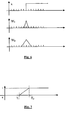
- Figure 3A shows a Haar wavelet at scale 1, time 0;
- Figure 3B shows a signal x(u);
- Figure 3C shows the product of the Haar wavelet of Figure 3A and the signal of Figure 3B (i.e. the wavelet multiple signal or wavelet coefficient);
- Figure 4A shows the Haar wavelet at scale 2, time 0;
- Figure 4B shows the signal x(u);
- Figure 4C shows the product of the Haar wavelet of Figure 4A and the signal of Figure 4B ;
- Figure 5A shows the Haar wavelet at scale 1, time 1;
- Figure 5B shows the signal x(u);
- Figure 5C shows the product of the Haar wavelet of Figure 5A and the signal of Figure 5B ;
- Figure 6 shows a signal x representing a transitional area in an image and corresponding wavelet coefficients at different scales
- Figure 7 shows an exemplary shrinkage function
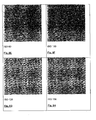
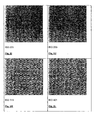
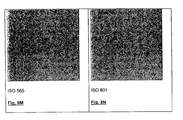
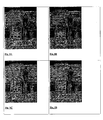
- Figures 8A to 8N are noise images captured by a digital camera at different ISO settings
- Figures 9A to 9H show digital images captured by a digital camera at different ISO settings and corresponding denoised images generated by the apparatus of Figure 1 ;
- Figures 10A to 10C show another digital image captured by a digital camera and a corresponding denoised image generated by the apparatus of Figure 1 .
- apparatus 40 comprises a processing unit 44, random access memory (“RAM”) 48, non-volatile memory 52, a communication interface 56, a user interface 64 and a display 68, all in communication over a local bus 72.
- RAM random access memory
- non-volatile memory 52 non-volatile memory 52
- communication interface 56 communication interface 56
- user interface 64 user interface 64
- display 68 display 68
- a noise reduction application is stored in the non-volatile memory 52.
- the noise reduction application is retrieved from the non-volatile memory 52, loaded into the RAM 48 and executed by the processing unit 44 when the apparatus 40 is used to process images to remove noise therein.
- FIG. 2 is a flowchart showing the general method employed by the apparatus 40 in order to reduce noise in an image during execution of the noise reducing application.
- the noise reduction application employs wavelet decomposition, wavelet coefficient modification and wavelet reconstruction during the image denoising process.
- the image is wavelet decomposed using a Haar wavelet into wavelet detail spaces of different scales, with each wavelet detail space comprising a plurality of wavelet detail subbands (step 100).
- the wavelet detail subbands at each scale represent the details of the image at that scale.
- Each wavelet detail subband comprises a matrix of wavelet coefficients. Wavelet shrinkage ratios based on the energy feature space of the wavelet coefficients are then generated and normalized (step 102).
- the normalized wavelet shrinkage ratios are applied to the wavelet coefficients (step 104). By modifying the wavelet coefficients in this manner, noise in the image is suppressed without adversely effecting image details. The modified wavelet coefficients are then reconstructed thereby to yield the noise reduced image (step 106).
- the preservation of energy in wavelet coefficients allows wavelet coefficients to be used to measure discontinuities in images. For example, the energy of wavelet coefficients associated with homogenous regions in images is close to zero. The energy of wavelet coefficients associated with high transitional areas in images, such as for example edges (i.e. image detail), is however, very high.
- Figure 6 shows a signal x representing a transitional area in an image, such as for example an edge, and corresponding wavelet coefficients W 1 and W 2 representing the edge at different scales.
- the energy of the wavelet coefficients W 1 and W 2 does not decrease at higher scales.
- the noise reducing technique employed by apparatus 40 makes use of this different wavelet coefficient energy behavior to reduce effectively noise in images as will now be described.
- the image is initially wavelet decomposed into wavelet detail spaces at different scales, with each wavelet detail space comprising a plurality of wavelet detail subbands.
- each wavelet detail space comprising a plurality of wavelet detail subbands.
- the image is initially decomposed into four (4) wavelet subbands, namely high-high (HH), high-low (HL), low-high (LH) and low-low (LL) subbands.
- the HH, HL and LH subbands represent the wavelet detail subbands at level one (1).
- the LL subband which is the low frequency approximation, is then decomposed into HH, HL, LH and LL subbands at the next level two (2).
- the HH, HL and LH subbands represent the wavelet detail subbands at level two (2).
- the LL subband is then decomposed into HH, HL, LH and LL subbands at the next level three (3). This process continues until the J 0 -th level is reached.
- the LL subband at this level represents the coarsest approximation of the image and is substantially noise free.
- the feature energy space of the wavelet coefficients is determined.
- a shrinkage ratio for each of the wavelet coefficients is calculated (step 104) according to Equation (13) below:
- Shrinkage j p Shrinkage l HH p , Shrinkage l HL p , Shrinkage l LH p
- Shrinkage j HH p ⁇ 1 Feature Energy j HH p > K * TH j HH Feature Energy l HH p - K * TH j HH K * TH j HH - K * TL j HH 0 Feature Energy j HH p ⁇ K * TL j HH
- Shrinkage j HL p ⁇ 1 Feature Energy j HL p > K * TH j HL Feature Energy l HL p - K * TH j HL K * TH j HL - K * TL j HL 0 Feature Energy j HL p ⁇ K * TL
- the parameter K may be fixed or adjustable either manually or automatically.
- Figure 7 shows an exemplary shrinkage ratio.
- the modified or "shrunk" wavelet coefficients are then reconstructed to yield the noise reduced images at step 106.
- the thresholds TL j and TH j used during calculation of the shrinkage ratios assist in distinguishing between image noise and image detail and to maintain a balance between removing noise and maintaining image detail. If the feature energy calculated for a wavelet coefficient is less than the threshold TL j , the wavelet coefficient is deemed to represent noise. If the feature energy calculated for a wavelet coefficient is greater than the threshold TH j , the wavelet coefficient is deemed to represent image detail. Noise images are used in this embodiment to select the thresholds TL j and TH j at each scale.
- noise images at different ISO settings and a 1/3 EV stop were captured using a digital camera employing a Penguin® digital camera board produced by Seiko Epson Corporation as shown in Figures 8A and 8N .
- a 256x256 pixel sub-window of each noise image was extracted and the sub-windows were wavelet decomposed as described above.
- the noise energy level at 68% of accumulated feature energy was determined and used as threshold TL j HH .
- the noise energy level at 98% of the accumulated feature energy of the HH suband was also determined and used as threshold TH j HH .
- the thresholds TH j HL TL j LH TH j HL and TH j LH for the HL and LH subbands at scale j were obtained in a similar manner.
- the thresholds TL j and TH j for each scale were recorded and represent the noise profile of the image capture device for that scale. If desired, a histogram of the noise image feature energy at each scale may also be recorded to form a noise profile.
- Figures 9A to 9H show digital images captured by a digital camera at different ISO settings and corresponding denoised images generated by the apparatus 40.
- Figure 9A shows an image captured by a digital camera at an ISO setting equal to one-hundred (100) and Figure 9B shows the corresponding denoised image.
- Figure 9C shows an image captured by a digital camera at an ISO setting equal to two-hundred (200) and Figure 9D shows the corresponding denoised image.
- Figure 9E shows an image captured by a digital camera at an ISO setting equal to four-hundred (400) and Figure 9F shows the corresponding denoised image.
- Figure 9G shows an image captured by a digital camera at an ISO setting equal to six-hundred (600) and Figure 9H shows the corresponding denoised image.
- Figures 10A and 10C show another digital image captured by a digital camera and the corresponding denoised image generated by the apparatus 40.
- a sub-window of pixels in the image of Figure 10A is used to determine the thresholds TL j and TH j .
- the entire image is wavelet decomposed and then wavelet reconstructed following modification of the wavelet coefficients based on the energy of the wavelet coefficients.
- each channel of the image can be processed separately.
- the noise level is higher.
- the Y channel of the image may be used to obtain prior possibilities for edges.
- the noise reducing technique may be performed only on the Y of the images channel in order to reduce the processing time.
- Haar wavelet Although use of a Haar wavelet is discussed above, those of skill in the art will appreciate that other wavelets such as for example Daubechies, Coiflets or Symmlet wavelets may be used.
- the noise reducing technique is described above in a post-processing environment where images are processed downstream of the equipment used to capture the images.
- the noise reducing technique may be employed in image capture devices such for example digital cameras, digital video recorders etc. to process and noise reduce images. This image denoising may be performed automatically prior to image display or in response to user input.
- the noise reducing technique may be used to denoise images captured in a number of fields including for example, astronomy, medical imaging, radar imaging, natural photography etc.
- the noise reducing application may run independently or may be incorporated into other available image processing applications to provide enhanced functionality to those applications.
- the software application may comprise program modules including routines, programs, object components, data structures etc. and be embodied as computer-readable program code stored on a computer-readable medium.
- the computer-readable medium is any data storage device that can store data, which can thereafter be read by a computer system. Examples of computer-readable medium include for example read-only memory, random-access memory, hard disk drives, magnetic tape, CD-ROMs and other optical data storage devices.
- the computer-readable program code can also be distributed over a network including coupled computer systems so that the computer-readable program code is stored and executed in a distributed fashion.
Landscapes
- Engineering & Computer Science (AREA)
- Physics & Mathematics (AREA)
- General Physics & Mathematics (AREA)
- Theoretical Computer Science (AREA)
- Multimedia (AREA)
- Image Processing (AREA)
- Apparatus For Radiation Diagnosis (AREA)
- Picture Signal Circuits (AREA)
- Facsimile Image Signal Circuits (AREA)
Applications Claiming Priority (1)
| Application Number | Priority Date | Filing Date | Title |
|---|---|---|---|
| US11/620,288 US7778484B2 (en) | 2007-01-05 | 2007-01-05 | Method and apparatus for reducing noise in an image using wavelet decomposition |
Publications (2)
| Publication Number | Publication Date |
|---|---|
| EP1942461A2 true EP1942461A2 (de) | 2008-07-09 |
| EP1942461A3 EP1942461A3 (de) | 2011-09-14 |
Family
ID=39204791
Family Applications (1)
| Application Number | Title | Priority Date | Filing Date |
|---|---|---|---|
| EP07016778A Withdrawn EP1942461A3 (de) | 2007-01-05 | 2007-08-27 | Verfahren und Vorrichtung zur Minderung von Bildrauschen mittels Waveletzerlegung |
Country Status (3)
| Country | Link |
|---|---|
| US (1) | US7778484B2 (de) |
| EP (1) | EP1942461A3 (de) |
| JP (1) | JP2008171402A (de) |
Cited By (2)
| Publication number | Priority date | Publication date | Assignee | Title |
|---|---|---|---|---|
| CN111681243A (zh) * | 2020-08-17 | 2020-09-18 | 广东利元亨智能装备股份有限公司 | 焊接图像处理方法、装置及电子设备 |
| CN112991224A (zh) * | 2021-04-07 | 2021-06-18 | 李�杰 | 基于改进小波阈值函数的图像去噪算法 |
Families Citing this family (21)
| Publication number | Priority date | Publication date | Assignee | Title |
|---|---|---|---|---|
| US8761504B2 (en) * | 2006-11-29 | 2014-06-24 | President And Fellows Of Harvard College | Spatio-spectral sampling paradigm for imaging and a novel color filter array design |
| WO2008067479A1 (en) * | 2006-11-29 | 2008-06-05 | President And Fellows Of Harvard College | A framework for wavelet-based analysis and processing of color filter array images with applications to denoising and demosaicing |
| KR101379256B1 (ko) * | 2007-07-09 | 2014-04-02 | 삼성전자주식회사 | 노이즈에 의한 신호 왜곡 보상 장치 및 그 방법 |
| KR101552680B1 (ko) * | 2009-03-09 | 2015-09-14 | 삼성전자 주식회사 | 노이즈 저감 장치 및 방법 |
| KR101618298B1 (ko) * | 2009-10-23 | 2016-05-09 | 삼성전자주식회사 | 고감도 영상 생성 장치 및 방법 |
| CN101847257B (zh) * | 2010-06-10 | 2012-06-20 | 上海电力学院 | 基于非局部均值与多级定向图像的图像降噪方法 |
| CN101900674A (zh) * | 2010-07-02 | 2010-12-01 | 天津大学 | 一种用于二氧化碳浓度检测信号静噪的小波滤波方法 |
| US9836433B1 (en) * | 2012-04-02 | 2017-12-05 | Rockwell Collins, Inc. | Image processing using multiprocessor discrete wavelet transform |
| KR102074857B1 (ko) * | 2012-09-26 | 2020-02-10 | 삼성전자주식회사 | 이벤트 기반 비전 센서를 이용한 근접 센서 및 근접 센싱 방법 |
| US8879863B1 (en) * | 2013-05-07 | 2014-11-04 | Qualcomm Technologies, Inc. | Method for determining noise level |
| US10249065B2 (en) * | 2015-05-08 | 2019-04-02 | Max-Planck-Gesellschaft Zur Foerderung Der Wissenschaften E.V | Method and device for magnetic resonance imaging with improved sensitivity by noise reduction |
| US9858495B2 (en) * | 2015-06-23 | 2018-01-02 | Hong Kong Applied Science And Technology Research | Wavelet-based image decolorization and enhancement |
| CN109727200A (zh) * | 2017-10-30 | 2019-05-07 | 上海交通大学 | 基于贝叶斯张量分解的相似块堆聚图像消噪方法及系统 |
| KR101958194B1 (ko) | 2017-11-30 | 2019-03-15 | 인천대학교 산학협력단 | 변환 도메인의 대조비 개선 장치 및 방법 |
| CN109345475B (zh) * | 2018-09-19 | 2021-07-23 | 长安大学 | 一种无人机遥感山区公路图像融合滤波方法 |
| CN109443367B (zh) * | 2018-12-27 | 2022-03-15 | 合肥工业大学 | 一种基于均值聚类随机粒子群算法的rfid定位方法 |
| CN111612707B (zh) * | 2020-04-30 | 2023-04-18 | 杭州电子科技大学 | 一种基于小波变换的神经网络图像去噪方法 |
| CN112084845B (zh) * | 2020-07-30 | 2023-05-02 | 中国人民解放军63892部队 | 基于多尺度小波系数自相关的低频1/f噪声消除方法 |
| CN113324918B (zh) * | 2021-01-26 | 2023-01-24 | 核工业北京地质研究院 | 一种岩石光谱去噪方法 |
| CN113435855B (zh) * | 2021-07-05 | 2022-05-20 | 广州市市政集团有限公司 | 一种基于5g通信的施工信息管理系统 |
| CN117495700B (zh) * | 2023-09-22 | 2024-08-16 | 深圳光现科技有限公司 | 一种光器件接收信号处理方法 |
Family Cites Families (24)
| Publication number | Priority date | Publication date | Assignee | Title |
|---|---|---|---|---|
| US5453945A (en) * | 1994-01-13 | 1995-09-26 | Tucker; Michael R. | Method for decomposing signals into efficient time-frequency representations for data compression and recognition |
| US5802369A (en) * | 1996-04-22 | 1998-09-01 | The United States Of America As Represented By The Secretary Of The Navy | Energy-based wavelet system and method for signal compression and reconstruction |
| TW343308B (en) | 1996-10-04 | 1998-10-21 | Adoban Tesuto Kk | Image processing method |
| US5953388A (en) * | 1997-08-18 | 1999-09-14 | George Mason University | Method and apparatus for processing data from a tomographic imaging system |
| US6058214A (en) * | 1998-01-20 | 2000-05-02 | At&T Corp. | Compression of partially masked still images |
| US7068851B1 (en) * | 1999-12-10 | 2006-06-27 | Ricoh Co., Ltd. | Multiscale sharpening and smoothing with wavelets |
| US6944350B2 (en) * | 1999-12-17 | 2005-09-13 | Utah State University | Method for image coding by rate-distortion adaptive zerotree-based residual vector quantization and system for effecting same |
| CA2309002A1 (en) | 2000-05-23 | 2001-11-23 | Jonathan Martin Shekter | Digital film grain reduction |
| US6836569B2 (en) | 2001-04-13 | 2004-12-28 | Erwan Le Pennec | Method and apparatus for processing or compressing n-dimensional signals by foveal filtering along trajectories |
| US7206459B2 (en) * | 2001-07-31 | 2007-04-17 | Ricoh Co., Ltd. | Enhancement of compressed images |
| US6933983B2 (en) | 2001-09-10 | 2005-08-23 | Jaldi Semiconductor Corp. | System and method for reducing noise in images |
| AU2002336643A1 (en) | 2001-09-21 | 2003-04-01 | Cardiomag Imaging, Inc. | Nonlinear noise reduction for magnetocardiograms using wavelet transforms |
| JP2004127064A (ja) * | 2002-10-04 | 2004-04-22 | Konica Minolta Holdings Inc | 画像処理方法、画像処理装置、画像処理プログラム及び画像記録装置 |
| JP2004242285A (ja) * | 2003-01-14 | 2004-08-26 | Fuji Photo Film Co Ltd | ノイズ抑制処理方法および装置並びにプログラム |
| US7609297B2 (en) | 2003-06-25 | 2009-10-27 | Qst Holdings, Inc. | Configurable hardware based digital imaging apparatus |
| US7260272B2 (en) | 2003-07-10 | 2007-08-21 | Samsung Electronics Co.. Ltd. | Method and apparatus for noise reduction using discrete wavelet transform |
| KR100547853B1 (ko) * | 2003-07-28 | 2006-01-31 | 삼성전자주식회사 | 블록별 에너지를 기초로 정지 영상을 적응적으로 부호화할수 있는 이산 웨이블렛 변환 장치 및 방법 |
| US7551792B2 (en) | 2003-11-07 | 2009-06-23 | Mitsubishi Electric Research Laboratories, Inc. | System and method for reducing ringing artifacts in images |
| JP4339671B2 (ja) * | 2003-11-27 | 2009-10-07 | オリンパス株式会社 | 撮像装置 |
| US20050207660A1 (en) | 2004-03-16 | 2005-09-22 | Sozotek, Inc. | System and method for reduction of compressed image artifacts |
| US7377170B2 (en) * | 2004-04-08 | 2008-05-27 | University Of South Florida | System and method for the identification of chemical mechanical planarization defects |
| US20050265633A1 (en) | 2004-05-25 | 2005-12-01 | Sarnoff Corporation | Low latency pyramid processor for image processing systems |
| US7406396B2 (en) * | 2004-11-08 | 2008-07-29 | University Of South Florida | System and method for online end point detection for use in chemical mechanical planarization |
| US7391915B1 (en) * | 2005-08-12 | 2008-06-24 | Texas Instruments Incorporated | Cache friendly method for performing inverse discrete wavelet transform |
-
2007
- 2007-01-05 US US11/620,288 patent/US7778484B2/en active Active
- 2007-08-27 EP EP07016778A patent/EP1942461A3/de not_active Withdrawn
- 2007-11-28 JP JP2007306942A patent/JP2008171402A/ja not_active Withdrawn
Cited By (2)
| Publication number | Priority date | Publication date | Assignee | Title |
|---|---|---|---|---|
| CN111681243A (zh) * | 2020-08-17 | 2020-09-18 | 广东利元亨智能装备股份有限公司 | 焊接图像处理方法、装置及电子设备 |
| CN112991224A (zh) * | 2021-04-07 | 2021-06-18 | 李�杰 | 基于改进小波阈值函数的图像去噪算法 |
Also Published As
| Publication number | Publication date |
|---|---|
| US7778484B2 (en) | 2010-08-17 |
| EP1942461A3 (de) | 2011-09-14 |
| JP2008171402A (ja) | 2008-07-24 |
| US20080166064A1 (en) | 2008-07-10 |
Similar Documents
| Publication | Publication Date | Title |
|---|---|---|
| EP1942461A2 (de) | Verfahren und Vorrichtung zur Minderung von Bildrauschen mittels Waveletzerlegung | |
| EP4109392B1 (de) | Bildverarbeitungsverfahren und bildverarbeitungsvorrichtung | |
| US7181086B2 (en) | Multiresolution method of spatially filtering a digital image | |
| US7386181B2 (en) | Image display apparatus | |
| US7551792B2 (en) | System and method for reducing ringing artifacts in images | |
| US8427559B2 (en) | Image data processing method by reducing image noise, and camera integrating means for implementing said method | |
| US7280703B2 (en) | Method of spatially filtering a digital image using chrominance information | |
| US7916940B2 (en) | Processing of mosaic digital images | |
| US6801672B1 (en) | Removing noise from a color image using wavelets | |
| KR101901602B1 (ko) | 디지털 사진에서 노이즈를 제거하는 장치 및 방법 | |
| CN101816017B (zh) | 图像处理装置以及程序 | |
| JP7362297B2 (ja) | 画像処理装置、画像処理方法、及びプログラム | |
| EP1223550A2 (de) | Verfahren zur Erkennung von Hautfarbe in digitalen Bildern | |
| EP1308889A2 (de) | Verfahren zur räumlichen Filterung von digitalen Bildern zur Rauschunterdrückung, Rauschschätzung oder digitalen Bildverbesserung | |
| CN1985274A (zh) | 用于复原图像模型中颜色分量的方法、系统和程序模块 | |
| EP1840830B1 (de) | Bildverarbeitungsverfahren | |
| US11915392B2 (en) | Image enhancement method and apparatus | |
| US8004586B2 (en) | Method and apparatus for reducing noise of image sensor | |
| US8942477B2 (en) | Image processing apparatus, image processing method, and program | |
| JP2002269558A (ja) | 色の相互相関統計量を利用した、デジタル画像から雑音を計算する方法。 | |
| US7522782B2 (en) | Digital image denoising | |
| US9111339B1 (en) | System and method for reducing noise from an image | |
| Rabie | Adaptive hybrid mean and median filtering of high-ISO long-exposure sensor noise for digital photography | |
| Safonov et al. | Adaptive sharpening of photos | |
| He et al. | A novel hybrid model framework to blind color image deconvolution |
Legal Events
| Date | Code | Title | Description |
|---|---|---|---|
| PUAI | Public reference made under article 153(3) epc to a published international application that has entered the european phase |
Free format text: ORIGINAL CODE: 0009012 |
|
| AK | Designated contracting states |
Kind code of ref document: A2 Designated state(s): AT BE BG CH CY CZ DE DK EE ES FI FR GB GR HU IE IS IT LI LT LU LV MC MT NL PL PT RO SE SI SK TR |
|
| AX | Request for extension of the european patent |
Extension state: AL BA HR MK RS |
|
| PUAL | Search report despatched |
Free format text: ORIGINAL CODE: 0009013 |
|
| AK | Designated contracting states |
Kind code of ref document: A3 Designated state(s): AT BE BG CH CY CZ DE DK EE ES FI FR GB GR HU IE IS IT LI LT LU LV MC MT NL PL PT RO SE SI SK TR |
|
| AX | Request for extension of the european patent |
Extension state: AL BA HR MK RS |
|
| RIC1 | Information provided on ipc code assigned before grant |
Ipc: G06T 5/00 20060101AFI20110810BHEP |
|
| AKY | No designation fees paid | ||
| REG | Reference to a national code |
Ref country code: DE Ref legal event code: R108 |
|
| REG | Reference to a national code |
Ref country code: DE Ref legal event code: R108 Effective date: 20120523 |
|
| STAA | Information on the status of an ep patent application or granted ep patent |
Free format text: STATUS: THE APPLICATION IS DEEMED TO BE WITHDRAWN |
|
| 18D | Application deemed to be withdrawn |
Effective date: 20120315 |