EP1944010A2 - Aufhell- und/oder Färbemittel mit Acrylsäurederivat (en) - Google Patents
Aufhell- und/oder Färbemittel mit Acrylsäurederivat (en) Download PDFInfo
- Publication number
- EP1944010A2 EP1944010A2 EP07022748A EP07022748A EP1944010A2 EP 1944010 A2 EP1944010 A2 EP 1944010A2 EP 07022748 A EP07022748 A EP 07022748A EP 07022748 A EP07022748 A EP 07022748A EP 1944010 A2 EP1944010 A2 EP 1944010A2
- Authority
- EP
- European Patent Office
- Prior art keywords
- group
- bis
- amino
- eine
- acid
- Prior art date
- Legal status (The legal status is an assumption and is not a legal conclusion. Google has not performed a legal analysis and makes no representation as to the accuracy of the status listed.)
- Granted
Links
- 0 **C(N1*)=C(*)C(*)=*(*)C1=* Chemical compound **C(N1*)=C(*)C(*)=*(*)C1=* 0.000 description 1
- OLYBXSQSVYXAPH-UHFFFAOYSA-N CN(C)c(cc1)ccc1C(c1ccc2)=[N+](C)c3c1c2ccc3 Chemical compound CN(C)c(cc1)ccc1C(c1ccc2)=[N+](C)c3c1c2ccc3 OLYBXSQSVYXAPH-UHFFFAOYSA-N 0.000 description 1
- SMESAHFVSAHRQM-UHFFFAOYSA-N CN(c(cc1)ccc1OC)/N=C/c1cc[n+](C)cc1 Chemical compound CN(c(cc1)ccc1OC)/N=C/c1cc[n+](C)cc1 SMESAHFVSAHRQM-UHFFFAOYSA-N 0.000 description 1
Classifications
-
- A—HUMAN NECESSITIES
- A61—MEDICAL OR VETERINARY SCIENCE; HYGIENE
- A61Q—SPECIFIC USE OF COSMETICS OR SIMILAR TOILETRY PREPARATIONS
- A61Q5/00—Preparations for care of the hair
- A61Q5/06—Preparations for styling the hair, e.g. by temporary shaping or colouring
- A61Q5/065—Preparations for temporary colouring the hair, e.g. direct dyes
-
- A—HUMAN NECESSITIES
- A61—MEDICAL OR VETERINARY SCIENCE; HYGIENE
- A61K—PREPARATIONS FOR MEDICAL, DENTAL OR TOILETRY PURPOSES
- A61K8/00—Cosmetics or similar toiletry preparations
- A61K8/18—Cosmetics or similar toiletry preparations characterised by the composition
- A61K8/30—Cosmetics or similar toiletry preparations characterised by the composition containing organic compounds
- A61K8/40—Cosmetics or similar toiletry preparations characterised by the composition containing organic compounds containing nitrogen
- A61K8/42—Amides
-
- A—HUMAN NECESSITIES
- A61—MEDICAL OR VETERINARY SCIENCE; HYGIENE
- A61K—PREPARATIONS FOR MEDICAL, DENTAL OR TOILETRY PURPOSES
- A61K8/00—Cosmetics or similar toiletry preparations
- A61K8/18—Cosmetics or similar toiletry preparations characterised by the composition
- A61K8/30—Cosmetics or similar toiletry preparations characterised by the composition containing organic compounds
- A61K8/49—Cosmetics or similar toiletry preparations characterised by the composition containing organic compounds containing heterocyclic compounds
-
- A—HUMAN NECESSITIES
- A61—MEDICAL OR VETERINARY SCIENCE; HYGIENE
- A61K—PREPARATIONS FOR MEDICAL, DENTAL OR TOILETRY PURPOSES
- A61K2800/00—Properties of cosmetic compositions or active ingredients thereof or formulation aids used therein and process related aspects
- A61K2800/80—Process related aspects concerning the preparation of the cosmetic composition or the storage or application thereof
- A61K2800/95—Involves in-situ formation or cross-linking of polymers
Definitions
- the present invention relates to means for dyeing and / or whitening keratinic fibers, i. Agent for use on keratin fibers, in particular human hair, and their use.
- Coupler and developer components are also referred to as oxidation dye precursors.
- hair dyeing and / or lightening agents are mixed in solid or pasty form with dilute aqueous hydrogen peroxide solution. This mixture is then applied to the hair and rinsed again after a certain exposure time.
- the duration of exposure to the hair to achieve complete coloration or lightening is between about 30 and 40 minutes. It is obvious that there is a need among users of these hair dyes or bleaching agents to reduce this exposure time.
- acrylic acid derivatives can be radically polymerized in the presence of keratinic fibers and thereby dye the fiber intensively and brilliantly with high fastness properties.
- the dyeings are also very resistant to light and UV radiation and exceed conventional colorants.
- Keratin fibers mean furs, wool, feathers and in particular human hair. Although the compositions according to the invention are primarily suitable for dyeing and / or whitening keratin fibers, in principle, there is nothing to prevent their use in other fields as well.
- the agents according to the invention contain as essential ingredient at least one compound of the formula (I).
- the group Y is an arbitrarily functionalized alkyl radical.
- the unsubstituted radicals -CH 2 -, - (CH 2 ) 2 -, - (CH 2 ) 3 -, - (CH 2 ) 4 -, - (CH 2 ) 5 -, - (CH 2 ) 6 have proven useful -, - (CH 2 ) 7 -, - (CH 2 ) 8 -, - (CH 2 ) 9 - and the substituted representatives -CH (OH) -, -CH (OH) - (CH 2 ) -, - ( CH 2 ) -CH (OH) - (CH 2 ) -, -CH (OH) - (CH 2 ) 2 -, - (CH 2 ) 2 -CH (OH) - (CH 2 ) 2 -, - (CH 2 ) 2 -CH (OH
- the acrylic acid derivatives of the formula (I) can carry colored molecular residues from the various classes of dyes.
- acridine dyes alizarin dyes, alkaloid dyes, anthraquinone dyes, arcyria dyes, azine dyes, azo dyes, cyanine dyes, dermocybene dyes, diarylcarbenium dyes, diazo dyes, indulin dyes, phthalocyanine dyes, leprocyanine dyes, methine and polymethine dyes, myxomycete fibers, naphthol dyes, nitro dyes, oxazine dyes, oxonol dyes, Patent blue dyes, phenazine dyes, phenoxazazone dyes, pyrrole dyes, thiazine dyes, thiazole dyes, thioxanthene dyes, triarylmethane dyes, vinylsulf
- the aromatic ring in formula (Ia) may be substituted, with substitution with alkyl groups and in particular with methyl groups being preferred.
- Very particularly preferred representatives of the formula (Ia) have either an unsubstituted or a methyl-substituted aromatic ring.
- acceptors are carbo- or heterocyclic systems, which preferably have electron-accepting properties and are particularly preferably substituted by nitro groups and / or sulfonyl groups and / or acyl groups,
- R is -H.
- R ' is -H.
- R " is -H.
- Preferred radicals Y are -CH 2 -, - (CH 2 ) 2 -, - (CH 2 ) 3 -. Further preferred are - (CH 2 ) 2 -N (CH 2 CH 3 ) - and - (CH 2 ) 3 -N (CH 3 ) -.
- Particularly preferred agents according to the invention for dyeing and / or lightening keratinic fibers are characterized in that they contain at least one acrylic acid derivative from the group contain.
- the agents according to the invention may contain the acrylic acid derivative or derivatives of the formula (I) in varying amounts. Preference is given to compositions according to the invention for dyeing and / or whitening keratinic fibers which contain the compound (s) of the formula (I) in amounts of from 0.001 to 5% by weight, preferably from 0.0025 to 2.5% by weight preferably from 0.005 to 1.5 wt .-% and in particular from 0.01 to 1 wt .-%, each based on the total agent included.
- the polymerization of the compound (s) of formula (I) in the presence of keratinic fibers provides durable, very true and brilliant colorations.
- the polymerization is preferably started radically, wherein the usual polymerization initiators can be used.
- the usual polymerization initiators can be used.
- hydrogen peroxide, potassium persulfate, azo compounds, redox initiators, metal salts, UV initiators, etc. have proven useful.
- Particularly preferred examples are tert-butyl peroxides, potassium peroxodisulfate, cumene hydroperoxide, azo compounds, benzoyl peroxide, organosulfides, tri- and diarylmethyl derivatives, alkoxyamines and transition metal complexes of cobalt and copper.
- compositions according to the invention in the form of two preparations which are mixed together immediately before use to form an application mixture.
- Corresponding compositions according to the invention for dyeing and / or whitening keratinic fibers which are in the form of two separately packaged formulations A and B, which are mixed to form an application composition immediately before use, wherein the preparation A contains the acrylic acid derivative (s) and the Preparation B contains polymerization initiator (s) are preferred according to the invention.
- agents according to the invention for dyeing and / or lightening keratinic fibers are preferred which, based on their weight, contain from 0.01 to 1% by weight of at least one polymerization inhibitor, preferably from the group of hydroquinone, hydroquinone derivatives, 2,6-diisocyanate. tert-butyl-p-cresol, nitrophenols, N-nitrosoamines such as N-nitrosodiphenylamine or salts of N-nitrosocyclohexylhydroxylamine.
- compositions according to the invention If only one monomer of the formula (I) is used in the compositions according to the invention, then homopolymers are contained by polymerization, with several different compounds, copolymers are also possible. Other monomers can be polymerized into the dyeing polymer, for this purpose, the inventive composition must contain the corresponding monomers.
- such functional monomers have proven to be particularly suitable as conomers which impart further advantageous properties such as gloss or feel to the keratinic fiber or improve the adhesion of the polymers to the keratinic fiber.
- MTAC 3-trimethylammoniumpropylmethacrylamide
- APITAC acrylamidopropyltrimethylammonium
- the agents according to the invention serve to change the color of keratinic fibers, in particular human hair.
- the color change can be effected solely on the basis of the acrylic acid derivatives of the formula (I), but the agents according to the invention can also additionally contain further color-modifying substances, for example substantive dyes and / or oxidation dyes.
- oxidation colorants For permanent, intensive colorations with corresponding fastness properties, so-called oxidation colorants are used. Such colorants usually contain oxidation dye precursors, so-called developer components and coupler components.
- the developer components form the actual dyes under the influence of oxidizing agents or of atmospheric oxygen with one another or with coupling with one or more coupler components.
- the oxidation dyes are characterized by excellent, long-lasting dyeing results. For naturally acting dyeings but usually a mixture of a larger number of oxidation dye precursors must be used; In many cases, direct dyes are still used for shading.
- developer components are usually primary aromatic amines with another, located in the para or ortho position free or substituted hydroxy or amino group, diaminopyridine derivatives, heterocyclic hydrazones, 4-aminopyrazolone derivatives and 2,4,5,6-tetraaminopyrimidine and its derivatives used.
- Particularly preferred p-phenylenediamines of formula (E1) are selected from one or more compounds of the group formed from p-phenylenediamine, p-toluenediamine, 2-chloro-p-phenylenediamine, 2,3-dimethyl-p-phenylenediamine , 2,6-dimethyl-p-phenylenediamine, 2,6-diethyl-p-phenylenediamine, 2,5-dimethyl-p-phenylenediamine, N, N-dimethyl-p-phenylenediamine, N, N-diethyl-p-phenylenediamine , N, N-dipropyl-p-phenylenediamine, 4-amino-3-methyl- (N, N-diethyl) -aniline, N, N-bis ( ⁇ -hydroxyethyl) -p-phenylenediamine, 4-N, N Bis ( ⁇ -hydroxyethyl) amino-2-methylaniline,
- Very particularly preferred p-phenylenediamine derivatives of the formula (E1) according to the invention are selected from at least one compound of the group p-phenylenediamine, p-toluenediamine, 2- ( ⁇ -hydroxyethyl) -p-phenylenediamine, 2- ( ⁇ , ⁇ -dihydroxyethyl) - p-phenylenediamine, N, N-bis ( ⁇ -hydroxyethyl) -p-phenylenediamine, N- (4-amino-3-methylphenyl) -N- [3- (1 H -imidazol-1-yl) propyl] amine , as well as the physiologically acceptable salts of these compounds.
- developer component compounds which contain at least two aromatic nuclei which are substituted by amino and / or hydroxyl groups.
- Preferred dinuclear developing agents of the formula (E2) are in particular selected from at least one of the following compounds: N, N'-bis ( ⁇ -hydroxyethyl) -N, N'-bis (4'-aminophenyl) -1,3-diamino -propan-2-ol, N, N'-bis ( ⁇ -hydroxyethyl) -N, N'-bis (4'-aminophenyl) ethylenediamine, N, N'-bis (4'-aminophenyl) - tetramethylenediamine, N, N'-bis ( ⁇ -hydroxyethyl) -N, N'-bis (4'-aminophenyl) tetramethylenediamine, N, N'-bis (4- (methylamino) phenyl) tetramethylenediamine, N , N'-diethyl-N, N'-bis (4'-amino-3'-methylphenyl) ethylenediamine, bis (2
- Very particularly preferred binuclear developer components of the formula (E2) are selected from N, N'-bis ( ⁇ -hydroxyethyl) -N, N'-bis (4-aminophenyl) -1,3-diamino-propan-2-ol , Bis (2-hydroxy-5-aminophenyl) -methane, 1,3-bis (2,5-diaminophenoxy) -propan-2-ol, N, N'-bis (4-aminophenyl) -1, 4-diazacycloheptane, 1,10-bis (2,5-diaminophenyl) -1,4,7,10-tetraoxadecane or one of the physiologically acceptable salts of these compounds.
- Preferred p-aminophenols of the formula (E3) are, in particular, p-aminophenol, N-methyl-p-aminophenol, 4-amino-3-methylphenol, 4-amino-3-fluorophenol, 2-hydroxymethylamino-4-aminophenol, 4 -Amino-3-hydroxymethylphenol, 4-amino-2- ( ⁇ -hydroxyethoxy) -phenol, 4-amino-2-methylphenol, 4-amino-2-hydroxymethylphenol, 4-amino-2-methoxymethyl-phenol, 4-amino 2-aminomethylphenol, 4-amino-2- ( ⁇ -hydroxyethyl-aminomethyl) -phenol, 4-amino-2- ( ⁇ , ⁇ -dihydroxyethyl) -phenol, 4-amino-2-fluorophenol, 4-amino-2 -chlorophenol, 4-amino-2,6-dichlorophenol, 4-amino-2- (diethyl-aminomethyl) -phenol and their physiological
- Very particularly preferred compounds of the formula (E3) are p-aminophenol, 4-amino-3-methylphenol, 4-amino-2-aminomethylphenol, 4-amino-2- ( ⁇ , ⁇ -dihydroxyethyl) -phenol and 4-amino 2- (diethylaminomethyl) -phenol.
- the developer component may be selected from o-aminophenol and its derivatives such as 2-amino-4-methylphenol, 2-amino-5-methylphenol or 2-amino-4-chlorophenol.
- the developer component may be selected from heterocyclic developer components, such as pyrimidine derivatives, pyrazole derivatives, pyrazolopyrimidine derivatives or their physiologically acceptable salts.
- heterocyclic developer components such as pyrimidine derivatives, pyrazole derivatives, pyrazolopyrimidine derivatives or their physiologically acceptable salts.
- Particularly preferred pyrimidine derivatives are in particular the compounds 2,4,5,6-tetraaminopyrimidine, 4-hydroxy-2,5,6-triaminopyrimidine, 2-hydroxy-4,5,6-triaminopyrimidine, 2-dimethylamino-4,5 , 6-triaminopyrimidine, 2,4-dihydroxy-5,6-diaminopyrimidine and 2,5,6-triaminopyrimidine.
- the radical -NG 25 G 26 binds to the 5 position and the radical G 27 to the 3 position of the pyrazole cycle.
- Particularly preferred pyrazole derivatives are in particular the compounds which are selected from 4,5-diamino-1-methylpyrazole, 4,5-diamino-1- ( ⁇ -hydroxyethyl) pyrazole, 3,4-diaminopyrazole, 4,5- Diamino-1- (4'-chlorobenzyl) pyrazole, 4,5-diamino-1,3-dimethylpyrazole, 4,5-diamino-3-methyl-1-phenylpyrazole, 4,5-diamino-1-methyl-3 phenylpyrazole, 4-amino-1,3-dimethyl-5-hydrazinopyrazole, 1-benzyl-4,5-diamino-3-methylpyrazole, 4,5-diamino-3-tert-butyl-1-methylpyrazole, 4 5-diamino-1-tert-butyl-3-methylpyrazole, 4,5-diamino-1- ( ⁇ -hydroxyethyl
- pyrazolo [1,5-a] pyrimidines of the above formula (E6) can be prepared as described in the literature by cyclization from an aminopyrazole or hydrazine.
- Very particularly preferred developer components are selected from at least one compound from the group formed from p-phenylenediamine, p-toluenediamine, 2- ( ⁇ -hydroxyethyl) -p-phenylenediamine, 2- ( ⁇ , ⁇ -dihydroxyethyl) -p phenylenediamine, N, N-bis ( ⁇ -hydroxyethyl) -p-phenylenediamine, N- (4-amino-3-methylphenyl) -N- [3- (1H-imidazol-1-yl) propyl] amine, N , N'-bis ( ⁇ -hydroxyethyl) -N, N'-bis (4-aminophenyl) -1,3-diamino-propan-2-ol, bis (2-hydroxy-5-aminophenyl) -methane , 1,3-bis- (2,5-diaminophenoxy) -propan-2-ol, N, N'-bis (4-
- Examples of (C 1 to C 4 ) -alkyl radicals are the groups -CH 3 , -CH 2 CH 3 , -CH 2 CH 2 CH 3 , -CH (CH 3 ) 2 , -CH 2 CH 2 CH 2 CH 3 , -CH 2 CH (CH 3 ) 2 , -CH (CH 3 ) CH 2 CH 3 , -C (CH 3 ) 3 .
- Examples of (C 1 to C 4 ) -alkoxy radicals according to the invention are -OCH 3 , -OCH 2 CH 3 , -OCH 2 CH 2 CH 3 , -OCH (CH 3 ) 2 , -OCH 2 CH 2 CH 2 CH 3 , OCH 2 CH (CH 3 ) 2 , -OCH (CH 3 ) CH 2 CH 3 , -OC (CH 3 ) 3 , in particular a methoxy or an ethoxy group.
- a (C 1 to C 4 ) monohydroxyalkyl group -CH 2 OH, -CH 2 CH 2 OH, -CH 2 CH 2 CH 2 OH, -CHCH (OH) CH 3 , -CH 2 CH 2 CH 2 CH 2 OH, with the group -CH 2 CH 2 OH being preferred.
- a particularly preferred example of a (C 2 to C 4 ) polyhydroxyalkyl group is the 1,2-dihydroxyethyl group.
- halogen atoms are F, Cl or Br atoms, Cl atoms are very particularly preferred examples.
- nitrogen-containing groups are in particular -NH 2 , (C 1 to C 4 ) -monoalkylamino groups, (C 1 to C 4 ) -dialkylamino groups, (C 1 to C 4 ) -trialkylammonium groups, (C 1 to C 4 ) -monohydroxyalkylamino groups, Imidazolinium and -NH 3 + .
- Examples of (C 1 to C 4 ) monoalkylamino groups are -NHCH 3 , -NHCH 2 CH 3 , -NHCH 2 CH 2 CH 3 , -NHCH (CH 3 ) 2 .
- Examples of (C 1 to C 4 ) -dialkylamino group are -N (CH 3 ) 2 , -N (CH 2 CH 3 ) 2 .
- Examples of (C 1 to C 4 ) trialkylammonium groups are -N + (CH 3 ) 3 , -N + (CH 3 ) 2 (CH 2 CH 3 ), -N + (CH 3 ) (CH 2 CH 3 ) 2 ,
- Examples of (C 1 to C 4 ) -hydroxyalkylamino radicals are -NH-CH 2 CH 2 OH, -NH-CH 2 CH 2 OH, -NH-CH 2 CH 2 CH 2 OH, -NH-CH 2 CH 2 CH 2 OH.
- Examples of (C 1 to C 4 ) alkoxy (C 1 to C 4 ) alkyl groups are the groups -CH 2 CH 2 -O-CH 3 , -CH 2 CH 2 CH 2 -O-CH 3 , -CH 2 CH 2 -O-CH 2 CH 3 , -CH 2 CH 2 CH 2 -O-CH 2 CH 3 , -CH 2 CH 2 -O-CH (CH 3 ), -CH 2 CH 2 CH 2 -O- CH (CH 3 ).
- hydroxy (C 1 to C 4 ) alkoxy radicals are -O-CH 2 OH, -O-CH 2 CH 2 OH, -O-CH 2 CH 2 CH 2 OH, -O-CHCH (OH) CH 3 , -O-CH 2 CH 2 CH 2 CH 2 OH.
- Examples of (C 1 to C 4 ) -acetylaminoalkoxy radicals are -O-CH 2 NHC (O) CH 3 , -O-CH 2 CH 2 NHC (O) CH 3 , -O-CH 2 CH 2 CH 2 NHC (O ) CH 3 , -O-CH 2 CH (NHC (O) CH 3 ) CH 3 , -O-CH 2 CH 2 CH 2 CH 2 NHC (O) CH 3 .
- Examples of (C 1 to C 4 ) -carbamoylaminoalkoxy radicals are -O-CH 2 CH 2 -NH-C (O) -NH 2 , -O-CH 2 CH 2 CH 2 -NH-C (O) -NH 2 , -O-CH 2 CH 2 CH 2 CH 2 -NH-C (O) -NH 2 .
- Examples of (C 1 to C 4 ) -aminoalkyl radicals are -CH 2 NH 2 , -CH 2 CH 2 NH 2 , -CH 2 CH 2 CH 2 NH 2 , -CH 2 CH (NH 2 ) CH 3 , -CH 2 CH 2 CH 2 CH 2 NH 2 .
- Examples of (C 1 to C 4 ) -cyanoalkyl radicals are -CH 2 CN, -CH 2 CH 2 CN, -CH 2 CH 2 CH 2 CN.
- Examples of (C 1 to C 4 ) -hydroxyalkylamino (C 1 to C 4 ) -alkyl radicals are -CH 2 CH 2 NH-CH 2 CH 2 OH, -CH 2 CH 2 CH 2 N H-CH 2 CH 2 OH , -CH 2 CH 2 NH-CH 2 CH 2 CH 2 OH, -CH 2 CH 2 CH 2 NH-CH 2 CH 2 CH 2 OH.
- Examples of di [(C 1 to C 4 ) -hydroxyalkyl] amino (C 1 to C 4 ) -alkyl radicals are -CH 2 CH 2 N (CH 2 CH 2 OH) 2 , -CH 2 CH 2 CH 2 N ( CH 2 CH 2 OH) 2 , -CH 2 CH 2 N (CH 2 CH 2 CH 2 OH) 2 , -CH 2 CH 2 CH 2 N (CH 2 CH 2 CH 2 OH) 2 ,
- An example of aryl groups is the phenyl group.
- Examples of aryl (C 1 to C 4 ) alkyl groups are the benzyl group and the 2-phenylethyl group.
- Coupler components do not form a significant color within the framework of the oxidative dyeing alone, but always require the presence of developer components. Therefore, it is preferred according to the invention that at least one coupler component is additionally used when using at least one developer component.
- Coupler components according to the invention allow at least one substitution of a chemical residue of the coupler by the oxidized form of the developer component. This forms a covalent bond between the coupler and the developer component.
- Couplers are preferably cyclic compounds which carry on cycle at least two groups selected from (i) optionally substituted amino groups and / or (ii) hydroxy groups. These groups are conjugated by a double bond system. When the cyclic compound is a six-membered ring, said groups are preferably in ortho position or meta position to each other.
- Particularly preferred m-aminophenol coupler components are selected from at least one compound selected from the group consisting of m-aminophenol, 5-amino-2-methylphenol, N-cyclopentyl-3-aminophenol, 3-amino-2-chloro-6 -methylphenol, 2-hydroxy-4-aminophenoxyethanol, 2,6-dimethyl-3-aminophenol, 3-trifluoroacetylamino-2-chloro-6-methylphenol, 5-amino-4-chloro-2-methylphenol, 5-amino-4 -methoxy-2-methylphenol, 5- (2'-hydroxyethyl) amino-2-methylphenol, 3- (diethylamino) -phenol, N-cyclopentyl-3-aminophenol, 1,3-dihydroxy-5- (methylamino) - benzene, 3-ethylamino-4-methylphenol, 2,4-dichloro-3-aminophenol and the physiologically acceptable salts of all the abovementioned compounds.
- Particularly preferred m-diaminobenzene coupler components are selected from at least one compound from the group formed from 2- (2,4-diaminophenoxy) ethanol, 1,3-bis (2,4-diaminophenoxy) propane, 1-methoxy 2-amino-4- (2'-hydroxyethylamino) benzene, 1,3-bis (2,4-diaminophenyl) propane, 2,6-bis (2'-hydroxyethylamino) -1-methylbenzene, 2 - (3 [(2-hydroxyethyl) amino] -4-methoxy-5-methylphenyl ⁇ amino) ethanol, 2 - ( ⁇ 3 - [(2-hydroxyethyl) amino] -2-methoxy-5-methylphenyl ⁇ amino) ethanol, 2- ( ⁇ 3 - [(2-hydroxyethyl) amino] -4,5-dimethylphenyl ⁇ amino) ethanol, 2- [3-morpholin-4-ylphenyl) amino] ethanol, 3-
- Particularly preferred o-diaminobenzene coupler components are selected from at least one compound selected from the group consisting of 3,4-diaminobenzoic acid and 2,3-diamino-1-methylbenzene and the physiologically acceptable salts of all of the aforementioned compounds.
- Preferred di- or trihydroxybenzenes and their derivatives are selected from at least one compound of the group formed from resorcinol, resorcinol monomethyl ether, 2-methylresorcinol, 5-methylresorcinol, 2,5-dimethylresorcinol, 2-chlororesorcinol, 4-chlororesorcinol, pyrogallol and 1 , 2,4-trihydroxybenzene.
- radicals G 17 and G 18 are in the ortho position or in the meta position relative to one another.
- Particularly preferred pyridine derivatives are selected from at least one compound of the group formed from 2,6-dihydroxypyridine, 2-amino-3-hydroxypyridine, 2-amino-5-chloro-3-hydroxypyridine, 3-amino-2-methylamino 6-methoxypyridine, 2,6-dihydroxy-3,4-dimethylpyridine, 2,6-dihydroxy-4-methylpyridine, 2,6-diaminopyridine, 2,3-diamino-6-methoxypyridine, 3,5-diamino-2, 6-dimethoxypyridine, 2,6-dihydroxy-3,4-dimethylpyridine, 3,4-diaminopyridine, 2- (2-methoxyethyl) amino-3-amino-6-methoxypyridine, 2- (4'-methoxyphenyl) amino-3 -aminopyridine, and the physiologically acceptable salts of the aforementioned compounds.
- Preferred naphthalene derivatives having at least one hydroxy group are selected from at least one compound of the group formed from 1-naphthol, 2-methyl-1-naphthol, 2-hydroxymethyl-1-naphthol, 2-hydroxyethyl-1-naphthol, 1.3 Dihydroxynaphthalene, 1,5-dihydroxynaphthalene, 1,6-dihydroxynaphthalene, 1,7-dihydroxynaphthalene, 1,8-dihydroxynaphthalene, 2,7-dihydroxynaphthalene and 2,3-dihydroxynaphthalene.
- Particularly preferred indole derivatives are selected from at least one compound of the group which is formed from 4-hydroxyindole, 6-hydroxyindole and 7-hydroxyindole and the physiologically acceptable salts of the abovementioned compounds.
- Particularly preferred indoline derivatives are selected from at least one compound of the group formed from 4-hydroxyindoline, 6-hydroxyindoline and 7-hydroxyindoline and the physiologically acceptable salts of the aforementioned compounds.
- Preferred pyrimidine derivatives are selected from at least one compound of the group formed from 4,6-diaminopyrimidine, 4-amino-2,6-dihydroxypyrimidine, 2,4-diamino-6-hydroxypyrimidine, 2,4,6-trihydroxypyrimidine, 2 -Amino-4-methylpyrimidine, 2-amino-4-hydroxy-6-methylpyrimidine and 4,6-dihydroxy-2-methylpyrimidine and the physiologically acceptable salts of the aforementioned compounds.
- coupler components according to the invention are selected from m-aminophenol, 5-amino-2-methylphenol, N-cyclopentyl-3-aminophenol, 3-amino-2-chloro-6-methylphenol, 2-hydroxy-4-aminophenoxyethanol, 2.6 Dimethyl 3-aminophenol, 3-trifluoroacetylamino-2-chloro-6-methylphenol, 5-amino-4-chloro-2-methylphenol, 5-amino-4-methoxy-2-methylphenol, 5- (2'-hydroxyethyl ) -amino-2-methylphenol, 3- (diethylamino) -phenol, N-cyclopentyl-3-aminophenol, 1,3-dihydroxy-5- (methylamino) -benzene, 3-ethylamino-4-methylphenol, 2,4- Dichloro-3-aminophenol, 2- (2,4-diaminophenoxy) ethanol, 1,3-bis (2,4-diaminophenoxy) propane,
- the coupler components are preferably used in an amount of 0.005 to 20 wt .-%, preferably 0.1 to 5 wt.%, Each based on the ready-to-use oxidation colorant.
- developer components and coupler components are generally used in approximately molar amounts to each other.
- a certain excess of individual oxidation dye precursors is not disadvantageous, so that developer components and coupler components in a molar ratio of 1: 0.5 to 1: 3, in particular 1: 1 to 1: 2 , can stand.
- Examples of (C 1 to C 4 ) -alkyl radicals are the groups -CH 3 , -CH 2 CH 3 , -CH 2 CH 2 CH 3 , -CH (CH 3 ) 2 , -CH 2 CH 2 CH 2 CH 3 , -CH 2 CH (CH 3 ) 2 , -CH (CH 3 ) CH 2 CH 3 , -C (CH 3 ) 3 .
- Examples of (C 1 to C 4 ) -alkoxy radicals according to the invention are -OCH 3 , -OCH 2 CH 3 , -OCH 2 CH 2 CH 3 , -OCH (CH 3 ) 2 , -OCH 2 CH 2 CH 2 CH 3 , OCH 2 CH (CH 3 ) 2 , -OCH (CH 3 ) CH 2 CH 3 , -OC (CH 3 ) 3 , in particular a methoxy or an ethoxy group.
- a (C 1 to C 4 ) monohydroxyalkyl group -CH 2 OH, -CH 2 CH 2 OH, -CH 2 CH 2 CH 2 OH, -CH 2 CH (OH) CH 3 , -CH 2 CH 2 CH 2 CH 2 OH, with the group -CH 2 CH 2 OH being preferred.
- a particularly preferred example of a (C 2 to C 4 ) polyhydroxyalkyl group is the 1,2-dihydroxyethyl group.
- halogen atoms are F, Cl or Br atoms, Cl atoms are very particularly preferred examples.
- nitrogen-containing groups are in particular -NH 2 , (C 1 to C 4 ) -monoalkylamino groups, (C 1 to C 4 ) -dialkylamino groups, (C 1 to C 4 ) -trialkylammonium groups, (C 1 to C 4 ) -monohydroxyalkylamino groups, Imidazolinium and -NH 3 + .
- Examples of (C 1 to C 4 ) monoalkylamino groups are -NHCH 3 , -NHCH 2 CH 3 , -NHCH 2 CH 2 CH 3 , -NHCH (CH 3 ) 2 .
- Examples of (C 1 to C 4 ) -dialkylamino group are -N (CH 3 ) 2 , -N (CH 2 CH 3 ) 2 .
- Examples of (C 1 to C 4 ) trialkylammonium groups are -N + (CH 3 ) 3 , -N + (CH 3 ) 2 (CH 2 CH 3 ), -N + (CH 3 ) (CH 2 CH 3 ) 2 ,
- Examples of (C 1 to C 4 ) -hydroxyalkylamino radicals are -NH-CH 2 CH 2 OH, -NH-CH 2 CH 2 OH, -NH-CH 2 CH 2 CH 2 OH, -NH-CH 2 CH 2 CH 2 OH.
- Examples of (C 1 to C 4 ) alkoxy (C 1 to C 4 ) alkyl groups are the groups -CH 2 CH 2 -O-CH 3 , -CH 2 CH 2 CH 2 -O-CH 3 , -CH 2 CH 2 -O-CH 2 CH 3 , -CH 2 CH 2 CH 2 -O-CH 2 CH 3 , -CH 2 CH 2 -O-CH (CH 3 ) 2 , -CH 2 CH 2 CH 2 -O -CH (CH 3 ) 2 .
- hydroxy (C 1 to C 4 ) alkoxy radicals are -O-CH 2 OH, -O-CH 2 CH 2 OH, -O-CH 2 CH 2 CH 2 OH, -O-CH 2 CH (OH) CH 3 , -O-CH 2 CH 2 CH 2 CH 2 OH.
- Examples of (C 1 to C 4 ) -acetylaminoalkoxy radicals are -O-CH 2 NHC (O) CH 3 , -O-CH 2 CH 2 NHC (O) CH 3 , -O-CH 2 CH 2 CH 2 NHC (O ) CH 3 , -O-CH 2 CH (NHC (O) CH 3 ) CH 3 , -O-CH 2 CH 2 CH 2 CH 2 NHC (O) CH 3 .
- Examples of (C 1 to C 4 ) -carbamoylaminoalkoxy radicals are -O-CH 2 CH 2 -NH-C (O) -NH 2 , -O-CH 2 CH 2 CH 2 -NH-C (O) -NH 2 , -O-CH 2 CH 2 CH 2 CH 2 -NH-C (O) -NH 2 .
- Examples of (C 1 to C 4 ) -aminoalkyl radicals are -CH 2 NH 2 , -CH 2 CH 2 NH 2 , -CH 2 CH 2 CH 2 NH 2 , -CH 2 CH (NH 2 ) CH 3 , -CH 2 CH 2 CH 2 CH 2 NH 2 .
- Examples of (C 1 to C 4 ) -cyanoalkyl radicals are -CH 2 CN, -CH 2 CH 2 CN, -CH 2 CH 2 CH 2 CN.
- Examples of (C 1 to C 4 ) -hydroxyalkylamino (C 1 to C 4 ) -alkyl radicals are -CH 2 CH 2 NH-CH 2 CH 2 OH, -CH 2 CH 2 CH 2 NH-CH 2 CH 2 OH, -CH 2 CH 2 NH-CH 2 CH 2 CH 2 OH, -CH 2 CH 2 CH 2 NH-CH 2 CH 2 CH 2 OH.
- Examples of di [(C 1 to C 4 ) -hydroxyalkyl] amino (C 1 to C 4 ) -alkyl radicals are -CH 2 CH 2 N (CH 2 CH 2 OH) 2 , -CH 2 CH 2 CH 2 N ( CH 2 CH 2 OH) 2 , -CH 2 CH 2 N (CH 2 CH 2 CH 2 OH) 2 , -CH 2 CH 2 CH 2 N (CH 2 CH 2 CH 2 OH) 2 .
- An example of aryl groups is the phenyl group.
- Examples of aryl (C 1 to C 4 ) alkyl groups are the benzyl group and the 2-phenylethyl group.
- dyeing or tinting agents which contain so-called direct drawers as a coloring component. These are dye molecules that attach directly to the substrate and do not require an oxidative process to form the paint. These dyes include, for example, the henna already known from antiquity for coloring body and hair. These dyeings are generally much more sensitive to shampooing than the oxidative dyeings, so that a much more rapid undesirable change in shade or even a visible, homogeneous color loss occurs much faster.
- the agents according to the invention may contain at least one substantive dye. These are dyes that raise directly on the hair and do not require an oxidative process to form the color. Direct dyes are usually nitrophenylenediamines, nitroaminophenols, azo dyes, anthraquinones or indophenols.
- the substantive dyes are each preferably used in an amount of 0.001 to 20 wt .-%, based on the total application preparation.
- the total amount of substantive dyes is preferably at most 20% by weight.
- Direct dyes can be subdivided into anionic, cationic and nonionic substantive dyes.
- Particularly suitable anionic direct dyes are 6-hydroxy-5 - [(4-sulfophenyl) azo] -2-naphthalenesulfonic acid disodium salt (CI 15.985, Food Yellow No. 3, FD & C Yellow No. 6), 2,4-dinitro-1 naphthol-7-sulfonic acid disodium salt (CI 10,316, Acid Yellow 1, Food Yellow No. 1), 2- (indan-1,3-dion-2-yl) quinoline-x, x-sulfonic acid (mixture of mono- and di-sodium Disulfonic acid) (CI 47,005, D & C Yellow No. 10, Food Yellow No.
- Acid Blue 1 bis [4- (diethylamino) phenyl] (5-hydroxy-2,4-disulfophenyl) -carbenium inner salt, calcium salt (2: 1) (CI 42,051, Acid Blue 3), N- [4 - [(2,4-disulfophenyl) [4- [ethyl (phenylmethyl) amino) phenyl] methylene] -2,5-cyclohexadiene- 1-ylidene] -N-ethylbenzenemethanamine hydroxide, inner salt, sodium salt (CI 42,080; Acid Blue 7), (2-sulfophenyl) di [4- (ethyl ((4-sulfophenyl) methyl) amino) phenyl] -carbenium disodium salt betaine (Cl 42.090; Acid Blue 9; FD & C Blue No.
- Preferred anionic substantive dyes are those under the international designations or trade names Acid Yellow 1, Yellow 10, Acid Yellow 23, Acid Yellow 36, Acid Orange 7, Acid Red 33, Acid Red 52, Pigment Red 57: 1, Acid Blue 7, Acid Green 50, Acid Violet 43, Acid Black 1 and Acid Black 52 known compounds.
- Particularly suitable cationic direct dyes are 9- (dimethylamino) -benzo [a] phenoxazine-7-ium chloride (Cl 51.175; Basic Blue 6), di [4- (diethylamino) phenyl] [4- (ethylamino) naphthyl].
- carbenium chloride (Cl 42,595; Basic Blue 7), di (4- (dimethylamino) phenyl) - (4- (methylphenylamino) naphthalen-1-yl) carbenium chloride (CI 42,563, Basic Blue 8), 3,7-Di (dimethylamino) phenothiazine-5-ium chloride (CI 52.015 Basic Blue 9), di [4- (dimethylamino) phenyl] [4- (phenylamino) naphthyl] carbenium chloride (CI 44.045, Basic Blue 26 ), 2 - [(4- (ethyl (2-hydroxyethyl) amino) phenyl) azo] -6-methoxy-3-methylbenzothiazolium methylsulfate (Cl 11.154, Basic Blue 41), 8-amino-2-bromo 5-hydroxy-4-imino-6 - [(3- (trimethylammonio) phenyl) amino] -1
- Preferred cationic substantive dyes of group (c) are in particular the following compounds:
- the compounds of the formulas (DZ1), (DZ3) and (DZ5) which are also known by the names Basic Yellow 87, Basic Orange 31 and Basic Red 51, are very particularly preferred cationic substantive dyes of group (c).
- the cationic direct dyes which are sold under the trademark Arianor ®, according to the invention are also very particularly preferred cationic direct dyes.
- Nonionic substantive dyes are:
- Suitable nonionic substantive dyes are in particular nonionic nitro and quinone dyes and neutral azo dyes.
- Suitable blue nitro dyes are in particular:
- Suitable red nitro dyes are in particular:
- Suitable yellow nitro dyes are in particular:
- 1,2-diamino-4-nitrobenzene (CI 76,020), 1 - [(2-hydroxyethyl) amino] -2-nitrobenzene (HC Yellow 2), 1- (2-hydroxyethoxy) -2 - [(2-hydroxyethyl) amino] -5-nitrobenzene (HC Yellow 4), 1-amino-2 - [(2-hydroxyethyl) amino] -5-nitrobenzene (HC Yellow 5), 4 - [(2,3-dihydroxypropyl) amino] - 3-nitro-1-trifluoromethylbenzene (HC Yellow 6), 2- [di (2-hydroxyethyl) amino] -5-nitrophenol, 2 - [(2-hydroxyethyl) amino] -1-methoxy-5-nitrobenzene , 2-amino-3-nitrophenol, 2-amino-4-nitrophenol, 1-amino-2-methyl-6-nitrobenzene, 1- (2-hydroxyethoxy) -3-methylamino-4-nitrobenzene, 2,3- (
- Suitable quinone dyes are in particular:
- Suitable neutral azo dyes are in particular:
- Preferred nonionic substantive dyes are those under the international designations or trade names HC Yellow 2, HC Yellow 4, HC Yellow 5, HC Yellow 6, HC Yellow 12, HC Orange 1, Disperse Orange 3, HC Red 1, HC Red 3, HC HC Red 11, HC Red 11, HC Red 11, HC Blue 11, HC Blue 2, HC Blue 11, HC Blue 12, Disperse Blue 3, HC Violet 1, Disperse Violet 1, Disperse Violet 4, Disperse Black 9 well-known compounds, as well 1,4-diamino-2-nitrobenzene, 2-amino-4-nitrophenol, 1,4-bis (2-hydroxyethyl) amino-2-nitrobenzene, 3-nitro-4- (2-hydroxyethyl) aminophenol, 2- (2-hydroxyethyl) amino-4,6-dinitrophenol, 4 - [(2-hydroxyethyl) amino] -3-nitro-1-methylbenzene, 1-amino-4- (2-hydroxyethyl) amino-5- Chloro-2-nitrobenzene, 4-amino-3-nitrophenol
- the substantive dyes each represent uniform compounds. Rather, due to the production process for the individual dyes, minor amounts of other components may be included, as far as these do not adversely affect the dyeing result or for other reasons, e.g. toxicological, must be excluded.
- direct dyes also naturally occurring dyes may be used, as for example in henna red, henna neutral, henna black, chamomile flower, sandalwood, black tea, buckthorn bark, sage, bluewood, madder root, Catechu, Sedre and alkano root are included.
- keratinic fibers are characterized in that they additionally - based on its weight - 0.001 to 5 wt .-% of one or more oxidation dye precursors and / or direct dyes.
- precursors of the natural hair dye melanin are applied to the substrate, e.g. Hair, applied; These then form naturally-analogous dyes in the course of oxidative processes in the hair.
- multiple use of agents with 5,6-dihydroxyindoline it is possible to reproduce natural hair color to people with graying hair.
- the dyeing can be done with atmospheric oxygen as the sole oxidant, so that no further oxidizing agent must be used.
- the indoline can be used as the sole dye precursor.
- satisfactory results can often only be achieved for use in persons with originally red and, in particular, dark to black hair color, by using other dye components, in particular special oxidation dye precursors.
- the dyestuff precursors of naturally-analogous dyes are preferably indoles and indolines which have at least two groups selected from hydroxy and / or amino groups, preferably as a substituent on the six-membered ring. These groups may carry further substituents, e.g. Example in the form of etherification or esterification of the hydroxy group or alkylation of the amino group.
- the colorants contain at least one indole and / or indoline derivative.
- Compositions according to the invention which comprise precursors of naturally-analogous dyes are preferably used as air-oxidative colorants. Consequently, in this embodiment said compositions are not added with an additional oxidizing agent.
- Particularly preferred derivatives of indoline are 5,6-dihydroxyindoline, N-methyl-5,6-dihydroxyindoline, N-ethyl-5,6-dihydroxyindoline, N-propyl-5,6-dihydroxyindoline, N-butyl-5,6 dihydroxyindoline and 5,6-dihydroxyindoline-2-carboxylic acid.
- N-methyl-5,6-dihydroxyindoline N-ethyl-5,6-dihydroxyindoline, N-propyl-5,6-dihydroxyindoline, N-butyl-5,6-dihydroxyindoline and especially 5, 6-Dihydroxyindolin.
- Particularly preferred derivatives of indole are 5,6-dihydroxyindole, N-methyl-5,6-dihydroxyindole, N-ethyl-5,6-dihydroxyindole, N-propyl-5,6-dihydroxyindole, N-butyl-5,6- dihydroxyindole, 5,6-dihydroxyindole-2-carboxylic acid.
- N-methyl-5,6-dihydroxyindole N-ethyl-5,6-dihydroxyindole, N-propyl-5,6-dihydroxyindole, N-butyl-5,6-dihydroxyindole, and especially the 5,6 -Dihydroxyindol.
- a first class of oxo dye precursors are compounds having at least one reactive carbonyl group. This first class is called a component (Oxo1).
- a second class of oxo dye precursors form CH-acidic compounds and compounds having primary or secondary amino groups or hydroxy groups, which in turn are selected from compounds of the group formed from primary or secondary aromatic amines, nitrogen-containing heterocyclic compounds and aromatic hydroxy compounds. This second class is called a component (Oxo2).
- the aforementioned components (oxo1) and (oxo2) are generally not themselves dyes, and therefore are not in themselves suitable for coloring keratin-containing fibers. In combination, they form dyes in a non-oxidative process of so-called oxo dyeing. The resulting dyeings have partially color fastness on the keratin-containing fiber, which are comparable to those of the oxidation dyeing.
- the Nuancenspektrum achievable with the gentle oxo staining is very broad and the color obtained often has an acceptable brilliance and color depth.
- the oxo staining method can be readily combined with the oxidative staining system.
- Preferred reactive carbonyl compounds of the component (oxo1) are selected from the group consisting of benzaldehyde and its derivatives, naphthaldehyde and its derivatives, cinnamaldehyde and its derivatives, 2,3,6,7-tetrahydro-1H, 5H-benzo [ij] quinolizine -9-carboxaldehyde, 2,3,6,7-tetrahydro-8-hydroxy-1H, 5H-benzo [ij] quinolizine-9-carboxaldehyde, N-ethylcarbazole-3-aldehyde, 2-formylmethylene-1,3,3 trimethylindoline (Fischer's aldehyde or tribasic aldehyde), 2-indolealdehyde, 3-indolealdehyde, 1-methylindole-3-aldehyde, 2-methylindole-3-aldehyde, 2- (1 ', 3', 3'-tri
- the derivatives of benzaldehydes, naphthaldehydes or cinnamaldehydes of the reactive carbonyl compound according to component (Oxo1) are preferably selected from at least one compound of the group consisting of 4-hydroxy-3-methoxybenzaldehyde, 3,5-dimethoxy-4-hydroxybenzaldehyde, 4-hydroxy 1-naphthaldehyde, 4-hydroxy-2-methoxybenzaldehyde, 3,4-dihydroxy-5-methoxybenzaldehyde, 3,4,5-trihydroxybenzaldehyde, 3,5-dibromo-4-hydroxybenzaldehyde, 4-hydroxy-3-nitrobenzaldehyde, 3 Bromo-4-hydroxybenzaldehyde, 4-hydroxy-3-methylbenzaldehyde, 3,5-dimethyl-4-hydroxybenzaldehyde, 5-bromo-4-hydroxy-3-methoxybenzaldehyde, 4-diethylamino-2-hydroxybenzaldehyde, 4-di
- CH-acidic compounds are generally considered those compounds which carry a bound to an aliphatic carbon atom hydrogen atom, wherein due to electron-withdrawing substituents activation of the corresponding carbon-hydrogen bond is effected.
- these are preferably those CH-acidic compounds which contain an aromatic and / or a heterocyclic radical.
- the heterocyclic radical may again be aliphatic or aromatic.
- the CH-acidic compounds are particularly preferably selected from heterocyclic compounds, in particular cationic, heterocyclic compounds.
- Preferred ring structures which carry the structural unit of the formula (CH-1) are preferably selected according to the invention from 3H-indolium, benzothiazolium, benzoxazolium, 1,2-dihydro-2-oxopyrimidinium, quinolinium, quinoxalinium or pyridinium.
- compounds of the formula (CH-2) are particularly suitable for those in which the radical Het according to formula (CH-2) is derived from one of the heteroaromatic compounds furan, thiophene, pyrrole, isoxazole, isothiazole, imidazole, oxazole, thiazole, pyridine , Pyridazine, pyrimidine, pyrazine, 1,2,3-triazine, 1,2,4-triazine, 1,3,5-triazine, benzopyrrole, benzofuran, benzothiophene, benzimidazole, benzoxazole, indazole, benzoisoxazole, benzoisothiazole, indole, quinoline , Isoquinoline, cinnoline, phthalazine, quinazoline, quinoxaline, acridine, benzoquinoline, benzoisoquinoline, phenazine, benzocinno
- the compounds of formula (CH-2) are selected from at least one compound of the group consisting of 2- (2-furoyl) -acetonitrile, 2- (5-bromo-2-furoyl) -acetonitrile, 2- (5-methyl -2-trifluoromethyl-3-furoyl) -acetonitrile, 3- (2,5-dimethyl-3-furyl) -3-oxopropanitrile, 2- (2-thenoyl) -acetonitrile, 2- (3-thenoyl) -acetonitrile, 2- (5-Fluoro-2-thenoyl) -acetonitrile, 2- (5-chloro-2-thenoyl) -acetonitrile, 2- (5-bromo-2-thenoyl) -acetonitrile, 2- (5-methyl-2 -thenoyl) -acetonitrile, 2- (2,5-dimethyl-3-oyl) -acettonit
- At least one group R 10 or R 12 according to formula (CH-3) necessarily stands for a (C 1 to C 6 ) -alkyl group.
- This alkyl group preferably carries at least two hydrogen atoms on its ⁇ -carbon atom.
- Particularly preferred alkyl groups are the methyl, ethyl, propyl, n-butyl, iso-butyl, n-pentyl, neo-pentyl, n-hexyl group.
- R 10 and R 12 are each independently hydrogen or a methyl group, wherein at least one group R 10 or R 12 is a methyl group.
- Y of the formula (CH-3) is an oxygen or a sulfur atom, more preferably an oxygen atom.
- the radical R 8 of the formula (CH-3) is preferably selected from a (C 1 to C 6 ) -alkyl group (particularly preferably a methyl group), a (C 2 to C 6 ) -alkenyl group (in particular an allyl group), a ( C 2 to C 6 ) hydroxyalkyl group (especially a 2-hydroxyethyl group) or an optionally substituted benzyl group.
- R 11 of the formula (CH-3) is preferably a hydrogen atom.
- radicals R 9 , R 10 and R 12 is a methyl group
- the radical R 11 is a hydrogen atom
- Y is an oxygen or sulfur atom
- the radical R 8 is selected from a ( C 1 to C 6 ) alkyl group (particularly preferably a methyl group), a (C 2 to C 6 ) alkenyl group (especially an allyl group), a (C 2 to C 6 ) hydroxyalkyl group (especially a 2-hydroxyethyl group) or a optionally substituted benzyl group.
- the compounds according to formula (CH-3) are selected from one or more compounds of the group of salts with physiologically acceptable counterion X - , which is formed from salts of 1,2-dihydro-1,3,4,6-tetramethyl-2-oxo-pyrimidiniums, 1,2-dihydro-1,3-diethyl-4,6-dimethyl-2-oxo-pyrimidiniums, 1,2-dihydro-1,3-dipropyl-4,6-dimethyl-2-oxo-pyrimidiniums, 1,2-dihydro-1,3-di (2-hydroxyethyl) -4,6-dimethyl-2-oxo-pyrimidiniums, 1,2-dihydro-1,3-diphenyl-4,6-dimethyl-2-oxo-pyrimidiniums, 1,2-dihydro-1,3,4-trimethyl-2-oxo-pyrimidiniums, 1,2-dihydro-1,3-diethyl-4-
- Very particularly preferred compounds according to formula (CH-3) are selected from one or more compounds of the group of salts with physiologically acceptable counterion X - , which is formed from salts of 1,2-dihydro-1,3,4,6-tetramethyl-2-oxo-pyrimidiniums, 1,2-dihydro-1,3,4-trimethyl-2-oxo-pyrimidiniums, 1-allyl-1,2-dihydro-3,4,6-trimethyl-2-oxo-pyrimidiniums, 1,2-dihydro-1- (2-hydroxyethyl) -3,4,6-trimethyl-2-oxopyrimidinium and 1,2-dihydro-1,3,4,6-tetramethyl-2-thioxo-pyrimidiniums.
- physiologically acceptable counterion X - which is formed from salts of 1,2-dihydro-1,3,4,6-tetramethyl-2-oxo-pyrimidiniums, 1,2-dihydro-1,3,4-trimethyl-2-oxo
- X - is in the formulas (CH-1) and (CH-3) and in the above lists preferably for halide, benzenesulfonate, p-toluenesulfonate, (C 1 to C 4 ) alkanesulfonate, trifluoromethanesulfonate, perchlorate, 0.5 sulfate, hydrogen sulfate, Tetrafluoroborate, hexafluorophosphate or tetrachlorozincate.
- the anions chloride, bromide, iodide, hydrogensulfate or p-toluenesulfonate are particularly preferably used as X.sup.-.
- the CH-acidic compounds of the oxo dye precursors of the component (oxo2a) are most preferably selected from at least one compound of the group consisting of 2- (2-furoyl) -acetonitrile, 2- (5-bromo-2-furoyl) -acetonitrile, 2- (5-Methyl-2-trifluoromethyl-3-furoyl) -acetonitrile, 3- (2,5-dimethyl-3-furyl) -3-oxopropanitrile, 2- (2-thenoyl) -acetonitrile, 2- (3 -Thenoyl) -acetonitrile, 2- (5-fluoro-2-thenoyl) -acetonitrile, 2- (5-chloro-2-thenoyl) -acetonitrile, 2- (5-bromo-2-thenoyl) -acetonitrile, 2- (5-methyl-2-thenoyl) -acetonitrile, 2-
- component (Oxo2b) at least one oxidation dye precursor having at least one primary or secondary amino group and / or at least one hydroxyl group can be used. Preferred suitable representatives are found under the execution of the oxidation dye precursors. However, it is preferred according to the invention if the compounds of the component (oxo2) are selected only among CH-acidic compounds.
- the above-mentioned compounds of the component (Oxo1) and the component (Oxo2) are, when used, each preferably in an amount of 0.03 to 65 mmol, in particular from 1 to 40 mmol, based on 100 g of the total composition , used.
- the agents according to the invention additionally preferably comprise hydrogen peroxide.
- compositions according to the invention for dyeing and / or lightening keratinic fibers which contain 0.5 to 15% by weight, preferably 1 to 12.5% by weight, particularly preferably 2.5 to 10 Wt .-% and in particular 3 to 6 wt.% Hydrogen peroxide (calculated as 100% H 2 O 2 ) included.
- the hydrogen peroxide may also be used in the form of its attachment compounds to solid supports, preferably hydrogen peroxide itself is used.
- the hydrogen peroxide is used as a solution or in the form of a solid addition compound of hydrogen peroxide to inorganic or organic compounds such as sodium perborate, sodium percarbonate, magnesium percarbonate, sodium percarbamide, polyvinylpyrrolidone H 2 O 2 (n is a positive integer greater than 0), urea peroxide and melamine peroxide ,
- aqueous hydrogen peroxide solutions are very particularly preferred according to the invention.
- concentration of a hydrogen peroxide solution is determined on the one hand by the legal requirements and on the other hand by the desired effect; preferably 6-12% solutions in water are used.
- At least one bleaching booster is preferably used in the cosmetic compositions according to the invention.
- bleach amplifiers it is possible to use compounds which, under perhydrolysis conditions, give aliphatic peroxycarboxylic acids having preferably 1 to 10 C atoms, in particular 2 to 4 C atoms, and / or optionally substituted perbenzoic acid.
- Suitable substances are the oxygen- and / or Stichstoffolde acyl groups with the number mentioned Carbon atoms and / or optionally substituted benzoyl groups.
- polyacylated alkylenediamines in particular tetraacetylethylenediamine (TAED), acylated triazine derivatives, in particular 1,5-diacetyl-2,4-dioxohexahydro-1,3,5-triazine (DADHT), acylated glycolurils, in particular tetraacetylglycoluril (TAGU), N- Acylimides, in particular N-nonanoylsuccinimide (NOSI), acylated phenolsulfonates, in particular n-nonanoyl or isononanoyloxybenzenesulfonate (n- or iso-NOBS), carboxylic anhydrides, in particular phthalic anhydride, acylated polyhydric alcohols, in particular triacetin, ethylene glycol diacetate and 2,5-diacetoxy- 2,5-dihydrofuran.
- TAED tetraacet
- the carbonate or bicarbonate salts are preferably selected from at least one compound of the group consisting of ammonium, alkali (especially sodium and potassium), and alkaline earth (especially calcium), carbonate salts and bicarbonate salts.
- Particularly preferred carbonate or bicarbonate salts are ammonium bicarbonate, ammonium carbonate, sodium bicarbonate, disodium carbonate, potassium bicarbonate, dipotassium carbonate and calcium carbonate. These particularly preferred salts can be used alone or in their mixtures of at least two representatives as bleaching amplifiers.
- Preferably usable organic carbonates are selected from at least one compound of the group of carbonic acid monoesters and / or from at least one compound of the group of carbonic acid monoamides.
- Preferably usable carbonic acid monoesters are the carbonic acid monoesters of the formula ((BV-1), in which R is a saturated or unsaturated, straight-chain, branched, or cyclic, substituted or unsubstituted hydrocarbon radical, or a substituted or unsubstituted aryl group or a substituted or unsubstituted heterocycle.
- R is a saturated or unsaturated, straight-chain, branched, or cyclic, substituted or unsubstituted hydrocarbon radical, or a substituted or unsubstituted aryl group or a substituted or unsubstituted heterocycle.
- R preferably represents a substituted or unsubstituted, straight-chain or branched alkyl, alkenyl or alkynyl radical, preference being given to hydroxy, amino, nitro, sulfonic acid groups or halogens as substituents.
- Further preferred radicals R are phenyl and benzyl radicals and further substituted representatives. More preferably, R is a C 1-6 alkyl group.
- C 1 -C 6 -alkyl groups are the groups methyl, ethyl, n-propyl, isopropyl, n-butyl, sec-butyl, isobutyl, tert-butyl, pentyl, isopentyl and hexyl.
- compositions particularly preferably used according to the invention are characterized in that the radical R in formula (BV-1) is selected from methyl, ethyl, n-propyl, iso-propyl, n-butyl, isobutyl, tert -butyl - As well as hydroxymethyl and hydroxyethyl radicals.
- Preferred carbonic acid monoamides are the compounds of the formula (BV-2), in which R is a saturated or unsaturated, straight-chain, branched, or cyclic, substituted or unsubstituted hydrocarbon radical, or a substituted or unsubstituted aryl group or a substituted or unsubstituted heterocycle.
- R preferably represents a substituted or unsubstituted, straight-chain or branched alkyl, alkenyl or alkynyl radical, preference being given to hydroxy, amino, nitro, sulfonic acid groups or halogens as substituents.
- Further preferred radicals R are phenyl and benzyl radicals and further substituted representatives. More preferably, R is a C 1-6 alkyl group.
- C 1 -C 6 -alkyl groups are the groups methyl, ethyl, n-propyl, isopropyl, n-butyl, sec-butyl, isobutyl, tert-butyl, pentyl, isopentyl and hexyl.
- Bleach enhancers of the formula (BV-2) which are particularly preferred according to the invention are characterized in that the radical R in formula (BV-2) is selected from methyl, ethyl, n-propyl, isopropyl, n-butyl, isobutyl, Butyl, tert- butyl and hydroxymethyl and hydroxyethyl radicals.
- the acidic H atom of the carbonic acid monoester or monoamide may also be in neutralized form, i. salts of carbonic acid monoesters or carbonic acid monoamides can also be used according to the invention.
- At least one compound selected from the group consisting of acetic acid, lactic acid, tartaric acid, citric acid, salicylic acid and orthophthalic acid may preferably be contained.
- Bleach boosters are preferably peroxo compounds, in particular inorganic peroxo compounds.
- the bleach-enhancing peroxy compounds according to the invention there are no addition products of hydrogen peroxide to other components and also not hydrogen peroxide itself.
- the choice of peroxo compounds is subject to no restrictions.
- Preferred peroxo compounds are peroxydisulfate salts, persulfate salts, peroxydiphosphate salts (especially ammonium peroxydisulfate, potassium peroxodisulfate, sodium peroxodisulfate, ammonium persulfate, potassium persulfate, sodium persulfate, potassium peroxydiphosphate) and peroxides (such as barium peroxide and magnesium peroxide).
- the peroxydisulfates in particular ammonium peroxydisulfate
- preferred agents for dyeing and / or lightening keratinic fibers are those which additionally contain from 0.01 to 2% by weight of at least one solid peroxy compound selected from ammonium, alkali metal and alkaline earth metal persulphates, peroxomonosulphates and peroxydisulphates preferred agents include peroxydisulfates, which are preferably selected from sodium peroxydisulfate and / or potassium peroxodisulfate and / or ammonium peroxydisulfate and particularly preferred agents containing at least two different peroxidisulfates.
- persulfates in particular the mixture of potassium peroxosulfate, potassium hydrogen sulfate and potassium sulfate, referred to as Caro's salt.
- the bleach boosters are present in the cosmetic agents according to the invention preferably in amounts of from 5 to 30% by weight, in particular in amounts of from 8 to 20% by weight, based in each case on the weight of the ready-to-use agent.
- the dyeing and / or brightening agents according to the invention contain nonionic surfactants.
- Such surfactants having an HLB of 5.0 and greater are preferred.
- HLB value For the definition of the HLB value, express reference is made to the remarks in Hugo Janistyn, Handbook of Cosmetics and Fragrances, III. Volume: The personal care products, 2nd edition, Dr. med. Alfred Hüthig Verlag Heidelberg, 1973, pages 68-78 and Hugo Janistyn, Paperback of modern perfumery and cosmetics, 4th edition, Scientific Verlagsgesellschaft mbH Stuttgart, 1974, pages 466-474 , as well as the original works cited therein.
- nonionic surfactants are because of the ease of processing substances that are commercially available as solids or liquids in pure form.
- the definition of purity in this context does not refer to chemically pure compounds. Rather, especially when it comes to natural-based products, mixtures of different homologs can be used, for example, with different alkyl chain lengths, such as those obtained with products based on natural fats and oils. Even with alkoxylated products, mixtures of different degrees of alkoxylation are usually present.
- purity in this context refers rather to the fact that the chosen substances should preferably be free from solvents, stabilizers and other impurities.
- nonionic surfactants are the alkoxylated fatty alcohols, the alkoxylated fatty acids and the alkylphenols and alkylphenol alkoxylates.
- Agents according to the invention which contain non-ionic surface-active substances in quantities of 1-5% by weight have proved to be particularly advantageous.
- the dyeing and / or brightening agents according to the invention may contain all known in such preparations active ingredients, additives and excipients.
- the agents contain at least one surfactant, wherein in principle both anionic and zwitterionic, ampholytic, nonionic and cationic surfactants are suitable.
- anionic surfactants may be very particularly preferred.
- Preferred anionic surfactants are alkyl sulfates, ether carboxylic acid salts having 10 to 18 carbon atoms in the alkyl group and up to 12 glycol ether groups in the molecule such as C 12 H 25 - (C 2 H 4 O) 6 -CH 2 -COONa and in particular salts of saturated and especially unsaturated C8-C22 carboxylic acids such as oleic acid, stearic acid, isostearic acid and palmitic acid.
- anionic surfactants should preferably be present in solid, in particular powder form. Very particular preference is given to solid soaps, especially sodium stearate, at room temperature. These are preferably present in amounts of from 5 to 20% by weight, in particular from 10 to 15% by weight.
- Suitable nonionic surfactants are in particular C 8 -C 22 -alkyl mono- and oligoglycosides and their ethoxylated analogs.
- the nonethoxylated compounds have been found to be particularly suitable.
- ammonium halides such as alkyltrimethylammonium chlorides, dialkyldimethylammonium chlorides and trialkylmethylammonium chlorides, eg. Cetyl trimethyl ammonium chloride, stearyl trimethyl ammonium chloride, distearyl dimethyl ammonium chloride, lauryl dimethyl ammonium chloride, lauryl dimethyl benzyl ammonium chloride and tricetylmethyl ammonium chloride.
- Further cationic surfactants which can be used according to the invention are the quaternized protein hydrolysates.
- Alkylamidoamines in particular fatty acid amidoamines, such as the stearylamidopropyldimethylamine obtainable under the name Tego Amid®S 18, are distinguished, in addition to good conditioning action, by their good biodegradability.
- esterquats such as the Distearoylethylhydroxyethylammoniummethosulfat available in a blend with Cetearylalkohle under the name Dehyquart® ® F 75 miles.
- the compounds containing alkyl groups used as surfactants may each be uniform substances. However, it is usually preferred to start from the production of these substances from native plant or animal raw materials, so as to obtain substance mixtures with different, depending on the particular raw material alkyl chain lengths.
- compositions according to the invention may contain at least one ammonium compound from the group of ammonium chloride, ammonium carbonate, ammonium bicarbonate, ammonium sulfate and / or ammonium carbamate in an amount of from 0.5 to 10, preferably from 1 to 5,% by weight, based on the total composition of the composition ,
- compositions according to the invention may contain the ingredients in a suitable aqueous, alcoholic or aqueous-alcoholic carrier.
- a suitable aqueous, alcoholic or aqueous-alcoholic carrier for the purpose of hair coloring such carriers are, for example, creams, emulsions, gels or surfactant-containing foaming solutions, such as shampoos, foam aerosols or other preparations which are suitable for use on the hair.
- a powdered or tablet-shaped formulation which is preferred for dyeing and / or brightening agents.
- aqueous-alcoholic solutions are to be understood as meaning aqueous solutions containing from 3 to 70% by weight of a C 1 -C 4 -alcohol, in particular ethanol or isopropanol.
- the compositions according to the invention may additionally contain further organic solvents, for example methoxybutanol, benzyl alcohol, ethyl diglycol or 1,2-propylene glycol. Preference is given to all water-soluble organic solvents.
- Preferred agents according to the invention are characterized in that they additionally contain a nonaqueous solvent, particularly preferred compositions according to the invention the solvent in a concentration of 0.1 to 30 weight percent, preferably in a concentration of 1 to 20 weight percent, most preferably in a concentration of 2 - 10 weight percent, each based on the agent included.
- the solvent is selected from ethanol, n-propanol, isoropanol, n-butanol, propylene glycol, n-butylene glycol, glycerol, diethylene glycol monoethyl ether, diethylene glycol mono-n-butyl ether, phenoxyethanol and benzyl alcohol and their mixtures.
- the pH of the compositions according to the invention can be adjusted within a wide range by suitable ingredients such as acidifying agent or alkalizing agent.
- Oxidative dyeing of the fibers can in principle be carried out with atmospheric oxygen in the presence of oxidation dye precursors.
- a chemical oxidizing agent is used, especially if, in addition to the coloring, a lightening effect on human hair is desired. This lightening effect may be desired regardless of the staining method.
- the presence of oxidation dye precursors is not a mandatory requirement for the use of oxidizing agents in the agents according to the invention.
- oxidizing agent Persulfates, chlorites and in particular hydrogen peroxide or its addition products of urea, melamine and sodium borate in question.
- the oxidation colorant can also be applied to the hair together with a catalyst which promotes the oxidation of the dye precursors, e.g. by atmospheric oxygen, activated.
- catalysts are e.g. Metal ions, iodides, quinones or certain enzymes.
- Suitable metal ions are, for example, Zn 2+ , Cu 2+ , Fe 2+ , Fe 3+ , Mn 2+ , Mn 4+ , Li + , Mg 2+ , Ca 2+ and Al 3+ . Particularly suitable are Zn 2+ , Cu 2+ and Mn 2+ .
- the metal ions can in principle be used in the form of any physiologically acceptable salt or in the form of a complex compound.
- Preferred salts are the acetates, sulfates, halides, lactates and tartrates.
- the actual colorant is expediently immediately before use by mixing the preparation of the oxidizing agent with the Preparation containing the compounds of formula I and optionally dye precursors.
- the resulting ready-to-use hair dye preparation should preferably have a pH in the range of 6 to 12. Particularly preferred is the use of the hair dye in a weakly alkaline medium.
- the application temperatures can range between 15 and 40 ° C. After a contact time of 5 to 45 minutes, the hair dye is removed by rinsing of the hair to be dyed. The washing with a shampoo is omitted if a strong surfactant-containing carrier, such as a dyeing shampoo was used.
- an agent according to the invention may optionally be applied to the hair with additional dye precursors but also without prior mixing with the oxidation component. After an exposure time of 20 to 30 minutes, the oxidation component is then applied, if appropriate after an intermediate rinse. After a further exposure time of 10 to 20 minutes is then rinsed and nachshampooniert if desired.
- the corresponding agent is adjusted to a pH of about 4 to 7.
- an air oxidation is initially desired, wherein the applied agent preferably has a pH of 7 to 10.
- the use of acidified peroxydisulfate solutions may be preferred as the oxidizing agent.
- compositions of the invention are mixed immediately before application with a hydrogen peroxide solution.
- concentration of this hydrogen peroxide solution is determined on the one hand by the legal requirements and on the other hand by the desired effect; As a rule, 6-12% solutions in water are used.
- the proportions of dyeing and / or lightening agent and hydrogen peroxide solution are usually in the range 1: 1 to 1: 2, with an excess of hydrogen peroxide solution is particularly selected when no too pronounced Blondier Stil is desired.
- compositions according to the invention may contain further ingredients.
- use of certain metal ions or complexes may be preferred to obtain intense colorations.
- agents according to the invention are preferred which additionally contain Cu, Fe, Mn, Ru ions or complexes of these ions.
- Preferred agents according to the invention for dyeing and / or lightening keratinic fibers additionally contain Cu, Fe, Mn, Co, Ce, V, Ru ions or complexes of these ions, preferred agents being from 0.0001 to 2.5% by weight .-%, preferably 0.001 to 1 wt .-% of at least one compound from the group copper chloride (CuCl 2 ), copper sulfate (CuSO 4 ), iron (II) sulfate, manganese (II) sulfate, manganese (II) chloride, cobalt ( II) chloride, cerium sulfate, cerium chloride, vanadium sulfate, manganese dioxide (MnO 2 ).
- Complex images are substances that can complex metal ions.
- Preferred complexing agents are so-called chelate complexing agents, ie substances which form cyclic compounds with metal ions, a single ligand occupying more than one coordination site on a central atom, i. H. at least "bidentate".
- chelate complexing agents ie substances which form cyclic compounds with metal ions, a single ligand occupying more than one coordination site on a central atom, i. H. at least "bidentate”.
- normally stretched compounds are closed by complex formation via an ion into rings.
- the number of bound ligands depends on the coordination number of the central ion.
- Customary and preferred chelate complex images in the context of the present invention are, for example, polyoxycarboxylic acids, polyamines, ethylenediaminetetraacetic acid (EDTA), nitrilotriacetic acid (NTA) and hydroxyethanediphosphonic acids or their alkali metal salts.
- complex-forming polymers ie polymers which carry functional groups either in the main chain themselves or laterally thereto, which can act as ligands and as a rule react with suitable metal atoms to form chelate complexes, can be used according to the invention.
- the polymer-bound ligands of the resulting metal complexes can originate from only one macromolecule or belong to different polymer chains. The latter leads to the crosslinking of the material, provided that the complex-forming polymers were not previously crosslinked via covalent bonds.
- Complexing groups (ligands) of conventional complexing polymers are iminodiacetic acid, hydroxyquinoline, thiourea, guanidine, dithiocarbamate, hydroxamic acid, amidoxime, aminophosphoric acid, (cyclic) polyamino, mercapto, 1,3-dicarbonyl - And crown ether residues with z. T. very specific. Activities towards ions of different metals.
- Base polymers of many also commercially important complex-forming polymers are polystyrene, polyacrylates, polyacrylonitriles, polyvinyl alcohols, polyvinylpyridines and polyethyleneimines. Natural polymers such as cellulose, starch or chitin are also complex-forming polymers. In addition, these can be provided by polymer-analogous transformations with other ligand functionalities.
- polycarboxylic acids a) are understood as meaning carboxylic acids, including monocarboxylic acids, in which the sum of carboxyl and the hydroxyl groups contained in the molecule is at least 5.
- Complexing agents from the group of nitrogen-containing polycarboxylic acids, in particular EDTA, are preferred. At the alkaline pH values of the treatment solutions required according to the invention, these complexing agents are at least partially as anions. It is irrelevant whether they are introduced in the form of acids or in the form of salts. In the case of use as salts, alkali metal, ammonium or alkylammonium salts, in particular sodium salts, are preferred.
- polymeric aminodicarboxylic acids their salts or their precursors.
- polyaspartic acids or their salts and derivatives which, in addition to cobuilder properties, also have a bleach-stabilizing action.
- polyacetals which can be obtained by reacting dialdehydes with polyolcarboxylic acids which have 5 to 7 C atoms and at least 3 hydroxyl groups.
- Preferred polyacetals are obtained from dialdehydes such as glyoxal, glutaraldehyde, terephthalaldehyde and mixtures thereof and from polyol carboxylic acids such as gluconic acid and / or glucoheptonic acid.
- phosphonates are, in particular, hydroxyalkane or aminoalkanephosphonates.
- hydroxyalkane phosphonates 1-hydroxyethane-1,1-diphosphonate (HEDP) is of particular importance. It is preferably used as the sodium salt, the disodium salt neutral and the tetrasodium salt alkaline (pH 9).
- Preferred aminoalkanephosphonates are ethylenediamine tetramethylenephosphonate (EDTMP), diethylenetriaminepentamethylenephosphonate (DTPMP) and their higher homologs. They are preferably in the form of neutral sodium salts, eg. B.
- the complexing agent used here is preferably HEDP from the class of phosphonates.
- the aminoalkanephosphonates also have a pronounced heavy metal binding capacity. Accordingly, in particular if the agents also contain bleach, it may be preferable to use aminoalkanephosphonates, in particular DTPMP, or to use mixtures of the phosphonates mentioned. These substances will be described below.
- phosphonates preferably hydroxyalkane or aminoalkane phosphonates and in particular 1-hydroxyethane-1,1-diphosphonate (HEDP) or its di- or tetrasodium salt and / or ethylenediamine tetramethylenephosphonate (EDTMP) or its hexasodium salt and / or diethylenetriamine pentamethylenephosphonate (DTPMP ) or its hepta- or octasodium salt.
- HEDP 1-hydroxyethane-1,1-diphosphonate
- ETMP ethylenediamine tetramethylenephosphonate
- DTPMP diethylenetriamine pentamethylenephosphonate
- Preferred agents according to the invention are formulated with little or no water.
- Particularly preferred agents according to the invention are characterized in that they contain less than 5% by weight, preferably less than 2% by weight, more preferably less than 1% by weight and in particular less than 0.5% by weight of water, preferred agents being anhydrous.
- the water content of the agent can be determined, for example, by means of titration according to Karl Fischer.
- the agents according to the invention can accordingly be formulated as single-component agents (dyeing and whitening agents M2 or aftertreatment agents M4), as two-component agents (M2 + M3) or as three-component agents (M2 + M3 + M4) and used accordingly. Separation into multicomponent systems is particularly suitable where incompatibilities of the ingredients are to be expected or feared; the agent to be used in such systems is manufactured by the consumer just prior to use by mixing the component.
- a dyeing and whitening process in which the whitening cream and the oxidizing agent are initially separate is preferred.
- a further subject of the present invention is therefore a process for dyeing and lightening human hair, in which an aqueous-based composition containing hydrogen peroxide is mixed with an agent according to the invention to form a homogeneous composition and applied to the hair.
- the aqueous composition contains from 1 to 20% by weight, preferably from 2 to 10% by weight and in particular from 3 to 6% by weight of hydrogen peroxide, calculated as 100% H 2 O 2 .
- aqueous-based composition comprising hydrogen peroxide is mixed with an agent according to the invention in a weight ratio of 1: 5 to 10: 1, preferably 1: 2 to 5: 1 and in particular 1: 2 to 2: 1 mixed into a homogeneous composition, and this is applied to the hair.
- a further subject of the present invention is therefore a process for dyeing and lightening human hair, comprising an aqueous-based composition containing hydrogen peroxide with a further agent containing preferably at least one alkalinity donor and / or substantive hair dye and / or at least one oxidation dye precursor, and a composition according to the invention mixed to a homogeneous composition, and this is applied to the hair.
- the mutated mutandis applies to the preferred agents.
Landscapes
- Health & Medical Sciences (AREA)
- Life Sciences & Earth Sciences (AREA)
- Animal Behavior & Ethology (AREA)
- General Health & Medical Sciences (AREA)
- Public Health (AREA)
- Veterinary Medicine (AREA)
- Birds (AREA)
- Epidemiology (AREA)
- Cosmetics (AREA)
- Coloring (AREA)
Abstract
Description
- Die vorliegende Erfindung betrifft Mittel zum Färben und/oder Aufhellen keratinischer Fasern, d.h. Mittel zur Anwendung auf Keratinfasern, insbesondere menschlichen Haaren, und deren Verwendung.
- Die Veränderung von Form und Farbe der Haare stellt einen wichtigen Bereich der modernen Kosmetik dar. Dadurch kann das Erscheinungsbild der Haare sowohl aktuellen Modeströmungen als auch den individuellen Wünschen der einzelnen Person angepaßt werden. Dabei können Dauerwell- und andere die Haarform verändernde Verfahren nahezu unabhängig vom Typ der zu behandelnden Haare eingesetzt werden. Dagegen sind Färbe- und Blondierverfahren auf bestimmte Ausgangshaarfarben begrenzt. Die Grundlagen der Blondierverfahren sind dem Fachmann bekannt und können in einschlägigen Monographien, z.B. von Kh. Schrader, Grundlagen und Rezepturen der Kosmetika, 2. Auflage, 1989, Dr. Alfred Hüthig Verlag, Heidelberg, oder W. Umbach (Hrg.), Kosmetik, 2. Auflage, 1995, Georg Thieme Verlag, Stuttgart, New York, nachgelesen werden.
- Gleichzeitig besteht aber auch vielfach der Wunsch, die Haarfarbe zu ändern und zusammen mit der Haarfärbung auch eine Aufhellung des zu färbenden Haares zu erreichen.
- Konventionelle Haarfärbemittel bestehen in der Regel aus mindestens einer Entwickler- und mindestens einer Kupplersubstanz und enthalten ggf. noch direktziehende Farbstoffe als Nuanceure. Kuppler- und Entwicklerkomponenten werden auch als Oxidationsfarbstoffvorprodukte bezeichnet.
- Vor ihrer Anwendung auf menschliches Haar werden Haarfärbe- und/oder -aufhellungsmittel in fester oder pastöser Form mit verdünnter wäßriger Wasserstoffperoxid-Lösung vermischt. Diese Mischung wird dann auf das Haar aufgebracht und nach einer bestimmten Einwirkzeit wieder ausgespült. Die Einwirkungsdauer auf dem Haar zur Erzielung einer vollständigen Ausfärbung bzw. Aufhellung liegt zwischen etwa 30 und 40 Minuten. Es ist naheliegend, daß bei den Benutzern dieser Haarfarben oder Blondiermittel ein Bedürfnis besteht, diese Einwirkungszeit zu verringern.
- Im Hinblick auf die Qualität der Ausfärbungen besteht weiterhin Bedarf an Colorationen mit hohen Echtheitseigenschaften und starker Brillanz. Hierdurch kann der Zeitraum zwischen zwei Anwendungen verlängert werden, was einem Verbraucherbedürfnis entspricht.
- Der vorliegenden Erfindung lag die Aufgabe zugrunde, Färbemittel für keratinische Fasern bereitzustellen, die Ausfärbungen in brillanten Farbtönen ermöglichen und deren Färbungen sich durch hohe Wasch-, Licht-, Reib- und Schweißechtheiten auszeichnen.
- Es wurde nun gefunden, daß sich Acrylsäurederivate in Gegenwart keratinischer Fasern radikalisch polymerisieren lassen und dabei die Faser intensiv und brillant mit hohen Echtheitseigenschaften einfärben. Neben einer hohen Beständigkeit gegen Waschen, Reibung und chemische Einflüsse (z.B. Schweiß) sind die Färbungen auch gegenüber Licht und UV-Strahlung sehr beständig und übertreffen herkömmliche Färbemittel.
- Gegenstand der vorliegenden Erfindung sind in einer ersten Ausführungsform Mittel zum Färben und/oder Aufhellen von Keratinfasern, insbesondere menschlichen Haaren, enthaltend mindestens ein Acrylsäurederivat der Formel (I):

- X
- steht für =O oder =N-R'
- Y
- steht für einen beliebig funktionalisierten Alkylrest
- Z
- steht für eine beliebige farbgebende Struktureinheit
- R, R', R", R1
- stehen unabhängig voneinander für ein Wasserstoffatom, eine gegebenenfalls substituierte Arylgruppe oder eine gegebenenfalls substituierte (C1-C6)-Alkylgruppe oder eine Hydroxyalkylgruppe oder eine Polyhydroxyalkylgruppe oder eine gegebenenfalls substituierte (C2-C6)-Alkylengruppe, oder einen (C1-C6)Acylrest, vorzugsweise für -H, -CH3, -CH2CH3, -(CH2)2CH2, -CH(CH3)2, -(CH2)3CH3, -CH(CH3)CH2CH3, -CH2CH(CH3)2, -C(CH3)3.
- Unter Keratinfasern sind dabei Pelze, Wolle, Federn und insbesondere menschliche Haare zu verstehen. Obwohl die erfindungsgemäßen Mittel in erster Linie zum Färben und/oder Aufhellen von Keratinfasern geeignet sind, steht prinzipiell einer Verwendung auch auf anderen Gebieten nichts entgegen.
- Die erfindungsgemäßen Mittel enthalten als wesentlichen Inhaltsstoff mindestens eine Verbindung der Formel (I). Die Gruppe Y steht darin für einen beliebig funktionalisierten Alkylrest. Bewährt haben sich beispielsweise die unsubstituierten Reste -CH2-, -(CH2)2-, -(CH2)3-, -(CH2)4-, -(CH2)5-, -(CH2)6-, -(CH2)7-, -(CH2)8-, -(CH2)9- sowie die substituierten Vertreter -CH(OH)-, -CH(OH)-(CH2)-, -(CH2)-CH(OH)-(CH2)-, -CH(OH)-(CH2)2-, -(CH2)2-CH(OH)-, -(CH2)2-CH(OH)-(CH2)2-, -CH(NH2)-, -CH(NH2)-(CH2)-, -(CH2)-CH(NH2)-(CH2)-, -CH(NH2)-(CH2)2-, -(CH2)2-CH(NH2)-, -(CH2)2-CH(NH2)-(CH2)2-.
- Besonders bevorzugte Moleküle der Formel (I) sind daher die folgenden Vertreter:
- (R)(R')C=C(R'')-C(O)-C(O)CH2-Z
- (R)(R')C=C(R'')-C(O)-C(O)-(CH2)2-Z
- (R)(R')C=C(R'')-C(O)-C(O)-(CH2)3-Z
- (R)(R')C=C(R'')-C(O)-C(O)-(CH2)4-Z
- (R)(R')C=C(R'')-C(O)-C(O)-(CH2)5-Z
- (R)(R')C=C(R'')-C(O)-C(O)-(CH2)6-Z
- (R)(R')C=C(R'')-C(O)-C(O)-(CH2)7-Z
- (R)(R')C=C(R'')-C(O)-C(O)-(CH2)8-Z
- (R)(R')C=C(R'')-C(O)-C(O)-(CH2)9-Z
- (R)(R')C=C(R'')-C(O)-C(O)-CH(OH)-Z
- (R)(R')C=C(R'')-C(O)-C(O)-CH(OH)-(CH2)-Z
- R)(R')C=C(R'')-C(O)-C(O)-(CH2)-CH(OH)-(CH2)-Z
- (R)(R')C=C(R'')-C(O)-C(O)-CH(OH)-(CH2)2-Z
- (R)(R')C=C(R'')-C(O)-C(O)-(CH2)2-CH(OH)-Z
- (R)(R')C=C(R'')-C(O)-C(O)-(CH2)2-CH(OH)-(CH2)2-Z
- (R)(R')C=C(R'')-C(O)-C(O)-CH(NH2)-Z
- (R)(R')C=C(R'')-C(O)-C(O)-CH(NH2)-(CH2)-Z
- (R)(R')C=C(R'')-C(O)-C(O)-(CH2)-CH(NH2)-(CH2)-Z
- (R)(R')C=C(R'')-C(O)-C(O)-CH(NH2)-(CH2)2-Z
- (R)(R')C=C(R'')-C(O)-C(O)-(CH2)2-CH(NH2)-Z
- (R)(R')C=C(R'')-C(O)-C(O)-(CH2)2-CH(NH2)-(CH2)2-Z
- (R)(R')C=C(R'')-C(O)-C(N-R1)-CH2-Z
- (R)(R')C=C(R'')-C(O)-C(N-R1)-(CH2)2-Z
- (R)(R')C=C(R'')-C(O)-C(N-R1)-(CH2)3-Z
- (R)(R')C=C(R'')-C(O)-C(N-R1)-(CH2)4-Z
- (R)(R')C=C(R'')-C(O)-C(N-R1)-(CH2)5-Z
- (R)(R')C=C(R'')-C(O)-C(N-R1)-(CH2)6-Z
- (R)(R')C=C(R'')-C(O)-C(N-R1)-(CH2)7-Z
- (R)(R')C=C(R'')-C(O)-C(N-R1)-(CH2)8-Z
- (R)(R')C=C(R'')-C(O)-C(N-R1)-(CH2)9-Z
- (R)(R')C=C(R'')-C(O)-C(N-R1)-CH(OH)-Z
- (R)(R')C=C(R'')-C(O)-C(N-R1)-CH(OH)-(CH2)-Z
- R)(R')C=C(R'')-C(O)-C(N-R1)-(CH2)-CH(OH)-(CH2)-Z
- (R)(R')C=C(R'')-C(O)-C(N-R1)-CH(OH)-(CH2)2-Z
- (R)(R')C=C(R'')-C(O)-C(N-R1)-(CH2)2-CH(OH)-Z
- (R)(R')C=C(R'')-C(O)-C(N-R1)-(CH2)2-CH(OH)-(CH2)2-Z
- (R)(R')C=C(R'')-C(O)-C(N-R1)-CH(NH2)-Z
- (R)(R')C=C(R'')-C(O)-C(N-R1)-CH(NH2)-(CH2)-Z
- (R)(R')C=C(R'')-C(O)-C(N-R1)-(CH2)-CH(NH2)-(CH2)-Z
- (R)(R')C=C(R'')-C(O)-C(N-R1)-CH(NH2)-(CH2)2-Z
- (R)(R')C=C(R'')-C(O)-C(N-R1)-(CH2)2-CH(NH2)-Z
- (R)(R')C=C(R'')-C(O)-C(N-R1)-(CH2)2-CH(NH2)-(CH2)2-Z
- Als farbgebende Struktureinheit Z können die Acrylsäurederivate der Formel (I) farbige Molekülreste aus den verschiedenen Farbstoffklassen tragen. Besonders bewährt haben sich beispielsweise Acridinfarbstoffe, Alizarinfarbstofe, Alkaloidfarbstoffe, Anthrachinonfarbstoffe, Arcyria-Farbstoffe, Azinfarbstoffe, Azofarbstoffe, Cyaninfarbstoffe, Dermocybenfarbstoffe, Diarylcarbeniumfarbstoffe, Diazolfarbstoffe, Indulinfarbstoffe, Phthalocyaninfarbstoffe, Leprocybinfarbstoffe, Methin- und Polymethinfarbstoffe, Myxomycetenfabstoffe, Naphtholfarbstoffe, Nitrofarbstoffe, Oxazinfarbstoffe, Oxonolfarbstoffe, Patentblaufarbstoffe, Phenazinfarbstoffe, Phenoxozazonfarbstoffe, Pyrrolfarbstoffe, Thiazinfarbstoffe, Thiazolfarbstoffe, Thioxanthenfarbstoffe, Triarylmethanfarbstoffe, Vinylsulfonfarbstoffe.
- Besonders bevorzugte farbgebende Struktureinheiten sind die Azofarbstoffe. Erfindungsgemäß bevorzugte Mittel zum Färben und/oder Aufhellen keratinischer Fasern sind demnach dadurch gekennzeichnet, daß sie ein oder mehrere Acrylsäurederivate der Formel (la) enthalten

- X, X'
- stehen unabhängig voneinander für =O oder =N-R'
- Y
- steht für einen beliebig funktionalisierten Alkylrest, vorzugsweise für -CH2-, -(CH2)2-, -(CH2)3-,
- Akzeptor
- steht für ein beliebiges aromatisches carbo- oder heterocyclisches System, das vorzugsweise Elektronenakzeptoreigenschaften besitzt und besonders bevorzugt mit Nitrogruppen und/oder Sulfonylgruppen und/oder Acylgruppen substituiert ist,
- R, R', R", R1
- stehen unabhängig voneinander für -H, -CH3, -CH2CH3, -(CH2)2CH2, -CH(CH3)2, -(CH2)3CH3, -CH(CH3)CH2CH3, -CH2CH(CH3)2, -C(CH3)3,
- Der aromatische Ring in Formel (Ia) kann substituiert sein, wobei die Substitution mit Alkylgruppen und insbesondere mit Methylgruppen bevorzugt ist. Ganz besonders bevorzugte Vertreter der Formel (la) weisen entweder einen unsubstituierten oder einen mit einer Methylgruppe substituierten aromatischen Ring auf.
- Als Akzeptoren eignen sich insbesondere carbo- oder heterocyclisches System, das vorzugsweise Elektronenakzeptoreigenschaften besitzt und besonders bevorzugt mit Nitrogruppen und/oder Sulfonylgruppen und/oder Acylgruppen substituiert ist,
- In erfindungsgemäß bevorzugten Vertretern der Formel (Ia) steht R für -H.
In erfindungsgemäß weiter bevorzugten Vertretern der Formel (Ia) steht R' für -H.
In erfindungsgemäß weiter bevorzugten Vertretern der Formel (Ia) steht R" für -H.
In erfindungsgemäß ganz besonders bevorzugten Vertretern der Formel (Ia) stehen alle drei Reste R, R' und R" für -H. - Bevorzugte Reste Y sind -CH2-, -(CH2)2-, -(CH2)3-. Weiter bevorzugt sind -(CH2)2-N(CH2CH3)- und - (CH2)3-N(CH3)-.
- Besonders bevorzugte erfindungsgemäße Mittel zum Färben und/oder Aufhellen keratinischer Fasern sind dadurch gekennzeichnet, daß sie mindestens ein Acrylsäurederivat aus der Gruppe

- Die erfindungsgemäßen Mittel können das bzw. die Acrylsäurederivate der Formel (I) in variierenden Mengen enthalten. Bevorzugt sind erfindungsgemäße Mittel zum Färben und/oder Aufhellen keratinischer Fasern, die die Verbindung(en) der Formel (I) in Mengen von 0,001 bis 5 Gew.-%, vorzugsweise von 0,0025 bis 2,5 Gew.-%, besonders bevorzugt von 0,005 bis 1,5 Gew.-% und insbesondere von 0,01 bis 1 Gew.-%, jeweils bezogen auf das gesamte Mittel, enthalten.
- Die Polymerisation der Verbindung(en) der Formel (I) in Gegenwart keratinischer Fasern liefert dauerhafte, sehr echte und brillante Ausfärbungen. Die Polymerisation wird dabei vorzugsweise radikalisch gestartet, wobei die üblichen Polymerisationsinitiatoren eingesetzt werden können. Bewährt haben sich beispielsweise Wasserstoffperoxid, Kaliumpersulfat, Azoverbindungen, Redoxinitiatoren, Metallsalze, UV-Initiatoren usw. Besonders bevorzugte Vertreter sind beispielsweise tert-Butylperoxide, Kaliumperoxodisulfat, Cumolhydroperoxid, Azo-Verbindungen, Benzoylperoxid, Organosulfide, Tri- und Diarylmethyl-Derivate, Alkoxyamine sowie Übergangsmetallkomplexe des Kobalts und Kupfers.
- Damit die Reaktion nicht vorzeitig gestartet wird, müssen Initiator und Monomere voneinander getrennt werden, beispielsweise durch Verkapselung des Initiators. Aus Gründen der besseren Handhabbarkeit (Start der Reaktion zu einem definierten Zeitpunkt) hat es sich als besonders vorteilhaft erwiesen, erfindungsgemäße Mittel in Forme von zwei Zubereitungen bereitzustellen, die unmittelbar vor der Anwendung miteinander zu einer Anwendungsmischung vermischt werden. Entsprechende erfindungsgemäße Mittel zum Färben und/oder Aufhellen keratinischer Fasern, die in Form von zwei getrennt verpackten Zubereitungen A und B vorliegen, die unmittelbar vor der Anwendung zu einer Anwendungszusammensetzung vermischt werden, wobei die Zubereitung A das bzw. die Acrylsäurederivat(e) und die Zubereitung B Polymerisationsinitiator(en) enthält, sind erfindungsgemäß bevorzugt.
- Zusätzlich kann es auch erwünscht sein, die Zubereitung bzw. das Mittel, das die Verbindung(en) der Formel (I) enthält, vor unerwünschter Polymerisation durch äußere Einflüsse zu schützen. Zu diesem Zweck können geringe Mengen Inhibitoren in die Mittel inkoorporiert werden, die die Monomere enthalten. Hier sind erfindungsgemäße Mittel zum Färben und/oder Aufhellen keratinischer Fasern bevorzugt, die - bezogen auf ihr Gewicht - 0,01 bis 1 Gew.-% mindestens eines Polymerisationsinhibitors, vorzugsweise aus der Gruppe Hydrochinon, Hydrochinon-Derivate, 2,6-Di-tert-butyl-p-cresol, Nitrophenole, N-Nitrosoamine, wie N-Nitrosodiphenylamin oder Salzen des N-Nitrosocyclohexylhydroxylamins, enthalten.
- Wird nur ein Monomer der Formel (I) in den erfindungsgemäßen Mitteln eingesetzt, so werden durch Polymerisation Homopolymere enthalten, bei mehreren unterschiedlichen Verbindungen sind auch Copolymere möglich. Auch andere Monomere lassen sich in das färbende Polymer einpolymerisieren, hierzu muß das erfindungsgemäße Mittel die entsprechenden Monomere enthalten.
- Für diesen Fall der Copolymerisation haben sich als Conomomere solche funktionalen Monomere als besonders geeignet erwiesen, die der keratinischen Faser weitere vorteilhafte Eigenschaften wie Glanz oder Griff verleihen oder die Haftung der Polymere an der keratinischen Faser verbessern.
- Erfindungsgemäße Mittel zum Färben und/oder Aufhellen keratinischer Fasern, die weitere Comonomere enthalten, wobei Comonomere aus der Gruppe der N-Heterocyclen, der Acrylate und/oder Meth-Acrylate, der mit PEG veretherten Acrylate und/oder Meth-Acrylate, der Silan- Acrylate und/oder -Meth-Acrylate, der kationischen Verbindungen, vorzugsweise der 3-Trimethylammoniumpropylmethacrylamid- (MAPTAC) und/oder Acrylamidopropyltrimethylammonium-(APTAC) Salze bevorzugt sind, sind bevorzugt.
- Die erfindungsgemäßen Mittel dienen der Farbveränderung keratinischer Fasern, insbesondere menschlicher Haare. Die Farbveränderung kann allein aufgrund der Acrylsäurederivate der Formel (I) erfolgen, die erfindungsgemäßen Mittel können aber auch zusätzlich weitere farbverändernde Substanzen enthalten, beispielsweise direktziehende Farbstoffe und/oder Oxidationsfärbemittel.
- Für permanente, intensive Färbungen mit entsprechenden Echtheitseigenschaften werden so genannte Oxidationsfärbemittel verwendet. Solche Färbemittel enthalten üblicherweise Oxidationsfarbstoffvorprodukte, so genannte Entwicklerkomponenten und Kupplerkomponenten. Die Entwicklerkomponenten bilden unter dem Einfluß von Oxidationsmitteln oder von Luftsauerstoff untereinander oder unter Kupplung mit einer oder mehreren Kupplerkomponenten die eigentlichen Farbstoffe aus. Die Oxidationsfärbemittel zeichnen sich zwar durch hervorragende, lang anhaltende Färbeergebnisse aus. Für natürlich wirkende Färbungen muß aber üblicherweise eine Mischung aus einer größeren Zahl von Oxidationsfarbstoffvorprodukten eingesetzt werden; in vielen Fällen werden weiterhin direktziehende Farbstoffe zur Nuancierung verwendet.
- Diese weiteren farbgebenden Substanzen werden nachstehend beschrieben:
- Als Entwicklerkomponenten werden üblicherweise primäre aromatische Amine mit einer weiteren, in para- oder ortho-Position befindlichen freien oder substituierten Hydroxy- oder Aminogruppe, Diaminopyridinderivate, heterocyclische Hydrazone, 4-Aminopyrazolonderivate sowie 2,4,5,6-Tetraaminopyrimidin und dessen Derivate eingesetzt.
- Es kann erfindungsgemäß bevorzugt sein, als Entwicklerkomponente ein p-Phenylendiaminderivat oder eines seiner physiologisch verträglichen Salze einzusetzen. Besonders bevorzugt sind p-Phenylendiaminderivate der Formel (E1)

- G1 steht für ein Wasserstoffatom, einen (C1 bis C4)-Alkylrest, einen (C1 bis C4)-Monohydroxyalkylrest, einen (C2 bis C4)-Polyhydroxyalkylrest, einen (C1 bis C4)-Alkoxy-(C1 bis C4)-alkylrest, einen 4'-Aminophenylrest oder einen (C1 bis C4)-Alkylrest, der mit einer stickstoffhaltigen Gruppe, einem Phenyl- oder einem 4'-Aminophenylrest substituiert ist;
- G2 steht für ein Wasserstoffatom, einen (C1 bis C4)-Alkylrest, einen (C1 bis C4)-Monohydroxyalkylrest, einen (C2 bis C4)-Polyhydroxyalkylrest, einen (C1 bis C4)-Alkoxy-(C1 bis C4)-alkylrest oder einen (C1 bis C4)-Alkylrest, der mit einer stickstoffhaltigen Gruppe substituiert ist;
- G3 steht für ein Wasserstoffatom, ein Halogenatom, wie ein Chlor-, Brom-, lod- oder Fluoratom, einen (C1 bis C4)-Alkylrest, einen (C1 bis C4)-Monohydroxyalkylrest, einen (C2 bis C4)-Polyhydroxyalkylrest, einen (C1 bis C4)-Hydroxyalkoxyrest, einen (C1 bis C4)-Acetylaminoalkoxyrest, einen Mesylamino-(C1 bis C4)-alkoxyrest oder einen (C1 bis C4)-Carbamoylaminoalkoxyrest;
- G4 steht für ein Wasserstoffatom, ein Halogenatom oder einen (C1 bis C4)-Alkylrest oder
- wenn G3 und G4 in ortho-Stellung zueinander stehen, können sie gemeinsam eine verbrückende α,ω-Alkylendioxogruppe, wie beispielsweise eine Ethylendioxygruppe bilden.
- Besonders bevorzugte p-Phenylendiamine der Formel (E1) werden ausgewählt aus einer oder mehrerer Verbindungen der Gruppe, die gebildet wird, aus p-Phenylendiamin, p-Toluylendiamin, 2-Chlor-p-phenylendiamin, 2,3-Dimethyl-p-phenylendiamin, 2,6-Dimethyl-p-phenylendiamin, 2,6-Diethyl-p-phenylendiamin, 2,5-Dimethyl-p-phenylendiamin, N,N-Dimethyl-p-phenylendiamin, N,N-Diethyl-p-phenylendiamin, N,N-Dipropyl-p-phenylendiamin, 4-Amino-3-methyl-(N,N-diethyl)-anilin, N,N-Bis-(β-hydroxyethyl)-p-phenylendiamin, 4-N,N-Bis-(β-hydroxyethyl)-amino-2-methylanilin, 4-N,N-Bis-(β-hydroxyethyl)-amino-2-chloranilin, 2-(β-Hydroxyethyl)-p-phenylendiamin, 2-(α,β-Dihydroxyethyl)-p-phenylendiamin, 2-Fluor-p-phenylendiamin, 2-Isopropyl-p-phenylendiamin, N-(β-Hydroxypropyl)-p-phenylendiamin, 2-Hydroxymethyl-p-phenylendiamin, N,N-Dimethyl-3-methyl-p-phenylendiamin, N,N-(Ethyl,β-hydroxyethyl)-p-phenylendiamin, N-(β,γ-Dihydroxypropyl)-p-phenylendiamin, N-(4'-Aminophenyl)-p-phenylendiamin, N-Phenyl-p-phenylendiamin, 2-(β-Hydroxyethyloxy)-p-phenylendiamin, 2-(β-Acetylaminoethyloxy)-p-phenylendiamin, N-(β-Methoxyethyl)-p-phenylendiamin, N-(4-Amino-3-methylphenyl)-N-[3-(1H-imidazol-1-yl)propyl]amin, 5,8-Diaminobenzo-1,4-dioxan sowie ihren physiologisch verträglichen Salzen.
- Erfindungsgemäß ganz besonders bevorzugte p-Phenylendiaminderivate der Formel (E1) sind ausgewählt aus mindestens einer Verbindung der Gruppe p-Phenylendiamin, p-Toluylendiamin, 2-(β-Hydroxyethyl)-p-phenylendiamin, 2-(α,β-Dihydroxyethyl)-p-phenylendiamin, N,N-Bis-(β-hydroxyethyl)-p-phenylendiamin, N-(4-Amino-3-methylphenyl)-N-[3-(1 H-imidazol-1-yl)propyl]amin, sowie den physiologisch verträglichen Salzen dieser Verbindungen.
- Es kann erfindungsgemäß weiterhin bevorzugt sein, als Entwicklerkomponente Verbindungen einzusetzen, die mindestens zwei aromatische Kerne enthalten, die mit Amino- und/oder Hydroxylgruppen substituiert sind.
- Unter den zweikernigen Entwicklerkomponenten, die in den Färbezusammensetzungen gemäß der Erfindung verwendet werden können, kann man insbesondere die Verbindungen nennen, die der folgenden Formel (E2) entsprechen, sowie ihre physiologisch verträglichen Salze:

- Z1 und Z2 stehen unabhängig voneinander für einen Hydroxyl- oder NH2-Rest, der gegebenenfalls durch einen (C1 bis C4)-Alkylrest, durch einen (C1 bis C4)-Hydroxyalkylrest und/oder durch eine Verbrückung Y substituiert ist oder der gegebenenfalls Teil eines verbrückenden Ringsystems ist,
- die Verbrückung Y steht für eine Alkylengruppe mit 1 bis 14 Kohlenstoffatomen, wie beispielsweise eine lineare oder verzweigte Alkylenkette oder einen Alkylenring, die von einer oder mehreren stickstoffhaltigen Gruppen und/oder einem oder mehreren Heteroatomen wie Sauerstoff-, Schwefel- oder Stickstoffatomen unterbrochen oder beendet sein kann und eventuell durch einen oder mehrere Hydroxyl- oder (C1 bis C8)-Alkoxyreste substituiert sein kann, oder eine direkte Bindung,
- G5 und G6 stehen unabhängig voneinander für ein Wasserstoff- oder Halogenatom, einen (C1 bis C4)-Alkylrest, einen (C1 bis C4)-Monohydroxyalkylrest, einen (C2 bis C4)-Polyhydroxyalkylrest, einen (C1 bis C4)-Aminoalkylrest oder eine direkte Verbindung zur Verbrückung Y,
- G7, G8, G9, G10, G11 und G12 stehen unabhängig voneinander für ein Wasserstoffatom, eine direkte Bindung zur Verbrückung Y oder einen (C1 bis C4)-Alkylrest,
- Die in Formel (E2) verwendeten Substituenten sind erfindungsgemäß analog zu den obigen Ausführungen definiert.
- Bevorzugte zweikernige Entwicklerkomponenten der Formel (E2) werden insbesondere aus mindestens einer der folgenden Verbindungen ausgewählt: N,N'-Bis-(β-hydroxyethyl)-N,N'-bis-(4'-aminophenyl)-1,3-diamino-propan-2-ol, N,N'-Bis-(β-hydroxyethyl)-N,N'-bis-(4'-aminophenyl)-ethylendiamin, N,N'-Bis-(4'-aminophenyl)-tetramethylendiamin, N,N'-Bis-(β-hydroxyethyl)-N,N'-bis-(4'-aminophenyl)-tetramethylendiamin, N,N'-Bis-(4-(methylamino)phenyl)-tetramethylendiamin, N,N'-Diethyl-N,N'-bis-(4'-amino-3'-methylphenyl)-ethylendiamin, Bis-(2-hydroxy-5-aminophenyl)-methan, N,N'-Bis-(4'-aminophenyl)-1,4-diazacycloheptan, N,N'-Bis-(2-hydroxy-5-aminobenzyl)-piperazin, N-(4'-Aminophenyl)-p-phenylendiamin und 1,10-Bis-(2',5'-diaminophenyl)-1,4,7,10-tetraoxadecan sowie ihre physiologisch verträglichen Salze.
- Ganz besonders bevorzugte zweikernige Entwicklerkomponenten der Formel (E2) werden ausgewählt unter N,N'-Bis-(β-hydroxyethyl)-N,N'-bis-(4-aminophenyl)-1,3-diamino-propan-2-ol, Bis-(2-hydroxy-5-aminophenyl)-methan, 1,3-Bis-(2,5-diaminophenoxy)-propan-2-ol, N,N'-Bis-(4-aminophenyl)-1,4-diazacycloheptan, 1,10-Bis-(2,5-diaminophenyl)-1,4,7,10-tetraoxadecan oder eines der physiologisch verträglichen Salze dieser Verbindungen.
- Weiterhin kann es erfindungsgemäß bevorzugt sein, als Entwicklerkomponente ein p-Aminophenolderivat oder eines seiner physiologisch verträglichen Salze einzusetzen. Besonders bevorzugt sind p-Aminophenolderivate der Formel (E3)

- G13 steht für ein Wasserstoffatom, ein Halogenatom, einen (C1 bis C4)-Alkylrest, einen (C1 bis C4)-Monohydroxyalkylrest, einen (C2 bis C4)-Polyhydroxyalkylrest, einen (C1 bis C4)-Alkoxy-(C1 bis C4)-alkylrest, einen (C1 bis C4)-Aminoalkylrest, einen Hydroxy-(C1 bis C4)-alkylaminorest, einen (C1 bis C4)-Hydroxyalkoxyrest, einen (C1 bis C4)-Hydroxyalkyl-(C1 bis C4)-aminoalkylrest oder einen (Di-[(C1 bis C4)-alkyllamino)-(C1 bis C4)-alkylrest, und
- G14 steht für ein Wasserstoff- oder Halogenatom, einen (C1 bis C4)-Alkylrest, einen (C1 bis C4)-Monohydroxyalkylrest, einen (C2 bis C4)-Polyhydroxyalkylrest, einen (C1 bis C4)-Alkoxy-(C1 bis C4)-alkylrest, einen (C1 bis C4)-Aminoalkylrest oder einen (C1 bis C4)-Cyanoalkylrest,
- G15 steht für Wasserstoff, einen (C1 bis C4)-Alkylrest, einen (C1 bis C4)-Monohydroxyalkylrest, einen (C2 bis C4)-Polyhydroxyalkylrest, einen Phenylrest oder einen Benzylrest, und
- G16 steht für Wasserstoff oder ein Halogenatom.
- Die in Formel (E3) verwendeten Substituenten sind erfindungsgemäß analog zu den obigen Ausführungen definiert.
- Bevorzugte p-Aminophenole der Formel (E3) sind insbesondere p-Aminophenol, N-Methyl-p-aminophenol, 4-Amino-3-methyl-phenol, 4-Amino-3-fluorphenol, 2-Hydroxymethylamino-4-aminophenol, 4-Amino-3-hydroxymethylphenol, 4-Amino-2-(β-hydroxyethoxy)-phenol, 4-Amino-2-methylphenol, 4-Amino-2-hydroxymethylphenol, 4-Amino-2-methoxymethyl-phenol, 4-Amino-2-aminomethylphenol, 4-Amino-2-(β-hydroxyethyl-aminomethyl)-phenol, 4-Amino-2-(α,β-dihydroxyethyl)-phenol, 4-Amino-2-fluorphenol, 4-Amino-2-chlorphenol, 4-Amino-2,6-dichlorphenol, 4-Amino-2-(diethyl-aminomethyl)-phenol sowie ihre physiologisch verträglichen Salze.
- Ganz besonders bevorzugte Verbindungen der Formel (E3) sind p-Aminophenol, 4-Amino-3-methylphenol, 4-Amino-2-aminomethylphenol, 4-Amino-2-(α,β-dihydroxyethyl)-phenol und 4-Amino-2-(diethylaminomethyl)-phenol.
- Ferner kann die Entwicklerkomponente ausgewählt sein aus o-Aminophenol und seinen Derivaten, wie beispielsweise 2-Amino-4-methylphenol, 2-Amino-5-methylphenol oder 2-Amino-4-chlorphenol.
- Weiterhin kann die Entwicklerkomponente ausgewählt sein aus heterocyclischen Entwicklerkomponenten, wie beispielsweise aus Pyrimidinderivaten, Pyrazolderivaten, Pyrazolopyrimidin-Derivaten bzw. ihren physiologisch verträglichen Salzen.
- Bevorzugte Pyrimidin-Derivate werden erfindungsgemäß ausgewählt aus Verbindungen gemäß Formel (E4) bzw. deren physiologisch verträglichen Salzen,

- G17, G18 und G19 unabhängig voneinander für ein Wasserstoffatom, eine Hydroxygruppe, eine (C1 bis C4)-Alkoxygruppe oder eine Aminogruppe steht und
- G20 für eine Hydroxygruppe oder eine Gruppe -NG21G22 steht, worin G21 und G22 unabhängig voneinander stehen für ein Wasserstoffatom, eine (C1 bis C4)-Alkylgruppe, eine (C1 bis C4)-Monohydroxyalkylgruppe,
- Besonders bevorzugte Pyrimidin-Derivate sind insbesondere die Verbindungen 2,4,5,6-Tetraaminopyrimidin, 4-Hydroxy-2,5,6-triaminopyrimidin, 2-Hydroxy-4,5,6-triaminopyrimidin, 2-Dimethylamino-4,5,6-triaminopyrimidin, 2,4-Dihydroxy-5,6-diaminopyrimidin und 2,5,6-Triaminopyrimidin.
- Bevorzugte Pyrazol-Derivate werden erfindungsgemäß ausgewählt aus Verbindungen gemäß Formel (E5),

- G23, G24, G25 stehen unabhängig voneinander für ein Wasserstoffatom, eine (C1 bis C4)-Alkylgruppe, eine (C1 bis C4)-Monohydroxyalkylgruppe, eine (C2 bis C4)-Polyhydroxyalkylgruppe, eine gegebenenfalls substituierte Arylgruppe oder eine gegebenenfalls substituierte Aryl-(C1 bis C4)-alkylgruppe, mit der Maßgabe dass, wenn G25 für ein Wasserstoffatom steht, G26 neben den vorgenannten Gruppen zusätzlich für eine Gruppe -NH2 stehen kann,
- G26 steht für ein Wasserstoffatom, eine (C1 bis C4)-Alkylgruppe, eine (C1 bis C4)-Monohydroxyalkylgruppe oder eine (C2 bis C4)-Polyhydroxyalkylgruppe und
- G27 steht für ein Wasserstoffatom, eine gegebenenfalls substituierte Arylgruppe, eine (C1 bis C4)-Alkylgruppe oder eine (C1 bis C4)-Monohydroxyalkylgruppe, insbesondere für ein Wasserstoffatom oder eine Methylgruppe.
- Bevorzugt bindet in Formel (E5) der Rest -NG25G26 an die 5 Position und der Rest G27 an die 3 Position des Pyrazolzyklus.
- Besonders bevorzugte Pyrazol-Derivate sind insbesondere die Verbindungen, die ausgewählt werden unter 4,5-Diamino-1-methylpyrazol, 4,5-Diamino-1-(β-hydroxyethyl)-pyrazol, 3,4-Diaminopyrazol, 4,5-Diamino-1-(4'-chlorbenzyl)-pyrazol, 4,5-Diamino-1,3-dimethylpyrazol, 4,5-Diamino-3-methyl-1-phenylpyrazol, 4,5-Diamino-1-methyl-3-phenylpyrazol, 4-Amino-1,3-dimethyl-5-hydrazinopyrazol, 1-Benzyl-4,5-diamino-3-methylpyrazol, 4,5-Diamino-3-tert.-butyl-1-methylpyrazol, 4,5-Diamino-1-tert.-butyl-3-methylpyrazol, 4,5-Diamino-1-(β-hydroxyethyl)-3-methylpyrazol, 4,5-Diamino-1-ethyl-3-methylpyrazol, 4,5-Diamino-1-ethyl-3-(4'-methoxyphenyl)-pyrazol, 4,5-Diamino-1-ethyl-3-hydroxymethylpyrazol, 4,5-Diamino-3-hydroxymethyl-1-methylpyrazol, 4,5-Diamino-3-hydroxymethyl-1-isopropylpyrazol, 4,5-Diamino-3-methyl-1-isopropylpyrazol, 4-Amino-5-(β-aminoethyl)amino-1,3-dimethylpyrazol, sowie deren physiologisch verträglichen Salze.
- Bevorzugte Pyrazolopyrimidin-Derivate sind insbesondere die Derivate des Pyrazolo[1,5-a]pyrimidin der folgenden Formel (E6) und dessen tautomeren Formen, sofern ein tautomeres Gleichgewicht besteht:

- G28, G29 und G30, G31 unabhängig voneinander stehen für ein Wasserstoffatom, einen (C1 bis C4)-Alkylrest, einen Aryl-Rest, einen (C1 bis C4)-Monohydroxyalkylrest, einen (C2 bis C4)-Polyhydroxyalkylrest einen (C1 bis C4)-Alkoxy-(C1 bis C4)-alkylrest, einen (C1 bis C4)-Aminoalkylrest, der gegebenenfalls durch ein Acetyl-Ureid- oder einen Sulfonyl-Rest geschützt sein kann, einen (C1 bis C4)-Alkylamino-(C1 bis C4)-alkylrest, einen Di-[(C1 bis C4)-alkyl]-(C1 bis C4)-aminoalkylrest, wobei die Dialkyl-Reste gegebenenfalls einen Kohlenstoffzyklus oder einen Heterozyklus mit 5 oder 6 Kettengliedern bilden, einen (C1 bis C4)-Monohydroxyalkyl- oder einen Di[(C1 bis C4)-Hydroxyalkyl]-(C1 bis C4)-aminoalkylrest,
- die X-Reste stehen unabhängig voneinander für ein Wasserstoffatom, einen (C1 bis C4)-Alkylrest, einen Aryl-Rest, einen (C1 bis C4)-Monohydroxyalkylrest, einen (C2 bis C4)-Polyhydroxyalkylrest, einen (C1 bis C4)-Aminoalkylrest, einen (C1 bis C4)-Alkylamino-(C1 bis C4)-alkylrest, einen Di-[(C1 bis C4)alkyl]-(C1 bis C4)-aminoalkylrest, wobei die Dialkyl-Reste gegebenenfalls einen Kohlenstoffzyklus oder einen Heterozyklus mit 5 oder 6 Kettengliedern bilden, einen (C1 bis C4)-Hydroxyalkyl- oder einen Di-[(C1 bis C4)-hydroxyalkyl]amino-(C1 bis C4)-alkylrest, einen Aminorest, einen (C1 bis C4)-Alkyl- oder Di-[(C1 bis C4)-hydroxyalkyl]aminorest, ein Halogenatom, eine Carboxylsäuregruppe oder eine Sulfonsäuregruppe,
- i hat den Wert 0, 1, 2 oder 3,
- p hat den Wert 0 oder 1,
- q hat den Wert 0 oder 1 und
- n hat den Wert 0 oder 1,
- die Summe aus p + q ungleich 0 ist,
- wenn p + q gleich 2 ist, n den Wert 0 hat, und die Gruppen NG28G29 und NG30G31 belegen die Positionen (2,3); (5,6); (6,7); (3,5) oder (3,7);
- wenn p + q gleich 1 ist, n den Wert 1 hat, und die Gruppen NG28G29 (oder NG30G31) und die Gruppe OH belegen die Positionen (2,3); (5,6); (6,7); (3,5) oder (3,7);
- Die in Formel (E7) verwendeten Substituenten sind erfindungsgemäß analog zu den obigen Ausführungen definiert.
- Wenn das Pyrazolo[1,5-a]pyrimidin der obenstehenden Formel (E6) eine Hydroxygruppe an einer der Positionen 2, 5 oder 7 des Ringsystems enthält, besteht ein tautomeres Gleichgewicht, das zum Beispiel im folgenden Schema dargestellt wird:

- Unter den Pyrazolo[1,5-a]pyrimidinen der obenstehenden Formel (E7) kann man insbesondere nennen:
- Pyrazolo[1,5-a]pyrimidin-3,7-diamin;
- 2,5-Dimethyl-pyrazolo[1,5-a]pyrimidin-3,7-diamin;
- Pyrazolo[1,5-a]pyrimidin-3,5-diamin;
- 2,7-Dimethyl-pyrazolo[1,5-a]pyrimidin-3,5-diamin;
- 3-Aminopyrazolo[1,5-a]pyrimidin-7-ol;
- 3-Aminopyrazolo[1,5-a]pyrimidin-5-ol;
- 2-(3-Aminopyrazolo[1,5-a]pyrimidin-7-ylamino)-ethanol;
- 2-(7-Aminopyrazolo[1,5-a]pyrimidin-3-ylamino)-ethanol;
- 2-[(3-Aminopyrazolo[1,5-a]pyrimidin-7-yl)-(2-hydroxy-ethyl)-amino]-ethanol;
- 2-[(7-Aminopyrazolo[1,5-a]pyrimidin-3-yl)-(2-hydroxy-ethyl)-amino]-ethanol;
- 5,6-Dimethylpyrazolo[1,5-a]pyrimidin-3,7-diamin;
- 2,6-Dimethylpyrazolo[1,5-a]pyrimidin-3,7-diamin;
- 3-Amino-7-dimethylamino-2,5-dimethylpyrazolo[1,5-a]pyrimidin;
- Die Pyrazolo[1,5-a]pyrimidine der obenstehenden Formel (E6) können wie in der Literatur beschrieben durch Zyklisierung ausgehend von einem Aminopyrazol oder von Hydrazin hergestellt werden.
- Ganz besonders bevorzugte Entwicklerkomponenten werden ausgewählt, aus mindestens einer Verbindung aus der Gruppe, die gebildet wird aus p-Phenylendiamin, p-Toluylendiamin, 2-(β-Hydroxyethyl)-p-phenylendiamin, 2-(α,β-Dihydroxyethyl)-p-phenylendiamin, N,N-Bis-(β-hydroxyethyl)-p-phenylendiamin, N-(4-Amino-3-methylphenyl)-N-[3-(1H-imidazol-1-yl)propyl]amin, N,N'-Bis-(β-hydroxyethyl)-N,N'-bis-(4-aminophenyl)-1,3-diamino-propan-2-ol, Bis-(2-hydroxy-5-aminophenyl)-methan, 1,3-Bis-(2,5-diaminophenoxy)-propan-2-ol, N,N'-Bis-(4-aminophenyl)-1,4-diazacycloheptan, 1,10-Bis-(2,5-diaminophenyl)-1,4,7,10-tetraoxadecan, p-Aminophenol, 4-Amino-3-methylphenol, 4-Amino-2-aminomethylphenol, 4-Amino-2-(α,β-dihydroxyethyl)-phenol und 4-Amino-2-(diethylaminomethyl)-phenol, 4,5-Diamino-1-(β-hydroxyethyl)-pyrazol, 2,4,5,6-Tetraaminopyrimidin, 4-Hydroxy-2,5,6-triaminopyrimidin, 2-Hydroxy-4,5,6-triaminopyrimidin, sowie den physiologisch verträglichen Salzen dieser Verbindungen.
- Im folgenden werden Beispiele für die als Substituenten der Verbindungen der Formeln (E1) bis (E6) genannten Reste aufgezählt: Beispiele für (C1 bis C4)-Alkylreste sind die Gruppen -CH3, -CH2CH3, -CH2CH2CH3, -CH(CH3)2, -CH2CH2CH2CH3, -CH2CH(CH3)2, -CH(CH3)CH2CH3, -C(CH3)3. Erfindungsgemäße Beispiele für (C1 bis C4)-Alkoxyreste sind -OCH3, -OCH2CH3, -OCH2CH2CH3, -OCH(CH3)2, -OCH2CH2CH2CH3, -OCH2CH(CH3)2, -OCH(CH3)CH2CH3, -OC(CH3)3, insbesondere eine Methoxy- oder eine Ethoxygruppe.
- Weiterhin können als bevorzugte Beispiele für eine (C1 bis C4)-Monohydroxyalkylgruppe -CH2OH, -CH2CH2OH, -CH2CH2CH2OH, -CHCH(OH)CH3, -CH2CH2CH2CH2OH, wobei die Gruppe -CH2CH2OH bevorzugt ist.
Ein besonders bevorzugtes Beispiel einer (C2 bis C4)-Polyhydroxyalkylgruppe ist die 1,2-Dihydroxyethylgruppe.
Beispiele für Halogenatome sind F-, Cl- oder Br-Atome, Cl-Atome sind ganz besonders bevorzugte Beispiele.
Beispiele für stickstoffhaltige Gruppen sind insbesondere -NH2, (C1 bis C4)-Monoalkylaminogruppen, (C1 bis C4)-Dialkylaminogruppen, (C1 bis C4)-Trialkylammoniumgruppen, (C1 bis C4)-Monohydroxyalkylaminogruppen, Imidazolinium und -NH3 +.
Beispiele für (C1 bis C4)-Monoalkylaminogruppen sind -NHCH3, -NHCH2CH3, -NHCH2CH2CH3, -NHCH(CH3)2.
Beispiele für (C1 bis C4)-Dialkylaminogruppe sind -N(CH3)2, -N(CH2CH3)2.
Beispiele für (C1 bis C4)-Trialkylammoniumgruppen sind -N+(CH3)3, -N+(CH3)2(CH2CH3), -N+(CH3)(CH2CH3)2.
Beispiele für (C1 bis C4)-Hydroxyalkylaminoreste sind -NH-CH2CH2OH, -NH-CH2CH2OH, -NH-CH2CH2CH2OH, -NH-CH2CH2CH2OH.
Beispiele für (C1 bis C4)-Alkoxy-(C1 bis C4)-alkylgruppen sind die Gruppen -CH2CH2-O-CH3, -CH2CH2CH2-O-CH3, -CH2CH2-O-CH2CH3, -CH2CH2CH2-O-CH2CH3, -CH2CH2-O-CH(CH3), -CH2CH2CH2-O-CH(CH3).
Beispiele für Hydroxy-(C1 bis C4)-alkoxyreste sind -O-CH2OH, -O-CH2CH2OH, -O-CH2CH2CH2OH, -O-CHCH(OH)CH3, -O-CH2CH2CH2CH2OH.
Beispiele für (C1 bis C4)-Acetylaminoalkoxyreste sind -O-CH2NHC(O)CH3, -O-CH2CH2NHC(O)CH3, -O-CH2CH2CH2NHC(O)CH3, -O-CH2CH(NHC(O)CH3)CH3, -O-CH2CH2CH2CH2NHC(O)CH3.
Beispiele für (C1 bis C4)-Carbamoylaminoalkoxyreste sind -O-CH2CH2-NH-C(O)-NH2, -O-CH2CH2CH2-NH-C(O)-NH2, -O-CH2CH2CH2CH2-NH-C(O)-NH2.
Beispiele für (C1 bis C4)-Aminoalkylreste sind -CH2NH2, -CH2CH2NH2, -CH2CH2CH2NH2, -CH2CH(NH2)CH3, -CH2CH2CH2CH2NH2.
Beispiele für (C1 bis C4)-Cyanoalkylreste sind -CH2CN, -CH2CH2CN, -CH2CH2CH2CN.
Beispiele für (C1 bis C4)-Hydroxyalkylamino-(C1 bis C4)-alkylreste sind -CH2CH2NH-CH2CH2OH, -CH2CH2CH2N H-CH2CH2OH, -CH2CH2NH-CH2CH2CH2OH, -CH2CH2CH2NH-CH2CH2CH2OH.
Beispiele für Di[(C1 bis C4)-Hydroxyalkyl]amino-(C1 bis C4)-alkylreste sind -CH2CH2N(CH2CH2OH)2, -CH2CH2CH2N(CH2CH2OH)2, -CH2CH2N(CH2CH2CH2OH)2, -CH2CH2CH2N(CH2CH2CH2OH)2,
Ein Beispiel für Arylgruppen ist die Phenylgruppe.
Beispiele für Aryl-(C1 bis C4)-alkylgruppen sind die Benzylgruppe und die 2-Phenylethylgruppe. - Kupplerkomponenten bilden im Rahmen der oxidativen Färbung allein keine signifikante Färbung aus, sondern benötigen stets die Gegenwart von Entwicklerkomponenten. Daher ist es erfindungsgemäß bevorzugt, dass bei Verwendung mindestens einer Entwicklerkomponente zusätzlich mindestens eine Kupplerkomponente zum Einsatz kommt.
- Kupplerkomponenten im Sinne der Erfindung erlauben mindestens eine Substitution eines chemischen Restes des Kupplers durch die oxidierte Form der Entwicklerkomponente. Dabei bildet sich eine kovalente Bindung zwischen Kuppler- und Entwicklerkomponente aus. Kuppler sind bevorzugt zyklische Verbindungen, die am Zyklus mindestens zwei Gruppen tragen, ausgewählt aus (i) gegebenenfalls substituierten Aminogruppen und/oder (ii) Hydroxygruppen. Diese Gruppen stehen durch ein Doppelbindungssystem in Konjugation. Wenn die zyklische Verbindung ein Sechsring ist, so befinden sich die besagten Gruppen bevorzugt in ortho-Position oder meta-Position zueinander.
- Erfindungsgemäße Kupplerkomponenten werden bevorzugt als mindestens eine Verbindung aus einer der folgenden Klassen ausgewählt:
- m-Aminophenol und/oder dessen Derivate,
- m-Diaminobenzol und/oder dessen Derivate,
- o-Diaminobenzol und/oder dessen Derivate,
- Naphthalinderivate mit mindestens einer Hydroxygruppe,
- Di- beziehungsweise Trihydroxybenzol und/oder deren Derivate,
- Pyridinderivate,
- Pyrimidinderivate,
- Monohydroxyindol-Derivate und/oder Monoaminoindol-Derivate,
- Monohydroxyindolin-Derivate und/oder Monoaminoindolin-Derivate,
- Pyrazolonderivate, wie beispielsweise 1-Phenyl-3-methylpyrazol-5-on,
- Morpholinderivate wie beispielsweise 6-Hydroxybenzomorpholin oder 6-Amino-benzomorpholin,
- Chinoxalinderivate wie beispielsweise 6-Methyl-1,2,3,4-tetrahydrochinoxalin,
- Die erfindungsgemäß verwendbaren m-Aminophenole bzw. deren Derivate werden bevorzugt ausgewählt aus mindestens einer Verbindung der Formel (K1) und/oder aus mindestens einem physiologisch verträglichen Salz einer Verbindung gemäß Formel (K1),

- G1 und G2
- unabhängig voneinander stehen für ein Wasserstoffatom, eine (C1 bis C4)-Alkylgruppe, eine (C3 bis C6)-Cycloalkylgruppe, eine (C2 bis C4)-Alkenylgruppe, eine (C1 bis C4)-Monohydroxyalkylgruppe, eine (C2 bis C4)-Polyhydroxyalkylgruppe, eine (C2 bis C4)-Perfluoracylgruppe,
- G3 und G4
- unabhängig voneinander stehen für ein Wasserstoffatom, ein Halogenatom, eine (C1 bis C4)-Alkylgruppe, eine (C1 bis C4)-Alkoxygruppe, eine Hydroxygruppe, eine (C1 bis C4)-Monohydroxyalkylgruppe, eine (C2 bis C4)-Polyhydroxyalkylgruppe, eine Hydroxy-(C1 bis C4)-alkoxygruppe.
- Besonders bevorzugte m-Aminophenol-Kupplerkomponenten werden ausgewählt aus mindestens einer Verbindung aus der Gruppe, die gebildet wird aus m-Aminophenol, 5-Amino-2-methylphenol, N-Cyclopentyl-3-aminophenol, 3-Amino-2-chlor-6-methylphenol, 2-Hydroxy-4-aminophenoxyethanol, 2,6-Dimethyl-3-aminophenol, 3-Trifluoroacetylamino-2-chlor-6-methylphenol, 5-Amino-4-chlor-2-methylphenol, 5-Amino-4-methoxy-2-methylphenol, 5-(2'-Hydroxyethyl)-amino-2-methylphenol, 3-(Diethylamino)-phenol, N-Cyclopentyl-3-aminophenol, 1,3-Dihydroxy-5-(methylamino)-benzol, 3-Ethylamino-4-methylphenol, 2,4-Dichlor-3-aminophenol und den physiologisch verträglichen Salzen aller vorstehend genannten Verbindungen.
- Die erfindungsgemäß verwendbaren m-Diaminobenzole bzw. deren Derivate werden bevorzugt ausgewählt aus mindestens einer Verbindung der Formel (K2) und/oder aus mindestens einem physiologisch verträglichen Salz einer Verbindung gemäß Formel (K2),

- G5, G6, G7 und G8
- unabhängig voneinander stehen für ein Wasserstoffatom, eine (C1 bis C4)-Alkylgruppe, eine (C3 bis C6)-Cycloalkylgruppe, eine (C2 bis C4)-Alkenylgruppe, eine (C1 bis C4)-Monohydroxyalkylgruppe, eine (C2 bis C4)-Polyhydroxyalkylgruppe, eine (C2 bis C4)-Pertluoracylgruppe, oder gemeinsam mit dem Stickstoffatom einen fünfgliedrigen oder sechsgliedrigen Heterozyklus bilden
- G9 und G10
- unabhängig voneinander stehen für ein Wasserstoffatom, ein Halogenatom, eine (C1 bis C4)-Alkylgruppe, eine ω-(2,4-Diaminophenyl)-(C1 bis C4)-alkylgruppe, eine ω-(2,4-Diaminophenyl)-(C1 bis C4)-alkoxygruppe, eine (C1 bis C4)-Alkoxygruppe, eine Hydroxygruppe, eine (C1 bis C4)-Monohydroxyalkylgruppe, eine (C2 bis C4)-Polyhydroxyalkylgruppe, eine Hydroxy-(C1 bis C4)-alkoxygruppe.
- Besonders bevorzugte m-Diaminobenzol-Kupplerkomponenten werden ausgewählt aus mindestens einer Verbindung aus der Gruppe, die gebildet wird aus 2-(2,4-Diaminophenoxy)ethanol, 1,3-Bis(2,4-diaminophenoxy)propan, 1-Methoxy-2-amino-4-(2'-hydroxyethylamino)benzol, 1,3-Bis(2,4-diaminophenyl)propan, 2,6-Bis(2'-hydroxyethylamino)-1-methylbenzol, 2-({3-[(2-Hydroxyethyl)amino]-4-methoxy-5-methylphenyl}amino)ethanol, 2-({3-[(2-Hydroxyethyl)amino]-2-methoxy-5-methylphenyl}amino)ethanol, 2-({3-[(2-Hydroxyethyl)amino]-4,5-dimethylphenyl}amino)ethanol, 2-[3-Morpholin-4-ylphenyl)amino]ethanol, 3-Amino-4-(2-methoxyethoxy)-5-methylphenylamin, 1-Amino-3-bis-(2'-hydroxyethyl)-aminobenzol und den physiologisch verträglichen Salzen aller vorstehend genannten Verbindungen.
- Die erfindungsgemäß verwendbaren o-Diaminobenzole bzw. deren Derivate werden bevorzugt ausgewählt aus mindestens einer Verbindung der Formel (K3) und/oder aus mindestens einem physiologisch verträglichen Salz einer Verbindung gemäß Formel (K3),

- G11, G12, G13 und G14
- unabhängig voneinander stehen für ein Wasserstoffatom, eine (C1 bis C4)-Alkylgruppe, eine (C3 bis C6)-Cycloalkylgruppe, eine (C2 bis C4)-Alkenylgruppe, eine (C1 bis C4)-Monohydroxyalkylgruppe, eine (C2 bis C4)-Polyhydroxyalkylgruppe, eine (C2 bis C4)-Perfluoracylgruppe, oder gemeinsam mit dem Stickstoffatom einen fünfgliedrigen oder sechsgliedrigen Heterozyklus bilden
- G15 und G16
- unabhängig voneinander stehen für ein Wasserstoffatom, ein Halogenatom, eine Carboxylgruppe, eine (C1 bis C4)-Alkylgruppe, eine (C1 bis C4)-Alkoxygruppe, eine Hydroxygruppe, eine (C1 bis C4)-Monohydroxyalkylgruppe, eine (C2 bis C4)-Polyhydroxyalkylgruppe, eine Hydroxy-(C1 bis C4)-alkoxygruppe.
- Besonders bevorzugte o-Diaminobenzol-Kupplerkomponenten werden ausgewählt aus mindestens einer Verbindung aus der Gruppe, die gebildet wird aus 3,4-Diaminobenzoesäure und 2,3-Diamino-1-methylbenzol und den physiologisch verträglichen Salzen aller vorstehend genannten Verbindungen.
- Bevorzugte Di- beziehungsweise Trihydroxybenzole und deren Derivate werden ausgewählt aus mindestens einer Verbindung der Gruppe, die gebildet wird aus Resorcin, Resorcinmonomethylether, 2-Methylresorcin, 5-Methylresorcin, 2,5-Dimethylresorcin, 2-Chlorresorcin, 4-Chlorresorcin, Pyrogallol und 1,2,4-Trihydroxybenzol.
- Die erfindungsgemäß verwendbaren Pyridinderivate werden bevorzugt ausgewählt aus mindestens einer Verbindung der Formel (K4) und/oder aus mindestens einem physiologisch verträglichen Salz einer Verbindung gemäß Formel (K4),

- G17 und G18
- stehen unabhängig voneinander für eine Hydroxygruppe oder eine Gruppe -NG21G22, worin G21 und G22 unabhängig voneinander stehen für ein Wasserstoffatom, eine (C1 bis C4)-Alkylgruppe, eine (C3 bis C6)-Cycloalkylgruppe, eine (C2 bis C4)-Alkenylgruppe, eine (C1 bis C4)-Monohydroxyalkylgruppe, eine (C2 bis C4)-Polyhydroxyalkylgruppe, eine gegebenenfalls substituierte Arylgruppe, eine (C1 bis C4)-Alkoxy-(C1 bis C4)-alkylgruppe,
- G19 und G20
- stehen unabhängig voneinander für ein Wasserstoffatom, ein Halogenatom, eine (C1 bis C4)-Alkylgruppe oder eine (C1 bis C4)-Alkoxygruppe.
- Es ist bevorzugt, wenn gemäß Formel (K4) die Reste G17 und G18 in ortho-Position oder in meta-Position zueinander stehen.
- Besonders bevorzugte Pyridinderivate werden ausgewählt aus mindestens einer Verbindung der Gruppe, die gebildet wird aus 2,6-Dihydroxypyridin, 2-Amino-3-hydroxypyridin, 2-Amino-5-chlor-3-hydroxypyridin, 3-Amino-2-methylamino-6-methoxypyridin, 2,6-Dihydroxy-3,4-dimethylpyridin, 2,6-Dihydroxy-4-methylpyridin, 2,6-Diaminopyridin, 2,3-Diamino-6-methoxypyridin, 3,5-Diamino-2,6-dimethoxypyridin, 2,6-Dihydroxy-3,4-dimethylpyridin, 3,4-Diaminopyridin, 2-(2-Methoxyethyl)amino-3-amino-6-methoxypyridin, 2-(4'-Methoxyphenyl)amino-3-aminopyridin, und den physiologisch verträglichen Salzen der vorgenannten Verbindungen.
- Bevorzugte Naphthalinderivate mit mindestens einer Hydroxygruppe werden ausgewählt aus mindestens einer Verbindung der Gruppe, die gebildet wird aus 1-Naphthol, 2-Methyl-1-naphthol, 2-Hydroxymethyl-1-naphthol, 2-Hydroxyethyl-1-naphthol, 1,3-Dihydroxynaphthalin, 1,5-Dihydroxynaphthalin, 1,6-Dihydroxynaphthalin, 1,7-Dihydroxynaphthalin, 1,8-Dihydroxynaphthalin, 2,7-Dihydroxynaphthalin und 2,3-Dihydroxynaphthalin.
- Die erfindungsgemäß verwendbaren Indolderivate werden bevorzugt ausgewählt aus mindestens einer Verbindung der Formel (K5) und/oder aus mindestens einem physiologisch verträglichen Salz einer Verbindung gemäß Formel (K5),

- Gz3
- steht für ein Wasserstoffatom, eine (C1 bis C4)-Alkylgruppe, eine (C3 bis C6)-Cycloalkylgruppe, eine (C2 bis C4)-Alkenylgruppe, eine (C1 bis C4)-Monohydroxyalkylgruppe, eine (C2 bis C4)-Polyhydroxyalkylgruppe,
- G24
- steht für eine Hydroxygruppe oder eine Gruppe -NG26G27, worin G26 und G27 unabhängig voneinander stehen für ein Wasserstoffatom, eine (C1 bis C4)-Alkylgruppe, eine (C3 bis C6)-Cycloalkylgruppe, eine (C2 bis C4)-Alkenylgruppe, eine (C1 bis C4)-Monohydroxyalkylgruppe, eine (C2 bis C4)-Polyhydroxyalkylgruppe,
- G25
- Wasserstoffatom, ein Halogenatom oder eine (C1 bis C4)-Alkylgruppe,
- Besonders bevorzugte Indolderivate werden ausgewählt aus mindestens einer Verbindung der Gruppe, die gebildet wird aus 4-Hydroxyindol, 6-Hydroxyindol und 7-Hydroxyindol und den physiologisch verträglichen Salzen der vorgenannten Verbindungen.
- Die erfindungsgemäß verwendbaren Indolinderivate werden bevorzugt ausgewählt aus mindestens einer Verbindung der Formel (K6) und/oder aus mindestens einem physiologisch verträglichen Salz einer Verbindung gemäß Formel (K6),

- G28
- steht für ein Wasserstoffatom, eine (C1 bis C4)-Alkylgruppe, eine (C3 bis C6)-Cycloalkylgruppe, eine (C2 bis C4)-Alkenylgruppe, eine (C1 bis C4)-Monohydroxyalkylgruppe, eine (C2 bis C4)-Polyhydroxyalkylgruppe,
- G29
- steht für eine Hydroxygruppe oder eine Gruppe -NG31G32, worin G31 und G32 unabhängig voneinander stehen für ein Wasserstoffatom, eine (C1 bis C4)-Alkylgruppe, eine (C3 bis C6)-Cycloalkylgruppe, eine (C2 bis C4)-Alkenylgruppe, eine (C1 bis C4)-Monohydroxyalkylgruppe, eine (C2 bis C4)-Polyhydroxyalkylgruppe,
- G30
- Wasserstoffatom, ein Halogenatom oder eine (C1 bis C4)-Alkylgruppe,
- Besonders bevorzugte Indolinderivate werden ausgewählt aus mindestens einer Verbindung der Gruppe, die gebildet wird aus 4-Hydroxyindolin, 6-Hydroxyindolin und 7-Hydroxyindolin und den physiologisch verträglichen Salzen der vorgenannten Verbindungen.
- Bevorzugte Pyrimidinderivate werden ausgewählt aus mindestens einer Verbindung der Gruppe, die gebildet wird aus 4,6-Diaminopyrimidin, 4-Amino-2,6-dihydroxypyrimidin, 2,4-Diamino-6-hydroxypyrimidin, 2,4,6-Trihydroxypyrimidin, 2-Amino-4-methylpyrimidin, 2-Amino-4-hydroxy-6-methylpyrimidin und 4,6-Dihydroxy-2-methylpyrimidin und den physiologisch verträglichen Salzen der vorgenannten Verbindungen.
- Erfindungsgemäß besonders bevorzugte Kupplerkomponenten werden ausgewählt unter m-Aminophenol, 5-Amino-2-methylphenol, N-Cyclopentyl-3-aminophenol, 3-Amino-2-chlor-6-methylphenol, 2-Hydroxy-4-aminophenoxyethanol, 2,6-Dimethyl-3-aminophenol, 3-Trifluoroacetylamino-2-chlor-6-methylphenol, 5-Amino-4-chlor-2-methylphenol, 5-Amino-4-methoxy-2-methylphenol, 5-(2'-Hydroxyethyl)-amino-2-methylphenol, 3-(Diethylamino)-phenol, N-Cyclopentyl-3-aminophenol, 1,3-Dihydroxy-5-(methylamino)-benzol, 3-Ethylamino-4-methylphenol, 2,4-Dichlor-3-aminophenol, 2-(2,4-Diaminophenoxy)ethanol, 1,3-Bis(2,4-diaminophenoxy)propan, 1-Methoxy-2-amino-4-(2'-hydroxyethylamino)benzol, 1,3-Bis(2,4-diaminophenyl)propan, 2,6-Bis(2'-hydroxyethylamino)-1-methylbenzol, 2-({3-[(2-Hydroxyethyl)amino]-4-methoxy-5-methylphenyl}amino)ethanol, 2-({3-[(2-Hydroxyethyl)amino]-2-methoxy-5-methylphenyl}amino)ethanol, 2-({3-[(2-Hydroxyethyl)amino]-4,5-dimethylphenyl}amino)ethanol, 2-[3-Morpholin-4-ylphenyl)amino]ethanol, 3-Amino-4-(2-methoxyethoxy)-5-methylphenylamin, 1-Amino-3-bis-(2'-hydroxyethyl)-aminobenzol, Resorcin, Resorcinmonomethylether, 2-Methylresorcin, 5-Methylresorcin, 2,5-Dimethylresorcin, 2-Chlorresorcin, 4-Chlorresorcin, Pyrogallol, 1,2,4-Trihydroxybenzol, 2,6-Dihydroxypyridin, 2-Amino-3-hydroxypyridin, 2-Amino-5-chlor-3-hydroxypyridin, 3-Amino-2-methylamino-6-methoxypyridin, 2,6-Dihydroxy-3,4-dimethylpyridin, 2,6-Dihydroxy-4-methylpyridin, 2,6-Diaminopyridin, 2,3-Diamino-6-methoxypyridin, 3,5-Diamino-2,6-dimethoxypyridin, 2,6-Dihydroxy-3,4-dimethylpyridin, 3,4-Diaminopyridin, 2-(2-Methoxyethyl)amino-3-amino-6-methoxypyridin, 2-(4'-Methoxyphenyl)amino-3-aminopyridin, 1-Naphthol, 2-Methyl-1-naphthol, 2-Hydroxymethyl-1-naphthol, 2-Hydroxyethyl-1-naphthol, 1,3-Dihydroxynaphthalin, 1,5-Dihydroxynaphthalin, 1,6-Dihydroxynaphthalin, 1,7-Dihydroxynaphthalin, 1,8-Dihydroxynaphthalin, 2,7-Dihydroxynaphthalin, 2,3-Dihydroxynaphthalin, 4-Hydroxyindol, 6-Hydroxyindol, 7-Hydroxyindol, 4-Hydroxyindolin, 6-Hydroxyindolin, 7-Hydroxyindolin, 4,6-Diaminopyrimidin, 4-Amino-2,6-dihydroxypyrimidin, 2,4-Diamino-6-hydroxypyrimidin, 2,4,6-Trihydroxypyrimidin, 2-Amino-4-methylpyrimidin, 2-Amino-4-hydroxy-6-methylpyrimidin und 4,6-Dihydroxy-2-methylpyrimidin oder Gemischen dieser Verbindungen oder den physiologisch verträglichen Salzen der vorgenannten Verbindungen.
- Die Kupplerkomponenten werden bevorzugt in einer Menge von 0,005 bis 20 Gew.-%, vorzugsweise 0,1 bis 5 Gew.%, jeweils bezogen auf das anwendungsbereite Oxidationsfärbemittel, verwendet.
- Dabei werden Entwicklerkomponenten und Kupplerkomponenten im Allgemeinen in etwa molaren Mengen zueinander eingesetzt. Wenn sich auch der molare Einsatz als zweckmäßig erwiesen hat, so ist ein gewisser Überschuss einzelner Oxidationsfarbstoffvorprodukte nicht nachteilig, so dass Entwicklerkomponenten und Kupplerkomponenten in einem Mol-Verhältnis von 1:0,5 bis 1:3, insbesondere 1:1 bis 1:2, stehen können.
- Im folgenden werden Beispiele für die als Substituenten der Verbindungen der Formeln (K1) bis (K6) genannten Reste aufgezählt: Beispiele für (C1 bis C4)-Alkylreste sind die Gruppen -CH3, -CH2CH3, -CH2CH2CH3, -CH(CH3)2, -CH2CH2CH2CH3, -CH2CH(CH3)2, -CH(CH3)CH2CH3, -C(CH3)3. Erfindungsgemäße Beispiele für (C1 bis C4)-Alkoxyreste sind -OCH3, -OCH2CH3, -OCH2CH2CH3, -OCH(CH3)2, -OCH2CH2CH2CH3, -OCH2CH(CH3)2, -OCH(CH3)CH2CH3, -OC(CH3)3, insbesondere eine Methoxy- oder eine Ethoxygruppe.
Weiterhin können als bevorzugte Beispiele für eine (C1 bis C4)-Monohydroxyalkylgruppe -CH2OH,-CH2CH2OH, -CH2CH2CH2OH, -CH2CH(OH)CH3, -CH2CH2CH2CH2OH genannt werden, wobei die Gruppe -CH2CH2OH bevorzugt ist.
Ein besonders bevorzugtes Beispiel einer (C2 bis C4)-Polyhydroxyalkylgruppe ist die 1,2-Dihydroxyethylgruppe. Beispiele für Halogenatome sind F-, Cl- oder Br-Atome, Cl-Atome sind ganz besonders bevorzugte Beispiele.
Beispiele für stickstoffhaltige Gruppen sind insbesondere -NH2, (C1 bis C4)-Monoalkylaminogruppen, (C1 bis C4)-Dialkylaminogruppen, (C1 bis C4)-Trialkylammoniumgruppen, (C1 bis C4)-Monohydroxyalkylaminogruppen, Imidazolinium und -NH3 +.
Beispiele für (C1 bis C4)-Monoalkylaminogruppen sind -NHCH3, -NHCH2CH3, -NHCH2CH2CH3, -NHCH(CH3)2.
Beispiele für (C1 bis C4)-Dialkylaminogruppe sind -N(CH3)2, -N(CH2CH3)2.
Beispiele für (C1 bis C4)-Trialkylammoniumgruppen sind -N+(CH3)3, -N+(CH3)2(CH2CH3), -N+(CH3)(CH2CH3)2.
Beispiele für (C1 bis C4)-Hydroxyalkylaminoreste sind -NH-CH2CH2OH, -NH-CH2CH2OH, -NH-CH2CH2CH2OH, -NH-CH2CH2CH2OH.
Beispiele für (C1 bis C4)-Alkoxy-(C1 bis C4)-alkylgruppen sind die Gruppen -CH2CH2-O-CH3, -CH2CH2CH2-O-CH3, -CH2CH2-O-CH2CH3, -CH2CH2CH2-O-CH2CH3, -CH2CH2-O-CH(CH3)2, -CH2CH2CH2-O-CH(CH3)2.
Beispiele für Hydroxy-(C1 bis C4)-alkoxyreste sind -O-CH2OH, -O-CH2CH2OH, -O-CH2CH2CH2OH, -O-CH2CH(OH)CH3, -O-CH2CH2CH2CH2OH.
Beispiele für (C1 bis C4)-Acetylaminoalkoxyreste sind -O-CH2NHC(O)CH3, -O-CH2CH2NHC(O)CH3, -O-CH2CH2CH2NHC(O)CH3, -O-CH2CH(NHC(O)CH3)CH3, -O-CH2CH2CH2CH2NHC(O)CH3.
Beispiele für (C1 bis C4)-Carbamoylaminoalkoxyreste sind -O-CH2CH2-NH-C(O)-NH2, -O-CH2CH2CH2-NH-C(O)-NH2, -O-CH2CH2CH2CH2-NH-C(O)-NH2.
Beispiele für (C1 bis C4)-Aminoalkylreste sind -CH2NH2, -CH2CH2NH2, -CH2CH2CH2NH2, -CH2CH(NH2)CH3, -CH2CH2CH2CH2NH2.
Beispiele für (C1 bis C4)-Cyanoalkylreste sind -CH2CN, -CH2CH2CN, -CH2CH2CH2CN.
Beispiele für (C1 bis C4)-Hydroxyalkylamino-(C1 bis C4)-alkylreste sind -CH2CH2NH-CH2CH2OH, -CH2CH2CH2NH-CH2CH2OH, -CH2CH2NH-CH2CH2CH2OH, -CH2CH2CH2NH-CH2CH2CH2OH.
Beispiele für Di[(C1 bis C4)-Hydroxyalkyl]amino-(C1 bis C4)-alkylreste sind -CH2CH2N(CH2CH2OH)2, -CH2CH2CH2N(CH2CH2OH)2, -CH2CH2N(CH2CH2CH2OH)2, -CH2CH2CH2N(CH2CH2CH2OH)2.
Ein Beispiel für Arylgruppen ist die Phenylgruppe.
Beispiele für Aryl-(C1 bis C4)-alkylgruppen sind die Benzylgruppe und die 2-Phenylethylgruppe. - Für temporäre Färbungen werden üblicherweise Färbe- oder Tönungsmittel verwendet, die als färbende Komponente sogenannte Direktzieher enthalten. Hierbei handelt es sich um Farbstoffmoleküle, die direkt auf das Substrat aufziehen und keinen oxidativen Prozeß zur Ausbildung der Farbe benötigen. Zu diesen Farbstoffen gehört beispielsweise das bereits aus dem Altertum zur Färbung von Körper und Haaren bekannte Henna. Diese Färbungen sind gegen Shampoonieren in der Regel deutlich empfindlicher als die oxidativen Färbungen, so daß dann sehr viel schneller eine vielfach unerwünschte Nuancenverschiebung oder gar ein sichtbarer homogener Farbverlust eintritt.
- Weiterhin können die erfindungsgemäßen Mittel mindestens einen direktziehenden Farbstoff enthalten. Dabei handelt sich um Farbstoffe, die direkt auf das Haar aufziehen und keinen oxidativen Prozess zur Ausbildung der Farbe benötigen. Direktziehende Farbstoffe sind üblicherweise Nitrophenylendiamine, Nitroaminophenole, Azofarbstoffe, Anthrachinone oder Indophenole.
- Die direktziehenden Farbstoffe werden jeweils bevorzugt in einer Menge von 0,001 bis 20 Gew.-%, bezogen auf die gesamte Anwendungszubereitung, eingesetzt. Die Gesamtmenge an direktziehenden Farbstoffen beträgt vorzugsweise höchstens 20 Gew.-%.
- Direktziehende Farbstoffe können in anionische, kationische und nichtionische direktziehende Farbstoffe unterteilt werden.
- Als anionische direktziehende Farbstoffe eignen sich insbesondere 6-Hydroxy-5-[(4-sulfophenyl)azo]-2-naphthalinsulfonsäuredinatriumsalz (C.I. 15,985; Food Yellow No. 3; FD&C Yellow No. 6), 2,4-Dinitro-1-naphthol-7-sulfonsäure-dinatriumsalz (C.I. 10,316; Acid Yellow 1; Food Yellow No. 1), 2-(Indan-1,3-dion-2-yl)chinolin-x,x-sulfonsäure (Gemisch aus Mono- und Disulfonsäure) (C.I. 47,005; D&C Yellow No. 10; Food Yellow No. 13; Acid Yellow 3, Yellow 10), 4-((4-Amino-3-sulfophenyl)azo)-benzolsulfonsäure-dinatriumsalz (C.I. 13,015, Acid Yellow 9), 5-Hydroxy-1-(4-suifopheny))-4-[(4-sulfophenyl)azo]pyrazol-3-carbonsäure-trinatriumsalz (C.I. 19,140; Food Yellow No. 4; Acid Yellow 23), 3-[(4-Phenylamino)phenyl]azobezolsulfonsäuresäure-natriumsalz (C.I. 13,065; Ki406; Acid Yellow 36), 9-(2-Carboxyphenyl)-6-hydroxy-3H-xanthen-3-on (C.I. 45,350; Acid Yellow 73; D&C Yellow No. 8), 5-[(2,4-Dinitrophenyl)amino]-2-phenylaminobenzolsulfonsäure-natriumsalz (C.l. 10,385; Acid Orange 3), 4-[(2,4- Dihydroxyphenyl)azo]-benzolsulfonsäure-natriumsalz (C.I. 14,270; Acid Orange 6), 4-[(2-Hydroxynaphth-1-yl)azo]-benzolsulfonsäure-natriumsalz (C.l. 15,510; Acid Orange 7), 4-[(2,4-Dihydroxy-3-[(2,4-dimethylphenyl)azo]-phenyl)azo]-benzolsulfonsäure-natriumsalz (C.I. 20,170; Acid Orange 24), 4-Hydroxy-3-[(2-methoxyphenyl)azo]-1-naphthalinsulfonsäure-natriumsalz (C.I. 14,710; Acid Red 4), 4-Hydroxy-3-[(4-sulfonaphth-1-yl)azo]-1-naphthalin-sulfonsäure-dinatriumsalz (C.I. 14,720; Acid Red No.14), 6- Hydroxy-5-[(4-sulfonaphth-1-yl)azo]-2,4-naphthalindisulfonsäure-trinatriumsalz (C.I. 16,255; Ponceau 4R; Acid Red 18), 3-Hydroxy-4-[(4-sulfonaphth-1-yl)azo]-2,7-naphthalin-disulfonsäure-trinatriumsalz (C.I. 16,185; Acid Red 27), 8-Amino-1-hydroxy-2-(phenylazo)-3,6-naphthalin-disulfonsäure-dinatriumsalz (C.I. 17,200; Acid Red 33; Red 33), 5-(Acetylamino)-4-hydroxy-3-[(2-methylphenyl)azo]-2,7-naphthalin-disulfonsäure-dinatriumsalz (C.I. 18,065; Acid Red 35), 2-(3-Hydroxy-2,4,5,7-tetraiod-dibenzopyran-6-on-9-yl)-benzoesäure-dinatriumsalz (C.I. 45,430; Acid Red 51), N-[6-(Diethylamino)-9-(2,4-disulfophenyl)-3H-xanthen-3-yliden]-N-ethylethanammonium-hydroxid, inneres Salz, Natriumsalz (C.I. 45,100; Acid Red 52), 8-[(4-(Phenylazo)phenyl)azo]-7-naphthol-1,3-disulfonsäure-dinatriumsalz (C.I. 27,290; Acid Red 73), 2',4',5',7'-Tetrabrom-3',6'- dihydroxyspiro[isobenzofuran-1(3H),9'-[9H]xanthen]-3-on-dinatriumsalz (C.I. 45,380; Acid Red 87), 2',4',5',7'-Tetrabrom-4,5,6,7-tetrachlor-3',6'- dihydroxyspiro[isobenzofuran-1(3H),9'[9H]xanthen]-3-on-dinatriumsalz (C.I. 45,410; Acid Red 92), 3',6'-Dihydroxy-4',5'-diiodospiro[isobenzofuran-1(3H),9'(9H)- xanthen]-3-on-dinatriumsalz (C.I. 45425; Acid Red 95), 2-Hydroxy-3-((2- hydroxynaphth-1-yl)azo)-5-nitrobenzolsulfonsäure-natriumsalz (C.I. 15,685; Acid Red 184), 3-Hydroxy-4-(3-methyl-5-oxo-1-phenyl-4,5-dihydro-1H-pyrazol-4-ylazo)-naphthalin-1-sulfonsäure-natriumsalz, Chrom-Komplex (Acid Red 195), 3-Hydroxy-4-[(4-methyl-2-sulfonphenyl)-azo]-2-naphthalincarbonsäure-calciumsalz (C.I. 15,850:1; Pigment Red 57:1), 3-[(2,4-Dimethyl-5-sulfophenyl)azo]-4-hydroxy-1-naphthalin-sulfonsäure-dinatriumsalz (C.I. 14,700; Food Red No. 1; Ponceau SX; FD&C Red No. 4), 1,4- Bis[(2-sulfo-4-methylphenyl)amino]-9,10-anthrachinondinatriumsalz (C.I. 61,570; Acid Green 25), Bis[4-(dimethylamino)phenyl]-(3,7-disulfo-2-hydroxynaphth-1-yl)carbenium-inneres Salz, Natriumsalz (C.I. 44,090; Food Green No. 4; Acid Green 50), Bis[4-(diethylamino)-phenyl](2,4-disulfophenyl)carbenium-inneres Salz, Natriumsalz (2:1) (C.I. 42,045; Food Blue No. 3; Acid Blue 1), Bis[4-(diethylamino)phenyl](5-hydroxy-2,4-disulfophenyl)-carbenium-inneres Salz, Calciumsalz (2:1) (C.l. 42,051; Acid Blue 3), N-[4-[(2,4-Disulfophenyl)[4-[ethyl(phenylmethyl)amino)phenyl]methylen]-2,5-cyclohexadien-1-yliden]-N-ethylbenzolmethanaminium-hydroxid, inneres Salz, Natriumsalz (C.l. 42,080; Acid Blue 7), (2-Sulfophenyl)di[4-(ethyl((4-sulfophenyl)methyl)amino)phenyl]-carbenium-dinatriumsalz Betain (C.l. 42,090; Acid Blue 9; FD&C Blue No. 1), 1-Amino-4-(phenylamino)-9,10-anthrachinon-2-sulfonsäure (C.I. 62,055; Acid Blue 25), 1-Amino-4-(cyclohexylamino)-9,10-anthrachinon-2-sulfonsäurenatriumsalz (C.I. 62045; Acid Blue 62), 2-(1,3-Dihydro-3-oxo-5-sulfo-2H-indol-2-yliden)-2,3-dihydro-3-oxo-1 H-indol-5- sulfonsäure-dinatriumsalz (C.I. 73,015; Acid Blue 74), 9-(2-Carboxyphenyl)-3-[(2-methylphenyl)amino]-6-[(2-methyl-4-sulfophenyl)amino]xanthylium-inneres Salz, Natriumsalz (C.I. 45,190; Acid Violet 9), 1-Hydroxy-4-[(4-methyl-2- sulfophenyl)amino]-9,10-anthrachinon-natriumsalz (C.I. 60,730; D&C Violett No. 2; Acid Violet 43), Bis[3-nitro-4-[(4-phenylamino)-3-sulfo-phenylamino]-phenyl]-sulfon (C.I. 10,410; Acid Brown 13), 5-Amino-4-hydroxy-6-[(4-nitrophenyl)-azo]-3-(phenylazo)-2,7-naphthalin-disulfonsäure-dinatriumsalz (C.I. 20,470; Acid Black 1), 3-Hydroxy-4-[(2-hydroxynaphth-1-yl)azo]-7-nitro-1-naphthalin-sulfonsäure-chromkomplex (3:2) (C.I. 15,711; Acid Black 52), 4-(Acetylamino)-5-hydroxy-6-[(7-sulfo-4-[(4-sulfophenyl)azo]naphth-1-yl)azo]-1,7-naphthalindisulfonsäure-tetranatriumsalz (C.I. 28,440; Food Black No. 1), 3',3",5',5"-Tetrabromphenolsulfonphthalein (Bromphenolblau).
- Bevorzugte anionische direktziehende Farbstoffe sind die unter den internationalen Bezeichnungen bzw. Handelsnamen Acid Yellow 1, Yellow 10, Acid Yellow 23, Acid Yellow 36, Acid Orange 7, Acid Red 33, Acid Red 52, Pigment Red 57:1, Acid Blue 7, Acid Green 50, Acid Violet 43, Acid Black 1 und Acid Black 52 bekannten Verbindungen.
- Als kationische direktziehende Farbstoffe eignen sich insbesondere 9-(Dimethylamino)-benzo[a]phenoxazin-7-ium-chlorid (C.l. 51,175; Basic Blue 6), Di[4-(diethylamino)phenyl][4-(ethylamino)naphthyl]carbenium-chlorid (C.l. 42,595; Basic Blue 7), Di-(4-(dimethylamino)phenyl)-(4-(methyl-phenylamino)-naphthalin-1-yl)carbenium-chlorid (C.l. 42,563; Basic Blue 8), 3,7-Di(dimethylamino)phenothiazin-5-ium-chlorid (C.l. 52,015 Basic Blue 9), Di[4-(dimethylamino)phenyl][4-(phenylamino)naphthyl] carbenium-chlorid (C.l. 44,045; Basic Blue 26), 2-[(4-(Ethyl(2-hydroxyethyl)amino)phenyl)azo]-6-methoxy-3-methyl-benzothiazolium-methylsulfat (C.l. 11,154; Basic Blue 41), 8-Amino-2-brom-5-hydroxy-4-imino-6-[(3-(trimethylammonio)phenyl)amino]-1(4H)-naphthalinon-chlorid (C.I. 56,059; Basic Blue No. 99), Bis[4- (dimethylamino)phenyl]-[4-(methylamino)phenyl]carbenium-chlorid (C.I. 42,535; Basic Violet 1), Tri(4-amino-3-methylphenyl)carbenium-chlorid (C.I. 42,520; Basic Violet 2), Tri[4-(dimethylamino)-phenyl]-carbenium-chlorid (C.I. 42,555; Basic Violet 3), 2-[3,6-(Diethylamino)dibenzopyranium-9-yl]-benzoesäurechlorid (C.I. 45,170; Basic Violet 10), Di(4-aminophenyl)(4-amino-3- methylphenyl)carbeniumchlorid (C.I. 42,510 Basic Violet 14), 1,3-Bis[(2,4-diamino-5-methylphenyl)azo]-3-methylbenzol (C.I. 21,010; Basic Brown 4), 1-[(4-Aminophenyl)azo]-7-(trimethylammonio)- 2-naphthol-chlorid (C.I. 12,250; Basic Brown 16), 1-[(4-Amino-2-nitrophenyl)azo]-7-(trimethylammonio)-2-naphtholchlorid, 1-[(4-Amino-3-nitrophenyl)azo]-7-(trimethylammonio)-2-naphthol-chlorid (C.I. 12,251; Basic Brown 17), 3-[(4-Amino-2,5- dimethoxyphenyl)azo]-N,N,N-trimethylbenzolaminiumchlorid (C.I. 12,605, Basic Orange 69), 3,7-Diamino-2,8-dimethyl- 5-phenylphenazinium-chlorid (C.I. 50,240; Basic Red 2), 1,4-Dimethyl-5-[(4-(dimethylamino)-phenyl)azo]-1,2,4-triazolium-chlorid (C.I. 11,055; Basic Red 22), 2-Hydroxy-1-[(2-methoxyphenyl)-azo]-7-(trimethylammonio)-naphthalin-chlorid (C.I. 12,245; Basic Red 76), Di[4-(dimethylamino)-phenyl]iminomethan-hydrochlorid (C.I. 41,000; Basic Yellow 2), 2-[2-((2,4- Dimethoxyphenyl)-amino)ethenyl]-1,3,3-trimethyl-3H-indol-1-ium-chlorid (C.I. 48,055; Basic Yellow 11), 3-Methyl-1-phenyl-4-[(3-(trimethylammonio)phenyl)azo]-pyrazol-5-on-chlorid (C.I. 12,719; Basic Yellow 57), Bis[4-(diethylamino)phenyl]phenylcarbenium-hydrogensulfat (1:1) (C.I. 42,040; Basic Green 1), Di(4-(dimethylamino)phenyl)-phenylmethanol (C.I. 42,000; Basic Green 4), 1-(2- Morpholiniumpropylamino)-4-hydroxy-9,10-anthrachinon-methylsulfat, 1-[(3-(Dimethyl-propylaminium)-propyl)amino]-4-(methylamino)-9,10-anthrachinon-chlorid und direktziehende Farbstoffe, die einen Heterocyclus enthalten, der mindestens ein quaternäres Stickstoffatom aufweist.
- Bevorzugte kationische direktziehenden Farbstoffe sind dabei
- (a) kationische Triphenylmethanfarbstoffe, wie beispielsweise Basic Blue 7, Basic Blue 26, Basic Violet 2 und Basic Violet 14,
- (b) aromatischen Systeme, die mit einer quaternären Stickstoffgruppe substituiert sind, wie beispielsweise Basic Yellow 57, Basic Red 76, Basic Blue 99, Basic Brown 16 und Basic Brown 17, sowie
- (c) direktziehende Farbstoffe, die einen Heterocyclus enthalten, der mindestens ein quaternäres Stickstoffatom aufweist, wie sie beispielsweise in der
EP-A2-998 908 - Bevorzugte kationische direktziehende Farbstoffe der Gruppe (c) sind insbesondere die folgenden Verbindungen:


- Die Verbindungen der Formeln (DZ1), (DZ3) und (DZ5), die auch unter den Bezeichnungen Basic Yellow 87, Basic Orange 31 und Basic Red 51 bekannt sind, sind ganz besonders bevorzugte kationische direktziehende Farbstoffe der Gruppe (c).
- Die kationischen direktziehenden Farbstoffe, die unter dem Warenzeichen Arianor® vertrieben werden, sind erfindungsgemäß ebenfalls ganz besonders bevorzugte kationische direktziehende Farbstoffe.
- Als nichtionische direktziehende Farbstoffe eignen sich insbesondere nichtionische Nitro- und Chinonfarbstoffe und neutrale Azofarbstoffe.
- 1,4-Bis[(2-hydroxyethyl)amino]-2-nitrobenzol, 1-(2-Hydroxyethyl)amino-2-nitro-4-[di(2-hydroxyethyl)-amino]-benzol (HC Blue 2), 1-Methylamino-4- [methyl-(2,3-dihydroxypropyl)amino]-2-nitrobenzol (HC Blue 6),1-[(2,3- Dihydroxypropyl)-amino]-4-[ethyl-(2-hydroxyethyl)amino]-2-nitrobenzol-hydrochlorid (HC Blue 9), 1-[(2,3-Dihydroxypropyl)amino]-4-[methyl-(2-hydroxyethyl)amino]-2-nitrobenzol (HC Blue 10), 4-[Di(2-hydroxyethyl)amino]-1-[(2-methoxyethyl)amino]-2-nitrobenzol (HC Blue 11), 4-[Ethyl-(2-hydroxyethyl)-amino]-1-[(2-hydroxyethyl)amino]-2-nitrobenzol-hydrochlorid (HC Blue 12), 2-((4-Amino-2-nitrophenyl)amino)-5-dimethylamino-benzoesäure (HC Blue 13), 1-Amino-3-methyl-4-[(2-hydroxyethyl)amino]-6-nitrobenzol (HC Violet 1), 1-(3-Hydroxypropylamino)-4-[di(2-hydroxyethyl)-amino]-2-nitrobenzol (HC Violet 2), 1-(2-Aminoethylamino)-4-[di(2-hydroxyethyl)amino]-2-nitrobenzol, 4-(Di(2-hydroxyethyl)amino)-2-nitro-1-phenylamino-benzol.
- 1-Amino-4-[(2-hydroxyethyl)amino]-2-nitrobenzol (HC Red 7), 2-Amino-4,6-dinitrophenol (Pikraminsäure) und deren Salze, 1,4-Diamino-2-nitrobenzol (C.l. 76,070), 4-Amino-2-nitrodiphenylamin (HC Red 1), 1-Amino-4-[di(2-hydroxyethyl)amino]-2-nitrobenzol-hydrochlorid (HC Red 13), 1-Amino-4-[(2-hydroxyethyl)-amino]-5-chlor-2-nitrobenzol, 4-Amino-1-[(2-hydroxyethyl)amino]-2-nitrobenzol (HC Red 3), 4-[(2-Hydroxyethyl)methylamino]-1-(methylamino)-2-nitrobenzol, 1-Amino-4-[(2,3-dihydroxypropyl)amino]-5-methyl-2-nitrobenzol, 1-Amino-4-(methylamino)-2-nitrobenzol, 4-Amino-2-nitro-1-[(prop-2-en-1-yl)-amino]-benzol, 4-Amino-3-nitrophenol, 4-[(2-Hydroxyethyl)-amino]-3-nitrophenol, 4-[(2-Nitrophenyl)amino]phenol (HC Orange 1), 1-[(2-Aminoethyl)amino]-4-(2-hydroxyethoxy)-2-nitrobenzol (HC Orange 2), 4-(2,3-Dihydroxypropoxy)-1-[(2-hydroxyethyl)amino]-2-nitrobenzol (HC Orange 3), 1-Amino-5-chlor-4-[(2,3-dihydroxypropyl)amino]-2-nitrobenzol (HC Red 10), 5-Chlor-1,4-[di(2,3-dihydroxypropyl)amino]-2-nitrobenzol (HC Red 11), 2-[(2- Hydroxyethyl)-amino]-4,6-dinitrophenol, 4-Ethylamino-3-nitrobenzoesäure, 2-[(4-Amino-2-nitrophenyl)amino]-benzoesäure, 2-Chlor-6-ethylamino-4-nitrophenol, 2-Amino-6-chlor-4-nitrophenol, 4-[(3-Hydroxypropyl)amino]-3-nitrophenol (HC Red BN), 2,5-Diamino-6-nitropyridin, 6-Amino-3-[(2-hydroxyethyl)amino]-2-nitropyridin, 3-Amino-6-[(2-hydroxyethyl)amino]-2-nitropyridin, 3-Amino-6-(ethylamino)-2-nitropyridin, 3-[(2-Hydroxyethyl)amino]-6-(methylamino)-2-nitropyridin, 3- Amino-6-(methylamino)-2-nitropyridin, 6-(Ethylamino)-3-[(2-hydroxyethyl)amino]-2-nitropyridin, 1,2,3,4-Tetrahydro-6-nitrochinoxalin, 7-Amino-3,4-dihydro-6-nitro-2H-1,4-benzoxazin (HC Red 14).
- 1,2-Diamino-4-nitrobenzol (C.I. 76,020), 1-[(2-Hydroxyethyl)amino]-2-nitrobenzol (HC Yellow 2), 1-(2-Hydroxyethoxy)-2-[(2-hydroxyethyl)amino]-5-nitrobenzol (HC Yellow 4), 1-Amino-2-[(2-hydroxyethyl)amino]-5-nitrobenzol (HC Yellow 5), 4-[(2,3-Dihydroxypropyl)-amino]-3-nitro-1-trifluormethyl-benzol (HC Yellow 6), 2-[Di(2-hydroxyethyl)amino]-5-nitrophenol, 2-[(2- Hydroxyethyl)-amino]-1-methoxy-5-nitrobenzol, 2-Amino-3-nitrophenol, 2-Amino-4-nitrophenol, 1-Amino-2-methyl-6-nitrobenzol, 1-(2-Hydroxyethoxy)-3-methylamino-4-nitrobenzol, 2,3-(Dihydroxypropoxy)-3-methylamino-4-nitrobenzol, 3-[(2-Aminoethyl)amino]-1-methoxy-4-nitrobenzol-hydrochlorid (HC Yellow 9), 1-Chlor-2,4-bis[(2-hydroxyethyl)amino]-5-nitrobenzol (HC Yellow 10), 2-[(2-Hydroxyethyl)-amino]-5-nitrophenol (HC Yellow 11), 1-[(2'-Ureidoethyl)amino]-4-nitrobenzol, 1-Amino-4-[(2-aminoethyl)amino]-5-methyl-2-nitrobenzol, 4-[(2-Hydroxyethyl)amino]-3-nitro-1-methylbenzol, 1-Chlor-4-[(2-hydroxyethyl)amino]-3-nitrobenzol (HC Yellow 12), 4-[(2-Hydroxyethyl)amino]-3-nitro-1-trifluormethyl-benzol (HC Yellow 13), 4-[(2-Hydroxyethyl)-amino]-3-nitro-benzonitril (HC Yellow 14), 4-[(2-Hydroxyethyl)amino]-3-nitro-benzamid (HC Yellow 15) 3-[(2-Hydroxyethyl)amino]-4-methyl-1-nitrobenzol, 4-Chlor-3-[(2-hydroxyethyl)amino]-1-nitrobenzol.
- 1,4-Di[(2,3-dihydroxypropyl)amino]-9,10-anthrachinon, 1,4-Di[(2-hydroxyethyl)amino]-9,10-anthrachinon (C.I. 61,545, Disperse Blue 23), 1-[(2-Hydroxyethyl)amino]-4-methylamino-9,10-anthrachinon (C.I. 61,505, Disperse Blue 3), 2-[(2-Aminoethyl)amino]-9,10-anthrachinon (HC Orange 5), 1-Amino-4-hydroxy-9,10-anthrachinon (C.I. 60,710, Disperse Red 15), 1-Hydroxy-4-[(4-methyl-2-sulfophenyl)amino]-9,10-anthrachinon, 7-Beta-D-glucopyranosyl-9,10-dihydro-1-methyl-9,10-dioxo-3,5,6,8-tetrahydroxy-2-anthracencarbonsäure (C.I. 75,470, Natural Red 4) , 1-[(3-Aminopropyl)amino]-4-methylamino-9,10-anthrachinon (HC Blue 8), 1-[(3-Aminopropyl)-amino]-9,10-anthrachinon (HC Red 8), 1,4-Diamino-2-methoxy-9,10-anthrachinon (C.I. 62,015, Disperse Red 11, Solvent Violet No. 26), 1,4-Dihydroxy-5,8-bis[(2-hydroxyethyl)amino]-9,10-anthrachinon (C.I. 62,500, Disperse Blue 7, Solvent Blue No. 69), 1,4-Diamino-9,10-anthrachinon (C.I. 61,100, Disperse Violet 1), 1-Amino-4-(methylamino)-9,10-anthrachinon (C.I. 61,105, Disperse Violet 4, Solvent Violet No. 12), 2-Hydroxy-3-methoxy-1,4-naphthochinon, 2,5-Dihydroxy-1,4-naphthochinon, 2-Hydroxy-3-methyl-1,4-naphthochinon, N-{6-[(3-Chlor-4-(methylamino)phenyl)imino]-4-methyl-3-oxo-1,4-cyclohexadien-1-yl}harnstoff (HC Red 9), 2-{{4-[Di(2-hydroxyethyl)amino]phenyl}amino}-5-[(2-hydroxyethyl)amino]-2,5-cyclohexadien-1,4-dion (HC Green 1), 5-Hydroxy-1,4-naphthochinon (C.I. 75,500, Natural Brown 7), 2-Hydroxy-1,4-naphthochinon (C.I. 75,480, Natural Orange 6), 1,2-Dihydro-2-(1,3-dihydro-3-oxo-2H-indol-2-yliden)-3H-indol-3-on (C.I. 73,000), 4-{{5-[(2-Hydroxyethyl) amino]-1-methyl-1H- pyrazol-4-yl}imino}-4,5-dihydro-5-[(2-hydroxyethyl)-imino]-1-methyl-1H-Pyrazol-sulfat(1:1), Hydrat(1:1).
- 1-[Di(2-hydroxyethyl)amino]-3-methyl-4-[(4-nitrophenyl)azo]-benzol (C.I. 11,210, Disperse Red 17), 1-[Di(2-hydroxyethyl)amino]-4-[(4-nitrophenyl)azo]-benzol (Disperse Black 9), 4-[(4- Aminophenyl)azo]-1-[di(2-hydroxyethyl)amino]-3-methylbenzol (HC Yellow 7), 2,6-Diamino-3-[(pyridin-3-yl)azo]-pyridin, 2-{[4-(Acetylamino)phenyl]azo}-4-methylphenol (C.I. 11855; Disperse Yellow 3), 4-[(4-Nitrophenyl)azo]-anilin (C.I. 11,005; Disperse Orange 3).
- Bevorzugte nichtionische direktziehende Farbstoffe sind die unter den internationalen Bezeichnungen bzw. Handelsnamen HC Yellow 2, HC Yellow 4, HC Yellow 5, HC Yellow 6, HC Yellow 12, HC Orange 1, Disperse Orange 3, HC Red 1, HC Red 3, HC Red 10, HC Red 11, HC Red 13, HC Red BN, HC Blue 2, HC Blue 11, HC Blue 12, Disperse Blue 3, HC Violet 1, Disperse Violet 1, Disperse Violet 4, Disperse Black 9 bekannten Verbindungen, sowie 1,4-Diamino-2-nitrobenzol, 2-Amino-4-nitrophenol, 1,4-Bis-(2-hydroxyethyl)-amino-2-nitrobenzol, 3-Nitro-4-(2-hydroxyethyl)-aminophenol, 2-(2-Hydroxyethyl)amino-4,6-dinitrophenol, 4-[(2-Hydroxyethyl)amino]-3-nitro-1-methylbenzol, 1-Amino-4-(2-hydroxyethyl)-amino-5-chlor-2-nitrobenzol, 4-Amino-3-nitrophenol, 1-(2'-Ureidoethyl)amino-4-nitrobenzol, 2-[(4-Amino-2-nitrophenyl)amino]-benzoesäure, 6-Nitro-1,2,3,4-tetrahydrochinoxalin, 2-Hydroxy-1,4-naphthochinon, Pikraminsäure und deren Salze, 2-Amino-6-chloro-4-nitrophenol, 4-Ethylamino-3-nitrobenzoesäure und 2-Chlor-6-ethylamino-4-nitrophenol.
- Es ist nicht erforderlich, dass die direktziehenden Farbstoffe jeweils einheitliche Verbindungen darstellen. Vielmehr können, bedingt durch die Herstellungsverfahren für die einzelnen Farbstoffe, in untergeordneten Mengen noch weitere Komponenten enthalten sein, soweit diese nicht das Färbeergebnis nachteilig beeinflussen oder aus anderen Gründen, z.B. toxikologischen, ausgeschlossen werden müssen.
- Weiterhin können als direktziehende Farbstoffe auch in der Natur vorkommende Farbstoffe eingesetzt werden, wie sie beispielsweise in Henna rot, Henna neutral, Henna schwarz, Kamillenblüte, Sandelholz, schwarzem Tee, Faulbaumrinde, Salbei, Blauholz, Krappwurzel, Catechu, Sedre und Alkannawurzel enthalten sind.
- Erfindungsgemäß bevorzugte Mittel zum Färben und/oder Aufhellen keratinischer Fasern sind dadurch gekennzeichnet, daß sie zusätzlich - bezogen auf sein Gewicht - 0,001 bis 5 Gew.-% eines oder mehrerer Oxidationsfarbstoffvorprodukte und/oder direktziehender Farbstoffe enthalten.
- Schließlich hat ein weiteres Färbeverfahren große Beachtung gefunden. Bei diesem Verfahren werden Vorstufen des natürlichen Haarfarbstoffes Melanin auf das Substrat, z.B. Haare, aufgebracht; diese bilden dann im Rahmen oxidativer Prozesse im Haar naturanaloge Farbstoffe aus. Bei, insbesondere mehrfacher, Anwendung von Mitteln mit 5,6-Dihydroxyindolin ist es möglich, Menschen mit ergrauten Haaren die natürliche Haarfarbe wiederzugeben. Die Ausfärbung kann dabei mit Luftsauerstoff als einzigem Oxidationsmittel erfolgen, so daß auf keine weiteren Oxidationsmittel zurückgegriffen werden muß. Bei Personen mit ursprünglich mittelblondem bis braunem Haar kann das Indolin als alleinige Farbstoffvorstufe eingesetzt werden. Für die Anwendung bei Personen mit ursprünglich roter und insbesondere dunkler bis schwarzer Haarfarbe können dagegen befriedigende Ergebnisse häufig nur durch Mitverwendung weiterer Farbstoffkomponenten, insbesondere spezieller Oxidationsfarbstoffvorprodukte, erzielt werden.
- Als Farbstoffvorstufen naturanaloger Farbstoffe werden bevorzugt solche Indole und Indoline eingesetzt, die mindestens zwei Gruppen ausgewählt aus Hydroxy- und/oder oder Aminogruppen, bevorzugt als Substituent am Sechsring, aufweisen. Diese Gruppen können weitere Substituenten tragen, z. B. in Form einer Veretherung oder Veresterung der Hydroxygruppe oder eine Alkylierung der Aminogruppe. In einer weiteren Ausführungsform enthalten die Färbemittel mindestens ein Indol- und/oder Indolinderivat. Erfindungsgemäße Zusammensetzungen, die Vorstufen naturanaloger Farbstoffe enthalten, werden bevorzugt als luftoxidative Färbemittel verwendet. In dieser Ausführungsform werden die besagten Zusammensetzungen folglich nicht mit einem zusätzlichen Oxidationsmittel versetzt.
- Besonders gut als Vorstufen naturanaloger Haarfarbstoffe geeignet sind Derivate des 5,6-Dihydroxyindolins der Formel (RN1),

- R1 steht für Wasserstoff, eine C1-C4-Alkylgruppe oder eine C1-C4-Hydroxy-alkylgruppe,
- R2 steht für Wasserstoff oder eine -COOH-Gruppe, wobei die -COOH-Gruppe auch als Salz mit einem physiologisch verträglichen Kation vorliegen kann,
- R3 steht für Wasserstoff oder eine C1-C4-Alkylgruppe,
- R4 steht für Wasserstoff, eine C1-C4-Alkylgruppe oder eine Gruppe -CO-R6, in der R6 steht für eine C1-C4-Alkylgruppe, und
- R5 steht für eine der unter R4 genannten Gruppen,
- Besonders bevorzugte Derivate des Indolins sind das 5,6-Dihydroxyindolin, N-Methyl-5,6-dihydroxyindolin, N-Ethyl-5,6-dihydroxyindolin, N-Propyl-5,6-dihydroxyindolin, N-Butyl-5,6-dihydroxyindolin sowie 5,6-Dihydroxyindolin-2-carbonsäure.
- Besonders hervorzuheben sind innerhalb dieser Gruppe N-Methyl-5,6-dihydroxyindolin, N-Ethyl-5,6-dihydroxyindolin, N-Propyl-5,6-dihydroxyindolin, N-Butyl-5,6-dihydroxyindolin und insbesondere das 5,6-Dihydroxyindolin.
- Als Vorstufen naturanaloger Haarfarbstoffe hervorragend geeignet sind weiterhin Derivate des 5,6-Dihydroxyindols der Formel (RN2),

- R1 steht für Wasserstoff, eine C1-C4-Alkylgruppe oder eine C1-C4-Hydroxyalkylgruppe,
- R2 steht für Wasserstoff oder eine -COOH-Gruppe, wobei die -COOH-Gruppe auch als Salz mit einem physiologisch verträglichen Kation vorliegen kann,
- R3 steht für Wasserstoff oder eine C1-C4-Alkylgruppe,
- R4 steht für Wasserstoff, eine C1-C4-Alkylgruppe oder eine Gruppe -CO-R6, in der R6 steht für eine C1-C4-Alkylgruppe, und
- R5 steht für eine der unter R4 genannten Gruppen,
- sowie physiologisch verträgliche Salze dieser Verbindungen mit einer organischen oder anorganischen Säure.
- Besonders bevorzugte Derivate des Indols sind 5,6-Dihydroxyindol, N-Methyl-5,6-dihydroxyindol, N-Ethyl-5,6-dihydroxyindol, N-Propyl-5,6-dihydroxyindol, N-Butyl-5,6-dihydroxyindol, 5,6-Dihydroxyindol-2-carbonsäure.
- Innerhalb dieser Gruppe hervorzuheben sind N-Methyl-5,6-dihydroxyindol, N-Ethyl-5,6-dihydroxyindol, N-Propyl-5,6-dihydroxyindol, N-Butyl-5,6-dihydroxyindol sowie insbesondere das 5,6-Dihydroxyindol.
- Eine weitere Möglichkeit zur Farbveränderung bietet die Verwendung von Färbemitteln, welche sogenannte Oxofarbstoffvorprodukte enthalten. Eine erste Klasse der Oxofarbstoffvorprodukte sind Verbindungen mit mindestens einer reaktiven Carbonylgruppe. Diese erste Klasse wird als Komponente (Oxo1) bezeichnet. Eine zweite Klasse der Oxofarbstoffvorprodukte bilden CH-acide Verbindungen und Verbindungen mit primärer oder sekundärer Aminogruppe oder Hydroxygruppe, die wiederum ausgewählt werden aus Verbindungen der Gruppe, die gebildet wird aus primären oder sekundären aromatischen Aminen, stickstoffhaltigen heterozyklischen Verbindungen sowie aromatischen Hydroxyverbindungen. Diese zweite Klasse wird als Komponente (Oxo2) bezeichnet. Die vorgenannten Komponenten (Oxo1) und (Oxo2) sind im Allgemeinen selbst keine Farbstoffe, und eignen sich daher jede für sich genommen allein nicht zur Färbung keratinhaltiger Fasern. In Kombination bilden sie in einem nichtoxidativen Prozess der sogenannten Oxofärbung Farbstoffe aus. Die resultierenden Färbungen besitzen teilweise Farbechtheiten auf der keratinhaltigen Faser, die mit denen der Oxidationsfärbung vergleichbar sind.
- Das mit der schonenden Oxofärbung erzielbare Nuancenspektrum ist sehr breit und die erhaltene Färbung weist oftmals eine akzeptable Brillanz und Farbtiefe auf. Unter Verbindungen der Komponente (Oxo2) können allerdings auch entsprechende Oxidationsfarbstoffvorprodukte vom Entwickler- und/oder Kupplertyp mit oder ohne Einsatz eines Oxidationsmittels Verwendung finden. Somit läßt sich die Methode der Oxofärbung ohne weiteres mit dem oxidativen Färbesystem kombinieren.
- Als Oxofarbstoffvorprodukte kommt bevorzugt eine Kombination aus
- mindestens einer Verbindung, die mindestens eine reaktive Carbonylgruppe enthält (Komponente (Oxo 1))
mit mindestens einer Verbindung (Komponente Oxo2) - Verbindungen, ausgewählt aus
(Oxo2a) CH-aciden Verbindungen
und/oder aus
(Oxo2b) Verbindungen mit primärer oder sekundärer Aminogruppe oder Hydroxygruppe, ausgewählt aus mindestens einer Verbindung der Gruppe, die gebildet wird aus primären oder sekundären aromatischen Aminen, stickstoffhaltigen heterozyklischen Verbindungen und aromatischen Hydroxyverbindungen - Reaktive Carbonylverbindungen als Komponente (Oxo1) besitzen im Sinne der Erfindung mindestens eine Carbonylgruppe als reaktive Gruppe, welche mit der Komponente (Oxo2) unter Ausbildung einer kovalenten Bindung reagiert. Bevorzugte reaktive Carbonylverbindungen sind ausgewählt aus Verbindungen die mindestens eine Formylgruppe und/oder mindestens eine Ketogruppe, insbesondere mindestens eine Formylgruppe, tragen. Ferner sind erfindungsgemäß auch solche Verbindungen als Komponente (Oxo1) verwendbar, in denen die reaktive Carbonylgruppe derart derivatisiert bzw. maskiert ist, dass die Reaktivität des Kohlenstoffatoms der derivatisierten Carbonylgruppe gegenüber der Komponente (Oxo2) stets vorhanden ist. Diese Derivate sind bevorzugt Additionsverbindungen
- a) von Aminen und deren Derivate unter Bildung von Iminen oder Oximen als Additionsverbindung
- b) von Alkoholen unter Bildung von Acetalen oder Ketalen als Additionsverbindung
- c) von Wasser unter Bildung von Hydraten als Additionsverbindung (Komponente (Oxo1) leitet sich in diesem Fall c) von einem Aldehyd ab)
- Bevorzugte reaktive Carbonylverbindungen der Komponente (Oxo1) werden ausgewählt aus der Gruppe, bestehend aus Benzaldehyd und seinen Derivaten, Naphthaldehyd und seinen Derivaten, Zimtaldehyd und seinen Derivaten, 2,3,6,7-Tetrahydro-1H,5H-benzo[ij]chinolizin-9-carboxaldehyd, 2,3,6,7-Tetrahydro-8-hydroxy-1H,5H-benzo[ij]chinolizin-9-carboxaldehyd, N-Ethylcarbazol-3-aldehyd, 2-Formylmethylen-1,3,3-trimethylindolin (Fischers Aldehyd oder Tribasen Aldehyd), 2-Indolaldehyd, 3-Indolaldehyd, 1-Methylindol-3-aldehyd, 2-Methylindol-3-aldehyd, 2-(1',3',3'-Trimethyl-2-indolinyliden)-acetaldehyd, 1-Methylpyrrol-2-aldehyd, 4-Pyridinaldehyd, 2-Pyridinaldehyd, 3-Pyridinaldehyd, Pyridoxal, Antipyrin-4-aldehyd, Furfural, 5-Nitrofurfural, 2-Thenoyl-trifluor-aceton, Chromon-3-aldehyd, 3-(5'-Nitro-2'-furyl)-acrolein, 3-(2'-Furyl)-acrolein und Imidazol-2-aldehyd, 5-(4-Dimethylaminophenyl)penta-2,4-dienal, 5-(4-Diethylaminophenyl)penta-2,4-dienal, 5-(4-Methoxyphenyl)penta-2,4-dienal, 5-(3,4-Dimethoxyphenyl)penta-2,4-dienal, 5-(2,4-Dimethoxyphenyl)penta-2,4-dienal, 5-(4-Piperidinophenyl)penta-2,4-dienal, 5-(4-Morpholinophenyl)penta-2,4-dienal, 5-(4-Pyrrolidinophenyl)penta-2,4-dienal, 5-(4-Dimethylamino-1-naphthyl)penta-3,5-dienal, 9-Methyl-3-carbazolaldehyd, 9-Ethyl-3-carbazolaldehyd, 3-Acetylcarbazol, 3,6-Diacetyl-9-ethylcarbazol, 3-Acetyl-9-methylcarbazol, 1,4-Dimethyl-3-carbazolaldehyd, 1,4,9-Trimethyl-3-carbazolaldehyd, 6-Nitropiperonal, 2-Nitropiperonal, 5-Nitrovanillin, 2,5-Dinitrosalicylaldehyd, 5-Brom-3-nitrosalicylaldehyd, 3-Nitro-4-formylbenzolsulfonsäure, 4-Formyl-1-methylpyridinium-, 2-Formyl-1-methylpyridinium-, 4-Formyl-1-ethylpyridinium-, 2-Formyl-1-ethylpyridinium-, 4-Formyl-1-benzylpyridinium-, 2-Formyl-1-benzylpyridinium-, 4-Formyl-1,2-dimethylpyridinium-, 4-Formyl-1,3-dimethylpyridinium-, 4-Formyl-1-methylchinolinium-, 2-Formyl-1-methylchinolinium-, 5-Formyl-1-methylchinolinium-, 6-Formyl-1-methylchinolinium-, 7-Formyl-1-methylchinolinium-, 8-Formyl-1-methylchinolinium, 5-Formyl-1-ethylchinolinium-, 6-Formyl-1-ethylchinolinium-, 7-Formyl-1-ethylchinolinium-, 8-Formyl-1-ethylchinolinium, 5-Formyl-1-benzylchinolinium-, 6-Formyl-1-benzylchinolinium-, 7-Formyl-1-benzylchinolinium-, 8-Formyl-1-benzylchinolinium, 5-Formyl-1-allylchinolinium-, 6-Formyl-1-allylchinolinium-, 7-Formyl-1-allylchinolinium- und 8-Formyl-1-allylchinolinium-benzolsulfonat, -p-toluolsulfonat, -methansulfonat, - perchlorat, -sulfat, -chlorid, -bromid, -iodid, -tetrachlorozinkat, -methylsulfat-, -trifluormethansulfonat, - tetrafluoroborat, Isatin, 1-Methyl-isatin, 1-Allyl-isatin, 1-Hydroxymethyl-isatin, 5-Chlor-isatin, 5-Methoxy-isatin, 5-Nitroisatin, 6-Nitro-isatin, 5-Sulfo-isatin, 5-Carboxy-isatin, Chinisatin, 1-Methylchinisatin, sowie beliebigen Gemischen der voranstehenden Verbindungen.
- Ganz besonders bevorzugt werden als reaktive Carbonylkomponente im Rahmen der Oxofärbung Benzaldehyd und/oder Zimtaldehyd und/oder Naphthaldehyd und/oder mindestens ein Derivat dieser vorgenannten Aldehyde, die insbesondere einen oder mehrere Hydroxy-, Alkoxy- oder Aminosubstituenten tragen, verwendet. Bevorzugt wird dabei wiederum die reaktive Carbonylverbindung der Komponente (Oxo1) ausgewählt aus mindestens einer Verbindung gemäß Formel (AC-1),

- R1, R2 und R3 stehen unabhängig voneinander für ein Wasserstoffatom, ein Halogenatom, eine (C1 bis C6)-Alkylgruppe, eine (C2 bis C6)-Alkenylgruppe, eine Formylgruppe, eine Hydroxygruppe, eine C1-C6-Alkoxygruppe, eine (C1 bis C6)-Dialkylaminogruppe, eine Di(C2-C6-hydroxyalkyl)aminogruppe, eine Di(C1 bis C6)-alkoxy-(C1 bis C6)-alkyl)aminoguppe, eine (C1 bis C6)-Hydroxyalkyloxygruppe, eine Sulfonylgruppe, eine Carboxylgruppe, eine Sulfonsäuregruppe, eine Sulfonamidgruppe, eine Carbamoylgruppe, eine (C2 bis C6)-Acylgruppe, eine Acetylgruppe oder eine Nitrogruppe,
- Z' steht für eine direkte Bindung oder eine Vinylengruppe,
- R4 und R5 stehen für ein Wasserstoffatom oder bilden gemeinsam, zusammen mit dem Restmolekül einen 5- oder 6-gliederigen aromatischen oder aliphatischen Ring.
- Die Derivate der Benzaldehyde, Naphthaldehyde bzw. Zimtaldehyde der reaktiven Carbonylverbindung gemäß Komponente (Oxo1) werden bevorzugt ausgewählt aus mindestens einer Verbindung der Gruppe, bestehend aus 4-Hydroxy-3-methoxybenzaldehyd, 3,5-Dimethoxy-4-hydroxybenzaldehyd, 4-Hydroxy-1-naphthaldehyd, 4-Hydroxy-2-methoxybenzaldehyd, 3,4-Dihydroxy-5-methoxybenzaldehyd, 3,4,5-Trihydroxybenzaldehyd, 3,5-Dibrom-4-hydroxybenzaldehyd, 4-Hydroxy-3-nitrobenzaldehyd, 3-Brom-4-hydroxybenzaldehyd, 4-Hydroxy-3-methylbenzaldehyd, 3,5-Dimethyl-4-hydroxy-benzaldehyd, 5-Brom-4-hydroxy-3-methoxybenzaldehyd, 4-Diethylamino-2-hydroxybenzaldehyd, 4-Dimethylamino-2-methoxybenzaldehyd, 2-Methoxybenzaldehyd, 3-Methoxybenzaldehyd, 4-Methoxybenzaldehyd, 2-Ethoxybenzaldehyd, 3-Ethoxybenzaldehyd, 4-Ethoxybenzaldehyd, 4-Hydroxy-2,3-dimethoxy-benzaldehyd, 4-Hydroxy-2,5-dimethoxy-benzaldehyd, 4-Hydroxy-2,6-dimethoxy-benzaldehyd, 4-Hydroxy-2-methyl-benzaldehyd, 4-Hydroxy-2,3-dimethylbenzaldehyd, 4-Hydroxy-2,5-dimethyl-benzaldehyd, 4-Hydroxy-2,6-dimethyl-benzaldehyd, 3,5-Diethoxy-4-hydroxy-benzaldehyd, 2,6-Diethoxy-4-hydroxy-benzaldehyd, 3-Hydroxy-4-methoxybenzaldehyd, 2-Hydroxy-4-methoxy-benzaldehyd, 2-Ethoxy-4-hydroxy-benzaldehyd, 3-Ethoxy-4-hydroxy-benzaldehyd, 4-Ethoxy-2-hydroxy-benzaldehyd, 4-Ethoxy-3-hydroxy-benzaldehyd, 2,3-Dimethoxybenzaldehyd, 2,4-Dimethoxybenzaldehyd, 2,5-Dimethoxybenzaldehyd, 2,6-Dimethoxybenzaldehyd, 3,4-Dimethoxybenzaldehyd, 3,5-Dimethoxybenzaldehyd, 2,3,4-Trimethoxybenzaldehyd, 2,3,5-Trimethoxybenzaldehyd, 2,3,6-Trimethoxybenzaldehyd, 2,4,6-Trimethoxybenzaldehyd, 2,4,5-Trimethoxybenzaldehyd, 2,5,6-Trimethoxybenzaldehyd, 2-Hydroxybenzaldehyd, 3-Hydroxybenzaldehyd, 4-Hydroxybenzaldehyd, 2,3-Dihydroxybenzaldehyd, 2,4-Dihydroxybenzaldehyd, 2,4-Dihydroxy-3-methyl-benzaldehyd, 2,4-Dihydroxy-5-methylbenzaldehyd, 2,4-Dihydroxy-6-methyl-benzaldehyd, 2,4-Dihydroxy-3-methoxy-benzaldehyd, 2,4-Dihydroxy-5-methoxy-benzaldehyd, 2,4-Dihydroxy-6-methoxy-benzaldehyd, 2,5-Dihydroxybenzaldehyd, 2,6-Dihydroxybenzaldehyd, 3,4-Dihydroxybenzaldehyd, 3,4-Dihydroxy-2-methyl-benzaldehyd, 3,4-Dihydroxy-5-methyl-benzaldehyd, 3,4-Dihydroxy-6-methyl-benzaldehyd, 3,4-Dihydroxy-2-methoxy-benzaldehyd, 3,5-Dihydroxybenzaldehyd, 2,3,4-Trihydroxybenzaldehyd, 2,3,5-Trihydroxybenzaldehyd, 2,3,6-Trihydroxybenzaldehyd, 2,4,6-Trihydroxybenzaldehyd, 2,4,5-Trihydroxybenzaldehyd, 2,5,6-Trihydroxybenzaldehyd, 4-Dimethylaminobenzaldehyd, 4-Diethylaminobenzaldehyd, 4-Dimethylamino-2-hydroxybenzaldehyd, 4-Pyrrolidinobenzaldehyd, 4-Morpholinobenzaldehyd, 2-Morpholinobenzaldehyd, 4-Piperidinobenzaldehyd, 3,5-Dichlor-4-hydroxybenzaldehyd, 4-Hydroxy-3,5-diiod-benzaldehyd, 3-Chlor-4-hydroxybenzaldehyd, 5-Chlor-3,4-dihydroxybenzaldehyd, 5-Brom-3,4-dihydroxybenzaldehyd, 3-Chlor-4-hydroxy-5-methoxybenzaldehyd, 4-Hydroxy-3-iod-5-methoxybenzaldehyd, 2-Methoxy-1-naphthaldehyd, 4-Methoxy-1-naphthaldehyd, 2-Hydroxy-1-naphthaldehyd, 2,4-Dihydroxy-1-napthaldehyd, 4-Hydroxy-3-methoxy-1-naphthaldehyd, 2-Hydroxy-4-methoxy-1-naphthaldehyd, 3-Hydroxy-4-methoxy-1-naphthaldehyd, 2,4-Dimethoxy-1-naphthaldehyd, 3,4-Dimethoxy-1-naphthaldehyd, 4-Dimethylamino-1-naphthaldehyd, 3-Hydroxy-4-nitrobenzaldehyd, 2-Hydroxy-3-methoxy-5-nitrobenzaldehyd, 5-Nitrovanillin, 2,5-Dinitrosalicylaldehyd, 5-Brom-3-nitrosalicylaldehyd, 2-Dimethylaminobenzaldehyd, 2-Chlor-4-dimethylaminobenzaldehyd, 4-Dimethylamino-2-methylbenzaldehyd, 4-Diethylaminozimtaldehyd, 4-Dibutylamino-benzaldehyd, 3-Carboxy-4-hydroxy-benzaldehyd, 5-Carboxyvanillin, 3-Carboxy-4-hydroxy-5-methylbenzaldehyd, 3-Carboxy-5-ethoxy-4-hydroxybenzaldehyd, 3-Carboxy-4-hydroxybenzaldehyd, 5-Carboxyvanillin, 3-Carboxy-4-hydroxy-5-methylbenzaldehyd, 3-Carboxy-5-ethoxy-4-hydroxybenzaldehyd, 3-Allyl-4-hydroxybenzaldehyd, 3-Allyl-4-hydroxy-5-methoxybenzaldehyd, 3-Allyl-4-hydroxy-5-methylbenzaldehyd, 3-Allyl-5-brom-4-hydroxybenzaldehyd, 3,5-Diallyl-4-hydroxybenzaldehyd, 3-Allyl-5-carboxy-4-hydroxybenzaldehyd (3-Allyl-5-formyl-2-hydroxybenzoesäure), 3-Allyl-4-hydroxy-5-formylbenzaldehyd (5-Allyl-4-hydroxyisophthalaldehyd) und Piperonal.
- Als CH-acide Verbindungen werden im Allgemeinen solche Verbindungen angesehen, die ein an ein aliphatisches Kohlenstoffatom gebundenes Wasserstoffatom tragen, wobei aufgrund von Elektronenziehenden Substituenten eine Aktivierung der entsprechenden Kohlenstoff-Wasserstoff-Bindung bewirkt wird. Prinzipiell sind der Auswahl der CH-aciden Verbindungen keine Grenzen gesetzt, solange nach der Kondensation mit den reaktiven Carbonylverbindungen der Komponente (Oxo1) eine für das menschliche Auge sichtbar farbige Verbindung erhalten wird. Es handelt sich erfindungsgemäß bevorzugt um solche CH-aciden Verbindungen, welche einen aromatischen und/oder einen heterozyklischen Rest enthalten. Der heterozyklische Rest kann wiederum aliphatisch oder aromatisch sein. Besonders bevorzugt werden die CH-aciden Verbindungen ausgewählt aus heterozyklischen Verbindungen, insbesondere kationischen, heterozyklischen Verbindungen.
- Ganz besonders bevorzugt wird als Komponente (Oxo2a) mindestens eine CH-acide Verbindung mit einem aromatischen oder aliphatischen, heterozyklischen Grundkörper eingesetzt, die ausgewählt wird aus zyklischen Oniumverbindungen mit der Struktureinheit der Formel (CH-1) und/oder Verbindungen der Formel (CH-2),

- R6 steht für eine lineare oder cyclische (C1 bis C6)-Alkylgruppe, eine (C2 bis C6)-Alkenylgruppe, eine gegebenenfalls substituierte Arylgruppe, eine gegebenenfalls substituierte Heteroarylgruppe, eine Aryl-(C1 bis C6)-alkylgruppe, eine (C1 bis C6)-Hydroxyalkylgruppe, eine (C2 bis C6)-Polyhydroxyalkylgruppe, eine (C1 bis C6)-Alkoxy-(C1 bis C6)-alkylgruppe, eine Gruppe RIRIIN-(CH2)m-, worin RI und RII stehen unabhängig voneinander für ein Wasserstoffatom, eine (C1 bis C4)-Alkylgruppe, eine (C1 bis C4)-Hydroxyalkylgruppe oder eine Aryl-(C1 bis C6)-alkylgruppe, wobei RI und RII gemeinsam mit dem Stickstoffatom einen 5-, 6- oder 7-gliedrigen Ring bilden können und m steht für eine Zahl 2, 3, 4, 5 oder 6,
- R7 steht für eine (C1 bis C6)-Alkylgruppe, insbesondere für eine Methylgruppe,
- X- steht für ein physiologisch verträgliches Anion,
- der Zyklus der Formel (CH-1) repräsentiert alle Ringstrukturen, die zusätzlich weitere Heteroatome wie Stickstoff, Sauerstoff oder Schwefel enthalten können und ferner ankondensierte Ringstrukturen tragen können, wobei alle diese Ringsstrukturen zusätzliche Substituenten tragen können,
- Het steht für einen gegebenenfalls substituierten Heteroaromaten,
- X' steht für eine direkte Bindung oder eine Carbonylgruppe.
- Bevorzugte Ringstrukturen, die die Struktureinheit der Formel (CH-1) tragen, werden erfindungsgemäß bevorzugt ausgewählt aus 3H-Indolium, Benzothiazolium, Benzoxazolium, 1,2-Dihydro-2-oxopyrimidinium, Chinolinium, Chinoxalinium oder Pyridinium.
- Erfindungsgemäß eignen sich Verbindungen gemäß Formel (CH-2) besonders gut solche, in denen sich der Rest Het gemäß Formel (CH-2) ableitet von einem der Heteroaromaten Furan, Thiophen, Pyrrol, lsoxazol, Isothiazol, Imidazol, Oxazol, Thiazol, Pyridin, Pyridazin, Pyrimidin, Pyrazin, 1,2,3-Triazin, 1,2,4-Triazin, 1,3,5-Triazin, Benzopyrrol, Benzofuran, Benzothiophen, Benzimidazol, Benzoxazol, Indazol, Benzoisoxazol, Benzoisothiazol, Indol, Chinolin, Isochinolin, Cinnolin, Phthalazin, Chinazolin, Chinoxalin, Acridin, Benzochinolin, Benzoisochinolin, Phenazin, Benzocinnolin, Benzochinazolin, Benzochinoxalin, Phenoxazin, Phenothiazin, Nephthyridin, Phenanthrolin, Indolizin, Chinolizin, Carbolin, Purin, Pteridin oder Cumarin, wobei die vorgenannten Heteroaromaten mit mindestens einer Gruppe ausgewählt aus einem Halogenatom, einer Nitrogruppe, einer Thiogruppe, einer Thio-(C1 bis C6)-alkylgruppe, einer Heteroarylgruppe, einer Arylgruppe, einer (C1 bis C6)-Alkylgruppe, einer (C1 bis C6)-Alkoxygruppe, einer Hydroxygruppe, einer (C2 bis C6)-Hydroxyalkylgruppe, einer (C2 bis C6)-Polyhydroxyalkylgruppe, einer (C1 bis C6)-Alkoxy-(C1 bis C6)-alkylgruppe, einer Aryl-(C1 bis C6)-alkylgruppe, einer Aminogruppe, einer (C1 bis C6)-Monoalkylaminogruppe, einer (C1 bis C6)-Dialkylaminogruppe, eine Dialkylaminoalkylgruppe -(CH2)n-NR'R", worin n eine ganze Zahl von 2 und 6 ist und R' und R" unabhängig voneinander eine lineare oder verzweigte Alkylgruppe bedeutet, welche gegebenenfalls zusammen einen Ring bilden können, substituiert sein können.
- Vorzugsweise werden die Verbindungen gemäß Formel (CH-2) ausgewählt aus mindestens einer Verbindung der Gruppe bestehend aus 2-(2-Furoyl)-acetonitril, 2-(5-Brom-2-furoyl)-acetonitril, 2-(5-Methyl-2-trifluormethyl-3-furoyl)-acetonitril, 3-(2,5-Dimethyl-3-furyl)-3-oxopropanitril, 2-(2-Thenoyl)-acetonitril, 2-(3-Thenoyl)-acetonitril, 2-(5-Fluor-2-thenoyl)-acetonitril, 2-(5-Chlor-2-thenoyl)-acetonitril, 2-(5-Brom-2-thenoyl)-acetonitril, 2-(5-Methyl-2-thenoyl)-acetonitril, 2-(2,5-Dimethylpyrrol-3-oyl)-acetonitril, 2-(1,2,5-Trimethylpyrrol-3-oyl)-acetonitril, 1H-Benzimidazol-2-ylacetonitril, 1H-Benzothiazol-2-ylacetonitril, 2-(Pyrid-2-yl)-acetonitril, 2,6-Bis(cyanmethyl)-pyridin, 2-(Indol-3-oyl)-acetonitril, 2-(2-Methyl-indol-3-oyl)-acetonitril, 8-Cyanacetyl-7-methoxy-4-methylcumarin, 2-(2-Isopropyl-5,6-benzochinolin-4-oyl)-acetonitril, 2-(2-Phenyl-5,6-benzochinolin-4-oyl)-acetonitril, 2-(Chinoxalin-2-yl)-acetonitril, 2-(Cumaron-2-yl)-acetonitril, 6,7-Dichlor-5-(cyanoacetyl)-2,3-dihydro-1-benzofuran-2-carbonsäure-tert.-butylester, 2-(6-Hydroxy-4,7-dimethoxy-1-benzofuran-5-oyl)-acetonitril und 2-(1-Phenyl-1,4-dihydrothiochromeno[4,3-c]pyrazol-3-oyl)-acetonitril.
- Die CH-aciden Verbindungen der Oxofarbstoffvorprodukte der Komponente (Oxo2a) werden bevorzugt aus mindestens einer Verbindung der Formel (CH-3) ausgewählt,

- R8 und R9 stehen unabhängig voneinander für eine lineare oder cyclische (C1 bis C6)-Alkylgruppe, eine (C2 bis C6)-Alkenylgruppe, eine gegebenenfalls substituierte Arylgruppe, eine gegebenenfalls substituierte Heteroarylgruppe, eine Aryl-(C1 bis C6)-alkylgruppe, eine (C1 bis C6)-Hydroxyalkylgruppe, eine (C2 bis C6)-Polyhydroxyalkylgruppe, eine (C1 bis C6)-Alkoxy-(C1 bis C6)-alkylgruppe, eine Gruppe RIRIIN-(CH2)m-, worin RI und RII stehen unabhängig voneinander für ein Wasserstoffatom, eine (C1 bis C4)-Alkylgruppe, eine (C1 bis C4)-Hydroxyalkylgruppe oder eine Aryl-(C1 bis C4)-alkylgruppe, wobei RI und RII gemeinsam mit dem Stickstoffatom einen 5-, 6- oder 7-gliedrigen Ring bilden können und m steht für eine Zahl 2, 3, 4, 5 oder 6,
- R10 und R12 stehen unabhängig voneinander für ein Wasserstoffatom oder eine C1-C6-Alkylgruppe, wobei mindestens einer der Reste R10 und R12 eine (C1 bis C6)-Alkylgruppe bedeutet,
- R11 steht für ein Wasserstoffatom, eine (C1 bis C6)-Alkylgruppe, eine (C1 bis C6)-Hydroxyalkylgruppe, eine (C2 bis C6)-Polyhydroxyalkylgruppe, eine (C1 bis C6)-Alkoxygruppe, eine (C1 bis C6)-Hydroxyalkoxygruppe, eine Gruppe RIIIRIVN-(CH2)q-, worin RIII und RIV stehen unabhängig voneinander für ein Wasserstoffatom, eine (C1 bis C6)-Alkylgruppe, eine (C1 bis C6)-Hydroxyalkylgruppe oder eine Aryl-(C1 bis C6)-alkylgruppe und q steht für eine Zahl 1, 2, 3, 4, 5 oder 6, wobei der Rest R11 zusammen mit einem der Reste R10 oder R12 einen 5- oder 6-gliedrigen aromatischen Ring bilden kann, der gegebenenfalls mit einem Halogenatom, einer (C1 bis C6)-Alkylgruppe, einer (C1 bis C6)-Hydroxyalkylgruppe, einer (C2 bis C6)-Polyhydroxyalkylgruppe, einer (C1 bis C6)-Alkoxygruppe, einer (C1 bis C6)-Hydroxyalkoxygruppe, einer Nitrogruppe, einer Hydroxygruppe, einer Gruppe RVRVIN-(CH2)s-, worin RV und RVI stehen unabhängig voneinander für ein Wasserstoffatom, eine (C1 bis C6)-Alkylgruppe, eine (C1 bis C6)-Hydroxyalkylgruppe oder eine Aryl-(C1 bis C6)-alkylgruppe und s steht für eine Zahl 0, 1, 2, 3, 4, 5 oder 6 substituiert sein kann,
- Y steht für ein Sauerstoffatom, ein Schwefelatom oder eine Gruppe NRVII, worin RVII steht für ein Wasserstoffatom, eine Arylgruppe, eine Heteroarylgruppe, eine (C1 bis C6)-Alkylgruppe oder eine Aryl-(C1 bis C6)-alkylgruppe,
- X- steht für ein physiologisch verträgliches Anion.
- Mindestens eine Gruppe R10 oder R12 gemäß Formel (CH-3) steht zwingend für eine (C1 bis C6)-Alkylgruppe. Diese Alkylgruppe trägt an deren α-Kohlenstoffatom bevorzugt mindestens zwei Wasserstoffatome. Besonders bevorzugte Alkylgruppen sind die Methyl-, Ethyl-, Propyl-, n-Butyl-, iso-Butyl, n-Pentyl-, neo-Pentyl-, n-Hexylgruppe. Ganz besonders bevorzugt stehen R10 und R12 unabhängig voneinander für Wasserstoff oder eine Methylgruppe, wobei mindestens eine Gruppe R10 oder R12 eine Methylgruppe bedeutet.
- In einer bevorzugten Ausführungsform steht Y der Formel (CH-3) für ein Sauerstoff- oder ein Schwefelatom, besonders bevorzugt für ein Sauerstoffatom.
- Der Rest R8 der Formel (CH-3) wird bevorzugt ausgewählt aus einer (C1 bis C6)-Alkylgruppe (besonders bevorzugt einer Methylgruppe), einer (C2 bis C6)-Alkenylgruppe (insbesondere einer Allylgruppe), einer (C2 bis C6)-Hydroxyalkylgruppe (insbesondere eine 2-Hydroxyethylgruppe) oder einer gegebenenfalls substituierten Benzylgruppe.
- R11 der Formel (CH-3) steht bevorzugt für ein Wasserstoffatom.
- Besonders bevorzugt stehen in Formel (CH-3) die Reste R9, R10 und R12 für eine Methylgruppe, der Rest R11 für ein Wasserstoffatom, Y für ein Sauerstoff- oder ein Schwefelatom und der Rest R8 wird ausgewählt aus einer (C1 bis C6)-Alkylgruppe (besonders bevorzugt einer Methylgruppe), einer (C2 bis C6)-Alkenylgruppe (insbesondere einer Allylgruppe), einer (C2 bis C6)-Hydroxyalkylgruppe (insbesondere eine 2-Hydroxyethylgruppe) oder einer gegebenenfalls substituierten Benzylgruppe.
- Vorzugsweise sind die Verbindungen gemäß Formel (CH-3) ausgewählt aus einer oder mehrerer Verbindungen der Gruppe von Salzen mit physiologisch verträglichem Gegenion X-, die gebildet wird aus Salzen des
1,2-Dihydro-1,3,4,6-tetramethyl-2-oxo-pyrimidiniums,
1,2-Dihydro-1,3-diethyl-4,6-dimethyl-2-oxo-pyrimidiniums,
1,2-Dihydro-1,3-dipropyl-4,6-dimethyl-2-oxo-pyrimidiniums,
1,2-Dihydro-1,3-di(2-hydroxyethyl)-4,6-dimethyl-2-oxo-pyrimidiniums,
1,2-Dihydro-1,3-diphenyl-4,6-dimethyl-2-oxo-pyrimidiniums,
1,2-Dihydro-1,3,4-trimethyl-2-oxo-pyrimidiniums,
1,2-Dihydro-1,3-diethyl-4-methyl-2-oxo-pyrimidiniums,
1,2-Dihydro-1,3-dipropyl-4-methyl-2-oxo-pyrimidiniums,
1,2-Dihydro-1,3-di(2-hydroxyethyl)-4-methyl-2-oxo-pyrimidiniums,
1,2-Dihydro-1,3-diphenyl-4-methyl-2-oxo-pyrimidiniums,
1-Allyl-1,2-dihydro-3,4,6-trimethyl-2-oxo-pyrimidiniums,
1,2-Dihydro-1-(2-hydroxyethyl)-3,4,6-trimethyl-2-oxo-pyrimidiniums,
1,2-Dihydro-1,3,4,6-tetramethyl-2-thioxo-pyrimidiniums,
1,2-Dihydro-1,3-diethyl-4,6-dimethyl-2-thioxo-pyrimidiniums,
1,2-Dihydro-1,3-dipropyl-4,6-dimethyl-2-thioxo-pyrimidiniums,
1,2-Dihydro-1,3-di(2-hydroxyethyl)-4,6-dimethyl-2-thioxo-pyrimidiniums,
1,2-Dihydro-1,3-diphenyl-4,6-dimethyl-2-thioxo-pyrimidiniums,
1,2-Dihydro-1,3,4-trimethyl-2-thioxo-pyrimidiniums,
1,2-Dihydro-1,3-diethyl-4-methyl-2-thioxo-pyrimidiniums,
1,2-Dihydro-1,3-dipropyl-4-methyl-2-thioxo-pyrimidiniums,
1,2-Dihydro-1,3-di(2-hydroxyethyl)-4-methyl-2-thioxo-pyrimidiniums,
1,2-Dihydro-1,3-diphenyl-4-methyl-2-thioxo-pyrimidiniums,
1,2-Dihydro-3,4-dimethyl-2-oxo-chinazoliniums und
1,2-Dihydro-3,4-dimethyl-2-thioxo-chinazoliniums. - Ganz besonders bevorzugte Verbindungen gemäß Formel (CH-3) werden ausgewählt aus einer oder mehrerer Verbindungen der Gruppe von Salzen mit physiologisch verträglichem Gegenion X-, die gebildet wird aus Salzen des
1,2-Dihydro-1,3,4,6-tetramethyl-2-oxo-pyrimidiniums,
1,2-Dihydro-1,3,4-trimethyl-2-oxo-pyrimidiniums,
1-Allyl-1,2-dihydro-3,4,6-trimethyl-2-oxo-pyrimidiniums,
1,2-Dihydro-1-(2-hydroxyethyl)-3,4,6-trimethyl-2-oxo-pyrimidiniums und
1,2-Dihydro-1,3,4,6-tetramethyl-2-thioxo-pyrimidiniums. - X- steht in den Formeln (CH-1) und (CH-3) sowie in obigen Listen bevorzugt für Halogenid, Benzolsulfonat, p-Toluolsulfonat, (C1 bis C4)-Alkansulfonat, Trifluormethansulfonat, Perchlorat, 0.5 Sulfat, Hydrogensulfat, Tetrafluoroborat, Hexafluorophosphat oder Tetrachlorozinkat. Besonders bevorzugt werden die Anionen Chlorid, Bromid, Iodid, Hydrogensulfat oder p-Toluolsulfonat als X-eingesetzt.
- Verbindungen der Formel (CH-3) werden erfindungsgemäß besonders bevorzugt verwendet.
- Die CH-aciden Verbindungen der Oxofarbstoffvorprodukte der Komponente (Oxo2a) werden ganz besonders bevorzugt ausgewählt aus mindestens einer Verbindung der Gruppe, bestehend aus 2-(2-Furoyl)-acetonitril, 2-(5-Brom-2-furoyl)-acetonitril, 2-(5-Methyl-2-trifluormethyl-3-furoyl)-acetonitril, 3-(2,5-Dimethyl-3-furyl)-3-oxopropanitril, 2-(2-Thenoyl)-acetonitril, 2-(3-Thenoyl)-acetonitril, 2-(5-Fluor-2-thenoyl)-acetonitril, 2-(5-Chlor-2-thenoyl)-acetonitril, 2-(5-Brom-2-thenoyl)-acetonitril, 2-(5-Methyl-2-thenoyl)-acetonitril, 2-(2,5-Dimethylpyrrol-3-oyl)-acetonitril, 2-(1,2,5-Trimethylpyrrol-3-oyl)-acetonitril, 1H-Benzimidazol-2-ylacetonitril, 1H-Benzothiazol-2-ylacetonitril, 2-(Pyrid-2-yl)-acetonitril, 2,6-Bis(cyanmethyl)-pyridin, 2-(Indol-3-oyl)-acetonitril, 2-(2-Methyl-indol-3-oyl)-acetonitril, 8-Cyanacetyl-7-methoxy-4-methylcumarin, 2-(2-Isopropyl-5,6-benzochinolin-4-oyl)-acetonitril, 2-(2-Phenyl-5,6-benzochinolin-4-oyl)-acetonitril, 2-(Chinoxalin-2-yl)-acetonitril, 2-(Cumaron-2-yl)-acetonitril, 6,7-Dichlor-5-(cyanoacetyl)-2,3-dihydro-1-benzofuran-2-carbonsäure-tert.-butylester, 2-(6-Hydroxy-4,7-dimethoxy-1-benzofuran-5-oyl)-acetonitril, 2-(1-Phenyl-1,4-dihydrothiochromeno[4,3-c]pyrazol-3-oyl)-acetonitril, 1,2,3,3-Tetramethyl-3H-indoliumiodid, 1,2,3,3-Tetramethyl-3H-indolium-p-toluolsulfonat, 1,2,3,3-Tetramethyl-3H-indolium-methansulfonat, 2,3-Dimethyl-benzothiazoliumiodid, 2,3-Dimethylbenzothiazolium-p-toluolsulfonat, 1,4-Dimethylchinolinium-iodid, 1,2-Dimethylchinolinium-iodid, 3-Ethyl-2-methyl-benzoxazoliumiodid, 3-Ethyl-2-methyl-benzothiazoliumiodid, 1-Ethyl-4-methylchinoliniumiodid, 1-Ethyl-2-methylchinoliniumiodid, 1,2,3-Trimethylchinoxaliniumiodid, 3-Ethyl-2-methyl-benzoxazolium-p-toluolsulfonat, 3-Ethyl-2-methyl-benzothiazolium-p-toluolsulfonat, 1-Ethyl-4-methyl-chinolinium-p-toluolsulfonat, 1-Ethyl-2-methylchinolinium-p-toluolsulfonat, 1,2,3-Trimethylchinoxalinium-p-toluolsulfonat, 1-Allyl-1,2-dihydro-3,4,6-trimethyl-2-oxopyrimidinium-chlorid, 1,2-Dihydro-1-(2-hydroxyethyl)-3,4,6-trimethyl-2-oxopyrimidinium-chlorid, 1,2-Dihydro-1,3,4,6-tetramethyl-2-oxo-pyrimidinium-chlorid, 1,2-Dihydro-1,3-diethyl-4,6-dimethyl-2-oxo-pyrimidiniumchlorid, 1,2-Dihydro-1,3-dipropyl-4,6-dimethyl-2-oxo-pyrimidinium-chlorid, 1-Allyl-1,2-dihydro-3,4,6-trimethyl-2-oxopyrimidinium-hydrogensulfat, 1,2-Dihydro-1-(2-hydroxyethyl)-3,4,6-trimethyl-2-oxopyrimidinium-hydrogensulfat, 1,2-Dihydro-1,3,4,6-tetramethyl-2-oxo-pyrimidinium-hydrogensulfat, 1,2-Dihydro-1,3-diethyl-4,6-dimethyl-2-oxo-pyrimidinium-hydrogensulfat, 1,2-Dihydro-1,3-dipropyl-4,6-dimethyl-2-oxo-pyrimidinium-hydrogensulfat, 1,2-Dihydro-1,3,4-trimethyl-2-oxo-pyrimidinium-chlorid, 1,2-Dihydro-1,3,4-trimethyl-2-oxo-pyrimidinium-hydrogensulfat, 1,2-Dihydro-1,3-diethyl-4-methyl-2-oxo-pyrimidinium-chlorid, 1,2-Dihydro-1,3-diethyl-4-methyl-2-oxo-pyrimidinium-hydrogensulfat, 1,2-Dihydro-1,3-dipropyl-4-methyl-2-oxo-pyrimidinium-chlorid, 1,2-Dihydro-1,3-dipropyl-4-methyl-2-oxo-pyrimidinium-hydrogensulfat, 1,2-Dihydro-1,3,4,6-tetramethyl-2-thioxo-pyrimidinium-chlorid, 1,2-Dihydro-1,3-diethyl-4,6-dimethyl-2-thioxo-pyrimidinium-chlorid, 1,2-Dihydro-1,3-dipropyl-4,6-dimethyl-2-thioxo-pyrimidinium-chlorid, 1,2-Dihydro-1,3,4,6-tetramethyl-2-thioxo-pyrimidinium-hydrogensulfat, 1,2-Dihydro-1,3-dipropyl-4,6-dimethyl-2-thioxo-pyrimidinium-hydrogensulfat, 1,2-Dihydro-1,3,4-trimethyl-2-thioxo-pyrimidinium-chlorid, 1,2-Dihydro-1,3,4-trimethyl-2-thioxo-pyrimidinium-hydrogensulfat, 1,2-Dihydro-1,3-diethyl-4-methyl-2-thioxo-pyrimidinium-chlorid, 1,2-Dihydro-1,3-diethyl-4-methyl-2-thioxo-pyrimidinium-hydrogensulfat, 1,2-Dihydro-1,3-dipropyl-4-methyl-2-thioxo-pyrimidinium-chlorid und 1,2-Dihydro-1,3-dipropyl-4-methyl-2-thioxo-pyrimidinium-hydrogensulfat.
- Des Weiteren kann als Komponente (Oxo2b) mindestens ein Oxidationsfarbstoffvorprodukt mit mindestens einer primären oder sekundären Aminogruppe und/oder mindestens einer Hydroxygruppe verwendet werden. Bevorzugt geeignete Vertreter finden sich unter der Ausführung der Oxidationsfarbstoffvorprodukte. Es ist jedoch erfindungsgemäß bevorzugt, wenn die Verbindungen der Komponente (Oxo2) nur unter CH-aciden Verbindungen ausgewählt werden.
- Die voranstehend genannten Verbindungen der Komponente (Oxo1) sowie der Komponente (Oxo2) werden, wenn sie zum Einsatz kommen, jeweils vorzugsweise in einer Menge von 0,03 bis 65 mmol, insbesondere von 1 bis 40 mmol, bezogen auf 100 g des gesamten Mittels, verwendet.
- Die erfindungsgemäßen Mittel enthalten mit besonderem Vorzug zusätzlich Wasserstoffperoxid. Hier sind erfindungsgemäße Mittel zum Färben und/oder Aufhellen keratinischer Fasern besonders bevorzugt, die 0,5 bis 15 Gew.-%, vorzugsweise 1 bis 12,5 Gew.-%, besonders bevorzugt 2,5 bis 10 Gew.-% und insbesondere 3 bis 6 Gew.% Wasserstoffperoxid (berechnet als 100%iges H2O2) enthalten.
- Das Wasserstoffperoxid kann auch in Form dessen Anlagerungsverbindungen an feste Träger eingesetzt werden, bevorzugt wird Wasserstoffperoxid selbst verwendet. Das Wasserstoffperoxid wird als Lösung oder in Form einer festen Anlagerungsverbindung von Wasserstoffperoxid an anorganische oder organische Verbindungen, wie beispielsweise Natriumperborat, Natriumpercarbonat, Magnesiumpercarbonat, Natriumpercarbamid, Polyvinylpyrrolidon H2O2 (n ist eine positive ganze Zahl größer 0), Harnstoffperoxid und Melaminperoxid, eingesetzt.
- Erfindungsgemäß ganz besonders bevorzugt sind wässrige Wasserstoffperoxid-Lösungen. Die Konzentration einer Wasserstoffperoxid-Lösung wird einerseits von den gesetzlichen Vorgaben und andererseits von dem gewünschten Effekt bestimmt; vorzugsweise werden 6- bis 12-prozentige Lösungen in Wasser verwendet.
- Für eine Farbveränderung mittels Aufhellung bzw. Bleichung des Substrats, beispielsweise der Haare, wird bevorzugt in den erfindungsgemäßen kosmetischen Mitteln neben den Oxidationsmitteln zusätzlich mindestens ein Bleichverstärker eingesetzt.
- Bleichverstärker werden bevorzugt zur Steigerung der Bleichwirkung des Oxidationsmittels, insbesondere des Wasserstoffperoxids, eingesetzt. Geeignete Bleichverstärker sind
- (BV-i) Verbindungen, die unter Perhydrolysebedingungen aliphatische Peroxocarbonsäuren und/oder gegebenenfalls substituierte Perbenzoesäure ergeben,
und/oder - (BV-ii) Carbonatsalze und/oder Hydrogencarbonatsalze,
und/oder - (BV-iii) organische Carbonate,
und/oder - (BV-iv) Carbonsäuren,
und/oder - (BV-v) Peroxoverbindungen.
- Als Bleichverstärker können Verbindungen, die unter Perhydrolysebedingungen aliphatische Peroxocarbonsäuren mit vorzugsweise 1 bis 10 C-Atomen, insbesondere 2 bis 4 C-Atomen, und/oder gegebenenfalls substituierte Perbenzoesäure ergeben, eingesetzt werden. Geeignet sind Substanzen, die sauerstoff- und/oder stichstoffgebundene Acylgruppen mit der genannten Anzahl an Kohlenstoffatomen und/oder gegebenenfalls substituierte Benzoylgruppen tragen. Bevorzugt sind mehrfach acylierte Alkylendiamine, insbesondere Tetraacetylethylendiamin (TAED), acylierte Triazinderivate, insbesondere 1,5-Diacetyl-2,4-dioxohexahydro-1,3,5-triazin (DADHT), acylierte Glykolurile, insbesondere Tetraacetylglykoluril (TAGU), N-Acylimide, insbesondere N-Nonanoylsuccinimid (NOSI), acylierte Phenolsulfonate, insbesondere n-Nonanoyl- oder Isononanoyloxybenzolsulfonat (n- bzw. iso-NOBS), Carbonsäureanhydride, insbesondere Phthalsäureanhydrid, acylierte mehrwertige Alkohole, insbesondere Triacetin, Ethylenglykoldiacetat und 2,5-Diacetoxy-2,5-dihydrofuran.
- Die Carbonat- bzw. Hydrogencarbonatsalze werden bevorzugt ausgewählt aus mindestens einer Verbindung der Gruppe bestehend aus Ammonium-, Alkali- (insbesondere Natrium- und Kalium-), sowie Erdalkali- (insbesondere Calcium-), -carbonatsalzen und -hydrogencarbonatsalzen. Besonders bevorzugte Carbonat-, bzw. Hydrogencarbonatsalze sind Ammoniumhydrogencarbonat, Ammoniumcarbonat, Natriumhydrogencarbonat, Dinatriumcarbonat, Kaliumhydrogencarbonat, Dikaliumcarbonat und Calciumcarbonat. Diese besonders bevorzugten Salze können allein oder in deren Mischungen von mindestens zwei Vertretern als Bleichverstärker verwendet werden.
- Bevorzugt nutzbare organische Carbonate werden ausgewählt aus mindestens einer Verbindung der Gruppe der Kohlensäuremonoester und/oder aus mindestens einer Verbindung der Gruppe der Kohlensäuremonoamide.
- Bevorzugt verwendbare Kohlensäuremonoester sind die Kohlensäuremonoester der Formel ((BV-1),

- In Formel (BV-1) steht R vorzugsweise für einen substituierten oder unsubstituierten, geradkettigen oder verzweigten Alkyl-, Alkenyl- oder Alkinylrest, wobei als Substituenten bevorzugt Hydroxy-, Amino-, Nitro-, Sulfonsäuregruppen oder Halogene in Frage kommen. Weitere bevorzugte Reste R sind Phenyl- und Benzylreste sowie weiter substituierte Vertreter. Besonders bevorzugt steht R für eine C1-6-Alkylgruppe. Beispiele für erfindungsgemäße C1-C6-Alkylgruppen sind die Gruppen Methyl, Ethyl, n-Propyl, Isopropyl, n-Butyl, sec-Butyl, iso-Butyl, tert-Butyl, Pentyl, iso-Pentyl und Hexyl.
- Erfindungsgemäß besonders bevorzugt verwendete Zusammensetzungen sind dadurch gekennzeichnet, daß der Rest R in Formel (BV-1) ausgewählt ist aus Methyl-, Ethyl-, n-Propyl-, isoPropyl-, n-Butyl-, iso-Butyl-, tert-Butyl- sowie Hydroxymethyl- und Hydroxyethyl-Resten.
- Bevorzugte Kohlensäuremonoamide sind die Verbindungen der Formel (BV-2),
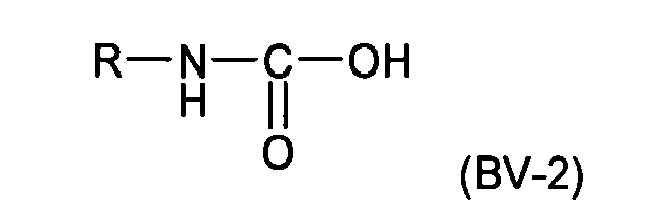
- In Formel (BV-2) steht R vorzugsweise für einen substituierten oder unsubstituierten, geradkettigen oder verzweigten Alkyl-, Alkenyl- oder Alkinylrest, wobei als Substituenten bevorzugt Hydroxy-, Amino-, Nitro-, Sulfonsäuregruppen oder Halogene in Frage kommen. Weitere Bevorzugte Reste R sind Phenyl- und Benzylreste sowie weiter substituierte Vertreter. Besonders bevorzugt steht R für eine C1-6-Alkylgruppe. Beispiele für erfindungsgemäße C1-C6-Alkylgruppen sind die Gruppen Methyl, Ethyl, n-Propyl, Isopropyl, n-Butyl, sec-Butyl, iso-Butyl, tert-Butyl, Pentyl, iso-Pentyl und Hexyl.
- Erfindungsgemäß besonders bevorzugte Bleichverstärker der Formel (BV-2) sind dadurch gekennzeichnet, daß der Rest R in Formel (BV-2) ausgewählt ist aus Methyl-, Ethyl-, n-Propyl-, isoPropyl-, n-Butyl-, iso-Butyl-, tert-Butyl- sowie Hydroxymethyl- und Hydroxyethyl-Resten.
- Das acide H-Atom des Kohlensäuremonoesters bzw. -monoamids kann auch in neutralisierter Form vorliegen, d.h. es können erfindungsgemäß auch Salze von Kohlensäuremonoestern bzw. Kohlensäuremonoamiden eingesetzt werden. Hier sind erfindungsgemäß Kohlensäuremonoester bzw. das Kohlensäuremonoamide bevorzugt, die in ganz oder teilweise neutralisierter Form, vorzugsweise in Form des Alkalimetall-, Ammonium-, Erdalkalimetall- oder Aluminiumsalzes und insbesondere in Form seines Natriumsalzes, vorliegen.
- Als bleichverstärkende Carbonsäure kann in den erfindungsgemäßen Zusammensetzungen bevorzugt mindestens eine Verbindung aus der Gruppe, bestehend aus Essigsäure, Milchsäure, Weinsäure, Zitronensäure, Salicylsäure und ortho-Phthalsäure, enthalten sein.
- Bleichverstärker sind bevorzugt Peroxoverbindungen, insbesondere anorganische Peroxoverbindungen. Unter die erfindungsgemäß bleichverstärkenden Peroxoverbindungen fallen keine Anlagerungsprodukte von Wasserstoffperoxid an andere Komponenten und auch nicht Wasserstoffperoxid selbst. Die Auswahl der Peroxoverbindungen unterliegt darüber hinaus keinen Beschränkungen. Bevorzugte Peroxoverbindungen sind Peroxidisulfatsalze, Persulfatsalze, Peroxidiphosphatsalze (insbesondere Ammoniumperoxidisulfat, Kaliumperoxidisulfat, Natriumperoxidisulfat, Ammoniumpersulfat, Kaliumpersulfat, Natriumpersulfat, Kaliumperoxidiphosphat) und Peroxide (wie Bariumperoxid und Magnesiumperoxid). Unter diesen Peroxoverbindungen, die auch in Kombination eingesetzt werden können, sind erfindungsgemäß die Peroxidisulfate, insbesondere Ammoniumperoxidisulfat, bevorzugt. Hier sind erfindungsgemäße Mittel zum Färben und/oder Aufhellen keratinischer Fasern bevorzugt, die zusätzlich 0,01 bis 2 Gew.-% mindestens einer festen Peroxoverbindung, die ausgewählt ist aus Ammonium-, Alkalimetall- und Erdalkalimetallpersulfaten, -peroxomonosulfaten und -peroxidisulfaten enthalten, wobei bevorzugte Mittel Peroxidisulfate enthalten, die vorzugsweise ausgewählt sind aus Natriumperoxidisulfat und/oder Kaliumperoxidisulfat und/oder Ammoniumperoxidisulfat und wobei besonders bevorzugte Mittel mindestens zwei verschiedene Peroxidislfate enthalten.
- Weiterhin besonders bevorzugt sind Persulfate, insbesondere das als Carosche Salz bezeichnete Gemisch aus Kaliumperoxosulfat, Kaliumhydrogensulfat und Kaliumsulfat.
- Die Bleichverstärker sind in den erfindungsgemäßen, kosmetischen Mitteln bevorzugt in Mengen von 5 bis 30 Gew.%, insbesondere in Mengen von 8 bis 20 Gew.%, jeweils bezogen auf das Gewicht des anwendungsbereiten Mittels, enthalten.
- Weiterhin hat es sich als vorteilhaft erwiesen, wenn die erfindungsgemäßen Färbe- und/oder Aufhellmittel nichtionogene grenzflächenaktive Stoffe enthalten.
- Dabei sind solche grenzflächenaktive Stoffe, die einen HLB-Wert von 5,0 und größer aufweisen, bevorzugt. Für die Definition des HLB-Wertes wird ausdrücklich auf die Ausführungen in Hugo Janistyn, Handbuch der Kosmetika und Riechstoffe, III. Band: Die Körperpflegemittel, 2. Auflage, Dr. Alfred Hüthig Verlag Heidelberg, 1973, Seiten 68-78 und Hugo Janistyn, Taschenbuch der modernen Parfümerie und Kosmetik, 4. Auflage, Wissenschaftliche Verlagsgesellschaft m.b.H. Stuttgart, 1974, Seiten 466-474, sowie die darin zitierten Originalarbeiten Bezug genommen.
- Besonders bervorzugte nichtionogene oberflächenaktive Substanzen sind dabei wegen der einfachen Verarbeitbarkeit Substanzen, die kommerziell als Feststoffe oder Flüssigkeiten in reiner Form erhältlich sind. Die Definition für Reinheit bezieht sich in diesem Zusammenhang nicht auf chemisch reine Verbindungen. Vielmehr können, insbesondere wenn es sich um Produkte auf natürlicher Basis handelt, Mischungen verschiedener Homologen eingesetzt werden, beispielsweise mit verschiedenen Alkylkettenlängen, wie sie bei Produkten auf Basis natürlicher Fette und Öle erhalten werden. Auch bei alkoxylierten Produkten liegen üblicherweise Mischungen unterschiedlicher Alkoxylierungsgrade vor. Der Begriff Reinheit bezieht sich in diesem Zusammenhang vielmehr auf die Tatsache, daß die gewählten Substanzen bevorzugt frei von Lösungsmitteln, Stellmitteln und anderen Begleitstoffen sein sollen.
- Bevorzugte nichtionogene grenzflächenaktive Stoffe sind
- alkoxylierte Fettalkohole mit 8 bis 22, insbesondere 10 bis 16, Kohlenstoffatomen in der Fettalkylgruppe und 1 bis 30, insbesondere 1 bis 15, Ethylenoxid- und/oder Propylenoxid-Einheiten. Bevorzugte Fettalkylgruppen sind beispielsweise Lauryl-, Myristyl-, Cetyl-, aber auch Stearyl-, Isostearyl- und Oleylgruppen. Besonders bevorzugte Verbindungen dieser Klasse sind beispielsweise Laurylalkohol mit 2 bis 4 Ethylenoxid-Einheiten, Oleyl- und Cetylalkohol mit jeweils 5 bis 10 Ethylenoxideinheiten, Cetyl- und Stearylalkohol sowie deren Mischungen mit 10 bis 30 Ethylenoxideinheiten sowie das Handelsprodukt Aethoxal®B (Henkel), ein Laurylalkohol mit jeweils 5 Ethylenoxid- und Propylenoxideinheiten. Neben den üblichen alkoxylierten Fettalkoholen können auch sogenannte "endgruppenverschlossene" Verbindungen erfindungsgemäß eingesetzt werden. Bei diesen Verbindungen weist die Alkoxygruppe am Ende keine OH-Gruppe auf, sondern ist in Form eines Ethers, insbesondere eines C1-C4-Alkyl-Ethers, "verschlossen". Ein Beispiel für eine solche Verbindung ist das Handelsprodukt Dehypon®LT 054, ein C12-18-Fettalkoholol + 4,5 Ethylenoxid-butylether.
- alkoxylierte Fettsäuren mit 8 bis 22, insbesondere 10 bis 16, Kohlenstoffatomen in der Fettsäuregruppe und 1 bis 30, insbesondere 1 bis 15, Ethylenoxid- und/oder Propylenoxid-Einheiten. Bevorzugte Fettsäuren sind beispielsweise Laurin-, Myristin-, Palmitin-, Stearin-, Isostearin- und Ölsäure.
- alkoxylierte, bevorzugt propoxylierte und insbesondere ethoxylierte, Mono-, Di- und Triglyceride. Beispiele für bevorzugte Verbindungen sind Glycerinmonolaurat + 20 Ethylenoxid und Glycerinmonostearat + 20 Ethylenoxid.
- Polyglycerinester und alkoxylierte Polyglycerinester. Bevorzugte Verbindungen dieser Klasse sind beispielsweise Poly(3)glycerindiisostearat (Handelsprodukt: Lameform®TGI (Henkel)) und Poly(2)glycerinpolyhydroxystearat (Handelsprodukt: Dehymuls®PGPH (Henkel)).
- Sorbitan-Fettsäureester und alkoxylierte Sorbitan- Fettsäureester wie beispielsweise Sorbitanmonolaurat und Sorbitanmonolaurat + 20 Ethylenoxid (EO).
- Alkylphenole und Alkylphenolalkoxylate mit 6 bis 21, insbesondere 6 bis 15, Kohlenstoffatomen in der Alkylkette und 0 bis 30 Ethylenoxid- und/oder Propylenoxid-Einheiten. Bevorzugte Vertreter dieser Klasse sind beipielsweise Nonylphenol + 4 EO, Nonylphenol + 9 EO, Octylphenol + 3 EO und Octylphenol + 8 EO.
- Besonders bevorzugte Klassen an nichtionogenen grenzflächenaktiven Stoffen stellen die alkoxylierten Fettalkohole, die alkoxylierten Fettsäuren sowie die Alkylphenole und Alkylphenolalkoxylate dar.
- Als besonders vorteilhaft haben sich erfindungsgemäße Mittel erwiesen, die nichtionogene grenzflächenaktive Substanzen in Mengen von 1-5 Gew.-% enthalten.
- Weiterhin können die erfindungsgemäßen Färbe- und/oder Aufhellmittel alle in solchen Zubereitungen bekannten Wirk-, Zusatz- und Hilfsstoffe enthalten. In vielen Fällen enthalten die Mittel mindestens ein Tensid, wobei prinzipiell sowohl anionische als auch zwitterionische, ampholytische, nichtionische und kationische Tenside geeignet sind. In vielen Fällen hat es sich aber als vorteilhaft erwiesen, die Tenside aus anionischen, kationischen oder nichtionischen Tensiden auszuwählen. Anionische Tenside können dabei ganz besonders bevorzugt sein.
- Bevorzugte anionische Tenside sind Alkylsulfate, Ethercarbonsäuresalze mit 10 bis 18 C-Atomen in der Alkylgruppe und bis zu 12 Glykolethergruppen im Molekül wie C12H25-(C2H4O)6-CH2-COONa sowie insbesondere Salze von gesättigten und speziell ungesättigten C8-C22-Carbonsäuren wie Ölsäure, Stearinsäure, Isostearinsäure und Palmitinsäure.
- Diese anionischen Tenside sollten bevorzugt in fester, insbesondere Pulverform vorliegen. Ganz besonders bevorzugt sind dabei bei Raumtemperatur feste Seifen, insbesondere Natriumstearat. Diese liegen bevorzugt in Mengen von 5 bis 20 Gew.-%, insbesondere 10 bis 15 Gew.-.%, vor.
- Als nichtionische Tenside eignen sich insbesondere C8-C22-Alkylmono- und oligoglycoside und deren ethoxylierte Analoga. Insbesondere die nichtethoxylierten Verbindungen haben sich als besonders geeignet erwiesen.
- Beispiele für die in den erfindungsgemäßen Haarbehandlungsmitteln verwendbaren kationischen Tenside sind insbesondere quartäre Ammoniumverbindungen. Bevorzugt sind Ammoniumhalogenide wie Alkyltrimethylammoniumchloride, Dialkyldimethylammoniumchloride und Trialkylmethylammoniumchloride, z. B. Cetyltrimethylammoniumchlorid, Stearyltrimethylammoniumchlorid, Distearyldimethylammoniumchlorid, Lauryldimethylammoniumchlorid, Lauryldimethylbenzylammoniumchlorid und Tricetylmethylammoniumchlorid. Weitere erfindungsgemäß verwendbare kationische Tenside stellen die quaternisierten Proteinhydrolysate dar.
- Alkylamidoamine, insbesondere Fettsäureamidoamine wie das unter der Bezeichnung Tego Amid®S 18 erhältliche Stearylamidopropyldimethylamin, zeichnen sich neben einer guten konditionierenden Wirkung speziell durch ihre gute biologische Abbaubarkeit aus.
- Ebenfalls sehr gut biologisch abbaubar sind quaternäre Esterverbindungen, sogenannte "Esterquats", wie das unter der Bezeichnung Dehyquart®F 75 in Abmischung mit Cetearylalkohle erhältliche Distearoylethylhydroxyethylammoniummethosulfat.
- Bei den als Tenside eingesetzten Verbindungen mit Alkylgruppen kann es sich jeweils um einheitliche Substanzen handeln. Es ist jedoch in der Regel bevorzugt, bei der Herstellung dieser Stoffe von nativen pflanzlichen oder tierischen Rohstoffen auszugehen, so daß man Substanzgemische mit unterschiedlichen, vom jeweiligen Rohstoff abhängigen Alkylkettenlängen erhält.
- Weitere Wirk-, Hilfs- und Zusatzstoffe sind beispielsweise
- nichtionische Polymere wie beispielsweise Vinylpyrrolidon/Vinylacrylat-Copolymere, Polyvinylpyrrolidon und Vinylpyrrolidon/Vinylacetat-Copolymer und Polysiloxane,
- kationische Polymere wie quaternisierte Celluloseether und andere, als Feststoff stabile bzw. im Handel erhältliche Verbindungen,
- zwitterionische und amphotere Polymere, die als Feststoffe stabil bzw. bevorzugt als Handelsprodukte erhältlich sind,
- anionische Polymere wie beispielsweise Polyacrylsäuren, vernetzte Polyacrylsäuren und Vinylacetat/Crotonsäure-Copolymere, sofern diese als Feststoffe stabil bzw. bevorzugt im Handel erhältlich sind,
- Verdickungsmittel wie Agar-Agar, Guar-Gum, Alginate, Xanthan-Gum, Gummi arabicum, Karaya-Gummi, Johannisbrotkernmehl, Leinsamengummen, Dextrane, Cellulose-Derivate, z. B. Methylcellulose, Hydroxyalkylcellulose und Carboxymethylcellulose, Stärke-Fraktionen und Derivate wie Amylose, Amylopektin und Dextrine, Tone wie z. B. Bentonit oder vollsynthetische Hydrokolloide wie z.B. Polyvinylalkohol,
- Strukturanten wie Glucose, Maleinsäure und Milchsäure,
- haarkonditionierende Verbindungen wie Phospholipide, beispielsweise Sojalecithin, Ei-Lecitin und Kephaline, sowie Silikonöle
- Proteinhydrolysate, insbesondere Elastin-, Kollagen-, Keratin-, Milcheiweiß-, Sojaprotein- und Weizenproteinhydrolysate, deren Kondensationsprodukte mit Fettsäuren sowie quaternisierte Proteinhydrolysate,
- Parfümöle, Dimethylisosorbid und Cyclodextrine,
- Farbstoffe zum Einfärben der Zubereitungen,
- Wirkstoffe wie Panthenol, Pantothensäure, Allantoin, Pyrrolidoncarbonsäuren und deren Salze,
- Cholesterin,
- Fette und Wachse wie Walrat, Bienenwachs, Montanwachs, Paraffine, Fettalkohole und Fettsäureester,
- Fettsäurealkanolamide,
- Komplexbildner wie EDTA, NTA und Phosphonsäuren,
- Quell- und Penetrationsstoffe wie Carbonate, Hydrogencarbonate, Guanidine, Harnstoffe sowie primäre, sekundäre und tertiäre Phosphate,
- Die Auswahl dieser weiteren Stoffe wird der Fachmann gemäß der gewünschten Eigenschaften der Mittel treffen.
- Als weiteren Bestandteil können die erfindungsgemäßen Zusammensetzungen mindestens eine Ammoniumverbindung aus der Gruppe Ammoniumchlorid, Ammoniumcarbonat, Ammoniumbicarbonat, Ammoniumsulfat und/oder Ammoniumcarbamat in einer Menge von 0,5 bis 10, vorzugsweise 1 bis 5 Gew.-%, bezogen auf die Gesamtzusammensetzung des Mittels enthalten.
- Ferner können die erfindungsgemäßen Färbe- und/oder Aufhellmittel weitere Wirk-, Hilfs- und Zusatzstoffe, wie beispielsweise
- nichtionische Polymere wie beispielsweise Vinylpyrrolidon/Vinylacrylat-Copolymere, Polyvinylpyrrolidon und Vinylpyrrolidon/Vinylacetat-Copolymere und Polysiloxane,
- kationische Polymere wie quaternisierte Celluloseether, Polysiloxane mit quaternären Gruppen, Dimethyldiallylammoniumchlorid-Polymere, Acrylamid-Dimethyldiallyl-ammoniumchlorid-Copolymere, mit Diethylsulfat quaternierte Dimethylamino-ethylmethacrylat-Vinylpyrrolidon-Copolymere, Vinylpyrrolidon-Imidazolinium-methochlorid-Copolymere und quaternierter Polyvinylalkohol,
- zwitterionische und amphotere Polymere wie beispielsweise Acrylamidopropyl-trimethylammoniumchlorid/Acrylat-Copolymere und Octylacrylamid/Methyl-methacrylat/tert-Butylaminoethylmethacrylat/2-Hydroxypropylmethacrylat-Copolymere,
- anionische Polymere wie beispielsweise Polyacrylsäuren, vernetzte Polyacrylsäuren, Vinylacetat/Crotonsäure-Copolymere, Vinylpyrrolidon/Vinylacrylat-Copolymere, Vinylacetat/Butylmaleat/Isobornylacrylat-Copolymere, Methylvinylether/Malein-säureanhydrid-Copolymere und Acrylsäure/Ethylacrylat/N-tert.Butyl-acrylamid-Terpolymere,
- Verdickungsmittel wie Agar-Agar, Guar-Gum, Alginate, Xanthan-Gum, Gummi arabicum, Karaya-Gummi, Johannisbrotkernmehl, Leinsamengummen, Dextrane, Cellulose-Derivate, z. B. Methylcellulose, Hydroxyalkylcellulose und Carboxymethylcellulose, Stärke-Fraktionen und Derivate wie Amylose, Amylopektin und Dextrine, Tone wie z. B. Bentonit oder vollsynthetische Hydrokolloide wie z.B. Polyvinylalkohol,
- Strukturanten wie Maleinsäure und Milchsäure,
- haarkonditionierende Verbindungen wie Phospholipide, beispielsweise Sojalecithin, Ei-Lecitin und Kephaline,
- Proteinhydrolysate, insbesondere Elastin-, Kollagen-, Keratin-, Milcheiweiß-, Sojaprotein- und Weizenproteinhydrolysate, deren Kondensationsprodukte mit Fettsäuren sowie quaternisierte Proteinhydrolysate, Parfümöle, Dimethylicocorbid und Cyclodextrine,
- Lösungsmittel und -vermittler wie Ethanol, Isopropanol, Ethylenglykol, Propylenglykol, Glycerin und Diethylenglykol,
- faserstrukturverbessernde Wirkstoffe, insbesondere Mono-, Di- und Oligosaccharide wie beispielsweise Glucose, Galactose, Fructose, Fruchtzucker und Lactose,
- quaternierte Amine wie Methyl-1-alkylamidoethyl-2-alkylimidazolinium-methosulfat
- Entschäumer wie Silikone,
- Farbstoffe zum Anfärben des Mittels,
- Antischuppenwirkstoffe wie Piroctone Olamine, Zink Omadine und Climbazol,
- Lichtschutzmittel, insbesondere derivatisierte Benzophenone, Zimtsäure-Derivate und Triazine,
- Substanzen zur Einstellung des pH-Wertes, wie beispielsweise übliche Säuren, insbesondere Genußsäuren und Basen,
- Wirkstoffe wie Allantoin, Pyrrolidoncarbonsäuren und deren Salze sowie Bisabolol,
- Vitamine, Provitamine und Vitaminvorstufen, insbesondere solche der Gruppen A, B3, B5, B6, C, E, F und H,
- Pflanzenextrakte wie die Extrakte aus Grünem Tee, Eichenrinde, Brennessel, Hamamelis, Hopfen, Kamille, Klettenwurzel, Schachtelhalm, Weißdorn, Lindenblüten, Mandel, Aloe Vera, Fichtennadel, Roßkastanie, Sandelholz, Wacholder, Kokosnuß, Mango, Aprikose, Limone, Weizen, Kiwi, Melone, Orange, Grapefruit, Salbei, Rosmarin, Birke, Malve, Wiesenschaumkraut, Quendel, Schafgarbe, Thymian, Melisse, Hauhechel, Huflattich, Eibisch, Meristem, Ginseng und Ingwerwurzel,.
- Cholesterin,
- Konsistenzgeber wie Zuckerester, Polyolester oder Polyolalkylether,
- Fette und Wachse wie Walrat, Bienenwachs, Montanwachs und Paraffine,
- Fettsäurealkanolamide,
- Komplexbildner wie EDTA, NTA, β-Alanindiessigsäure und Phosphonsäuren,
- Quell- und Penetrationsstoffe wie Glycerin, Propylenglykolmonoethylether, Carbonate, Hydrogencarbonate, Guanidine, Harnstoffe sowie primäre, sekundäre und tertiäre Phosphate,
- Trübungsmittel wie Latex, Styrol/PVP- und Styrol/Acrylamid-Copolymere
- Perlglanzmittel wie Ethylenglykolmono- und -distearat sowie PEG-3-distearat,
- Pigmente,
- Stabilisierungsmittel für Wassserstoffperoxid und andere Oxidationsmittel,
- Treibmittel wie Propan-Butan-Gemische, N2O, Dimethylether, CO2 und Luft,
- Antioxidantien,
- Bezüglich weiterer fakultativer Komponenten sowie die eingesetzten Mengen dieser Komponenten wird ausdrücklich auf die dem Fachmann bekannten einschlägigen Handbücher, z. B. Kh. Schrader, Grundlagen und Rezepturen der Kosmetika, 2. Auflage, Hüthig Buch Verlag, Heidelberg, 1989, verwiesen.
- Die erfindungsgemäßen Mittel können die Inhaltsstoffe in einem geeigneten wäßrigen, alkoholischen oder wäßrig-alkoholischen Träger enthalten. Zum Zwecke der Haarfärbung sind solche Träger beispielsweise Cremes, Emulsionen, Gele oder auch tensidhaltige schäumende Lösungen, wie beispielsweise Shampoos, Schaumaerosole oder andere Zubereitungen, die für die Anwendung auf dem Haar geeignet sind. Es ist aber auch möglich, eine pulverförmige oder auch Tabletten-förmige Formulierung bereitzustellen, was für Färbe- und/oder Aufhellmittel bevorzugt ist.
- Unter wäßrig-alkoholischen Lösungen sind im Sinne der vorliegenden Erfindung wäßrige Lösungen enthaltend 3 bis 70 Gew.-% eines C1-C4-Alkohols, insbesondere Ethanol bzw. Isopropanol, zu verstehen. Die erfindungsgemäßen Mittel können zusätzlich weitere organische Lösemittel, wie beispielsweise Methoxybutanol, Benzylalkohol, Ethyldiglykol oder 1,2-Propylenglykol, enthalten. Bevorzugt sind dabei alle wasserlöslichen organischen Lösemittel.
- Bevorzugte erfindungsgemäße Mittel sind dadurch gekennzeichnet, daß sie zusätzlich ein nichtwässriges Lösungsmittel enthalten, wobei besonders bevorzugte erfindungsgemäße Mittel das Lösungsmittel in einer Konzentration von 0,1 - 30 Gewichtsprozent, bevorzugt in einer Konzentration von 1 - 20 Gewichtsprozent, ganz besonders bevorzugt in einer Konzentration von 2 - 10 Gewichtsprozent, jeweils bezogen auf das Mittel, enthalten.
- In weiter bevorzugten erfindungsgemäßen Mitteln ist das Lösungsmittel ausgewählt aus Ethanol, n-Propanol, Isoropanol, n-Butanol, Propylenglykol, n- Butylenglykol, Glycerin, Diethylenglykolmonoethylether, Diethylenglykolmono-n- butylether , Phenoxyethanol und Benzylalkohol sowie ihren Mischungen.
- Der pH-Wert der erfindungsgemäßen Mittel kann durch geeignete Inhaltsstoffe wie Acidifizierungsmittel oder Alkalisierungsmittel in einem weiten Bereich eingestellt werden.
- Eine oxidative Färbung der Fasern kann in Gegenwart von Oxidationsfarbstoffvorprodukten grundsätzlich mit Luftsauerstoff erfolgen. Bevorzugt wird jedoch ein chemisches Oxidationsmittel eingesetzt, besonders dann, wenn neben der Färbung ein Aufhelleffekt an menschlichem Haar gewünscht ist. Dieser Aufhelleffekt kann unabhängig von der Färbemethode gewünscht sein. Die Gegenwart von Oxidationsfarbstoffvorprdukten ist demnach keine zwingende voraussetzung für einen Einsatz von Oxidationsmitteln in den erfindungsgemäßen Mitteln. Als Oxidationsmittel kommen Persulfate, Chlorite und insbesondere Wasserstoffperoxid oder dessen Anlagerungsprodukte an Harnstoff, Melamin sowie Natriumborat in Frage.
- Erfindungsgemäß kann aber das Oxidationsfärbemittel auch zusammen mit einem Katalysator auf das Haar aufgebracht werden, der die Oxidation der Farbstoffvorprodukte, z.B. durch Luftsauerstoff, aktiviert. Solche Katalysatoren sind z.B. Metallionen, Iodide, Chinone oder bestimmte Enzyme.
- Geeignete Metallionen sind beispielsweise Zn2+, Cu2+, Fe2+, Fe3+, Mn2+, Mn4+, Li+, Mg2+, Ca2+ und Al3+. Besonders geeignet sind dabei Zn2+, Cu2+ und Mn2+. Die Metallionen können prinzipiell in der Form eines beliebigen, physiologisch verträglichen Salzes oder in Form einer Komplexverbindung eingesetzt werden. Bevorzugte Salze sind die Acetate, Sulfate, Halogenide, Lactate und Tartrate. Durch Verwendung dieser Metallsalze kann sowohl die Ausbildung der Färbung beschleunigt als auch die Farbnuance gezielt beeinflusst werden.
- Geeignete Enzyme sind z.B. Peroxidasen, die die Wirkung geringer Mengen an Wasserstoffperoxid deutlich verstärken können. Weiterhin sind solche Enzyme erfindungsgemäß geeignet, die mit Hilfe von Luftsauerstoff die Oxidationsfarbstoffvorprodukte direkt oxidieren, wie beispielsweise die Laccasen, oder in situ geringe Mengen Wasserstoffperoxid erzeugen und auf diese Weise die Oxidation der Farbstoffvorprodukte biokatalytisch aktivieren. Besonders geeignete Katalysatoren für die Oxidation der Farbstoffvorläufer sind die sogenannten 2-Elektronen-Oxidoreduktasen in Kombination mit den dafür spezifischen Substraten, z.B.
- Pyranose-Oxidase und z.B. D-Glucose oder Galactose,
- Glucose-Oxidase und D-Glucose,
- Glycerin-Oxidase und Glycerin,
- Pyruvat-Oxidase und Benztraubensäure oder deren Salze,
- Alkohol-Oxidase und Alkohol (MeOH, EtOH),
- Lactat-Oxidase und Milchsäure und deren Salze,
- Tyrosinase-Oxidase und Tyrosin,
- Uricase und Harnsäure oder deren Salze,
- Cholinoxidase und Cholin,
- Aminosäure-Oxidase und Aminosäuren.
- Bei einer Anwendung von Oxidationsmitteln wird das eigentliche Färbemittel zweckmäßigerweise unmittelbar vor der Anwendung durch Mischung der Zubereitung des Oxidationsmittels mit der Zubereitung, enthaltend die Verbindungen der Formel I und gegebenenfalls Farbstoffvorprodukte, hergestellt. Das dabei entstehende gebrauchsfertige Haarfärbepräparat sollte bevorzugt einen pH-Wert im Bereich von 6 bis 12 aufweisen. Besonders bevorzugt ist die Anwendung der Haarfärbemittel in einem schwach alkalischen Milieu. Die Anwendungstemperaturen können in einem Bereich zwischen 15 und 40 °C liegen. Nach einer Einwirkungszeit von 5 bis 45 Minuten wird das Haarfärbemittel durch Ausspülen von dem zu färbenden Haar entfernt. Das Nachwaschen mit einem Shampoo entfällt, wenn ein stark tensidhaltiger Träger, z.B. ein Färbeshampoo, verwendet wurde.
- Insbesondere bei schwer färbbarem Haar kann ein erfindungsgemäßes Mittel gegebenenfalls mit zusätzlichen Farbstoffvorprodukten aber auch ohne vorherige Vermischung mit der Oxidationskomponente auf das Haar aufgebracht werden. Nach einer Einwirkdauer von 20 bis 30 Minuten wird dann - gegebenenfalls nach einer Zwischenspülung - die Oxidationskomponente aufgebracht. Nach einer weiteren Einwirkdauer von 10 bis 20 Minuten wird dann gespült und gewünschtenfalls nachshampooniert. Bei dieser Ausführungsform wird gemäß einer ersten Variante, bei der das vorherige Aufbringen der Farbstoffvorprodukte eine bessere Penetration in das Haar bewirken soll, das entsprechende Mittel auf einen pH-Wert von etwa 4 bis 7 eingestellt. Gemäß einer zweiten Variante wird zunächst eine Luftoxidation angestrebt, wobei das aufgebrachte Mittel bevorzugt einen pH-Wert von 7 bis 10 aufweist. Bei der anschließenden beschleunigten Nachoxidation kann die Verwendung von sauer eingestellten Peroxidisulfat-Lösungen als Oxidationsmittel bevorzugt sein.
- Für die Anwendung der erfindungsgemäßen Mittel auf dem Haar werden die Färbe- und/oder Aufhellmittel unmittelbar vor dem Auftragen mit einer Wasserstoffperoxid-Lösung vermischt. Die Konzentration dieser Wasserstoffperoxid-Lösung wird einerseits von den gesetzlichen Vorgaben und andererseits von dem gewünschten Effekt bestimmt; in der Regel werden 6- bis 12prozentige Lösungen in Wasser verwendet. Die Mengenverhältnisse von Färbe- und/oder Aufhellmittel und Wasserstoffperoxid-Lösung liegen dabei üblicherweise im Bereich 1:1 bis 1:2, wobei ein Überschuß an Wasserstoffperoxid-Lösung insbesondere dann gewählt wird, wenn keine zu ausgeprägte Blondierwirkung erwünscht ist.
- Zusätzlich können die erfindungsgemäßen Mittel weitere Inhaltsstoffe enthalten. Ein Einsatz bestimmter Metallionen oder -komplexe kann beispielsweise bevorzugt sein, um intensive Färbungen zu erhalten. Hier sind erfindungsgemäße Mittel bevorzugt, die zusätzlich Cu-, Fe-, Mn-, Ru-lonen oder Komplexe dieser Ionen enthalten.
- Bevorzugte erfindungsgemäße Mittel zum Färben und/oder Aufhellen keratinischer Fasern enthalten zusätzlich Cu-, Fe-, Mn-, Co-, Ce-, V-, Ru-lonen oder Komplexe dieser Ionen, wobei bevorzugte Mittel 0,0001 bis 2,5 Gew.-%, vorzugsweise 0,001 bis 1 Gew.-% mindestens einer Verbindung aus der Gruppe Kupferchlorid (CuCl2), Kupfersulfat (CuSO4), Eisen(II)sulfat, Mangan(II)sulfat, Mangan(II)chlorid, Kobalt(II)chlorid, Cersulfat, Cerchlorid, Vanadiumsulfat, Mangandioxid (MnO2).
- Erfindungsgemäß bevorzugt ist auch der Einsatz von sogenannten Komplexbildnern. Komplexbilder sind Stoffe, die Metallionen komplexieren können. Bevorzugte Komplexbildner sind sogenannte Chelatkomplexbildner, also Stoffe, die mit Metallionen cyclische Verbindungen bilden, wobei ein einzelner Ligand mehr als eine Koordinationsstelle an einem Zentralatom besetzt, d. h. mind. "zweizähnig" ist. In diesem Falle werden also normalerweise gestreckte Verbindungen durch Komplexbildung über ein Ion zu Ringen geschlossen. Die Zahl der gebundenen Liganden hängt von der Koordinationszahl des zentralen Ions ab.
- Gebräuchliche und im Rahmen der vorliegenden Erfindung bevorzugte Chelatkomplexbilder sind beispielsweise Polyoxycarbonsäuren, Polyamine, Ethylendiamintetraessigsäure (EDTA), Nitrilotriessigsäure (NTA) und Hydroxyethandiphosphonsäuren bzw. deren Alkalisalze. Auch komplexbildende Polymere, also Polymere, die entweder in der Hauptkette selbst oder seitenständig zu dieser funktionelle Gruppen tragen, die als Liganden wirken können und mit geeigneten MetallAtomen in der Regel unter Bildung von Chelat-Komplexen reagieren, sind erfindungsgemäß einsetzbar. Die Polymer-gebundenen Liganden der entstehenden Metall-Komplexe können dabei aus nur einem Makromolekül stammen oder aber zu verschiedenen Polymerketten gehören. Letzteres führt zur Vernetzung des Materials, sofern die komplexbildenden Polymere nicht bereits zuvor über kovalente Bindungen vernetzt waren.
- Komplexierende Gruppen (Liganden) üblicher komplexbildender Polymere sind Iminodi-essigsäure-, Hydroxychinolin-, Thioharnstoff-, Guanidin-, Dithiocarbamat-, Hydroxamsäure-, Amidoxim-, Aminophosphorsäure-, (cycl.) Polyamino-, Mercapto-, 1,3-Dicarbonyl- und Kronenether-Reste mit z. T. sehr spezif. Aktivitäten gegenüber Ionen unterschiedlicher Metalle. Basispolymere vieler auch kommerziell bedeutender komplexbildender Polymere sind Polystyrol, Polyacrylate, Polyacrylnitrile, Polyvinylalkohole, Polyvinylpyridine und Polyethylenimine. Auch natürliche Polymere wie Cellulose, Stärke od Chitin sind komplexbildende Polymere. Darüber hinaus können diese durch polymeranaloge Umwandlungen mit weiteren Ligand-Funktionalitäten versehen werden.
- Besonders bevorzugt ist im Rahmen der vorliegenden Erfindung der Einsatz eines oder mehrerer Chelatkomplexbildner aus den Gruppen der
- (i) Polycarbonsäuren, bei denen die Summe der Carboxyl- und gegebenenfalls Hydroxylgruppen mindestens 5 beträgt,
- (ii) stickstoffhaltigen Mono- oder Polycarbonsäuren,
- (iii) geminalen Diphosphonsäuren,
- (iv) Aminophosphonsäuren,
- (v) Phosphonopolycarbonsäuren,
- (vi) Cyclodextrine.
- Im Rahmen der vorliegenden Erfindung können alle Komplexbildner des Standes der Technik eingesetzt werden. Diese können unterschiedlichen chemischen Gruppen angehören. Vorzugsweise werden einzeln oder im Gemisch miteinander eingesetzt:
- a) Polycarbonsäuren, bei denen die Summe der Carboxyl- und gegebenenfalls Hydroxylgruppen mindestens 5 beträgt wie Gluconsäure,
- b) stickstoffhaltige Mono- oder Polycarbonsäuren wie Ethylendiamintetraessigsäure (EDTA), N-Hydroxyethylethylendiamintriessigsäure, Diethylentriaminpentaessigsäure, Hydroxyethyliminodiessigsäure, Nitridodiessigsäure-3-propionsäure, Isoserindiessigsäure, N,N-Di-(β-hydroxyethyl)glycin, N-(1,2-Dicarboxy-2-hydroxyethyl)-glycin, N-(1,2-Dicarboxy-2-hydroxyethyl)asparaginsäure oder Nitrilotriessigsäure (NTA),
- c) geminale Diphosphonsäuren wie 1-Hydroxyethan-1,1-diphosphonsäure (HEDP), deren höhere Homologe mit bis zu 8 Kohlenstoffatomen sowie Hydroxy- oder Aminogruppen-haltige Derivate hiervon und 1-Aminoethan-1,1-diphosphonsäure, deren höhere Homologe mit bis zu 8 Kohlenstoffatomen sowie Hydroxy- oder Aminogruppen-haltige Derivate hiervon,
- d) Aminophosphonsäuren wie Ethylendiamintetra(methylenphosphonsäure), Diethylentriaminpenta(methylenphosphonsäure) oder Nitrilotri(methylenphosphonsäure),
- e) Phosphonopolycarbonsäuren wie 2-Phosphonobutan-1,2,4-tricarbonsäure sowie
- f) Cyclodextrine.
- Als Polycarbonsäuren a) werden im Rahmen dieser Patentanmeldung Carbonsäuren -auch Monocarbonsäuren- verstanden, bei denen die Summe aus Carboxyl- und den im Molekül enthaltenen Hydroxylgruppen mindestens 5 beträgt. Komplexbildner aus der Gruppe der stickstoffhaltigen Polycarbonsäuren, insbesondere EDTA, sind bevorzugt. Bei den erfindungsgemäß erforderlichen alkalischen pH-Werten der Behandlungslösungen liegen diese Komplexbildner zumindest teilweise als Anionen vor. Es ist unwesentlich, ob sie in Form der Säuren oder in Form von Salzen eingebracht werden. Im Falle des Einsatzes als Salze sind Alkali-, Ammonium- oder Alkylammoniumsalze, insbesondere Natriumsalze, bevorzugt.
- Ebenso sind als weitere bevorzugte Komplexbildner polymere Aminodicarbonsäuren, deren Salze oder deren Vorläufersubstanzen zu nennen. Besonders bevorzugt sind Polyasparaginsäuren bzw. deren Salze und Derivate, die neben Cobuilder-Eigenschaften auch eine bleichstabilisierende Wirkung aufweisen.
- Weitere geeignete Komplexbildner sind Polyacetale, welche durch Umsetzung von Dialdehyden mit Polyolcarbonsäuren, welche 5 bis 7 C-Atome und mindestens 3 Hydroxylgruppen aufweisen, erhalten werden können. Bevorzugte Polyacetale werden aus Dialdehyden wie Glyoxal, Glutaraldehyd, Terephthalaldehyd sowie deren Gemischen und aus Polyolcarbonsäuren wie Gluconsäure und/oder Glucoheptonsäure erhalten.
- Eine weitere Substanzklasse mit komplexbildenden Eigenschaften stellen die Phosphonate dar. Dabei handelt es sich insbesondere um Hydroxyalkan- bzw. Aminoalkanphosphonate. Unter den Hydroxyalkanphosphonaten ist das 1-Hydroxyethan-1,1-diphosphonat (HEDP) von besonderer Bedeutung. Es wird vorzugsweise als Natriumsalz eingesetzt, wobei das Dinatriumsalz neutral und das Tetranatriumsalz alkalisch (pH 9) reagiert. Als Aminoalkanphosphonate kommen vorzugsweise Ethylendiamintetramethylenphosphonat (EDTMP), Diethylentriaminpentamethylenphosphonat (DTPMP) sowie deren höhere Homologe in Frage. Sie werden vorzugsweise in Form der neutral reagierenden Natriumsalze, z. B. als Hexanatriumsalz der EDTMP bzw. als Hepta- und OctaNatriumsalz der DTPMP, eingesetzt. Als Komplexbildner wird dabei aus der Klasse der Phosphonate bevorzugt HEDP verwendet. Die Aminoalkanphosphonate besitzen zudem ein ausgeprägtes Schwermetallbindevermögen. Dementsprechend kann es, insbesondere wenn die Mittel auch Bleiche enthalten, bevorzugt sein, Aminoalkanphosphonate, insbesondere DTPMP, einzusetzen, oder Mischungen aus den genannten Phosphonaten zu verwenden. Diese Stoffe werden nachstehend beschrieben.
- Erfindungsgemäß bevorzugte Komplexbildner sind Phosphonate, vorzugsweise Hydroxyalkan- bzw. Aminoalkanphosphonate und insbesondere 1-Hydroxyethan-1,1-diphosphonat (HEDP) bzw. dessen Di- oder Tetranatriumsalz und/oder Ethylendiamintetramethylenphosphonat (EDTMP) bzw. dessen Hexanatriumsalz und/oder Diethylentriaminpentamethylenphosphonat (DTPMP) bzw. dessen Hepta- oder Octanatriumsalz.
- Erfindungsgemäß besonders bevorzugte Mittel enthalten einen oder mehrere Stoffe aus der Gruppe
- (a) Nitrilotriessigsäure (NTA),
- (b) Diethylenetriaminpentaesigsäure (DTPA),
- (c) Ethylendiamindibernsteinsäure (EDDS),
- (d) Ethylenediamindiglutarsäure (EDGA),
- (e) 2- Hydroxypropylendiamindibernsteinsäure (HPDS),
- (f) Glycinamid-N,N'- dibernsteinsäure (GADS),
- (g) Ethylendiamin-N-N'-diglutarsäure (EDDG),
- (h) 2-Hydroxypropylendiamin-N-N'-dibernsteinsäure (HPDDS),
- (i) Ethylendiamintetraessigsäure (EDTA),
- (j) Ethylendicysteinsäure (EDC),
- (k) Diaminoalkyldi(sulfobernsteinsäure) (DDS),
- (l) Ethylendiamine-N-N'-bis(ortho-hydroxyphenylesigsäure (EDDHA),
- (m) N-2-hydroxyethyl-N,N-diessigsäure,
- (n) Glyceryliminodiessigsäure,
- (o) Iminodiessigsäure-N-2-hydroxypropylsulfonsäure,
- (p) Asparaginsäure-N-carboxymethyl-N-2,5-hydroxypropyl-3-sulfonsäure,
- (q) 8-Alanin-N,N'-diessigsäure,
- (r) Asparaginsäure-N,N'-diessigsäure,
- (s) Asparaginsäure-N-monoessigsäure,
- (t) Dipicolinsäure,
- (u) sowie deren Salze und/oder Derivate
- Aus den vorstehend genannten Stoffgruppen sind einige Vertreter im Rahmen der vorliegenden Erfindung besonders bevorzugt. Erfindungsgemäß besonders bevorzugte Mittel zum Färben und/oder Aufhellen keratinischer Fasern enthalten zusätzlich einen oder mehrere Chelatkomplexbildner aus den Gruppen der
- (i) Polycarbonsäuren, bei denen die Summe der Carboxyl- und gegebenenfalls Hydroxylgruppen mindestens 5 beträgt,
- (ii) stickstoffhaltigen Mono- oder Polycarbonsäuren,
- (iii) geminalen Diphosphonsäuren,
- (iv) Aminophosphonsäuren,
- (v) Phosphonopolycarbonsäuren,
- (vi) Cyclodextrine,
- Bevorzugte erfindungsgemäße Mittel werden wasserarm bzw. wasserfrei formuliert. Erfindungsgemäß besonders bevorzugte Mittel sind dadurch gekennzeichnet, daß sie weniger als 5 Gew.-%, vorzugsweise weniger als 2 Gew.-%, besonders bevorzugt weniger als 1 Gew.-% und insbesondere weniger als 0,5 Gew.-% Wasser enthalten, wobei bevorzugte Mittel wasserfrei sind. Der Wassergehalt der Mittel läßt sich beispielsweise mittels Titration nach Karl Fischer bestimmen.
- Ein zweiter Gegenstand der vorliegenden Erfindung ist Verfahren zum Färben und/oder Aufhellen von Keratinfasern, insbesondere menschlichen Haaren, bei dem
- gewünschtenfalls ein Vorbehandlungsmittel M1 auf die Faser aufgebracht wird, dann
- ein Mittel M2 auf der Faser zur Anwendung kommt, wobei gewünschtenfalls dem Mittel M2 vor der Anwendung ein weiteres Mittel M3 zugegeben wird,
- dieses Mittel M2 nach einer Zeit von 5-30 Minuten von der Faser abgespült wird
- und nach der Behandlung gegebenenfalls ein Nachbehandlungsmittel M4 auf die Faser aufgetragen und nach einer Einwirkzeit von einigen Minuten wieder abgespült wird,
- Die erfindungsgemäßen Mittel können demnach als Einkomponentenmittel (Färbe- und Aufhellmittel M2 bzw. Nachbehandlungsmittel M4), als Zweikomponenten Mittel (M2 + M3) oder als Dreikomponentenmittel (M2 + M3 + M4) formuliert und entsprechend angewendet werden. Eine Auftrennung in Mehrkomponentensysteme bietet sich insbesondere dort an, wo Inkompatibilitäten der Inhaltsstoffe zu erwarten oder zu befürchten sind; das einzusetzende Mittel wird bei solchen Systemen vom Verbraucher direkt vor der Anwendung durch Vermischen der Komponente hergestellt.
- Ein Färbe- und Aufhellungsverfahren, bei dem die Aufhellcreme und das Oxidationsmittel zunächst getrennt vorliegen, ist dabei bevorzugt. Ein weiterer Gegenstand der vorliegenden Erfindung ist daher ein Verfahren zum Färben und Aufhellen von menschlichen Haaren, bei dem eine Zusammensetzung auf wäßriger Grundlage, enthaltend Wasserstoffperoxid, mit einem erfindungsgemäßen Mittel zu einer homogenen Zusammensetzung vermischt, und diese auf das Haar aufgebracht wird.
- In bevorzugten erfindungsgemäßen Verfahren dieser Art enthält die Zusammensetzung auf wäßriger Grundlage bezogen auf ihr Gewicht 1 bis 20 Gew.%, vorzugsweise 2 bis 10 Gew.% und insbesondere 3 bis 6 Gew.% Wasserstoffperoxid, berechnet als 100%iges H2O2.
- Weiter bevorzugte erfindungsgemäße Verfahren dieser Art sind dadurch gekennzeichnet, daß die Zusammensetzung auf wäßriger Grundlage, enthaltend Wasserstoffperoxid, mit einem erfindungsgemäßen Mittel im Gewichtsverhältnis 1:5 bis 10:1, vorzugsweise 1:2 bis 5:1 und insbesondere 1:2 bis 2:1 zu einer homogenen Zusammensetzung vermischt, und diese auf das Haar aufgebracht wird.
- Alternativ kann - wie vorstehend erwähnt - auch ein Dreikomponentensystem zur Anwendung gelangen. Ein weiterer Gegenstand der vorliegenden Erfindung ist daher ein Verfahren zum Färben und Aufhellen von menschlichen Haaren, bei dem eine Zusammensetzung auf wäßriger Grundlage, enthaltend Wasserstoffperoxid, mit einem weiteren Mittel enthaltend vorzugsweise mindestens einen Alkalitätsgeber und/oder direktziehenden Haarfarbstoff und/oder mindestens ein Oxidationsfarbstoffvorprodukt, und einem erfindungsgemäßen Mittel zu einer homogenen Zusammensetzung vermischt, und diese auf das Haar aufgebracht wird.
- Bezüglich weiterer bevorzugter Ausführungsformen der erfindungsgemäßen Verfahren gilt mutatis mutandis das zu den erfindungsgemäßen Mitteln Gesagte.
- Besonders bevorzugt ist es, die Polymerisationreaktion, d.h. die Ausfärbung durch physikalische Maßnahmen zu unterstützen. Erfindungsgemäße Verfahren, bei denen die Anwendung durch Einwirkung von Wärme und/oder UV-Strahlung während der Einwirkzeit unterstützt wird, sind daher bevorzugt.
- Ein weiterer Gegenstand der vorliegenden Erfindung ist die Verwendung von Acrylsäurederiaten der Formel (I):

- X
- steht für =O oder =N-R1
- Y
- steht für einen beliebig funktionalisierten Alkylrest
- Z
- steht für eine beliebige farbgebende Struktureinheit
- R, R', R'', R1
- stehen unabhängig voneinander für ein Wasserstoffatom, eine gegebenenfalls substituierte Arylgruppe oder eine gegebenenfalls substituierte (C1-C6)-Alkylgruppe oder eine Hydroxyalkylgruppe oder eine Polyhydroxyalkylgruppe oder eine gegebenenfalls substituierte (C2-C6)-Alkylengruppe, oder einen (C1-C6)Acylrest, vorzugsweise für -H, -CH3, -CH2CH3, -(CH2)2CH2, -CH(CH3)2, -(CH2)3CH3, -CH(CH3)CH2CH3, -CH2CH(CH3)2, -C(CH3)3,
- Besonders bevorzugt dient der Einsatz der Verbindungen der Erzielung bestimmter vorteilhafter Effekte. Erfindungsgemäß bevorzugt sind Verwendungen zur
- i. Steigerung der Echtheitseigenschaften der Färbungen und/oder
- ii. Steigerung der Farbbrillanz und/oder
- iii. Steigerung der Hautverträglichkeit von Färbe bzw. Aufhellmitteln.
- Bezüglich bevorzugter erfindungsgemäßer Verwendungen gilt mutatis mutandis das zu den bevorzugten Mitteln Ausgeführte.
Claims (13)
- Mittel zum Färben und/oder Aufhellen von Keratinfasern, insbesondere menschlichen Haaren, enthaltend mindestens ein Acrylsäurederivat der Formel (I):
 X steht für =O oder =N-R'Y steht für einen beliebig funktionalisierten AlkylrestZ steht für eine beliebige farbgebende StruktureinheitR, R', R'', R1 stehen unabhängig voneinander für ein Wasserstoffatom, eine gegebenenfalls substituierte Arylgruppe oder eine gegebenenfalls substituierte (C1-C6)-Alkylgruppe oder eine Hydroxyalkylgruppe oder eine Polyhydroxyalkylgruppe oder eine gegebenenfalls substituierte (C2-C6)-Alkylengruppe, oder einen (C1-C6)Acylrest, vorzugsweise für -H, -CH3, -CH2CH3, -(CH2)2CH2, -CH(CH3)2, -(CH2)3CH3, -CH(CH3)CH2CH3, -CH2CH(CH3)2, -C(CH3)3.
 - Mittel zum Färben und/oder Aufhellen keratinischer Fasern nach Anspruch 1, dadurch gekennzeichnet, daß es ein oder mehrere Acrylsäurederivate der Formel (la) enthält
 X, X' stehen unabhängig voneinander für =O oder =N-R'Y steht für einen beliebig funktionalisierten Alkylrest, vorzugsweise für -CH2-, -(CH2)2-, -(CH2)3-,Akzeptor steht für ein beliebiges aromatisches carbo- oder heterocyclisches System, das vorzugsweise Elektronenakzeptoreigenschaften besitzt und besonders bevorzugt mit Nitrogruppen und/oder Sulfonylgruppen und/oder Acylgruppen subnstituiert ist,R, R', R'', R1 stehen unabhängig voneinander für -H, -CH3, -CH2CH3, -(CH2)2CH2, -CH(CH3)2, -(CH2)3CH3, -CH(CH3)CH2CH3, -CH2CH(CH3)2, -C(CH3)3,wobei der aromatische Ring in Formel (la) gegebenenfalls substituiert sein kann.
 - Mittel zum Färben und/oder Aufhellen keratinischer Fasern nach einem der Ansprüche 1 oder 2, dadurch gekennzeichnet, daß es mindestens ein Acrylsäurederivat aus der Gruppe

- Mittel zum Färben und/oder Aufhellen keratinischer Fasern nach einem der Ansprüche 1 bis 3, dadurch gekennzeichnet, daß es die Verbindung(en) der Formel (I) in Mengen von 0,001 bis 5 Gew.-%, vorzugsweise von 0,0025 bis 2,5 Gew.%, besonders bevorzugt von 0,005 bis 1,5 Gew.-% und insbesondere von 0,01 bis 1 Gew.%, jeweils bezogen auf das gesamte Mittel, enthält.
- Mittel zum Färben und/oder Aufhellen keratinischer Fasern nach einem der Ansprüche 1 bis 4, dadurch gekennzeichnet, daß es zusätzlich - bezogen auf sein Gewicht - 0,001 bis 5 Gew.-% eines oder mehrerer Oxidationsfarbstoffvorprodukte und/oder direktziehender Farbstoffe enthält.
- Mittel zum Färben und/oder Aufhellen keratinischer Fasern nach einem der Ansprüche 1 bis 5, dadurch gekennzeichnet, daß es 0,5 bis 15 Gew.-%, vorzugsweise 1 bis 12,5 Gew.-%, besonders bevorzugt 2,5 bis 10 Gew.-% und insbesondere 3 bis 6 Gew.-% Wasserstoffperoxid (berechnet als 100%iges H2O2) enthält.
- Mittel zum Färben und/oder Aufhellen keratinischer Fasern nach einem der Ansprüche 1 bis 6, dadurch gekennzeichnet, daß es - bezogen auf sein Gewicht - 0,01 bis 1 Gew.-% mindestens eines Polymerisationsinhibitors, vorzugsweise aus der Gruppe Hydrochinon, Hydrochinon-Derivate, 2,6-Di-tert-butyl-p-cresol, Nitrophenole, N-Nitrosoamine, wie N-Nitrosodiphenylamin oder Salzen des N-Nitrosocyclohexylhydroxylamins, enthält.
- Mittel zum Färben und/oder Aufhellen keratinischer Fasern nach einem der Ansprüche 1 bis 7, dadurch gekennzeichnet, daß es in Form von zwei getrennt verpackten Zubereitungen A und B vorliegt, die unmittelbar vor der Anwendung zu einer Anwendungszusammensetzung vermischt werden, wobei die Zubereitung A das bzw. die Acrylsäurederivat(e) und die Zubereitung B Polymerisationsinitiator(en) enthält.
- Mittel zum Färben und/oder Aufhellen keratinischer Fasern nach einem der Ansprüche 1 bis 8, dadurch gekennzeichnet, daß es weitere Comonomere enthält, wobei Comonomere aus der Gruppe der N-Heterocyclen, der Acrylate und/oder Meth-Acrylate, der mit PEG veretherten Acrylate und/oder Meth-Acrylate, der Silan- Acrylate und/oder -Meth-Acrylate, der kationischen Verbindungen, vorzugsweise der 3-Trimethylammoniumpropylmethacrylamid- (MAPTAC) und/oder Acrylamidopropyltrimethylammonium- (APTAC) Salze bevorzugt sind.
- Verfahren zum Färben und/oder Aufhellen von Keratinfasern, insbesondere menschlichen Haaren, dadurch gekennzeichnet, daß- gewünschtenfalls ein Vorbehandlungsmittel M1 auf die Faser aufgebracht wird, dann- ein Mittel M2 auf der Faser zur Anwendung kommt, wobei gewünschtenfalls dem Mittel M2 vor der Anwendung ein weiteres Mittel M3 zugegeben wird,- dieses Mittel M2 nach einer Zeit von 5-30 Minuten von der Faser abgespült wird- und nach der Behandlung gegebenenfalls ein Nachbehandlungsmittel M4 auf die Faser aufgetragen und nach einer Einwirkzeit von einigen Minuten wieder abgespült wird,wobei mindestens eines der Mittel M1, M2 oder M3 ein Mittel nach einem der Ansprüche 1 bis 9 ist.
- Verfahren nach Anspruch 10, dadurch gekennzeichnet, daß die Anwendung durch Einwirkung von Wärme und/oder UV-Strahlung während der Einwirkzeit unterstützt wird.
- Verwendung von Acrylsäurederiaten der Formel (I):
 X steht für =O oder =N-R'Y steht für einen beliebig funktionalisierten AlkylrestZ steht für eine beliebige farbgebende StruktureinheitR, R', R'', R1 stehen unabhängig voneinander für ein Wasserstoffatom, eine gegebenenfalls substituierte Arylgruppe oder eine gegebenenfalls substituierte (C1-C6)-Alkylgruppe oder eine Hydroxyalkylgruppe oder eine Polyhydroxyalkylgruppe oder eine gegebenenfalls substituierte (C2-C6)-Alkylengruppe, oder einen (C1-C6)Acylrest, vorzugsweise für -H, -CH3, -CH2CH3, -(CH2)2CH2, -CH(CH3)2, -(CH2)3CH3, -CH(CH3)CH2CH3 -CH2CH(CH3)2 -C(CH3)3,in Mitteln zum Färben und/oder Aufhellen keratinischer Fasern.
 - Verwendung nach Anspruch 12 zuri. Steigerung der Echtheitseigenschaften der Färbungen und/oderii. Steigerung der Farbbrillanz und/oderiii. Steigerung der Hautverträglichkeit von Färbe bzw. Aufhellmitteln.
Applications Claiming Priority (1)
| Application Number | Priority Date | Filing Date | Title |
|---|---|---|---|
| DE200710002582 DE102007002582A1 (de) | 2007-01-11 | 2007-01-11 | Aufhell- und/oder Färbemittel mit Acrylsäurederivat(en) |
Publications (3)
| Publication Number | Publication Date |
|---|---|
| EP1944010A2 true EP1944010A2 (de) | 2008-07-16 |
| EP1944010A3 EP1944010A3 (de) | 2012-04-04 |
| EP1944010B1 EP1944010B1 (de) | 2015-03-11 |
Family
ID=39343524
Family Applications (1)
| Application Number | Title | Priority Date | Filing Date |
|---|---|---|---|
| EP20070022748 Not-in-force EP1944010B1 (de) | 2007-01-11 | 2007-11-23 | Aufhell- und/oder Färbemittel mit Acrylsäurederivat (en) |
Country Status (2)
| Country | Link |
|---|---|
| EP (1) | EP1944010B1 (de) |
| DE (1) | DE102007002582A1 (de) |
Cited By (2)
| Publication number | Priority date | Publication date | Assignee | Title |
|---|---|---|---|---|
| WO2013174871A1 (en) | 2012-05-23 | 2013-11-28 | L'oreal | Process for dyeing keratin fibres comprising a dye/pigment, a photoactive compound and a light source |
| EP2705878A3 (de) * | 2012-09-10 | 2015-07-15 | Henkel AG&Co. KGAA | Haarkur mit ausgewählten Esterölen, ausgewählten Silikonen und ausgewählten Acrylsäurederivaten mit geringem Wassergehalt |
Citations (1)
| Publication number | Priority date | Publication date | Assignee | Title |
|---|---|---|---|---|
| EP0998908A2 (de) | 1998-11-04 | 2000-05-10 | L'oreal | Färbende Zusammensetzung enthaltend einen kationschen direkt-und einen Oxidationsfarbstoff auf der Basis von Pyrazolo-(1,5)-Pyramidin und Färbeverfahren |
Family Cites Families (2)
| Publication number | Priority date | Publication date | Assignee | Title |
|---|---|---|---|---|
| US6930184B2 (en) * | 2002-07-26 | 2005-08-16 | 3M Innovative Properties Company | Functional fluorescent dyes |
| KR20080063835A (ko) * | 2005-10-26 | 2008-07-07 | 시바 홀딩 인코포레이티드 | 모발 염색 방법 |
-
2007
- 2007-01-11 DE DE200710002582 patent/DE102007002582A1/de not_active Withdrawn
- 2007-11-23 EP EP20070022748 patent/EP1944010B1/de not_active Not-in-force
Patent Citations (1)
| Publication number | Priority date | Publication date | Assignee | Title |
|---|---|---|---|---|
| EP0998908A2 (de) | 1998-11-04 | 2000-05-10 | L'oreal | Färbende Zusammensetzung enthaltend einen kationschen direkt-und einen Oxidationsfarbstoff auf der Basis von Pyrazolo-(1,5)-Pyramidin und Färbeverfahren |
Non-Patent Citations (5)
| Title |
|---|
| B. KH. SCHRADER: "Grundlagen und Rezepturen der Kosmetika", 1989, HÜTHIG BUCH VERLAG |
| HUGO JANISTYN: "Handbuch der Kosmetika und Riechstoffe", vol. 2, 1973, DR. ALFRED HÜTHIG VERLAG, pages: 68 - 78 |
| HUGO JANISTYN: "Taschenbuch der modernen Parfümerie und Kosmetik", vol. 4, 1974, pages: 466 - 474 |
| KH. SCHRADER: "Grundlagen und Rezepturen der Kosmetika", vol. 2, 1989, DR. ALFRED HÜTHIG VERLAG |
| W. UMBACH: "Kosmetik", vol. 2, 1995, GEORG THIEME VERLAG |
Cited By (3)
| Publication number | Priority date | Publication date | Assignee | Title |
|---|---|---|---|---|
| WO2013174871A1 (en) | 2012-05-23 | 2013-11-28 | L'oreal | Process for dyeing keratin fibres comprising a dye/pigment, a photoactive compound and a light source |
| US9730876B2 (en) | 2012-05-23 | 2017-08-15 | L'oreal | Process for dyeing keratin fibres comprising a dye-pigment, a photoactive compound and a light source |
| EP2705878A3 (de) * | 2012-09-10 | 2015-07-15 | Henkel AG&Co. KGAA | Haarkur mit ausgewählten Esterölen, ausgewählten Silikonen und ausgewählten Acrylsäurederivaten mit geringem Wassergehalt |
Also Published As
| Publication number | Publication date |
|---|---|
| EP1944010B1 (de) | 2015-03-11 |
| DE102007002582A1 (de) | 2008-07-17 |
| EP1944010A3 (de) | 2012-04-04 |
Similar Documents
| Publication | Publication Date | Title |
|---|---|---|
| DE102008024030A1 (de) | Aufhellmittel mit kationischen 3,4-Dihydroisochinoliniumderivaten, speziellen Alkanolaminen und Wasserstoffperoxid | |
| EP2192957A1 (de) | Aufhellmittel mit kationischen 3,4-dihydroisochinoliniumderivaten und wasserstoffperoxid | |
| DE102010030434A1 (de) | Kationische Direktzieher mit Dimethyl[(2-oxo-1,3-dioxolan-4-yl)methyl]-ammonium-Gruppierung und Mittel zum Färben von keratinhaltigen Fasern | |
| DE102007047685A1 (de) | Aufhellmittel mit kationischen Acylpyridiniumderivaten, Imidazolderivaten und Wasserstoffperoxid | |
| DE102008044715A1 (de) | Kationische Acylpyridinium-Derivate als Bleichaktivatoren | |
| EP2014275A2 (de) | Kit zur Bereitstellung von lagerstabilen Formulierungen | |
| DE102008052618A1 (de) | Tricyclische Aldehyde und C,H-acide Verbindungen | |
| DE102008044714A1 (de) | Kationische Dihydroisochinolinium-Derivate als Bleichaktivatoren | |
| DE102009001039A1 (de) | Kationische Direktzieher und Mittel zum Färben von keratinhaltigen Fasern | |
| WO2009027112A1 (de) | Haarbehandlungsmittel | |
| DE102008018132A1 (de) | Kationische Direktzieher und Mittel zum Färben von keratinhaltigen Fasern | |
| WO2009019048A2 (de) | Haarfärbemittel | |
| EP1944010B1 (de) | Aufhell- und/oder Färbemittel mit Acrylsäurederivat (en) | |
| DE102010031243A1 (de) | Polycyclische Cumarinderivate mit kationischer Ladung und Mittel zum Färben von keratinhaltigen Fasern | |
| EP2044977B1 (de) | Haarfärbeverfahren mit oxidativer Vorbehandlung | |
| DE102009001687A1 (de) | Kationische Direktzieher und Mittel zum Färben von keratinhaltigen Fasern | |
| DE102007018380A1 (de) | Kationische Direktzieher und Mittel zum Färben von keratinhaltigen Fasern | |
| DE102008056811A1 (de) | Neue Oxidationsfarbstoffvorprodukte | |
| DE102010038404A1 (de) | Neuartige Anthrachinonfarbstoffe und Mittel zum Färben von keratinhaltigen Fasern | |
| EP2190402A1 (de) | Biotin und kieselsäure gegen haaralterung | |
| DE102008061863A1 (de) | Verfahren zur Kaschierung grauer Haare | |
| DE102010027949A1 (de) | Haar- und Kopfhautschonende Haarfärbe- und Dauerwellmittel | |
| DE102010030439A1 (de) | Kationische Azofarbstoffe mit einer speziellen Gruppierung des 4-Aza-1-azoniabicyclo[2.2.2]octans und Mittel zum Färben von keratinhaltigen Fasern | |
| DE102010030589A1 (de) | Kationische Derivate des 8-Hydroxy-1-methylchinoliniums und Mittel zum Färben von keratinhaltigen Fasern | |
| EP1972323A2 (de) | Haarfärbemittel |
Legal Events
| Date | Code | Title | Description |
|---|---|---|---|
| PUAI | Public reference made under article 153(3) epc to a published international application that has entered the european phase |
Free format text: ORIGINAL CODE: 0009012 |
|
| 17P | Request for examination filed |
Effective date: 20071123 |
|
| AK | Designated contracting states |
Kind code of ref document: A2 Designated state(s): AT BE BG CH CY CZ DE DK EE ES FI FR GB GR HU IE IS IT LI LT LU LV MC MT NL PL PT RO SE SI SK TR |
|
| AX | Request for extension of the european patent |
Extension state: AL BA HR MK RS |
|
| PUAL | Search report despatched |
Free format text: ORIGINAL CODE: 0009013 |
|
| AK | Designated contracting states |
Kind code of ref document: A3 Designated state(s): AT BE BG CH CY CZ DE DK EE ES FI FR GB GR HU IE IS IT LI LT LU LV MC MT NL PL PT RO SE SI SK TR |
|
| AX | Request for extension of the european patent |
Extension state: AL BA HR MK RS |
|
| RIC1 | Information provided on ipc code assigned before grant |
Ipc: A61K 8/35 20060101AFI20120228BHEP Ipc: A61K 8/42 20060101ALI20120228BHEP Ipc: A61K 8/49 20060101ALI20120228BHEP Ipc: A61K 8/40 20060101ALI20120228BHEP Ipc: A61K 8/41 20060101ALI20120228BHEP Ipc: A61Q 5/10 20060101ALI20120228BHEP Ipc: A61Q 5/06 20060101ALI20120228BHEP Ipc: A61Q 5/08 20060101ALI20120228BHEP |
|
| 17Q | First examination report despatched |
Effective date: 20120316 |
|
| AKX | Designation fees paid |
Designated state(s): AT BE BG CH CY CZ DE DK EE ES FI FR GB GR HU IE IS IT LI LT LU LV MC MT NL PL PT RO SE SI SK TR |
|
| GRAP | Despatch of communication of intention to grant a patent |
Free format text: ORIGINAL CODE: EPIDOSNIGR1 |
|
| INTG | Intention to grant announced |
Effective date: 20141107 |
|
| GRAS | Grant fee paid |
Free format text: ORIGINAL CODE: EPIDOSNIGR3 |
|
| GRAA | (expected) grant |
Free format text: ORIGINAL CODE: 0009210 |
|
| AK | Designated contracting states |
Kind code of ref document: B1 Designated state(s): AT BE BG CH CY CZ DE DK EE ES FI FR GB GR HU IE IS IT LI LT LU LV MC MT NL PL PT RO SE SI SK TR |
|
| REG | Reference to a national code |
Ref country code: GB Ref legal event code: FG4D Free format text: NOT ENGLISH |
|
| REG | Reference to a national code |
Ref country code: CH Ref legal event code: EP |
|
| REG | Reference to a national code |
Ref country code: IE Ref legal event code: FG4D Free format text: LANGUAGE OF EP DOCUMENT: GERMAN |
|
| REG | Reference to a national code |
Ref country code: AT Ref legal event code: REF Ref document number: 714922 Country of ref document: AT Kind code of ref document: T Effective date: 20150415 |
|
| REG | Reference to a national code |
Ref country code: DE Ref legal event code: R096 Ref document number: 502007013777 Country of ref document: DE Effective date: 20150423 |
|
| REG | Reference to a national code |
Ref country code: NL Ref legal event code: VDEP Effective date: 20150311 |
|
| REG | Reference to a national code |
Ref country code: NL Ref legal event code: VDEP Effective date: 20150311 |
|
| PG25 | Lapsed in a contracting state [announced via postgrant information from national office to epo] |
Ref country code: LT Free format text: LAPSE BECAUSE OF FAILURE TO SUBMIT A TRANSLATION OF THE DESCRIPTION OR TO PAY THE FEE WITHIN THE PRESCRIBED TIME-LIMIT Effective date: 20150311 Ref country code: SE Free format text: LAPSE BECAUSE OF FAILURE TO SUBMIT A TRANSLATION OF THE DESCRIPTION OR TO PAY THE FEE WITHIN THE PRESCRIBED TIME-LIMIT Effective date: 20150311 Ref country code: FI Free format text: LAPSE BECAUSE OF FAILURE TO SUBMIT A TRANSLATION OF THE DESCRIPTION OR TO PAY THE FEE WITHIN THE PRESCRIBED TIME-LIMIT Effective date: 20150311 Ref country code: ES Free format text: LAPSE BECAUSE OF FAILURE TO SUBMIT A TRANSLATION OF THE DESCRIPTION OR TO PAY THE FEE WITHIN THE PRESCRIBED TIME-LIMIT Effective date: 20150311 |
|
| REG | Reference to a national code |
Ref country code: LT Ref legal event code: MG4D |
|
| PG25 | Lapsed in a contracting state [announced via postgrant information from national office to epo] |
Ref country code: GR Free format text: LAPSE BECAUSE OF FAILURE TO SUBMIT A TRANSLATION OF THE DESCRIPTION OR TO PAY THE FEE WITHIN THE PRESCRIBED TIME-LIMIT Effective date: 20150612 Ref country code: LV Free format text: LAPSE BECAUSE OF FAILURE TO SUBMIT A TRANSLATION OF THE DESCRIPTION OR TO PAY THE FEE WITHIN THE PRESCRIBED TIME-LIMIT Effective date: 20150311 |
|
| PG25 | Lapsed in a contracting state [announced via postgrant information from national office to epo] |
Ref country code: NL Free format text: LAPSE BECAUSE OF FAILURE TO SUBMIT A TRANSLATION OF THE DESCRIPTION OR TO PAY THE FEE WITHIN THE PRESCRIBED TIME-LIMIT Effective date: 20150311 |
|
| PG25 | Lapsed in a contracting state [announced via postgrant information from national office to epo] |
Ref country code: EE Free format text: LAPSE BECAUSE OF FAILURE TO SUBMIT A TRANSLATION OF THE DESCRIPTION OR TO PAY THE FEE WITHIN THE PRESCRIBED TIME-LIMIT Effective date: 20150311 Ref country code: PT Free format text: LAPSE BECAUSE OF FAILURE TO SUBMIT A TRANSLATION OF THE DESCRIPTION OR TO PAY THE FEE WITHIN THE PRESCRIBED TIME-LIMIT Effective date: 20150713 Ref country code: RO Free format text: LAPSE BECAUSE OF FAILURE TO SUBMIT A TRANSLATION OF THE DESCRIPTION OR TO PAY THE FEE WITHIN THE PRESCRIBED TIME-LIMIT Effective date: 20150311 Ref country code: SK Free format text: LAPSE BECAUSE OF FAILURE TO SUBMIT A TRANSLATION OF THE DESCRIPTION OR TO PAY THE FEE WITHIN THE PRESCRIBED TIME-LIMIT Effective date: 20150311 Ref country code: CZ Free format text: LAPSE BECAUSE OF FAILURE TO SUBMIT A TRANSLATION OF THE DESCRIPTION OR TO PAY THE FEE WITHIN THE PRESCRIBED TIME-LIMIT Effective date: 20150311 |
|
| REG | Reference to a national code |
Ref country code: FR Ref legal event code: PLFP Year of fee payment: 9 |
|
| PG25 | Lapsed in a contracting state [announced via postgrant information from national office to epo] |
Ref country code: IS Free format text: LAPSE BECAUSE OF FAILURE TO SUBMIT A TRANSLATION OF THE DESCRIPTION OR TO PAY THE FEE WITHIN THE PRESCRIBED TIME-LIMIT Effective date: 20150711 Ref country code: PL Free format text: LAPSE BECAUSE OF FAILURE TO SUBMIT A TRANSLATION OF THE DESCRIPTION OR TO PAY THE FEE WITHIN THE PRESCRIBED TIME-LIMIT Effective date: 20150311 |
|
| REG | Reference to a national code |
Ref country code: DE Ref legal event code: R097 Ref document number: 502007013777 Country of ref document: DE |
|
| PG25 | Lapsed in a contracting state [announced via postgrant information from national office to epo] |
Ref country code: IT Free format text: LAPSE BECAUSE OF FAILURE TO SUBMIT A TRANSLATION OF THE DESCRIPTION OR TO PAY THE FEE WITHIN THE PRESCRIBED TIME-LIMIT Effective date: 20150311 |
|
| PLBE | No opposition filed within time limit |
Free format text: ORIGINAL CODE: 0009261 |
|
| STAA | Information on the status of an ep patent application or granted ep patent |
Free format text: STATUS: NO OPPOSITION FILED WITHIN TIME LIMIT |
|
| PG25 | Lapsed in a contracting state [announced via postgrant information from national office to epo] |
Ref country code: DK Free format text: LAPSE BECAUSE OF FAILURE TO SUBMIT A TRANSLATION OF THE DESCRIPTION OR TO PAY THE FEE WITHIN THE PRESCRIBED TIME-LIMIT Effective date: 20150311 |
|
| PGFP | Annual fee paid to national office [announced via postgrant information from national office to epo] |
Ref country code: CH Payment date: 20151118 Year of fee payment: 9 |
|
| REG | Reference to a national code |
Ref country code: DE Ref legal event code: R084 Ref document number: 502007013777 Country of ref document: DE |
|
| 26N | No opposition filed |
Effective date: 20151214 |
|
| PG25 | Lapsed in a contracting state [announced via postgrant information from national office to epo] |
Ref country code: SI Free format text: LAPSE BECAUSE OF FAILURE TO SUBMIT A TRANSLATION OF THE DESCRIPTION OR TO PAY THE FEE WITHIN THE PRESCRIBED TIME-LIMIT Effective date: 20150311 |
|
| PGFP | Annual fee paid to national office [announced via postgrant information from national office to epo] |
Ref country code: AT Payment date: 20151119 Year of fee payment: 9 |
|
| PG25 | Lapsed in a contracting state [announced via postgrant information from national office to epo] |
Ref country code: MC Free format text: LAPSE BECAUSE OF FAILURE TO SUBMIT A TRANSLATION OF THE DESCRIPTION OR TO PAY THE FEE WITHIN THE PRESCRIBED TIME-LIMIT Effective date: 20150311 Ref country code: LU Free format text: LAPSE BECAUSE OF FAILURE TO SUBMIT A TRANSLATION OF THE DESCRIPTION OR TO PAY THE FEE WITHIN THE PRESCRIBED TIME-LIMIT Effective date: 20151123 |
|
| REG | Reference to a national code |
Ref country code: IE Ref legal event code: MM4A |
|
| PG25 | Lapsed in a contracting state [announced via postgrant information from national office to epo] |
Ref country code: IE Free format text: LAPSE BECAUSE OF NON-PAYMENT OF DUE FEES Effective date: 20151123 |
|
| REG | Reference to a national code |
Ref country code: FR Ref legal event code: PLFP Year of fee payment: 10 |
|
| PG25 | Lapsed in a contracting state [announced via postgrant information from national office to epo] |
Ref country code: HU Free format text: LAPSE BECAUSE OF FAILURE TO SUBMIT A TRANSLATION OF THE DESCRIPTION OR TO PAY THE FEE WITHIN THE PRESCRIBED TIME-LIMIT; INVALID AB INITIO Effective date: 20071123 Ref country code: BG Free format text: LAPSE BECAUSE OF FAILURE TO SUBMIT A TRANSLATION OF THE DESCRIPTION OR TO PAY THE FEE WITHIN THE PRESCRIBED TIME-LIMIT Effective date: 20150311 |
|
| PG25 | Lapsed in a contracting state [announced via postgrant information from national office to epo] |
Ref country code: CY Free format text: LAPSE BECAUSE OF FAILURE TO SUBMIT A TRANSLATION OF THE DESCRIPTION OR TO PAY THE FEE WITHIN THE PRESCRIBED TIME-LIMIT Effective date: 20150311 |
|
| REG | Reference to a national code |
Ref country code: CH Ref legal event code: PL |
|
| REG | Reference to a national code |
Ref country code: AT Ref legal event code: MM01 Ref document number: 714922 Country of ref document: AT Kind code of ref document: T Effective date: 20161123 |
|
| PG25 | Lapsed in a contracting state [announced via postgrant information from national office to epo] |
Ref country code: LI Free format text: LAPSE BECAUSE OF NON-PAYMENT OF DUE FEES Effective date: 20161130 Ref country code: CH Free format text: LAPSE BECAUSE OF NON-PAYMENT OF DUE FEES Effective date: 20161130 Ref country code: BE Free format text: LAPSE BECAUSE OF NON-PAYMENT OF DUE FEES Effective date: 20151130 |
|
| PG25 | Lapsed in a contracting state [announced via postgrant information from national office to epo] |
Ref country code: MT Free format text: LAPSE BECAUSE OF FAILURE TO SUBMIT A TRANSLATION OF THE DESCRIPTION OR TO PAY THE FEE WITHIN THE PRESCRIBED TIME-LIMIT Effective date: 20150311 Ref country code: TR Free format text: LAPSE BECAUSE OF FAILURE TO SUBMIT A TRANSLATION OF THE DESCRIPTION OR TO PAY THE FEE WITHIN THE PRESCRIBED TIME-LIMIT Effective date: 20150311 Ref country code: AT Free format text: LAPSE BECAUSE OF NON-PAYMENT OF DUE FEES Effective date: 20161123 |
|
| REG | Reference to a national code |
Ref country code: FR Ref legal event code: PLFP Year of fee payment: 11 |
|
| PGFP | Annual fee paid to national office [announced via postgrant information from national office to epo] |
Ref country code: DE Payment date: 20201119 Year of fee payment: 14 Ref country code: FR Payment date: 20201120 Year of fee payment: 14 Ref country code: GB Payment date: 20201120 Year of fee payment: 14 |
|
| REG | Reference to a national code |
Ref country code: DE Ref legal event code: R119 Ref document number: 502007013777 Country of ref document: DE |
|
| GBPC | Gb: european patent ceased through non-payment of renewal fee |
Effective date: 20211123 |
|
| PG25 | Lapsed in a contracting state [announced via postgrant information from national office to epo] |
Ref country code: GB Free format text: LAPSE BECAUSE OF NON-PAYMENT OF DUE FEES Effective date: 20211123 Ref country code: DE Free format text: LAPSE BECAUSE OF NON-PAYMENT OF DUE FEES Effective date: 20220601 |
|
| PG25 | Lapsed in a contracting state [announced via postgrant information from national office to epo] |
Ref country code: FR Free format text: LAPSE BECAUSE OF NON-PAYMENT OF DUE FEES Effective date: 20211130 |