EP1944280A2 - Couche barrière environnementale pour substrats contenant du silicium et procédé correspondant - Google Patents
Couche barrière environnementale pour substrats contenant du silicium et procédé correspondant Download PDFInfo
- Publication number
- EP1944280A2 EP1944280A2 EP07122658A EP07122658A EP1944280A2 EP 1944280 A2 EP1944280 A2 EP 1944280A2 EP 07122658 A EP07122658 A EP 07122658A EP 07122658 A EP07122658 A EP 07122658A EP 1944280 A2 EP1944280 A2 EP 1944280A2
- Authority
- EP
- European Patent Office
- Prior art keywords
- phase
- coating
- protective coating
- stoichiometric
- bsas
- Prior art date
- Legal status (The legal status is an assumption and is not a legal conclusion. Google has not performed a legal analysis and makes no representation as to the accuracy of the status listed.)
- Withdrawn
Links
- XUIMIQQOPSSXEZ-UHFFFAOYSA-N Silicon Chemical compound [Si] XUIMIQQOPSSXEZ-UHFFFAOYSA-N 0.000 title claims abstract description 26
- 239000010703 silicon Substances 0.000 title claims abstract description 26
- 229910052710 silicon Inorganic materials 0.000 title claims abstract description 26
- 238000000034 method Methods 0.000 title claims description 20
- 230000008569 process Effects 0.000 title claims description 18
- 238000000576 coating method Methods 0.000 title abstract description 109
- 239000011248 coating agent Substances 0.000 title abstract description 72
- 239000000758 substrate Substances 0.000 title abstract description 8
- 230000007613 environmental effect Effects 0.000 title description 7
- 230000004888 barrier function Effects 0.000 title description 4
- VYPSYNLAJGMNEJ-UHFFFAOYSA-N Silicium dioxide Chemical compound O=[Si]=O VYPSYNLAJGMNEJ-UHFFFAOYSA-N 0.000 claims abstract description 127
- 239000000377 silicon dioxide Substances 0.000 claims abstract description 64
- 239000011253 protective coating Substances 0.000 claims abstract description 50
- 239000000203 mixture Substances 0.000 claims abstract description 47
- 229910001597 celsian Inorganic materials 0.000 claims abstract description 34
- 238000010438 heat treatment Methods 0.000 claims abstract description 21
- 230000008021 deposition Effects 0.000 claims abstract description 16
- 229910000323 aluminium silicate Inorganic materials 0.000 claims abstract description 15
- 239000000843 powder Substances 0.000 claims description 47
- PNEYBMLMFCGWSK-UHFFFAOYSA-N aluminium oxide Inorganic materials [O-2].[O-2].[O-2].[Al+3].[Al+3] PNEYBMLMFCGWSK-UHFFFAOYSA-N 0.000 claims description 42
- 229910052593 corundum Inorganic materials 0.000 claims description 26
- 229910001845 yogo sapphire Inorganic materials 0.000 claims description 26
- 229910052681 coesite Inorganic materials 0.000 claims description 22
- 229910052906 cristobalite Inorganic materials 0.000 claims description 22
- 229910052682 stishovite Inorganic materials 0.000 claims description 22
- 229910052712 strontium Inorganic materials 0.000 claims description 22
- 229910052905 tridymite Inorganic materials 0.000 claims description 22
- CIOAGBVUUVVLOB-UHFFFAOYSA-N strontium atom Chemical compound [Sr] CIOAGBVUUVVLOB-UHFFFAOYSA-N 0.000 claims description 21
- HNPSIPDUKPIQMN-UHFFFAOYSA-N dioxosilane;oxo(oxoalumanyloxy)alumane Chemical compound O=[Si]=O.O=[Al]O[Al]=O HNPSIPDUKPIQMN-UHFFFAOYSA-N 0.000 claims description 10
- 239000012535 impurity Substances 0.000 claims description 8
- IATRAKWUXMZMIY-UHFFFAOYSA-N strontium oxide Inorganic materials [O-2].[Sr+2] IATRAKWUXMZMIY-UHFFFAOYSA-N 0.000 claims description 7
- 238000005507 spraying Methods 0.000 claims description 4
- 230000015556 catabolic process Effects 0.000 abstract description 7
- 238000006731 degradation reaction Methods 0.000 abstract description 7
- 238000000151 deposition Methods 0.000 abstract 2
- QVQLCTNNEUAWMS-UHFFFAOYSA-N barium oxide Inorganic materials [Ba]=O QVQLCTNNEUAWMS-UHFFFAOYSA-N 0.000 description 31
- 239000007789 gas Substances 0.000 description 18
- 238000011835 investigation Methods 0.000 description 16
- XLYOFNOQVPJJNP-UHFFFAOYSA-N water Substances O XLYOFNOQVPJJNP-UHFFFAOYSA-N 0.000 description 14
- 230000015572 biosynthetic process Effects 0.000 description 13
- 239000000463 material Substances 0.000 description 11
- HBMJWWWQQXIZIP-UHFFFAOYSA-N silicon carbide Chemical compound [Si+]#[C-] HBMJWWWQQXIZIP-UHFFFAOYSA-N 0.000 description 9
- 229910010271 silicon carbide Inorganic materials 0.000 description 8
- FAPWRFPIFSIZLT-UHFFFAOYSA-M Sodium chloride Chemical compound [Na+].[Cl-] FAPWRFPIFSIZLT-UHFFFAOYSA-M 0.000 description 7
- 235000002639 sodium chloride Nutrition 0.000 description 7
- 239000011780 sodium chloride Substances 0.000 description 7
- 239000008199 coating composition Substances 0.000 description 6
- 239000002210 silicon-based material Substances 0.000 description 6
- 229910052581 Si3N4 Inorganic materials 0.000 description 4
- 238000004458 analytical method Methods 0.000 description 4
- 239000002131 composite material Substances 0.000 description 4
- 238000005137 deposition process Methods 0.000 description 4
- 239000011159 matrix material Substances 0.000 description 4
- 239000011148 porous material Substances 0.000 description 4
- HQVNEWCFYHHQES-UHFFFAOYSA-N silicon nitride Chemical compound N12[Si]34N5[Si]62N3[Si]51N64 HQVNEWCFYHHQES-UHFFFAOYSA-N 0.000 description 4
- 238000004876 x-ray fluorescence Methods 0.000 description 4
- 238000013459 approach Methods 0.000 description 3
- 230000008901 benefit Effects 0.000 description 3
- 239000003518 caustics Substances 0.000 description 3
- 239000000919 ceramic Substances 0.000 description 3
- 239000011153 ceramic matrix composite Substances 0.000 description 3
- KZHJGOXRZJKJNY-UHFFFAOYSA-N dioxosilane;oxo(oxoalumanyloxy)alumane Chemical compound O=[Si]=O.O=[Si]=O.O=[Al]O[Al]=O.O=[Al]O[Al]=O.O=[Al]O[Al]=O KZHJGOXRZJKJNY-UHFFFAOYSA-N 0.000 description 3
- 229910052863 mullite Inorganic materials 0.000 description 3
- 238000001878 scanning electron micrograph Methods 0.000 description 3
- 239000007921 spray Substances 0.000 description 3
- PXHVJJICTQNCMI-UHFFFAOYSA-N Nickel Chemical compound [Ni] PXHVJJICTQNCMI-UHFFFAOYSA-N 0.000 description 2
- 239000007795 chemical reaction product Substances 0.000 description 2
- 238000002485 combustion reaction Methods 0.000 description 2
- 238000005260 corrosion Methods 0.000 description 2
- 230000007797 corrosion Effects 0.000 description 2
- 230000006872 improvement Effects 0.000 description 2
- 238000002844 melting Methods 0.000 description 2
- 230000008018 melting Effects 0.000 description 2
- 239000007800 oxidant agent Substances 0.000 description 2
- 230000003647 oxidation Effects 0.000 description 2
- 238000007254 oxidation reaction Methods 0.000 description 2
- 238000007750 plasma spraying Methods 0.000 description 2
- 230000002787 reinforcement Effects 0.000 description 2
- RMAQACBXLXPBSY-UHFFFAOYSA-N silicic acid Chemical compound O[Si](O)(O)O RMAQACBXLXPBSY-UHFFFAOYSA-N 0.000 description 2
- 241000894007 species Species 0.000 description 2
- 239000000126 substance Substances 0.000 description 2
- 238000004381 surface treatment Methods 0.000 description 2
- 229910001233 yttria-stabilized zirconia Inorganic materials 0.000 description 2
- 241000446313 Lamella Species 0.000 description 1
- 238000002441 X-ray diffraction Methods 0.000 description 1
- 230000001464 adherent effect Effects 0.000 description 1
- 229910052784 alkaline earth metal Inorganic materials 0.000 description 1
- 150000001342 alkaline earth metals Chemical class 0.000 description 1
- QVGXLLKOCUKJST-UHFFFAOYSA-N atomic oxygen Chemical compound [O] QVGXLLKOCUKJST-UHFFFAOYSA-N 0.000 description 1
- 229910052788 barium Inorganic materials 0.000 description 1
- 239000013590 bulk material Substances 0.000 description 1
- 229910010293 ceramic material Inorganic materials 0.000 description 1
- 238000013034 coating degradation Methods 0.000 description 1
- 229910017052 cobalt Inorganic materials 0.000 description 1
- 239000010941 cobalt Substances 0.000 description 1
- GUTLYIVDDKVIGB-UHFFFAOYSA-N cobalt atom Chemical compound [Co] GUTLYIVDDKVIGB-UHFFFAOYSA-N 0.000 description 1
- 239000006185 dispersion Substances 0.000 description 1
- -1 e.g. Substances 0.000 description 1
- 239000000835 fiber Substances 0.000 description 1
- 238000010191 image analysis Methods 0.000 description 1
- 238000003384 imaging method Methods 0.000 description 1
- 238000011065 in-situ storage Methods 0.000 description 1
- 239000011810 insulating material Substances 0.000 description 1
- 238000005259 measurement Methods 0.000 description 1
- 230000007246 mechanism Effects 0.000 description 1
- 238000012986 modification Methods 0.000 description 1
- 230000004048 modification Effects 0.000 description 1
- 229910052759 nickel Inorganic materials 0.000 description 1
- 229910052575 non-oxide ceramic Inorganic materials 0.000 description 1
- 239000011225 non-oxide ceramic Substances 0.000 description 1
- 230000001590 oxidative effect Effects 0.000 description 1
- 239000001301 oxygen Substances 0.000 description 1
- 229910052760 oxygen Inorganic materials 0.000 description 1
- 239000002245 particle Substances 0.000 description 1
- 230000035699 permeability Effects 0.000 description 1
- 238000007781 pre-processing Methods 0.000 description 1
- 238000012545 processing Methods 0.000 description 1
- 230000001681 protective effect Effects 0.000 description 1
- 239000012779 reinforcing material Substances 0.000 description 1
- 229910002076 stabilized zirconia Inorganic materials 0.000 description 1
- 150000003437 strontium Chemical class 0.000 description 1
- 229910000601 superalloy Inorganic materials 0.000 description 1
- 230000002459 sustained effect Effects 0.000 description 1
- 238000012360 testing method Methods 0.000 description 1
Images


Classifications
-
- C—CHEMISTRY; METALLURGY
- C04—CEMENTS; CONCRETE; ARTIFICIAL STONE; CERAMICS; REFRACTORIES
- C04B—LIME, MAGNESIA; SLAG; CEMENTS; COMPOSITIONS THEREOF, e.g. MORTARS, CONCRETE OR LIKE BUILDING MATERIALS; ARTIFICIAL STONE; CERAMICS; REFRACTORIES; TREATMENT OF NATURAL STONE
- C04B41/00—After-treatment of mortars, concrete, artificial stone or ceramics; Treatment of natural stone
- C04B41/80—After-treatment of mortars, concrete, artificial stone or ceramics; Treatment of natural stone of only ceramics
- C04B41/81—Coating or impregnation
- C04B41/85—Coating or impregnation with inorganic materials
-
- C—CHEMISTRY; METALLURGY
- C04—CEMENTS; CONCRETE; ARTIFICIAL STONE; CERAMICS; REFRACTORIES
- C04B—LIME, MAGNESIA; SLAG; CEMENTS; COMPOSITIONS THEREOF, e.g. MORTARS, CONCRETE OR LIKE BUILDING MATERIALS; ARTIFICIAL STONE; CERAMICS; REFRACTORIES; TREATMENT OF NATURAL STONE
- C04B35/00—Shaped ceramic products characterised by their composition; Ceramics compositions; Processing powders of inorganic compounds preparatory to the manufacturing of ceramic products
- C04B35/01—Shaped ceramic products characterised by their composition; Ceramics compositions; Processing powders of inorganic compounds preparatory to the manufacturing of ceramic products based on oxide ceramics
- C04B35/16—Shaped ceramic products characterised by their composition; Ceramics compositions; Processing powders of inorganic compounds preparatory to the manufacturing of ceramic products based on oxide ceramics based on silicates other than clay
- C04B35/18—Shaped ceramic products characterised by their composition; Ceramics compositions; Processing powders of inorganic compounds preparatory to the manufacturing of ceramic products based on oxide ceramics based on silicates other than clay rich in aluminium oxide
- C04B35/195—Alkaline earth aluminosilicates, e.g. cordierite or anorthite
-
- C—CHEMISTRY; METALLURGY
- C04—CEMENTS; CONCRETE; ARTIFICIAL STONE; CERAMICS; REFRACTORIES
- C04B—LIME, MAGNESIA; SLAG; CEMENTS; COMPOSITIONS THEREOF, e.g. MORTARS, CONCRETE OR LIKE BUILDING MATERIALS; ARTIFICIAL STONE; CERAMICS; REFRACTORIES; TREATMENT OF NATURAL STONE
- C04B41/00—After-treatment of mortars, concrete, artificial stone or ceramics; Treatment of natural stone
- C04B41/009—After-treatment of mortars, concrete, artificial stone or ceramics; Treatment of natural stone characterised by the material treated
-
- C—CHEMISTRY; METALLURGY
- C04—CEMENTS; CONCRETE; ARTIFICIAL STONE; CERAMICS; REFRACTORIES
- C04B—LIME, MAGNESIA; SLAG; CEMENTS; COMPOSITIONS THEREOF, e.g. MORTARS, CONCRETE OR LIKE BUILDING MATERIALS; ARTIFICIAL STONE; CERAMICS; REFRACTORIES; TREATMENT OF NATURAL STONE
- C04B41/00—After-treatment of mortars, concrete, artificial stone or ceramics; Treatment of natural stone
- C04B41/45—Coating or impregnating, e.g. injection in masonry, partial coating of green or fired ceramics, organic coating compositions for adhering together two concrete elements
- C04B41/50—Coating or impregnating, e.g. injection in masonry, partial coating of green or fired ceramics, organic coating compositions for adhering together two concrete elements with inorganic materials
- C04B41/5024—Silicates
-
- C—CHEMISTRY; METALLURGY
- C04—CEMENTS; CONCRETE; ARTIFICIAL STONE; CERAMICS; REFRACTORIES
- C04B—LIME, MAGNESIA; SLAG; CEMENTS; COMPOSITIONS THEREOF, e.g. MORTARS, CONCRETE OR LIKE BUILDING MATERIALS; ARTIFICIAL STONE; CERAMICS; REFRACTORIES; TREATMENT OF NATURAL STONE
- C04B41/00—After-treatment of mortars, concrete, artificial stone or ceramics; Treatment of natural stone
- C04B41/45—Coating or impregnating, e.g. injection in masonry, partial coating of green or fired ceramics, organic coating compositions for adhering together two concrete elements
- C04B41/52—Multiple coating or impregnating multiple coating or impregnating with the same composition or with compositions only differing in the concentration of the constituents, is classified as single coating or impregnation
-
- C—CHEMISTRY; METALLURGY
- C04—CEMENTS; CONCRETE; ARTIFICIAL STONE; CERAMICS; REFRACTORIES
- C04B—LIME, MAGNESIA; SLAG; CEMENTS; COMPOSITIONS THEREOF, e.g. MORTARS, CONCRETE OR LIKE BUILDING MATERIALS; ARTIFICIAL STONE; CERAMICS; REFRACTORIES; TREATMENT OF NATURAL STONE
- C04B41/00—After-treatment of mortars, concrete, artificial stone or ceramics; Treatment of natural stone
- C04B41/80—After-treatment of mortars, concrete, artificial stone or ceramics; Treatment of natural stone of only ceramics
- C04B41/81—Coating or impregnation
- C04B41/89—Coating or impregnation for obtaining at least two superposed coatings having different compositions
-
- C—CHEMISTRY; METALLURGY
- C23—COATING METALLIC MATERIAL; COATING MATERIAL WITH METALLIC MATERIAL; CHEMICAL SURFACE TREATMENT; DIFFUSION TREATMENT OF METALLIC MATERIAL; COATING BY VACUUM EVAPORATION, BY SPUTTERING, BY ION IMPLANTATION OR BY CHEMICAL VAPOUR DEPOSITION, IN GENERAL; INHIBITING CORROSION OF METALLIC MATERIAL OR INCRUSTATION IN GENERAL
- C23C—COATING METALLIC MATERIAL; COATING MATERIAL WITH METALLIC MATERIAL; SURFACE TREATMENT OF METALLIC MATERIAL BY DIFFUSION INTO THE SURFACE, BY CHEMICAL CONVERSION OR SUBSTITUTION; COATING BY VACUUM EVAPORATION, BY SPUTTERING, BY ION IMPLANTATION OR BY CHEMICAL VAPOUR DEPOSITION, IN GENERAL
- C23C28/00—Coating for obtaining at least two superposed coatings either by methods not provided for in a single one of groups C23C2/00 - C23C26/00 or by combinations of methods provided for in subclasses C23C and C25C or C25D
- C23C28/04—Coating for obtaining at least two superposed coatings either by methods not provided for in a single one of groups C23C2/00 - C23C26/00 or by combinations of methods provided for in subclasses C23C and C25C or C25D only coatings of inorganic non-metallic material
-
- C—CHEMISTRY; METALLURGY
- C23—COATING METALLIC MATERIAL; COATING MATERIAL WITH METALLIC MATERIAL; CHEMICAL SURFACE TREATMENT; DIFFUSION TREATMENT OF METALLIC MATERIAL; COATING BY VACUUM EVAPORATION, BY SPUTTERING, BY ION IMPLANTATION OR BY CHEMICAL VAPOUR DEPOSITION, IN GENERAL; INHIBITING CORROSION OF METALLIC MATERIAL OR INCRUSTATION IN GENERAL
- C23C—COATING METALLIC MATERIAL; COATING MATERIAL WITH METALLIC MATERIAL; SURFACE TREATMENT OF METALLIC MATERIAL BY DIFFUSION INTO THE SURFACE, BY CHEMICAL CONVERSION OR SUBSTITUTION; COATING BY VACUUM EVAPORATION, BY SPUTTERING, BY ION IMPLANTATION OR BY CHEMICAL VAPOUR DEPOSITION, IN GENERAL
- C23C30/00—Coating with metallic material characterised only by the composition of the metallic material, i.e. not characterised by the coating process
-
- C—CHEMISTRY; METALLURGY
- C23—COATING METALLIC MATERIAL; COATING MATERIAL WITH METALLIC MATERIAL; CHEMICAL SURFACE TREATMENT; DIFFUSION TREATMENT OF METALLIC MATERIAL; COATING BY VACUUM EVAPORATION, BY SPUTTERING, BY ION IMPLANTATION OR BY CHEMICAL VAPOUR DEPOSITION, IN GENERAL; INHIBITING CORROSION OF METALLIC MATERIAL OR INCRUSTATION IN GENERAL
- C23C—COATING METALLIC MATERIAL; COATING MATERIAL WITH METALLIC MATERIAL; SURFACE TREATMENT OF METALLIC MATERIAL BY DIFFUSION INTO THE SURFACE, BY CHEMICAL CONVERSION OR SUBSTITUTION; COATING BY VACUUM EVAPORATION, BY SPUTTERING, BY ION IMPLANTATION OR BY CHEMICAL VAPOUR DEPOSITION, IN GENERAL
- C23C4/00—Coating by spraying the coating material in the molten state, e.g. by flame, plasma or electric discharge
- C23C4/04—Coating by spraying the coating material in the molten state, e.g. by flame, plasma or electric discharge characterised by the coating material
- C23C4/10—Oxides, borides, carbides, nitrides or silicides; Mixtures thereof
- C23C4/11—Oxides
-
- C—CHEMISTRY; METALLURGY
- C23—COATING METALLIC MATERIAL; COATING MATERIAL WITH METALLIC MATERIAL; CHEMICAL SURFACE TREATMENT; DIFFUSION TREATMENT OF METALLIC MATERIAL; COATING BY VACUUM EVAPORATION, BY SPUTTERING, BY ION IMPLANTATION OR BY CHEMICAL VAPOUR DEPOSITION, IN GENERAL; INHIBITING CORROSION OF METALLIC MATERIAL OR INCRUSTATION IN GENERAL
- C23C—COATING METALLIC MATERIAL; COATING MATERIAL WITH METALLIC MATERIAL; SURFACE TREATMENT OF METALLIC MATERIAL BY DIFFUSION INTO THE SURFACE, BY CHEMICAL CONVERSION OR SUBSTITUTION; COATING BY VACUUM EVAPORATION, BY SPUTTERING, BY ION IMPLANTATION OR BY CHEMICAL VAPOUR DEPOSITION, IN GENERAL
- C23C4/00—Coating by spraying the coating material in the molten state, e.g. by flame, plasma or electric discharge
- C23C4/18—After-treatment
-
- F—MECHANICAL ENGINEERING; LIGHTING; HEATING; WEAPONS; BLASTING
- F01—MACHINES OR ENGINES IN GENERAL; ENGINE PLANTS IN GENERAL; STEAM ENGINES
- F01D—NON-POSITIVE DISPLACEMENT MACHINES OR ENGINES, e.g. STEAM TURBINES
- F01D5/00—Blades; Blade-carrying members; Heating, heat-insulating, cooling or antivibration means on the blades or the members
- F01D5/12—Blades
- F01D5/28—Selecting particular materials; Particular measures relating thereto; Measures against erosion or corrosion
- F01D5/288—Protective coatings for blades
-
- F—MECHANICAL ENGINEERING; LIGHTING; HEATING; WEAPONS; BLASTING
- F23—COMBUSTION APPARATUS; COMBUSTION PROCESSES
- F23R—GENERATING COMBUSTION PRODUCTS OF HIGH PRESSURE OR HIGH VELOCITY, e.g. GAS-TURBINE COMBUSTION CHAMBERS
- F23R3/00—Continuous combustion chambers using liquid or gaseous fuel
- F23R3/007—Continuous combustion chambers using liquid or gaseous fuel constructed mainly of ceramic components
-
- C—CHEMISTRY; METALLURGY
- C04—CEMENTS; CONCRETE; ARTIFICIAL STONE; CERAMICS; REFRACTORIES
- C04B—LIME, MAGNESIA; SLAG; CEMENTS; COMPOSITIONS THEREOF, e.g. MORTARS, CONCRETE OR LIKE BUILDING MATERIALS; ARTIFICIAL STONE; CERAMICS; REFRACTORIES; TREATMENT OF NATURAL STONE
- C04B2235/00—Aspects relating to ceramic starting mixtures or sintered ceramic products
- C04B2235/02—Composition of constituents of the starting material or of secondary phases of the final product
- C04B2235/30—Constituents and secondary phases not being of a fibrous nature
- C04B2235/32—Metal oxides, mixed metal oxides, or oxide-forming salts thereof, e.g. carbonates, nitrates, (oxy)hydroxides, chlorides
- C04B2235/3205—Alkaline earth oxides or oxide forming salts thereof, e.g. beryllium oxide
- C04B2235/3213—Strontium oxides or oxide-forming salts thereof
-
- C—CHEMISTRY; METALLURGY
- C04—CEMENTS; CONCRETE; ARTIFICIAL STONE; CERAMICS; REFRACTORIES
- C04B—LIME, MAGNESIA; SLAG; CEMENTS; COMPOSITIONS THEREOF, e.g. MORTARS, CONCRETE OR LIKE BUILDING MATERIALS; ARTIFICIAL STONE; CERAMICS; REFRACTORIES; TREATMENT OF NATURAL STONE
- C04B2235/00—Aspects relating to ceramic starting mixtures or sintered ceramic products
- C04B2235/02—Composition of constituents of the starting material or of secondary phases of the final product
- C04B2235/30—Constituents and secondary phases not being of a fibrous nature
- C04B2235/32—Metal oxides, mixed metal oxides, or oxide-forming salts thereof, e.g. carbonates, nitrates, (oxy)hydroxides, chlorides
- C04B2235/3205—Alkaline earth oxides or oxide forming salts thereof, e.g. beryllium oxide
- C04B2235/3215—Barium oxides or oxide-forming salts thereof
-
- C—CHEMISTRY; METALLURGY
- C04—CEMENTS; CONCRETE; ARTIFICIAL STONE; CERAMICS; REFRACTORIES
- C04B—LIME, MAGNESIA; SLAG; CEMENTS; COMPOSITIONS THEREOF, e.g. MORTARS, CONCRETE OR LIKE BUILDING MATERIALS; ARTIFICIAL STONE; CERAMICS; REFRACTORIES; TREATMENT OF NATURAL STONE
- C04B2235/00—Aspects relating to ceramic starting mixtures or sintered ceramic products
- C04B2235/02—Composition of constituents of the starting material or of secondary phases of the final product
- C04B2235/30—Constituents and secondary phases not being of a fibrous nature
- C04B2235/32—Metal oxides, mixed metal oxides, or oxide-forming salts thereof, e.g. carbonates, nitrates, (oxy)hydroxides, chlorides
- C04B2235/3217—Aluminum oxide or oxide forming salts thereof, e.g. bauxite, alpha-alumina
-
- C—CHEMISTRY; METALLURGY
- C04—CEMENTS; CONCRETE; ARTIFICIAL STONE; CERAMICS; REFRACTORIES
- C04B—LIME, MAGNESIA; SLAG; CEMENTS; COMPOSITIONS THEREOF, e.g. MORTARS, CONCRETE OR LIKE BUILDING MATERIALS; ARTIFICIAL STONE; CERAMICS; REFRACTORIES; TREATMENT OF NATURAL STONE
- C04B2235/00—Aspects relating to ceramic starting mixtures or sintered ceramic products
- C04B2235/02—Composition of constituents of the starting material or of secondary phases of the final product
- C04B2235/30—Constituents and secondary phases not being of a fibrous nature
- C04B2235/34—Non-metal oxides, non-metal mixed oxides, or salts thereof that form the non-metal oxides upon heating, e.g. carbonates, nitrates, (oxy)hydroxides, chlorides
- C04B2235/3427—Silicates other than clay, e.g. water glass
- C04B2235/3463—Alumino-silicates other than clay, e.g. mullite
- C04B2235/3481—Alkaline earth metal alumino-silicates other than clay, e.g. cordierite, beryl, micas such as margarite, plagioclase feldspars such as anorthite, zeolites such as chabazite
-
- C—CHEMISTRY; METALLURGY
- C04—CEMENTS; CONCRETE; ARTIFICIAL STONE; CERAMICS; REFRACTORIES
- C04B—LIME, MAGNESIA; SLAG; CEMENTS; COMPOSITIONS THEREOF, e.g. MORTARS, CONCRETE OR LIKE BUILDING MATERIALS; ARTIFICIAL STONE; CERAMICS; REFRACTORIES; TREATMENT OF NATURAL STONE
- C04B2235/00—Aspects relating to ceramic starting mixtures or sintered ceramic products
- C04B2235/70—Aspects relating to sintered or melt-casted ceramic products
- C04B2235/74—Physical characteristics
- C04B2235/79—Non-stoichiometric products, e.g. perovskites (ABO3) with an A/B-ratio other than 1
-
- C—CHEMISTRY; METALLURGY
- C04—CEMENTS; CONCRETE; ARTIFICIAL STONE; CERAMICS; REFRACTORIES
- C04B—LIME, MAGNESIA; SLAG; CEMENTS; COMPOSITIONS THEREOF, e.g. MORTARS, CONCRETE OR LIKE BUILDING MATERIALS; ARTIFICIAL STONE; CERAMICS; REFRACTORIES; TREATMENT OF NATURAL STONE
- C04B2235/00—Aspects relating to ceramic starting mixtures or sintered ceramic products
- C04B2235/70—Aspects relating to sintered or melt-casted ceramic products
- C04B2235/80—Phases present in the sintered or melt-cast ceramic products other than the main phase
-
- F—MECHANICAL ENGINEERING; LIGHTING; HEATING; WEAPONS; BLASTING
- F05—INDEXING SCHEMES RELATING TO ENGINES OR PUMPS IN VARIOUS SUBCLASSES OF CLASSES F01-F04
- F05D—INDEXING SCHEME FOR ASPECTS RELATING TO NON-POSITIVE-DISPLACEMENT MACHINES OR ENGINES, GAS-TURBINES OR JET-PROPULSION PLANTS
- F05D2230/00—Manufacture
- F05D2230/90—Coating; Surface treatment
-
- F—MECHANICAL ENGINEERING; LIGHTING; HEATING; WEAPONS; BLASTING
- F05—INDEXING SCHEMES RELATING TO ENGINES OR PUMPS IN VARIOUS SUBCLASSES OF CLASSES F01-F04
- F05D—INDEXING SCHEME FOR ASPECTS RELATING TO NON-POSITIVE-DISPLACEMENT MACHINES OR ENGINES, GAS-TURBINES OR JET-PROPULSION PLANTS
- F05D2300/00—Materials; Properties thereof
- F05D2300/20—Oxide or non-oxide ceramics
- F05D2300/21—Oxide ceramics
- F05D2300/211—Silica
-
- F—MECHANICAL ENGINEERING; LIGHTING; HEATING; WEAPONS; BLASTING
- F05—INDEXING SCHEMES RELATING TO ENGINES OR PUMPS IN VARIOUS SUBCLASSES OF CLASSES F01-F04
- F05D—INDEXING SCHEME FOR ASPECTS RELATING TO NON-POSITIVE-DISPLACEMENT MACHINES OR ENGINES, GAS-TURBINES OR JET-PROPULSION PLANTS
- F05D2300/00—Materials; Properties thereof
- F05D2300/20—Oxide or non-oxide ceramics
- F05D2300/21—Oxide ceramics
- F05D2300/2112—Aluminium oxides
-
- F—MECHANICAL ENGINEERING; LIGHTING; HEATING; WEAPONS; BLASTING
- F23—COMBUSTION APPARATUS; COMBUSTION PROCESSES
- F23M—CASINGS, LININGS, WALLS OR DOORS SPECIALLY ADAPTED FOR COMBUSTION CHAMBERS, e.g. FIREBRIDGES; DEVICES FOR DEFLECTING AIR, FLAMES OR COMBUSTION PRODUCTS IN COMBUSTION CHAMBERS; SAFETY ARRANGEMENTS SPECIALLY ADAPTED FOR COMBUSTION APPARATUS; DETAILS OF COMBUSTION CHAMBERS, NOT OTHERWISE PROVIDED FOR
- F23M2900/00—Special features of, or arrangements for combustion chambers
- F23M2900/05004—Special materials for walls or lining
-
- Y—GENERAL TAGGING OF NEW TECHNOLOGICAL DEVELOPMENTS; GENERAL TAGGING OF CROSS-SECTIONAL TECHNOLOGIES SPANNING OVER SEVERAL SECTIONS OF THE IPC; TECHNICAL SUBJECTS COVERED BY FORMER USPC CROSS-REFERENCE ART COLLECTIONS [XRACs] AND DIGESTS
- Y02—TECHNOLOGIES OR APPLICATIONS FOR MITIGATION OR ADAPTATION AGAINST CLIMATE CHANGE
- Y02T—CLIMATE CHANGE MITIGATION TECHNOLOGIES RELATED TO TRANSPORTATION
- Y02T50/00—Aeronautics or air transport
- Y02T50/60—Efficient propulsion technologies, e.g. for aircraft
Definitions
- This invention relates to coating systems suitable for protecting components exposed to high-temperature environments, such as the hot gas flow path through a gas turbine engine. More particularly, this invention is directed to a coating composition that exhibits improved high temperature stability when used to protect a silicon-containing substrate.
- silicon-based non-oxide ceramics most notably with silicon carbide (SiC) as a matrix and/or as a reinforcing material, are candidates for high temperature applications, such as combustor liners, vanes, shrouds, airfoils, and other hot section components of gas turbine engines. Components in many of these applications are in contact with highly corrosive and oxidative environments.
- Si-based ceramics lose mass and recede at high temperatures in water-containing environments because of the formation of volatile silicon hydroxide (Si(OH) 4 ).
- the recession rate due to volatilization or corrosion can be sufficiently high to require an external coating with high resistance to such environments.
- Stability is a critical requirement of a coating system for a Si-based material in high temperature environments containing water vapors.
- Other important properties for the coating material include low thermal conductivity, a coefficient of thermal expansion (CTE) compatible with the Si-based ceramic material, low permeability to oxidants, and chemical compatibility with the Si-based material and a silica scale that forms from oxidation.
- CTE coefficient of thermal expansion
- protective coatings for gas turbine engine components formed of Si-based materials have been termed environmental barrier coatings (EBC).
- Barium-strontium-aluminosilicates (BSAS; (Ba 1x Sr x )O-Al 2 O 3 -SiO 2 ) and other alkaline earth aluminosilicates have been proposed as protective coatings for Si-based materials in view of their excellent environmental protection properties and low thermal conductivity.
- BSAS Barium-strontium-aluminosilicates
- U.S. Patent Nos. 6,254,935 , 6,352,790 , 6,365,288 , 6,387,456 , and 6,410,148 to Eaton et al. disclose the use of BSAS and alkaline earth aluminosilicates as outer protective coatings for Si-based substrates. Of these, all but Patent No.
- 6,352,790 disclose stoichiometric BSAS (molar ratio: 0.75BaO ⁇ 0.25SrO ⁇ Al 2 O 3 ⁇ 2SiO 2 ; molar percent: 18.75BaO ⁇ 6.25SrO ⁇ 25Al 2 O 3 ⁇ 50SiO 2 ) as the preferred alkaline earth aluminosilicate composition, with layers of silicon and mullite (3Al 2 O 3 ⁇ 2SiO 2 ) employed as bond coats.
- the BSAS coatings are typically produced by air plasma spraying (APS) followed by heat treatment to contain at least 50% of the crystalline celsian phase, which is stoichiometric BSAS.
- 6,254,935 and 6,365,288 further teach that the coating contains at least 80% of crystalline celsian and hexacelsian phases, which differ crystallographically but have the same stoichiometric BSAS chemistry (the term "stoichiometric phase" will be used in reference to the presence of both the celsian and hexacelsian phases, though the celsian phase is preferred).
- the term "stoichiometric phase" will be used in reference to the presence of both the celsian and hexacelsian phases, though the celsian phase is preferred.
- each of these patents allows for the presence of significant amounts of non-stoichiometric phases in addition to the stoichiometric celsian and hexacelsian phases.
- the present invention provides a protective coating and processes and compositions used to deposit such a coating, for example, on a silicon-containing article that will be exposed to high temperatures, such as the hostile thermal environment of a gas turbine engine.
- the protective coating has a strontium aluminosilicate (SAS) composition that is less susceptible to degradation by volatilization as compared to prior art BSAS-based coating compositions.
- SAS strontium aluminosilicate
- the coating composition of this invention has at least an outer surface region that consists essentially of stoichiometric crystalline phases of SAS and contains less than ten volume percent, and more preferably is substantially free, of a nonstoichiometric second crystalline phase of SAS.
- substantially free means less than five volume percent of the second phase.
- the undesired second phase contains roughly an equimolar ratio of SrO, Al 2 O 3 , and SiO 2 , and therefore differs from stoichiometric SAS (molar ratio: SrO ⁇ Al 2 O 3 ⁇ 2SiO 2 ; molar percent: 25SrO ⁇ 25Al 2 O 3 ⁇ 50SiO 2 ).
- the second phase contains a substoichiometric amount of silica (silica-lean).
- silica-lean a substoichiometric amount of silica (silica-lean).
- an SAS coating containing a silica-lean second phase would be expected to form when stoichiometric SAS powders are deposited by APS.
- the present invention has identified the silica-lean second phase of BSAS and, by extension, the silica-lean second phase of SAS, as being unstable and volatilizing when subjected to high-temperature environments that contain water and/or corrosive agents such as sea salt. Accordingly, by eliminating the second phase from at least the outer surface region of the protective coating, degradation of the protective coating is inhibited.
- a protective coating of this invention can be produced by carrying out deposition and heat treatment steps that result in at least the outer surface region of the protective coating consisting essentially of stoichiometric phases of SAS and substantially free of the second phase.
- the protective coating is deposited so that substantially the entire protective coating consists essentially of SrO, Al 2 O 3 and SiO 2 in approximately stoichiometric amounts for SAS, and after heat treatment the protective coating consists essentially of one or more stoichiometric SAS phases and is substantially free of the nonstoichiometric silica-lean second phase.
- the protective coating can be deposited to contain non-stoichiometric amounts of SrO, Al 2 O 3 and SiO 2 for SAS so as to contain the second phase following heat treatment, but then undergoes a second heat treatment step during which the second phase within at least the outer surface region of the coating is volatilized (and resultant porosity is sealed), such that essentially only one or more stoichiometric SAS phases remain in the outer surface region.
- a second region of the protective coating may remain beneath the outer surface region and contain non-stoichiometric SAS and the second phase.
- SAS protective coatings of this invention are believed to be capable of withstanding higher temperatures and/or longer exposures to the combustion environment within a gas turbine engine as a result of the substantial absence of the second phase, whose susceptibility to volatilization leads to coating recession.
- the protective coatings of this invention are also believed to be more resistant to corrosive environments (e.g., sea salt) and CMAS-containing environments, which also lead to severe degradation and increased recession rates of BSAS coatings of the prior art.
- the SAS protective coatings of this invention are able to exhibit improved performance in corrosive environments and exhibit increased volatilization resistance at temperatures above 2300°F (about 1260°C) while subjected to high gas velocities, enabling the coatings to be used in more demanding aircraft engine applications such as vanes, blades, shrouds, and combustors.
- the present invention is directed to a coating composition for an environmental barrier coating system suitable for protecting silicon-containing components subjected to high temperatures in the presence of water (water vapor) and corrosive agents, including the high and low pressure turbine vanes (nozzles) and blades (buckets), shrouds, combustor liners and augmentor hardware of gas turbine engines.
- water water vapor
- corrosive agents including the high and low pressure turbine vanes (nozzles) and blades (buckets), shrouds, combustor liners and augmentor hardware of gas turbine engines.
- silicon-containing materials examples include monolithic materials (e.g., silicon carbide, silicon nitride, etc.), composite materials containing a dispersion of silicon carbide, silicon nitride, and/or silicon reinforcement material in a metallic or nonmetallic matrix, composite materials having a silicon carbide, silicon nitride and/or silicon-containing matrix, and composite materials that employ silicon carbide, silicon nitride and/or silicon as both the reinforcement and matrix materials (e.g., SiC/SiC ceramic matrix composites (CMC)). While the advantages of this invention will be described with reference to gas turbine engine components, the teachings of the invention are generally applicable to any silicon-containing component whose silicon content is subject to volatilization.
- monolithic materials e.g., silicon carbide, silicon nitride, etc.
- composite materials containing a dispersion of silicon carbide, silicon nitride, and/or silicon reinforcement material in a metallic or nonmetallic matrix composite materials having a silicon carbide, silicon
- a multilayer coating system 14 in accordance with an embodiment of this invention is schematically represented in Figure 1 .
- the coating system 14 is shown as protecting a surface region 12 of a silicon-containing component 10.
- the coating system 14 is represented as including a protective coating 20 and a multilayer bond coat comprising bond coat layers 16 and 18.
- the coating system 14 is intended to provide environmental protection to the underlying surface region 12 and reduce the operating temperature of the component 10, thereby enabling the component 10 to survive within higher temperature environments than otherwise possible.
- a top coat (not shown) of a suitable insulating material such as stabilized zirconia, preferably yttria-stabilized zirconia (YSZ), may be deposited on the outer surface of the protective coating 20.
- a suitable insulating material such as stabilized zirconia, preferably yttria-stabilized zirconia (YSZ)
- silicon and silicon-based compounds e.g., silicon carbide
- Si(OH) 4 volatile silicon hydroxide
- alkaline-earth metal ceramic compositions such as BSAS and SAS exhibit low diffusivity to oxidants, e.g., oxygen and water vapor, and therefore are effective compositions for the protective coating 20 as a result of their ability to inhibit oxidation of the silicon content within the surface region 12, while also being sufficiently chemically and physically compatible with the surface region 12 to remain adherent to the region 12 under severe thermal conditions.
- the bond coat layers 16 and 18 serve to promote the adhesion of the coating 20 to the surface region 12 of the component 10.
- Suitable materials for the bond coat layers 16 and 18 include silicon and mixtures of mullite and BSAS, respectively, in accordance with prior art practice.
- a protective coating 20 formed of BSAS or SAS is also physically compliant with SiC-containing materials (such as the surface region 12) and is relatively compatible with mullite and the Si-based surface region 12 in terms of CTE.
- a suitable thickness range for the protective coating 20 is about 50 to about 1000 micrometers, depending on the particular application.
- BSAS compositions for the protective coating 20 have a crystalline microstructure characterized by the presence of one or more stoichiometric phases (molar ratio: 0.75BaO ⁇ 0.25SrO ⁇ Al 2 O 3 ⁇ 2SiO 2 ) of BSAS and, at least within an outer surface region 22 of the coating 20, by the substantial absence of a second crystalline phase of BSAS that contains approximately equal molar amounts of BaO+SrO, Al 2 O 3 , and SiO 2 .
- the second phase is a lamella phase that contains a substoichiometric amount of silica, and furthermore tends to be strontium-rich, i.e., SrO constitutes greater than 25 molar percent of the combined BaO+SrO content in the second phase.
- SAS compositions for the protective coating 20 also have a crystalline microstructure characterized by the presence of one or more stoichiometric phases (molar ratio: SrO ⁇ Al 2 O 3 ⁇ 2SiO 2 ) of SAS and, at least within an outer surface region 22 of the coating 20, by the substantial absence of a second crystalline phase of SAS that contains approximately equal molar amounts of SrO, Al 2 O 3 , and SiO 2 .
- the second phases of both BSAS and SAS are intentionally avoided (ideally zero volume percent, preferably not more than five volume percent, and at most ten volume percent) in at least the outer surface region 22 of the protective coating 20 based on investigations discussed below, which showed that the second phase is prone to volatilization when exposed to water vapors at high temperatures and prone to forming volatile reaction products when exposed to corrosive agents at high temperatures.
- compositions and deposition processes for forming a protective coating 20 of stoichiometric BSAS Such teachings are then extended to protective coatings 20 having a stoichiometric SAS composition in accordance with the present invention.
- BSAS compositions for the protective coating 20 preferably has a silica content of at least 47 molar percent, and preferably has a near-stoichiometric silica content, i.e., about 50 molar percent or more.
- the protective coating 20 may have the stoichiometric composition for BSAS (by molar percent, about 18.75% barium oxide, about 6.25% strontia, about 25% alumina, about 50% silica, and likely incidental impurities) throughout its thickness or at least in the outer surface region 22.
- the protective coating 20 (or at least its outer surface region 22) can be processed in accordance with the invention to be substantially free of the second phase.
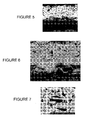
- Figure 8 summarizes data obtained during investigations that led to the invention.
- Figure 8 evidences that the stoichiometric celsian phase of BSAS and the nonstoichiometric second phase of BSAS contain distinctly different amounts of silicon (and therefore, silica).
- the celsian phase has a nominal silicon atomic content of about 15.4%, generally encompassing a range of about 14.3 to 17.2 atomic percent based on investigations discussed below
- the second phase appears to have a silicon atomic content of less than 11.4%.
- the protective coating 20 (or at least its outer surface region 22) preferably has a BaO+SrO content of about 25 molar percent in accordance with the stoichiometric composition of BSAS, but with strontia constituting less than 25 molar percent of the BaO+SrO content, i.e., the coating 20 has a strontia content of less than 6.25 molar percent.
- the chemistries of the stoichiometric celsian and nonstoichiometric second phases of BSAS can also be plotted as a function of strontia content.
- the second phase can be avoided or minimized by reducing the strontia content in the powder to suppress the formation of the second phase on the basis of strontium solubility in the celsian phase.
- the latter approach would require the powder to have a silica content at or above the stoichiometric amount (50 molar percent) for BSAS, and slight compensation with the alumina content in the powder.
- suitable approximate compositions (molar percent) for powders that can be used to deposit by APS a BSAS coating that is substantially free of the second phase are summarized below.
- the composition of Powder A is based on reducing the strontia content of the powder per the strontium solubility model while providing a silica content of at least 50 molar percent.
- the composition of Powder B is also based on lowering the strontia content, but with a further increase in the silica content of the powder. In each case, the silica content has been increased above that used in the past, and compensates for silica volatilization that occurs during deposition by APS.
- strontia constitutes less than 25 molar percent of the BaO+SrO content of each powder, and therefore BSAS coatings deposited from the powders.
- Powders A and B Comparing Powders A and B, it can be seen that their BaO+SrO contents are substantially the same and below the 25 molar percent level of stoichiometric BSAS, yielding a silica to BaO+SrO molar ratio of greater than 2:1.
- a notable difference is that the alumina content of Powder B is lower than in Powder A to accommodate the higher silica content in Powder B. Powder B would be predicted to produce an as-deposited coating whose bulk chemistry is substantially stoichiometric.
- the higher alumina content of Powder A (greater than 25 molar percent) pushes the composition of the resulting BSAS coating toward a more alumina-rich composition.
- BSAS coatings deposited from Powder A should fall near the celsian-alumina two-phase region, resulting in an alumina phase content of about 2 atomic percent. This additional phase is believed to provide an added margin for avoiding the strontia-rich second phase. Because an alumina phase content in excess of 20 atomic percent may affect thermal expansion to a significant degree, a suitable upper limit for the alumina phase content in BSAS coatings deposited from Powder A is believed to be about 20 atomic percent.
- BSAS coatings intended to have the stoichiometric composition were deposited on Si-containing substrates by APS followed by heat treatment in accordance with U.S. Patent No. 6,410,148 .
- the powder used in the deposition process had a near-stoichiometric composition of, by molar percent, about 19.0% barium oxide, about 6.8% strontia, about 24.8% alumina, and about 49.4% silica, and therefore had a silica content only slightly below the stoichiometric amount of 50 molar percent.
- the substrates were held at about 250°C to about 350°C.
- the coatings were heat treated at about 1250°C for about twenty-four hours to provide stress relief and promote bonding of the sprayed particles.
- FIG. 2 An SEM image of one of the coatings is shown in Figure 2 , and evidences that the coating contained two crystalline phases: the celsian phase corresponding to stoichiometric BSAS, and the nonstoichiometric second phase discussed above, which is iso-structural to the celsian phase (e.g., exhibits the same X-ray pattern).
- the celsian phase appears as the darker regions while the lighter regions are the second phase.
- the second phase was determined to be nonstoichiometric, having higher SrO 2 and Al 2 O 3 contents and a lower SiO 2 content than the stoichiometric celsian phase.
- the second phase in the coating is nonstoichiometric as a result of being alumina-rich (i.e., Al 2 O 3 constitutes greater than 25 molar percent of the second phase) and strontium-rich (i.e., SrO constitutes greater than 25 molar percent of the combined BaO+SrO content in the second phase, and greater than 6.25 molar percent of the second phase).
- alumina-rich i.e., Al 2 O 3 constitutes greater than 25 molar percent of the second phase
- strontium-rich i.e., SrO constitutes greater than 25 molar percent of the combined BaO+SrO content in the second phase, and greater than 6.25 molar percent of the second phase.
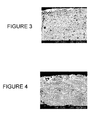
- the coatings were exposed for about fifty hours to temperatures of between about 2500 and 2900°F (about 1370 and 1600°C) and water-containing air at high velocities of about Mach 0.3 to 0.5. SEM images of two of the coatings are shown in Figures 3 and 4 .
- the strontia-rich second phase had volatized, whereas the stoichiometric celsian phase had remained very stable. It was concluded that when exposed to water at high gas velocities, the second phase became unstable and began to volatilize through the loss of silica, resulting in pore formation throughout the coating thickness.
- additional steps were necessary to avoid formation of the second phase and thereby produce an as-deposited coating structure that is substantially free of the second phase, or to eliminate the second phase following coating deposition.
- steps might include process modifications and/or preprocessing of the powder (e.g., heat treating) before the spraying operation.
- the entire BSAS coating need not be substantially free of the second phase, in that sufficient improvement in coating performance should be achieved if just the outer surface region were processed to be substantially free of the second phase.
- BSAS coatings were deposited by APS on CFCC (continuous fiber ceramic composite) combustor liners for an extended engine test.
- the powder material used to deposit the coatings had a composition of, in molar percent, about 19.0% BaO, about 6.8% SrO, about 24.8% Al 2 O 3 , and about 49.4% SiO 2 , and therefore had a silica content only slightly below the stoichiometric amount.
- the coatings were targeted to have stoichiometric compositions (in molar percent, 18.75% BaO, 6.25% SrO, 25% Al 2 O 3 , and 50% SiO 2 ).
- XRF showed the coatings to have as-deposited compositions of, in molar percent, about 20.1% BaO, about 7.2%SrO, about 26.0% Al 2 O 3 , and about 46.8% SiO 2 . Therefore, the coatings had a sub-stoichiometric silica content (i.e., below 50 molar percent), and strontia constituted more than 26 molar percent of the BaO+SrO content.
- the BSAS coatings produced in the first and second investigations presumably had essentially the same chemistries as that found for the coatings produced in the third investigation, including a sub-stoichiometric silica content of less than 47 molar percent and a BaO+SrO content of which SrO constitutes more than 25 molar percent.
- the second phase is undesirable in a protective coating 20 formed of a BSAS or SAS composition as a result of being prone to volatilizing in water and gas velocity environments and causing coating degradation in sea-salt containing environments, both of which result in the formation of pores in BSAS and SAS coatings.
- a protective coating 20 formed of BSAS or SAS is deposited to have a chemistry that inhibits the formation of the second phase, namely, through having a silica content of at least 47 molar percent and preferably about 50 molar percent.
- the BaO+SrO content is preferably about 25 molar percent, but strontia constitutes less than 25 molar percent of the BaO+SrO content, i.e., a strontia content of less than 6.25 molar percent.
- Such coatings are capable of being substantially free of pores formed by volatilization after extended periods at elevated temperatures, such as during operation of a gas turbine engine in which a CMC component protected by the coating is installed.
- a more optimal BSAS chemistry can be obtained by employing a powder whose chemistry is sufficiently rich in silica so that silica losses due to volatilization during deposition result in the as-deposited coating have a silica content of at least 47 molar percent and preferably at or near 50 molar percent.
- a powder can be used whose chemistry is sufficiently lean in strontia to inhibit the formation of the second phase as a result of the strontium solubility in the celsian phase.
- such compositions should produce a coating having a composition that would ensure a celsian phase content of very near 100%.
- an alternative method to developing a near 100% celsian phase in a BSAS (or SAS) coating is to use a stoichiometric or near-stoichiometric BSAS (or SAS) powder in accordance with prior practices, with the result that the coating would contain a sub-stoichiometric amount of silica as a result of volatilization.
- the coating is subjected to a temperature sufficient to eliminate the second phase by intentional volatilization.
- a suitable heat treatment for this purpose is believed to be near but below the melting temperature (1414°C) of free silicon within the substrate or coating system.
- the duration of the heat treatment can be adjusted to control the amount of second phase volatized and to seal the resultant porosity. For example, a duration of about two to about ten hours is believed to be sufficient to eliminate the second phase from about 0.5 to 1.0 mil (about 10 to about 25 micrometers) of the outermost surface region of the coating, with longer durations increasing the depth to which the second phase is eliminated from the coating.
- the region 24 of the BSAS coating 20 beneath the outer surface region 22 would still contain non-stoichiometric barium-strontium-aluminosilicate (e.g., less than 47 molar percent silica), and therefore contain the second phase in addition to stoichiometric phases.
- surface heat treatments can be performed by such methods as laser glazing or in-situ surface treatments performed with the plasma spray gun after coating deposition and with the powder feed turned off.
- the stoichiometric composition for SAS has a molar ratio of about SrO ⁇ Al 2 O 3 ⁇ 2SiO 2 (by molar percent, about 25SrO ⁇ 25Al 2 O 3 ⁇ 50SiO 2 ).
- a stoichiometric SAS coating can be obtained in the as-deposited condition by ensuring a sufficient amount of silica is present in the starting powder material, while also adjusting the amounts of alumina and strontia to avoid formation of the silica-lean second phase.
- suitable starting powders should have a silica-rich composition of, by molar percent, about 22.9% to about 23.7% SrO, about 23.4% to about 24.4% Al 2 O 3 , and about 52.3% to about 53.3% SiO 2 , the balance incidental impurities.
- suitable starting powders may have a silica-rich and alumina-rich composition of, by molar percent, about 23.2% to about 24.2% SrO, about 25.1% to about 26.1 % Al 2 O 3 , and about 50.4% to about 51.4% SiO 2 , the balance incidental impurities. Based on these compositions, suitable powders generally fall in ranges of, by molar percent, about 22.9% to about 24.2% SrO, about 23.4% to about 26.1% Al 2 O 3 , and about 50.4% to about 53.3% SiO 2 , the balance incidental impurities.
- compositions should produce a coating having a composition with a celsian phase content of very near 100% (ideally zero volume percent of the second phase, preferably not more than five volume percent and at most ten volume percent of the second phase).
- a suitable composition for such a stoichiometric SAS coating is, by molar percent, about 25% SrO, about 25% Al 2 O 3 , and at least 47% and preferably at least 50% SiO 2 .
- a suitable stoichiometric SAS coating composition is, by molar percent, about 24.1 % to about 25.4% SrO, about 24.6% to about 26.9% Al 2 O 3 , and about 48.2% to about 50.8% SiO 2 , the balance incidental impurities.
- the coating may contain up to about 2 atomic percent of an alumina phase.
- the above-noted heat treatments for BSAS coatings are also believed to be applicable to the SAS coatings of this invention, by which a stoichiometric SAS coating can be formed in an as-deposited condition, and/or following heat treatment.
Landscapes
- Chemical & Material Sciences (AREA)
- Engineering & Computer Science (AREA)
- Ceramic Engineering (AREA)
- Materials Engineering (AREA)
- Organic Chemistry (AREA)
- Mechanical Engineering (AREA)
- Structural Engineering (AREA)
- Chemical Kinetics & Catalysis (AREA)
- Metallurgy (AREA)
- Inorganic Chemistry (AREA)
- General Engineering & Computer Science (AREA)
- Physics & Mathematics (AREA)
- Plasma & Fusion (AREA)
- Combustion & Propulsion (AREA)
- Manufacturing & Machinery (AREA)
- Turbine Rotor Nozzle Sealing (AREA)
- Paints Or Removers (AREA)
- Surface Treatment Of Glass (AREA)
Applications Claiming Priority (1)
| Application Number | Priority Date | Filing Date | Title |
|---|---|---|---|
| US11/616,361 US7919187B2 (en) | 2004-04-27 | 2006-12-27 | Environmental barrier coating for silicon-containing substrates and process therefor |
Publications (2)
| Publication Number | Publication Date |
|---|---|
| EP1944280A2 true EP1944280A2 (fr) | 2008-07-16 |
| EP1944280A3 EP1944280A3 (fr) | 2013-01-23 |
Family
ID=39203323
Family Applications (1)
| Application Number | Title | Priority Date | Filing Date |
|---|---|---|---|
| EP07122658A Withdrawn EP1944280A3 (fr) | 2006-12-27 | 2007-12-07 | Couche barrière environnementale pour substrats contenant du silicium et procédé correspondant |
Country Status (2)
| Country | Link |
|---|---|
| US (1) | US7919187B2 (fr) |
| EP (1) | EP1944280A3 (fr) |
Families Citing this family (4)
| Publication number | Priority date | Publication date | Assignee | Title |
|---|---|---|---|---|
| US9052116B2 (en) * | 2008-10-30 | 2015-06-09 | Power Generation Technologies Development Fund, L.P. | Toroidal heat exchanger |
| SG173932A1 (en) * | 2010-02-25 | 2011-09-29 | United Technologies Corp | Repair of a coating on a turbine component |
| US8807955B2 (en) * | 2011-06-30 | 2014-08-19 | United Technologies Corporation | Abrasive airfoil tip |
| CA2904185C (fr) | 2013-03-13 | 2021-02-23 | General Electric Company | Revetements pour substrats metalliques |
Citations (3)
| Publication number | Priority date | Publication date | Assignee | Title |
|---|---|---|---|---|
| US6254935B1 (en) | 1999-04-15 | 2001-07-03 | United Technologies Corporation | Method for applying a barrier layer to a silicon based substrate |
| US6352790B1 (en) | 2000-06-29 | 2002-03-05 | United Technologies Corporation | Substrate containing silicon and a barrier layer which functions as a protective/thermal barrier coating |
| US6387456B1 (en) | 1999-04-15 | 2002-05-14 | General Electric Company | Silicon based substrate with environmental/thermal barrier layer |
Family Cites Families (2)
| Publication number | Priority date | Publication date | Assignee | Title |
|---|---|---|---|---|
| US6299988B1 (en) * | 1998-04-27 | 2001-10-09 | General Electric Company | Ceramic with preferential oxygen reactive layer |
| US7341797B2 (en) * | 2004-04-27 | 2008-03-11 | General Electric Company | Environmental barrier coating for silicon-containing substrates and process therefor |
-
2006
- 2006-12-27 US US11/616,361 patent/US7919187B2/en not_active Expired - Fee Related
-
2007
- 2007-12-07 EP EP07122658A patent/EP1944280A3/fr not_active Withdrawn
Patent Citations (5)
| Publication number | Priority date | Publication date | Assignee | Title |
|---|---|---|---|---|
| US6254935B1 (en) | 1999-04-15 | 2001-07-03 | United Technologies Corporation | Method for applying a barrier layer to a silicon based substrate |
| US6365288B1 (en) | 1999-04-15 | 2002-04-02 | United Technologies Corporation | Method for applying a barrier layer to a silicon based substrate |
| US6387456B1 (en) | 1999-04-15 | 2002-05-14 | General Electric Company | Silicon based substrate with environmental/thermal barrier layer |
| US6410148B1 (en) | 1999-04-15 | 2002-06-25 | General Electric Co. | Silicon based substrate with environmental/ thermal barrier layer |
| US6352790B1 (en) | 2000-06-29 | 2002-03-05 | United Technologies Corporation | Substrate containing silicon and a barrier layer which functions as a protective/thermal barrier coating |
Also Published As
| Publication number | Publication date |
|---|---|
| US20070184287A1 (en) | 2007-08-09 |
| EP1944280A3 (fr) | 2013-01-23 |
| US7919187B2 (en) | 2011-04-05 |
Similar Documents
| Publication | Publication Date | Title |
|---|---|---|
| US7687105B2 (en) | Environmental barrier coating for silicon-containing substrates and process therefor | |
| US7357994B2 (en) | Thermal/environmental barrier coating system for silicon-containing materials | |
| EP2503027B1 (fr) | Revêtements résistant à la corrosion à chaud et composants ainsi protégés | |
| US6699607B1 (en) | Thermal/environmental barrier coating for silicon-containing substrates | |
| EP1685083B1 (fr) | Revetements constituant une barriere contre l'oxydation pour ceramiques a base de silicium | |
| EP2202212B1 (fr) | Composants comportant des compositions d'atténuation CMAS | |
| EP1142850B1 (fr) | Barriere environnementale/thermique pour un substrat à base de silicium | |
| US6733908B1 (en) | Multilayer article having stabilized zirconia outer layer and chemical barrier layer | |
| US11072566B2 (en) | Thermal and environmental barrier coating compositions and methods of deposition | |
| US7300702B2 (en) | Diffusion barrier coating for Si-based components | |
| EP1394139A2 (fr) | Surcouche protectrice pour céramiques | |
| JP2006347871A (ja) | シリコン含有基材用の耐食密封剤および同物を製造するプロセス | |
| EP3351522B1 (fr) | Couche de liaison pour céramique ou composite à matrice céramique | |
| EP1734025B1 (fr) | Système de couches barrière thermique/environnementale pour materiaux contenant du silicium | |
| EP2698451A2 (fr) | Revêtement formant une barrière environnementale résistant à la cavitation | |
| EP1683772B1 (fr) | Barrière environnementale/thermique avec une couche de transition pour un substrat à base de silicium | |
| EP1683774B1 (fr) | Couche barrière thermique/environnementale pour un substrat contenant du silicium | |
| EP1544185A2 (fr) | Revêtement protecteur comprenant une surcouche pour reduire la vitesse de gaz | |
| EP1944280A2 (fr) | Couche barrière environnementale pour substrats contenant du silicium et procédé correspondant | |
| US20240076245A1 (en) | Advanced coating chemistries for cmcs |
Legal Events
| Date | Code | Title | Description |
|---|---|---|---|
| PUAI | Public reference made under article 153(3) epc to a published international application that has entered the european phase |
Free format text: ORIGINAL CODE: 0009012 |
|
| AK | Designated contracting states |
Kind code of ref document: A2 Designated state(s): AT BE BG CH CY CZ DE DK EE ES FI FR GB GR HU IE IS IT LI LT LU LV MC MT NL PL PT RO SE SI SK TR |
|
| AX | Request for extension of the european patent |
Extension state: AL BA HR MK RS |
|
| PUAL | Search report despatched |
Free format text: ORIGINAL CODE: 0009013 |
|
| RIC1 | Information provided on ipc code assigned before grant |
Ipc: F01D 5/28 20060101ALI20121212BHEP Ipc: C04B 41/89 20060101ALI20121212BHEP Ipc: C04B 41/85 20060101AFI20121212BHEP |
|
| AK | Designated contracting states |
Kind code of ref document: A3 Designated state(s): AT BE BG CH CY CZ DE DK EE ES FI FR GB GR HU IE IS IT LI LT LU LV MC MT NL PL PT RO SE SI SK TR |
|
| AX | Request for extension of the european patent |
Extension state: AL BA HR MK RS |
|
| 17P | Request for examination filed |
Effective date: 20130723 |
|
| RBV | Designated contracting states (corrected) |
Designated state(s): AT BE BG CH CY CZ DE DK EE ES FI FR GB GR HU IE IS IT LI LT LU LV MC MT NL PL PT RO SE SI SK TR |
|
| AKX | Designation fees paid |
Designated state(s): DE FR GB |
|
| 17Q | First examination report despatched |
Effective date: 20140616 |
|
| STAA | Information on the status of an ep patent application or granted ep patent |
Free format text: STATUS: THE APPLICATION IS DEEMED TO BE WITHDRAWN |
|
| 18D | Application deemed to be withdrawn |
Effective date: 20141028 |