EP1944930A2 - Signalisierungsverfahren, das die Berücksichtigung des Grundes des Anrufs erlaubt - Google Patents
Signalisierungsverfahren, das die Berücksichtigung des Grundes des Anrufs erlaubt Download PDFInfo
- Publication number
- EP1944930A2 EP1944930A2 EP08100244A EP08100244A EP1944930A2 EP 1944930 A2 EP1944930 A2 EP 1944930A2 EP 08100244 A EP08100244 A EP 08100244A EP 08100244 A EP08100244 A EP 08100244A EP 1944930 A2 EP1944930 A2 EP 1944930A2
- Authority
- EP
- European Patent Office
- Prior art keywords
- request
- message
- equipment
- receiving equipment
- call
- Prior art date
- Legal status (The legal status is an assumption and is not a legal conclusion. Google has not performed a legal analysis and makes no representation as to the accuracy of the status listed.)
- Withdrawn
Links
- 238000000034 method Methods 0.000 title claims abstract description 18
- 230000011664 signaling Effects 0.000 title claims abstract description 14
- 238000004891 communication Methods 0.000 claims abstract description 29
- 230000004044 response Effects 0.000 claims description 20
- 230000005540 biological transmission Effects 0.000 claims description 9
- 238000006243 chemical reaction Methods 0.000 claims description 4
- 230000015654 memory Effects 0.000 claims description 3
- 230000004931 aggregating effect Effects 0.000 claims description 2
- 230000009471 action Effects 0.000 description 10
- 230000004913 activation Effects 0.000 description 4
- 230000008901 benefit Effects 0.000 description 3
- 238000006677 Appel reaction Methods 0.000 description 2
- 238000010586 diagram Methods 0.000 description 2
- 238000005516 engineering process Methods 0.000 description 2
- 230000000007 visual effect Effects 0.000 description 2
- UHLRPXXFPYMCAE-UHFFFAOYSA-N 4-isopropylcalix[4]arene Chemical compound C1C(C=2O)=CC(C(C)C)=CC=2CC(C=2O)=CC(C(C)C)=CC=2CC(C=2O)=CC(C(C)C)=CC=2CC2=CC(C(C)C)=CC1=C2O UHLRPXXFPYMCAE-UHFFFAOYSA-N 0.000 description 1
- 241000897276 Termes Species 0.000 description 1
- 230000002730 additional effect Effects 0.000 description 1
- 230000001413 cellular effect Effects 0.000 description 1
- 230000006835 compression Effects 0.000 description 1
- 238000007906 compression Methods 0.000 description 1
- 238000001514 detection method Methods 0.000 description 1
- 230000006870 function Effects 0.000 description 1
- 230000000977 initiatory effect Effects 0.000 description 1
- 230000010354 integration Effects 0.000 description 1
- 230000002045 lasting effect Effects 0.000 description 1
- 229920001690 polydopamine Polymers 0.000 description 1
- 230000017105 transposition Effects 0.000 description 1
- 230000001755 vocal effect Effects 0.000 description 1
Images


Classifications
-
- H—ELECTRICITY
- H04—ELECTRIC COMMUNICATION TECHNIQUE
- H04M—TELEPHONIC COMMUNICATION
- H04M1/00—Substation equipment, e.g. for use by subscribers
- H04M1/253—Telephone sets using digital voice transmission
- H04M1/2535—Telephone sets using digital voice transmission adapted for voice communication over an Internet Protocol [IP] network
-
- H—ELECTRICITY
- H04—ELECTRIC COMMUNICATION TECHNIQUE
- H04L—TRANSMISSION OF DIGITAL INFORMATION, e.g. TELEGRAPHIC COMMUNICATION
- H04L65/00—Network arrangements, protocols or services for supporting real-time applications in data packet communication
- H04L65/40—Support for services or applications
-
- H—ELECTRICITY
- H04—ELECTRIC COMMUNICATION TECHNIQUE
- H04M—TELEPHONIC COMMUNICATION
- H04M1/00—Substation equipment, e.g. for use by subscribers
- H04M1/66—Substation equipment, e.g. for use by subscribers with means for preventing unauthorised or fraudulent calling
- H04M1/663—Preventing unauthorised calls to a telephone set
-
- H—ELECTRICITY
- H04—ELECTRIC COMMUNICATION TECHNIQUE
- H04M—TELEPHONIC COMMUNICATION
- H04M3/00—Automatic or semi-automatic exchanges
- H04M3/42—Systems providing special services or facilities to subscribers
- H04M3/42025—Calling or Called party identification service
- H04M3/42034—Calling party identification service
- H04M3/42042—Notifying the called party of information on the calling party
-
- H—ELECTRICITY
- H04—ELECTRIC COMMUNICATION TECHNIQUE
- H04L—TRANSMISSION OF DIGITAL INFORMATION, e.g. TELEGRAPHIC COMMUNICATION
- H04L65/00—Network arrangements, protocols or services for supporting real-time applications in data packet communication
- H04L65/1066—Session management
- H04L65/1101—Session protocols
- H04L65/1104—Session initiation protocol [SIP]
Definitions
- the invention relates to the field of telecommunications. It relates more precisely the connection between two equipment, namely a calling equipment and a called equipment.
- a telephone communication conventionally comprises a phase, prior to the actual communication, establishing communication.
- this preliminary phase also called signaling
- the call from the calling equipment is presented to the called equipment, by means of a warning which can be of sound type (for example via a ringing or music), visual (for example by the display of a light) or mechanical (for example by means of a vibration) or combine these three types.
- Modern hand-held communicating equipment cellular phones, Personal Digital Assistant (PDA), pagers, etc., contain memories in which a certain amount of information is stored, for example personal information relating to the owner (name, surname, address, function, etc.). They also include interfaces allowing them to display, during a call presentation, information relating to the calling terminal (call number, name and possibly photograph of the correspondent, etc.). With these features, users can, from the presentation of the call, choose the action that seems most appropriate to them: taking or refusing the call, switching to a switchboard or voice mailbox, put on hold, etc. Communicating equipment may also be included in telecommunication servers, which have call management features, including transmission, reception, rejection, hold and transfer.
- PDA Personal Digital Assistant
- the signaling phase is commonly carried out according to the Session Initiation Protocol ( SIP ) described in the RFC3261 standard of June 2002.
- SIP Session Initiation Protocol
- At least one response proposal to aggregate to said request at least one response proposal, before transmitting it to the receiving equipment, it consists in determining at least one response proposal in an intermediate server, according to information of which it features in real time.
- the prior knowledge of the subject of the call, and a proposal of a response adapted to the context of the communication facilitates to the called part the management of its calls, allowing him to choose with knowledge of the action to take when receiving a call-up request: answer, refusal to take the call, sending a response in text format, transferring the call, etc.
- the retrieval of the object message by the called equipment can be performed by display on a graphical interface, or by reading on a sound interface, in which case, prior to the transmission of the communication request to the called equipment, the object message in text format is converted into a voice message that can be restored on this audio interface.
- the request from the calling terminal is a SIP request.
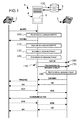
- a telecommunication network 1 of VolP type comprising several communicating equipment, namely in this case two terminals 2, 3 in the form of IP phones, and a proxy server 4 (proxy).
- the proxy server 4 and one of the terminals belong to the same local area network (LAN).
- the proxy server 4 is preferably connected to a database 5 where are stored the associations between the URI (Uniform Resource Identifier) and IP (Internet Protocol) addresses of all the terminals 3 of the LAN.
- URI Uniform Resource Identifier
- IP Internet Protocol
- Both the server 4 and the terminals 2, 3 are designed to make and receive calls.
- the server 4 serves as a telecommunication relay during a communication to be established between the two terminals 2, 3.
- At least two other schemes are possible.
- the server 4 receives a call from a transmitting terminal (for example the terminal 2 outside the LAN network) without transferring it to another terminal: in this case, the server 4 is considered as a receiver of the call.
- the server 4 transmits or retransmits after receiving it and modified, for example by adding information, a call to a receiving terminal (for example the terminal 3 internal to the LAN). In this case, server 4 is considered as the sender of the call.
- the network 1 is here configured to use the SIP protocol during the establishment and termination of communications.
- devices terminal 2 , 3 and server 4
- each include a software application, called UA (User Agent) implemented on a processor and programmed to generate SIP requests.
- the UAs of the sending equipment (in this case the terminal 2) and the receiving equipment (in this case the terminal 3) are respectively called UAC (User Agent Client) and UAS (User Agent Server).
- the call-up request includes an object message relating to the reason for the call.
- this message is "Urgent Question - 1 Min.”
- the object message containing the reason for the call can be either entered by the user of the sending terminal 2 by means of an alphanumeric keyboard, or generated automatically by conversion of a voice message into a text message by means of a speech-to-text application, or still selected from a list of pre-established messages stored in the transmitting terminal.
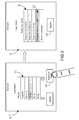
- FIG 3 shows an example of choice, on a primary screen 6 displayed on a graphical interface 7 of the transmitting terminal 2, the object message among a list presented in the form of a drop-down menu 8 appearing on a secondary screen 9 of the interface 7 by activation of a key 10 adequate (here called "reason for the call").
- the key 10 may be a physical button in the terminal 2, in which case its activation is carried out by pulse, or a zone delimited in the primary screen 6, its activation can then be performed by means of directional selection buttons or, if interface 6 is tactile (as shown on the figure 3 ), by pulse on the zone defining the key 10.
- the user of the sending terminal wants to contact Chloé for an urgent question requiring a telephone conversation lasting one minute.
- Bertrand selects Chloe from among a set of recipients presented on the primary screen 6 in a list in the form of a drop-down menu 11, then activates the key 10 "Reason for the call” in order to access the menu 8 and select the message of adequate object 12 : "Urgent matter - 1 min”. Bertrand then transmits the call, for example by pressing a key 13 called "Call”. The communication request is then sent to Chloe.
- the request passes through the server 4, which detects the presence of the object message 12 and reads the content, optionally aggregates response proposals (see below) before transferring the request to the receiving terminal 3.
- the interface 7 also displays an object message 16 recalling the object message 12 transmitted by the transmitting terminal 2.
- Chloe can then choose the action she wishes to undertake in response to the communication request, by selecting it from a list of predefined actions that are displayed on the terminal 3 in the form of a drop-down menu 17.
- actions have been stored, for example, partly in the terminal 3 itself, and partly in the server 4 which, according to information available to it in real time (including the transfer possibilities according to the availability of others terminals to which it is connected), is able, upon receipt of the call-up request, to propose additional actions to the user of the terminal 3, actions that are added to the predefined actions already stored therein.
- the action entitled “Deny and transfer the call to Denis” is proposed by the server 4, which is indeed informed of the availability of the terminal corresponding to the user "Denis".
- the server transmits this action proposal to the receiving terminal 3 simultaneously with the connection request.
- Chloe does not want to take the call but delay communication by scheduling a reminder 10 minutes later. It therefore selects a message 18 entitled "Delay - program reminder in 10 minutes” and activates a key 19 entitled “Send” (it is for example, as in the example shown, a touch zone in the interface 7 terminal 3).
- the activation of the key 19 causes the cancellation of the communication request and the sending to the transmitting terminal 2, by the receiving terminal 3, the selected message.
- An automatic reminder is programmed by the terminal 3, with visual reminder (in this case two minutes before the automatic reminder). According to an embodiment illustrated on the figure 4 a summary of each action taken is displayed on a secondary screen 20 on the interface 7 of the terminal 3.
- a first operation 100 is the reception, by the server 4, of the call-up INVITE request formed and then sent by the sending terminal 2, to the receiving terminal 3.
- a second operation 110 is the analysis of the INVITE request by the server 4.
- a third operation 120 is the interrogation of the database 5 for the identification of the receiver terminal 3.
- a fourth operation 130 is the detection and reading by the server 4 of the object message contained in the INVITE request.
- a fifth operation 140 is the conversion of the text object message into a text to speech message in the event that the receiving terminal 3 does not have any display functionality enabling it to reproduce the text of the text. object message.
- the database 5 is informed of the functionalities of the terminals connected to the server 4.
- a sixth operation 150 is the transmission, by the server 4 to the receiving terminal 3, of the INVITE request with the object message.
- a seventh operation 160 is the reception by the receiver terminal 3 of the call-up request.
- An eighth operation 170 is the taking into account by the receiving terminal 3 of the object message, then a ninth operation 180 being the restitution by the receiving terminal 3 of the object message, either textually on a graphical interface, or voice mode on sound interface (such as loudspeaker), depending on the functionalities of the receiving terminal 3.
- the user of the receiving terminal 3 can accept the call and therefore respond favorably to the call-up request.
- the following operations can therefore simply include the step of the receiving terminal 3, the communication between the terminals 2 and 3, then, at the end of the call, the termination of the latter, as illustrated in FIG. figure 1 .
- the user of the receiving terminal 3 may (at least in the immediate future) not wish to communicate with the user of the transmitting terminal 2.
- an eighth operation 190 consists in the editing on the receiver terminal 3 of a response message, a ninth operation 200 being the cancellation of the call-up request and the transmission of the response message to the transmitting terminal 2.
- the tenth and last operation 210 consists of the restitution, textual or vocal (after conversion) of the response message on the interface of the transmitting terminal 2, as illustrated on the figure 2 .
- the method just described has the advantage of making communications more accurate and more effective, insofar as these are only engaged when both parties (transmitter and receiver) are ready to communicate and both know the subject of the communication.
- Knowing the reason for the call allows the receiving party to better manage its calls by accepting certain communications deemed important or urgent, while others are refused or postponed.
Landscapes
- Engineering & Computer Science (AREA)
- Signal Processing (AREA)
- Computer Security & Cryptography (AREA)
- Multimedia (AREA)
- Computer Networks & Wireless Communication (AREA)
- Telephonic Communication Services (AREA)
- Mobile Radio Communication Systems (AREA)
- Communication Control (AREA)
Applications Claiming Priority (1)
| Application Number | Priority Date | Filing Date | Title |
|---|---|---|---|
| FR0752622A FR2911459B1 (fr) | 2007-01-11 | 2007-01-11 | Procede de signalisation permettant la prise en compte de la raison de l'appel |
Publications (2)
| Publication Number | Publication Date |
|---|---|
| EP1944930A2 true EP1944930A2 (de) | 2008-07-16 |
| EP1944930A3 EP1944930A3 (de) | 2008-07-30 |
Family
ID=38349503
Family Applications (1)
| Application Number | Title | Priority Date | Filing Date |
|---|---|---|---|
| EP08100244A Withdrawn EP1944930A3 (de) | 2007-01-11 | 2008-01-09 | Signalisierungsverfahren, das die Berücksichtigung des Grundes des Anrufs erlaubt |
Country Status (5)
| Country | Link |
|---|---|
| US (1) | US20080170678A1 (de) |
| EP (1) | EP1944930A3 (de) |
| CN (1) | CN101222536A (de) |
| FR (1) | FR2911459B1 (de) |
| WO (1) | WO2008084056A2 (de) |
Families Citing this family (12)
| Publication number | Priority date | Publication date | Assignee | Title |
|---|---|---|---|---|
| US7333820B2 (en) * | 2001-07-17 | 2008-02-19 | Networks In Motion, Inc. | System and method for providing routing, mapping, and relative position information to users of a communication network |
| CN101803353B (zh) | 2007-09-20 | 2013-12-25 | 西门子企业通讯有限责任两合公司 | 用于运行通信连接的方法和通信装置 |
| US8781094B2 (en) * | 2008-01-16 | 2014-07-15 | Microsoft Corporation | Contextual call routing by calling party specified information through called party specified form |
| US8077833B2 (en) * | 2008-07-25 | 2011-12-13 | Embarq Holdings Company, Llc | Method for sending a previously recorded personalized message to a caller by a network voice mail system |
| WO2010096546A1 (en) * | 2009-02-18 | 2010-08-26 | MBTE Holdings Sweden AB | Telephone call scheduling and initiation system |
| CN103297938A (zh) * | 2012-03-01 | 2013-09-11 | 联想(北京)有限公司 | 一种通信方法及电子终端 |
| CN103118020B (zh) * | 2013-01-24 | 2016-03-16 | 北京中创信测科技股份有限公司 | 实现主题呼叫的方法及装置 |
| US9374688B2 (en) * | 2013-11-28 | 2016-06-21 | Lg Electronics Inc. | Mobile terminal and method for controlling the same |
| CN104219368A (zh) * | 2014-09-29 | 2014-12-17 | 上海斐讯数据通信技术有限公司 | 一种用于防止骚扰电话的方法 |
| US9716796B2 (en) * | 2015-04-17 | 2017-07-25 | Microsoft Technology Licensing, Llc | Managing communication events |
| CN106850949A (zh) * | 2016-12-16 | 2017-06-13 | 北京奇虎科技有限公司 | 语音呼叫方法、装置和移动终端 |
| CN110351416B (zh) * | 2019-06-06 | 2021-05-28 | 杭州数梦工场科技有限公司 | 通信方法、装置、电子设备及存储介质 |
Citations (1)
| Publication number | Priority date | Publication date | Assignee | Title |
|---|---|---|---|---|
| US6950504B1 (en) | 2001-07-06 | 2005-09-27 | Cingular Wireless Ii, Inc. | Method and apparatus for providing personal audio alert messaging for audio alerting capable terminals |
Family Cites Families (10)
| Publication number | Priority date | Publication date | Assignee | Title |
|---|---|---|---|---|
| US6185603B1 (en) * | 1997-03-13 | 2001-02-06 | At&T Corp. | Method and system for delivery of e-mail and alerting messages |
| US6400808B1 (en) * | 1997-11-26 | 2002-06-04 | At&T Corp | System and method for providing call subject information to a called party |
| US6169796B1 (en) * | 1998-03-09 | 2001-01-02 | At & T Corp. | Call rerouter method and apparatus |
| GB2367707A (en) * | 2000-06-28 | 2002-04-10 | Neil Lennox Munro | Internet activated telephone alert |
| DE60132096T2 (de) * | 2000-08-22 | 2008-06-26 | Symbian Ltd. | Verfahren und vorrichtung zur kommunikation von nutzerbezogenen informationen unter verwendung einer drahtlosen informationsvorrichtung |
| JP2002291035A (ja) * | 2001-03-26 | 2002-10-04 | Toshiba Corp | 移動通信端末装置 |
| US20040252679A1 (en) * | 2002-02-26 | 2004-12-16 | Tim Williams | Stored voice message control extensions |
| US7496189B2 (en) * | 2002-06-10 | 2009-02-24 | Alcatel-Lucent Usa Inc. | Caller information display methods and systems |
| US7280646B2 (en) * | 2003-04-18 | 2007-10-09 | At&T Bls Intellectual Property, Inc. | Dynamic Caller ID messaging |
| US20100056120A1 (en) * | 2006-11-30 | 2010-03-04 | Christian Olrog | Method and server for filtering telephone calls |
-
2007
- 2007-01-11 FR FR0752622A patent/FR2911459B1/fr not_active Expired - Fee Related
-
2008
- 2008-01-09 WO PCT/EP2008/050177 patent/WO2008084056A2/fr not_active Ceased
- 2008-01-09 EP EP08100244A patent/EP1944930A3/de not_active Withdrawn
- 2008-01-09 CN CNA2008100020349A patent/CN101222536A/zh active Pending
- 2008-01-10 US US11/972,425 patent/US20080170678A1/en not_active Abandoned
Patent Citations (1)
| Publication number | Priority date | Publication date | Assignee | Title |
|---|---|---|---|---|
| US6950504B1 (en) | 2001-07-06 | 2005-09-27 | Cingular Wireless Ii, Inc. | Method and apparatus for providing personal audio alert messaging for audio alerting capable terminals |
Also Published As
| Publication number | Publication date |
|---|---|
| US20080170678A1 (en) | 2008-07-17 |
| CN101222536A (zh) | 2008-07-16 |
| WO2008084056A3 (fr) | 2008-09-25 |
| FR2911459B1 (fr) | 2009-04-03 |
| EP1944930A3 (de) | 2008-07-30 |
| FR2911459A1 (fr) | 2008-07-18 |
| WO2008084056A2 (fr) | 2008-07-17 |
Similar Documents
| Publication | Publication Date | Title |
|---|---|---|
| EP1944930A2 (de) | Signalisierungsverfahren, das die Berücksichtigung des Grundes des Anrufs erlaubt | |
| EP2526657B1 (de) | Verfahren und system zur aufrechterhaltung des telefoniesitzungsstatus | |
| CN100571310C (zh) | 在互联网/内联网通话中统一通信的系统 | |
| US7702792B2 (en) | Method and system for managing communication sessions between a text-based and a voice-based client | |
| JP5079695B2 (ja) | コンテキストによる電話の増補 | |
| WO2009147348A2 (fr) | Procédé et système d'enregistrement automatique d'une session de communication | |
| US8903058B2 (en) | Conveying call subject matter with voice data | |
| US20060245558A1 (en) | System and method for providing presence information to voicemail users | |
| EP2882161B1 (de) | Verfahren und Vorrichtung zur Herstellung einer Kommunikation | |
| US7623633B2 (en) | System and method for providing presence information to voicemail users | |
| FR2934451A1 (fr) | Etablissement et controle d'appel par equipement tiers. | |
| US8977970B2 (en) | Method and system for handling media in an instant messaging environment | |
| EP2117218A1 (de) | Stimme-Text-Konversion in Echtzeit für Telekommunikationsdienste | |
| EP1869858A2 (de) | Verfahren zur steuerung des sendens unangeforderter voice-informationen | |
| WO2005053264A1 (fr) | Systeme et procede de mise en relation entre au moins deux terminaux multimedia relies entre eux par un reseau fixe ou cellulaire | |
| EP1921835A1 (de) | Bereicherung der Signalübertragung in einer Kommunikatonssession vom Typ "Push to Talk" durch Einführen einer Visitenkarte | |
| CA2593870A1 (fr) | Enregistrement de communications dans un reseau de telecommunications | |
| CN113923198A (zh) | 一种用于改善VoIP语音通话质量低的方法和装置 | |
| WO2009112760A1 (fr) | Procede de gestion d'une session de communication au niveau d'une passerelle domestique | |
| JP2017046133A (ja) | 録音音声自動ネーミング機能を有するip電話端末 | |
| EP1865696A2 (de) | Zeichengabeverfahren, das einen Vorgang der Umwandlung einer Nachricht von einem anrufenden Endgerät umfasst | |
| FR2860936A1 (fr) | Procede et systeme de controle de communication multi-terminaux | |
| FR2911236A1 (fr) | Procede d'etablissement de communication entre terminaux sur un medium choisi par l'appele, et dispositifs d'aide associes | |
| FR3020539A1 (fr) | Procede et dispositif d'etablissement d'une communication | |
| FR2867651A1 (fr) | Procede de transmission d'informations par mms et telephones associes |
Legal Events
| Date | Code | Title | Description |
|---|---|---|---|
| PUAI | Public reference made under article 153(3) epc to a published international application that has entered the european phase |
Free format text: ORIGINAL CODE: 0009012 |
|
| PUAL | Search report despatched |
Free format text: ORIGINAL CODE: 0009013 |
|
| AK | Designated contracting states |
Kind code of ref document: A2 Designated state(s): AT BE BG CH CY CZ DE DK EE ES FI FR GB GR HR HU IE IS IT LI LT LU LV MC MT NL NO PL PT RO SE SI SK TR |
|
| AX | Request for extension of the european patent |
Extension state: AL BA MK RS |
|
| AK | Designated contracting states |
Kind code of ref document: A3 Designated state(s): AT BE BG CH CY CZ DE DK EE ES FI FR GB GR HR HU IE IS IT LI LT LU LV MC MT NL NO PL PT RO SE SI SK TR |
|
| AX | Request for extension of the european patent |
Extension state: AL BA MK RS |
|
| RIC1 | Information provided on ipc code assigned before grant |
Ipc: H04M 3/42 20060101AFI20080626BHEP |
|
| AKX | Designation fees paid | ||
| REG | Reference to a national code |
Ref country code: DE Ref legal event code: 8566 |
|
| STAA | Information on the status of an ep patent application or granted ep patent |
Free format text: STATUS: THE APPLICATION IS DEEMED TO BE WITHDRAWN |
|
| 18D | Application deemed to be withdrawn |
Effective date: 20090131 |