EP1944936A1 - Verfahren zum schutz des dienstablaufs und netzwerkeinrichtung - Google Patents
Verfahren zum schutz des dienstablaufs und netzwerkeinrichtung Download PDFInfo
- Publication number
- EP1944936A1 EP1944936A1 EP06791133A EP06791133A EP1944936A1 EP 1944936 A1 EP1944936 A1 EP 1944936A1 EP 06791133 A EP06791133 A EP 06791133A EP 06791133 A EP06791133 A EP 06791133A EP 1944936 A1 EP1944936 A1 EP 1944936A1
- Authority
- EP
- European Patent Office
- Prior art keywords
- path
- traffic flow
- sub
- backup
- target entity
- Prior art date
- Legal status (The legal status is an assumption and is not a legal conclusion. Google has not performed a legal analysis and makes no representation as to the accuracy of the status listed.)
- Withdrawn
Links
- 238000000034 method Methods 0.000 title claims abstract description 31
- 238000001514 detection method Methods 0.000 claims description 25
- 238000004364 calculation method Methods 0.000 claims description 19
- 230000005540 biological transmission Effects 0.000 claims description 18
- 238000004891 communication Methods 0.000 claims description 9
- 230000000737 periodic effect Effects 0.000 claims description 5
- 238000011897 real-time detection Methods 0.000 claims description 5
- 238000011084 recovery Methods 0.000 description 5
- 238000005516 engineering process Methods 0.000 description 1
Images




Classifications
-
- H—ELECTRICITY
- H04—ELECTRIC COMMUNICATION TECHNIQUE
- H04L—TRANSMISSION OF DIGITAL INFORMATION, e.g. TELEGRAPHIC COMMUNICATION
- H04L45/00—Routing or path finding of packets in data switching networks
- H04L45/22—Alternate routing
-
- H—ELECTRICITY
- H04—ELECTRIC COMMUNICATION TECHNIQUE
- H04L—TRANSMISSION OF DIGITAL INFORMATION, e.g. TELEGRAPHIC COMMUNICATION
- H04L45/00—Routing or path finding of packets in data switching networks
- H04L45/28—Routing or path finding of packets in data switching networks using route fault recovery
Definitions
- the present invention relates to a traffic flow protection technology in communication network, particularly a traffic flow protection method and IP network device in IP communication network.
- the source node in order to transmit a traffic flow from a source node to a target entity, the source node first calculates an optimal path from the source node to the target entity based on a routing algorithm. In a normal situation of a steady network and a convergent route, the optimal path obtained by a route calculation is called a primary path. After acquiring the primary path, the source node could transmit the traffic flow to a next hop node of the primary path. The next hop node of the primary path forwards the traffic flow to the target entity. In the context, a link between the source node and the next hop node in the primary path is called a primary link.
- the source node in the text could be a network, a node or a particular network device and the target entity could be a network, a node or a particular network device.
- the source node When the primary path is invalid due to failure, the source node will recalculate the optimal path from the source node to the target entity.
- the optimal path obtained by calculating route when the primary path is under failure is called a sub-optimal path.
- the source node After acquiring the sub-optimal path, the source node could transmit the traffic flow to a next hop node in the sub-optimal path. The next hop node in the sub-optimal path will forward the traffic flow to the target entity.
- a link between the source node and the next hop node in the sub-optimal path is called a sub-optimal link.
- FIG. 1 is a principle view of the traffic flow protection method of the prior art.
- a traffic flow is transmitted from a source node A to a target entity.
- the source node transmits the traffic flow via a primary link to a next hop node B in a primary path.
- the next hop node B in the primary path will forward the traffic flow to the target entity.
- the source node will transmit the traffic flow via a sub-optimal link to a next hop node C in a sub-optimal path, and the next hop node C in the sub-optimal path forwards the traffic flow to the target entity.
- Figure 2 is a flow chart of the traffic flow protection method of the prior art. The method includes:
- Steps 201-202 the source node A obtains the primary path by a route calculation with a routing algorithm.
- the source node A transmits the traffic flow via the primary link to the next hop node B in the primary path.
- the next hop node B in the primary path forwards the traffic flow to the target entity, and meanwhile the source node A detects and determines whether the primary path is invalid. If the primary path is invalid, the process proceeds to step 203 and its following steps. If the primary path is not invalid, the flow ends.
- a detection of the primary path by the source node A may be a periodic detection or a real-time detection.
- Steps 203-205 the traffic flow transmission is interrupted, meanwhile the source node A recalculates the route to obtain the sub-optimal path; the source node A switches the traffic flow to the sub-optimal path; the source node A transmits the traffic flow via the sub-optimal link to the next hop node C in the sub-optimal path, the next hop node C in the sub-optimal path forwards the traffic flow to the target entity.
- the transmission of the traffic flow is interrupted immediately when the primary path becomes invalid because of failure. Only after recalculating route to obtain the sub-optimal path and performing corresponding switch, the transmission of traffic flow could be recovered. Because the time for calculating the route is usually at second-level, the failure recovery time from detecting the failure of primary path to switching the traffic flow to the sub-optimal path is at least at the second-level, even if the time for switching is not taken into consideration.
- the traffic flow protection method of the prior art can substantially meet the needs of communication network, because the demand for the network real-time performance and reliability is not high.
- the communication networks carries more and more real-time or quasi real-time services, such as voice and video which usually requires failure recovery time up to millisecond-level. It is obvious that the traffic flow protection method of the prior art can not meet the requirements of these services.
- the present invention provides a traffic flow protection method.
- a backup path between a source node and a target entity is preset, the method includes the following steps:
- A switching, by the source node, a traffic flow to a backup path, to transmit the traffic flow to the target entity via the backup path, meanwhile obtaining, by the source node, a sub-optimal path by a route calculation with a routing algorithm and comparing whether the sub-optimal path is superior to the backup path, if the sub-optimal path is superior to the backup path, step B is performed, and if the sub-optimal path is not superior to the backup path, the flow ends;
- the communication network may be an IP network.
- the detection may be a periodic detection or a real-time detection.
- the target entity may be a target node, a target network or a target network device.
- the invention also provides a network device, including a Transmission and Detection Module, for switching a traffic flow to a stored backup path which can transmit the traffic flow to a target entity, and transmitting the traffic flow to the target entity by the backup path when a primary path is detected to be invalid;
- a network device including a Transmission and Detection Module, for switching a traffic flow to a stored backup path which can transmit the traffic flow to a target entity, and transmitting the traffic flow to the target entity by the backup path when a primary path is detected to be invalid;
- a Route Calculation Module for calculating a sub-optimal path adapted for transmitting the traffic flow to the target entity when the primary path is invalid;
- a Path Determination Module for comparing the sub-optimal path calculated by the Route Calculation Module and the backup path stored by the Transmission and Detection Module, to determine whether the sub-optimal path is superior to the backup path
- the Transmission and Detection Module switches the traffic flow to the sub-optimal path and transmits the traffic flow to the target entity via the sub-optimal path if the Path Determination Module determines that the sub-optimal path is superior to the backup path.
- the network device may be an IP network device.
- a backup path is preset, and when a primary path is invalid, a traffic flow is switched to the backup path immediately, and meanwhile a route is recalculated.
- a source node transmits the traffic flow via a backup link to a next hop node in the backup path.
- the next hop node in the backup path forwards the traffic flow to the target entity. If the calculated sub-optimal path is superior to the backup path, the traffic flow is switched to the sub-optimal path; and if the calculated sub-optimal path is not superior to the backup path, the traffic flow is transmitted still by the backup path.
- the failure recovery time of the traffic flow is also at millisecond-level, which can sufficiently meet the requirements of real-time or quasi real-time communication services, such as voice and video.
- Figure 1 is a principle view of a traffic flow protection method of the prior art
- Figure 2 is a flow chart of a traffic flow protection method of the prior art
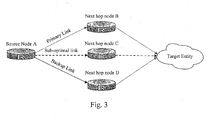
- Figure 3 is a principle view of a traffic flow protection method of the invention.
- Figure 4 is a flow chart of a traffic flow protection method of the invention.
- Figure 5 is a structure view of a network device of the invention.
- a backup path is preset, and when a primary path is invalid, a traffic flow is switched to the backup path immediately, and meanwhile a route is recalculated.
- a source node transmits the traffic flow via a backup link to a next hop node in the backup path.
- the next hop node in the backup path forwards the traffic flow to a target entity.
- FIG 3 is a principle view of the traffic flow protection method of the invention.
- a backup path that can transmit a traffic flow to a target entity is pre-setup between source node A and the target entity.
- the source node transmits the traffic flow to a next hop node B in a primary path.
- the next hop node B in the primary path forwards the traffic flow to the target entity.
- the traffic flow is switched to the backup path immediately.
- the source node may transmit the traffic flow to a next hop node D in the backup path.
- the next hop node D in the backup path forwards the traffic flow to the target entity.
- a link between source node A and the next hop node in the backup path is called a backup link.
- FIG. 4 is the flow chart of the traffic flow protection method of the invention.
- the traffic flow protection method includes:
- Steps 401-402 the source node A obtains the primary path by a route calculation with a routing algorithm; the source node A transmits the traffic flow via a primary link to the next hop node B in the primary path; the next hop node B in the primary path forwards the traffic flow to the target entity, meanwhile source node A detects and determines whether the primary path is invalid. If the primary path is invalid, step 403 and the following steps are performed. If the primary path is not invalid, the flow ends.
- the detection of the primary path by source node A may be a periodic detection or a real-time detection.
- Steps 403-405 the source node A switches the traffic flow to the backup path; the source node A transmits the traffic flow through the backup link to the next hop node D in the backup path; the next hop node D in the backup path forwards the traffic flow to the target entity, meanwhile the source node A recalculates a route to obtain a sub-optimal path.
- the source node A compares the sub-optimal path and the backup path to determine whether the sub-optimal path is superior to the backup path. If the sub-optimal path is superior to the backup path, step 406 and the following steps are performed. If the sub-optimal path is not superior to the backup path, the flow ends.
- the term "superior to" here means shorter path, better link situation or larger bandwidth.
- Steps 406-407 the source node A switches the traffic flow to the sub-optimal path; the source node A transmits the traffic flow via a sub-optimal link to a next hop node D in the sub-optimal path; and the next hop node D in the sub-optimal path forwards the traffic flow to the target entity.
- FIG. 5 is a structure view of the network device of the invention, used to implement the traffic flow protection method of the invention.
- the network device 500 of the invention includes: Transmission and Detection Module 501, Route Calculation Module 502, and Path Determination Module 503 connecting with each other in a communicable way.
- the Transmission and Detection Module 501 stores a backup path that can transmit the traffic flow to the target entity.
- the Transmission and Detection Module 501 is adapted to send a traffic flow to the target entity and detect the path for transmitting traffic flow.
- the detection may be a periodic detection or a real-time detection.
- the Transmission and Detection Module 501 transmits the traffic flow to the target entity via a primary path acquired from the Route Calculation Module 502, meanwhile detects and determines whether the primary path is invalid and if the primary path is invalid, the Transmission and Detection Module 501 switches the traffic flow to the stored backup path and transmits the traffic flow to the target entity via the backup path, meanwhile notifies the Route Calculation Module 502 to recalculate the route, and when acquiring from the Path Determination Module 503 that the sub-optimal path calculated by the Route Calculation Module 502 is superior to the backup path, switches the traffic flow to the sub-optimal path and transmits the traffic flow to target entity via the sub-optimal path link.
- the Route Calculation Module 502 is adapted to calculate the optimal path for transmitting the traffic flow to the target entity. In the normal situation of steady network and convergent route, the Route Calculation Module 502 calculates the optimal path and obtains the primary path, and sends the calculated primary path to Transmission and the Detection Module 501. When the primary path is in failure, the Route Calculation Module 502 calculates the optimal path and obtains the sub-optimal path, and sends the calculated sub-optimal path to the Path Determination Module 503.
- the Path Determination Module 503 is adapted to compare the sub-optimal path calculated by the Route Calculation Module 502 and the backup path stored by the Transmission and Detection Module 501, determine whether the sub-optimal path is superior to the backup path, and send the compare result to the Transmission and Detection Module 501.
Landscapes
- Engineering & Computer Science (AREA)
- Computer Networks & Wireless Communication (AREA)
- Signal Processing (AREA)
- Data Exchanges In Wide-Area Networks (AREA)
Applications Claiming Priority (2)
| Application Number | Priority Date | Filing Date | Title |
|---|---|---|---|
| CNB2005101174995A CN100403734C (zh) | 2005-11-02 | 2005-11-02 | 一种业务流保护方法 |
| PCT/CN2006/002545 WO2007051388A1 (en) | 2005-11-02 | 2006-09-27 | A method for protecting the service flow and a network device |
Publications (3)
| Publication Number | Publication Date |
|---|---|
| EP1944936A1 true EP1944936A1 (de) | 2008-07-16 |
| EP1944936A8 EP1944936A8 (de) | 2008-10-29 |
| EP1944936A4 EP1944936A4 (de) | 2009-03-11 |
Family
ID=37133713
Family Applications (1)
| Application Number | Title | Priority Date | Filing Date |
|---|---|---|---|
| EP06791133A Withdrawn EP1944936A4 (de) | 2005-11-02 | 2006-09-27 | Verfahren zum schutz des dienstablaufs und netzwerkeinrichtung |
Country Status (4)
| Country | Link |
|---|---|
| US (1) | US20080205282A1 (de) |
| EP (1) | EP1944936A4 (de) |
| CN (1) | CN100403734C (de) |
| WO (1) | WO2007051388A1 (de) |
Cited By (1)
| Publication number | Priority date | Publication date | Assignee | Title |
|---|---|---|---|---|
| EP2187582A1 (de) * | 2008-11-12 | 2010-05-19 | Nec Corporation | Übertragungsvorrichtung, Übertragungsnetzwerk und dafür verwendete Verfahren |
Families Citing this family (5)
| Publication number | Priority date | Publication date | Assignee | Title |
|---|---|---|---|---|
| US8817596B2 (en) * | 2009-01-09 | 2014-08-26 | Futurewei Technologies, Inc. | Protecting ingress and egress of a label switched path |
| CN101645848B (zh) * | 2009-09-04 | 2012-11-07 | 华为技术有限公司 | 流量保护方法、装置及系统 |
| US8885459B2 (en) | 2010-02-26 | 2014-11-11 | Futurewei Technologies, Inc. | System and method for computing a backup ingress of a point-to-multipoint label switched path |
| GB2590448A (en) * | 2019-12-18 | 2021-06-30 | Sony Corp | A controller, computer program and method |
| CN115499369B (zh) * | 2022-08-10 | 2024-11-01 | 新华三技术有限公司 | 路径保护方法及装置 |
Family Cites Families (12)
| Publication number | Priority date | Publication date | Assignee | Title |
|---|---|---|---|---|
| CA2310872A1 (en) * | 1999-12-22 | 2001-06-22 | Nortel Networks Corporation | Automatic protection switching using link-level redundancy supporting multi-protocol label switching |
| US20020093954A1 (en) * | 2000-07-05 | 2002-07-18 | Jon Weil | Failure protection in a communications network |
| CA2371432A1 (en) * | 2001-02-13 | 2002-08-13 | Telecommunications Research Laboratory | Restoration of ip networks using precalculated restoration routing tables |
| CN1145333C (zh) * | 2001-06-27 | 2004-04-07 | 华为技术有限公司 | 多协议标签交换快速保护倒换方法 |
| US7525907B2 (en) * | 2002-07-05 | 2009-04-28 | Nortel Networks Limited | Method, device and software for establishing protection paths on demand and revertive protection switching in a communications network |
| CN1499747A (zh) * | 2002-11-07 | 2004-05-26 | 华为技术有限公司 | 一种实现智能光网络保护和恢复的方法 |
| US7352703B2 (en) * | 2003-04-29 | 2008-04-01 | Alcatel Lucent | Protection scheme for a communications network under multiple failures |
| GB2421158B (en) * | 2003-10-03 | 2007-07-11 | Avici Systems Inc | Rapid alternate paths for network destinations |
| CN1558621A (zh) * | 2003-10-30 | 2004-12-29 | ����� Լ������� | 通用多协议标签交换网络中恢复路由的方法 |
| US7782787B2 (en) * | 2004-06-18 | 2010-08-24 | Avaya Inc. | Rapid fault detection and recovery for internet protocol telephony |
| CN1271802C (zh) * | 2004-08-05 | 2006-08-23 | 上海交通大学 | 实现光突发交换连接控制的方法 |
| US9306831B2 (en) * | 2005-02-14 | 2016-04-05 | Cisco Technology, Inc. | Technique for efficient load balancing of TE-LSPs |
-
2005
- 2005-11-02 CN CNB2005101174995A patent/CN100403734C/zh not_active Expired - Fee Related
-
2006
- 2006-09-27 WO PCT/CN2006/002545 patent/WO2007051388A1/zh not_active Ceased
- 2006-09-27 EP EP06791133A patent/EP1944936A4/de not_active Withdrawn
-
2008
- 2008-04-29 US US12/111,740 patent/US20080205282A1/en not_active Abandoned
Cited By (1)
| Publication number | Priority date | Publication date | Assignee | Title |
|---|---|---|---|---|
| EP2187582A1 (de) * | 2008-11-12 | 2010-05-19 | Nec Corporation | Übertragungsvorrichtung, Übertragungsnetzwerk und dafür verwendete Verfahren |
Also Published As
| Publication number | Publication date |
|---|---|
| US20080205282A1 (en) | 2008-08-28 |
| WO2007051388A1 (en) | 2007-05-10 |
| EP1944936A8 (de) | 2008-10-29 |
| CN100403734C (zh) | 2008-07-16 |
| EP1944936A4 (de) | 2009-03-11 |
| CN1852244A (zh) | 2006-10-25 |
Similar Documents
| Publication | Publication Date | Title |
|---|---|---|
| EP2658182B1 (de) | Ringnetzwerk-Schutzverfahren, Netzwerkknoten dafür und Ringnetzwerk | |
| Shand et al. | IP fast reroute framework | |
| US6721269B2 (en) | Apparatus and method for internet protocol flow ring protection switching | |
| US9853854B1 (en) | Node-protection and path attribute collection with remote loop free alternates | |
| US6915463B2 (en) | System and method for performing pre-emptive protection switching | |
| CN101286892B (zh) | 进行业务恢复的装置和方法 | |
| US8780696B2 (en) | System and method of implementing lightweight not-via IP fast reroutes in a telecommunications network | |
| US20070286069A1 (en) | Method For Implementing Working/Standby Transmission Path | |
| JP5196195B2 (ja) | 通信方法、通信システム、ノード及びプログラム | |
| CN102724086B (zh) | 检测传输链路质量的方法及装置 | |
| US20080205282A1 (en) | Method for protecting the service flow and a network device | |
| CN101459535A (zh) | 进行业务恢复的装置和方法 | |
| US6848062B1 (en) | Mesh protection service in a communications network | |
| JP4682887B2 (ja) | 故障復旧方法およびノードならびにネットワーク | |
| EP2658177B1 (de) | Verfahren zur erkennung von tunnelfehlern und verkehrsmanipulationsknoten | |
| CN101617240B (zh) | 流量路由 | |
| CN102158300B (zh) | 波分网络中建立路径的方法、通信节点和通信系统 | |
| WO2008032403A1 (en) | Path confirmation method and device | |
| CN100353716C (zh) | 一种建立和删除分叉标记交换路径的方法 | |
| US20220094486A1 (en) | Link bit error-based processing method and apparatus | |
| CN102291310A (zh) | 一种提高t-mpls链路环网保护切换性能的方法及装置 | |
| JP5201021B2 (ja) | ネットワーク輻輳監視システム及びネットワーク輻輳監視方法 | |
| CN116962278A (zh) | Sfc保护路径动态生成方法及装置 | |
| CN101621468A (zh) | 构造保护隧道路由的方法 | |
| HK1136875B (en) | Traffic routing |
Legal Events
| Date | Code | Title | Description |
|---|---|---|---|
| PUAI | Public reference made under article 153(3) epc to a published international application that has entered the european phase |
Free format text: ORIGINAL CODE: 0009012 |
|
| 17P | Request for examination filed |
Effective date: 20080429 |
|
| AK | Designated contracting states |
Kind code of ref document: A1 Designated state(s): AT BE BG CH CY CZ DE DK EE ES FI FR GB GR HU IE IS IT LI LT LU LV MC NL PL PT RO SE SI SK TR |
|
| RIN1 | Information on inventor provided before grant (corrected) |
Inventor name: HUANG, HE |
|
| A4 | Supplementary search report drawn up and despatched |
Effective date: 20090206 |
|
| RIC1 | Information provided on ipc code assigned before grant |
Ipc: H04L 29/04 20060101AFI20070629BHEP Ipc: H04L 12/56 20060101ALI20090130BHEP |
|
| 17Q | First examination report despatched |
Effective date: 20091005 |
|
| STAA | Information on the status of an ep patent application or granted ep patent |
Free format text: STATUS: THE APPLICATION IS DEEMED TO BE WITHDRAWN |
|
| 18D | Application deemed to be withdrawn |
Effective date: 20100226 |