EP1946193B2 - Verfahren zur steuerung der bewegungen eines flugsimulators und ein solches verfahren implementierender flugsimulator - Google Patents
Verfahren zur steuerung der bewegungen eines flugsimulators und ein solches verfahren implementierender flugsimulator Download PDFInfo
- Publication number
- EP1946193B2 EP1946193B2 EP06806200A EP06806200A EP1946193B2 EP 1946193 B2 EP1946193 B2 EP 1946193B2 EP 06806200 A EP06806200 A EP 06806200A EP 06806200 A EP06806200 A EP 06806200A EP 1946193 B2 EP1946193 B2 EP 1946193B2
- Authority
- EP
- European Patent Office
- Prior art keywords
- roll
- simulator
- lateral
- pilot
- roll angle
- Prior art date
- Legal status (The legal status is an assumption and is not a legal conclusion. Google has not performed a legal analysis and makes no representation as to the accuracy of the status listed.)
- Active
Links
Images






Classifications
-
- G—PHYSICS
- G09—EDUCATION; CRYPTOGRAPHY; DISPLAY; ADVERTISING; SEALS
- G09B—EDUCATIONAL OR DEMONSTRATION APPLIANCES; APPLIANCES FOR TEACHING, OR COMMUNICATING WITH, THE BLIND, DEAF OR MUTE; MODELS; PLANETARIA; GLOBES; MAPS; DIAGRAMS
- G09B9/00—Simulators for teaching or training purposes
- G09B9/02—Simulators for teaching or training purposes for teaching control of vehicles or other craft
- G09B9/08—Simulators for teaching or training purposes for teaching control of vehicles or other craft for teaching control of aircraft, e.g. Link trainer
- G09B9/12—Motion systems for aircraft simulators
-
- G—PHYSICS
- G05—CONTROLLING; REGULATING
- G05B—CONTROL OR REGULATING SYSTEMS IN GENERAL; FUNCTIONAL ELEMENTS OF SUCH SYSTEMS; MONITORING OR TESTING ARRANGEMENTS FOR SUCH SYSTEMS OR ELEMENTS
- G05B19/00—Program-control systems
- G05B19/02—Program-control systems electric
- G05B19/18—Numerical control [NC], i.e. automatically operating machines, in particular machine tools, e.g. in a manufacturing environment, so as to execute positioning, movement or co-ordinated operations by means of program data in numerical form
- G05B19/408—Numerical control [NC], i.e. automatically operating machines, in particular machine tools, e.g. in a manufacturing environment, so as to execute positioning, movement or co-ordinated operations by means of program data in numerical form characterised by data handling or data format, e.g. reading, buffering or conversion of data
- G05B19/4086—Coordinate conversions; Other special calculations
Definitions
- the present invention relates to flight simulators and methods for controlling flight simulators.
- Flight simulator motion systems or in short flight simulators, are provided with 6 degrees of freedom motion systems. Flight simulators provide motion cueing fidelity from manoeuvres through filtering of angular accelerations and (linear) specific forces. These signals are important for pilot perception, and therefore the motions of the flight simulators should be brought into agreement with motions of an actual aircraft. The following algorithms are found in prior art methods for controlling flight simulators.
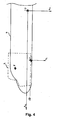
- the flight simulator is located hypothetically in the aircraft with corresponding pilots' reference point P ( fig. 4 ).
- a ycentro ⁇ d A ycg + pq + r ⁇ ⁇ xc ac + rq - p ⁇ ⁇ zc ac with Ay-centroid the y-component of the specific force at the hypothetical centroid location of the simulator with respect to the aircraft reference system, Ay-cg the y-component of the specific force at the centre of gravity of the aircraft, p the roll rate, q the pitch rate, r the yaw rate, ⁇ the roll angular acceleration, ⁇ the yaw angular acceleration, xc-ac the x-coordinate of the centroid in the aircraft reference system and zc-ac the z-coordinate of the centroid in the aircraft reference system. In most cases zc-ac is being neglected.
- the motion program uses the 3 corrected specific force components Ax-centroid, Ay-centroid, Az-centroid and the 3 angular rates (or accelerations) p, q, r as input.
- the 6 output signals of the motion program command the motion platform centroid position (3 co-ordinates) as well as the 3 Euler angles.
- Roll rate multiplied with a down tuning gain Kd is filtered through a roll high pass filter (1 st or 2 nd order).
- the co-ordinating path uses lateral sway in order to keep "gravity alignment".
- lateral position is sent through a y-wash-out filter, generally 2 nd order.
- the output of the program is simulator roll angle ⁇ and centroid position y.
- These filters may be adaptive which means that Kd could be continuously adapted according to a given cost criterion.
- Lateral specific force computed at the hypothetical centroid position is multiplied by a down tuning gain and is then sent through two different filters: a high pass position filter and a low pass angular filter. These filters are in most cases of 2 nd order and are not complementary. They may well be adaptive. Again the output of the filters is 'centroid position' and not the position of the pilot.
- Prior art flight simulators with at least sway and roll as a degree of freedom, invariantly behave as follows: when considering flying co-ordinated turn only by means of aileron input, at the beginning of the maneuver, pilot's perception seems to be correct. The roll onset as well as lateral specific force onset are perceived. A few moments later however, one notices a spurious opposite lateral specific force. It feels like if the aircraft were in a sideslip, which is not the case.
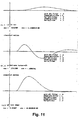
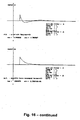
- Angular roll acceleration (fig. 11.4) shows a sign reversal which is inherent to high pass filtered roll acceleration.
- the time response of the lateral specific force at the pilots' reference point P shows the following characteristics:
- the present invention provides methods to control movements of a flight simulator, resulting in improved motion perception for a pilot using the flight simulator.
- the present invention provides a method to control the movements of a flight simulator, involving linear and angular accelerations perceived by a pilot seated at a pilot's seat, whereby roll rate and yaw rate, as well as a specific force in a lateral direction calculated according to a model of a simulated aircraft in a fixed point of the simulated aircraft are converted by a motion program to a lateral position and a roll angle of the simulator.
- the method comprises calculating the roll angle of the simulator due to simulated aircraft roll angle by correcting an originally calculated value of the roll angle with a correction factor proportional to a lateral specific force induced by a wash-out filter used during the earth gravity alignment calculation of the lateral position of the simulator.
- the second component of the specific force in the lateral direction may be obtained by means of a first set of two complementary filters for roll acceleration and a second set of two complementary filters for yaw acceleration.
- each set of complementary filters one is for commanding a simulator lateral excursion and the other is for commanding a simulator roll angle.
- the present invention provides a method to control the movements of a flight simulator, involving linear and angular accelerations perceived by a pilot seated at a pilot's seat, whereby roll rate and yaw rate, as well as a specific force in a lateral direction calculated according to a model of a simulated aircraft in a fixed point of the simulated aircraft are converted by a motion program to a lateral position and a roll angle of the simulator.
- the method comprises
- the present invention provides a method to control the movements of a flight simulator, involving linear and angular accelerations perceived by a pilot seated at a pilot's seat, whereby roll rate and yaw rate, as well as a specific force in a lateral direction calculated according to a model of a simulated aircraft in a fixed point of the simulated aircraft are converted by a motion program to a lateral position and a roll angle of the simulator.
- the method comprises transforming the position of the pilot's reference point in the simulator obtained through the motion program, either by means of a state of the art method or by means of any of the methods of the first or second aspect or by means of a combination thereof, into the position of the simulator centroid. This may be done by a coordination transformation taking into account the three Euler angles of the simulator yaw ( ⁇ ), pitch ( ⁇ ) and roll ( ⁇ ) angle.
- the method of the third embodiment may furthermore comprise transforming the specific force calculated according to a model of a simulated aircraft in the fixed point of said aircraft into a specific force acting at a pilot's reference point and then giving this transformed specific force as input to the motion program and converting the output of the motion program by a location transformation from the pilot's reference point to the simulator centroid position into signals to command the simulator centroid position.
- the first transformation may be performed by means of mathematical transformations converting specific forces at the aircraft fixed point to the pilots' reference point P according to
- a y pilot A x cg - q 2 + r 2 ⁇ xp ac + pr + q ⁇ ⁇ zp ac
- a ypilot A ycg + ( pq + r ) ⁇ ⁇ x ⁇ p ac + qr - p ⁇ ⁇ z ⁇ p ac
- a z pilot A z cg + pr - q ⁇ ⁇ x ⁇ p ac - p 2 + q 2 ⁇ z ⁇ p ac
- centroid y-component y c y c y p - ⁇ ⁇ ⁇ ⁇ being the vertical distance between the pilot's reference point and the simulator centroid and ⁇ being the roll angle.
- the first, second and third embodiments of the first aspect and their dependent features may be separate embodiments or may be combined with each other.
- the fixed point of the simulated aircraft may be the centre of gravity of said simulated aircraft.
- Alternative useful points for the fixed point are other fixed points on the aircraft in the neighbourhood of the centre of gravity.
- the present invention provides a computer program product for executing any of the methods as claimed in any of the previous claims when executed on a computing device associated with a flight simulator simulating an aircraft.
- the computer program product provides the functionality of any of the above methods according to the present invention when executed on a computing device associated with a flight simulator.
- the computer program may be part of a computer software product (i.e. a carrier medium) that includes one or more code segments that cause a processor such as a CPU of the processing system to carry out the steps of the method.
- the program runs under an operating system, and may include a user interface that enables a user to interact with the program.
- the flight simulator program operates on input data, e.g. a pre-determined flight scheme and generates control data for controlling movements of a flight simulator platform.
- the present invention provides a machine readable data storage device or carrier medium which stores the computer program product of the present invention in a machine readable form and which executes at least one of the methods of the invention when executed on a computing device.
- a computing device may include one of a microprocessor and an FPGA.
- carrier medium and "computer readable medium” as used herein refer to any medium that participates in providing instructions to a processor for execution. Such a medium may take many forms, including but not limited to, non-volatile media, volatile media, and transmission media.
- Non-volatile media include, for example, optical or magnetic disks, such as a storage device which is part of mass storage.
- Volatile media include dynamic memory such as RAM.
- Transmission media include coaxial cables, copper wire and fiber optics, including the wires that comprise a bus within a computer. Transmission media can also take the form of acoustic or light waves, such as those generated during radio wave and infra-red data communications.
- Computer readable media include, for example a floppy disk, a flexible disk, a hard disk, magnetic tape, or any other magnetic medium, a CD-ROM, any other optical medium, punch cards, paper tapes, any other physical medium with patterns of holes, a RAM, a PROM, an EPROM, a FLASH-EPROM, any other memory chip or cartridge, a carrier wave as described hereafter, or any other medium from which a computer can read.
- Various forms of computer readable media may be involved in carrying one or more sequences of one or more instructions to a processor for execution.
- the instructions may initially be carried on a magnetic disk of a remote computer.
- the remote computer can load the instructions into its dynamic memory and send the instructions over a telephone line using a modem.
- a modem local to the computer system for controlling the simulator platform can receive the data on the telephone line and use an infrared transmitter to convert the data to an infrared signal.
- An infrared detector coupled to a bus can receive the data carried in the infra-red signal and place the data on the bus.
- the bus carries data to main memory, from which a processor retrieves and executes the instructions.
- main memory may optionally be stored on a storage device either before or after execution by a processor.
- the instructions can also be transmitted via a carrier wave in a network, such as a LAN, a WAN or the internet.
- Transmission media can take the form of acoustic or light waves, such as those generated during radio wave and infrared data communications. Transmission media include coaxial cables, copper wire and fibre optics, including the wires that form a bus within a computer.
- the present invention provides a controller for controlling, the movements of a flight simulator, involving linear and angular accelerations perceived by a pilot seated at a pilot's seat, whereby roll rate and yaw rate, as well as a specific force in a lateral direction calculated according to a model of a simulated aircraft in a fixed point of the simulated aircraft are converted by a motion program to a lateral position and a roll angle of the simulator, wherein the controller comprises any of:
- the present invention provides a flight simulator adapted to perform controlled movements, involving linear and angular accelerations perceived by a pilot seated at a pilot's seat, whereby roll rate and yaw rate, as well as a specific force in a lateral direction calculated according to a model of a simulated aircraft in a fixed point of the simulated aircraft are converted by a motion program to a lateral position and a roll angle of the simulator, wherein the flight simulator comprises any of:
- the present concepts are believed to represent substantial new and novel improvements, including departures from prior practices, resulting in improved motion cueing fidelity during lateral manoeuvres on ground and in the air.
- the teachings of the present invention permit the design of improved flight simulators and methods for controlling flight simulators.
- a/c aircraft A direction cosines matrix Ax specific force x-component Ay specific force y-component Az specific force z-component Ay-centroid Ay at hypothetical centroid location with respect to a/c ref. system Ay-cg Ay at a/c c.g. Ay-pilot Ay pilot with respect to a/c reference system Ay-p Ay at pilots' reference point P in the simulator c centroid, geometrical centre of gravity of moving platform c.g.
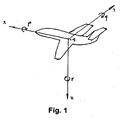
- Fig. 1 a aircraft reference system is illustrated having its origin at a fixed point, e.g. in centre of gravity.
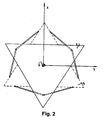
- Fig. 2 a fixed platform reference system is illustrated having its origin at an initial position of the centroid.
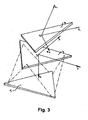
- Fig. 3 shows a moving platform reference system having its origin at the centroid.
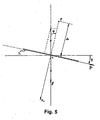
- Point where the motion perception is assumed to take place. Motion is perceived through the semicircular canals of the inner ear. However there is also tactile motion perception (also called “seat of the pants"). Therefore the point P is assumed to be located in between the 2 pilots at a height halfway between their head and seat cushion. In a typical flight simulator the distance ⁇ between the pilot's reference point P and the centroid c of the simulator is 1.00 to 1.75 m.
- Specific force in a given direction is equal to the linear acceleration which would be measured by a linear accelerometer in that direction. It is equal to the vectorial difference between kinematical acceleration and acceleration due to gravity.
- Roll rate (fig. 6.2) asymptotically approaches its end value while roll acceleration (fig. 6.3) shows an initial peak value damping out to zero.
- a ypilot A ycg + r ⁇ . xp ac - p ⁇ . zp ac
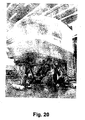
- the simulator platform may be of well-known conventional design. An embodiment of such simulator platform is illustrated in Fig. 20 .
- the present invention is also applicable to any design with at least the following two degrees of freedom: lateral displacement (sway) and roll angle. Only its controlling is adapted in accordance with embodiments of the present invention.
- the new motion concept in accordance with embodiments of the present invention is based upon any of three fundamental alterations, or a combination thereof:
- centroid transformation in "Background of invention" holds a major error. Since the motions of the platform are filtered motions of the centroid c, and as the pilots' reference point P is not situated in the centroid c, spurious accelerations are created at the pilot's reference point P through the combination of platform angular accelerations and the distance in x and z direction between centroid c and pilot's reference point P.
- y c y p - cos ⁇ sin ⁇ ⁇ xp c - cos ⁇ sin ⁇ sin ⁇ - sin ⁇ cos ⁇ ⁇ zp c
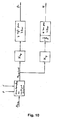
- the innovative thing about this schematic is the feed-forward of a roll angle correction ⁇ -cor to the roll channel.
- the roll angle correction ⁇ -cor is proportional to the spurious lateral specific force induced by the y-washout filter. It is a low frequency signal. From a physical point of view it means that the platform is being tilted back proportionally to its linear deceleration ( Very much the same way a waiter has to tilt back his serve tray in order not to loose his drinks when he is suddenly forced to stop).
- the lateral co-ordination factor Ky (between 0 and 1) is meant to reduce the lateral sway of the simulator.
- the y-washout filter is preferably chosen to be of 1 st order and not of 2 nd or higher order. This way the total filter is 3 rd order and not 4 th order. Total ⁇ filter of 4 th or higher order would have resulted in even more distortion of roll angular acceleration.
- Lateral specific force at the pilot's seat in the aircraft is the sum of lateral specific force of a fixed point of the aircraft, e.g. its centre of gravity, and accelerations due to the position of the pilot in front and above this fixed point, e.g. centre of gravity, according to the formulae given above.
- a good approximation for the lateral specific force was already given in the definitions section, where only the acceleration due to angular acceleration was considered:
- a y pilot A y cg + r ⁇ ⁇ xp ac - p ⁇ ⁇ zp ac
- the yaw filter can be adapted for taxi and engine failure, the roll filter for co-ordinated turns in combination with the roll angle correction ( ⁇ -cor) concept.
- positions and angles from the 'roll channel' ( fig. 13 ) and the 'Ay specific force filters' ( fig. 14 ) have to be added to each other to obtain total position and angle.
- the pilots' reference point P position it is then preferably, in accordance with embodiments of the present invention, converted to centroid position according to the equation given above ( fig. 12 ).
- the second derivative with respect to time of this function is continuous.
- Ay at cg is of "low frequency nature", i.e. no abrupt changes in side forces on main tires. Therefore, most benefits from this scheme become apparent at such speeds.
- a processing system 1500 such as shown in fig. 19.
- Fig. 19 shows one configuration of processing system 1500 that includes at least one programmable processor 1503 coupled to a memory subsystem 1505 that includes at least one form of memory, e.g., RAM, ROM, and so forth.
- a storage subsystem 1507 may be included that has at least one disk drive and/or CD-ROM drive and/or DVD drive.
- a display system, a keyboard, and a pointing device may be included as part of a user interface subsystem 1509 to provide for a user to manually input information. Ports for inputting and outputting data also may be included.
- More elements such as network connections, interfaces to various devices, and so forth, may be included, but are not illustrated in fig. 19 .
- the various elements of the processing system 1500 may be coupled in various ways, including via a bus subsystem 1513 shown in fig. 19 for simplicity as a single bus, but will be understood to those in the art to include a system of at least one bus.
- the memory of the memory subsystem 1505 may at some time hold part or all (in either case shown as 1511) of a set of instructions that when executed on the processing system 1500 implement the step(s) of the method embodiments described herein.
- a processing system 1500 such as shown in fig. 19 is prior art
- a system that includes the instructions to implement aspects of the present invention is not prior art, and therefore fig. 19 is not labeled as prior art.
- processor 1503 or processors may be a general purpose, or a special purpose processor, and may be for inclusion in a device, e.g., a chip that has other components that perform other functions.
- processors may be implemented in digital electronic circuitry, or in computer hardware, firmware, software, or in combinations of them.
- aspects of the invention can be implemented in a computer program product tangibly embodied in a carrier medium carrying machine-readable code for execution by a programmable processor. Method steps of aspects of the invention may be performed by a programmable processor executing instructions to perform functions of those aspects of the invention, e.g., by operating on input data and generating output data.
- the above processing system may be for use in a flight simulator as for example illustrated in fig. 20 .
Landscapes
- Engineering & Computer Science (AREA)
- General Physics & Mathematics (AREA)
- Theoretical Computer Science (AREA)
- Physics & Mathematics (AREA)
- Aviation & Aerospace Engineering (AREA)
- Automation & Control Theory (AREA)
- Manufacturing & Machinery (AREA)
- Human Computer Interaction (AREA)
- Business, Economics & Management (AREA)
- Educational Administration (AREA)
- Educational Technology (AREA)
- Control Of Position, Course, Altitude, Or Attitude Of Moving Bodies (AREA)
- Management, Administration, Business Operations System, And Electronic Commerce (AREA)
- Control Of Electric Motors In General (AREA)
Claims (12)
- Verfahren, um die Bewegungen eines Flugsimulators zu steuern, einschließlich von Linear- und Winkelbeschleunigungen, die durch einen in einem Pilotensitz sitzenden Piloten wahrgenommen werden,
wobei die Rollgeschwindigkeit (p) und die Giergeschwindigkeit (r) sowie eine spezifische Kraft in einer seitlichen Richtung (Ay), berechnet nach einem Modell eines simulierten Flugzeugs in einem Festpunkt des simulierten Flugzeugs, durch ein Bewegungsprogramm in eine seitliche Position (y) und einen Rollwinkel (ϕ) des Simulators umgewandelt werden, dadurch gekennzeichnet, dass das Verfahren einen der folgenden Schritte umfasst:Berechnen des Rollwinkels (ϕ) des Simulators auf Grund eines Rollwinkels des simulierten Flugzeugs durch Korrigieren eines ursprünglich berechneten Wertes (ϕhp) des Rollwinkels (ϕ) mit einem Korrekturfaktor (ϕcor), proportional zu einer seitlichen spezifischen Kraft, induziert durch ein Flügelschränkungsfilter, das während der Erdanziehungsausrichtungsberechnung der seitlichen Position (y) des Simulators verwendet wird,und/oder- Zerlegen der spezifischen Kraft in der seitlichen Richtung (Aypilot), die an dem Bezugspunkt des Piloten in dem simulierten Flugzeug wirkt, in eine erste Komponente und eine zweite Komponente, wobei sich die erste Komponente auf die spezifische Kraft (Ay) an einem Festpunkt des simulierten Flugzeugs bezieht und die zweite Komponente einen ersten Term, der sich auf die Beschleunigungen auf Grund des Gierens (r) bezieht, und einen zweiten Term, der sich auf Winkelbeschleunigungen des Rollens (p) bezieht, hat, nach der Formel:
wobei xpac die X-Koordinate des Bezugspunktes (P) des Piloten in einem Bezugssystem ist, das einen Ursprung an dem Festpunkt des simulierten Flugzeugs hat, und zpac die Z-Koordinate des Bezugspunktes des Piloten in dem Bezugssystem ist, p die Roll-Winkelbeschleunigung ist und ṙ die Gier-Winkelbeschleunigung ist,- Filtern der ersten Komponente (Ay) durch zwei Filter, ein Hochpassfilter und ein Tiefpassfilter,- Filtern jedes der Terme der zweiten Komponente durch einen Satz aus einem ersten und einem zweiten komplementären Filter in Parallelschaltung, wobei komplementäre Filter diejenigen Filter sind, deren Summe der Übertragungsfunktionen eins beträgt,- Verwenden der Summe der Ausgabe des Hochpassfilters und der Ausgabe des ersten der komplementären Filter jedes Satzes, um die gewünschte seitliche Simulatorposition (y) zu berechnen, und Verwenden der Summe der Ausgabe des Tiefpassfilters und der Ausgabe des zweiten der komplementären Filter jedes Satzes, um den gewünschten Simulatorrollwinkel (ϕ) zu berechnen. - Verfahren nach Anspruch 1, wobei das Berechnen des Rollwinkels (ϕroll) des Simulators umfasst, eine mathematische Transformation zu verwenden, welche die Vorwärtskopplung eines Korrekturwinkels (ϕcor) in der Rollwinkel-Transformationsfunktion nach den folgenden Formeln einschließt:

 wobei ϕ-hp gleich dem hochpassgefilterten Simulatorrollwinkel ist,ÿ-roll gleich der seitlichen Positionsbeschleunigung des Bezugspunktes P des Piloten ist, die das Ergebnis eines Multiplizierens von ϕhp mit einer Verstärkung Ky und g und anschließenden Hochpassfilterns ist,g die Gravitationskonstante ist,Ky ein Stellfaktor der seitlichen Koordination ist,ϕ-roll gleich dem Simulatorrollwinkel als Ergebnis einer Rollbeschleunigung oder Rollgeschwindigkeit des simulierten Flugzeugs ist.
 - Verfahren nach Anspruch 2, wobei in der mathematischen Transformation ein seitlicher Koordinationsfaktor Ky zwischen 0 und 1 eingeführt wird, was es ermöglicht, die seitliche Bewegung auf Kosten einer gewissen annehmbaren seitlichen spezifischen Störkraft zu verringern, durch Modulieren zwischen einem Fall "ohne Koordination", wobei Ky = 0, und einem Fall "volle Koordination", wobei Ky = 1.
- verfahren nach Anspruch 3, wobei Ky = 1 und der Rollwinkel (ϕroll) durch ein Hochpassfilter 3. oder 4. Ordnung an der Rollgeschwindigkeit des simulierten Flugzeugs gewonnen wird und die seitliche Beschleunigung zu jedem Zeitpunkt gleich diesem Rollwinkel (ϕroll), multipliziert mit der Erdbeschleunigung (g), ist.
- Verfahren nach einem der Ansprüche 2 bis 4, wobei die mathematische Transformation ein Rollwinkel - (ϕroll) - Hochpassfilter 2. Ordnung und ein y-Flügelschränkungsfilter 1. Ordnung einschließt, nach dem folgenden Transferfunktionsformeln:


wobei pltd die eingegebene Rollgeschwindigkeit ist, begrenzt durch einen Abwärtsabgleich-Stellfaktor Kd und wahlweise eine Begrenzungsfunktion für die Rollgeschwindigkeit, auf eine solche Weise, dass die seitliche Simulatorbewegung für einen Schritt in der Querruderanweisung einen endlichen Wert hat, und wobei P für den Laplace-Operator steht. - Verfahren nach einem der Ansprüche 2 bis 4, wobei die mathematische Transformation ein Rollwinkel - (ϕhp) - Hochpassfilter 1. Ordnung und ein y-Flügelschränkungsfilter 2. Ordnung einschließt.
- Verfahren nach Anspruch 1, wobei die zweite Komponente der spezifischen Kraft in der seitlichen Richtung mit Hilfe von vier zusätzlichen Filtern gewonnen wird: einem ersten Satz von komplementären Filtern für die Rollbeschleunigung und einem zweiten Satz von komplementären Filtern für die Gierbeschleunigung, wobei in jedem Satz von komplementären Filtern der eine eine seitliche Simulatorauslenkung anweist und der andere einen Simulatorrollwinkel anweist, nach dem folgenden Transferfunktionsformeln:


und
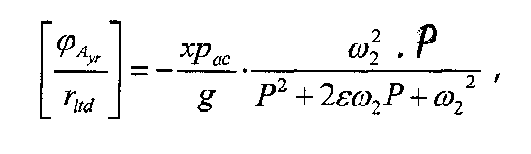
wobei pltd und rltd die eingegebene Roll- bzw. Giergeschwindigkeit sind, begrenzt durch einen Abwärtsabgleich-Stellfaktor Kp bzw. Kr und wahlweise durch eine Begrenzungsfunktion für die Geschwindigkeit, und wobei P für den Laplace-Operator steht. - Verfahren nach einem der vorhergehenden Ansprüche, wobei der Festpunkt des simulierten Flugzeugs der Schwerpunkt des simulierten Flugzeugs ist.
- Rechnerprogrammerzeugnis zum Ausführen eines der Verfahren nach einem der vorhergehenden Ansprüche, wenn es auf einem Rechnergerät ausgeführt wird, das mit einem Flugsimulator verbunden ist, der ein Flugzeug simuliert.
- Maschinenlesbares Datenspeichergerät, welches das Rechnerprogrammerzeugnis von Anspruch 9 trägt.
- Steuergerät, das dafür eingerichtet ist, die Bewegungen eines Flugsimulators zu steuern, einschließlich von Linear- und Winkelbeschleunigungen, die durch einen in einem Pilotensitz sitzenden Piloten wahrgenommen werden,
wobei die Rollgeschwindigkeit (p) und die Giergeschwindigkeit (r) sowie eine spezifische Kraft in einer seitlichen Richtung (Ay), berechnet nach einem Modell eines simulierten Flugzeugs in einem Festpunkt des simulierten Flugzeugs, durch ein Bewegungsprogramm in eine seitliche Position (y) und einen Rollwinkel (ϕ) des Simulators umgewandelt werden, wobei das Steuergerät eine der folgenden Komponenten umfasst:eine erste Rechenmaschine, eingerichtet zum Berechnen des Rollwinkels (ϕ) des Simulators auf Grund eines Rollwinkels des simulierten Flugzeugs durch Korrigieren eines ursprünglich berechneten Wertes (ϕhp) des Rollwinkels (ϕ) mit einem Korrekturfaktor (ϕcor), proportional zu einer seitlichen spezifischen Kraft, induziert durch ein Flügelschränkungsfilter, das während der Erdanziehungsausrichtungsberechnung der seitlichen Position (y) des Simulators verwendet wird,und/oder- eine zweite Rechenmaschine, eingerichtet zum Zerlegen der spezifischen Kraft in der seitlichen Richtung (Aypilot), die an dem Bezugspunkt des Piloten in dem simulierten Flugzeug wirkt, in eine erste Komponente und eine zweite Komponente, wobei sich die erste Komponente auf die spezifische Kraft (Ay) an einem Festpunkt des simulierten Flugzeugs bezieht und die zweite Komponente einen ersten Term, der sich auf die Beschleunigungen auf Grund des Gierens (r) bezieht, und einen zweiten Term, der sich auf Winkelbeschleunigungen des Rollens (p) bezieht, hat, nach der Formel:
wobei xpac die X-Koordinate des Bezugspunktes (P) des Piloten in einem Bezugssystem ist, das einen Ursprung an dem Festpunkt des simulierten Flugzeugs hat, und zpac die Z-Koordinate des Bezugspunktes des Piloten in dem Bezugssystem ist, ṗ die Roll-Winkelbeschleunigung ist und ṙ die Gier-Winkelbeschleunigung ist,- ein Hochpassfilter und ein Tiefpassfilter zum Filtern der ersten Komponente (Ay),- zwei Sätze aus einem ersten und einem zweiten komplementären Filter, wobei komplementäre Filter diejenigen Filter sind, deren Summe der Übertragungsfunktionen eins beträgt, zum Filtern jedes der Terme der zweiten Komponente in Parallelschaltung,- einen Kombinator zum Kombinieren der Summe der Ausgabe des Hochpassfilters und der Ausgaben des ersten der komplementären Filter jedes Satzes, um die gewünschte seitliche Simulatorposition (y) zu berechnen, und einen Kombinator zum Kombinieren der Summe der Ausgabe des Tiefpassfilters und der Ausgaben des zweiten der komplementären Filter jedes Satzes, um den gewünschten Simulatorrollwinkel (ϕ) zu berechnen. - Flugsimulator, der dafür eingerichtet ist, gesteuerte Bewegungen auszuführen, einschließlich von Linear- und Winkelbeschleunigungen, die durch einen in einem Pilotensitz sitzenden Piloten wahrgenommen werden,
wobei die Rollgeschwindigkeit (p) und die Giergeschwindigkeit (r) sowie eine spezifische Kraft in einer seitlichen Richtung (Ay), berechnet nach einem Modell eines simulierten Flugzeugs in einem Festpunkt des simulierten Flugzeugs, durch ein Bewegungsprogramm in eine seitliche Position (y) und einen Rollwinkel (ϕ) des Simulators umgewandelt werden, wobei der Flugsimulator eine der folgenden Komponenten umfasst:eine erste Rechenmaschine, eingerichtet zum Berechnen des Rollwinkels (ϕ) des Simulators auf Grund eines Rollwinkels des simulierten Flugzeugs durch Korrigieren eines ursprünglich berechneten Wertes (ϕhp) des Rollwinkels (ϕ) mit einem Korrekturfaktor (ϕcor), proportional zu einer seitlichen spezifischen Kraft, induziert durch ein Flügelschränkungsfilter, das während der Erdanziehungsausrichtungsberechnung der seitlichen Position (y) des Simulators verwendet wird,und/oder- eine zweite Rechenmaschine, eingerichtet zum Zerlegen der spezifischen Kraft in der seitlichen Richtung (Aypilot), die an dem Bezugspunkt des Piloten in dem simulierten Flugzeug wirkt, in eine erste Komponente und eine zweite Komponente, wobei sich die erste Komponente auf die spezifische Kraft (Ay) an einem Festpunkt des simulierten Flugzeugs bezieht und die zweite Komponente einen ersten Term, der sich auf die Beschleunigungen auf Grund des Gierens (r) bezieht, und einen zweiten Term, der sich auf Winkelbeschleunigungen des Rollens (p) bezieht, hat, nach der Formel:
wobei xpac die X-Koordinate des Bezugspunktes (P) des Piloten in einem Bezugssystem ist, das einen Ursprung an dem Festpunkt des simulierten Flugzeugs hat, und zpac die Z-Koordinate des Bezugspunktes des Piloten in dem Bezugssystem ist, ṗ die Roll-Winkelbeschleunigung ist und ṙ die Gier-Winkelbeschleunigung ist,- ein Hochpassfilter und ein Tiefpassfilter zum Filtern der ersten Komponente (Ay),- zwei Sätze aus einem ersten und einem zweiten komplementären Filter, wobei komplementäre Filter diejenigen Filter sind, deren Summe der Übertragungsfunktionen eins beträgt, zum Filtern jedes der Terme der zweiten Komponente in Parallelschaltung,- einen Kombinator zum Kombinieren der Summe der Ausgabe des Hochpassfilters und der Ausgaben des ersten der komplementären Filter jedes Satzes, um die gewünschte seitliche Simulatorposition (y) zu berechnen, und einen Kombinator zum Kombinieren der Summe der Ausgabe des Tiefpassfilters und der Ausgaben des zweiten der komplementären Filter jedes Satzes, um den gewünschten Simulatorrollwinkel (ϕ) zu berechnen.
Priority Applications (1)
| Application Number | Priority Date | Filing Date | Title |
|---|---|---|---|
| EP06806200A EP1946193B2 (de) | 2005-10-12 | 2006-10-12 | Verfahren zur steuerung der bewegungen eines flugsimulators und ein solches verfahren implementierender flugsimulator |
Applications Claiming Priority (3)
| Application Number | Priority Date | Filing Date | Title |
|---|---|---|---|
| EP05447231 | 2005-10-12 | ||
| EP06806200A EP1946193B2 (de) | 2005-10-12 | 2006-10-12 | Verfahren zur steuerung der bewegungen eines flugsimulators und ein solches verfahren implementierender flugsimulator |
| PCT/EP2006/009841 WO2007042290A1 (en) | 2005-10-12 | 2006-10-12 | Method to control the movements of a flight simulator and flight simulator implementing such method |
Publications (3)
| Publication Number | Publication Date |
|---|---|
| EP1946193A1 EP1946193A1 (de) | 2008-07-23 |
| EP1946193B1 EP1946193B1 (de) | 2010-03-24 |
| EP1946193B2 true EP1946193B2 (de) | 2013-01-30 |
Family
ID=36204350
Family Applications (1)
| Application Number | Title | Priority Date | Filing Date |
|---|---|---|---|
| EP06806200A Active EP1946193B2 (de) | 2005-10-12 | 2006-10-12 | Verfahren zur steuerung der bewegungen eines flugsimulators und ein solches verfahren implementierender flugsimulator |
Country Status (11)
| Country | Link |
|---|---|
| US (1) | US8393902B2 (de) |
| EP (1) | EP1946193B2 (de) |
| JP (1) | JP5715324B2 (de) |
| CN (1) | CN101305328B (de) |
| AT (1) | ATE462163T1 (de) |
| CA (1) | CA2625103C (de) |
| DE (1) | DE602006013179D1 (de) |
| ES (1) | ES2342901T5 (de) |
| PT (1) | PT1946193E (de) |
| RU (1) | RU2425409C2 (de) |
| WO (1) | WO2007042290A1 (de) |
Families Citing this family (29)
| Publication number | Priority date | Publication date | Assignee | Title |
|---|---|---|---|---|
| US8827709B1 (en) | 2008-05-08 | 2014-09-09 | ACME Worldwide Enterprises, Inc. | Dynamic motion seat |
| NL2005174C2 (en) | 2010-07-29 | 2012-01-31 | E2M Technologies B V | Movement-simulator. |
| US8653780B2 (en) * | 2010-09-28 | 2014-02-18 | The Boeing Company | Integrated upsampler and filtering for multi-rate controller for electro-mechanical flight actuation system |
| TWI448969B (zh) * | 2011-02-16 | 2014-08-11 | Chang Jung Christian University | Three - axis dynamic simulation platform system and its control method |
| CN102390544B (zh) * | 2011-09-15 | 2013-11-13 | 北京航空航天大学 | 一种连动式飞机模拟器座舱布局转换装置 |
| US8620492B2 (en) * | 2012-02-27 | 2013-12-31 | Textron Innovations Inc. | Yaw damping system and method for aircraft |
| US8874286B2 (en) | 2012-02-27 | 2014-10-28 | Textron Innovations, Inc. | Yaw damping system and method for aircraft |
| DE102012103870B4 (de) * | 2012-04-19 | 2016-10-13 | Deutsches Zentrum für Luft- und Raumfahrt e.V. | Bewegungssystemzustand |
| US9242181B2 (en) | 2012-12-03 | 2016-01-26 | Dynamic Motion Group Gmbh | Amusement park elevator drop ride system and associated methods |
| US9536446B2 (en) | 2012-12-03 | 2017-01-03 | Dynamic Motion Group Gmbh | Motion simulation system controller and associated methods |
| US9259657B2 (en) | 2012-12-03 | 2016-02-16 | Dynamic Motion Group Gmbh | Motion simulation system and associated methods |
| EP2854120A1 (de) | 2013-09-26 | 2015-04-01 | Thomson Licensing | Verfahren und Vorrichtung zur Steuerung einer haptischen Vorrichtung |
| DE102015102459B4 (de) * | 2015-02-20 | 2016-11-03 | Deutsches Zentrum für Luft- und Raumfahrt e.V. | Verfahren und Vorrichtung zur Ansteuerung eines Simulators |
| US9837939B1 (en) * | 2015-04-01 | 2017-12-05 | Lockheed Martin Corporation | System and method for providing vibration isolation by magnetic levitation |
| US9845146B2 (en) * | 2015-10-23 | 2017-12-19 | The Boeing Company | Zoom climb prevention system for enhanced performance |
| US11288340B2 (en) * | 2016-03-31 | 2022-03-29 | Cae Inc. | Dynamically updating a model associated to a simulated interactive object |
| FR3052861B1 (fr) * | 2016-06-20 | 2018-07-13 | Ixblue | Procede de compensation des couples de coriolis, centrifuges et de gravite dans un simulateur de mouvements, systeme a simulateur de mouvements |
| CN106403937B (zh) * | 2016-07-07 | 2023-05-26 | 上海机电工程研究所 | 提高动基座对准精度的导航信息滤波方法 |
| WO2018214014A1 (zh) * | 2017-05-23 | 2018-11-29 | 深圳市大疆创新科技有限公司 | 加速度计的安装误差检测方法、设备以及无人机 |
| CN107150816B (zh) * | 2017-06-06 | 2019-04-26 | 哈尔滨工业大学 | 一种变质心飞行器模拟装置 |
| CN108388279B (zh) * | 2018-02-12 | 2021-09-17 | 浙江中控技术股份有限公司 | 一种高速旋转机械设备的控制方法和装置 |
| KR102239618B1 (ko) | 2019-09-17 | 2021-04-12 | 김경환 | 가상현실 조종수 시뮬레이터용 제어 시스템 |
| IT202000005671A1 (it) * | 2020-03-17 | 2021-09-17 | Faiveley Transport Italia Spa | Procedimento per la stima di una velocità longitudinale di almeno un veicolo ferroviario |
| CN112307572B (zh) * | 2020-07-27 | 2022-10-21 | 中国工程物理研究院总体工程研究所 | 一种载人离心机感知误差动态分配的过载、姿态模拟方法 |
| CN111816023B (zh) * | 2020-07-27 | 2022-05-03 | 中国工程物理研究院总体工程研究所 | 一种四轴载人离心机的运动学方法 |
| KR102499292B1 (ko) * | 2020-12-01 | 2023-02-13 | 주식회사 젠스템 | 운용 범위 마진을 기반으로 큐잉 알고리즘을 구현하는 모션 플랫폼의 제어 방법 |
| RU2768310C1 (ru) * | 2021-07-07 | 2022-03-23 | Акционерное общество "Российская самолетостроительная корпорация "МиГ" (АО "РСК "МиГ") | Система управления летательного аппарата в канале курса |
| CN113674582A (zh) * | 2021-08-08 | 2021-11-19 | 中国航空工业集团公司沈阳飞机设计研究所 | 一种六自由度运动平台加速度模拟方法 |
| CN116552802B (zh) * | 2023-06-16 | 2025-09-16 | 中国飞机强度研究所 | 一种飞机结构强度试验全机地面起吊位姿监测方法 |
Family Cites Families (21)
| Publication number | Priority date | Publication date | Assignee | Title |
|---|---|---|---|---|
| US3678256A (en) * | 1970-10-05 | 1972-07-18 | Mc Donnell Douglas Corp | Performance and failure assessment monitor |
| US3732630A (en) | 1970-10-21 | 1973-05-15 | Us Navy | Visual simulator |
| US3989208A (en) * | 1972-11-16 | 1976-11-02 | The Boeing Company | Thrust and flight path control decoupling system |
| US4956780A (en) * | 1988-12-08 | 1990-09-11 | The Boeing Company | Flight path angle command flight control system for landing flare |
| US5353242A (en) * | 1988-12-28 | 1994-10-04 | Veda Incorporated | Motion base control process and operator perceptual simulator |
| US5179525A (en) * | 1990-05-01 | 1993-01-12 | University Of Florida | Method and apparatus for controlling geometrically simple parallel mechanisms with distinctive connections |
| GB2253825B (en) * | 1991-03-20 | 1994-06-22 | Rediffusion Simulation Ltd | Vehicle simulator |
| US5195700A (en) * | 1991-08-28 | 1993-03-23 | United Technologies Corporation | Low speed model following velocity command system for rotary wing aircraft |
| RU2037209C1 (ru) * | 1992-02-14 | 1995-06-09 | Летно-исследовательский институт им.М.М.Громова | Тренажер |
| JPH08248872A (ja) * | 1995-03-08 | 1996-09-27 | Toyota Motor Corp | 運転模擬試験装置 |
| US5711670A (en) * | 1995-11-13 | 1998-01-27 | Barr; Craig Kevin | Motion-base ride simulator with improved passenger loading and unloading method and apparatus |
| US5762068A (en) * | 1995-11-27 | 1998-06-09 | Quinton Instrument Company | ECG filter and slew rate limiter for filtering an ECG signal |
| JP3718236B2 (ja) | 1997-06-16 | 2005-11-24 | スイスコム モービル アーゲー | チップカード、および外部機器・チップカード間の通信の方法 |
| JP3716134B2 (ja) | 1999-07-13 | 2005-11-16 | 株式会社日立製作所 | 動揺装置の動作指令データ生成方法及び動揺装置 |
| RU2178721C2 (ru) * | 2000-03-01 | 2002-01-27 | Новолодский Иван Дмитриевич | Аттракцион-тренажер |
| JP2003186387A (ja) * | 2001-12-20 | 2003-07-04 | Masao Nagai | 運転シミュレーション装置のための動揺装置の制御方法 |
| US7236914B1 (en) * | 2002-02-22 | 2007-06-26 | Microsoft Corporation | Integrated aircraft flight dynamics prediction and simulation |
| JP4104362B2 (ja) | 2002-03-27 | 2008-06-18 | 泰敬 田川 | 体感加速度模擬装置のための動揺装置の制御方法 |
| US7033176B2 (en) * | 2002-07-17 | 2006-04-25 | Powergrid Fitness, Inc. | Motion platform system and method of rotating a motion platform about plural axes |
| US6772080B2 (en) * | 2002-12-24 | 2004-08-03 | The Boeing Company | System and method for kinematic consistency processing |
| US7496865B2 (en) * | 2005-05-20 | 2009-02-24 | Chung Yuan Christian University | OTA-based high-order filters |
-
2006
- 2006-10-12 WO PCT/EP2006/009841 patent/WO2007042290A1/en not_active Ceased
- 2006-10-12 CN CN2006800378042A patent/CN101305328B/zh active Active
- 2006-10-12 EP EP06806200A patent/EP1946193B2/de active Active
- 2006-10-12 PT PT06806200T patent/PT1946193E/pt unknown
- 2006-10-12 DE DE602006013179T patent/DE602006013179D1/de active Active
- 2006-10-12 AT AT06806200T patent/ATE462163T1/de not_active IP Right Cessation
- 2006-10-12 RU RU2008118206/08A patent/RU2425409C2/ru active
- 2006-10-12 JP JP2008534934A patent/JP5715324B2/ja active Active
- 2006-10-12 CA CA2625103A patent/CA2625103C/en active Active
- 2006-10-12 ES ES06806200T patent/ES2342901T5/es active Active
- 2006-10-12 US US12/083,496 patent/US8393902B2/en active Active
Also Published As
| Publication number | Publication date |
|---|---|
| US20090047636A1 (en) | 2009-02-19 |
| ES2342901T3 (es) | 2010-07-16 |
| RU2008118206A (ru) | 2009-11-20 |
| CN101305328B (zh) | 2012-10-17 |
| US20110070564A2 (en) | 2011-03-24 |
| JP2009511968A (ja) | 2009-03-19 |
| WO2007042290A1 (en) | 2007-04-19 |
| CN101305328A (zh) | 2008-11-12 |
| RU2425409C2 (ru) | 2011-07-27 |
| US8393902B2 (en) | 2013-03-12 |
| DE602006013179D1 (de) | 2010-05-06 |
| EP1946193A1 (de) | 2008-07-23 |
| HK1123612A1 (en) | 2009-06-19 |
| ATE462163T1 (de) | 2010-04-15 |
| CA2625103A1 (en) | 2007-04-19 |
| ES2342901T5 (es) | 2013-05-28 |
| JP5715324B2 (ja) | 2015-05-07 |
| CA2625103C (en) | 2014-07-22 |
| EP1946193B1 (de) | 2010-03-24 |
| PT1946193E (pt) | 2010-06-23 |
Similar Documents
| Publication | Publication Date | Title |
|---|---|---|
| EP1946193B1 (de) | Verfahren zur steuerung der bewegungen eines flugsimulators und ein solches verfahren implementierender flugsimulator | |
| Nahon et al. | Simulator motion-drive algorithms-A designer's perspective | |
| Becerra-Vargas et al. | Application of H∞ theory to a 6 DOF flight simulator motion base | |
| Polushin et al. | Projection-based force-reflection algorithms with frequency separation for bilateral teleoperation | |
| CN113467461B (zh) | 移动机器人非结构化环境下的人机协作式路径规划方法 | |
| Weiß | Control of a dynamic driving simulator: Time-variant motion cueing algorithms and prepositioning | |
| CN119673022B (zh) | 用于飞行驾驶摇杆和油门模拟的多自由度运动控制方法 | |
| HK1123612B (en) | Method to control the movements of a flight simulator and flight simulator implementing such method | |
| CN109213306B (zh) | 一种机器人远程控制平台及其设计方法 | |
| Parrish et al. | Comparison of a linear and a nonlinear washout for motion simulators utilizing objective and subjective data from ctol transport landing approaches | |
| Guiatni et al. | Programmable force-feedback side-stick for flight simulation | |
| Beukers et al. | Investigation into pilot perception and control during Decrab maneuvers in simulated flight | |
| Zhao et al. | Six-DoF Stewart platform motion simulator control using switchable model predictive control | |
| Salisbury et al. | Optimal race car motion cueing | |
| CN115686205A (zh) | 交互方法、车机系统及包括其的车辆、存储介质 | |
| JP2008213092A (ja) | モーション習得システムおよびモーション習得方法 | |
| Iakovou | Fuzzy control for helicopter aviation | |
| Roscoe et al. | Rotorcraft Pitch–Surge Motion Cueing Considerations for a Simulated Offshore Approach Task: A Preliminary Investigation | |
| Advani et al. | Integrated design of a motion cueing algorithm and motion-base mechanism for a wright flyer simulator | |
| Pena et al. | Motion Cueing Implementation for a Low Cost 6 DOF Flight Simulator | |
| Ko | Investigation of simulator motion drive algorithms for airplane upset simulation | |
| Tang et al. | An Improved Washout Algorithm for UPRT | |
| Kennedy | Swing-up and stabilization of a single inverted pendulum: real-time implementation | |
| Wang et al. | A Real-Time Haptic Teleoperation Platform for UAVs Based on Unity-ROS Integration | |
| Basson | Fault tolerant adaptive control of an unmanned aerial vehicle |
Legal Events
| Date | Code | Title | Description |
|---|---|---|---|
| PUAI | Public reference made under article 153(3) epc to a published international application that has entered the european phase |
Free format text: ORIGINAL CODE: 0009012 |
|
| 17P | Request for examination filed |
Effective date: 20080506 |
|
| AK | Designated contracting states |
Kind code of ref document: A1 Designated state(s): AT BE BG CH CY CZ DE DK EE ES FI FR GB GR HU IE IS IT LI LT LU LV MC NL PL PT RO SE SI SK TR |
|
| REG | Reference to a national code |
Ref country code: HK Ref legal event code: DE Ref document number: 1123612 Country of ref document: HK |
|
| GRAP | Despatch of communication of intention to grant a patent |
Free format text: ORIGINAL CODE: EPIDOSNIGR1 |
|
| GRAS | Grant fee paid |
Free format text: ORIGINAL CODE: EPIDOSNIGR3 |
|
| GRAA | (expected) grant |
Free format text: ORIGINAL CODE: 0009210 |
|
| AK | Designated contracting states |
Kind code of ref document: B1 Designated state(s): AT BE BG CH CY CZ DE DK EE ES FI FR GB GR HU IE IS IT LI LT LU LV MC NL PL PT RO SE SI SK TR |
|
| REG | Reference to a national code |
Ref country code: GB Ref legal event code: FG4D |
|
| REG | Reference to a national code |
Ref country code: CH Ref legal event code: EP |
|
| REG | Reference to a national code |
Ref country code: IE Ref legal event code: FG4D |
|
| REF | Corresponds to: |
Ref document number: 602006013179 Country of ref document: DE Date of ref document: 20100506 Kind code of ref document: P |
|
| REG | Reference to a national code |
Ref country code: PT Ref legal event code: SC4A Free format text: AVAILABILITY OF NATIONAL TRANSLATION Effective date: 20100616 |
|
| REG | Reference to a national code |
Ref country code: NL Ref legal event code: T3 |
|
| REG | Reference to a national code |
Ref country code: ES Ref legal event code: FG2A Ref document number: 2342901 Country of ref document: ES Kind code of ref document: T3 |
|
| PG25 | Lapsed in a contracting state [announced via postgrant information from national office to epo] |
Ref country code: LT Free format text: LAPSE BECAUSE OF FAILURE TO SUBMIT A TRANSLATION OF THE DESCRIPTION OR TO PAY THE FEE WITHIN THE PRESCRIBED TIME-LIMIT Effective date: 20100324 |
|
| LTIE | Lt: invalidation of european patent or patent extension |
Effective date: 20100324 |
|
| PG25 | Lapsed in a contracting state [announced via postgrant information from national office to epo] |
Ref country code: LV Free format text: LAPSE BECAUSE OF FAILURE TO SUBMIT A TRANSLATION OF THE DESCRIPTION OR TO PAY THE FEE WITHIN THE PRESCRIBED TIME-LIMIT Effective date: 20100324 Ref country code: SI Free format text: LAPSE BECAUSE OF FAILURE TO SUBMIT A TRANSLATION OF THE DESCRIPTION OR TO PAY THE FEE WITHIN THE PRESCRIBED TIME-LIMIT Effective date: 20100324 Ref country code: AT Free format text: LAPSE BECAUSE OF FAILURE TO SUBMIT A TRANSLATION OF THE DESCRIPTION OR TO PAY THE FEE WITHIN THE PRESCRIBED TIME-LIMIT Effective date: 20100324 Ref country code: FI Free format text: LAPSE BECAUSE OF FAILURE TO SUBMIT A TRANSLATION OF THE DESCRIPTION OR TO PAY THE FEE WITHIN THE PRESCRIBED TIME-LIMIT Effective date: 20100324 Ref country code: PL Free format text: LAPSE BECAUSE OF FAILURE TO SUBMIT A TRANSLATION OF THE DESCRIPTION OR TO PAY THE FEE WITHIN THE PRESCRIBED TIME-LIMIT Effective date: 20100324 |
|
| PG25 | Lapsed in a contracting state [announced via postgrant information from national office to epo] |
Ref country code: RO Free format text: LAPSE BECAUSE OF FAILURE TO SUBMIT A TRANSLATION OF THE DESCRIPTION OR TO PAY THE FEE WITHIN THE PRESCRIBED TIME-LIMIT Effective date: 20100324 Ref country code: EE Free format text: LAPSE BECAUSE OF FAILURE TO SUBMIT A TRANSLATION OF THE DESCRIPTION OR TO PAY THE FEE WITHIN THE PRESCRIBED TIME-LIMIT Effective date: 20100324 Ref country code: SE Free format text: LAPSE BECAUSE OF FAILURE TO SUBMIT A TRANSLATION OF THE DESCRIPTION OR TO PAY THE FEE WITHIN THE PRESCRIBED TIME-LIMIT Effective date: 20100324 Ref country code: GR Free format text: LAPSE BECAUSE OF FAILURE TO SUBMIT A TRANSLATION OF THE DESCRIPTION OR TO PAY THE FEE WITHIN THE PRESCRIBED TIME-LIMIT Effective date: 20100625 |
|
| REG | Reference to a national code |
Ref country code: HK Ref legal event code: GR Ref document number: 1123612 Country of ref document: HK |
|
| PG25 | Lapsed in a contracting state [announced via postgrant information from national office to epo] |
Ref country code: SK Free format text: LAPSE BECAUSE OF FAILURE TO SUBMIT A TRANSLATION OF THE DESCRIPTION OR TO PAY THE FEE WITHIN THE PRESCRIBED TIME-LIMIT Effective date: 20100324 Ref country code: IS Free format text: LAPSE BECAUSE OF FAILURE TO SUBMIT A TRANSLATION OF THE DESCRIPTION OR TO PAY THE FEE WITHIN THE PRESCRIBED TIME-LIMIT Effective date: 20100724 Ref country code: BG Free format text: LAPSE BECAUSE OF FAILURE TO SUBMIT A TRANSLATION OF THE DESCRIPTION OR TO PAY THE FEE WITHIN THE PRESCRIBED TIME-LIMIT Effective date: 20100624 Ref country code: CZ Free format text: LAPSE BECAUSE OF FAILURE TO SUBMIT A TRANSLATION OF THE DESCRIPTION OR TO PAY THE FEE WITHIN THE PRESCRIBED TIME-LIMIT Effective date: 20100324 |
|
| PLBI | Opposition filed |
Free format text: ORIGINAL CODE: 0009260 |
|
| PG25 | Lapsed in a contracting state [announced via postgrant information from national office to epo] |
Ref country code: DK Free format text: LAPSE BECAUSE OF FAILURE TO SUBMIT A TRANSLATION OF THE DESCRIPTION OR TO PAY THE FEE WITHIN THE PRESCRIBED TIME-LIMIT Effective date: 20100324 |
|
| 26 | Opposition filed |
Opponent name: CAE INC. Effective date: 20101227 |
|
| PLAX | Notice of opposition and request to file observation + time limit sent |
Free format text: ORIGINAL CODE: EPIDOSNOBS2 |
|
| PLAF | Information modified related to communication of a notice of opposition and request to file observations + time limit |
Free format text: ORIGINAL CODE: EPIDOSCOBS2 |
|
| PG25 | Lapsed in a contracting state [announced via postgrant information from national office to epo] |
Ref country code: MC Free format text: LAPSE BECAUSE OF NON-PAYMENT OF DUE FEES Effective date: 20101031 |
|
| REG | Reference to a national code |
Ref country code: CH Ref legal event code: PL |
|
| PG25 | Lapsed in a contracting state [announced via postgrant information from national office to epo] |
Ref country code: CH Free format text: LAPSE BECAUSE OF NON-PAYMENT OF DUE FEES Effective date: 20101031 Ref country code: LI Free format text: LAPSE BECAUSE OF NON-PAYMENT OF DUE FEES Effective date: 20101031 |
|
| REG | Reference to a national code |
Ref country code: GB Ref legal event code: S117 Free format text: REQUEST FILED; REQUEST FOR CORRECTION UNDER SECTION 117 FILED ON 4 APRIL 2011 |
|
| PLAF | Information modified related to communication of a notice of opposition and request to file observations + time limit |
Free format text: ORIGINAL CODE: EPIDOSCOBS2 |
|
| PLBB | Reply of patent proprietor to notice(s) of opposition received |
Free format text: ORIGINAL CODE: EPIDOSNOBS3 |
|
| PLBP | Opposition withdrawn |
Free format text: ORIGINAL CODE: 0009264 |
|
| PG25 | Lapsed in a contracting state [announced via postgrant information from national office to epo] |
Ref country code: CY Free format text: LAPSE BECAUSE OF FAILURE TO SUBMIT A TRANSLATION OF THE DESCRIPTION OR TO PAY THE FEE WITHIN THE PRESCRIBED TIME-LIMIT Effective date: 20100324 |
|
| PG25 | Lapsed in a contracting state [announced via postgrant information from national office to epo] |
Ref country code: HU Free format text: LAPSE BECAUSE OF FAILURE TO SUBMIT A TRANSLATION OF THE DESCRIPTION OR TO PAY THE FEE WITHIN THE PRESCRIBED TIME-LIMIT Effective date: 20100925 Ref country code: LU Free format text: LAPSE BECAUSE OF NON-PAYMENT OF DUE FEES Effective date: 20101012 |
|
| PUAH | Patent maintained in amended form |
Free format text: ORIGINAL CODE: 0009272 |
|
| STAA | Information on the status of an ep patent application or granted ep patent |
Free format text: STATUS: PATENT MAINTAINED AS AMENDED |
|
| RIC2 | Information provided on ipc code assigned after grant |
Ipc: G09B 9/12 20060101ALI20121130BHEP Ipc: G05B 19/408 20060101AFI20121130BHEP |
|
| 27A | Patent maintained in amended form |
Effective date: 20130130 |
|
| AK | Designated contracting states |
Kind code of ref document: B2 Designated state(s): AT BE BG CH CY CZ DE DK EE ES FI FR GB GR HU IE IS IT LI LT LU LV MC NL PL PT RO SE SI SK TR |
|
| REG | Reference to a national code |
Ref country code: DE Ref legal event code: R102 Ref document number: 602006013179 Country of ref document: DE Effective date: 20130130 |
|
| REG | Reference to a national code |
Ref country code: ES Ref legal event code: DC2A Ref document number: 2342901 Country of ref document: ES Kind code of ref document: T5 Effective date: 20130528 |
|
| REG | Reference to a national code |
Ref country code: NL Ref legal event code: T3 |
|
| REG | Reference to a national code |
Ref country code: FR Ref legal event code: ST Effective date: 20130628 |
|
| PG25 | Lapsed in a contracting state [announced via postgrant information from national office to epo] |
Ref country code: LV Free format text: LAPSE BECAUSE OF FAILURE TO SUBMIT A TRANSLATION OF THE DESCRIPTION OR TO PAY THE FEE WITHIN THE PRESCRIBED TIME-LIMIT Effective date: 20130130 Ref country code: FR Free format text: LAPSE BECAUSE OF NON-PAYMENT OF DUE FEES Effective date: 20121031 |
|
| REG | Reference to a national code |
Ref country code: FR Ref legal event code: D3 Effective date: 20130814 |
|
| PGRI | Patent reinstated in contracting state [announced from national office to epo] |
Ref country code: FR Effective date: 20130814 |
|
| REG | Reference to a national code |
Ref country code: FR Ref legal event code: PLFP Year of fee payment: 11 |
|
| REG | Reference to a national code |
Ref country code: FR Ref legal event code: PLFP Year of fee payment: 12 |
|
| REG | Reference to a national code |
Ref country code: FR Ref legal event code: PLFP Year of fee payment: 13 |
|
| REG | Reference to a national code |
Ref country code: BE Ref legal event code: PD Owner name: ACCELERATION WORX (AWX) BVBA; BE Free format text: DETAILS ASSIGNMENT: CHANGE OF OWNER(S), AUTRE, TRANSFERT PAR APPORT TOTAL; FORMER OWNER NAME: WINNING INGENIOUS SOLUTIONS Effective date: 20201026 |
|
| REG | Reference to a national code |
Ref country code: GB Ref legal event code: 732E Free format text: REGISTERED BETWEEN 20201112 AND 20201118 Ref country code: NL Ref legal event code: PD Owner name: ACCELERATION WORX (AWX) BVBA; BE Free format text: DETAILS ASSIGNMENT: CHANGE OF OWNER(S), ASSIGNMENT; FORMER OWNER NAME: WINNING INGENIOUS SOLUTIONS Effective date: 20201106 |
|
| REG | Reference to a national code |
Ref country code: ES Ref legal event code: PC2A Owner name: ACCELERATION WORX (AWX) BVBA Effective date: 20201217 |
|
| REG | Reference to a national code |
Ref country code: DE Ref legal event code: R082 Ref document number: 602006013179 Country of ref document: DE Representative=s name: MICHALSKI HUETTERMANN & PARTNER PATENTANWAELTE, DE Ref country code: DE Ref legal event code: R081 Ref document number: 602006013179 Country of ref document: DE Owner name: ACCELERATION WORX (AWX) BVBA, BE Free format text: FORMER OWNER: WINNING INGENIOUS SOLUTIONS, LA HULPE, BE Ref country code: DE Ref legal event code: R081 Ref document number: 602006013179 Country of ref document: DE Owner name: ACCELERATION WORX (AWX) BVBA, BE Free format text: FORMER OWNER: VANBIERVLIET, FILIP, LA HULPE, BE |
|
| P01 | Opt-out of the competence of the unified patent court (upc) registered |
Effective date: 20230514 |
|
| PGFP | Annual fee paid to national office [announced via postgrant information from national office to epo] |
Ref country code: PT Payment date: 20250923 Year of fee payment: 20 |
|
| PGFP | Annual fee paid to national office [announced via postgrant information from national office to epo] |
Ref country code: TR Payment date: 20250924 Year of fee payment: 20 |
|
| PGFP | Annual fee paid to national office [announced via postgrant information from national office to epo] |
Ref country code: NL Payment date: 20251027 Year of fee payment: 20 |
|
| PGFP | Annual fee paid to national office [announced via postgrant information from national office to epo] |
Ref country code: DE Payment date: 20251027 Year of fee payment: 20 |
|
| PGFP | Annual fee paid to national office [announced via postgrant information from national office to epo] |
Ref country code: GB Payment date: 20251021 Year of fee payment: 20 |
|
| PGFP | Annual fee paid to national office [announced via postgrant information from national office to epo] |
Ref country code: IT Payment date: 20251013 Year of fee payment: 20 |
|
| PGFP | Annual fee paid to national office [announced via postgrant information from national office to epo] |
Ref country code: FR Payment date: 20251027 Year of fee payment: 20 |
|
| PGFP | Annual fee paid to national office [announced via postgrant information from national office to epo] |
Ref country code: BE Payment date: 20251028 Year of fee payment: 20 |
|
| PGFP | Annual fee paid to national office [announced via postgrant information from national office to epo] |
Ref country code: IE Payment date: 20251023 Year of fee payment: 20 |
|
| PGFP | Annual fee paid to national office [announced via postgrant information from national office to epo] |
Ref country code: ES Payment date: 20260114 Year of fee payment: 20 |