EP1946246B1 - Codage etendu d'amplitude pour coefficients de transformation en cluster - Google Patents
Codage etendu d'amplitude pour coefficients de transformation en cluster Download PDFInfo
- Publication number
- EP1946246B1 EP1946246B1 EP06839677.9A EP06839677A EP1946246B1 EP 1946246 B1 EP1946246 B1 EP 1946246B1 EP 06839677 A EP06839677 A EP 06839677A EP 1946246 B1 EP1946246 B1 EP 1946246B1
- Authority
- EP
- European Patent Office
- Prior art keywords
- amplitude
- coefficients
- zero
- encoding
- amplitudes
- Prior art date
- Legal status (The legal status is an assumption and is not a legal conclusion. Google has not performed a legal analysis and makes no representation as to the accuracy of the status listed.)
- Not-in-force
Links
- 238000000034 method Methods 0.000 claims description 216
- 238000012545 processing Methods 0.000 claims description 20
- 238000004590 computer program Methods 0.000 claims description 8
- 230000015654 memory Effects 0.000 description 26
- 230000006835 compression Effects 0.000 description 11
- 238000007906 compression Methods 0.000 description 11
- 230000003044 adaptive effect Effects 0.000 description 8
- 230000008901 benefit Effects 0.000 description 6
- 239000003795 chemical substances by application Substances 0.000 description 6
- 230000006870 function Effects 0.000 description 6
- 230000006872 improvement Effects 0.000 description 6
- 230000005540 biological transmission Effects 0.000 description 3
- 238000006243 chemical reaction Methods 0.000 description 3
- 230000005291 magnetic effect Effects 0.000 description 3
- 230000003287 optical effect Effects 0.000 description 3
- 238000013139 quantization Methods 0.000 description 2
- 102100032814 ATP-dependent zinc metalloprotease YME1L1 Human genes 0.000 description 1
- 101710161876 ATP-dependent zinc metalloprotease YME1L1 Proteins 0.000 description 1
- RYGMFSIKBFXOCR-UHFFFAOYSA-N Copper Chemical compound [Cu] RYGMFSIKBFXOCR-UHFFFAOYSA-N 0.000 description 1
- 101000969688 Homo sapiens Macrophage-expressed gene 1 protein Proteins 0.000 description 1
- 102100021285 Macrophage-expressed gene 1 protein Human genes 0.000 description 1
- 238000013459 approach Methods 0.000 description 1
- 230000001413 cellular effect Effects 0.000 description 1
- 230000008859 change Effects 0.000 description 1
- 238000010276 construction Methods 0.000 description 1
- 238000013479 data entry Methods 0.000 description 1
- 230000007812 deficiency Effects 0.000 description 1
- 238000010586 diagram Methods 0.000 description 1
- 239000000835 fiber Substances 0.000 description 1
- 239000004973 liquid crystal related substance Substances 0.000 description 1
- 238000005259 measurement Methods 0.000 description 1
- 230000005055 memory storage Effects 0.000 description 1
- 230000008569 process Effects 0.000 description 1
- 238000012552 review Methods 0.000 description 1
- 230000003068 static effect Effects 0.000 description 1
- 230000009466 transformation Effects 0.000 description 1
Images


Classifications
-
- H—ELECTRICITY
- H04—ELECTRIC COMMUNICATION TECHNIQUE
- H04N—PICTORIAL COMMUNICATION, e.g. TELEVISION
- H04N19/00—Methods or arrangements for coding, decoding, compressing or decompressing digital video signals
- H04N19/90—Methods or arrangements for coding, decoding, compressing or decompressing digital video signals using coding techniques not provided for in groups H04N19/10-H04N19/85, e.g. fractals
- H04N19/93—Run-length coding
-
- H—ELECTRICITY
- H04—ELECTRIC COMMUNICATION TECHNIQUE
- H04N—PICTORIAL COMMUNICATION, e.g. TELEVISION
- H04N19/00—Methods or arrangements for coding, decoding, compressing or decompressing digital video signals
- H04N19/60—Methods or arrangements for coding, decoding, compressing or decompressing digital video signals using transform coding
-
- H—ELECTRICITY
- H04—ELECTRIC COMMUNICATION TECHNIQUE
- H04N—PICTORIAL COMMUNICATION, e.g. TELEVISION
- H04N19/00—Methods or arrangements for coding, decoding, compressing or decompressing digital video signals
- H04N19/90—Methods or arrangements for coding, decoding, compressing or decompressing digital video signals using coding techniques not provided for in groups H04N19/10-H04N19/85, e.g. fractals
- H04N19/91—Entropy coding, e.g. variable length coding [VLC] or arithmetic coding
Definitions
- Two-dimensional variable length coding includes collecting or assuming the statistics of two dimensional block transform coefficient events that are each a run of the most likely-to-occur amplitude, e.g., 0, followed by another amplitude.
- the coding includes assigning variable length codes, e.g., optimal codes such as Huffman codes or Arithmetic codes, to each event. In the description herein, 0 is assumed to be the most likely-to-occur amplitude.
- the collecting of or assuming statistics includes tracking the quantized non-zero-valued coefficient amplitudes and the number of zero-valued coefficients preceding the non-zero amplitude, i.e., tracking the runlengths of zeros which precedes any non-zero amplitude along a specified path, e.g., a zigzag scan path for a block of coefficients, e.g., an 8 by 8 or a 16 by 16 coefficient block.
- Table 1 shows by example the statistics tabulated as a two dimensional table: Table 1: 2D-VLC statistics Runlength of preceding 0's 0 1 2 3 4 5 6 . . 1 S10 S11 S12 S13 S14 S15 S16 . .
- a variable length code such as an optimal code is then assigned to each of the events that have an Sij above, with the most likely-to-occur element typically S10 for the case of encoding a block of transform coefficients in transform coding having the shortest number of bits, and the least occurring event coded using the longest number of bits.
- Table 2 below shows an example of a 2D-VLC table: Table 2: 2D-VLC codes Runlength of preceding 0's 0 1 2 3 4 5 6 . . 1 C10 C11 C12 C13 C14 C15 C16 . . 2 C20 C21 C22 C23 C24 C25 C26 . . 3 C30 C31 C32 C33 C34 C35 C36 . .
- 2D-VLC is used in common transform coding methods such as JPEG, MPEG1, MPEG2, ITU-T-261, etc., as follows.
- an image is divided into blocks, e.g., 8 by 8 or 16 by 16 blocks.
- Each image is classified as interframe or intraframe.
- Interframe images arc typically post motion compensation.
- the blocks of the image are transformed and the transform coefficients are quantized.
- the quantized transform coefficients are then coded along a specified path according to a 2D-VLC table.
- interframe and intraframe images have different 2D-VLC tables.
- the DC component is typically separately encoded.
- the 2D-VLC table may be truncated so that the least frequently occurring events use an escape code followed by a fixed length code.
- a special "EOB" code is used to indicate the end of a block when all remaining coefficients are zero.
- Still images are similarly encoded, e.g., in the same manner as an intraframe image for motion video.
- a table lookup may be used to implement a 2D-VLC scheme. Prior to the table look up, the runlength of zero amplitudes preceding any non-zero amplitude and the non-zero amplitude are determined. The table look up uses a 2D table for those likely events encoded using variable length encoding. An escape code together with a fixed length code is used for relatively less likely-to-occur combinations.
- 2D-VLC The advantage of 2D-VLC is that both the position of each non-zero-valued coefficient as indicated by the runlength, and the quantized amplitude value are coded simultaneously as a pair using one 2D-VLC table. This may result in shorter codes, i.e., codes that use fewer bits than using separate VLC tables for each non-zero-valued coefficient and for its amplitude.
- ITU H.263 compression standard defines one such variation sometimes called three-dimensional VLC (3D-VLC).
- 3D-VLC three-dimensional VLC
- each symbol is a triplet (LAST, RUN, LEVEL) that includes: LAST, a binary flag that indicates whether or not the current non-zero amplitude-value is the last non-zero coefficient in the block, RUN, the run-length of zero-value coefficients that precede the current non-zero amplitude, i.e., the number of zeroes since the last non-zero coefficient amplitude, and LEVEL, the current non-zero coefficient amplitude value.
- LAST a binary flag that indicates whether or not the current non-zero amplitude-value is the last non-zero coefficient in the block
- RUN the run-length of zero-value coefficients that precede the current non-zero amplitude, i.e., the number of zeroes since the last non-zero coefficient amplitude
- LEVEL the current non-zero coefficient amplitude value
- the Extended Hybrid VLC Method of U.S. Patent Application No. 10/898,654 provides an alternative coding method for the high frequency region by taking advantage of the very few amplitude values in the high frequency region, especially, for example, for low bit rate and interframe applications.
- a boundary is established along the path to define two regions, e.g., a low frequency region and a high frequency region.
- the boundary can be made adaptive to the video depending on a number of factors such as intraframe coding or interframe coding, standard definition television (SDTV) or high definition television (HDTV), complex scene or simple scene, high bit rate coding or low bit rate coding, and so forth.
- the encoding of the quantized coefficients in the low-frequency region includes coding the positions of consecutive non-zero-valued coefficients and the positions of consecutive zero-valued coefficients using a run-length coding method of a first type and a run-length coding method of a second type.
- the encoding further includes coding the amplitude values and sign of the non-zero-valued coefficients.
- the encoding of coefficients in the high frcqucncy region includes encoding the positions of either no consecutive zero-valued coefficients or runs of one or more consecutive zero-valued coefficients using a run-length coding method of a third type.
- the encoding further includes coding the amplitude values and sign of the non-zero-valued coefficients.
- a coding method is used in the second region that takes into account that almost all non-zero-valued coefficients in the high frequency region are ⁇ 1. No amplitude coding is needed to encode runs of consecutive zeroes that end in a coefficient of amplitude 1. An exception (escape) code is included to encode those rare non-zero-valued coefficients that have values other than ⁇ 1.
- the consecutive non-zero-valued coefficients and the consecutive zero-valued coefficients in the low frequency region are coded alternatively using two independent one-dimensional variable length coding methods, e.g., using two independent one-dimensional VLC tables.
- the 2-D Non-Zero/Zero Cluster Coding Method of above-mentioned U.S. Patent Application No. 10/922,508 was introduced to improve the coding efficiency, for example for the low frequency region, and in other embodiments for more than the low frequency region.
- a method includes, in a first contiguous region, identifying events that each include a run of zero-valued coefficients preceding a run of one or more non-zero-valued coefficients. The method includes for each such event, jointly encoding the runlengths of the preceding run of zero-valued coefficients and the following run of non-zero-valued coefficients with a codeword, such that for at least some events, relatively more likely-to-occur pairs of runlengths are encoded by a shorter codeword than relatively less likely-to-occur runlengths.
- the method further includes encoding each amplitude in the run of consecutive non-zero-valued coefficients, and encoding the signs of such coefficients.
- each event includes a single zero-valued coefficient following the run of non-zero-valued coefficients.
- variable length coding methods are introduced to encode the relative positions of the clustered or non-clustered transform coefficients. After each such encoding, a coding of the magnitude of each non-zero valued coefficient is included, as is a sign bit (+ or -).
- the inventors have noticed that encoding the amplitudes takes up a significant part of the code in VLC coding of clusters of non-zero-valued coefficients. With this in mind, the inventors observed that, at least in theory, an improvement in amplitude code can be achieved by introducing a single multi-dimensional code, say an n-dimensional code, n an integer greater than 1, to encode n clustered non-zero coefficients, instead of using n separate one dimensional codes.
- the Basic Multi-Dimensional Amplitude Coding Method of above-mentioned U.S. Patent Application No. 10/922,507 includes such multidimensional amplitude coding.
- One embodiment of the Basic Multi-Dimensional Amplitude Coding Method includes, in a first region, identifying events that each includes a run of one or more non-zero-valued coefficients, and for each such event, encoding the event with a codeword such that for at least some events, relatively more likely-to-occur events are encoded by a shorter codeword than relatively less likely-to-occur events, and for each identified event, jointly encoding a plurality of consecutive values in the run of consecutive non-zero-valued coefficients, the joint encoding according to an amplitude coding method.
- the method is such that relatively short codewords are formed to represent values or sequences of values that are relatively more likely-to-occur, and relatively long codewords are formed to represent values or sequences of values that are relatively less likely-to-occur.
- the method is applicable to encoding a region in the series where there is likely to be a cluster of non-zero-valued coefficients.
- a two-dimensional coding table is used for each cluster length n, so that the multidimensional table of the Basic Multi-Dimensional Amplitude Coding Method is replaced by a number of increasingly large 2-D coding tables.
- the value of n can be as large as the position of the breakpoint.
- One view of the Multi-Table Amplitude Coding Method is that it applies a modified 2D-VLC method within each cluster of consecutive non-zero-valued coefficients, with the most likely to occur amplitude in the cluster being 1, so that, within each cluster, one can view the method as applying a 2D-VLC method to a modified sequence of coefficients, with each coefficient amplitude reduced by 1, and with appropriate assumed or measured statistics for such clusters.
- the position code and amplitude code can be jointly coded.
- One aspect of the Joint Position and Amplitude VLC Method" of above-mentioned U.S. Patent Application Serial No. 11/069,621 is jointly encoding the relative position and runlength of each clusters of non-zero valued coefficients with the amplitudes of the non-zero- coefficients in the cluster to form a joint codeword for the combination of the relative position of the cluster and of the non-zero amplitudes within the cluster.
- one aspect of the present invention is that rather than concatenating the codes for the position of clusters with the codes for the amplitudes of the non-zero coefficients in the clusters, a function of the position on the one hand, and non-zero amplitudes on the other hand, is used to obtain a single codeword for the position and non-zero-coefficient amplitudes of the cluster.
- the signs of the non-zero amplitudes are included such that the function is also of the signs of the non-zero amplitudes.
- the two-dimensional position code and the multi-dimensional amplitude code e.g., n-dimensional amplitude code, were n is an integer greater than 1 may be jointly coded as a (2+n)-dimensional code in the low frequency region, while a one-dimensional position code and one-dimensional amplitude code are jointly coded as 2-dimensional code, such as the conventional 2D-VLC, in the high frequency region. While it is relatively easy to construct a 2D-VLC code table for the high frequency coefficients, a construction of (2+n) dimensional code table for the low frequency coefficients simply becomes too large to be manageable.
- n In order to reduce the size of the code table to a manageable size in the joint position and amplitude coding, the size of n needs to be restricted to a low number. With this restriction, those clustered coefficients with a large n can always be resorted back to a separate position and amplitude coding.
- a series of multibit input words having values A, B, C, D or E is input to the encoder.
- the words in a processing interval are grouped into runs to separate the most frequent value A from all other less frequent values B-E.
- FRL-n represents a code word for run length "n" derived from a first (frequent value) conversion table
- NFRL-n represents a code word for a run of length "n” derived from a second (non-frequent value) conversion table.
- Each set of run length codes is followed by a code word NFV-x, which represents the value of word "x" using yet a third conversion table.
- US-A-5644305 describes a high-efficiency encoding apparatus having a data division circuit which applies 1-dimensional scanning to the orthogonal-transformed data obtained by applying orthogonal transformation to blocked digital data in the unit of block and divides the data into run-length data and coefficient data, an encoding circuit which applies run-length encoding to the divided run-length data by employing data of the highest probability of occurrence (for example 0), and an encoding circuit which applies run-length encoding to the divided coefficient data by employing data of the highest probability of occurrence (for example 1), thereby reduces the amount of the digital data.
- the present invention provides the methods, apparatus and computer program product as set out in the appended claims.
- An aspect of the present invention combines a position coding method to code the position of clusters of consecutive non-zero-valued coefficients with an amplitude coding method to code the amplitudes of a concatenation of a plurality of the clusters of non-zero-valued coefficients.
- the amplitude coding method exploits that runs of amplitude 1 coefficients are more likely in the clusters than runs of other coefficient amplitudes.
- the method is applicable for coding an ordered series of quantized coefficients of a transform of image data in a first region - e.g., the low frequency region - of the series.
- a series occurs in many image compression methods.
- One aspect of the invention includes jointly encoding two or more clusters by amplitude coding the (longer) cluster that results from the concatenation of the two or more clusters. Encoding such longer cluster(s) can provide improved coding when using a code for the cluster that more efficiently encodes longer clusters than shorter clusters.
- the code for the positioning 1 indicates the relative position of each cluster of non-zero-valued coefficients.
- the processing is to reduce the amount of data used to represent the digital signals and to form codewords such that the relatively more likely-to-occur values or sequences of values of digital signals are represented by relatively short codewords and the relatively less likely-to-occur values or sequences of values of digital signals are represented by relatively long codewords.
- the method includes, for a first contiguous region in the series, which in one version is the whole series, identifying position events that each include a cluster of at least one consecutive signal having any amplitude other than the most likely-to-occur amplitude, such that the position events define the relative positions and runlengths of the clusters and of intervening runs of consecutive coefficients having the most likely-to-occur value.
- the method further includes encoding the position events.
- the method further includes encoding the amplitudes of the consecutive coefficients in one or more concatenations of a plurality of consecutive clusters to form at least one codeword for each concatenation.
- the encoding of amplitudes includes using a first amplitude coding method wherein for at least some of the concatenations, the more likely a series of consecutive coefficient amplitudes, the shorter the codeword used to represent the coefficient amplitudes.
- the transform is such that the most likely-to-occur amplitude is 0, and the next most likely-to-occur amplitude is 1, such that the identifying of position events identifies events that include a cluster one or more non-zero-valued coefficients, and such that the concatenations are of a plurality of consecutive clusters of non-zero-valued coefficients.
- An aspect of the present invention includes a first coding method used to code the position of consecutive non-zero-valued coefficients that occur in runs of non-zero-valued coefficients ("clusters"), and a second coding method used to code the amplitudes of the non-zero-valued coefficients in the clusters to produce codewords for coding an ordered series of quantized coefficients of a transform of image data in a first region the low frequency region of the series.
- clusters non-zero-valued coefficients
- One aspect of the invention includes jointly encoding two or more clusters by amplitude coding the (longer) cluster that results from the concatenation of the two or more clusters. Encoding such longer cluster(s) can provide improved coding when using a code for the cluster that more efficiently encodes longer clusters than shorter clusters.
- the code for the positioning indicates the relative position of each cluster of non-zero-valued coefficients.
- Another aspect of the invention is the joint coding using the first coding method in combination with the second coding method to produce a combined code.
- the invention is, in general, applicable to an ordered series of digital signals that each have an amplitude from a finite set of amplitudes consisting of the most likely-to-occur amplitude and at least one other amplitude.
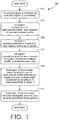
- FIG. 1 shows a flow chart of one embodiment of a variable length coding (VLC) method 100 that includes in 101 providing a breakpoint along the ordering of the series to define a first, e.g., low frequency region wherein non-zero-coefficients are likely to be clustered, and a second, e.g., high-frequency region where non-zero coefficients are likely to be scattered, and in the version shown, likely to be dominated by amplitude-1 coefficients.
- a first region e.g., low frequency region wherein non-zero-coefficients are likely to be clustered
- a second e.g., high-frequency region where non-zero coefficients are likely to be scattered, and in the version shown, likely to be dominated by amplitude-1 coefficients.
- the first region covers all the coefficients, typically excluding the non-DC coefficients.
- each run of consecutive zero-valued coefficients, and each run of consecutive non-zero-valued coefficients is identified.
- Different encoding methods are available for encoding the positions of the zero and non-zero-valued coefficients.
- the Basic Hybrid Method and the Extended Hybrid Method provide separate codewords for the runlengths of the zero-value coefficients, and for the runlengths of the clusters of non-zero-valued coefficients.
- the codes include variable length codes determined using assumed or actual statistics.
- step 103 identifies the runlengths of the consecutive zero-valued coefficients and of the non-zero-valued coefficients.
- step 103 includes identifying the runlengths of consecutive zero-values coefficients and of the cluster of non-zero-valued coefficients that follows the zeroes, including a single zero-valued coefficient following the run of non-zero-valued coefficients. Furthermore, events that have no non-zero-valued cocfficicnts preceding the non-zero coefficient(s) are included.
- the identified events are encoded.
- the encoding uses joint encoding for each event of the runlength of the preceding zero-valued coefficient and the runlength of the following one or more non-zero-valued coefficients.
- 105 includes using a two-dimensional lookup table of codes. The codes include variable length codes determined using assumed or actual statistics.
- the amplitudes in each run of non-zero-amplitudes in the identified event is encoded using an amplitude code.
- One aspect of the present invention includes coding modified clusters that are each a concatenation of two or more adjacent clusters, so that a coding method that efficiently encodes longer clusters can be used.
- the inventors recognized that runs of non-zero -valued coefficients of amplitude 1 are more likely than any other methods, so that a coding method that efficiently encodes runs of amplitude-1 coefficients in a cluster is likely to lead to coding efficiency improvement.
- a first amplitude method that takes advantage of the existence of such runs is used to encode the non-zero-amplitudes in the concatenations.
- the first amplitude method is the amplitude coding method of the Multi-Table Amplitude VLC Method and is used in 107 to code the amplitudes of the concatenated clusters.
- This method exploits that runs of amplitude-1 coefficients occur relatively frequently in clusters of non-zero valued coefficients coding gains and applies a modified 2D-VLC method within each cluster of consecutive non-zero-valued coefficients, with the most likely to occur amplitude in the cluster being 1, so that, within each cluster, one can view the method as applying a 2D-VLC method to a modified sequence of coefficients, with each coefficient amplitude reduced by 1, and with appropriate assumed or measured statistics for such clusters.
- the first amplitude coding method is applied to pairs of consecutive clusters that have been concatenated.
- amplitude coding is applied to the cluster that results from concatenating three consecutive clusters.
- amplitude coding is applied to the cluster that results from concatenating different numbers of more than three consecutive clusters.
- N c N c >1
- the first or the last concatenated cluster to be encoded may have less than N c consecutive clusters. Because the position code for the runs of zero-valued coefficients, and for the clusters provides accurate locations of the component clusters, the last coding being applied to the concatenation of less than N c consecutive clusters does not present a problem for a decoder.
- the first amplitude coding method is applied only to concatenations of clusters that have an amplitude of 1 at each side of each concatenation boundary, e.g., to a concatenation of a cluster that ends in an amplitude 1 immediately followed by a cluster that starts with an amplitude-1 coefficient.
- the amplitude coding is applied to a concatenation of all the clusters within the first, e.g., low-frequency region, or to the whole sequence of coefficients in the case that the whole sequence is being encoded.
- r(n) an identified run of n consecutive non-zero coefficients
- r'(z) an identified run of z consecutive zero-valued coefficients in the first region
- n,z 1,2,....
- N c clusters are concatenated.
- N c is pre-defined, and in another, N c is determined by the sequence of coefficients, e.g., in an embodiment wherein the code for a concatenation of all clusters is obtained.
- C(z 1 ,n 1 ), C(z 2 ,n 2 ), ... C(z Nc ,n Nc ) the codewords for the positions of the first, second, ...
- N c 'th event where n 1 , n 2 , ..., n Nc are the lengths of the first, second, ..., N c 'th clusters of non-zero coefficients, and z 1 , z 2 , ..., z Nc are the numbers of zero-valued coefficients preceding the first, second, ..., N c 'th clusters, respectively.
- C(n Nc ) the variable length codeword for first, second, ..., N c 'th cluster, respectively, and denote by C'(z 1 ), C'(z 2 ), ... C'(z Nc ) the variable length codeword for lengths of zero-valued coefficients preceding the first, second, ..., N c 'th cluster, respectively.
- step 107 uses an aspect of the Basic Multi-Dimensional Amplitude Coding Method.
- One such aspect is to use a single codeword obtained by a multidimensional amplitude encoding method to encode the sequence of amplitudes of the concatenation of the clusters by a variable length codeword.
- the codeword can be obtained by a multi-dimensional coding table, obtained using assumed or measured statistics. For example, denote by A nc (m 1 (1), m 1 (2), ..., m Nc (n Nc )) the codeword for the sequence of n c quantized amplitudes in the concatenation.
- the Basic Multi-Dimensional Amplitude Coding Method in the case the encoding of 107 is of the concatenation of all the clusters, using the Basic Multi-Dimensional Amplitude Coding Method leads to the code for the first region (which could be the whole region) of: C z 1 n 1 + C z 2 n 2 + ... + C z Nc n Nc + A n c m 1 1 , m 1 2 , ... , m Nc n Nc + S 1 1 + S 1 2 + ... + S Nc n Nc ,
- the code is: C n 1 + C ′ z 1 + C n 2 + C ′ z 2 , ... C n Nc + C ′ z Nc A n c m 1 1 , m 1 2 , ... , m Nc n Nc + S 1 1 + S 1 2 + ... + S Nc n Nc .
- the maximum length of the run of non-zero amplitudes jointly encoded using the Basic Multi-Dimensional Amplitude Coding Method is restricted to relatively low numbers such as 2 or 3 in a practical implementation. Only a few concatenated clusters would have such a short length.
- step 107 uses an aspect of the Multi-Table Amplitude Coding Method that uses an observation that in clusters of non-zero-valued coefficients, the appearance of amplitude 1 is more likely than that of amplitude 2, the appearance of amplitude 2 is more likely than that of amplitude 3, and so forth.
- the Multi-Table Amplitude Coding Method within each concatenation of N c clusters, such a concatenation containing n c non-zero valued coefficients, events are recognized of consecutive amplitude-1 coefficients followed by single coefficient of amplitude greater than one. Such events include the runlength of 0 amplitide-1 coefficients followed by the single coefficient of amplitude greater than 1.
- One embodiment of the Multi-Table Amplitude Coding Method includes assigning a variable length code for each identified event of the combination of the runlength of 1's and the amplitude of the final coefficient, or for an exception of all 1's.
- the variable length code may be assigned using assumed or measured statistics.
- a 2-D code table may be built to assign the codes. There is a different code table for each cluster length n. Denote by K n c (j,k) the variable length codeword.
- n events the number of such events in a cluster of length m
- j i and k i the runlength of preceding amplitude-1 coefficients, and the value of the final coefficient, respectively, in the ith event
- the codewords for the first region are: C z 1 n 1 + C z 2 n 2 + ... + C c z Nc n Nc + + ⁇ i C n c j i k i + S 1 1 + ... + S i j i + 1 .
- the codewords are: C n 1 + C ′ z 1 + C n 2 + C ′ z 2 , ... C n Nc + C ′ z Nc + ⁇ i C n c j i k i + S i 1 + ... + S i j i + 1 .
- one embodiment uses both the Basic Multi-Dimensional Amplitude Coding Method and the Multi-Table Amplitude Coding Method depending on the length of the cluster of non-zero-valued coefficients.
- the code for the clusters and positions, in the case N c includes all the clusters may be expressed as
- the second, e.g., high frequency region is encoded as described in the Extended Hybrid Coding method.
- events are defined that are each either no consecutive zero-valued coefficients, or a run of one or more zero-valued coefficients followed by a single non-zero-valued coefficient. Any such non-zero coefficient is assumed to have amplitude 1 such that no amplitude encoding is required for such a coefficient.
- a non-amplitude-1, non-zero coefficient is marked as an exception. Furthermore, the remainder of the block being zero is also identified.
- the runlength of the zero-valued coefficients preceding the single non-zero-valued coefficient is encoded using a variable length runlength coding method, implemented, e.g., as a coding table.
- the sign of the ending non-zero-value coefficient is encoded by a sign bit, and, in the case that the non-zero-valued coefficient is the exceptional case of not having amplitude 1, an exception code followed by an amplitude code is included.
- the amplitude code is obtained, e.g., using an amplitude coding table, which in general is different than the amplitude coding table used for encoding the non-zero-amplitudes in the first region, since the second region amplitudes are more likely to have lower value than the first region amplitudes.
- How to set up the codeword tables includes either assuming or obtaining statistics for typical series of coefficient image blocks, or, in an adaptive system, by measurement of the relative frequencies of occurrcncc of events and amplitudes, depending on the coding method, e.g., code table.
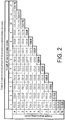
- FIG. 2 shows a code table for the positions of zeroes and clusters of non-zero coefficients using an embodiment of the 2-D Non-Zero/Zero Cluster Coding Method.
- FIG. 3 shows a 3-D codc table 305 for the amplitudes up to value M of clusters of three consecutive non-zero coefficients.
- Coding using aspects of the present invention are now described as an example, and compared to encoding according to conventional 2D-VLC, the Basic Hybrid VLC Method, the 2-D Non-Zero/Zero Cluster Coding Method with conventional amplitude coding, the 2-D Non-Zero/Zero Cluster Coding Method with the Multi-Dimensional Amplitude Coding Method, and the 2-D Non-Zero/Zero Cluster Coding Method with the Multi-Table Amplitude Coding Method.
- Coding using the 2-D Non-Zero/Zero Cluster Coding Method with separate amplitude coding of the non-zero-valued coefficients in the first (low-frequency) region includes identifying events of a run of zero-valued coefficients preceding a run (cluster) of non-zero coefficients followed by a single zero-valued coefficient.
- the low frequency region consists of, assuming a soft boundary:
- C(z,n) represents position code for 2D non-zero/zero clusters, where z is the number of zero-valued coefficients preceding a cluster of non-zero-valued coefficients followed by a single zero-values coefficient, and where n is the number of non-zero-valued coefficients in the cluster.
- A(i) is the one-dimensional amplitude code for a non-zero amplitude of i, while S + and S - represents codes used to encode positive and negative signs, respectively.
- the low frequency region includes identifying events of a run of zero-valued coefficients preceding a run (cluster) of non-zero coefficients followed by a single zero-valued coefficient.
- the low frequency region consists of, assuming a soft boundary, the sequence can be written as:
- the code is:
- a n (.) are n-dimensional functions of the amplitudes of the n-consecutive non-zero amplitudes in a cluster. Note that in practice, it is unlikely that the seven-dimensional codes A 7 would be used, and such a code is presented here for illustrative purposes only.
- the low frequency region consists of, assuming a soft boundary, the region is:
- C n (j,k) denotes the variable length codeword within a cluster of n non-zero-valued coefficients for a run of j amplitude-1 coefficients preceding a coefficient of value k>1, and C n (Esc) denotes codeword within a cluster of n non-zero-valued coefficients for a run of only amplitude-1 coefficients that is not followed by a coefficient of amplitude greater than 1.
- Coding using the concatenation aspect of the present invention together with the 2-D Non-Zcro/Zcro Cluster Coding Method and the Multi-Table Amplitude Coding Method to code the positions and amplitudes of the concatenated clusters of non-zero-valued coefficients in the first (low-frequency) region includes identifying runs of zero-valued coefficients preceding runs (cluster) of non-zero coefficients followed by a single zero-valued coefficient, then within the concatenation of all clusters, leading to a cluster of n c consecutive non-zero coefficients, identifying events of a run of consecutive amplitude 1 coefficients followed by a single coefficient of amplitude greater than 1.
- the low frequency region consists of, assuming a soft boundary:
- so that there are three clusters (non-pre-defined N c 3).
- the position codes for the three clusters of non-zero-valued coefficient clusters are (leaving out the indications of the codes of each cluster): C(0,7), C(1,5), and C(2,1).
- C n (j,k) denotes the variable length codeword within a concatenated cluster of n non-zero-valued coefficients for a run of j amplitude-1 coefficients preceding a coefficient of value k>1
- C n (Esc) denotes codeword within a concatenated cluster of n non-zero-valued coefficients for a run of only amplitude-1 coefficients that is not followed by a coefficient of amplitude greater than 1.
- FIG. 5 shows an apparatus 500 that includes a processing system 502 that includes one or more processors 504 and a memory 506.
- a single processor is shown in FIG. 5 and those in the art will appreciate that this may represent several processors.
- a single memory subsystem 506 is shown, and those in the art will appreciate that the memory subsystem may include different elements such as RAM, ROM, and so forth.
- the memory subsystem is meant to include any non-volatile memory storage such as a magnetic or optical storage component.
- a computer program 508 is included and is loaded into the memory 506.
- the program 508 includes instructions to instruct the processor to implement, in different versions, the different coding methods described above.
- the processor thus accepts as data the ordered coefficients and generates the codewords.
- the apparatus 500 further includes in the memory subsystem 506 a coding data structure 510 that provides the codewords for sets of one or more coefficients as described in any one of the novel coding methods described herein.
- the data structure is in the form of the coding tables for the position codes and for the amplitude codes, and for the joint coding function of position code and amplitude code.
- FIG. 5 does not show details such as bus structures, I/O structures, etc., that may be included since the need for such structures would be known to those in the art and their inclusion would only obscure the inventive aspects of the apparatus.
- the processing system may be implemented using one or more general purpose microprocessors, one or more microcontrollers that include several memory and other elements, one or more DSP devices, or any other programmable processors.
- the processors may be standalone devices, or may be implemented as "cores" to be included in an ASIC, gate array, or other device.
- Another aspect of the invention is a memory (such as memory 506 in FIG. 5 ) that stores a coding data structure that provides the codewords for sets of one or more coefficients as described in any one of the novel coding methods described herein.
- the data structure is in the form of one or more tables.
- variable length coding method and apparatus has been described suitable for encoding the quantized transform coefficients of blocks of images as occur in common image compression methods.
- Another aspect of the invention is a method to decode a bitstream in order to form a series of quantized coefficients of a transform of a block of image data, the transform such that 0 is the most likely coefficient amplitude and 1 is the next most likely coefficient amplitude.
- the bitstream is encoded by the coding method described above including, for a first contiguous region in the series, identifying clusters of at least one non-zero-valued coefficients, and for each such cluster, identifying at least one position event to identify the relative position and runlength of the cluster of non-zero coefficients, and identifying at least one amplitude event to define the non-zero amplitudes in the cluster of non-zero coefficients.
- the method further includes coding the identified position event(s), and further coding the amplitudes in one or more concatenations of the identified amplitude event(s) such that relatively short codewords are formed to represent values or sequences of values that are relatively more likely-to-occur, and relatively long codewords are formed to represent values or sequences of values that are relatively less likely-to-occur.
- the method is applicable to encoding a region in the series where there is likely to be a cluster of non-zero-valued coefficients.
- the decoding method includes recognizing one or more position codewords, determining the positions of clusters of non-zero-valued coefficients from the position codewords, recognizing one or more amplitude codewords, determining the amplitudes and signs of the non-zero-coefficients in the concatenations represented by the recognized amplitude codewords; and determining the sub-series of coefficients from recognized codewords until all coefficients in the series arc determined.
- FIG. 6 shows one embodiment of the apparatus.
- a codeword recognizer 602 accepts the bits of a bitstream and recognizes a codeword of a set of possible codewords. The codeword recognizer determines which of the a set of coding tables the codeword is from.
- a decoder 604 is coupled to the codeword recognizer 602 and determines the data for the codeword recognized by the codeword recognizer, e.g., the runlength of non-zeroes, the runlength of zeroes, the sign, etc..
- the decoder 604 includes a lookup device that looks up the appropriate decoding table stored in a memory 606.
- That table provides the event that corresponds to at least some of the codewords of the set of codewords, e.g., the relative position in the case of a position codeword, or an amplitude event, or sign information.
- Other codewords may include an escape code, so that decoding is by other than a table lookup method.
- the bitstream is stored in a buffer 608, and the output of the buffer is coupled to the codeword recognizer.
- the apparatus for decoding implements a codeword decoding method that includes recognizing one or more position codewords, determining the positions of clusters of non-zero-valued coefficients from the position codewords, recognizing one or more amplitude codewords, determining the amplitudes and signs of the non-zero-coefficients in the concatenations represented by the recognized amplitude codewords; and determining the sub-series of coefficients from recognized codewords until all coefficients in the series are determined.
- the lookup device includes memory for the tables, and such other embodiments are included herein.
- the codeword recognizer and also the lookup device may be each implemented on a computer as a set of instructions stored in a memory, e.g., the memory 606, that instruct one or more processors to carry out the operations of the recognition and of the lookup.
- Another aspect of the invention is a memory (such as memory 606 in FIG. 6 ) that stores a decoding data structure that provides the data for any set of codewords recognized in a bitstream of compressed image data.
- the bitstream is coded by any one of the novel coding methods described herein.
- the data structure is in the form of one or more tables.
- coding of the amplitudes is applied to concatenations of a pre-defined number of consecutive clusters. It is to be understood that in some situations, there may only be fewer clusters than the pre-defined number remaining to be encoded in the first region, e.g., because there are fewer than the pre-defined number in the fist part, or because, after encoding concatenations of one or more sets of the pre-defined number of clusters, there are only less than the pre-defined number of clusters remaining in the first region.
- the coding and decoding methodologies described herein are, in one embodiment, performable by a machine which includes a one or more processors that accept code segments containing instructions. For any of the methods described herein, when the instructions are executed by the machine, the machine performs the method. Any machine capable of executing a set of instructions (sequential or otherwise) that specify actions to be taken by that machine are included. Thus, one typical machine may be exemplified by a typical processing system that includes one or more processors. Each processor may include one or more of a CPU, a graphics processing unit, and a programmable DSP unit. The processing system further may include a memory subsystem including main RAM and/or a static RAM, and/or ROM. A bus subsystem may be included for communicating between the components.
- the processing system requires a display, such a display may be included, e.g., a liquid crystal display (LCD) or a cathode ray tube (CRT) display.
- the processing system also includes an input device such as one or more of an alphanumeric input unit such as a keyboard, a pointing control device such as a mouse, and so forth.
- the term memory unit as used herein also encompasses a storage system such as a disk drive unit.
- the processing system in some configurations may include a sounds output device, and a network interface device.
- the memory subsystem thus includes a carrier medium that carries machine readable code segments (e.g., software) including instructions for performing, when executed by the processing system, one of more of the methods described herein.
- the software may reside in the hard disk, or may also reside, completely or at least partially, within the RAM and/or within the processor during execution thereof by the computer system.
- the memory and the processor also constitute carrier medium carrying machine readable code.
- the machine operates as a standalone device or may be connected, e.g., networked to other machines, in a networked deployment, the machine may operate in the capacity of a server or a client machine in a server-client network environment, or as a peer machine in a peer-to-peer or distributed network environment.
- the machine may be a personal computer (PC), a tablet PC, a set-top box (STB), a Personal Digital Assistant (PDA), a cellular telephone, a web appliance, a network router, switch or bridge, or any machine capable of executing a set of instructions (sequential or otherwise) that specify actions to be taken by that machine.
- machine shall also be taken to include any collection of machines that individually or jointly execute a set (or multiple sets) of instructions to perform any one or more of the methodologies discussed herein.
- each of the methods described herein is in the form of a computer program that executes on a processing system, e.g., one or more processors that are part of an image encoder.
- a processing system e.g., one or more processors that are part of an image encoder.
- embodiments of the present invention may be embodied as a method, an apparatus such as a special purpose apparatus, an apparatus such as a data processing system, or a carrier medium, e.g., a computer program product.
- the carrier medium carries one or more computer readable code segments for controlling a processing system to implement a method.
- aspects of the present invention may take the form of a method, an entirely hardware embodiment, an entirely software embodiment or an embodiment combining software and hardware aspects.
- the present invention may take the form of carrier medium (e.g., a computer program product on a computer-readable storage medium) carrying computer-readable program code segments embodied in the medium.
- the software may further be transmitted or received over a network via the network interface device.
- the carrier medium is shown in an exemplary embodiment to be a single medium, the term “carrier medium” should be taken to include a single medium or multiple media (e.g., a centralized or distributed database, and/or associated caches and servers) that store the one or more sets of instructions.
- the term " carrier medium” shall also be taken to include any medium that is capable of storing, encoding or carrying a set of instructions for execution by the machine and that cause the machine to perform any one or more of the methodologies of the present invention.
- a carrier medium may take many forms, including but not limited to, non-volatile media, volatile media, and transmission media.
- Non-volatile media includes, for example, optical, magnetic disks, and magneto-optical disks.
- Volatile media includes dynamic memory, such as main memory.
- Transmission media includes coaxial cables, copper wire and fiber optics, including the wires that comprise a bus subsystem. Transmission media also may also take the form of acoustic or light waves, such as those generated during radio wave and infrared data communications.
- carrier medium shall accordingly be taken to include, but not be limited to, solid-state memories, optical and magnetic media, and carrier wave signals.
- some of the embodiments are described herein as a method or combination of elements of a method that can be implemented by a processor of a computer system or by other means of carrying out the function.
- a processor with the necessary instructions for carrying out such a method or element of a method forms a means for carrying out the method or element of a method.
- an element described herein of an apparatus embodiment is an example of a means for carrying out the function performed by the element for the purpose of carrying out the invention.
- the invention has been described in the context of transform encoding of images, the invention is not limited to such contexts and may be utilized in various other compression applications and systems. Furthermore, the invention is not limited to any one type of architecture or type of transform encoding.
- the DCT is mentioned above as one transform.
- Other transforms may be used, e.g., the new H.264/MEG-4 AVC video coding standard/draft standard defines 4x4 blocks and a DCT-like 4x4 integer transform.
- the invention does not depend on any particular type of interframe coding if used, or of motion compensation if used for interframe coding, or any intra-estimation if used for estimating the pixels of a block using information from neighboring blocks.
- variable length coding is sometimes referred to as entropy coding or statistical coding.
- amplitude is irrespective of sign. Therefore, for example, coefficient of values + 1 and -1 both have amplitude 1.
- the present invention does not depend on the particular type of VLC used for any of the coding methods, e.g., the coding tables, and can work, for example, with Huffman coding and with arithmetic coding methods.
- VLC Video Coding
- a priori likelihoods of occurrence of the events also called the symbols
- the likelihoods of occurrence of the events do not change
- other embodiments use adaptive encoding, i.e., the encoding is changeable according to statistical data such as histograms collected from the actual coefficients.
- a device A coupled to a device B should not be limited to devices or systems wherein an output of device A is directly connected to an input of device B. It means that there exists a path between an output of A and an input of B which may be a path including other devices or means.
Landscapes
- Engineering & Computer Science (AREA)
- Multimedia (AREA)
- Signal Processing (AREA)
- Compression Or Coding Systems Of Tv Signals (AREA)
- Compression, Expansion, Code Conversion, And Decoders (AREA)
- Compression Of Band Width Or Redundancy In Fax (AREA)
Claims (16)
- Procédé de codage d'une série ordonnée de coefficients quantifiés d'un bloc transformé de données d'image, les coefficients quantifiés ayant chacun une amplitude à partir d'un ensemble fini d'amplitudes comprenant l'amplitude la plus susceptible de se produire, comprenant 0, et au moins une autre amplitude, la au moins une autre amplitude comprenant une amplitude la plus susceptible de se produire suivante par rapport à l'amplitude la plus susceptible de se produire, l'amplitude la plus susceptible de se produire suivante comprenant 1, le codage servant à réduire la quantité de données utilisée pour représenter les coefficients quantifiés et à former des mots de code en utilisant un codage à longueur variable, le procédé comprenant de :
pour une première région contiguë de la série :identifier des événements de position qui incluent chacun un groupe d'au moins un coefficient consécutif ayant une amplitude autre que 0, de sorte que les événements de position définissent les positions et les longueurs de plage relatives des groupes et de plages intermédiaires de coefficients consécutifs ayant l'amplitude 0 entre des groupes consécutifs de coefficients à valeur non nulle;coder les événements de position; etconcaténer une pluralité des groupes consécutifs;coder les amplitudes des coefficients consécutifs dans la pluralité de groupes consécutifs concaténés pour former au moins un mot de code pour chaque concaténation, le codage d'amplitudes incluant d'utiliser un premier procédé de codage d'amplitudes, dans lequel, pour au moins certaines des concaténations, plus une série d'amplitudes de coefficients consécutifs est probable, plus le mot de code utilisé pour représenter les amplitudes de coefficients est court;caractérisé en ce que le premier procédé de codage d'amplitudes comprend un procédé de codage d'amplitudes multi-table dans lequel une table de code bidimensionnelle différente est utilisée pour chaque longueur de groupe n, et les amplitudes sont codées en utilisant le premier procédé de codage d'amplitudes pour les concaténations de groupes de coefficients non nuls dans les séries qui ont un nombre total de coefficients non nuls, «longueur de concaténation», supérieur à un seuil de longueur présélectionné; etpour chaque concaténation qui a une longueur de concaténation inférieure ou égale au seuil de longueur présélectionné, coder conjointement les amplitudes non nulles de la concaténation par une fonction de codage multidimensionnelle des amplitudes afin de produire un mot de code de telle sorte que, pour au moins certaines plages d'amplitudes non nulles, plus une plage d'amplitude est probable, plus le mot de code utilisé pour représenter la plage d'amplitude est court. - Procédé selon la revendication 1, dans lequel l'identification des événements de position est configurée de sorte que des événements qui incluent tous les groupes de coefficients non nuls dans la série soient identifiés, et dans lequel le codage d'amplitudes est appliqué à tous les groupes de coefficients non nuls dans la série.
- Procédé selon l'une quelconque des revendications 1 ou 2, dans lequel le bloc de données d'image transformé comprend un terme DC, et dans lequel le terme DC est codé séparément, de sorte que la série de coefficients quantifiés est un ensemble de coefficients quantifiés non DC d'un bloc transformé de données d'image.
- Procédé selon l'une quelconque des revendications 1 à 3, dans lequel le codage des amplitudes comprend de coder séparément les signes des amplitudes.
- Procédé selon l'une quelconque des revendications 1 à 4, dans lequel le premier procédé de codage d'amplitudes comprend, pour au moins une concaténation, de :reconnaître une ou plusieurs séquences dans la concaténation qui sont chacune une plage d'au moins un coefficient d'amplitude 1 consécutif qui se termine par un coefficient ayant une amplitude supérieure à 1, ou dans le cas d'une séquence à la fin d'une concaténation, qui est une plage de coefficients d'amplitude 1 consécutifs uniquement, chaque séquence reconnue étant définie par la longueur de la longueur de plage des coefficients d'amplitude 1 consécutifs et par l'amplitude du coefficient de fin, etdans lequel le premier procédé de codage d'amplitudes comprend de, pour au moins une concaténation, coder chaque séquence reconnue par un mot de code, de sorte que, pour au moins certaines séquences reconnues, plus une séquence est probable, plus le mot de code utilisé pour représenter la séquence est court.
- Procédé selon la revendication 5, dans lequel le codage des amplitudes utilise une table de codage (305, 510) qui fournit un mot de code pour chaque paire de la longueur de plage de la séquence de coefficients d'amplitude 1 précédente et de l'amplitude du coefficient de fin d'amplitude supérieure à 1.
- Procédé selon la revendication 6, dans lequel une table de codage différente (305, 510) est utilisée pour chaque longueur de groupe concaténé.
- Procédé selon la revendication 6 ou 7, dans lequel la table de codage (305, 510) est construite en affectant un code de longueur variable en fonction de statistiques mesurées ou supposées de paires de la longueur de plage de la séquence des coefficients d'amplitude 1 précédente et de l'amplitude du coefficient de fin.
- Procédé selon l'une quelconque des revendications 1 à 8, dans lequel le codage des amplitudes en utilisant le premier procédé de codage d'amplitudes est appliqué uniquement à des concaténations de groupes ayant une amplitude de 1 de chaque côté de chaque limite de concaténation.
- Procédé selon l'une quelconque des revendications 1 à 8, dans lequel le codage des amplitudes en utilisant le premier procédé de codage d'amplitudes est appliqué à des concaténations de tous les groupes dans la première région.
- Appareil de codage d'une série ordonnée de coefficients quantifiés d'un bloc transformé de données d'image, les coefficients quantifiés ayant chacun une amplitude à partir d'un ensemble fini d'amplitudes comprenant l'amplitude la plus susceptible de se produire, comprenant 0, et au moins une autre amplitude, la au moins une autre amplitude comprenant une amplitude la plus susceptible de se produire suivante par rapport à l'amplitude la plus susceptible de se produire, l'amplitude la plus susceptible de se produire suivante comprenant 1, le codage servant à réduire la quantité de données utilisée pour représenter les coefficients quantifiés et à former des mots de code en utilisant un codage à longueur variable, l'appareil comprenant :un moyen pour identifier, dans une première région contiguë de la série, des événements de position qui incluent chacun un groupe d'au moins un coefficient consécutif ayant une amplitude autre que 0, de sorte que les événements de position définissent les positions relatives et les longueurs de plages des groupes et de plages intermédiaires de coefficients consécutifs ayant l'amplitude 0 entre des groupes consécutifs de coefficients à valeur non nulle;un moyen pour coder les événements de position dans la première région contiguë;un moyen pour concaténer une pluralité des groupes consécutifs; etun moyen pour coder les amplitudes des coefficients consécutifs dans la pluralité de groupes consécutifs concaténés pour former au moins un mot de code pour chaque concaténation, le moyen de codage d'amplitudes incluant d'utiliser un premier procédé de codage d'amplitudes, dans lequel, pour au moins certaines des concaténations, plus une série d'amplitudes de coefficients consécutifs est probable, plus le mot de code utilisé pour représenter les amplitudes de coefficients est court;caractérisé en ce que le premier procédé de codage d'amplitudes comprend un procédé de codage d'amplitudes multi-table dans lequel une table de code bidimensionnelle différente est utilisée pour chaque longueur de groupe n, et le moyen pour coder les amplitudes comprend un moyen de codage utilisant le premier procédé de codage d'amplitudes pour les concaténations de groupes de coefficients non nuls dans les séries qui ont un nombre total de coefficients non nuls, «longueur de concaténation», supérieur à un seuil de longueur présélectionné; etpour chaque concaténation qui a une longueur de concaténation inférieure ou égale au seuil de longueur présélectionné, le moyen de codage comprend un moyen pour coder conjointement les amplitudes non nulles de la concaténation par une fonction de codage multidimensionnelle des amplitudes afin de produire un mot de code de telle sorte que, pour au moins certaines plages d'amplitudes non nulles, plus une plage d'amplitude est probable, plus le mot de code utilisé pour représenter la plage d'amplitude est court.
- Appareil selon la revendication 11, dans lequel le bloc de données d'image transformé comprend un terme DC, et dans lequel le terme DC est codé séparément, de sorte que la série de coefficients quantifiés est un ensemble de coefficients quantifiés non DC d'un bloc transformé de données d'image.
- Appareil selon la revendication 11 à 12, dans lequel le codage des amplitudes comprend de coder séparément les signes des amplitudes.
- Appareil selon l'une quelconque des revendications 11 à 13,
dans lequel le premier procédé de codage d'amplitudes comprend, pour au moins une concaténation, de :reconnaître une ou plusieurs séquences dans la concaténation qui sont chacune une plage d'au moins un coefficient d'amplitude 1 consécutif qui se termine par un coefficient ayant une amplitude supérieure à 1, ou dans le cas d'une séquence à la fin d'une concaténation, qui est une plage de coefficients d'amplitude 1 consécutifs uniquement, chaque séquence reconnue étant définie par la longueur de la longueur de plage des coefficients d'amplitude 1 consécutifs et par l'amplitude du coefficient de fin, etdans lequel le premier procédé de codage d'amplitudes comprend de, pour au moins une concaténation, coder chaque séquence reconnue par un mot de code, de sorte que, pour au moins certaines séquences reconnues, plus une séquence est probable, plus le mot de code utilisé pour représenter la séquence est court. - Appareil selon la revendication 14, dans lequel le moyen de codage des amplitudes utilise une table de codage (305, 510) qui fournit un mot de code pour chaque paire de la longueur de plage de la séquence de coefficients d'amplitude 1 précédente et de l'amplitude du coefficient de fin d'amplitude supérieure à 1, et dans lequel la table de codage (305, 510) est construite en affectant un code de longueur variable en fonction de statistiques mesurées ou supposées de paires de la longueur de plage de la séquence de coefficients d'amplitude 1 précédente et de l'amplitude du coefficient de fin.
- Produit-programme d'ordinateur comprenant un code de programme d'ordinateur (508) qui, lorsqu'il est exécuté par un ou plusieurs processeurs (504) d'un système de traitement (502), amène ledit système de traitement à mettre en oeuvre un procédé selon l'une quelconque des revendications 1 à 10.
Applications Claiming Priority (2)
| Application Number | Priority Date | Filing Date | Title |
|---|---|---|---|
| US11/270,138 US7620258B2 (en) | 2004-08-18 | 2005-11-09 | Extended amplitude coding for clustered transform coefficients |
| PCT/US2006/060472 WO2007056657A2 (fr) | 2005-11-09 | 2006-11-02 | Codage etendu d'amplitude pour coefficients de transformation en cluster |
Publications (3)
| Publication Number | Publication Date |
|---|---|
| EP1946246A2 EP1946246A2 (fr) | 2008-07-23 |
| EP1946246A4 EP1946246A4 (fr) | 2011-07-27 |
| EP1946246B1 true EP1946246B1 (fr) | 2019-02-20 |
Family
ID=38024038
Family Applications (1)
| Application Number | Title | Priority Date | Filing Date |
|---|---|---|---|
| EP06839677.9A Not-in-force EP1946246B1 (fr) | 2005-11-09 | 2006-11-02 | Codage etendu d'amplitude pour coefficients de transformation en cluster |
Country Status (3)
| Country | Link |
|---|---|
| US (1) | US7620258B2 (fr) |
| EP (1) | EP1946246B1 (fr) |
| WO (1) | WO2007056657A2 (fr) |
Families Citing this family (17)
| Publication number | Priority date | Publication date | Assignee | Title |
|---|---|---|---|---|
| NO322043B1 (no) * | 2004-12-30 | 2006-08-07 | Tandberg Telecom As | Fremgangsmate for forenklet entropikoding |
| US7242328B1 (en) | 2006-02-03 | 2007-07-10 | Cisco Technology, Inc. | Variable length coding for sparse coefficients |
| US7515042B2 (en) * | 2006-05-25 | 2009-04-07 | Alcatel-Lucent Usa Inc. | Mobile surveillance |
| US8135071B2 (en) | 2007-01-16 | 2012-03-13 | Cisco Technology, Inc. | Breakpoint determining for hybrid variable length coding using relationship to neighboring blocks |
| US7796825B2 (en) | 2007-02-16 | 2010-09-14 | Cisco Technology, Inc. | Losslessly improving compression of compressed image data |
| US8144784B2 (en) * | 2007-07-09 | 2012-03-27 | Cisco Technology, Inc. | Position coding for context-based adaptive variable length coding |
| US8204327B2 (en) | 2007-10-01 | 2012-06-19 | Cisco Technology, Inc. | Context adaptive hybrid variable length coding |
| US8265162B2 (en) | 2007-10-01 | 2012-09-11 | Cisco Technology, Inc. | Context adaptive position and amplitude coding of coefficients for video compression |
| US8041131B2 (en) * | 2007-10-02 | 2011-10-18 | Cisco Technology, Inc. | Variable length coding of coefficient clusters for image and video compression |
| US8036471B2 (en) * | 2007-10-02 | 2011-10-11 | Cisco Technology, Inc. | Joint amplitude and position coding of coefficients for video compression |
| WO2010063883A1 (fr) * | 2008-12-03 | 2010-06-10 | Nokia Corporation | Commutation entre modes de codage de coefficients dct |
| US8934540B2 (en) | 2010-07-20 | 2015-01-13 | Cisco Technology, Inc. | Video compression using multiple variable length coding methods for multiple types of transform coefficient blocks |
| US8737464B1 (en) | 2011-07-21 | 2014-05-27 | Cisco Technology, Inc. | Adaptive quantization for perceptual video coding |
| CN103002275B (zh) * | 2011-09-13 | 2016-05-04 | 富士通株式会社 | 用于cavlc编码的双系数扫描方法 |
| CN102752592B (zh) * | 2012-06-20 | 2015-02-11 | 深圳广晟信源技术有限公司 | 视频变换系数的熵编码方法 |
| CN111402852B (zh) * | 2019-01-02 | 2023-02-28 | 香港科技大学 | 频率离散主动面板的低频吸声和软边界效应 |
| US11258464B1 (en) * | 2020-04-09 | 2022-02-22 | Kioxia Corporation | Codeword concatenation for correcting errors in data storage devices |
Family Cites Families (88)
| Publication number | Priority date | Publication date | Assignee | Title |
|---|---|---|---|---|
| US4420771A (en) * | 1981-02-09 | 1983-12-13 | Bell Telephone Laboratories, Incorporated | Technique for encoding multi-level signals |
| JPS61107818A (ja) * | 1984-10-30 | 1986-05-26 | Nec Corp | エントロピ−符号化方式とその装置 |
| US4698672A (en) | 1986-10-27 | 1987-10-06 | Compression Labs, Inc. | Coding system for reducing redundancy |
| IT1197948B (it) * | 1986-11-04 | 1988-12-21 | Telettra Lab Telefon | Codice a lunghezza variabile e dispositivi per trasmissione ad alta frequenza |
| US4920426A (en) * | 1986-11-10 | 1990-04-24 | Kokusai Denshin Denwa Co., Ltd. | Image coding system coding digital image signals by forming a histogram of a coefficient signal sequence to estimate an amount of information |
| SE454734B (sv) * | 1987-02-20 | 1988-05-24 | Harald Brusewitz | Forfarande och anordning for sendning och mottagning vid variabel lengdkodning |
| JP2508439B2 (ja) * | 1987-05-29 | 1996-06-19 | ソニー株式会社 | 高能率符号化装置 |
| US5371811A (en) * | 1987-07-09 | 1994-12-06 | British Telecommunications Public Limited Company | Data encoding |
| GB8717124D0 (en) * | 1987-07-20 | 1987-08-26 | British Telecomm | P c m signal coding |
| GB8722394D0 (en) * | 1987-09-23 | 1987-10-28 | British Telecomm | Video coder |
| US4813056A (en) * | 1987-12-08 | 1989-03-14 | General Electric Company | Modified statistical coding of digital signals |
| US4858017A (en) * | 1988-01-22 | 1989-08-15 | The Trustees Of Columbia University In The City Of New York | System and method for hierarchal image encoding and decoding |
| US4985700A (en) * | 1988-03-01 | 1991-01-15 | Canon Kabushiki Kaisha | Variable-length coding/decoding device |
| US5179442A (en) * | 1989-06-02 | 1993-01-12 | North American Philips Corporation | Method and apparatus for digitally processing a high definition television augmentation signal |
| US5128758A (en) * | 1989-06-02 | 1992-07-07 | North American Philips Corporation | Method and apparatus for digitally processing a high definition television augmentation signal |
| DE68909592T2 (de) * | 1989-07-04 | 1994-05-11 | Rai Radiotelevisione Italiana | Vorrichtung zur Redundanzreduktion in Blöcken digitaler Videodaten in DCT-Kodierung. |
| JPH0832039B2 (ja) * | 1989-08-19 | 1996-03-27 | 日本ビクター株式会社 | 可変長符号化方法及びその装置 |
| US5086488A (en) * | 1989-08-19 | 1992-02-04 | Mitsubishi Denki Kabushiki Kaisha | Transform coding apparatus |
| JPH0379182A (ja) * | 1989-08-23 | 1991-04-04 | Fujitsu Ltd | 画像符号化制御方式 |
| JPH03129987A (ja) * | 1989-10-14 | 1991-06-03 | Sony Corp | 映像信号符号化装置及び映像信号符号化方法 |
| DE69032177T2 (de) * | 1989-12-25 | 1998-11-12 | Mitsubishi Electric Corp | Kodierungsgerät |
| JP3013381B2 (ja) * | 1990-03-28 | 2000-02-28 | ソニー株式会社 | 可変長データの復号装置 |
| US5291282A (en) * | 1990-04-19 | 1994-03-01 | Olympus Optical Co., Ltd. | Image data coding apparatus and method capable of controlling amount of codes |
| DE69130275T2 (de) * | 1990-07-31 | 1999-04-08 | Canon K.K., Tokio/Tokyo | Verfahren und Gerät zur Bildverarbeitung |
| EP0475251B1 (fr) * | 1990-09-10 | 1997-03-26 | Mitsubishi Denki Kabushiki Kaisha | Dispositif de codage pour des données d'image numériques |
| JPH04185119A (ja) * | 1990-11-20 | 1992-07-02 | Matsushita Electric Ind Co Ltd | 可変長符号化装置 |
| USRE35093E (en) * | 1990-12-03 | 1995-11-21 | The Trustees Of Columbia University In The City Of New York | Systems and methods for coding even fields of interlaced video sequences |
| US5253053A (en) * | 1990-12-31 | 1993-10-12 | Apple Computer, Inc. | Variable length decoding using lookup tables |
| EP0495490B1 (fr) * | 1991-01-17 | 1998-05-27 | Mitsubishi Denki Kabushiki Kaisha | Dispositif de codage d'un signal vidéo |
| DE69216436T2 (de) * | 1991-01-29 | 1997-05-15 | Canon Kk | Bildsignalkodierungsgerät |
| SG65702A1 (en) * | 1991-04-10 | 1999-06-22 | Mitsubishi Electric Corp | Encorder and decorder |
| JPH0541862A (ja) * | 1991-08-03 | 1993-02-19 | Sony Corp | 動きベクトルの可変長符号化方式 |
| JPH0568243A (ja) * | 1991-09-09 | 1993-03-19 | Hitachi Ltd | 可変長符号化制御方式 |
| US5475501A (en) * | 1991-09-30 | 1995-12-12 | Sony Corporation | Picture encoding and/or decoding method and apparatus |
| NO175080B (no) | 1992-03-11 | 1994-05-16 | Teledirektoratets Forskningsav | Fremgangsmåte for koding av bildedata |
| KR0160610B1 (ko) * | 1992-04-07 | 1999-01-15 | 강진구 | 가변장부호화에 의한 영상압축방법과 신장방법 및 그 장치 |
| JP2697479B2 (ja) * | 1992-04-17 | 1998-01-14 | 国際電信電話株式会社 | 可逆可変長符号化方式 |
| JPH05344490A (ja) * | 1992-06-10 | 1993-12-24 | Canon Inc | 符号化方法および符号化装置 |
| US5226082A (en) * | 1992-07-02 | 1993-07-06 | At&T Bell Laboratories | Variable length decoder |
| US5253055A (en) * | 1992-07-02 | 1993-10-12 | At&T Bell Laboratories | Efficient frequency scalable video encoding with coefficient selection |
| US5363097A (en) * | 1992-09-14 | 1994-11-08 | Industrial Technology Research Institute | Direct sequential-bit variable length decoder |
| KR0129558B1 (ko) * | 1992-10-26 | 1998-04-10 | 배순훈 | 적응적 가변길이 부호화 방법 및 장치 |
| US5982437A (en) * | 1992-10-26 | 1999-11-09 | Sony Corporation | Coding method and system, and decoding method and system |
| US5400075A (en) * | 1993-01-13 | 1995-03-21 | Thomson Consumer Electronics, Inc. | Adaptive variable length encoder/decoder |
| US5717394A (en) * | 1993-02-10 | 1998-02-10 | Ricoh Company Ltd. | Method and apparatus for encoding and decoding data |
| JP3446237B2 (ja) * | 1993-04-16 | 2003-09-16 | ソニー株式会社 | 可変長符号テーブル生成方法及び装置 |
| JP3210996B2 (ja) * | 1993-07-30 | 2001-09-25 | 三菱電機株式会社 | 高能率符号化装置及び高能率復号化装置 |
| US5479527A (en) * | 1993-12-08 | 1995-12-26 | Industrial Technology Research Inst. | Variable length coding system |
| KR0155784B1 (ko) * | 1993-12-16 | 1998-12-15 | 김광호 | 영상데이타의 적응형 가변장 부호화/복호화방법 |
| KR970009408B1 (ko) * | 1994-01-18 | 1997-06-13 | 대우전자 주식회사 | 인터/인트라 테이블 선택 회로 |
| US5491480A (en) * | 1994-05-25 | 1996-02-13 | Industrial Technology Research Institute | Variable length decoder using serial and parallel processing |
| JP3220598B2 (ja) * | 1994-08-31 | 2001-10-22 | 三菱電機株式会社 | 可変長符号テーブルおよび可変長符号化装置 |
| JPH08102943A (ja) * | 1994-09-30 | 1996-04-16 | Fuji Xerox Co Ltd | 画像符号化装置 |
| KR100209877B1 (ko) * | 1994-11-26 | 1999-07-15 | 윤종용 | 복수개의 허프만부호테이블을 이용한 가변장부호화장치 및 복호화장치 |
| KR0139161B1 (ko) * | 1994-11-26 | 1998-05-15 | 김광호 | 가변장부호테이블의 심볼-부호어 재배정을 이용한 가변장 부호화/복호화 장치 |
| KR0139164B1 (ko) * | 1994-12-19 | 1998-06-01 | 김광호 | 적응적 직교변환부호화 장치 |
| EP1802135A3 (fr) * | 1995-03-15 | 2008-11-12 | Kabushiki Kaisha Toshiba | Systèmes de codage et/ou de décodage d'images mobiles |
| US6104754A (en) * | 1995-03-15 | 2000-08-15 | Kabushiki Kaisha Toshiba | Moving picture coding and/or decoding systems, and variable-length coding and/or decoding system |
| US5648774A (en) * | 1995-05-08 | 1997-07-15 | Industrial Technology Research Institute | Variable length coding with three-field codes |
| JP3226439B2 (ja) * | 1995-06-02 | 2001-11-05 | 松下電器産業株式会社 | 画像符号化方法および画像復号方法 |
| JP3992303B2 (ja) * | 1995-06-22 | 2007-10-17 | ソニー株式会社 | 信号圧縮装置と信号伸長装置および信号圧縮方法と信号伸長方法 |
| US5740283A (en) * | 1995-07-06 | 1998-04-14 | Rubin, Bednarek & Associates, Inc. | Digital video compression utilizing mixed vector and scalar outputs |
| KR100188934B1 (ko) * | 1995-08-28 | 1999-06-01 | 윤종용 | 영상 신호 부호화 장치 및 방법 |
| JP3355888B2 (ja) * | 1995-09-19 | 2002-12-09 | 松下電器産業株式会社 | 画像符号化記録再生装置 |
| KR100304660B1 (ko) * | 1995-09-22 | 2001-11-22 | 윤종용 | 누적에러처리를통한비디오신호부호화방법및부호화기 |
| JPH09162748A (ja) * | 1995-12-01 | 1997-06-20 | Fujitsu Ltd | データ符号化方法、データ復号方法、データ圧縮装置、データ復元装置、及びデータ圧縮・復元システム |
| JP3267142B2 (ja) * | 1996-02-23 | 2002-03-18 | ケイディーディーアイ株式会社 | 可変長符号生成装置 |
| US5818877A (en) * | 1996-03-14 | 1998-10-06 | The Regents Of The University Of California | Method for reducing storage requirements for grouped data values |
| KR100318056B1 (ko) * | 1996-11-06 | 2001-12-24 | 모리시타 요이찌 | 화상 복호화 방법 |
| JP2870515B2 (ja) * | 1996-12-27 | 1999-03-17 | 日本電気株式会社 | 可変長符号化装置 |
| SE512613C2 (sv) * | 1996-12-30 | 2000-04-10 | Ericsson Telefon Ab L M | Metod och organ för informationshantering |
| WO1998035503A1 (fr) * | 1997-02-08 | 1998-08-13 | Matsushita Electric Industrial Co., Ltd. | Matrice de quantification pour le codage d'images fixes et en mouvement |
| US6304607B1 (en) * | 1997-03-18 | 2001-10-16 | Texas Instruments Incorporated | Error resilient video coding using reversible variable length codes (RVLCS) |
| JP3410629B2 (ja) * | 1997-05-21 | 2003-05-26 | シャープ株式会社 | 可変長符号化回路及び可変長符号化方法 |
| US6118822A (en) * | 1997-12-01 | 2000-09-12 | Conexant Systems, Inc. | Adaptive entropy coding in adaptive quantization framework for video signal coding systems and processes |
| US6111914A (en) * | 1997-12-01 | 2000-08-29 | Conexant Systems, Inc. | Adaptive entropy coding in adaptive quantization framework for video signal coding systems and processes |
| US7263127B1 (en) * | 1998-04-02 | 2007-08-28 | Intel Corporation | Method and apparatus for simplifying frame-based motion estimation |
| JP2000059234A (ja) * | 1998-08-10 | 2000-02-25 | Mitsubishi Electric Corp | 可変長符号処理装置 |
| KR100335138B1 (ko) * | 1998-12-30 | 2002-11-27 | 엘지정보통신주식회사 | 비디오코더의가변부호화기및이를이용한코딩방법 |
| US6477280B1 (en) | 1999-03-26 | 2002-11-05 | Microsoft Corporation | Lossless adaptive encoding of finite alphabet data |
| TW425776B (en) * | 1999-08-11 | 2001-03-11 | Cyberlink Corp | Method for generating symmetric reversible variable length code |
| US6445314B1 (en) * | 2000-03-01 | 2002-09-03 | Cisco Technology Inc. | System and method for the decoding of variable length codes |
| US6771828B1 (en) | 2000-03-03 | 2004-08-03 | Microsoft Corporation | System and method for progessively transform coding digital data |
| JP4109404B2 (ja) * | 2000-04-26 | 2008-07-02 | 松下電器産業株式会社 | 符号化装置および符号化方法 |
| US6918069B2 (en) | 2002-04-16 | 2005-07-12 | Cisco Technology, Inc. | Optimum threshold for FEC transponders |
| US6962205B1 (en) | 2003-02-28 | 2005-11-08 | Lay Jr Milford | Subsea wellhead landing clamp and slip bowl assembly |
| US7194137B2 (en) | 2003-05-16 | 2007-03-20 | Cisco Technology, Inc. | Variable length coding method and apparatus for video compression |
| EP1486139B1 (fr) | 2003-06-13 | 2005-02-02 | Aemme S.r.l. | Meuble de cuisine pour la cuisson des aliments |
-
2005
- 2005-11-09 US US11/270,138 patent/US7620258B2/en not_active Expired - Fee Related
-
2006
- 2006-11-02 WO PCT/US2006/060472 patent/WO2007056657A2/fr not_active Ceased
- 2006-11-02 EP EP06839677.9A patent/EP1946246B1/fr not_active Not-in-force
Non-Patent Citations (1)
| Title |
|---|
| None * |
Also Published As
| Publication number | Publication date |
|---|---|
| WO2007056657A2 (fr) | 2007-05-18 |
| EP1946246A4 (fr) | 2011-07-27 |
| US7620258B2 (en) | 2009-11-17 |
| US20060056720A1 (en) | 2006-03-16 |
| EP1946246A2 (fr) | 2008-07-23 |
| WO2007056657A3 (fr) | 2007-12-27 |
Similar Documents
| Publication | Publication Date | Title |
|---|---|---|
| US7912306B2 (en) | Variable length coding for clustered transform coefficients in video compression | |
| US7454076B2 (en) | Hybrid variable length coding method for low bit rate video coding | |
| EP1946246B1 (fr) | Codage etendu d'amplitude pour coefficients de transformation en cluster | |
| US7486212B2 (en) | Variable length coding for sparse coefficients | |
| US7949195B2 (en) | Per block breakpoint determining for hybrid variable length coding | |
| CA2520652C (fr) | Codage de longueur de plage et codage de longueur variable combines pour la compression video | |
| US8401321B2 (en) | Method and apparatus for context adaptive binary arithmetic coding and decoding | |
| CN1656817B (zh) | 上下文自适应的可变长度码字vlc视频变换系数编码和解码方法与设备 | |
| US7324699B2 (en) | Extension of two-dimensional variable length coding for image compression | |
| US20070046504A1 (en) | Adaptive variable length codes for independent variables | |
| US7499595B2 (en) | Joint amplitude and position coding for photographic image and video coding | |
| US7471840B2 (en) | Two-dimensional variable length coding of runs of zero and non-zero transform coefficients for image compression | |
| JP3016456B2 (ja) | 適応的可変長符号化方法 | |
| US7499596B2 (en) | Amplitude coding for clustered transform coefficients | |
| EP1782337B1 (fr) | Codage hybride a longueur variable pour la compression de donnees video | |
| WO2005057937A1 (fr) | Compression de donnees d'image | |
| US7492956B2 (en) | Video coding using multi-dimensional amplitude coding and 2-D non-zero/zero cluster position coding |
Legal Events
| Date | Code | Title | Description |
|---|---|---|---|
| PUAI | Public reference made under article 153(3) epc to a published international application that has entered the european phase |
Free format text: ORIGINAL CODE: 0009012 |
|
| 17P | Request for examination filed |
Effective date: 20080314 |
|
| AK | Designated contracting states |
Kind code of ref document: A2 Designated state(s): AT BE BG CH CY CZ DE DK EE ES FI FR GB GR HU IE IS IT LI LT LU LV MC NL PL PT RO SE SI SK TR |
|
| AX | Request for extension of the european patent |
Extension state: AL BA HR MK RS |
|
| RIC1 | Information provided on ipc code assigned before grant |
Ipc: H03M 7/40 20060101ALI20110601BHEP Ipc: H03M 7/48 20060101ALI20110601BHEP Ipc: G06K 9/36 20060101AFI20070716BHEP Ipc: H04N 7/30 20060101ALI20110601BHEP |
|
| A4 | Supplementary search report drawn up and despatched |
Effective date: 20110628 |
|
| DAX | Request for extension of the european patent (deleted) | ||
| 17Q | First examination report despatched |
Effective date: 20150724 |
|
| REG | Reference to a national code |
Ref country code: DE Ref legal event code: R079 Ref document number: 602006057461 Country of ref document: DE Free format text: PREVIOUS MAIN CLASS: G06K0009360000 Ipc: H04N0019600000 |
|
| GRAP | Despatch of communication of intention to grant a patent |
Free format text: ORIGINAL CODE: EPIDOSNIGR1 |
|
| STAA | Information on the status of an ep patent application or granted ep patent |
Free format text: STATUS: GRANT OF PATENT IS INTENDED |
|
| RIC1 | Information provided on ipc code assigned before grant |
Ipc: H04N 19/93 20140101ALI20180905BHEP Ipc: H04N 19/91 20140101ALI20180905BHEP Ipc: H04N 19/60 20140101AFI20180905BHEP |
|
| INTG | Intention to grant announced |
Effective date: 20180919 |
|
| GRAS | Grant fee paid |
Free format text: ORIGINAL CODE: EPIDOSNIGR3 |
|
| GRAA | (expected) grant |
Free format text: ORIGINAL CODE: 0009210 |
|
| STAA | Information on the status of an ep patent application or granted ep patent |
Free format text: STATUS: THE PATENT HAS BEEN GRANTED |
|
| RAP1 | Party data changed (applicant data changed or rights of an application transferred) |
Owner name: CISCO TECHNOLOGY, INC. |
|
| AK | Designated contracting states |
Kind code of ref document: B1 Designated state(s): AT BE BG CH CY CZ DE DK EE ES FI FR GB GR HU IE IS IT LI LT LU LV MC NL PL PT RO SE SI SK TR |
|
| REG | Reference to a national code |
Ref country code: GB Ref legal event code: FG4D |
|
| REG | Reference to a national code |
Ref country code: CH Ref legal event code: EP |
|
| REG | Reference to a national code |
Ref country code: DE Ref legal event code: R096 Ref document number: 602006057461 Country of ref document: DE |
|
| REG | Reference to a national code |
Ref country code: AT Ref legal event code: REF Ref document number: 1099790 Country of ref document: AT Kind code of ref document: T Effective date: 20190315 |
|
| REG | Reference to a national code |
Ref country code: IE Ref legal event code: FG4D |
|
| REG | Reference to a national code |
Ref country code: LT Ref legal event code: MG4D |
|
| REG | Reference to a national code |
Ref country code: NL Ref legal event code: MP Effective date: 20190220 |
|
| PG25 | Lapsed in a contracting state [announced via postgrant information from national office to epo] |
Ref country code: LT Free format text: LAPSE BECAUSE OF FAILURE TO SUBMIT A TRANSLATION OF THE DESCRIPTION OR TO PAY THE FEE WITHIN THE PRESCRIBED TIME-LIMIT Effective date: 20190220 Ref country code: PT Free format text: LAPSE BECAUSE OF FAILURE TO SUBMIT A TRANSLATION OF THE DESCRIPTION OR TO PAY THE FEE WITHIN THE PRESCRIBED TIME-LIMIT Effective date: 20190620 Ref country code: FI Free format text: LAPSE BECAUSE OF FAILURE TO SUBMIT A TRANSLATION OF THE DESCRIPTION OR TO PAY THE FEE WITHIN THE PRESCRIBED TIME-LIMIT Effective date: 20190220 Ref country code: SE Free format text: LAPSE BECAUSE OF FAILURE TO SUBMIT A TRANSLATION OF THE DESCRIPTION OR TO PAY THE FEE WITHIN THE PRESCRIBED TIME-LIMIT Effective date: 20190220 |
|
| PG25 | Lapsed in a contracting state [announced via postgrant information from national office to epo] |
Ref country code: BG Free format text: LAPSE BECAUSE OF FAILURE TO SUBMIT A TRANSLATION OF THE DESCRIPTION OR TO PAY THE FEE WITHIN THE PRESCRIBED TIME-LIMIT Effective date: 20190520 Ref country code: GR Free format text: LAPSE BECAUSE OF FAILURE TO SUBMIT A TRANSLATION OF THE DESCRIPTION OR TO PAY THE FEE WITHIN THE PRESCRIBED TIME-LIMIT Effective date: 20190521 Ref country code: IS Free format text: LAPSE BECAUSE OF FAILURE TO SUBMIT A TRANSLATION OF THE DESCRIPTION OR TO PAY THE FEE WITHIN THE PRESCRIBED TIME-LIMIT Effective date: 20190620 Ref country code: LV Free format text: LAPSE BECAUSE OF FAILURE TO SUBMIT A TRANSLATION OF THE DESCRIPTION OR TO PAY THE FEE WITHIN THE PRESCRIBED TIME-LIMIT Effective date: 20190220 Ref country code: NL Free format text: LAPSE BECAUSE OF FAILURE TO SUBMIT A TRANSLATION OF THE DESCRIPTION OR TO PAY THE FEE WITHIN THE PRESCRIBED TIME-LIMIT Effective date: 20190220 |
|
| REG | Reference to a national code |
Ref country code: AT Ref legal event code: MK05 Ref document number: 1099790 Country of ref document: AT Kind code of ref document: T Effective date: 20190220 |
|
| PG25 | Lapsed in a contracting state [announced via postgrant information from national office to epo] |
Ref country code: RO Free format text: LAPSE BECAUSE OF FAILURE TO SUBMIT A TRANSLATION OF THE DESCRIPTION OR TO PAY THE FEE WITHIN THE PRESCRIBED TIME-LIMIT Effective date: 20190220 Ref country code: CZ Free format text: LAPSE BECAUSE OF FAILURE TO SUBMIT A TRANSLATION OF THE DESCRIPTION OR TO PAY THE FEE WITHIN THE PRESCRIBED TIME-LIMIT Effective date: 20190220 Ref country code: ES Free format text: LAPSE BECAUSE OF FAILURE TO SUBMIT A TRANSLATION OF THE DESCRIPTION OR TO PAY THE FEE WITHIN THE PRESCRIBED TIME-LIMIT Effective date: 20190220 Ref country code: EE Free format text: LAPSE BECAUSE OF FAILURE TO SUBMIT A TRANSLATION OF THE DESCRIPTION OR TO PAY THE FEE WITHIN THE PRESCRIBED TIME-LIMIT Effective date: 20190220 Ref country code: SK Free format text: LAPSE BECAUSE OF FAILURE TO SUBMIT A TRANSLATION OF THE DESCRIPTION OR TO PAY THE FEE WITHIN THE PRESCRIBED TIME-LIMIT Effective date: 20190220 Ref country code: IT Free format text: LAPSE BECAUSE OF FAILURE TO SUBMIT A TRANSLATION OF THE DESCRIPTION OR TO PAY THE FEE WITHIN THE PRESCRIBED TIME-LIMIT Effective date: 20190220 Ref country code: DK Free format text: LAPSE BECAUSE OF FAILURE TO SUBMIT A TRANSLATION OF THE DESCRIPTION OR TO PAY THE FEE WITHIN THE PRESCRIBED TIME-LIMIT Effective date: 20190220 |
|
| REG | Reference to a national code |
Ref country code: DE Ref legal event code: R097 Ref document number: 602006057461 Country of ref document: DE |
|
| PG25 | Lapsed in a contracting state [announced via postgrant information from national office to epo] |
Ref country code: PL Free format text: LAPSE BECAUSE OF FAILURE TO SUBMIT A TRANSLATION OF THE DESCRIPTION OR TO PAY THE FEE WITHIN THE PRESCRIBED TIME-LIMIT Effective date: 20190220 |
|
| PLBE | No opposition filed within time limit |
Free format text: ORIGINAL CODE: 0009261 |
|
| STAA | Information on the status of an ep patent application or granted ep patent |
Free format text: STATUS: NO OPPOSITION FILED WITHIN TIME LIMIT |
|
| PG25 | Lapsed in a contracting state [announced via postgrant information from national office to epo] |
Ref country code: AT Free format text: LAPSE BECAUSE OF FAILURE TO SUBMIT A TRANSLATION OF THE DESCRIPTION OR TO PAY THE FEE WITHIN THE PRESCRIBED TIME-LIMIT Effective date: 20190220 |
|
| 26N | No opposition filed |
Effective date: 20191121 |
|
| PG25 | Lapsed in a contracting state [announced via postgrant information from national office to epo] |
Ref country code: SI Free format text: LAPSE BECAUSE OF FAILURE TO SUBMIT A TRANSLATION OF THE DESCRIPTION OR TO PAY THE FEE WITHIN THE PRESCRIBED TIME-LIMIT Effective date: 20190220 |
|
| PG25 | Lapsed in a contracting state [announced via postgrant information from national office to epo] |
Ref country code: TR Free format text: LAPSE BECAUSE OF FAILURE TO SUBMIT A TRANSLATION OF THE DESCRIPTION OR TO PAY THE FEE WITHIN THE PRESCRIBED TIME-LIMIT Effective date: 20190220 |
|
| REG | Reference to a national code |
Ref country code: CH Ref legal event code: PL |
|
| PG25 | Lapsed in a contracting state [announced via postgrant information from national office to epo] |
Ref country code: MC Free format text: LAPSE BECAUSE OF FAILURE TO SUBMIT A TRANSLATION OF THE DESCRIPTION OR TO PAY THE FEE WITHIN THE PRESCRIBED TIME-LIMIT Effective date: 20190220 Ref country code: LI Free format text: LAPSE BECAUSE OF NON-PAYMENT OF DUE FEES Effective date: 20191130 Ref country code: CH Free format text: LAPSE BECAUSE OF NON-PAYMENT OF DUE FEES Effective date: 20191130 Ref country code: LU Free format text: LAPSE BECAUSE OF NON-PAYMENT OF DUE FEES Effective date: 20191102 |
|
| REG | Reference to a national code |
Ref country code: BE Ref legal event code: MM Effective date: 20191130 |
|
| PG25 | Lapsed in a contracting state [announced via postgrant information from national office to epo] |
Ref country code: IE Free format text: LAPSE BECAUSE OF NON-PAYMENT OF DUE FEES Effective date: 20191102 |
|
| PG25 | Lapsed in a contracting state [announced via postgrant information from national office to epo] |
Ref country code: BE Free format text: LAPSE BECAUSE OF NON-PAYMENT OF DUE FEES Effective date: 20191130 |
|
| PGFP | Annual fee paid to national office [announced via postgrant information from national office to epo] |
Ref country code: DE Payment date: 20201127 Year of fee payment: 15 Ref country code: GB Payment date: 20201127 Year of fee payment: 15 Ref country code: FR Payment date: 20201125 Year of fee payment: 15 |
|
| PG25 | Lapsed in a contracting state [announced via postgrant information from national office to epo] |
Ref country code: CY Free format text: LAPSE BECAUSE OF FAILURE TO SUBMIT A TRANSLATION OF THE DESCRIPTION OR TO PAY THE FEE WITHIN THE PRESCRIBED TIME-LIMIT Effective date: 20190220 |
|
| PG25 | Lapsed in a contracting state [announced via postgrant information from national office to epo] |
Ref country code: HU Free format text: LAPSE BECAUSE OF FAILURE TO SUBMIT A TRANSLATION OF THE DESCRIPTION OR TO PAY THE FEE WITHIN THE PRESCRIBED TIME-LIMIT; INVALID AB INITIO Effective date: 20061102 |
|
| REG | Reference to a national code |
Ref country code: DE Ref legal event code: R119 Ref document number: 602006057461 Country of ref document: DE |
|
| GBPC | Gb: european patent ceased through non-payment of renewal fee |
Effective date: 20211102 |
|
| PG25 | Lapsed in a contracting state [announced via postgrant information from national office to epo] |
Ref country code: GB Free format text: LAPSE BECAUSE OF NON-PAYMENT OF DUE FEES Effective date: 20211102 Ref country code: DE Free format text: LAPSE BECAUSE OF NON-PAYMENT OF DUE FEES Effective date: 20220601 |
|
| PG25 | Lapsed in a contracting state [announced via postgrant information from national office to epo] |
Ref country code: FR Free format text: LAPSE BECAUSE OF NON-PAYMENT OF DUE FEES Effective date: 20211130 |
|
| P01 | Opt-out of the competence of the unified patent court (upc) registered |
Effective date: 20230525 |