EP1947623A1 - Procédé et dispositif destinés à la classification dynamique d'objets et/ou de situations de trafic - Google Patents
Procédé et dispositif destinés à la classification dynamique d'objets et/ou de situations de trafic Download PDFInfo
- Publication number
- EP1947623A1 EP1947623A1 EP07024268A EP07024268A EP1947623A1 EP 1947623 A1 EP1947623 A1 EP 1947623A1 EP 07024268 A EP07024268 A EP 07024268A EP 07024268 A EP07024268 A EP 07024268A EP 1947623 A1 EP1947623 A1 EP 1947623A1
- Authority
- EP
- European Patent Office
- Prior art keywords
- classifier
- boundary conditions
- selection
- classification
- basis
- Prior art date
- Legal status (The legal status is an assumption and is not a legal conclusion. Google has not performed a legal analysis and makes no representation as to the accuracy of the status listed.)
- Granted
Links
Images

Classifications
-
- G—PHYSICS
- G08—SIGNALLING
- G08G—TRAFFIC CONTROL SYSTEMS
- G08G1/00—Traffic control systems for road vehicles
- G08G1/01—Detecting movement of traffic to be counted or controlled
- G08G1/0104—Measuring and analyzing of parameters relative to traffic conditions
-
- G—PHYSICS
- G08—SIGNALLING
- G08G—TRAFFIC CONTROL SYSTEMS
- G08G1/00—Traffic control systems for road vehicles
- G08G1/16—Anti-collision systems
- G08G1/161—Decentralised systems, e.g. inter-vehicle communication
Definitions
- the invention relates to a method and a device for the dynamic classification of objects and / or traffic situations.
- driver assistance or safety systems The assistance of the driver of a motor vehicle by means of technical means has become increasingly important in the recent past. Depending on the intended use, such technical aids are also referred to as driver assistance or safety systems.
- driver assistance or safety systems are the group of so-called predictive driver assistance or safety systems.
- objects and / or traffic situations are to be detected and classified by technical aids, in particular by cameras or other sensors, in order to be able to make the driver aware of possible dangerous situations at an early stage or initiate countermeasures.
- countermeasures are, for example, the triggering of belt tensioner systems and interventions in brake or steering.
- classifiers For the classification of objects and / or traffic situations, different classification methods are used, for example based on decision trees, neural networks or support vector machines. Classification software modules created on the basis of such classification methods are referred to as classifiers.
- Classifiers can be optimized using training data to increase the number of objects and / or traffic situations to be detected, as well as the success rate.
- the disadvantage is that training the classifiers is not only costly, but also there is a risk that classifiers are "over-trained". Too intensive training of a classifier leads to the fact that this classifier in relation the trained patterns have a high performance, whereas the classification efficiency of non-trained patterns is significantly reduced.
- a generalized classifier has high performance with respect to non-trained patterns, but in special cases does not achieve the performance of a specialized classifier. Therefore, classifiers can not be interpreted as having a high classification performance in nearly all applications, similar to the human brain.
- the object of the invention is to provide a method and a device for classifying objects and / or traffic situations with increased performance.
- a first classifier and at least one second classifier are made available for classifying objects and / or traffic situations for the classification of at least one object or a traffic situation, wherein the first classifier and the at least second classifier are different or differently trained classifiers .
- boundary conditions are determined at least once, and based on the determined boundary conditions, the selection of a classifier to be used then takes place.
- boundary conditions can be all detectable parameters in the environment of the execution site of the method. If the method is carried out in a motor vehicle, such boundary conditions may be, for example, information on the outside temperature, the position of the motor vehicle, the light and / or road conditions, individual vehicle parameters, etc.
- the boundary conditions are determined periodically so that a classifier selection can be made dynamically adapted to the boundary conditions.
- a periodic determination of the boundary conditions has the advantage, in particular if there are only small time intervals between the individual determinations, that changes in the boundary conditions are detected promptly and can be taken into account directly in the classifier selection. If, for example, a vehicle drives into a tunnel on a sunny day, the lighting conditions change within a very short time, while the other boundary conditions remain essentially constant. If the boundary conditions are determined periodically, this change is immediately recognized within a cycle and taken into account in such a way that - if a classifier designed especially for darkness or better suited for darkness is available - this classifier is selected directly.
- the determination of the boundary conditions is carried out with the aid of auxiliary means arranged in a motor vehicle.
- auxiliary means arranged in a motor vehicle.
- Most modern motor vehicles already have their basic equipment a variety of tools, which are suitable to provide useful information regarding a Klassifikatoraus inches. Such tools can be used with almost no additional technical and financial overhead to determine constraints.
- a first example of such an aid is a possibly existing state and environment sensor system, in particular an electronic stability program (ESP), a camera, a radar system, the information of a Global Positioning System (GPS) etc.
- ESP electronic stability program
- GPS Global Positioning System
- a state and environment sensor system for example current position (coordinates) of a vehicle and thus the country are determined in which a vehicle is located. Furthermore, the speed and direction of movement and the current traction of the vehicle can be determined.
- Such information may be used to determine whether any existing country-specific classifiers are selected based on country-specific markings, left-hand or right-hand traffic, a country-specific arrangement of traffic signs (eg traffic signs arranged predominantly on the right-hand side of the road), country-specific traffic signs, etc. are.
- aids arranged in a motor vehicle are telematics and weather services as well as date and / or time information, wherein the term telematics services also includes the use of GPS and digitized maps. With such aids particular features with respect to the weather or in relation to the current day and / or season can be considered.
- a classifier selection takes place on the basis of a correlation table, wherein it is determined in the correlation table under which boundary conditions which classifier has the highest performance. This can be done, for example, by establishing a quality measure for the performance in advance and by using tests for each combination of boundary conditions to determine a classifier which has the highest performance under the given boundary conditions.
- An example of a usable measure of merit is the hit rate of the classifiers, i. the probability that a classifier performs a correct classification under given boundary conditions.
- the assignment between the detected boundary conditions and the most powerful classifier does not necessarily have to be done using a correlation table. Alternative assignment models can also be used.
- a classification of an object or a traffic situation takes place on the basis of two or more classifiers, wherein the selected classifiers are used sequentially.
- classifiers sequentially for example, the advantages of a generalized classifier can be combined with the advantages of specialized classifiers by performing a rough classification through a first classifier and then refining the classification using a second, downstream classifier.
- the classifier selection can either be made strictly deterministic or based on a higher-level classification method, such as with the aid of a decision tree or a neural network. In this case, according to a first alternative, it can be specified whether the classifier selection should be made by a superordinate classification method or is performed according to a second alternative depending on the determined boundary conditions.
- the second alternative is particularly suitable when it is to be feared that individual boundary conditions may not be clearly determined by the system or can be ascertainable. If, for example, due to contradictory information from two devices, reliable information about the weather situation is not available, a weather situation can be determined on the basis of a neural network, which seems obvious on the basis of the other available information.
- a classifier selection should be based on a decision tree or on another deterministic method.
- the determined boundary conditions are checked and / or processed before the selection of a classifier to be used.
- a control unit may be provided for this purpose which partially or completely checks information about determined boundary conditions and, in particular in the case of contradictory or incomplete information, plausibility of the boundary conditions.
- a plausibility check also "blurred" methods, such as. a classification using neural networks.
- the invention is also reflected in an inventive device for object and / or situation classification comprising an assistance system with a first classifier and a data input for boundary conditions, wherein the assistance system at least one different from the first classifier and / or one compared to the first classifier has differently trained second classifier and wherein a Klassifikatoraus anglesussi is provided, which is adapted to make a Klassifikatoraus inches on the basis of the data input detected boundary conditions.
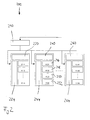
- Fig. 1 shows a system 100 comprising a first assistance system 120, a second assistance system 140, further assistance systems (in Fig. 1 indicated by four points) as well as an mth assistance system 160.
- Each of the assistance systems 120, 140, 160 is a device according to the invention for object and / or situation classification.
- the invention is explained in more detail below with reference to the second assistance system 140, wherein the second assistance system 140 is used for traffic sign recognition and is part of a motor vehicle (not shown).
- the second assistance system 140 has a data input for constraints 142, a Klassifikatoraus inchesappel 144 and a first classifier (K 21) 146, a second classifier (K 22) 148, a third classifier (K 23) 150 and a fourth classifier (K 24) 152 on.
- the first classifier 146 is a generalized classifier
- the second classifier 148 is a classifier specialized in daytime traffic in Germany
- the third classifier is a classifier specialized in night traffic in Germany
- the fourth classifier is a specialized classifier for the classifier Traffic outside Germany.
- the Klassifikatoraus inchesightappel 144 has an interrogation unit (not shown), via which the second assistance system 140 can permanently retrieve data of the existing GPS system in the vehicle as well as date and time information.
- the second assistance system 140 If the second assistance system 140 is activated, an interrogation of the GPS about the position of the vehicle and a query about the current date and the current time are carried out with the aid of the interrogation unit.
- the boundary conditions thus queried are transmitted via the data input 142 to the classifier selection unit 144, which compares the determined boundary conditions with a correlation table.
- the correlation table contains for each complete constellation of boundary conditions, i. for each combination of location of the vehicle, date and time an assignment of a particularly suitable for this combination classifier.
- the classifier selection unit 144 decides based on this correlation table which classifier is used for the classification of the traffic sign.
- the classifier selection unit 144 determines that the first generalized classifier 146 is used in a first step to provide a first coarse classification and using a neural network to determine which position of the vehicle is most likely. On the basis of this first classification, a second classification with the classifier is then made in a second step, wherein the classifier is selected, which is the most powerful due to the information available after the first classification.
- the remaining assistance systems 120, 160 are constructed analogously, with the number of classifiers integrated into the respective assistance systems being variable depending on the desired power, as indicated by the dotted lines between K 12 and K 1 n or K m1 and K mn , What is common to the assistance systems, however, is that the first and the m-th assistance systems 120, 160 also have a data input 122 or 162, the data transmission to all assistance systems 120, 140, 160, in particular if they are arranged in spatial proximity to one another a common data line 180, in particular a CAN bus can be made.
- FIG. 2 System 200 shown comprises a first assistance system 220, a second assistance system 240, further assistance systems (in Fig. 2 indicated by four points) as well as an m-th assistance system 260 and is analogous to that in Fig. 1 shown system 100 constructed. For the same elements are therefore in the in Fig. 2 shown second assistance system 200 by 100 increased reference numerals used.
- This in Fig. 2 System 200 shown differs from that in Fig. 1 shown system in that the system 200 additionally includes a control unit 290.
- assistance systems 220, 240, 260 are dispensed generalized classifiers, if for each constellation of boundary conditions specific classifiers are available and it is ensured that missing by the control unit missing boundary conditions with high probability properly.
Landscapes
- Physics & Mathematics (AREA)
- General Physics & Mathematics (AREA)
- Chemical & Material Sciences (AREA)
- Analytical Chemistry (AREA)
- Traffic Control Systems (AREA)
Applications Claiming Priority (1)
| Application Number | Priority Date | Filing Date | Title |
|---|---|---|---|
| DE200710002562 DE102007002562A1 (de) | 2007-01-17 | 2007-01-17 | Verfahren und Vorrichtung zur dynamischen Klassifikation von Objekten und/oder Verkehrssituationen |
Publications (2)
| Publication Number | Publication Date |
|---|---|
| EP1947623A1 true EP1947623A1 (fr) | 2008-07-23 |
| EP1947623B1 EP1947623B1 (fr) | 2009-11-11 |
Family
ID=39153646
Family Applications (1)
| Application Number | Title | Priority Date | Filing Date |
|---|---|---|---|
| EP20070024268 Ceased EP1947623B1 (fr) | 2007-01-17 | 2007-12-14 | Procédé et dispositif destinés à la classification dynamique d'objets et/ou de situations de trafic |
Country Status (2)
| Country | Link |
|---|---|
| EP (1) | EP1947623B1 (fr) |
| DE (2) | DE102007002562A1 (fr) |
Cited By (2)
| Publication number | Priority date | Publication date | Assignee | Title |
|---|---|---|---|---|
| EP2400473A1 (fr) * | 2010-06-28 | 2011-12-28 | Audi AG | Procédé et dispositif destinés à assister un conducteur de véhicule |
| US9950711B2 (en) | 2013-10-01 | 2018-04-24 | Volkswagen Ag | Device for a vehicle |
Families Citing this family (11)
| Publication number | Priority date | Publication date | Assignee | Title |
|---|---|---|---|---|
| US8653482B2 (en) | 2006-02-21 | 2014-02-18 | Goji Limited | RF controlled freezing |
| DE102007034505A1 (de) * | 2007-07-24 | 2009-01-29 | Hella Kgaa Hueck & Co. | Verfahren und Vorrichtung zur Verkehrszeichenerkennung |
| DE102008043761B4 (de) * | 2008-11-14 | 2017-04-27 | Robert Bosch Gmbh | Verfahren und Steuergerät zum Anpassen eines Fahrzeugassistenzsystems |
| DE102009057553A1 (de) | 2009-12-09 | 2011-06-16 | Conti Temic Microelectronic Gmbh | Verfahren zur Unterstützung des Fahrers eines straßengebundenen Fahrzeugs bei der Fahrzeugführung |
| JP5819420B2 (ja) | 2010-06-15 | 2015-11-24 | コンティ テミック マイクロエレクトロニック ゲゼルシャフト ミットベシュレンクテル ハフツングConti Temic microelectronic GmbH | 自動車の交通標識認識システムと車線認識システムとを融合する方法 |
| DE102012213485A1 (de) | 2012-07-31 | 2014-02-06 | Robert Bosch Gmbh | Verfahren und Vorrichtung zum Überprüfen einer in einem Fahrempfehlungsspeicher gespeicherten Fahrempfehlungsinformation für Fahrzeuge sowie Verfahren und Vorrichtung zum Bereitstellen einer Fahrempfehlungsnachricht |
| DE102013219909A1 (de) | 2013-10-01 | 2015-04-02 | Conti Temic Microelectronic Gmbh | Verfahren und Vorrichtung zur Erkennung von Verkehrszeichen |
| US9754049B2 (en) | 2014-09-30 | 2017-09-05 | International Business Machines Corporation | Characterizing success pathways in networked graphs |
| DE102017215868A1 (de) * | 2017-09-08 | 2019-03-14 | Robert Bosch Gmbh | Verfahren und Vorrichtung zum Erstellen einer Karte |
| DE102018205248B4 (de) * | 2018-04-09 | 2024-08-22 | Bayerische Motoren Werke Aktiengesellschaft | Fusionssystem zur Fusion von Umfeldinformation für ein Kraftfahrzeug |
| DE102019218590B4 (de) * | 2019-11-29 | 2025-02-13 | Volkswagen Aktiengesellschaft | Verfahren und Vorrichtung zur Objekterkennung |
Citations (4)
| Publication number | Priority date | Publication date | Assignee | Title |
|---|---|---|---|---|
| DE10336638A1 (de) * | 2003-07-25 | 2005-02-10 | Robert Bosch Gmbh | Vorrichtung zur Klassifizierung wengistens eines Objekts in einem Fahrzeugumfeld |
| WO2005052883A1 (fr) * | 2003-11-20 | 2005-06-09 | Bayerische Motoren Werke Aktiengesellschaft | Procede et systeme pour determiner une situation de conduite |
| WO2005064566A1 (fr) * | 2003-12-19 | 2005-07-14 | Bayerische Motoren Werke Aktiengesellschaft | Procede pour determiner un niveau de vitesse auquel s'attendre |
| DE102005043471A1 (de) * | 2005-09-13 | 2007-03-15 | Daimlerchrysler Ag | Verfahren zur Ansteuerung eines verkehrsadaptiven Assistenzsystems, Abstandsregeltempomat und Tempomat |
-
2007
- 2007-01-17 DE DE200710002562 patent/DE102007002562A1/de not_active Withdrawn
- 2007-12-14 EP EP20070024268 patent/EP1947623B1/fr not_active Ceased
- 2007-12-14 DE DE200750001957 patent/DE502007001957D1/de active Active
Patent Citations (4)
| Publication number | Priority date | Publication date | Assignee | Title |
|---|---|---|---|---|
| DE10336638A1 (de) * | 2003-07-25 | 2005-02-10 | Robert Bosch Gmbh | Vorrichtung zur Klassifizierung wengistens eines Objekts in einem Fahrzeugumfeld |
| WO2005052883A1 (fr) * | 2003-11-20 | 2005-06-09 | Bayerische Motoren Werke Aktiengesellschaft | Procede et systeme pour determiner une situation de conduite |
| WO2005064566A1 (fr) * | 2003-12-19 | 2005-07-14 | Bayerische Motoren Werke Aktiengesellschaft | Procede pour determiner un niveau de vitesse auquel s'attendre |
| DE102005043471A1 (de) * | 2005-09-13 | 2007-03-15 | Daimlerchrysler Ag | Verfahren zur Ansteuerung eines verkehrsadaptiven Assistenzsystems, Abstandsregeltempomat und Tempomat |
Cited By (2)
| Publication number | Priority date | Publication date | Assignee | Title |
|---|---|---|---|---|
| EP2400473A1 (fr) * | 2010-06-28 | 2011-12-28 | Audi AG | Procédé et dispositif destinés à assister un conducteur de véhicule |
| US9950711B2 (en) | 2013-10-01 | 2018-04-24 | Volkswagen Ag | Device for a vehicle |
Also Published As
| Publication number | Publication date |
|---|---|
| DE102007002562A1 (de) | 2008-07-24 |
| DE502007001957D1 (de) | 2009-12-24 |
| EP1947623B1 (fr) | 2009-11-11 |
Similar Documents
| Publication | Publication Date | Title |
|---|---|---|
| EP1947623B1 (fr) | Procédé et dispositif destinés à la classification dynamique d'objets et/ou de situations de trafic | |
| EP3688538B1 (fr) | Procédé et système de mise à jour d'un modèle de commande pour une commande automatique d'au moins une unité mobile | |
| DE102013214383A1 (de) | Verfahren und Vorrichtung zum Bereitstellen eines Kollisionsignals hinsichtlich einer Fahrzeugkollision, Verfahren und Vorrichtung zum Verwalten von Kollisionsdaten hinsichtlich Fahrzeugkollisionen sowie Verfahren und Vorrichtung zum Steuern zumindest einer Kollisionsschutzeinrichtung eines Fahrzeugs | |
| DE10354322A1 (de) | Verfahren und System zur Ermittlung der Fahrsituation | |
| WO2009013223A1 (fr) | Procédé et dispositif servant à la reconnaissance de panneaux de signalisation routière | |
| EP3663719A1 (fr) | Procédé de fourniture de données de carte dans un véhicule automobile, véhicule automobile et dispositif central de traitement des données | |
| DE102019207721A1 (de) | Lenkvorrichtung und zugehöriges Lenksteuerverfahren | |
| DE102021209315A1 (de) | Verfahren zum Betreiben eines Infrastruktursystems zur Fahrunterstützung von zumindest teilautomatisiert geführten Kraftfahrzeugen | |
| DE102015213526A1 (de) | Verfahren und System zum Warnen eines Fahrers eines Fahrzeugs | |
| DE102018219290B4 (de) | Verfahren zum Anlernen einer personalisierten Scheinwerfereinrichtung eines Kraftfahrzeugs | |
| DE102017204347A1 (de) | Verfahren und System zum Bestimmen einer kinematischen Eigenschaft eines Objekts, Verfahren zum Steuern eines Assistenzsystems eines Kraftfahrzeugs und Kraftfahrzeug | |
| WO2019223833A1 (fr) | Commande d'un véhicule à moteur | |
| DE102019000403A1 (de) | Verfahren zumindest zur Ausgabe einer Warnung vor einer Gefahrenstelle | |
| EP3128495B1 (fr) | Procede de reconnaissance de zones geographiques d'infrastructure de transport | |
| DE102015208208A1 (de) | Verfahren und Vorrichtung zum Erkennen einer Müdigkeit eines Fahrers eines Fahrzeugs | |
| DE102007059083A1 (de) | Vorrichtung zur reversiblen Einstellung von Kraftfahrzeugsteuersystemen | |
| DE102019201690A1 (de) | Verfahren und Assistenzsystem zur Umfeldüberwachung eines Ego-Fahrzeugs | |
| EP3985565A1 (fr) | Procédé et dispositif de vérification d'un système de traitement d'informations basé sur l'ia utilisé lors de la commande partiellement automatisée ou entièrement automatisée d'un véhicule | |
| DE102023211355B3 (de) | Verfahren zum Erzeugen eines Modells zum Unterstützen eines Querführungsassistenten, Verfahren zum Betreiben eines Querführungsassistenten in einem Fahrzeug und Querführungsassistent für ein Fahrzeug | |
| DE102008011165B4 (de) | Sensoranordnung für ein Insassenschutzsystem eines Kraftfahrzeugs | |
| DE102019218127B4 (de) | Verfahren und Vorrichtung zum optimalen Bereitstellen von KI-Systemen | |
| DE102023205046A1 (de) | Verfahren zum Betreiben zumindest einer Funktionseinheit eines Fahrzeugs auf Basis von Sensordaten anderer Fahrzeuge sowie Steuervorrichtung, Computerprogramm und Fahrzeug | |
| DE102018214674A1 (de) | Verfahren und Vorrichtung zur Unfallfrüherkennung | |
| DE102018129485A1 (de) | Verfahren sowie System zur Bestimmung eines Fahrkorridors | |
| DE102019218078B4 (de) | Bestimmung eines Sachverhalts im Umfeld eines Kraftfahrzeugs |
Legal Events
| Date | Code | Title | Description |
|---|---|---|---|
| PUAI | Public reference made under article 153(3) epc to a published international application that has entered the european phase |
Free format text: ORIGINAL CODE: 0009012 |
|
| AK | Designated contracting states |
Kind code of ref document: A1 Designated state(s): AT BE BG CH CY CZ DE DK EE ES FI FR GB GR HU IE IS IT LI LT LU LV MC MT NL PL PT RO SE SI SK TR |
|
| AX | Request for extension of the european patent |
Extension state: AL BA HR MK RS |
|
| 17P | Request for examination filed |
Effective date: 20080620 |
|
| 17Q | First examination report despatched |
Effective date: 20080728 |
|
| AKX | Designation fees paid |
Designated state(s): DE FR GB IT |
|
| GRAP | Despatch of communication of intention to grant a patent |
Free format text: ORIGINAL CODE: EPIDOSNIGR1 |
|
| GRAS | Grant fee paid |
Free format text: ORIGINAL CODE: EPIDOSNIGR3 |
|
| GRAA | (expected) grant |
Free format text: ORIGINAL CODE: 0009210 |
|
| AK | Designated contracting states |
Kind code of ref document: B1 Designated state(s): DE FR GB IT |
|
| REG | Reference to a national code |
Ref country code: GB Ref legal event code: FG4D Free format text: NOT ENGLISH |
|
| REF | Corresponds to: |
Ref document number: 502007001957 Country of ref document: DE Date of ref document: 20091224 Kind code of ref document: P |
|
| PLBE | No opposition filed within time limit |
Free format text: ORIGINAL CODE: 0009261 |
|
| STAA | Information on the status of an ep patent application or granted ep patent |
Free format text: STATUS: NO OPPOSITION FILED WITHIN TIME LIMIT |
|
| 26N | No opposition filed |
Effective date: 20100812 |
|
| PG25 | Lapsed in a contracting state [announced via postgrant information from national office to epo] |
Ref country code: IT Free format text: LAPSE BECAUSE OF NON-PAYMENT OF DUE FEES Effective date: 20101214 |
|
| REG | Reference to a national code |
Ref country code: FR Ref legal event code: PLFP Year of fee payment: 9 |
|
| REG | Reference to a national code |
Ref country code: FR Ref legal event code: PLFP Year of fee payment: 10 |
|
| REG | Reference to a national code |
Ref country code: FR Ref legal event code: PLFP Year of fee payment: 11 |
|
| PGFP | Annual fee paid to national office [announced via postgrant information from national office to epo] |
Ref country code: GB Payment date: 20201227 Year of fee payment: 14 Ref country code: FR Payment date: 20201228 Year of fee payment: 14 |
|
| PGFP | Annual fee paid to national office [announced via postgrant information from national office to epo] |
Ref country code: IT Payment date: 20201231 Year of fee payment: 14 |
|
| PGFP | Annual fee paid to national office [announced via postgrant information from national office to epo] |
Ref country code: DE Payment date: 20201231 Year of fee payment: 14 |
|
| REG | Reference to a national code |
Ref country code: DE Ref legal event code: R119 Ref document number: 502007001957 Country of ref document: DE |
|
| GBPC | Gb: european patent ceased through non-payment of renewal fee |
Effective date: 20211214 |
|
| PG25 | Lapsed in a contracting state [announced via postgrant information from national office to epo] |
Ref country code: GB Free format text: LAPSE BECAUSE OF NON-PAYMENT OF DUE FEES Effective date: 20211214 Ref country code: DE Free format text: LAPSE BECAUSE OF NON-PAYMENT OF DUE FEES Effective date: 20220701 |
|
| PG25 | Lapsed in a contracting state [announced via postgrant information from national office to epo] |
Ref country code: FR Free format text: LAPSE BECAUSE OF NON-PAYMENT OF DUE FEES Effective date: 20211231 |
|
| PG25 | Lapsed in a contracting state [announced via postgrant information from national office to epo] |
Ref country code: IT Free format text: LAPSE BECAUSE OF NON-PAYMENT OF DUE FEES Effective date: 20211214 |