EP1950908B1 - Procédé et système permettant la commande de bande passante - Google Patents
Procédé et système permettant la commande de bande passante Download PDFInfo
- Publication number
- EP1950908B1 EP1950908B1 EP06817851A EP06817851A EP1950908B1 EP 1950908 B1 EP1950908 B1 EP 1950908B1 EP 06817851 A EP06817851 A EP 06817851A EP 06817851 A EP06817851 A EP 06817851A EP 1950908 B1 EP1950908 B1 EP 1950908B1
- Authority
- EP
- European Patent Office
- Prior art keywords
- service
- bandwidth
- service type
- user
- occupied
- Prior art date
- Legal status (The legal status is an assumption and is not a legal conclusion. Google has not performed a legal analysis and makes no representation as to the accuracy of the status listed.)
- Active
Links
Images



Classifications
-
- H—ELECTRICITY
- H04—ELECTRIC COMMUNICATION TECHNIQUE
- H04L—TRANSMISSION OF DIGITAL INFORMATION, e.g. TELEGRAPHIC COMMUNICATION
- H04L41/00—Arrangements for maintenance, administration or management of data switching networks, e.g. of packet switching networks
- H04L41/08—Configuration management of networks or network elements
- H04L41/0896—Bandwidth or capacity management, i.e. automatically increasing or decreasing capacities
-
- H—ELECTRICITY
- H04—ELECTRIC COMMUNICATION TECHNIQUE
- H04L—TRANSMISSION OF DIGITAL INFORMATION, e.g. TELEGRAPHIC COMMUNICATION
- H04L47/00—Traffic control in data switching networks
- H04L47/10—Flow control; Congestion control
-
- H—ELECTRICITY
- H04—ELECTRIC COMMUNICATION TECHNIQUE
- H04L—TRANSMISSION OF DIGITAL INFORMATION, e.g. TELEGRAPHIC COMMUNICATION
- H04L47/00—Traffic control in data switching networks
- H04L47/10—Flow control; Congestion control
- H04L47/20—Traffic policing
-
- H—ELECTRICITY
- H04—ELECTRIC COMMUNICATION TECHNIQUE
- H04L—TRANSMISSION OF DIGITAL INFORMATION, e.g. TELEGRAPHIC COMMUNICATION
- H04L47/00—Traffic control in data switching networks
- H04L47/10—Flow control; Congestion control
- H04L47/22—Traffic shaping
-
- H—ELECTRICITY
- H04—ELECTRIC COMMUNICATION TECHNIQUE
- H04L—TRANSMISSION OF DIGITAL INFORMATION, e.g. TELEGRAPHIC COMMUNICATION
- H04L47/00—Traffic control in data switching networks
- H04L47/10—Flow control; Congestion control
- H04L47/24—Traffic characterised by specific attributes, e.g. priority or QoS
- H04L47/2408—Traffic characterised by specific attributes, e.g. priority or QoS for supporting different services, e.g. a differentiated services [DiffServ] type of service
-
- H—ELECTRICITY
- H04—ELECTRIC COMMUNICATION TECHNIQUE
- H04L—TRANSMISSION OF DIGITAL INFORMATION, e.g. TELEGRAPHIC COMMUNICATION
- H04L47/00—Traffic control in data switching networks
- H04L47/10—Flow control; Congestion control
- H04L47/24—Traffic characterised by specific attributes, e.g. priority or QoS
- H04L47/2425—Traffic characterised by specific attributes, e.g. priority or QoS for supporting services specification, e.g. SLA
- H04L47/2433—Allocation of priorities to traffic types
-
- H—ELECTRICITY
- H04—ELECTRIC COMMUNICATION TECHNIQUE
- H04L—TRANSMISSION OF DIGITAL INFORMATION, e.g. TELEGRAPHIC COMMUNICATION
- H04L47/00—Traffic control in data switching networks
- H04L47/70—Admission control; Resource allocation
-
- H—ELECTRICITY
- H04—ELECTRIC COMMUNICATION TECHNIQUE
- H04L—TRANSMISSION OF DIGITAL INFORMATION, e.g. TELEGRAPHIC COMMUNICATION
- H04L47/00—Traffic control in data switching networks
- H04L47/70—Admission control; Resource allocation
- H04L47/80—Actions related to the user profile or the type of traffic
- H04L47/808—User-type aware
-
- H—ELECTRICITY
- H04—ELECTRIC COMMUNICATION TECHNIQUE
- H04L—TRANSMISSION OF DIGITAL INFORMATION, e.g. TELEGRAPHIC COMMUNICATION
- H04L47/00—Traffic control in data switching networks
- H04L47/70—Admission control; Resource allocation
- H04L47/82—Miscellaneous aspects
- H04L47/824—Applicable to portable or mobile terminals
-
- H—ELECTRICITY
- H04—ELECTRIC COMMUNICATION TECHNIQUE
- H04L—TRANSMISSION OF DIGITAL INFORMATION, e.g. TELEGRAPHIC COMMUNICATION
- H04L47/00—Traffic control in data switching networks
- H04L47/70—Admission control; Resource allocation
- H04L47/83—Admission control; Resource allocation based on usage prediction
-
- H—ELECTRICITY
- H04—ELECTRIC COMMUNICATION TECHNIQUE
- H04W—WIRELESS COMMUNICATION NETWORKS
- H04W28/00—Network traffic management; Network resource management
- H04W28/02—Traffic management, e.g. flow control or congestion control
- H04W28/0252—Traffic management, e.g. flow control or congestion control per individual bearer or channel
-
- H—ELECTRICITY
- H04—ELECTRIC COMMUNICATION TECHNIQUE
- H04W—WIRELESS COMMUNICATION NETWORKS
- H04W8/00—Network data management
- H04W8/02—Processing of mobility data, e.g. registration information at HLR [Home Location Register] or VLR [Visitor Location Register]; Transfer of mobility data, e.g. between HLR, VLR or external networks
- H04W8/04—Registration at HLR or HSS [Home Subscriber Server]
Definitions
- the present invention relates to broadband access technology, and particularly to a method and a system for bandwidth control, a communication system, an apparatus for service access control, an apparatus for terminal access control and an apparatus for user profile management.
- Broadband communication networks are provided by network operators for communications between user terminals or between a user terminal and a service provider.
- a user has to request and order bandwidth and an access method from a network operator in advance through a network administrator. While intending to access the network, the user needs to send a request for accessing the network in the access method ordered in advance.
- the access method includes Asymmetrical Digital Subscription Line (ADSL), optical fiber access, General Package Radio Service (GPRS), etc.
- ADSL Asymmetrical Digital Subscription Line
- GPRS General Package Radio Service
- the network operator configures the network to allocate the bandwidth ordered by the user to the user and the bandwidth is the maximum bandwidth which the user may occupy while accessing the network, i.e., the maximum usable bandwidth.
- the network usually no longer controls the bandwidth allocated to the user and the bandwidth always remains unchanged unless the user requests to access the network again or to change the access method.
- a network access device such as a multi-service bandwidth access server providing access, authentication and charging functions for users, usually controls the traffic entering the communication network. Therefore, in practical applications, the bandwidth allocated to a user usually changes with the network conditions and the distance from the user to the access server.
- the bandwidth of a local Metropolitan Area Network (MAN) is broad and able to support higher local access traffic while the bandwidth from the MAN to the interface of the Internet is usually narrower than the bandwidth of the local MAN.
- the traffic expresses the maximum traffic in unit time, i.e., bandwidth, therefore the traffic control in unit time means bandwidth control.
- the user needs different bandwidth for different services. For example, when the user enjoys an online streaming media service, the bandwidth needed will be broader than the bandwidth needed for browsing a normal web page.
- different services have different requirements in realtime performance, e.g., online streaming media requires a high realtime performance and is sensitive to a delay, while some services including a download service require a moderate realtime performance and broad bandwidth.
- the user wishes that different bandwidth may be allocated for different services with different bandwidth demands. If the network does not control the bandwidth occupied by different services, the quality of some services may drop sharply and a proper network resource utilization ratio will be hard to achieve.
- the existing network access devices usually control the bandwidth in two ways.
- the bandwidth is controlled based on users, i.e., different bandwidth limits are allocated to users having different bandwidth authorities; in the second way, the bandwidth is controlled based on the combination of a data origination address and a data destination address.
- Both the two ways control the overall bandwidth only based on users or based on an access method and/or an address instead of the bandwidth for different service types or different services of a user or an access method and/or an address. Therefore although the two ways for controlling bandwidth have satisfied the basic requirements of different services, they cannot achieve actual effective bandwidth control or effectively improve the network resource utilization ratio. For example, when a mobile terminal user accesses the network with a bandwidth of 24KB through the GPRS, the bandwidth of 24KB shall be shared by all services of the user over the GPRS, and there is no way to control the bandwidth allocated to a specified service.
- the bandwidth control mechanism in the conventional broadband communication network is still far from satisfactory and cannot control bandwidth in accordance with the features of different services over the communication network, therefore the Quality of Service may not be guaranteed and the network resource utilization ratio is kept low in the conventional broadband communication network.
- WO 02/052869 discloses that a traffic shaper decomposes the overall IP stream into services and applications, expresses them as flows, and shapes the traffic by allocating different bandwidth and delay to each flow; the traffic shaper is controlled by the policy manager, or policy processor, which ensures the proper dynamic allocation of the air interface resources to the different applications and users; a policy processor interfaces with the mobile system infrastructure and retrieves information regarding the mobile user profile and location, the ASP profile, the load on the air-interface, and other information.
- WO 2005048533 discloses that a method for managing QoS in a wireless local area network, wherein applications request specific resources such as bandwidth from an access point. Depending on the QoS requirements, network load, wireless medium conditions, and traffic flows, these requests can be accepted or rejected by admission control. Traffic shaping is used to control the traffic flow, so as to not overload the channel. During traffic shaping, the transmission of some data can be delayed and/or excess data can be dropped when a maximum data rate or amount is reached.
- the present invention provides a method and a system for bandwidth control, a communication system, an apparatus for service access control, an apparatus for terminal access control and an apparatus for user profile management, which are able to control bandwidth based on different service types so that the bandwidth resource utilization ratio and the quality of service over the network may be improved.
- the present invention discloses a method for bandwidth control, including:
- the calculating bandwidth occupied by the service type when the user uses the service includes:
- the calculating bandwidth occupied by the service type includes:
- the present invention discloses a system for bandwidth control, including:
- the calculation unit includes:
- the information unit includes:
- the information record module includes:
- the system includes at least one calculation units, and further includes:
- the method and the system for bandwidth control, the communication system, the apparatus for service access control, the apparatus for terminal access control and the apparatus for user profile management provided by the present invention are able to control the service bandwidth of a user according to service types, hence the service bandwidth of the user may be effectively utilized and the requirements of different service types may be satisfied.
- the present invention may properly control the bandwidth resources of the network and improves the overall Quality of Service, and provide a basis for the extension of various service applications. Hence the present invention is of considerable commercial value.
- the present invention provides a bandwidth control method, which includes: allocating a maximum usable bandwidth to the service type of a service ordered by a user and setting a bandwidth control policy for the service type, monitoring whether the bandwidth occupied by one of service types enjoyed by the user is more than the maximum usable bandwidth corresponding to the one of service types, and if one of the service types occupies excessive bandwidth, adjusting the bandwidth of the service type according to the bandwidth control policy set up for the service type.
- the excessive bandwidth indicates the occupied bandwidth by a service type is higher than the maximum usable bandwidth allocated to the service type.
- the maximum usable bandwidth herein indicates a usable bandwidth threshold assigned to a user, and the maximum usable bandwidth is usually the bandwidth ordered by the user, not the bandwidth actually used by the user. The bandwidth actually used by the user is usually lower than the maximum usable bandwidth of the user.
- the present invention also provides a bandwidth control system based on the basic theory of the bandwidth control method.
- the system is used for monitoring the bandwidth occupied by each service type enjoyed by the user, saving the bandwidth control policy and the maximum usable bandwidth of each service type, and adjusting, according to a corresponding bandwidth control policy, the bandwidth of a service which occupies excessive bandwidth.
- the bandwidth control system mainly includes a calculation unit, a control unit and an information unit.
- FIG. 1 is a schematic diagram illustrating a network for implementing bandwidth control in accordance with an embodiment of the present invention.
- the entities involved in the present invention include: user terminals, a terminal access control apparatus, a communication network for bearing application services, service access control apparatuses for providing the communication network with application services, Application Servers (ASs) and a bandwidth control system.
- the user terminals, the terminal access control apparatus, the communication network, the service access control apparatuses and the ASs are existing entities in a network of the prior art while the bandwidth control system is a new entity added into the network of the prior art according to the present invention.
- the bandwidth control system includes: a calculation unit, a control unit and an information unit, and the control unit is connected to the calculation unit and the information unit.
- Figure 1 is only an embodiment of the network for implementing bandwidth control and the embodiment includes only two user terminals, three ASs, two service access control apparatuses and one terminal access control apparatus.
- the network may include a considerable number of user terminals, ASs, service access control apparatuses and terminal access control apparatuses, which involve complicated connections among these entities.
- the connections between the bandwidth control system of the present invention and the entities in the network are described with reference to the network shown in Figure 1 , yet the description shall not be used in limiting the number or connection patterns of the entities in the network.
- the embodiment shown in Figure 1 includes two user terminals (Terminal 1 and Terminal 2), three ASs ( AS1, AS2 and AS3), two service access control apparatus (Service access control apparatus 1 and Service access control apparatus) and only one terminal access control apparatus.
- the communication network is connected to the terminal access control apparatus, the Service access control apparatus 1 and the Service access control apparatus 2.
- the Terminal 1 and the Terminal 2 are connected to the terminal access control apparatus in order to access the communication network.
- the ASs are connected to the Service access control apparatus in order to access the communication network; as shown in Figure 1 , the AS1 and the AS2 are connected to the Service access control apparatus 1 and the AS3 is connected to the Service access control apparatus 2.
- the present invention may be applied on the terminal access side or the service access side, i.e., the bandwidth control system in accordance with the present invention may be installed on the terminal access side or the service access side.
- the calculation unit in the bandwidth control system receives traffic from each of the service access control apparatuses in the network, e.g. the traffic from the Service access control apparatus 1 and the Service access control apparatus 2 in Figure 1 , and calculates the actual bandwidth occupied by each service according to the received traffic.
- the bandwidth control system is installed on the terminal access side, the calculation unit in the bandwidth control system receives traffic from the terminal access control apparatus in the network and accordingly calculates the actual bandwidth occupied by each service.
- the bandwidth control system installed on the terminal access side or on the service access side, has to set up maximum usable bandwidth and bandwidth control policies in a service order process shown in Figure 2 .
- FIG. 2 is a flow chart illustrating a service order process in accordance with an embodiment of the present invention.
- the present invention relates to the bandwidth control method, hence the service order process described hereafter includes only the processes related to bandwidth control, and the processes unrelated to the bandwidth control in the service order process are not involved in the present invention and will not be described herein.
- the service order process includes:
- each service ordered by the user has a unique service ID and belongs to a certain service type, and each service type also has a unique service type ID.
- the service order information may include: a user ID, a service ID, bandwidth requirements, and may further include a service type ID.
- the service ordered and the service type of the service ordered may be determined according to the service ID, or, the service type of the service ordered may be determined directly according to the service type ID.
- Block 202 The information unit determines whether the service type being ordered at present includes a service that has already been ordered by the user, i.e., whether the service type is a new service type ordered by the user. If the service type includes a service that has already been ordered by the user, the service type is not a new service type and Block 205 is performed; if the service type includes no service that has already been ordered by the user, the service type is a new service type and Block 203 is performed.
- the service type being ordered at present is the service type determined in Block 201.
- the information unit maintains in real time a relation table of corresponding relations between a user; services ordered by the user and the service types of the services, hence whether the user has ordered a service included in the service type may be determined by searching the relation table according to the user ID and the service type ID in the service order information.
- Block 203 The information unit allocates bandwidth to the new service type and allocates whole bandwidth of the new service type to the service in the new service type.
- the bandwidth allocated to the new service type may be regarded as the maximum usable bandwidth of the service.
- Block 204 The information unit configures the new service type and sets up a bandwidth control policy for the service, and the process terminates.
- Block 205 The information unit allocates a maximum usable bandwidth to the service and adjusts the maximum usable bandwidth of the service type that includes the service, or keeps the original maximum usable bandwidth of the service type unchangeable and adjusts the maximum usable bandwidth of each service ordered by the user and included in the service type. It should be noted that the maximum usable bandwidth is not the actual bandwidth occupied by the service, and usually the actual bandwidth occupied by the service is lower than the maximum usable bandwidth allocated to the service when the user uses the service.
- the allocation of the maximum usable bandwidth to the service or the service type may require interaction with the user terminal, i.e. the selection and confirmation made by the user. Obviously, if the service order information of the user carries the information on the allocation of the maximum usable bandwidth, the interaction with the user terminal is unnecessary and the maximum usable bandwidth of the service or the service type may be allocated directly according to the service order information and subscription information of the user.
- the maximum usable bandwidth of the service or the service type it needs to be determined first whether the maximum usable bandwidth ordered or selected by the user exceeds the bandwidth supported by the network capacity, and if the maximum usable bandwidth exceeds the bandwidth supported by the network capacity, the maximum usable bandwidth ordered or selected by the user should be refused and the user should be prompted to order or select again. For example, if the network type and terminal capacity of the user physically limit the maximum usable bandwidth of the user terminal to 2MB, the bandwidth higher than 2MB, which is selected by the user while ordering a service, will not be allowed and the user should be prompted to select a maximum usable bandwidth again.
- Block 206 The information unit sets up the bandwidth control policy for the service.
- At least a bandwidth control policy should be set up for a service type, and a bandwidth control policy may further be set up for each service included in the service type, and it should be ensured that the bandwidth control policy of each service is compatible with the bandwidth control policy of the service type.
- the bandwidth control policy of Service type A includes: ensuring the bandwidth of each service in Service type A according to the priority level of each service, hence the bandwidth control policy of Service A' in Service type A may include: increasing bandwidth until the requirement of Service A' is met.
- a bandwidth control policy is set up for each service type and bandwidth control policies are setup for services in each service type.
- the bandwidth control policy of the service may be configured to be a sub-policy under the bandwidth control policy of the service type, therefore the bandwidth control policy of the service can only be applied according to the bandwidth control policy of the service type after the application of the bandwidth control policy of the service type.
- the present invention does not limit the bandwidth control policy contents.
- the bandwidth control policy may be a group of functions or a combination of rules.
- the control unit adjusts bandwidth by controlling the traffic of each service according to bandwidth control policy.
- the following relations should be maintained in real time: the corresponding relations between a user and services ordered by the user, the corresponding relations between services and service types of the services, and the corresponding relation between the service types and the bandwidth control policies of the service types.
- the corresponding relations between the services in each service type and the bandwidth control policies of the services may also be maintained. Table 1 shows the relations between service types and bandwidth control policies.
- Policy 1 requires, when the bandwidth of a service type exceeds the maximum usable bandwidth allocated to the service type, the bandwidth of services with higher priority levels should be guaranteed and the bandwidth of services with lower priority levels should be limited.
- the bandwidth control policy of Service type A is Policy 1
- the total of the maximum usable bandwidth allocated to each service in Service type A is 1M
- Service type A includes Service 1, Service 2 and Service 3, the priority level of Service 1 is the highest and the priority level of Service 3 is the lowest; when the total bandwidth occupied by the three services exceeds 1 M, the bandwidth of Service 1 and Service 2 shall be guaranteed and the bandwidth of Service 3 shall be blocked.
- the bandwidth control policies may also be described with policy combinations and functions. The present invention does not limit the description method of bandwidth control policies and will not provide more bandwidth control policy descriptions herein.
- the bandwidth control policy described above is designed for service plane in a service type and the bandwidth control may be performed for the services in the service type according to the bandwidth control policy, so as to ensure that bandwidth occupied by each service type does not exceed the bandwidth ordered for the service type.
- the bandwidth control policies cannot adjust the bandwidth occupied by each service type. Therefore the present invention may further set up bandwidth control policies for the service type plane, e.g., a bandwidth control policy to guarantee the bandwidth of service types with higher priority levels and block the bandwidth of service types with lower priority levels.
- bandwidth control policies set for the service type plane should not conflict with the bandwidth control policies set for the service type plane, e.g., the bandwidth control policies set for the service plane may be configured to be sub-policies of the bandwidth control policies set for the service type plane.
- bandwidth control may be performed at different levels according to the division of service types and bandwidth control policies are set up for each level in order to implement massive services oriented bandwidth control based on the levels.
- the services ordered by the user may be divided into three levels: service types; sub-types and/or services in a service type; and services in a sub-type.
- bandwidth control policies may be set up for the three levels respectively, and the bandwidth of service types, sub-types and/or services in a service type, or services in a sub-type are controlled respectively according to corresponding bandwidth control policies.
- the bandwidth control policy set up for each of the three levels may include a bandwidth control policy or a set of bandwidth control policies.
- Two different bandwidth control policies may also be set up for a certain level, one of the bandwidth control policies is used for controlling the bandwidth of the service types in the first level, controlling the bandwidth of sub-types and/or services in a service type in the second level, and controlling the bandwidth of services in a sub-type in the third level, e.g. the above-mentioned bandwidth control policy based on priority level, the other of the bandwidth control policies is used for controlling the bandwidth of a service type or a service, e.g., a bandwidth control policy of expanding the bandwidth until the requirements of the service is met.
- a bandwidth control system of the present invention may effectively control the bandwidth of services ordered by a user according to the service order process and bandwidth control policies explained in the fore-going description.
- FIG. 3 is a flow chart illustrating a bandwidth control process on the terminal access side in accordance with an embodiment of the present invention.
- the bandwidth control process may be triggered regularly or by an event.
- the trigger mechanism may be determined according to practical demands and is not defined in the present invention.
- the service order process includes:
- the method of the invention may be applied to a terminal access control apparatus, and the terminal access control apparatus is able to count data packets of each user terminal easily, e.g., determine the user terminal to which each data packet belongs according to the address of the user terminal.
- the address of the user terminal includes information for identifying the terminal access, e.g., an IP address or a telephone number.
- the uplink data packets are sent from the user terminal to the network side and the downlink data packets are sent from the network side to the user terminal; the uplinks and downlinks of the network may function as symmetric transmission or asymmetric transmission, and the present invention may be applied to the uplinks and/or downlinks according to requirements for bandwidth control in practical applications.
- Block 302 A service and a service type of each data packet are determined.
- the service of each data packet may be determined with the service category information in the data packet header, e.g., a service identification code, and the service type of each data packet may be determined according to the service of the data packet; the service and service type of each data packet may also be determined by other methods, e.g., by checking the IP quintuple attributes of the data packet.
- the IP quintuple includes five IP attributes of a data packet: a source IP address, a destination IP address, a source port number, a destination port number and an IP layer protocol number.
- the bandwidth control system keeps the corresponding relations between different services and service types of the services, therefore the service types of the services may be determined once the services of the data packets are determined.
- Table 2 shows the corresponding relations between services, service types and service identification codes.
- Table 2 Service ID Service type ID Service ID code Service 1 Service type A 10111001 Service 2 Service type B 10110101 Service 3 Service type C 10111101 ?? .... .
- Block 303 The traffic of each service of the user terminal in unit time is counted; the traffic equals the actual bandwidth occupied by the each service of the user terminal, and the bandwidth occupied by each service type may further be calculated according to the bandwidth of each service, and then the maximum usable bandwidth allocated to each service type of the present user is queried.
- the bandwidth occupied by different services may be calculated first (as shown in Table 3 below) and the bandwidth of the service types are calculated accordingly.
- the bandwidth occupied by Service 1 is 450KB and the bandwidth occupied by Service 2 is 110KB, both Service 1 and Service 2 are included in Service type A, therefore the bandwidth occupied by Service type A is 560KB.
- Block 304 It is determined whether the actual bandwidth occupied by a service type is higher than the allocated maximum usable bandwidth, i.e., whether the bandwidth of a service type has exceeds the allocated maximum usable bandwidth, and Block 305 is performed with the service type that has occupied excessive bandwidth; and the process terminates when the service type does not occupy excessive bandwidth.
- Block 305 The bandwidth control policies corresponding to the service type are determined, an appropriate bandwidth control policy is selected, and the bandwidth occupied by the service type is controlled according to the selected bandwidth control policy.
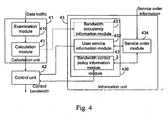
- Figure 4 is a schematic diagram illustrating a system structure on the terminal access side in accordance with an embodiment of the present invention.
- the embodiment includes a calculation unit 41, a control unit 42 and an information unit 43.
- the system in the embodiment may be a separate entity or be integrated into a terminal access control apparatus on the terminal access side.
- the terminal access control apparatus usually is an access gateway based on multiple access patterns, e.g., the terminal access control apparatus is a Network Access Server (NAS).
- NAS Network Access Server
- NASs include dial-up access servers for dial-up access, such as a Broadband Access Server (BAS) for Asymmetric Digital Subscriber Line (ADSL) access and Local Area Network (LAN) access, a Gateway GPRS Support Node (GGSN) and a Service GPRS Support Node (SGSN) for General Packet Radio Service (GPRS) access, etc.
- the information unit 43 may be a separate entity or be integrated into a user profile management apparatus.
- the user profile management apparatus may be a Home Location Register (HLR), a Home Subscriber Server (HSS), a Customer Relationship Management (CRM) server, or a Generic User Profile (GUP) server.
- HLR Home Location Register
- HSS Home Subscriber Server
- CRM Customer Relationship Management
- GUP Generic User Profile
- the calculation unit 41 is capable of receiving data traffic of a user terminal from the terminal access control apparatus, calculating the actual bandwidth occupied by each service and the service type of the service for the user terminal by parsing the received data traffic, and exporting a result of the calculation to the control unit 42.
- a service order module 434 is capable of receiving service order information of a user, determining the services and service types ordered by the user according to the service order information, determining bandwidth control policies corresponding to the services and the service types, allocating maximum usable bandwidth to the services ordered by the user, and exporting the services and the service types ordered by the user and the allocated maximum usable bandwidth to an information record module 430 as service information of the user as well as exporting the determined bandwidth control policies to the information record module 430.
- the control unit 42 is capable of receiving the bandwidth occupied at present by each services and the service types of the user from the calculation unit 41, receiving the service information of the user from the information record module 430, and if a service or a service type occupies excessive bandwidth at present, reading the bandwidth control policy corresponding to the service or the service type that occupies excessive bandwidth from the information record module 430, and adjusting the bandwidth of the service or the service type according to the bandwidth control policy. The bandwidth control is thus achieved.
- the calculation unit 41 may include an examination module 410 and a calculation module 411
- the information record module 430 may include a user service information module 432 and a bandwidth control policy information module 433.
- the examination module 410 is used for parsing the data traffic to the user terminals, determining the user terminal to which each data packet in the data traffic belongs, service and service type of each data packet and exporting the information on the user terminal, service and service type of each data packet to the calculation module 411 as the data packet information.
- the calculation module 411 is used for calculating the traffic of each service according to the data packet information from the examination module 410 and obtaining the traffic of each service in unit time, i.e., the actual bandwidth occupied by the service at present, and further obtaining the actual bandwidth occupied by each service type at present, and exporting the actual bandwidth occupied by each service and each service type respectively at present and calculated by the calculation module 411 to the control unit 42.
- the user service information module 432 is used for receiving user service information from the service order module 434 and exporting the user service information to the control unit 42.
- the bandwidth control policy information module 433 is used for storing the bandwidth control policies corresponding to services ordered by a user and the service types of the services and exporting the bandwidth control policies to the control unit 42.
- the network may charge a user terminal according to the actual bandwidth occupied by the services which are enjoyed by user terminal, therefore an entity for charging in the network usually needs to query the bandwidth occupancy information of the information unit 43.
- the information record module 430 may further include a bandwidth occupancy information module 431 for recording the bandwidth occupied by each service and each service type for a user terminal, and the calculation module 411 may further export the bandwidth occupied by each service and each service type for the user terminal to the bandwidth occupancy information module 431.
- Figure 4 shows a bandwidth control system for only one user terminal, and the bandwidth control system includes a calculation unit 41, a control unit 42 and an information unit 43.
- the calculation unit 41 may be used for calculating the data traffic of one or multiple user terminals
- the control unit 42 may be used for controlling the bandwidth of one or multiple user terminals
- the information unit 43 may be connected to one or multiple control units or calculation units.
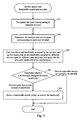
- FIG. 5 is a flow chart illustrating a bandwidth control process on the service access side in accordance with an embodiment of the present invention. As shown in Figure 5 , the service order process includes:
- the bandwidth control system has to parse data packets from all ASs, each of the ASs may provide one or multiple services, the bandwidth control system determines the user terminals and services corresponding to the data packets according to routing information and address information in the data packets.
- Block 502 The services and the service types enjoyed by the user terminals determined in Block 501 are determined, and Blocks 503 to 505 may be performed with each of the user terminals.
- the services enjoyed by each user terminal may be learnt from the process in Block 501, and the service types of the services enjoyed by the user terminal may further be determined according to the corresponding relations between services and service types.
- the corresponding relations are obtained in the service order process.
- Block 503 The actual bandwidth occupied by each service at present is calculated, and the bandwidth occupied by each service type at present is further calculated; and the maximum usable bandwidth allocated to each service type in the service order process is queried.
- Multiple calculation units may be installed on the service access side in multiple service access control apparatuses, each of the service access control apparatuses is connected to one or multiple ASs, hence a calculation unit makes the calculation according to the data packets on the AS connected to the service access control apparatus which includes the calculation unit.
- a service terminal may use services provided by multiple ASs which may connect with multiple calculation units, therefore the bandwidth obtained by one calculation unit for service types enjoyed by the user terminal does not equal the actual overall bandwidth occupied by all service types at present for the user terminal, the bandwidth of the user terminal calculated by all calculation units should be summed up to obtain the actual overall bandwidth occupied by all service types at present for the user terminal.
- the information unit is used for recording the user service information and bandwidth control policy information in a centralized manner, one information unit may be connected to multiple calculation units, therefore all the bandwidth occupied by service types for the user terminal, which are calculated by different calculation units, may be reported to the information unit which sums up the bandwidth.
- Block 504 It is determined whether the actual bandwidth occupied by a service type is higher than the allocated maximum usable bandwidth, i.e., whether the bandwidth of a service type has exceed the allocated maximum usable bandwidth, and Block 505 is performed with the service type that has occupied excessive bandwidth; and the process terminates when the service type does not occupy excessive bandwidth.
- Block 505 The bandwidth control policies corresponding to the service type are determined, an appropriate bandwidth control policy is selected and the bandwidth occupied by the service type is controlled according to the selected bandwidth control policy.
- the system shown in Figure 4 may be applied when the system of the present invention is applied on the service access side.
- the calculation unit 41 is used for receiving data traffic of the ASs from the service access control apparatus, parsing the data traffic to determine user terminals, services and service types corresponding to different data packets, calculating the actual bandwidth occupied by different services and service types for a user terminal, and exporting the actual occupied bandwidth to the control unit 42.
- the service order module 434 is used for receiving service order information of a user, determining the services and service types ordered by the user according to the service order information, determining the bandwidth control policies corresponding to the services and the service types, allocating maximum usable bandwidth to the services ordered by the user, and exporting the services and the service types ordered by the user and the allocated maximum usable bandwidth as the service information of the user to the information record module 430 as well as exporting the determined bandwidth control policies to the information record module 430.
- the control unit 42 is used for receiving from the calculation unit 41 the actual bandwidth occupied by the services and service types for the user terminal, receiving from the information record module 430 the user service information corresponding to the services and service types enjoyed by the user terminal at present, and reading, if a service or a service type is determined to have occupied excessive bandwidth, the bandwidth control policy corresponding to the service or the service type from the information record module 430, and adjusting the excessive bandwidth occupied by the service or the service type according to the bandwidth control policy. Therefore the bandwidth control is achieved.
- a condition for the normal operation of a system in such structure is that the ASs which provide services for one user terminal have to be connected to one calculation unit 41.
- Figure 6 is a schematic diagram illustrating a system structure on the service access side in accordance with an embodiment of the present invention.
- the embodiment includes a calculation unit 61, a control unit 62, an information unit 63 and a sum calculation unit 64.
- the calculation unit 61 includes an examination module 610 and a calculation module 611; the information unit 63 includes an information record module 630 and a service order module 634.
- the information record module 630 includes a user service information module 632 and a bandwidth control policy module 633.
- the system includes multiple calculation units which are all connected to the sum calculation unit 64. Because the functions and structures of the calculation units are all identical, Figure 6 shows only one calculation unit 61.
- the system may be a separate entity or be integrated into a service access control apparatus on the service access side.
- the service access control apparatus usually is a Data Service Management Platform (DSMP) in a mobile network.
- the information unit 63 may be a separate entity or be integrated into a user profile management apparatus.
- the user profile management apparatus may be an HLR, or an HSS, or a CRM server, or a GUP server, etc.
- the examination module 610 is used for receiving data traffic of the ASs from the service access control apparatus, parsing the data traffic to determine user terminals, services and service types corresponding to different data packets, and exporting the user terminals, services and service types corresponding to different data packets as the data packet information to the calculation module 611.
- the calculation module 611 is used for calculating the actual bandwidth occupied by different services and service types for the user terminal according to the received data packet information, and exporting the actual occupied bandwidth to the sum calculation unit 64.
- the service order module 634 is used for receiving service order information of the user, determining the services and service types ordered by the user according to the service order information, determining the bandwidth control policies corresponding to the services and the service types, allocating maximum usable bandwidth to the services ordered by the user, and exporting the services and the service types ordered by the user and the allocated maximum usable bandwidth as the service information of the user to the user service information module 632 as well as exporting the determined bandwidth control policies to the bandwidth control policy information module 633.
- the user service information module 632 is used for receiving the user service information from the service order module 634, and exporting the user service information to the control unit 62.
- the bandwidth control policy information module 633 is used for recording the bandwidth control policies corresponding to different services and service types for the user and exporting the bandwidth control policies to the control unit 62.
- the sum calculation unit 64 is used for receiving from all calculation units the actual bandwidth calculated by the calculation units for the service types enjoyed by the user at present, summing up the total of the actual bandwidth occupied by the service types enjoyed by the user at present, and exporting the total bandwidth to the control unit 62.
- the control unit 62 is used for receiving from the sum calculation unit 64 the actual bandwidth occupied by the services and service types of the user terminal, receiving from the user service information module 632 the user service information of the user terminal at present, and reading, if a service or a service type is determined to have occupied excessive bandwidth, the bandwidth control policy corresponding to the service or the service type from the bandwidth control policy information module 633, and adjusting the bandwidth occupied by the service or the service type according to the bandwidth control policy. Therefore the bandwidth control is achieved.
- the sum calculation unit 64 may be separated from other units in the system of the present invention, yet the sum calculation unit 64 may also be integrated into the information unit 63 if such case that the information unit 63 records the user service information and bandwidth control policies of user terminals in a centralized manner is considered.
- the network may charge a user terminal according to the actual bandwidth occupied by the services which are enjoyed by the user terminal, therefore an entity for charging in the network usually needs to query the bandwidth occupancy information of the information unit 63.
- the information record module 630 may further include a bandwidth occupancy information module 631 for recording the bandwidth occupied by the services and service types for different user terminals, and the sum calculation unit 64 may further export the bandwidth occupied by the services and service types for different user terminals to the bandwidth occupancy information module 631.
- Figure 6 shows a bandwidth control system for only one user terminal, and the bandwidth control system includes: one or multiple calculation units connected to the user terminal, a sum calculation unit 64 connected to the one or multiple calculation units, a control unit 62 and an information unit 63.
- the calculation unit 61 may be used for calculating the data traffic of one or multiple ASs
- the control unit 62 may be used for controlling the service bandwidth of one or multiple ASs
- the sum calculation unit 64 may be connected to one or multiple control units
- the information unit 63 may be connected to one or multiple control units or sum calculation units.
- the system for one user terminal may be extended directly to serve as a bandwidth control system for multiple user terminals.
- the multiple bandwidth control systems, each of which serves one user terminal have identical functions and are separated from each other logically, yet the bandwidth control systems of multiple user terminals may be physically integrated into one entity, and the calculation units, and/or control units and/or information units of different user terminals may also be integrated into one entity.
- the deployment of and the connections among bandwidth control systems in accordance with the present invention for multiple user terminals are influenced by multiple factors including the number of user terminals and the demands of the applications, therefore the combinations and connections of the system deployments will be unexhausted in practical applications. So the bandwidth control system for multiple user terminals will not be described herein, but is still covered by the protection scope of the present invention.
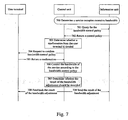
- FIG. 7 is a flowchart illustrating a signaling interaction process in accordance with an embodiment of the present invention.
- the entities involved in the embodiment include a user terminal, a control unit and an information unit. As shown in Figure 7 , the process includes the following.
- Block 700 The control unit determines whether a service or a service type has occupied excessive bandwidth according to the user service information from the information unit and the actual bandwidth occupied by the services and service types for the present user from the calculation unit or the sum calculation unit.
- Block 701-702 The control unit queries the information unit of the bandwidth control policy corresponding to the service or service type which is determined to have occupied excessive bandwidth in 700, and the information unit returns the bandwidth control policy to the control unit.
- Block 703 The control unit determine whether interaction with the user terminal is needed for confirming the bandwidth control policy, and if the interaction is needed, 704 is performed; otherwise, 706 is performed.
- Block 704-705 The control unit sends a message to the user terminal, requesting the user terminal to confirm the bandwidth control policy, the message may indicate the service or the service type whose bandwidth will be adjusted, the bandwidth control policies that may be used in the adjustment, the possible result of the adjustment, and the charging information that may be involved; the user terminal returns a confirm message to the control unit to inform the control unit of the bandwidth control policy that shall be used for controlling the bandwidth.
- Block 706 The control unit adjusts the bandwidth of the service or the service type that has occupied excessive bandwidth for the present user terminal according to the bandwidth control policy.
- Block 707 The control unit determines whether the result of the bandwidth adjustment needs to be recorded; if the result needs to be recorded, 708 is performed; otherwise, the process is terminated.
- the result of the bandwidth adjustment should be recorded by sending the result of the adjustment to the information unit by the control unit, or by caching the result of the adjustment in the local machine of the control unit and sending the result of the adjustment to the information unit.
- the result of the bandwidth adjustment may also be fed back to the user terminal while being sending to the information unit.
- Block 708 The control unit sends the result information of the present bandwidth adjustment to the user terminal and the information unit.
- the result information may include a user ID, the ID of the service and/or service type whose bandwidth has been adjusted, the applied bandwidth control policy and the bandwidth after the adjustment.
- the method, system and apparatuses provided by the present invention control the service bandwidth of a user terminals according to service types, therefore the service bandwidth ordered by the users may be utilized effectively according to the features of different service types and the quality of services is ensured; the basic theory of the present invention further level-based enables bandwidth control on large number of services enjoyed by users.
- the present invention properly controls the bandwidth resources of service networks of different sizes and improves the resource utilization ratio of the whole service networks while satisfying the service demands of users, hence the present invention is of high commercial value to operators and service providers.
Landscapes
- Engineering & Computer Science (AREA)
- Computer Networks & Wireless Communication (AREA)
- Signal Processing (AREA)
- Databases & Information Systems (AREA)
- Data Exchanges In Wide-Area Networks (AREA)
- Hardware Redundancy (AREA)
Claims (15)
- Procédé de commande de largeur de bande, comprenant :la détermination (201) (302) (502) d'un type de service d'un service actuel demandé par un utilisateur ;caractérisé en ce que le procédé comprend en outre :si l'utilisateur a demandé le type de service (202) auparavant, le réglage (205) de la largeur de bande utilisable maximum allouée au type de service, ou le réglage de la largeur de bande maximum utilisable allouée à chaque service dans le type de service tout en maintenant inchangée (205) la largeur de bande utilisable maximum allouée au type de service ;si l'utilisateur n'a pas demandé le type de service (202) auparavant, l'allocation (203) d'une largeur de bande utilisable maximum au type de service ;l'établissement (204, 206) d'une règle de commande de largeur de bande pour le type de service ;le calcul (303) (503) de la largeur de bande occupée par le type de service quand l'utilisateur utilise le service ; etle réglage (304, 305) (504, 505) (706), en fonction de la règle de commande de largeur de bande, de la largeur de bande occupée par le type de service si la largeur de bande occupée par le type de service est supérieure à la largeur de bande utilisable maximum allouée au type de service.
- Procédé selon la revendication 1, comprenant en outre :la détermination de la règle de commande de largeur de bande par interaction avec l'utilisateur avant de régler la largeur de bande occupée par le type de service.
- Procédé selon l'une quelconque des revendications 1 et 2, dans lequel le calcul de la largeur de bande occupée par le type de service quand l'utilisateur utilise le service comprend :la réception du trafic de données de terminaux utilisateurs sur un côté d'accès aux terminaux, l'analyse syntaxique des paquets de données dans le trafic de données, la détermination des utilisateurs et types de services des paquets de données ; le calcul de la largeur de bande occupée par le type de service en calculant des paquets de données correspondant au type de service.
- Procédé selon l'une quelconque des revendications 1 et 2, dans lequel le calcul de la largeur de bande occupée par le type de service comprend :la réception du trafic de données de Serveurs d'Application, AS, sur un côté d'accès aux services, l'analyse syntaxique des paquets de données dans le trafic de données,la détermination des utilisateurs et types de services des paquets de données, et le comptage des paquets de données qui correspondent au type de service dans le trafic de données de chacun des AS ; le calcul du nombre de paquets de données correspondant au type de service dans le trafic de données des AS en ajoutant les paquets de données correspondants au type de service dans le trafic de données de chacun des AS, et le calcul de la largeur de bande occupée par le type de service en fonction du nombre de paquets de données correspondant au type de service.
- Procédé selon la revendication 1, dans lequel le réglage de la largeur de bande occupée par le type de service comprend :la réduction de la largeur de bande occupée par le type de service.
- Procédé selon la revendication 1, comprenant en outre :l'allocation d'une largeur de bande utilisable maximum à chaque service dans le type de service et l'établissement d'une règle de commande de largeur de bande pour le service, la règle de commande de largeur de bande du service étant compatible avec la règle de commande de largeur de bande du type de service.
- Système de commande de largeur de bande, caractérisé en ce que le système comprend :une unité d'information, capable de déterminer un type de service d'un service actuel demandé par un utilisateur ; si l'utilisateur a demandé le type de service auparavant, régler la largeur de bande utilisable maximum allouée au type de service, ou régler la largeur de bande maximum utilisable allouée à chaque service dans le type de service tout en maintenant inchangée la largeur de bande utilisable maximum allouée au type de service ; si l'utilisateur n'a pas demandé le type de service auparavant, allouer la largeur de bande utilisable maximum au type de service ; établir une règle de commande de largeur de bande pour le type de service ; enregistrer le service demandé par l'utilisateur, le type de service du service, la règle de commande de largeur de bande et la largeur de bande utilisable maximum ; etune unité de calcul, capable de calculer la largeur de bande occupée par le type de service quand l'utilisateur utilise le service ; etune unité de commande, capable de déterminer si la largeur de bande occupée par le type de service est supérieure ou non à la largeur de bande utilisable maximum du type de service en fonction de la largeur de bande occupée par le type de service provenant de l'unité de calcul et de la largeur de bande utilisable maximum du type de service provenant de l'unité d'information, et régler la largeur de bande occupée par le type de service en fonction de la règle de commande de largeur de bande provenant de l'unité d'information si la largeur de bande occupée par le type de service est supérieure à la largeur de bande utilisable maximum allouée au type de service.
- Système selon la revendication 7, dans lequel l'unité de calcul comprend :un module d'examen, capable d'analyser syntaxiquement les paquets de données du trafic de données, déterminer un utilisateur, un service et un type de service de chaque paquet de données et obtenir des informations de paquet de données indiquant l'utilisateur, le service et le type de service de chaque paquet de données, etun module de calcul, capable de calculer la largeur de bande occupée par chaque type de service en fonction des informations de paquet de données provenant du module d'examen.
- Système selon la revendication 7, dans lequel l'unité d'information comprend :un module de demande de service, capable de recevoir des informations de demande de service en provenance des utilisateurs, déterminer les services demandés par les utilisateurs et le type de service de chaque service, déterminer la largeur de bande utilisable maximum et la règle de commande de largeur de bande pour chaque type de service ; etun module d'enregistrement d'informations, capable d'enregistrer la largeur de bande utilisable maximum et la règle de commande de largeur de bande déterminées par le module de demande de service pour chaque type de service.
- Système selon la revendication 9, dans lequel le module d'enregistrement d'informations comprend :un module d'informations de service utilisateur, capable d'enregistrer la largeur de bande utilisable maximum déterminée déterminée par le module de demande de service pour chaque type de service ; etun module d'informations de règle de commande de largeur de bande, capable d'enregistrer la règle de commande de largeur de bande déterminée par le module de demande de service pour chaque type de service.
- Système selon la revendication 10, dans lequel le module d'enregistrement d'informations comprend en outre :un module d'informations d'occupation de largeur de bande, capable d'enregistrer la largeur de bande occupée par chaque type de service et obtenue de l'unité de calcul.
- Système selon l'une quelconque des revendications 7 à 11, comprenant en outre :au moins une unité de calcul ;une unité de calcul de somme, capable de calculer une somme de largeur de bande occupée par le type de service pour différents utilisateurs en fonction de la largeur de bande occupée par les types de services pour différents utilisateurs provenant de chaque unité de calcul, et d'exporter la somme vers l'unité de commande.
- Système selon la revendication 7, dans lequel l'unité de calcul est capable de calculer la largeur de bande occupée par le type de service en analysant syntaxiquement le trafic de données provenant d'un appareil de commande d'accès au service ou d'un appareil de commande d'accès au terminal.
- Système selon la revendication 8, dans lequel le trafic de données provient au moins d'un terminal utilisateur ou au moins d'un Serveur d'Application, AS.
- Système selon la revendication 8, dans lequel l'unité de calcul est capable d'analyser syntaxiquement le trafic de données envoyé à différents terminaux utilisateurs et de calculer la largeur de bande occupée par chaque type de service pour différents terminaux utilisateurs ; et est capable d'analyser syntaxiquement les paquets de données du trafic de données de différents AS, déterminer un terminal utilisateur et un type de service de chaque paquet de données, compter des paquets de données dans chaque type de service pour différents terminaux utilisateurs depuis chaque AS, additionner les paquets de données dans chaque type de service pour différents terminaux utilisateurs depuis les AS pour obtenir le nombre de paquets de données dans chaque type de service pour différents terminaux utilisateurs, et calculer la largeur de bande occupée par chaque type de service pour différents terminaux utilisateurs.
Applications Claiming Priority (2)
| Application Number | Priority Date | Filing Date | Title |
|---|---|---|---|
| CNB200610008043XA CN100396009C (zh) | 2006-02-23 | 2006-02-23 | 带宽控制方法、系统、接入控制设备、用户档案管理设备 |
| PCT/CN2006/003113 WO2007095804A1 (fr) | 2006-02-23 | 2006-11-20 | Procédé, système, appareil de contrôle d'accès, et appareil de gestion d'archives d'utilisateur permettant la commande de bande passante |
Publications (3)
| Publication Number | Publication Date |
|---|---|
| EP1950908A1 EP1950908A1 (fr) | 2008-07-30 |
| EP1950908A4 EP1950908A4 (fr) | 2008-12-17 |
| EP1950908B1 true EP1950908B1 (fr) | 2010-10-06 |
Family
ID=37298061
Family Applications (1)
| Application Number | Title | Priority Date | Filing Date |
|---|---|---|---|
| EP06817851A Active EP1950908B1 (fr) | 2006-02-23 | 2006-11-20 | Procédé et système permettant la commande de bande passante |
Country Status (9)
| Country | Link |
|---|---|
| US (1) | US7860124B2 (fr) |
| EP (1) | EP1950908B1 (fr) |
| CN (2) | CN100396009C (fr) |
| AT (1) | ATE484122T1 (fr) |
| DE (1) | DE602006017426D1 (fr) |
| ES (1) | ES2352972T3 (fr) |
| PT (1) | PT1950908E (fr) |
| RU (1) | RU2394381C9 (fr) |
| WO (1) | WO2007095804A1 (fr) |
Families Citing this family (48)
| Publication number | Priority date | Publication date | Assignee | Title |
|---|---|---|---|---|
| US20090031394A1 (en) * | 2007-07-24 | 2009-01-29 | Telefonaktiebolaget Lm Ericsson (Publ) | Methods and systems for inter-resource management service type descriptions |
| JP5118202B2 (ja) * | 2007-10-19 | 2013-01-16 | テレフオンアクチーボラゲット エル エム エリクソン(パブル) | 通信セッションに関するリソース制限をアプリケーション機能に通知するための方法および装置 |
| US20090147779A1 (en) * | 2007-12-07 | 2009-06-11 | Telefonaktiebolaget Lm Ericsson (Publ) | Methods, iptv (internet protocol television) terminal, and iptv control server for iptv bandwidth management |
| CN101471858B (zh) * | 2007-12-24 | 2012-06-13 | 中兴通讯股份有限公司 | 一种业务识别与控制系统中内部协作的方法 |
| US9712331B1 (en) | 2008-08-20 | 2017-07-18 | At&T Mobility Ii Llc | Systems and methods for performing conflict resolution and rule determination in a policy realization framework |
| JP5281162B2 (ja) * | 2008-09-03 | 2013-09-04 | テレフオンアクチーボラゲット エル エム エリクソン(パブル) | 通信帯域を割当てるための方法及び関連する装置 |
| US8346923B2 (en) * | 2008-11-12 | 2013-01-01 | Sophos Plc | Methods for identifying an application and controlling its network utilization |
| US8732787B2 (en) | 2008-11-26 | 2014-05-20 | Telefonatiebolaget L M Ericsscon (publ) | Method and system for establishing digital media streams |
| US20100172367A1 (en) * | 2009-01-08 | 2010-07-08 | Telefonaktiebolaget Lm Ericsson (Publ) | Network based bandwidth control in ims systems |
| US8243628B2 (en) | 2009-01-30 | 2012-08-14 | Embarq Holdings Company, Llc | Free market based pricing for bandwidth and network usage |
| US9104986B2 (en) | 2009-03-09 | 2015-08-11 | Centurylink Intellectual Property Llc | Customer premise equipment with access to free market based pricing for bandwidth on a communications network |
| JP5443026B2 (ja) * | 2009-03-13 | 2014-03-19 | 日本通信株式会社 | ネットワーク接続通信システム |
| CN101646207B (zh) * | 2009-08-31 | 2012-08-08 | 华为技术有限公司 | 带宽信息通知方法、业务处理方法、网络节点及通信系统 |
| CN101741734B (zh) * | 2009-12-08 | 2012-02-22 | 南京联创科技集团股份有限公司 | 基于海量数据的动态策略模型实现方法 |
| US8972541B2 (en) * | 2010-02-12 | 2015-03-03 | Alcatel Lucent | Method and apparatus providing access network aware presence to applications |
| JP5375665B2 (ja) * | 2010-02-26 | 2013-12-25 | ブラザー工業株式会社 | 通信装置、通信方法、通信システム、及び通信プログラム |
| US8873401B2 (en) * | 2010-03-16 | 2014-10-28 | Futurewei Technologies, Inc. | Service prioritization in link state controlled layer two networks |
| CN102201968A (zh) * | 2010-03-25 | 2011-09-28 | 华为技术有限公司 | 一种网络电视中分配用户带宽的方法、装置及系统 |
| CN102263686B (zh) * | 2010-05-25 | 2016-06-15 | 中兴通讯股份有限公司 | 一种多边缘架构下的多业务控制方法及系统 |
| US7899019B1 (en) | 2010-06-17 | 2011-03-01 | Oto Technologies, Llc | Method and system for bandwidth management |
| CN102469020B (zh) | 2010-11-19 | 2017-10-17 | 华为技术有限公司 | 一种业务控制方法及系统、演进基站、分组数据网网关 |
| EP2503773A1 (fr) * | 2011-03-23 | 2012-09-26 | Alcatel Lucent | Procédé pour le partage configurable de ressources serveur pour des applications multimédia demandées par l'utilisateur |
| CN102665187B (zh) * | 2012-02-29 | 2014-11-12 | 华中科技大学 | 基于智能终端的智能管道控制方法 |
| CN102932273B (zh) * | 2012-10-17 | 2015-07-01 | 北京奇虎科技有限公司 | 一种用于调节进程带宽占用的方法及装置 |
| CN102946322B (zh) * | 2012-10-17 | 2016-03-30 | 北京奇虎科技有限公司 | 带宽占用管理方法及装置 |
| CN103780446A (zh) * | 2012-10-23 | 2014-05-07 | 成都市迅电网络技术有限公司 | 一种实时监控网络带宽资源的方法及系统 |
| CN103457872A (zh) * | 2013-05-31 | 2013-12-18 | 华为技术有限公司 | 带宽控制策略下发方法、带宽控制方法、装置及系统 |
| CN103532868B (zh) * | 2013-11-01 | 2016-10-26 | 国网上海市电力公司 | 电力系统网络带宽和流量控制方法 |
| US9137114B2 (en) | 2014-01-17 | 2015-09-15 | Sony Corporation | Computer ecosystem providing device announcements of session needs and rule-based establishment of network sharing based thereon |
| CN104113492B (zh) * | 2014-07-25 | 2018-07-13 | 北京奇虎科技有限公司 | 基于路由器的接入用户带宽调整方法、装置及系统 |
| CN104125170B (zh) * | 2014-07-25 | 2017-12-08 | 北京奇虎科技有限公司 | 基于路由器的接入用户带宽调整方法、装置及系统 |
| CN105516019B (zh) * | 2014-09-24 | 2019-11-12 | 中国移动通信集团公司 | 网络设备QoS控制方法、装置、系统和网络设备 |
| CN104967528B (zh) * | 2015-05-12 | 2019-05-17 | 中国联合网络通信集团有限公司 | 一种基于sdn控制器的带宽调整方法及系统 |
| CN105100241B (zh) * | 2015-07-23 | 2018-12-18 | 中国联合网络通信集团有限公司 | 识别业务类型的方法及装置 |
| SG11201802562VA (en) | 2015-09-30 | 2018-04-27 | Huawei Tech Co Ltd | Policy determining method and apparatus |
| US10200272B1 (en) * | 2015-09-30 | 2019-02-05 | Alarm.Com Incorporated | Dynamic availability-based wireless data transmission |
| CN105530302B (zh) * | 2015-12-15 | 2019-05-17 | 中国联合网络通信集团有限公司 | 一种上行带宽的控制方法及系统 |
| CN107196877B (zh) * | 2016-03-14 | 2021-07-20 | 华为技术有限公司 | 网络流量控制的方法及其网络设备 |
| CN106059952A (zh) * | 2016-04-29 | 2016-10-26 | 宇龙计算机通信科技(深圳)有限公司 | 一种应用带宽管理方法及装置 |
| CN107493241B (zh) * | 2016-06-13 | 2022-04-12 | 中兴通讯股份有限公司 | 一种令牌分配方法和装置 |
| JP6502901B2 (ja) * | 2016-08-09 | 2019-04-17 | 日本電信電話株式会社 | 通信制御システム及び通信制御方法 |
| WO2018082078A1 (fr) * | 2016-11-05 | 2018-05-11 | Apple Inc. | Prise en charge de largeur de bande asymétrique et réglage de largeur de bande dynamique |
| CN109600759B (zh) * | 2017-09-30 | 2022-04-29 | 华为技术有限公司 | 一种策略确定的方法及通信装置 |
| CN109067607B (zh) * | 2018-11-07 | 2020-09-18 | 网宿科技股份有限公司 | 一种调整额定带宽的方法和装置 |
| CN110213131B (zh) * | 2019-06-05 | 2022-01-11 | 腾讯科技(深圳)有限公司 | 带宽确定方法、装置、计算机设备及存储介质 |
| CN110474956B (zh) * | 2019-07-10 | 2023-06-09 | 视联动力信息技术股份有限公司 | 视联网设备封号方法、装置、电子设备及可读存储介质 |
| CN114006820B (zh) * | 2020-07-28 | 2023-09-05 | 中移(苏州)软件技术有限公司 | 一种传输带宽调整方法及设备、计算机可读存储介质 |
| US11792692B2 (en) | 2020-09-24 | 2023-10-17 | Arris Enterprises Llc | Personalized data throttling in a residential wireless network |
Citations (1)
| Publication number | Priority date | Publication date | Assignee | Title |
|---|---|---|---|---|
| EP1292054A2 (fr) * | 2001-09-10 | 2003-03-12 | Nippon Telegraph and Telephone Corporation | Circuit, méthode, logiciel et support d'enregistrement d'allocation dynamique de largeur de bande |
Family Cites Families (17)
| Publication number | Priority date | Publication date | Assignee | Title |
|---|---|---|---|---|
| US6046981A (en) * | 1997-02-28 | 2000-04-04 | Nec Usa, Inc. | Multi-class connection admission control method for Asynchronous Transfer Mode (ATM) switches |
| DE19802600A1 (de) * | 1998-01-23 | 1999-08-05 | Siemens Ag | Verfahren zur digitalen Datenübertragung mit variabler Bandbreite |
| EP1037486A3 (fr) * | 1999-03-16 | 2001-06-27 | Siemens Aktiengesellschaft | Procédé et système pour sélectionner un canal de transmission dans un système de communication |
| US7606146B1 (en) * | 2000-08-15 | 2009-10-20 | Nortel Networks Limited | Method and apparatus for implementing a policy-based management system on a network device |
| EP1413151A2 (fr) * | 2000-12-27 | 2004-04-28 | Cellglide Technologies Corp. | Attribution de ressources dans des reseaux de telephonie cellulaire |
| US6931011B2 (en) * | 2001-01-31 | 2005-08-16 | Telcordia Technologies, Inc. | Method and systems for bandwidth management in packet data networks |
| EP1421744B1 (fr) * | 2001-07-20 | 2008-09-03 | Thomson Licensing | Systeme et procede de gestion dynamique de la largeur de bande de trafic pour un reseau de telecommunications |
| EP1470664A2 (fr) * | 2002-01-28 | 2004-10-27 | British Telecommunications Public Limited Company | Controle d'utilisation de reseau |
| AUPS339102A0 (en) * | 2002-07-04 | 2002-08-01 | Three Happy Guys Pty Ltd | Method of monitoring volumes of data between multiple terminals and an external communication network |
| US7151781B2 (en) * | 2002-07-19 | 2006-12-19 | Acme Packet, Inc. | System and method for providing session admission control |
| US7206286B2 (en) * | 2002-07-24 | 2007-04-17 | Lucent Technologies Inc. | Dynamic DCH allocation methodology for packet data services in a wireless communications system |
| DE60334736D1 (de) * | 2002-09-27 | 2010-12-09 | Nokia Corp | Erweiterte qos-kontrolle |
| CN1283064C (zh) * | 2003-01-28 | 2006-11-01 | 华为技术有限公司 | 基于接入用户的带宽控制方法 |
| KR100735408B1 (ko) * | 2003-03-10 | 2007-07-04 | 삼성전자주식회사 | 이더넷 기반의 네트워크에서 서비스 클래스별 트래픽의스위칭 제어 방법 및 그 스위칭 장치 |
| US7779096B2 (en) * | 2003-06-23 | 2010-08-17 | Hewlett-Packard Development Company, L.P. | System and method for managing a shared streaming media service |
| TWI349460B (en) * | 2003-11-05 | 2011-09-21 | Interdigital Tech Corp | Quality of service management for a wireless local area network |
| CN100414924C (zh) * | 2003-11-20 | 2008-08-27 | 华为技术有限公司 | 一种分配abis接口带宽资源的方法 |
-
2006
- 2006-02-23 CN CNB200610008043XA patent/CN100396009C/zh not_active Expired - Lifetime
- 2006-11-20 RU RU2008127283/09A patent/RU2394381C9/ru active
- 2006-11-20 CN CNA2006800117381A patent/CN101156368A/zh active Pending
- 2006-11-20 WO PCT/CN2006/003113 patent/WO2007095804A1/fr not_active Ceased
- 2006-11-20 EP EP06817851A patent/EP1950908B1/fr active Active
- 2006-11-20 ES ES06817851T patent/ES2352972T3/es active Active
- 2006-11-20 DE DE602006017426T patent/DE602006017426D1/de active Active
- 2006-11-20 PT PT06817851T patent/PT1950908E/pt unknown
- 2006-11-20 AT AT06817851T patent/ATE484122T1/de not_active IP Right Cessation
-
2008
- 2008-06-12 US US12/137,893 patent/US7860124B2/en active Active
Patent Citations (1)
| Publication number | Priority date | Publication date | Assignee | Title |
|---|---|---|---|---|
| EP1292054A2 (fr) * | 2001-09-10 | 2003-03-12 | Nippon Telegraph and Telephone Corporation | Circuit, méthode, logiciel et support d'enregistrement d'allocation dynamique de largeur de bande |
Also Published As
| Publication number | Publication date |
|---|---|
| US7860124B2 (en) | 2010-12-28 |
| CN101156368A (zh) | 2008-04-02 |
| CN100396009C (zh) | 2008-06-18 |
| RU2394381C2 (ru) | 2010-07-10 |
| RU2394381C9 (ru) | 2010-09-20 |
| EP1950908A4 (fr) | 2008-12-17 |
| ATE484122T1 (de) | 2010-10-15 |
| US20080273553A1 (en) | 2008-11-06 |
| PT1950908E (pt) | 2010-12-20 |
| RU2008127283A (ru) | 2010-01-20 |
| EP1950908A1 (fr) | 2008-07-30 |
| WO2007095804A1 (fr) | 2007-08-30 |
| ES2352972T3 (es) | 2011-02-24 |
| DE602006017426D1 (de) | 2010-11-18 |
| CN1859195A (zh) | 2006-11-08 |
Similar Documents
| Publication | Publication Date | Title |
|---|---|---|
| EP1950908B1 (fr) | Procédé et système permettant la commande de bande passante | |
| US11184796B2 (en) | Traffic priority for long term evolution networks | |
| CN100399856C (zh) | 资源管理设备及其资源管理方法 | |
| EP1859585B1 (fr) | Adaptation de largeur de bande en fonction de la charge du reseau | |
| EP3446464B1 (fr) | Systèmes et procédé destinés à la surveillance de qualité de service, l'application de politique et la facturation dans un réseau de communication | |
| CN102138301B (zh) | 合理使用管理方法和系统 | |
| CN2922346Y (zh) | 管理无线资源的无线网络控制器及基站 | |
| CN107787458B (zh) | 无线回程中的服务质量 | |
| US11159359B2 (en) | Methods, systems, and computer readable media for diameter-peer-wide egress rate limiting at diameter relay agent (DRA) | |
| JP5833697B2 (ja) | 電気通信ネットワークにおける輻輳制御 | |
| EP1993231B1 (fr) | Procédé, système et dispositif d'affectation pour ressources réseau dans un réseau de communications | |
| KR101940815B1 (ko) | 장치 보조 서비스를 위한 서비스 품질 | |
| US8917600B2 (en) | Technique for introducing a real-time congestion status in a policy decision for a cellular network | |
| US10313919B2 (en) | Method and device for providing transmission differentiation in mobile communication system | |
| US10349311B2 (en) | End-to-end quality of service control for a remote service gateway | |
| US20180007586A1 (en) | Service processing method, pcrf, and service processing system | |
| JP2008529398A (ja) | 電気通信ネットワークの帯域幅割り当て | |
| US8699962B2 (en) | Systems and methods for preparing a telecommunication network for providing services | |
| CN105227396B (zh) | 一种面向移动通信网络的次等内容推荐分发系统及其方法 | |
| KR100415583B1 (ko) | 인터넷에서 차등 서비스 제공을 위한 서비스 관리 시스템및 그 서비스방법 | |
| KR100936529B1 (ko) | 멀티미디어 메시지 특성에 따른 서비스 품질 제어 방법 |
Legal Events
| Date | Code | Title | Description |
|---|---|---|---|
| PUAI | Public reference made under article 153(3) epc to a published international application that has entered the european phase |
Free format text: ORIGINAL CODE: 0009012 |
|
| 17P | Request for examination filed |
Effective date: 20080612 |
|
| AK | Designated contracting states |
Kind code of ref document: A1 Designated state(s): AT BE BG CH CY CZ DE DK EE ES FI FR GB GR HU IE IS IT LI LT LU LV MC NL PL PT RO SE SI SK TR |
|
| A4 | Supplementary search report drawn up and despatched |
Effective date: 20081114 |
|
| RIC1 | Information provided on ipc code assigned before grant |
Ipc: H04L 12/24 20060101AFI20070924BHEP Ipc: H04L 12/56 20060101ALI20081110BHEP |
|
| 17Q | First examination report despatched |
Effective date: 20090415 |
|
| GRAP | Despatch of communication of intention to grant a patent |
Free format text: ORIGINAL CODE: EPIDOSNIGR1 |
|
| DAX | Request for extension of the european patent (deleted) | ||
| GRAS | Grant fee paid |
Free format text: ORIGINAL CODE: EPIDOSNIGR3 |
|
| GRAA | (expected) grant |
Free format text: ORIGINAL CODE: 0009210 |
|
| AK | Designated contracting states |
Kind code of ref document: B1 Designated state(s): AT BE BG CH CY CZ DE DK EE ES FI FR GB GR HU IE IS IT LI LT LU LV MC NL PL PT RO SE SI SK TR |
|
| REG | Reference to a national code |
Ref country code: GB Ref legal event code: FG4D |
|
| REG | Reference to a national code |
Ref country code: CH Ref legal event code: EP |
|
| REG | Reference to a national code |
Ref country code: IE Ref legal event code: FG4D |
|
| REF | Corresponds to: |
Ref document number: 602006017426 Country of ref document: DE Date of ref document: 20101118 Kind code of ref document: P |
|
| REG | Reference to a national code |
Ref country code: PT Ref legal event code: SC4A Free format text: AVAILABILITY OF NATIONAL TRANSLATION Effective date: 20101213 |
|
| REG | Reference to a national code |
Ref country code: NL Ref legal event code: T3 |
|
| REG | Reference to a national code |
Ref country code: ES Ref legal event code: FG2A Effective date: 20110214 |
|
| PG25 | Lapsed in a contracting state [announced via postgrant information from national office to epo] |
Ref country code: SI Free format text: LAPSE BECAUSE OF FAILURE TO SUBMIT A TRANSLATION OF THE DESCRIPTION OR TO PAY THE FEE WITHIN THE PRESCRIBED TIME-LIMIT Effective date: 20101006 |
|
| LTIE | Lt: invalidation of european patent or patent extension |
Effective date: 20101006 |
|
| PG25 | Lapsed in a contracting state [announced via postgrant information from national office to epo] |
Ref country code: LT Free format text: LAPSE BECAUSE OF FAILURE TO SUBMIT A TRANSLATION OF THE DESCRIPTION OR TO PAY THE FEE WITHIN THE PRESCRIBED TIME-LIMIT Effective date: 20101006 |
|
| PG25 | Lapsed in a contracting state [announced via postgrant information from national office to epo] |
Ref country code: LV Free format text: LAPSE BECAUSE OF FAILURE TO SUBMIT A TRANSLATION OF THE DESCRIPTION OR TO PAY THE FEE WITHIN THE PRESCRIBED TIME-LIMIT Effective date: 20101006 Ref country code: AT Free format text: LAPSE BECAUSE OF FAILURE TO SUBMIT A TRANSLATION OF THE DESCRIPTION OR TO PAY THE FEE WITHIN THE PRESCRIBED TIME-LIMIT Effective date: 20101006 Ref country code: BG Free format text: LAPSE BECAUSE OF FAILURE TO SUBMIT A TRANSLATION OF THE DESCRIPTION OR TO PAY THE FEE WITHIN THE PRESCRIBED TIME-LIMIT Effective date: 20110106 Ref country code: SE Free format text: LAPSE BECAUSE OF FAILURE TO SUBMIT A TRANSLATION OF THE DESCRIPTION OR TO PAY THE FEE WITHIN THE PRESCRIBED TIME-LIMIT Effective date: 20101006 Ref country code: FI Free format text: LAPSE BECAUSE OF FAILURE TO SUBMIT A TRANSLATION OF THE DESCRIPTION OR TO PAY THE FEE WITHIN THE PRESCRIBED TIME-LIMIT Effective date: 20101006 Ref country code: IS Free format text: LAPSE BECAUSE OF FAILURE TO SUBMIT A TRANSLATION OF THE DESCRIPTION OR TO PAY THE FEE WITHIN THE PRESCRIBED TIME-LIMIT Effective date: 20110206 |
|
| PG25 | Lapsed in a contracting state [announced via postgrant information from national office to epo] |
Ref country code: BE Free format text: LAPSE BECAUSE OF FAILURE TO SUBMIT A TRANSLATION OF THE DESCRIPTION OR TO PAY THE FEE WITHIN THE PRESCRIBED TIME-LIMIT Effective date: 20101006 Ref country code: GR Free format text: LAPSE BECAUSE OF FAILURE TO SUBMIT A TRANSLATION OF THE DESCRIPTION OR TO PAY THE FEE WITHIN THE PRESCRIBED TIME-LIMIT Effective date: 20110107 Ref country code: MC Free format text: LAPSE BECAUSE OF NON-PAYMENT OF DUE FEES Effective date: 20101130 |
|
| REG | Reference to a national code |
Ref country code: CH Ref legal event code: PL |
|
| PG25 | Lapsed in a contracting state [announced via postgrant information from national office to epo] |
Ref country code: LI Free format text: LAPSE BECAUSE OF NON-PAYMENT OF DUE FEES Effective date: 20101130 Ref country code: CH Free format text: LAPSE BECAUSE OF NON-PAYMENT OF DUE FEES Effective date: 20101130 Ref country code: EE Free format text: LAPSE BECAUSE OF FAILURE TO SUBMIT A TRANSLATION OF THE DESCRIPTION OR TO PAY THE FEE WITHIN THE PRESCRIBED TIME-LIMIT Effective date: 20101006 Ref country code: CZ Free format text: LAPSE BECAUSE OF FAILURE TO SUBMIT A TRANSLATION OF THE DESCRIPTION OR TO PAY THE FEE WITHIN THE PRESCRIBED TIME-LIMIT Effective date: 20101006 |
|
| PLBE | No opposition filed within time limit |
Free format text: ORIGINAL CODE: 0009261 |
|
| STAA | Information on the status of an ep patent application or granted ep patent |
Free format text: STATUS: NO OPPOSITION FILED WITHIN TIME LIMIT |
|
| PG25 | Lapsed in a contracting state [announced via postgrant information from national office to epo] |
Ref country code: PL Free format text: LAPSE BECAUSE OF FAILURE TO SUBMIT A TRANSLATION OF THE DESCRIPTION OR TO PAY THE FEE WITHIN THE PRESCRIBED TIME-LIMIT Effective date: 20101006 Ref country code: SK Free format text: LAPSE BECAUSE OF FAILURE TO SUBMIT A TRANSLATION OF THE DESCRIPTION OR TO PAY THE FEE WITHIN THE PRESCRIBED TIME-LIMIT Effective date: 20101006 Ref country code: RO Free format text: LAPSE BECAUSE OF FAILURE TO SUBMIT A TRANSLATION OF THE DESCRIPTION OR TO PAY THE FEE WITHIN THE PRESCRIBED TIME-LIMIT Effective date: 20101006 Ref country code: DK Free format text: LAPSE BECAUSE OF FAILURE TO SUBMIT A TRANSLATION OF THE DESCRIPTION OR TO PAY THE FEE WITHIN THE PRESCRIBED TIME-LIMIT Effective date: 20101006 |
|
| 26N | No opposition filed |
Effective date: 20110707 |
|
| PG25 | Lapsed in a contracting state [announced via postgrant information from national office to epo] |
Ref country code: IE Free format text: LAPSE BECAUSE OF NON-PAYMENT OF DUE FEES Effective date: 20101120 |
|
| REG | Reference to a national code |
Ref country code: DE Ref legal event code: R097 Ref document number: 602006017426 Country of ref document: DE Effective date: 20110707 |
|
| PG25 | Lapsed in a contracting state [announced via postgrant information from national office to epo] |
Ref country code: CY Free format text: LAPSE BECAUSE OF FAILURE TO SUBMIT A TRANSLATION OF THE DESCRIPTION OR TO PAY THE FEE WITHIN THE PRESCRIBED TIME-LIMIT Effective date: 20101006 |
|
| PG25 | Lapsed in a contracting state [announced via postgrant information from national office to epo] |
Ref country code: HU Free format text: LAPSE BECAUSE OF FAILURE TO SUBMIT A TRANSLATION OF THE DESCRIPTION OR TO PAY THE FEE WITHIN THE PRESCRIBED TIME-LIMIT Effective date: 20110407 Ref country code: LU Free format text: LAPSE BECAUSE OF NON-PAYMENT OF DUE FEES Effective date: 20101120 |
|
| PG25 | Lapsed in a contracting state [announced via postgrant information from national office to epo] |
Ref country code: TR Free format text: LAPSE BECAUSE OF FAILURE TO SUBMIT A TRANSLATION OF THE DESCRIPTION OR TO PAY THE FEE WITHIN THE PRESCRIBED TIME-LIMIT Effective date: 20101006 |
|
| REG | Reference to a national code |
Ref country code: FR Ref legal event code: PLFP Year of fee payment: 10 |
|
| REG | Reference to a national code |
Ref country code: FR Ref legal event code: PLFP Year of fee payment: 11 |
|
| REG | Reference to a national code |
Ref country code: FR Ref legal event code: PLFP Year of fee payment: 12 |
|
| REG | Reference to a national code |
Ref country code: FR Ref legal event code: PLFP Year of fee payment: 13 |
|
| REG | Reference to a national code |
Ref country code: DE Ref legal event code: R079 Ref document number: 602006017426 Country of ref document: DE Free format text: PREVIOUS MAIN CLASS: H04L0012240000 Ipc: H04L0041000000 |
|
| REG | Reference to a national code |
Ref country code: FR Ref legal event code: PLFP Year of fee payment: 17 |
|
| P01 | Opt-out of the competence of the unified patent court (upc) registered |
Effective date: 20230524 |
|
| PGFP | Annual fee paid to national office [announced via postgrant information from national office to epo] |
Ref country code: GB Payment date: 20250930 Year of fee payment: 20 |
|
| PGFP | Annual fee paid to national office [announced via postgrant information from national office to epo] |
Ref country code: FR Payment date: 20250930 Year of fee payment: 20 |
|
| PGFP | Annual fee paid to national office [announced via postgrant information from national office to epo] |
Ref country code: NL Payment date: 20251003 Year of fee payment: 20 |
|
| PGFP | Annual fee paid to national office [announced via postgrant information from national office to epo] |
Ref country code: PT Payment date: 20251119 Year of fee payment: 20 |
|
| PGFP | Annual fee paid to national office [announced via postgrant information from national office to epo] |
Ref country code: DE Payment date: 20250930 Year of fee payment: 20 |
|
| PGFP | Annual fee paid to national office [announced via postgrant information from national office to epo] |
Ref country code: IT Payment date: 20251022 Year of fee payment: 20 |
|
| PGFP | Annual fee paid to national office [announced via postgrant information from national office to epo] |
Ref country code: ES Payment date: 20251211 Year of fee payment: 20 |