EP1952861A1 - Spielautomat, spielbildverarbeitungsverfahren und informationsspeichermedium - Google Patents
Spielautomat, spielbildverarbeitungsverfahren und informationsspeichermedium Download PDFInfo
- Publication number
- EP1952861A1 EP1952861A1 EP06782666A EP06782666A EP1952861A1 EP 1952861 A1 EP1952861 A1 EP 1952861A1 EP 06782666 A EP06782666 A EP 06782666A EP 06782666 A EP06782666 A EP 06782666A EP 1952861 A1 EP1952861 A1 EP 1952861A1
- Authority
- EP
- European Patent Office
- Prior art keywords
- viewpoint
- game
- screen image
- oscillation parameter
- game space
- Prior art date
- Legal status (The legal status is an assumption and is not a legal conclusion. Google has not performed a legal analysis and makes no representation as to the accuracy of the status listed.)
- Ceased
Links
Images


Classifications
-
- A63F13/10—
-
- A—HUMAN NECESSITIES
- A63—SPORTS; GAMES; AMUSEMENTS
- A63F—CARD, BOARD, OR ROULETTE GAMES; INDOOR GAMES USING SMALL MOVING PLAYING BODIES; VIDEO GAMES; GAMES NOT OTHERWISE PROVIDED FOR
- A63F13/00—Video games, i.e. games using an electronically generated display having two or more dimensions
- A63F13/50—Controlling the output signals based on the game progress
- A63F13/52—Controlling the output signals based on the game progress involving aspects of the displayed game scene
- A63F13/525—Changing parameters of virtual cameras
- A63F13/5258—Changing parameters of virtual cameras by dynamically adapting the position of the virtual camera to keep a game object or game character in its viewing frustum, e.g. for tracking a character or a ball
-
- A—HUMAN NECESSITIES
- A63—SPORTS; GAMES; AMUSEMENTS
- A63F—CARD, BOARD, OR ROULETTE GAMES; INDOOR GAMES USING SMALL MOVING PLAYING BODIES; VIDEO GAMES; GAMES NOT OTHERWISE PROVIDED FOR
- A63F13/00—Video games, i.e. games using an electronically generated display having two or more dimensions
- A63F13/45—Controlling the progress of the video game
-
- G—PHYSICS
- G06—COMPUTING OR CALCULATING; COUNTING
- G06F—ELECTRIC DIGITAL DATA PROCESSING
- G06F3/00—Input arrangements for transferring data to be processed into a form capable of being handled by the computer; Output arrangements for transferring data from processing unit to output unit, e.g. interface arrangements
- G06F3/01—Input arrangements or combined input and output arrangements for interaction between user and computer
- G06F3/048—Interaction techniques based on graphical user interfaces [GUI]
- G06F3/0481—Interaction techniques based on graphical user interfaces [GUI] based on specific properties of the displayed interaction object or a metaphor-based environment, e.g. interaction with desktop elements like windows or icons, or assisted by a cursor's changing behaviour or appearance
- G06F3/04815—Interaction with a metaphor-based environment or interaction object displayed as three-dimensional [3D], e.g. changing the user viewpoint with respect to the environment or object
-
- G—PHYSICS
- G06—COMPUTING OR CALCULATING; COUNTING
- G06T—IMAGE DATA PROCESSING OR GENERATION, IN GENERAL
- G06T15/00—Three-dimensional [3D] image rendering
- G06T15/10—Geometric effects
- G06T15/20—Perspective computation
-
- G—PHYSICS
- G06—COMPUTING OR CALCULATING; COUNTING
- G06T—IMAGE DATA PROCESSING OR GENERATION, IN GENERAL
- G06T19/00—Manipulating three-dimensional [3D] models or images for computer graphics
- G06T19/003—Navigation within 3D models or images
-
- G—PHYSICS
- G06—COMPUTING OR CALCULATING; COUNTING
- G06T—IMAGE DATA PROCESSING OR GENERATION, IN GENERAL
- G06T19/00—Manipulating three-dimensional [3D] models or images for computer graphics
- G06T19/20—Editing of three-dimensional [3D] images, e.g. changing shapes or colours, aligning objects or positioning parts
-
- A—HUMAN NECESSITIES
- A63—SPORTS; GAMES; AMUSEMENTS
- A63F—CARD, BOARD, OR ROULETTE GAMES; INDOOR GAMES USING SMALL MOVING PLAYING BODIES; VIDEO GAMES; GAMES NOT OTHERWISE PROVIDED FOR
- A63F2300/00—Features of games using an electronically generated display having two or more dimensions, e.g. on a television screen, showing representations related to the game
- A63F2300/60—Methods for processing data by generating or executing the game program
- A63F2300/66—Methods for processing data by generating or executing the game program for rendering three dimensional images
- A63F2300/6661—Methods for processing data by generating or executing the game program for rendering three dimensional images for changing the position of the virtual camera
-
- A—HUMAN NECESSITIES
- A63—SPORTS; GAMES; AMUSEMENTS
- A63F—CARD, BOARD, OR ROULETTE GAMES; INDOOR GAMES USING SMALL MOVING PLAYING BODIES; VIDEO GAMES; GAMES NOT OTHERWISE PROVIDED FOR
- A63F2300/00—Features of games using an electronically generated display having two or more dimensions, e.g. on a television screen, showing representations related to the game
- A63F2300/60—Methods for processing data by generating or executing the game program
- A63F2300/66—Methods for processing data by generating or executing the game program for rendering three dimensional images
- A63F2300/6661—Methods for processing data by generating or executing the game program for rendering three dimensional images for changing the position of the virtual camera
- A63F2300/6684—Methods for processing data by generating or executing the game program for rendering three dimensional images for changing the position of the virtual camera by dynamically adapting its position to keep a game object in its viewing frustrum, e.g. for tracking a character or a ball
Definitions
- the present invention relates to a game machine, a game machine image processing method, and an information storage medium, and more particularly to improvement of the realism of an image representative of a game space.
- Games which use three dimensional computer graphics have become widely popular.
- an object (a game character object) representative of a game character is placed in a game space (a virtual three dimensional space), in which a viewpoint set in a position corresponding to the eyes of the game character object moves as the game character object moves.
- a screen image showing a picture obtained by viewing ahead of the game character (a viewing direction) from the viewpoint is produced on a real time basis, and the produced screen image is shown on a game screen on a real time basis. This makes it possible for the player looking at the game screen image to feel as if they themselves have become the game character in the game space.
- Patent Document 1 Japanese Patent Laid-open Publication No. 2002-292119
- the present invention has been conceived in view of the above, and aims to provide a game machine, a game machine image processing method, and an information storage medium which can reflect the movement of the viewpoint in the game space in the screen image to thereby improve the realism.
- a game machine for producing a screen image on a real time basis, the screen image showing a picture obtained by viewing from a predetermined viewpoint defined in a game space in a predetermined viewing direction, and displaying the screen image on a real time basis, comprising viewpoint moving means for moving a position of the viewpoint in the game space; oscillation parameter update means for changing a predetermined oscillation parameter according to movement of the viewpoint in the game space; and oscillating means for oscillating the position of the viewpoint or the viewing direction in the game space according to the predetermined oscillation parameter.
- a game machine image processing method for producing a screen image on a real time basis, the screen image showing a picture obtained by viewing from a predetermined viewpoint defined in a game space in a predetermined viewing direction, and displaying the screen image on a real time basis, comprising a viewpoint moving step of moving the position of the viewpoint in the game space; a oscillation parameter update step of changing a predetermined oscillation parameter according to movement of the viewpoint in the game space; and a oscillating step of oscillating the position of the viewpoint or the viewing direction in the game space according to the predetermined oscillation parameter.
- an information storage medium recording a program for causing a computer to function as image processing means for producing a screen image on a real time basis, the screen image showing a picture obtained by viewing from a predetermined viewpoint defined in a game space in a predetermined viewing direction, and displaying the screen image on a real time basis; viewpoint moving means for moving a position of the viewpoint in the game space; oscillation parameter update means for changing a predetermined oscillation parameter according to movement of the viewpoint in the game space; and oscillating means for oscillating the position of the viewpoint or the viewing direction in the game space according to the predetermined oscillation parameter.
- the computer may be, for example, a consumer game machine, a commercial game machine, a portable game machine, a portable phone, a portable data assistant, a personal computer, a server computer, and so forth.
- the program may be stored in a computer readable information storage medium, such as a CD-ROM, a DVD-ROM, a ROM cartridge, and so forth.
- an oscillation parameter changes accordingly. Further, according to the oscillation parameter, the position of the viewpoint or the viewing direction oscillates. With the above, a screen image showing a picture obtained by viewing from the viewpoint in the viewing direction also oscillates. That is, when the viewpoint moves in the game space, it can be preferably reflected in the game screen image, thereby improving the realism.
- a character object may be placed in the position of the viewpoint in the game space, and the viewpoint moving means may cause the position of the viewpoint to move following the character object.
- the oscillating means may cause at least a part of the character object (for example, the head portion) to further oscillation according to the predetermined oscillation parameter.
- the oscillation parameter update means may change the predetermined oscillation parameter by a value according to a moving speed at which the viewpoint moves in the game space.
- the oscillation parameter update means may change the predetermined oscillation parameter according to elapse of time.
- Fig. 1 is a diagram showing a hardware structure of a game machine according to an embodiment of the present invention.
- the shown game machine 10 comprises a consumer game machine 11 having a DVD-ROM 25 and a memory card 28 as information storage media mounted thereto, and a monitor 18 and a speaker 22 connected thereto.
- the monitor 18 may be a home-use television receiver, and the speaker 22 may be a built-in speaker thereof.
- the game machine 10 operates as a sound player according to an embodiment of the present invention.
- the consumer game machine 11 is a publicly known computer game system comprising a bus 12, a microprocessor 14, an image processing unit 16, a sound processing unit 20, a DVD-ROM reader 24, a main memory 26, an input/output processing unit 30, and a controller 32.
- the respective structural elements other than the controller 32 are accommodated in an enclosure.
- the bus 12 is used for exchanging an address and/or data among the respective units of the consumer game machine 11.
- the microprocessor 14, the image processing unit 16, the main memory 26, and the input/output processing unit 30 are mutually connected via the bus 12 for data exchange.
- the microprocessor 14 controls the respective units of the consumer game machine 11, based on an operation system stored in a ROM (not shown), a program read from the DVD-ROM 25, and data read from the memory card 28.
- the main memory 26 comprises a RAM, for example, into which a program read from the DVD-ROM 25 and/or data read from the memory card 28 is written as required.
- the main memory 26 is also used as a working memory of the microprocessor 14.
- the image processing unit 16 which comprises a VRAM, renders a game screen image into the VRAM, based on the image data received from the microprocessor 14, then converts the content of the rendered game screen image into a video signal, and outputs the video signal to the monitor 18 (a game screen) at a predetermined timing.
- the input/output processing unit 30 is an interface via which the microprocessor 14 accesses the sound processing unit 20, the DVD-ROM reader 24, the memory card 28, and.the controller 32.
- the sound processing unit 20, the DVD-ROM reader 24, the memory card 28, and the controller 32 are connected to the input/output processing unit 30.
- the sound processing unit 20 which comprises a sound buffer, plays various sound data, such as game music, game sound effects, a message, and so forth, which is read from the DVD-ROM 25 and stored in the sound buffer, and outputs via the speaker 22.
- the sound processing unit 20, which is capable of processing a predetermined number of channels, plays mixing sound data assigned to the respective channels and outputs via the speaker 22.
- the DVD-ROM reader 24 reads a program from the DVD-ROM 25 according to an instruction sent from the microprocessor 14. It should be noted that although the DVD-ROM 25 is used here to provide a program to the consumer game machine 11, any other computer readable information storage medium, such as a CD-ROM, a ROM card, or the like, may be used. Alternatively, a program may be provided via a data communication network, such as the Internet, or the like, from a remote place to the consumer game machine 11.
- the memory card 28 is formed including a nonvolatile memory (for example, EEPROM, or the like).
- the consumer game machine 11 has a plurality of memory card slots defined therein, each for accepting a memory card 28, so that a plurality of memory cards 28 can be inserted into the consumer game machine 11 at the same time.
- the memory card 28 is removable with respect to the memory card slot and stores various game data, such as saved data, or the like.
- the controller 32 is a general purpose operation input means, via which the game player inputs various game operations.
- the input/output processing unit 30 scans the states of the respective units of the controller 32 in a constant cycle (for example, every 1/60th second) and sends an operation signal about the scanning result to the microprocessor 14 via the bus 12.
- the microprocessor 14 determines the game operation carried out by the game player, based on an operation signal.
- the consumer game machine 11 is adapted to connection to a plurality of controllers 32, and the microprocessor 14 controls a game based on the operation signals input from the respective controllers 32.
- Fig. 2 is a diagram showing a game space (a virtual three dimensional space) created in the main memory 26 of the game machine 10.
- objects such as a player game character object 42, a building object 48, and so forth, are placed in a game space 40, and a viewpoint 44 is defined at a position corresponding to the eyes of the player game character object 42.
- a viewing direction 46 is defined so that a space area in a quadrangular pyramid which extends in the viewing direction 46 with the viewpoint 44 as a vertex serves as a view range 50 of the player game character object 42.
- a screen image showing a picture obtained by viewing from the viewpoint 44 in the viewing direction 46 is produced using publicly known three dimensional image processing techniques, and displayed on the monitor 18.
- the player game character object 42 is an object to be controlled by the controller 32, and as shown in Fig. 3 is designed to (a) stop moving, (b) run, (c) jump, and so forth, in the game space 40 according to the content of an operation signal input from the controller 32. Then, as the player game character object 42 (b) runs or (c) jumps, the head portion 42a of the player game character object 42 oscillates up and down (b to d). While the player game character object 42 keeps standing still in the game space 40, the extent of oscillation of the head portion 42a becomes smaller until the head portion 42a eventually remains still (e). The extent of oscillation is determined based on the oscillation parameter stored in the main memory 26.
- the value of the oscillation parameter becomes larger as the player game character object 42 runs or jumps in the game space 40, and smaller as the player game character object 42 remains still.
- the viewpoint 44 is defined at the position of the eyes of the head portion 42a of the player game character object 42.
- the viewpoint 44 accordingly oscillates up and down.
- the extent of oscillation is determined based on the oscillation parameter value, similar to the head portion 42a of the player game character object 42.
- the viewpoint 44 oscillates that is, the position coordinates of the viewpoint 44 fluctuate up and down as time passes, the viewing direction 46 may be changed up and down as time passes.
- Fig. 4 is a diagram showing one example of a screen image shown on the monitor 18.
- the shown screen image is an image of a picture obtained by viewing from the viewpoint 44 in the viewing direction 46, which specifically shows a building object 48 placed in the game space 40.
- the viewpoint 44 or the viewing direction 46 oscillates according to the oscillation parameter value, as described above
- the content of the screen image oscillates up and down, as indicated by the arrow A in the drawing.
- the extent of oscillation changes according to the state of the player game character object 42 as described above. Therefore, when the player game character object 44 runs or jumps and becomes tired, or is recovered from fatigue after remaining still for a while, such conditions of the player game character object 44 can be reflected in the screen image, and the realism is improved.
- Fig. 5 is a diagram showing an oscillation parameter change amount table for use in updating the oscillation parameter.
- the change amount of the oscillation parameter is defined for each movement kind (that is, a moving state of the viewpoint 44) of the player game character object 42. Specifically, with the player game character object 42 walking (moving at a first moving speed), the oscillation parameter remains the same; with the player game character object 42 running (moving at a second speed faster than the first moving speed), the oscillation parameter is sequentially incremented by one; and with the player game character object 42 jumping (walking at a third moving speed faster than the above mentioned second moving speed), the oscillation parameter is sequentially incremented by two. With the player game character object 42 remaining still, the oscillation parameter is sequentially decreased by one.
- Fig. 6 is a diagram showing an oscillation extent table for use in obtaining an extent of oscillation of the viewpoint 44 or the viewing direction 46 based on the thus updated oscillation parameter.
- the oscillation extent table shows the relationship between an oscillation parameter value and an oscillation extent value in which, specifically, increase of the oscillation parameter from 0 to Pmax leads to increase of the oscillation extent from 0 to Wmax. With the oscillation parameter equal to or larger than Pmax, the oscillation extent remains Wmax.
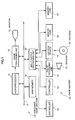
- Fig. 7 is a functional block diagram for the present game machine 10.
- the game machine 10 comprises, in terms of function, an oscillation parameter update unit 60, a screen image production unit 62, a viewpoint moving unit 64, an oscillation parameter storage unit 66, and an oscillating unit 68.
- These functions are realized by carrying out a game program in the consumer game machine 11 according to an embodiment of the present invention.
- the game program may be stored in the DVD-ROM 25, and read into the consumer game machine 11.
- the game program may be downloaded from a remote computer via a network adapter which the consumer game machine 11 may have for connection to a data communication network, such as the Internet, or the like.
- the screen image production unit 62 stores the position and posture of an object, such as the player game character object 42, the building object 48, or the like, placed in the game space 40, the position of the viewpoint 44, the viewing direction 46, and the kind of the current motion of the player game character object 42, then produces a screen image showing a picture obtained by viewing from the viewpoint 44 in the viewing direction 46 on a real time basis, and displays the produced screen image on the monitor 18 on a real time basis.
- an object such as the player game character object 42, the building object 48, or the like
- the viewpoint moving unit 64 moves the player game character object 42 and the viewpoint 44, which moves following the player game character object 42, according to an operation signal input from the controller 32. Specifically, the kind of motion of the player game character object 42, (whether walking, running, jumping, or remaining still), that is, the movement state of the viewpoint 44, is determined based on an operation signal, and the result of the determination is notified to the screen image production unit 62.
- the screen image production unit 62 updates the position and posture of the player game character object 42, the position of the viewpoint 44, and the viewing direction 46 according to the notified motion kind of the player game character object 42.
- the oscillation parameter update unit 60 changes the oscillation parameter stored in the oscillation parameter storage unit 66 according to the movement of the viewpoint 44 in the game space 40. Specifically, the motion kind of the player game character object 42, stored in the screen image production unit 62, is obtained, and an oscillation parameter change amount corresponding to the motion kind is read from the oscillation parameter change amount table. Then, the oscillation parameter stored in the oscillation parameter storage unit 66 is updated according to the read oscillation parameter change amount.
- the oscillating unit 68 reads the thus updated oscillation parameter from the oscillation parameter storage unit 66, and obtains an oscillation extent based on the value while referring to the oscillation extent table. Then, the oscillating unit 68 instructs the screen image production unit 62 to oscillate the viewpoint 44 or the viewing direction 46 up and down by an extent corresponding to the obtained oscillation extent.
- Fig. 8 is a flowchart of image processing carried out in the game machine 10.
- an operation signal input from the controller 32 is obtained by the viewpoint moving unit 64 (S101), which then determines the motion kind of the player game character object 42, based on the content of the operational signal (S102).
- the result of this determination is notified to the screen image production unit 62.
- the oscillation parameter update unit 60 obtains the motion state of the player game character object 42 from the screen image production unit 62, then obtains a oscillation parameter change amount corresponding to the motion state from the oscillation parameter change amount table, and updates the oscillation parameter stored in the oscillation parameter storage unit 66 according to the value (S103).
- the oscillating unit 68 reads an oscillation parameter from the oscillation parameter storage unit 66, and obtains an oscillation extent based on the value while referring to the oscillation extent table (S104).
- the oscillating unit 68 instructs the screen image production unit 62 to oscillate the screen image based on the oscillation extent.
- the screen image production unit 62 calculates the position and posture of the player game character object 42 and other object (S105) and also the position of the viewpoint 44 and the viewing direction 46 (S106). Then, based on the results of the calculations made in S105 and S106, a screen image is produced (S107). The thus produced screen image is shown on the monitor 18. Thereafter, the next time at which to update the screen image is waited for (S108) before the process at S101 to S107 is carried out.
- the viewpoint 44 or the viewing direction 46 can be made to oscillate according to the content of the motion. This allows the player viewing the screen image shown on the monitor 18 to feel as if the player game character object 42 has become tired or has recovered from fatigue. With the above, the realism of the screen image shown on the monitor 18 can be improved.
Landscapes
- Engineering & Computer Science (AREA)
- Theoretical Computer Science (AREA)
- Physics & Mathematics (AREA)
- General Engineering & Computer Science (AREA)
- General Physics & Mathematics (AREA)
- Computer Graphics (AREA)
- Software Systems (AREA)
- Multimedia (AREA)
- Computer Hardware Design (AREA)
- Remote Sensing (AREA)
- Radar, Positioning & Navigation (AREA)
- Computing Systems (AREA)
- Geometry (AREA)
- Human Computer Interaction (AREA)
- Architecture (AREA)
- Processing Or Creating Images (AREA)
Applications Claiming Priority (2)
| Application Number | Priority Date | Filing Date | Title |
|---|---|---|---|
| JP2005339719A JP2007143684A (ja) | 2005-11-25 | 2005-11-25 | ゲーム装置、ゲーム用画像処理方法及びプログラム |
| PCT/JP2006/315880 WO2007060770A1 (ja) | 2005-11-25 | 2006-08-10 | ゲーム装置、ゲーム用画像処理方法及び情報記憶媒体 |
Publications (2)
| Publication Number | Publication Date |
|---|---|
| EP1952861A1 true EP1952861A1 (de) | 2008-08-06 |
| EP1952861A4 EP1952861A4 (de) | 2008-12-03 |
Family
ID=38067007
Family Applications (1)
| Application Number | Title | Priority Date | Filing Date |
|---|---|---|---|
| EP06782666A Ceased EP1952861A4 (de) | 2005-11-25 | 2006-08-10 | Spielautomat, spielbildverarbeitungsverfahren und informationsspeichermedium |
Country Status (7)
| Country | Link |
|---|---|
| US (1) | US20090267943A1 (de) |
| EP (1) | EP1952861A4 (de) |
| JP (1) | JP2007143684A (de) |
| KR (1) | KR100977692B1 (de) |
| CN (1) | CN101316637A (de) |
| TW (1) | TWI294299B (de) |
| WO (1) | WO2007060770A1 (de) |
Families Citing this family (3)
| Publication number | Priority date | Publication date | Assignee | Title |
|---|---|---|---|---|
| CA2798954C (en) * | 2010-05-10 | 2016-05-24 | Square Enix Co., Ltd. | Image processing apparatus, image processing method, and image processing program |
| JP6298613B2 (ja) | 2013-10-17 | 2018-03-20 | 株式会社ソニー・インタラクティブエンタテインメント | ゲームシステム、ゲーム制御方法、及びゲーム制御プログラム |
| JP6499728B2 (ja) * | 2017-07-18 | 2019-04-10 | 株式会社カプコン | ゲームプログラム及びゲームシステム |
Family Cites Families (12)
| Publication number | Priority date | Publication date | Assignee | Title |
|---|---|---|---|---|
| US5483630A (en) | 1990-07-12 | 1996-01-09 | Hitachi, Ltd. | Method and apparatus for representing motion of multiple-jointed object, computer graphic apparatus, and robot controller |
| JP4045513B2 (ja) * | 1996-07-25 | 2008-02-13 | 株式会社セガ | 画像処理装置、画像処理方法、ゲーム装置及び乗り物遊戯機 |
| US20010040586A1 (en) * | 1996-07-25 | 2001-11-15 | Kabushiki Kaisha Sega Enterprises | Image processing device, image processing method, game device, and craft simulator |
| JPH10290886A (ja) * | 1997-02-18 | 1998-11-04 | Sega Enterp Ltd | 画像処理装置および画像処理方法 |
| JP3882287B2 (ja) * | 1997-03-07 | 2007-02-14 | 株式会社セガ | 魚釣り遊戯装置 |
| JP4114822B2 (ja) * | 1997-12-05 | 2008-07-09 | 株式会社バンダイナムコゲームス | 画像生成装置及び情報記憶媒体 |
| US6222549B1 (en) * | 1997-12-31 | 2001-04-24 | Apple Computer, Inc. | Methods and apparatuses for transmitting data representing multiple views of an object |
| US6743104B1 (en) * | 1999-11-18 | 2004-06-01 | Nintendo Co., Ltd. | Portable game machine |
| GB2373039B (en) * | 2000-11-28 | 2005-06-15 | In2Games Ltd | Position transducer |
| JP2002292119A (ja) | 2001-03-29 | 2002-10-08 | Square Co Ltd | ビデオゲームプログラム、ビデオゲームプログラムを記録した記録媒体、ビデオゲームにおけるキャラクタ移動制御方法及びゲーム装置 |
| JP3564440B2 (ja) * | 2001-08-08 | 2004-09-08 | コナミ株式会社 | 動画像生成プログラム、動画像生成方法及び装置 |
| JP4146320B2 (ja) * | 2003-09-24 | 2008-09-10 | 株式会社バンダイナムコゲームス | プログラム、情報記憶媒体及びゲーム装置 |
-
2005
- 2005-11-25 JP JP2005339719A patent/JP2007143684A/ja active Pending
-
2006
- 2006-07-25 TW TW095127059A patent/TWI294299B/zh not_active IP Right Cessation
- 2006-08-10 KR KR1020087008917A patent/KR100977692B1/ko not_active Expired - Fee Related
- 2006-08-10 CN CNA200680044139XA patent/CN101316637A/zh active Pending
- 2006-08-10 EP EP06782666A patent/EP1952861A4/de not_active Ceased
- 2006-08-10 US US12/092,027 patent/US20090267943A1/en not_active Abandoned
- 2006-08-10 WO PCT/JP2006/315880 patent/WO2007060770A1/ja not_active Ceased
Also Published As
| Publication number | Publication date |
|---|---|
| TWI294299B (en) | 2008-03-11 |
| CN101316637A (zh) | 2008-12-03 |
| US20090267943A1 (en) | 2009-10-29 |
| KR100977692B1 (ko) | 2010-08-24 |
| TW200719933A (en) | 2007-06-01 |
| WO2007060770A1 (ja) | 2007-05-31 |
| JP2007143684A (ja) | 2007-06-14 |
| KR20080046265A (ko) | 2008-05-26 |
| EP1952861A4 (de) | 2008-12-03 |
Similar Documents
| Publication | Publication Date | Title |
|---|---|---|
| EP1850319B1 (de) | Speichermedium mit darauf gespeichertem Tonausgabeprogramm, Tonausgabegerät und Verfahren zur Tonausgabesteuerung | |
| US8419538B2 (en) | Storage medium storing game program, game apparatus and game control method | |
| US20070238529A1 (en) | Communication game system | |
| KR100987625B1 (ko) | 게임 장치, 게임 장치의 제어 방법 및 정보 기억 매체 | |
| US7083519B2 (en) | Game system and related game machine, control method and program, operable with different interchangeable controllers | |
| KR100935570B1 (ko) | 게임 장치, 게임 장치의 제어 방법 및 정보 기억 매체 | |
| US7932903B2 (en) | Image processor, image processing method and information storage medium | |
| US7667615B2 (en) | Message image display device, message image display device control method, and information recording medium | |
| EP1938875B1 (de) | Spielautomat, spielautomatsteuerverfahren und informationsspeichermedium | |
| JP2006247281A (ja) | メッセージ画像表示装置、メッセージ画像表示装置の制御方法及びプログラム | |
| US8485898B2 (en) | Game device, method for controlling game device, program, and information storage medium | |
| EP1952861A1 (de) | Spielautomat, spielbildverarbeitungsverfahren und informationsspeichermedium | |
| EP1264621B1 (de) | Spielsystem und Spielprogramm | |
| JP4054016B2 (ja) | 画像処理装置、画像処理方法及びプログラム | |
| JP3973046B2 (ja) | ゲーム装置、ゲーム装置の制御方法及びプログラム | |
| JP2005095439A (ja) | ゲーム装置、ゲーム装置の制御方法及びプログラム | |
| JP2005095348A (ja) | ゲームプログラム | |
| HK1104644B (en) | Image processor, image processing method and information storage medium |
Legal Events
| Date | Code | Title | Description |
|---|---|---|---|
| PUAI | Public reference made under article 153(3) epc to a published international application that has entered the european phase |
Free format text: ORIGINAL CODE: 0009012 |
|
| 17P | Request for examination filed |
Effective date: 20080328 |
|
| AK | Designated contracting states |
Kind code of ref document: A1 Designated state(s): DE FR GB |
|
| A4 | Supplementary search report drawn up and despatched |
Effective date: 20081105 |
|
| DAX | Request for extension of the european patent (deleted) | ||
| RBV | Designated contracting states (corrected) |
Designated state(s): DE FR GB |
|
| 17Q | First examination report despatched |
Effective date: 20090304 |
|
| REG | Reference to a national code |
Ref country code: DE Ref legal event code: R003 |
|
| STAA | Information on the status of an ep patent application or granted ep patent |
Free format text: STATUS: THE APPLICATION HAS BEEN REFUSED |
|
| 18R | Application refused |
Effective date: 20110226 |