EP1952879A1 - Grossmassstäbliche membrantrennvorrichtung - Google Patents
Grossmassstäbliche membrantrennvorrichtung Download PDFInfo
- Publication number
- EP1952879A1 EP1952879A1 EP05795702A EP05795702A EP1952879A1 EP 1952879 A1 EP1952879 A1 EP 1952879A1 EP 05795702 A EP05795702 A EP 05795702A EP 05795702 A EP05795702 A EP 05795702A EP 1952879 A1 EP1952879 A1 EP 1952879A1
- Authority
- EP
- European Patent Office
- Prior art keywords
- header
- chemical liquid
- cleaning chemical
- branch pipes
- membrane
- Prior art date
- Legal status (The legal status is an assumption and is not a legal conclusion. Google has not performed a legal analysis and makes no representation as to the accuracy of the status listed.)
- Withdrawn
Links
Images





Classifications
-
- B—PERFORMING OPERATIONS; TRANSPORTING
- B01—PHYSICAL OR CHEMICAL PROCESSES OR APPARATUS IN GENERAL
- B01D—SEPARATION
- B01D65/00—Accessories or auxiliary operations, in general, for separation processes or apparatus using semi-permeable membranes
- B01D65/02—Membrane cleaning or sterilisation ; Membrane regeneration
-
- B—PERFORMING OPERATIONS; TRANSPORTING
- B01—PHYSICAL OR CHEMICAL PROCESSES OR APPARATUS IN GENERAL
- B01D—SEPARATION
- B01D61/00—Processes of separation using semi-permeable membranes, e.g. dialysis, osmosis or ultrafiltration; Apparatus, accessories or auxiliary operations specially adapted therefor
- B01D61/14—Ultrafiltration; Microfiltration
- B01D61/18—Apparatus therefor
-
- B—PERFORMING OPERATIONS; TRANSPORTING
- B01—PHYSICAL OR CHEMICAL PROCESSES OR APPARATUS IN GENERAL
- B01D—SEPARATION
- B01D61/00—Processes of separation using semi-permeable membranes, e.g. dialysis, osmosis or ultrafiltration; Apparatus, accessories or auxiliary operations specially adapted therefor
- B01D61/14—Ultrafiltration; Microfiltration
- B01D61/20—Accessories; Auxiliary operations
-
- B—PERFORMING OPERATIONS; TRANSPORTING
- B01—PHYSICAL OR CHEMICAL PROCESSES OR APPARATUS IN GENERAL
- B01D—SEPARATION
- B01D2313/00—Details relating to membrane modules or apparatus
- B01D2313/10—Specific supply elements
-
- B—PERFORMING OPERATIONS; TRANSPORTING
- B01—PHYSICAL OR CHEMICAL PROCESSES OR APPARATUS IN GENERAL
- B01D—SEPARATION
- B01D2313/00—Details relating to membrane modules or apparatus
- B01D2313/12—Specific discharge elements
-
- B—PERFORMING OPERATIONS; TRANSPORTING
- B01—PHYSICAL OR CHEMICAL PROCESSES OR APPARATUS IN GENERAL
- B01D—SEPARATION
- B01D2315/00—Details relating to the membrane module operation
- B01D2315/06—Submerged-type; Immersion type
-
- B—PERFORMING OPERATIONS; TRANSPORTING
- B01—PHYSICAL OR CHEMICAL PROCESSES OR APPARATUS IN GENERAL
- B01D—SEPARATION
- B01D2317/00—Membrane module arrangements within a plant or an apparatus
- B01D2317/04—Elements in parallel
-
- B—PERFORMING OPERATIONS; TRANSPORTING
- B01—PHYSICAL OR CHEMICAL PROCESSES OR APPARATUS IN GENERAL
- B01D—SEPARATION
- B01D2321/00—Details relating to membrane cleaning, regeneration, sterilization or to the prevention of fouling
- B01D2321/04—Backflushing
Definitions
- the present invention relates to a large scale membrane separating installation, and to a technique of, when cleaning a membrane unit with a chemical liquid, efficiently uniformly distributing and contacting the chemical liquid to and with the membrane unit.
- a membrane unit constituting a basic unit has a plurality of membrane cartridges installed in one casing.
- the cleaning chemical liquid is supplied to each of the membrane cartridges by gravity injection.
- the inventors have contrived a method of supplying a predetermined amount of cleaning chemical liquid in a short time using a pump as shown in FIG. 19 .
- a plurality of membrane units 1 are arranged in a line.
- a plurality of membrane cartridges (not shown) are arranged parallel to one another.
- Each of the membrane cartridges has filtration membranes like flat membranes located on respective surfaces of a filter plate so as to form a permeated liquid channel between the filter plate and each of the filtration membranes.
- the permeated liquid channel is in communication with a collecting header via a tube.
- a header 2 is located along a direction in which the membrane units 1 are arranged.
- the header 2 forms a channel with a diameter (large diameter) required to ensure a smooth flow.
- Branch pipes 3 branch from the header 2 and connect to collecting headers of the respective membrane units 1 via valves 4.
- Each of the branch pipes 3 forms a channel having a smaller diameter than the header 2.
- Each of the collecting headers is provided for a casing of the corresponding membrane unit 1.
- the header 2 is located at a position of a predetermined height h1. from a liquid level in the reaction vessel. Furthermore, the header 2 has a pressure release valve 5 located beside a terminal thereof in a flow direction at a position of a predetermined height h2 from the header 2.
- the header 2 is in communication with a filtrate recovery pipeline 6 at a start point thereof (inlet) in the flow direction.
- the filtrate recovery pipeline 6 is in communication with a treated water tank 7 and has a first selector valve 8 and a plurality of treated water pumps 9 interposed in the middle thereof.
- cleaning liquid supply pipeline 11 is connected to the filtrate recovery pipeline 6 via a second selector valve 10.
- the cleaning liquid supply pipeline 11 is connected to a submerged pump 12 provided in the treated water tank 7 and has an agitator 13 interposed in the middle thereof.
- a cleaning chemical liquid supply pipeline 14 is connected between the submerged pump 12 and the agitator 13.
- the cleaning chemical liquid supply pipeline 14 is in communication with a chemical tank 15 and has a transfer pump 16 interposed in the middle thereof.
- valve 4 and the first selector valve 8 are open.
- the pressure release valve 5 and the second selector valve 10 are closed.
- the treated water pump 9 is driven to exert a suction pressure on the membrane cartridges in each of the membrane units 1.
- the suction pressure is used as a driving pressure to subject a liquid in the reaction vessel to a membrane separation treatment using the membrane cartridges,
- a filtrate having permeated the filtration membrane in each membrane cartridge flows through the tube (not shown) into the collecting header (not shown).
- the filtrate further flows through the branch pipe 3 to the header 2 and then through the filtrate recovery pipeline 6 into the treated water tank 7.
- valve 4 the pressure release valve 5, and the second selector valve 10 are open.
- the first selector valve 8 is closed.
- the submerged pump 12 is driven to supply treated water in the treated water tank 7 to the header 2.
- the transfer pump 16 is driven to supply a cleaning chemical liquid to the header 2 together with the treated water.
- the cleaning chemical liquid is mixed into the treated water in the agitator 13, where the concentration of the cleaning chemical liquid is adjusted to a predetermined value.
- the cleaning chemical liquid then flows through the cleaning liquid supply pipeline 11 into the header 2.
- the concentration is adjusted by controlling the submerged pump 12 and the transfer pump 16.
- the cleaning chemical liquid having flown into the header 2 flows from the header 2 through the branch pipes 3 to the collecting headers of the respective membrane units 1-
- the cleaning chemical liquid then flows into the respective membrane cartridges via the tubes.
- the pressure inside the header 2 increases. If the pressure increases excessively and the facility has no equipment such as a valve which can reduce the increased pressure, the filtration membranes in the membrane cartridges may be broken by the pressure acting on the membrane cartridges through the branch pipe 3, the collecting header, and the tube or by the inflow of a large amount of cleaning chemical liquid resulting from the pressure. Furthermore, the pressure inside the header 2 is also a cause of the nonuniform injection of the cleaning chemical liquid.
- the injected chemical liquid remaining in the membrane units may nonuniformly flow out and leak from membrane surfaces in the membrane units due to an uneven pressure in the branch pipe. This may also prevent the chemical liquid remaining in the membrane units from being kept uniform.
- a water head is limited and needs to be at most 100 kPa.
- the water head needs to be at most 40 kPa (preferably at most 20 kPa).
- An object of the present invention is to provide a large scale membrane separating installation that can simultaneously and uniformly distribute and contact the cleaning chemical liquid to and with the membrane cartridges in the plurality of membrane units.
- the present invention provides a large scale membrane separating installation including a plurality of membrane units arranged in a reaction vessel and a plurality of branch pipes branching from a header and connected to collecting headers of the respective membrane units so that a cleaning chemical liquid flows through the header and the branch pipes to the respective membrane units, wherein a cleaning chemical liquid distribution unit includes the header and the branch pipes each having a smaller diameter than the header, and the cleaning chemical liquid distribution unit includes a pipeline configuration uniformly distributing the cleaning chemical liquid to be supplied to the membrane units.
- the cleaning chemical liquid distribution unit uses an adjusting function provided by the pipeline configuration to adjust a first force resulting mainly from a pressure head and a second force resulting mainly from a velocity head.
- the first force acts as a force that pushes the cleaning chemical liquid in the header toward an inlet of each of the branch pipes.
- the second force acts as a force that sweeps away the cleaning chemical liquid in the header in a pipe axis direction.
- the cleaning chemical liquid flows in a non-full condition, that is, flows with a gas phase present in the upper area of the header.
- the cleaning chemical liquid thus flows through the branch pipes to the collecting headers of the respective membrane units.
- the branch pipe inlet supply pressure Factors determining the pressure include the amount of cleaning chemical liquid supplied and flowing into the header, the supply pressure (the pressure of the pump or the water head in a vessel from which the cleaning chemical liquid is fed), the flow velocity of the cleaning chemical liquid flowing through the header, the ratio of the header diameter and the branch pipe diameter, the resistance of the pipeline, and gravity.
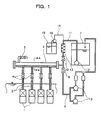
- FIGS. 1 and 2 show a configuration similar to that shown in FIG. 19 .
- reference numeral 1a denotes an air diffusing pipe in the membrane unit 1.
- Reference numeral 1b denotes a blower.
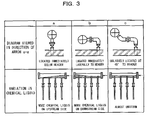
- FIG. 3 is a diagram as viewed in the direction of arrow a-a in FIG. 1 and shows three cases in which the branch pipes 3 have different structures.
- FIG. 4(a), (b) and (c) are graphs showing the flow rate of the cleaning chemical liquid flowing from each of the branch pipes 3 to the corresponding membrane unit 1 in each of the configurations shown in FIG. 3 .
- the branch pipe 3 located closest to the start point (inlet) of the header 2 in a flow direction is denoted by NO. 1.
- the branch pipe 3 located closest to the terminal of the header 2 in the flow direction is denoted by NO. 8.
- the cleaning chemical liquid has more difficulty flowing into the branch pipes 3 located closer to the start point (inlet) of the header.
- the cleaning chemical liquid flows more easily into the branch pipes 3 located closer to the terminal of the header 2.
- This phenomenon is attributed to the following. That is, at the start point of the header, the second force (resulting mainly from the velocity head) acts more dominantly than the first force (resulting mainly from the pressure head). The force sweeping away the cleaning chemical liquid in the pipe axis direction of the header 2 dominates the force pushing the cleaning chemical liquid toward the inlet of each branch pipe. On the other hand, at the terminal of the header, the flow of the cleaning chemical liquid impacts the terminal of the header 2 to increase the pressure head.
- the pressure of the cleaning chemical liquid When the branch pipes 3 are arranged so as to hang from the header 2 in a vertical direction, the pressure of the cleaning chemical liquid, one of the factors uniformizing the branch pipe inlet supply pressure, has a greater impact than the other factors.
- the cleaning chemical liquid flows more easily into the branch pipes 3 located closer to the start point (inlet) of the header.
- the amount of cleaning chemical liquid reaching the terminal of the header 2 decreases consistently with the distance to the terminal of the header 2, making it more difficult for the cleaning chemical liquid to flow into the branch pipes 3.
- This phenomenon is attributed to the following. That is, in addition to the pressure head resulting from the supply pressure of the pump, the gravity acts as a force pushing the cleaning chemical liquid toward the inlet of each branch pipe.
- the first force resulting mainly from the pressure head
- the second force resulting mainly from the velocity head.
- the force pushing the cleaning chemical liquid toward the inlet of the branch pipe dominates the force sweeping away the cleaning chemical liquid in the pipe axis direction of the header 2.
- most of the cleaning chemical liquid flows into the branch pipes 3 located closer to the start point of the header, reducing the amount of cleaning chemical liquid reaching the terminal of the header 2.
- the cleaning chemical liquid distribution unit includes the pipeline configuration adjusting the first force and the second force. This allows the cleaning chemical liquid to flow uniformly to the plurality of membrane units through the header and the branch pipes.
- a specific configuration of the cleaning chemical liquid distribution unit is as follows.
- the header is located along a direction in which the membrane units are arranged and along a horizontal direction. Mounting axes of the branch pipes are arranged parallel to one another.
- the header is positioned above a. liquid level in the reaction vessel.
- Each of the branch pipes is inclined with a falling gradient from the header toward the collecting header at a predetermined angle.
- the branch pipes 3 are inclined at 45 ° to the header 2 to adjust the "gravity” and "velocity head” so as to uniformize the branch pipe inlet supply pressure.
- the rate of the gravity in the total force of the gravity and the "pushing force", the first force, to which the gravity is added, is adjusted by the inclination of the branch pipes, to inhibit the flow of an excessive amount of cleaning chemical liquid into the branch pipes located closer to the start point of the header, while the cleaning chemical liquid is swept away toward the terminal of the header by the "sweeping force", the second force.
- the branch pipe inlet supply pressure is uniformized such that the cleaning chemical liquid flows uniformly into all the branch pipes 3.
- each branch pipe has no valve reducing the pressure.
- the branch pipe is not full of the cleaning chemical liquid, but a gas phase is present therein.
- the branch pipe is also in communication with the air, and all the branch pipes are kept at a fixed pressure, the atmospheric pressure.
- the chemical liquid remaining inside the membrane units can be kept uniform from membrane surfaces in the membrane units each connected to the tip of the corresponding branch pipe.
- each of the branch pipes is inclined with the falling gradient from the header toward the collecting header at the predetermined angle, the cleaning chemical liquid can be uniformly distributed to and contacted with the plurality of membrane units through the header and the branch pipes.
- the header is located along the direction in which the membrane units are arranged and along the horizontal direction.
- the mounting axes of the branch pipes are arranged parallel to one another.
- the header is positioned above the liquid level in the reaction vessel.
- Each of the branch pipes has an overflow portion at a predetermined height position above the header.
- the pressure head in the header is set to a value at which the cleaning chemical liquid is lifted to the overflow portion of each branch pipe.
- the predetermined height position of the overflow portion, formed in the branch pipe is set on the basis of the pressure head generated in the cleaning chemical liquid in the header by the supply pressure of the cleaning chemical liquid (the supply pressure of the pump or the like) so that when the cleaning chemical liquid flows through the overflow portion, a gas phase is present in an upper area of the overflow portion.
- the cleaning chemical liquid flows so as to fill the header.
- the cleaning chemical liquid flowing from the header to the branch pipes overflows through the overflow portion with a gas phase present in the upper area of the overflow portion and flows to the collecting headers of the respective membrane units.
- the interior of the header is full of the cleaning chemical liquid to inhibit a possible nonuniform branch pipe inlet supply pressure resulting from the velocity head.
- the gravity does not act as the "pushing force” pushing the cleaning chemical liquid toward the inlet of the branch pipe.
- the pressure head acts as the "pushing force", the first force. The pressure head lifts the cleaning chemical liquid to the overflow portion against the gravity to allow the cleaning chemical liquid to overflow.
- the branch pipe has the overflow portion at the predetermined height position above the header, the cleaning chemical liquid can be uniformly distributed to and contacted with the plurality of membrane units through the header and the branch pipes.
- an air open portion may be provided in the overflow portion of each branch pipe.
- the overflow portion is open to the air at the air open portion.
- the header is located along the direction in which the membrane units are arranged and along the horizontal direction.
- the mounting axes of the branch pipes are arranged parallel to one another.
- the header is positioned below the liquid level in the reaction vessel.
- Each of the branch pipes is connected to the header below the liquid level.
- the cleaning chemical liquid supplied to the header during cleaning with the chemical liquid flows to each branch pipe so as to fill the header.
- the cleaning chemical liquid then flows to the collecting header of each membrane unit through the corresponding branch pipe.
- the header is positioned below the liquid level in the reaction vessel, the interior of the header is full of the cleaning chemical liquid. This inhibits a possible nonuniform branch pipe inlet supply pressure resulting from the velocity head.
- the water head corresponding to the distance from the liquid level to the header acts as a back pressure. Consequently, the gravity does not act as the "pushing force” pushing the cleaning chemical liquid toward the branch pipe inlet.
- the pressure head acts as the "pushing force", the first force, to push the cleaning chemical liquid toward the branch pipe inlet.
- the cleaning chemical liquid can thus be uniformly distributed to and contacted with the plurality of membrane units through the header and the branch pipes.
- the header is located along the direction in which the membrane units are arranged and along the horizontal direction.
- the mounting axes of the branch pipes are arranged parallel to one another.
- the header is positioned at or above the liquid level.
- the header is divided into a plurality of short pipelines each of which is located for every predetermined number of membrane units and each of which is in communication with a cleaning chemical liquid supply source at a central part thereof in a pipe axis direction.
- the cleaning chemical liquid supplied to each header during cleaning with the chemical liquid flows through the branch pipes to the collecting headers of the respective membrane units.
- each of the short pipes of the header is present for the corresponding one of the membrane units and each short pipe is in communication with the cleaning chemical liquid supply source at the central part thereof in the pipe axis direction, the liquid level and velocity head in the short pipes are inhibited from being nonuniformly distributed.
- the cleaning chemical liquid can thus be uniformly distributed to and contacted with the plurality of membrane units through the short pipes of the header and the branch pipes.
- the header is located at an equal distance in the vertical direction from the plurality of membrane units circularly arranged in the reaction vessel.
- the branch pipes branching from the header are radially arranged.
- the header is positioned at or above the liquid level.
- the cleaning chemical liquid supplied to the header during cleaning with the chemical liquid flows through the branch pipes to the collecting headers of the respective membrane units.
- the cleaning chemical liquid flows from the header into the radially branching branch pipes, the possible nonuniform distribution of the velocity head in the header is avoided.
- the cleaning chemical liquid can thus be uniformly distributed to and contacted with the plurality of membrane units through the header and the branch pipes.
- the header is located along the direction in which the membrane units are arranged and along the horizontal direction.
- the mounting axes of the branch pipes are arranged parallel to one another.
- the header is in communication with the cleaning chemical liquid supply source at the inlet of the header at one end thereof in the pipe axis direction.
- the header has a pressure control device provided at the other end thereof in the pipe axis direction to maintain a pressure at less than or equal to a set value.
- the pressure control device is activated to release the excessive pressure, preventing the excessive pressure from acting on the membrane units.
- the pressure control device includes a pressure sensing device, a valve device that is in communication with the header, and a control device that opens the valve device when a pressure detected by the pressure sensing device reaches an upper limit value.
- the header is located along the direction in which the membrane units are arranged and along the horizontal direction.
- the header is in communication with the cleaning chemical liquid supply source at the inlet thereof at one end thereof in the pipe axis direction and with a return pipe at the outlet thereof at the other end thereof in the pipe axis direction.
- the return pipe is in communication with the inlet of the header or the cleaning chemical liquid supply source.
- the velocity head since the cleaning chemical liquid circulates through the header and the return pipe, the velocity head is inhibited from being nonuniformly distributed. This prevents a possible nonuniform branch pipe inlet supply pressure caused by the nonuniform distribution of the velocity head. Furthermore, the "pushing force", the first force, acts substantially uniformly over the entire length of the header to uniformize the branch pipe inlet supply pressure among all the branch pipes. The cleaning chemical liquid can thus be uniformly distributed to and contacted with the plurality of membrane units through the header and the branch pipes.
- the gravity does not act as the force pushing the cleaning chemical liquid toward the inlet of each branch pipe. Instead, only the pressure head (the supply pressure of the pump or the like) acts as the "pushing force", the first force.
- the cleaning chemical liquid can thus be uniformly distributed to and contacted with the plurality of membrane units through the header and the branch pipes.
- each branch pipe is preferably connected to the header in the horizontal direction.
- the branch pipe may be connected on a slant to the header.
- the cleaning chemical liquid flows through the header in a non-full condition in which a gas phase is present in the upper area of the header.
- the cleaning chemical liquid thus flows through each branch pipe to the collecting header of the corresponding membrane unit.
- a plurality of membrane units 1 are arranged in a reaction vessel.
- a header 2 is located along a direction in which the membrane units 1 are arranged and along a horizontal direction.
- a plurality of branch pipes 3 branching from the header 2 are arranged parallel to one another. Each of the branch pipes 3 is connected to a collecting header (not shown) of a corresponding one of the membrane units 1.
- the header 2 forms a channel with a diameter (large diameter) required to ensure a smooth flow.
- Each of the branch pipes 3 forms a channel with a diameter smaller than that of the header 2.
- Each of the collecting headers is provided for a casing of a corresponding one of the membrane units 1.
- the header 2 is located in the horizontal direction at a predetermined height hl (for example, 1 m) from a liquid level in the reaction vessel.
- hl for example, 1 m
- Each branch pipe 3 is inclined with a falling gradient from the header 2 toward the corresponding collecting header at a predetermined angle X (0 ⁇ X ⁇ 90°).
- a submerged pump 12 and a transfer pump 16 are driven to allow a predetermined amount of cleaning chemical liquid to flow through the header 2.
- the cleaning chemical liquid flows through the header in a non-full condition, that is, with a gas phase present in an upper area of the header 2.
- the cleaning chemical liquid then flows uniformly through the branch pipes 3 to the collecting headers of the respective membrane units.
- the branch pipes 3 are inclined at 45 ° to the header 2 to allow a force resulting from the "gravity” and “velocity head” to contribute to uniformizing the branch pipe inlet supply pressure.
- the rate of gravity in the total force of the gravity and a "pushing force”, a first force, to which the gravity is added, is adjusted by the inclination of the branch pipes, to inhibit the flow of an excessive amount of cleaning chemical liquid into the branch pipes located closer to the start point (inlet) of the header 2, while the cleaning chemical liquid is swept away toward the terminal of the header 2 by a "sweeping force", a second force.
- the branch pipe inlet supply pressure is uniformized such that the cleaning chemical liquid flows uniformly into all the branch pipes 3.
- each branch pipe 3 required to uniformize the branch pipe inlet supply pressure is determined mathematically or on the basis of the rule of thumb taking into account the amount of cleaning chemical liquid supplied and flowing into the header 2, the supply pressure, the flow velocity of the cleaning chemical liquid flowing through the header 2, the ratio of the header diameter to the branch pipe diameter, the pipeline resistance, the gravity, and the like.
- the branch pipe inlet supply pressure can be uniformized by setting the predetermined inclination of each branch pipe 3 on the basis of the above-described elements.
- the predetermined inclination of the branch pipe 3 can be set on the basis of conditions such as the number of the membrane units 1, the number of membrane cartridges in each of the membrane units 1, and the diameter of the piping.
- the branch pipe inlet supply pressure in the header 2 can also be uniformed by a configuration shown in FIGS. 7(a) and 7(b) .
- the header 2 is located along the direction in which the membrane units 1 are arranged and along the horizontal direction.
- the plurality of branch pipes 3 are arranged parallel to one another.
- the header 2 is positioned at or above the liquid level in the reaction vessel.
- Each of the branch pipes 3 is connected to the top of the header 2.
- the branch pipe 3 has an overflow portion 21 at a predetermined height position h3 above the header 2.
- the overflow portion 21 of the branch pipe 3 is located at the predetermined height position h3.
- the predetermined height position h3 is set on the basis of the pressure head generated in the cleaning chemical liquid in the header by the supply pressure of the cleaning chemical liquid (the supply pressure of a pump). This results in the presence of a gas phase in an upper area of the overflow portion 21 when the cleaning chemical liquid flows through the overflow portion 21.
- the distance from the liquid level to the header 2 is at most 0.2 m, preventing a siphon from being established in the branch pipe 3.
- the siphon may vary the flow rate among the branch pipes 3.
- the overflow portion 21 may have an air open portion 21a including an on-off valve 21b.
- the air open portion 21a and the on-off valve 21b are not necessarily required for the overflow portion 21.
- the cleaning chemical liquid supplied to the header 2 during cleaning with the chemical liquid flows so as to fill the header 2.
- the cleaning chemical liquid flowing through each branch pipe 3 overflows through the overflow portion 21 and flows to the collecting header of the corresponding membrane unit 1.
- the gas phase is present in the upper area of the overflow portion 21 in the branch pipe 3.
- the interior of the header 2 is full of the cleaning chemical liquid to increase the effective channel cross section (the substantial channel cross section over which the cleaning chemical liquid flows) of the header 2 compared to the effective channel cross section observed in the non-full condition. This inhibits a possible nonuniform branch pipe inlet supply pressure resulting from the velocity head.
- the gravity does not act as the "pushing force” pushing the cleaning chemical liquid toward an inlet of the branch pipe. Instead, only the pressure head (in this case, the supply pressure of the pump) acts as the "pushing force” pushing the cleaning chemical liquid toward the branch pipe inlet to lift the cleaning chemical liquid to the overflow portion 21 against the gravity. The cleaning chemical liquid then overflows through the overflow portion 21.
- the branch pipe 3 forms the overflow portion 21 at the predetermined height position h3 above the header 2,
- the cleaning chemical liquid can thus be uniformly distributed to and contacted with the plurality of the membrane units 1 through the header 2 and the branch pipes 3.
- the overflow portion 21 has the air open portion 21a and the on-off valve 21b
- the on-off valve 21b is open during cleaning with the chemical liquid.
- the pressure head in the cleaning chemical liquid supplied to the header 2 during cleaning with the chemical liquid lifts the cleaning chemical liquid to the overflow portion 21 against the gravity.
- the cleaning chemical liquid thus overflows through the overflow portion 21 of each branch pipe 3 with the gas phase present in the upper area of the overflow portion 21.
- the cleaning chemical liquid then flows to the collecting header of the corresponding membrane unit 1
- the overflow portion 21 is open to the air at the air open portion 21a, preventing the gas phase in the overflow portion 21 from causing air lock.
- the cleaning chemical liquid flows naturally downward through each branch pipe 3 under the atmospheric pressure to the collecting header of the corresponding membrane unit 1.
- the cleaning chemical liquid can thus be uniformly distributed to and contacted with the plurality of membrane units 1 through the header 2 and the branch pipes 3.
- the branch pipe inlet supply pressure in the header 2 can also be uniformized by a configuration shown in FIGS. 8 and 9 .
- the header 2 is located along the direction in which the membrane units 1 are arranged and along the horizontal direction.
- the plurality of branch pipes 3 are arranged parallel to one another.
- the header 2 is positioned below the liquid level in the reaction vessel at a predetermined distance h4 therefrom.
- the header 2 may be located below the liquid level in the reaction vessel as shown in FIG. 8 or located outside the reaction vessel as shown in FIG. 9 . In this case, each of the branch pipes 3 may be connected at any angle to the header 2.
- the cleaning chemical liquid supplied to the header 2 during cleaning with the chemical liquid flows to the branch pipes 3 so as to fill the header 2.
- the cleaning chemical liquid then flows through the branch pipes 3 to the collecting headers of the respective membrane units.
- the effective channel cross section (the substantial channel cross section over which the cleaning chemical liquid flows) of the header 2 increases compared to the effective channel cross section observed in the non-full condition. This inhibits a possible nonuniform branch pipe inlet supply pressure resulting from the velocity head.
- the water head corresponding to the distance h4 from the liquid level to the header 2 acts as a back pressure.
- the gravity does not act as the "pushing force” pushing the cleaning chemical liquid toward the branch pipe inlet.
- the pressure head in this case, the supply pressure of the pump
- the cleaning chemical liquid can thus be uniformly distributed to and contacted with the plurality of membrane units through the header 2 and the branch pipes 3.
- the channel cross section A of the header 2, the channel cross section B of each branch pipe 3, and the number of the branch pipes 3 desirably satisfy the relationship A>B ⁇ N ⁇ 0.2.
- the branch pipe inlet supply pressure in the header 2 can also be uniformized by a configuration shown in FIG. 10 .
- the header 2 is located along the direction in which the membrane units 1 are arranged and along the horizontal direction.
- the header 2 is positioned at or above the liquid level.
- the header 2 is divided into a plurality of short pipes 2a each corresponding to a predetermined number of membrane units 1.
- Each of the short pipes 2a is in communication with a cleaning liquid supply pipeline 11 at a central part thereof in a pipe axis direction.
- the branch pipes 3 can be connected to the header 2 either in the horizontal direction or in a vertical direction or in an inclining direction.
- the cleaning chemical liquid supplied to the header 2 during cleaning with the chemical liquid flows through the branch pipes 3 to the collecting headers of the respective membrane units.
- the header 2 is divided into the short pipes 2a and each header 2 is in communication with the cleaning liquid supply pipeline 11 at the central part thereof in the pipe axis direction, the liquid level and velocity head in the short pipes 2a of each header 2 are inhibited from being nonuniformly distributed.
- the cleaning chemical liquid can thus be uniformly distributed to and contacted with the plurality of membrane units 1 through the header 2 and the branch pipes 3.
- the branch pipe inlet supply pressure in the header 2 can also be uniformized by a configuration shown in FIGS. 11 and 12 .
- the plurality of membrane units 1, located in the reaction vessel are circularly arranged.
- the header 2 is located at an equal distance in the vertical direction from the membrane units 1, that is, at a central position of the membrane units 1.
- the header 2 is located at or above the liquid level.
- the branch pipes 3 are arranged so as to branch radially from the header 2 and connected to the collecting headers of the respective membrane units 1.
- the cleaning chemical liquid supplied to the header 2 during cleaning with the chemical liquid flows through the branch pipes 3 to the collecting headers of the respective membrane units 1.
- the cleaning chemical liquid flows into the branch pipes 3 branching radially from the header 2, the possible nonuniform distribution of the velocity head in the header 2 is avoided.
- the pressure in the header 2 acts uniformly on the branch pipes 3, so that the cleaning chemical liquid can be uniformly distributed to and made in contact with the plurality of membrane units 1 through the header 2 and the branch pipes 3.
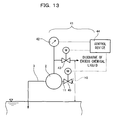
- a pressure control device 41 maintaining the pressure at less than or equal to a set value may be provided at the terminal of the header 2 in order to prevent an excessive pressure from acting on the membrane units 1 through the header 2 and the branch pipes 3.
- the header 2 is positioned above the liquid level. However, the header 2 may be located below the liquid level.
- the pressure control device 41 is made up of a pressure sensing device 42 that measures the pressure at the terminal the header 2, a valve device 43 installed at a position of a predetermined height h5 (for example, 2 m) from the liquid level in communication with the header 2, a control device 44 that opens the valve device 43 when the pressure detected by the pressure sensing device 42 reaches an upper limit value, and a valve device 45 provided in the cleaning liquid supply pipeline 11.
- a second selector valve 10 may be configured so as to vary the flow rate instead of providing the valve device 45.
- the design of the header 2 and branch pipes 3 and the total inflow amount of cleaning chemical liquid are adjusted such that for example, the pressure in each branch pipe 3 is set to about 0 to 20 kPa. If the inflow of the liquid undergoes a high resistance owing to unexpected dirt or the like in the membrane unit, injection at a standard flow rate may result in an excessive pushing force pushing the cleaning chemical liquid toward the inlet of the branch pipe. Then, when the detected pressure measured by the pressure sensing device 42 of the pressure control device 41 reaches the upper limit value (which is set at, for example, 20 kPa), the control device 44 controllably opens and closes the valve devices 43 and 45 to release the excessive pressure. This prevents the excessive pressure from acting on the corresponding membrane unit 1, to control the flow rate.
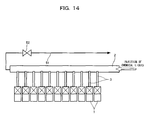
- the branch pipe inlet supply pressure in the header 2 can also be uniformized by a configuration shown in FIGS. 14 and 15 .
- the header 2 is located along the direction in which the membrane units 1 are arranged.
- the branch pipes 3 branching from the header 2 are connected to the collecting headers of the respective membrane unit 1 (not shown).
- the header 2 is located along the direction in which the membrane units 1 are arranged and along the horizontal direction.
- the header 2 is positioned at the liquid level in the reaction vessel or at a predetermined height from the liquid level.
- the branch pipes 3 are connected to the header 2 in the horizontal direction.
- the header 2 is in communication with the cleaning liquid supply pipeline 11 at the start point (inlet) thereof in the flow direction.
- a first end of a return pipe 51 is connected to the terminal (outlet) of the header 2 in the flow direction.
- a second end of the return pipe 51 is in communication with the inlet of the header 2.
- An on-off valve 52 is provided in the return pipe 51.
- the second end of the return pipe 51 can be connected to the cleaning liquid supply pipeline 11.
- the first end of the return pipe 51 may be connected to the branch pipe 3 positioned at the terminal of the header 2.
- a valve 4 and a first selector valve 8 are open.
- the on-off valve 52 and the second selector valve 10 are closed.
- a treated water pump 9 is driven to apply a suction pressure to the membrane cartridges in each of the membrane units 1.
- the suction pressure is used as a driving pressure to perform a filtration operation using the membrane cartridges.
- a filtrate having permeated a filtration membrane flows through a tube (not shown) into the collecting header (not shown). The filtrate further flows through the branch pipe 3 to the header 2 and then through a filtrate recovery pipeline 6 into the treated water tank 7.
- valve 4 the second selector valve 10 and the on-off valve 52 are open, and the first selector valve 8 is closed.
- the submerged pump 12 is driven to supply treated water in the treated water tank 7.
- the transfer pump 16 is driven to supply the cleaning chemical liquid.
- the cleaning chemical liquid flows through the header in the non-full condition, that is, with the gas phase present in the upper area of the header 2.
- the cleaning chemical liquid flows through the header 2 and the branch pipes 3 to the collecting headers of the respective membrane units.
- Part of the cleaning chemical liquid returns to the inlet of the header 2 or the cleaning liquid supply pipeline 11 through the return pipe 51.
- the cleaning chemical liquid thus circulates through the header 2 and the return pipe 51.
- the "pushing force", the first force, acts substantially uniformly over the entire length of the header 2 to uniformize the branch pipe inlet supply pressure among all the branch pipes 3.
- the cleaning chemical liquid can thus be uniformly distributed to and contacted with the plurality of membrane units 1 through the header 2 and the branch pipes 3.
- the gravity does not act as the "pushing force” pushing the cleaning chemical liquid toward the branch pipe inlet- Instead, only the pressure head (in this case, the supply pressure of the pump) acts as the "pushing force", the first force.
- the cleaning chemical liquid can thus be uniformly distributed to and contacted with the plurality of membrane units 1 through the header 2 and the branch pipes 3.
- a 0.002 m 2
- Q 0.001 m 3 /sec
- v 0.5.
- the cleaning chemical liquid flows in at a flow velocity of 4.4 m/s.
- the cleaning chemical liquid flows through the first branch pipe at a flow rate about 1.5 times as large as a design value.
- the branch pipe 3 is obliquely located at an angle of 45° to the header as shown in FIG. 18(b)
- a 0.002 m 2
- Q 0.001 m 3 /sec
- the header 2 has a diameter of 150 mm.
- the center of the branch pipe is 0.022 m away from the bottom surface thereof.
- the branch pipe 3 is located in the horizontal direction as shown in FIG. 18(c) .
- a 0.002 m 2
- Q 0.001 m 3 /sec
- the header 2 has a diameter of 150 mm.
- the center of the branch pipe is 0.075 m away from the bottom surface thereof.
- the total water depth is 0.0878.
- the cleaning chemical liquid flows in at a flow velocity of 4.4 m/s.
- the total water depth is 0.0325 ⁇ 0.075.
- the water level is lower than the center (0.075) of the branch pipe, preventing the cleaning chemical liquid from flowing out of the first branch pipe.
- the water level increases sequentially from the terminal of the header, increasing the flow rate in the corresponding branch pipes above the design value.
Landscapes
- Engineering & Computer Science (AREA)
- Water Supply & Treatment (AREA)
- Chemical & Material Sciences (AREA)
- Chemical Kinetics & Catalysis (AREA)
- Separation Using Semi-Permeable Membranes (AREA)
- Cleaning In General (AREA)
Applications Claiming Priority (1)
| Application Number | Priority Date | Filing Date | Title |
|---|---|---|---|
| PCT/JP2005/019479 WO2007049327A1 (ja) | 2005-10-24 | 2005-10-24 | 大規模膜分離装置 |
Publications (2)
| Publication Number | Publication Date |
|---|---|
| EP1952879A1 true EP1952879A1 (de) | 2008-08-06 |
| EP1952879A4 EP1952879A4 (de) | 2010-04-14 |
Family
ID=37967451
Family Applications (1)
| Application Number | Title | Priority Date | Filing Date |
|---|---|---|---|
| EP05795702A Withdrawn EP1952879A4 (de) | 2005-10-24 | 2005-10-24 | Grossmassstäbliche membrantrennvorrichtung |
Country Status (6)
| Country | Link |
|---|---|
| US (1) | US20090152180A1 (de) |
| EP (1) | EP1952879A4 (de) |
| JP (1) | JPWO2007049327A1 (de) |
| CN (1) | CN101291720A (de) |
| CA (1) | CA2623893A1 (de) |
| WO (1) | WO2007049327A1 (de) |
Cited By (2)
| Publication number | Priority date | Publication date | Assignee | Title |
|---|---|---|---|---|
| EP2389238A4 (de) * | 2009-01-14 | 2013-07-03 | Bl Technologies Inc | Eingetauchte membrankassette und bedienungsverfahren |
| EP2560743B1 (de) * | 2010-04-19 | 2019-07-17 | ABB Research Ltd. | Verfahren und system für ein optimiertes membranreinigungsverfahren |
Families Citing this family (8)
| Publication number | Priority date | Publication date | Assignee | Title |
|---|---|---|---|---|
| JP5096765B2 (ja) * | 2007-02-28 | 2012-12-12 | メタウォーター株式会社 | 膜ろ過装置の逆洗方法 |
| US7488426B1 (en) * | 2008-01-23 | 2009-02-10 | Sohail Zaiter | Scalable immersed-filtration method and apparatus |
| JP5377028B2 (ja) * | 2009-03-31 | 2013-12-25 | 株式会社クボタ | 膜分離装置 |
| WO2011024726A1 (ja) * | 2009-08-25 | 2011-03-03 | 旭化成ケミカルズ株式会社 | 浸漬膜装置の洗浄方法及び浸漬膜装置 |
| JP5388968B2 (ja) * | 2010-08-12 | 2014-01-15 | 株式会社クボタ | 膜分離装置の洗浄方法および膜分離装置 |
| JP2013213624A (ja) * | 2012-04-02 | 2013-10-17 | Taisei Corp | 蓄熱槽構造 |
| KR101538772B1 (ko) * | 2013-12-23 | 2015-07-22 | 주식회사 에코니티 | 자유말단을 가지는 침지형 중공사막 유닛 모듈을 포함하는 카트리지형 중공사 막 모듈과 간헐/연속포기가 가능한 산기장치를 포함하는 침지형 수처리 장치 및 이의 포기 방법 |
| CN110180245B (zh) * | 2019-06-13 | 2021-06-01 | 信丰县包钢新利稀土有限责任公司 | 一种稀土金属萃取废液回收器 |
Family Cites Families (13)
| Publication number | Priority date | Publication date | Assignee | Title |
|---|---|---|---|---|
| JPH0665371B2 (ja) * | 1990-09-20 | 1994-08-24 | 荏原インフイルコ株式会社 | 有機性汚水の生物処理装置 |
| US5227071A (en) * | 1992-01-17 | 1993-07-13 | Madison Chemical Company, Inc. | Method and apparatus for processing oily wastewater |
| JP3290555B2 (ja) * | 1995-03-31 | 2002-06-10 | 株式会社クボタ | 浸漬型膜カートリッジの槽内洗浄方法 |
| JP3257933B2 (ja) * | 1995-08-17 | 2002-02-18 | 株式会社クボタ | 膜カートリッジの薬液洗浄方法 |
| FR2741280B1 (fr) * | 1995-11-22 | 1997-12-19 | Omnium Traitement Valorisa | Procede de nettoyage d'une installation de filtration du type a membranes immergees |
| JPH11309349A (ja) * | 1998-04-28 | 1999-11-09 | Asahi Chem Ind Co Ltd | 濾過膜モジュールの配管洗浄方法 |
| WO2000030742A1 (en) * | 1998-11-23 | 2000-06-02 | Zenon Environmental Inc. | Water filtration using immersed membranes |
| JP2000254459A (ja) * | 1999-03-05 | 2000-09-19 | Sumitomo Heavy Ind Ltd | 固液分離エレメントの洗浄方法及び固液分離装置 |
| JP3953256B2 (ja) * | 2000-05-18 | 2007-08-08 | 旭化成ケミカルズ株式会社 | 配管構造 |
| CA2398461C (en) * | 2000-12-04 | 2007-10-30 | Kubota Corporation | Multistage immersion type membrane separator and high-concentration wastewater treatment facility using same |
| EP1515793A1 (de) * | 2002-06-26 | 2005-03-23 | Bucher-Guyer AG | Vorrichtung zur querstromfiltration |
| JP4374260B2 (ja) * | 2004-03-05 | 2009-12-02 | 前澤工業株式会社 | 浸漬型膜ろ過装置 |
| JP2005270810A (ja) * | 2004-03-25 | 2005-10-06 | Ngk Insulators Ltd | 濾過装置 |
-
2005
- 2005-10-24 JP JP2007542524A patent/JPWO2007049327A1/ja active Pending
- 2005-10-24 CA CA002623893A patent/CA2623893A1/en not_active Abandoned
- 2005-10-24 US US12/083,421 patent/US20090152180A1/en not_active Abandoned
- 2005-10-24 WO PCT/JP2005/019479 patent/WO2007049327A1/ja not_active Ceased
- 2005-10-24 CN CNA2005800518700A patent/CN101291720A/zh active Pending
- 2005-10-24 EP EP05795702A patent/EP1952879A4/de not_active Withdrawn
Cited By (2)
| Publication number | Priority date | Publication date | Assignee | Title |
|---|---|---|---|---|
| EP2389238A4 (de) * | 2009-01-14 | 2013-07-03 | Bl Technologies Inc | Eingetauchte membrankassette und bedienungsverfahren |
| EP2560743B1 (de) * | 2010-04-19 | 2019-07-17 | ABB Research Ltd. | Verfahren und system für ein optimiertes membranreinigungsverfahren |
Also Published As
| Publication number | Publication date |
|---|---|
| JPWO2007049327A1 (ja) | 2009-04-30 |
| EP1952879A4 (de) | 2010-04-14 |
| CA2623893A1 (en) | 2007-05-03 |
| CN101291720A (zh) | 2008-10-22 |
| US20090152180A1 (en) | 2009-06-18 |
| WO2007049327A1 (ja) | 2007-05-03 |
Similar Documents
| Publication | Publication Date | Title |
|---|---|---|
| EP1952879A1 (de) | Grossmassstäbliche membrantrennvorrichtung | |
| US10828607B2 (en) | Aerator device, filter system including an aerator device, and method of aerating a filter using an aerator device | |
| JP5073076B2 (ja) | 膜分離ユニット | |
| CN101448562A (zh) | 用于带有浸入式隔膜的水过滤系统的、且包括设置有用于注入气体的机构和至少一个压力平衡系统的底板的曝气装置 | |
| ES2282329T3 (es) | Difusor de aire y metodo de limpieza del mismo. | |
| CA2591580A1 (en) | Simple gas scouring method and apparatus | |
| EP0049154A1 (de) | Reinigung von Luftverteilerelementen mit Gas während des Betriebs | |
| US9815027B2 (en) | Gas scouring apparatus for immersed membranes | |
| JPH11300177A (ja) | 膜分離装置 | |
| WO2008144098A2 (en) | Diffuser assembly with buoyancy vessel | |
| US11452971B2 (en) | Method for operating membrane separation device with halt process | |
| US6913689B2 (en) | Methods and apparatus for removing sediment from a liquid using pulses of pressurized air | |
| JPH1015574A (ja) | 汚水処理装置 | |
| US11325079B2 (en) | Combined coarse and fine bubble diffuser | |
| JPWO2012137276A1 (ja) | 散気装置の運転方法 | |
| KR101870598B1 (ko) | 생물 처리 장치, 생물 처리 방법, 및 프로그램 | |
| US7413713B2 (en) | Reaction apparatus and mixing system | |
| USRE33177E (en) | In place gas cleaning of diffusion elements | |
| JP2021506345A (ja) | 高効率のエアリフトポンプ | |
| JP3382926B2 (ja) | 散気装置の洗浄方法および散気装置 | |
| US7104279B2 (en) | Method and apparatus for preventing stagnation in fluid reservoirs | |
| US5505840A (en) | Chlorinator-filter system for sewage treatment plants | |
| JP2000084554A (ja) | 膜分離装置を備えた水処理装置の運転方法 | |
| JP5273935B2 (ja) | 集水装置 | |
| US940402A (en) | Feeding device for water-purifying apparatus. |
Legal Events
| Date | Code | Title | Description |
|---|---|---|---|
| PUAI | Public reference made under article 153(3) epc to a published international application that has entered the european phase |
Free format text: ORIGINAL CODE: 0009012 |
|
| 17P | Request for examination filed |
Effective date: 20080526 |
|
| AK | Designated contracting states |
Kind code of ref document: A1 Designated state(s): AT BE BG CH CY CZ DE DK EE ES FI FR GB GR HU IE IS IT LI LT LU LV MC NL PL PT RO SE SI SK TR |
|
| A4 | Supplementary search report drawn up and despatched |
Effective date: 20100316 |
|
| STAA | Information on the status of an ep patent application or granted ep patent |
Free format text: STATUS: THE APPLICATION HAS BEEN WITHDRAWN |
|
| 18D | Application deemed to be withdrawn |
Effective date: 20100417 |
|
| 18W | Application withdrawn |
Effective date: 20101021 |