EP1954287B2 - Cetp-inhibitoren - Google Patents
Cetp-inhibitoren Download PDFInfo
- Publication number
- EP1954287B2 EP1954287B2 EP06826999.2A EP06826999A EP1954287B2 EP 1954287 B2 EP1954287 B2 EP 1954287B2 EP 06826999 A EP06826999 A EP 06826999A EP 1954287 B2 EP1954287 B2 EP 1954287B2
- Authority
- EP
- European Patent Office
- Prior art keywords
- alkyl
- phenyl
- group
- optionally substituted
- independently selected
- Prior art date
- Legal status (The legal status is an assumption and is not a legal conclusion. Google has not performed a legal analysis and makes no representation as to the accuracy of the status listed.)
- Not-in-force
Links
- 0 CC1CC*CC1 Chemical compound CC1CC*CC1 0.000 description 49
- WDLAHWCTCZLWSG-UHFFFAOYSA-N CCOC(Nc1ccc2[o]c(-c(cc3)ccc3NC(COc3ccccc3C)=O)nc2c1)=O Chemical compound CCOC(Nc1ccc2[o]c(-c(cc3)ccc3NC(COc3ccccc3C)=O)nc2c1)=O WDLAHWCTCZLWSG-UHFFFAOYSA-N 0.000 description 3
- DAOZBJCTEPJGES-UHFFFAOYSA-N Cc1cc(Cl)ccn1 Chemical compound Cc1cc(Cl)ccn1 DAOZBJCTEPJGES-UHFFFAOYSA-N 0.000 description 3
- ZVMBMBOULDNRBQ-UHFFFAOYSA-N Cc1nc(C(F)(F)F)ccn1 Chemical compound Cc1nc(C(F)(F)F)ccn1 ZVMBMBOULDNRBQ-UHFFFAOYSA-N 0.000 description 3
- VQJNKRMCBJFDCJ-UHFFFAOYSA-N CC(C)(C)OC(CN(CC1)CCC1OCC(C)=O)=O Chemical compound CC(C)(C)OC(CN(CC1)CCC1OCC(C)=O)=O VQJNKRMCBJFDCJ-UHFFFAOYSA-N 0.000 description 2
- XRWOGTKRSMDXPD-UHFFFAOYSA-N CC(C)(C)OC(N(CC1)CCC1OCC(Nc(cc1)ccc1-c1nc2cc(C#N)cc(C=O)c2[o]1)=O)=O Chemical compound CC(C)(C)OC(N(CC1)CCC1OCC(Nc(cc1)ccc1-c1nc2cc(C#N)cc(C=O)c2[o]1)=O)=O XRWOGTKRSMDXPD-UHFFFAOYSA-N 0.000 description 2
- FULQQLSBJIMODW-UHFFFAOYSA-N CC(C)c1n[n](CCN(C)C2)c2n1 Chemical compound CC(C)c1n[n](CCN(C)C2)c2n1 FULQQLSBJIMODW-UHFFFAOYSA-N 0.000 description 2
- JHTVXFPQRSFQHL-UHFFFAOYSA-N CC(CN(C)CC1)N1C(OC(C)(C)C)=O Chemical compound CC(CN(C)CC1)N1C(OC(C)(C)C)=O JHTVXFPQRSFQHL-UHFFFAOYSA-N 0.000 description 2
- FRLQWJPMYGDLJZ-UHFFFAOYSA-N CC(c1c2[o]c(-c(cc3)ccc3NC(CN(CC3)CCN3c3ccc(C(F)(F)F)cc3)=O)nc2cc(C#N)c1)O Chemical compound CC(c1c2[o]c(-c(cc3)ccc3NC(CN(CC3)CCN3c3ccc(C(F)(F)F)cc3)=O)nc2cc(C#N)c1)O FRLQWJPMYGDLJZ-UHFFFAOYSA-N 0.000 description 2
- GINXLMPWJKEAFV-UHFFFAOYSA-N CCOc1c(C(F)(F)F)cccc1 Chemical compound CCOc1c(C(F)(F)F)cccc1 GINXLMPWJKEAFV-UHFFFAOYSA-N 0.000 description 2
- PZNQMJBVNDWXDY-UHFFFAOYSA-N CN(CCN1c2ccccc2)CC1=O Chemical compound CN(CCN1c2ccccc2)CC1=O PZNQMJBVNDWXDY-UHFFFAOYSA-N 0.000 description 2
- HPIWWHARNRHKKJ-UHFFFAOYSA-N CN1Cc2nc(C(F)(F)F)n[n]2CC1 Chemical compound CN1Cc2nc(C(F)(F)F)n[n]2CC1 HPIWWHARNRHKKJ-UHFFFAOYSA-N 0.000 description 2
- YIHBKVOCXUBROA-UHFFFAOYSA-N CNCCOC1CC(CCCC2)C2CC1 Chemical compound CNCCOC1CC(CCCC2)C2CC1 YIHBKVOCXUBROA-UHFFFAOYSA-N 0.000 description 2
- JFLPPELZYKHKQZ-UHFFFAOYSA-N CNCc1cccc(C(F)(F)F)c1 Chemical compound CNCc1cccc(C(F)(F)F)c1 JFLPPELZYKHKQZ-UHFFFAOYSA-N 0.000 description 2
- MKFCYQTVSDCXAQ-UHFFFAOYSA-N Cc(c(F)c1)ccc1Cl Chemical compound Cc(c(F)c1)ccc1Cl MKFCYQTVSDCXAQ-UHFFFAOYSA-N 0.000 description 2
- DEMKNLXJQNYAFY-UHFFFAOYSA-N Cc(cc1)ncc1Cl Chemical compound Cc(cc1)ncc1Cl DEMKNLXJQNYAFY-UHFFFAOYSA-N 0.000 description 2
- GIOZNNPGJLWBOS-UHFFFAOYSA-N Cc(cccc1)c1OCC(Nc(cc1)ccc1-c1nc(cc(cc2)OCc3ccccc3)c2[o]1)=O Chemical compound Cc(cccc1)c1OCC(Nc(cc1)ccc1-c1nc(cc(cc2)OCc3ccccc3)c2[o]1)=O GIOZNNPGJLWBOS-UHFFFAOYSA-N 0.000 description 2
- MZVSTDHRRYQFGI-UHFFFAOYSA-N Cc1cc(Cl)ncc1 Chemical compound Cc1cc(Cl)ncc1 MZVSTDHRRYQFGI-UHFFFAOYSA-N 0.000 description 2
- LRLRAYMYEXQKID-UHFFFAOYSA-N Cc1ccc(C(F)(F)F)cc1 Chemical compound Cc1ccc(C(F)(F)F)cc1 LRLRAYMYEXQKID-UHFFFAOYSA-N 0.000 description 2
- RAIVNNSPGQIYAJ-UHFFFAOYSA-N Cc1ccccc1OCC(Nc(cc1)ccc1-c1nc(cc(cc2C(O)=O)Br)c2[o]1)=O Chemical compound Cc1ccccc1OCC(Nc(cc1)ccc1-c1nc(cc(cc2C(O)=O)Br)c2[o]1)=O RAIVNNSPGQIYAJ-UHFFFAOYSA-N 0.000 description 2
- RWOQXPVPMPSPLG-UHFFFAOYSA-N Cc1ccccc1OCC(Nc(cc1)ccc1-c1nc2cc(N)ccc2[o]1)=O Chemical compound Cc1ccccc1OCC(Nc(cc1)ccc1-c1nc2cc(N)ccc2[o]1)=O RWOQXPVPMPSPLG-UHFFFAOYSA-N 0.000 description 2
- QQSTUVZYDLPYAF-UHFFFAOYSA-N Bc(cn1)ncc1Br Chemical compound Bc(cn1)ncc1Br QQSTUVZYDLPYAF-UHFFFAOYSA-N 0.000 description 1
- GGGKIZMWNJYGSK-SCGPFSFSSA-N C/C(/C(F)(F)F)=C\C=C(/C)\N1CCN(CC(Nc(cc2)ccc2-c2nc3cc(Br)ccc3[o]2)=O)CC1 Chemical compound C/C(/C(F)(F)F)=C\C=C(/C)\N1CCN(CC(Nc(cc2)ccc2-c2nc3cc(Br)ccc3[o]2)=O)CC1 GGGKIZMWNJYGSK-SCGPFSFSSA-N 0.000 description 1
- XRFFSMSEWRTXAG-UHFFFAOYSA-N C=[I]COc1cccc(Cl)c1 Chemical compound C=[I]COc1cccc(Cl)c1 XRFFSMSEWRTXAG-UHFFFAOYSA-N 0.000 description 1
- WEXQRZPXTIGLBI-UHFFFAOYSA-N CC(C(F)(F)F)(C(F)(F)F)OCCCc(cc1)ccc1-c1nc2cc(C#N)cc(C)c2[o]1 Chemical compound CC(C(F)(F)F)(C(F)(F)F)OCCCc(cc1)ccc1-c1nc2cc(C#N)cc(C)c2[o]1 WEXQRZPXTIGLBI-UHFFFAOYSA-N 0.000 description 1
- KJPAMKYJLWWOOI-UHFFFAOYSA-N CC(C)(C)NC(C1(CCN(C)CC1)C1CCCCC1)=O Chemical compound CC(C)(C)NC(C1(CCN(C)CC1)C1CCCCC1)=O KJPAMKYJLWWOOI-UHFFFAOYSA-N 0.000 description 1
- BTRLVPUESNLJAH-JXMROGBWSA-N CC(C)(C)OC(/C=C/c(cc1)ccc1-c1nc2cc(C#N)cc(C)c2[o]1)=O Chemical compound CC(C)(C)OC(/C=C/c(cc1)ccc1-c1nc2cc(C#N)cc(C)c2[o]1)=O BTRLVPUESNLJAH-JXMROGBWSA-N 0.000 description 1
- HMCACUDVMYOZAZ-UHFFFAOYSA-N CC(C)(C)OC(N(CC1)CCC1OCC(Nc(cc1)ccc1-c1nc2cc(C#N)cc(C(Br)Br)c2[o]1)=O)=O Chemical compound CC(C)(C)OC(N(CC1)CCC1OCC(Nc(cc1)ccc1-c1nc2cc(C#N)cc(C(Br)Br)c2[o]1)=O)=O HMCACUDVMYOZAZ-UHFFFAOYSA-N 0.000 description 1
- MDXAREYVOMTVBH-UHFFFAOYSA-N CC(C)(C)OC(N(CC1)CCC1OCC(Nc(cc1)ccc1-c1nc2cc(C#N)cc(CO)c2[o]1)=O)=O Chemical compound CC(C)(C)OC(N(CC1)CCC1OCC(Nc(cc1)ccc1-c1nc2cc(C#N)cc(CO)c2[o]1)=O)=O MDXAREYVOMTVBH-UHFFFAOYSA-N 0.000 description 1
- QFXCRSSZJIHHFE-UHFFFAOYSA-N CC(C)(C)OC(N1CCC(COC(Nc(cc2)ccc2-c2nc3cc(C#N)cc(C)c3[o]2)=O)CC1)=O Chemical compound CC(C)(C)OC(N1CCC(COC(Nc(cc2)ccc2-c2nc3cc(C#N)cc(C)c3[o]2)=O)CC1)=O QFXCRSSZJIHHFE-UHFFFAOYSA-N 0.000 description 1
- JCRLRSJTDNGLPS-UHFFFAOYSA-N CC(C)(CO)OC(N(CC1)CCC1OCC(Nc(cc1)ccc1-c1nc2cc(C#N)cc(C)c2[o]1)=O)=O Chemical compound CC(C)(CO)OC(N(CC1)CCC1OCC(Nc(cc1)ccc1-c1nc2cc(C#N)cc(C)c2[o]1)=O)=O JCRLRSJTDNGLPS-UHFFFAOYSA-N 0.000 description 1
- OMNQKUSPMMEGRM-UHFFFAOYSA-N CC(C)(COCc(cc1)ccc1OC)OC(N(CC1)CCC1OCC(Nc(cc1)ccc1-c1nc2cc(C#N)cc(C)c2[o]1)=O)=O Chemical compound CC(C)(COCc(cc1)ccc1OC)OC(N(CC1)CCC1OCC(Nc(cc1)ccc1-c1nc2cc(C#N)cc(C)c2[o]1)=O)=O OMNQKUSPMMEGRM-UHFFFAOYSA-N 0.000 description 1
- KTXYFMJMHNSQHX-UHFFFAOYSA-N CC(C)(c1c2[o]c(-c(cc3)ccc3NC(COc3c(C)cccc3)=O)nc2ccc1)O Chemical compound CC(C)(c1c2[o]c(-c(cc3)ccc3NC(COc3c(C)cccc3)=O)nc2ccc1)O KTXYFMJMHNSQHX-UHFFFAOYSA-N 0.000 description 1
- WSKIRYBDSGEPSS-UHFFFAOYSA-N CC(C)(c1cc(Br)cc2c1[o]c(-c(nc1)ccc1NC(COc1ccccc1C)=O)n2)O Chemical compound CC(C)(c1cc(Br)cc2c1[o]c(-c(nc1)ccc1NC(COc1ccccc1C)=O)n2)O WSKIRYBDSGEPSS-UHFFFAOYSA-N 0.000 description 1
- ZFYLIPANCNAGGR-UHFFFAOYSA-N CC(C)N(C)CC(Nc(cc1)ccc1-c1nc2cc(C#N)ccc2[o]1)=O Chemical compound CC(C)N(C)CC(Nc(cc1)ccc1-c1nc2cc(C#N)ccc2[o]1)=O ZFYLIPANCNAGGR-UHFFFAOYSA-N 0.000 description 1
- NGFIRFOYFZFFPC-UHFFFAOYSA-N CC(C)OC(C(F)(F)F)C(F)(F)F Chemical compound CC(C)OC(C(F)(F)F)C(F)(F)F NGFIRFOYFZFFPC-UHFFFAOYSA-N 0.000 description 1
- XDUJRJZOOPSGSJ-UHFFFAOYSA-N CC(C)OC(C)(C(F)(F)F)C(F)(F)F Chemical compound CC(C)OC(C)(C(F)(F)F)C(F)(F)F XDUJRJZOOPSGSJ-UHFFFAOYSA-N 0.000 description 1
- RSOOVQCAMBUOOD-UHFFFAOYSA-N CC(C)OCCNC Chemical compound CC(C)OCCNC RSOOVQCAMBUOOD-UHFFFAOYSA-N 0.000 description 1
- BAFUKOXVBDILES-UHFFFAOYSA-N CC(C)OCCNC(CC1)=CC=C1c1nc2cc(Br)cc(C(C)(C)O)c2[o]1 Chemical compound CC(C)OCCNC(CC1)=CC=C1c1nc2cc(Br)cc(C(C)(C)O)c2[o]1 BAFUKOXVBDILES-UHFFFAOYSA-N 0.000 description 1
- XQCAUANBRXJLCG-UHFFFAOYSA-N CC(C)OCCNc(cc1)ccc1-c1nc(cc(cc2C(C)(C)O)C#N)c2[o]1 Chemical compound CC(C)OCCNc(cc1)ccc1-c1nc(cc(cc2C(C)(C)O)C#N)c2[o]1 XQCAUANBRXJLCG-UHFFFAOYSA-N 0.000 description 1
- IDVPRDSBNVTTPZ-UHFFFAOYSA-N CC(C)OCCNc(cc1)ccc1-c1nc2cc(Br)cc(C(C)(C)O)c2[o]1 Chemical compound CC(C)OCCNc(cc1)ccc1-c1nc2cc(Br)cc(C(C)(C)O)c2[o]1 IDVPRDSBNVTTPZ-UHFFFAOYSA-N 0.000 description 1
- HXKCZXWERCDMCG-UHFFFAOYSA-N CC(C)OCCNc(cc1)ccc1-c1nc2cc(Br)cc(C(C)=O)c2[o]1 Chemical compound CC(C)OCCNc(cc1)ccc1-c1nc2cc(Br)cc(C(C)=O)c2[o]1 HXKCZXWERCDMCG-UHFFFAOYSA-N 0.000 description 1
- QJWZGYKILGSXHW-UHFFFAOYSA-N CC(C)OCCNc(cc1)ccc1-c1nc2cc(Br)cc(C3(C)OCCO3)c2[o]1 Chemical compound CC(C)OCCNc(cc1)ccc1-c1nc2cc(Br)cc(C3(C)OCCO3)c2[o]1 QJWZGYKILGSXHW-UHFFFAOYSA-N 0.000 description 1
- IMKDXZFIAXAXKA-UHFFFAOYSA-N CC(C)[N+](CNC)([O-])O Chemical compound CC(C)[N+](CNC)([O-])O IMKDXZFIAXAXKA-UHFFFAOYSA-N 0.000 description 1
- BDOGADGFEYQFJE-UHFFFAOYSA-N CC(C)c1c2[o]c(-c(cc3)ccc3NC(CN(CC3)CCN3c3ccc(C(F)(F)F)cc3)=O)nc2cc(C#N)c1 Chemical compound CC(C)c1c2[o]c(-c(cc3)ccc3NC(CN(CC3)CCN3c3ccc(C(F)(F)F)cc3)=O)nc2cc(C#N)c1 BDOGADGFEYQFJE-UHFFFAOYSA-N 0.000 description 1
- GBFTZFSOTQSEAY-UHFFFAOYSA-N CC(C)c1c2[o]c(-c3ccc(C(CCC(CC4)CCN4c4ccc(C(F)(F)F)cn4)F)cc3)nc2cc(C#N)c1 Chemical compound CC(C)c1c2[o]c(-c3ccc(C(CCC(CC4)CCN4c4ccc(C(F)(F)F)cn4)F)cc3)nc2cc(C#N)c1 GBFTZFSOTQSEAY-UHFFFAOYSA-N 0.000 description 1
- XPKWHWUSDIYQBX-UHFFFAOYSA-N CC(C)c1c2[o]c(-c3ccc(CC(CN(CC4)CCN4c4ncc(C(F)(F)F)cc4)O)cc3)nc2cc(C#N)c1 Chemical compound CC(C)c1c2[o]c(-c3ccc(CC(CN(CC4)CCN4c4ncc(C(F)(F)F)cc4)O)cc3)nc2cc(C#N)c1 XPKWHWUSDIYQBX-UHFFFAOYSA-N 0.000 description 1
- MQGYXMODTZWSFF-UHFFFAOYSA-N CC(C)c1c2[o]c(-c3ccc(CC(CN(CC4)CCN4c4nccc(C(F)(F)F)n4)=O)cc3)nc2cc(C#N)c1 Chemical compound CC(C)c1c2[o]c(-c3ccc(CC(CN(CC4)CCN4c4nccc(C(F)(F)F)n4)=O)cc3)nc2cc(C#N)c1 MQGYXMODTZWSFF-UHFFFAOYSA-N 0.000 description 1
- PGSBMIXMAWVMNZ-UHFFFAOYSA-N CC(C)c1c2[o]c(-c3ccc(CNCC(CC4)CCN4c4ccc(C(F)(F)F)cc4)cc3)nc2cc(C#N)c1 Chemical compound CC(C)c1c2[o]c(-c3ccc(CNCC(CC4)CCN4c4ccc(C(F)(F)F)cc4)cc3)nc2cc(C#N)c1 PGSBMIXMAWVMNZ-UHFFFAOYSA-N 0.000 description 1
- KAYMAHMLGGZSHM-UHFFFAOYSA-N CC(C)c1cc(C#N)cc2c1[o]c(C1C=CC(CC(CN(CC3)CCN3c3ccc(C(F)(F)F)cc3)=O)=CC1)n2 Chemical compound CC(C)c1cc(C#N)cc2c1[o]c(C1C=CC(CC(CN(CC3)CCN3c3ccc(C(F)(F)F)cc3)=O)=CC1)n2 KAYMAHMLGGZSHM-UHFFFAOYSA-N 0.000 description 1
- REHSOLOAQRUONJ-UHFFFAOYSA-N CC(C)c1cc(C)c2[o]c(-c(cc3)ccc3NC(CCN(CC3)CCN3c3ccc(C(F)(F)F)cc3)=O)nc2c1 Chemical compound CC(C)c1cc(C)c2[o]c(-c(cc3)ccc3NC(CCN(CC3)CCN3c3ccc(C(F)(F)F)cc3)=O)nc2c1 REHSOLOAQRUONJ-UHFFFAOYSA-N 0.000 description 1
- IDPPGDOGIHKPJL-UHFFFAOYSA-N CC(CC1)(CC2)CCC12OCC(Nc1ccc(-c2nc(cc(cc3C)C#N)c3[o]2)nc1)=O Chemical compound CC(CC1)(CC2)CCC12OCC(Nc1ccc(-c2nc(cc(cc3C)C#N)c3[o]2)nc1)=O IDPPGDOGIHKPJL-UHFFFAOYSA-N 0.000 description 1
- FFYDCVVJZGBPEP-UHFFFAOYSA-N CC(COC(CC1)CCN1S(Cc1ccccc1)(=O)=O)=O Chemical compound CC(COC(CC1)CCN1S(Cc1ccccc1)(=O)=O)=O FFYDCVVJZGBPEP-UHFFFAOYSA-N 0.000 description 1
- CSMSMZOMGJSHST-UHFFFAOYSA-N CC(OCc1ccc2[o]c(-c(cc3)ccc3NC(COc3c(C)cccc3)=O)nc2c1)=O Chemical compound CC(OCc1ccc2[o]c(-c(cc3)ccc3NC(COc3c(C)cccc3)=O)nc2c1)=O CSMSMZOMGJSHST-UHFFFAOYSA-N 0.000 description 1
- HHGHYFNJDPTMDN-UHFFFAOYSA-N CC(c1c2[o]c(-c(cc3)ccc3NC(COC(CC3)CCN3C(OC(C)(C)C)=O)=O)nc2cc(C#N)c1)O Chemical compound CC(c1c2[o]c(-c(cc3)ccc3NC(COC(CC3)CCN3C(OC(C)(C)C)=O)=O)nc2cc(C#N)c1)O HHGHYFNJDPTMDN-UHFFFAOYSA-N 0.000 description 1
- CUFIHYCLPRCGRB-UHFFFAOYSA-N CC(c1c2[o]c(-c(cc3)ccc3NC(COc3ccccc3C)=O)nc2cc(Br)c1)O Chemical compound CC(c1c2[o]c(-c(cc3)ccc3NC(COc3ccccc3C)=O)nc2cc(Br)c1)O CUFIHYCLPRCGRB-UHFFFAOYSA-N 0.000 description 1
- RXHMUROJMXMQSY-UHFFFAOYSA-N CC(c1cc(C)c2[o]c(-c(cc3)ccc3NC(CN(CC3)CCN3c3ccc(C(F)(F)F)cc3)=O)nc2c1)=C Chemical compound CC(c1cc(C)c2[o]c(-c(cc3)ccc3NC(CN(CC3)CCN3c3ccc(C(F)(F)F)cc3)=O)nc2c1)=C RXHMUROJMXMQSY-UHFFFAOYSA-N 0.000 description 1
- JTTBAFBKSGJXFK-UHFFFAOYSA-N CC(c1cc(C)c2[o]c(C(C=C3)=CCC3NC(CN(CC3)CCN3c3ccc(C(F)(F)F)cc3)=O)nc2c1)=C Chemical compound CC(c1cc(C)c2[o]c(C(C=C3)=CCC3NC(CN(CC3)CCN3c3ccc(C(F)(F)F)cc3)=O)nc2c1)=C JTTBAFBKSGJXFK-UHFFFAOYSA-N 0.000 description 1
- OFJBRVPKOCARGK-UHFFFAOYSA-N CC(c1ccc2[o]c(-c(cc3)ccc3NC(COc3ccccc3C)=O)nc2c1)O Chemical compound CC(c1ccc2[o]c(-c(cc3)ccc3NC(COc3ccccc3C)=O)nc2c1)O OFJBRVPKOCARGK-UHFFFAOYSA-N 0.000 description 1
- AIJZVIPMZXJUDX-UHFFFAOYSA-N CC1(CCC(N(CC2)CCC2OCC(Nc(cc2)ccc2-c2nc3cc(C#N)cc(C)c3[o]2)=O)=O)CCCCC1 Chemical compound CC1(CCC(N(CC2)CCC2OCC(Nc(cc2)ccc2-c2nc3cc(C#N)cc(C)c3[o]2)=O)=O)CCCCC1 AIJZVIPMZXJUDX-UHFFFAOYSA-N 0.000 description 1
- YHRXWIYPNWPNSC-UHFFFAOYSA-N CC1C=C(C(OC)=O)C(OCN2CC2)=CC1 Chemical compound CC1C=C(C(OC)=O)C(OCN2CC2)=CC1 YHRXWIYPNWPNSC-UHFFFAOYSA-N 0.000 description 1
- OFNVZSQAQYCGCS-UHFFFAOYSA-N CC1N(C)CCN(CC(OC(C)(C)C)=O)C1 Chemical compound CC1N(C)CCN(CC(OC(C)(C)C)=O)C1 OFNVZSQAQYCGCS-UHFFFAOYSA-N 0.000 description 1
- DZEKXNZRIOWTHG-UHFFFAOYSA-N CCC(CC1)CCN1C(OC(C)(C)C)=O Chemical compound CCC(CC1)CCN1C(OC(C)(C)C)=O DZEKXNZRIOWTHG-UHFFFAOYSA-N 0.000 description 1
- JMIOSENGLCNZMU-UHFFFAOYSA-N CCCC(CC1)CCN1C(OC)=O Chemical compound CCCC(CC1)CCN1C(OC)=O JMIOSENGLCNZMU-UHFFFAOYSA-N 0.000 description 1
- MUENDCDJCFCZSC-UHFFFAOYSA-N CCCC(N(CC1)CCC1OCCNc(cc1)ccc1-c1nc2cc(C#N)cc(C)c2[o]1)=O Chemical compound CCCC(N(CC1)CCC1OCCNc(cc1)ccc1-c1nc2cc(C#N)cc(C)c2[o]1)=O MUENDCDJCFCZSC-UHFFFAOYSA-N 0.000 description 1
- FQRPCRDEWYEHMF-UHFFFAOYSA-N CCCCc1n[n](CCN(C)C2)c2n1 Chemical compound CCCCc1n[n](CCN(C)C2)c2n1 FQRPCRDEWYEHMF-UHFFFAOYSA-N 0.000 description 1
- ZIJUBTJNCOCOSO-UHFFFAOYSA-N CCCOC(CC1)CCN1C(CC(C)(C)C)=O Chemical compound CCCOC(CC1)CCN1C(CC(C)(C)C)=O ZIJUBTJNCOCOSO-UHFFFAOYSA-N 0.000 description 1
- GKWKVAIKBVXBMH-UHFFFAOYSA-N CCCOc1ccccc1NC(C(F)(F)F)=O Chemical compound CCCOc1ccccc1NC(C(F)(F)F)=O GKWKVAIKBVXBMH-UHFFFAOYSA-N 0.000 description 1
- OTWQSFHZBPTIHF-UHFFFAOYSA-N CCOC(C(F)(F)F)(C(F)(F)F)C(F)(F)F Chemical compound CCOC(C(F)(F)F)(C(F)(F)F)C(F)(F)F OTWQSFHZBPTIHF-UHFFFAOYSA-N 0.000 description 1
- SHIJNZIPJHEQEP-UHFFFAOYSA-N CCOC(C(N)(N)N)c1ccccc1 Chemical compound CCOC(C(N)(N)N)c1ccccc1 SHIJNZIPJHEQEP-UHFFFAOYSA-N 0.000 description 1
- YLUUDKUOZLYNIO-UHFFFAOYSA-N CCOC(C)(C(F)(F)F)C(F)(F)F Chemical compound CCOC(C)(C(F)(F)F)C(F)(F)F YLUUDKUOZLYNIO-UHFFFAOYSA-N 0.000 description 1
- VNSRBAXURMYQHS-UHFFFAOYSA-N CCOC(CC1(F)F)C1(F)F Chemical compound CCOC(CC1(F)F)C1(F)F VNSRBAXURMYQHS-UHFFFAOYSA-N 0.000 description 1
- ZOIJEKFAQWZUGQ-UHFFFAOYSA-N CCOC(N(CC1)CCC1OCC(Nc(cc1)ccc1-c1nc2cc(C#N)cc(C)c2[o]1)=O)=O Chemical compound CCOC(N(CC1)CCC1OCC(Nc(cc1)ccc1-c1nc2cc(C#N)cc(C)c2[o]1)=O)=O ZOIJEKFAQWZUGQ-UHFFFAOYSA-N 0.000 description 1
- WYEWKJYUIYAODG-UHFFFAOYSA-N CCOC1CCOCC1 Chemical compound CCOC1CCOCC1 WYEWKJYUIYAODG-UHFFFAOYSA-N 0.000 description 1
- OSAMMUYKJFJAMF-UHFFFAOYSA-N CCOCCCNC(OC(C)(C)C)=O Chemical compound CCOCCCNC(OC(C)(C)C)=O OSAMMUYKJFJAMF-UHFFFAOYSA-N 0.000 description 1
- ANJBAKJHPNPSQD-UHFFFAOYSA-N CCOc(cccc1)c1NC(C(F)(F)F)=O Chemical compound CCOc(cccc1)c1NC(C(F)(F)F)=O ANJBAKJHPNPSQD-UHFFFAOYSA-N 0.000 description 1
- HNMYSCABMYNGTP-UHFFFAOYSA-N CCOc1cc(Cl)ccc1 Chemical compound CCOc1cc(Cl)ccc1 HNMYSCABMYNGTP-UHFFFAOYSA-N 0.000 description 1
- QZUBGRWYONPCBD-UHFFFAOYSA-N CN(C)C(CC1N(C)CC[n]2nc(C(F)(F)F)nc12)=O Chemical compound CN(C)C(CC1N(C)CC[n]2nc(C(F)(F)F)nc12)=O QZUBGRWYONPCBD-UHFFFAOYSA-N 0.000 description 1
- FKRYJFUOZNSHFY-UHFFFAOYSA-N CN(CC1)CCC1(C1)c2ccccc2N1S(C)(=O)=O Chemical compound CN(CC1)CCC1(C1)c2ccccc2N1S(C)(=O)=O FKRYJFUOZNSHFY-UHFFFAOYSA-N 0.000 description 1
- KWKKMAWHMMLZRR-UHFFFAOYSA-N CN(CC1)CCC1N(c1ccccc1N1)C1=O Chemical compound CN(CC1)CCC1N(c1ccccc1N1)C1=O KWKKMAWHMMLZRR-UHFFFAOYSA-N 0.000 description 1
- YUVOYMGYCGJEOQ-UHFFFAOYSA-N CN(CC1)CCC1c1ccc(C(F)(F)F)cc1 Chemical compound CN(CC1)CCC1c1ccc(C(F)(F)F)cc1 YUVOYMGYCGJEOQ-UHFFFAOYSA-N 0.000 description 1
- VFYDKHKYYBVUSI-UHFFFAOYSA-N CN(CC1)CCN1c1ccc(C(F)(F)F)cc1 Chemical compound CN(CC1)CCN1c1ccc(C(F)(F)F)cc1 VFYDKHKYYBVUSI-UHFFFAOYSA-N 0.000 description 1
- VPOOCSSYZJGVON-UHFFFAOYSA-N CN1Cc2nc(-c3ccccc3)n[n]2CC1 Chemical compound CN1Cc2nc(-c3ccccc3)n[n]2CC1 VPOOCSSYZJGVON-UHFFFAOYSA-N 0.000 description 1
- GYGYDOOXVKDZCF-UHFFFAOYSA-N CNCCN1CCCC1 Chemical compound CNCCN1CCCC1 GYGYDOOXVKDZCF-UHFFFAOYSA-N 0.000 description 1
- KCAUHAHOMIRXAN-UHFFFAOYSA-N CNCCN1CCCCC1 Chemical compound CNCCN1CCCCC1 KCAUHAHOMIRXAN-UHFFFAOYSA-N 0.000 description 1
- MQYWSTIXBXORCU-UHFFFAOYSA-N CNCOc(c(N)c1)ccc1N Chemical compound CNCOc(c(N)c1)ccc1N MQYWSTIXBXORCU-UHFFFAOYSA-N 0.000 description 1
- UWHWNFVVODLFIQ-UHFFFAOYSA-N COC(N1CCCC1)=O Chemical compound COC(N1CCCC1)=O UWHWNFVVODLFIQ-UHFFFAOYSA-N 0.000 description 1
- QMLBCGGFQDVWPT-UHFFFAOYSA-N COC(c1c2[o]c(-c(cc3)ccc3NC(CN(CC3)CCN3C3=CCC(C(F)(F)F)C=C3)=O)nc2cc(C#N)c1)=O Chemical compound COC(c1c2[o]c(-c(cc3)ccc3NC(CN(CC3)CCN3C3=CCC(C(F)(F)F)C=C3)=O)nc2cc(C#N)c1)=O QMLBCGGFQDVWPT-UHFFFAOYSA-N 0.000 description 1
- WDRWJGNPFKJJRE-UHFFFAOYSA-N CS(Cc1c2[o]c(-c(cc3)ccc3NC(CN(CC3)CCN3c3ccc(C(C=C)(F)F)cc3)=O)nc2cc(C#N)c1)(=O)=O Chemical compound CS(Cc1c2[o]c(-c(cc3)ccc3NC(CN(CC3)CCN3c3ccc(C(C=C)(F)F)cc3)=O)nc2cc(C#N)c1)(=O)=O WDRWJGNPFKJJRE-UHFFFAOYSA-N 0.000 description 1
- BEARMXYKACECDH-UHFFFAOYSA-N CS(Cc1ccccc1)(=O)=O Chemical compound CS(Cc1ccccc1)(=O)=O BEARMXYKACECDH-UHFFFAOYSA-N 0.000 description 1
- NENVQKBHHSHEQY-QMMMGPOBSA-N C[C@@H](C1)N(C)CCN1c1nc(C(F)(F)F)ccn1 Chemical compound C[C@@H](C1)N(C)CCN1c1nc(C(F)(F)F)ccn1 NENVQKBHHSHEQY-QMMMGPOBSA-N 0.000 description 1
- NENVQKBHHSHEQY-MRVPVSSYSA-N C[C@H](C1)N(C)CCN1c1nc(C(F)(F)F)ccn1 Chemical compound C[C@H](C1)N(C)CCN1c1nc(C(F)(F)F)ccn1 NENVQKBHHSHEQY-MRVPVSSYSA-N 0.000 description 1
- ZDMVFQXIHARLDA-UHFFFAOYSA-N Cc(c(S(C)(=O)=O)c1)ccc1F Chemical compound Cc(c(S(C)(=O)=O)c1)ccc1F ZDMVFQXIHARLDA-UHFFFAOYSA-N 0.000 description 1
- SPICZPCIWHHXED-UHFFFAOYSA-N Cc(cc(C(F)(F)F)cc1)c1F Chemical compound Cc(cc(C(F)(F)F)cc1)c1F SPICZPCIWHHXED-UHFFFAOYSA-N 0.000 description 1
- XEQAJBVCRSOQEY-UHFFFAOYSA-N Cc(cc1)cc(C(F)(F)F)c1[N+]([O-])=O Chemical compound Cc(cc1)cc(C(F)(F)F)c1[N+]([O-])=O XEQAJBVCRSOQEY-UHFFFAOYSA-N 0.000 description 1
- FZMPLKVGINKUJZ-UHFFFAOYSA-N Cc(cc1)cc(F)c1F Chemical compound Cc(cc1)cc(F)c1F FZMPLKVGINKUJZ-UHFFFAOYSA-N 0.000 description 1
- LPVVVCBDJJRLHT-UHFFFAOYSA-N Cc(cc1)ncc1OC Chemical compound Cc(cc1)ncc1OC LPVVVCBDJJRLHT-UHFFFAOYSA-N 0.000 description 1
- VFERJFHPHSUIHY-UHFFFAOYSA-N Cc(ccc(C(F)(F)F)c1)c1[N+]([O-])=O Chemical compound Cc(ccc(C(F)(F)F)c1)c1[N+]([O-])=O VFERJFHPHSUIHY-UHFFFAOYSA-N 0.000 description 1
- HQZKDABSFYZFRP-UHFFFAOYSA-N Cc(cccc1)c1OCC(Nc(cc1)ccc1-c1nc2cc(CO)ccc2[o]1)=O Chemical compound Cc(cccc1)c1OCC(Nc(cc1)ccc1-c1nc2cc(CO)ccc2[o]1)=O HQZKDABSFYZFRP-UHFFFAOYSA-N 0.000 description 1
- WZMOEPZZTTWDIA-UHFFFAOYSA-N Cc(ccnc1)c1F Chemical compound Cc(ccnc1)c1F WZMOEPZZTTWDIA-UHFFFAOYSA-N 0.000 description 1
- YSEYOMUPVMGJPP-UHFFFAOYSA-N Cc(nccc1)c1Cl Chemical compound Cc(nccc1)c1Cl YSEYOMUPVMGJPP-UHFFFAOYSA-N 0.000 description 1
- MQFAKJDDGBRVMV-UHFFFAOYSA-N Cc1c(C)c(OC(CSC)C2)c2cc1 Chemical compound Cc1c(C)c(OC(CSC)C2)c2cc1 MQFAKJDDGBRVMV-UHFFFAOYSA-N 0.000 description 1
- RKJAXEQOJKUKSS-UHFFFAOYSA-N Cc1c2[o]c(-c(cc3)ccc3C#CCOC3OCCCC3)nc2cc(C#N)c1 Chemical compound Cc1c2[o]c(-c(cc3)ccc3C#CCOC3OCCCC3)nc2cc(C#N)c1 RKJAXEQOJKUKSS-UHFFFAOYSA-N 0.000 description 1
- IUDTVCXGFXDRDM-UHFFFAOYSA-N Cc1c2[o]c(-c(cc3)ccc3NC(CN(CC3)CCN3c3ccc(C(F)(F)F)cc3)=O)nc2cc(C#N)c1 Chemical compound Cc1c2[o]c(-c(cc3)ccc3NC(CN(CC3)CCN3c3ccc(C(F)(F)F)cc3)=O)nc2cc(C#N)c1 IUDTVCXGFXDRDM-UHFFFAOYSA-N 0.000 description 1
- YKLVGWOWFHSINM-UHFFFAOYSA-N Cc1c2[o]c(-c(cc3)ccc3NCCN(CC3)CCN3c3cc(C(F)(F)F)ccc3)nc2cc(C#N)c1 Chemical compound Cc1c2[o]c(-c(cc3)ccc3NCCN(CC3)CCN3c3cc(C(F)(F)F)ccc3)nc2cc(C#N)c1 YKLVGWOWFHSINM-UHFFFAOYSA-N 0.000 description 1
- MJZYLCJORXPARY-UHFFFAOYSA-N Cc1c2[o]c(-c3ccc(CCCOC4OCCCC4)cc3)nc2cc(C#N)c1 Chemical compound Cc1c2[o]c(-c3ccc(CCCOC4OCCCC4)cc3)nc2cc(C#N)c1 MJZYLCJORXPARY-UHFFFAOYSA-N 0.000 description 1
- VORLZOMYWLWXDS-UHFFFAOYSA-N Cc1cc(Br)cc2c1[o]c(-c(nc1)ccc1NC(COc1ccccc1C)=O)n2 Chemical compound Cc1cc(Br)cc2c1[o]c(-c(nc1)ccc1NC(COc1ccccc1C)=O)n2 VORLZOMYWLWXDS-UHFFFAOYSA-N 0.000 description 1
- MWVSSYOXUWYVTJ-UHFFFAOYSA-N Cc1cc(OC)ccn1 Chemical compound Cc1cc(OC)ccn1 MWVSSYOXUWYVTJ-UHFFFAOYSA-N 0.000 description 1
- MOTVIUSOANTTID-UHFFFAOYSA-N Cc1ccc(C(F)(F)F)cc1F Chemical compound Cc1ccc(C(F)(F)F)cc1F MOTVIUSOANTTID-UHFFFAOYSA-N 0.000 description 1
- CLHPQJWHPPMXIV-UHFFFAOYSA-N Cc1ccc2[o]c(-c(cc3)ccc3NC(C[O](c3c(C)cccc3)=C)=O)nc2c1 Chemical compound Cc1ccc2[o]c(-c(cc3)ccc3NC(C[O](c3c(C)cccc3)=C)=O)nc2c1 CLHPQJWHPPMXIV-UHFFFAOYSA-N 0.000 description 1
- WRNXOOXIPSTAGJ-UHFFFAOYSA-N Cc1cccc(OC(F)(F)F)c1 Chemical compound Cc1cccc(OC(F)(F)F)c1 WRNXOOXIPSTAGJ-UHFFFAOYSA-N 0.000 description 1
- XPMZTQVHPJUKBT-UHFFFAOYSA-N Cc1ccccc1OCC(Nc(cc1)ccc1-c1nc(cncc2)c2[o]1)=O Chemical compound Cc1ccccc1OCC(Nc(cc1)ccc1-c1nc(cncc2)c2[o]1)=O XPMZTQVHPJUKBT-UHFFFAOYSA-N 0.000 description 1
- QTQFRTKUZBSFKJ-UHFFFAOYSA-N Cc1ccccc1OCC(Nc(cc1)ccc1-c1nc2cccc(C#N)c2[o]1)=O Chemical compound Cc1ccccc1OCC(Nc(cc1)ccc1-c1nc2cccc(C#N)c2[o]1)=O QTQFRTKUZBSFKJ-UHFFFAOYSA-N 0.000 description 1
- SAEUZYNMFXUART-UHFFFAOYSA-N Cc1ccccc1OCC(Nc1ccc(-c2nc3cc(Cl)ccc3[o]2)nc1)=O Chemical compound Cc1ccccc1OCC(Nc1ccc(-c2nc3cc(Cl)ccc3[o]2)nc1)=O SAEUZYNMFXUART-UHFFFAOYSA-N 0.000 description 1
- CAWHJQAVHZEVTJ-UHFFFAOYSA-N Cc1cnccn1 Chemical compound Cc1cnccn1 CAWHJQAVHZEVTJ-UHFFFAOYSA-N 0.000 description 1
- TWGNOYAGHYUFFR-UHFFFAOYSA-N Cc1cncnc1 Chemical compound Cc1cncnc1 TWGNOYAGHYUFFR-UHFFFAOYSA-N 0.000 description 1
- DNXHGGGLGZKHIG-UHFFFAOYSA-N Cc1nc(-c2ccccc2)ccn1 Chemical compound Cc1nc(-c2ccccc2)ccn1 DNXHGGGLGZKHIG-UHFFFAOYSA-N 0.000 description 1
- UTGYDHHZGXOFMZ-UHFFFAOYSA-N Cc1nc(C(F)(F)F)ccc1 Chemical compound Cc1nc(C(F)(F)F)ccc1 UTGYDHHZGXOFMZ-UHFFFAOYSA-N 0.000 description 1
- LNJMHEJAYSYZKK-UHFFFAOYSA-N Cc1ncccn1 Chemical compound Cc1ncccn1 LNJMHEJAYSYZKK-UHFFFAOYSA-N 0.000 description 1
- ZPWGFPXBBGFTKZ-UHFFFAOYSA-N N#Cc(cc1)cc2c1[o]c(-c(cc1)ccc1NC(C(C1)Oc3c1cc(cccc1)c1c3)=O)n2 Chemical compound N#Cc(cc1)cc2c1[o]c(-c(cc1)ccc1NC(C(C1)Oc3c1cc(cccc1)c1c3)=O)n2 ZPWGFPXBBGFTKZ-UHFFFAOYSA-N 0.000 description 1
- WPCAPMWUTHDEFW-UHFFFAOYSA-N N#Cc1cc(Br)c2[o]c(-c(cc3)ccc3NC(CN(CC3)CCN3c3ccc(C(F)(F)F)cc3)=O)nc2c1 Chemical compound N#Cc1cc(Br)c2[o]c(-c(cc3)ccc3NC(CN(CC3)CCN3c3ccc(C(F)(F)F)cc3)=O)nc2c1 WPCAPMWUTHDEFW-UHFFFAOYSA-N 0.000 description 1
- HKFMPCCGIHCNEG-UHFFFAOYSA-N N#Cc1cc(I)c2[o]c(-c(cc3)ccc3NC(CN(CC3)CCN3c3ccc(C(F)(F)F)cc3)=O)nc2c1 Chemical compound N#Cc1cc(I)c2[o]c(-c(cc3)ccc3NC(CN(CC3)CCN3c3ccc(C(F)(F)F)cc3)=O)nc2c1 HKFMPCCGIHCNEG-UHFFFAOYSA-N 0.000 description 1
- RVJWZYQHMLPKPA-UHFFFAOYSA-N N#Cc1cc(N2CCOCC2)c2[o]c(-c(cc3)ccc3NC(CN(CC3)CCN3c3ccc(C(F)(F)F)cc3)=O)nc2c1 Chemical compound N#Cc1cc(N2CCOCC2)c2[o]c(-c(cc3)ccc3NC(CN(CC3)CCN3c3ccc(C(F)(F)F)cc3)=O)nc2c1 RVJWZYQHMLPKPA-UHFFFAOYSA-N 0.000 description 1
- UKLYEIVTROYUCW-UHFFFAOYSA-N NCCOC1CCCCC1 Chemical compound NCCOC1CCCCC1 UKLYEIVTROYUCW-UHFFFAOYSA-N 0.000 description 1
- NWXLVRZWOAUZBX-UHFFFAOYSA-N O=C(CBr)Nc(cc1)ccc1-c1nc2cc(Cl)ccc2[o]1 Chemical compound O=C(CBr)Nc(cc1)ccc1-c1nc2cc(Cl)ccc2[o]1 NWXLVRZWOAUZBX-UHFFFAOYSA-N 0.000 description 1
Classifications
-
- C—CHEMISTRY; METALLURGY
- C07—ORGANIC CHEMISTRY
- C07D—HETEROCYCLIC COMPOUNDS
- C07D263/00—Heterocyclic compounds containing 1,3-oxazole or hydrogenated 1,3-oxazole rings
- C07D263/52—Heterocyclic compounds containing 1,3-oxazole or hydrogenated 1,3-oxazole rings condensed with carbocyclic rings or ring systems
- C07D263/54—Benzoxazoles; Hydrogenated benzoxazoles
- C07D263/56—Benzoxazoles; Hydrogenated benzoxazoles with only hydrogen atoms, hydrocarbon or substituted hydrocarbon radicals, directly attached in position 2
- C07D263/57—Aryl or substituted aryl radicals
-
- A—HUMAN NECESSITIES
- A61—MEDICAL OR VETERINARY SCIENCE; HYGIENE
- A61P—SPECIFIC THERAPEUTIC ACTIVITY OF CHEMICAL COMPOUNDS OR MEDICINAL PREPARATIONS
- A61P43/00—Drugs for specific purposes, not provided for in groups A61P1/00-A61P41/00
-
- A—HUMAN NECESSITIES
- A61—MEDICAL OR VETERINARY SCIENCE; HYGIENE
- A61P—SPECIFIC THERAPEUTIC ACTIVITY OF CHEMICAL COMPOUNDS OR MEDICINAL PREPARATIONS
- A61P9/00—Drugs for disorders of the cardiovascular system
- A61P9/10—Drugs for disorders of the cardiovascular system for treating ischaemic or atherosclerotic diseases, e.g. antianginal drugs, coronary vasodilators, drugs for myocardial infarction, retinopathy, cerebrovascula insufficiency, renal arteriosclerosis
-
- C—CHEMISTRY; METALLURGY
- C07—ORGANIC CHEMISTRY
- C07D—HETEROCYCLIC COMPOUNDS
- C07D235/00—Heterocyclic compounds containing 1,3-diazole or hydrogenated 1,3-diazole rings, condensed with other rings
- C07D235/02—Heterocyclic compounds containing 1,3-diazole or hydrogenated 1,3-diazole rings, condensed with other rings condensed with carbocyclic rings or ring systems
- C07D235/04—Benzimidazoles; Hydrogenated benzimidazoles
- C07D235/18—Benzimidazoles; Hydrogenated benzimidazoles with aryl radicals directly attached in position 2
-
- C—CHEMISTRY; METALLURGY
- C07—ORGANIC CHEMISTRY
- C07D—HETEROCYCLIC COMPOUNDS
- C07D239/00—Heterocyclic compounds containing 1,3-diazine or hydrogenated 1,3-diazine rings
- C07D239/70—Heterocyclic compounds containing 1,3-diazine or hydrogenated 1,3-diazine rings condensed with carbocyclic rings or ring systems
- C07D239/72—Quinazolines; Hydrogenated quinazolines
- C07D239/74—Quinazolines; Hydrogenated quinazolines with only hydrogen atoms, hydrocarbon or substituted hydrocarbon radicals, attached to ring carbon atoms of the hetero ring
-
- C—CHEMISTRY; METALLURGY
- C07—ORGANIC CHEMISTRY
- C07D—HETEROCYCLIC COMPOUNDS
- C07D277/00—Heterocyclic compounds containing 1,3-thiazole or hydrogenated 1,3-thiazole rings
- C07D277/60—Heterocyclic compounds containing 1,3-thiazole or hydrogenated 1,3-thiazole rings condensed with carbocyclic rings or ring systems
- C07D277/62—Benzothiazoles
- C07D277/64—Benzothiazoles with only hydrocarbon or substituted hydrocarbon radicals attached in position 2
-
- C—CHEMISTRY; METALLURGY
- C07—ORGANIC CHEMISTRY
- C07D—HETEROCYCLIC COMPOUNDS
- C07D277/00—Heterocyclic compounds containing 1,3-thiazole or hydrogenated 1,3-thiazole rings
- C07D277/60—Heterocyclic compounds containing 1,3-thiazole or hydrogenated 1,3-thiazole rings condensed with carbocyclic rings or ring systems
- C07D277/62—Benzothiazoles
- C07D277/64—Benzothiazoles with only hydrocarbon or substituted hydrocarbon radicals attached in position 2
- C07D277/66—Benzothiazoles with only hydrocarbon or substituted hydrocarbon radicals attached in position 2 with aromatic rings or ring systems directly attached in position 2
-
- C—CHEMISTRY; METALLURGY
- C07—ORGANIC CHEMISTRY
- C07D—HETEROCYCLIC COMPOUNDS
- C07D413/00—Heterocyclic compounds containing two or more hetero rings, at least one ring having nitrogen and oxygen atoms as the only ring hetero atoms
- C07D413/02—Heterocyclic compounds containing two or more hetero rings, at least one ring having nitrogen and oxygen atoms as the only ring hetero atoms containing two hetero rings
- C07D413/04—Heterocyclic compounds containing two or more hetero rings, at least one ring having nitrogen and oxygen atoms as the only ring hetero atoms containing two hetero rings directly linked by a ring-member-to-ring-member bond
-
- C—CHEMISTRY; METALLURGY
- C07—ORGANIC CHEMISTRY
- C07D—HETEROCYCLIC COMPOUNDS
- C07D413/00—Heterocyclic compounds containing two or more hetero rings, at least one ring having nitrogen and oxygen atoms as the only ring hetero atoms
- C07D413/02—Heterocyclic compounds containing two or more hetero rings, at least one ring having nitrogen and oxygen atoms as the only ring hetero atoms containing two hetero rings
- C07D413/10—Heterocyclic compounds containing two or more hetero rings, at least one ring having nitrogen and oxygen atoms as the only ring hetero atoms containing two hetero rings linked by a carbon chain containing aromatic rings
-
- C—CHEMISTRY; METALLURGY
- C07—ORGANIC CHEMISTRY
- C07D—HETEROCYCLIC COMPOUNDS
- C07D413/00—Heterocyclic compounds containing two or more hetero rings, at least one ring having nitrogen and oxygen atoms as the only ring hetero atoms
- C07D413/02—Heterocyclic compounds containing two or more hetero rings, at least one ring having nitrogen and oxygen atoms as the only ring hetero atoms containing two hetero rings
- C07D413/12—Heterocyclic compounds containing two or more hetero rings, at least one ring having nitrogen and oxygen atoms as the only ring hetero atoms containing two hetero rings linked by a chain containing hetero atoms as chain links
-
- C—CHEMISTRY; METALLURGY
- C07—ORGANIC CHEMISTRY
- C07D—HETEROCYCLIC COMPOUNDS
- C07D413/00—Heterocyclic compounds containing two or more hetero rings, at least one ring having nitrogen and oxygen atoms as the only ring hetero atoms
- C07D413/14—Heterocyclic compounds containing two or more hetero rings, at least one ring having nitrogen and oxygen atoms as the only ring hetero atoms containing three or more hetero rings
-
- C—CHEMISTRY; METALLURGY
- C07—ORGANIC CHEMISTRY
- C07D—HETEROCYCLIC COMPOUNDS
- C07D471/00—Heterocyclic compounds containing nitrogen atoms as the only ring hetero atoms in the condensed system, at least one ring being a six-membered ring with one nitrogen atom, not provided for by groups C07D451/00 - C07D463/00
- C07D471/02—Heterocyclic compounds containing nitrogen atoms as the only ring hetero atoms in the condensed system, at least one ring being a six-membered ring with one nitrogen atom, not provided for by groups C07D451/00 - C07D463/00 in which the condensed system contains two hetero rings
- C07D471/04—Ortho-condensed systems
-
- C—CHEMISTRY; METALLURGY
- C07—ORGANIC CHEMISTRY
- C07D—HETEROCYCLIC COMPOUNDS
- C07D471/00—Heterocyclic compounds containing nitrogen atoms as the only ring hetero atoms in the condensed system, at least one ring being a six-membered ring with one nitrogen atom, not provided for by groups C07D451/00 - C07D463/00
- C07D471/02—Heterocyclic compounds containing nitrogen atoms as the only ring hetero atoms in the condensed system, at least one ring being a six-membered ring with one nitrogen atom, not provided for by groups C07D451/00 - C07D463/00 in which the condensed system contains two hetero rings
- C07D471/10—Spiro-condensed systems
-
- C—CHEMISTRY; METALLURGY
- C07—ORGANIC CHEMISTRY
- C07D—HETEROCYCLIC COMPOUNDS
- C07D487/00—Heterocyclic compounds containing nitrogen atoms as the only ring hetero atoms in the condensed system, not provided for by groups C07D451/00 - C07D477/00
- C07D487/02—Heterocyclic compounds containing nitrogen atoms as the only ring hetero atoms in the condensed system, not provided for by groups C07D451/00 - C07D477/00 in which the condensed system contains two hetero rings
- C07D487/04—Ortho-condensed systems
-
- C—CHEMISTRY; METALLURGY
- C07—ORGANIC CHEMISTRY
- C07D—HETEROCYCLIC COMPOUNDS
- C07D495/00—Heterocyclic compounds containing in the condensed system at least one hetero ring having sulfur atoms as the only ring hetero atoms
- C07D495/02—Heterocyclic compounds containing in the condensed system at least one hetero ring having sulfur atoms as the only ring hetero atoms in which the condensed system contains two hetero rings
- C07D495/10—Spiro-condensed systems
-
- C—CHEMISTRY; METALLURGY
- C07—ORGANIC CHEMISTRY
- C07D—HETEROCYCLIC COMPOUNDS
- C07D498/00—Heterocyclic compounds containing in the condensed system at least one hetero ring having nitrogen and oxygen atoms as the only ring hetero atoms
- C07D498/02—Heterocyclic compounds containing in the condensed system at least one hetero ring having nitrogen and oxygen atoms as the only ring hetero atoms in which the condensed system contains two hetero rings
- C07D498/04—Ortho-condensed systems
Definitions
- This invention relates to a class of chemical compounds that inhibit cholesterol ester transfer protein (CETP) and therefore may have utility in the treatment and prevention of atherosclerosis.
- CETP cholesterol ester transfer protein
- CHD coronary heart disease
- stroke and peripheral vascular disease represent a truly enormous burden to the health care systems of the industrialized world.
- CHD coronary heart disease
- stroke and peripheral vascular disease represent a truly enormous burden to the health care systems of the industrialized world.
- CHD coronary heart disease
- stroke and peripheral vascular disease represent a truly enormous burden to the health care systems of the industrialized world.
- CHD coronary heart disease
- stroke and peripheral vascular disease represent a truly enormous burden to the health care systems of the industrialized world.
- CHD coronary heart disease
- HMG-CoA Reductase inhibitors especially the statins
- LDL-C Low Density Lipoprotein cholesterol
- epidemiologic studies have demonstrated an inverse relationship between High Density Lipoprotein cholesterol (HDL-C) levels and atherosclerosis, leading to the conclusion that low serum HDL-C levels arc associated with an increased risk for CHD.
- cholesteryl ester transfer protein a plasma glycoprotein that catalyzes the movement of cholesteryl esters from HDL to the apoB containing lipoproteins, especially VLDL (see Hesler, C.B., et. al. (1987) Purification and characterization of human plasma cholesteryl ester transfer protein. J. Biol. Chem. 262(5), 2275-2282 )). Under physiological conditions, the net reaction is a heteroexchange in which CETP carries triglyceride to HDL from the apoB lipoproteins and transports cholesterol ester from HDL to the apoB lipoprotein.
- CETP plays a role in reverse cholesterol transport, the process whereby cholesterol is returned to the liver from peripheral tissues.
- many animals do not possess CETP, including animals that have high HDL levels and are known to be resistant to coronary heart disease, such as rodents (see Guyard-Dangremont, V., et. al., (1998) Phospholipid and cholesteryl ester transfer activities in plasma from 14 vertebrate species. Relation to atherogenensis susceptibility, Comp. Riochem. Physiol. B Biochem. Mol. Biol. 120(3), 517-525 ).
- statins such as simvastatin (ZOCOR®) represent
- statins only achieve a risk reduction of approximately one-third in the treatment and prevention of atherosclerosis and ensuing atherosclerotic disease events.
- few pharmacologic therapies are available that favorably raise circulating levels of HDL-C.
- Certain statins and some fibrates offer modest HDL-C gains.
- Niacin which provides the most effective therapy for raising HDL-C that has been clinically documented, suffers from patient compliance issues, due in part to side effects such as flushing.
- An agent that safely and effectively raises HDL cholesterol levels can answer a significant, but as yet unmet medical need by offering a means of pharmacologic therapy that can significantly improve circulating lipid profiles through a mechanism that is complementary to existing therapies.
- CETP inhibitors New classes of chemical compounds that inhibit CETP are being investigated at several pharmaceutical companies. No CETP inhibitors are currently being marketed. One CETP inhibitor, torcetrapib, is currently in clinical trials, and is being developed for use in combination with atorvastatin. It is not currently being developed as a drug for monotherapy. New compounds are needed so that additional pharmaceutical compounds can be found that are safe and effective, either alone or in combination with other drugs that are used for treatment of lipid disorders. The compounds described herein are very potent CETP inhibitors and may be suitable for use in monotherapy and/or combination therapy.
- Compounds having Formula I including pharmaceutically acceptable salts of the compounds, are CETP inhibitors, having the utilities described below:
- A is a difunctional cyclic group selected from 1,4-phenylene, 2,5-pyridinylene, 2,5-thienylene, 2,5-furylene, 2,5-pyrazinylene, 2,5-pyrimidinylene, and 1,4-bicyclo[2,2,2]octylene, wherein A is optionally substituted with 1-3 substituent groups R b ;
- Each R a substituent is independently selected from the group consisting of halogen, -OH, -CN, -NO 2 .
- a subgroup of the compounds of this invention has the structure of Formula la, written below, or a pharmaceutically acceptable salt thereof:
- R Y is -CN.
- B is selected from the group consisting of:
- R 3 is selected from the group consisting of R 4 , -OR 4 , and -R 5 .
- R4 is a cyclic group selected from the group consisting of:
- R6 is selected from the group consisting of :
- each R 9 is independently selected from H and CH 3 .
- Alkyl means saturated carbon chains which may be linear or branched or combinations thereof, unless the carbon chain is defined otherwise.
- alkyl groups include methyl, ethyl, propyl, isopropyl, butyl, sec - and tert -butyl, pentyl, hexyl, heptyl, octyl, nonyl, and the like.
- Alkylene groups are alkyl groups that are difunctional rather than monofunctional. For example, methyl is an alkyl group and methylene (-CH 2 -) is the corresponding alkylene group.
- alkenyl means carbon chains which contain at least one carbon-carbon double bond, and which may be linear or branched or combinations thereof. Examples of alkenyl include vinyl, allyl, isopropenyl, pentenyl, hexenyl, heptenyl, 1-propenyl, 2-butenyl, 2-methyl-2-butenyl, and the like.
- Alkynyl means carbon chains which contain at least one carbon-carbon triple bond, and which may be linear or branched or combinations thereof. Examples of alkynyl include ethynyl, propargyl, 3-methyl-1-pentynyl, 2-heptynyl and the like.
- Cycloalkyl means a saturated carbocyclic ring having from 3 to 8 carbon atoms, unless otherwise stated. The term also includes a cycloalkyl ring fused to an aryl group. Examples of cycloalkyl include cyclopropyl, cyclopentyl, cyclohexyl, cycloheptyl, and the like. “Cycloalkenyl” means a non-aromatic carbocyclic ring having one or more double binds.
- Aryl when used to describe a substituent or group in a structure means a monocyclic or bicyclic compound in which the rings are aromatic and which contains only carbon ring atoms.
- aryl can also refer to an aryl group that is fused to a cycloalkyl or heterocycle.
- Preferred "aryls” are phenyl and naphthyl. Phenyl is generally the most preferred aryl group.
- Heterocyclyl means a saturated or partly unsaturated 5-6 membered ring containing 1-4 heteroatoms independently selected from N, S and O, unless otherwise stated.
- the heterocyclic ring may also be defined to include an optional carbonyl group or -N(O)-group as part of the ring structure.
- Heteroaromatic means a 5-6 membered aromatic ring having 1-4 heteroatoms independently selected from N, S and O, unless otherwise stated.
- the heteroaromatic ring may also be defined to include an optional carbonyl group or -N(O)-group as part of the ring structure.
- An example of the latter is pyridine N-oxide.
- “Benzoheterocycle” represents a phenyl ring fused to a 5-6-membered heterocyclic ring having 1-3 heteroatoms, each of which is O, N, or S, unless otherwise defined, where the heterocyclic ring may be saturated or unsaturated or aromatic (i.e. the heterocyclic ring may have 1-2 double bonds in addition to the double bond of the phenyl ring). Examples include indole, 2,3-dihydroindole, benzofuran, 2,3-dihydrobenzofuran, quinoline, and isoquinoline. When the fused heterocycle is aromatic, the benzoheterocycle may also be referred to as benzoheteroaromatic or benzoheteroaryl.
- Halogen includes fluorine, chlorine, bromine and iodine. Halogen substitutents are most often fluorine or chlorine.
- composition as in pharmaceutical composition, is intended to encompass a product comprising the active ingredient(s), and the inert ingredient(s) that make up the carrier, as well as any product which results, directly or indirectly, from combination, complexation or aggregation of any two or more of the ingredients, or from dissociation of one or more of the ingredients, or from other types of reactions or interactions of one or more of the ingredients.
- pharmaceutical compositions of the present invention encompass any composition made by admixing a compound of the present invention and a pharmaceutically acceptable carrier.
- tetrazole means a 2 H -tetrazol-5-yl substituent group and tautomers thereof.
- Compounds of Formula I may contain one or more asymmetric centers and can thus occur as racemates, racemic mixtures, single enantiomers, diastereomeric mixtures and individual diastereomers.
- the present invention is meant to comprehend all such isomeric forms of the compounds of Formula I and of all structures provided herein.
- Some of the compounds described herein may contain olefinic double bonds, and unless specified otherwise, are meant to include both E and Z geometric isomers.
- keto-enol tautomers Some of the compounds described herein may exist as tautomers.
- An example is a ketone and its enol form, known as keto-enol tautomers.
- keto-enol tautomers The individual tautomers as well as mixtures thereof are encompassed with compounds of Formula L
- enantiomers and other compounds with chiral centers may be synthesized by stereospecific synthesis using optically pure starting materials and/or reagents of known configuration.
- Some of the crystalline forms of compounds of the present invention may exist as polymorphs, and as such are intended to be included in the present invention.
- some of the compounds of the instant invention may form solvates with water or common organic solvents. Such solvates and hydrates are likewise encompassed within the scope of this invention.
- biphenyl and biaryl compounds herein are observed as mixtures of atropisomers (rotamers) in the NMR spectra.
- the individual atropisomers as well as the mixtures are encompassed with the compounds of this invention.
- salts refers to salts prepared from pharmaceutically acceptable non-toxic bases or acids including inorganic or organic bases and inorganic or organic acids.
- Salts derived from inorganic bases include aluminum, ammonium, calcium, copper, ferric, ferrous, lithium, magnesium, manganic salts, manganous, potassium, sodium, zinc, and the like. Particularly preferred are the ammonium, calcium, magnesium, potassium, and sodium salts. Salts in the solid form may exist in more than one crystal structure, and may also be in the form of hydrates.
- Salts derived from pharmaceutically acceptable organic non-toxic bases include salts of primary, secondary, and tertiary amines, substituted amines including naturally occurring substituted amines, cyclic amines, and basic ion exchange resins, such as arginine, betaine, caffeine, choline, N,N'-dibenzylethylenediamine, diethylamine, 2-diethylaminoethanol, 2-dimethylaminoethanol, ethanolamine, ethylenediamine, N-ethylmorpholine, N-ethylpiperidine, glucamine, glucosamine, histidine, hydrabamine, isopropylamine, lysine, methylglucamine, morpholine, piperazine, piperidine, polyamine resins, procaine, purines, theobromine, triethylamine, trimethylamine, tripropylamine, tromethamine, and the like.
- basic ion exchange resins such as
- salts may be prepared from pharmaceutically acceptable non-toxic acids, including inorganic and organic acids.
- acids include acetic, benzenesulfonic, benzoic, camphorsulfonic, citric, ethanesulfonic, fumaric, gluconic, glutamic, hydrobromic, hydrochloric, isethionic, lactic, maleic, malic, mandelic, methanesulfonic, mucic, nitric, pamoic, pantothenic, phosphoric, succinic, sulfuric, tartaric, p-toluenesulfonic acid, and the like.
- Particularly preferred are citric, hydrobromic, hydrochloric, maleic, phosphoric, sulfuric, and tartaric acids.
- Compounds of the current invention are potent inhibitors of CETP. They are therefore useful in treating diseases and conditions that are treated by inhibitors of CETP.
- One aspect of the present invention provides a compound for use in treating or reducing the risk of developing a disease or condition that may be treated or prevented by inhibition of CETP.
- a patient is a human or mammal, and is most often a human.
- a "therapeutically effective amount” can be used, which is the amount of compound that is effective in obtaining a desired clinical outcome in the treatment of a specific disease.
- Diseases or conditions that may be treated with compounds of this invention, and diseases which the patient may have a reduced risk of developing as a result of being treated with the compounds of this invention include: atherosclerosis, peripheral vascular disease, dyslipidemia, hyperbetalipoproteinemia, hypoalphalipoproteinemia, hypercholesterolemia, hypertriglyceridemia, familial-hypercholesterolemia, cardiovascular disorders, angina, ischemia, cardiac ischemia, stroke, myocardial infarction, reperfusion injury, angioplastic restenosis, hypertension, vascular complications of diabetes, obesity and endotoxemia.
- the compounds of this invention are expected to be particularly effective in raising HDL-C and/or increasing the ratio of HDL-C to LDL-C. They also may be effective in lowering LDL-C. These changes in HDL-C and LDL-C may be beneficial in treating atherosclerosis, reducing or reversing the development of atherosclerosis, reducing the risk of developing atherosclerosis, or preventing atherosclerosis.
- Any suitable route of administration may be employed for providing a mammal, especially a human, with an effective dose of a compound of the present invention.
- oral, rectal, topical, parenteral, ocular, pulmonary, nasal, and the like may be employed.
- Dosage forms include tablets, troches, dispersions, suspensions, solutions, capsules, creams, ointments, aerosols, and the like.
- compounds of Formula I are administered orally.
- the effective dosage of active ingredient employed may vary depending on the particular compound employed, the mode of administration, the condition being treated and the severity of the condition being treated. Such dosage may be ascertained readily by a person skilled in the art.
- the compounds of the present invention are administered at a daily dosage of from about 0.01 milligram to about 100 milligram per kilogram of animal or human body weight, preferably given as a single daily dose or in divided doses two to six times a day, or in sustained release form.
- the total daily dose will generally be from about 0.5 milligram to about 500 milligrams.
- the dosage for an adult human may be as low as 0.1 mg. The dosage regimen may be adjusted within this range or even outside of this range to provide the optimal therapeutic response.
- Oral administration will usually be carried out using tablets.
- Examples of doses in tablets are 0.5 mg, 1 mg, 2 mg, 5 mg, 10 mg, 25 mg, 50 mg, 100 mg, 250 mg, and 500 mg.
- Other oral forms can also have the same dosages (e.g. capsules).
- compositions which comprise a compound of Formula I and a pharmaceutically acceptable carrier.
- the pharmaceutical compositions of the present invention comprise a compound of Formula I or a pharmaceutically acceptable salt as an active ingredient, as well as a pharmaceutically acceptable carrier and optionally other therapeutic ingredients.
- pharmaceutically acceptable salts refers to salts prepared from pharmaceutically acceptable non-toxic bases or acids including inorganic bases or acids and organic bases or acids.
- a pharmaceutical composition may also comprise a prodrug, or a pharmaceutically acceptable salt thereof, if a prodrug is administered.
- Pharmaceutical compositions may also consist essentially of a compound of Formula I and a pharmaceutically acceptable carrier.
- the compounds of Formula I can be combined as the active ingredient in intimate admixture with a pharmaceutical carrier according to conventional pharmaceutical compounding techniques.
- the carrier may take a wide variety of forms depending on the form of preparation desired for administration, e.g., oral or parenteral (including intravenous).
- any of the usual pharmaceutical media may be employed, such as, for example, water, glycols, oils, alcohols, flavoring agents, preservatives, coloring agents and the like in the case of oral liquid preparations, such as, for example, suspensions, elixirs and solutions; or carriers such as starches, sugars, microcrystalline cellulose, diluents, granulating agents, lubricants, binders, disintegrating agents and the like in the case of oral solid preparations such as, for example, powders, hard and soft capsules and tablets, with the solid oral preparations being preferred over the liquid preparations.
- oral liquid preparations such as, for example, suspensions, elixirs and solutions
- carriers such as starches, sugars, microcrystalline cellulose, diluents, granulating agents, lubricants, binders, disintegrating agents and the like in the case of oral solid preparations such as, for example, powders, hard and soft capsules and tablets, with the solid oral preparations being preferred over the liquid preparation
- tablets and capsules represent the most advantageous oral dosage unit form in which case solid pharmaceutical carriers are obviously employed. If desired, tablets may be coated by standard aqueous or nonaqueous techniques. Such compositions and preparations should contain at least 0.1 percent of active compound. The percentage of active compound in these compositions may, of course, be varied and may conveniently be between about 2 percent to about 60 percent of the weight of the unit. The amount of active compound in such therapeutically useful compositions is such that an effective dosage will be obtained.
- the active compounds can also be administered intranasally as, for example, liquid drops or spray.
- the tablets, pills, capsules, and the like may also contain a binder such as gum tragacanth, acacia, corn starch or gelatin; excipients such as dicalcium phosphate; a disintegrating agent such as corn starch, potato starch, alginic acid; a lubricant such as magnesium stearate; and a sweetening agent such as sucrose, lactose or saccharin.
- a dosage unit form is a capsule, it may contain, in addition to materials of the above type, a liquid carrier such as a fatty oil.
- tablets may be coated with shellac, sugar or both.
- a syrup or elixir may contain, in addition to the active ingredient, sucrose as a sweetening agent, methyl and propylparabens as preservatives, a dye and a flavoring such as cherry or orange flavor.
- Compounds of formula I may also be administered parenterally. Solutions or suspensions of these active compounds can be prepared in water suitably mixed with a surfactant such as hydroxypropylcellulose. Dispersions can also be prepared in glycerol, liquid polyethylene glycols and mixtures thereof in oils. Under ordinary conditions of storage and use, these preparations contain a preservative to prevent the growth of microorganisms.
- the pharmaceutical forms suitable for injectable use include sterile aqueous solutions or dispersions and sterile powders for the extemporaneous preparation of sterile injectable solutions or dispersions.
- the form must be sterile and must be fluid to the extent that easy syringability exists. It must be stable under the conditions of manufacture and storage and must be preserved against the contaminating action of microorganisms such as bacteria and fungi.
- the carrier can be a solvent or dispersion medium containing, for example, water, ethanol, polyol (e.g. glycerol, propylene glycol and liquid polyethylene glycol), suitable mixtures thereof, and vegetable oils.
- Compounds of the invention may be used in combination with other drugs that may also be useful in the treatment or amelioration of the diseases or conditions for which compounds of Formula I are useful.
- Such other drugs may be administered, by a route and in an amount commonly used therefor, contemporaneously or sequentially with a compound of Formula I.
- a pharmaceutical composition in unit dosage form containing such other drugs and the compound of Formula I is preferred.
- the combination therapy also includes therapies in which the compound of Formula I and one or more other drugs are administered on different schedules.
- the drugs When oral formulations are used, the drugs may be combined into a single combination tablet or other oral dosage form, or the drugs may be packaged together as separate tablets or other oral dosage forms. It is also contemplated that when used in combination with one or more other active ingredients, the compound of the present invention and the other active ingredients may be used in lower doses than when each is used singly. Accordingly, the pharmaceutical compositions of the present invention include those that contain one or more other active ingredients, in addition to a compound of Formula L
- HMG-CoA reductase inhibitors which are generally statins, including lovastatin, simvastatin, rosuvastatin, pravastatin, fluvastatin, atorvastatin, rivastatin, itavastatin, ZD-4522 and other statins
- bile acid sequestrants cholesterolestyramine, colestipol, and dialkylaminoalkyl derivatives of a cross-linked dextran
- niacin and related compounds such as nicotinyl alcohol, nicotinamide, and nicotinic acid or a salt thereof
- PPARa agonists such as gemfibrozil and fen
- Preferred classes of therapeutic compounds that can be used with the compounds of this invention for use in improving a patient's lipid profile include one or both of statins and cholesterol absorption inhibitors.
- Particularly preferred are combinations of compounds of this invention with simvastatin, ezetimibe, or both simvastatin and ezetimibe.
- Also preferred are combinations with atorvastatin, ezetimibe, or both compounds.
- compounds of this invention can be used with compounds that are useful for treating other disease, such as diabetes and obesity, as well as other anti-atherosclerostic compounds.
- Examples of other active ingredients that may be administered in combination with a compound of this invention include, but are not limited to:
- a patient having metabolic syndrome is characterized as having three or more symptoms selected from the following group of five symptoms: (1) abdominal obesity; (2) hypertriglyceridemia; (3) low high-density lipoprotein cholesterol (HDL); (4) high blood pressure; and (5) elevated fasting glucose, which may be in the range characteristic of Type 2 diabetes if the patient is also diabetic.
- Each of these symptoms is defined clinically in the recently released Third Report of the National Cholesterol Education Program Expert Panel on Detection, Evaluation and Treatment of High Blood Cholesterol in Adults (Adult Treatment Panel III, or ATP III, National Institutes of Health, 2001, NIH Publication No. 01-3670.
- Patients with metabolic syndrome have an increased risk of developing the macrovascular and microvascular complications that are listed above, including atherosclerosis and coronary heart disease.
- Particles used in the assay were created from the following sources: Synthetic donor HDL particles containing DOPC (Dioleoyl Phosphatidyl Choline), BODIPY®-CE (Molecular Probes C-3927), triolein (a triglyceride), and apoHDL were essentially created by probe sonication as described by Epps et al, but with the addition of a non-diffusable quencher molecule, dabcyl dicetylamide, in order to reduce background fluorescence.
- DOPC Dioleoyl Phosphatidyl Choline
- BODIPY®-CE Molecular Probes C-3927
- triolein a triglyceride
- apoHDL a non-diffusable quencher molecule, dabcyl dicetylamide
- Dabcyl dicetylamide was made by heating dabcyl n-succinimide with dicetylamine in DMF at 95 °C overnight in the presence of diisopropylamine catalyst
- Native lipoproteins from human blood were used as acceptor particles. Particles having a density less than 1.063 g/ml were collected by ultracentrifugation. These particles include VLDL, IDL, and LDL. Particle concentrations were expressed in terms of protein concentration as determined by BCA assay (Pierce, USA). Particles were stored at 4 °C until use.
- Assays were performed in Dynex Microfluor 2 U-bottom black 96-well plates (Cat# 7205).
- An assay cocktail containing CETP, 1X CETP buffer (50 mM Tris, pH 7.4, 100 mM NaCl, 1 mM EDTA), and half the final concentration of acceptor particles was prepared, and 100 ⁇ L of the assay cocktail was added to each well of the plate.
- Test compounds in DMSO were added in a volume of 3 ⁇ L. The plate was mixed on a plate shaker and then incubated at 25 °C for 1 hour.
- a second assay cocktail containing donor particles, the remaining acceptor particles and 1X CETP buffer was prepared. 47 ⁇ L of the second assay cocktail was added to the reaction wells to start the assay.
- Assays were performed at 25 °C in a final volume of 150 ⁇ L. Final concentrations of materials were: 5 ng/ ⁇ L donor particles, 30 ng/ ⁇ L acceptor particles (each expressed by protein content), 1X CETP buffer, 0.8 nM recombinant human CETP (expressed in CHO cells and partially purified), and up to 2% DMSO when testing compounds.
- aminophenols and p-aminobenzoic acid can be treated with another acid, such as p-toluenesulfonic acid, with concurrent removal of water, such as with a Dean-Stark trap, to form the benzoxazoles.
- another acid such as p-toluenesulfonic acid
- water such as with a Dean-Stark trap
- Acid chlorides 4-2 can be purchased or prepared from the corresponding acids by treatment with oxalyl chloride, thionyl chloride, phosphorus pentachloride, phosphorus oxychloride, phosgene, triphenyl phosphine and carbon tetrachloride, or the like.
- amides 4-2 can be prepared via standard amide formation between amine 4-1 and the corresponding acid using reagents such as DCC, HATU and the like.
- Compounds 7-3 are prepared via Suzuki, Stille, Sonogashira, or Heck reaction or variation thereof employing palladium-catalyzed cross-coupling of an appropriately substituted bromide 7-1 with an appropriately substituted alkynyl-, vinyl-, aryl- or heteroaryl-substituted boronic acid, boronate ester, or trialkyl tin reagent, or alkyne or alkene 7-2, as described in Miyaura et al., Chem. Rev. 95, 2457 (1995 ) and references cited within and as described in Smith, M. B. and March, J. "March's Advanced Organic Chemistry", 5th Ed., John Wiley and Sons, New York, pp.
- D is an alkenylene or alkynylene
- the compounds can be Further reduced by hydrogenation using Pd on carbon, or the like.
- Compound 8-4 can be prepared from 8-3 via demethylation using pyridinium chloride at elevated temperatures (150 - 200°C).
- Compound 8-5 can be prepared from 8-4 via reduction with hydrogen gas over a palladium catalyst.
- Aminophenols 13-1 are commercially available or prepared using standard procedures.
- Intermediate 13-3 can be reduced to 13-4 using H 2 /PtO 2 in THF.
- Other methods can be used to reduce nitro groups including H 2 and Pd/C in a variety of solvents and the like; for other methods, see: Smith, M. B. and March, J. "March's Advanced Organic Chemistry", 5th Ed., John Wiley and Sons, New York, pp. 1552 to 1554 (2001 ) and references cited therein.
- Intermediate 13-4 can be coupled to an appropriately activated carboxylic acid to form amide 13-5.
- Activation of the carboxylic acid can be accomplished via the acid chloride or by using standard coupling reagents such as HATU in the presence of a tertiary amine base such as DIPEA, triethylamine or the like.
- a tertiary amine base such as DIPEA, triethylamine or the like.
- Activation of the carboxylic acid can be accomplished via the acid chloride or by using standard coupling reagents such as HATU in the presence of a tertiary amine base such as DIPEA, triethylamine or the like.
- a tertiary amine base such as DIPEA, triethylamine or the like.
- alkylation of benzimidazole 16-3 with an appropriate alkyl iodide or bromide in DMF using Cs 2 CO 3 as a base afforded alkylated benzimidazoles 16-4 and can give rise to a mixture of regioisomers.
- Other alkylating reagents, bases, and solvents may be used to carry out this transformation.
- Polyphosporic acid ( ca . 50 g) was heated until it liquefied (ca. 50°C).
- a mixture of 10.0 g of 2-amino-4-chlorophenol and 9.6 g of 4-aminobenzoic acid was added all at once, stirring with a spatula to dissolve solids.
- the mixture was heated to 150°C for 15 min, and then poured into ca . 500 mL of ice water.
- the solid was filtered and washed with water, then resuspended in ca . 70 mL of 1 N Na 2 CO 3 and filtered again, washing with water.
- the resulting gray solid was suspended in toluene and concentrated, then dried for 1 h under vacuum. The residue was preadsorbed onto ca .
- Step B N-(5-cyano-2-hydroxyphenyl)-4-nitrobenzamide
- Step B To a suspension of 9.5 g of N-(5-cyano-2-hydroxyphenyl)-4-nitrobenzamide (Step B) in 2 L of toluene in a round-bottom flask equipped with a reflux condenser and a Dean-Stark trap was added 3 g of p-toluenesulfonic acid. The mixture was heated to reflux and stirred at this temperature overnight, and the solids gradually went into solution. The solution was cooled and concentrated, and the resulting solid was recrystallized from EtOH to the title compound, mixed with a small amount of p-toluenesulfonic acid. This material was used in Step D without further purification.
- Mass spectrum (ESI) 254.1 (M+1).
- Step A 4-bromo-2-methyl-6-nitrophenol (Step A) (640 mg, 2.76 mmol) in 12 ml of methanol was added 6.6 ml of concentrated HCl. The resulting mixture was chilled in an ice bath and tin chloride bishydrate (2.98 g, 13.2 mmol) was added. The ice bath was removed after 10 minutes and the reaction mixture was stirred at room temperature for ca. 24 hours. Ethyl acetate and saturated aqueous sodium bicarbonate (till pH ⁇ 7) were then added to the reaction. The resulting white, milky mixture was filtered through a pad of celite washing with ethyl acetate.
- Step D 4-(5-bromo-7-methyl-1,3-benzoxazol-2-yl)aniline
- Step D 4-(5-bromo-7-methyl-1,3-benzoxazol-2-yl)aniline (1.97 g, 6.50 mmol) in 32 ml NMP was added CuCN (699 mg, 7.80 mmol) and the resulting mixture was heated at 190°C under nitrogen for ca. 20 hours. The reaction was then cooled to room temperature, added 200 ml EtOAc and 200 ml of water, and stirred the resulting mixture vigorously for ca. 40 hours. The layers were separated adding saturated aqueous sodium bicarbonate and brine to help with emulsion.
- Step A ⁇ [1-(tert-butoxycarbonyl)piperidin-4-yl]oxy ⁇ acetic acid
- Step B tert-butyl 4-(2- ⁇ [4-(5-cyano-7-methyl-1,3-benzoxazol-2-yl)phenyl]amino ⁇ -2-oxoethoxy)piperidine-1-carboxylate
- Step A To a solution of ⁇ [1-(tert-butoxycarbonyl)piperidin-4-yl]oxy ⁇ acetic acid (Step A) (427 mg, 1.65 mmol) in 5 ml CH 2 Cl 2 , at room temperature under nitrogen, was added oxalyl chloride (2M solution in CH 2 Cl 2 , 910 ⁇ l, 1.82 mmol) followed by 1 drop of DMF. The resulting mixture was stirred under N 2 until the gas evolution ceased, then, concentrated and azeotroped with toluene.
- oxalyl chloride 2M solution in CH 2 Cl 2 , 910 ⁇ l, 1.82 mmol
- Step B N-[4-(5-cyano-1,3-benzoxazol-2yl)phenyl]-2-(cyclobutyloxy)acetamide
- Step A To a solution of (cyclobutyloxy)acetic acid (Step A) (24 mg, 0.18 mmol) in 2 ml CH 2 Cl 2 under nitrogen was added oxalyl chloride (2M solution in CH 2 Cl 2 , 100 ⁇ l, 0.20 mmol) followed by 1 drop of DMF. After ca. 1 hour 2-(4-aminophenyl)-1,3-benzoxazole-5-carbonitrile (INTERMEDIATE 3) (20 mg, 0.085 mmol) was added followed by diisopropylethyl amine (76 ⁇ l, 0.44 mmol). The resulting mixture was stirred at room temperature overnight.
- oxalyl chloride 2M solution in CH 2 Cl 2 , 100 ⁇ l, 0.20 mmol
- DMF 2-(4-aminophenyl)-1,3-benzoxazole-5-carbonitrile
- Step B Benzyl [2,2,2-trifluoro-1-(hydroxymethyl)ethyl]carbamate
- Step C Benzyl [1-( ⁇ [tert-butyl(dimethyl)silyl]oxy ⁇ methyl)-2,2,2-trifluoroethyl]carbamate
- Step A tert-butyl 4-(allyloxy)piperidine-1-carboxylate
- Step B tert -butyl 4-(2-oxoethoxy)piperidine-1-carboxylate
- Step A To a mixture of tert-butyl 4-(allyloxy)piperidine-1-carboxylate (Step A) (550 mg, 2.28 mmol) in 15 ml of 1,4-dioxane and 5 ml of water under nitrogen was added OsO 4 (4% by weight solution in water, 139 ⁇ l, 0.023 mmol) and, after stirring for 15 minutes, NaIO 4 (1.03 g, 4.79 mmol) was added. White solids slowly precipitated and, after stirring for 2 hours, the solids were filtered and washed with dichloromethane.
- OsO 4 4% by weight solution in water, 139 ⁇ l, 0.023 mmol
- Step C tert -butyl 4-(2- ⁇ [4-(5-cyano-7-methyl-1,3-benzoxazol-2-yl)phenyl]amino ⁇ ethoxy)piperidine-1-carboxylate
- reaction mixture was then concentrated, azeotroped with toluene, and dried under reduced pressure to provide 485 mg of crude 2-(4-isocyanatophenyl)-7-methyl- 1,3-benzoxazole-5-carbonitrile, 110 mg of which was refluxed overnight with 100 mg of t-butyl 4-(hydroxymethyl)piperidine-1-carboxylate in 6 ml of toluene.
- the mixture was then concentrated and purified by flash column chromatography on a Biotage Horizon, 25M Si column, eluting with 1 column volume of CH 2 Cl 2 , followed by a linear gradient of EtOAc in CH 2 Cl 2 from 0% to 100% over 10 column volumes.
- Step B 2-[(4-methoxybenzyl)oxy]-1,1-dimethylethyl 1,2,2,2-tetrachloroethyl carbonate
- Step A To a solution of 1-[(4-methoxybenzyl)oxy]-2-methylpropan-2-ol (Step A) (413 mg, 1.96 mmol) in 2 ml of CH 2 Cl 2 under nitrogen at 0°C was added 1,2,2,2-tetrachloroethyl chloroformate (330 ⁇ l, 2.16 mmol) followed by pyridine (175 ⁇ l, 2.16 mmol) and the resulting mixture was stirred at room temperature overnight. Another 100 ⁇ l of 1,2,2,2-tetrachloroethyl chloroformate and 100 ⁇ l pyridine were added and the reaction solidified.
- Step C 2-[(4-methoxybenzzl)oxy]-1,1-dimethylethyl 4-(2- ⁇ [4-(5-cyano-7-methyl-1,3-benzoxazol-2-yl)phenyl]amino ⁇ -2-oxoethoxy)piperidine-1-carboxylate
- StepA 4- ⁇ [(2-methylphenoxy)acetyl]amino ⁇ benzoic acid
- StepB N -[4-(5-methyl-1,3-benzoxazol-2-yl)phenyl]-2-(2-methylphenoxy)acetamide
- StepA 5-chloro-2-[4-(chloromethyl)phenyl]-1,3-benzoxazole
- Step A tert -butyl [4-(5-cyano-7-methyl-1,3-benzoxazol-2-yl)phenyl]carbamate
- Step B tert -butyl ⁇ 4-[5-cyano-7-(dibromomethyl)-1,3-benzoxazol-2-yl]phenyl ⁇ carbamate
- Benzoyl peroxide 14 mg, 0.057 mmol was added to a refluxing solution of tert-butyl [4-(5-cyano-7-methyl-1,3-benzoxazol-2-yl)phenyl]carbamate (Step A) (200 mg, 0.57 mmol) in 40 ml of carbon tetrachloride. 32 ⁇ l of bromine were added and the reaction mixture was irradiated with an infrared heat lamp for 2 hours, then, another 32 ⁇ l of bromine were added and after 1 hour the reaction was stopped.
- Step C tert -butyl 4-[2-( ⁇ 4-[5-cyano-7-(dibromomethyl)-1,3-benzoxazol-2-yl]phenyl ⁇ amino)-2-oxoethoxy]piperidine-1-carboxylate
- Step C N-[4-(5-bromo-7-methyl-1,3-benzoxazol-2-yl)phenyl]-2-(2-methylphenoxy)acetamide
- Step B N -[4-(7-chloro-1,3-benzoxazol-2-yl)phenyl]-2-(2-methylphenoxy)acetamide
- Step B N -[4-(5-bromo-1,3-benzoxazol-2-yl)phenyl)-2-(2-methylphenoxy)acetamide
- the resulting mixture was heated at reflux under N 2 for 2 days.
- the reaction mixture was cooled, diluted with CH 2 Cl 2 (25 mL) and washed with saturated NaHCO 3 (25 mL).
- the aqueous layer was extracted with CH 2 Cl 2 (2 x 25 mL) and EtOAc (25 mL) and the combined organic extracts were washed with brine (10 mL), dried (Na 2 SO 4 ) and concentrated under reduced pressure to afford the crude product.
- Methyl magnesium chloride (333 ⁇ L, 3 M in THF, 1.00 mmol) was added to a stirred solution of N-[4-(7-acetyl-5-bromo-1,3-benzoxazol-2-yl)phenyl]-2-(2-methylphenoxy)acetamide (240 mg, 0.5 mmol) in dry THF at -20°C under N 2 .
- the reaction was allowed to warm to -10°C over 3 h then was stirred at room temperature for 2 h.
- the reaction was quenched with saturated NH 4 Cl and extracted with EtOAc (2 x). The combined organic extracts were concentrated under reduced pressure to afford the crude product.
- the reaction was diluted with CH 2 Cl 2 (10 mL) and 0.1 M HCl (10 mL).
- the aqueous layer was extracted with CH 2 Cl 2 (2 x 10 mL) and the combined organic extracts were washed with saturated NaHCO3 (10 mL) and water (10 mL), dried (Na 2 SO 4 ) and concentrated under reduced pressure to afford the crude product.
- a solution of the crude product in 0.1 M NaOH (4 mL) and THF (10 mL) was stirred at room temperature for 1 h.
- the reaction was diluted with CH 2 Cl 2 (15 mL) and water (15 mL).
- a sodium hypobromite solution was prepared by adding Br 2 (300 mg, 96 ⁇ L, 1.88 mmol) to a stirred solution of NaOH (300 mg, 7.51 mmol) in water (1.85 mL) at 0 °C. An aliquot (185 ⁇ L) of the above, solution was added to a stirred suspension of N-[4-(7-acetyl-5-bromo-1,3-benzoxazol-2-yl)phenyl]-2-(2-methylphenoxy)acetamide (20.0 mg, 0.0417 mmol) in 1,4-dioxane (0.37 mL) at room temperature and the mixture was stirred for 2 h.
- Step B methyl 4-[(tert-butoxycarbonyl)(2-isopropoxyethyl)amino]benzoate
- Step C 4-[(tert-butoxycarbonyl)(2-isopropoxyethyl)amino]benzoic acid
- Step D 1-(5-bromo-2- ⁇ 4-[(2-isopropoxyethyl)amino]phenyl ⁇ -1,3-benzoxazol-7-yl)ethanone
- Methyl magnesium bromide (3.0M in Et 2 O, 240 ⁇ L, 0.720 mmol) was added dropwise to a stirred solution of 1-(5-bromo-2- ⁇ 4-[(2-isopropoxyethyl)amino]phenyl ⁇ -1,3-benzoxazol-7-yl)ethanone (50.0 mg, 0.120 mmol) in dry THF at -78 °C under N 2 . After 2 h saturated NH 4 Cl (4 mL) was added and the reaction was diluted with water (15 mL) and EtOAc (20 mL).
- Step B 5-bromo-2-(4-iodophenyl)-7-(2-methyl-1,3-dioxolan-2-yl)-1,3-benzoxazole
- Step C ⁇ 4-[5-bromo-7-(2-methyl-1,3-dioxolan-2-yl)-1,3-benzoxazol-2-yl]phenyl ⁇ (2-isopropoxyethyl)amine
- Step A N -(4-formylphenyl)-2-(2-methylphenoxy)acetamide.
- Step B N -[4-(5-chloro-1,3-benzothiazol-2-yl)phenyl]-2-(2-methylphenoxy)acetamide
- Step A 5-chloro-2-(5-nitro-2-thienyl)-1,3-benzothiazole.
- Step B N -[5-(5-chloro-1,3-benzothiazol-2-yl)-2-thienyl]-2-(2-methylphenoxy)acetamide.
- Step A 5-chloro-2-(5-nitro-2-thienyl)-1,3-benzoxazole
- Step B N -[5-(5-chloro-1,3-benzoxazol-2-yl)-2-thienyl]-2-(2-methylphenoxy)acetamide.
- Step A tert -butyl [6-(5-chloro-1,3-benzothiazol-2-yl)pyridin-3-yl]carbamate.
- Step B 6-(5-chloro-1,3-benzothiazol-2-yl)pyridin-3-amine.
- Step C N -[6-(5-chloro-1,3-benzothiazol-2-yl)pyridin-3-yl]-2-(2-methylphenoxy)acetamide.
- Step A 4-(benzyloxy)-2-nitrophenol.
- Step B 2-amino-4-(benzyloxy)phenol.
- Step C N - ⁇ 4-[5-(benzyloxy)-1,3-benzoxazol-2-yl]phenyl ⁇ -2-(2-methylphenoxy)acetamide.
- N -(4-formylphenyl)-2-(2-methylphenoxy)acetamide (450 mg, 1.67 mmol) and 2-amino-4-(benzyloxy)phenol (430 mg, 2.01 mmol) were refluxed in EtOH (20 mL) for 2 hours.
- the reaction was cooled to room temperature, and concentrated.
- the residue was dissolved in CH 2 Cl 2 (20 mL) and THF (10 mL) and DDQ (456 mg, 2.01 mmol) was added.
- the reaction was stirred at room temperature for 1 hour, and then diluted with EtOAc (125 mL).
- the organic layer was washed with 10% aqueous K 2 CO 3 (3 x 25 mL), and then concentrated onto celite.
- N -[4-(5-hydroxy-1,3-benzoxazol-2-yl)phenyl]-2-(2-methylphenoxy)acetamide (11.0 mg, 0.0294 mmol) was dissolved in DMF (1.0 mL).
- Cs 2 CO 3 (11.5 mg, 0.0353 mmol) and 2-bromoethyl methyl ether (3 ⁇ L, 0.0323 mmol) mmol were added to the reaction. Over the next hour, two more additions of Cs 2 CO 3 and bromoethyl methyl ether (same amounts as first time) were made.
- the reaction was then diluted with EtOAc (20 mL) and washed with H 2 O and brine (5 mL each).
- Step A 4-hydroxy-3-nitrobenzyl acetate.
- Step B 3-amino-4-hydroxybenzyl acetate.
- Step C [2-(4- ⁇ [2-(2-methylphenoxy)acetyl]amino ⁇ phenyl)-1,3-benzoxazol-5-yl]methyl acetate.
- N-(4-formylphenyl)-2-(2-methylphenoxy)acetamide (61 mg, 0.227 mmol) and 3-amino-4-hydroxybenzyl acetate (41 mg, 0.227 mmol) were refluxed in EtOH (4 mL) for 45 minutes. The reaction was cooled to room temperature, and concentrated. The residue was dissolved in CH 2 Cl 2 (5 mL) and DDQ (52 mg, 0.227 mmol) was added. The reaction was stirred at room temperature for 1 hour, and then diluted with EtOAc (50 mL). The organic layer was washed with 10% aqueous K 2 CO 3 (3 x 15 mL) and brine (15 mL), dried over Na 2 SO 4 , filtered and concentrated.
- Step A ⁇ 4-[(4-methoxybenzyl)oxy]-3-nitrophenyl ⁇ methanol.
- Step C 4-(methoxymethyl)-2-nitrophenol.
- Step D 2-amino-4-(methoxymethyl)phenol.
- Step E N - ⁇ 4-[5-(methoxymethyl)-1,3-benzoxazol-2-yl]phenyl ⁇ -2-(2-methylphenoxy)acetamide.
- N -(4-formylphenyl)-2-(2-methylphenoxy)acetamide 93.5 mg, 0.348 mmol
- 2-amino-4-(methoxymethyl)phenol 53.2 mg, 0.348 mmol
- EtOH 5 mL
- the reaction was cooled to room temperature, and concentrated.
- the residue was dissolved in CH 2 Cl 2 (5 mL) and DDQ (79 mg, 0.348 mmol) was added. The reaction was stirred at room temperature for 1 hour, and then diluted with EtOAc (50 mL).
- Step A methyl 2-hydroxy-5-methoxy-3-nitrobenzoate.
- Step B methyl 3-amino-2-hydroxy-5-methoxybenzoate.
- Step C methyl 5-methoxy-2-(4- ⁇ [(2-methylphenoxy)acetyl]amino ⁇ phenyl)-1,3-benzoxazole-7-carboxylate.
- Step B N -[6-(5-bromo-7-methyl-1,3-benzoxazol-2-yl)pyridine-3-yl]-(2,2,2-trifluoro-1,1-dimethylethoxy)acetamide
- the reaction was flushed with N 2 , sealed, and heated at 140°C for 24 h.
- the reaction was partitioned between EtOAc (50 mL) and saturated NH 4 Cl (50 mL).
- the aqueous layer was extracted with EtOAc (3 x 50 mL) and the combined organic layers were washed with brine (50 mL), dried (MgSO4), filtered and concentrated under reduced pressure.
- Step B N -[3-chloro-4-(5-chloro-1,3-benzoxazol-2-yl)phenyl]-2-(2-methylphenoxy)-acetamide
- Step A 4-(5-chloro-1,3-benzoxazol-2-yl)-3-fluoroaniline
- Step B N -[4-(5-chloro-1,3-benzoxazol-2-yl)-3-fluorophenyl]-2-(2-methylphenoxy)acetamide
- N-[4-(5-chloro-1,3-benzoxazol-2-yl)-3-fluorophenyl]-2-(2-methylphenoxy)acetamide (Example 349; 40 mg; 0.098 mmol) was treated with tris (dibenzylideneacetone) dipalladium (17.9 mg; 0.0195 mmol), 1,1'-bis(diphenylphosphino)ferrocene (21.6 mg; 0.039 mmol) and Zn(CN) 2 (11.5 mg; 0.098 mmol) as described in Example 355 to afford N-[4-(5-cyano-1,3-benzoxazol-2-yl)-3-fluorophenyl]-2-(2-methylphenoxy)-acetamide as a white solid.
- Step A 5-(5-chloro-1,3-benzoxazol-2-yl)pyridine-2-amine
- 6-aminonicotinic acid 500 mg; 3.62 mmol
- 2-amino-4-chlorophenol 624 mg; 4.34 mmol
- polyphosphoric acid 5 mL
- Step C to afford 5-(5-chloro-1,3-benzoxazol-2-yl)pyridine-2-amine as a pale pink solid.
- LCMS 246.2 (M+1) + .
- Step B N -[5-(5-chloro-1,3-benzoxazol-2-yl)pyridine-2-yl]-2-(2-methylphenoxy)-acetamide
- N -[5-(5-cbloro-1,3-benzoxazol-2-yl)pyridine-2-yl]-2-(2-methylphenoxy)acetamide (Example 351; 13.3 mg; 0.034 mmol) was treated with tris (dibenzylideneacetone) dipalladium (3.1 mg; 0.0034 mmol), 1,1'-bis(diphenylphosphino)ferrocene (3.8 mg; 0.0068 mmol) and Zn(CN) 2 (2.4 mg; 0.020 mmol) as described in Example 355 to afford N-[5-(5-cyano-1,3-benzoxazol-2-yl)pyridin-2-yl]-2-(2-methylphenoxy)acetamide as an off-white solid.
- Step B N -[4-(5-chloro-1,3-benzoxazol-2-yl)-3-hydroxyphenyl]-2-(2-methylphenoxy)-acetamide
- Step C 5-amino-2-(5-chloro-1,3-benzoxazol-2-yl)phenyl trifluoromethanesulfonate
- Step B To an oven-dried tube were added N-[4-(5-chloro-1,3-benzoxazol-2-yl)-3-hydroxyphenyl]-2-(2-methylphenoxy)acetamide (Step B, 100 mg., 0.245 mmol), N-phenyl trifluoromethanesulfonimide (87.5 mg; 0.245 mmol), K 2 CO 3 (102 mg, 0.735 mmol), and THF (3 mL). The reaction mixture was flushed with N 2 , sealed and subjected to microwave rradiation (200W, 120°C, 40 min). The resultant mixture was partitioned between EtOAc (15 mL) and H 2 O (15 mL).
- Step D N -[4-(5-chloro-1,3-benzoxazol-2-yl)-3-ethylphenyl]-2-(2-methylphenoxy)-acetamide
- Step B methyl 5-[(tert-butoxycarbonyl)amino]pyridine-2-carboxylate
- Oxalyl chloride (88 ⁇ l, 0.18 mmol, 2.0 M in CH 2 Cl 2 ) was added to a stirred and cooled solution (0° C) of (2-methylphenoxy)acetic acid (6.3 mg, 0.038 mmol) in CH 2 Cl 2 (1 mL), under an atmosphere of nitrogen.
- One drop of anhydrous DMF was added and the mixture was stirred for an additional 15 min before the addition of 6-(5-chloro-1,3-benzoxazol-2-yl)pyridine-3-amine (8.5 mg, 0.035 mmol).
- the reaction mixture was allowed to warm to ambient temperature and stirred for an additional 11 h.
- the reaction was diluted with H 2 O (5 mL) and extracted with EtOAc (3 x 20 mL).
- the crude acid chloride was dissolved in THF (2 mL) and added dropwise to a solution of 2-amino-4-bromophenol (50 mg, 0.25 mmol) in THF (2 mL) under N 2 .
- the reaction was diluted with EtOAc (50 mL) and water (50 mL) and the aqueous layer was extracted with EtOAc (2 x 50 mL).
- the combined organic extracts were washed with brine (50 mL), dried (Na 2 SO 4 ) and concentrated under reduced pressure to afford the crude amide product.
- Step C N-[6-(5-bromo-7-methyl-1,3-benzoxazol-2-yl)pyridine-3-yl]-2-(2-methylphenoxy)acetamide.
- N-[6-(5-bromo-7-methyl-1,3-benzoxazol-2-yl)pyridine-3-yl]-2-(2-methylphenoxy)acetamide (7.0 mg, 0.0155 mmol) was treated with tris (dibenzylideneacetone) dipalladium (1.4 mg, 0.0155 mmol), 1,1'-bis(diphenylphosphino) ferrocene (1.72 mg, 0.0031 mmol) and Zn(CN) 2 (1.82 mg, 0.0155 mmol) as described in EXAMPLES 355 to afford N-[6-(5-cyano-7-methyl-1,3-benzoxazol-2-yl)pyridine-3-yl]-2-(2-methylphenoxy) acetamide as a white solid.
- N-[6-(5-bromo-7-methyl-1,3-benzoxazol-2-yl)pyridine-3-yl]-2-[(4-methylbicyclo[2.2.2]oct-1-yl)oxy]acetamide (21 mg, 0.043 mmol) was treated with tris (dibenzylideneacetone) dipalladium (4.0 mg, 0.0043 mmol), 1,1'-bis(diphenylphosphino) ferrocene (4.8 mg, 0.0086 mmol) and Zn(CN) 2 (5.05 mg, 0.043 mmol) as described in Example 355 to afford N-[6-(5-cyano-7-methyl-1,3-benzoxazol-2-yl)pyridine-3-yl]-2-[(4-methylbicyclo[2.2.2]oct-1-yl)oxy]acetamide as a white solid.
- Step A methyl 4- ⁇ [(benzyloxy)carbonyl]amino ⁇ bicyclo[2.2.2]octane-1-carboxylate.
- Step B 4- ⁇ [(benzyloxy)carbonyl]amino ⁇ bicyclo[2.2.2]octane-1-carboxylic acid.
- Methyl 4- ⁇ [(benzyloxy) carbonyl]amino ⁇ bicyclo[2.2.2]octane-1-carboxylate (1.56 g, 4.92 mmol) was dissolved in MeOH/H 2 O (95:5) (11.4 mL: 0.6 mL) and treated with solid KOH (0.83 g, 14.76 mmol). The resultant solution was heated at 60°C for 12 h. The mixture was concentrated under reduced pressure, diluted with H 2 O (20 mL) and extracted with EtOAc (40 mL). The aqueous phase was separated and re-extracted with EtOAc (3 x 30 mL).
- Step C benzyl [4-(7-acetyl-5-bromo-1,3-benzoxazol-2-yl)biclyclo[2.2.2]oct-1-yl]carbamate.
- Step D benzyl ⁇ 4-[5-bromo-7-(1-hydroxy-1-methylethyl)-1,3-benzoxazol-2-yl]bicycle[2.2.2]oct-1-yl ⁇ carbamate.
- Step B N-[6-(5-bromo-7-methyl-1,3-benzoxazol-2-yl)pyridine-3-yl]-2-[2,2,2-trifluoro-1-methyl-1-(trifluoromethyl)ethoxy]acetamide.
- Step A 1-[2-(5-aminopyridin-2-yl)-5-bromo-1,3-benzoxazol-7-yl]ethanone.
- Step B N-[6-(7-acetyl-5-bromo-1,3-benzoxazol-2-yl]-2-(2-methylphenoxy)acetamide.
- Step C N- ⁇ 6-[5-bromo-7-(1-hydroxy-1-methylethyl)-1,3-benzoxazol-2-yl]pyridine-3-yl ⁇ -2-(2-methylphenoxy)acetamide.
- N-[6-(7-acetyl-5-bromo-1,3-benzoxazol-2-yl]-2-(2-methylphenxoy)acetamide (10 mg, 0.021 mmol) was treated with methyl magnesium bromide (3.0 M in THF, 42 ⁇ L, 0.125 mmol) as described in Example 218 to afford N- ⁇ 6-[5-bromo-7-(1-hydroxy-1-methylethyl)-1,3-benzoxazol-2-yl]pyridine-3-yl ⁇ -2-(2-methylphenoxy)acetamide.
- N- ⁇ 6-[5-bromo-7-(1-hydroxy-1-methylethyl)-1,3-benzoxazol-2-yl]pyridine-3-yl ⁇ -2-(2-methylphenoxy)acetamide (3.0 mg, 0.006 mmol) was treated with tris (dibenzylideneacetone) dipalladium (0.7 mg, 0.0008 mmol), 1,1'-bis(diphenylphosphino) ferrocene (0.9 mg, 0.0016 mmol) and Zn(CN) 2 (0.94 mg, 0.008 mmol) as described in Example 355 to afford N- ⁇ 6-[-cyano-7-(1-hydroxy-1-methylethyl)-1,3-benzoxazol-2-yl]pyridine-3-yl ⁇ -2-(2-methylphenoxy)acetamide as a white solid.
- Step B N-[4-(5-Cyano-7-methyl-1,3-benzoxazole-2-yl)phenyl]-2- ⁇ 4-[4-(trifluoromethyl)phenyl]-piperazin-1-yl ⁇ acetamide
- EXAMPLES in Table 12 were prepared according to the general procedure outlined in EXAMPLE 365 TABLE 12 EXAMPLE R 6 MS (M+1) 366 476 367 494 368 520 369 480 370 486 371 520 372 452 373 520 374 530 375 470 376 470 377 520 378 588 379 528 380 458 381 482 382 520 383 565 384 486 385 520 386 536 387 488 388 538 389 488 390 565 391 548 392 506 393 554 394 538 395 576 396 466 397 556 398 494 399 610 400 542 401 494 402 578 403 486 404 538 405 482 406 482 407 536 408 570 409 556 410 570 411 504 412 454 413 454 414 453 415 453 416 453 417 479 418 478 419 478 420
- EXAMPLES in Table 13 were prepared according to the general procedure outlined in Example 365, Step B using the appropriately substituted cyclic amine. TABLE 13 EXAMPLE R MS (M+1) 442 491 443 492 444 507 445 609 446 490 447 519 448 466 449 536 450 536 451 411 452 397 453 482 454 456 455 470 456 490 457 504 458 481 459 496 460 567 461 536 462 536 463 522 464 555 465 494 466 528 467 555 468 519 469 522 470 609
- Step A N-methoxy-N-methyl-2- ⁇ 4-3-(trifluoromethl)phenyl]piperazin-1-yl ⁇ acetamide
- Step B ⁇ 4-[3-(Trifluoromethyl)phenyl]piperazin-1-yl ⁇ -acetaldehyde
- N-methoxy-N-methyl-2- ⁇ 4-[3-(trifluoromethl)phenyl]piperazin-1-yl ⁇ acetamide (from Step A, 0.34 ml, 1.02 mmol) was dissolved in toluene (16 mL) and tetrahydrofuran (14 mL). The solution was cooled to - 45°C under a nitrogen atmosphere. To this solution was added RedAl (1.02 ml, 3.06 mmol) at -45°C. After stirring at -45°C for 2 hours, the reaction was quenched with saturated Rochelle's Salt solution and then diluted in with dichloromethane, 2N-HCl, and saturated aqueous sodium bicarbonate solution.
- Step C N-[4-(5-Cyano-7-methyl-1,3-benzoxazole-2-yl)phenyl]-2- ⁇ 4-[3-(trifluoromethyl)phenyl]piperazin-1-yl ⁇
- Step A 2-bromo-N- ⁇ 4-[5-cyano-7-(dibromomethyl)-1,3-benzoxazol-2-yl]phenyl ⁇ acetamide
- Step B N- ⁇ 4-[5-cyano-7-(dibromomethyl)-1,3-benzoxazol-2-yl]phenyl ⁇ -2- ⁇ 4-[4-(trifluoromethyl)phenyl]piperazin-1-yl ⁇ acetamide
- Step B N-[4-(5-bromo-7-methyl-1,3-benzoxazol-2-yl)phenyl]-2-2- ⁇ 4-[4-(trifluoromethyl)phenyl]piperazin-1-yl ⁇ acetamide
- Step D 2-(4-aminophenyl)-7-bromo-1,3-benzoxazole-5-carbonitrile
- Step F N-[4-(7-bromo-5-cyano-1,3-benzoxazol-2-yl)phenyl]-2- ⁇ 4-[4-(trifluoromethyl)phenyl]piperazin-1-yl ⁇ acetamide
- Step A methyl 4-[(bromoacetyl)amino]benzoate
- Step B methyl-4-[(4- ⁇ 4-(trifluoromethyl)phenyl]piperazin-1-yl ⁇ acetyl)amino]benzoate
- Step C 1- ⁇ 2-[(4-carboxyphenyl)amino]-2-oxoethyl ⁇ -4-[4-(trifluoromethyl)phenyl]piperazin-1-ium chloride
- Step D N - ⁇ 4-[5-cyano-7-(trifluoromethyl)-1,3-benzoxazol-2-yl]phenyl ⁇ -2- ⁇ 4-[4-(trifluoromethyl)phenyl]piperazin-1-yl ⁇ acetamide
- Step A 3-bromo-4-methoxy-5-nitrobenzonitrile (Step A) (6.26 g, 24.35 mmol) in DME (61 ml) was added water(16 ml), isopropenylboronic acid (6.28 g, 73.1 mmol), potassium carbonate (10.10 g, 73.1 mmol), and tetrakis(triphenylphosphine)palladium (0) (0.281 g, 0.244 mmol). The resulting mixture was heated to reflux overnight under nitrogen, then, concentrated. Added water to the residue and extracted 3 times with EtOAc.
- StepB 3-isopropenyl-4-methoxy-5-nitrobenzonitrile (StepB) (5.06 g, 23.19 mmol) and pyridine hydrochloride (10 g, 87 mmol) was placed in an oil bath at 200°C for 4 minutes. Cooled reaction to RT, added 1M HCl, and extracted 3 times with EtOAc. The combined organics were washed with brine, dried over sodium sulfate, filtered, and the solvent was evaporated under reduced pressure.
- Step C 4-hydroxy-3-isopropenyl-5-nitrobenzonitrile (Step C) (4.135 g, 20.25 mmol) in EtOAc (100 ml) was added 1.2 g of Pd/C and the resulting mixture was degassed and flushed with nitrogen, then, degassed and flushed with hydrogen using a double balloon. The reaction was stirred under hydrogen for 14 hours, then, diluted with EtOAc, filtered through a pad of celite and concentrated. The residue was purified by flash column chromatography using a Horizon Biotage, 65i Si column, eluting with 1 CV of DCM, followed by a linear gradient of EtOAc in DCM from 0% to 50% over 10 CV.
- Step A 7-isopropyl-2-(4-vinylphenyl)-1,3-benzoxazole-5-carbonitrile
- Step B 2-(4-formylphenyl)-7-isopropyl-1,3-benzoxazole-5-carbonitrile
- Step A ⁇ 1-[5-(trifluoromethyl)pyridin-2-yl]piperidin-4-yl ⁇ methanol
- Step B 1-[5-(trifluoromethyl)pyridin-2-yl]piperidine-4-carbaldehyde
- Step A To a solution of ⁇ 1-[5-(trifluoromethyl)pyridin-2-yl]piperidin-4-yl ⁇ methanol (Step A) (971 mg, 3.73 mmol) in DCM (20 ml) at 0°C under nitrogen was added Dess-Martin periodinane (1741 mg, 4.10 mmol). The ice bath was removed and the resulting solution was allowed to warm to RT overnight. Added 2M aqueous sodium hydroxide and extracted the aqueous layer 3 times with dichloromethane. The combined organics were washed with brine, dried over sodium sulfate, filtered, and the solvent was evaporated under reduced pressure.
- Step C 2-[4-(2,2-dibromovinyl)piperidin-1-yl]-5-(trifluoromethyl)pyridine
- Step A 2-[4-(1-hydroxy-3- ⁇ 1-[5-(trifluoromethyl)pyridin-2-yl]piperidin-4-yl ⁇ prop-2-yn-1-yl)phenyl]-7-isopropyl-1,3-benzoxazole-5-carbonitrile
- Step B 7-isopropyl-2-[4-(3- ⁇ 1-[5-(trifluoromethyl)pyridin-2-yl]piperidin-4-yl ⁇ prop-2-ynoyl)phenyl]-1,3-benzoxazole-5-carbonitrile
- Step C 7-isopropyl-2-[4-(3- ⁇ 1-[5-(trifluoromethyl)pyridin-2-yl]piperidin-4-yl ⁇ propanoyl)phenyl]-1,3-benzoxazole-5-carbonitrile and 2-[4-(1-hydroxy-3- ⁇ 1-[5-(trifluoromethyl)pyridin-2-yl]piperidin-4-yl ⁇ propyl)phenyl]-7-isopropyl-1,3-benzoxazole-5-carbonitrile
- Step B To a solution of 7-isopropyl-2-[4-(3- ⁇ 1-[5-(trifluoromethyl)pyridin-2-yl]piperidin-4-yl ⁇ prop-2-ynoyl)phenyl]-1,3-benzoxazole-5-carbonitrile (Step B) (18 mg, 0.033 mmol) in EtOAc (6 ml) was added 18 mg of 10% Pd/C and the resulting mixture was degassed and flushed with nitrogen, then, degassed and flushed with hydrogen using a double balloon. The mixture was stirred under hydrogen overnight, then, diluted with EtOAc, filtered through a celite pad, and concentrated.
- Step A 2-[4-(chloromethyl)phenyl)-7-isopropyl-1,3-benzoxazole-5-carbonitrile
- Step B 2-[4-(iodomethyl)phenyl]-7-isopropyl-1,3-benzoxazole-5-carbonitrile
- Step B 7-isopropyl-2-(4- ⁇ [( ⁇ 1-[4-(trifluoromethyl)phenyl]piperidin-4-yl ⁇ methyl)amino]methyl ⁇ phenyl)-1,3-benzoxazole-5-carbonitrile
- Step A t -butyl-4-( ⁇ [4-(5-cyano-7-isopropyl-1,3-benzoxazol-2-yl)benzyl]oxy ⁇ methyl)piperidine-1-carboxylate
- Step B 7-isopropyl-2- ⁇ 4-[(piperidin-4-ylmethoxy)methyl]phenyl ⁇ -1-1,3-benzoxazole-5-carbonitrile
- Step C 7-isopropyl-2- ⁇ 4-[( ⁇ 1-[5-(trifluoromethyl)pyridin-2-yl]piperidin-4-yl ⁇ methoxy)methyl]phenyl ⁇ -1,3-benzoxazole-5-carbonitrile
- Step A tert-butyl ⁇ 1-[5-(trifluoromethyl)pyridin-2-yl]pyperidin-4-yl ⁇ carbamate
- Step C 7-isopropyl-2- ⁇ 4-[-( ⁇ 1-(trifluoromethyl)pyridin-2-yl]piperidin-4-yl ⁇ amino)ethyl]phenyl ⁇ -1,3-benzoxazole-5-carbonitrile
- Step A t -butyl 4-[3-(trimethylsilyl)prop-2-yn-1-yl]piperidine-1-carboxylate
- Step B t -bytyl-4- ⁇ 3-[4-(5-cyano-7-isopropyl-1,3-benzoxazol-2-yl)phenyl]prop-2-yn-1-yl ⁇ piperidine-1-carboxylate
- Step C 7-isopropyl-2-[4-(3-piperidin-4-ylprop-1-yn-1-yl)phenyl]-1,3-benzoxazole-5-carbonitrile
- Step D 7-isopropyl-2-[4-(3- ⁇ 1-[5-(trifluoromethyl)pyridin-2-yl]pineridin-4-yl ⁇ prop-1-yn-1-yl)phenyl]-1,3-benzoxazole-5-carbonitrile
Landscapes
- Chemical & Material Sciences (AREA)
- Organic Chemistry (AREA)
- Health & Medical Sciences (AREA)
- Engineering & Computer Science (AREA)
- Bioinformatics & Cheminformatics (AREA)
- General Health & Medical Sciences (AREA)
- General Chemical & Material Sciences (AREA)
- Medicinal Chemistry (AREA)
- Nuclear Medicine, Radiotherapy & Molecular Imaging (AREA)
- Pharmacology & Pharmacy (AREA)
- Life Sciences & Earth Sciences (AREA)
- Animal Behavior & Ethology (AREA)
- Chemical Kinetics & Catalysis (AREA)
- Public Health (AREA)
- Veterinary Medicine (AREA)
- Vascular Medicine (AREA)
- Urology & Nephrology (AREA)
- Cardiology (AREA)
- Heart & Thoracic Surgery (AREA)
- Pharmaceuticals Containing Other Organic And Inorganic Compounds (AREA)
- Medicines That Contain Protein Lipid Enzymes And Other Medicines (AREA)
- Nitrogen Condensed Heterocyclic Rings (AREA)
- Plural Heterocyclic Compounds (AREA)
- Heterocyclic Carbon Compounds Containing A Hetero Ring Having Nitrogen And Oxygen As The Only Ring Hetero Atoms (AREA)
- Heterocyclic Carbon Compounds Containing A Hetero Ring Having Oxygen Or Sulfur (AREA)
- Acyclic And Carbocyclic Compounds In Medicinal Compositions (AREA)
Claims (17)
- Eine Verbindung mit der Formel I oder ein pharmazeutisch annehmbares Salz davon:
 drei der Gruppen W, X, Y und Z =CH- bedeuten und die vierte der Gruppen W, X, Y und Z =CH-, =N- oder =N(-O)- bedeutet, wobei das H einer jeden =CH-Gruppe gegebenenfalls ersetzt ist mit einer Substituentengruppe Ra, mit der Maßgabe, dass wenigstens eine der H-Gruppen mit einer Substituentengruppe Ra ersetzt ist,Q ausgewählt ist aus der Gruppe, bestehend aus O oder -CH=N-, wobei der Kohlenstoff von -CH=N- an den 6-gliedrigen Ring gebunden ist,A eine bifunktionelle cyclische Gruppe ist, ausgewählt aus 1,4-Phenylen, 2,5-Pyridinylen, 2,5-Thienylen, 2,5-Furylen, 2,5-Pyrazinylen, 2,5-Pyrimidinylen und 1,4-Bicyclo[2,2,2]octylen, wobei A gegebenenfalls mit 1-3 Substituentengruppen Rb substituiert ist,jeder Ra-Substituenten unabhängig ausgewählt ist aus der Gruppe, bestehend aus Halogen, -OH, -CN, -NO2, -N(R9)2, C1-C7-Alkyl, OC1-C7-Alkyl, C2-C7-Alkenyl, C2-C7-Alkinyl, -C(=O)H, -C(=O)C1-C5-Alkyl, -N(R9)C(=O)C1-C5-Alkyl, Pyridinyl, N-Oxidopyridinyl, Phenyl, -OPhenyl, Piperidinyl, Pyrimidinyl, C3-C6-Cycloalkyl, Methyldioxolanyl, Furyl, Thienyl, Oxazolyl, Morpholinyl, Isoxazolyl, -N(R9)C(=O)OC1-C5-Alkyl, -C(=NH)NH2, -C(=O)OC1-C5-Alkyl, -S(O)xC1-C7-Alkyl, -CH2S(O)xC1-C5-Alkyl, -OC(=O)C1-C5-Alkyl und -OCH2C(=O)OCH2Phenyl, wobei C1-C7-Alkyl, C1-C5-Alkyl, C2-C7-Alkenyl und C2-C7-Alkinyl bei jedem Auftreten gegebenenfalls substituiert sind mit 1-7 Halogenen und gegebenenfalls substituiert sind mit einem Substituenten, ausgewählt aus der Gruppe, bestehend aus -OH, -CN, -SH, -S(O)xC1-C3-Alkyl, -N(R9)2, -OC1-C3-Alkyl, -OCF3, -OC(=O)CH3, Phenyl, C3-C6-Cycloalkyl, -OC3-C6-Cycloalkyl und -OCH2Phenyl; wobei, wenn Ra Phenyl ist oder eine Phenylgruppe umfasst, die Phenylgruppe gegebenenfalls substituiert ist mit 1-3 Substituenten, unabhängig ausgewählt aus Halogen, C1-C3-Alkyl, gegebenenfalls substituiert mit 1-5 Halogenen, -OC1-C5-Alkyl, gegebenenfalls substituiert mit 1-5 Halogenen, -CN und -C(=O)N(R9)2,x eine ganze Zahl von 0-2 ist,jedes Rb unabhängig ausgewählt ist aus der Gruppe, bestehend aus Halogen, C1-C3-Alkyl, C1-C3-Alkenyl, C1-C3-Alkinyl, -OCH3 und -OCF3, wobei jeder Alkyl-, Alkenyl- und Alkinylsubstituent gegebenenfalls mit 1-3 Halogenen substituiert ist,R2 unabhängig ausgewählt ist aus H, C1-C5-Alkyl, C1-C5-Alkenyl, C1-C5-Alkinyl, -CH2C3-C6-Cycloalkyl und -CH2Phenyl, wobei jeder Alkyl-, Alkenyl- und Alkinylsubstituent gegebenenfalls substituiert ist mit 1-7 Halogenen, und die Phenyl- und Cycloalkylgruppen gegebenenfalls substituiert sind mit 1-3 Substituentengruppen, unabhängig ausgewählt aus Halogen, CH3, CF3, -OCH3 und -OCF3,B ausgewählt ist aus der Gruppe, bestehend aus:- N(R9)(C(=O))DR3,- N(R9)(C(=O))DR7,- N(R9)(C(=O))R3,- N(R9)(C(=O))R7,- N(R9)(C(=O))OCH2R3,- N(R9)D(C(=O))R7,- N(R9)DR3,- N(R9)D2R7,- OD2R3,- SD2R3,- C(=O)CH2CH2R4,- D2(C(=O))R7,- D2R3,- D2R7 und- R3,D eine bifunktionelle Gruppe ist, ausgewählt aus C1-C7-Alkylen, C2-C5-Alkenylen und C2-C5-Alkinylen, wobei die Alkylengruppe gegebenenfalls eine bifunktionelle Gruppe O, S, -NH- oder -N(C1-C3-Alkyl)- zwischen zwei Kohlenstoffatomen von D besitzt, und die Alkylen-, Alkenylen- und Alkinylengruppen gegebenenfalls substituiert sind mit 1-9 Substituenten, unabhängig ausgewählt aus 1-7 Halogenen und gegebenenfalls 1-2 -OH-Gruppen,D2 eine bifunktionelle Gruppe ist, ausgewählt aus C2-C7-Alkylen, C2-C5-Alkenylen und C2-C5-Alkinylen, wobei die Alkylengruppe gegebenenfalls eine bifunktionelle Gruppe O, S, -NH- oder -N(C1-C3-Alkyl)- zwischen zwei Kohlenstoffatomen der Alkylengruppe anders als Carbonyl besitzt, und die Alkylen-, Alkenylen- und Alkinylengruppen gegebenenfalls substituiert sind mit 1-9 Substituenten, unabhängig ausgewählt aus (a) 1-7 Halogenen, (b) 1-2 Substituenten, unabhängig ausgewählt aus -N(R9)2, -CN, -NO2, -OC1-C3-Alkyl, gegebenenfalls substituiert mit 1-3 Halogenen, -C(=O)OH, -C(=O)H, -C(=O)OC1-C5-Alkyl, gegebenenfalls substituiert mit 1-7 Halogenen, -C(=O)C1-C5-Alkyl, gegebenenfalls substituiert mit 1-7 Halogenen, -C(=O)N(R9)2, (c) 1-2 OH-Gruppen und (d) einer Oxogruppe an einem Kohlenstoffatom zwischen zwei anderen Kohlenstoffatomen der Alkylengruppe,R3 ausgewählt ist aus der Gruppe, bestehend aus R4, -T-R4 und -R5,R7 ausgewählt ist aus der Gruppe, bestehend aus -OC1-C7-Alkyl, -CH2S(O)2C1-C7Alkyl, C5-C10-Alkyl, -NR9C1-C7-Alkyl, -NR9C(=O)OC1-C7-Alkyl, -OC(=O)OC1-C7-Alkyl und -OSi(R8)3, wobei die C5-C10-Alkyl- und C1-C7-Alkylgruppen von R7 gegebenenfalls substituiert sind mit 1-9 Halogenen und gegebenenfalls substituiert sind mit einer Gruppe, ausgewählt aus -N(R9)2, -N(R9)C(=O)OC1-C7-Alkyl, -N(R9)C(=O)C1-C7-Alkyl und -OH, wobei die C1-C7-Alkylgruppen der -N(R9)C(=O)OC1-C7-Alkyl- und -N(R9)C(=O)C1-C7-Alkyl-Substituenten an R7 gegebenenfalls substituiert sind mit 1-9 Halogenen,T ausgewählt ist aus -O-, -N(R9)- und -S-,
jede R8-Gruppe unabhängig ausgewählt ist aus C1-C5-Alkyl, das gegebenenfalls substituiert ist mit 1-7 Halogenen,R4 eine cyclische Gruppe ist, ausgewählt aus der Gruppe, bestehend aus(a) C3-C8-Cycloalkyl, das gegebenenfalls 1-2 Doppelbindungen enthält,(b) bicyclischem C6-C12-Cycloalkyl, das gegebenenfalls 1-2 Doppelbindungen enthält,(c) einem 4-8-gliedrigen gesättigten oder teilweise ungesättigten heterocyclischen Ring mit 1-2 Ringelementen, unabhängig ausgewählt aus -O- und -N(R6)-, wobei der heterocyclische Ring mit dem linken Teil der Formel I durch ein Kohlenstoffatom des heterocyclischen Rings verbunden ist, wobei der heterocyclische Ring gegebenenfalls an einen aromatischen Ring, ausgewählt aus Phenyl und Naphthyl, oder an ein C5-C7-Cycloalkyl kondensiert ist,(d) einem aromatischen Ring, ausgewählt aus Phenyl und Naphthyl, und(e) einem 5-7-gliedrigen heteroaromatischen Ring mit 1-3 Heteroatomen, unabhängig ausgewählt aus N, S und O, und gegebenenfalls mit einer -C(=O)-Gruppe als ein Ringelement, wobei der heteroaromatische Ring mit dem linken Teil der Formel I durch ein Kohlenstoffatom des heteroaromatischen Rings verbunden ist, wobei die heteroaromatische Gruppe gegebenenfalls an einen aromatischen Ring, ausgewählt aus Phenyl und Naphthyl, kondensiert ist,wobei die cyclischen Gruppen R4, die in (a) - (e) definiert sind, einschließlich optionaler kondensierter Ringe, gegebenenfalls substituiert sind mit 1-7 Substituenten, unabhängig ausgewählt aus Halogen, C1-C5-Alkyl, -OC1-C5-Alkyl, Phenyl, -NO2, -C(=O)C1-C5-Alkyl, -C(=O)OC1-C5-Alkyl, -C(=O)OH und -NR9C(=O)C1-C5-Alkyl, wobei C1-C5-Alkyl und OC1-C5-Alkyl bei allen Anwendungen gegebenenfalls substituiert sind mit 1-9 Halogenen, und das Phenyl gegebenenfalls substituiert ist mit 1-5 Substituenten, unabhängig ausgewählt aus Halogen, CH3, CF3, -OCH3 und -OCF3,R5 eine gesättigte oder teilweise ungesättigte 5-8-gliedrige monocyclische heterocyclische Gruppe oder eine gesättigte oder teilweise ungesättigte 6-10-gliedrige bicyclische heterocyclische Gruppe ist, wobei die heterocyclische Gruppe ein Heteroatom N, verbunden mit der linken Seite der Formel I, besitzt und gegebenenfalls ein zweites Heteroatom besitzt, ausgewählt aus O, S und -N(R6)-, wobei die heterocyclische Gruppe gegebenenfalls 1-2 Doppelbindungen und eine optionale Carbonylgruppe besitzt und gegebenenfalls an eine cyclische Gruppe, ausgewählt aus Phenyl und einem 5-7-gliedrigen heteroaromatischen Ring mit 1-3 Heteroatomen, unabhängig ausgewählt aus O, N und S, kondensiert ist oder gegebenenfalls durch eine Spiro-Verknüpfung eines Kohlenstoffatoms an einen 5-6-gliedrigen Cycloalkylring oder an einen 5-7-gliedrigen heterocyclischen Ring mit einem Heteroatom, ausgewählt aus O, N und S(O)x, verbunden ist, wobei der Cycloalkyl- und der heterocyclische Ring gegebenenfalls eine Doppelbindung besitzen und gegebenenfalls an einen Phenylring kondensiert sind, wobei R5, einschließlich der Ringe, die gegebenenfalls an R5 kondensiert oder mit R5 durch eine Spiro-Verknüpfung verbunden sind, gegebenenfalls mit 1-9 Halogenatomen substituiert ist und gegebenenfalls substituiert ist mit 1-3 Substituenten, unabhängig ausgewählt aus C1-C5-Alkyl; -OC1-C5-Alkyl; -NO2; -N(R9)C(=O)OCH2Phenyl, -S(O)2C1-C3-Alkyl; C3-C6-Cycloalkyl; -CO2H; -C(=O)C1-C3-Alkyl; -C(=O)OC1-C3-Alkyl; -C(=O)N(R9)2; -C1-C3-AlkylenN(R9)2; -C1-C3-AlkylenC(=O)N(R9)2; Phenyl; -C1-C3-Alkylenphenyl; einer 5-10-gliedrigen heteroaromatischen monocyclischen oder kondensierten bicyclischen Gruppe mit 1-3 Heteroatomen, unabhängig ausgewählt aus N, O und S; einem 5-6-gliedrigen gesättigten oder teilweise ungesättigten heterocyclischen Ring mit 1-3 Heteroatomen, unabhängig ausgewählt aus N, O und S, gegebenenfalls mit einer Carbonylgruppe, gegebenenfalls mit einer Doppelbindung und gegebenenfalls kondensiert an einen Phenylring; und einem 5-6-gliedrigen heteroaromatischen Ring mit 1-2 Heteroatomen, unabhängig ausgewählt aus N, S und O, wobei der heteroaromatische Ring an ein 5-7-gliedriges Cycloalkyl oder an einen gesättigten oder teilweise ungesättigten Heterocyclus mit 1-2 Heteroatomen, unabhängig ausgewählt aus N, S und O, kondensiert ist; wobei sämtliche Alkylgruppen, die in Substituentengruppen an R5 enthalten sind, gegebenenfalls mit 1-9 Halogenen substituiert sind, und sämtliche Phenylgruppen, die Substituenten an R5 sind oder die in Substituenten an R5 enthalten sind, gegebenenfalls substituiert sind mit 1-5 Substituenten, unabhängig ausgewählt aus Halogen, -CN, -NO2, CH3, CF3, -OCH3 und -OCF3,R6 ausgewählt ist aus der Gruppe, bestehend aus C1-C7-Alkyl, -C(=O)OC1-C7-Alkyl, -C(=O)C1-C7-Alkyl, -S(O)x-Phenyl, -S(O)xC1-C7-Alkyl, -C(=O)N(R9)2, -C(=O)Phenyl, -C(=O)OPhenyl, -C1-C3-Alkylen-C(=O)OC1-C6-Alkyl, -C1-C5-Alkylen-OC1-C5-alkyl, -C(=O)C3-C7-Cycloalkyl, -C(=O)OC3-C7-Cycloalkyl und einer cyclischen Gruppe, ausgewählt aus (a) Phenyl, (b) Naphthyl, (c) Biphenyl, (d) C3-C8-Cycloalkyl, (e) einem gesättigten oder teilweise ungesättigten monocyclischen oder bicyclischen 5-10-gliedrigen Heterocyclus mit 1-2 Heteroatomen, unabhängig ausgewählt aus N, O und S, wobei der Heterocyclus gegebenenfalls 1-2 Doppelbindung enthält, und (f) einer monocyclischen oder bicyclischen 5-12-gliedrigen heteroaromatischen Gruppe mit 1-4 Heteroatomen, unabhängig ausgewählt aus N, S und O, und gegebenenfalls mit 1-2 Carbonylgruppen, wobei in allen Fällen jede Alkyl-, Alkenyl- und Alkinylgruppe, die in R6 enthalten ist, gegebenenfalls mit 1-10 Halogenen substituiert ist und auch gegebenenfalls mit 1-2 Gruppen substituiert ist, unabhängig ausgewählt aus Phenyl, OH, Biphenyl, -OPhenyl und -OC1-C3-Alkylenphenyl, wobei die Phenylsubstituenten an den Alkyl-, Alkenyl- und Alkinylgruppen von R6 gegebenenfalls substituiert sind mit 1-5 Substituentengruppen, unabhängig ausgewählt aus Halogen, CH3, CF3, -OCF3, -NO2 und -OCH3, und, wenn R6 eine cyclische Gruppe ist, ausgewählt aus (a) Phenyl, (b) Naphthyl, (c) Biphenyl, (d) C3-C8-Cycloalkyl, (e) einem gesättigten oder teilweise ungesättigten monocyclischen oder bicyclischen 5-10-gliedrigen Heterocyclus mit 1-2 Heteroatomen, unabhängig ausgewählt aus N, O und S, wobei der Heterocyclus gegebenenfalls 1-2 Doppelbindungen enthält, und (f) einer cyclischen oder bicyclischen 5-12-gliedrigen heteroaromatischen Gruppe mit 1-4 Heteroatomen, unabhängig ausgewählt aus N, S und O, und gegebenenfalls mit 1-2 Carbonylgruppen, die cyclische Gruppe R6 gegebenenfalls substituiert ist mit 1-3 Gruppen, unabhängig ausgewählt aus C1-C5-Alkyl, -OC1-C5-Alkyl, -C(=O)C1-C3-Alkyl, -S(O)xC1-C3-Alkyl, Phenyl, Halogen, -CN und -NO2, wobei C1-C5-Alkyl und -OC1-C5-Alkyl gegebenenfalls substituiert sind mit 1-7 Halogenen, und
R9 ausgewählt ist aus der Gruppe, bestehend aus H, C1-C5-Alkyl, -C2-C5-Alkenyl und C2-C5-Alkinyl, wobei C1-C5-Alkyl, C2-C5-Alkenyl und C2-C5-Alkinyl gegebenenfalls substituiert sind mit 1-9 Halogenen,
mit der Maßgabe (I), dass, wenn (a) und (b) wie nachstehend beschrieben sind, wobei (a) die Gruppen W, X, Y und Z jeweils -CH= oder -(CRa)= sind, wobei die Substituentengmppen Ra jeweils ausgewählt sind aus Cl, C1-C4-Alkyl, -OCH3, -NH2, -N(H)C(=O)OC1-C5-Alkyl und -N(H)C(=O)C1-C5-Alkyl, wobei die Alkylgruppen von -N(H)C(=O)OC1-C5-Alkyl und -N(H)C(=O)C1-C5-Alkyl gegebenenfalls substituiert sind mit 1-7 Halogenen, und (b) A 1,4-Phenylen ist, das gegebenenfalls substituiert ist, B dann nicht (i) -NHC(=O)CH2OPhenyl, (ii) -NHC(=O)CH2ONaphthyl, (iii) -NHC(=O)Benzofuryl, (iv) -NHC(=O)Benzoxazolyl, (v) -NHC(=O)CH2R5, wobei R5 ein cyclisches Amin ist, das durch ein Ring-N-Atom gebunden ist und ausgewählt ist aus der Gruppe, bestehend aus Morpholinyl, Piperidinyl, cbz-Prolinyl und Triazolyl, oder (vi) -NHC(=O)CH2-, verbunden mit dem N einer Amingruppe, die ausgewählt ist aus der Gruppe, bestehend aus Dimethylamin, t-Butylglycin und n-Butylglycin, ist, wobei Phenyl, Naphthyl, Benzofuryl, Benzoxazolyl, Morpholinyl, Piperidinyl, Prolinyl und Triazolyl gegebenenfalls substituiert sind,
ferner mit der Maßgabe (II), dass, wenn (a) und (b) wie nachstehend beschrieben sind, wobei (a) die Gruppen W, X, Y und Z jeweils -CH= oder -(CRa)= sind, wobei Ra -OCH3 ist, und (b) A 1,4-Phenylen ist, das gegebenenfalls substituiert ist, B dann nicht -N(H)C(=O)(CH2)5NH(C(=O))CF3 oder - N(H)C(=O)CH(NH2)(C4-Alkyl) ist,
und ferner mit der Maßgabe (III), dass, wenn (a) und (b) wie nachstehend beschrieben sind, wobei (a) die Gruppen W, X, Y und Z jeweils -CH= oder -(CRa)= sind, wobei Ra-OCH3, Halogen, C1-C4-Alkyl oder -NH2 ist und (b) A 1,4-Phenylen ist, gegebenenfalls substituiert mit -CH3, -OCH3 oder Halogen, dann B nicht -NHC(=O)Phenyl, -NHC(=O)Cyclobutyl, -NHC(=O)(CH=CH)(1,4-Furyl)phenyl, -NHC(=O)(1,4-furyl)phenyl, -NHC(=O)(CH2)(CH2)(1,2,4-Oxadiazolyl)phenyl, -NHC(=O)(Cyclopentyl)phenyl oder NHC(=O)Biphenyl ist, wobei Phenyl in allen Fällen gegebenenfalls mit 1-2 Substituenten, unabhängig ausgewählt aus Halogen, Methoxy und C1-4-Alkyl, substituiert ist, zur Verwendung bei der Behandlung von Atherosklerose oder Erhöhung von HDL-Cholesterin. - Die Verbindung zur Verwendung nach Anspruch 1 oder ein pharmazeutisch annehmbares Salz davon, wobei wenigstens eine der Substituentengruppen Ra -CN ist.
- Die Verbindung zur Verwendung nach Anspruch 2 oder ein pharmazeutisch annehmbares Salz davon, wobei W, X, Y und Z =CH- sind, wobei das H von jedem =CH- gegebenenfalls durch Ra ersetzt ist und das H von =CH- in der Y-Position durch die Substituentengruppe -CN ersetzt ist.
- Die Verbindung zur Verwendung nach einem der Ansprüche 1 bis 3 oder ein pharmazeutisch annehmbares Salz davon, wobei
B ausgewählt ist aus der Gruppe, bestehend aus:-(NH)(C(=O))CH2R3,-(NH)(C(=O))CH2CH2R3,-(NH)(C(=O))CH2O(CH2)3R7,-(NH)(C(=O))OCH2R4,-C2-C4-Alkylen-R3, wobei -C2-C4-Alkylen gegebenenfalls eine bifunktionelle Gruppe O, S, -NH- oder -N(CH3)- zwischen zwei Kohlenstoffatomen besitzt und gegebenenfalls substituiert ist mit 1-8 Substituenten, unabhängig ausgewählt aus (a) 1-7 Halogenen, (b) 1-2 Substituenten, unabhängig ausgewählt aus -N(R9)2, -CN, -OC1-C3-Alkyl, gegebenenfalls substituiert mit 1-3 Halogenen, -C(=O)OH, -C(=O)H, -C(=O)OC1-C5-Alkyl, gegebenenfalls substituiert mit 1-7 Halogenen, -C(=O)C1-C5-Alkyl, gegebenenfalls substituiert mit 1-7 Halogenen, -C(=O)N(R9)2, (c) 1-2 -OH-Gruppen und (d) einer Oxo-Gruppe an einem Kohlenstoffatom zwischen zwei anderen Kohlenstoffatomen der Alkylengruppe,-C2-C4-Alkylen-R7, wobei -C2-C4-Alkylen gegebenenfalls eine bifunktionelle Gruppe O, S, -NH- oder -N(CH3)- zwischen zwei Kohlenstoffatomen besitzt und gegebenenfalls substituiert ist mit 1-8 Substituenten, unabhängig ausgewählt aus (a) 1-7 Halogenen, (b) 1-2 Substituenten, unabhängig ausgewählt aus -N(R9)2, -CN, -C(=O)OH, -C(=O)H, -C(=O)OC1-C5-Alkyl, gegebenenfalls substituiert mit 1-7 Halogenen, -C(=O)C1-C5-Alkyl, gegebenenfalls substituiert mit 1-7 Halogenen, -C(=O)N(R9)2, (c) 1-2 -OH-Gruppen und (d) einer Oxo-Gruppe an einem Kohlenstoffatom zwischen zwei anderen Kohlenstoffatomen der Alkylengruppe,-CH=CHCH2R3,-CH=CHCH2R7,-C≡CCH2R3,-C≡CCH2R7,-NHCH2CH2R3,-NHCH(CF3)CH2R7,-NHCH2C(=O)R5,-CH(OH)CH(OH)C(=O)OC1-C4-Alkyl, undjedes R9 unabhängig ausgewählt ist aus H und CH3. - Die Verbindung zur Verwendung nach Anspruch 1 oder ein pharmazeutisch annehmbares Salz davon, ausgewählt aus den nachstehenden Strukturen:




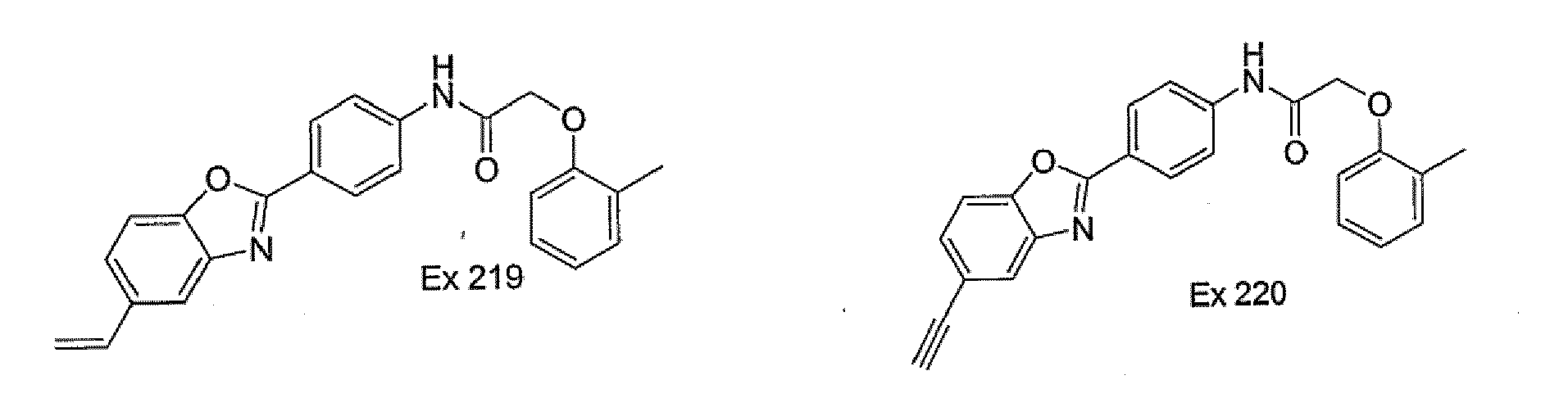


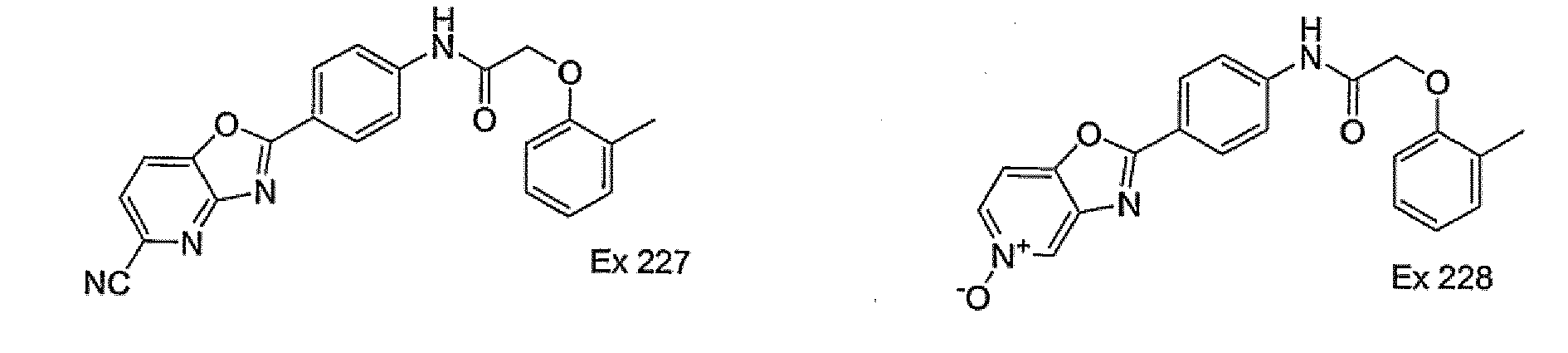


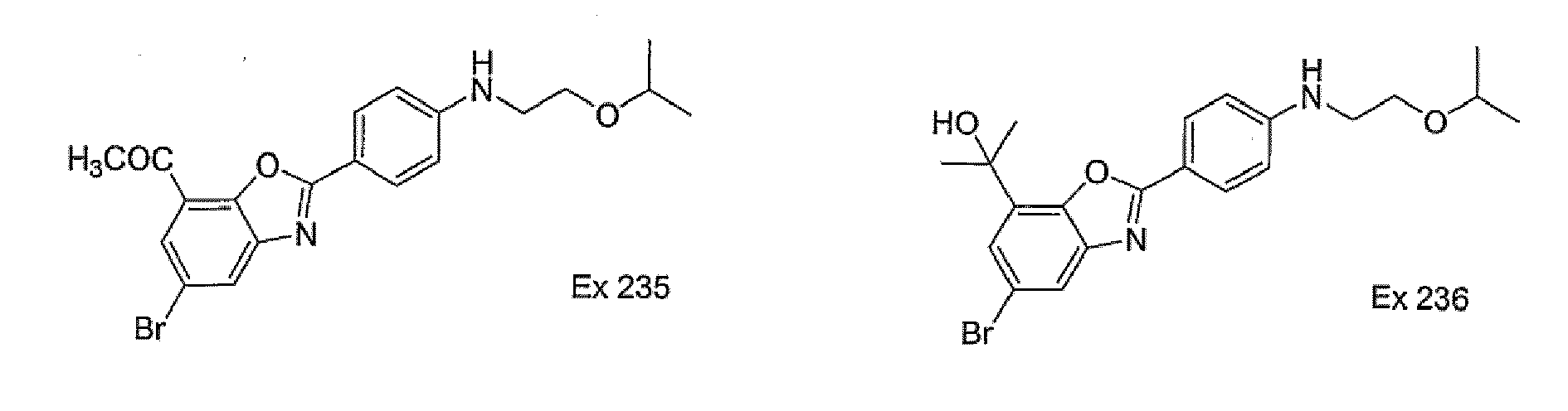


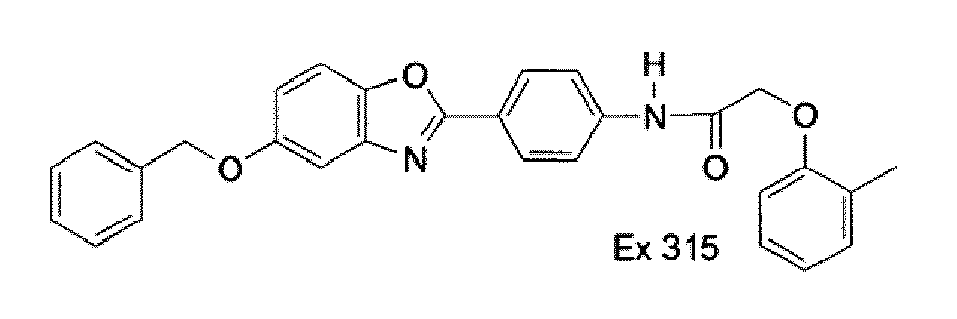


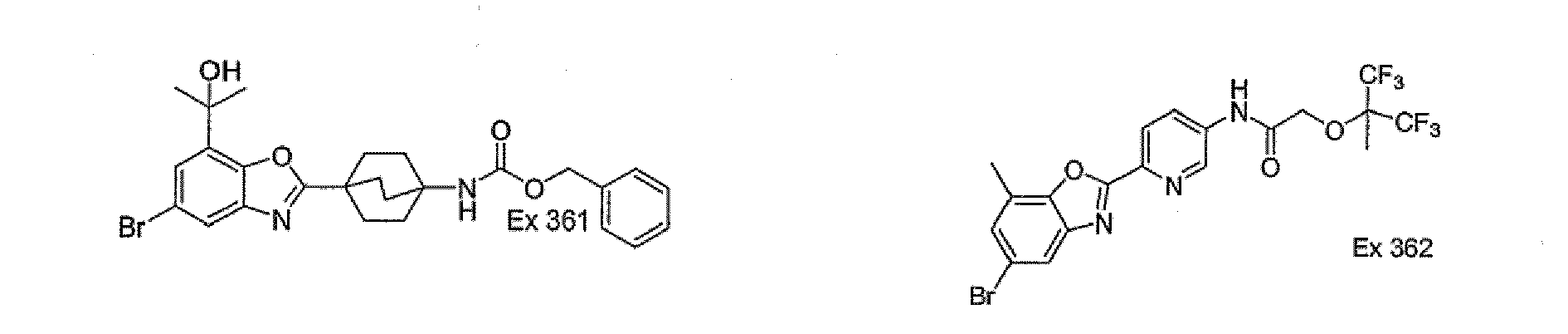


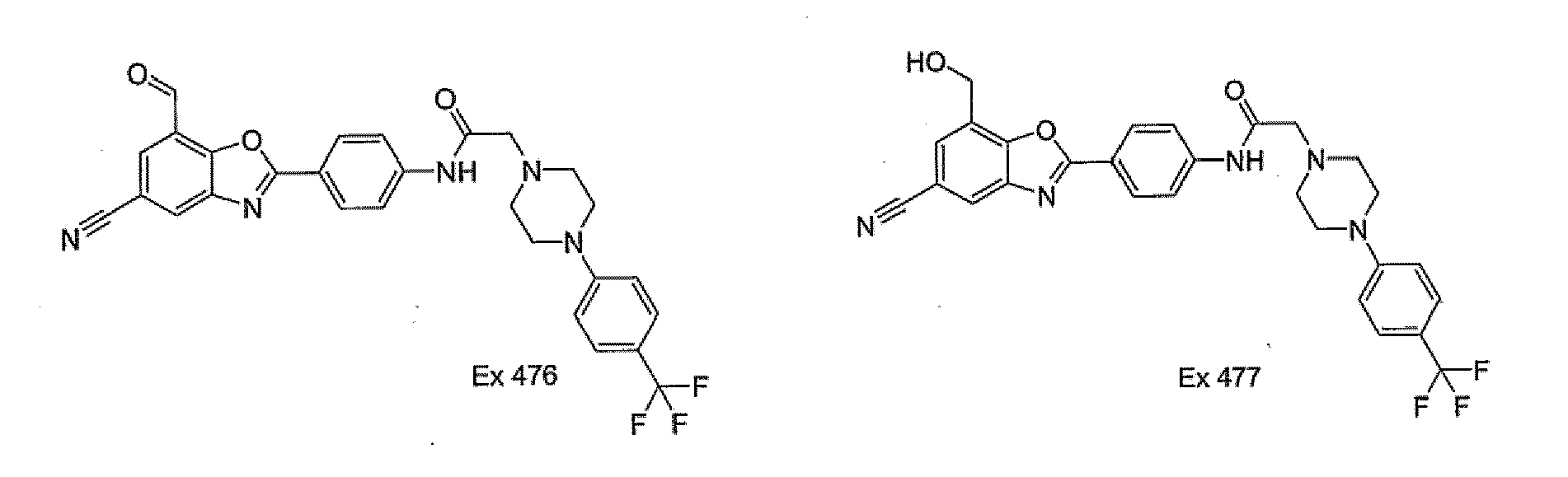


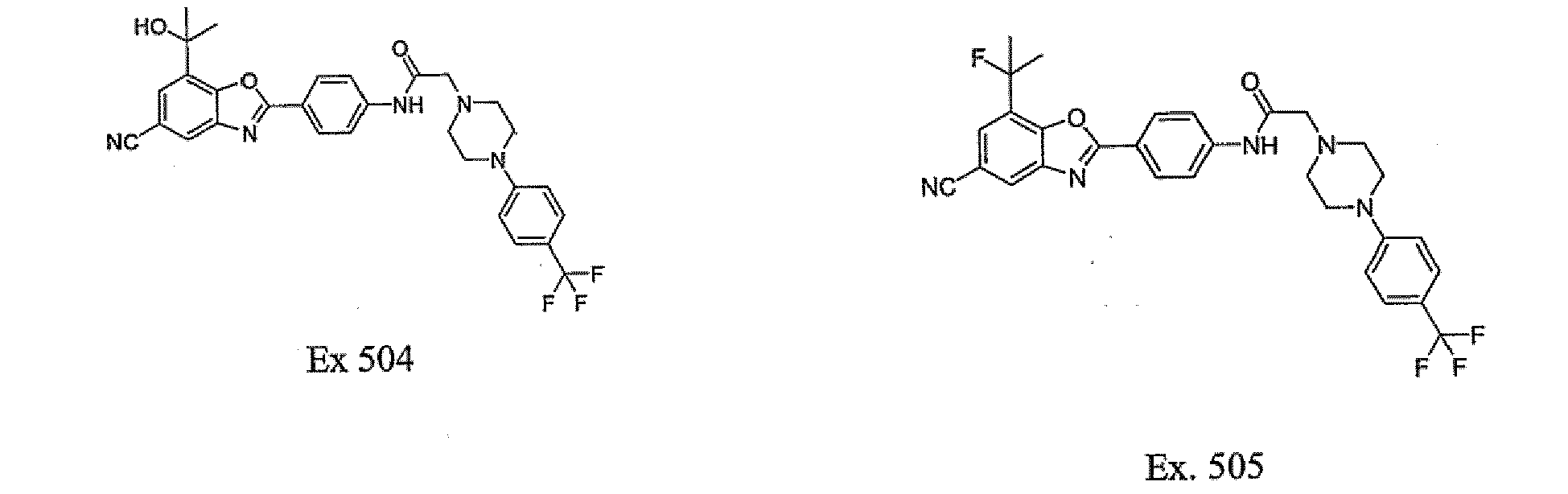


Tabelle 1 
EX R1 R2 R3 39 
H Cl 40 
H Cl 41 
H Cl 42 
H Cl 43 
H Cl 44 
H Cl 45 
H Cl 46 
H Cl 47 
H Cl 48 
H Cl 49 
H Cl 50 
H Cl 51 
H Cl 52 
H Cl 53 
H Cl 54 
H Cl 55 
H Cl 56 
H Cl 57 
H Cl 58 
H Cl 59 
H Cl 60 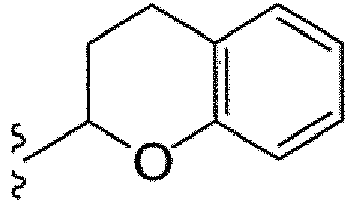
H Cl 61 
H Cl 62 
H Cl 63 
H CN 64 
H CN 65 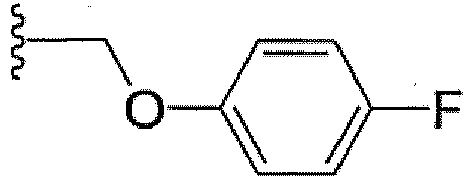
H CN 66 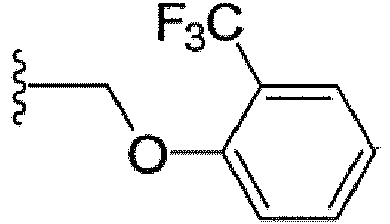
H CN 67 
H CN 68 
H CN 69 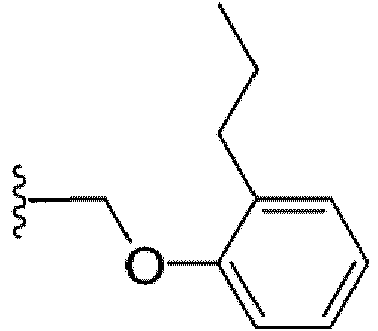
H CN 70 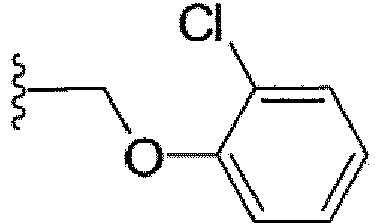
H CN 71 
H CN 72 
H CN 73 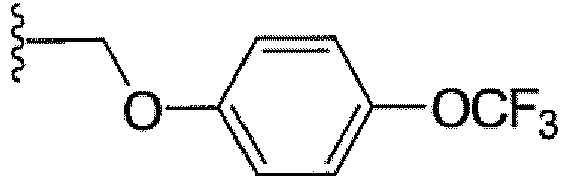
H CN 74 
H CN 75 
H CN 76 
H CN 77 
H CN 78 
H CN 79 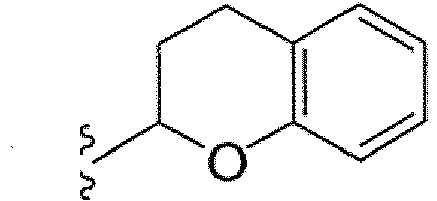
H CN 80 
H CN 81 
H CN 82 
H CN 83 
H CN 84 
H CN 85 
H CN 86 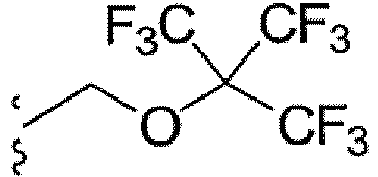
H CN 87 
H CN 88 
H CN 89 
H CN 90 
H CN 91 
H CN 92 
H CN 93 
H CN 94 
H CN 95 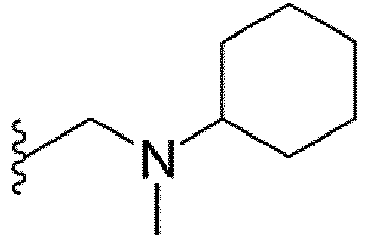
H CN 96 
H CN 97 
H CN 98 
H CN 99 
H CN 100 
H CN 101 
H CN 102 
H CN 103 
H CN 104 
H CN 105 
H CN 106 
H CN 107 
H CN 108 
H CN 109 
H CN 110 
H CN 111 
H CN 112 
H CN 113 
H CN 114 
H CN 115 
H CN 116 
H CN 117 
H CN 118 
H CN 119 
H CN 120 
H CN 121 
H CN 122 
H CN 123 
H CN 124 
H CN 125 
H CN 126 
H CN 127 
H CN 128 
H CN 129 
H CN 130 
H CN 131 
H CN 132 
H CN 133 
H CN 134 
H CN 135 
H CN 136 
H CN 137 
H CN 138 
H CN 139 
H CN 140 
H CN 141 
H CN 142 
H CN 143 
H CN 144 
H CN 145 
H CN 146 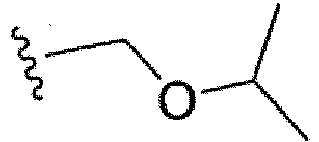
H CN 147 
H CN 148 
H CN 149 
H CN 150 
H CN 151 
H CN 152 
H CN 153 
H CN 154 
H CN 155 
H CN 156 
H CN 157 
CH3 CN 158 
CH3 CN 159 
CH3 CN 160 
CH3 CN 161 
CH3 CN 162 
CH3 CN 163 
CH3 CN Tabelle 2 
EX R1 R2 R3 165 
H CN 166 
H CN 167 
H CN 168 
H CN 169 
H CN 170 
H CN 171 
H CN 172 
H CN 173 
H CN 174 
H CN 175 
H CN 176 
H CN 177 
H CN 178 
H CN 179 
H CN 180 
H CN 181 
H CN 182 
H CN 183 
H CN 184 
CH3 CN 185 
CH3 CN 186 
CH3 CN 187 
CH3 Br 188 
CH3 Br Tabelle 3 
Ex R Ex R 189 
190 
191 
192 
193 
194 
195 
196 
197 
198 
199 
200 
201 
Tabelle 4 
Ex R Ex R 202 
203 
204 
Tabelle 5 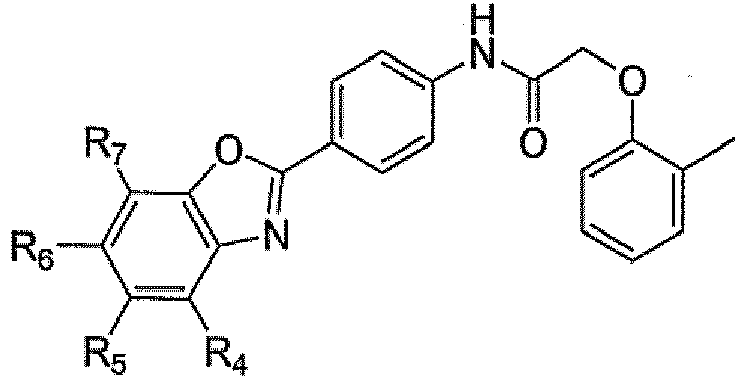
Ex R4 R5 R6 R7 239 H Ph H H 240 H H CO2CH3 H 241 H CO2CH3 H H 242 H CN H H 243 H Cl CH3 H 244 CH3 Br H H 245 H F H H 246 H SCH3 H H 247 H Br H F 248 H Cl H Cl 249 H H F H 250 H H H Cl 251 H OCH3 H H 252 H H NO2 H 253 H NO2 H H 254 CH3 H H H 255 H COCH3 H H 256 H OH H H 257 H Cl H NO2 258 H Br H COCH3 259 H 
H H 260 H 
H H 261 H 
H H 262 H 
H CH3 263 H 
H H 264 H 
H H 265 H 
H H 266 H 
H H 267 H 
H H 268 H 
H H 269 H 
H H 270 H Br H 
271 H Br H 
272 H Br H 
273 H Br H 
274 H Br H 
275 H H CN H 276 H CN H CH3 277 H CN H CO2H 278 H CN CH3 H 279 CH3 CN H H 280 H CN H CN 281 H CN H F 282 H CN H COCH3 283 H CN H 
284 H CN H 
285 H CN H 
286 H CN H 
287 H CN H 
288 H CN H 
Tabelle 9 
Ex R Ex R 320 
321 
322 
323 
324 
325 
326 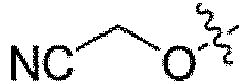
327 
328 
329 
330 
331 
332 
Tabelle 10 
Ex R1 R2 Ex R1 R2 343 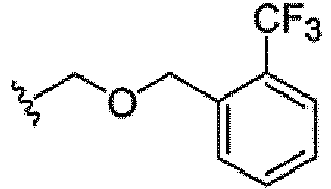
Br 344 
Br 345 
CN 346 
H 347 
CN Tabelle 12 
Ex R6 Ex R6 366 
367 
368 
369 
370 
371 
372 
373 
374 
375 
376 
377 
378 
379 
380 
381 
382 
383 
384 
385 
386 
387 
388 
389 
390 
391 
392 
393 
394 
395 
396 
397 
398 
399 
400 
401 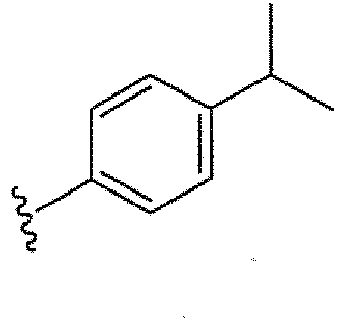
402 
403 
404 
405 
406 
407 
408 
409 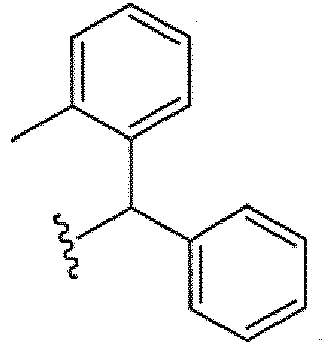
410 
411 
412 
413 
414 
415 
416 
417 
418 
419 
420 
421 
422 
423 
424 
425 
426 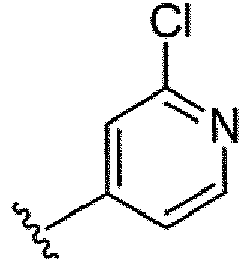
427 
428 
429 
430 
431 
432 
433 
434 
435 
436 
437 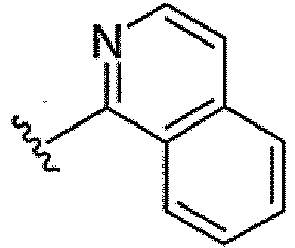
438 
439 
440 
441 
Tabelle 13 
Ex R Ex R 442 
443 
444 
445 
446 
447 
448 
449 
450 
451 
452 
453 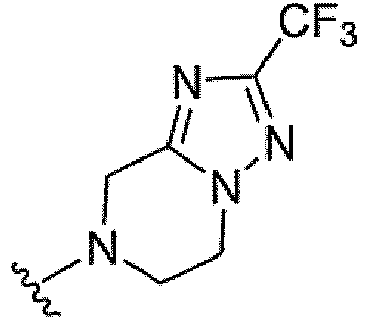
454 
455 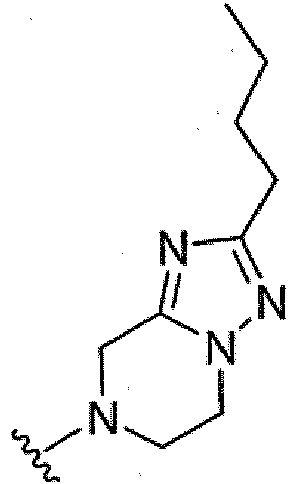
456 
457 
458 
459 
460 
461 
462 
463 
464 
465 
466 
467 
468 
469 
470 
Tabelle 14 
Ex R6 Ex R6 472 
473 
Tabelle 15 
Ex R1 R2 Ex R1 R2 483 
CN 484 
CN 485 
CN 486 Me 
487 
CN 488 
CN 489 
CN 
Tabelle 16 BEISPIEL R1 R2 495 
CN 496 
CN 497 
CN 498 
CN 499 
CN 
Tabelle 17 BEISPIEL R 525 
526 
527 

Tabelle 18 BEISPIEL X R 532 CH 
533 CH 
534 N 
- Die Verbindung mit der Formel Ia oder ein pharmazeutisch annehmbares Salz davon:
 Rw ausgewählt ist aus der Gruppe, bestehend aus (a) C1-C5-Alkyl, das gegebenenfalls substituiert ist mit 1-9 Substituenten, unabhängig ausgewählt aus 1-7 Halogenen und 1-2 Gruppen, unabhängig ausgewählt aus -CN, -OH, -OCH3, -OCF3 und -N(R9)2, (b) C2-5-Alkenyl, gegebenenfalls substituiert mit 1-5 Halogenen, (c) -C(=O)OC1-3-Alkyl, gegebenenfalls substituiert mit 1-5 Halogenen, (d) -C(=O)C1-C3-Alkyl, das gegebenenfalls substituiert ist mit 1-7 Halogenen, (e) -C(=O)H, (f) -NO2, (g) -OC1-C3-Alkyl, das gegebenenfalls substituiert ist mit 1-7 Halogenen, (h) C3-C6-Cycloalkyl, (i) Phenyl, (j) einem 5-6-gliedrigen gesättigten oder teilweise ungesättigten heterocyclischen Ring mit 1-3 Heteroatomen, unabhängig ausgewählt aus N, S und O, und (k) einem 5-7-gliedrigen heteroaromatischen Ring mit 1-3 Heteroatomen, unabhängig ausgewählt aus N, S und O, wobei der C3-C6-Cycloalkyl-, Phenyl-, 5-6-gliedrige gesättigte oder teilweise ungesättigte heterocyclische Ring und der 5-7-gliedrige heteroaromatische Ring gegebenenfalls substituiert sind mit 1-5 Substituenten, unabhängig ausgewählt aus Halogen, CH3, CF3, -OCH3 und -OCF3,Ry ausgewählt ist aus der Gruppe, bestehend aus Br, -OCH3, -CN und Pyridyl,x eine ganze Zahl von 0-2 ist,B ausgewählt ist aus der Gruppe, bestehend aus:- N(R9)(C(=O))DR3,- N(R9)(C(=O))DR7,- N(R9)(C(=O))R3,- N(R9)(C(=O))R7,- N(R9)(C(=O))OCH2R3,- N(R9)D(C(=O))R7,- N(R9)DR3,- N(R9)D2R7,- OD2R3,- SD2R3,- C(=O)CH2CH2R4,- D2(C(=O))R7,- D2R3,- D2R7 und- R3,D eine bifunktionelle Gruppe ist, ausgewählt aus C1-C7-Alkylen, C2-C5-Alkenylen und C2-C5-Alkinylen, wobei die Alkylengruppe gegebenenfalls eine bifunktionelle Gruppe O, S, -NH- oder -N(C1-C3-Alkyl)- zwischen zwei Kohlenstoffatomen von D besitzt, und die Alkylen-, Alkenylen- und Alkinylengruppen gegebenenfalls substituiert sind mit 1-9 Substituenten, unabhängig ausgewählt aus 1-7 Halogenen und gegebenenfalls 1-2 -OH-Gruppen,D2 eine bifunktionelle Gruppe ist, ausgewählt aus C2-C7-Alkylen, C2-C5-Alkenylen und C2-C5-Alkinylen, wobei die Alkylengruppe gegebenenfalls eine bifunktionelle Gruppe O, S, -NH- oder -N(C1-C3-Alkyl)- zwischen zwei Kohlenstoffatomen der Alkylengruppe anders als Carbonyl besitzt, und die Alkylen-, Alkenylen- und Alkinylengruppen gegebenenfalls substituiert sind mit 1-9 Substituenten, unabhängig ausgewählt aus (a) 1-7 Halogenen, (b) 1-2 Substituenten, unabhängig ausgewählt aus -N(R9)2, -CN, -NO2, -OC1-C3-Alkyl, gegebenenfalls substituiert mit 1-3 Halogenen, -C(=O)OH, -C(=O)H, -C(=O)OC1-C5-Alkyl, gegebenenfalls substituiert mit 1-7 Halogenen, -C(=O)C1-C5-Alkyl, gegebenenfalls substituiert mit 1-7 Halogenen, -C(=O)N(R9)2, (c) 1-2 OH-Gruppen und (d) einer Oxogruppe an einem Kohlenstoffatom zwischen zwei anderen Kohlenstoffatomen der Alkylengruppe,R3 ausgewählt ist aus der Gruppe, bestehend aus R4, -T-R4 und -R5,R7 ausgewählt ist aus der Gruppe, bestehend aus -OC1-C7-Alkyl, -CH2S(O)2C1-C7Alkyl, C5-C10-Alkyl, -NR9C1-C7-Alkyl, -NR9C(=O)OC1-C7-Alkyl, -OC(=O)OC1-C7-Alkyl und -OSi(R8)3, wobei die C5-C10-Alkyl- und C1-C7-Alkylgruppen von R7 gegebenenfalls substituiert sind mit 1-9 Halogenen und gegebenenfalls substituiert sind mit einer Gruppe, ausgewählt aus -N(R9)2, -N(R9)C(=O)OC1-C7-Alkyl, -N(R9)C(=O)C1-C7-Alkyl und -OH, wobei die C1-C7-Alkylgruppen der -N(R9)C(=O)OC1-C7-Alkyl- und -N(R9)C(=O)C1-C7-Alkyl-Substituenten an R7 gegebenenfalls substituiert sind mit 1-9 Halogenen,T ausgewählt ist aus -O-, -N(R9)- und -S-,jede R8-Gruppe unabhängig ausgewählt ist aus C1-C5-Alkyl, das gegebenenfalls substituiert ist mit 1-7 Halogenen,R4 eine cyclische Gruppe ist, ausgewählt aus der Gruppe, bestehend aus(a) C3-C8-Cycloalkyl, das gegebenenfalls 1-2 Doppelbindungen enthält,(b) bicyclischem C6-C12-Cycloalkyl, das gegebenenfalls 1-2 Doppelbindungen enthält,(c) einem 4-8-gliedrigen gesättigten oder teilweise ungesättigten heterocyclischen Ring mit 1-2 Ringelementen, unabhängig ausgewählt aus -O- und -N(R6)-, wobei der heterocyclische Ring mit dem linken Teil der Formel I durch ein Kohlenstoffatom des heterocyclischen Rings verbunden ist, wobei der heterocyclische Ring gegebenenfalls an einen aromatischen Ring, ausgewählt aus Phenyl und Naphthyl, oder an ein C5-C7-Cycloalkyl kondensiert ist,(d) einem aromatischen Ring, ausgewählt aus Phenyl und Naphthyl, und(e) einem 5-7-gliedrigen heteroaromatischen Ring mit 1-3 Heteroatomen, unabhängig ausgewählt aus N, S und O, und gegebenenfalls mit einer -C(=O)-Gruppe als ein Ringelement, wobei der heteroaromatische Ring mit dem linken Teil der Formel I durch ein Kohlenstoffatom des heteroaromatischen Rings verbunden ist, wobei die heteroaromatische Gruppe gegebenenfalls an einen aromatischen Ring, ausgewählt aus Phenyl und Naphthyl, kondensiert ist,wobei die cyclischen Gruppen R4, die in (a) - (e) definiert sind, einschließlich optionaler kondensierter Ringe, gegebenenfalls substituiert sind mit 1-7 Substituenten, unabhängig ausgewählt aus Halogen, C1-C5-Alkyl, -OC1-C5-Alkyl, Phenyl, -NO2, -C(=O)C1-C5-Alkyl, -C(=O)OC1-C5-Alkyl, -C(=O)OH und -NR9C(=O)C1-C5-Alkyl, wobei C1-C5-Alkyl und OC1-C5-Alkyl bei allen Anwendungen gegebenenfalls substituiert sind mit 1-9 Halogenen, und das Phenyl gegebenenfalls substituiert ist mit 1-5 Substituenten, unabhängig ausgewählt aus Halogen, CH3, CF3, -OCH3 und -OCF3,R5 eine gesättigte oder teilweise ungesättigte 5-8-gliedrige monocyclische heterocyclische Gruppe oder eine gesättigte oder teilweise ungesättigte 6-10-gliedrige bicyclische heterocyclische Gruppe ist, wobei die heterocyclische Gruppe ein Heteroatom N, verbunden mit der linken Seite der Formel I, besitzt und gegebenenfalls ein zweites Heteroatom besitzt, ausgewählt aus O, S und -N(R6)-, wobei die heterocyclische Gruppe gegebenenfalls 1-2 Doppelbindungen und eine optionale Carbonylgruppe besitzt und gegebenenfalls an eine cyclische Gruppe, ausgewählt aus Phenyl und einem 5-7-gliedrigen heteroaromatischen Ring mit 1-3 Heteroatomen, unabhängig ausgewählt aus O, N und S, kondensiert ist oder gegebenenfalls durch eine Spiro-Verknüpfung eines Kohlenstoffatoms an einen 5-6-gliedrigen Cycloalkylring oder an einen 5-7-gliedrigen heterocyclischen Ring mit einem Heteroatom, ausgewählt aus O, N und S(O)x, verbunden ist, wobei der Cycloalkyl- und der heterocyclische Ring gegebenenfalls eine Doppelbindung besitzen und gegebenenfalls an einen Phenylring kondensiert sind, wobei R5, einschließlich der Ringe, die gegebenenfalls an R5 kondensiert oder mit R5 durch eine Spiro-Verknüpfung verbunden sind, gegebenenfalls mit 1-9 Halogenatomen substituiert ist und gegebenenfalls substituiert ist mit 1-3 Substituenten, unabhängig ausgewählt aus C1-C5-Alkyl; -OC1-C5-Alkyl; -NO2; -N(R9)C(=O)OCH2Phenyl, -S(O)2C1-C3-Alkyl; C3-C6-Cycloalkyl; -CO2H; -C(=O)C1-C3-Alkyl; -C(=O)OC1-C3-Alkyl; -C(=O)N(R9)2; -C1-C3-AlkylenN(R9)2; -C1-C3-AlkylenC(=O)N(R9)2; Phenyl; -C1-C3-Alkylenphenyl; einer 5-10-gliedrigen heteroaromatischen monocyclischen oder kondensierten bicyclischen Gruppe mit 1-3 Heteroatomen, unabhängig ausgewählt aus N, O und S; einem 5-6-gliedrigen gesättigten oder teilweise ungesättigten heterocyclischen Ring mit 1-3 Heteroatomen, unabhängig ausgewählt aus N, O und S, gegebenenfalls mit einer Carbonylgruppe, gegebenenfalls mit einer Doppelbindung und gegebenenfalls kondensiert an einen Phenylring; und einem 5-6-gliedrigen heteroaromatischen Ring mit 1-2 Heteroatomen, unabhängig ausgewählt aus N, S und O, wobei der heteroaromatische Ring an ein 5-7-gliedriges Cycloalkyl oder an einen gesättigten oder teilweise ungesättigten Heterocyclus mit 1-2 Heteroatomen, unabhängig ausgewählt aus N, S und O, kondensiert ist; wobei sämtliche Alkylgruppen, die in Substituentengruppen an R5 enthalten sind, gegebenenfalls mit 1-9 Halogenen substituiert sind, und sämtliche Phenylgruppen, die Substituenten an R5 sind oder die in Substituenten an R5 enthalten sind, gegebenenfalls substituiert sind mit 1-5 Substituenten, unabhängig ausgewählt aus Halogen, -CN, -NO2, CH3, CF3, -OCH3 und -OCF3,R6 ausgewählt ist aus der Gruppe, bestehend aus C1-C7-Alkyl, -C(=O)OC1-C7-Alkyl, -C(=O)C1-C7-Alkyl, -S(O)x-Phenyl, -S(O)xC1-C7-Alkyl, -C(=O)N(R9)2, -C(=O)Phenyl, -C(=O)OPhenyl, -C1-C3-Alkylen-C(=O)OC1-C6-Alkyl, -C1-C5-Alkylen-OC1-C5-alkyl, -C(=O)C3-C7-Cycloalkyl, -C(=O)OC3-C7-Cycloalkyl und einer cyclischen Gruppe, ausgewählt aus (a) Phenyl, (b) Naphthyl, (c) Biphenyl, (d) C3-C8-Cycloalkyl, (e) einem gesättigten oder teilweise ungesättigten monocyclischen oder bicyclischen 5-10-gliedrigen Heterocyclus mit 1-2 Heteroatomen, unabhängig ausgewählt aus N, O und S, wobei der Heterocyclus gegebenenfalls 1-2 Doppelbindung enthält, und (f) einer monocyclischen oder bicyclischen 5-12-gliedrigen heteroaromatischen Gruppe mit 1-4 Heteroatomen, unabhängig ausgewählt aus N, S und O, und gegebenenfalls mit 1-2 Carbonylgruppen, wobei in allen Fällen jede Alkyl-, Alkenyl- und Alkinylgruppe, die in R6 enthalten ist, gegebenenfalls mit 1-10 Halogenen substituiert ist und auch gegebenenfalls mit 1-2 Gruppen substituiert ist, unabhängig ausgewählt aus Phenyl, OH, Biphenyl, -OPhenyl und -OC1-C3-Alkylenphenyl, wobei die Phenylsubstituenten an den Alkyl-, Alkenyl- und Alkinylgruppen von R6 gegebenenfalls substituiert sind mit 1-5 Substituentengruppen, unabhängig ausgewählt aus Halogen, CH3, CF3, -OCF3, -NO2 und -OCH3, und, wenn R6 eine cyclische Gruppe ist, ausgewählt aus (a) Phenyl, (b) Naphthyl, (c) Biphenyl, (d) C3-C8-Cycloalkyl, (e) einem gesättigten oder teilweise ungesättigten monocyclischen oder bicyclischen 5-10-gliedrigen Heterocyclus mit 1-2 Heteroatomen, unabhängig ausgewählt aus N, O und S, wobei der Heterocyclus gegebenenfalls 1-2 Doppelbindungen enthält, und (f) einer cyclischen oder bicyclischen 5-12-gliedrigen heteroaromatischen Gruppe mit 1-4 Heteroatomen, unabhängig ausgewählt aus N, S und O, und gegebenenfalls mit 1-2 Carbonylgruppen, die cyclische Gruppe R6 gegebenenfalls substituiert ist mit 1-3 Gruppen, unabhängig ausgewählt aus C1-C5-Alkyl, -OC1-C5-Alkyl, -C(=O)C1-C3-Alkyl, -S(O)xC1-C3-Alkyl, Phenyl, Halogen, -CN und -NO2, wobei C1-C5-Alkyl und -OC1-C5-Alkyl gegebenenfalls substituiert sind mit 1-7 Halogenen, undR9 ausgewählt ist aus der Gruppe, bestehend aus H, C1-C5-Alkyl, -C2-C5-Alkenyl und C2-C5-Alkinyl, wobei C1-C5-Alkyl, C2-C5-Alkenyl und C2-C5-Alkinyl gegebenenfalls substituiert sind mit 1-9 Halogenen,mit der Maßgabe (I), dass, wenn Rw und/oder Ry -OCH3 ist, B dann nicht -N(H)C(=O)(CH2)5NH(C(=O))CF3 oder -N(H)C(=O)CH(NH2)(C4-Alkyl) ist,
und mit der weiteren Maßgabe (II), dass, wenn Rw -OCH3 oder C1-C4-Alkyl ist und/oder Ry -OCH3 oder Br ist, B dann nicht -NHC(=O)Phenyl, NHC(=O)Cyclobutyl, -NHC(=O)(CH=CH)(1,4-Furyl)phenyl, -NHC(=O)(1,4-furyl)phenyl, -NHC(=O)(CH2)(CH2)(1,2,4-Oxadiazolyl)phenyl, -NHC(=O)(Cyclopentyl)phenyl oder NHC(=O)Biphenyl ist, wobei Phenyl in allen Fällen gegebenenfalls mit 1-2 Substituenten, unabhängig ausgewählt aus Halogen, Methoxy und C1-4-Alkyl, substituiert ist. - Die Verbindung nach Anspruch 6 mit der Formel Ib oder ein pharmazeurisch annehmbares Salz davon:
 wobei Rw ausgewählt ist aus der Gruppe, bestehend aus (b) C1-C5-Alkyl, das gegebenenfalls substituiert ist mit 1-9 Substituenten, unabhängig ausgewählt aus 1-7 Halogenen und 1-2 Gruppen, unabhängig ausgewählt aus -CN, -OH, -OCH3, -OCF3 und -N(R9)2, (c) C2-5-Alkenyl, gegebenenfalls substituiert mit 1-5 Halogenen, (d) -C(=O)OC1-3-Alkyl, gegebenenfalls substituiert mit 1-5 Halogenen, (e) -C(=O)C1-C3-Alkyl, das gegebenenfalls substituiert ist mit 1-7 Halogenen, (f) -C(=O)H, (g) -NO2, (h) -OC1-C3-Alkyl, das gegebenenfalls substituiert ist mit 1-7 Halogenen, (i) C3-C6-Cycloalkyl, (j) Phenyl, (k) einem 5-6-gliedrigen gesättigten oder teilweise ungesättigten heterocyclischen Ring mit 1-3 Heteroatomen, unabhängig ausgewählt aus N, S und O, und (l) einem 5-7-gliedrigen heteroaromatischen Ring mit 1-3 Heteroatomen, unabhängig ausgewählt aus N, S und O, wobei der C3-C6-Cycloalkyl-, Phenyl-, 5-6-gliedrige gesättigte oder teilweise ungesättigte heterocyclische Ring und der 5-7-gliedrige heteroaromatische Ring gegebenenfalls substituiert sind mit 1-5 Substituenten, unabhängig ausgewählt aus Halogen, CH3, CF3, -OCH3 und -OCF3, undR9 unabhängig ausgewählt ist aus H und CH3.
 - Die Verbindung nach Anspruch 6 oder 7 oder ein pharmazeurisch annehmbares Salz davon, wobei
B ausgewählt ist aus der Gruppe, bestehend aus:-(NH)(C(=O))CH2R3,-(NH)(C(=O))CH2CH2R3,-(NH)(C(=O))CH2O(CH2)3R7,-(NH)(C(=O))OCH2R4,-C2-C4-Alkylen-R3, wobei -C2-C4-Alkylen gegebenenfalls eine bifunktionelle Gruppe O, S, -NH-oder -N(CH3)- zwischen zwei Kohlenstoffatomen besitzt und gegebenenfalls substituiert ist mit 1-8 Substituenten, unabhängig ausgewählt aus (a) 1-7 Halogenen, (b) 1-2 Substituenten, unabhängig ausgewählt aus -N(R9)2, -CN, -OC1-C3-Alkyl, gegebenenfalls substituiert mit 1-3 Halogenen, -C(=O)OH, -C(=O)H, -C(=O)OC1-C5-Alkyl, gegebenenfalls substituiert mit 1-7 Halogenen, -C(=O)C1-C5-Alkyl, gegebenenfalls substituiert mit 1-7 Halogenen, -C(=O)N(R9)2, (c) 1-2 -OH-Gruppen und (d) einer Oxo-Gruppe an einem Kohlenstoffatom zwischen zwei anderen Kohlenstoffatomen der Alkylengruppe,-C2-C4-Alkylen-R7, wobei -C2-C4-Alkylen gegebenenfalls eine bifunktionelle Gruppe O, S, -NH- oder -N(CH3)- zwischen zwei Kohlenstoffatomen besitzt und gegebenenfalls substituiert ist mit 1-8 Substituenten, unabhängig ausgewählt aus (a) 1-7 Halogenen, (b) 1-2 Substituenten, unabhängig ausgewählt aus -N(R9)2, -CN, -C(=O)OH, -C(=O)H, -C(=O)OC1-C5-Alkyl, gegebenenfalls substituiert mit 1-7 Halogenen, -C(=O)C1-C5-Alkyl, gegebenenfalls substituiert mit 1-7 Halogenen, -C(=O)N(R9)2, (c) 1-2 -OH-Gruppen und (d) einer Oxo-Gruppe an einem Kohlenstoffatom zwischen zwei anderen Kohlenstoffatomen der Alkylengruppe,-CH=CHCH2R3,-CH=CHCH2R7,-C≡CCH2R3,-C≡CCH2R7,-NHCH2CH2R3,-NHCH(CF3)CH2R7,-NHCH2C(=O)R5,-CH(OH)CH(OH)C(=O)OC1-C4-Alkyl, undjedes R9 unabhängig ausgewählt ist aus H und CH3. - Die Verbindung nach Anspruch 8 oder eine pharmazeutisch annehmbares Salz davon, wobei:R3 ausgewählt ist aus der Gruppe, bestehend aus R4, -OR4 und -R5,R4 eine cyclische Gruppe ist, ausgewählt aus der Gruppe, bestehend aus:(a) Cyclohexyl,(b) 2-Chinolyl,(c) 1-Isochinolyl,(d) Phenyl,(e) 2-Tetrahydropyranyl,(f)
 (g)
(g) (h)wobei R4 gegebenenfalls substituiert ist mit 1-3 Substituenten, unabhängig ausgewählt aus -CH3, -CF3, -OCH3, -OCF3 und Halogen,
 R5 ausgewählt ist aus der Gruppe, bestehend aus:(a)
 (b)
(b) (c)
(c) (d)
(d) (e)
(e) (f)
(f) (g)
(g) wobei R10 ausgewählt ist aus der Gruppe, bestehend aus -SO2CF3, -SO2CH3 und -C(=O)CH3,R11 ausgewählt ist aus der Gruppe, bestehend aus H, C1-C5-Alkyl, Phenyl und Benzyl, wobei C1-C5-Alkyl gegebenenfalls substituiert ist mit 1-3 Halogenen, und wobei Phenyl und Benzyl gegebenenfalls substituiert sind mit 1-3 Gruppen, unabhängig ausgewählt aus Halogen, -CH3, -CF3, -OCH3 und -OCF3,R12 ausgewählt ist aus der Gruppe, bestehend aus H, C1-C3-Alkyl, das gegebenenfalls mit 1-3 Halogenen substituiert ist, und -CH2C(=O)N(R9)2,wobei, wenn R5 (a) oder (d) - (g) ist, R5 dann gegebenenfalls substituiert ist mit 1-3 Substituentengruppen, unabhängig ausgewählt aus Halogen, -CH3, -CF3, -OCH3 und -OCF3, und, wenn R5 (b) oder (c) ist, R5 dann gegebenenfalls substituiert ist mit 1-2 Substituenten, unabhängig ausgewählt aus Halogen, Cyclohexyl, Phenyl, -C(=O)N(R9)C2-C5-Alkyl, -C(=O)OC1-C4-Alkyl, Benzotriazol, Pyrazoltetrahydropyridin und -N(C2-C3-Alkenyl)(C(=O))O-benzyl, wobei Alkyl und Alkenyl gegebenenfalls substituiert sind mit 1-3 Halogenen, und Phenyl und das Phenyl von Benzyl gegebenenfalls substituiert sind mit 1-3 Halogenen und 1 Gruppe, ausgewählt aus -CH3, -CF3, -OCH3, -OCF3 und -NO2,x eine ganze Zahl von 0-2 ist,R6 ausgewählt ist aus der Gruppe, bestehend aus:(a) Phenyl,(b) Pyrimidinyl,(c) Pyrazinyl,(d) Pyridyl,(e) Naphthyl,(f) C3-C6-Cycloalkyl,(g) CH(Phenyl)2,(h) -C(=O)OC1-C5-Alkyl,(i) -C(=O)C1-C5-Alkyl,(j) -SO2C1-C3-Alkylenphenyl,(k) -SO2C1-C5-Alkyl,(l) -C(=O)OC3-C5-Alkylen-OH,(m) -C(=O)OC3-C5-Alkylen-O-benzyl,(n) -C(=O)O-Phenyl,(o) -C(=O)O-Benzyl,(p) -C(=O)N(R9)C1-C5-Alkyl,(q) -C(=O)OC5-C6-Cycloalkyl,(r) -CH2C(=O)OC1-C5-Alkyl,(s) C1-C3-Alkylenphenyl und(t) C4-C6-Alkyl,wobei die Alkyl-, Alkylen- und Cycloalkylgruppen gegebenenfalls mit 1-3 Halogenen substituiert sind; Phenyl, die Phenylgruppen von Benzyl und das Naphthyl gegebenenfalls substituiert sind mit 1-3 Substituenten, unabhängig ausgewählt aus (i) Halogen, (ii) C1-C3-Alkyl, gegebenenfalls substituiert mit 1-3 Halogenen, (iii) -OCF3, (iv) -OCH3, (v) -NO2, (vii) Phenyl, (viii) -CN, (ix) -C(=O)CH3 und (x) -SO2CH3; und Pyridyl, Pyrimidinyl und Pyrazinyl gegebenenfalls substituiert sind mit 1-3 Substituenten, unabhängig ausgewählt aus Halogen, -CH3, -CF3, -OCH3, -OCF3, -NO2, -CN und Phenyl, undR7 ausgewählt ist aus der Gruppe, bestehend aus -OC3-C5-Alkyl, -N(R9)C(=O)OC3-C5-Alkyl und -OSi(CH3)2C3-C6-Alkyl, wobei jede Alkylgruppe gegebenenfalls mit 1-3 Halogenen substituiert ist.
 - Die Verbindung nach Anspruch 7 oder ein pharmazeurisch annehmbares Salz davon, wobei B ausgewählt ist aus der Gruppe, bestehend aus:(a) -NHC(=O)CH2OR4,(b) -NHC(=O)CH2R3,(c) -NHCH2CH2R3,(d) -SCH2CH2R3,(e) -C(=O)CH2CH2R3,(f) -CH2CH2CH2R3, wobei die Propylenkette gegebenenfalls substituiert ist mit 1-2 Halogenen, einer -OH-Gruppe oder einer Methylengruppe (=CH2),(g) -CH2TCH2R3,(h) -CH2C(=O)CH2R3 und(i) -CH2CH2TR4,T ausgewählt ist aus der Gruppe, bestehend aus O, -NH- und S,
R3 ausgewählt ist aus R4 und R5,
R4 ausgewählt ist aus der Gruppe, bestehend aus 4-Piperidinyl mit einem R6-Substituenten am N, Cyclohexyl und Phenyl, wobei 4-Piperidinyl gegebenenfalls substituiert ist mit 1-2 Substituenten, unabhängig ausgewählt aus F, CH3 und CF3, und Phenyl und Cyclohexyl gegebenenfalls substituiert sind mit 1-3 Substituenten, unabhängig ausgewählt aus Halogen, CH3, CF3, OCH3 und OCF3,
R5 ausgewählt ist aus der Gruppe, bestehend aus 1-Pyrrolidinyl, 1-Piperidinyl und 1-Piperazinyl, wobei das N an der 4-Position von 1-Piperazinyl substituiert ist mit R6, und die Pyrrolidinyl-, Piperidinyl- und Piperazinylgruppen gegebenenfalls substituiert sind mit 1-2 Substituenten, unabhängig ausgewählt aus F, CH3 und CF3, und
R6 ausgewählt ist aus der Gruppe, bestehend aus -C(=O)OC1-C5-Alkyl, -C(=O)C1-C3-Alkyl, gegebenenfalls substituiert mit 1-3 F, Phenyl, Pyridyl und Pyrimidinyl, wobei Pyridyl, Pyrimidinyl und Phenyl gegebenenfalls substituiert sind mit 1-3 Gruppen, unabhängig ausgewählt aus Halogen, CH3, CF3, OCH3 und OCF3, und gegebenenfalls einem Phenyl. - Die Verbindung nach Aspruch 10, wobei Rw ausgewählt ist aus der Gruppe, bestehend aus -OCH3, -OCF3, -C(=O)OCH3, C1-C3-Alkyl und C2-C3-Alkenyl, wobei C1-C3 Alkyl und C2-C3-Alkenyl jeweils gegebenenfalls substituiert sind mit 1-3 Halogenen und einem -OH.
- Die Verbindung nach Aspruch 6 oder ein pharmazeutisch annehmbares Salz davon, ausgewählt aus den nachstehenden Strukturen:


Tabelle 1 
EX R1 R2 R3 157 
CH3 CN 158 
CH3 CN 159 
CH3 CN 160 
CH3 CN 161 
CH3 CN 162 
CH3 CN 163 
CH3 CN Tabelle 2 
EX R1 R2 R3 184 
CH3 CN 185 
CH3 CN 186 
CH3 CN 187 
CH3 Br 188 
CH3 Br Tabelle 3 
Ex R Ex R 189 
190 
191 
192 
193 
194 
195 
196 
197 
198 
199 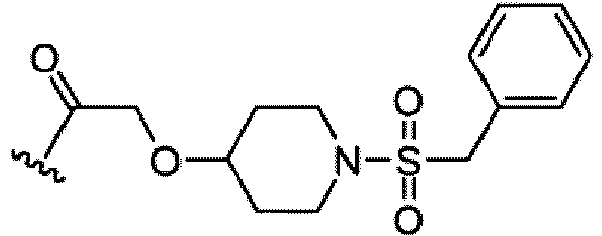
200 
201 
Tabelle 5 
Ex R4 R5 R6 R7 258 H Br H COCH3 262 H 
H CH3 270 H Br H 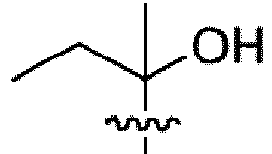
271 H Br H 
272 H Br H 
276 H CN H CH3 277 H CN H CO2H 282 H CN H COCH3 283 H CN H 
284 H CN H 
285 H CN H 
286 H CN H 
287 H CN H 
Tabelle 12 
Ex R6 Ex R6 366 
367 
368 
369 
370 
371 
372 
373 
374 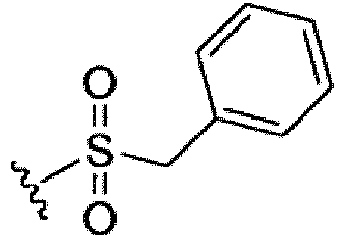
375 
376 
377 
378 
379 
380 
381 
382 
383 
384 
385 
386 
387 
388 
389 
390 
391 
392 
393 
394 
395 
396 
397 
398 
399 
400 
401 
402 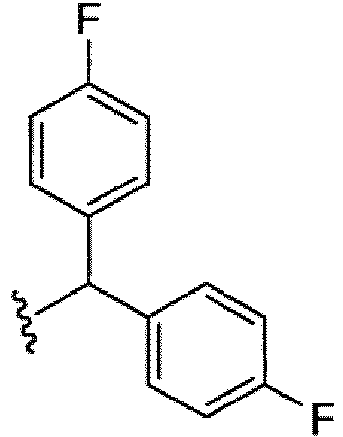
403 
404 
405 
406 
407 
408 
409 
410 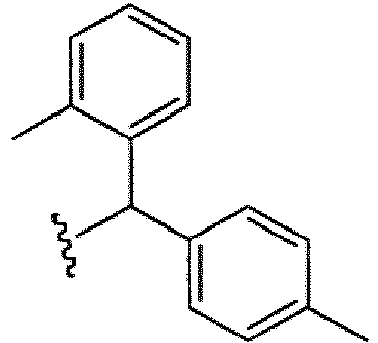
411 
412 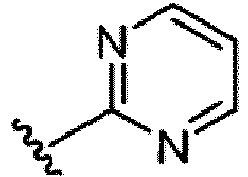
413 
414 
415 
416 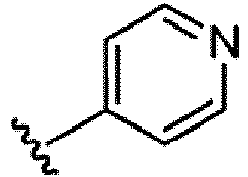
417 
418 
419 
420 
421 
422 
423 
424 
425 
426 
427 
428 
429 
430 
431 
432 
433 
434 
435 
436 
437 
438 
439 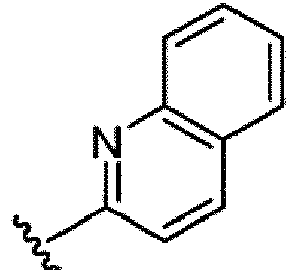
440 
441 
Tabelle 13 
Ex R Ex R 442 
443 
444 
445 
446 
447 
448 
449 
450 
451 
452 
453 
454 
455 
456 
457 
458 
459 
460 
461 
462 
463 
464 
465 
466 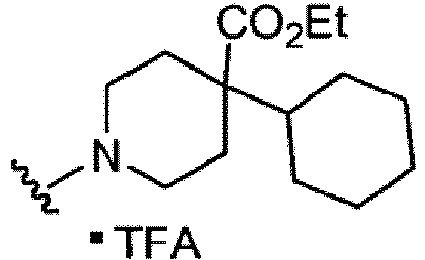
467 
468 
469 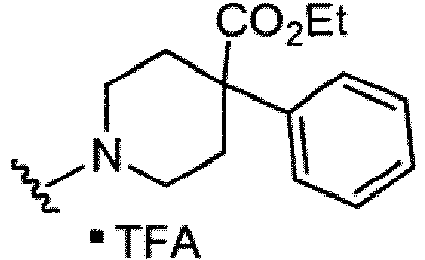
470 
Tabelle 14 
Ex R6 Ex R6 472 
473 
Tabelle 15 
Ex R1 R2 Ex R1 R2 483 
CN 484 
CN 485 
CN 486 Me 
487 
CN 488 
CN 489 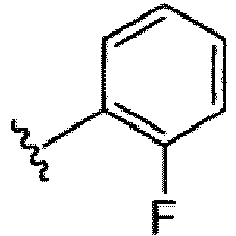
CN 
Tabelle 16 BEISPIEL R1 R2 495 
CN 496 
CN 497 
CN 498 
CN 499 
CN 
Tabelle 17 BEISPIEL R 525 
526 
527 
- Eine pharmazeutische Zusammensetzung, die eine Verbindung nach einem der Ansprüche 6 bis 12 oder ein pharmazeutisch annehmbares Salz davon und einen pharmazeutisch annehmbaren Träger umfasst.
- Eine Verbindung gemäß einem der Ansprüche 6 bis 12 oder ein pharmazeutisch annehmbares Salz davon zur Verwendung in der Therapie.
- Eine Verbindung nach einem der Ansprüche 6 bis 12 oder ein pharmazeutisch annehmbares Salz davon zur Verwendung bei der Behandlung von Atherosklerose oder zur HDL-Erhöhung.
- Die Verwendung einer Verbindung nach einem der Ansprüche 6 bis 12 oder eines pharmazeutisch annehmbaren Salzes davon zur Herstellung eines Medikaments zur Behandlung von Atherosklerose oder zur Erhöhung von HDL-Cholesterin.
- Eine Kombination aus einer Verbindung nach einem der Ansprüche 6 bis 12 oder einem pharmazeutisch annehmbaren Salz davon und einem oder mehreren Wirkstoffen, ausgewählt aus der Gruppe, bestehend aus:(a) PPAR-gamma-Agonisten und -Teilagonisten,(b) Biguaniden,(c) Protein-Tyrosin-Phosphatase-1B(PTP-1B)-Inhibitoren,(d) Dipeptidylpeptidase-IV(DP-IV)-Inhibitoren,(e) Insulin oder Insulin-Mimetika,(f) Sulfonylharnstoffen,(g) α-Glucosidase-Inhibitoren,(h) einer oder mehreren Verbindungen, ausgewählt aus der Gruppe, bestehend aus (a) HMG-CoA-Reduktase-Inhibitoren, (b) Gallensäuresequestriermitteln, (c) Niacin, Nicotinylalkohol, Nicotinamid und Nicotinsäure oder einem Salz davon, (d) PPARα-Agonisten, (e) Cholesterinabsorptionsinhibitoren, (f) Acyl-CoA:Cholesterinacyltransferase-Inhibitoren (ACAT-Inhibitoren), (g) phenolischen Antioxidantien, wie z.B. Probucol, und (h) einem mikrosomalen Triglyceridtransfer-Protein (MTP)/ApoB-Sekretions-Inhibitor,(i) dualen PPARα/γ-Agonisten,(j) PPARδ-Agonisten,(k) Verbindungen gegen Adipositas,(l) Ileum-Gallensäure-Transporter-Inhibitoren,(m) Antiphlogistika,(n) Glucagonrezeptorantagonisten,(o) GLP-1,(p) GIP-1 und(q) GLP-1-Analoga.
Applications Claiming Priority (2)
| Application Number | Priority Date | Filing Date | Title |
|---|---|---|---|
| US73216805P | 2005-10-31 | 2005-10-31 | |
| PCT/US2006/042208 WO2007070173A2 (en) | 2005-10-31 | 2006-10-30 | Cetp inhibitors |
Publications (4)
| Publication Number | Publication Date |
|---|---|
| EP1954287A2 EP1954287A2 (de) | 2008-08-13 |
| EP1954287A4 EP1954287A4 (de) | 2010-05-05 |
| EP1954287B1 EP1954287B1 (de) | 2011-11-16 |
| EP1954287B2 true EP1954287B2 (de) | 2016-02-24 |
Family
ID=38163381
Family Applications (1)
| Application Number | Title | Priority Date | Filing Date |
|---|---|---|---|
| EP06826999.2A Not-in-force EP1954287B2 (de) | 2005-10-31 | 2006-10-30 | Cetp-inhibitoren |
Country Status (7)
| Country | Link |
|---|---|
| US (1) | US8334290B2 (de) |
| EP (1) | EP1954287B2 (de) |
| JP (1) | JP5301999B2 (de) |
| AT (1) | ATE533485T1 (de) |
| AU (1) | AU2006325294B2 (de) |
| CA (1) | CA2627722A1 (de) |
| WO (1) | WO2007070173A2 (de) |
Families Citing this family (44)
| Publication number | Priority date | Publication date | Assignee | Title |
|---|---|---|---|---|
| TW201018678A (en) | 2006-01-27 | 2010-05-16 | Astrazeneca Ab | Novel heteroaryl substituted benzothiazoles |
| ATE478067T1 (de) | 2006-03-31 | 2010-09-15 | Janssen Pharmaceutica Nv | Benzoimidazol-2-yl pyridine und pyrazine als modulatoren des histamin-h4-rezeptors |
| AU2007235577B2 (en) | 2006-03-31 | 2011-09-15 | Janssen Pharmaceutica N.V. | Benzoimidazol-2-yl pyridines as modulators of the histamine H4 receptor |
| CN101626765B (zh) * | 2006-06-23 | 2012-12-26 | 帕拉特克药品公司 | 转录因子调节化合物及其使用方法 |
| JP2010530416A (ja) * | 2007-06-20 | 2010-09-09 | メルク・シャープ・エンド・ドーム・コーポレイション | ベンゾオキサゾールアリールアミドから誘導されたcetp阻害剤 |
| JP2010530418A (ja) | 2007-06-20 | 2010-09-09 | メルク・シャープ・エンド・ドーム・コーポレイション | ベンゾオキサゾールアリールアミドから誘導されたcetp阻害剤 |
| CA2689523A1 (en) | 2007-06-20 | 2008-12-24 | Merck Sharp & Dohme Corp. | Cetp inhibitors derived from benzoxazole arylamides |
| BRPI0814182A2 (pt) * | 2007-08-02 | 2015-01-27 | Recordati Ireland Ltd | Compostos heterocíclocos inéditos como antagonistas de mglu5 |
| US8084466B2 (en) | 2007-12-18 | 2011-12-27 | Janssen Pharmaceutica Nv | Bicyclic heteroaryl-substituted imidazoles as modulators of the histamine H4 receptor |
| US8530483B2 (en) | 2008-05-30 | 2013-09-10 | Merck Sharp & Dohme Corp. | Substituted azabenzoxazoles |
| US9371311B2 (en) | 2008-06-30 | 2016-06-21 | Janssen Pharmaceutica Nv | Benzoimidazol-2-yl pyrimidine derivatives |
| MX2013000359A (es) | 2010-07-09 | 2013-02-11 | Ube Industries | Compuesto de piridina sustituida. |
| WO2012020725A1 (ja) * | 2010-08-10 | 2012-02-16 | 塩野義製薬株式会社 | Npy y5受容体拮抗作用を有するヘテロ環誘導体 |
| RU2013114352A (ru) | 2010-09-15 | 2014-10-20 | Ф. Хоффманн-Ля Рош Аг | Азабензотиазолы, композиции и способы применения |
| JPWO2013027694A1 (ja) * | 2011-08-24 | 2015-03-19 | 国立大学法人京都大学 | コンフォメーション病診断用分子イメージングプローブ |
| CN102977085B (zh) * | 2011-10-27 | 2015-07-29 | 四川大学 | 2-芳基-苯并[d]噁唑、2-芳基-苯并[d]噻唑衍生物及其制备方法和用途 |
| CA2860601C (en) | 2012-01-06 | 2016-07-05 | Daiichi Sankyo Company, Limited | Acid addition salt of substituted pyridine compound |
| JO3516B1 (ar) | 2013-03-06 | 2020-07-05 | Janssen Pharmaceutica Nv | مُعدِّلات بنزإيميدازول-2-يل بيريميدين لمستقبل الهستامين h4 |
| US9688630B2 (en) | 2013-10-10 | 2017-06-27 | Merck Sharp & Dohme Corp. | 3,3′-disubstituted indolines as inhibitors of cholesterol ester transfer protein |
| US9663534B2 (en) | 2013-12-17 | 2017-05-30 | Merck Sharp & Dohme Corp. | Fused bicyclic isoxazolines as inhibitors of cholesterol ester transfer protein |
| EP3174537B1 (de) | 2014-07-29 | 2021-06-23 | Merck Sharp & Dohme Corp. | Monocyclische isoxazoline als hemmer des cholesterinestertransferproteins |
| US20170298081A1 (en) * | 2014-08-08 | 2017-10-19 | Kasuma Partners Inc. | Condensed heterocyclic compound |
| UY36390A (es) * | 2014-11-05 | 2016-06-01 | Flexus Biosciences Inc | Compuestos moduladores de la enzima indolamina 2,3-dioxigenasa (ido), sus métodos de síntesis y composiciones farmacéuticas que los contienen |
| EA201790806A1 (ru) | 2014-11-05 | 2017-11-30 | Флексус Байосайенсиз, Инк. | Иммунорегулирующие средства |
| KR20160066490A (ko) | 2014-12-02 | 2016-06-10 | 주식회사 씨앤드씨신약연구소 | 헤테로사이클 유도체 및 그의 용도 |
| WO2016089062A2 (en) * | 2014-12-02 | 2016-06-09 | C&C Research Laboratories | Heterocyclic derivatives and use thereof |
| MA41168A (fr) * | 2014-12-17 | 2017-10-24 | Acraf | Nouveaux composés antibactériens |
| GB201506658D0 (en) | 2015-04-20 | 2015-06-03 | Cellcentric Ltd | Pharmaceutical compounds |
| GB201506660D0 (en) | 2015-04-20 | 2015-06-03 | Cellcentric Ltd | Pharmaceutical compounds |
| TW201808914A (zh) * | 2016-05-05 | 2018-03-16 | 嘉來克生命科學有限責任公司 | 整合應激途徑之調節劑 |
| KR102440762B1 (ko) * | 2016-07-07 | 2022-09-05 | 호도가야 가가쿠 고교 가부시키가이샤 | 벤조아졸 고리 구조를 가지는 화합물 및 유기 일렉트로루미네센스 소자 |
| JP7028889B2 (ja) | 2016-12-20 | 2022-03-02 | ブリストル-マイヤーズ スクイブ カンパニー | テトラヒドロカルバゾールカルボキサミド化合物の製造方法 |
| CN106928212B (zh) * | 2017-02-28 | 2020-03-17 | 牡丹江医学院 | 一种用于治疗阑尾炎的药物及其制备方法和应用 |
| KR102101234B1 (ko) * | 2017-04-18 | 2020-04-16 | 부산대학교 산학협력단 | 신규 sirt 1 활성화제 및 이의 의학적 용도 |
| WO2018205916A1 (zh) * | 2017-05-09 | 2018-11-15 | 南京圣和药业股份有限公司 | Fgfr4抑制剂及其制备与应用 |
| KR102009325B1 (ko) * | 2018-03-29 | 2019-08-09 | 한림대학교 산학협력단 | 노카벤즈옥사졸 유도체 합성방법 및 그 유도체를 포함하는 항염증 약학 조성물 |
| KR101997518B1 (ko) * | 2018-03-29 | 2019-10-01 | 한림대학교 산학협력단 | 노카벤즈옥사졸 g 및 노카벤즈옥사졸 유도체 합성방법 |
| KR101997516B1 (ko) * | 2018-03-29 | 2019-10-01 | 한림대학교 산학협력단 | 노카벤즈옥사졸 및 그 유도체 합성방법 |
| WO2020077024A1 (en) | 2018-10-10 | 2020-04-16 | Albert Einstein College Of Medicine | Benzoxazole and related compounds useful as chaperone-mediated autophagy modulators |
| TR201904869A2 (tr) * | 2019-04-01 | 2020-10-21 | Anadolu Ueniversitesi | Anti-kanser etkili benzoksazol türevi bileşikler. |
| ES2997335T3 (en) | 2020-10-22 | 2025-02-17 | Evotec Int Gmbh | Modulators of the integrated stress response pathway |
| JP2023551474A (ja) * | 2020-11-25 | 2023-12-08 | エフ. ホフマン-ラ ロシュ アーゲー | B型肝炎ウイルス感染症の処置および予防のための芳香族架橋環アミド誘導体 |
| CN116262744A (zh) * | 2021-12-13 | 2023-06-16 | 复旦大学 | 用于α-突触核蛋白聚集体成像的小分子探针 |
| AU2023418987A1 (en) * | 2022-12-30 | 2025-07-03 | Altay Therapeutics, Inc. | 2-substituted thiazole and benzothiazole compositions and methods as dux4 inhibitors |
Citations (17)
| Publication number | Priority date | Publication date | Assignee | Title |
|---|---|---|---|---|
| DE2807008A1 (de) † | 1977-02-22 | 1978-08-24 | Ciba Geigy Ag | Phenyl-benzimidazolyl-furane |
| EP0118086A2 (de) † | 1983-03-02 | 1984-09-12 | Hoechst Aktiengesellschaft | Zweikomponenten-Diazotypiematerial |
| WO1998006703A1 (en) † | 1996-08-14 | 1998-02-19 | Warner-Lambert Company | 2-phenyl benzimidazole derivatives as mcp-1 antagonists |
| WO1999011627A1 (en) † | 1997-09-05 | 1999-03-11 | Ortho-Mcneil Pharmaceutical, Inc. | 2-substituted phenyl-benzimidazole antibacterial agents |
| WO1999061020A1 (en) † | 1998-05-22 | 1999-12-02 | Avanir Pharmaceuticals | BENZIMIDAZOLE ANALOGS AS DOWN-REGULATORS OF IgE |
| WO2002085903A2 (en) † | 2001-04-23 | 2002-10-31 | The Trustees Of The University Of Pennsylvania | Amyloid plaque aggregation inhibitors and diagnostic imaging agents |
| WO2003048137A1 (en) † | 2001-11-30 | 2003-06-12 | Merck & Co., Inc. | Metabotropic glutamate receptor-5 modulators |
| WO2003082186A2 (en) † | 2002-03-25 | 2003-10-09 | Avanir Pharmaceuticals | Use of benzimidazole analogs in the treatment of cell proliferation |
| WO2004016611A1 (en) † | 2002-08-14 | 2004-02-26 | Astrazeneca Ab | Use of and some novel imidazopyridines |
| WO2004083195A1 (en) † | 2003-03-14 | 2004-09-30 | University Of Pittsburgh | Benzothiazole derivative compounds, compositions and uses |
| WO2005030206A1 (en) † | 2003-09-24 | 2005-04-07 | Imclone Systems Incorporated | Aryl-1,3-azole derivatives and methods for inhibiting heparnase activity |
| WO2005044807A2 (en) † | 2003-09-30 | 2005-05-19 | Janssen Pharmaceutica N.V. | Benzoimidazole compounds |
| EP1547991A1 (de) † | 2002-09-18 | 2005-06-29 | Mitsui Mining & Smelting Co., Ltd. | Aufspannvorrichtung zum brennen von elektronischen bauteilen |
| WO2006066914A2 (en) † | 2004-12-23 | 2006-06-29 | F. Hoffmann-La Roche Ag | Carbamate substituted imidazo- and pyrrolo-pyridines as protein kinase inhibitors |
| WO2006080821A1 (en) † | 2005-01-28 | 2006-08-03 | Daewoong Pharmaceutical Co., Ltd. | Novel benzoimidazole derivatives and pharmaceutical composition comprising the same |
| WO2007040438A2 (en) † | 2005-10-03 | 2007-04-12 | Astrazeneca Ab | Novel imidazo [4,5 -b] pyridine derivatives as inhibitors of glycogen synthase kinase 3 for use in the treatment of dementia and neurodegenerative disorders |
| WO2007117400A2 (en) † | 2006-03-31 | 2007-10-18 | Janssen Pharmaceutica N.V. | Benzoimidazol-2-yl pyridines as modulators of the histamine h4 receptor |
Family Cites Families (31)
| Publication number | Priority date | Publication date | Assignee | Title |
|---|---|---|---|---|
| BE612776A (de) * | 1961-01-19 | |||
| US4025636A (en) * | 1973-10-23 | 1977-05-24 | Lilly Industries, Ltd. | 2-(Optionally substituted)phenyl-5 or 6-substituted benzoxazoles |
| CH597225A5 (de) * | 1974-08-14 | 1978-03-31 | Ciba Geigy Ag | |
| DE3818986A1 (de) * | 1987-06-05 | 1988-12-22 | Ciba Geigy Ag | Transparente folie |
| US5104960A (en) * | 1989-02-22 | 1992-04-14 | The Dow Chemical Company | Nucleophilic displacement method for synthesis of non-rigid PBZ polymers |
| US6372770B1 (en) * | 1994-10-12 | 2002-04-16 | Euro-Celtique, S.A. | Benzoxazoles |
| US5665737B1 (en) * | 1994-10-12 | 1999-02-16 | Euro Celtique Sa | Substituted benzoxazoles |
| GB9503946D0 (en) | 1995-02-28 | 1995-04-19 | Cancer Res Campaign Tech | Benzazole compounds |
| IT1284525B1 (it) * | 1996-09-13 | 1998-05-21 | 3V Sigma Spa | Derivati di benzossazolo loro uso come stabilizzanti contro le radiazioni uv |
| EP0986384B1 (de) * | 1997-05-07 | 2012-02-22 | University Of Pittsburgh | Isoprentransferase proteine inhibitoren |
| GB9919673D0 (en) | 1999-08-20 | 1999-10-20 | Cancer Res Campaign Tech | 2-Arlybenzazole compounds |
| WO2001052847A1 (en) * | 2000-01-19 | 2001-07-26 | Alteon, Inc. | Thiazole, imidazole and oxazole compounds and treatments of disorders associated with protein aging |
| GB0008264D0 (en) * | 2000-04-04 | 2000-05-24 | Smithkline Beecham Plc | Novel method and compounds |
| CZ2003686A3 (cs) * | 2000-08-08 | 2003-08-13 | Ortho Mcneil Pharmaceutical, Inc. | Neimidazolové aryloxypiperidiny |
| WO2002036580A2 (en) | 2000-10-31 | 2002-05-10 | Lynn Bonham | Benzoxazole lpaat- beta inhibitors and uses thereof |
| BR0208010A (pt) * | 2001-03-12 | 2004-12-21 | Avanir Pharmaceuticals | Composto de benzimidazol para modulação de ige e inibição de proliferação celular |
| JP2004359546A (ja) | 2001-03-15 | 2004-12-24 | Ono Pharmaceut Co Ltd | ヒドロキサム酸誘導体、それらの非毒性塩およびそれらのプロドラッグ体を有効成分として含有する、固形癌の予防および/または治療剤 |
| US20040006092A1 (en) | 2001-08-31 | 2004-01-08 | Neurochem, Inc. | Amidine derivatives for treating amyloidosis |
| AU2002334355A1 (en) | 2001-09-06 | 2003-03-18 | Prochon Biotech Ltd. | Protein tyrosine kinase inhibitors |
| JP4637481B2 (ja) | 2001-10-19 | 2011-02-23 | オーソ−マクニール・フアーマシユーチカル・インコーポレーテツド | Cds1/chk2阻害剤および癌治療における化学療法または放射線療法の補助剤としての2−フェニルベンズイミダゾールおよびイミダゾ−[4,5]−ピリジン |
| DE10204115A1 (de) * | 2002-02-01 | 2003-08-07 | Bayer Cropscience Ag | DELTA·1·-Pyrroline |
| EP1482931B1 (de) * | 2002-03-05 | 2011-10-19 | TransTech Pharma, Inc. | Mono- und bicyclische azolderivate die die interaktion von liganden mit rage hemmen |
| JP2006515274A (ja) | 2002-10-08 | 2006-05-25 | マサチューセッツ・インスティテュート・オブ・テクノロジー | コレステロール輸送の調節のための化合物 |
| AU2003283597A1 (en) | 2002-11-16 | 2004-06-15 | Oxford Glycosciences (Uk) Ltd | Benzoxazole, benzthiazole and benzimidazole acid derivatives and their use as heparanase inhibitors |
| EP1628967B1 (de) * | 2003-05-19 | 2014-04-09 | Irm Llc | Die immunreaktion unterdrückende verbindungen und zusammensetzungen |
| EP1663959A4 (de) * | 2003-09-05 | 2007-10-31 | Univ North Carolina | Neue amidinverbindungen zur behandlung mikrobieller infektionen |
| WO2005033288A2 (en) * | 2003-09-29 | 2005-04-14 | The Johns Hopkins University | Hedgehog pathway antagonists |
| GB0326964D0 (en) | 2003-11-19 | 2003-12-24 | Glaxo Group Ltd | Chemical compounds |
| CN1942428A (zh) * | 2004-04-13 | 2007-04-04 | 默克公司 | Cetp抑制剂 |
| FR2884516B1 (fr) * | 2005-04-15 | 2007-06-22 | Cerep Sa | Antagonistes npy, preparation et utilisations |
| WO2007039170A1 (en) * | 2005-09-23 | 2007-04-12 | European Molecular Biology Laboratory (Embl) | Antagonists of topoisomerase activity and their use in inhibiting pathological conditions |
-
2006
- 2006-10-30 EP EP06826999.2A patent/EP1954287B2/de not_active Not-in-force
- 2006-10-30 AU AU2006325294A patent/AU2006325294B2/en not_active Ceased
- 2006-10-30 WO PCT/US2006/042208 patent/WO2007070173A2/en not_active Ceased
- 2006-10-30 JP JP2008538054A patent/JP5301999B2/ja not_active Expired - Fee Related
- 2006-10-30 US US12/083,324 patent/US8334290B2/en active Active
- 2006-10-30 CA CA002627722A patent/CA2627722A1/en not_active Abandoned
- 2006-10-30 AT AT06826999T patent/ATE533485T1/de active
Patent Citations (17)
| Publication number | Priority date | Publication date | Assignee | Title |
|---|---|---|---|---|
| DE2807008A1 (de) † | 1977-02-22 | 1978-08-24 | Ciba Geigy Ag | Phenyl-benzimidazolyl-furane |
| EP0118086A2 (de) † | 1983-03-02 | 1984-09-12 | Hoechst Aktiengesellschaft | Zweikomponenten-Diazotypiematerial |
| WO1998006703A1 (en) † | 1996-08-14 | 1998-02-19 | Warner-Lambert Company | 2-phenyl benzimidazole derivatives as mcp-1 antagonists |
| WO1999011627A1 (en) † | 1997-09-05 | 1999-03-11 | Ortho-Mcneil Pharmaceutical, Inc. | 2-substituted phenyl-benzimidazole antibacterial agents |
| WO1999061020A1 (en) † | 1998-05-22 | 1999-12-02 | Avanir Pharmaceuticals | BENZIMIDAZOLE ANALOGS AS DOWN-REGULATORS OF IgE |
| WO2002085903A2 (en) † | 2001-04-23 | 2002-10-31 | The Trustees Of The University Of Pennsylvania | Amyloid plaque aggregation inhibitors and diagnostic imaging agents |
| WO2003048137A1 (en) † | 2001-11-30 | 2003-06-12 | Merck & Co., Inc. | Metabotropic glutamate receptor-5 modulators |
| WO2003082186A2 (en) † | 2002-03-25 | 2003-10-09 | Avanir Pharmaceuticals | Use of benzimidazole analogs in the treatment of cell proliferation |
| WO2004016611A1 (en) † | 2002-08-14 | 2004-02-26 | Astrazeneca Ab | Use of and some novel imidazopyridines |
| EP1547991A1 (de) † | 2002-09-18 | 2005-06-29 | Mitsui Mining & Smelting Co., Ltd. | Aufspannvorrichtung zum brennen von elektronischen bauteilen |
| WO2004083195A1 (en) † | 2003-03-14 | 2004-09-30 | University Of Pittsburgh | Benzothiazole derivative compounds, compositions and uses |
| WO2005030206A1 (en) † | 2003-09-24 | 2005-04-07 | Imclone Systems Incorporated | Aryl-1,3-azole derivatives and methods for inhibiting heparnase activity |
| WO2005044807A2 (en) † | 2003-09-30 | 2005-05-19 | Janssen Pharmaceutica N.V. | Benzoimidazole compounds |
| WO2006066914A2 (en) † | 2004-12-23 | 2006-06-29 | F. Hoffmann-La Roche Ag | Carbamate substituted imidazo- and pyrrolo-pyridines as protein kinase inhibitors |
| WO2006080821A1 (en) † | 2005-01-28 | 2006-08-03 | Daewoong Pharmaceutical Co., Ltd. | Novel benzoimidazole derivatives and pharmaceutical composition comprising the same |
| WO2007040438A2 (en) † | 2005-10-03 | 2007-04-12 | Astrazeneca Ab | Novel imidazo [4,5 -b] pyridine derivatives as inhibitors of glycogen synthase kinase 3 for use in the treatment of dementia and neurodegenerative disorders |
| WO2007117400A2 (en) † | 2006-03-31 | 2007-10-18 | Janssen Pharmaceutica N.V. | Benzoimidazol-2-yl pyridines as modulators of the histamine h4 receptor |
Non-Patent Citations (2)
| Title |
|---|
| K. L. ARIENTI ET AL.: "Checkpoint Kinase Inhibitors: SAR and Radioprotective Properties of a Series of 2-Arylbenzimidazoles", J. MED. CHEM., vol. 48, 2005, pages 1873 - 1885 † |
| M. A. WEIDNER-WELLS: "Amidino Benzimidazole of Bacterial Two-Component Systems", BIOORGANIC & MEDICAL CHEMISTRY LETTERS, vol. 11, 2001, pages 1545 - 1548 † |
Also Published As
| Publication number | Publication date |
|---|---|
| ATE533485T1 (de) | 2011-12-15 |
| JP5301999B2 (ja) | 2013-09-25 |
| US20090264405A1 (en) | 2009-10-22 |
| WO2007070173A2 (en) | 2007-06-21 |
| US8334290B2 (en) | 2012-12-18 |
| JP2009516649A (ja) | 2009-04-23 |
| CA2627722A1 (en) | 2007-06-21 |
| AU2006325294B2 (en) | 2012-10-11 |
| EP1954287B1 (de) | 2011-11-16 |
| WO2007070173A3 (en) | 2009-05-07 |
| EP1954287A4 (de) | 2010-05-05 |
| EP1954287A2 (de) | 2008-08-13 |
| AU2006325294A1 (en) | 2007-06-21 |
Similar Documents
| Publication | Publication Date | Title |
|---|---|---|
| EP1954287B1 (de) | Cetp-inhibitoren | |
| EP2170058B1 (de) | Cetp-hemmer aus benzoxazolarylamiden | |
| US8436028B2 (en) | CETP inhibitors derived from benzoxazole arylamides | |
| JP5192392B2 (ja) | コレステリルエステル転送タンパク質阻害剤 | |
| JP4759517B2 (ja) | 肥満症の処置のためのアリールアルキル酸誘導体の製造および使用 | |
| EP1737811B1 (de) | Cetp-inhibitoren | |
| JP5199121B2 (ja) | Cetp阻害剤 | |
| ES2483992T3 (es) | Compuesto oxazol y composición farmacéutica | |
| AU2007314405A1 (en) | Antidiabetic bicyclic compounds | |
| EP2166847B1 (de) | Cetp-hemmer aus benzoxazolarylamiden | |
| JP2009513573A (ja) | コレステリルエステル転送蛋白阻害剤 | |
| WO2018186365A1 (ja) | リードスルー誘導剤およびその医薬用途 | |
| WO2016183534A1 (en) | Ebna1 inhibitors and methods using same | |
| EP3083642B1 (de) | Kondensierte bicyclische isoxazoline als hemmer des cholesterinestertransferproteins | |
| JP2009512701A (ja) | Cetp阻害薬 |
Legal Events
| Date | Code | Title | Description |
|---|---|---|---|
| PUAI | Public reference made under article 153(3) epc to a published international application that has entered the european phase |
Free format text: ORIGINAL CODE: 0009012 |
|
| AK | Designated contracting states |
Kind code of ref document: A2 Designated state(s): AT BE BG CH CY CZ DE DK EE ES FI FR GB GR HU IE IS IT LI LT LU LV MC NL PL PT RO SE SI SK TR |
|
| AX | Request for extension of the european patent |
Extension state: AL BA HR MK RS |
|
| R17D | Deferred search report published (corrected) |
Effective date: 20090507 |
|
| RIC1 | Information provided on ipc code assigned before grant |
Ipc: A61K 31/41 20060101AFI20090610BHEP |
|
| 17P | Request for examination filed |
Effective date: 20091109 |
|
| RBV | Designated contracting states (corrected) |
Designated state(s): AT BE BG CH CY CZ DE DK EE ES FI FR GB GR HU IE IS IT LI LT LU LV MC NL PL PT RO SE SI SK TR |
|
| RAP1 | Party data changed (applicant data changed or rights of an application transferred) |
Owner name: MERCK SHARP & DOHME CORP. |
|
| A4 | Supplementary search report drawn up and despatched |
Effective date: 20100401 |
|
| 17Q | First examination report despatched |
Effective date: 20100527 |
|
| REG | Reference to a national code |
Ref country code: DE Ref legal event code: R079 Ref document number: 602006025936 Country of ref document: DE Free format text: PREVIOUS MAIN CLASS: A61K0031541000 Ipc: A61K0031410000 |
|
| GRAP | Despatch of communication of intention to grant a patent |
Free format text: ORIGINAL CODE: EPIDOSNIGR1 |
|
| RIC1 | Information provided on ipc code assigned before grant |
Ipc: A61K 31/41 20060101AFI20110315BHEP |
|
| DAX | Request for extension of the european patent (deleted) | ||
| GRAS | Grant fee paid |
Free format text: ORIGINAL CODE: EPIDOSNIGR3 |
|
| GRAA | (expected) grant |
Free format text: ORIGINAL CODE: 0009210 |
|
| AK | Designated contracting states |
Kind code of ref document: B1 Designated state(s): AT BE BG CH CY CZ DE DK EE ES FI FR GB GR HU IE IS IT LI LT LU LV MC NL PL PT RO SE SI SK TR |
|
| REG | Reference to a national code |
Ref country code: GB Ref legal event code: FG4D |
|
| REG | Reference to a national code |
Ref country code: CH Ref legal event code: EP |
|
| REG | Reference to a national code |
Ref country code: IE Ref legal event code: FG4D |
|
| REG | Reference to a national code |
Ref country code: DE Ref legal event code: R096 Ref document number: 602006025936 Country of ref document: DE Effective date: 20120112 |
|
| REG | Reference to a national code |
Ref country code: CH Ref legal event code: NV Representative=s name: MARKS & CLERK (LUXEMBOURG) LLP |
|
| REG | Reference to a national code |
Ref country code: NL Ref legal event code: T3 |
|
| LTIE | Lt: invalidation of european patent or patent extension |
Effective date: 20111116 |
|
| PG25 | Lapsed in a contracting state [announced via postgrant information from national office to epo] |
Ref country code: IS Free format text: LAPSE BECAUSE OF FAILURE TO SUBMIT A TRANSLATION OF THE DESCRIPTION OR TO PAY THE FEE WITHIN THE PRESCRIBED TIME-LIMIT Effective date: 20120316 Ref country code: LT Free format text: LAPSE BECAUSE OF FAILURE TO SUBMIT A TRANSLATION OF THE DESCRIPTION OR TO PAY THE FEE WITHIN THE PRESCRIBED TIME-LIMIT Effective date: 20111116 |
|
| PG25 | Lapsed in a contracting state [announced via postgrant information from national office to epo] |
Ref country code: SE Free format text: LAPSE BECAUSE OF FAILURE TO SUBMIT A TRANSLATION OF THE DESCRIPTION OR TO PAY THE FEE WITHIN THE PRESCRIBED TIME-LIMIT Effective date: 20111116 Ref country code: LV Free format text: LAPSE BECAUSE OF FAILURE TO SUBMIT A TRANSLATION OF THE DESCRIPTION OR TO PAY THE FEE WITHIN THE PRESCRIBED TIME-LIMIT Effective date: 20111116 Ref country code: GR Free format text: LAPSE BECAUSE OF FAILURE TO SUBMIT A TRANSLATION OF THE DESCRIPTION OR TO PAY THE FEE WITHIN THE PRESCRIBED TIME-LIMIT Effective date: 20120217 Ref country code: SI Free format text: LAPSE BECAUSE OF FAILURE TO SUBMIT A TRANSLATION OF THE DESCRIPTION OR TO PAY THE FEE WITHIN THE PRESCRIBED TIME-LIMIT Effective date: 20111116 Ref country code: PL Free format text: LAPSE BECAUSE OF FAILURE TO SUBMIT A TRANSLATION OF THE DESCRIPTION OR TO PAY THE FEE WITHIN THE PRESCRIBED TIME-LIMIT Effective date: 20111116 Ref country code: BE Free format text: LAPSE BECAUSE OF FAILURE TO SUBMIT A TRANSLATION OF THE DESCRIPTION OR TO PAY THE FEE WITHIN THE PRESCRIBED TIME-LIMIT Effective date: 20111116 Ref country code: PT Free format text: LAPSE BECAUSE OF FAILURE TO SUBMIT A TRANSLATION OF THE DESCRIPTION OR TO PAY THE FEE WITHIN THE PRESCRIBED TIME-LIMIT Effective date: 20120316 |
|
| PG25 | Lapsed in a contracting state [announced via postgrant information from national office to epo] |
Ref country code: CY Free format text: LAPSE BECAUSE OF FAILURE TO SUBMIT A TRANSLATION OF THE DESCRIPTION OR TO PAY THE FEE WITHIN THE PRESCRIBED TIME-LIMIT Effective date: 20111116 |
|
| REG | Reference to a national code |
Ref country code: CH Ref legal event code: PFUS Owner name: SCHERING CORPORATION, US Free format text: FORMER OWNER: MERCK SHARP DOHME CORP., US Ref country code: CH Ref legal event code: PFA Owner name: MERCK SHARP & DOHME CORP. Free format text: SCHERING CORPORATION#2000 GALLOPING HILL ROAD#KENILWORTH, NJ 07033 (US) -TRANSFER TO- MERCK SHARP & DOHME CORP.#126 EAST LINCOLN AVENUE#RAHWAY, NEW JERSEY 07065 (US) |
|
| PG25 | Lapsed in a contracting state [announced via postgrant information from national office to epo] |
Ref country code: SK Free format text: LAPSE BECAUSE OF FAILURE TO SUBMIT A TRANSLATION OF THE DESCRIPTION OR TO PAY THE FEE WITHIN THE PRESCRIBED TIME-LIMIT Effective date: 20111116 Ref country code: EE Free format text: LAPSE BECAUSE OF FAILURE TO SUBMIT A TRANSLATION OF THE DESCRIPTION OR TO PAY THE FEE WITHIN THE PRESCRIBED TIME-LIMIT Effective date: 20111116 Ref country code: CZ Free format text: LAPSE BECAUSE OF FAILURE TO SUBMIT A TRANSLATION OF THE DESCRIPTION OR TO PAY THE FEE WITHIN THE PRESCRIBED TIME-LIMIT Effective date: 20111116 Ref country code: DK Free format text: LAPSE BECAUSE OF FAILURE TO SUBMIT A TRANSLATION OF THE DESCRIPTION OR TO PAY THE FEE WITHIN THE PRESCRIBED TIME-LIMIT Effective date: 20111116 Ref country code: BG Free format text: LAPSE BECAUSE OF FAILURE TO SUBMIT A TRANSLATION OF THE DESCRIPTION OR TO PAY THE FEE WITHIN THE PRESCRIBED TIME-LIMIT Effective date: 20120216 |
|
| RAP2 | Party data changed (patent owner data changed or rights of a patent transferred) |
Owner name: SCHERING CORPORATION |
|
| PLBI | Opposition filed |
Free format text: ORIGINAL CODE: 0009260 |
|
| RAP2 | Party data changed (patent owner data changed or rights of a patent transferred) |
Owner name: MERCK SHARP & DOHME CORP. |
|
| REG | Reference to a national code |
Ref country code: GB Ref legal event code: 732E Free format text: REGISTERED BETWEEN 20120726 AND 20120801 |
|
| PG25 | Lapsed in a contracting state [announced via postgrant information from national office to epo] |
Ref country code: IT Free format text: LAPSE BECAUSE OF FAILURE TO SUBMIT A TRANSLATION OF THE DESCRIPTION OR TO PAY THE FEE WITHIN THE PRESCRIBED TIME-LIMIT Effective date: 20111116 Ref country code: RO Free format text: LAPSE BECAUSE OF FAILURE TO SUBMIT A TRANSLATION OF THE DESCRIPTION OR TO PAY THE FEE WITHIN THE PRESCRIBED TIME-LIMIT Effective date: 20111116 |
|
| REG | Reference to a national code |
Ref country code: NL Ref legal event code: SD Effective date: 20120828 |
|
| 26 | Opposition filed |
Opponent name: UCB PHARMA GMBH Effective date: 20120808 |
|
| REG | Reference to a national code |
Ref country code: AT Ref legal event code: MK05 Ref document number: 533485 Country of ref document: AT Kind code of ref document: T Effective date: 20111116 |
|
| REG | Reference to a national code |
Ref country code: NL Ref legal event code: TD Effective date: 20120924 |
|
| PLAX | Notice of opposition and request to file observation + time limit sent |
Free format text: ORIGINAL CODE: EPIDOSNOBS2 |
|
| REG | Reference to a national code |
Ref country code: DE Ref legal event code: R026 Ref document number: 602006025936 Country of ref document: DE Effective date: 20120808 |
|
| PG25 | Lapsed in a contracting state [announced via postgrant information from national office to epo] |
Ref country code: AT Free format text: LAPSE BECAUSE OF FAILURE TO SUBMIT A TRANSLATION OF THE DESCRIPTION OR TO PAY THE FEE WITHIN THE PRESCRIBED TIME-LIMIT Effective date: 20111116 |
|
| PGFP | Annual fee paid to national office [announced via postgrant information from national office to epo] |
Ref country code: NL Payment date: 20120827 Year of fee payment: 7 |
|
| REG | Reference to a national code |
Ref country code: DE Ref legal event code: R082 Ref document number: 602006025936 Country of ref document: DE Representative=s name: ABITZ & PARTNER, DE Effective date: 20121213 Ref country code: DE Ref legal event code: R081 Ref document number: 602006025936 Country of ref document: DE Owner name: MERCK SHARP & DOHME CORP., US Free format text: FORMER OWNER: MERCK SHARP & DOHME CORP., RAHWAY, US Effective date: 20121213 Ref country code: DE Ref legal event code: R081 Ref document number: 602006025936 Country of ref document: DE Owner name: SCHERING CORPORATION, US Free format text: FORMER OWNER: MERCK SHARP & DOHME CORP., RAHWAY, US Effective date: 20121213 Ref country code: DE Ref legal event code: R081 Ref document number: 602006025936 Country of ref document: DE Owner name: MERCK SHARP & DOHME CORP., RAHWAY, US Free format text: FORMER OWNER: MERCK SHARP & DOHME CORP., RAHWAY, N.J., US Effective date: 20121213 Ref country code: DE Ref legal event code: R082 Ref document number: 602006025936 Country of ref document: DE Representative=s name: ABITZ & PARTNER PATENTANWAELTE MBB, DE Effective date: 20121213 |
|
| PLAF | Information modified related to communication of a notice of opposition and request to file observations + time limit |
Free format text: ORIGINAL CODE: EPIDOSCOBS2 |
|
| PLBB | Reply of patent proprietor to notice(s) of opposition received |
Free format text: ORIGINAL CODE: EPIDOSNOBS3 |
|
| REG | Reference to a national code |
Ref country code: FR Ref legal event code: TP Owner name: SCHERING CORPORATION, US Effective date: 20130318 Ref country code: FR Ref legal event code: CD Owner name: SCHERING CORPORATION, US Effective date: 20130319 |
|
| PG25 | Lapsed in a contracting state [announced via postgrant information from national office to epo] |
Ref country code: ES Free format text: LAPSE BECAUSE OF FAILURE TO SUBMIT A TRANSLATION OF THE DESCRIPTION OR TO PAY THE FEE WITHIN THE PRESCRIBED TIME-LIMIT Effective date: 20120227 |
|
| PLAY | Examination report in opposition despatched + time limit |
Free format text: ORIGINAL CODE: EPIDOSNORE2 |
|
| REG | Reference to a national code |
Ref country code: DE Ref legal event code: R082 Ref document number: 602006025936 Country of ref document: DE Representative=s name: ABITZ & PARTNER, DE |
|
| PG25 | Lapsed in a contracting state [announced via postgrant information from national office to epo] |
Ref country code: MC Free format text: LAPSE BECAUSE OF NON-PAYMENT OF DUE FEES Effective date: 20121031 |
|
| PG25 | Lapsed in a contracting state [announced via postgrant information from national office to epo] |
Ref country code: FI Free format text: LAPSE BECAUSE OF FAILURE TO SUBMIT A TRANSLATION OF THE DESCRIPTION OR TO PAY THE FEE WITHIN THE PRESCRIBED TIME-LIMIT Effective date: 20111116 |
|
| REG | Reference to a national code |
Ref country code: DE Ref legal event code: R082 Ref document number: 602006025936 Country of ref document: DE Representative=s name: ABITZ & PARTNER, DE Effective date: 20130514 Ref country code: DE Ref legal event code: R081 Ref document number: 602006025936 Country of ref document: DE Owner name: MERCK SHARP & DOHME CORP., US Free format text: FORMER OWNER: SCHERING CORPORATION, RAHWAY, US Effective date: 20130514 Ref country code: DE Ref legal event code: R081 Ref document number: 602006025936 Country of ref document: DE Owner name: MERCK SHARP & DOHME CORP., RAHWAY, US Free format text: FORMER OWNER: SCHERING CORPORATION, RAHWAY, US Effective date: 20130514 Ref country code: DE Ref legal event code: R082 Ref document number: 602006025936 Country of ref document: DE Representative=s name: ABITZ & PARTNER PATENTANWAELTE MBB, DE Effective date: 20130514 |
|
| REG | Reference to a national code |
Ref country code: IE Ref legal event code: MM4A |
|
| PLAH | Information related to despatch of examination report in opposition + time limit modified |
Free format text: ORIGINAL CODE: EPIDOSCORE2 |
|
| PLBC | Reply to examination report in opposition received |
Free format text: ORIGINAL CODE: EPIDOSNORE3 |
|
| PG25 | Lapsed in a contracting state [announced via postgrant information from national office to epo] |
Ref country code: IE Free format text: LAPSE BECAUSE OF NON-PAYMENT OF DUE FEES Effective date: 20121030 |
|
| PLAH | Information related to despatch of examination report in opposition + time limit modified |
Free format text: ORIGINAL CODE: EPIDOSCORE2 |
|
| PLAL | Information related to reply to examination report in opposition modified |
Free format text: ORIGINAL CODE: EPIDOSCORE3 |
|
| PLAT | Information related to reply to examination report in opposition deleted |
Free format text: ORIGINAL CODE: EPIDOSDORE3 |
|
| PLBC | Reply to examination report in opposition received |
Free format text: ORIGINAL CODE: EPIDOSNORE3 |
|
| PLAP | Information related to despatch of examination report in opposition + time limit deleted |
Free format text: ORIGINAL CODE: EPIDOSDORE2 |
|
| PLAT | Information related to reply to examination report in opposition deleted |
Free format text: ORIGINAL CODE: EPIDOSDORE3 |
|
| PLAY | Examination report in opposition despatched + time limit |
Free format text: ORIGINAL CODE: EPIDOSNORE2 |
|
| PLBC | Reply to examination report in opposition received |
Free format text: ORIGINAL CODE: EPIDOSNORE3 |
|
| PG25 | Lapsed in a contracting state [announced via postgrant information from national office to epo] |
Ref country code: TR Free format text: LAPSE BECAUSE OF FAILURE TO SUBMIT A TRANSLATION OF THE DESCRIPTION OR TO PAY THE FEE WITHIN THE PRESCRIBED TIME-LIMIT Effective date: 20111116 |
|
| REG | Reference to a national code |
Ref country code: NL Ref legal event code: V1 Effective date: 20140501 |
|
| PG25 | Lapsed in a contracting state [announced via postgrant information from national office to epo] |
Ref country code: LU Free format text: LAPSE BECAUSE OF NON-PAYMENT OF DUE FEES Effective date: 20121030 |
|
| REG | Reference to a national code |
Ref country code: CH Ref legal event code: PL |
|
| PG25 | Lapsed in a contracting state [announced via postgrant information from national office to epo] |
Ref country code: LI Free format text: LAPSE BECAUSE OF NON-PAYMENT OF DUE FEES Effective date: 20131031 Ref country code: HU Free format text: LAPSE BECAUSE OF FAILURE TO SUBMIT A TRANSLATION OF THE DESCRIPTION OR TO PAY THE FEE WITHIN THE PRESCRIBED TIME-LIMIT Effective date: 20061030 Ref country code: CH Free format text: LAPSE BECAUSE OF NON-PAYMENT OF DUE FEES Effective date: 20131031 |
|
| PG25 | Lapsed in a contracting state [announced via postgrant information from national office to epo] |
Ref country code: NL Free format text: LAPSE BECAUSE OF NON-PAYMENT OF DUE FEES Effective date: 20140501 |
|
| PLAY | Examination report in opposition despatched + time limit |
Free format text: ORIGINAL CODE: EPIDOSNORE2 |
|
| PLBC | Reply to examination report in opposition received |
Free format text: ORIGINAL CODE: EPIDOSNORE3 |
|
| PLAY | Examination report in opposition despatched + time limit |
Free format text: ORIGINAL CODE: EPIDOSNORE2 |
|
| REG | Reference to a national code |
Ref country code: FR Ref legal event code: PLFP Year of fee payment: 10 |
|
| PUAH | Patent maintained in amended form |
Free format text: ORIGINAL CODE: 0009272 |
|
| STAA | Information on the status of an ep patent application or granted ep patent |
Free format text: STATUS: PATENT MAINTAINED AS AMENDED |
|
| 27A | Patent maintained in amended form |
Effective date: 20160224 |
|
| AK | Designated contracting states |
Kind code of ref document: B2 Designated state(s): AT BE BG CH CY CZ DE DK EE ES FI FR GB GR HU IE IS IT LI LT LU LV MC NL PL PT RO SE SI SK TR |
|
| REG | Reference to a national code |
Ref country code: DE Ref legal event code: R102 Ref document number: 602006025936 Country of ref document: DE |
|
| REG | Reference to a national code |
Ref country code: FR Ref legal event code: PLFP Year of fee payment: 11 |
|
| REG | Reference to a national code |
Ref country code: FR Ref legal event code: PLFP Year of fee payment: 12 |
|
| REG | Reference to a national code |
Ref country code: FR Ref legal event code: PLFP Year of fee payment: 13 |
|
| PGFP | Annual fee paid to national office [announced via postgrant information from national office to epo] |
Ref country code: FR Payment date: 20190924 Year of fee payment: 14 |
|
| PGFP | Annual fee paid to national office [announced via postgrant information from national office to epo] |
Ref country code: GB Payment date: 20190925 Year of fee payment: 14 |
|
| PGFP | Annual fee paid to national office [announced via postgrant information from national office to epo] |
Ref country code: DE Payment date: 20190917 Year of fee payment: 14 |
|
| REG | Reference to a national code |
Ref country code: DE Ref legal event code: R119 Ref document number: 602006025936 Country of ref document: DE |
|
| GBPC | Gb: european patent ceased through non-payment of renewal fee |
Effective date: 20201030 |
|
| PG25 | Lapsed in a contracting state [announced via postgrant information from national office to epo] |
Ref country code: DE Free format text: LAPSE BECAUSE OF NON-PAYMENT OF DUE FEES Effective date: 20210501 Ref country code: FR Free format text: LAPSE BECAUSE OF NON-PAYMENT OF DUE FEES Effective date: 20201031 |
|
| PG25 | Lapsed in a contracting state [announced via postgrant information from national office to epo] |
Ref country code: GB Free format text: LAPSE BECAUSE OF NON-PAYMENT OF DUE FEES Effective date: 20201030 |