EP1955731B1 - Anwendung mit monopolarem und bipolarem Strom zur transdermalen Wirkstoffverabreichung und Analytextraktion - Google Patents
Anwendung mit monopolarem und bipolarem Strom zur transdermalen Wirkstoffverabreichung und Analytextraktion Download PDFInfo
- Publication number
- EP1955731B1 EP1955731B1 EP08075263.7A EP08075263A EP1955731B1 EP 1955731 B1 EP1955731 B1 EP 1955731B1 EP 08075263 A EP08075263 A EP 08075263A EP 1955731 B1 EP1955731 B1 EP 1955731B1
- Authority
- EP
- European Patent Office
- Prior art keywords
- skin
- electrode
- electrodes
- substance
- stratum corneum
- Prior art date
- Legal status (The legal status is an assumption and is not a legal conclusion. Google has not performed a legal analysis and makes no representation as to the accuracy of the status listed.)
- Expired - Lifetime
Links
Images





Classifications
-
- A—HUMAN NECESSITIES
- A61—MEDICAL OR VETERINARY SCIENCE; HYGIENE
- A61N—ELECTROTHERAPY; MAGNETOTHERAPY; RADIATION THERAPY; ULTRASOUND THERAPY
- A61N1/00—Electrotherapy; Circuits therefor
- A61N1/18—Applying electric currents by contact electrodes
- A61N1/20—Applying electric currents by contact electrodes continuous direct currents
- A61N1/30—Apparatus for iontophoresis, i.e. transfer of media in ionic state by an electromotoric force into the body, or cataphoresis
-
- A—HUMAN NECESSITIES
- A61—MEDICAL OR VETERINARY SCIENCE; HYGIENE
- A61M—DEVICES FOR INTRODUCING MEDIA INTO, OR ONTO, THE BODY; DEVICES FOR TRANSDUCING BODY MEDIA OR FOR TAKING MEDIA FROM THE BODY; DEVICES FOR PRODUCING OR ENDING SLEEP OR STUPOR
- A61M37/00—Other apparatus for introducing media into the body; Percutany, i.e. introducing medicines into the body by diffusion through the skin
- A61M37/0015—Other apparatus for introducing media into the body; Percutany, i.e. introducing medicines into the body by diffusion through the skin by using microneedles
-
- A—HUMAN NECESSITIES
- A61—MEDICAL OR VETERINARY SCIENCE; HYGIENE
- A61N—ELECTROTHERAPY; MAGNETOTHERAPY; RADIATION THERAPY; ULTRASOUND THERAPY
- A61N1/00—Electrotherapy; Circuits therefor
- A61N1/18—Applying electric currents by contact electrodes
- A61N1/32—Applying electric currents by contact electrodes alternating or intermittent currents
- A61N1/325—Applying electric currents by contact electrodes alternating or intermittent currents for iontophoresis, i.e. transfer of media in ionic state by an electromotoric force into the body
-
- A—HUMAN NECESSITIES
- A61—MEDICAL OR VETERINARY SCIENCE; HYGIENE
- A61N—ELECTROTHERAPY; MAGNETOTHERAPY; RADIATION THERAPY; ULTRASOUND THERAPY
- A61N1/00—Electrotherapy; Circuits therefor
- A61N1/18—Applying electric currents by contact electrodes
- A61N1/32—Applying electric currents by contact electrodes alternating or intermittent currents
- A61N1/327—Applying electric currents by contact electrodes alternating or intermittent currents for enhancing the absorption properties of tissue, e.g. by electroporation
-
- A—HUMAN NECESSITIES
- A61—MEDICAL OR VETERINARY SCIENCE; HYGIENE
- A61B—DIAGNOSIS; SURGERY; IDENTIFICATION
- A61B18/00—Surgical instruments, devices or methods for transferring non-mechanical forms of energy to or from the body
- A61B18/04—Surgical instruments, devices or methods for transferring non-mechanical forms of energy to or from the body by heating
- A61B18/12—Surgical instruments, devices or methods for transferring non-mechanical forms of energy to or from the body by heating by passing a current through the tissue to be heated, e.g. high-frequency current
- A61B18/14—Probes or electrodes therefor
-
- A—HUMAN NECESSITIES
- A61—MEDICAL OR VETERINARY SCIENCE; HYGIENE
- A61B—DIAGNOSIS; SURGERY; IDENTIFICATION
- A61B17/00—Surgical instruments, devices or methods
- A61B2017/00743—Type of operation; Specification of treatment sites
- A61B2017/00747—Dermatology
- A61B2017/00765—Decreasing the barrier function of skin tissue by radiated energy, e.g. using ultrasound, using laser for skin perforation
-
- A—HUMAN NECESSITIES
- A61—MEDICAL OR VETERINARY SCIENCE; HYGIENE
- A61B—DIAGNOSIS; SURGERY; IDENTIFICATION
- A61B18/00—Surgical instruments, devices or methods for transferring non-mechanical forms of energy to or from the body
- A61B2018/00315—Surgical instruments, devices or methods for transferring non-mechanical forms of energy to or from the body for treatment of particular body parts
- A61B2018/00452—Skin
-
- A—HUMAN NECESSITIES
- A61—MEDICAL OR VETERINARY SCIENCE; HYGIENE
- A61B—DIAGNOSIS; SURGERY; IDENTIFICATION
- A61B18/00—Surgical instruments, devices or methods for transferring non-mechanical forms of energy to or from the body
- A61B18/04—Surgical instruments, devices or methods for transferring non-mechanical forms of energy to or from the body by heating
- A61B18/12—Surgical instruments, devices or methods for transferring non-mechanical forms of energy to or from the body by heating by passing a current through the tissue to be heated, e.g. high-frequency current
- A61B18/1206—Generators therefor
- A61B2018/1213—Generators therefor creating an arc
Definitions
- the present description relates generally to methods and devices for drug delivery and analyte extraction, and specifically to methods and devices for puncturing the outer layer of living skin and to methods and devices for transdermal drug delivery and analyte extraction.
- transdermal drug delivery and/or analyte extraction including passive diffusion of a drug or analyte between a skin patch and skin, as well as active processes such as iontophoresis, sonophoresis, electroporation, and chemically enhanced diffusion. These methods are primarily used for generating transdermal movement of small molecules, but generally do not enhance the motion of large molecules through the 10-50 micron thick outermost layer of the skin, the stratum corneum epidermidis.
- PCT Publication WO 97/07734 also discloses thermal ablation of the stratum corneum using an electrically resistive element in contact with the stratum corneum, such that a high current through the element causes a general heating of tissue in its vicinity, most particularly the stratum corneum. As above, no means are disclosed to terminate current flow upon sufficient disruption of the stratum corneum. Additionally, thermal characteristics of skin vary highly across different areas of an individual's skin, as well as among a group of subjects, making optimal thermal dosages, which produce the desired ablation without causing pain, very difficult to determine.
- Electroporation is also well known in the art as a method to increase pore size by application of an electric field. This process is described in an article by Chizmadzhev et al., entitled “Electrical properties of skin at moderate voltages,” Biophysics Journal, February, 1998, 74(2), pp. 843-856 . Electroporation is disclosed as a means for transiently decreasing the electrical resistance of the stratum corneum and increasing the transdermal flux of small molecules by applying an electric field to increase the size of existing pores. Electroporation generally does not produce pores of sufficient diameter to pass large molecules therethrough. Additionally, optimal voltage profiles are difficult to determine because of naturally occurring variations as described hereinabove, as well as the lack of an accurate feedback mechanism to indicate achievement of the desired pore enlargement. If excessive voltage is applied, an irreversible breakdown occurs, resulting in damage to the skin and possible sensations of pain.
- U.S. Patents 5,885,211 , 6,022,316 , 6,142,939 and 6,173,202 to Eppstein et al. describe methods for forming micropores in the stratum corneum by heating tissue-bound water above the vapor point with a heat conducting element, so as to enhance transdermal transport of an analyte or active substance. Further enhancement techniques include the use of sonic energy, pressure, and chemical enhancers,
- U.S. Patent 6,148,232 to Avrahami describes apparatus for applying electrodes at respective points on skin of a subject and applying electrical energy between two or more of the electrodes to cause resistive heating and subsequent ablation of the stratum corneum primarily in an area intermediate the respective points.
- Various techniques for limiting ablation to the stratum corneum are described, including spacing of the electrodes and monitoring the electrical resistance of skin between adjacent electrodes.
- Electrosurgery is commonly used during surgical procedures today, particularly in endoscopic and laparoscopic surgery where direct access to the tissue being dissected is limited. Electrosurgery involves applying radio frequency electric current to electrodes which are used to sever tissue or achieve homeostasis.
- a publication entitled “Instruction Manual for the Force 2 Electrosurgical Generator” (ValleylabrTyco Healthcare Group LP, Boulder, Colorado), describes the modes of operation of electrosurgical devices.
- U.S. Patent 6,159,194 to Eggers et al. describes electrosurgical apparatus and methods for inducing tissue contraction, without ablation or dissociation of surrounding tissue, in order to reduce wrinkles in skin.
- U.S. Patent 6,090,106 to Goble et al. describes monopolar and bipolar electrosurgical instruments for ablating gross tissue, such as the prostate or endometrial tissue.
- WO-A-0074763 discloses the features according to the preamble of claim 1.
- a device for enhancing transdermal movement of a substance comprises: (a) a housing, for supporting at least one spark-generating electrode in a vicinity of the skin of a subject; and (b) a control unit, coupled to the housing, which causes electrical current to pass through the electrode and generate one or more sparks between the electrode and the stratum corneum epidermidis, in order to create at least one micro-channel in the stratum corneum to enable or augment transdermal movement of the substance.
- the control unit comprises circuitry to control the magnitude, frequency, and/or duration of the electrical energy delivered to the electrode, so as to control spark generation, and thus micro-channel formation.
- spark generation may be used as a form of feedback, which indicates that the desired depth has been reached and current application should be terminated.
- the electrodes are preferably shaped and/or supported in a housing which is conducive to facilitating ablation of the stratum corneum to the desired depth, but not beyond that depth.
- the control unit may determine whether a number of sparks or a rate of spark generation exceeds a threshold number or rate, and terminate or reduce current application responsive thereto.
- micro-channel refers to a pathway generally extending from the surface of the skin through all or a significant part of the stratum corneum, through which pathway molecules can diffuse.
- micro-channels allow the diffusion therethrough of large molecules at a greater rate than the same molecules would diffuse through pores generated by electroporation.
- micro-channels are formed, in accordance with a preferred embodiment of the present description, due to spark generation between the electrode and the skin as a result of sufficiently large applied voltages.
- this embodiment of the present description enables relatively large channels to be formed, through which even large molecules of the active substance can pass rapidly, without the necessity of ionizing or polarizing the molecules, Moreover, unlike the device described in the above-cited U.S.
- Patent 6,148,232 to Avrahami which does describe the creation of micro-channels in the stratum corneum, this particular embodiment preferably creates the channels in the stratum corneum by generating sparks which generally explosively remove the stratum corneum in a very localized area, in a manner analogous to that used in electrosurgery. Nevertheless, it is to be understood that, for certain applications, some of the apparatus and techniques described in the Avrahami patent may be adapted for use with preferred embodiments of the present description, mutatis mutandis.
- electric current may be applied to the skin in order to ablate the stratum corneum, without necessarily generating sparks, using some of the same parameters (e.g., frequency or amplitude) as those described in the Avrahami patent.
- the stratum corneum epidermidis (the superficial layer of the epidermis) demonstrates a significantly higher resistance to the passage of molecules therethrough than does the underlying epidermal tissue. It is therefore an object of these preferred embodiments of the present description to form micro-channels in the stratum corneum by ablating the stratum corneum, in order to increase conductance of the substance therethrough, and to generally not directly affect or damage epidermal tissue underlying the stratum corneum or in the innervated dermis. Limiting ablation substantially to the non-innervated stratum corneum is expected to decrease or eliminate the subject's sensations, discomfort, or pain responsive to use of these embodiments of the present description, particularly as compared with other procedures known in the art. It is noted, however, that for some applications it may be desirable to ablate tissue to a depth beyond the stratum corneum.
- the housing supports an array of electrodes, preferably closely-spaced electrodes, which act together to produce a high micro-channel density in an area of the skin under the housing.
- the control unit and/or associated circuitry sequentially or simultaneously evaluates the current flow through each electrode, or a subset of the electrodes, in order to determine, for example: (a) when one spark or a desired number of sparks have formed responsive to the applied field, or (b) when a property (such as electrical impedance) of the skin has changed, thereby indicating successful ablation of the stratum corneum. Responsive thereto, the control unit discontinues application of the field.
- the degree of ablation is preferably controlled by allowing a predetermined number of sparks to occur.
- the total current flow to the skin is used as a control parameter.
- a strictly time-based control is used to control the degree of ablation (e.g-, a predetermined voltage applied for a predetermined time).
- a concentric electrode pair is formed by employing the housing as a return path for the current passing from the electrode to the skin.
- the housing has a relatively large contact surface area with the skin, resulting in relatively low current densities in the skin near the housing, and thus no significant heating or substantial damage to the skin at the contact surface.
- the high-energy applied field typically induces very rapid heating and ablation of the stratum corneum.
- a plurality of inner electrodes may be provided, adjacent to or surrounded at least in part by one or more other electrodes which define the return path.
- the housing is adapted to contain a pharmaceutical substance, e.g.: (a) an active substance, such as insulin or dimenhydrinate, (b) a vaccine, (c) a substance to aid in diagnosis of a condition, or (d) substantially any other pharmaceutical or other type of material suitable for transdermal administration.
- a pharmaceutical substance e.g.: (a) an active substance, such as insulin or dimenhydrinate, (b) a vaccine, (c) a substance to aid in diagnosis of a condition, or (d) substantially any other pharmaceutical or other type of material suitable for transdermal administration.
- the substance is preferably actively or passively delivered to the ablated sites.
- the active substance is in the form of a gel, which is applied to the housing near the electrodes at the time of manufacture of the device, or, as appropriate, shortly prior to the use of the device.
- the device creates micro-channels, as described herein, and is then removed from the skin, in order to enhance the transdermal delivery of a substance into or out of a commercially-available skin patch subsequently placed on the skin.
- a substance e.g., an analyte or a drug
- the flow is stopped by application of a current, e.g., one having an AC and/or a DC component, which at least in part seals the pores induced in the stratum corneum.
- the applied current may be configured so as to have a local coagulation effect, optionally using parameters known in the art of electrosurgery.
- the current may induce the coagulation of a material in the pore, such as a natural body fluid or an externally-applied material.
- a material is applied between the electrodes and the skin so as to aid in attaining good electrical contact between the electrodes and the skin.
- this embodiment is appropriate for applications in which the electrodes do not make physical contact with the skin, and instead generate sparks which ablate the stratum corneum.
- the material comprises a liquid, gel, cream or disposable film or patch, and, if appropriate, a substance such as a drug intended for transdermal delivery.
- electrodes which substantially do not contain metal are employed to ablate the stratum corneum.
- drug films or coatings are applied to the surface of the electrodes, or are impregnated within the electrodes, and the electrodes themselves are porous or otherwise configured to allow designated materials to be delivered through the skin.
- a charge-limiting substance for delivery into the body may be integrated into the electrode itself, so as to terminate current flow through the electrode when a sufficient quantity of the substance has been delivered.
- electrodes may be etched onto a printed circuit board (PCB), or they may be electroformed. If appropriate, the electrodes may be printed onto a surface, preferably incorporating a substance for transdermal delivery into the printed electrode. Alternatively or additionally, electrodes may be stamped or laser-cut out of thin sheet metal, and sandwiched between insulating spacers.
- PCB printed circuit board
- transdermal movement of a range of molecules may be facilitated using the techniques provided by preferred embodiments of the present description, including both small molecules and molecules having molecular weights greater than, for example, 500 dalton.
- hydrophilic molecules which are normally rejected by the stratum corneum, are particularly well-suited for use with these embodiments. It is noted that prior art transdermal drug delivery techniques often required finding drugs that are neither hydrophilic nor hydrophobic, thus compromising to some extent the availability of many drugs for these applications.
- a device for facilitating passage of a substance through skin on the body of a subject including:
- control unit is adapted to apply electrical energy capable of generating a spark between the electrode and the skin, so as to ablate the stratum corneum.
- the device includes a conductive material, adapted for placement between the electrode and the skin so as to facilitate current flow between the electrode and the skin.
- a device for facilitating passage of a substance through skin on the body of a subject including:
- a device for facilitating passage of a substance through skin on the body of a subject including:
- control unit is adapted to terminate application of the current responsive to detecting the generation of the at least one spark.
- control unit is adapted to determine whether a number of sparks generated responsive to the applied current exceeds a threshold number.
- control unit is adapted to determine whether a rate of spark generation responsive to the applied current exceeds a threshold rate.
- a device for facilitating passage of a substance through skin on the body of a subject including:
- control unit is adapted to detect a transition from (a) a first time, in which the second portion is substantially not in contact with the skin, to (b) a second time, in which the second portion is in contact with the skin.
- the second portion is electrically conductive.
- the second portion is substantially electrically non-conductive.
- the second portion includes a partially non-conductive material.
- the second cross-section has a characteristic diameter larger than a characteristic diameter of the first cross-section.
- the first portion is typically adapted for insertion into the skin responsive to ablation of the stratum corneum
- control unit is adapted to modify a parameter of the current responsive to detecting the transition.
- the second portion includes the substance.
- a device for facilitating passage of a substance through skin on the body of a subject including:
- control unit is adapted to detect a transition from (a) a first time, in which the second portion is substantially not in contact with the skin, to (b) a second time, in which the second portion is in contact with the skin.
- the second portion includes a measured quantity of the substance.
- the first portion typically has an electrical property, and the second portion has an electrical property different from the electrical property of the first portion.
- the first portion has a material property, and wherein the second portion has a material property different from the material property of the first portion.
- control unit is adapted to modify a parameter of the current responsive to detecting the transition.
- a device for facilitating delivery of a substance through skin on the body of a subject including:
- a device for facilitating passage of a substance through skin on the body of a subject including:
- the ablating electrode includes at least 100 ablating electrodes.
- the non-ablating electrode includes at least 3 non-ablating electrodes.
- the non-ablating electrode includes two non-ablating electrodes, and the device includes a control unit, adapted to measure electrical impedance between the two non-ablating electrodes.
- a device for facilitating passage of a substance through skin on the body of a subject including:
- a device for facilitating passage of a substance through skin on the body of a subject including:
- control unit is adapted to provide a time period between successive bursts sufficient to allow recovery, at least in part, of a skin property changed by the application of the current.
- control unit is adapted to provide a time period between successive bursts sufficient to allow recovery, at least in part, of a level of electrical impedance of the skin that is changed by the application of the current.
- control unit is adapted to measure an electrical property of the skin during one or more of the bursts, and to modify a parameter of the current responsive to measuring the property.
- control unit may be adapted to compare a value of the property measured during one of the bursts with a value of the property measured during another one of the bursts, and to modify a parameter of the current responsive to comparing the values.
- control unit may be adapted to detect, during a single burst, a change in a value of the property, and to modify the parameter of the current responsive to detecting the change.
- control unit is adapted to provide a period between two of the bursts which is greater than about 1 millisecond and less than about 50 milliseconds.
- a device for facilitating passage of a substance through skin on the body of a subject including:
- a characteristic diameter of the second portion of the electrode is such as to inhibit insertion of the second portion into the skin.
- the second portion is substantially non-conductive.
- control unit is adapted to detect contact of the second portion and the skin, and to terminate the current responsive thereto, so as to inhibit insertion of the second portion into the skin.
- control unit is adapted to detect one or more sparks generated responsive to the current.
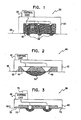
- Fig. 1 is a schematic, sectional illustration of a device 20 for facilitating transdermal delivery of an active substance 32 and, optionally, transdermal extraction of an analyte, in accordance with a preferred embodiment of the present description.
- Device 20 comprises a housing 22, to which is coupled a control unit 26 and one or more spark-generating electrodes 24.
- housing 22 is held in contact with the skin 28 of a subject, such that electrodes 24 are maintained at a generally fixed distance above the skin.
- electrodes 24 are between about 5 - 500 microns above skin 28, although it will be appreciated that the distance may be greater or less than this range, as appropriate, so as to optimize the operation of device 20 for a given application.
- each of electrodes 24 comes to a sharp point, so as to facilitate spark generation.
- Control unit 26 preferably provides electrical energy to electrodes 24 such that one or more sparks 30 occur between electrodes 24 and skin 28.
- regulation of the magnitude and timing of the voltage applied to electrodes 24 controls the strength and number of sparks 30.
- an alternating voltage is applied to electrodes 24, such that a series of sparks 30 occur during a given time interval, with each successive spark ablating more of the stratum corneum.
- the alternating voltage has a frequency between about 10 kHz and 4000 kHz, preferably between about 10 kHz and 500 kHz.
- the voltage is applied for a fixed length of time, determined in advance to be sufficient to achieve the desired degree of ablation.
- the number of sparks 30 is counted, and the voltage is turned off after a given number of sparks occur.
- control unit 26 is regulating voltage, a current surge can be detected at the time that a spark is generated.
- control unit 26 is regulating current, a detectable voltage drop occurs responsive to spark generation. It is noted that, depending on the properties of the electric field applied to electrodes 24 and the physical construction of device 20, it may be appropriate to detect only a single spark, indicative of ablation of the stratum corneum, or to continue applying the field until, for example, 100 or more sparks are detected.
- a high-magnitude DC voltage is applied to electrodes 24.
- the degree of ablation is controlled by the strength of the applied voltage and/or the number of sparks 30 generated.
- the occurrence of sparks may be determined by current spikes through electrodes 24.
- a voltage drop at one of electrodes 24 may be used to determine the occurrence of a spark.
- housing 22 is adapted to hold a prescribed quantity of a pharmaceutical substance such as an active substance 32, and to passively or actively deliver active substance 32 to a vicinity of one or more spark-induced ablation sites 34 in skin 28.
- Active substance 32 typically comprises an inactive gel or paste which supports an active pharmaceutical agent, and is applied to housing 22 in a region thereof near electrodes 24. In this manner, as device 20 is held against skin 28, the active substance is also brought into contact with skin 28, so as to be able to pass into the skin upon the ablation thereof.
- techniques such as iontophoresis, electroporation, sonophoresis, or other methods known in the art may be adapted to further facilitate transdermal transport of substance 32 into the skin, or transport of an analyte out of the skin.
- active substance 32 is stored in a porous material, such as a standard medical patch, which is adapted to fit around or in a vicinity of electrodes 24.
- a pharmaceutical agent is stored in device 20, but is instead applied, if appropriate, following the ablation of the skin by the device.
- device 20 is used exclusively for ablation of stratum corneum of skin 28 to facilitate analyte extraction, and substantially no active substance is applied to the skin.
- Fig. 2 is a schematic, sectional illustration of another device 40 for facilitating transdermal delivery of a pharmaceutical substance such as an active substance 52 and, optionally, transdermal extraction of an analyte, in accordance with a preferred embodiment of the present description.
- Device 40 comprises a housing 42, to which is coupled a control unit 46 and one or more electrodes 44.
- the placement of housing 42 on skin 48 of the subject automatically places electrodes 44 in contact with skin 48, as shown in Fig. 2 .
- each one of electrodes 44 has a characteristic diameter of approximately 10 - 100 microns where it contacts the skin. It is noted that this contact area is significantly smaller than that used for electroporation applications.
- electrodes 44 function as monopolar electrodes, whereby electrical energy is discharged from electrodes 44 into skin 48, while the return path of the electrical current passes through a much larger surface area (e.g., a metal base of housing 42 surrounding or adjacent to electrodes 44), resulting in substantially no damage to tissue other than in regions near electrodes 44.
- a larger number of electrodes 44 e.g., three or more
- two relatively large return electrodes are provided, to obtain the safety and other benefits known in the art to be associated with "split grounds.”
- one or more pairs of electrodes 44 are driven in a bipolar mode (as shown in Fig. 2 ), in which a spark 50 occurs between electrodes 44 in the pair, resulting in ablation of skin 48 in a region 54 thereof.
- Control unit 46 preferably functions in generally the same manner as control unit 26 described hereinabove with reference to Fig. 1 . Additionally, delivery of active substance 52 to skin 48 is preferably performed in substantially the same manner as the delivery of active substance 32.
- Fig. 3 is a schematic, sectional illustration of yet another device 60 for facilitating transdermal delivery of a pharmaceutical substance such as an active substance 72 and, optionally, transdermal extraction of an analyte, in accordance with a preferred embodiment of the present description.
- Device 60 comprises a housing 62, to which is coupled a control unit 66 and one or more electrodes 64.
- the placement of housing 62 on skin 68 of the subject causes electrodes 64 to be pressed against skin 68, resulting in dimpling of the skin caused by pressure of the electrodes on the skin.
- the electrodes preferably extend to a depth of approximately 10 - 500 microns in the skin, and, as a result, typically maintain contact with the skin during the ablation thereof for a greater time period than do the electrodes shown in Figs. 1 and 2 , for applications in which this is desirable.
- Device 60 preferably comprises at least one force / pressure-sensitive switch 76 coupled to control unit 66.
- the subject is instructed that sufficient pressure must be applied to housing 62 in order for the control unit to activate electrodes 64.
- Switch 76 thus typically ensures that sufficient pressure is applied to electrodes 64, such that the electrodes depress skin 68 the desired amount and electrical contact or small electrode-skin gap distances are maintained.
- device 60 is operative to generate sparks in order to ablate skin 68.
- device 60 drives current into skin 68 in order to ablate the stratum corneum.
- sparks are substantially not generated during the ablation, or are only generated after a significant portion of the stratum comeum has been ablated, and therefore serve as a form of electrical feedback to indicate the ablation of the stratum corneum,
- Fig. 4 (not to scale) is a sectional, schematic illustration of an electrode 100 which may be incorporated into any of the devices described hereinabove, in accordance with a preferred embodiment of the present description.
- a generally conical tip 120 of the electrode is intended for insertion in the skin 108 of the subject up to the tip's entire length L of approximately 10 - 150 microns (typically about 10 - 20 microns).
- a conductive or non-conductive base 110 of electrode 100 preferably has a diameter D2 between about 100 and 500 microns, and meets tip 120 where the tip has a diameter D1 of approximately 20 - 200 microns. Typically, but not necessarily, D2 is greater than D1 by about 10 - 500 microns.
- conical tip 120 of electrode 100 is shown as coming to a sharp point, other shapes are suitable for some applications.
- the tip may be rounded at the point of contact with the skin, such that an equivalent radius of the rounded portion is between about 10 and 100 microns.
- the tip may be hemispherical, e.g., with a radius of 50 microns.
- a characteristic diameter of the tip is between about 20 and 200 microns. Ablation of the stratum corneum by such a tip advantageously yields channels which are sufficiently large to allow the delivery or extraction therethrough of substantially all pharmaceutical substances and analytes of interest.
- a control unit 130 coupled to electrode 100 preferably comprises one of the control units described hereinabove with reference to Figs. 1-3 .
- control unit 130 is operative to continuously or intermittently measure the electrical impedance between electrode 100 and a second electrode 140, which is typically significantly larger than electrode 100; and which is placed in electrical contact with skin 108.
- Electrode 100 is shown in Fig. 4 just prior to its initial insertion into the skin.
- control unit 130 is adapted to track changes in the impedance of the skin or in another electrical property, in order to receive feedback indicating the depth of insertion of tip 120.
- control unit 130 may apply current in highfrequency AC bursts, and measure skin impedance during the bursts and/or between bursts, in order to determine the insertion depth of tip 120 or the extent to which the skin has been ablated,
- the control unit modifies a parameter (e.g., amplitude, duration, frequency) of the current applied through electrode 100 responsive to the detected insertion depth of tip 120.
- the current is turned on or off at the time that base 110 reaches the skin, or shortly thereafter.
- Fig. 5 is a schematic, sectional illustration of a portion of a device 200 for facilitating transdermal delivery of a pharmaceutical substance and/or transdermal extraction of an analyte, in accordance with a preferred embodiment of the present description.
- Device 200 preferably comprises a housing 210, which provides support to one or more electrodes 220 to allow the electrodes to apply pressure to the stratum corneum 230 of the subject's skin.
- electrodes 220 pass through all or a substantial portion of stratum corneum 230 during the ablation thereof, preferably without being subsequently inserted beyond a predetermined distance into underlying epidermal tissue 240.
- electrodes 220 typically extend from the base of housing 210 approximately 40 - 500 microns, which is substantially greater than the 10 - 50 micron thickness of stratum corneum 230.
- the added length of the electrodes, while not itself being used for insertion into the skin, has been found by the inventors to be useful because it applies a mechanical force on the skin sufficient to facilitate the entry of the electrodes during ablation.
- the skin would typically be pressed by (and would therefore recede from) an electrode that extends no further from its housing than approximately 50 microns
- an electrode that extends no further from its housing than approximately 50 microns
- Such a short electrode would not be subject to the level of reaction force from the skin that is experienced by longer electrodes (e.g., electrodes 220), which are provided by these embodiments of the present description.
- the greater reaction force applied to electrodes 220 facilitates the entry of the electrodes into the stratum corneum.
- the inventors have found that the spacing between each of electrodes 220 contributes in a significant fashion to the level of reaction force of the skin on each of the electrodes. In order to maximize this force, it is generally preferable to maintain a minimum inter-electrode spacing of about 0.3 mm - 2 mm, and/or about 100% - 500% of the total distance from the bottom surface of housing 210 to the tips of electrodes 220. It is to be understood, however, that maximizing the force is not necessarily the only consideration in the design of device 200, and that, for some applications, it is desirable to place the electrodes at a spacing less than that which would maximize the force.
- Fig. 6 is a schematic, sectional illustration of a portion of a device 300 for facilitating transdermal delivery of a pharmaceutical substance and/or transdermal extraction of an analyte, in accordance with a preferred embodiment of the present description.
- Device 300 preferably comprises a non-conductive housing 310 coupled to one or more stepped electrodes 320.
- electrodes 320 each comprise a tip 324, intended for ablation-facilitated insertion into the skin of the subject, and a conductive face 322, at the end of tip 324.
- Electrodes are described herein as being "stepped,” either by themselves or in combination with the housing or other portions of a device including the electrodes, other shapes not necessarily defining a sharp step are also useful for applying the principles of the present description. These other shapes could also be configured, for example, to have cross-sections which also provide feedback to a control unit regarding depth of insertion of an electrode. Alternatively or additionally, other changes besides cross-sectional changes may be integrated into the electrodes, such as gradual or sharp changes in an electrical or chemical property.
- a pharmaceutical substance for delivery into the skin is placed on a portion of the electrode, such that a control unit can determine when that portion comes in contact with the skin, or reaches a certain depth in the skin.
- the substance may be configured to be highly conductive or highly resistive to current flow.
- a control unit (not shown) coupled to the electrodes is preferably enabled to detect a rapid change in the electrical properties of the electrode / skin interface at the time when conductive face 322 comes in contact with the skin.
- the control unit may measure the electrical impedance between two of the electrodes, or between one of electrodes 320 and a non-ablating electrode that is in contact with the skin.
- these and/or other properties can change within less than about one millisecond following the successful complete insertion of the tip of the electrode into the skin.
- detecting changes in these properties can be used as feedback to the control unit, e.g., to allow the control unit to terminate current application following such a complete insertion.
- spark generation may be detected, which has been found by the inventors to typically be initiated or accelerated following generally complete insertion of tip 324. It is hypothesized that increased spark generation is observed following contact of face 322 with the skin, because further current application ablates and thereby removes tissue below the electrode, whereupon the continued presence at tip 324 of a high voltage, in the absence of a suitable resistive path for current flow, results in the generation of sparks between the tip and the skin. Thus, increased spark generation is an indicator of the contact of face 322 with the skin.
- Fig. 7 is a schematic, sectional illustration of a portion of a device 400 for facilitating transdermal delivery of a pharmaceutical substance and/or transdermal extraction of an analyte, in accordance with a preferred embodiment of the present description.
- Device 400 preferably comprises a non-conductive housing 410, through which protrude the tips 424 of one or more electrodes 420, in order to make contact with the skin of the subject.
- the length of the portion of tip 424 which protrudes through housing 410 is between approximately 10 and 200 microns, and is preferably about 50 - 60 microns.
- a non-conductive face 422 of housing 410 comes into contact with the skin, typically inhibiting by virtue of its size any further insertion of the electrode.
- the properties of face 422 are obtained, alternatively, by applying a non-conductive coating to electrode 420.
- the diameter of non-conductive face 422 is at least about 40 microns greater than the diameter of tip 424 where it meets face 422.
- the diameter of face 422 is about 40 - 200 microns greater than the diameter of tip 424 where it meets face 422.
- spark generation may in any case typically be detected, and may further provide a feedback to the control unit (not shown) indicating complete insertion.
- housing 410 to simply have a series of 50 - 60 micron electrodes protruding from its lower surface.
- the distance of face 422 from the lower surface of electrode housing 410 is typically at least about 100 microns, and the total distance from the lower surface of housing 410 to the end of tip 424 is typically between about 40 and 500 microns.
- this total distance allows device 400 to apply a sufficient amount of force to the skin in order to facilitate the entry of the electrode during ablation of the stratum corneum.
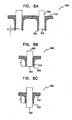
- Fig. 8A is a schematic illustration of a portion of a device 500 for facilitating transdermal delivery of a pharmaceutical substance and/or transdermal extraction of an analyte, in accordance with a preferred embodiment of the present description.
- device 500 comprises a non-conductive frame 510, a surface 550 of which is placed against the skin of the subject.
- An electrode 520 recessed a distance b within the frame (typically about 5 - 500 microns), is driven by a control unit to apply current to the skin.
- the current is typically delivered to the skin in the form of a series of one or more sparks, whose number and/or rate are preferably regulated by the control unit so as to obtain ablation of the stratum corneum within a suitable time period.
- Fig. 8B is a schematic illustration of a portion of a device 600 for facilitating transdermal delivery of a pharmaceutical substance and/or transdermal extraction of an analyte, in accordance with a preferred embodiment of the present description.
- device 600 comprises a non-conductive frame 610, a skin-contact surface 650 of which is placed against the skin of the subject.
- a distance "a" of about 40 to 500 microns preferably separates the underside of frame 610 from the skin-contact surface.
- An electrode 620, a surface 652 of which is generally flush with surface 650, is driven by a control unit to apply current to the skin. This current is preferably initially delivered, directly to the skin, and, after the ablation of some or all of the stratum corneum, terminated following the generation of one or more sparks.
- Fig. 8C is a schematic illustration of a portion of a device 700 for facilitating transdermal delivery of a pharmaceutical substance and/or transdermal extraction of an analyte, in accordance with a preferred embodiment of the present description.
- device 700 comprises a non-conductive frame 710, a surface 750 of which is placed against the skin of the subject.
- An electrode fixed to frame 710 preferably comprises a surface 752 which protrudes beyond surface 750 by a distance sufficient to obtain the advantages of direct current application followed by sparks (described hereinabove with reference to Figs. 4-7 ).
- Fig. 9A is a graph showing experimental data measured during a period in which an electrode was in generally continuous contact with in vitro skin taken from behind the ear of a pig, in accordance with a preferred embodiment of the present description.
- a 100 kHz sinusoidal voltage was applied by the electrode to the skin, and it is seen that during the first millisecond, the current delivered to the skin increased, peaked, and began to decrease until a generally steady-state current injection period began at approximately 2.5 milliseconds.
- Fig . 9B shows some of the same data as in Fig . 9A , on an expanded time scale.
- changes in electrical properties of the skin may be responsible, at least in part, for the observed changes in the waveform of Fig. 9A .
- the relatively high impedance seen at the beginning of the application of current is reduced during the first millisecond because of ablation of the stratum corneum, and, perhaps, because of a generally simultaneous release of water from intracellular and/or interstitial sources.
- the decrease in current and the final steady-state waveform result from essentially complete local ablation and desiccation in an area adjacent to the tip of the electrode, whereby further current flow is significantly impeded.
- each burst includes an AC component having a characteristic frequency between about 10 kHz and 500 kHz.
- Burst durations from about 10 microseconds to 100 milliseconds (typically ranging from 100 microseconds to 10 milliseconds) are preferred, with particular values typically being selected in combination with the selection of other driving parameters, such as frequency and signal amplitude and electrode shape.
- Inter-burst periods preferably range from about 100 microseconds to 100 milliseconds.
- Fig. 10 is a graph showing experimental data measured during the insertion into skin of an experimental electrode similar to electrode 100 ( Fig. 4 ), in accordance with a preferred embodiment of the present description.
- the experimental electrode was constructed to have a 30 micron diameter stainless steel tip.
- a second electrode was placed on the skin at a distance of 15 mm from the experimental electrode.
- a non-ideal voltage source drove the electrode to apply to the skin a 100 kHz biphasic signal, which was designated to be 700 V, but, because of the high 57 mA peak-to-peak current drain, was measured to be 320 V peak-to-peak
- the measured peak-to-peak current dropped to 19 mA, allowing the applied voltage to recover to a measured peak-to-peak voltage of 696 V.
- a large number of sparks were observed, which correspond to the downward moving current spikes seen in Fig. 10 . It is hypothesized that the sparks were generated as a result of a self-nurturing cycle, in which ablation causes gaps to form between the electrode and the skin, which induce more sparks, additional ablation, and yet further gaps.
- Fig. 11 is a graph showing experimental data obtained during ablation of in vitro stratum corneum from a pig, in accordance with a preferred embodiment of the present description, A large number of spark discharges can be seen in the figure, and, in a preferred embodiment, a control unit such as one of those described hereinabove is operative to detect these spikes using signal processing techniques known in the art, and to regulate the application of energy to the skin responsive thereto.
- Figs. 12, 13, 14, and 15 are schematic illustrations of different waveforms for application to the skin of a subject, in accordance with respective preferred embodiments of the present description.
- a symmetric sinusoid Fig. 12
- a half sine wave Fig. 13
- a series of pulses Fig. 14
- a series of pulses having the net DC component removed Fig. 15
- other waveforms are selected for application to the skin, responsive to the type of material which is to be conveyed through the skin, energy considerations, and/or the area of the skin to which a device is applied.
- Circuitry 800 preferably comprises a DC voltage source 804 coupled to supply power to a low-voltage pulse generator 806, whose pulses are amplified and conveyed to an ablating electrode via the coupling of generator 806 to an inductor 802, a MOSFET 808, and a capacitor 810.
- Fig. 17 is a schematic illustration of resonant circuitry 840 for generating high voltages for application to the skin, in accordance with another preferred embodiment of the present description.
- Circuitry 840 preferably comprises a DC voltage source 846 coupled through a controlled switch 848 to generate an AC signal, whose frequency is determined by the values of a capacitor 844 and an inductor 842 in the circuit.
- Resonant circuits are particularly well-suited for some applications of the present description, because they have inherent self-limiting behaviors, such as changes in resonant gain as electrode insertion and ablation causes impedance changes.
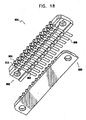
- FIG. 18 is a schematic illustration of a device 900 for facilitating transdermal delivery of a pharmaceutical substance and/or transdermal extraction of an analyte, in accordance with a preferred embodiment of the present description.
- Device 900 preferably comprises an endplate 920, a series of one or more electrode mounting elements 902, and a second endplate 920 (not shown). In use, elements 902 are preferably securely sandwiched between the two endplates.
- Element 902 preferably comprises a series of electrodes 908. Twelve such electrodes are shown in the figure. In a preferred embodiment, the length of each electrode 908 (extending from a first end which is square to a skin-contact end 910 which is typically generally pointed) is approximately 4 - 5 mm, and the width at the first end is about 0.4 mm. The first end of each electrode is typically electrically coupled to a control unit. Preferably, mechanical supporting members 906 surround and maintain the position of each electrode 908. Pyramid-style pieces 904 on element 902 (or pieces having other shapes) preferably engage corresponding pieces 904 on endplate 920 or on an adjacent element 902, in order to surround part or all of skin-contact end 910 of each electrode and provide the "step" feature described hereinabove.
- electrodes 908 and/or other electrodes described herein may comprise stainless steel or titanium, and may be formed from sheets having a thickness ranging from about 10 to 200 microns. Techniques known in the art may be used for forming the electrodes from these sheets, such as through the use of laser cutting.
- Figs. 19 and 20 are graphs showing experimental results obtained using techniques provided in accordance with respective preferred embodiments of the present description.
- the parameter Transepidermal Water Loss (TEWL) was evaluated in order to assess the extent of the creation of micropores in the outer layers of the skin. For these experiments, frozen pig ear skin was placed overnight in refrigeration, and than transferred to room temperature for at least 1 hour. Values of TEWL presented in Fig. 19 represent:
- Figs. 21, 22, and 23 are graphs showing experimental results obtained using techniques provided in accordance with respective preferred embodiments of the present description.
- the permeation of drugs through pig ear skin was studied using flow-through diffusion cells (LGA Inc., Berkeley, CA). Each cell had a diffusional surface area of 3.1 cm2 and a receptor volume of 5 mL The temperature of the receptor compartment was maintained at 33 °C.
- a donor solution placed in a cell on one side of the skin sample comprised 1% acetaminophen in 10% ethyl alcohol.
- the receptor solution, in the cell on the other side of the skin sample comprised 10% ethyl alcohol in FBS (pH 7.2).
- a flow rate of 2 ml/hr was maintained.
- Pore creation in accordance with the ablation technique of a preferred embodiment of the present description, is seen to have enhanced the permeation of acetaminophen through the skin compared to untreated skin. Moreover, the density of 100 pores/cm2 resulted in a 10-fold elevation in drug permeation compared to untreated skin. It is also noted that Fig. 21 shows a direct correlation between pore density and permeation enhancement.
- the donor solution had 1% diclofenac in 10% ethyl alcohol, and the receptor solution was PBS (pH 7.2). The flow rate was maintained at 2 ml/hr.
- transdermal delivery of a substance are generally appropriate for many types of substances, including drugs, and broadly including any active agents that include chemical or biological compounds produced either by chemical synthesis or biotechnology routes, including fermentation and/or recombinant technologies.
- Drug delivery devices provided by these embodiments of the present description can be used for administering drugs that are physiologically or pharmacologically active at a point in near relation to the drug delivery device, or for administering a systemically active substance which will produce a physiological or pharmacological response at a site remote from the point of application of the drug delivery device.
- the active agents that can be administered by these devices include, therefore, by way of illustration and not limitation:
- the methods and apparatus described herein with respect to facilitating substance delivery into the skin may typically be adapted for analyte extraction applications, mutatis mutandis, and, similarly, methods and apparatus described herein with respect to facilitating analyte extraction may be adapted for substance delivery applications, mutatis mutandis.
- some devices incorporating embodiments of the present description may include means for both drug delivery and analyte extraction, and, if appropriate, apparatus within the device for analyzing the analyte and controlling aspects of the drug delivery responsive to the analysis.
Landscapes
- Health & Medical Sciences (AREA)
- Engineering & Computer Science (AREA)
- Life Sciences & Earth Sciences (AREA)
- Public Health (AREA)
- Biomedical Technology (AREA)
- Veterinary Medicine (AREA)
- Animal Behavior & Ethology (AREA)
- General Health & Medical Sciences (AREA)
- Radiology & Medical Imaging (AREA)
- Nuclear Medicine, Radiotherapy & Molecular Imaging (AREA)
- Dermatology (AREA)
- Medical Informatics (AREA)
- Anesthesiology (AREA)
- Heart & Thoracic Surgery (AREA)
- Hematology (AREA)
- Biophysics (AREA)
- Media Introduction/Drainage Providing Device (AREA)
- Electrotherapy Devices (AREA)
- Surgical Instruments (AREA)
Claims (8)
- Vorrichtung (400, 700) zum Fördern des Durchgangs eines Stoffs durch Haut (108) am Körper einer Versuchsperson, umfassend:einen nichtleitenden Rahmen (410, 710), wobei der Rahmen (410, 710) derart geformt ist, dass er mindestens einen Vorsprung mit einer nichtleitenden Hautkontakt-Rahmenoberfläche (422, 750) definiert, die relativ zu einer der Haut (108) zugewandten Unterseite des Rahmens (410, 710) vorsteht;mindestens eine Elektrode (420), die an dem Rahmen (410, 710) befestigt ist, wobei die mindestens eine Elektrode (420) eine Spitze (424) aufweist, die derart geformt ist, dass sie eine Hautkontakt-Elektrodenoberfläche (752) definiert, wobei die mindestens eine Elektrode (420) durch den Vorsprung verläuft, so dass die Elektrodenoberfläche (752) über die nichtleitende Hautkontakt-Rahmenoberfläche (422, 750) hinaus vorsteht; undeine Steuereinheit (130), die dazu konfiguriert ist, die Elektrode (420) dazu zu treiben, einen elektrischen Strom an die Haut (108) anzulegen, der fähig ist, Stratum corneum epidermidis davon zu abladieren, um den Durchgang des Stoffs durch die Haut zu fördern;dadurch gekennzeichnet, dass die Steuereinheit (130) dazu angepasst ist, Funkenerzeugung zu erkennen, die das vollständige Einführen der Spitze (424) anzeigt.
- Vorrichtung (400, 700) nach Anspruch 1, wobei die Steuereinheit (130) dazu angepasst ist, einen Parameter des Stroms als Reaktion auf das Erkennen der Funkenerzeugung zu verändern.
- Vorrichtung (400, 700) nach Anspruch 1, wobei ein Abstand von 40 bis 500 Mikrometern die Unterseite des Rahmens (410, 710) vom Ende der Elektrodenspitze (424) trennt.
- Vorrichtung (400, 700) nach Anspruch 1, wobei ein Abstand von mindestens 100 Mikrometern die Unterseite des Rahmens (410, 710) von der Hautkontakt-Rahmenoberfläche (422, 750) trennt.
- Vorrichtung (400, 700) nach Anspruch 1, wobei ein Durchmesser der nichtleitenden Hautkontakt-Rahmenoberfläche (422, 750) mindestens 40 Mikrometer größer ist als ein Durchmesser der Elektrode (420), wo die Elektrode (420) mit der Rahmenoberfläche (422, 750) zusammentrifft.
- Vorrichtung (400, 700) nach Anspruch 1, wobei eine Länge des Abschnitts der Elektrode (420), der über die Hautkontakt-Rahmenoberfläche (422, 750) hinaus vorsteht, zwischen 10 und 200 Mikrometer beträgt.
- Vorrichtung (400, 700) nach Anspruch 1, wobei eine Länge des Abschnitts der Elektrode (420), der über die Hautkontakt-Rahmenoberfläche (422, 750) hinaus vorsteht, 50 bis 60 Mikrometer beträgt.
- Vorrichtung (400, 700) nach Anspruch 1, wobei ein Abstand von der Unterseite des Rahmens (410, 710) zur Spitze der Elektrode (420) zwischen 40 und 500 Mikrometer beträgt.
Priority Applications (1)
| Application Number | Priority Date | Filing Date | Title |
|---|---|---|---|
| EP10182192.4A EP2319445B1 (de) | 2001-05-17 | 2002-05-15 | Mit Strom erzeugtem, transdermalen Eintragsweg für eine Medikamentenabgabe |
Applications Claiming Priority (2)
| Application Number | Priority Date | Filing Date | Title |
|---|---|---|---|
| US09/859,645 US6611706B2 (en) | 1998-11-09 | 2001-05-17 | Monopolar and bipolar current application for transdermal drug delivery and analyte extraction |
| EP02730666A EP1387640A1 (de) | 2001-05-17 | 2002-05-15 | Mit strom erzeugter, transdermaler eintragsweg für eine medikamentenabgabe |
Related Parent Applications (1)
| Application Number | Title | Priority Date | Filing Date |
|---|---|---|---|
| EP02730666A Division EP1387640A1 (de) | 2001-05-17 | 2002-05-15 | Mit strom erzeugter, transdermaler eintragsweg für eine medikamentenabgabe |
Related Child Applications (2)
| Application Number | Title | Priority Date | Filing Date |
|---|---|---|---|
| EP10182192.4A Division EP2319445B1 (de) | 2001-05-17 | 2002-05-15 | Mit Strom erzeugtem, transdermalen Eintragsweg für eine Medikamentenabgabe |
| EP10182192.4A Division-Into EP2319445B1 (de) | 2001-05-17 | 2002-05-15 | Mit Strom erzeugtem, transdermalen Eintragsweg für eine Medikamentenabgabe |
Publications (3)
| Publication Number | Publication Date |
|---|---|
| EP1955731A2 EP1955731A2 (de) | 2008-08-13 |
| EP1955731A3 EP1955731A3 (de) | 2009-06-24 |
| EP1955731B1 true EP1955731B1 (de) | 2015-08-19 |
Family
ID=25331402
Family Applications (3)
| Application Number | Title | Priority Date | Filing Date |
|---|---|---|---|
| EP08075263.7A Expired - Lifetime EP1955731B1 (de) | 2001-05-17 | 2002-05-15 | Anwendung mit monopolarem und bipolarem Strom zur transdermalen Wirkstoffverabreichung und Analytextraktion |
| EP02730666A Ceased EP1387640A1 (de) | 2001-05-17 | 2002-05-15 | Mit strom erzeugter, transdermaler eintragsweg für eine medikamentenabgabe |
| EP10182192.4A Expired - Lifetime EP2319445B1 (de) | 2001-05-17 | 2002-05-15 | Mit Strom erzeugtem, transdermalen Eintragsweg für eine Medikamentenabgabe |
Family Applications After (2)
| Application Number | Title | Priority Date | Filing Date |
|---|---|---|---|
| EP02730666A Ceased EP1387640A1 (de) | 2001-05-17 | 2002-05-15 | Mit strom erzeugter, transdermaler eintragsweg für eine medikamentenabgabe |
| EP10182192.4A Expired - Lifetime EP2319445B1 (de) | 2001-05-17 | 2002-05-15 | Mit Strom erzeugtem, transdermalen Eintragsweg für eine Medikamentenabgabe |
Country Status (4)
| Country | Link |
|---|---|
| US (2) | US6611706B2 (de) |
| EP (3) | EP1955731B1 (de) |
| JP (1) | JP4638130B2 (de) |
| WO (1) | WO2002091934A2 (de) |
Cited By (1)
| Publication number | Priority date | Publication date | Assignee | Title |
|---|---|---|---|---|
| US10322296B2 (en) | 2009-07-20 | 2019-06-18 | Syneron Medical Ltd. | Method and apparatus for fractional skin treatment |
Families Citing this family (241)
| Publication number | Priority date | Publication date | Assignee | Title |
|---|---|---|---|---|
| US7473251B2 (en) * | 1996-01-05 | 2009-01-06 | Thermage, Inc. | Methods for creating tissue effect utilizing electromagnetic energy and a reverse thermal gradient |
| US7267675B2 (en) * | 1996-01-05 | 2007-09-11 | Thermage, Inc. | RF device with thermo-electric cooler |
| US7229436B2 (en) | 1996-01-05 | 2007-06-12 | Thermage, Inc. | Method and kit for treatment of tissue |
| US20030212393A1 (en) | 1996-01-05 | 2003-11-13 | Knowlton Edward W. | Handpiece with RF electrode and non-volatile memory |
| US8765177B2 (en) * | 1997-09-12 | 2014-07-01 | Columbia Laboratories, Inc. | Bioadhesive progressive hydration tablets |
| US7153845B2 (en) | 1998-08-25 | 2006-12-26 | Columbia Laboratories, Inc. | Bioadhesive progressive hydration tablets |
| EP1056501B1 (de) | 1998-02-24 | 2005-11-16 | Boston Scientific Limited | Dialysekatheter mit hohem durchfluss und verfahren dazu |
| US6611706B2 (en) * | 1998-11-09 | 2003-08-26 | Transpharma Ltd. | Monopolar and bipolar current application for transdermal drug delivery and analyte extraction |
| EP1163024B1 (de) * | 1999-01-28 | 2003-12-17 | Cyto Pulse Sciences, Inc. | Einbringen von makromolekülen in zellen |
| US6792306B2 (en) * | 2000-03-10 | 2004-09-14 | Biophoretic Therapeutic Systems, Llc | Finger-mounted electrokinetic delivery system for self-administration of medicaments and methods therefor |
| US6256533B1 (en) * | 1999-06-09 | 2001-07-03 | The Procter & Gamble Company | Apparatus and method for using an intracutaneous microneedle array |
| US6300108B1 (en) * | 1999-07-21 | 2001-10-09 | The Regents Of The University Of California | Controlled electroporation and mass transfer across cell membranes |
| US7133717B2 (en) * | 1999-08-25 | 2006-11-07 | Johnson & Johnson Consumer Companies, Inc. | Tissue electroperforation for enhanced drug delivery and diagnostic sampling |
| US7113821B1 (en) * | 1999-08-25 | 2006-09-26 | Johnson & Johnson Consumer Companies, Inc. | Tissue electroperforation for enhanced drug delivery |
| USRE44145E1 (en) | 2000-07-07 | 2013-04-09 | A.V. Topchiev Institute Of Petrochemical Synthesis | Preparation of hydrophilic pressure sensitive adhesives having optimized adhesive properties |
| US6795728B2 (en) | 2001-08-17 | 2004-09-21 | Minnesota Medical Physics, Llc | Apparatus and method for reducing subcutaneous fat deposits by electroporation |
| US6892099B2 (en) | 2001-02-08 | 2005-05-10 | Minnesota Medical Physics, Llc | Apparatus and method for reducing subcutaneous fat deposits, virtual face lift and body sculpturing by electroporation |
| US6697670B2 (en) * | 2001-08-17 | 2004-02-24 | Minnesota Medical Physics, Llc | Apparatus and method for reducing subcutaneous fat deposits by electroporation with improved comfort of patients |
| US8251986B2 (en) * | 2000-08-17 | 2012-08-28 | Angiodynamics, Inc. | Method of destroying tissue cells by eletroporation |
| US7131987B2 (en) | 2000-10-16 | 2006-11-07 | Corium International, Inc. | Microstructures and method for treating and conditioning skin which cause less irritation during exfoliation |
| US7108681B2 (en) | 2000-10-16 | 2006-09-19 | Corium International, Inc. | Microstructures for delivering a composition cutaneously to skin |
| US7828827B2 (en) | 2002-05-24 | 2010-11-09 | Corium International, Inc. | Method of exfoliation of skin using closely-packed microstructures |
| US6663820B2 (en) * | 2001-03-14 | 2003-12-16 | The Procter & Gamble Company | Method of manufacturing microneedle structures using soft lithography and photolithography |
| US20050215727A1 (en) | 2001-05-01 | 2005-09-29 | Corium | Water-absorbent adhesive compositions and associated methods of manufacture and use |
| US8206738B2 (en) | 2001-05-01 | 2012-06-26 | Corium International, Inc. | Hydrogel compositions with an erodible backing member |
| WO2002087645A1 (en) | 2001-05-01 | 2002-11-07 | A.V. Topchiev Institute Of Petrochemical Synthesis | Hydrogel compositions |
| US20050113510A1 (en) | 2001-05-01 | 2005-05-26 | Feldstein Mikhail M. | Method of preparing polymeric adhesive compositions utilizing the mechanism of interaction between the polymer components |
| AU2002316053A1 (en) | 2001-05-01 | 2002-11-11 | A.V. Topchiev Institute Of Petrochemical Synthesis | Two-phase, water-absorbent bioadhesive composition |
| US8541021B2 (en) | 2001-05-01 | 2013-09-24 | A.V. Topchiev Institute Of Petrochemical Synthesis | Hydrogel compositions demonstrating phase separation on contact with aqueous media |
| US8840918B2 (en) | 2001-05-01 | 2014-09-23 | A. V. Topchiev Institute of Petrochemical Synthesis, Russian Academy of Sciences | Hydrogel compositions for tooth whitening |
| US7130697B2 (en) * | 2002-08-13 | 2006-10-31 | Minnesota Medical Physics Llc | Apparatus and method for the treatment of benign prostatic hyperplasia |
| USRE42016E1 (en) | 2001-08-13 | 2010-12-28 | Angiodynamics, Inc. | Apparatus and method for the treatment of benign prostatic hyperplasia |
| US6994706B2 (en) | 2001-08-13 | 2006-02-07 | Minnesota Medical Physics, Llc | Apparatus and method for treatment of benign prostatic hyperplasia |
| US20040087992A1 (en) * | 2002-08-09 | 2004-05-06 | Vladimir Gartstein | Microstructures for delivering a composition cutaneously to skin using rotatable structures |
| AU2002360648B2 (en) * | 2001-12-14 | 2009-01-08 | Genetronics, Inc. | Methods for particle-assisted polynucleotide immunization using a pulsed electric field |
| WO2003089043A2 (en) * | 2002-04-19 | 2003-10-30 | Transpharma Medical Ltd. | Handheld transdermal drug delivery and analyte extraction |
| WO2004010883A1 (en) | 2002-07-25 | 2004-02-05 | Sherwood Services Ag | Electrosurgical pencil with drag sensing capability |
| WO2004028379A1 (en) * | 2002-09-25 | 2004-04-08 | Flock, Stephen, T. | Microsurgical tissue treatment system |
| IL152574A (en) * | 2002-10-31 | 2009-09-22 | Transpharma Medical Ltd | A system for passing through the skin of dry items or dried medicines |
| IL152575A (en) * | 2002-10-31 | 2008-12-29 | Transpharma Medical Ltd | A skin-to-skin transmission system of water-insoluble drugs |
| US8133505B2 (en) * | 2002-10-31 | 2012-03-13 | Transpharma Medical Ltd. | Transdermal delivery system for dried particulate or lyophilized medications |
| US7383084B2 (en) * | 2002-10-31 | 2008-06-03 | Transpharma Medical Ltd. | Transdermal delivery system for dried particulate or lyophilized medications |
| IL152573A (en) * | 2002-10-31 | 2009-11-18 | Transpharma Medical Ltd | A system for the transmission through the skin of a medical preparation against vomiting and nausea |
| US7662404B2 (en) * | 2002-10-31 | 2010-02-16 | Transpharma Medical Ltd. | Transdermal delivery system for dried particulate or lyophilized peptides and polypeptides |
| US7244257B2 (en) | 2002-11-05 | 2007-07-17 | Sherwood Services Ag | Electrosurgical pencil having a single button variable control |
| EP1596743B1 (de) * | 2003-02-20 | 2008-04-09 | Covidien AG | Bewegungsnachweisgerät zur kontrolle des elektrochirurgischen ausgangs |
| US7578954B2 (en) * | 2003-02-24 | 2009-08-25 | Corium International, Inc. | Method for manufacturing microstructures having multiple microelements with through-holes |
| JP4381705B2 (ja) * | 2003-03-26 | 2009-12-09 | シスメックス株式会社 | 経皮的分析物抽出システムと分析システムおよび経皮的分析物抽出方法と分析方法 |
| EP1720605A4 (de) * | 2003-06-23 | 2007-10-24 | Transpharma Medical Ltd | Transdermales abgabesystem für kosmetische mittel |
| GB2432321B (en) | 2003-09-30 | 2007-10-17 | Synapse Medical Solutions Ltd | Dressing for tissue treatment |
| US7241294B2 (en) | 2003-11-19 | 2007-07-10 | Sherwood Services Ag | Pistol grip electrosurgical pencil with manual aspirator/irrigator and methods of using the same |
| US7156842B2 (en) | 2003-11-20 | 2007-01-02 | Sherwood Services Ag | Electrosurgical pencil with improved controls |
| US7879033B2 (en) * | 2003-11-20 | 2011-02-01 | Covidien Ag | Electrosurgical pencil with advanced ES controls |
| US7156844B2 (en) | 2003-11-20 | 2007-01-02 | Sherwood Services Ag | Electrosurgical pencil with improved controls |
| US7503917B2 (en) | 2003-11-20 | 2009-03-17 | Covidien Ag | Electrosurgical pencil with improved controls |
| IL159273A0 (en) * | 2003-12-09 | 2004-06-01 | Transpharma Medical Ltd | Transdermal delivery system for sustained release of polypeptides |
| ES2729378T3 (es) | 2003-12-24 | 2019-11-04 | Univ California | Ablación de tejido con electroporación irreversible |
| US8298222B2 (en) | 2003-12-24 | 2012-10-30 | The Regents Of The University Of California | Electroporation to deliver chemotherapeutics and enhance tumor regression |
| IL160033A0 (en) * | 2004-01-25 | 2004-06-20 | Transpharma Medical Ltd | Transdermal delivery system for polynucleotides |
| WO2005074894A1 (en) | 2004-01-30 | 2005-08-18 | Corium International | Rapidly dissolving film for delivery of an active agent |
| GB0405200D0 (en) * | 2004-03-08 | 2004-04-21 | Pfizer Ltd | Combinations comprising alpha-2-delta ligands |
| CA2560840C (en) | 2004-03-24 | 2014-05-06 | Corium International, Inc. | Transdermal delivery device |
| WO2005096979A1 (en) | 2004-04-01 | 2005-10-20 | The General Hospital Corporation | Method and apparatus for dermatological treatment and tissue reshaping |
| US7666914B2 (en) * | 2004-06-03 | 2010-02-23 | Richlin David M | Topical preparation and method for transdermal delivery and localization of therapeutic agents |
| EP1768742A4 (de) * | 2004-07-06 | 2007-10-17 | Transpharma Medical Ltd | Abgabesystem für die transdermale immunisierung |
| MX2007001512A (es) | 2004-08-05 | 2007-04-20 | Corium Int Inc | Composicion adhesiva. |
| US20060047281A1 (en) * | 2004-09-01 | 2006-03-02 | Syneron Medical Ltd. | Method and system for invasive skin treatment |
| CA2587780A1 (en) * | 2004-11-18 | 2006-05-26 | Transpharma Medical Ltd. | Combined micro-channel generation and iontophoresis for transdermal delivery of pharmaceutical agents |
| US8096303B2 (en) | 2005-02-08 | 2012-01-17 | Koninklijke Philips Electronics N.V | Airway implants and methods and devices for insertion and retrieval |
| US8371307B2 (en) | 2005-02-08 | 2013-02-12 | Koninklijke Philips Electronics N.V. | Methods and devices for the treatment of airway obstruction, sleep apnea and snoring |
| US8679101B2 (en) * | 2005-03-04 | 2014-03-25 | The Invention Science Fund I, Llc | Method and system for temporary hair removal |
| US8540701B2 (en) | 2005-03-04 | 2013-09-24 | The Invention Science Fund I, Llc | Hair treatment system |
| US20060276859A1 (en) * | 2005-06-02 | 2006-12-07 | Searete Llc, A Limited Liability Corporation Of The State Of Delaware | Photopatterning of skin |
| US8157807B2 (en) * | 2005-06-02 | 2012-04-17 | The Invention Science Fund I, Llc | Skin treatment including patterned light |
| US8529560B2 (en) | 2005-03-04 | 2013-09-10 | The Invention Science Fund I, Llc | Hair treatment system |
| US7856263B2 (en) * | 2005-04-22 | 2010-12-21 | Travanti Pharma Inc. | Transdermal systems for the delivery of therapeutic agents including granisetron using iontophoresis |
| US20060264752A1 (en) * | 2005-04-27 | 2006-11-23 | The Regents Of The University Of California | Electroporation controlled with real time imaging |
| WO2006124639A1 (en) * | 2005-05-11 | 2006-11-23 | Corium International, Inc. | Permeabilization of biological membranes |
| US20080274166A1 (en) * | 2005-06-10 | 2008-11-06 | Transpharma Medical Ltd. | Patch for Transdermal Drug Delivery |
| US7655003B2 (en) | 2005-06-22 | 2010-02-02 | Smith & Nephew, Inc. | Electrosurgical power control |
| US20060293730A1 (en) | 2005-06-24 | 2006-12-28 | Boris Rubinsky | Methods and systems for treating restenosis sites using electroporation |
| US20060293725A1 (en) * | 2005-06-24 | 2006-12-28 | Boris Rubinsky | Methods and systems for treating fatty tissue sites using electroporation |
| US20060293731A1 (en) * | 2005-06-24 | 2006-12-28 | Boris Rubinsky | Methods and systems for treating tumors using electroporation |
| US8114070B2 (en) * | 2005-06-24 | 2012-02-14 | Angiodynamics, Inc. | Methods and systems for treating BPH using electroporation |
| US7500974B2 (en) | 2005-06-28 | 2009-03-10 | Covidien Ag | Electrode with rotatably deployable sheath |
| US9055958B2 (en) | 2005-06-29 | 2015-06-16 | The Invention Science Fund I, Llc | Hair modification using converging light |
| US20070009542A1 (en) * | 2005-07-05 | 2007-01-11 | Galit Levin | Method and device for transdermal immunization |
| US20070038270A1 (en) * | 2005-07-05 | 2007-02-15 | Searete Llc, A Limited Liability Corporation Of The State Of Delaware | Multi step photopatterning of skin |
| US8386030B2 (en) | 2005-08-08 | 2013-02-26 | Tti Ellebeau, Inc. | Iontophoresis device |
| US7828794B2 (en) | 2005-08-25 | 2010-11-09 | Covidien Ag | Handheld electrosurgical apparatus for controlling operating room equipment |
| JPWO2007026671A1 (ja) * | 2005-08-29 | 2009-03-05 | Tti・エルビュー株式会社 | センサからの情報により投与すべき薬剤の選定を行うイオントフォレーシス装置 |
| US20070048340A1 (en) * | 2005-08-31 | 2007-03-01 | Searete Llc, A Limited Liability Corporation Of The State Of Delaware | Multi step patterning of a skin surface |
| EP1925336A4 (de) | 2005-09-15 | 2011-01-19 | Tti Ellebeau Inc | Stabartiges iontophoresegerät |
| US20070071807A1 (en) * | 2005-09-28 | 2007-03-29 | Hidero Akiyama | Capsule-type drug-releasing device and capsule-type drug-releasing device system |
| US20070078502A1 (en) * | 2005-10-05 | 2007-04-05 | Thermage, Inc. | Method and apparatus for estimating a local impedance factor |
| US7957815B2 (en) * | 2005-10-11 | 2011-06-07 | Thermage, Inc. | Electrode assembly and handpiece with adjustable system impedance, and methods of operating an energy-based medical system to treat tissue |
| US8702691B2 (en) * | 2005-10-19 | 2014-04-22 | Thermage, Inc. | Treatment apparatus and methods for delivering energy at multiple selectable depths in tissue |
| CN101583620B (zh) | 2005-11-28 | 2016-08-17 | 马里纳斯医药公司 | 加奈索酮组合物及其制备和使用方法 |
| JP4804904B2 (ja) * | 2005-12-09 | 2011-11-02 | Tti・エルビュー株式会社 | イオントフォレーシス装置包装品 |
| US10799285B2 (en) * | 2005-12-22 | 2020-10-13 | Inmode Ltd. | Skin rejuvenation resurfacing device and method of use |
| US8048089B2 (en) | 2005-12-30 | 2011-11-01 | Edge Systems Corporation | Apparatus and methods for treating the skin |
| US20070156135A1 (en) * | 2006-01-03 | 2007-07-05 | Boris Rubinsky | System and methods for treating atrial fibrillation using electroporation |
| US20070185431A1 (en) * | 2006-02-03 | 2007-08-09 | Kern Dale G | Galvanic Current Skin Treatment |
| WO2014151104A1 (en) | 2013-03-15 | 2014-09-25 | Edge Systems Llc | Devices, systems and methods for treating the skin |
| US20070260240A1 (en) | 2006-05-05 | 2007-11-08 | Sherwood Services Ag | Soft tissue RF transection and resection device |
| US8246611B2 (en) | 2006-06-14 | 2012-08-21 | Candela Corporation | Treatment of skin by spatial modulation of thermal heating |
| WO2008048620A2 (en) | 2006-10-16 | 2008-04-24 | The Regents Of The University Of California | Gels with predetermined conductivity used in irreversible electroporation of tissue |
| AU2007325628A1 (en) | 2006-11-28 | 2008-06-05 | Marinus Pharmaceuticals | Nanoparticulate formulations and methods for the making and use thereof |
| US8062783B2 (en) | 2006-12-01 | 2011-11-22 | Tti Ellebeau, Inc. | Systems, devices, and methods for powering and/or controlling devices, for instance transdermal delivery devices |
| US20080132884A1 (en) * | 2006-12-01 | 2008-06-05 | Boris Rubinsky | Systems for treating tissue sites using electroporation |
| AU2008209537B2 (en) | 2007-01-22 | 2013-01-31 | Corium Pharma Solutions, Inc. | Applicators for microneedle arrays |
| WO2008091983A2 (en) * | 2007-01-25 | 2008-07-31 | Thermage, Inc. | Treatment apparatus and methods for inducing microburn patterns in tissue |
| US9283029B2 (en) | 2007-01-31 | 2016-03-15 | Alma Lasers Ltd. | Skin treatment using a multi-discharge applicator |
| US8911749B2 (en) | 2007-04-16 | 2014-12-16 | Corium International, Inc. | Vaccine delivery via microneedle arrays |
| AU2008241470B2 (en) | 2007-04-16 | 2013-11-07 | Corium Pharma Solutions, Inc. | Solvent-cast microneedle arrays containing active |
| US20080269735A1 (en) * | 2007-04-26 | 2008-10-30 | Agustina Vila Echague | Optical array for treating biological tissue |
| US8150505B2 (en) * | 2007-05-03 | 2012-04-03 | Path Scientific, Llc | Method and apparatus for the formation of multiple microconduits |
| US7853320B1 (en) | 2007-05-31 | 2010-12-14 | Purdue Pharma L.P. | Transdermal device having mechanical assist for porator-to-skin contact |
| US8095213B1 (en) * | 2007-05-31 | 2012-01-10 | Purdue Pharma L.P. | Transdermal patch |
| US8047399B1 (en) | 2007-07-05 | 2011-11-01 | Purdue Pharma L.P. | Dispenser for transdermal devices |
| US8216218B2 (en) * | 2007-07-10 | 2012-07-10 | Thermage, Inc. | Treatment apparatus and methods for delivering high frequency energy across large tissue areas |
| US8152800B2 (en) * | 2007-07-30 | 2012-04-10 | Vivant Medical, Inc. | Electrosurgical systems and printed circuit boards for use therewith |
| US8506565B2 (en) | 2007-08-23 | 2013-08-13 | Covidien Lp | Electrosurgical device with LED adapter |
| US20100121307A1 (en) * | 2007-08-24 | 2010-05-13 | Microfabrica Inc. | Microneedles, Microneedle Arrays, Methods for Making, and Transdermal and/or Intradermal Applications |
| CA2704740C (en) * | 2007-10-09 | 2016-05-17 | Transpharma Ltd. | Magnetic patch coupling |
| CA2696227A1 (en) * | 2007-10-17 | 2009-04-23 | Transpharma Medical Ltd. | Dissolution rate verification |
| CA2704164A1 (en) * | 2007-10-29 | 2009-05-07 | Transpharma Medical Ltd. | Vertical patch drying |
| US8235987B2 (en) | 2007-12-05 | 2012-08-07 | Tyco Healthcare Group Lp | Thermal penetration and arc length controllable electrosurgical pencil |
| JP2011505899A (ja) | 2007-12-05 | 2011-03-03 | シネロン メディカル リミテッド | 使い捨て可能な電磁気エネルギーアプリケータ及びそれを使用する方法 |
| KR101836310B1 (ko) | 2008-01-04 | 2018-03-08 | 엣지 시스템즈 엘엘씨 | 피부 처리 장치 및 방법 |
| US20090187159A1 (en) * | 2008-01-17 | 2009-07-23 | California Institute Of Technology | Chronically implantable hybrid cannula-microelectrode system for continuous monitoring electrophysiological signals during infusion of a chemical or pharmaceutical agent |
| EP2240105B1 (de) | 2008-01-17 | 2012-09-26 | Syneron Medical Ltd. | Haarentfernungsvorrichtung für den persönlichen einsatz und einsatzverfahren dafür |
| CN101951851B (zh) | 2008-01-24 | 2013-02-06 | 赛诺龙医疗公司 | 肥胖组织治疗的装置和器具 |
| WO2009097451A1 (en) | 2008-01-29 | 2009-08-06 | Edge Systems Corporation | Apparatus and method for treating the skin |
| US20090247933A1 (en) | 2008-03-27 | 2009-10-01 | The Regents Of The University Of California; Angiodynamics, Inc. | Balloon catheter method for reducing restenosis via irreversible electroporation |
| US20100004623A1 (en) * | 2008-03-27 | 2010-01-07 | Angiodynamics, Inc. | Method for Treatment of Complications Associated with Arteriovenous Grafts and Fistulas Using Electroporation |
| US8636733B2 (en) | 2008-03-31 | 2014-01-28 | Covidien Lp | Electrosurgical pencil including improved controls |
| US8597292B2 (en) | 2008-03-31 | 2013-12-03 | Covidien Lp | Electrosurgical pencil including improved controls |
| US8632536B2 (en) | 2008-03-31 | 2014-01-21 | Covidien Lp | Electrosurgical pencil including improved controls |
| US8494608B2 (en) | 2008-04-18 | 2013-07-23 | Medtronic, Inc. | Method and apparatus for mapping a structure |
| US10117707B2 (en) | 2008-04-29 | 2018-11-06 | Virginia Tech Intellectual Properties, Inc. | System and method for estimating tissue heating of a target ablation zone for electrical-energy based therapies |
| US9198733B2 (en) | 2008-04-29 | 2015-12-01 | Virginia Tech Intellectual Properties, Inc. | Treatment planning for electroporation-based therapies |
| US11272979B2 (en) | 2008-04-29 | 2022-03-15 | Virginia Tech Intellectual Properties, Inc. | System and method for estimating tissue heating of a target ablation zone for electrical-energy based therapies |
| US10238447B2 (en) | 2008-04-29 | 2019-03-26 | Virginia Tech Intellectual Properties, Inc. | System and method for ablating a tissue site by electroporation with real-time monitoring of treatment progress |
| US10245098B2 (en) | 2008-04-29 | 2019-04-02 | Virginia Tech Intellectual Properties, Inc. | Acute blood-brain barrier disruption using electrical energy based therapy |
| US9867652B2 (en) | 2008-04-29 | 2018-01-16 | Virginia Tech Intellectual Properties, Inc. | Irreversible electroporation using tissue vasculature to treat aberrant cell masses or create tissue scaffolds |
| US10272178B2 (en) | 2008-04-29 | 2019-04-30 | Virginia Tech Intellectual Properties Inc. | Methods for blood-brain barrier disruption using electrical energy |
| US8992517B2 (en) | 2008-04-29 | 2015-03-31 | Virginia Tech Intellectual Properties Inc. | Irreversible electroporation to treat aberrant cell masses |
| CA2722296A1 (en) | 2008-04-29 | 2009-11-05 | Virginia Tech Intellectual Properties, Inc. | Irreversible electroporation to create tissue scaffolds |
| US9283051B2 (en) | 2008-04-29 | 2016-03-15 | Virginia Tech Intellectual Properties, Inc. | System and method for estimating a treatment volume for administering electrical-energy based therapies |
| US10702326B2 (en) | 2011-07-15 | 2020-07-07 | Virginia Tech Intellectual Properties, Inc. | Device and method for electroporation based treatment of stenosis of a tubular body part |
| US11254926B2 (en) | 2008-04-29 | 2022-02-22 | Virginia Tech Intellectual Properties, Inc. | Devices and methods for high frequency electroporation |
| WO2009137800A2 (en) * | 2008-05-09 | 2009-11-12 | Angiodynamics, Inc. | Electroporation device and method |
| US20090291127A1 (en) * | 2008-05-21 | 2009-11-26 | Jianye Wen | Transdermal anti-dementia active agent formulations and methods for using the same |
| WO2009155526A2 (en) * | 2008-06-20 | 2009-12-23 | Angiodynamics, Inc. | Device and method for the ablation of fibrin sheath formation on a venous catheter |
| US9681909B2 (en) * | 2008-06-23 | 2017-06-20 | Angiodynamics, Inc. | Treatment devices and methods |
| US8162937B2 (en) | 2008-06-27 | 2012-04-24 | Tyco Healthcare Group Lp | High volume fluid seal for electrosurgical handpiece |
| US20100017750A1 (en) * | 2008-07-16 | 2010-01-21 | Avner Rosenberg | User interface |
| US9314293B2 (en) * | 2008-07-16 | 2016-04-19 | Syneron Medical Ltd | RF electrode for aesthetic and body shaping devices and method of using same |
| US8221411B2 (en) * | 2008-07-28 | 2012-07-17 | Medtronic, Inc. | Systems and methods for cardiac tissue electroporation ablation |
| ES2481668T3 (es) * | 2008-09-02 | 2014-07-31 | Teikoku Pharma Usa, Inc. | Diseño de electrodo de sacrificio y especie de administración adecuada para periodos prolongados de aplicación de iontoforesis |
| WO2010029552A1 (en) * | 2008-09-10 | 2010-03-18 | Transpharma Medical Ltd. | Transdermal delivery of oligosaccharides |
| WO2010032235A1 (en) | 2008-09-21 | 2010-03-25 | Syneron Medical Ltd. | A method and apparatus for personal skin treatment |
| CA2733265A1 (en) * | 2008-09-30 | 2010-04-08 | Teikoku Pharma Usa, Inc. | Transdermal extended-delivery donepezil compositions and methods for using the same |
| JP5409796B2 (ja) * | 2008-11-05 | 2014-02-05 | メディクエヌ.アール.ジー. リミテッド | 歯腔処置のための装置と方法 |
| US20110301628A1 (en) * | 2008-12-05 | 2011-12-08 | Yossi Gross | Techniques for use with a nail penetration device |
| US20100152725A1 (en) * | 2008-12-12 | 2010-06-17 | Angiodynamics, Inc. | Method and system for tissue treatment utilizing irreversible electroporation and thermal track coagulation |
| US8882758B2 (en) * | 2009-01-09 | 2014-11-11 | Solta Medical, Inc. | Tissue treatment apparatus and systems with pain mitigation and methods for mitigating pain during tissue treatments |
| CA2751884C (en) | 2009-01-14 | 2018-09-25 | Corium International, Inc. | Transdermal administration of tamsulosin |
| US8753335B2 (en) * | 2009-01-23 | 2014-06-17 | Angiodynamics, Inc. | Therapeutic energy delivery device with rotational mechanism |
| US8231603B2 (en) * | 2009-02-10 | 2012-07-31 | Angiodynamics, Inc. | Irreversible electroporation and tissue regeneration |
| US8231620B2 (en) | 2009-02-10 | 2012-07-31 | Tyco Healthcare Group Lp | Extension cutting blade |
| US8606366B2 (en) | 2009-02-18 | 2013-12-10 | Syneron Medical Ltd. | Skin treatment apparatus for personal use and method for using same |
| US20100211055A1 (en) * | 2009-02-18 | 2010-08-19 | Shimon Eckhouse | Method for body toning and an integrated data management system for the same |
| CA2747767A1 (en) | 2009-02-25 | 2010-09-02 | Transpharma Medical Ltd. | Electrical skin rejuvenation |
| US8632534B2 (en) | 2009-04-03 | 2014-01-21 | Angiodynamics, Inc. | Irreversible electroporation (IRE) for congestive obstructive pulmonary disease (COPD) |
| US11382681B2 (en) | 2009-04-09 | 2022-07-12 | Virginia Tech Intellectual Properties, Inc. | Device and methods for delivery of high frequency electrical pulses for non-thermal ablation |
| US11638603B2 (en) | 2009-04-09 | 2023-05-02 | Virginia Tech Intellectual Properties, Inc. | Selective modulation of intracellular effects of cells using pulsed electric fields |
| WO2010118387A1 (en) * | 2009-04-09 | 2010-10-14 | Virginia Tech Intellectual Properties, Inc. | Integration of very short electric pulses for minimally to noninvasive electroporation |
| WO2010120847A1 (en) * | 2009-04-14 | 2010-10-21 | Old Dominion University Research Foundation | System and method for applying plasma sparks to tissue |
| EP3991783A1 (de) | 2009-04-16 | 2022-05-04 | Inovio Pharmaceuticals, Inc. | Kontaktlose elektropermeabilisierungselektrode und verfahren dafür |
| USD630321S1 (en) | 2009-05-08 | 2011-01-04 | Angio Dynamics, Inc. | Probe handle |
| US8903488B2 (en) | 2009-05-28 | 2014-12-02 | Angiodynamics, Inc. | System and method for synchronizing energy delivery to the cardiac rhythm |
| US9895189B2 (en) | 2009-06-19 | 2018-02-20 | Angiodynamics, Inc. | Methods of sterilization and treating infection using irreversible electroporation |
| US20110118732A1 (en) | 2009-11-19 | 2011-05-19 | The Regents Of The University Of California | Controlled irreversible electroporation |
| US20100178307A1 (en) * | 2010-01-13 | 2010-07-15 | Jianye Wen | Transdermal anti-dementia active agent formulations and methods for using the same |
| WO2011140274A2 (en) | 2010-05-04 | 2011-11-10 | Corium International, Inc. | Method and device for transdermal delivery of parathyroid hormone using a microprojection array |
| WO2012051433A2 (en) | 2010-10-13 | 2012-04-19 | Angiodynamics, Inc. | System and method for electrically ablating tissue of a patient |
| WO2012088149A2 (en) | 2010-12-20 | 2012-06-28 | Virginia Tech Intellectual Properties, Inc. | High-frequency electroporation for cancer therapy |
| JP5801590B2 (ja) * | 2011-04-11 | 2015-10-28 | シスメックス株式会社 | 生体成分測定方法 |
| US8998985B2 (en) | 2011-07-25 | 2015-04-07 | Rainbow Medical Ltd. | Sinus stent |
| US9078665B2 (en) | 2011-09-28 | 2015-07-14 | Angiodynamics, Inc. | Multiple treatment zone ablation probe |
| US9414881B2 (en) | 2012-02-08 | 2016-08-16 | Angiodynamics, Inc. | System and method for increasing a target zone for electrical ablation |
| SI3677252T1 (sl) | 2012-03-19 | 2024-02-29 | Cidara Therapeutics, Inc. | Sheme odmerjanja za spojine iz razreda ehinokandinov |
| KR101979746B1 (ko) | 2012-09-13 | 2019-05-17 | (주)아모레퍼시픽 | 전기 천공 장치 |
| JP6865524B2 (ja) | 2012-12-21 | 2021-04-28 | コリウム, インコーポレイテッド | 治療剤を送達するためのマイクロアレイおよび使用方法 |
| KR101257022B1 (ko) * | 2013-01-03 | 2013-04-24 | (주)하늘마음바이오 | 고주파 치료기용 압력 감지 타입 전극 유닛 |
| US20140257036A1 (en) * | 2013-03-11 | 2014-09-11 | Ohio University | Method And Device For Detecting Thermal Effects Of Tissue Ablation On A Tissue Of A Patient |
| CA3130120A1 (en) | 2013-03-12 | 2014-10-09 | Corium, Inc. | Microprojection applicators |
| RU2711567C2 (ru) | 2013-03-15 | 2020-01-17 | Кориум, ИНК. | Микрочип для доставки лекарственного средства и способы его использования |
| US10384045B2 (en) | 2013-03-15 | 2019-08-20 | Corium, Inc. | Microarray with polymer-free microstructures, methods of making, and methods of use |
| WO2014144973A1 (en) | 2013-03-15 | 2014-09-18 | Corium International, Inc. | Microarray for delivery of therapeutic agent, methods of use, and methods of making |
| JP6689187B2 (ja) | 2013-03-15 | 2020-04-28 | コリウム, インコーポレイテッド | 複数の衝突微小突起アプリケータおよび使用方法 |
| ITRM20130154A1 (it) * | 2013-03-15 | 2014-09-16 | Lgm S R L | Dispositivo per la veicolazione di un principio attivo |
| US10166321B2 (en) | 2014-01-09 | 2019-01-01 | Angiodynamics, Inc. | High-flow port and infusion needle systems |
| US10471254B2 (en) | 2014-05-12 | 2019-11-12 | Virginia Tech Intellectual Properties, Inc. | Selective modulation of intracellular effects of cells using pulsed electric fields |
| US12114911B2 (en) | 2014-08-28 | 2024-10-15 | Angiodynamics, Inc. | System and method for ablating a tissue site by electroporation with real-time pulse monitoring |
| GB201415611D0 (en) | 2014-09-03 | 2014-10-15 | Univ Strathclyde | Apparatus for topical application of material |
| EP3188714A1 (de) | 2014-09-04 | 2017-07-12 | Corium International, Inc. | Mikrostrukturanordnung, verfahren zur herstellung und verfahren zur verwendung |
| US9839644B2 (en) | 2014-09-09 | 2017-12-12 | ARKAY Therapeutics, LLC | Formulations and methods for treatment of metabolic syndrome |
| WO2016100325A1 (en) | 2014-12-15 | 2016-06-23 | Virginia Tech Intellectual Properties, Inc. | Devices, systems, and methods for real-time monitoring of electrophysical effects during tissue treatment |
| EP3237055B1 (de) | 2014-12-23 | 2020-08-12 | Edge Systems LLC | Vorrichtungen und verfahren zur behandlung der haut unter verwendung eines rollerballs oder eines abführenden elements |
| US10179229B2 (en) | 2014-12-23 | 2019-01-15 | Edge Systems Llc | Devices and methods for treating the skin using a porous member |
| WO2017004067A1 (en) | 2015-06-29 | 2017-01-05 | Corium International, Inc. | Microarray for delivery of therapeutic agent, methods of use, and methods of making |
| FR3043332B1 (fr) * | 2015-11-06 | 2019-05-10 | Seb S.A. | Dispositif d'application d'un produit a distribuer sur la peau d'un utilisateur par iontophorese |
| US10272244B2 (en) | 2016-11-03 | 2019-04-30 | Nano Retina Ltd. | Retinal implant fixation |
| US10226625B2 (en) | 2016-11-03 | 2019-03-12 | Nano Retina Ltd. | Surgical techniques for implantation of a retinal implant |
| US10905492B2 (en) | 2016-11-17 | 2021-02-02 | Angiodynamics, Inc. | Techniques for irreversible electroporation using a single-pole tine-style internal device communicating with an external surface electrode |
| KR101905651B1 (ko) * | 2017-03-06 | 2018-10-10 | 주식회사 루트로닉 | 치료장치 및 이의 제어방법 |
| CN110582245B (zh) * | 2017-03-27 | 2022-09-16 | 诺服塞尔有限公司 | 用于皮内溶液递送的系统、设备和方法 |
| CN107347370A (zh) * | 2017-08-31 | 2017-11-17 | 太仓市山姆绿丰农产品专业合作社 | 一种具有检测功能的玉米剥皮机 |
| US11607537B2 (en) | 2017-12-05 | 2023-03-21 | Virginia Tech Intellectual Properties, Inc. | Method for treating neurological disorders, including tumors, with electroporation |
| US11251635B2 (en) | 2017-12-19 | 2022-02-15 | Welch Allyn, Inc. | Vital signs monitor with a removable and dischargable battery |
| US11311329B2 (en) | 2018-03-13 | 2022-04-26 | Virginia Tech Intellectual Properties, Inc. | Treatment planning for immunotherapy based treatments using non-thermal ablation techniques |
| US11925405B2 (en) | 2018-03-13 | 2024-03-12 | Virginia Tech Intellectual Properties, Inc. | Treatment planning system for immunotherapy enhancement via non-thermal ablation |
| US12390262B2 (en) | 2018-03-13 | 2025-08-19 | Virginia Tech Intellectual Properties, Inc. | Treatment planning system for immunotherapy enhancement via non-thermal ablation |
| CA3145277A1 (en) * | 2019-03-21 | 2020-09-24 | Paul Weber | Apparatus and methods for minimally invasive dissection and modification of tissues |
| US11950835B2 (en) | 2019-06-28 | 2024-04-09 | Virginia Tech Intellectual Properties, Inc. | Cycled pulsing to mitigate thermal damage for multi-electrode irreversible electroporation therapy |
| US12214189B2 (en) | 2019-07-24 | 2025-02-04 | Virginia Tech Intellectual Properties, Inc. | Fourier analysis spectroscopy for monitoring tissue impedance changes and treatment outcome during electroporation-based-therapies |
| US11564732B2 (en) | 2019-12-05 | 2023-01-31 | Covidien Lp | Tensioning mechanism for bipolar pencil |
| US11291474B2 (en) | 2020-01-06 | 2022-04-05 | Ed F. Nicolas | Skin treatment tool applicator tip |
| EP4146328A1 (de) | 2020-05-05 | 2023-03-15 | Cynosure, LLC | Nadelarray-vorrichtungen und zugehörige verfahren |
| US12485279B2 (en) | 2020-11-25 | 2025-12-02 | Virginia Tech Intellectual Properties, Inc. | Methods for modulating temporal infrastructure of pulsed electric fields |
| USD1016615S1 (en) | 2021-09-10 | 2024-03-05 | Hydrafacial Llc | Container for a skin treatment device |
| USD1065551S1 (en) | 2021-09-10 | 2025-03-04 | Hydrafacial Llc | Skin treatment device |
| CA3231401A1 (en) | 2021-09-10 | 2023-03-16 | Hydrafacial Llc | Devices, systems and methods for treating the skin |
| USD1116120S1 (en) | 2021-10-11 | 2026-03-03 | Hydrafacial Llc | Skin treatment device |
| USD1042807S1 (en) | 2021-10-11 | 2024-09-17 | Hydrafacial Llc | Skin treatment tip |
| USD1112778S1 (en) | 2022-03-04 | 2026-02-10 | Hydrafacial Llc | Light therapy device for skin care |
| USD1084369S1 (en) | 2023-02-10 | 2025-07-15 | Hydrafacial Llc | Skin treatment tip |
| WO2025205758A1 (ja) * | 2024-03-27 | 2025-10-02 | 株式会社カネカ | 薬物送達装置 |
Family Cites Families (88)
| Publication number | Priority date | Publication date | Assignee | Title |
|---|---|---|---|---|
| US3964482A (en) | 1971-05-17 | 1976-06-22 | Alza Corporation | Drug delivery device |
| US4141359A (en) * | 1976-08-16 | 1979-02-27 | University Of Utah | Epidermal iontophoresis device |
| US4775361A (en) | 1986-04-10 | 1988-10-04 | The General Hospital Corporation | Controlled removal of human stratum corneum by pulsed laser to enhance percutaneous transport |
| US4846179A (en) * | 1987-06-08 | 1989-07-11 | Connor Edward O | Electro-medical method and apparatus for treating folliculitis and cutaneous infected conditions |
| US4943290A (en) | 1987-06-23 | 1990-07-24 | Concept Inc. | Electrolyte purging electrode tip |
| EP0398960B1 (de) | 1988-01-21 | 1995-12-06 | Massachusetts Institute Of Technology | Molekültransport durch gewebe mit der verwendung von elektroporation |
| CA2071321C (en) | 1989-05-10 | 2000-12-12 | Dan Sibalis | Multi-signal electrical transdermal drug applicator |
| US5135478A (en) | 1989-05-10 | 1992-08-04 | Drug Delivery Systems Inc. | Multi-signal electrical transdermal drug applicator |
| WO1992013265A1 (en) | 1991-01-24 | 1992-08-06 | The University Of Maryland | Method and apparatus for multi-dimensional phase fluorescence lifetime imaging |
| US5196709A (en) | 1991-05-03 | 1993-03-23 | University Of Maryland Systems | Fluorometry method and apparatus using a semiconductor laser diode as a light source |
| WO1992019957A2 (en) | 1991-05-03 | 1992-11-12 | University Of Maryland At Baltimore | Method for optically measuring chemical analytes |
| US5648269A (en) | 1991-05-03 | 1997-07-15 | Joseph R. Lakowicz | pH and pCO2 sensing by luminescent lifetimes and energy transfer |
| US5571149A (en) | 1991-05-21 | 1996-11-05 | E.P., Inc. | Non-intrusive analgesic neuroaugmentive and iontophoretic delivery apparatus and management system |
| US5421817A (en) | 1991-05-21 | 1995-06-06 | E.P., Inc. | Non-intrusive analgesic neuroaugmentive and iontophoretic delivery apparatus and management system |
| US5203328A (en) | 1991-07-17 | 1993-04-20 | Georgia Tech Research Corporation | Apparatus and methods for quantitatively measuring molecular changes in the ocular lens |
| US5281825A (en) | 1991-09-05 | 1994-01-25 | The University Of Maryland School Of Medicine | Phase fluorometry using a modulated electroluminescent lamp as a light source |
| US5423803A (en) | 1991-10-29 | 1995-06-13 | Thermotrex Corporation | Skin surface peeling process using laser |
| ATE143279T1 (de) | 1991-12-03 | 1996-10-15 | Alza Corp | Iontophoretische verbreichungsvorrichtung und versorgungsnetz dafür |
| CA2084734C (en) | 1991-12-17 | 1998-12-01 | John L. Haynes | Iontophoresis system having features for reducing skin irritation |
| US6210402B1 (en) | 1995-11-22 | 2001-04-03 | Arthrocare Corporation | Methods for electrosurgical dermatological treatment |
| US6142992A (en) | 1993-05-10 | 2000-11-07 | Arthrocare Corporation | Power supply for limiting power in electrosurgery |
| US6024733A (en) | 1995-06-07 | 2000-02-15 | Arthrocare Corporation | System and method for epidermal tissue ablation |
| US6159194A (en) | 1992-01-07 | 2000-12-12 | Arthrocare Corporation | System and method for electrosurgical tissue contraction |
| US5697882A (en) | 1992-01-07 | 1997-12-16 | Arthrocare Corporation | System and method for electrosurgical cutting and ablation |
| US5902272A (en) | 1992-01-07 | 1999-05-11 | Arthrocare Corporation | Planar ablation probe and method for electrosurgical cutting and ablation |
| US5246867A (en) | 1992-01-17 | 1993-09-21 | University Of Maryland At Baltimore | Determination and quantification of saccharides by luminescence lifetimes and energy transfer |
| DE69326967T2 (de) | 1992-01-17 | 2000-06-15 | Lakowicz, Joseph R. | Phasenmodulationsenergieübertragungsfluoroimmunassay |
| US5165418B1 (en) | 1992-03-02 | 1999-12-14 | Nikola I Tankovich | Blood sampling device and method using a laser |
| US5232441A (en) | 1992-05-18 | 1993-08-03 | Physion S.R.L. | Method of treating schistosomal infestations by iontophoresis |
| US5688233A (en) | 1992-08-17 | 1997-11-18 | Genetronics, Inc. | Electronincorporation enhanced transdermal delivery of molecules |
| US5464386A (en) | 1992-08-17 | 1995-11-07 | Genetronics, Inc. | Transdermal drug delivery by electroincorporation of vesicles |
| US5462520A (en) | 1992-08-17 | 1995-10-31 | Genetronics, Inc. | Transsurface drug delivery by electrofusion of microbubbles to the tissue surface |
| US5720772A (en) | 1992-10-20 | 1998-02-24 | Esc Medical Systems Ltd. | Method and apparatus for therapeutic electromagnetic treatment |
| US5409835A (en) | 1992-12-30 | 1995-04-25 | The University Of Maryland At Baltimore | Long-wavelength fluorescent probe compounds for calcium ions and their use in ratiometrically measuring calcium ion concentrations |
| US5380272A (en) | 1993-01-28 | 1995-01-10 | Scientific Innovations Ltd. | Transcutaneous drug delivery applicator |
| JP2916736B2 (ja) | 1993-03-04 | 1999-07-05 | 宇部興産株式会社 | 種子消毒剤 |
| FR2703253B1 (fr) | 1993-03-30 | 1995-06-23 | Centre Nat Rech Scient | Applicateur d'impulsions electriques pour traitement de tissus biologiques. |
| US5439440A (en) | 1993-04-01 | 1995-08-08 | Genetronics, Inc. | Electroporation system with voltage control feedback for clinical applications |
| US6235020B1 (en) | 1993-05-10 | 2001-05-22 | Arthrocare Corporation | Power supply and methods for fluid delivery in electrosurgery |
| US6117109A (en) | 1995-11-22 | 2000-09-12 | Arthrocare Corporation | Systems and methods for electrosurgical incisions on external skin surfaces |
| US5445609A (en) | 1993-05-28 | 1995-08-29 | Alza Corporation | Electrotransport agent delivery device having a disposable component and a removable liner |
| US5458140A (en) | 1993-11-15 | 1995-10-17 | Non-Invasive Monitoring Company (Nimco) | Enhancement of transdermal monitoring applications with ultrasound and chemical enhancers |
| US5885211A (en) | 1993-11-15 | 1999-03-23 | Spectrix, Inc. | Microporation of human skin for monitoring the concentration of an analyte |
| IL108775A (en) | 1994-02-25 | 2003-09-17 | Univ Ramot | Method for efficient incorporation of molecules into cells |
| US5660991A (en) | 1994-10-28 | 1997-08-26 | Lakowicz; Joseph R. | Long lifetime anisotropy (polarization) probes for clinical chemistry, immunoassays, affinity assays and biomedical research |
| US5697896A (en) | 1994-12-08 | 1997-12-16 | Alza Corporation | Electrotransport delivery device |
| US5628310A (en) | 1995-05-19 | 1997-05-13 | Joseph R. Lakowicz | Method and apparatus to perform trans-cutaneous analyte monitoring |
| US6238391B1 (en) | 1995-06-07 | 2001-05-29 | Arthrocare Corporation | Systems for tissue resection, ablation and aspiration |
| US5983130A (en) | 1995-06-07 | 1999-11-09 | Alza Corporation | Electrotransport agent delivery method and apparatus |
| US6041253A (en) | 1995-12-18 | 2000-03-21 | Massachusetts Institute Of Technology | Effect of electric field and ultrasound for transdermal drug delivery |
| US5983131A (en) | 1995-08-11 | 1999-11-09 | Massachusetts Institute Of Technology | Apparatus and method for electroporation of tissue |
| AU707065B2 (en) | 1995-08-29 | 1999-07-01 | Nitto Denko Corporation | Microporation of human skin for drug delivery and monitoring applications |
| US5688232A (en) | 1995-09-28 | 1997-11-18 | Becton Dickinson And Company | Iontophoretic drug delivery device having an improved controller |
| US6228078B1 (en) | 1995-11-22 | 2001-05-08 | Arthrocare Corporation | Methods for electrosurgical dermatological treatment |
| US6090106A (en) | 1996-01-09 | 2000-07-18 | Gyrus Medical Limited | Electrosurgical instrument |
| US6002482A (en) | 1996-01-17 | 1999-12-14 | Spectrx, Inc. | Disposable calibration device |
| US6045502A (en) | 1996-01-17 | 2000-04-04 | Spectrx, Inc. | Analyzing system with disposable calibration device |
| US5924981A (en) | 1996-01-17 | 1999-07-20 | Spectrx, Inc. | Disposable calibration target |
| US5792049A (en) | 1996-01-17 | 1998-08-11 | Spectrx, Inc. | Spectroscopic system with disposable calibration device |
| US5860421A (en) | 1996-01-17 | 1999-01-19 | Spectrx, Inc. | Apparatus and method for calibrating measurement systems |
| CA2259437C (en) | 1996-07-03 | 2006-12-05 | Altea Technologies, Inc. | Multiple mechanical microporation of skin or mucosa |
| US5911223A (en) | 1996-08-09 | 1999-06-15 | Massachusetts Institute Of Technology | Introduction of modifying agents into skin by electroporation |
| US5759767A (en) | 1996-10-11 | 1998-06-02 | Joseph R. Lakowicz | Two-photon and multi-photon measurement of analytes in animal and human tissues and fluids |
| US6076012A (en) | 1996-12-19 | 2000-06-13 | Ep Technologies, Inc. | Structures for supporting porous electrode elements |
| US5938657A (en) | 1997-02-05 | 1999-08-17 | Sahar Technologies, Inc. | Apparatus for delivering energy within continuous outline |
| US5991655A (en) * | 1997-03-03 | 1999-11-23 | Drug Delivery Systems, Inc. | Iontophoretic drug delivery device and method of manufacturing the same |
| US6030399A (en) | 1997-06-04 | 2000-02-29 | Spectrx, Inc. | Fluid jet blood sampling device and methods |
| DE19723910A1 (de) * | 1997-06-06 | 1998-12-10 | Braun Ag | Epilationsgerät und Epilationsverfahren |
| US6009344A (en) | 1997-07-25 | 1999-12-28 | Becton, Dickinson And Company | Iontophoretic drug delivery system |
| JPH1147284A (ja) * | 1997-07-30 | 1999-02-23 | Shinichi Higano | 点電極素子を用いた弱電気麻酔 |
| CA2313698C (en) | 1997-12-11 | 2008-04-15 | Alza Corporation | Device for enhancing transdermal agent flux |
| JP4061022B2 (ja) | 1997-12-11 | 2008-03-12 | アルザ・コーポレーション | 経皮輸送剤の流量促進装置 |
| US6055451A (en) | 1997-12-12 | 2000-04-25 | Spectrx, Inc. | Apparatus and method for determining tissue characteristics |
| US6104952A (en) | 1998-01-07 | 2000-08-15 | Tu; Lily Chen | Devices for treating canker sores, tissues and methods thereof |
| US6173202B1 (en) | 1998-03-06 | 2001-01-09 | Spectrx, Inc. | Method and apparatus for enhancing flux rates of a fluid in a microporated biological tissue |
| US6022316A (en) | 1998-03-06 | 2000-02-08 | Spectrx, Inc. | Apparatus and method for electroporation of microporated tissue for enhancing flux rates for monitoring and delivery applications |
| US6611706B2 (en) * | 1998-11-09 | 2003-08-26 | Transpharma Ltd. | Monopolar and bipolar current application for transdermal drug delivery and analyte extraction |
| US6148232A (en) | 1998-11-09 | 2000-11-14 | Elecsys Ltd. | Transdermal drug delivery and analyte extraction |
| US5983135A (en) * | 1998-12-24 | 1999-11-09 | Avrahami; Zohar | Transdermal delivery of fine powders |
| EP1163024B1 (de) * | 1999-01-28 | 2003-12-17 | Cyto Pulse Sciences, Inc. | Einbringen von makromolekülen in zellen |
| EP1150741A1 (de) * | 1999-02-10 | 2001-11-07 | GMP Drug Delivery, Inc. | Iontophorese, elektroperation und kombinationskissenelektrode zur örtlichen verabreichung von medikamenten |
| US6088606A (en) | 1999-03-22 | 2000-07-11 | Spectrx, Inc. | Method and apparatus for determining a duration of a medical condition |
| AU771818B2 (en) | 1999-05-17 | 2004-04-01 | Stephen T Flock | Remote and local controlled delivery of pharmaceutical compounds using electromagnetic energy |
| EP1187653B1 (de) * | 1999-06-04 | 2010-03-31 | Georgia Tech Research Corporation | Vorrichtungen zur vergrösserten penetration von mikronadeln in biologischen hautschichten |
| ATE324922T1 (de) | 1999-06-08 | 2006-06-15 | Altea Therapeutics Corp | Vorrichtung zur mikroporation eines biologischen gewebes mittels einer filmgewebe schnittstellenvorrichtung und verfahren |
| KR20010018270A (ko) * | 1999-08-18 | 2001-03-05 | 최영욱 | 전하공급 및 피부 맛사지 장치 |
| US7113821B1 (en) * | 1999-08-25 | 2006-09-26 | Johnson & Johnson Consumer Companies, Inc. | Tissue electroperforation for enhanced drug delivery |
| US7133717B2 (en) * | 1999-08-25 | 2006-11-07 | Johnson & Johnson Consumer Companies, Inc. | Tissue electroperforation for enhanced drug delivery and diagnostic sampling |
-
2001
- 2001-05-17 US US09/859,645 patent/US6611706B2/en not_active Expired - Lifetime
-
2002
- 2002-05-15 EP EP08075263.7A patent/EP1955731B1/de not_active Expired - Lifetime
- 2002-05-15 EP EP02730666A patent/EP1387640A1/de not_active Ceased
- 2002-05-15 WO PCT/IL2002/000375 patent/WO2002091934A2/en not_active Ceased
- 2002-05-15 JP JP2002588855A patent/JP4638130B2/ja not_active Expired - Fee Related
- 2002-05-15 EP EP10182192.4A patent/EP2319445B1/de not_active Expired - Lifetime
-
2003
- 2003-06-11 US US10/460,484 patent/US7062317B2/en not_active Expired - Lifetime
Cited By (1)
| Publication number | Priority date | Publication date | Assignee | Title |
|---|---|---|---|---|
| US10322296B2 (en) | 2009-07-20 | 2019-06-18 | Syneron Medical Ltd. | Method and apparatus for fractional skin treatment |
Also Published As
| Publication number | Publication date |
|---|---|
| EP2319445A2 (de) | 2011-05-11 |
| JP2004533296A (ja) | 2004-11-04 |
| US20020058936A1 (en) | 2002-05-16 |
| WO2002091934A2 (en) | 2002-11-21 |
| EP2319445B1 (de) | 2015-10-14 |
| EP1387640A1 (de) | 2004-02-11 |
| US20030212397A1 (en) | 2003-11-13 |
| US6611706B2 (en) | 2003-08-26 |
| EP2319445A3 (de) | 2011-09-28 |
| US7062317B2 (en) | 2006-06-13 |
| EP1955731A2 (de) | 2008-08-13 |
| JP4638130B2 (ja) | 2011-02-23 |
| EP1955731A3 (de) | 2009-06-24 |
Similar Documents
| Publication | Publication Date | Title |
|---|---|---|
| EP1955731B1 (de) | Anwendung mit monopolarem und bipolarem Strom zur transdermalen Wirkstoffverabreichung und Analytextraktion | |
| EP1404406B1 (de) | Elektronische karte für die transdermale arzneimittelabgabe und analytenextraktion | |
| US7133717B2 (en) | Tissue electroperforation for enhanced drug delivery and diagnostic sampling | |
| EP1502622B1 (de) | Handgerät zur transdermalen Verabreichung von Medikamenten und zur Entnahme von Körperflüssigkeiten | |
| US7113821B1 (en) | Tissue electroperforation for enhanced drug delivery | |
| AU768938B2 (en) | Transdermal drug delivery and analyte extraction | |
| US20120158100A1 (en) | Driving Microneedle Arrays into Skin and Delivering RF Energy | |
| AU2002307781A1 (en) | Handheld apparatus for transdermal drug delivery and analyte extraction | |
| WO2003089043A2 (en) | Handheld transdermal drug delivery and analyte extraction | |
| WO2003039620A2 (en) | Integrated transdermal drug delivery system | |
| CA3124709C (en) | DEVICE AND METHOD FOR ELECTROTRANSFERRING TISSUE USING A MICROELECTRODE | |
| US7483736B2 (en) | Feedback control device for transcutaneous drug delivery and uses therefor | |
| IL158582A (en) | Handheld apparatus for transdermal drug delivery and analyte extraction |
Legal Events
| Date | Code | Title | Description |
|---|---|---|---|
| PUAI | Public reference made under article 153(3) epc to a published international application that has entered the european phase |
Free format text: ORIGINAL CODE: 0009012 |
|
| AC | Divisional application: reference to earlier application |
Ref document number: 1387640 Country of ref document: EP Kind code of ref document: P |
|
| AK | Designated contracting states |
Kind code of ref document: A2 Designated state(s): AT BE CH CY DE DK ES FI FR GB GR IE IT LI LU MC NL PT SE TR |
|
| RIN1 | Information on inventor provided before grant (corrected) |
Inventor name: AVRAHAMI, ZOHAR Inventor name: SOHN, ZE'EV |
|
| PUAL | Search report despatched |
Free format text: ORIGINAL CODE: 0009013 |
|
| AK | Designated contracting states |
Kind code of ref document: A3 Designated state(s): AT BE CH CY DE DK ES FI FR GB GR IE IT LI LU MC NL PT SE TR |
|
| 17P | Request for examination filed |
Effective date: 20091215 |
|
| AKX | Designation fees paid |
Designated state(s): AT BE CH CY DE DK ES FI FR GB GR IE IT LI LU MC NL PT SE TR |
|
| RAP1 | Party data changed (applicant data changed or rights of an application transferred) |
Owner name: SYNERON MEDICAL LTD. |
|
| 17Q | First examination report despatched |
Effective date: 20130918 |
|
| GRAP | Despatch of communication of intention to grant a patent |
Free format text: ORIGINAL CODE: EPIDOSNIGR1 |
|
| INTG | Intention to grant announced |
Effective date: 20150311 |
|
| GRAS | Grant fee paid |
Free format text: ORIGINAL CODE: EPIDOSNIGR3 |
|
| GRAA | (expected) grant |
Free format text: ORIGINAL CODE: 0009210 |
|
| AC | Divisional application: reference to earlier application |
Ref document number: 1387640 Country of ref document: EP Kind code of ref document: P |
|
| AK | Designated contracting states |
Kind code of ref document: B1 Designated state(s): AT BE CH CY DE DK ES FI FR GB GR IE IT LI LU MC NL PT SE TR |
|
| REG | Reference to a national code |
Ref country code: GB Ref legal event code: FG4D |
|
| REG | Reference to a national code |
Ref country code: CH Ref legal event code: EP |
|
| REG | Reference to a national code |
Ref country code: IE Ref legal event code: FG4D |
|
| REG | Reference to a national code |
Ref country code: AT Ref legal event code: REF Ref document number: 743365 Country of ref document: AT Kind code of ref document: T Effective date: 20150915 |
|
| REG | Reference to a national code |
Ref country code: DE Ref legal event code: R096 Ref document number: 60247412 Country of ref document: DE |
|
| REG | Reference to a national code |
Ref country code: AT Ref legal event code: MK05 Ref document number: 743365 Country of ref document: AT Kind code of ref document: T Effective date: 20150819 |
|
| REG | Reference to a national code |
Ref country code: NL Ref legal event code: MP Effective date: 20150819 |
|
| PG25 | Lapsed in a contracting state [announced via postgrant information from national office to epo] |
Ref country code: GR Free format text: LAPSE BECAUSE OF FAILURE TO SUBMIT A TRANSLATION OF THE DESCRIPTION OR TO PAY THE FEE WITHIN THE PRESCRIBED TIME-LIMIT Effective date: 20151120 Ref country code: FI Free format text: LAPSE BECAUSE OF FAILURE TO SUBMIT A TRANSLATION OF THE DESCRIPTION OR TO PAY THE FEE WITHIN THE PRESCRIBED TIME-LIMIT Effective date: 20150819 |
|
| PG25 | Lapsed in a contracting state [announced via postgrant information from national office to epo] |
Ref country code: PT Free format text: LAPSE BECAUSE OF FAILURE TO SUBMIT A TRANSLATION OF THE DESCRIPTION OR TO PAY THE FEE WITHIN THE PRESCRIBED TIME-LIMIT Effective date: 20151221 Ref country code: SE Free format text: LAPSE BECAUSE OF FAILURE TO SUBMIT A TRANSLATION OF THE DESCRIPTION OR TO PAY THE FEE WITHIN THE PRESCRIBED TIME-LIMIT Effective date: 20150819 Ref country code: ES Free format text: LAPSE BECAUSE OF FAILURE TO SUBMIT A TRANSLATION OF THE DESCRIPTION OR TO PAY THE FEE WITHIN THE PRESCRIBED TIME-LIMIT Effective date: 20150819 Ref country code: AT Free format text: LAPSE BECAUSE OF FAILURE TO SUBMIT A TRANSLATION OF THE DESCRIPTION OR TO PAY THE FEE WITHIN THE PRESCRIBED TIME-LIMIT Effective date: 20150819 |
|
| PG25 | Lapsed in a contracting state [announced via postgrant information from national office to epo] |
Ref country code: NL Free format text: LAPSE BECAUSE OF FAILURE TO SUBMIT A TRANSLATION OF THE DESCRIPTION OR TO PAY THE FEE WITHIN THE PRESCRIBED TIME-LIMIT Effective date: 20150819 |
|
| PG25 | Lapsed in a contracting state [announced via postgrant information from national office to epo] |
Ref country code: IT Free format text: LAPSE BECAUSE OF FAILURE TO SUBMIT A TRANSLATION OF THE DESCRIPTION OR TO PAY THE FEE WITHIN THE PRESCRIBED TIME-LIMIT Effective date: 20150819 Ref country code: DK Free format text: LAPSE BECAUSE OF FAILURE TO SUBMIT A TRANSLATION OF THE DESCRIPTION OR TO PAY THE FEE WITHIN THE PRESCRIBED TIME-LIMIT Effective date: 20150819 |
|
| REG | Reference to a national code |
Ref country code: DE Ref legal event code: R097 Ref document number: 60247412 Country of ref document: DE |
|
| PLBE | No opposition filed within time limit |
Free format text: ORIGINAL CODE: 0009261 |
|
| STAA | Information on the status of an ep patent application or granted ep patent |
Free format text: STATUS: NO OPPOSITION FILED WITHIN TIME LIMIT |
|
| 26N | No opposition filed |
Effective date: 20160520 |
|
| REG | Reference to a national code |
Ref country code: FR Ref legal event code: PLFP Year of fee payment: 15 |
|
| PG25 | Lapsed in a contracting state [announced via postgrant information from national office to epo] |
Ref country code: BE Free format text: LAPSE BECAUSE OF NON-PAYMENT OF DUE FEES Effective date: 20160531 |
|
| PG25 | Lapsed in a contracting state [announced via postgrant information from national office to epo] |
Ref country code: LU Free format text: LAPSE BECAUSE OF FAILURE TO SUBMIT A TRANSLATION OF THE DESCRIPTION OR TO PAY THE FEE WITHIN THE PRESCRIBED TIME-LIMIT Effective date: 20160515 Ref country code: BE Free format text: LAPSE BECAUSE OF FAILURE TO SUBMIT A TRANSLATION OF THE DESCRIPTION OR TO PAY THE FEE WITHIN THE PRESCRIBED TIME-LIMIT Effective date: 20150819 |
|
| REG | Reference to a national code |
Ref country code: CH Ref legal event code: PL |
|
| PG25 | Lapsed in a contracting state [announced via postgrant information from national office to epo] |
Ref country code: CH Free format text: LAPSE BECAUSE OF NON-PAYMENT OF DUE FEES Effective date: 20160531 Ref country code: LI Free format text: LAPSE BECAUSE OF NON-PAYMENT OF DUE FEES Effective date: 20160531 |
|
| REG | Reference to a national code |
Ref country code: IE Ref legal event code: MM4A |
|
| REG | Reference to a national code |
Ref country code: FR Ref legal event code: PLFP Year of fee payment: 16 |
|
| PG25 | Lapsed in a contracting state [announced via postgrant information from national office to epo] |
Ref country code: IE Free format text: LAPSE BECAUSE OF NON-PAYMENT OF DUE FEES Effective date: 20160515 |
|
| PGFP | Annual fee paid to national office [announced via postgrant information from national office to epo] |
Ref country code: FR Payment date: 20170523 Year of fee payment: 16 Ref country code: DE Payment date: 20170523 Year of fee payment: 16 Ref country code: GB Payment date: 20170519 Year of fee payment: 16 |
|
| PG25 | Lapsed in a contracting state [announced via postgrant information from national office to epo] |
Ref country code: CY Free format text: LAPSE BECAUSE OF FAILURE TO SUBMIT A TRANSLATION OF THE DESCRIPTION OR TO PAY THE FEE WITHIN THE PRESCRIBED TIME-LIMIT Effective date: 20150819 |
|
| PG25 | Lapsed in a contracting state [announced via postgrant information from national office to epo] |
Ref country code: MC Free format text: LAPSE BECAUSE OF FAILURE TO SUBMIT A TRANSLATION OF THE DESCRIPTION OR TO PAY THE FEE WITHIN THE PRESCRIBED TIME-LIMIT Effective date: 20150819 Ref country code: TR Free format text: LAPSE BECAUSE OF FAILURE TO SUBMIT A TRANSLATION OF THE DESCRIPTION OR TO PAY THE FEE WITHIN THE PRESCRIBED TIME-LIMIT Effective date: 20150819 |
|
| REG | Reference to a national code |
Ref country code: DE Ref legal event code: R119 Ref document number: 60247412 Country of ref document: DE |
|
| GBPC | Gb: european patent ceased through non-payment of renewal fee |
Effective date: 20180515 |
|
| PG25 | Lapsed in a contracting state [announced via postgrant information from national office to epo] |
Ref country code: FR Free format text: LAPSE BECAUSE OF NON-PAYMENT OF DUE FEES Effective date: 20180531 Ref country code: GB Free format text: LAPSE BECAUSE OF NON-PAYMENT OF DUE FEES Effective date: 20180515 Ref country code: DE Free format text: LAPSE BECAUSE OF NON-PAYMENT OF DUE FEES Effective date: 20181201 |