EP1959612B1 - Mécanisme de coexistence radio pour liaisons radio de débit binaire variable - Google Patents
Mécanisme de coexistence radio pour liaisons radio de débit binaire variable Download PDFInfo
- Publication number
- EP1959612B1 EP1959612B1 EP07003400A EP07003400A EP1959612B1 EP 1959612 B1 EP1959612 B1 EP 1959612B1 EP 07003400 A EP07003400 A EP 07003400A EP 07003400 A EP07003400 A EP 07003400A EP 1959612 B1 EP1959612 B1 EP 1959612B1
- Authority
- EP
- European Patent Office
- Prior art keywords
- radio
- link
- coexistence
- transmitter
- monitor
- Prior art date
- Legal status (The legal status is an assumption and is not a legal conclusion. Google has not performed a legal analysis and makes no representation as to the accuracy of the status listed.)
- Active
Links
Images


Classifications
-
- H—ELECTRICITY
- H04—ELECTRIC COMMUNICATION TECHNIQUE
- H04W—WIRELESS COMMUNICATION NETWORKS
- H04W72/00—Local resource management
- H04W72/02—Selection of wireless resources by user or terminal
-
- H—ELECTRICITY
- H04—ELECTRIC COMMUNICATION TECHNIQUE
- H04L—TRANSMISSION OF DIGITAL INFORMATION, e.g. TELEGRAPHIC COMMUNICATION
- H04L1/00—Arrangements for detecting or preventing errors in the information received
- H04L1/0001—Systems modifying transmission characteristics according to link quality, e.g. power backoff
- H04L1/0002—Systems modifying transmission characteristics according to link quality, e.g. power backoff by adapting the transmission rate
- H04L1/0003—Systems modifying transmission characteristics according to link quality, e.g. power backoff by adapting the transmission rate by switching between different modulation schemes
-
- H—ELECTRICITY
- H04—ELECTRIC COMMUNICATION TECHNIQUE
- H04L—TRANSMISSION OF DIGITAL INFORMATION, e.g. TELEGRAPHIC COMMUNICATION
- H04L1/00—Arrangements for detecting or preventing errors in the information received
- H04L1/0001—Systems modifying transmission characteristics according to link quality, e.g. power backoff
- H04L1/0015—Systems modifying transmission characteristics according to link quality, e.g. power backoff characterised by the adaptation strategy
- H04L1/0017—Systems modifying transmission characteristics according to link quality, e.g. power backoff characterised by the adaptation strategy where the mode-switching is based on Quality of Service requirement
- H04L1/0018—Systems modifying transmission characteristics according to link quality, e.g. power backoff characterised by the adaptation strategy where the mode-switching is based on Quality of Service requirement based on latency requirement
-
- H—ELECTRICITY
- H04—ELECTRIC COMMUNICATION TECHNIQUE
- H04L—TRANSMISSION OF DIGITAL INFORMATION, e.g. TELEGRAPHIC COMMUNICATION
- H04L1/00—Arrangements for detecting or preventing errors in the information received
- H04L1/12—Arrangements for detecting or preventing errors in the information received by using return channel
- H04L1/16—Arrangements for detecting or preventing errors in the information received by using return channel in which the return channel carries supervisory signals, e.g. repetition request signals
- H04L1/18—Automatic repetition systems, e.g. Van Duuren systems
- H04L1/1867—Arrangements specially adapted for the transmitter end
-
- H—ELECTRICITY
- H04—ELECTRIC COMMUNICATION TECHNIQUE
- H04W—WIRELESS COMMUNICATION NETWORKS
- H04W24/00—Supervisory, monitoring or testing arrangements
-
- H—ELECTRICITY
- H04—ELECTRIC COMMUNICATION TECHNIQUE
- H04W—WIRELESS COMMUNICATION NETWORKS
- H04W28/00—Network traffic management; Network resource management
- H04W28/16—Central resource management; Negotiation of resources or communication parameters, e.g. negotiating bandwidth or QoS [Quality of Service]
- H04W28/18—Negotiating wireless communication parameters
- H04W28/22—Negotiating communication rate
-
- H—ELECTRICITY
- H04—ELECTRIC COMMUNICATION TECHNIQUE
- H04W—WIRELESS COMMUNICATION NETWORKS
- H04W84/00—Network topologies
- H04W84/18—Self-organising networks, e.g. ad-hoc networks or sensor networks
-
- H—ELECTRICITY
- H04—ELECTRIC COMMUNICATION TECHNIQUE
- H04W—WIRELESS COMMUNICATION NETWORKS
- H04W88/00—Devices specially adapted for wireless communication networks, e.g. terminals, base stations or access point devices
- H04W88/02—Terminal devices
- H04W88/06—Terminal devices adapted for operation in multiple networks or having at least two operational modes, e.g. multi-mode terminals
Definitions
- This invention relates to devices having a radio transmitter with a coexistence controller, to corresponding methods of controlling transmissions, and to integrated circuits or software for carrying out such methods.
- radio links with automatically variable data rates. If the channel quality of the link changes owing to fading caused by movement or other changes in the air transmission path, this can be detected by a monitor and the data rate can be changed to suit or maximize the data transmissible over the link at the given time. It is also known to provide a coexistence control arranged to communicate with another radio transmitter suitable for part of another radio link, to control transmissions to enable both radio links to use potentially conflicting transmission frequencies.
- US 2002/0065907 A1 discloses a device having a radio transmitter for a first radio link and having a coexistence controller arranged to communicate with another radio transmitter for another radio link (i.e. BT-WLAN system hardware coexistence interface) and to control transmission to enable both radio links to use potentially conflicting transmission frequencies (i.e. WLAN/BT coexistence) the radio transmitter also having a link monitor arranged to monitor the first radio link (i.e. a rate fallback mechanism after a number of unsuccessful communications) according to an output from the coexistence controller (i.e. the rate fallback mechanism of the WLAN is disabled in a collocated WLAN/BT during periods in which the collocated BT system may transmit).
- the WLAN link controller is disabled when BT transmits.
- An object of the invention is to provide improved devices having a radio transmitter with a coexistence controller, to corresponding methods of controlling transmissions, and to integrated circuits or software for carrying out such methods.
- the invention provides: A device having a first radio transmitter for supporting a first radio link, the radio transmitter having a coexistence controller arranged to communicate with a second radio transmitter for supporting a second radio link, and to control transmission times of the first and second transmitter to enable both radio links to use potentially conflicting transmission frequencies as defined in claim 1.
- the transmitter and the other transmitter may be located within 1 meter of each other.
- Embodiments of the invention can involve any type of radio transmitter, any form of coexistence interface, and any form of link monitor. Embodiments can have any other additional features. Some additional features are described in more detail below. For example, the monitoring of an error rate of the link can be suspended in accordance with an output from the coexistence controller. Or the error rate can be determined by ignoring errors that occur during the a time determined by the output of the coexistence controller, i.e. during the time that the coexistence controller prevents one of the devices from transmitting. Another aspect of the invention can be summarized as a method of controlling radio transmissions as defined in claim 8.
- Some embodiments of the invention involve channel quality driven modulation change in multi-modulation wireless systems in case of frequency band sharing.
- Several wireless systems support variable data rates by varying their modulation scheme: for example recent Bluetooth standards (see http://www.bluetooth.org/spec/) supports 1 Mbps Physical rate (using GFSK modulation (Gaussian Frequency Shift Keying)), 2 Mbps Physical rate (using pi/4DQPSK modulation, (Differential Quadrature Phase Shift Keying)) and 3Mbps Physical rate (using 8-DPSK modulation, (Differential Phase Shift Keying)).
- GFSK modulation Gaussian Frequency Shift Keying
- 2 Mbps Physical rate using pi/4DQPSK modulation, (Differential Quadrature Phase Shift Keying)
- 3Mbps Physical rate using 8-DPSK modulation, (Differential Phase Shift Keying)
- IEEE 802.11b supports DSS (Distribution system Services) and CCK (Complemenatry Code Keying) modulations with physical rates from 1 to 11 Mbps and 802.11g (http:Hgrouper.ieee.org/groups/802/11/ ) is OFDM (Orthogonal Frequency Division Multiplexing) based with a physical rate up to 54 Mbps.
- a lower physical transmission rate implies mainly two things:
- Wireless systems supporting more than one modulation type can embed a monitor in the form of an algorithm capable of estimating the level of disturbance or interference present on the air interface. In some examples this can be done by making a count or some other assessment of the incorrectly received or not received packets and hence also a determination of needed retransmissions. The worse the quality of the air interface, the higher the bit error rate, the frame error rate, the symbol error rate or any other measure of the quality of received packets. Hence a monitor algorithm will assume that if any of these received signal quality measures are poor, that some adaptation is required. For example, the output of the monitor can be used by a controller to cause an automatic lowering of the data rate by changing the modulation if the algorithm deduces a drop in quality of the air link.
- Bluetooth this feature is called CQDDR (Channel Quality Driven Data Rate).
- Wireless systems like those defined by the Bluetooth and IEEE 802.11 standards share the same ISM (Industrial, Scentific and Medical) band situated at 2.4GHz.
- ISM Industrial, Scentific and Medical
- any two radio transmitter devices such as Bluetooth device and an IEEE 802.11 device, are placed within range, such as when they are incorporated in any way in the same product at a very close distance, perhaps a few centimeters apart (in the collocated scenario)
- the transmitters which may conflict may be located within 1 meter of each other.
- PTA Packet Traffic Arbitration
- An overall view including a coexistence mechanism in a collocated scenario is shown in fig. 1 .
- the coexistence bus could be implemented using any kind of communication link including a wired link, an optical link, another radio link or links etc.
- Each of the devices has their own largely independent radio links to other devices (not shown). What usually happens is that when one of the two devices has to do an RF transmission or has receiving activity considered vital for the application it requests the other device not to perform any RF activity (or at least no transmissions (TX)).
- the second device If the second device is already doing something it should stop it within a time T. This would cause on one or both links a certain number of missed packets and hence retransmissions forced by the coexistence mechanism. These retransmissions are forced by the coexistence mechanism and not directly by poorer air link quality. However, the monitor algorithm checking the link air quality will then observe an increased number of retransmissions, and deduce from this that the air quality has been degraded. The response to a degraded air interface is to change modulation, i.e. reduce data rate. The monitor algorithm will therefore cause a controller to change the modulation type and lower the physical rate of the transmissions. This change of modulation is actually unnecessary - the air interface can support the original modulation satisfactorily.
- the IEEE 802.11 device is requested not to operate when voice traffic is ongoing on the Bluetooth side (at least not to do any TX). Therefore, for the IEEE 802.11 device, only packets scheduled in between those Bluetooth voice slots will be successfully transmitted as shown in fig. 3 . If the IEEE 802.11 device is using a physical rate of 11Mbps the packet may fit the 2.5us but some times the packet will coincide with those of the other link and so may be killed by the coexistence mechanism. If the rate controller receives an indication from the air link monitor that the air link is bad since some packets have been lost, it lowers the physical rate as shown in fig 4 . This shows the effect that increasing the air length of the packet increases the chances of having a packet killed by the coexistence mechanism as shown in fig. 4 .
- an embodiment of the invention provides the monitor with an input from the coexistence controller. This can be in the form of a loop back from the coexistence mechanism to the air quality estimation algorithm to tell it that the current retransmission was not due to a problem on the air link, but due to the coexistence mechanism itself. In this case the air quality estimation algorithm will not take into account retransmissions due to the coexistence mechanism.
- Fig 5 shows an embodiment based on the arrangement shown in fig 1 and corresponding reference numerals have been used as appropriate.
- a coexistence controller 60, 160 is provided in each device, at each end of the coexistence bus.
- a Bluetooth link monitor 50 is provided, coupled to receive an input from the coexistence controller.
- a corresponding monitor 150 is provided in the 802.11 device.
- a possible implementation is to provide a counter for the retransmissions due to coexistence mechanism and subtract this value from the general retransmission counter.
- the rate controller can make a decision on whether to alter the modulation type and therefore the data rate, periodically, according to the general retransmission counter after the subtraction, and according to other conventional input parameters such as recent history of the retransmission rate, and time since last change and so on.
- the counter may be located in a remote device or in the device having the two conflicting transmitters.
- the count may be sent over the air interface.
- Fig 6 shows another implementation in which a rate control part 70 is provided in the Bluetooth device.
- the rate control part has a monitor in the form of a channel quality monitor 80, and the determined channel quality is used to control the rate of transmission according to the Bluetooth standard.
- the monitor algorithm can be done in any of a number of different ways, each one being an embodiment of the present invention. For example, one way is to measure the number of correctly received packets (e.g. packet received with correct CRC). In this case, at every received packet a counter will be incremented if the CRC is not correctly decoded.
- T the counter exceeds a threshold, e.g. a predetermined threshold or a dynamically set threshold
- Dynamical setting of the time T or the threshold can have the advantage that the operation is adjusted according to a traffic parameter, such as the traffic load or to a quality of service parameter, e.g. the quality of signals received over the air interface. For example, packets that are stopped by the coexistence mechanism while they are not completely received will increase this counter. So preferably these should not be taken into account.
- a second problem will now be considered, which can arise in some embodiments.
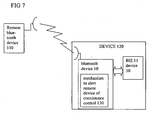
- the collocated device will know that the retransmission are coming from the coexistence mechanism while the remote device will not know.
- This scenario is illustrated in fig 7 , with the first radio link extending between the local device 120 and the remote device 110.
- the local device 120 incorporates both coexisting radio devices Bluetooth device 10 and 802.11 device 30 in this example.
- the air quality estimation algorithm of the remote device can cause a reduced data rate and change in modulation level since it sees many retransmissions and it is not aware of the existence of the coexistence mechanism.
- the problem can be addressed in at least two ways:
Landscapes
- Engineering & Computer Science (AREA)
- Computer Networks & Wireless Communication (AREA)
- Signal Processing (AREA)
- Quality & Reliability (AREA)
- Mobile Radio Communication Systems (AREA)
- Small-Scale Networks (AREA)
Claims (13)
- Dispositif ayant un premier émetteur radio (10) pour supporter une première liaison radio, l'émetteur radio ayant une unité de commande de coexistence (60) agencée pour communiquer avec un second émetteur radio (30) pour supporter une seconde liaison radio, et pour commander des temps d'émission du premier émetteur et du second émetteur pour permettre aux deux liaisons radio d'utiliser des fréquences d'émission potentiellement contradictoires,
caractérisé en ce que le premier émetteur radio a également un dispositif de contrôle de liaison (50) agencé pour compter des retransmissions sur la première liaison radio, et dans lequel le dispositif de contrôle de liaison (50) est muni d'une sortie en provenance de l'unité de commande de coexistence (60) qui indique quand une retransmission est provoquée par l'unité de commande de coexistence et le dispositif de contrôle de liaison (50) est agencé pour soustraire un compte de retransmissions provoquées par l'unité de commande de coexistence du compte de retransmissions sur la première liaison radio. - Dispositif selon la revendication 1 et ayant le second émetteur radio incorporé dans le dispositif (120).
- Dispositif selon la revendication 1 ou 2, le premier émetteur radio ayant une unité de commande de débit (70) agencée pour varier un débit de données d'émission, ou le débit de données d'émissions reçues par le dispositif sur la première liaison, selon une sortie du dispositif de contrôle.
- Dispositif selon la revendication 3, agencé pour varier le débit de données en variant un type de modulation.
- Dispositif selon l'une quelconque des revendications précédentes, le premier émetteur radio étant agencé pour passer une sortie en provenance de l'unité de commande de coexistence sur la première liaison radio.
- Dispositif selon l'une quelconque des revendications précédentes, le premier émetteur radio ayant une portée de moins de 100 m.
- Dispositif selon l'une quelconque des revendications précédentes, le premier émetteur radio comprenant n'importe lequel d'un émetteur de type Bluetooth (10) ou d'un émetteur de type IEEE 802.11 (30).
- Procédé de commande d'émissions radio sur une première liaison radio, ayant les étapes de :commande de temps d'émission sur la première liaison radio et sur une seconde liaison radio selon un algorithme de coexistence pour permettre à la première liaison radio et à la seconde liaison d'utiliser des fréquences d'émission potentiellement contradictoires, et caractérisé par :le comptage de retransmissions sur la première liaison radio,la réception d'une sortie de l'algorithme de coexistence qui indique quand une retransmission est provoquée par l'algorithme de coexistence et le comptage de retransmissions provoquées par l'algorithme de coexistence, etla soustraction d'un compte de retransmissions provoquées par l'algorithme de coexistence d'un compte de retransmissions sur la première liaison radio.
- Procédé selon la revendication 8, ayant l'étape de variation d'un débit de données d'émission, ou du débit de données d'émissions reçues par le dispositif sur la première liaison, selon une sortie du dispositif de contrôle.
- Procédé selon la revendication 8 ou 9, variant le débit de données en variant un type de modulation.
- Procédé selon l'une quelconque des revendications 8 à 10, ayant l'étape de passation d'une sortie en provenance de l'algorithme de coexistence sur la première liaison radio.
- Programme pour ordinateur comprenant un code pour exécuter le procédé selon l'une quelconque des revendications 8 à 11, quand il est exécuté sur un appareil de traitement de données.
- Dispositif selon l'une quelconque des revendications 1 à 7, dans lequel le dispositif de contrôle de liaison, l'unité de commande de coexistence et l'unité de commande de débit sont mis en oeuvre sous la forme d'un circuit intégré.
Priority Applications (3)
| Application Number | Priority Date | Filing Date | Title |
|---|---|---|---|
| EP07003400A EP1959612B1 (fr) | 2007-02-19 | 2007-02-19 | Mécanisme de coexistence radio pour liaisons radio de débit binaire variable |
| DE602007010416T DE602007010416D1 (de) | 2007-02-19 | 2007-02-19 | Funkkoexistenzmechanismus für Funkverbindungen mit variabler Datenrate |
| US12/032,076 US8185058B2 (en) | 2007-02-19 | 2008-02-15 | Radio coexistence mechanism for variable data rate radio links |
Applications Claiming Priority (1)
| Application Number | Priority Date | Filing Date | Title |
|---|---|---|---|
| EP07003400A EP1959612B1 (fr) | 2007-02-19 | 2007-02-19 | Mécanisme de coexistence radio pour liaisons radio de débit binaire variable |
Publications (2)
| Publication Number | Publication Date |
|---|---|
| EP1959612A1 EP1959612A1 (fr) | 2008-08-20 |
| EP1959612B1 true EP1959612B1 (fr) | 2010-11-10 |
Family
ID=38236515
Family Applications (1)
| Application Number | Title | Priority Date | Filing Date |
|---|---|---|---|
| EP07003400A Active EP1959612B1 (fr) | 2007-02-19 | 2007-02-19 | Mécanisme de coexistence radio pour liaisons radio de débit binaire variable |
Country Status (3)
| Country | Link |
|---|---|
| US (1) | US8185058B2 (fr) |
| EP (1) | EP1959612B1 (fr) |
| DE (1) | DE602007010416D1 (fr) |
Families Citing this family (23)
| Publication number | Priority date | Publication date | Assignee | Title |
|---|---|---|---|---|
| US8280368B2 (en) * | 2005-04-07 | 2012-10-02 | Qualcomm Incorporated | Method and system for re-acquiring signals of a wireless broadcast network |
| KR20100082106A (ko) * | 2009-01-08 | 2010-07-16 | 삼성전자주식회사 | 와이 파이 멀티미디어 기반의 데이터 전송 방법 및 장치 |
| US8184580B2 (en) * | 2009-02-12 | 2012-05-22 | Telefonaktiebolaget L M Ericsson (Publ) | Data packet communication scheduling in a communication system |
| US9119215B2 (en) * | 2009-08-31 | 2015-08-25 | Qualcomm Incorporated | Method and apparatus for enhanced packet traffic arbitration |
| US8340578B2 (en) | 2009-10-05 | 2012-12-25 | Apple Inc. | Methods and apparatus for enhanced coexistence algorithms in wireless systems |
| US8693569B2 (en) * | 2009-10-19 | 2014-04-08 | Apple Inc. | Methods and apparatus for dynamic wireless device coexistence |
| JP2012014452A (ja) * | 2010-06-30 | 2012-01-19 | Fujitsu Ltd | 情報処理装置、情報処理プログラム、情報処理方法 |
| KR101489843B1 (ko) * | 2010-07-19 | 2015-02-06 | 퀄컴 인코포레이티드 | 향상된 패킷 트래픽 중재를 위한 방법 및 장치 |
| US8837637B2 (en) * | 2010-08-09 | 2014-09-16 | Mediatek Inc. | Method for dynamically adjusting one or more RF parameters and communications apparatus utilizing the same |
| CA2813292C (fr) * | 2010-10-01 | 2019-04-02 | Research In Motion Limited | Procede et dispositif pour eviter un brouillage de coexistence dans un dispositif |
| US8599709B2 (en) | 2011-02-10 | 2013-12-03 | Apple Inc. | Methods and apparatus for wireless coexistence based on transceiver chain emphasis |
| US8805303B2 (en) | 2011-02-18 | 2014-08-12 | Blackberry Limited | Method and apparatus for avoiding in-device coexistence interference with preferred frequency notification |
| US8965286B2 (en) * | 2011-05-13 | 2015-02-24 | Nokia Corporation | Inquiry response event control |
| US8842602B2 (en) | 2011-07-29 | 2014-09-23 | Blackberry Limited | Enhancement of in-device coexistence interference avoidance |
| US9060280B2 (en) | 2011-07-29 | 2015-06-16 | Blackberry Limited | Enhanced in-device coexistence interference avoidance using predetermined downlink channel |
| US8995929B2 (en) | 2011-12-06 | 2015-03-31 | Apple Inc. | Methods and apparatus for wireless optimization based on platform configuration and use cases |
| WO2013089747A1 (fr) * | 2011-12-15 | 2013-06-20 | Intel Corporation | Système et procédé pour permettre des dispositifs de faible puissance |
| US9143957B2 (en) * | 2012-02-24 | 2015-09-22 | Qualcomm Incorporated | Mitigating cross-device interference |
| US8995553B2 (en) * | 2012-06-08 | 2015-03-31 | Apple Inc. | Methods and apparatus for mitigating interference in aggressive form factor designs |
| WO2017167380A1 (fr) | 2016-03-31 | 2017-10-05 | Telefonaktiebolaget Lm Ericsson (Publ) | Récepteur à multiples modulations, émetteurs et procédés pour traiter de multiples modulations dans des systèmes de communication sans fil |
| EP3437280B1 (fr) * | 2016-03-31 | 2019-12-25 | Telefonaktiebolaget LM Ericsson (PUBL) | Émetteur multimodulation, récepteur et procédés permettant de gérer une multimodulation dans des systèmes de communication sans fil |
| US11120811B2 (en) * | 2018-08-29 | 2021-09-14 | Qualcomm Incorporated | Power optimized link quality detection and feedback |
| CN112260778B (zh) * | 2020-10-16 | 2023-02-14 | 展讯半导体(成都)有限公司 | 广播信道的评估方法及相关产品 |
Family Cites Families (14)
| Publication number | Priority date | Publication date | Assignee | Title |
|---|---|---|---|---|
| US6795418B2 (en) * | 2000-03-31 | 2004-09-21 | Koninklijke Philips Electronics N.V. | Wireless MAC protocol based on a hybrid combination of slot allocation, token passing, and polling for isochronous traffic |
| US6954616B2 (en) * | 2001-03-22 | 2005-10-11 | Transdimension, Inc. | Top-level controller for wireless communication devices and protocols |
| US8364080B2 (en) * | 2002-08-01 | 2013-01-29 | Broadcom Corporation | Method and system for achieving enhanced quality and higher throughput for collocated IEEE 802.11 B/G and bluetooth devices in coexistent operation |
| US20040192222A1 (en) * | 2003-03-26 | 2004-09-30 | Nokia Corporation | System and method for semi-simultaneously coupling an antenna to transceivers |
| US7406296B2 (en) * | 2003-08-22 | 2008-07-29 | Telefonaktiebolaget L M Ericsson (Publ) | Co-located radio operation |
| EP1513281A1 (fr) * | 2003-09-05 | 2005-03-09 | Motorola Inc. | Procédé et dispositif d'adaptation de liaison pour la transmission des paquets |
| US7610057B2 (en) * | 2004-04-23 | 2009-10-27 | Microsoft Corporation | Selecting a wireless networking technology on a device capable of carrying out wireless network communications via multiple wireless technologies |
| US7280836B2 (en) * | 2004-04-30 | 2007-10-09 | Symbol Technologies, Inc. | System and method for coexistence in wireless networks |
| US7440728B2 (en) * | 2004-12-03 | 2008-10-21 | Microsoft Corporation | Use of separate control channel to mitigate interference problems in wireless networking |
| US20060239223A1 (en) * | 2005-04-21 | 2006-10-26 | Itay Sherman | Method and system for bluetooth and wireless local area network coexistence |
| US9059782B2 (en) * | 2005-06-01 | 2015-06-16 | Broadcom Corporation | Method and system for antenna and radio front-end topologies for a system-on-a-chip (SOC) device that combines bluetooth and IEEE 802.11 b/g WLAN technologies |
| US9031604B2 (en) * | 2005-06-02 | 2015-05-12 | Broadcom Corporation | Method and apparatus for enabling simultaneous VoWLAN and Bluetooth audio in small form factor handheld devices |
| US20060292987A1 (en) * | 2005-06-27 | 2006-12-28 | Lior Ophir | Method of wireless local area network and Bluetooth network coexistence in a collocated device |
| US20060292986A1 (en) * | 2005-06-27 | 2006-12-28 | Yigal Bitran | Coexistent bluetooth and wireless local area networks in a multimode terminal and method thereof |
-
2007
- 2007-02-19 EP EP07003400A patent/EP1959612B1/fr active Active
- 2007-02-19 DE DE602007010416T patent/DE602007010416D1/de active Active
-
2008
- 2008-02-15 US US12/032,076 patent/US8185058B2/en active Active
Also Published As
| Publication number | Publication date |
|---|---|
| US20080200124A1 (en) | 2008-08-21 |
| US8185058B2 (en) | 2012-05-22 |
| DE602007010416D1 (de) | 2010-12-23 |
| EP1959612A1 (fr) | 2008-08-20 |
Similar Documents
| Publication | Publication Date | Title |
|---|---|---|
| EP1959612B1 (fr) | Mécanisme de coexistence radio pour liaisons radio de débit binaire variable | |
| US6882635B2 (en) | Coexistence between interfering communication systems | |
| US8107999B2 (en) | Communication device and method of communicating transmissions | |
| CN105722097B (zh) | 信道检测方法、信道检测装置和终端 | |
| JP5148756B2 (ja) | 無線局 | |
| EP3621227B1 (fr) | Coexistence intra-dispositif de technologies de communication sans fil | |
| CN102957455B (zh) | 无线通信装置以及干扰避免方法 | |
| EP2340629B1 (fr) | Transmission en coopération dans un système de communications sans fil | |
| JP4625128B2 (ja) | 送信設定を適合させるための方法、装置、及びコンピュータ可読記録媒体 | |
| JP5852128B2 (ja) | バースト的ノイズ環境に対する通信技術 | |
| EP2738960A1 (fr) | Système de communication sans fil et dispositif de communication sans fil | |
| US9629202B2 (en) | In-device coexistence of multiple wireless communication technologies | |
| MXPA04008194A (es) | Sistema de comunicacion inalambrica, dispositivo de comunicacion inalambrica y metodo de comunicacion inalambrica, y programa de computo. | |
| EP2732582A1 (fr) | Procédés et appareils de fourniture d'une technique de partage de temps flexible sur une bande sans licence d'un système | |
| EP2257087A1 (fr) | Terminal sans fil et procédé de retransmission | |
| WO2015179811A1 (fr) | Bande de fréquences sans licence utilisant la synchronisation d'une bande de fréquences sous licence | |
| US20120075987A1 (en) | Radio apparatus, method for communication disturbance remedial action and program for communication disturbance remedial action | |
| CN102292937A (zh) | 减少运作于相邻频带中的两个通信系统之间干扰的方法 | |
| WO2016057146A1 (fr) | Coordination de transmission pour radios colocalisées | |
| WO2016126383A1 (fr) | Gestion d'atténuation d'interférences de coexistence pour systèmes mimo multiutilisateur | |
| CN108029137A (zh) | 免授权蜂窝无线电网络中的竞争窗口调节 | |
| WO2012095161A1 (fr) | Contrôle d'erreur dans un système de communication | |
| JP6938526B2 (ja) | ライセンス補助アクセスキャリアに対するリンク適応 | |
| CN102056303A (zh) | 调度信息的触发以及载波激活控制方法及装置 | |
| JP2006135891A (ja) | 無線通信方法 |
Legal Events
| Date | Code | Title | Description |
|---|---|---|---|
| PUAI | Public reference made under article 153(3) epc to a published international application that has entered the european phase |
Free format text: ORIGINAL CODE: 0009012 |
|
| AK | Designated contracting states |
Kind code of ref document: A1 Designated state(s): AT BE BG CH CY CZ DE DK EE ES FI FR GB GR HU IE IS IT LI LT LU LV MC NL PL PT RO SE SI SK TR |
|
| AX | Request for extension of the european patent |
Extension state: AL BA HR MK RS |
|
| 17P | Request for examination filed |
Effective date: 20090126 |
|
| 17Q | First examination report despatched |
Effective date: 20090225 |
|
| AKX | Designation fees paid |
Designated state(s): DE FR GB IT |
|
| RIC1 | Information provided on ipc code assigned before grant |
Ipc: H04W 8/08 20090101AFI20100208BHEP |
|
| GRAP | Despatch of communication of intention to grant a patent |
Free format text: ORIGINAL CODE: EPIDOSNIGR1 |
|
| RAP1 | Party data changed (applicant data changed or rights of an application transferred) |
Owner name: ST-ERICSSON BELGIUM NV |
|
| RIC1 | Information provided on ipc code assigned before grant |
Ipc: H04L 1/00 20060101ALI20100505BHEP Ipc: H04W 88/06 20090101ALI20100505BHEP Ipc: H04W 8/08 20090101AFI20100505BHEP |
|
| GRAS | Grant fee paid |
Free format text: ORIGINAL CODE: EPIDOSNIGR3 |
|
| GRAA | (expected) grant |
Free format text: ORIGINAL CODE: 0009210 |
|
| AK | Designated contracting states |
Kind code of ref document: B1 Designated state(s): DE FR GB IT |
|
| REG | Reference to a national code |
Ref country code: GB Ref legal event code: FG4D |
|
| REF | Corresponds to: |
Ref document number: 602007010416 Country of ref document: DE Date of ref document: 20101223 Kind code of ref document: P |
|
| PLBE | No opposition filed within time limit |
Free format text: ORIGINAL CODE: 0009261 |
|
| STAA | Information on the status of an ep patent application or granted ep patent |
Free format text: STATUS: NO OPPOSITION FILED WITHIN TIME LIMIT |
|
| 26N | No opposition filed |
Effective date: 20110811 |
|
| REG | Reference to a national code |
Ref country code: DE Ref legal event code: R097 Ref document number: 602007010416 Country of ref document: DE Effective date: 20110811 |
|
| PG25 | Lapsed in a contracting state [announced via postgrant information from national office to epo] |
Ref country code: IT Free format text: LAPSE BECAUSE OF FAILURE TO SUBMIT A TRANSLATION OF THE DESCRIPTION OR TO PAY THE FEE WITHIN THE PRESCRIBED TIME-LIMIT Effective date: 20101110 |
|
| REG | Reference to a national code |
Ref country code: FR Ref legal event code: PLFP Year of fee payment: 10 |
|
| REG | Reference to a national code |
Ref country code: FR Ref legal event code: PLFP Year of fee payment: 11 |
|
| REG | Reference to a national code |
Ref country code: FR Ref legal event code: PLFP Year of fee payment: 12 |
|
| PGFP | Annual fee paid to national office [announced via postgrant information from national office to epo] |
Ref country code: GB Payment date: 20260121 Year of fee payment: 20 |
|
| PGFP | Annual fee paid to national office [announced via postgrant information from national office to epo] |
Ref country code: DE Payment date: 20260121 Year of fee payment: 20 |
|
| PGFP | Annual fee paid to national office [announced via postgrant information from national office to epo] |
Ref country code: FR Payment date: 20260121 Year of fee payment: 20 |