EP1961479A2 - Procédé et dispositif de liaison de CO2 gazeux en relation avec la désalinisation de l'eau de mer - Google Patents
Procédé et dispositif de liaison de CO2 gazeux en relation avec la désalinisation de l'eau de mer Download PDFInfo
- Publication number
- EP1961479A2 EP1961479A2 EP07104246A EP07104246A EP1961479A2 EP 1961479 A2 EP1961479 A2 EP 1961479A2 EP 07104246 A EP07104246 A EP 07104246A EP 07104246 A EP07104246 A EP 07104246A EP 1961479 A2 EP1961479 A2 EP 1961479A2
- Authority
- EP
- European Patent Office
- Prior art keywords
- ammonia
- brine
- concentrated brine
- concentrated
- water
- Prior art date
- Legal status (The legal status is an assumption and is not a legal conclusion. Google has not performed a legal analysis and makes no representation as to the accuracy of the status listed.)
- Withdrawn
Links
Images

Classifications
-
- C—CHEMISTRY; METALLURGY
- C01—INORGANIC CHEMISTRY
- C01D—COMPOUNDS OF ALKALI METALS, i.e. LITHIUM, SODIUM, POTASSIUM, RUBIDIUM, CAESIUM, OR FRANCIUM
- C01D7/00—Carbonates of sodium, potassium or alkali metals in general
- C01D7/10—Preparation of bicarbonates from carbonates
-
- B—PERFORMING OPERATIONS; TRANSPORTING
- B01—PHYSICAL OR CHEMICAL PROCESSES OR APPARATUS IN GENERAL
- B01D—SEPARATION
- B01D53/00—Separation of gases or vapours; Recovering vapours of volatile solvents from gases; Chemical or biological purification of waste gases, e.g. engine exhaust gases, smoke, fumes, flue gases, aerosols
- B01D53/14—Separation of gases or vapours; Recovering vapours of volatile solvents from gases; Chemical or biological purification of waste gases, e.g. engine exhaust gases, smoke, fumes, flue gases, aerosols by absorption
- B01D53/1456—Removing acid components
- B01D53/1475—Removing carbon dioxide
-
- C—CHEMISTRY; METALLURGY
- C01—INORGANIC CHEMISTRY
- C01B—NON-METALLIC ELEMENTS; COMPOUNDS THEREOF; METALLOIDS OR COMPOUNDS THEREOF NOT COVERED BY SUBCLASS C01C
- C01B32/00—Carbon; Compounds thereof
- C01B32/60—Preparation of carbonates or bicarbonates in general
-
- B—PERFORMING OPERATIONS; TRANSPORTING
- B01—PHYSICAL OR CHEMICAL PROCESSES OR APPARATUS IN GENERAL
- B01D—SEPARATION
- B01D2251/00—Reactants
- B01D2251/20—Reductants
- B01D2251/206—Ammonium compounds
- B01D2251/2062—Ammonia
-
- B—PERFORMING OPERATIONS; TRANSPORTING
- B01—PHYSICAL OR CHEMICAL PROCESSES OR APPARATUS IN GENERAL
- B01D—SEPARATION
- B01D2251/00—Reactants
- B01D2251/20—Reductants
- B01D2251/206—Ammonium compounds
- B01D2251/2067—Urea
-
- B—PERFORMING OPERATIONS; TRANSPORTING
- B01—PHYSICAL OR CHEMICAL PROCESSES OR APPARATUS IN GENERAL
- B01D—SEPARATION
- B01D2257/00—Components to be removed
- B01D2257/50—Carbon oxides
- B01D2257/504—Carbon dioxide
-
- Y—GENERAL TAGGING OF NEW TECHNOLOGICAL DEVELOPMENTS; GENERAL TAGGING OF CROSS-SECTIONAL TECHNOLOGIES SPANNING OVER SEVERAL SECTIONS OF THE IPC; TECHNICAL SUBJECTS COVERED BY FORMER USPC CROSS-REFERENCE ART COLLECTIONS [XRACs] AND DIGESTS
- Y02—TECHNOLOGIES OR APPLICATIONS FOR MITIGATION OR ADAPTATION AGAINST CLIMATE CHANGE
- Y02C—CAPTURE, STORAGE, SEQUESTRATION OR DISPOSAL OF GREENHOUSE GASES [GHG]
- Y02C20/00—Capture or disposal of greenhouse gases
- Y02C20/20—Capture or disposal of greenhouse gases of methane
-
- Y—GENERAL TAGGING OF NEW TECHNOLOGICAL DEVELOPMENTS; GENERAL TAGGING OF CROSS-SECTIONAL TECHNOLOGIES SPANNING OVER SEVERAL SECTIONS OF THE IPC; TECHNICAL SUBJECTS COVERED BY FORMER USPC CROSS-REFERENCE ART COLLECTIONS [XRACs] AND DIGESTS
- Y02—TECHNOLOGIES OR APPLICATIONS FOR MITIGATION OR ADAPTATION AGAINST CLIMATE CHANGE
- Y02C—CAPTURE, STORAGE, SEQUESTRATION OR DISPOSAL OF GREENHOUSE GASES [GHG]
- Y02C20/00—Capture or disposal of greenhouse gases
- Y02C20/40—Capture or disposal of greenhouse gases of CO2
-
- Y—GENERAL TAGGING OF NEW TECHNOLOGICAL DEVELOPMENTS; GENERAL TAGGING OF CROSS-SECTIONAL TECHNOLOGIES SPANNING OVER SEVERAL SECTIONS OF THE IPC; TECHNICAL SUBJECTS COVERED BY FORMER USPC CROSS-REFERENCE ART COLLECTIONS [XRACs] AND DIGESTS
- Y02—TECHNOLOGIES OR APPLICATIONS FOR MITIGATION OR ADAPTATION AGAINST CLIMATE CHANGE
- Y02P—CLIMATE CHANGE MITIGATION TECHNOLOGIES IN THE PRODUCTION OR PROCESSING OF GOODS
- Y02P20/00—Technologies relating to chemical industry
- Y02P20/151—Reduction of greenhouse gas [GHG] emissions, e.g. CO2
Definitions
- the present application relates to methods and apparatus for binding gaseous CO 2 in connection with seawater desalination.
- Carbon dioxide (usually called carbon dioxide) is a chemical compound of carbon and oxygen. Carbon dioxide is a colorless and odorless gas. It is a natural constituent of the air at a low concentration and is produced in living beings during cellular respiration, but also in the combustion of carbonaceous substances under sufficient oxygen. Since the beginning of industrialization, the CO 2 share in the atmosphere has increased significantly. The main reason for this is man-made - the so-called anthropogenic - CO 2 emissions.
- the carbon dioxide in the atmosphere absorbs part of the heat radiation. This property makes carbon dioxide a so-called greenhouse gas and is one of the contributors to the greenhouse effect.
- Another disadvantage is that energy is the biggest cost factor in extracting drinking water from salty seawater. If the plant is connected to a conventional power plant for energy production, the required energy can be supplied by the power plant. Unfortunately, the power plant produces environmentally harmful substances, such as CO 2 , which enter the air with the flue gas.
- the Solvay process proceeds via the following partial reactions (1) to (4): CaCO 3 ⁇ CaO + CO 2 (1) 2 NaCl + 2 CO 2 + 2 NH 3 + 2 H 2 O ⁇ 2 NaHCO 3 + 2 NH 4 Cl (2) 2 NaHCO 3 ⁇ Na 2 CO 3 + H 2 O + CO 2 (3) CaO + 2NH 4 Cl ⁇ 2NH 3 + CaCl 2 + H 2 O (4) CaCO 3 + 2 NaCl ⁇ CaCl 2 + Na 2 CO 3 (5)
- the Solvay process is about the industrial production of soda.
- the carbon dioxide used for the soda must always be replaced.
- limestone (CaCO 3 ) is heated in furnaces, which decomposes from 900 ° C to calcium oxide (CaO).
- CaO calcium oxide
- CO 2 is released, which in turn is consumed in the production of soda. This process needs a lot of energy. 178.44 kJ + CaCO 3 -> CaO + CO 2 (6)
- Soda Na 2 CO 3
- Soda is used in many other areas besides glass production (with silicon dioxide) and is an important raw material. It is used for the production of detergents, soaps and food as well as for dyeing and bleaching. However, soda is also found in paints, catalysts, pesticides and fertilizers, in cellulose or other substances, and in the reduction of alumina and silica.
- this method should be designed so that it runs energetically particularly favorable.
- the process should be widely accepted in order to enable a broad-based technical implementation.
- the inventive method is based on a novel concept, which binds using existing starting materials, the CO 2 in sodium bicarbonate (NaHCO 3 ) or in soda, and possibly also in NH 4 Cl.
- seawater is preferably used in order to produce a concentrated aqueous sodium chloride solution therefrom.
- the concentrated aqueous sodium chloride solution produced from the seawater is referred to herein for simplicity as concentrated brine.
- this concentrated salt brine (preferably a saturated or near-saturated brine) is produced by an evaporation process (thermal distillation process).
- evaporation process thermal distillation process
- the multi-stage flash evaporation has proven particularly useful.
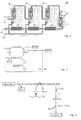
- a corresponding system 10 is in Fig. 1 shown.
- the concentrated brine preferably has a salinity greater than 200 g / l, and preferably greater than 300 g / l. It is particularly advantageous the total salt content (salinity) of the concentrated brine by a To monitor conductivity measurement. The total salt content can also be monitored by measuring the pH and controlling the entire process.
- the multistage flash evaporation is based on the evaporation and subsequent condensation of the resulting vapor.
- the seawater supplied through a conduit 11 is heated in a heating zone 12. However, before that, the seawater passes through several cooling loops 16. There, the seawater is used to cool the water vapor in low-pressure tanks 13 so that the water vapor is there condensed out. After heating in the heating area 12 to temperatures above 100 ° C, the heated seawater is then passed into low-pressure tanks 13. Due to the low pressure, the water relaxes and evaporates there. This steam then condenses on the corresponding cooling loop 16 and pure water (referred to here as fresh water) is obtained in a region 17. This water can be withdrawn through a line 14. The concentrated brine (NaCl brine) is removed through a line 15.
- NaCl brine NaCl brine
- MED multi-effect distillation
- a filtering method can be used, which is based for example on a reverse osmosis.
- a membrane is used which separates a concentrated and a dilute solution from each other.
- Preferred is a solution that combines a multi-stage relaxation process with a filtering process.
- Reverse osmosis systems This energy is consumed in reverse osmosis systems in the form of electricity. In the thermal distillation process, the energy consumption is between 3 and 6 kWh of electricity (equivalent to between 10.8 MJ and 21.6 MJ) and approx. 230 MJ thermal energy per m 3 of seawater for an MSF plant and between 2 and 4 kWh of electricity (equals between 7.2 MJ and 14.4 MJ) and about 200 MJ heat energy per m 3 of seawater in a MED plant.
- the amount of energy E1 required to operate the multi-stage expansion process is at least partially provided by a power plant or pyrolysis process.
- the corresponding energy share is referred to here as E2.
- Fig. 3 The basic scheme of a first process according to the invention is in Fig. 3 shown. As well in Fig. 2 as well as in Fig. 3 the educts (starting materials) as well as the products are shown with border, while intermediates are shown without bordering.
- seawater is used, which is converted into fresh water (H 2 O) and NaCl brine (top left in FIG Fig. 3 shown).
- ammonia (NH 3 ) is used.
- an ammonia-containing brine (also ammonia brine called) generated. This is done by introducing ammonia (NH 3 ) into the concentrated brine (NaCl brine).
- this process also called absorption of the ammonia in the brine, is carried out in a so-called saturation apparatus 20.
- This step is exothermic, ie it releases energy.
- Fig. 3 Therefore, a - ⁇ H is shown next to this step.
- a corresponding saturation apparatus 20 is greatly simplified in FIG Fig. 4 shown.
- a pump 21 eg a vacuum pump
- the ammonia is pumped or sucked through the saturation apparatus 20 and is cooled accordingly.
- a tube cooler 22 Preferably used here is a tube cooler 22 with pipes that are traversed by cold water.
- the seawater for example, immediately after removal from the sea, is passed through these tubes of the tube cooler 22, as in FIG Fig. 4 indicated.
- Two advantages are achieved by this measure: 1. the seawater is preheated, which reduces the energy requirement for providing the brine (if a thermal distillation method is used), since the seawater already has an elevated temperature; 2. Cooling of the ammonia-containing brine 24 takes place, which then makes it possible to dissolve significantly more CO 2 in this brine.
- the seawater has, after passing through the tube cooler 22 on the output side 23, a higher temperature than on the input side 25.
- heat energy referred to here as E3 *, passed to the sea water.
- This energy E3 * is a first portion of the further energy portion E3 needed for the thermal distillation process to provide the NaCl brine.
- the output side 23 of the Tube cooler 22 for example, be connected directly to the input side 11 of the device 10.
- the tube cooler 22 may be traversed by a heat transfer medium that transports heat through tubes to the heater 12 to assist in heating the seawater. In this case, the tube cooler 22 is not flowed through by the seawater.
- CO 2 is introduced into the ammonia-containing brine 24.
- This can be done by passing the ammonia-containing brine 24 from above into a device 30 (eg in the form of a filling tower) while at the same time pumping in CO 2 from below (see FIG Fig. 5 ).
- the ammonia-containing brine 24 is introduced into the device 30 through a distributor head 33 or through injection nozzles.
- cooling means 32 should be used to dissipate the heat generated during the exothermic reaction. This heat energy is called E3 **.
- This cooling device 32 can in turn be cooled with seawater, as in Fig. 5 indicated.
- the seawater is (further) preheated before it is finally brought in the heating 12 to a temperature above 100 ° C.
- the cooling device 32 may be traversed by a heat transfer medium that transports heat through tubes to the heater 12 to assist in heating the seawater. In this case, the cooling device 32 is not flowed through by the seawater.
- the cooling devices 22 and 32 are connected in series and successively flowed through by seawater, before then the heated seawater passes through the input side 11 in the device 10.
- the cooling capacity of the cooling loops 16 decreases. These cooling loops 16 work best at seawater temperatures below 50 ° C and preferably below 30 ° C. Therefore, in an alternative embodiment, the preheated by the waste heat E3 * and E3 ** ** water can be passed directly via a bypass line 18 in the heater 12, while cooler seawater is passed through the cooling loops 16.
- the bypass line 18 is in Fig. 1 hinted at.
- the cooler seawater is mixed in this embodiment with the preheated seawater and then brought to about 100 ° C before it then enters the low-pressure tanks 13.
- ammonia (NH 3 ) is used, as mentioned.
- ammonia NH 3
- the sodium bicarbonate (NaHCO 3 ) can be stored to permanently bind the CO 2 .
- sodium bicarbonate can also be used in chemical processes where no CO 2 is produced as far as possible.
- the fresh water generated upon heating will catch.
- the sodium carbonate can be stored to permanently bind the CO 2 .
- sodium carbonate can also be used in chemical processes where no CO 2 is produced as far as possible.
- Ammonia can be prepared by directly combining nitrogen and hydrogen according to equation (7): N 2 + 3 H 2 ⁇ 2 NH 3 + 92 kJ (7)
- the ammonia synthesis according to equation (7) is exothermic (reaction enthalpy - 92.28 kJ / mol). It is an equilibrium reaction that proceeds with volume reduction.
- the nitrogen can be provided, for example, according to the Linde method, in which from the ambient air on the one hand, the oxygen and on the other hand, the nitrogen is separated, as in Fig. 6 schematically represented by the process block 41.
- the process block 41 may be part of a plant 40 designed to provide the ammonia (NH 3 ).
- the hydrogen can be generated conventionally from methane (CH 4 ).
- This methane can be generated from a pyrolysis process or the methane can be generated from ammonium chloride (NH 4 Cl) and eg methane.
- NH 4 Cl ammonium chloride
- This NH 4 Cl is formed in the process according to the invention as (intermediate) product, as in Fig. 3 (NH 4 Cl is another Solvay starting product). But you can also use NH 4 Cl to bind more CO 2 .
- the NH 3 synthesis according to (7) is exothermic and proceeds under volume reduction, there is a dependence of the yield of NH 3 on pressure and temperature.
- the exothermic reaction (7) shifts with increasing temperature on the side of the starting materials, ie at high temperature, the yield of NH 3 is lower. Reactions with a decrease in volume shift to the side of the end products as the pressure increases, ie here to higher yields of NH 3 . Therefore, according to the invention, preferably the NH 3 synthesis is carried out in a NH 3 synthesis reactor, for example in the form of a cooled pressure vessel 43.
- cooling by means of seawater is again particularly preferred. It can be here too Cooling device 42 are used, which in turn is part of a series circuit of seawater cooled cooling devices 22, 32 and 42.
- cooling with a heat transfer medium can also be carried out here, as described above, in order to convey the energy E3 *** to the heater 12.
- urea can also be prepared from the ammonia (NH 3 ) according to the following equation (8) (3rd CO 2 binding possibility): 2 NH 3 + CO 2 ⁇ (NH 2 ) 2 CO + H 2 O (8)
- This method (8) can be used if, for example, urea is needed in the parallel power plant or pyrolysis process to remove soot particles or other pollutants from the exhaust gases (flue gas).
- the urea can also be used as an energy storage, since urea can be easily and easily stored and / or transported.
- the urea can also serve as a fertilizer raw material.
- Ammonium chloride (NH 4 Cl) is produced in the process according to the invention as (intermediate) product, as in Fig. 3 indicated.
- Ammonium chloride sublimates on heating and decomposes completely from 335 ° C into ammonia (NH 3 ) and hydrogen chloride (HCl) as shown in equation (9): H 2 O + 2 NH 4 Cl ⁇ 2 NH 3 + HCI (9)
- This process (9) can be used to recover ammonia (NH 3 ) (back).
- Hydrogen chloride (HCI) is a valuable raw material for many industrial processes. If sodium (Na) is on hand, NaCI could optionally be re-made.
- ammonia (NH 3 ) (back) can also be obtained via the following optional route (10). Also in this process one recovers NaCl: NH 4 Cl + NaOH -> NH 3 + NaCl + H 2 O (10)
- ammonium chloride is used, among other things, in the production of cold mixes, in dye works and tanneries. It also finds application in tinning, galvanizing or brazing, as it has the ability to form volatile chlorides with metal oxides and thus to clean the metal surface.
- ammonium sulfide (NH 4 HSO 4 ) can also be produced from the ammonium chloride, as described, for example, in MXNL03000042.
- the ammonium chloride can also be used as a hydrogen storage.
- This method (11) is presently particularly preferred, since on the one hand CO 2 is bound and on the other hand methane can be made available. Methane is a valuable source of energy that stores and transports can be. It is particularly advantageous if in the context of the invention, the methane is used to provide at least a portion of the amount of energy E1, which is needed for the production of NaCl brine.
- the methane can also be converted or liquefied into longer-chain hydrocarbons.
- ammonium chloride as an (intermediate) product for other important processes, or to convert the ammonium chloride into corresponding products.
- NaOH or even a strong soda-potash solution dissolves silicates, Al 2 O 3 or SiO 2 , in which it is hydrolyzed to low-linked silicates (mainly ring and chain silicates [SiO 3 ] n 2n- ).
- the soda can be used according to the invention in a modified soda / potash digestion, for example in the production of aluminum for melting point depression (fluorine-free without cryolite), or in the production of silicon from sand.
- This silicon can in turn be used to react with the carbon from the CO 2 exothermic to silicon carbide (SiC).
- Another essential aspect of the invention is seen in the fact that in binding of CO 2 , which originates from a combustion, pyrolysis or other industrial process, in addition to the valuable soda also Drinking water / fresh water is created. This water is virtually a waste product and can be used for drinking water supply.
- the water can be used for the irrigation of plantings and new plantings. This creates "living biomass” that helps to bind more CO 2 through photosynthesis. This creates a real “avalanche effect” by "watering" desert areas.
- Ceramic AION powder This powder can be prepared, for example, by grinding a mixture of aluminum and alumina in a nitrogen atmosphere. Then, this powder is heated in an inert gas atmosphere to produce a homogeneous aluminum oxynitride material therefrom. Details are the US Patent 6955798 refer to.
- the aluminum required can be prepared with the soda according to the invention in a modified soda / potash digestion.
Landscapes
- Chemical & Material Sciences (AREA)
- Organic Chemistry (AREA)
- Engineering & Computer Science (AREA)
- Inorganic Chemistry (AREA)
- Analytical Chemistry (AREA)
- General Chemical & Material Sciences (AREA)
- Oil, Petroleum & Natural Gas (AREA)
- Chemical Kinetics & Catalysis (AREA)
- Materials Engineering (AREA)
- Fertilizers (AREA)
- Heat Treatment Of Water, Waste Water Or Sewage (AREA)
Priority Applications (8)
| Application Number | Priority Date | Filing Date | Title |
|---|---|---|---|
| EP07104246A EP1961479A3 (fr) | 2007-01-11 | 2007-03-15 | Procédé et dispositif de liaison de CO2 gazeux en relation avec la désalinisation de l'eau de mer |
| EP07107134A EP2017223A3 (fr) | 2007-01-11 | 2007-04-27 | Procédé et dispositif destinés à la production d'énergie et à la désalinisation de l'eau de mer avec utilisation contrôlée de gaz à effet de serre et à la préparation d'engrais de type charbon de bois à teneur en CO2 négative |
| EP07113903A EP1958683A3 (fr) | 2007-01-11 | 2007-08-07 | Procédé destiné au traitement de gaz de fumée pour centrales et autres installations |
| EP08708412A EP2134811A2 (fr) | 2007-03-15 | 2008-01-30 | Procédé et dispositif de liaison de co2 gazeux et de traitement de gaz de combustion à l'aide de composés carbonate de sodium |
| PCT/EP2008/051097 WO2008110405A2 (fr) | 2007-03-15 | 2008-01-30 | Procédé et dispositif de liaison de co2 gazeux et de traitement de gaz de combustion à l'aide de composés carbonate de sodium |
| US12/531,489 US20100196244A1 (en) | 2007-03-15 | 2008-01-30 | Method and device for binding gaseous co2 to sea water for the flue gas treatment with sodium carbonate compounds |
| EP08717769A EP2132280A2 (fr) | 2007-03-15 | 2008-03-13 | Procédé de traitement de gaz de fumées dans des centrales et autres installations |
| PCT/EP2008/053025 WO2008110609A2 (fr) | 2007-03-15 | 2008-03-13 | Procédé de traitement de gaz de fumées dans des centrales et autres installations |
Applications Claiming Priority (2)
| Application Number | Priority Date | Filing Date | Title |
|---|---|---|---|
| EP07100387A EP1857640A3 (fr) | 2006-05-10 | 2007-01-11 | Processus de centrale électrique cascadé de nouveau type et procédé de préparation de supports d'hydrogène insérables réversibles dans un tel processus de centrale électrique |
| EP07104246A EP1961479A3 (fr) | 2007-01-11 | 2007-03-15 | Procédé et dispositif de liaison de CO2 gazeux en relation avec la désalinisation de l'eau de mer |
Publications (2)
| Publication Number | Publication Date |
|---|---|
| EP1961479A2 true EP1961479A2 (fr) | 2008-08-27 |
| EP1961479A3 EP1961479A3 (fr) | 2010-05-05 |
Family
ID=39760732
Family Applications (2)
| Application Number | Title | Priority Date | Filing Date |
|---|---|---|---|
| EP07104246A Withdrawn EP1961479A3 (fr) | 2007-01-11 | 2007-03-15 | Procédé et dispositif de liaison de CO2 gazeux en relation avec la désalinisation de l'eau de mer |
| EP07107134A Withdrawn EP2017223A3 (fr) | 2007-01-11 | 2007-04-27 | Procédé et dispositif destinés à la production d'énergie et à la désalinisation de l'eau de mer avec utilisation contrôlée de gaz à effet de serre et à la préparation d'engrais de type charbon de bois à teneur en CO2 négative |
Family Applications After (1)
| Application Number | Title | Priority Date | Filing Date |
|---|---|---|---|
| EP07107134A Withdrawn EP2017223A3 (fr) | 2007-01-11 | 2007-04-27 | Procédé et dispositif destinés à la production d'énergie et à la désalinisation de l'eau de mer avec utilisation contrôlée de gaz à effet de serre et à la préparation d'engrais de type charbon de bois à teneur en CO2 négative |
Country Status (1)
| Country | Link |
|---|---|
| EP (2) | EP1961479A3 (fr) |
Cited By (2)
| Publication number | Priority date | Publication date | Assignee | Title |
|---|---|---|---|---|
| WO2017029509A1 (fr) | 2015-08-18 | 2017-02-23 | United Arab Emirates University | Procédé de capture de dioxyde de carbone et de dessalement |
| CN106552497A (zh) * | 2016-11-25 | 2017-04-05 | 东南大学 | 一种用于二氧化碳捕集和提纯的装置及方法 |
Families Citing this family (1)
| Publication number | Priority date | Publication date | Assignee | Title |
|---|---|---|---|---|
| CN107934964A (zh) * | 2017-12-18 | 2018-04-20 | 青海盐湖工业股份有限公司 | 一种二氧化碳气体综合利用方法 |
Family Cites Families (4)
| Publication number | Priority date | Publication date | Assignee | Title |
|---|---|---|---|---|
| JPS6259525A (ja) * | 1985-09-11 | 1987-03-16 | Tokuyama Soda Co Ltd | 重炭酸ナトリウムの製造方法 |
| NO319666B1 (no) * | 2000-06-16 | 2005-09-05 | Enpro As | Fremgangsmate til fjerning av salt fra saltholdig vann, samt anvendelse derav |
| DE10113879A1 (de) * | 2001-03-21 | 2002-09-26 | Mannheim Thomas | Verfahren und System zur Gewinnung von Energie |
| NO317918B1 (no) * | 2002-02-15 | 2005-01-03 | Sargas As | Fremgangsmate for fremstilling av ferskvann og rensing av karbondioksyd |
-
2007
- 2007-03-15 EP EP07104246A patent/EP1961479A3/fr not_active Withdrawn
- 2007-04-27 EP EP07107134A patent/EP2017223A3/fr not_active Withdrawn
Cited By (2)
| Publication number | Priority date | Publication date | Assignee | Title |
|---|---|---|---|---|
| WO2017029509A1 (fr) | 2015-08-18 | 2017-02-23 | United Arab Emirates University | Procédé de capture de dioxyde de carbone et de dessalement |
| CN106552497A (zh) * | 2016-11-25 | 2017-04-05 | 东南大学 | 一种用于二氧化碳捕集和提纯的装置及方法 |
Also Published As
| Publication number | Publication date |
|---|---|
| EP2017223A2 (fr) | 2009-01-21 |
| EP1961479A3 (fr) | 2010-05-05 |
| EP2017223A3 (fr) | 2010-12-15 |
Similar Documents
| Publication | Publication Date | Title |
|---|---|---|
| WO2008110405A2 (fr) | Procédé et dispositif de liaison de co2 gazeux et de traitement de gaz de combustion à l'aide de composés carbonate de sodium | |
| US10793458B2 (en) | Process to recover ammonium bicarbonate from wastewater | |
| US11858823B2 (en) | Process to recover ammonium bicarbonate from wastewater | |
| DE69617683T2 (de) | Verfahren zur herstellung von natriumbicarbonat, natriumcabonat und ammoniumsulfat aus natriumsulfat | |
| Kang et al. | Carbon capture and utilization using industrial wastewater under ambient conditions | |
| CN104707451B (zh) | 一种氨法烟气碳捕集及合成化工产品的方法 | |
| CA3007484C (fr) | Systeme d'elimination du dioxyde de soufre et procede de production de produits de potassium | |
| US9475712B2 (en) | Process for recovering sulfate and chloride salts from wastewater, mixed salts, and brines | |
| MX2011007502A (es) | Proceso para la recuperacion de amoniaco de una corriente gaseosa. | |
| EP3224223B1 (fr) | Procédé et installation pour produire un mélange d'urée et de nitrate d'ammonium | |
| EP3363523B1 (fr) | Procédé permettant de limiter les émissions de co2 dans des procédés de soude | |
| ITMI20091372A1 (it) | Procedimento per il recupero di ammoniaca da una corrente gassosa | |
| Krótki et al. | Carbon capture pilot study in Solvay soda ash process | |
| KR100929190B1 (ko) | 음이온이 저감된 해수를 이용한 연소배출가스 중 이산화탄소 제거 방법 및 장치 | |
| EP1958683A2 (fr) | Procédé destiné au traitement de gaz de fumée pour centrales et autres installations | |
| WO2008110609A2 (fr) | Procédé de traitement de gaz de fumées dans des centrales et autres installations | |
| EP3208237A1 (fr) | Système d'épuration de dioxyde de soufre et procédé de production de produits de potassium | |
| JP2011162404A (ja) | 炭酸ナトリウムの製造方法 | |
| EP2017223A2 (fr) | Procédé et dispositif destinés au gain d'énergie et désalinisation de l'eau de mer avec utilisation maîtrisée du gaz à effet de serre tout comme préparation d'engrais de type charbon de bois à teneur en CO2 négative | |
| KR20150021175A (ko) | 이산화탄소 흡수 공정과 연계된 광물탄산화 공정 | |
| EP2040323A2 (fr) | Procédé de préparation d'accumulateurs d'énergie à l'hydrogène à base d'azote | |
| KR20230108747A (ko) | 생활폐기물 소각장에서 발생하는 비산재를 활용한 온실가스 포집 및 침강탄산칼슘 제조 방법 | |
| CN1895741A (zh) | 以烟道气制备重碱并脱除二氧化硫的方法 | |
| AT6274U1 (de) | Verfahren zur umwandlung von rückstandsprodukten des solvay-prozesses | |
| Khan | CHEMCAD as a tool when teaching Chemical Engineering. |
Legal Events
| Date | Code | Title | Description |
|---|---|---|---|
| PUAI | Public reference made under article 153(3) epc to a published international application that has entered the european phase |
Free format text: ORIGINAL CODE: 0009012 |
|
| AK | Designated contracting states |
Kind code of ref document: A2 Designated state(s): AT BE BG CH CY CZ DE DK EE ES FI FR GB GR HU IE IS IT LI LT LU LV MC MT NL PL PT RO SE SI SK TR |
|
| AX | Request for extension of the european patent |
Extension state: AL BA HR MK RS |
|
| PUAL | Search report despatched |
Free format text: ORIGINAL CODE: 0009013 |
|
| AK | Designated contracting states |
Kind code of ref document: A3 Designated state(s): AT BE BG CH CY CZ DE DK EE ES FI FR GB GR HU IE IS IT LI LT LU LV MC MT NL PL PT RO SE SI SK TR |
|
| AX | Request for extension of the european patent |
Extension state: AL BA HR MK RS |
|
| RIC1 | Information provided on ipc code assigned before grant |
Ipc: C01B 31/24 20060101ALI20100331BHEP Ipc: C01D 7/10 20060101ALI20100331BHEP Ipc: C01D 7/00 20060101ALI20100331BHEP Ipc: B01D 53/62 20060101AFI20080716BHEP |
|
| 17P | Request for examination filed |
Effective date: 20100517 |
|
| 17Q | First examination report despatched |
Effective date: 20100624 |
|
| AKX | Designation fees paid |
Designated state(s): AT BE BG CH CY CZ DE DK EE ES FI FR GB GR HU IE IS IT LI LT LU LV MC MT NL PL PT RO SE SI SK TR |
|
| STAA | Information on the status of an ep patent application or granted ep patent |
Free format text: STATUS: THE APPLICATION IS DEEMED TO BE WITHDRAWN |
|
| 18D | Application deemed to be withdrawn |
Effective date: 20131001 |