EP1961885A2 - Elément de mur - Google Patents
Elément de mur Download PDFInfo
- Publication number
- EP1961885A2 EP1961885A2 EP08003430A EP08003430A EP1961885A2 EP 1961885 A2 EP1961885 A2 EP 1961885A2 EP 08003430 A EP08003430 A EP 08003430A EP 08003430 A EP08003430 A EP 08003430A EP 1961885 A2 EP1961885 A2 EP 1961885A2
- Authority
- EP
- European Patent Office
- Prior art keywords
- wall element
- element according
- wall
- bars
- profiled
- Prior art date
- Legal status (The legal status is an assumption and is not a legal conclusion. Google has not performed a legal analysis and makes no representation as to the accuracy of the status listed.)
- Withdrawn
Links
Images


Classifications
-
- E—FIXED CONSTRUCTIONS
- E04—BUILDING
- E04B—GENERAL BUILDING CONSTRUCTIONS; WALLS, e.g. PARTITIONS; ROOFS; FLOORS; CEILINGS; INSULATION OR OTHER PROTECTION OF BUILDINGS
- E04B2/00—Walls, e.g. partitions, for buildings; Wall construction with regard to insulation; Connections specially adapted to walls
- E04B2/74—Removable non-load-bearing partitions; Partitions with a free upper edge
-
- E—FIXED CONSTRUCTIONS
- E04—BUILDING
- E04B—GENERAL BUILDING CONSTRUCTIONS; WALLS, e.g. PARTITIONS; ROOFS; FLOORS; CEILINGS; INSULATION OR OTHER PROTECTION OF BUILDINGS
- E04B1/00—Constructions in general; Structures which are not restricted either to walls, e.g. partitions, or floors or ceilings or roofs
- E04B1/62—Insulation or other protection; Elements or use of specified material therefor
- E04B1/74—Heat, sound or noise insulation, absorption, or reflection; Other building methods affording favourable thermal or acoustical conditions, e.g. accumulating of heat within walls
-
- E—FIXED CONSTRUCTIONS
- E06—DOORS, WINDOWS, SHUTTERS, OR ROLLER BLINDS IN GENERAL; LADDERS
- E06B—FIXED OR MOVABLE CLOSURES FOR OPENINGS IN BUILDINGS, VEHICLES, FENCES OR LIKE ENCLOSURES IN GENERAL, e.g. DOORS, WINDOWS, BLINDS, GATES
- E06B9/00—Screening or protective devices for wall or similar openings, with or without operating or securing mechanisms; Closures of similar construction
- E06B9/02—Shutters, movable grilles, or other safety closing devices, e.g. against burglary
- E06B9/08—Roll-type closures
- E06B9/11—Roller shutters
- E06B9/15—Roller shutters with closing members formed of slats or the like
-
- E—FIXED CONSTRUCTIONS
- E04—BUILDING
- E04B—GENERAL BUILDING CONSTRUCTIONS; WALLS, e.g. PARTITIONS; ROOFS; FLOORS; CEILINGS; INSULATION OR OTHER PROTECTION OF BUILDINGS
- E04B2/00—Walls, e.g. partitions, for buildings; Wall construction with regard to insulation; Connections specially adapted to walls
- E04B2/74—Removable non-load-bearing partitions; Partitions with a free upper edge
- E04B2/7407—Removable non-load-bearing partitions; Partitions with a free upper edge assembled using frames with infill panels or coverings only; made-up of panels and a support structure incorporating posts
- E04B2/7409—Removable non-load-bearing partitions; Partitions with a free upper edge assembled using frames with infill panels or coverings only; made-up of panels and a support structure incorporating posts special measures for sound or thermal insulation, including fire protection
-
- E—FIXED CONSTRUCTIONS
- E04—BUILDING
- E04B—GENERAL BUILDING CONSTRUCTIONS; WALLS, e.g. PARTITIONS; ROOFS; FLOORS; CEILINGS; INSULATION OR OTHER PROTECTION OF BUILDINGS
- E04B2/00—Walls, e.g. partitions, for buildings; Wall construction with regard to insulation; Connections specially adapted to walls
- E04B2/02—Walls, e.g. partitions, for buildings; Wall construction with regard to insulation; Connections specially adapted to walls built-up from layers of building elements
- E04B2002/0202—Details of connections
- E04B2002/0232—Undercut connections, e.g. using undercut tongues and grooves
- E04B2002/0239—Round dovetails
-
- E—FIXED CONSTRUCTIONS
- E04—BUILDING
- E04B—GENERAL BUILDING CONSTRUCTIONS; WALLS, e.g. PARTITIONS; ROOFS; FLOORS; CEILINGS; INSULATION OR OTHER PROTECTION OF BUILDINGS
- E04B2/00—Walls, e.g. partitions, for buildings; Wall construction with regard to insulation; Connections specially adapted to walls
- E04B2/02—Walls, e.g. partitions, for buildings; Wall construction with regard to insulation; Connections specially adapted to walls built-up from layers of building elements
- E04B2002/0256—Special features of building elements
- E04B2002/0263—Building elements for making angled walls
Definitions
- the present invention relates to a wall element, preferably a partition, having a first and a second opposite outer wall.
- the invention is therefore based on the object to provide a wall element which has little weight and is easy to install.
- this wall element should be flexible and ensure high sound insulation.
- interconnected profile bars at least partially form the first and the second opposite outer wall of the wall element openings are provided in at least one of the first and second outer walls, and the wall element has at least partially an acoustic absorber.
- the dividing wall is also light.
- the provided openings in at least one of the first and second outer walls and the acoustic absorber effect a good sound insulation, so that a good working atmosphere can be created.
- the profile bars can be designed to be load-bearing, no further supporting elements, such. As supports, necessary.
- the construction of the partition and also the assembly of the partition are thus greatly simplified. In addition, this construction results in a uniform design of the partition, which contributes to a good visual appearance.
- first and second outer walls are part of a profile bar, since the construction can thus be simplified even further.
- the proportion of the openings on the surface of the wall element is between 10% and 30%, preferably between 15% and 20%. In this way, the soundproofing can be further improved.
- the profile bars in the mounted state are substantially vertical to the ground. Such a construction can further increase the stability of the wall element. However, it is also within the scope of the invention that the profile bars in the mounted state extend substantially horizontally to the ground. In addition, it may be advantageous if the profile bars have a closed cross-section, since thereby the stability of the wall element can be further increased. However, it is also within the scope of the invention that the profile bars have an approximately U-, C-shaped and the like. Cross-section.
- the profile bars may also be favorable if the profile bars have cavities. In this way, the weight can be further reduced.
- the cavities of the profile bars may be at least partially filled with the acoustic absorber.
- the soundproofing can be further increased.
- the acoustic absorber is a non-woven or a porous material, preferably foam, as this can be the sound insulation can be further improved.
- the profile bars may comprise first and second profile bars, which are at least partially arranged opposite one another. This construction can allow even better stability of the wall element.
- first and second profile bars are at least partially spaced from each other, as this can further increase the stability of the wall element.
- the acoustic absorber is arranged at least in sections between the first and second profile bars. Such an arrangement can increase the sound insulation even further.
- the profile bars can be connected to each other by profile bar connector. With such a compound of the profile bars, the stability of the wall element can be further increased.
- a profile bar has a thickness of at least 5 mm, preferably between 7 and 20 mm, since this can further increase the stability of the wall element.
- a profile bar has a width of at least 10 mm, preferably between 10 and 200 mm.
- the wall element has at least one installation opening which extends over at least one profile bar. In this way, the wall element can be used even more versatile.
- the installation opening may comprise at least one installation element, whereby an even more versatile use is possible.
- the installation element is a socket, switch or lighting element. In this way, an even better integration of the wall element in a large office is possible.
- the wall element may additionally comprise an upper and / or a lower holding device. With such a construction, the stability of the wall element can be further increased.
- the upper and / or lower holding means may comprise a plurality of holding elements.
- the mounting of the wall element can be further simplified and even better adaptation of the partition to the space conditions be possible.
- the upper holding device is supported on the profiled bars, as this can further increase the stability of the wall element. This corresponds to a load-bearing design of the profile bars.
- the wall element may additionally have a closable opening.
- the wall element can be used even more versatile.
- an opening z. B. files are stored.
- an opening electronic devices such as. B. a flat screen, to install.
- the opening can be closed with profiled bars, which are displaceable relative to the upper and lower holding device. In this way, the visual appearance of the partition can be further increased because z. B. files that are stored in the opening, can be covered by the profile bars.
- the lower and / or upper holding device is at least partially arcuate, since thereby the construction of the wall element can be further facilitated.
- a plurality of lower retaining elements are connected to each other, whereby the stability of the wall element can be further increased.
- At least one connecting device can be arranged between the upper and lower holding device.
- the stability of the wall element can be further increased.
- the connecting device is located between the first and second outer wall, since this can further improve the visual appearance of the wall element.
- the connecting device may extend through a profiled bar. This also makes it possible to further improve the visual appearance of the wall element.
- the connecting device may have a pull rod, whereby the stability of the wall element can be further increased.
- the lower holding device is fastened to the ground.
- the stability of the wall element can be further increased.
- the upper and / or lower holding device has a groove into which the profile bars can be inserted. With such a construction, the mounting of the wall member can be further simplified.
- the profile bars are glued to the upper and / or lower holding device, since thus the stability of the wall element can be further increased.
- the profile bars can be clamped in the upper and / or lower holding device. In this way, the stability of the wall element can be further increased.
- At least one end face of the wall element can be closed with a covering element. In this way, the stability of the wall element can be further increased and the visual appearance of the wall element can be further improved.
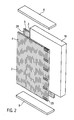
- Fig. 1 shows a wall element 1 or partition according to the invention.
- a first outer wall 2 and a second outer wall 3 are formed by first profile bars 4 and second profile bars 5, which are arranged opposite one another and spaced from each other. In this way, a clearance 24 is formed between the first outer wall 2 and the second outer wall 3, to which reference will be made later Fig. 2 will be discussed in more detail.
- the second outer wall 3 with the profile bars 5 is shown only in sections. The second outer wall 3 can be continued behind the first outer wall 2.
- the profile bars 4, 5 run in the mounted state substantially vertically to the ground.
- a profiled bar 4, 5 has a thickness of at least 5 mm, preferably between 7 and 20 mm.
- profile bars 4, 5 can be hinged together.
- the stability of the wall element 1 can be increased and the structure of the wall element 1 can be facilitated if a plurality of profile bars 4, 5 fixedly connected to each other, for. B. are glued, and form a profile mat 26.
- This profile mat 26 can be connected to other profile mats or profile bars 4, 5 by profile distance connector 12. Also individual profile bars 4, 5 can be connected by profile spacer connector 12. In particular, when long wall elements 1 are set up, the use of profile mats 26 is advantageous.
- the wall element 1 can also have installation openings which extend over one or more profile bars 4, 5.
- an installation element 13 as in Fig. 1 is shown used.
- installation element is an arrangement of three superposed sockets 13, which extend over two profiled bars 4. Die Profilstäbe 4 Sind in der Zeichnungitz. It is also conceivable the installation of switches, lighting elements or electronic devices.
- FIG. 1 illustrated embodiment of a wall element 1 also has an upper holding device 6 and a lower holding device 9.
- the upper holding device 6 has the upper holding elements 7 and the upper holding element 8 and the lower holding device has the lower holding elements 10 and 11.
- the upper and lower holding elements 7 and 10 are formed as straight sections and the upper and lower holding elements 8 and 11 are each formed as a holding closure element.
- Such holding elements can not only be formed as straight holding elements 7, 10 or as retaining closure elements formed holding elements 8, 11, but also be designed arcuate, with bows with different radii are possible. Curved retaining elements are not shown.
- the holding devices 6, 9 may be composed of a plurality of differently shaped holding elements, the z. B. different curved and may have different lengths.
- the arrangement shown is only an example.
- the upper holding elements 7, 8 are connected by a connecting pin 18 with each other.
- This connecting pin 18 is partially inserted into an insertion opening 25 of a holding element 7, 8, so that the holding elements 7, 8 are connected to each other by this connecting pin 18.
- screws which are inserted into screw holes 16 a the connecting pin 18 can be secured against falling out.
- the lower holding device 9 can be fixed to the bottom with screws, not shown, which are inserted into screw openings 16 b.
- an Allen wrench 15 is shown for tightening.
- the upper and lower holding device 6, 9 has a groove 14 into which the profiled bars 4, 5 or a profile mat 26 can be inserted. Only the groove 14 for the lower holder 9 is shown.
- the profiled bars 4, 5 can be glued or clamped to the upper and / or lower holding device 6, 9.
- the upper holding device 6 is supported on the profiled bars 4, 5, d. H. the profile bars 4, 5 are formed supporting.
- profile bars 4, 5 are fixed relative to the upper and lower holding means 6, 9, that is, they can not be moved.
- the wall element 1 also not shown, preferably closable, have openings for receiving electronic devices, such. B. a flat screen, or for recording z.
- electronic devices such. B. a flat screen, or for recording z.
- books preferably closable.
- the closing can be done with profiled bars which are similar to the profiled bars 4, 5 discussed above. However, in contrast to the profiled bars 4, 5 discussed above, these profiled bars are displaceable relative to the upper and lower holding devices 6, 9, ie. H. they form a kind of roller shutters.
- connection devices may be arranged between the upper and lower holding devices 6, 9. These connecting devices may be located between the first and second outer wall 2, 3 or extend through a profile bar 4, 5. It is also conceivable that a part of the connecting device between the first outer wall 2 and the second outer wall 3 is located and another part by one or more profile bars 4, 5 extends.
- a connection device may, for. B. have a pull rod or a wire rope. Such a connection device should only absorb tensile forces.
- the supporting parts are the profile bars 4, 5.
- a mounting aid 17 is shown, with which it can be ensured that the profile bars 4, 5 extend vertically to the ground.
- openings 20 are provided in at least one of the first and second outer walls 2, 3. These openings 20 are in the Fig. 2 and 3 but not in Fig. 1 shown.
- Fig. 1 are designed as a conclusion of the wall element 1 formed as a lower holding closure element holding member 11 and formed as the upper retaining closure element Holding element 8 shown.
- the profiled bars 4, 5 are arranged in the region of the holding elements 8, 11 formed as a holding closure elements in a narrow radius.
- the end face of the wall element 1 can also be closed with a cover element, not shown.
- Fig. 2 shows a straight section of the wall element 1 according to the invention. Shown are the first outer wall 2 and the second outer wall 3, which are formed by the first profile bars 4 and the second profile bars 5.
- the first outer wall 2 and the second outer wall 3 are spaced from each other, so that the gap 24 is formed between them. In this space 24, an acoustic absorber 19 is used.
- openings 20 are provided in the wall element 1 according to the invention in at least one of the first and second outer walls 2, 3.
- the openings 20 are shown only in some of the profile bars 4 as an example.
- the profile bars 4, 5 are in Fig. 3 shown enlarged. How out Fig. 3 can be seen, the profile bars 4, 5 a closed cross section and cavities 23. In the Fig. 3 shown cavities 23 of the profile bars 4, 5 are partially filled with the acoustic absorber 19. In the acoustic absorber 19 for the gap 24 and the cavities 23 may be, for. B. a nonwoven or a porous material such. As foam, act.
- the profile bars 4, 5 are usually made of a polymeric material such. As polypropylene and are produced by extrusion. Also conceivable are other, for example, thermoset materials or metals, such as. As aluminum.
- Fig. 3 seen in cross-section round portions 21 and receptacles 22, for receiving the cross-sectionally round sections 21.
- the diameter of the round sections seen in cross section 21 is slightly smaller than the diameter of the receptacles 22, so that the round sections seen in cross-section 21 opposite the recordings 22 are movable.
- profile bars 4, 5 are not hinged together, but z. B. are glued together. This has particular advantages for long wall elements 1. Also, a plurality of profile bars 4, 5 form a profile mat, not shown. This allows a simple construction of the wall element 1.
- profile bars 4, 5 are shown closed. It is also conceivable that the profile bars are designed to be hinged, so that the acoustic absorber 19 is easier to introduce into the cavities 23.
- hinge strips 27 are also shown, which are usually made of a softer material, in particular plastic, than the round sections 21 seen in cross-section.
- the round sections 21 and the hinge strips 27 seen in cross-section can usually be produced by coextrusion.
- the profile bars 4, 5 also consist of a uniform material.
- the in the Fig. 2 and 3 shown arrangement of the openings 20 is only an example. Depending on the circumstances, the arrangement of the openings 20 may vary. It has proved to be favorable if the proportion of the openings 20 on the surface of the wall element 1 is between 10% and 30%, preferably between 15% and 20%.
- the openings 20 are arranged in this embodiment at the front and back of the profile bar 4, 5.
- first outer wall 2 are formed by the first profile bars 4 and the second outer wall 3 by the second profile bars 5, that is, the wall element 1 has two spaced apart and opposite rows of profile bars 4, 5.
- first outer wall and the second outer wall are part of only one profile bar, ie the front of the profile bar forms the first outer wall and the back forms the second outer wall, so that only a number of profile bars is needed.
- the profile bars then have the openings 20 and are filled with the acoustic absorber 19.
- interconnected profile bars 4, 5 form, at least in sections, the first and second opposing outer walls 2, 3, openings 20 being provided in at least one of the first and / or the second outer walls 2, 3.
- the wall element 1 has the acoustic absorber 19 at least in sections.
- the embodiment shown in the figures can be varied.
- for. B. only the first profile bars 4 of the first outer wall having the openings 20.
- the acoustic absorber 19 can then be located in the cavities 23 of the profiled bars 4.
- the second profile bars 5 of the second outer wall 3 may have no openings 20.
- no acoustic absorber 19 can then be located in the cavities 23 of the second profiled bars 5 and in the intermediate space 24 between the first outer wall 2 and the second outer wall 3.
- This example represents a simple form of the sound-insulating wall element 1.
- the sound insulation can be increased, although the second profile bars 5 of the second outer wall 3, the openings 20 and have both in the cavities 23 of the first section bars 4 and in the cavities 23 of second profile bars 5 of the acoustic absorber 19 is located.
- the highest sound insulation is achieved when the acoustic absorber 19 is in the first profile bars 4 of the first outer wall 2, the second profile bars 5 of the second outer wall 3 and in the space 24 between the first outer wall 2 and the second outer wall 3.
- the wall element 1 according to the invention is very well suited for use by the modular design z. B. suitable in open-plan offices. Due to the special construction, even narrow bends can be realized, whereby a particularly good adaptation to the respective conditions is possible. Furthermore, with the wall element according to the invention the sound insulation can be varied depending on the requirements. Due to the integrable installation elements, such. As sockets, switches or lighting elements, and the possibility of providing openings in the wall element, which can preferably be made closable, a good integration of the wall element in an office is possible. These openings of the wall element can, for. B. be used for flat screen TV.
- the openings can also be designed as preferably closable passages in the wall element.
- the wall element according to the invention can thus be used in a wide range and can be tailored to the respective needs.
- due to the special construction it is possible to easily set up and possibly dismantle the wall element. Use of the wall element after dismantling at another location is also possible. Due to the modular design, if necessary, additions and conversions can be made easily.
Landscapes
- Engineering & Computer Science (AREA)
- Architecture (AREA)
- Structural Engineering (AREA)
- Physics & Mathematics (AREA)
- Civil Engineering (AREA)
- Electromagnetism (AREA)
- Acoustics & Sound (AREA)
- Building Environments (AREA)
Applications Claiming Priority (1)
| Application Number | Priority Date | Filing Date | Title |
|---|---|---|---|
| DE202007002913U DE202007002913U1 (de) | 2007-02-26 | 2007-02-26 | Wandelement |
Publications (2)
| Publication Number | Publication Date |
|---|---|
| EP1961885A2 true EP1961885A2 (fr) | 2008-08-27 |
| EP1961885A3 EP1961885A3 (fr) | 2009-09-02 |
Family
ID=39535357
Family Applications (1)
| Application Number | Title | Priority Date | Filing Date |
|---|---|---|---|
| EP08003430A Withdrawn EP1961885A3 (fr) | 2007-02-26 | 2008-02-26 | Elément de mur |
Country Status (2)
| Country | Link |
|---|---|
| EP (1) | EP1961885A3 (fr) |
| DE (1) | DE202007002913U1 (fr) |
Families Citing this family (2)
| Publication number | Priority date | Publication date | Assignee | Title |
|---|---|---|---|---|
| DE202010014603U1 (de) * | 2010-10-25 | 2012-01-26 | Rehau Ag + Co. | Trennwandvorrichtung |
| DE102014112556A1 (de) | 2014-09-01 | 2016-03-03 | Technische Universität Dresden | Akustisch wirksames Raumteilsystem |
Citations (1)
| Publication number | Priority date | Publication date | Assignee | Title |
|---|---|---|---|---|
| EP1092365B1 (fr) | 1999-10-15 | 2002-01-23 | Bernd Isinger | Meuble |
Family Cites Families (14)
| Publication number | Priority date | Publication date | Assignee | Title |
|---|---|---|---|---|
| DE1757316U (de) * | 1957-10-05 | 1957-12-05 | Franco Franzi | Bauelement zur herstellung einer wand, die aus miteinander loesbar verbundenen einheiten besteht. |
| NL131614C (fr) * | 1967-06-20 | |||
| GB1282008A (en) * | 1968-09-17 | 1972-07-19 | Havenbedrijf Vlaardingen Oost | Improvements relating to construction elements |
| FR2415696A1 (fr) * | 1978-01-26 | 1979-08-24 | Smac Acieroid | Paroi isolante thermo-acoustique |
| DE3217072A1 (de) * | 1982-05-06 | 1983-11-10 | Gotthard 8359 Ortenburg Sonnleitner | Holzblockhaus |
| GB8406622D0 (en) * | 1984-03-14 | 1984-04-18 | Adams J A | Partition assembly |
| DE3517930A1 (de) * | 1985-05-18 | 1986-11-20 | Hermann Scholz GmbH, 2353 Nortorf | Abschirmwand aus vorgeformten bauelementen |
| US5253458A (en) * | 1992-02-21 | 1993-10-19 | Dean Christian | Simulated log and panel prefabricated house structure |
| FI973951L (fi) * | 1997-04-03 | 1998-12-08 | Sebastian Bertil Loennqvist | Taipuisa levymäinen tuote ja sen valmistusmenetelmä |
| DE19804890A1 (de) * | 1998-02-07 | 1999-09-02 | Sonnleitner Holzwerk Gmbh | Verbundelement |
| DE19919991A1 (de) * | 1999-04-30 | 2000-11-16 | Schaffitzel Juergen | Wandelement für Gebäude |
| DE20003204U1 (de) * | 2000-02-23 | 2000-08-24 | Birkholz, Wolfgang, 28219 Bremen | Bewegliche Trennwand |
| WO2005095729A1 (fr) * | 2004-03-31 | 2005-10-13 | Pierre Messerli | Batiment en bois massif |
| DE202004014003U1 (de) * | 2004-09-06 | 2004-11-18 | Preiss, Hermann | Baumodul |
-
2007
- 2007-02-26 DE DE202007002913U patent/DE202007002913U1/de not_active Expired - Lifetime
-
2008
- 2008-02-26 EP EP08003430A patent/EP1961885A3/fr not_active Withdrawn
Patent Citations (1)
| Publication number | Priority date | Publication date | Assignee | Title |
|---|---|---|---|---|
| EP1092365B1 (fr) | 1999-10-15 | 2002-01-23 | Bernd Isinger | Meuble |
Also Published As
| Publication number | Publication date |
|---|---|
| EP1961885A3 (fr) | 2009-09-02 |
| DE202007002913U1 (de) | 2008-07-10 |
Similar Documents
| Publication | Publication Date | Title |
|---|---|---|
| DE102014101405B4 (de) | Bodenbaugruppe für das Rahmengestell eines Schaltschranks | |
| EP1413031A1 (fr) | Structure | |
| DE1216957B (de) | Kabelfuehrungskanal | |
| EP1639225B1 (fr) | Element profile servant a former un volet roulant a isolation acoustique | |
| DE102019112367B4 (de) | Anbauteil für eine Stabmatte | |
| EP1961885A2 (fr) | Elément de mur | |
| DE202004003393U1 (de) | Schnellbau-Fertigwandmodule | |
| EP2031145A2 (fr) | Plafond intérieur suspendu | |
| DE202012003175U1 (de) | Modularer Raum in Gerüstbauweise, insbesondere ein Operationsraum im Medizinsektor | |
| DE2606645A1 (de) | Verbindungsvorrichtung fuer verkleidungspaneele oder trennwandelemente | |
| DE9313426U1 (de) | Lüftungsvorrichtung für Räume | |
| DE202010013208U1 (de) | Trockenbauwand | |
| DE9203849U1 (de) | Bauelement zur Erstellung von Wänden, insbesondere auf Schiffen | |
| DE102013019243B4 (de) | Seilbremse, Spannset und Vorhangsystem | |
| DE202021103171U1 (de) | Modulare Arbeitsplatzkabine | |
| DE9410031U1 (de) | Unterdecke für Gebäuderäume | |
| WO2004104356A1 (fr) | Element profile servant a former un volet roulant | |
| DE102009003910A1 (de) | Tragschiene für eine Vorrichtung zur Halterung von Wandplatten an einer Wand sowie Fassadenbekleidung | |
| DE2153997C3 (de) | Bauelementensatz zur Montage von Verkleidungsplatten an einer Wand bzw. für eine Trennwand | |
| DE9400053U1 (de) | Abschlußprofil, insbesondere Türschwellenprofil | |
| EP2761109A1 (fr) | Paroi intérieure de bâtiment | |
| DE1932803C (de) | Kabelkanal | |
| DE2742504A1 (de) | Decken- und wandelemente umfassende variable raumbegrenzung | |
| DE202010007167U1 (de) | Kassettenboden | |
| DE20304517U1 (de) | Trennwandelement |
Legal Events
| Date | Code | Title | Description |
|---|---|---|---|
| PUAI | Public reference made under article 153(3) epc to a published international application that has entered the european phase |
Free format text: ORIGINAL CODE: 0009012 |
|
| AK | Designated contracting states |
Kind code of ref document: A2 Designated state(s): AT BE BG CH CY CZ DE DK EE ES FI FR GB GR HR HU IE IS IT LI LT LU LV MC MT NL NO PL PT RO SE SI SK TR |
|
| AX | Request for extension of the european patent |
Extension state: AL BA MK RS |
|
| PUAL | Search report despatched |
Free format text: ORIGINAL CODE: 0009013 |
|
| AK | Designated contracting states |
Kind code of ref document: A3 Designated state(s): AT BE BG CH CY CZ DE DK EE ES FI FR GB GR HR HU IE IS IT LI LT LU LV MC MT NL NO PL PT RO SE SI SK TR |
|
| AX | Request for extension of the european patent |
Extension state: AL BA MK RS |
|
| RIC1 | Information provided on ipc code assigned before grant |
Ipc: E04B 1/74 20060101ALN20090728BHEP Ipc: E04B 2/70 20060101ALI20090728BHEP Ipc: E04B 2/74 20060101AFI20080630BHEP |
|
| 17P | Request for examination filed |
Effective date: 20100226 |
|
| AKX | Designation fees paid |
Designated state(s): AT BE BG CH CY CZ DE DK EE ES FI FR GB GR HR HU IE IS IT LI LT LU LV MC MT NL NO PL PT RO SE SI SK TR |
|
| 17Q | First examination report despatched |
Effective date: 20120327 |
|
| STAA | Information on the status of an ep patent application or granted ep patent |
Free format text: STATUS: THE APPLICATION IS DEEMED TO BE WITHDRAWN |
|
| 18D | Application deemed to be withdrawn |
Effective date: 20120807 |