EP1962433A1 - Verfahren und vorrichtung zum beseitigen von schmalbandigen störungen mittels fensterverarbeitung in einem spreizspektrumsystem - Google Patents
Verfahren und vorrichtung zum beseitigen von schmalbandigen störungen mittels fensterverarbeitung in einem spreizspektrumsystem Download PDFInfo
- Publication number
- EP1962433A1 EP1962433A1 EP05823414A EP05823414A EP1962433A1 EP 1962433 A1 EP1962433 A1 EP 1962433A1 EP 05823414 A EP05823414 A EP 05823414A EP 05823414 A EP05823414 A EP 05823414A EP 1962433 A1 EP1962433 A1 EP 1962433A1
- Authority
- EP
- European Patent Office
- Prior art keywords
- interference
- points
- narrow
- window
- energy
- Prior art date
- Legal status (The legal status is an assumption and is not a legal conclusion. Google has not performed a legal analysis and makes no representation as to the accuracy of the status listed.)
- Granted
Links
Images

Classifications
-
- H—ELECTRICITY
- H04—ELECTRIC COMMUNICATION TECHNIQUE
- H04B—TRANSMISSION
- H04B1/00—Details of transmission systems, not covered by a single one of groups H04B3/00 - H04B13/00; Details of transmission systems not characterised by the medium used for transmission
- H04B1/69—Spread spectrum techniques
- H04B1/707—Spread spectrum techniques using direct sequence modulation
- H04B1/7097—Interference-related aspects
- H04B1/71—Interference-related aspects the interference being narrowband interference
- H04B1/7102—Interference-related aspects the interference being narrowband interference with transform to frequency domain
Definitions
- the present invention pertains to a method and device for eliminating narrow-band interference in a wireless communications, specifically refers to a method and device for eliminating narrow-band interference in a spread spectrum communication system.
- the spread spectrum or the pseudo-random (PN) code modulation can reduce the interference from other users and wireless signals.
- PN pseudo-random
- the interference signals will spread to the entire band and thus weaken the impact of the interference.
- the spread spectrum signals can weaken the narrow-band interference to some extend.
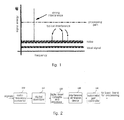
- a typical spectrum of a spread spectrum signal (e.g. performing spread spectrum from PN sequence) is submerged in the noise as shown in Fig. 1 .
- An ideal signal is the signal energy that is actually sent out by the mobile station and the noise is the additive interference. Obviously, the ideal signal energy of the spread spectrum is usually less than the noise energy.
- “Strong interference” generally refers to the blocking signals or the signals that are sent by TV, wireless station and nearby communication equipments.
- Typical interference refers to the signals sent by those low-power sources, such as amateur radio. Processing gain represents the interference signal levels tolerable by the spread signals in mobile stations. The spread signals can still be recovered when they are affected by the typical interference, but they will never be recovered when the strong interference shows up. What's more, even with the typical interference, the signals can be recovered but the system performance will degrade.
- the frequency band will be swept in order to protect the CDMA signals from the interference of narrow-band signals.
- the narrow-band interference will present disorder and randomicity.
- the narrow-band interference will increase the congestion rate and call-dropping rate in a CDMA system, as well as overload the radio-frequency power control system, increase the power consumption of mobile station, and reduce base station coverage. Under extreme situation, the high-power interference will even block the entire cell, and thus the normal communication will stop. As a result, we must find a good solution in order to eliminate the impact of the narrow-band interference signals pushing on the CDMA signals and guarantee a good communication quality.
- the first category is to make the signal (usually under analog processing) pass through a narrow-band notch filter or a filter group.
- This method is usually realized by the surface acoustic technology, which makes estimation for the frequency of interference signals and places the narrow-band notch filter wherever the narrow-band interference signals exist based on the estimation result.
- PLL Phase Locked Loop
- the analog technology has its own limitations, and usually lacks flexibility.
- Another category is frequency domain elimination which is generally realized through digital processing. Signals are first digitized and then transformed into frequency domain through Fourier Transform. These data will be processed in the frequency domain and finally be transformed back into the time domain to be output through inverse-Fourier Transform.
- the methods for processing interference signals in the frequency domain can be concluded into two categories: the first method is to filter out the interference impact through the filter on the frequency domain data and this method is suitable to the case that the bandwidth and location of the interference are already known, but this method will have a certain limitation when the location of the interference in the frequency domain, the bandwidth and the number of the interference are hard to identify, since there is a certain degree of difficulty in designing a fully adaptive filter.
- Another method is to compute the signal amplitude on each frequency point and then compare them with a threshold value.
- the signals exceeding the threshold values will be set as zero or be degraded to noise level.
- This method can adaptively process multiple narrow-band interferences, multiple interference bandwidths and interference frequency changes.
- this method only processes the data that exceed the threshold, and in a practical system, the part of the frequency spectrum with interference will leak to the neighbor frequency points because of some factors such as the selection for the number of the points of Fourier Transform. If the impact of spectrum leakage on the capability for suppressing narrow-band interference is totally ignored, as the result, the capability for suppressing narrow-band interference can not meet the requirements of the system.
- the technical problem that needs to be solved in present invention is to provide a device and method for eliminating narrow-band interference by way of windowing in a spread spectrum system, reducing adverse impacts of spectrum leakage on the capability for suppressing narrow-band interference.
- the present invention provides a method for eliminating narrow-band interference by way of windowing in a spread spectrum system, which comprises following steps of:
- step (b) said threshold value is obtained by multiplying the minimum of said N energy values with a coefficient or it is obtained as follows: removing partial maximum energy values from said N energy values and averaging the rest , then multiplying the average value with a coefficient.
- the above method also possesses the following characteristic: in step (b), if the energy value at a certain data point is larger than the threshold, then this point is considered as an interference point.
- Each group of consecutive interference points constitutes one narrow-band interference, and the number of interference points included in the narrow-band interference is considered as the width of this narrow-band interference by which the number of narrow-band interferences, as well as the width and location of each narrow-band interference in this data spectrum are determined.
- step (b) M is determined by the number of sampling cycles included in a time period, and this time period is of 60-120ms.
- step (c) the shape of said window is determined in the following way: with the prescient energy concentration degree of the narrow-band interference signals, if the interference energy is concentrated, then a window with a steep edge is to be selected; if the interference energy is scattered, then a window with a slow-changing edge is to be selected.
- step (c) the adjusted values of the points within the window are set according to the noise level.
- the adjusted values of interference points are set as the noise level and the adjusted values of other points around window edge are set as the multiples of the noise level.
- the device for eliminating narrow-band interference by means of windowing in a spread spectrum system comprises a frequent-cy spectrum transform unit, an interference elimination unit, an interference elimination control unit and a frequency spectrum inverse transform unit, wherein:
- the frequency spectrum transform unit is used to perform frequency spectrum transform for the data of one-time-extracted N sampling points, obtain the spectrum of the data and output the transformed data into the interference elimination unit and the interference elimination control unit;
- the interference elimination control unit is used to get N energy values obtained from energy accumulation of data after transform for M times of N sampling points within a set time period, and compare the N energy values with the threshold obtained from these values, and then determine the number of narrow-band interferences as well as the width and location of the interference based on the comparison result, choose one window for each narrow-band interference and obtain the information of the points included in the window as well as the adjusted values of those points, and finally output them to the interference elimination unit;
- the interference elimination unit is used as follows: for the N points of data after frequency spectrum transform each time, based on the information of the obtained points included in each window and the adjusted value of each point during the current time period and the last period, it can set the energy values of the data at these points as the corresponding adjusted values, which will finally be sent to the frequency spectrum inverse transform unit;
- the frequency spectrum inverse transform unit is used to perform frequency spectrum inverse transform for the N points of data output from interference elimination unit and then output them.
- said interference elimination control unit further comprises an energy computation subunit, a threshold computation subunit, an interference determination subunit and a window selection unit, wherein:
- the energy computation subunit is used to compute N energy values from the energy accumulation of data after transform for M times for N sampling points within a set time period, and then output them to the threshold computation subunit and the interference determination subunit, M is an integer which is ⁇ 1;
- the threshold computation subunit is used to compute the threshold for interference determination based on said N energy values and then output the threshold to the interference determination subunit;
- the interference determination subunit is used to compare said N energy values with said threshold, define the point whose energy value is larger than the threshold as the interference point (consecutive interference points constitute one narrow-band interference), determine the number of the narrow-band interferences as well as the width and location of each interference, finally output the above information to the window selection unit;
- the window selection unit is used to select a suitable frequency domain adjusting window for each narrow-band interference based on the narrow-band interference information output from the interference determination subunit, output the information of the points within each window and adjusted value of each point to the interference elimination unit.
- the above device also possesses the following characteristics: when said threshold computation subunit calculates the threshold, it multiplies the minimum of said N energy values with a coefficient, or the threshold is obtained as follows: removing partial maximum energy values from said N energy values and averaging the rest, then multiplying the average value with a coefficient.
- the above device also possesses the following characteristics: when the window selection unit sets the adjusted values of the points within the window, it sets the adjusted values of interference points as the noise level and sets the adjusted values of other points around window edge as the multiples of the noise level.
- the present invention is targeted for eliminating the narrow-band interference in a spread spectrum communication system and it processes the signals within the frequency domain.
- the employed narrow-band interference elimination processing method uses windowing processing to suppress the data and it processes not only the data exceeding the threshold, but the neighboring data as well.
- the method is very flexible and it can also adjust the window shape according to different interference characteristics.
- the method of the present invention weakens the impacts of the spectrum leakage on the capability for suppressing narrow-band interference , thus efficiently improving the capability for suppressing narrow-band suppression.
- Fig. 2 is schematic diagram of the operation of the device for processing received signals in accordance with the embodiment of the present invention. It comprises a radio frequency converter 100, a digital quantizer 110, a digital down converter and processor 120, an interference elimination device 130, and an automatic gain processor 140.
- the signals are received by the radio frequency converter 100 and converted into digital signals after being sampled by digital quantizer 110, then the signals are input to the digital down converter and processor 120 to become intermediate frequency (IF) signals.
- IF intermediate frequency
- the output IF signals will be input into the interference elimination device 130 for interference elimination processing, and after the interference is suppressed, the data will be sent to the automatic gain processor 140 for automatic gain control and finally be transmitted to the base-band for processing.
- the device can either be placed before the automatic gain controller 140 or at the place of base-band processing. In the present embodiment, it is chosen to be placed before the automatic gain controller 140. The reason is that with the existence of the narrow-band interference, the signal energy will far exceed the normal value and prohibit the automatic gain controller 140 from performing ordinary gain control as it for non-interference signals, and when the interference is very large, it will be in saturation status and stop working. Therefore the selection of the location for interference elimination device 130 is a key factor in the design.
- Figure 3 shows the diagram of the interference elimination device 130 in Figure 2 , and it comprises the following units:
- a frequency spectrum transform unit 200 used to perform frequency spectrum transform for the data of one-time-extracted N sampling points, obtain the data spectrum and output the transformed data into the interference elimination unit and the interference elimination control unit;
- An interference elimination control unit 230 used to determine the number of narrow-band interferences as well as the width and location of each interference in a set period of time according to the comparison result between the N energy values obtained from energy accumulation of data after transform for M times of N sampling points and the threshold that is computed from these values, choose a window for each narrow-band interference and obtain the information of the points in each window and adjusted values of each point, finally output them to the interference elimination unit; the detailed calculation method will be introduced in the following;
- An interference elimination unit 210 used to perform windowing for the N points of data after frequency spectrum transform each time, based on the obtained information of points in each window and adjusted value of each point during the current time period and the last period, set the energy values of the data at these points as the corresponding adjusted values, and finally send the data after interference suppression to frequency spectrum inverse transform unit;
- a frequency spectrum inverse transform unit 220 used to perform frequency spectrum inverse transform for the N points of data output from the interference elimination unit and then output them;
- the interference elimination control unit 230 further comprises the following parts:
- An energy computation subunit 231 used to get N energy values obtained from energy accumulation of data after transform for M times for N sampling points within a set time period, and then output them to the threshold computation subunit and the interference determination subunit, wherein M is an integer that is ⁇ 1;
- a threshold computation subunit 232 used to compute a threshold for interference determination based on said N energy values and then output the threshold to the interference determination subunit;
- An interference determination subunit 233 used to compare said N energy values with said threshold, define the point whose energy value is bigger than the threshold as the interference point (consecutive interference points constitute one narrow-band interference) and determine the number of narrow-band interferences as well as the width (represent by points) and location of each interference, finally output the above information to the window selection unit 234;
- a window selection unit 234 used to select a suitable frequency domain adjusting window for each narrow-band interference based on the information of the narrow-band interference and prescient characteristics of narrow-band signals output from the interference determination subunit, output the information of points within each window and adjusted value of each point to the interference elimination unit.
- the adjusted values of interference points are set as the noise level and the adjusted values of other points are set as multiples of the noise level.
- the method in present embodiment for eliminating narrow-band interference by means of windowing in a spread spectrum system comprises the following steps of:
- the threshold When computing the threshold, it can be done by choosing the minimum within all the energy values and multiplying it with a coefficient of 2-4, or by removing partial maximum values and averaging the rest, then taking the value that is 3-3.5 times of the average value as the threshold. Both of these two methods can avoid the impacts of excessive large energy values at narrow-band interference points on the threshold computation. However the present invention does not define the threshold computation.
- narrow-band interference exists at this point (represents the frequency location) and it is called interference point in the text.
- Each group of consecutive interference points constitute one narrow-band interference and the number of interference points included in eachnarrow-band interference represents the width of the narrow-band interference.
- Step 3 based on the width, location and characteristics of each narrow-band interference, determining the width, location and shape of the corresponding frequency domain adjusting window and obtaining the points included in each window, and also determining adjusted value of each point based on the noise level;
- the width of frequency domain adjusting window is determined by the width of narrow-band interference.
- the width of the window is chosen as 2-3 times of the interference width.
- the window can be divided into a narrow-band interference part and fringe parts at each sides of the narrow-band interference. In order to keep both sides symmetric, the differences (indicated by the number of the points) between window width and interference width should be even when determining the window width.
- the characteristics of narrow-band interference can be pre-determined, for example, by the result of the spectrum scanner, it is to determine whether its energy is concentrated or it has a steep edge.
- One way to determine if the energy is concentrated or not is as follows: if the interference width is equal to 1, then it is directly determined that the interference energy is relatively concentrated; if the interference width is larger than one and the ratio of the maximum energy value to the minimum of the interference is bigger than 0.707, then it also means that the interference energy is relatively concentrated; otherwise, it belongs to the status that the comparison energy is relatively scattered. All these determination rules can be set by oneself and the present invention is not limited to a certain rule.
- the window shape is chosen based on the characteristics of the narrow-band interference. If the narrow-band interference energy is relatively concentrated, then the interference edge will be steeper, therefore, a window with a steep edge can be chosen; if the narrow-band interference energy is relatively scattered, then the interference edge changes slowly, therefore, a window with a slow-changing edge can be chosen; if there are many types of interferences or the show-up time is uncertain, which leads to the unpredictable characteristics of the interference signal, a window with the edge characteristics somewhere in between can be chosen.
- Figure 4A and Figure 4B give the examples of the two windows.
- the Figure 4A shows a reverse trapezoidal window, which is more suitable for the situation where the interference edge is relatively steeper.
- the window in Fig. 4B is more suitable for the situation that the interference edge changes slowly.
- the method for choosing window shape based on the characteristics of the narrow-band interference can employ the current technology.
- the present embodiment sets the adjusted values of interference points as noise level, and sets the adjust values of other points around window edges as the multiples of noise level, wherein the specific multiples will be determined by the window shape; for example, when setting the multiples at the window base as 1 and the multiples at window top as 2, if the width and the shape of every part of the window are known, then it can easily compute the relative value at individual point.
- the noise level can be obtained either by dividing the minimum within said N energy values by the accumulation times or dividing the average value of the rest energy values after removing the maximum ones from N energy values by the accumulation times. Other than that, we can use other current methods as well.
- step 1 After step 1, executing the following steps of interference elimination process at the same time:
- Step 3' performing frequency spectrum inverse transform for the adjusted data, and outputting them as the data result, ending.
- the purpose of present invention is to eliminate the narrow-band interference in the spread spectrum communication system and it processes the signals within the frequency domain.
- the employed narrow-band interference elimination processing method uses windowing to suppress the data and it processes not only the data exceeding the threshold, but the nearby data as well.
- the method is very flexible and it can also adjust the window shape based on the different interference characteristics.
- the method of the present invention weakens the impacts of the spectrum leakage on the capability for suppressing narrow-band interference and as a result, efficiently improves the capability for suppressing narrow-band interference.
- the present invention can also perform various modifications and changes, which should be within the scope defined by the present claim.
- the values when suppressing the energy values of the interference data, the values can also be set as zero, however, it will damage the original data greatly.
- the present invention has already been realized in the cdma_20001x backward link. After the simulation, in the case of the existences of both large energy narrow-band interference and a plurality of narrow-band interferences, it greatly increases the suppression capability of the narrow-band interference suppression system and improves the performance of the system.
- the present invention is a common technology, and can be used in the technology for eliminating narrow-band interference in spread spectrum system.
Landscapes
- Engineering & Computer Science (AREA)
- Computer Networks & Wireless Communication (AREA)
- Signal Processing (AREA)
- Noise Elimination (AREA)
- Radar Systems Or Details Thereof (AREA)
- Mobile Radio Communication Systems (AREA)
- Stereo-Broadcasting Methods (AREA)
Applications Claiming Priority (1)
| Application Number | Priority Date | Filing Date | Title |
|---|---|---|---|
| PCT/CN2005/002223 WO2007068146A1 (en) | 2005-12-16 | 2005-12-16 | Method and apparatus for eliminating narrow band interference by means of windowing processing in spread spectrum system |
Publications (3)
| Publication Number | Publication Date |
|---|---|
| EP1962433A1 true EP1962433A1 (de) | 2008-08-27 |
| EP1962433A4 EP1962433A4 (de) | 2010-04-07 |
| EP1962433B1 EP1962433B1 (de) | 2011-09-07 |
Family
ID=38162538
Family Applications (1)
| Application Number | Title | Priority Date | Filing Date |
|---|---|---|---|
| EP05823414A Expired - Lifetime EP1962433B1 (de) | 2005-12-16 | 2005-12-16 | Verfahren und vorrichtung zum beseitigen von schmalbandigen störungen mittels fensterverarbeitung in einem spreizspektrumsystem |
Country Status (9)
| Country | Link |
|---|---|
| US (1) | US8068531B2 (de) |
| EP (1) | EP1962433B1 (de) |
| CN (1) | CN100544218C (de) |
| AT (1) | ATE523969T1 (de) |
| DK (1) | DK1962433T3 (de) |
| ES (1) | ES2370328T3 (de) |
| NO (1) | NO20082807L (de) |
| PT (1) | PT1962433E (de) |
| WO (1) | WO2007068146A1 (de) |
Cited By (3)
| Publication number | Priority date | Publication date | Assignee | Title |
|---|---|---|---|---|
| CN101741776B (zh) * | 2009-11-10 | 2013-06-05 | 华为技术有限公司 | 消除干扰信号的方法以及装置 |
| US8989234B2 (en) | 2011-09-07 | 2015-03-24 | Huawei Technologies Co., Ltd. | Method and device for signal processing in spread spectrum system |
| CN105549035A (zh) * | 2015-12-22 | 2016-05-04 | 武汉梦芯科技有限公司 | 一种基带信号频域窄带干扰检测消除装置及方法 |
Families Citing this family (7)
| Publication number | Priority date | Publication date | Assignee | Title |
|---|---|---|---|---|
| JP5640990B2 (ja) * | 2009-11-09 | 2014-12-17 | 日本電気株式会社 | 無線送信装置、無線送信方法、記憶媒体、およびベースバンド回路 |
| US9277554B2 (en) * | 2012-09-05 | 2016-03-01 | The Boeing Company | Servers and methods for operating a communication system |
| US9118401B1 (en) * | 2014-10-28 | 2015-08-25 | Harris Corporation | Method of adaptive interference mitigation in wide band spectrum |
| GB2546994B (en) * | 2016-02-03 | 2019-10-09 | Toshiba Res Europe Limited | Transmit and receive apparatus and method |
| CN114337773B (zh) * | 2021-12-06 | 2024-03-26 | 泰提斯电子科技(上海)有限公司 | 一种vdes卫星的窄带干扰检测及信道选择方法 |
| CN114362837B (zh) * | 2022-01-10 | 2023-12-29 | 中国电子科技集团公司第五十四研究所 | 一种扩频卫星信号窄带干扰自适应消除装置 |
| US11811574B2 (en) | 2022-01-19 | 2023-11-07 | Texas Instruments Incorporated | Detection of in-band interference |
Family Cites Families (7)
| Publication number | Priority date | Publication date | Assignee | Title |
|---|---|---|---|---|
| US5612978A (en) | 1995-05-30 | 1997-03-18 | Motorola, Inc. | Method and apparatus for real-time adaptive interference cancellation in dynamic environments |
| US20020006174A1 (en) * | 2000-07-11 | 2002-01-17 | Mohammed Nafie | Interference cancellation of a narrow band interferer in a wide band communication device |
| US6868114B2 (en) * | 2001-01-18 | 2005-03-15 | The Titan Corporation | Interference suppression in a spread spectrum communications system using non-linear frequency domain excision |
| FI20010952A0 (fi) * | 2001-05-07 | 2001-05-07 | Nokia Corp | Signaalikomponenttien erottaminen radiojärjestelmän vastaanottimessa |
| CN2612156Y (zh) * | 2003-04-11 | 2004-04-14 | 天津大学 | 带时间窗的频域数字滤波器 |
| JP2007535265A (ja) * | 2004-04-29 | 2007-11-29 | コーニンクレッカ フィリップス エレクトロニクス エヌ ヴィ | 狭帯域干渉キャンセレーションのための受信機 |
| CN100512027C (zh) * | 2005-03-01 | 2009-07-08 | 华为技术有限公司 | 抑制窄带干扰的方法和装置 |
-
2005
- 2005-12-16 AT AT05823414T patent/ATE523969T1/de active
- 2005-12-16 WO PCT/CN2005/002223 patent/WO2007068146A1/zh not_active Ceased
- 2005-12-16 DK DK05823414.7T patent/DK1962433T3/da active
- 2005-12-16 ES ES05823414T patent/ES2370328T3/es not_active Expired - Lifetime
- 2005-12-16 PT PT05823414T patent/PT1962433E/pt unknown
- 2005-12-16 EP EP05823414A patent/EP1962433B1/de not_active Expired - Lifetime
- 2005-12-16 US US12/096,051 patent/US8068531B2/en active Active
- 2005-12-16 CN CNB2005800476002A patent/CN100544218C/zh not_active Expired - Fee Related
-
2008
- 2008-06-20 NO NO20082807A patent/NO20082807L/no not_active Application Discontinuation
Cited By (3)
| Publication number | Priority date | Publication date | Assignee | Title |
|---|---|---|---|---|
| CN101741776B (zh) * | 2009-11-10 | 2013-06-05 | 华为技术有限公司 | 消除干扰信号的方法以及装置 |
| US8989234B2 (en) | 2011-09-07 | 2015-03-24 | Huawei Technologies Co., Ltd. | Method and device for signal processing in spread spectrum system |
| CN105549035A (zh) * | 2015-12-22 | 2016-05-04 | 武汉梦芯科技有限公司 | 一种基带信号频域窄带干扰检测消除装置及方法 |
Also Published As
| Publication number | Publication date |
|---|---|
| ES2370328T3 (es) | 2011-12-14 |
| CN101112001A (zh) | 2008-01-23 |
| NO20082807L (no) | 2008-06-20 |
| DK1962433T3 (da) | 2011-11-28 |
| ATE523969T1 (de) | 2011-09-15 |
| EP1962433A4 (de) | 2010-04-07 |
| CN100544218C (zh) | 2009-09-23 |
| PT1962433E (pt) | 2011-11-04 |
| US8068531B2 (en) | 2011-11-29 |
| US20080279256A1 (en) | 2008-11-13 |
| EP1962433B1 (de) | 2011-09-07 |
| WO2007068146A1 (en) | 2007-06-21 |
Similar Documents
| Publication | Publication Date | Title |
|---|---|---|
| US8059768B2 (en) | Method and device for removing narrow band interference in spreading frequency system | |
| JP5201421B2 (ja) | Ofdmシステム用のチャネル推定器 | |
| EP2011241B1 (de) | Nachbarkanalstörungsunterdrückung | |
| US10153921B2 (en) | Self-interference channel estimation method and device | |
| KR20080066035A (ko) | 위상 잡음 소거 ofdm 수신기 | |
| US8068531B2 (en) | Method and apparatus for eliminating narrow band interference by means of windowing processing in spread spectrum system | |
| KR200302895Y1 (ko) | 간섭 신호 코드 전력 및 잡음 분산을 추정하기 위한 코드분할 다중 액세스 기지국 | |
| US20060256885A1 (en) | Apparatus and method for estimating carrier-to-interference-and-noise ratio in an orthogonal frequency division multiplexing system | |
| CN101136654B (zh) | 一种消除通信系统中窄带干扰的方法及装置 | |
| KR100661029B1 (ko) | Cdma 통신 네트워크에서 용량을 증가시키기 위한 방법및 통신 단말 | |
| RU2365042C2 (ru) | Способ и устройство устранения узкополосных радиопомех в широкополосной системе | |
| US20100238980A1 (en) | Signal Reception with Adjustable Processing Delay Placement | |
| CN100375401C (zh) | 扩频系统中窄带干扰消除的方法和装置 | |
| EP2485417A1 (de) | Verfahren und vorrichtung zur auswahl von geräuschpfaden | |
| KR20090131794A (ko) | 이동통신 시스템의 수신 장치 및 방법 | |
| KR101494401B1 (ko) | 이동통신 시스템의 수신 장치 및 방법 | |
| KR20070018663A (ko) | 직교주파수분할다중 통신시스템의 신호대간섭잡음비 추정을위한 장치 및 방법 | |
| JP2004297444A (ja) | 制御されたチャネル推定を行なう通信システム | |
| FI115578B (fi) | Tietoliikennejärjestelmä ja vastaanotin | |
| US8290018B2 (en) | Method for efficient equalization in a telecommunication system including at least one mobile transceiver | |
| CN121125004A (zh) | 一种扫频干扰的消除方法及装置 | |
| KR101447220B1 (ko) | 직교주파수 다중 분할 다중 시스템에서 신호대 간섭 잡음비추정 방법 및 장치 | |
| Saberali et al. | Detection of the Weak Signal in the Presence of Strong Interference Using Locally Optimal Rule and Estimation of the Parameters with the Method of Moments | |
| CN104581759B (zh) | 无线接入网系统的接收信号码功率rscp的测量方法及装置 | |
| Kumar et al. | Effects of 1/f baseband noise and its suppression using kalman filter in ofdm system |
Legal Events
| Date | Code | Title | Description |
|---|---|---|---|
| PUAI | Public reference made under article 153(3) epc to a published international application that has entered the european phase |
Free format text: ORIGINAL CODE: 0009012 |
|
| 17P | Request for examination filed |
Effective date: 20080616 |
|
| AK | Designated contracting states |
Kind code of ref document: A1 Designated state(s): AT BE BG CH CY CZ DE DK EE ES FI FR GB GR HU IE IS IT LI LT LU LV MC NL PL PT RO SE SI SK TR |
|
| A4 | Supplementary search report drawn up and despatched |
Effective date: 20100304 |
|
| 17Q | First examination report despatched |
Effective date: 20100503 |
|
| GRAP | Despatch of communication of intention to grant a patent |
Free format text: ORIGINAL CODE: EPIDOSNIGR1 |
|
| DAX | Request for extension of the european patent (deleted) | ||
| GRAS | Grant fee paid |
Free format text: ORIGINAL CODE: EPIDOSNIGR3 |
|
| GRAA | (expected) grant |
Free format text: ORIGINAL CODE: 0009210 |
|
| REG | Reference to a national code |
Ref country code: GB Ref legal event code: FG4D |
|
| REG | Reference to a national code |
Ref country code: CH Ref legal event code: EP |
|
| REG | Reference to a national code |
Ref country code: IE Ref legal event code: FG4D |
|
| REG | Reference to a national code |
Ref country code: PT Ref legal event code: SC4A Free format text: AVAILABILITY OF NATIONAL TRANSLATION Effective date: 20111024 |
|
| REG | Reference to a national code |
Ref country code: DE Ref legal event code: R096 Ref document number: 602005029949 Country of ref document: DE Effective date: 20111110 |
|
| REG | Reference to a national code |
Ref country code: DK Ref legal event code: T3 |
|
| REG | Reference to a national code |
Ref country code: ES Ref legal event code: FG2A Ref document number: 2370328 Country of ref document: ES Kind code of ref document: T3 Effective date: 20111214 |
|
| REG | Reference to a national code |
Ref country code: NL Ref legal event code: VDEP Effective date: 20110907 |
|
| PG25 | Lapsed in a contracting state [announced via postgrant information from national office to epo] |
Ref country code: LT Free format text: LAPSE BECAUSE OF FAILURE TO SUBMIT A TRANSLATION OF THE DESCRIPTION OR TO PAY THE FEE WITHIN THE PRESCRIBED TIME-LIMIT Effective date: 20110907 Ref country code: SE Free format text: LAPSE BECAUSE OF FAILURE TO SUBMIT A TRANSLATION OF THE DESCRIPTION OR TO PAY THE FEE WITHIN THE PRESCRIBED TIME-LIMIT Effective date: 20110907 Ref country code: FI Free format text: LAPSE BECAUSE OF FAILURE TO SUBMIT A TRANSLATION OF THE DESCRIPTION OR TO PAY THE FEE WITHIN THE PRESCRIBED TIME-LIMIT Effective date: 20110907 |
|
| LTIE | Lt: invalidation of european patent or patent extension |
Effective date: 20110907 |
|
| PG25 | Lapsed in a contracting state [announced via postgrant information from national office to epo] |
Ref country code: GR Free format text: LAPSE BECAUSE OF FAILURE TO SUBMIT A TRANSLATION OF THE DESCRIPTION OR TO PAY THE FEE WITHIN THE PRESCRIBED TIME-LIMIT Effective date: 20111208 Ref country code: LV Free format text: LAPSE BECAUSE OF FAILURE TO SUBMIT A TRANSLATION OF THE DESCRIPTION OR TO PAY THE FEE WITHIN THE PRESCRIBED TIME-LIMIT Effective date: 20110907 Ref country code: CY Free format text: LAPSE BECAUSE OF FAILURE TO SUBMIT A TRANSLATION OF THE DESCRIPTION OR TO PAY THE FEE WITHIN THE PRESCRIBED TIME-LIMIT Effective date: 20110907 Ref country code: SI Free format text: LAPSE BECAUSE OF FAILURE TO SUBMIT A TRANSLATION OF THE DESCRIPTION OR TO PAY THE FEE WITHIN THE PRESCRIBED TIME-LIMIT Effective date: 20110907 |
|
| PG25 | Lapsed in a contracting state [announced via postgrant information from national office to epo] |
Ref country code: BE Free format text: LAPSE BECAUSE OF FAILURE TO SUBMIT A TRANSLATION OF THE DESCRIPTION OR TO PAY THE FEE WITHIN THE PRESCRIBED TIME-LIMIT Effective date: 20110907 |
|
| PG25 | Lapsed in a contracting state [announced via postgrant information from national office to epo] |
Ref country code: SK Free format text: LAPSE BECAUSE OF FAILURE TO SUBMIT A TRANSLATION OF THE DESCRIPTION OR TO PAY THE FEE WITHIN THE PRESCRIBED TIME-LIMIT Effective date: 20110907 Ref country code: CZ Free format text: LAPSE BECAUSE OF FAILURE TO SUBMIT A TRANSLATION OF THE DESCRIPTION OR TO PAY THE FEE WITHIN THE PRESCRIBED TIME-LIMIT Effective date: 20110907 Ref country code: IS Free format text: LAPSE BECAUSE OF FAILURE TO SUBMIT A TRANSLATION OF THE DESCRIPTION OR TO PAY THE FEE WITHIN THE PRESCRIBED TIME-LIMIT Effective date: 20120107 |
|
| PG25 | Lapsed in a contracting state [announced via postgrant information from national office to epo] |
Ref country code: RO Free format text: LAPSE BECAUSE OF FAILURE TO SUBMIT A TRANSLATION OF THE DESCRIPTION OR TO PAY THE FEE WITHIN THE PRESCRIBED TIME-LIMIT Effective date: 20110907 Ref country code: NL Free format text: LAPSE BECAUSE OF FAILURE TO SUBMIT A TRANSLATION OF THE DESCRIPTION OR TO PAY THE FEE WITHIN THE PRESCRIBED TIME-LIMIT Effective date: 20110907 Ref country code: EE Free format text: LAPSE BECAUSE OF FAILURE TO SUBMIT A TRANSLATION OF THE DESCRIPTION OR TO PAY THE FEE WITHIN THE PRESCRIBED TIME-LIMIT Effective date: 20110907 Ref country code: PL Free format text: LAPSE BECAUSE OF FAILURE TO SUBMIT A TRANSLATION OF THE DESCRIPTION OR TO PAY THE FEE WITHIN THE PRESCRIBED TIME-LIMIT Effective date: 20110907 |
|
| PLBE | No opposition filed within time limit |
Free format text: ORIGINAL CODE: 0009261 |
|
| STAA | Information on the status of an ep patent application or granted ep patent |
Free format text: STATUS: NO OPPOSITION FILED WITHIN TIME LIMIT |
|
| PG25 | Lapsed in a contracting state [announced via postgrant information from national office to epo] |
Ref country code: MC Free format text: LAPSE BECAUSE OF NON-PAYMENT OF DUE FEES Effective date: 20111231 |
|
| REG | Reference to a national code |
Ref country code: CH Ref legal event code: PL |
|
| 26N | No opposition filed |
Effective date: 20120611 |
|
| REG | Reference to a national code |
Ref country code: IE Ref legal event code: MM4A |
|
| REG | Reference to a national code |
Ref country code: DE Ref legal event code: R097 Ref document number: 602005029949 Country of ref document: DE Effective date: 20120611 |
|
| PG25 | Lapsed in a contracting state [announced via postgrant information from national office to epo] |
Ref country code: CH Free format text: LAPSE BECAUSE OF NON-PAYMENT OF DUE FEES Effective date: 20111231 Ref country code: LI Free format text: LAPSE BECAUSE OF NON-PAYMENT OF DUE FEES Effective date: 20111231 Ref country code: IE Free format text: LAPSE BECAUSE OF NON-PAYMENT OF DUE FEES Effective date: 20111216 |
|
| PG25 | Lapsed in a contracting state [announced via postgrant information from national office to epo] |
Ref country code: LU Free format text: LAPSE BECAUSE OF NON-PAYMENT OF DUE FEES Effective date: 20111216 |
|
| PG25 | Lapsed in a contracting state [announced via postgrant information from national office to epo] |
Ref country code: BG Free format text: LAPSE BECAUSE OF FAILURE TO SUBMIT A TRANSLATION OF THE DESCRIPTION OR TO PAY THE FEE WITHIN THE PRESCRIBED TIME-LIMIT Effective date: 20111207 |
|
| PG25 | Lapsed in a contracting state [announced via postgrant information from national office to epo] |
Ref country code: HU Free format text: LAPSE BECAUSE OF FAILURE TO SUBMIT A TRANSLATION OF THE DESCRIPTION OR TO PAY THE FEE WITHIN THE PRESCRIBED TIME-LIMIT Effective date: 20110907 |
|
| REG | Reference to a national code |
Ref country code: FR Ref legal event code: PLFP Year of fee payment: 11 |
|
| REG | Reference to a national code |
Ref country code: FR Ref legal event code: PLFP Year of fee payment: 12 |
|
| REG | Reference to a national code |
Ref country code: FR Ref legal event code: PLFP Year of fee payment: 13 |
|
| PGFP | Annual fee paid to national office [announced via postgrant information from national office to epo] |
Ref country code: DE Payment date: 20241023 Year of fee payment: 20 |
|
| PGFP | Annual fee paid to national office [announced via postgrant information from national office to epo] |
Ref country code: DK Payment date: 20241212 Year of fee payment: 20 |
|
| PGFP | Annual fee paid to national office [announced via postgrant information from national office to epo] |
Ref country code: PT Payment date: 20241217 Year of fee payment: 20 |
|
| PGFP | Annual fee paid to national office [announced via postgrant information from national office to epo] |
Ref country code: GB Payment date: 20241001 Year of fee payment: 20 |
|
| PGFP | Annual fee paid to national office [announced via postgrant information from national office to epo] |
Ref country code: AT Payment date: 20241126 Year of fee payment: 20 Ref country code: FR Payment date: 20241008 Year of fee payment: 20 |
|
| PGFP | Annual fee paid to national office [announced via postgrant information from national office to epo] |
Ref country code: IT Payment date: 20241112 Year of fee payment: 20 |
|
| PGFP | Annual fee paid to national office [announced via postgrant information from national office to epo] |
Ref country code: TR Payment date: 20241203 Year of fee payment: 20 |
|
| PGFP | Annual fee paid to national office [announced via postgrant information from national office to epo] |
Ref country code: ES Payment date: 20250116 Year of fee payment: 20 |
|
| REG | Reference to a national code |
Ref country code: DE Ref legal event code: R071 Ref document number: 602005029949 Country of ref document: DE |
|
| REG | Reference to a national code |
Ref country code: DK Ref legal event code: EUP Expiry date: 20251216 |
|
| REG | Reference to a national code |
Ref country code: ES Ref legal event code: FD2A Effective date: 20251230 |
|
| REG | Reference to a national code |
Ref country code: GB Ref legal event code: PE20 Expiry date: 20251215 |
|
| PG25 | Lapsed in a contracting state [announced via postgrant information from national office to epo] |
Ref country code: PT Free format text: LAPSE BECAUSE OF EXPIRATION OF PROTECTION Effective date: 20251226 |
|
| PG25 | Lapsed in a contracting state [announced via postgrant information from national office to epo] |
Ref country code: ES Free format text: LAPSE BECAUSE OF EXPIRATION OF PROTECTION Effective date: 20251217 |
|
| REG | Reference to a national code |
Ref country code: AT Ref legal event code: MK07 Ref document number: 523969 Country of ref document: AT Kind code of ref document: T Effective date: 20251216 |