EP1963341B1 - Mesostrukturiertes organisch/anorganisches hybridmaterial - Google Patents
Mesostrukturiertes organisch/anorganisches hybridmaterial Download PDFInfo
- Publication number
- EP1963341B1 EP1963341B1 EP06831069.7A EP06831069A EP1963341B1 EP 1963341 B1 EP1963341 B1 EP 1963341B1 EP 06831069 A EP06831069 A EP 06831069A EP 1963341 B1 EP1963341 B1 EP 1963341B1
- Authority
- EP
- European Patent Office
- Prior art keywords
- organic
- groups
- hybrid material
- matrix
- precursor
- Prior art date
- Legal status (The legal status is an assumption and is not a legal conclusion. Google has not performed a legal analysis and makes no representation as to the accuracy of the status listed.)
- Not-in-force
Links
- 239000000463 material Substances 0.000 title claims description 138
- 239000002243 precursor Substances 0.000 claims description 84
- 239000011159 matrix material Substances 0.000 claims description 76
- 125000000962 organic group Chemical group 0.000 claims description 68
- 239000004094 surface-active agent Substances 0.000 claims description 42
- 239000002245 particle Substances 0.000 claims description 37
- 238000000034 method Methods 0.000 claims description 36
- 230000015572 biosynthetic process Effects 0.000 claims description 29
- 239000000443 aerosol Substances 0.000 claims description 26
- 150000001282 organosilanes Chemical class 0.000 claims description 25
- 239000011148 porous material Substances 0.000 claims description 25
- 238000000889 atomisation Methods 0.000 claims description 19
- 238000001035 drying Methods 0.000 claims description 17
- 239000012798 spherical particle Substances 0.000 claims description 17
- 239000000126 substance Substances 0.000 claims description 17
- RTAQQCXQSZGOHL-UHFFFAOYSA-N Titanium Chemical compound [Ti] RTAQQCXQSZGOHL-UHFFFAOYSA-N 0.000 claims description 13
- QCWXUUIWCKQGHC-UHFFFAOYSA-N Zirconium Chemical compound [Zr] QCWXUUIWCKQGHC-UHFFFAOYSA-N 0.000 claims description 13
- 229910052782 aluminium Inorganic materials 0.000 claims description 13
- XAGFODPZIPBFFR-UHFFFAOYSA-N aluminium Chemical compound [Al] XAGFODPZIPBFFR-UHFFFAOYSA-N 0.000 claims description 13
- 229910052726 zirconium Inorganic materials 0.000 claims description 13
- 238000004519 manufacturing process Methods 0.000 claims description 11
- 230000002378 acidificating effect Effects 0.000 claims description 10
- 239000000460 chlorine Substances 0.000 claims description 10
- 238000011282 treatment Methods 0.000 claims description 10
- 229910052684 Cerium Inorganic materials 0.000 claims description 9
- 239000010936 titanium Substances 0.000 claims description 9
- 229910052719 titanium Inorganic materials 0.000 claims description 9
- WFKWXMTUELFFGS-UHFFFAOYSA-N tungsten Chemical compound [W] WFKWXMTUELFFGS-UHFFFAOYSA-N 0.000 claims description 9
- 229910052721 tungsten Inorganic materials 0.000 claims description 9
- 239000010937 tungsten Substances 0.000 claims description 9
- VYPSYNLAJGMNEJ-UHFFFAOYSA-N Silicium dioxide Chemical compound O=[Si]=O VYPSYNLAJGMNEJ-UHFFFAOYSA-N 0.000 claims description 7
- 230000000269 nucleophilic effect Effects 0.000 claims description 7
- 229910052814 silicon oxide Inorganic materials 0.000 claims description 7
- ZAMOUSCENKQFHK-UHFFFAOYSA-N Chlorine atom Chemical compound [Cl] ZAMOUSCENKQFHK-UHFFFAOYSA-N 0.000 claims description 6
- ABLZXFCXXLZCGV-UHFFFAOYSA-N Phosphorous acid Chemical compound OP(O)=O ABLZXFCXXLZCGV-UHFFFAOYSA-N 0.000 claims description 6
- 239000002253 acid Substances 0.000 claims description 6
- 150000001412 amines Chemical class 0.000 claims description 6
- 150000004820 halides Chemical class 0.000 claims description 5
- 239000013385 inorganic framework Substances 0.000 claims description 5
- 239000003463 adsorbent Substances 0.000 claims description 4
- 229910052801 chlorine Inorganic materials 0.000 claims description 4
- 238000002156 mixing Methods 0.000 claims description 4
- 230000009466 transformation Effects 0.000 claims description 4
- 229910006069 SO3H Inorganic materials 0.000 claims description 3
- 230000008030 elimination Effects 0.000 claims description 2
- 238000003379 elimination reaction Methods 0.000 claims description 2
- 229910052736 halogen Inorganic materials 0.000 claims description 2
- 150000002367 halogens Chemical class 0.000 claims description 2
- GWXLDORMOJMVQZ-UHFFFAOYSA-N cerium Chemical compound [Ce] GWXLDORMOJMVQZ-UHFFFAOYSA-N 0.000 claims 3
- LSNNMFCWUKXFEE-UHFFFAOYSA-M Bisulfite Chemical compound OS([O-])=O LSNNMFCWUKXFEE-UHFFFAOYSA-M 0.000 claims 2
- 125000003396 thiol group Chemical class [H]S* 0.000 claims 2
- 239000000243 solution Substances 0.000 description 60
- 238000002360 preparation method Methods 0.000 description 49
- LFQSCWFLJHTTHZ-UHFFFAOYSA-N Ethanol Chemical compound CCO LFQSCWFLJHTTHZ-UHFFFAOYSA-N 0.000 description 47
- IJGRMHOSHXDMSA-UHFFFAOYSA-N Atomic nitrogen Chemical compound N#N IJGRMHOSHXDMSA-UHFFFAOYSA-N 0.000 description 44
- 239000000203 mixture Substances 0.000 description 27
- XLYOFNOQVPJJNP-UHFFFAOYSA-N water Substances O XLYOFNOQVPJJNP-UHFFFAOYSA-N 0.000 description 23
- 229910052757 nitrogen Inorganic materials 0.000 description 22
- 239000000843 powder Substances 0.000 description 22
- HEMHJVSKTPXQMS-UHFFFAOYSA-M Sodium hydroxide Chemical compound [OH-].[Na+] HEMHJVSKTPXQMS-UHFFFAOYSA-M 0.000 description 21
- 239000007787 solid Substances 0.000 description 18
- LZZYPRNAOMGNLH-UHFFFAOYSA-M Cetrimonium bromide Chemical compound [Br-].CCCCCCCCCCCCCCCC[N+](C)(C)C LZZYPRNAOMGNLH-UHFFFAOYSA-M 0.000 description 16
- 239000003153 chemical reaction reagent Substances 0.000 description 15
- 238000009616 inductively coupled plasma Methods 0.000 description 15
- 238000004627 transmission electron microscopy Methods 0.000 description 15
- BOTDANWDWHJENH-UHFFFAOYSA-N Tetraethyl orthosilicate Chemical compound CCO[Si](OCC)(OCC)OCC BOTDANWDWHJENH-UHFFFAOYSA-N 0.000 description 14
- 238000004458 analytical method Methods 0.000 description 12
- 238000009826 distribution Methods 0.000 description 12
- 238000001179 sorption measurement Methods 0.000 description 12
- 238000003786 synthesis reaction Methods 0.000 description 12
- 238000004448 titration Methods 0.000 description 12
- 238000001704 evaporation Methods 0.000 description 11
- 229920000233 poly(alkylene oxides) Polymers 0.000 description 11
- 238000003756 stirring Methods 0.000 description 11
- QAOWNCQODCNURD-UHFFFAOYSA-N sulfuric acid Substances OS(O)(=O)=O QAOWNCQODCNURD-UHFFFAOYSA-N 0.000 description 11
- 238000002441 X-ray diffraction Methods 0.000 description 10
- 229920001400 block copolymer Polymers 0.000 description 10
- 230000008020 evaporation Effects 0.000 description 10
- 230000008569 process Effects 0.000 description 10
- 150000003573 thiols Chemical class 0.000 description 10
- MHAJPDPJQMAIIY-UHFFFAOYSA-N Hydrogen peroxide Chemical compound OO MHAJPDPJQMAIIY-UHFFFAOYSA-N 0.000 description 9
- 238000003556 assay Methods 0.000 description 9
- 239000012159 carrier gas Substances 0.000 description 9
- 239000003795 chemical substances by application Substances 0.000 description 9
- 238000001338 self-assembly Methods 0.000 description 9
- 239000002904 solvent Substances 0.000 description 9
- BDHFUVZGWQCTTF-UHFFFAOYSA-N sulfonic acid Chemical compound OS(=O)=O BDHFUVZGWQCTTF-UHFFFAOYSA-N 0.000 description 9
- VEXZGXHMUGYJMC-UHFFFAOYSA-N Hydrochloric acid Chemical compound Cl VEXZGXHMUGYJMC-UHFFFAOYSA-N 0.000 description 8
- 239000012634 fragment Substances 0.000 description 8
- 125000000524 functional group Chemical group 0.000 description 8
- 230000003993 interaction Effects 0.000 description 8
- 230000007935 neutral effect Effects 0.000 description 8
- 239000012071 phase Substances 0.000 description 8
- 239000000047 product Substances 0.000 description 8
- 238000010992 reflux Methods 0.000 description 8
- UIIMBOGNXHQVGW-UHFFFAOYSA-N sodium;hydron;carbonate Chemical compound [Na+].OC(O)=O UIIMBOGNXHQVGW-UHFFFAOYSA-N 0.000 description 8
- 238000005406 washing Methods 0.000 description 8
- 229920003171 Poly (ethylene oxide) Polymers 0.000 description 7
- 230000009471 action Effects 0.000 description 7
- 229920001577 copolymer Polymers 0.000 description 7
- 238000004090 dissolution Methods 0.000 description 7
- 238000001556 precipitation Methods 0.000 description 7
- 238000012800 visualization Methods 0.000 description 7
- ZMIGMASIKSOYAM-UHFFFAOYSA-N cerium Chemical compound [Ce][Ce][Ce][Ce][Ce][Ce][Ce][Ce][Ce][Ce][Ce][Ce][Ce][Ce][Ce][Ce][Ce][Ce][Ce][Ce][Ce][Ce][Ce][Ce][Ce][Ce][Ce][Ce][Ce][Ce][Ce][Ce][Ce][Ce][Ce][Ce][Ce][Ce] ZMIGMASIKSOYAM-UHFFFAOYSA-N 0.000 description 6
- 230000003647 oxidation Effects 0.000 description 6
- 238000007254 oxidation reaction Methods 0.000 description 6
- 150000003242 quaternary ammonium salts Chemical class 0.000 description 6
- 238000001878 scanning electron micrograph Methods 0.000 description 6
- 238000001228 spectrum Methods 0.000 description 6
- 229910004298 SiO 2 Inorganic materials 0.000 description 5
- XUIMIQQOPSSXEZ-UHFFFAOYSA-N Silicon Chemical compound [Si] XUIMIQQOPSSXEZ-UHFFFAOYSA-N 0.000 description 5
- 238000011161 development Methods 0.000 description 5
- 229910010272 inorganic material Inorganic materials 0.000 description 5
- 239000011147 inorganic material Substances 0.000 description 5
- 229910052710 silicon Inorganic materials 0.000 description 5
- 239000010703 silicon Substances 0.000 description 5
- DCQBZYNUSLHVJC-UHFFFAOYSA-N 3-triethoxysilylpropane-1-thiol Chemical compound CCO[Si](OCC)(OCC)CCCS DCQBZYNUSLHVJC-UHFFFAOYSA-N 0.000 description 4
- GRYLNZFGIOXLOG-UHFFFAOYSA-N Nitric acid Chemical compound O[N+]([O-])=O GRYLNZFGIOXLOG-UHFFFAOYSA-N 0.000 description 4
- 125000000217 alkyl group Chemical group 0.000 description 4
- 239000004411 aluminium Substances 0.000 description 4
- 230000008901 benefit Effects 0.000 description 4
- 238000009833 condensation Methods 0.000 description 4
- 238000003618 dip coating Methods 0.000 description 4
- 230000007062 hydrolysis Effects 0.000 description 4
- 238000006460 hydrolysis reaction Methods 0.000 description 4
- 230000002209 hydrophobic effect Effects 0.000 description 4
- 125000002496 methyl group Chemical group [H]C([H])([H])* 0.000 description 4
- 229910017604 nitric acid Inorganic materials 0.000 description 4
- 239000002736 nonionic surfactant Substances 0.000 description 4
- 238000001308 synthesis method Methods 0.000 description 4
- 238000000207 volumetry Methods 0.000 description 4
- YMWUJEATGCHHMB-UHFFFAOYSA-N Dichloromethane Chemical compound ClCCl YMWUJEATGCHHMB-UHFFFAOYSA-N 0.000 description 3
- WYURNTSHIVDZCO-UHFFFAOYSA-N Tetrahydrofuran Chemical group C1CCOC1 WYURNTSHIVDZCO-UHFFFAOYSA-N 0.000 description 3
- 229910052799 carbon Inorganic materials 0.000 description 3
- 238000006243 chemical reaction Methods 0.000 description 3
- 150000001875 compounds Chemical class 0.000 description 3
- 238000006482 condensation reaction Methods 0.000 description 3
- 238000009792 diffusion process Methods 0.000 description 3
- 125000002228 disulfide group Chemical group 0.000 description 3
- 125000001495 ethyl group Chemical group [H]C([H])([H])C([H])([H])* 0.000 description 3
- 125000002887 hydroxy group Chemical group [H]O* 0.000 description 3
- 238000010348 incorporation Methods 0.000 description 3
- 239000002563 ionic surfactant Substances 0.000 description 3
- 229910052751 metal Inorganic materials 0.000 description 3
- 239000002184 metal Substances 0.000 description 3
- 239000000693 micelle Substances 0.000 description 3
- 230000008520 organization Effects 0.000 description 3
- 150000001367 organochlorosilanes Chemical class 0.000 description 3
- 125000003884 phenylalkyl group Chemical group 0.000 description 3
- 229920001983 poloxamer Polymers 0.000 description 3
- 230000000750 progressive effect Effects 0.000 description 3
- 238000004626 scanning electron microscopy Methods 0.000 description 3
- 230000007704 transition Effects 0.000 description 3
- WYTZZXDRDKSJID-UHFFFAOYSA-N (3-aminopropyl)triethoxysilane Chemical compound CCO[Si](OCC)(OCC)CCCN WYTZZXDRDKSJID-UHFFFAOYSA-N 0.000 description 2
- KEQGZUUPPQEDPF-UHFFFAOYSA-N 1,3-dichloro-5,5-dimethylimidazolidine-2,4-dione Chemical compound CC1(C)N(Cl)C(=O)N(Cl)C1=O KEQGZUUPPQEDPF-UHFFFAOYSA-N 0.000 description 2
- XKRFYHLGVUSROY-UHFFFAOYSA-N Argon Chemical compound [Ar] XKRFYHLGVUSROY-UHFFFAOYSA-N 0.000 description 2
- CPELXLSAUQHCOX-UHFFFAOYSA-M Bromide Chemical compound [Br-] CPELXLSAUQHCOX-UHFFFAOYSA-M 0.000 description 2
- HEDRZPFGACZZDS-UHFFFAOYSA-N Chloroform Chemical compound ClC(Cl)Cl HEDRZPFGACZZDS-UHFFFAOYSA-N 0.000 description 2
- 238000005481 NMR spectroscopy Methods 0.000 description 2
- MCMNRKCIXSYSNV-UHFFFAOYSA-N ZrO2 Inorganic materials O=[Zr]=O MCMNRKCIXSYSNV-UHFFFAOYSA-N 0.000 description 2
- 238000001856 aerosol method Methods 0.000 description 2
- 239000002152 aqueous-organic solution Substances 0.000 description 2
- 150000001721 carbon Chemical group 0.000 description 2
- 125000004432 carbon atom Chemical group C* 0.000 description 2
- 238000001460 carbon-13 nuclear magnetic resonance spectrum Methods 0.000 description 2
- 125000003178 carboxy group Chemical group [H]OC(*)=O 0.000 description 2
- XTHPWXDJESJLNJ-UHFFFAOYSA-N chlorosulfonic acid Substances OS(Cl)(=O)=O XTHPWXDJESJLNJ-UHFFFAOYSA-N 0.000 description 2
- 230000003098 cholesteric effect Effects 0.000 description 2
- 230000005494 condensation Effects 0.000 description 2
- 230000008021 deposition Effects 0.000 description 2
- 230000001687 destabilization Effects 0.000 description 2
- -1 dinitrophenyl Chemical group 0.000 description 2
- 238000000605 extraction Methods 0.000 description 2
- 238000010438 heat treatment Methods 0.000 description 2
- 229910003480 inorganic solid Inorganic materials 0.000 description 2
- 230000004807 localization Effects 0.000 description 2
- 229920002521 macromolecule Polymers 0.000 description 2
- 239000012074 organic phase Substances 0.000 description 2
- 239000003960 organic solvent Substances 0.000 description 2
- 239000003791 organic solvent mixture Substances 0.000 description 2
- 239000002798 polar solvent Substances 0.000 description 2
- 229920001451 polypropylene glycol Polymers 0.000 description 2
- 150000003141 primary amines Chemical class 0.000 description 2
- 238000007493 shaping process Methods 0.000 description 2
- 241000894007 species Species 0.000 description 2
- 150000003512 tertiary amines Chemical class 0.000 description 2
- DDFYFBUWEBINLX-UHFFFAOYSA-M tetramethylammonium bromide Chemical compound [Br-].C[N+](C)(C)C DDFYFBUWEBINLX-UHFFFAOYSA-M 0.000 description 2
- DUNKXUFBGCUVQW-UHFFFAOYSA-J zirconium tetrachloride Chemical compound Cl[Zr](Cl)(Cl)Cl DUNKXUFBGCUVQW-UHFFFAOYSA-J 0.000 description 2
- NBGRNFHLFKAJII-UHFFFAOYSA-N 1-phenyl-2-trichlorosilylethanesulfonyl chloride Chemical compound Cl[Si](Cl)(Cl)CC(S(Cl)(=O)=O)C1=CC=CC=C1 NBGRNFHLFKAJII-UHFFFAOYSA-N 0.000 description 1
- 238000004922 13C solid-state nuclear magnetic resonance spectroscopy Methods 0.000 description 1
- KXALBLJBEDOYEY-UHFFFAOYSA-N COS(OC)(OC)CCC[SiH3] Chemical compound COS(OC)(OC)CCC[SiH3] KXALBLJBEDOYEY-UHFFFAOYSA-N 0.000 description 1
- FEYOJVMUKRRRIA-UHFFFAOYSA-N ClS(=O)(=O)C(C[Si](OC)(OC)OC)C1=CC=CC=C1 Chemical compound ClS(=O)(=O)C(C[Si](OC)(OC)OC)C1=CC=CC=C1 FEYOJVMUKRRRIA-UHFFFAOYSA-N 0.000 description 1
- RYGMFSIKBFXOCR-UHFFFAOYSA-N Copper Chemical compound [Cu] RYGMFSIKBFXOCR-UHFFFAOYSA-N 0.000 description 1
- IAYPIBMASNFSPL-UHFFFAOYSA-N Ethylene oxide Chemical group C1CO1 IAYPIBMASNFSPL-UHFFFAOYSA-N 0.000 description 1
- 108010039918 Polylysine Proteins 0.000 description 1
- 238000003917 TEM image Methods 0.000 description 1
- 229920002359 Tetronic® Polymers 0.000 description 1
- 150000007513 acids Chemical class 0.000 description 1
- 230000001476 alcoholic effect Effects 0.000 description 1
- 229920000615 alginic acid Polymers 0.000 description 1
- 235000010443 alginic acid Nutrition 0.000 description 1
- 125000002947 alkylene group Chemical group 0.000 description 1
- 125000003277 amino group Chemical group 0.000 description 1
- 238000004873 anchoring Methods 0.000 description 1
- 239000007864 aqueous solution Substances 0.000 description 1
- 229910052786 argon Inorganic materials 0.000 description 1
- 125000003710 aryl alkyl group Chemical group 0.000 description 1
- 125000003118 aryl group Chemical group 0.000 description 1
- 229910052788 barium Inorganic materials 0.000 description 1
- DSAJWYNOEDNPEQ-UHFFFAOYSA-N barium atom Chemical compound [Ba] DSAJWYNOEDNPEQ-UHFFFAOYSA-N 0.000 description 1
- 239000011324 bead Substances 0.000 description 1
- 238000012512 characterization method Methods 0.000 description 1
- KOPOQZFJUQMUML-UHFFFAOYSA-N chlorosilane Chemical group Cl[SiH3] KOPOQZFJUQMUML-UHFFFAOYSA-N 0.000 description 1
- 230000000295 complement effect Effects 0.000 description 1
- 238000010276 construction Methods 0.000 description 1
- 238000007796 conventional method Methods 0.000 description 1
- 229910052802 copper Inorganic materials 0.000 description 1
- 239000010949 copper Substances 0.000 description 1
- 230000003247 decreasing effect Effects 0.000 description 1
- 239000000412 dendrimer Substances 0.000 description 1
- 229920000736 dendritic polymer Polymers 0.000 description 1
- OGQYPPBGSLZBEG-UHFFFAOYSA-N dimethyl(dioctadecyl)azanium Chemical compound CCCCCCCCCCCCCCCCCC[N+](C)(C)CCCCCCCCCCCCCCCCCC OGQYPPBGSLZBEG-UHFFFAOYSA-N 0.000 description 1
- 239000012153 distilled water Substances 0.000 description 1
- TXKMVPPZCYKFAC-UHFFFAOYSA-N disulfur monoxide Inorganic materials O=S=S TXKMVPPZCYKFAC-UHFFFAOYSA-N 0.000 description 1
- 230000000694 effects Effects 0.000 description 1
- 238000004993 emission spectroscopy Methods 0.000 description 1
- 238000013213 extrapolation Methods 0.000 description 1
- 238000001125 extrusion Methods 0.000 description 1
- 239000000835 fiber Substances 0.000 description 1
- 238000001914 filtration Methods 0.000 description 1
- 239000011521 glass Substances 0.000 description 1
- 239000008187 granular material Substances 0.000 description 1
- 239000001257 hydrogen Substances 0.000 description 1
- 229910052739 hydrogen Inorganic materials 0.000 description 1
- 238000007654 immersion Methods 0.000 description 1
- 229910052809 inorganic oxide Inorganic materials 0.000 description 1
- 230000001788 irregular Effects 0.000 description 1
- 125000001449 isopropyl group Chemical group [H]C([H])([H])C([H])(*)C([H])([H])[H] 0.000 description 1
- 239000007788 liquid Substances 0.000 description 1
- 239000007791 liquid phase Substances 0.000 description 1
- 238000005259 measurement Methods 0.000 description 1
- 230000007246 mechanism Effects 0.000 description 1
- 239000013335 mesoporous material Substances 0.000 description 1
- 229910001510 metal chloride Inorganic materials 0.000 description 1
- 229910000000 metal hydroxide Inorganic materials 0.000 description 1
- 150000004692 metal hydroxides Chemical class 0.000 description 1
- 229910044991 metal oxide Inorganic materials 0.000 description 1
- 150000004706 metal oxides Chemical class 0.000 description 1
- 239000012229 microporous material Substances 0.000 description 1
- 239000000178 monomer Substances 0.000 description 1
- 125000004108 n-butyl group Chemical group [H]C([H])([H])C([H])([H])C([H])([H])C([H])([H])* 0.000 description 1
- 239000002105 nanoparticle Substances 0.000 description 1
- 238000000696 nitrogen adsorption--desorption isotherm Methods 0.000 description 1
- 238000007557 optical granulometry Methods 0.000 description 1
- 150000002902 organometallic compounds Chemical class 0.000 description 1
- 125000002524 organometallic group Chemical group 0.000 description 1
- 239000008188 pellet Substances 0.000 description 1
- 125000001997 phenyl group Chemical group [H]C1=C([H])C([H])=C(*)C([H])=C1[H] 0.000 description 1
- XYFCBTPGUUZFHI-UHFFFAOYSA-O phosphonium Chemical compound [PH4+] XYFCBTPGUUZFHI-UHFFFAOYSA-O 0.000 description 1
- 229920001308 poly(aminoacid) Polymers 0.000 description 1
- 229920000656 polylysine Polymers 0.000 description 1
- 229920000642 polymer Polymers 0.000 description 1
- 230000005855 radiation Effects 0.000 description 1
- 239000000376 reactant Substances 0.000 description 1
- 230000005070 ripening Effects 0.000 description 1
- 125000002914 sec-butyl group Chemical group [H]C([H])([H])C([H])([H])C([H])(*)C([H])([H])[H] 0.000 description 1
- 150000003335 secondary amines Chemical class 0.000 description 1
- RMAQACBXLXPBSY-UHFFFAOYSA-N silicic acid Chemical compound O[Si](O)(O)O RMAQACBXLXPBSY-UHFFFAOYSA-N 0.000 description 1
- 235000012239 silicon dioxide Nutrition 0.000 description 1
- 125000006850 spacer group Chemical group 0.000 description 1
- 238000010561 standard procedure Methods 0.000 description 1
- 239000000758 substrate Substances 0.000 description 1
- 238000006277 sulfonation reaction Methods 0.000 description 1
- 125000004354 sulfur functional group Chemical group 0.000 description 1
- XTQHKBHJIVJGKJ-UHFFFAOYSA-N sulfur monoxide Chemical compound S=O XTQHKBHJIVJGKJ-UHFFFAOYSA-N 0.000 description 1
- 239000006228 supernatant Substances 0.000 description 1
- 238000010189 synthetic method Methods 0.000 description 1
- 125000000999 tert-butyl group Chemical group [H]C([H])([H])C(*)(C([H])([H])[H])C([H])([H])[H] 0.000 description 1
- UBMUZYGBAGFCDF-UHFFFAOYSA-N trimethoxy(2-phenylethyl)silane Chemical compound CO[Si](OC)(OC)CCC1=CC=CC=C1 UBMUZYGBAGFCDF-UHFFFAOYSA-N 0.000 description 1
- GPRLSGONYQIRFK-MNYXATJNSA-N triton Chemical compound [3H+] GPRLSGONYQIRFK-MNYXATJNSA-N 0.000 description 1
- 125000000391 vinyl group Chemical group [H]C([*])=C([H])[H] 0.000 description 1
- 229920002554 vinyl polymer Polymers 0.000 description 1
Images

Classifications
-
- C—CHEMISTRY; METALLURGY
- C07—ORGANIC CHEMISTRY
- C07F—ACYCLIC, CARBOCYCLIC OR HETEROCYCLIC COMPOUNDS CONTAINING ELEMENTS OTHER THAN CARBON, HYDROGEN, HALOGEN, OXYGEN, NITROGEN, SULFUR, SELENIUM OR TELLURIUM
- C07F7/00—Compounds containing elements of Groups 4 or 14 of the Periodic Table
- C07F7/02—Silicon compounds
- C07F7/08—Compounds having one or more C—Si linkages
- C07F7/18—Compounds having one or more C—Si linkages as well as one or more C—O—Si linkages
- C07F7/1804—Compounds having Si-O-C linkages
-
- Y—GENERAL TAGGING OF NEW TECHNOLOGICAL DEVELOPMENTS; GENERAL TAGGING OF CROSS-SECTIONAL TECHNOLOGIES SPANNING OVER SEVERAL SECTIONS OF THE IPC; TECHNICAL SUBJECTS COVERED BY FORMER USPC CROSS-REFERENCE ART COLLECTIONS [XRACs] AND DIGESTS
- Y10—TECHNICAL SUBJECTS COVERED BY FORMER USPC
- Y10T—TECHNICAL SUBJECTS COVERED BY FORMER US CLASSIFICATION
- Y10T428/00—Stock material or miscellaneous articles
- Y10T428/29—Coated or structually defined flake, particle, cell, strand, strand portion, rod, filament, macroscopic fiber or mass thereof
- Y10T428/2982—Particulate matter [e.g., sphere, flake, etc.]
Definitions
- the present invention relates to the field of organic-inorganic hybrid materials comprising silicon, especially hybrid materials whose inorganic matrix is in the form of metal oxides containing silicon and has an organized and uniform porosity at the mesopore scale. It also relates to the preparation of these materials which are obtained by the use of the so-called "aerosol" synthesis technique.
- soft chemistry synthesis methods
- mesostructured materials at low temperatures.
- the methods of soft chemistry consist essentially in bringing into contact in aqueous solution or in polar solvents, inorganic precursors with a structuring agent, generally a molecular or supramolecular, ionic or neutral surfactant.
- the release of the porosity is then obtained by removing the surfactant, which is conventionally carried out by chemical extraction processes or by heat treatment.
- M41S family initially developed by Mobil JS Beck, JC Vartuli, WJ Roth, ME Leonowicz, Kresge CT, KD Schmitt, CT-W. Chu, DH Olson, EW Sheppard, SB McCullen, JB Higgins, J. Schlenker, J. Am. Chem.
- structuring agents of different chemical nature have been employed as block copolymer type amphiphilic macromolecules, the latter leading to mesostructured materials having a generally hexagonal, cubic or lamellar structure, pores of uniform size within a range of 4 to 50 nm, and amorphous walls of thickness in a range of 3 to 7 nm (families of SBA, MSU, etc.).
- the formation of a mesostructured inorganic network passes through a precise control of each of the unitary steps of the synthesis.
- the chemical composition of the initial solution is a key parameter since the nature and concentration of each of the reagents and solvents will affect the hydrolysis-condensation kinetics of the various inorganic precursors, and influence the nature and strength of the interactions between the organic and inorganic phases during the self-assembly process.
- This destabilization of the initial solution can be the result of chemical phenomena (precipitation, gelling) or physical phenomena (evaporation, temperature).
- these syntheses can take place in an acid medium (pH ⁇ 1) ( WO 99/37705 ) or in a neutral environment ( WO 96/39357 ), the nature of the structuring agent used also playing a leading role.
- pH ⁇ 1 WO 99/37705
- neutral environment WO 96/39357
- the elementary particles thus obtained do not have a regular shape and are generally characterized by a size greater than 500 nm.
- mesostructured materials can also be obtained by evaporation of solvents from dilute solutions of reagents, this process usually being referred to as "Evaporative Self-Assembly".
- the principle consists in this case from a dilute solution of reagents with a concentration of structuring agent generally lower than the critical micelle concentration (Cmc).
- Cmc critical micelle concentration
- the progressive evaporation of the solvents of the solution leads to a concentration of all the reagents until the concentration of structuring agent reaches the Cmc and causes the self-assembly of the "template” together with the formation of the matrix mesostructured.
- the evaporation method has the advantage of allowing a better control of the hydrolysis - condensation of the reagents, to keep the exact stoichiometry defined for the initial solution, and to obtain the desired materials under various conditions.
- morphologies such as films, powders made of spherical particles, fibers, etc.
- the obtaining of a mesostructured matrix is generally favored during the "dip-coating" technique because of the presence of the support as anchoring point for the formation of the material compared with the aerosol technique. from which a powder is directly obtained.
- the extrapolation of a synthesis mode by "dip-coating" to an aerosol mode is therefore not direct.
- the aerosol process has the advantage of allowing the synthesis of materials economically and continuously in the form of powders used in the state or after shaping in the industry.
- the materials described above consist of a purely inorganic matrix, unlike the materials according to the present invention which has a hybrid matrix at sense where the inorganic structure or framework of the matrix is completed by organic groups as will be explained later.
- the first method mentioned has the advantage of allowing the incorporation of high levels of organic fragments compared to the post-treatment technique which is limited by the surface state of the initially formed solid.
- mesostructured MHOIs using a suitable metal organoalkoxide precursor leads to the formation of a hybrid mesostructured network in which the organic fragments are positioned at the mesopore walls.
- the localization of the organic part on the surface of the mesopores associated with the mesostructure of the framework promotes accessibility to organic sites.
- the first mesostructured MHOIs were obtained in 1996 using the precipitation technique ( SL Burket, SD Sims, S. Mann, Chem. Comm., 1996, 1367 ).
- hybrid organic-inorganic films have been obtained by "dip-coating", the matrix being essentially silicic, and the incorporated organic fragments being of variable nature: carbon alkyl chains, fluorinated alkyl chains, alkyl chains carrying terminal reactive functions thiol, amine, dinitrophenyl, etc. ( US 6387453, 2002 ).
- the organic fragment is an integral part of the framework and is therefore not "pendant" in the mesopores ( US 2002/04 6682 A1 ).
- a second example deals with a mesostructured MHOI obtained via the use of the precursor organoalkoxysilane (OEt) 3 Si-CH 3 , the corresponding solid being characterized by the presence of methyl groups located on the pore walls of the mesostructure.
- OEt organoalkoxysilane
- the invention relates to an organic-inorganic hybrid material (hereinafter referred to as MHOI) consisting of essentially spherical elementary particles, each spherical particle consisting of a mesostructured matrix based on silicon oxide, and organic groups with terminal functions. reagents covalently bound to the inorganic framework of the matrix, said mesostructured matrix having a pore size of between 1.5 and 30 nm and having amorphous walls with a thickness of between 1 and 20 nm.
- MHOI organic-inorganic hybrid material
- the elementary spherical particles have a maximum diameter of 10 ⁇ m.
- the matrix based on silicon oxide further comprises at least one element Z selected from the group consisting of aluminum, titanium, tungsten, zirconium and cerium.
- the terminal reactive functional groups considered are the functions -SO 3 H, -SH, -NH 2 , and more preferably the function -SO 3 H.
- a mesostructured matrix comprising organic groups with reactive terminal functions belonging to other groups remains perfectly within the scope of the invention.
- the present invention also relates to a method for preparing the mesostructured MHOI.
- the ordered structure of the MHOI matrix according to the invention is consecutive to the phenomenon of micellization or self-assembly by evaporation induced by the so-called aerosol technique.
- the hybrid organic-inorganic material (MHOI) according to the invention simultaneously exhibits the structural, textural, acid-baseicity and / or adsorption properties specific to silicon-based mesostructured inorganic materials, and the acid-base properties. , nucleophilia and / or adsorption specific to functionalized organic groups.
- the mesostructured MHOI according to the invention consists of spherical elementary particles, the diameter of these particles advantageously varying from 50 nm to 10 ⁇ m, and preferably from 50 to 300 nm.
- the process for preparing the material according to the invention makes it possible to easily develop mesostructured MHOIs, the ordered structure of the material being consecutive to the phenomenon of micellization or self-assembly by evaporation induced by the so-called aerosol.
- the incorporation of the organic precursor into the initial solution makes it possible to produce, via a single-step synthesis method, hybrid materials having organic groups located in a preferred manner on the pore walls of the mesostructured matrix which constitutes the elementary spherical particles of the MHOI according to the invention.
- the production of the material according to the invention is carried out continuously.
- the preparation time is reduced to a few hours compared with 12 to 24 hours using autoclaving, and the stoichiometry of the non-volatile species present in the initial solution of the reagents is maintained in the material of the invention.
- the subject of the present invention is an organic-inorganic hybrid material (denoted MHOI in the remainder of the text) consisting of elementary spherical particles, each of the elementary spherical particles consisting of a mesostructured matrix based on silicon oxide, and groups organic reactive end-groups covalently bound to the inorganic structure of the matrix.
- the term "mesostructured matrix” is intended to mean a matrix having an organized porosity on the mesopore scale, said mesopores having a uniform size of between 1.5 and 30 nm, and preferably between 1.5 and 30. 10 nm, and being distributed homogeneously and uniformly in each of the particles constituting the material according to the invention.
- porosity of a microporous nature may also result from the imbrication of the surfactant, used during the preparation of the material according to the invention, with the inorganic wall at the level of the organic-inorganic interface developed during the mesostructuring of the inorganic component of said material according to the invention.
- the material located between the mesopores of each spherical particle is amorphous and forms walls, or walls, whose thickness is between 1 and 20 nm.
- the thickness of the walls corresponds to the average distance between one pore and another pore.
- the organization of the mesoporosity described above leads to a structuring of the matrix that can be hexagonal, cubic, cholesteric, lamellar, bicontinuous or vermicular.
- the terminal reactive functions are the functions -SO 3 H, -SH, -NH 2 and more preferably the function -SO 3 H.
- the matrix based on silicon oxide comprises in its inorganic part, at least one element Z selected from the group consisting of aluminum, titanium, tungsten, zirconium and cerium.
- the organic groups of the mesostructured matrix, and in particular the reactive terminal functions are identical and arise from the use of a single organosilane precursor.
- the organic groups of the mesostructured matrix, and in particular the reactive terminal functions may be different and resulting from the use of at least two organosilane precursors, provided that the Different terminal reactive functions considered to be compatible with the process, ie they do not react with each other and do not cause the precipitation of the precursors in the initial solution.
- the organic groups represent from 0.1 to 30 mol% of the inorganic matrix based on silicon oxide of the mesostructured MHOI according to the invention.
- the elementary spherical particles constituting the material according to the invention have a diameter advantageously between 50 nm and 10 ⁇ m, preferably between 50 and 300 nm. More specifically, they are present in the material according to the invention in the form of aggregates.
- the material according to the invention has a specific surface area of between 100 and 1500 m 2 / g, and very advantageously between 300 and 1000 m 2 / g.
- the silicic precursor and the precursor of at least one element Z are precursors of inorganic oxides well known to those skilled in the art.
- the precursor of element Z may also be an oxide, a metal hydroxide or a metal chloride of formula Z (Cl) n .
- organosilane precursors are introduced into the material according to the invention by the use of organosilane precursors according to step a) of the first preparation process according to the invention.
- organosilane precursors Any organoalkoxysilane or organochlorosilane having one or more terminal reactive functions may be employed.
- an organoalkoxysilane of dendritic nature may be employed, the latter being a monodisperse hyperbranched nanoscopic polymer consisting of a generally alkoxysilane reactive core, and having at its periphery a large number of reactive terminal functions.
- the fragment (s) -R- of the organic group can be considered as a spacer between the inorganic framework and the terminal reactive function considered.
- the reactive terminal function F is chosen from the group of functions constituted by: acidic reactive functions of the sulphonic acid -SO 3 H type, carboxylic acid -COOH and derivative, OH, phosphonic acid, the basic amine reactive functions (primary, secondary, tertiary), OH, the nucleophilic reactive functions of the halide type (preferably the halogen is chlorine), OH and the reactive reactive functions such as the thiol functions for the capture of mercuric derivatives, the latter also being able to exist in their oxidized disulfide form.
- the terminal reactive functions considered are the functions -SO 3 H, -SH, -NH 2 , and more preferably the function -SO 3 H.
- a usable organoalkoxysilane precursor is in particular the trimethoxymercaptopropylsilane (OMe) 3 Si- (CH 2 ) 3 -SH precursor.
- a usable organoalkoxysilane precursor is in particular the precursor aminopropyltriethoxysilane (OEt) 3 Si- (CH 2 ) 3 -NH 2 .
- a usable organoalkoxysilane precursor is in particular the precursor (chlorosulfonylphenylethyl) trimethoxysilane (OMe) 3 Si- (CH 2 ) 2 -C 6 H 4 -SO 2 C1 and a usable organochlorosilane precursor is in particular the precursor (chlorosulfonylphenylethyl) trichlorosilane (Cl) 3 Si- (CH 2 ) 2 -C 6 H 4 -SO 2 Cl.
- the surfactant used for the preparation of the mixture according to step a) of the first process for preparing the mesostructured MHOI according to the invention is an ionic or nonionic surfactant, or a mixture of both.
- the ionic surfactant is chosen from phosphonium and ammonium ions, and very preferably from quaternary ammonium salts such as cetyltrimethylammonium bromide (CTAB).
- CTAB cetyltrimethylammonium bromide
- the nonionic surfactant is in the form of a copolymer having at least two parts of different polarity which gives it properties of amphiphilic macromolecule.
- a copolymer chosen from the family of block copolymers consisting of poly (alkylene oxide) chains is preferably used.
- Said block copolymer is preferably a block copolymer having two, three or four blocks, each block consisting of a poly (alkylene oxide) chain.
- one of the blocks consists of a poly (alkylene oxide) chain of hydrophilic nature
- the other block consists of a poly (alkylene oxide) chain of hydrophobic nature
- two of the blocks consist of a chain of poly (alkylene oxide) of hydrophilic nature while the other block, located between the two blocks with the hydrophilic parts, consists of a chain of poly (alkylene oxide) hydrophobic nature.
- the hydrophilic poly (alkylene oxide) chains are poly (ethylene oxide) chains denoted (PEO) x and (PEO) z
- the poly (alkylene oxide) chains of hydrophobic nature are chains of poly (propylene oxide) denoted (PPO) y , poly (butylene oxide) chains or mixed chains, each chain of which is a mixture of several alkylene oxide monomers.
- a compound of formula (PEO) x - (PPO) y - (PEO) z where x is between 5 and 300, y is between 33 and 300, and z is between 5 and 300.
- the values of x and z are identical.
- nonionic surfactants known as Pluronic (BASF), Tetronic (BASF), Triton (Sigma), Tergitol (Union Carbide), Brij (Aldrich) are useful as nonionic surfactants in step a ) of the first process for preparing the mesostructured MHOI according to the invention.
- two of the blocks consist of a chain of poly (alkylene oxide) of hydrophilic nature, and the other two blocks consist of a poly (alkylene oxide) chain hydrophobic nature .
- the step of atomizing the mixture according to step b) of the first process for preparing the mesostructured MHOI according to the invention produces spherical droplets with a diameter of less than or equal to 200 ⁇ m, and preferably in a range of between 50 nm and 20 ⁇ m.
- the size distribution of these droplets is lognormal.
- the aerosol generator used here is a commercial model 9306 device provided by TSI having a 6-jet atomizer.
- step c) of the first preparation process according to the invention said droplets are dried.
- This drying is carried out by transporting said droplets via the carrier gas, the O 2 / N 2 mixture, in glass tubes, which leads to the gradual evaporation of the solution, for example from the aquo-organic acid solution such as that specified in the rest of this presentation, and thus to obtain spherical elementary particles.
- This drying is further improved by passing said particles through an oven whose temperature can be adjusted, the usual temperature range varying from 50 ° C to 600 ° C, and preferably from 80 ° C to 400 ° C.
- the residence time of the particles in the oven is of the order of one second.
- the particles are then recovered in a filter and constitute the mesostructured material according to the invention.
- a pump placed at the end of the circuit promotes the routing of species in the aerosol experimental device.
- step c) of the first preparation process according to the invention is advantageously followed by a passage in an oven at a temperature of between 50 and 150 ° C.
- the removal of the surfactant during step d) of the first preparation process according to the invention is advantageously carried out by chemical extraction processes or by suitable heat treatments in order to selectively decompose the organic surfactant without modifying the organic groups.
- mesostructured MHOI according to the invention is advantageously carried out by chemical extraction processes or by suitable heat treatments in order to selectively decompose the organic surfactant without modifying the organic groups.
- the surfactant is removed by washing at reflux in an organic solvent such as ethanol.
- a possible variant of the first preparation method according to the invention consists in defering for 2 h the addition of at least one organosilane precursor possessing at least one terminal reactive functional group, the said terminal function chosen being that desired for the final material with respect to the other reagents in step a) of the first and method of preparation according to the invention.
- the organic precursors introduced into the initial solution of the reactants have intermediate organic groups, and the Terminal reactive functions desired will be obtained only after chemical treatment of these intermediate groups.
- the silicic precursor, the precursor of at least one element Z and the surfactant used for the preparation of the mixture of step a') are identical to those defined in step a) of the first preparation process according to the invention.
- Said intermediate organic groups are introduced into the solution of step a ') of the second preparation process according to the invention via the use of organosilane precursors as described in step a) of the first preparation process according to the invention.
- the said intermediate organic groups are chosen judiciously so as to conduct, after chemical treatments, the formation of organic groups -RF where F is the desired terminal reactive function.
- the reactive terminal functions considered are the functions -SO 3 H, -SH, -NH 2 , and more preferably the function -SO 3 H.
- the intermediate organic group can have a thiol function or be a phenylalkyl chain which can respectively undergo an oxidation step or a sulphonation step to lead to the function. SO 3 H desired.
- Steps b '), c'), d ') of the second preparation process according to the invention are in all respects similar to steps b), c), d) of the first preparation process according to the invention.
- step e ' The chemical treatments leading to the transformation of the intermediate organic group into an organic group having the desired terminal reactive function according to step e '), are chosen so as not to damage the mesostructuration of the hybrid material obtained in step d) and to better preserve the content of organic groups introduced into the initial solution of step a ').
- an organic intermediate having a thiol function can be oxidized according to the conventional processes known to those skilled in the art, such as treatments with oxygenated water, with nitric acid, barium permanganate, etc.
- the material obtained is washed with water and dried by drying at a temperature between 50 ° C and 150 ° C.
- the sulfonation of the aromatic ring is carried out according to the standard methods known to those skilled in the art: treatments with chlorosulfonic acid, with concentrated sulfuric acid, with SO 3 sulfur oxide, etc.
- a first possible variant to the second preparation method according to the invention consists in performing step e ') simultaneously with step a').
- a second possible variant to the second preparation process according to the invention consists in defering by 2 h the addition of an organosilane precursor having at least one organic group intermediate to the organic group having the desired terminal reactive function during step a '. ) of the second preparation process according to the invention.
- the solution in which all the reagents are mixed according to steps a) and a ') respectively of the first and second preparation process according to the invention may be acidic, neutral or basic.
- said solution is acidic and has a maximum pH equal to 3, preferably between 0 and 2.
- the acids used to obtain an acid solution of maximum pH equal to 3 are, without limitation, hydrochloric acid, sulfuric acid and nitric acid.
- Said solution may be aqueous or may be a water-organic solvent mixture, the organic solvent preferably being a polar solvent miscible with water, in particular THF or an alcohol, in the latter case preferably ethanol.
- Said solution may also be substantially organic, preferably substantially alcoholic, the amount of water being such that the hydrolysis of the inorganic precursors and organosilanes is ensured stoichiometrically.
- said solution consists of acidic organic-organic mixtures, and very preferably acid-alcohol water mixtures. This last characteristic is valid for the two preparation processes according to the invention.
- the initial concentration of surfactant introduced into the mixture according to steps a) and a ') of the first and second preparation process according to the invention is defined by c 0 and c 0 is defined relative to the critical micelle concentration (Cmc) well known to those skilled in the art.
- Cmc is the limit concentration beyond which occurs the phenomenon of self-assembly of the surfactant molecules in the solution.
- concentration c 0 can be lower, equal to or greater than the Cmc, preferably it is lower than the Cmc.
- the concentration c 0 is lower than the Cmc and said solution referred to in each of the steps a) and a ') of each of the two preparation processes according to the invention.
- the invention is an acidic-alcoholic water mixture.
- the solution referred to in each of the steps a) and a ') of each of the two preparation processes according to the invention is a water-organic solvent mixture, preferably acidic
- the surfactant concentration at the origin of the mesostructuration of the matrix is lower than the critical micelle concentration, so that the evaporation of said aqueous-organic solution, preferably, during each of steps b) and b ')
- the aerosol technique induces a micellization or self-assembly phenomenon leading to the mesostructuration of the matrix of the hybrid material of the invention.
- the mesostructuration of the matrix of the hybrid material according to the invention, prepared according to one of the two processes of the invention is consecutive to a progressive concentration, within each droplet, of the surfactant, the precursor silicic acid, organosilane precursor, and precursor of at least one element Z, up to a concentration of surfactant c> Cmc resulting from evaporation of the aqueous-organic solution, preferably acidic.
- the increase in the combined concentration of the silicic precursor, the organosilane precursor, the precursor of at least one element Z, and the surfactant causes the precipitation of the hydrolysed silicic precursor, the hydrolysed organosilane precursor, and the hydrolysed precursor. at least one element Z around the self-organized surfactant. This results in the structuring of the hybrid material according to the invention.
- organic / organic phases and organic / inorganic phases result in a cooperative self-assembly mechanism for the condensation of the hydrolysed silicic precursor, the hydrolysed organosilane precursor, and the hydrolysed precursor of at least one Z element. around the self-organized surfactant.
- the hydrolysis-condensation reactions of the alkoxysilane or chlorosilane moiety will allow the attachment of the organic group in the inorganic matrix by reaction.
- the hydrolysed silicic precursor, and the hydrolysed precursor of at least one Z element whereas the organic group, by affinity with the organic surfactant, will tend to localize in the micellar phase defined by the surfactant.
- This double compatibility of the hydrolyzed organosilane precursor for the inorganic phase in construction on the one hand and for the organic phase associated with the surfactant on the other hand is at the origin of the privileged localization of the organic groups and thus of the terminal reactive functions present in the final material at the pore walls of the mesostructure.
- the aerosol technique is particularly advantageous for the implementation of steps b) and b ') of each of the two processes according to the invention, so as to constrain the reagents present in the initial solution to interact with each other, no loss of material except solvents is possible. All the silicon elements, organic groups and Z elements initially present are thus perfectly preserved throughout each of the two processes according to the invention, instead of partially eliminating these reagents during the filtration and washing steps encountered in the two processes. conventional synthesis methods known to those skilled in the art.
- the mesostructured MHOI of the present invention may be obtained in the form of powder, beads, pellets, granules, or extrusions, the shaping operations being carried out by conventional techniques known to those skilled in the art.
- the mesostructured MHOI according to the invention is obtained in powder form, which consists of elementary spherical particles having a maximum diameter of 10 ⁇ m, which facilitates the possible diffusion of the reagents in the case of the use of the material according to the invention. the invention in a potential industrial application.
- the mesostructured MHOI of the invention can be characterized by several analysis techniques and in particular by low-angle X-ray diffraction (low-angle XRD), by nitrogen volumetry (BET), by transmission electron microscopy (TEM). ), by Inductively Coupled Plasma (ICP) emission spectrometry.
- low-angle XRD low-angle X-ray diffraction
- BET nitrogen volumetry
- TEM transmission electron microscopy
- ICP Inductively Coupled Plasma
- the X-ray diffraction technique at low angles makes it possible to characterize the periodicity at the nanoscale generated by the organized mesoporosity of the mesostructured hybrid matrix of the material. the invention.
- the X-ray diffraction analysis is carried out on powder with a diffractometer operating in reflection and equipped with a rear monochromator using copper radiation (wavelength 1.5406 ⁇ ).
- This indexing then makes it possible to determine the mesh parameters (abc) of the network direct, the value of these parameters being a function of the hexagonal, cubic, cholesteric, lamellar, bicontinuous or vermicular structure obtained.
- CTAB quaternary ammonium salt
- the nitrogen volumetry corresponding to the physical adsorption of nitrogen molecules in the porosity of the material via a progressive increase of the pressure at constant temperature, provides information on the textural characteristics (pore diameter, type of porosity, specific surface) particular of the mesostructured MHOI according to the invention. In particular, it provides access to the specific surface and the mesoporous distribution of the material.
- specific surface is meant the BET specific surface area (S BET in m 2 / g) determined by nitrogen adsorption according to the ASTM D 3663-78 standard established from the method BRUNAUER-EMMETT-TELLER described in the periodical "The Journal of American Society", 60, 309, (1938 ).
- the representative porous distribution of a mesopore population centered in a range of 1.5 to 50 nm is determined by the Barrett-Joyner-Halenda model (BJH).
- BJH Barrett-Joyner-Halenda model
- the diameter of the mesospores ⁇ of the given mesostructured hybrid matrix corresponds to the mean diameter at the adsorption of nitrogen defined as being a diameter such that all the pores smaller than this diameter constitute 50% of the pore volume ( Vp) measured on the adsorption branch of the nitrogen isotherm.
- the shape of the nitrogen adsorption isotherm and the hysteresis loop can provide information on the nature of the mesoporosity and the possible presence of microporosity in the mesostructured hybrid matrix.
- TEM Transmission electron microscopy
- This allows the formation of an image of the studied solid, the contrasts observed being characteristic of the structural organization, the texture or the morphology of the particles observed.
- the resolution of the technique reaches a maximum of 0.2 nm.
- the TEM photos are made from microtome sections of the sample in order to visualize a section of an elementary spherical particle of the material according to the invention.
- CTAB quaternary ammonium salt
- the analysis of the image also makes it possible to access the parameters d, ⁇ and e characteristic of the hybrid mesostructured matrix defined above.
- Nuclear Magnetic Resonance analysis of the solid 13 C is a technique of choice to characterize the presence and nature of organic groups having terminal reactive functions of the material according to the invention. Indeed, this technique makes it possible to know the environment close to a considered core (short-range order). It is based on the interaction of atomic nuclei with a non-zero magnetic moment ⁇ with an external magnetic field B 0 .
- the chemical shifts of the carbon atoms make it possible to characterize the organic groups.
- the carbon atoms carrying the terminal reactive functions of the material according to the invention have specific chemical shifts associated with the nature of these functions, thus making it possible to confirm their presence within the material according to the invention.
- the spectrum obtained during the 13 C NMR-RAM analysis of an organic group of a hybrid material is close to the spectrum obtained in the liquid phase for the corresponding organic precursor, the signals being broadened by the analysis of a solid matrix.
- the 13 C NMR spectrum obtained for a mesostructured MHOI consisting of elementary spherical particles comprising a silicic matrix and organic groups with terminal reactive functional groups -RF - (CH 2 ) 2 -C 6 H 4 -SO 3 H obtained according to the first preparation process according to the invention via the use of the quaternary ammonium salt CH 3 (CH 2 ) 15 N (CH 3 ) 3 Br (CTAB), which is a methyltrimethylammonium bromide, is characteristic of the liquid 13 C NMR spectrum of the precursor (OMe) 3 Si- (CH 2 ) 2 -C 6 H 4 -SO 3 H, the signals being widened.
- CTAB quaternary ammonium salt
- the characterization of the acidity expressed in mmol of H + / g of inorganic matter is carried out by a dosage via a base, this base being generally sodium hydroxide NaOH.
- the morphology and size distribution of the elementary particles were established by SEM photo analysis.
- EXAMPLE 1 Preparation of a mesostructured organic-inorganic hybrid material consisting of a silicic matrix and organic groups - (CH 2 ) 2 -C 6 H 4 -SO 3 H at 10 mol% of the inorganic matrix obtained according to the first process of preparation according to the invention.
- TEOS tetraethylorthosilicate
- 2- (4-chlorosulfonylphenylethyl) trimethoxysilane 50% by mass in dichloromethane
- the whole is left stirring at room temperature for 2 h 30 until complete dissolution of the precursors.
- the droplets are dried according to the protocol described in the disclosure of the invention above.
- the temperature of the drying oven is set at 350 ° C.
- the recovered powder is then consolidated by passing in an oven at 130 ° C. for 60 h.
- the CTAB surfactant is extracted from the hybrid material by washing with absolute ethanol at reflux for 2 h (100 ml of solvent / g of product).
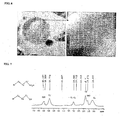
- the solid is characterized by low angle XRD ( figure 1 ), by nitrogen volumetry ( figure 2 , in which the magnitude P0 indicated on the abscissa is the saturation vapor pressure), by MET, by 13 C NMR-RAM ( figure 3 ), by basic soda and ICP assay.
- the TEM analysis shows that the final hybrid material has an organized mesoporosity characterized by a 2D hexagonal structure.
- An SEM image of the spherical elementary particles thus obtained indicates that these particles have a size characterized by a diameter ranging from 50 to 700 nm, the size distribution of these particles being centered around 300 nm.
- the experimental molar percentage of organic groups with respect to the silicic matrix is 8.5% according to the ICP data.
- the proton exchange capacity of the hybrid material according to the invention is estimated by assaying with sodium hydroxide at 1.1 mmol H + / g of SiO 2 .
- EXAMPLE 2 Preparation of a mesostructured organic-inorganic hybrid material consisting of a silicic matrix and organic groups - (CH 2 ) 2 -C 6 H 4 -SO 3 H at 10 mol% of the inorganic matrix obtained according to the second process of preparation according to the invention.
- TEOS tetraethylorthosilicate
- (2-phenylethyl) trimethoxysilane 9 g are added to a solution containing 65 g of ethanol, 34 g of water, 81 ⁇ l of HCl (35% by mass) and 3, 08 g of CTAB surfactant.
- the whole is left stirring at room temperature for 2 h 30 until complete dissolution of the precursors.
- the droplets are dried according to the protocol described in the disclosure of the invention above.
- the temperature of the drying oven is set at 350 ° C.
- the harvested powder is then consolidated by passing in an oven at 130 ° C. for 60 h.
- the CTAB surfactant is extracted from the hybrid material by washing with absolute ethanol at reflux for 2 h (100 ml of solvent / g of product).
- the hybrid material thus obtained is then sulfonated with excess chlorosulfonic acid.
- 380 mg of powder are placed in 8 ml of anhydrous chloroform in a previously parboiled vessel and purged with argon, then 0.6 ml of HSO 3 Cl are added.
- the mixture is stirred at room temperature for 30 minutes and then heated at 55 ° C. for 2 hours 30 minutes.
- the mixture stains progressively from yellow to dark brown-black.
- the hydrolysis is carried out with 10 ml of 95% ethanol then the product is washed with absolute ethanol, with distilled water until neutral pH, then one last time with ethanol.
- the hybrid material is then dried in an oven overnight at 60 ° C.
- the solid is characterized by low-angle XRD, nitrogen volumetric analysis by TEM, 13 C NMR-RAM, basic soda assay and ICP.
- the TEM analysis shows that the final hybrid material has an organized mesoporosity characterized by a 2D hexagonal structure.
- An SEM image of the spherical elementary particles thus obtained indicates that these particles have a size characterized by a diameter ranging from 50 to 700 nm, the size distribution of these particles being centered around 300 nm.
- the experimental molar percentage of sulfur functional groups with respect to the silicic matrix is 12% according to the ICP data.
- the proton exchange capacity of the hybrid material according to the invention is estimated by assaying with sodium hydroxide at 1.1 mmol H + / g of SiO 2 .
- EXAMPLE 3 Preparation of a mesostructured organic-inorganic hybrid material consisting of a silicic matrix and organic groups - (CH 2 ) 3 -SO 3 H at 10 mol% of the inorganic matrix obtained according to the second preparation method according to US Pat. 'invention.
- TEOS tetraethylorthosilicate
- mercaptopropyltriethoxysilane 9 g, tetraethylorthosilicate (TEOS) and 1.2 g of mercaptopropyltriethoxysilane are added to a solution containing 65 g of ethanol, 34 g of water, 81 ⁇ l of HCl (35% by weight) and 3.08 g of CTAB surfactant. .
- TEOS tetraethylorthosilicate
- the whole is left stirring at room temperature for 2 h 30 until complete dissolution of the precursors.
- the droplets are dried according to the protocol described in the disclosure of the invention above.
- the temperature of the drying oven is set at 350 ° C.
- the harvested powder is then consolidated by passing under study at 130 ° C for 60 h.
- the CTAB surfactant is extracted from the hybrid material by washing with absolute ethanol at reflux for 2 h (100 ml of solvent / g of product).
- the hybrid material thus obtained is then oxidized with nitric acid.
- nitric acid HNO 3
- 1 g of powder is impregnated with nitric acid (HNO 3 ) diluted to 20% by weight, and then treated with 20 ml of HNO 3 at 68% by weight, for 24 hours with stirring. After oxidation, the powder is washed with water, acidified with 0.05 M sulfuric acid, and again washed copiously with water until neutral pH. After a final rinsing with ethanol, the hybrid material is dried in an oven overnight at 60 ° C.
- HNO 3 nitric acid
- the solid is characterized by low angle XRD ( figure 4 ), by nitrogen volumetry ( figure 5 in which the magnitude P0 indicated on the abscissa is the saturation vapor pressure), by MET ( figure 6 ) by NMR-RAM 13 C ( figure 7 ), by basic soda and ICP assay.
- MET Transmission Electron Microscopy
- a SEM (Scanning Electron Microscopy) photograph of the spherical elementary particles thus obtained indicates that these particles have a size characterized by a diameter ranging from 50 to 700 nm, the size distribution of these particles being centered around 300 nm.
- the experimental molar percentage of organic groups with respect to the silicic matrix is 10% according to the ICP data.
- the proton exchange capacity of the hybrid material according to the invention is estimated by assaying with sodium hydroxide at 1.4 mmol H + / g of SiO 2 .
- EXAMPLE 4 Preparation of a mesostructured organic-inorganic hybrid material consisting of a silicic matrix and organic groups - (CH 2 ) 3 -SO 3 H at 10 mol% of the inorganic matrix obtained according to the second preparation method according to US Pat. 'invention.
- TEOS tetraethylorthosilicate
- mercaptopropyltriethoxysilane 9 g, tetraethylorthosilicate (TEOS) and 1.2 g of mercaptopropyltriethoxysilane are added to a solution containing 65 g of ethanol, 34 g of water, 81 ⁇ l of HCl (35% by weight) and 3.08 g of CTAB surfactant. .
- TEOS tetraethylorthosilicate
- the whole is left stirring at room temperature for 2 h 30 until complete dissolution of the precursors.
- the droplets are dried according to the protocol described in the disclosure of the invention above.
- the temperature of the drying oven is set at 350 ° C.
- the harvested powder is then consolidated by passing under study at 130 ° C for 60 h.
- the CTAB surfactant is extracted from the hybrid material by washing with absolute ethanol at reflux for 2 h (100 ml of solvent / g of product).
- the hybrid material thus obtained is then oxidized with hydrogen peroxide.
- the hybrid material After a final rinsing with ethanol, the hybrid material is dried in an oven overnight at 60 ° C.
- the solid is characterized by low angle XRD, nitrogen volumetric analysis, TEM, 13 C NMR-RAM, basic soda assay and ICP.
- the TEM analysis shows that the final hybrid material has an organized mesoporosity characterized by a 2D hexagonal structure.
- An SEM image of the spherical elementary particles thus obtained indicates that these particles have a size characterized by a diameter ranging from 50 to 700 nm, the size distribution of these particles being centered around 300 nm.
- the experimental molar percentage of organic groups with respect to the silicic matrix is 7% according to the ICP data.
- the proton exchange capacity of the hybrid material according to the invention is estimated by assaying with sodium hydroxide at 1.3 mmol H + / g of SiO 2 .
- EXAMPLE 5 Preparation of a mesostructured organic-inorganic hybrid material consisting of a silicic matrix and organic groups - (CH 2 ) 3 -SO 3 H at 20 mole% of the inorganic matrix obtained according to the second preparation method according to US Pat. 'invention.
- TEOS tetraethylorthosilicate
- mercaptopropyltriethoxysilane 8 g are added to a solution containing 65 g of ethanol, 34 g of water, 81 ⁇ l of HCl (35% by mass) and 3.08 g of CTAB surfactant. .
- the whole is left stirring at room temperature for 2 h 30 until complete dissolution of the precursors.
- the droplets are dried according to the protocol described in the disclosure of the invention above.
- the temperature of the drying oven is set at 350 ° C.
- the harvested powder is then consolidated by passing under study at 130 ° C for 60 h.
- the CTAB surfactant is extracted from the hybrid material by washing with absolute ethanol at reflux for 2 h (100 ml of solvent / g of product).
- the hybrid material thus obtained is then oxidized with hydrogen peroxide.
- the solid is characterized by low-angle XRD, nitrogen volumetric analysis by TEM, 13 C NMR-RAM, basic soda assay and ICP.
- the TEM analysis shows that the final hybrid material has an organized mesoporosity characterized by a 2D hexagonal structure.
- An SEM image of the spherical elementary particles thus obtained indicates that these particles have a size characterized by a diameter ranging from 50 to 700 nm, the size distribution of these particles being centered around 300 nm.
- the experimental molar percentage of organic groups with respect to the silicic matrix is 19% according to the ICP data.
- the proton exchange capacity of the hybrid material according to the invention is estimated by soda assay at 2.0 mmol H + / g of SiO 2 .
- Example 6 Preparation of a mesostructured organic-inorganic hybrid material consisting of a silica-zirconia binary matrix (90:10 molar) and organic groups (CH 2 ) 3 -SO 3 H at 10 mol% of the inorganic matrix obtained according to the second preparation method according to the invention.
- the whole is left stirring at room temperature for 2 h 30 until complete dissolution of the precursors.
- the droplets are dried according to the protocol described in the disclosure of the invention above.
- the temperature of the drying oven is set at 350 ° C.
- the harvested powder is then consolidated by passing under study at 130 ° C for 60 h.
- the P123 copolymer is extracted from the hybrid material by a Soxhlet wash with absolute ethanol at reflux for 12 h.
- the hybrid material thus obtained is then oxidized with hydrogen peroxide.
- the solid is characterized by low angle XRD, nitrogen volumetric analysis, TEM, 13 C NMR-RAM, basic soda assay and ICP.
- the TEM analysis shows that the final hybrid material has an organized mesoporosity characterized by a 2D hexagonal structure.
- An SEM image of the spherical elementary particles thus obtained indicates that these particles have a size characterized by a diameter ranging from 50 to 700 nm, the size distribution of these particles being centered around 300 nm.
- the experimental molar percentage of organic groups with respect to the silicic matrix is 8% according to the ICP data.
- the proton exchange capacity of the hybrid material according to the invention is estimated by sodium hydroxide assay at 1.2 mmol H + / g of inorganic material.
- EXAMPLE 7 Preparation of a mesostructured organic-inorganic hybrid material consisting of a silica-zirconia binary matrix (85:15 molar) and organic groups (CH 2 ) 3 -NH 2 at 10 mol% of the inorganic matrix obtained according to the first preparation method according to the invention.
- the droplets are dried according to the protocol described in the disclosure of the invention above.
- the temperature of the drying oven is set at 350 ° C.
- the recovered powder is then consolidated by passing in an oven at 130 ° C. for 60 h.
- the P123 copolymer is extracted from the hybrid material by a Soxhlet washing with absolute ethanol at reflux for 12 h and then dried in an oven overnight at 60 ° C.
- the solid is characterized by low angle XRD, nitrogen volumetric analysis, TEM, 13 C NMR-RAM, basic soda assay and ICP.
- the TEM analysis shows that the final hybrid material has an organized mesoporosity characterized by a 2D hexagonal structure.
- An SEM image of the spherical elementary particles thus obtained indicates that these particles have a size characterized by a diameter ranging from 50 to 700 nm, the size distribution of these particles being centered around 300 nm.
- the experimental molar percentage of organic groups with respect to the silicic matrix is 8% according to the ICP data.
- the amount of amine groups of the hybrid material according to the invention is estimated by acid-base measurement at 1.4 mmol / g inorganic material.
Landscapes
- Chemical & Material Sciences (AREA)
- Organic Chemistry (AREA)
- Silicates, Zeolites, And Molecular Sieves (AREA)
- Solid-Sorbent Or Filter-Aiding Compositions (AREA)
Claims (10)
- Organisch-anorganischer Hybridwerkstoff (OIHW) in Form von kugelförmigen Elementarpartikeln mit einem Durchmesser 50 nm bis 10 Mikrometer, wobei jeder Partikel aus einer mesostrukturierten Matrix auf Basis von Siliciumoxid besteht sowie aus organischen Einheiten mit reaktionsfähigen endständigen funktionellen Gruppen, die aus den folgenden reaktionsfähigen funktionellen Gruppen ausgewählt sind:- sauren Gruppen vom Typ Sulfonsäure -SO3H, Carbonsäuren-COOH und Derivate, OH, Phosphonsäure oder einer beliebigen Kombination dieser Typen,- basischen Gruppen vom Typ Amin (primäre, sekundäre, tertiäre), OH oder einer beliebigen Kombination dieser Typen,- nukleophilen Gruppen vom Type Halogenid,- adsorptionsfähigen Gruppen vom Typ Thiol,wobei die organischen Einheiten auf kovalente Weise an das anorganische Gerüst der Matrix gebunden sind und sich an den Wänden der Poren dieser Matrix befinden, wobei die mesostrukturierte Matrix eine Porengröße im Bereich 1,5 bis 30 nm hat und amorphe Wände mit einer Dicke im Bereich 1 bis 20 nm aufweist, wobei die Matrix auf Basis von Siliciumoxid weiterhin mindestens ein Element Z enthält, das aus der Gruppe ausgewählt ist, welche aus Aluminium, Titan, Wolfram, Zirkonium und Cer besteht, und wobei die organischen Gruppen unter Bezugnahme auf die Matrix einen molaren Prozentanteil im Bereich von 0,1 bis 30 % ausmachen, und wobei der organisch-anorganische Hybridwerkstoff eine spezifische Oberfläche im Bereich von 100 bis 1500 m2/g hat.
- Organisch-anorganischer Hybridwerkstoff nach Anspruch 1, wobei dessen organische Einheiten saure reaktionsfähige endständige funktionelle Gruppen aufweisen, wobei Sulfonsäure die bevorzugte Einheit ist.
- Organisch-anorganischer Hybridwerkstoff nach Anspruch 1, wobei dessen organische Einheiten nukleophile reaktionsfähige endständige funktionelle Gruppen vom Typ Halogenid aufweisen, wobei es sich bei dem Halogen vorzugsweise um Chlor handelt.
- Organisch-anorganischer Hybridwerkstoff nach Anspruch 1, wobei dessen organische Einheiten absorptionsfähige endständige reaktionsfähige funktionelle Gruppen vom Typ Thiol aufweisen, wobei SH die bevorzugte Einheit ist.
- Organisch-anorganischer Hybridwerkstoff nach einem beliebigen der Ansprüche 1 bis 4, wobei die organischen Einheiten der mesostrukturierten Matrix gleichartig sind und aus dem Einsatz einer einzigen Organosilan-Vorstufe hervorgehen.
- Organisch-anorganischer Hybridwerkstoff nach einem beliebigen der Ansprüche 1 bis 4, wobei die organischen Einheiten der mesostrukturierten Matrix verschiedenartig sind und aus dem Einsatz mindestens zweier Organosilan-Vorstufen hervorgehen.
- Organisch-anorganischer Hybridwerkstoff nach einem beliebigen der Ansprüche 1 bis 6, wobei der Durchmesser der kugelförmigen Partikel im Bereich von 50 nm bis 300 nm liegt.
- Organisch-anorganischer Hybridwerkstoff nach einem beliebigen der Ansprüche 1 bis 7, wobei dessen spezifische Oberfläche im Bereich von 300 m2/g bis 1000 m2/g liegt.
- Verfahren zur Herstellung des organisch-anorganischen Hybridwerkstoffs nach Anspruch 1, welches durch die Abfolge der folgenden Schritte gekennzeichnet ist:a) Vermischen, in Lösung, mindestens eines Tensids, mindestens einer Kieselsäure-Vorstufe, mindestens einer Vorstufe mindestens eines Elements Z, das aus der Gruppe ausgewählt ist, welche aus Aluminium, Titan, Wolfram, Zirkonium und Cer besteht, und mindestens einer Organosilan-Vorstufe, die mindestens eine endständige reaktionsfähige funktionelle Gruppe besitzt, wobei es sich bei der ausgewählten endständigen reaktionsfähigen Gruppe um diejenige handelt, welche für das Werkstoff-Endprodukt angestrebt wird,b) Versprühen, durch Aerosolbildung, der Lösung, die in Schritt a) erhalten wurde, um die Bildung kugelförmiger Tröpfchen mit einem Durchmesser von weniger als 200 µm zu bewirken,c) Trocknen der Tröpfchen, undd) Entfernen des Tensids.
- Verfahren zur Herstellung des organisch-anorganischen Hybridwerkstoffs nach Anspruch 1, welches durch die Abfolge der folgenden Schritte gekennzeichnet ist:a') Vermischen, in Lösung, mindestens eines Tensids, mindestens einer Kieselsäure-Vorstufe, mindestens einer Vorstufe mindestens eines Elements Z, das aus der Gruppe ausgewählt ist, welche aus Aluminium, Titan, Wolfram, Zirkonium und Cer besteht, und mindestens einer Organosilan-Vorstufe, die mindestens eine organische Einheit besitzt, die ein Zwischenprodukt gegenüber derjenigen organischen Einheit darstellt, welche die endständige reaktionsfähige funktionelle Gruppe besitzt, die für das Werkstoff-Endprodukt angestrebt wird,b') Versprühen, durch Aerosolbildung, der Lösung, die in Schritt a') erhalten wurde, um die Bildung kugelförmiger Tröpfchen mit einem Durchmesser von weniger als 200 µm zu bewirken,c') Trocknen der Tröpfchen,d') Entfernen des Tensids, um einen Werkstoff mit organisierter und einheitlicher Porenbeschaffenheit zu erhalten, unde') Umwandeln, durch geeignete chemische Behandlungen, der organischen Zwischenprodukt-Einheit des Hybridwerkstoffs, der in Schritt d') erhalten wurde, in eine organische Einheit, welche die endständige reaktionsfähige funktionelle Gruppe besitzt, die für das Werkstoff-Endprodukt angestrebt wird.
Applications Claiming Priority (2)
| Application Number | Priority Date | Filing Date | Title |
|---|---|---|---|
| FR0512658A FR2894580B1 (fr) | 2005-12-09 | 2005-12-09 | Materiau hybride organique-inorganique mesostructure |
| PCT/FR2006/002467 WO2007065982A1 (fr) | 2005-12-09 | 2006-11-03 | Materiau hybride organique - inorganique mesostructure |
Publications (2)
| Publication Number | Publication Date |
|---|---|
| EP1963341A1 EP1963341A1 (de) | 2008-09-03 |
| EP1963341B1 true EP1963341B1 (de) | 2014-01-08 |
Family
ID=36658697
Family Applications (1)
| Application Number | Title | Priority Date | Filing Date |
|---|---|---|---|
| EP06831069.7A Not-in-force EP1963341B1 (de) | 2005-12-09 | 2006-11-03 | Mesostrukturiertes organisch/anorganisches hybridmaterial |
Country Status (5)
| Country | Link |
|---|---|
| US (1) | US20090186226A1 (de) |
| EP (1) | EP1963341B1 (de) |
| FR (1) | FR2894580B1 (de) |
| WO (1) | WO2007065982A1 (de) |
| ZA (1) | ZA200804539B (de) |
Families Citing this family (8)
| Publication number | Priority date | Publication date | Assignee | Title |
|---|---|---|---|---|
| KR101193164B1 (ko) * | 2006-02-21 | 2012-10-19 | 삼성에스디아이 주식회사 | 술폰산기 함유 유기 고분자 실록산 화합물 및 이를포함하는 연료전지 |
| FR2931475B1 (fr) * | 2008-05-23 | 2010-06-04 | Inst Francais Du Petrole | Procede de craquage d'ethers alkyl tertiaires utilisant un materiau hybride organique-inorganique mesostructure. |
| US8945804B2 (en) | 2008-07-09 | 2015-02-03 | Cabot Corporation | Treated metal oxide particles and toner compositions |
| MY169826A (en) * | 2009-05-07 | 2019-05-16 | Ifp Energies Now | Single-stage process of total demecuration of liquid hydrocarbon feedstocks using an organic-inorganic hybrid material |
| TWI457321B (zh) * | 2009-05-15 | 2014-10-21 | IFP Energies Nouvelles | 使用有機-無機混合材料之液態烴原料之完全脫汞處理之單一階段製程 |
| US8283027B2 (en) | 2010-06-11 | 2012-10-09 | The United States Of America, As Represented By The Secretary Of The Navy | Composite for controlled release of small molecules in aquatic environments |
| KR102148388B1 (ko) * | 2017-05-12 | 2020-08-26 | 주식회사 엘지화학 | 실리카 에어로겔 블랭킷의 제조방법 및 이로 제조된 실리카 에어로겔 블랭킷 |
| KR102238733B1 (ko) * | 2019-07-09 | 2021-04-09 | 서울여자대학교 산학협력단 | 신규 파에니스포로사르키나 퀴스퀼리아룸 17mud 1-1541 균주 및 이의 용도 |
Citations (1)
| Publication number | Priority date | Publication date | Assignee | Title |
|---|---|---|---|---|
| US20020046682A1 (en) * | 2000-04-21 | 2002-04-25 | Hongyou Fan | Prototyping of patterned functional nanostructures |
Family Cites Families (7)
| Publication number | Priority date | Publication date | Assignee | Title |
|---|---|---|---|---|
| US5622684A (en) | 1995-06-06 | 1997-04-22 | Board Of Trustees Operating Michigan State University | Porous inorganic oxide materials prepared by non-ionic surfactant templating route |
| US5858457A (en) | 1997-09-25 | 1999-01-12 | Sandia Corporation | Process to form mesostructured films |
| WO1999037705A1 (en) | 1997-12-09 | 1999-07-29 | The Regents Of The University Of California | Block polymer processing for mesostructured inorganic oxide materials |
| US6528034B1 (en) * | 1999-11-09 | 2003-03-04 | Board Of Trustees Of Michigan State University | Ultra-stable lamellar mesoporous silica compositions and process for the prepration thereof |
| US6387453B1 (en) * | 2000-03-02 | 2002-05-14 | Sandia Corporation | Method for making surfactant-templated thin films |
| US6713643B2 (en) * | 2001-05-24 | 2004-03-30 | Board Of Trustees Of Michigan State University | Ultrastable organofunctional microporous to mesoporous silica compositions |
| US7005118B2 (en) * | 2002-07-25 | 2006-02-28 | Instituto Mexicano Del Petroleo | Synthetic mesoporous material with radially assembled nanotubes |
-
2005
- 2005-12-09 FR FR0512658A patent/FR2894580B1/fr not_active Expired - Fee Related
-
2006
- 2006-11-03 EP EP06831069.7A patent/EP1963341B1/de not_active Not-in-force
- 2006-11-03 WO PCT/FR2006/002467 patent/WO2007065982A1/fr not_active Ceased
- 2006-11-03 US US12/096,379 patent/US20090186226A1/en not_active Abandoned
-
2008
- 2008-05-26 ZA ZA200804539A patent/ZA200804539B/xx unknown
Patent Citations (1)
| Publication number | Priority date | Publication date | Assignee | Title |
|---|---|---|---|---|
| US20020046682A1 (en) * | 2000-04-21 | 2002-04-25 | Hongyou Fan | Prototyping of patterned functional nanostructures |
Also Published As
| Publication number | Publication date |
|---|---|
| WO2007065982A1 (fr) | 2007-06-14 |
| ZA200804539B (en) | 2009-05-27 |
| FR2894580A1 (fr) | 2007-06-15 |
| EP1963341A1 (de) | 2008-09-03 |
| US20090186226A1 (en) | 2009-07-23 |
| FR2894580B1 (fr) | 2014-04-11 |
Similar Documents
| Publication | Publication Date | Title |
|---|---|---|
| EP1627852B1 (de) | Mesostrukturiertes aluminosilikates Material | |
| EP1627853B1 (de) | Material mit hierarchisierter Porosität enthaltend Silizium | |
| EP1893531B1 (de) | Anorganisches material mit in einer mesostrukturierten matrix eingeschlossenen metallnanopartikeln | |
| JP5911953B2 (ja) | メソポーラスシリカ及び有機シリカ材料並びにこれらの製造方法 | |
| EP2197793B1 (de) | Amorphes material mit silicium und einer organisierten und hierarchisierter porosität | |
| FR2929264A1 (fr) | Materiau inorganique forme de particules spheriques de taille specifique et presentant des nanoparticules metalliques piegees dans une matrice mesostructuree | |
| EP1963341B1 (de) | Mesostrukturiertes organisch/anorganisches hybridmaterial | |
| EP1910226B1 (de) | Mesostrukturiertes material mit hohem aluminiumgehalt | |
| EP2274237B1 (de) | Aus kugelförmigen partikeln von spezifischer grösse geformtes mesostrukturiertes aluminiumsilikatmaterial | |
| Saha et al. | A facile cost-effective electrolyte-assisted approach and comparative study towards the Greener synthesis of silica nanoparticles | |
| EP0974555B2 (de) | Verfahren zur Synthese von Aluminiumoxiden in alkalischem Medium | |
| WO2008129151A2 (fr) | Materiau hybride et procede pour sa preparation | |
| Li et al. | A general and efficient method for decorating graphene sheets with metal nanoparticles based on the non-covalently functionalized graphene sheets with hyperbranched polymers | |
| EP2274236B1 (de) | Aus kugelförmigen partikeln von spezifischer grösse mesostrukturiertes material mit hohem aluminiumgehalt | |
| US20120276290A1 (en) | Silica nanoparticles with rough surface | |
| Pereira et al. | Novel highly luminescent amine-functionalized bridged silsesquioxanes | |
| FR2931475A1 (fr) | Procede de craquage d'ethers alkyl tertiaires utilisant un materiau hybride organique-inorganique mesostructure. | |
| JP5687832B2 (ja) | 複合シリカ粒子 | |
| Laird et al. | Mesoporous organosilicas with thiol functionalised pores: multifunctional dendrimers as sacrificial building block and template | |
| Fortugno et al. | Novel Aerosol‐Based Approach toward Mesoporous Silica Nanoparticles | |
| EP2176172B1 (de) | Neue verbundmaterialien auf kupferbasis sowie herstellungsverfahren und verwendungen dafür | |
| JP2000017102A (ja) | 有機/無機複合高分子多孔材料及び多孔材料の製造方法 | |
| EP2231521A1 (de) | MESOPORöse Stoffe und Reaktanten für ihre Erzeugung | |
| Arrachart et al. | Synthesis and characterisation of carboxylate-terminated silica nanohybrid powders and thin films | |
| WO2023194681A1 (fr) | Matériaux mésoporeux magnétiques à base de silice (mpms) |
Legal Events
| Date | Code | Title | Description |
|---|---|---|---|
| PUAI | Public reference made under article 153(3) epc to a published international application that has entered the european phase |
Free format text: ORIGINAL CODE: 0009012 |
|
| 17P | Request for examination filed |
Effective date: 20080709 |
|
| AK | Designated contracting states |
Kind code of ref document: A1 Designated state(s): DE DK FR GB IT NL |
|
| 17Q | First examination report despatched |
Effective date: 20081105 |
|
| DAX | Request for extension of the european patent (deleted) | ||
| RBV | Designated contracting states (corrected) |
Designated state(s): DE DK FR GB IT NL |
|
| GRAP | Despatch of communication of intention to grant a patent |
Free format text: ORIGINAL CODE: EPIDOSNIGR1 |
|
| INTG | Intention to grant announced |
Effective date: 20130722 |
|
| GRAS | Grant fee paid |
Free format text: ORIGINAL CODE: EPIDOSNIGR3 |
|
| GRAA | (expected) grant |
Free format text: ORIGINAL CODE: 0009210 |
|
| AK | Designated contracting states |
Kind code of ref document: B1 Designated state(s): DE DK FR GB IT NL |
|
| REG | Reference to a national code |
Ref country code: GB Ref legal event code: FG4D Free format text: NOT ENGLISH |
|
| REG | Reference to a national code |
Ref country code: DE Ref legal event code: R096 Ref document number: 602006040009 Country of ref document: DE Effective date: 20140220 |
|
| REG | Reference to a national code |
Ref country code: NL Ref legal event code: VDEP Effective date: 20140108 |
|
| PG25 | Lapsed in a contracting state [announced via postgrant information from national office to epo] |
Ref country code: NL Free format text: LAPSE BECAUSE OF FAILURE TO SUBMIT A TRANSLATION OF THE DESCRIPTION OR TO PAY THE FEE WITHIN THE PRESCRIBED TIME-LIMIT Effective date: 20140108 |
|
| REG | Reference to a national code |
Ref country code: DE Ref legal event code: R097 Ref document number: 602006040009 Country of ref document: DE |
|
| PG25 | Lapsed in a contracting state [announced via postgrant information from national office to epo] |
Ref country code: DK Free format text: LAPSE BECAUSE OF FAILURE TO SUBMIT A TRANSLATION OF THE DESCRIPTION OR TO PAY THE FEE WITHIN THE PRESCRIBED TIME-LIMIT Effective date: 20140108 |
|
| PLBE | No opposition filed within time limit |
Free format text: ORIGINAL CODE: 0009261 |
|
| STAA | Information on the status of an ep patent application or granted ep patent |
Free format text: STATUS: NO OPPOSITION FILED WITHIN TIME LIMIT |
|
| 26N | No opposition filed |
Effective date: 20141009 |
|
| REG | Reference to a national code |
Ref country code: DE Ref legal event code: R097 Ref document number: 602006040009 Country of ref document: DE Effective date: 20141009 |
|
| PGFP | Annual fee paid to national office [announced via postgrant information from national office to epo] |
Ref country code: FR Payment date: 20141014 Year of fee payment: 9 |
|
| REG | Reference to a national code |
Ref country code: DE Ref legal event code: R119 Ref document number: 602006040009 Country of ref document: DE |
|
| GBPC | Gb: european patent ceased through non-payment of renewal fee |
Effective date: 20141103 |
|
| PG25 | Lapsed in a contracting state [announced via postgrant information from national office to epo] |
Ref country code: GB Free format text: LAPSE BECAUSE OF NON-PAYMENT OF DUE FEES Effective date: 20141103 Ref country code: DE Free format text: LAPSE BECAUSE OF NON-PAYMENT OF DUE FEES Effective date: 20150602 |
|
| PG25 | Lapsed in a contracting state [announced via postgrant information from national office to epo] |
Ref country code: IT Free format text: LAPSE BECAUSE OF FAILURE TO SUBMIT A TRANSLATION OF THE DESCRIPTION OR TO PAY THE FEE WITHIN THE PRESCRIBED TIME-LIMIT Effective date: 20140108 |
|
| REG | Reference to a national code |
Ref country code: FR Ref legal event code: ST Effective date: 20160729 |
|
| PG25 | Lapsed in a contracting state [announced via postgrant information from national office to epo] |
Ref country code: FR Free format text: LAPSE BECAUSE OF NON-PAYMENT OF DUE FEES Effective date: 20151130 |