EP1963436B1 - Colorants particuliers de type naphtalimide, composition tinctoriale comprenant au moins un tel colorant, procede de mise en oeuvre et utilisations - Google Patents
Colorants particuliers de type naphtalimide, composition tinctoriale comprenant au moins un tel colorant, procede de mise en oeuvre et utilisations Download PDFInfo
- Publication number
- EP1963436B1 EP1963436B1 EP07731808.7A EP07731808A EP1963436B1 EP 1963436 B1 EP1963436 B1 EP 1963436B1 EP 07731808 A EP07731808 A EP 07731808A EP 1963436 B1 EP1963436 B1 EP 1963436B1
- Authority
- EP
- European Patent Office
- Prior art keywords
- radical
- amino
- imidazol
- ium
- propyl
- Prior art date
- Legal status (The legal status is an assumption and is not a legal conclusion. Google has not performed a legal analysis and makes no representation as to the accuracy of the status listed.)
- Not-in-force
Links
- 0 C*1C=*C=C1 Chemical compound C*1C=*C=C1 0.000 description 7
- QQEQLTDPVQJUNB-UHFFFAOYSA-P C[n]1c[n+](CCCN(C(c2cccc3c2c2ccc3NCCC[n]3c[n+](CCCCCCN(C(c4cccc5c4c4ccc5NCCC[n]5c[n+](C)cc5)=O)C4=O)cc3)=O)C2=O)cc1 Chemical compound C[n]1c[n+](CCCN(C(c2cccc3c2c2ccc3NCCC[n]3c[n+](CCCCCCN(C(c4cccc5c4c4ccc5NCCC[n]5c[n+](C)cc5)=O)C4=O)cc3)=O)C2=O)cc1 QQEQLTDPVQJUNB-UHFFFAOYSA-P 0.000 description 1
- MCTWTZJPVLRJOU-UHFFFAOYSA-N C[n]1cncc1 Chemical compound C[n]1cncc1 MCTWTZJPVLRJOU-UHFFFAOYSA-N 0.000 description 1
Classifications
-
- C—CHEMISTRY; METALLURGY
- C07—ORGANIC CHEMISTRY
- C07D—HETEROCYCLIC COMPOUNDS
- C07D221/00—Heterocyclic compounds containing six-membered rings having one nitrogen atom as the only ring hetero atom, not provided for by groups C07D211/00 - C07D219/00
- C07D221/02—Heterocyclic compounds containing six-membered rings having one nitrogen atom as the only ring hetero atom, not provided for by groups C07D211/00 - C07D219/00 condensed with carbocyclic rings or ring systems
- C07D221/04—Ortho- or peri-condensed ring systems
- C07D221/06—Ring systems of three rings
- C07D221/14—Aza-phenalenes, e.g. 1,8-naphthalimide
-
- C—CHEMISTRY; METALLURGY
- C09—DYES; PAINTS; POLISHES; NATURAL RESINS; ADHESIVES; COMPOSITIONS NOT OTHERWISE PROVIDED FOR; APPLICATIONS OF MATERIALS NOT OTHERWISE PROVIDED FOR
- C09B—ORGANIC DYES OR CLOSELY-RELATED COMPOUNDS FOR PRODUCING DYES, e.g. PIGMENTS; MORDANTS; LAKES
- C09B57/00—Other synthetic dyes of known constitution
- C09B57/08—Naphthalimide dyes; Phthalimide dyes
-
- A—HUMAN NECESSITIES
- A61—MEDICAL OR VETERINARY SCIENCE; HYGIENE
- A61K—PREPARATIONS FOR MEDICAL, DENTAL OR TOILETRY PURPOSES
- A61K8/00—Cosmetics or similar toiletry preparations
- A61K8/18—Cosmetics or similar toiletry preparations characterised by the composition
- A61K8/30—Cosmetics or similar toiletry preparations characterised by the composition containing organic compounds
- A61K8/49—Cosmetics or similar toiletry preparations characterised by the composition containing organic compounds containing heterocyclic compounds
- A61K8/494—Cosmetics or similar toiletry preparations characterised by the composition containing organic compounds containing heterocyclic compounds with more than one nitrogen as the only hetero atom
- A61K8/4946—Imidazoles or their condensed derivatives, e.g. benzimidazoles
-
- A—HUMAN NECESSITIES
- A61—MEDICAL OR VETERINARY SCIENCE; HYGIENE
- A61Q—SPECIFIC USE OF COSMETICS OR SIMILAR TOILETRY PREPARATIONS
- A61Q5/00—Preparations for care of the hair
- A61Q5/06—Preparations for styling the hair, e.g. by temporary shaping or colouring
- A61Q5/065—Preparations for temporary colouring the hair, e.g. direct dyes
-
- A—HUMAN NECESSITIES
- A61—MEDICAL OR VETERINARY SCIENCE; HYGIENE
- A61Q—SPECIFIC USE OF COSMETICS OR SIMILAR TOILETRY PREPARATIONS
- A61Q5/00—Preparations for care of the hair
- A61Q5/10—Preparations for permanently dyeing the hair
-
- C—CHEMISTRY; METALLURGY
- C09—DYES; PAINTS; POLISHES; NATURAL RESINS; ADHESIVES; COMPOSITIONS NOT OTHERWISE PROVIDED FOR; APPLICATIONS OF MATERIALS NOT OTHERWISE PROVIDED FOR
- C09B—ORGANIC DYES OR CLOSELY-RELATED COMPOUNDS FOR PRODUCING DYES, e.g. PIGMENTS; MORDANTS; LAKES
- C09B69/00—Dyes not provided for by a single group of this subclass
- C09B69/001—Dyes containing an onium group attached to the dye skeleton via a bridge
Definitions
- the present application relates to dyes of the naphthalimide type, their use as direct dyes for dyeing keratinous fibers and dye compositions comprising such compounds.
- the resulting colorations are particularly chromatic colorations which are however temporary or semi-permanent. Indeed, the nature of the interactions that bind the direct dyes to the keratinous fiber, and their desorption of the surface and / or the core of the fiber, make the dyeing power and the resistance to washing or transpiration of the colorations still possible. considered insufficient. Some direct dyes may, in addition, be sensitive to light because of the low resistance of the chromophore to photochemical attacks and lead in time to a fading of the hair coloring.
- naphthalimide type derivatives of the naphthalimide type are known in the state of the art since the 1960s, in particular as optical or bleaching agents for synthetic textile products such as acrylic or cellulose acetate textile products.
- documents illustrating this use are the patents US 3,625,947 , US 4,508,900 , US 4,595,756 and the request for patent FR-A-1,557,945 cationic 4-alkoxynaphthalimide compounds, the patent application FR-A- 2010 444 cationic 4,5-dialkoxynaphthalimide compounds and the patent application FR-A-2 162 181 which relates to azo dyes comprising a naphthalimide group.
- patent application WO 2005/075574 discloses cationic or neutral naphthalenic direct dyes for dyeing keratin fibers and the patent application WO 2005/074872 describes naphthalenic direct dyes for lightening keratinous fibers.
- the naphthalimide dyes according to the present application are cationic.
- the dyes of the present invention make it possible to obtain very chromatic colorations and which have good resistance to external agents, in particular shampoos. Moreover, the dyes of the present invention make it possible to obtain a lightening effect on dark keratinous fibers, in particular keratinous fibers having a pitch of less than or equal to 6, preferably less than or equal to 4, without having recourse to an oxidizing agent, the fibers being able to be colored artificially or naturally. When the use of an oxidizing agent is desired, for example to obtain greater discoloration, the dyes of the present invention have good stability in an oxidizing medium.
- the present application also relates to the use as direct dye of at least one of the naphthalimide dyes that are the subject of the present application, for dyeing keratin fibers, and in particular human keratin fibers such as hair.
- the present invention also relates to dyeing compositions comprising, in a medium suitable for dyeing, at least one of the dyes of formula (I) to (IV), or their addition salts with an acid, or their solvates.
- a process for dyeing keratin fibers which comprises applying the composition of the invention to keratinous fibers for a time sufficient to obtain the desired coloration.
- a multi-compartment device comprising, in a first compartment, the composition according to the invention, and in a second compartment, an oxidizing composition.
- the compounds resulting from formulas (II) and (III) are symmetrical or asymmetrical. They are said to be symmetrical when there is a plane of symmetry perpendicular to the connecting arm L. They are said to be asymmetrical when there is no plane of symmetry perpendicular to the connecting arm L.
- a first subject of the invention consists of compounds corresponding to the above formulas (I) to (IV), their addition salts and their solvates.
- the cationic alkylene radical thus defined may be optionally interrupted by one or more heteroatoms or groups comprising at least one heteroatom or combinations thereof, such as, for example, oxygen, nitrogen, a group -CO-, a group -SO-, a group -SO 2 -; with the proviso that there is no azo, nitro, nitroso or peroxo group or bond in the L-linking arm. It may also be optionally substituted, in particular with one or more radicals chosen from hydroxyl and alkoxyl radicals. C 1 -C 2 , (poly) hydroxyalkoxyl C 2 -C 4 , amino substituted with one or more C 1 -C 2 alkyl groups optionally bearing at least one hydroxyl group.
- the radicals R 2 taken separately and independently of each other, represent a C 1 -C 6 alkyl radical. optionally substituted by a hydroxyl, C 1 -C 2 alkoxyl, hydroxycarbonyl, C 1 -C 6 alkylthiol or amino group disubstituted by a C 1 -C 4 alkyl radical.
- R 2 represents an alkyl radical such as methyl or ethyl, a hydroxyalkyl radical such as 2-hydroxyethyl, an alkoxyalkyl radical; such as 2-methoxyethyl, a hydroxycarbonylalkyl radical such as 3-hydroxycarbonylpropyl or a dialkylaminoalkyl radical such as 3-N, N-dimethylaminopropyl.
- R 3 represents a halogen atom chosen from chlorine and fluorine, an alkyl radical C 1 -C 6 monohydroxylalkyle radical in C 1 -C 4 alkoxyl radical C 1 -C 4 alkyl, a hydroxycarbonyl radical, a (C 1 -C 6 ) alkyl thiol radical, an amino radical disubstituted by a C 1 -C 4 alkyl radical.
- R 3 radicals By way of example of R 3 radicals, mention may be made of a chlorine atom, a methyl, an ethyl, a 2-hydroxyethyl, a methoxy, a hydroxycarbonyl or a dimethylamino.
- the radicals R taken separately and independently of each other, represent a hydrogen atom; an alkyl radical C 1 -C 6 , preferably C 2 -C 6 , optionally substituted with one or more identical or different groups preferably selected from hydroxyl substituents, C 1 -C 2 alkoxyl, and optionally substituted with at least one group corresponding to formula (a) as defined above; an aryl or arylalkyl radical, such as phenyl or benzyl, the aryl part being optionally substituted with one or more identical or different groups, preferably chosen from among a chlorine atom, an amino group, a hydroxyl group and a C-alkoxyl group; 1 -C 2 , an amino group mono- or disubstituted by two identical or different C 1 -C 4 alkyl radicals optionally bearing at least one hydroxyl group.
- an alkyl radical C 1 -C 6 preferably C 2 -C 6 , optionally substituted with one or more identical or different groups
- the radicals R which are identical or different, independently of one another, represent a hydrogen atom, a C 1 -C 3 alkyl radical such as methyl or ethyl a hydroxyalkyl radical such as 2-hydroxyethyl, an alkoxyalkyl radical such as 2-methoxyethyl, a C 1 -C 3 alkyl radical substituted with at least one group corresponding to the following formula (a "), an optionally substituted benzyl radical; by one or more radicals, identical or different, selected from hydroxyl groups, alkoxyl such as methoxy, amino, (di) alkylamino such as dimethylamino, (di) (hydroxyalkyl) amino such as (di) (2-hydroxyethyl) amino.
- X - represents an organic or inorganic counterion or a mixture of organic or inorganic counterions, making it possible to balance the charge (s) of the compounds of formula (I) with (IV ).
- X - is, for example, selected from a halide such as chloride, bromide, fluoride, iodide; a hydroxide; sulphate; a hydrogen sulfate; an alkyl sulphate for which the linear or branched alkyl part is C 1 -C 6 , such as the methyl sulphate or ethyl sulphate ion; carbonates and hydrogen carbonates; salts of carboxylic acids such as formate, acetate, citrate, tartrate, oxalate; alkylsulphonates for which the linear or branched alkyl part is C 1 -C 6, such as the methylsulphonate ion; arylsulphonates for which the aryl
- the acid addition salts of the compounds of formula (I) to (IV) may be, by way of example, addition salts with an organic or inorganic acid such as hydrochloric acid or hydrobromic acid.
- sulfuric acid or (alkyl- or phenyl) sulfonic acids such as p-toluenesulphonic acid or methylsulphonic acid.
- the solvates of the compounds of formula (I) to (IV) represent the hydrates of such compounds and the combination of a compound of formula (I) to (IV) with a linear or branched C 1 -C 4 alcohol such as methanol, ethanol, isopropanol, n-propanol.
- the compounds of formula (III) correspond to the following formula: wherein R, R 1 and L are as previously defined.
- the compounds of formula (IV) correspond to the following formula: wherein R, R 1 , L and X - are as defined above.
- the dyeing composition according to the invention may contain one or more naphthalimide-type compounds of formula (I), (II), (III) or (IV), or their addition salts with an acid and / or solvates, such as defined above, the mixtures of these compounds then being possible in all relative proportions, in a suitable medium for dyeing.
- composition according to the present application generally comprises from 0.001 to 10%, preferably from 0.01 to 10% by weight of one or more naphthalimide-type compounds of formula (I), (II), (III) or (IV) , or their addition salts with an acid and / or solvates, relative to the total weight of the composition.
- the dyeing composition in accordance with the invention may, in addition, contain one or more additional direct dyes other than the direct dyes of formula (I), (II), (III) or (IV), these additional direct dyes being particularly suitable for chosen from nitro dyes of the benzene series, neutral, acidic or cationic, azo direct dyes, neutral acid or cationic dyes, quinone direct dyes, and in particular, anthraquinone, neutral, acidic or cationic dyes, azine direct dyes, dyes direct triarylmethane, direct dyes indoamine, tetraazapentamethine type dyes and natural direct dyes.
- additional direct dyes being particularly suitable for chosen from nitro dyes of the benzene series, neutral, acidic or cationic, azo direct dyes, neutral acid or cationic dyes, quinone direct dyes, and in particular, anthraquinone, neutral, acidic or cationic dyes, azine direct dyes,
- azo direct dyes that can be used according to the invention, mention may be made of the cationic azo dyes described in the patent applications WO 95/15144 , WO 95/01772 and EP-A-714 954 .
- An generally representing an organic or inorganic anion for example chosen from a halide such as a chloride, a bromide, a fluoride, an iodide; a hydroxide; sulphate; a hydrogen sulfate; a (C 1 -C 6 ) alkyl sulphate such as, for example, a methyl sulphate or an ethyl sulphate; an acetate; tartrate; an oxalate; a (C 1 -C 6 ) alkyl sulfonate such as a methylsulfonate; an arylsulphonate substituted or unsubstituted by a C 1 -C 4 alkyl radical such as, for example, a 4-tolylsulphonate.
- An is preferably a chloride;
- the additional direct dye (s) preferably represent from 0.001 to 20% by weight approximately of the total weight of the ready-to-use composition and even more preferentially from 0.005 to 10% by weight approximately.
- composition of the present invention may further comprise one or more oxidation dye precursors: one or more oxidation bases and / or one or more couplers.
- the oxidation bases are chosen from para-phenylenediamines, bis-phenylalkylenediamines, para-aminophenols, ortho-aminophenols, heterocyclic bases other than heterocyclic paraphenylenediamines and their addition salts.
- paraphenylenediamines there may be mentioned by way of example, paraphenylenediamine, paratoluylenediamine, 2-chloroparaphenylenediamine, 2,3-dimethyl paraphenylenediamine, 2,6-dimethylparapenylenediamine, 2,6-diethyl paraphenylenediamine, 2, 5-dimethylparapenylenediamine, N, N-dimethyl-para-phenylenediamine, N, N-diethyl-para-phenylenediamine, N, N-dipropyl-para-phenylenediamine, 4-amino-N, N-diethyl-3-methylaniline, N, N-bis- ( ⁇ ) hydroxy-para-phenylenediamine, 4-N, N-bis- ( ⁇ -hydroxyethyl) amino-2-methylaniline, 4-N, N-bis- ( ⁇ -hydroxyethyl) amino-2-chloroaniline, 2- ⁇ - hydroxye
- paraphenylenediamine paratoluylenediamine, 2-isopropyl paraphenylenediamine, 2- ⁇ -hydroxyethyl paraphenylenediamine, 2- ⁇ -hydroxyethyloxy paraphenylenediamine, 2,6-dimethyl paraphenylenediamine, 2,6 ethyl paraphenylenediamine, 2,3-dimethyl paraphenylenediamine, N, N-bis- ( ⁇ -hydroxyethyl) paraphenylenediamine, 2-chloro-para-phenylenediamine, 2- ⁇ -acetylaminoethyloxy-para-phenylenediamine, and their addition salts with an acid are particularly preferred.
- bis-phenylalkylenediamines mention may be made, by way of example, of N, N'-bis- ( ⁇ -hydroxyethyl) N, N'-bis- (4'-aminophenyl) 1,3-diamino propanol, N N, N'-bis ( ⁇ -hydroxyethyl) N, N'-bis- (4'-aminophenyl) ethylenediamine, N, N'-bis- (4-aminophenyl) tetramethylenediamine, N, N'-bis- ( ⁇ -hydroxyethyl) N, N'-bis (4-aminophenyl) tetramethylenediamine, N, N'-bis (4-methylaminophenyl) tetramethylenediamine, N, N'-bis (ethyl) N, N ' -bis (ethyl) N, N ' -bis- (4'-amino, 3'-methylphenyl) ethylenediamine
- para-aminophenol para-aminophenol, 4-amino-3-methylphenol, 4-amino-3-fluorophenol, 4-amino-3-chlorophenol, 4-amino are exemplary; 3-hydroxymethylphenol, 4-amino-2-methylphenol, 4-amino-2-hydroxymethylphenol, 4-amino-2-methoxymethylphenol, 4-amino-2-aminomethylphenol, 4-amino-2- ( ⁇ -hydroxyethylaminomethyl) phenol, 4-amino-2-fluorophenol, and their addition salts with an acid.
- ortho-aminophenols mention may be made, for example, of 2-amino-phenol, 2-amino-5-methylphenol, 2-amino-6-methylphenol, 5-acetamido-2-aminophenol, and their addition salts.
- heterocyclic bases that may be mentioned by way of example are pyridine derivatives, pyrimidine derivatives and pyrazole derivatives.
- pyridine derivatives mention may be made of the compounds described, for example, in the patents GB-A-1,026,978 and GB-A-1,153,196 such as 2,5-diamino pyridine, 2- (4-methoxyphenyl) amino-3-amino pyridine, 3,4-diamino pyridine, and their addition salts.
- pyridinic oxidation bases useful in the present invention are the 3-amino pyrazolo [1,5-a] pyridines oxidation bases or their addition salts described for example in the patent application.
- FR-A-2 801 308 are the 3-amino pyrazolo [1,5-a] pyridines oxidation bases or their addition salts described for example in the patent application.
- pyrazolo [1,5-a] pyridin-3-ylamine 2-acetylamino pyrazolo [1,5-a] pyridin-3-ylamine; 2-morpholin-4-yl-pyrazolo [1,5-a] pyridin-3-ylamine; 3-amino-pyrazolo [1,5-a] pyridin-2-carboxylic acid; 2-methoxy-pyrazolo [1,5-a] pyridin-3-ylamino; (3-amino-pyrazolo [1,5-a] pyridin-7-yl) -methanol; 2- (3-Amino-pyrazolo [1,5-a] pyridin-5-yl) -ethanol; 2- (3-Amino-pyrazolo [1,5-a] pyridin-7-yl) -ethanol; (3-Amino-pyrazolo [1,5-a] pyridin-2-yl) -methanol
- pyrimidine derivatives mention may be made of the compounds described, for example, in the patents DE-A-23 59 399 ; JP 88-169571 ; EP-A-0 770 375 or patent application WO 96/15765 such as 2,4,5,6-tetraaminopyrimidine, 4-hydroxy-2,5,6-triaminopyrimidine, 2-hydroxy-4,5,6-triaminopyrimidine, 2,4-dihydroxy-5,6 -diaminopyrimidine, 2,5,6-triaminopyrimidine, their addition salts and their tautomeric forms, when there is a tautomeric equilibrium.
- 2,4,5,6-tetraaminopyrimidine 4-hydroxy-2,5,6-triaminopyrimidine, 2-hydroxy-4,5,6-triaminopyrimidine, 2,4-dihydroxy-5,6 -diaminopyrimidine, 2,5,6-triaminopyrimidine, their addition salts and their tautomeric forms, when
- pyrazole derivatives mention may be made of the compounds described in the patents DE-A-38 43 892 , DE-A-41 33 957 and patent applications WO 94/08969 , WO 94/08970 , FR-A-2,733,749 and DE-A-195 43 988 such as 4,5-diamino-1-methyl pyrazole, 4,5-diamino-1- ( ⁇ -hydroxyethyl) pyrazole, 3,4-diaminopyrazole, 4,5-diamino-1- (4'-chlorobenzyl) pyrazole, 4,5-diamino-1,3-dimethylpyrazole, 4,5-diamino-3-methyl-1-phenyl pyrazole, 4,5-diamino-1-methyl-3-phenyl pyrazole, 4- amino-1,3-dimethyl-5-hydrazinopyrazole, 1-benzyl-4,5-diamino-3-
- the oxidation base (s) present in the composition of the invention are, in general, present in amounts ranging from 0.001 to 20% by weight of the total weight of the dyeing composition, preferably ranging from 0.005 to 6%. in weight.
- the composition according to the invention preferably contains one or more couplers conventionally used for dyeing keratinous fibers.
- couplers conventionally used for dyeing keratinous fibers.
- 1,3-dihydroxybenzene 1,3-dihydroxy-2-methylbenzene, 4-chloro-1,3-dihydroxybenzene and 2,4-diamino-1- ( ⁇ hydroxyethyloxy) benzene, 2-amino-4- ( ⁇ -hydroxyethylamino) -1-methoxybenzene, 1,3-diamino-benzene, 1,3-bis (2,4-diaminophenoxy) propane, 3-ureidoaniline, 3-ureido-1-dimethylaminobenzene, sesamol, 1- ⁇ -hydroxyethylamino-3,4-methylenedioxybenzene, ⁇ -naphthol, 2-methyl-1-naphthol, 6-hydroxy indole, 4-hydroxyindole, 4-hydroxy-N-methylindole, 2-amino-3-hydroxypyridine, 6-hydroxy-benzomorpholine, 3,5-diamino-2
- the coupler or couplers are generally present in amounts ranging from 0.001 to 20% by weight of the total weight of the dyeing composition, preferably ranging from 0.005 to 6% by weight.
- addition salts of the oxidation bases and couplers that can be used in the context of the invention are chosen especially from the addition salts with an acid such as hydrochlorides, hydrobromides, sulphates, citrates, succinates, tartrates, lactates, tosylates, benzenesulfonates, phosphates and acetates, and addition salts with a base such as sodium hydroxide, potassium hydroxide, ammonia, amines or alkanolamines .
- an acid such as hydrochlorides, hydrobromides, sulphates, citrates, succinates, tartrates, lactates, tosylates, benzenesulfonates, phosphates and acetates
- a base such as sodium hydroxide, potassium hydroxide, ammonia, amines or alkanolamines .
- the medium suitable for dyeing is especially suitable for dyeing keratinous fibers such as the hair.
- a medium is a cosmetic medium generally consisting of water or a mixture of water and at least one organic solvent for solubilizing compounds that are not sufficiently soluble in water.
- organic solvent mention may be made, for example, of lower C 1 -C 4 alkanols, such as ethanol and isopropanol; polyols and polyol ethers such as 2-butoxyethanol, propylene glycol, glycerol, propylene glycol monomethyl ether, monoethyl ether and monomethyl ether, diethylene glycol; as well as aromatic alcohols such as benzyl alcohol or phenoxyethanol; and their mixtures.
- the solvents are present in proportions of, preferably, between 1 and 40% by weight, and more preferably between 5 and 30% by weight, relative to the total weight of the dyeing composition.
- the dyeing composition in accordance with the invention may also contain various adjuvants conventionally used in compositions for dyeing hair, such as anionic, cationic, nonionic, amphoteric or zwitterionic surfactants, or mixtures thereof, anionic polymers, cationic, nonionic, amphoteric, zwitterionic or their mixtures, inorganic or organic thickeners, and in particular anionic, cationic, nonionic and amphoteric polymeric associative thickeners, antioxidants, penetration agents, sequestering agents, perfumes, buffers, dispersing agents, conditioning agents such as, for example, volatile or non-volatile silicones, modified or unmodified, film-forming agents, ceramides, preserving agents, opacifying agents.
- adjuvants conventionally used in compositions for dyeing hair such as anionic, cationic, nonionic, amphoteric or zwitterionic surfactants, or mixtures thereof, anionic polymers, cationic, nonionic, am
- the adjuvants above are generally present in amounts ranging, for each of them, from 0.01 to 20% by weight relative to the total weight of the composition.
- the composition of the invention comprises an oxidizing agent in order to obtain a lightening of the fibers.
- the oxidizing agents conventionally used for the oxidation dyeing of keratin fibers are, for example, hydrogen peroxide, urea peroxide, alkali metal bromates, persalts such as perborates and persulfates, peracids and oxidase enzymes. among which there may be mentioned peroxidases, 2-electron oxidoreductases such as uricases and 4-electron oxygenases such as laccases.
- the composition contains a peroxide-type oxidizing agent and / or a persalt-type oxidizing agent, for example a mixture of hydrogen peroxide and persulfate, hydrogen peroxide alone or persulfate alone.
- the pH of the dye composition according to the invention is generally between 3 and 12 approximately, and preferably between 5 and 11 approximately. It can be adjusted to the desired value by means of acidifying or alkalizing agents usually used dyeing keratinous fibers or even using conventional buffer systems.
- acidifying agents mention may be made, by way of example, of mineral or organic acids such as hydrochloric acid, orthophosphoric acid, sulfuric acid, carboxylic acids such as acetic acid, tartaric acid, citric acid, lactic acid, sulphonic acids.
- mineral or organic acids such as hydrochloric acid, orthophosphoric acid, sulfuric acid, carboxylic acids such as acetic acid, tartaric acid, citric acid, lactic acid, sulphonic acids.
- alkalinizing agents that may be mentioned, by way of example, are ammonia, alkaline carbonates, alkanolamines such as mono-, di- and triethanolamines and their derivatives, sodium or potassium hydroxides and following formula: wherein W is a propylene residue optionally substituted by a hydroxyl group or a C 1 -C 4 alkyl radical; R a, R b, R c, and R d, identical or different, represent a hydrogen atom, an alkyl radical in C 1 -C 4 hydroxyalkyl or C 1 -C 4.
- the dye composition according to the invention may be in various forms, such as in the form of liquids, creams, gels, or in any other form suitable for dyeing keratinous fibers, and especially human hair.
- the process of the present invention is a process in which the composition according to the present invention, as defined above, is applied to the fibers.
- the process of the invention is carried out in the presence of an oxidizing agent.
- This oxidizing agent is applied to the keratinous fibers for a time sufficient to obtain the desired lightening.
- the oxidizing agent may be present in the composition comprising the naphthalimide compound, may be added just at the time of use, or may be applied simultaneously or sequentially to the naphthalimide-containing composition.
- the process of the invention comprises the application of the composition of the invention to dark keratinous fibers, in particular hair having a pitch of less than or equal to 6, preferably less than or equal to 4.
- pitch is meant the classification conventionally used in the field of hair coloring defined in the C. Zviak, Science of Hair Treatment, Masson Ed., Paris, p. 278 (1988) );
- the subject of the invention is finally a kit for staining keratin fibers, comprising a composition comprising, on the one hand, at least one of the naphthalimide dyes of formula (I), (II), (III) or (IV), salts addition with an acid and / or solvates above, and on the other hand, an oxidizing agent.
- the analyzes are in accordance with the expected product.
- a solution of 8 g of compound [2] in 20 ml of 1- (3-aminopropyl) imidazole is immersed in a bath preheated to 120 ° C.
- the medium is heated for 1 hour.
- the reaction medium is brought to ambient temperature and then hydrolysed with 70 ml of distilled water.
- the water is colored and an orange precipitate begins to form.
- the mixture is filtered through Buchner.
- the powder obtained is worked with several volumes of dichloromethane and acetone, and then dried under vacuum. 6.2 g of the expected compound [3] are recovered in the form of a yellow powder.
- the analyzes are in accordance with the expected product.
- reaction medium After cooling the reaction medium to room temperature, it is poured into 100 ml of a water / ice mixture. A precipitate is formed. This is filtered, then dissolved in a few milliliters of dichloromethane before being dried over magnesium sulfate. After filtration and evaporation, a yellowish powder is obtained. After purification by chromatography on a silica column (eluent dichloromethane / acetone 1/1), 4.73 g of an ocher yellow powder corresponding to the compound [5] are obtained.
- the analyzes are in accordance with the expected product.
- the organic phase is subsequently washed with ammonium chloride, dried over sodium sulfate filtered, and then concentrated under vacuum.
- the analyzes are in accordance with the expected product.
- the analyzes are in accordance with the expected product.
- Colorant 1 (compound [7]) 3-methyl-1- ⁇ 3 - [(2-methyl-1,3-dioxo-2,3-dihydro-1H-benzo [de] isoquinolin-6-yl) amino] propyl ⁇ -1H-imidazol-3- ium methylsulfate
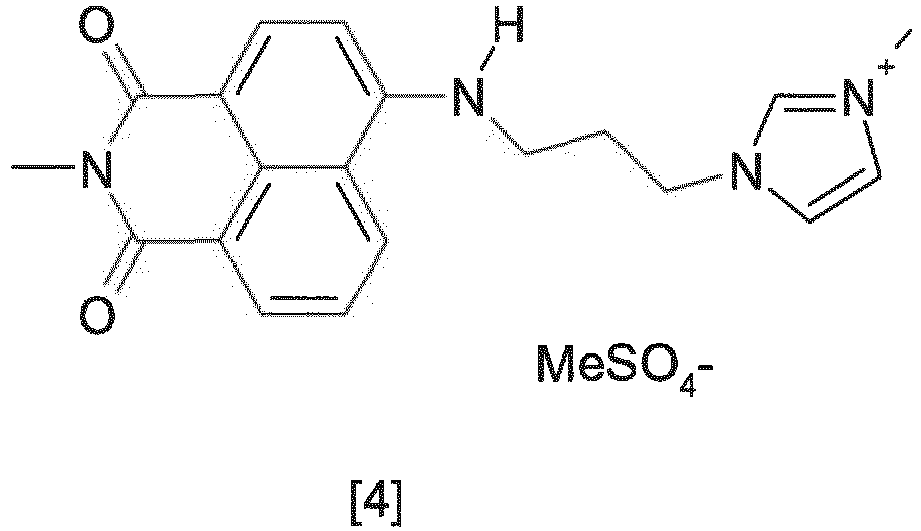
- Dye 2 (compound [4]) 3-methyl-1- ⁇ 3 - [(6 - ⁇ [3- (3-methyl-1H-imidazol-3-ium-1-yl) propyl] amino ⁇ -1,3-dioxo-1H-benzo [de ] isoquinolin-2 (3H) -yl] propyl ⁇ -1H-imidazol-3-ium bis (methylsulfate)
- Dye 3 (comparative) 2-hydroxyethylamino-5-nitroanisole
- Colorant 4 (comparative) Basic Yellow 87:
- Each of dyestuffs 1 to 4 is dissolved in a buffered solution to obtain a dye concentration at 5 ⁇ 10 -4 mol%.
- a lock of white hair is brought into contact with the resulting coloring solution in a bath ratio of 10: 1 (1 g of wick per 10 g of solution).
- the wick is rinsed with deionized water to remove excess dye solution.
- the dyes 1 and 2 according to the invention are visibly more chromatic.
- the composition containing the dyes 1 and 2 according to the invention is applied to dark hair (pitch equal to 4), a lightening optical effect is obtained.
- Each lock of colored hair according to the preceding step is washed with a solution comprising 1% by volume of a standard shampoo for thirty seconds, then rinsed with 200 ml of water. This process is repeated six times.
- the intensity of the color of the locks stained with the compositions containing the dyes 1 and 2 in accordance with the invention is greater than the intensity of the color of the locks stained with the comparative compositions containing the dyes 3 and 4: the dyeing compositions according to the present invention make it possible to obtain colorings that are more resistant to shampoos.
Landscapes
- Health & Medical Sciences (AREA)
- Life Sciences & Earth Sciences (AREA)
- Chemical & Material Sciences (AREA)
- Organic Chemistry (AREA)
- Animal Behavior & Ethology (AREA)
- General Health & Medical Sciences (AREA)
- Public Health (AREA)
- Veterinary Medicine (AREA)
- Birds (AREA)
- Epidemiology (AREA)
- Cosmetics (AREA)
- Plural Heterocyclic Compounds (AREA)
Description
- La présente demande a pour objet des colorants de type naphtalimide, leur utilisation en tant que colorants directs pour la teinture des fibres kératiniques ainsi que les compositions tinctoriales comprenant de tels composés.
- Il est connu de teindre les fibres kératiniques par une coloration directe. Le procédé classiquement utilisé en coloration directe consiste à appliquer sur les fibres kératiniques des colorants directs qui sont des molécules colorées et colorantes ayant une affinité pour les fibres, à laisser poser, puis à rincer les fibres.
- Il est connu par exemple d'utiliser des colorants directs du type nitré benzénique, anthraquinonique, nitropyridinique, des colorants du type azoïque, xanthénique, acridinique, azinique ou des colorants triarylméthane, par exemple.
- Les colorations qui en résultent sont des colorations particulièrement chromatiques qui sont cependant temporaires ou semi-permanentes. En effet, la nature des intéractions qui lient les colorants directs à la fibre kératinique, et leur désorption de la surface et/ou du coeur de la fibre font que la puissance tinctoriale et la tenue aux lavages ou à la transpiration des colorations peuvent être encore considérées insuffisantes. Certains colorants directs peuvent, en outre, être sensibles à la lumière du fait de la faible résistance du chromophore vis-à-vis des attaques photochimiques et conduire dans le temps à un affadissement de la coloration des cheveux.
- Afin d'obtenir une coloration plus visible, il est connu de décolorer les fibres kératiniques. Cette décoloration des fibres est effectuée par application d'un agent oxydant. Cependant, les colorants directs peuvent être sensibles à l'action des agents oxydants ce qui les rend généralement difficilement utilisables dans ces conditions. Par ailleurs, l'utilisation d'un agent oxydant peut dégrader de façon substantielle les propriétés cosmétiques des fibres kératiniques.
- Par ailleurs, des dérivés de type naphtalimide sont connus de l'état de la technique depuis les années 1960 notamment en tant qu'azurants optiques ou agents de blanchiment pour des produits textiles synthétiques tels que les produits textiles acryliques ou en acétate de cellulose. Parmi les documents illustrant cette utilisation, on peut citer les brevets
US 3,625,947 ,US 4,508,900 ,US 4,595,756 et la demande de brevetFR-A-1 557 945 FR-A- 2010 444 FR-A-2 162 181 - Par ailleurs, la demande de brevet
WO 2005/075574 décrit des colorants directs de type naphtalénique, cationiques ou neutres, pour teindre des fibres keratiniques et la demande de brevetWO 2005/074872 décrit des colorants directs de type naphtalénique pour éclaircir des fibres kératiniques. - Dans le domaine de la coloration directe des fibres kératiniques, il existe un réel besoin de rechercher des colorants directs très chromatiques et résistants aux agents extérieurs tels que les intempéries, les lavages et la transpiration.
- Il existe aussi un réel besoin de disposer de colorants qui permettent d'obtenir des couleurs chromatiques et qui sont stables en milieu oxydant. Il existe aussi un réel besoin de disposer de colorant direct permettant un éclaircissement des fibres kératiniques même foncées sans faire appel à un agent oxydant.
- Ainsi, la présente invention a pour objet un colorant naphtalimide correspondant aux composés de formule générale (I) ainsi que les dimères des composés (I) correspondant aux formules générales (II), (III) et (IV) suivantes, ainsi que leurs sels d'addition avec un acide et leurs solvates :


- les radicaux R1 pris séparément et indépendamment les uns des autres représentent un atome d'hydrogène ; un radical alkyle en C1-C4 éventuellement substitué par au moins un substituant choisi parmi les groupements :
- hydroxyle,
- alcoxy en C1-C4, (poly)hydroxyalcoxy en C2-C4,
- amino, amino substitué par un ou deux groupements alkyle identiques ou différents en C1-C4 éventuellement porteurs d'au moins un groupement hydroxyle, alcoxy en C1-C2, lesdits radicaux alkyle pouvant former avec l'atome d'azote auquel ils sont rattachés, un hétérocycle comprenant de 5 ou 7 chaînons, saturé ou insaturé, éventuellement aromatique, éventuellement substitué, comprenant éventuellement au moins un autre hétéroatome différent ou non de l'azote.
- Un radical alkylcarbonylamino (R'CO-NR-) dans lequel le radical R est un atome d'hydrogène, un radical alkyle en C1-C4 et le radical R' représente un radical alkyle en C1-C4, un radical phényle ;
- Un radical alkylsulfonyle (R-SO2-) dans lequel le radical R représente un radical alkyle en C1-C4.
- Un radical alkylsulfinyle (R-SO-) dans lequel le radical R représente un radical alkyle en C1-C4.
- Un radical alkylcarbonyle (R-CO-) dans lequel le radical R représente un radical alkyle en C1-C4,
- les radicaux R pris séparément et indépendamment les uns des autres représentent un atome d'hydrogène ; un radical aryle ou arylalkyle dont la partie aryle est éventuellement substituée ; un radical alkyle en C1-C8, de préférence en C2-C8, étant éventuellement substitué par au moins un substituant choisi parmi les groupements :
- hydroxyle,
- alcoxy en C1-C4, (poly)hydroxyalcoxy en C2-C4,
- amino, amino substitué par un ou deux groupements alkyle identiques ou différents en C1-C4 éventuellement porteurs d'au moins un groupement hydroxyle, alcoxy en C1-C2, lesdits radicaux alkyle pouvant former avec l'atome d'azote auquel ils sont rattachés, un hétérocycle comprenant de 5 ou 7 chaînons, saturé ou insaturé, éventuellement aromatique, éventuellement substitué, comprenant éventuellement au moins un autre hétéroatome différent ou non de l'azote.
- Un radical alkylcarbonylamino (R'CO-NR-) dans lequel le radical R est un atome d'hydrogène, un radical alkyle en C1-C4 et le radical R' représente un radical alkyle en C1-C4, un radical phényle ;
- Un radical alkylsulfonyle (R-SO2-) dans lequel le radical R représente un radical alkyle en C1-C4.
- Un radical alkylsulfinyle (R-SO-) dans lequel le radical R représente un radical alkyle en C1-C4.
- Un radical alkylcarbonyle (R-CO-) dans lequel le radical R représente un radical alkyle en C1-C4 ;

- L est un bras de liaison cationique alkylène en C2-C20 interrompu par au moins un groupement correspondant aux formules suivantes :

- X- représente un contre-ion permettant d'assurer l'électroneutralité des composés de formule (I) à (IV) ;
- Les colorants naphtalimides selon la présente demande sont cationiques.
- Les colorants de la présente invention permettent d'obtenir des colorations très chromatiques et qui présentent une bonne résistance vis-à-vis des agents extérieurs, notamment, des shampooings. Par ailleurs, les colorants de la présente invention permettent d'obtenir un effet éclaircissant sur des fibres kératiniques foncées, notamment des fibres kératiniques présentant une hauteur de ton inférieure ou égale à 6, de préférence, inférieure ou égale à 4, sans avoir recours à un agent oxydant, les fibres pouvant être colorées artificiellement ou naturellement. Lorsque l'utilisation d'un agent oxydant est souhaitée, par exemple pour obtenir une décoloration plus importante, les colorants de la présente invention présentent une bonne stabilité en milieu oxydant.
- La présente demande porte également sur l'utilisation en tant que colorant direct, d'au moins un des colorants de type naphtalimide objets de la présente demande, pour la teinture des fibres kératiniques, et en particulier, des fibres kératiniques humaines telles que des cheveux.
- La présente invention a de même pour objet des compositions tinctoriales comprenant, dans un milieu approprié pour la teinture, au moins l'un des colorants de formule (I) à (IV), ou leurs sels d'addition avec un acide, ou leurs solvates.
- Elle concerne, de plus, un procédé de coloration de fibres kératiniques qui comprend l'application de la composition de l'invention sur des fibres kératiniques, pendant une durée suffisante pour obtenir la coloration souhaitée.
- Elle a enfin pour objet un dispositif à plusieurs compartiments comprenant, dans un premier compartiment, la composition selon l'invention, et dans un second compartiment, une composition oxydante.
- Au sens de la présente invention, et à moins qu'une indication différente ne soit donnée :
- Un radical alkyl(èn)e ou la partie alkyl(èn)e d'un radical est linéaire ou ramifiée.
- Un radical alkyl(èn)e ou la partie alkyl(èn)e d'un radical est dite "substituée" lorsqu'elle comprend au moins un substituant choisi parmi les groupements :
- hydroxyle ;
- alcoxyle en C1-C4, (poly)hydroxyalcoxyle en C2-C4 ;
- amino, amino substitué par un ou deux groupements alkyle, identiques ou différents, en C1-C4, éventuellement porteurs d'au moins un groupement hydroxyle, alcoxyle en C1-C2, lesdits radicaux alkyle pouvant former avec l'atome d'azote auquel ils sont rattachés, un hétérocycle comprenant de 5 à 7 chaînons, saturé ou insaturé, éventuellement aromatique, éventuellement substitué, comprenant éventuellement au moins un autre hétéroatome différent ou non de l'azote ;
- un radical alkylcarbonylamino (R'CO-NR-) dans lequel le radical R est un atome d'hydrogène, un radical alkyle en C1-C4 et le radical R' représente un radical alkyle en C1-C4, un radical phényle ;
- un radical alkylsulfonyle (R-SO2-) dans lequel le radical R représente un radical alkyle en C1-C4 ;
- un radical alkylsulfinyle (R-SO-) dans lequel le radical R représente un radical alkyle en C1-C4 ;
- un radical alkylcarbonyle (R-CO-) dans lequel le radical R représente un radical alkyle en C1-C4.
- Un radical (hétéro)cyclique, saturé ou non, aromatique ou non, ou la partie (hétéro)cyclique, saturée ou non, aromatique ou non, d'un radical est dite 'substituée' lorsqu'elle comprend au moins un substituant, de préférence porté par un atome de carbone, choisi parmi :
- un radical alkyle en C1-C16, de préférence en C1-C8, éventuellement substitué ;
- un atome d'halogène tel que le chlore, le fluor ou le brome ;
- un groupement hydroxyle ;
- un radical alcoxyle en C1-C4 ; un radical (poly)hydroxyalcoxyle en C2-C4 ;
- un radical amino ;
- un radical amino substitué par un ou deux radicaux alkyle identiques ou différents en C1-C4, éventuellement porteurs d'au moins un groupement hydroxyle, amino, (mono- ou di-)alkylamino en C1-C4 ou alcoxyle en C1-C2 ; les deux radicaux alkyle pouvant former avec l'atome d'azote auquel ils sont rattachés, un hétérocycle renfermant de 1 à 3 hétéroatomes, de préférence de 1 à 2 hétéroatomes, choisis parmi N, O, S, de préférence N, l'hétérocycle comprenant de 5 à 7 chaînons, étant saturé ou insaturé, aromatique ou non, et éventuellement substitué ;
- un radical alkylcarbonylamino (R'CO-NR-) dans lequel le radical R est un atome d'hydrogène, un radical alkyle en C1-C4 et le radical R' est un radical alkyle en C1-C2 ;
- un radical aminocarbonyle ((R)2N-CO-) dans lequel les radicaux R, identiques ou non, représentent un atome d'hydrogène, un radical alkyle en C1-C4 ;
- un radical alkylsulfonylamino ou arylsulfonylamino (R'S02-NR-) dans lequel le radical R représente un atome d'hydrogène ou un radical alkyle en C1-C4 et le radical R' représente un radical alkyle en C1-C4 ou un radical phényle ;
- un radical aminosulfonyle ((R)2N-SO2-) dans lequel les radicaux R, identiques ou non, représentent un atome d'hydrogène ou un radical alkyle en C1-C4.
- Les composés issus des formules (II) et (III) sont symétriques ou dissymétriques. Ils sont dits symétriques lorsqu'il existe un plan de symétrie perpendiculaire au bras de liaison L. Ils sont dits dissymétriques lorsqu'il n'existe pas de plan de symétrie perpendiculaire au bras de liaison L.
- Dans ce qui va suivre et à moins qu'une autre indication ne soit donnée, les bornes délimitant un domaine de valeurs sont comprises dans ce domaine.
- Comme indiqué auparavant, un premier objet de l'invention consiste en des composés correspondant aux formules (I) à (IV) précitées, leurs sels d'addition et leurs solvates.
- De préférence, les composés de formule (I) à (IV) selon la présente invention sont tels que :
- les radicaux R1, identiques ou non, indépendamment les uns des autres, représentent un atome d'hydrogène, un radical alkyle linéaire en C1-C4 éventuellement substitué par un groupement hydroxyle, un radical alcoxyle en C1-C2, un radical dialkyl(C1-C4)amino, un radical alkyl(C1-C3)carbonylamino ou un radical alkyl(C1-C2)sulfonylamino.
- De manière encore plus préférée, les radicaux R1, identiques ou différents, indépendamment les uns des autres, représentent :
- un atome d'hydrogène ;
- un radical alkyle en C1-C4, par exemple méthyle, éthyle.
- L représente un bras de liaison cationique alkylène en C2-C20 interrompu par au moins un groupement correspondant aux formules suivantes :

- R2 et R3, pris séparément et indépendamment les uns des autres, ont la même signification que précédemment.
- z et z' ont la même signification que précédemment.
- X- est tel que défini précédemment.
- Le radical alkylène cationique ainsi défini peut être éventuellement interrompu par un ou plusieurs hétéroatomes ou groupements comprenant au moins un hétéroatome ou leurs combinaisons, comme par exemple l'oxygène, l'azote, un groupement -CO-, un groupement -SO-, un groupement -SO2- ; à la condition qu'il n'y ait pas de groupe ou liaison azo, nitro, nitroso ou peroxo dans le bras de liaison L. Il peut aussi être éventuellement substitué, notamment par un ou plusieurs radicaux choisis parmi les radicaux hydroxyle, alcoxyle en C1-C2, (poly)hydroxyalcoxyle en C2-C4, amino substitué par un ou plusieurs groupements alkyle en C1-C2 éventuellement porteurs d'au moins un groupement hydroxyle.
- Selon un mode de réalisation particulier des formules (a), (b), (b') et (c'), les radicaux R2, pris séparément et indépendamment les uns des autres, représentent un radical alkyle en C1-C6, éventuellement substitué par un groupement hydroxyle, alcoxyle en C1-C2, hydroxycarbonyle, alkyl(C1-C6)thiol ou amino disubstitué par un radical alkyle en C1-C4.
- Selon un mode de réalisation particulier des formules (a), (b), (b') et (c'), R2 représente un radical alkyle tel que méthyle ou éthyle, un radical hydroxyalkyle tel que 2-hydroxyéthyle, un radical alcoxyalkyle tel que 2-méthoxyéthyle, un radical hydroxycarbonylalkyle tel que 3-hydroxycarbonylpropyle ou un radical dialkylaminoalkyle tel que 3-N,N-diméthylaminopropyle.
- Selon un mode de réalisation particulier des formules (a), (b), (a'), (b') et (c'), R3 représente un atome d'halogène choisi parmi le chlore et le fluor, un radical alkyle en C1-C6, un radical monohydroxylalkyle en C1-C4, un radical alcoxyle en C1-C4, un radical hydroxycarbonyle, un radical alkyl(C1-C6)thiol, un radical amino disubstitué par un radical alkyle en C1-C4. A titre d'exemple de radicaux R3, on peut citer un atome de chlore, un méthyle, un éthyle, un 2-hydroxyéthyle, un méthoxy, un hydroxycarbonyle ou un diméthylamino.
- Selon une variante des formules (a), (b), (a') et (b'), z et z' sont égaux à 0.
- Selon un mode de réalisation particulier, les radicaux R, pris séparément et indépendamment les uns des autres, représentent un atome d'hydrogène ; un radical alkyle en C1-C6, de préférence en C2-C6, éventuellement substitué par un ou plusieurs groupements identiques ou différents de préférence choisis parmi les substituants hydroxyle, alcoxyle en C1-C2, et éventuellement substitué par au moins un groupement correspondant à la formule (a) telle que définie précédemment ; un radical aryle ou arylalkyle, tel que phényle, benzyle, la partie aryle étant éventuellement substituée par un ou plusieurs groupements identiques ou différents, de préférence choisis parmi par un atome de chlore, un groupement amino, un groupement hydroxyle, un groupement alcoxyle en C1-C2, un groupement amino mono ou disubstitué par deux radicaux alkyle en C1-C4 identiques ou différents éventuellement porteurs d'au moins un groupement hydroxyle.
- Conformément à un mode de réalisation préféré de l'invention, les radicaux R, identiques ou différents, indépendamment l'un de l'autre, représentent un atome d'hydrogène, un radical alkyle en C1-C3 tel que méthyle ou éthyle, un radical hydroxyalkyle tel que 2-hydroxyéthyle, un radical alcoxyalkyle tel que 2-méthoxyéthyle, un radical alkyle en C1-C3, substitué par au moins un groupement correspondant à la formule (a") suivante, un radical benzyle éventuellement substitué par un ou plusieurs radicaux, identiques ou différents, choisi parmi les groupements hydroxyle, alcoxyle tel que méthoxy, amino, (di)alkylamino tel que diméthylamino, (di)(hydroxyalkyl)amino tel que (di)(2-hydroxyéthyl)amino.

- Dans les formules (I) à (IV), X- représente un contre-ion organique ou minéral ou un mélange de contre-ions organiques ou minéraux, permettant d'équilibrer la ou les charges des composés de formule (I) à (IV). X- est, par exemple, choisi parmi un halogénure tel que chlorure, bromure, fluorure, iodure ; un hydroxyde ; un sulfate ; un hydrogénosulfate ; un alkylsulfate pour lequel la partie alkyle, linéaire ou ramifiée, est en C1-C6, comme l'ion méthylsulfate ou éthylsulfate ; les carbonates et hydrogénocarbonates ; des sels d'acides carboxyliques tels que le formiate, l'acétate, le citrate, le tartrate, l'oxalate ; les alkylsulfonates pour lesquels la partie alkyle, linéaire ou ramifiée, est en C1-C6 comme l'ion méthylsulfonate ; les arylsulfonates pour lesquels la partie aryle, de préférence phényle, est éventuellement substituée par un ou plusieurs radicaux alkyle en C1-C4, tel que, par exemple, le 4-toluylsulfonate ; les alkylsulfonyles tel que le mésylate.
- Les sels d'addition avec un acide des composés de formule (I) à (IV) peuvent être, à titre d'exemple, des sels d'addition avec un acide organique ou minéral tel que l'acide chlorhydrique, l'acide bromhydrique, l'acide sulfurique ou les acides (alkyl- ou phényl-) sulfoniques tels que l'acide p-toluènesulfonique ou l'acide méthylsulfonique.
- Les solvates des composés de formule (I) à (IV) représentent les hydrates de tels composés et l'association d'un composé de formule (I) à (IV) avec un alcool, linéaire ou ramifié, en C1-C4 tel que le méthanol, l'éthanol, l'isopropanol, le n-propanol.
- Conformément à un mode de réalisation particulier de l'invention, les composés correspondant aux formules (I), (II), (III) et (IV) ainsi qu'à leurs formes résonnantes et/ou leurs sels d'addition avec un acide et/ou leurs solvates sont choisis parmi les composés suivants :
- Le sel de 3-méthyl-1-{3-[(6-{[3-(3-méthyl-1H-imidazol-3-ium-1-yl)propyl]amino}-1,3-dioxo-1H-benzo[de]isoquinolin-2(3H)-yl]propyl}-1H-imidazol-3-ium:

- Le sel de 3-{5-[(2-éthyl-1,3-dioxo-2,3-dihydro-1H-benzo[de]isoquinolin-6-yl)amino]pentyl}-1-[3-({2-[3-(1-méthyl-1H-imidazol-3-ium-3-yl)propyl]-1,3-dioxo-2,3-dihydro-1H-benzo[de]isoquinolin-6-yl}amino)propyl]-1H-imidazol-3-ium

- Le sel de 1-méthyl-3-{3-[6-[(3-{3-[5-({2-[3-(1-méthyl-1H-imidazol-3-ium-3-yl)propyl]-1,3-dioxo-2,3-dihydro-1H-benzo[de]isoquinolin-6-yl}amino)pentyl]-1H-imidazol-3-ium-1-yl}propyl)amino]-1,3-dioxo-1H-benzo[de]isoquinolin-2(3H)-yl]-propyl}-1H-imidazol-3 -ium

- Le sel de 3,3'-butane-1,4-diylbis{1-[5-({2-[3-(1-méthyl-1H-imidazol-3-ium-3-yl)propyl]-1,3-dioxo-2,3-dihydro-1H-benzo[de]isoquinolin-6-yl}amino)-pentyl]-1H-imidazol-3-ium}

- Le sel de 1-méthyl-3-[3-({2-[3-(3-{5-[6-{[3-(1-méthyl-1H-imidazol-3-ium-3-yl)propyl]amino}-1,3-dioxo-1H-benzo[de]isoquinolin-2(3H)-yl]pentyl}-1H-imidazol-3-ium-1-yl)propyl]-1,3-dioxo-2,3-dihydro-1H-benzo[de]isoquinolin-6-yl}amino)propyl]-1H-imidazol-3-ium

- Le sel de 1-méthyl-3-{3-[6-{[3-(3-{6-[6-{[3-(3-méthyl-1H-imidazol-3-ium-1-yl)propyl]amino}-1,3-dioxo-1H-benzo[de]isoquinolin-2(3H)-yl]hexyl}-1H-imidazol-3-ium-1-yl)propyl]amino}-1,3-dioxo-1H-benzo[de]isoquinolin-2(3H)-yl]propyl}-1H-imidazol-3 -ium

- Le sel de 3-méthyl-1-[3-({2-[6-(1-{6-[6-{[3-(1-méthyl-1H-imidazol-3-ium-3-yl)propyl]amino}-1,3-dioxo-1H-benzo[de]isoquinolin-2(3H)-yl]hexyl}-1H-imidazol-3-ium-3-yl)hexyl]-1,3-dioxo-2,3-dihydro-1H-benzo[de]isoquinolin-6-yl}-amino)propyl]-1H-imidazol-3-ium

- Selon un mode particulier de l'invention, les composés de formule (I) correspondent à la formule suivante :
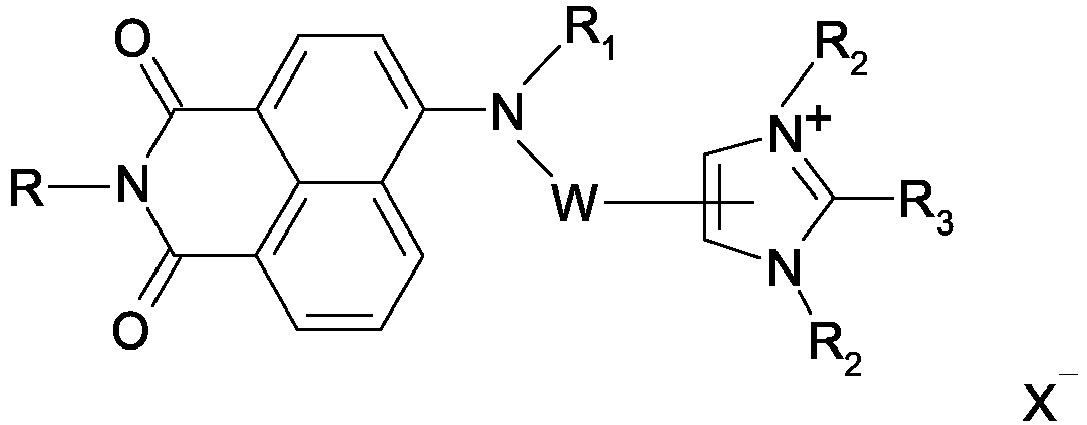
- W représente un radical alkyle en C1-C8, de préférence, en C2-C8, et de manière encore plus préférée, en C2-C4,
- R, R1, R2, R3, et X- sont tels que définis précédemment.
- De préférence, ils correspondent à la formule suivante :

- W représente un radical alkyle en C1-C8, de préférence, en C2-C8, et de manière encore plus préférée, en C2-C4,
- R, R1, R2 et X- sont tels que définis précédemment.
- Selon un mode de réalisation particulier de l'invention, les composés de formule (II) correspondent à la formule suivante :

- W représente un radical alkyle en C1-C8, de préférence, en C2-C8, et de manière encore plus préférée, en C2-C4,
- R1, R2 et X- sont tels que définis précédemment,
- L' est défini comme L.
- Selon un mode de réalisation particulier de l'invention, les composés de formule (III) correspondent à la formule suivante :

- Selon un mode de réalisation particulier de l'invention, les composés de formule (IV) correspondent à la formule suivante :

- Les composés représentés précédemment peuvent notamment être obtenus à partir des procédés de préparation décrits, par exemple, dans les documents :
- Konstantinova, T. ; Spirieva, A. ; Petkova, T. Dyes and Pigments 2000, 45, 125-129,
- Gunnlaugsson, T. ; Kruger, P.E. ; Clive Lee, T. ; Parkesh, R.; Pfeffer, F.M.; Hussey, G.M. Tetrahedron Lett., 2003, 44, 6575-6578,
- Shepard, E. R.; Shonle, H.A. J. Am. Chem. Soc. 1947, 69, 2269-2270.
- La composition tinctoriale selon l'invention peut contenir un ou plusieurs composés de type naphtalimide de formule (I), (II), (III) ou (IV), ou leurs sels d'addition avec un acide et/ou solvates, tels que définis précédemment, les mélanges de ces composés étant alors possibles en toutes proportions relatives, dans un milieu approprié pour la teinture.
- La composition selon la présente demande comprend généralement de 0,001 à 10 %, de préférence 0,01 à 10 % en poids d'un ou plusieurs composés de type naphtalimide de formule (I), (II), (III) ou (IV), ou de leurs sels d'addition avec un acide et/ou solvates, par rapport au poids total de la composition.
- La composition tinctoriale conforme à l'invention peut, en outre, contenir un ou plusieurs colorants directs additionnels autres que les colorants directs de formule (I), (II), (III) ou (IV), ces colorants directs additionnels pouvant notamment être choisis parmi les colorants nitrés de la série benzénique, neutres, acides ou cationiques, les colorants directs azoïques, neutres acides ou cationiques, les colorants directs quinonique, et en particulier, anthraquinonique, neutres, acides ou cationiques, les colorants directs azinique, les colorants directs triarylméthanique, les colorants directs indoaminique, les colorants de type tétraazapentaméthinique et les colorants directs naturels.
- Parmi les colorants directs benzéniques utilisables selon l'invention, on peut citer de manière non limitative les composés suivants :
- 1,4-diamino-2-nitrobenzène,
- 1-amino-2 nitro-4-β-hydroxyéthylaminobenzène,
- 1-amino-2 nitro-4-bis(β-hydroxyéthyl)-aminobenzène,
- 1,4-bis(β-hydroxyéthylamino)-2-nitrobenzène,
- 1-β-hydroxyéthylamino-2-nitro-4-bis-(β-hydroxyéthylamino)-benzène,
- 1-β-hydroxyéthylamino-2-nitro-4-aminobenzène,
- 1-β-hydroxyéthylamino-2-nitro-4-(éthyl)(β-hydroxyéthyl)-aminobenzène,
- 1-amino-3-méthyl-4-β-hydroxyéthylamino-6-nitrobenzène,
- 1-amino-2-nitro-4-β-hydroxyéthylamino-5-chlorobenzène,
- 1,2-diamino-4-nitrobenzène,
- 1-amino-2-β-hydroxyéthylamino-5-nitrobenzène,
- 1,2-bis-(β-hydroxyéthylamino)-4-nitrobenzène,
- 1-amino-2-tris-(hydroxyméthyl)-méthylamino-5-nitrobenzène,
- 1-hydroxy-2-amino-5-nitrobenzène,
- 1-hydroxy-2-amino-4-nitrobenzène,
- 1-hydroxy-3 -nitro-4-aminobenzène,
- 1-hydroxy-2-amino-4,6-dinitrobenzène,
- 1-β-hydroxyéthyloxy-2-β-hydroxyéthylamino-5-nitrobenzène,
- 1-méthoxy-2-β-hydroxyéthylamino-5-nitrobenzène,
- 1-β-hydroxyéthyloxy-3-méthylamino-4-nitrobenzène,
- 1-β,γ-dihydroxypropyloxy-3-méthylamino-4-nitrobenzène,
- 1-β-hydroxyéthylamino-4-β,γ-dihydroxypropyloxy-2-nitrobenzène,
- 1-β,γ-dihydroxypropylamino-4-trifluorométhyl-2-nitrobenzène,
- 1-β-hydroxyéthylamino-4-trifluorométhyl-2-nitrobenzène,
- 1-β-hydroxyéthylamino-3-méthyl-2-nitrobenzène,
- 1-β-aminoéthylamino-5-méthoxy-2-nitrobenzène,
- 1-hydroxy-2-chloro-6-éthylamino-4-nitrobenzène,
- 1-hydroxy-2-chloro-6-amino-4-nitrobenzène,
- 1-hydroxy-6-bis-(β-hydroxyéthyl)-amino-3-nitrobenzène,
- 1-β-hydroxyéthylamino-2-nitrobenzène,
- 1-hydroxy-4-β-hydroxyéthylamino-3-nitrobenzène.
- Parmi les colorants directs azoïques utilisables selon l'invention, on peut citer les colorants azoïques cationiques décrits dans les demandes de brevet
WO 95/15144 WO 95/01772 EP-A-714 954 - Parmi ces composés, on peut tout particulièrement citer les colorants suivants :
- le chlorure de 1,3-diméthyl-2-[[4-(diméthylamino)phényl]azo]-1H-imidazolium,
- le chlorure de 1,3-diméthyl-2-[(4-aminophényl)azo]-1H-imidazolium,
- le méthylsulfate de 1-méthyl-4-[(méthylphénylhydrazono)-méthyl]-pyridinium.
- On peut également citer, parmi les colorants directs azoïque, les colorants suivants, décrits dans le COLOUR INDEX INTERNATIONAL, 3e édition :
- Disperse Red 17,
- Acid Yellow 9,
- Acid Black 1,
- Basic Red 22,
- Basic Red 76,
- Basic Yellow 57,
- Basic Brown 16,
- Acid Yellow 36,
- Acid Orange 7,
- Acid Red 33,
- Acid Red 35,
- Basic Brown 17,
- Acid Yellow 23,
- Acid Orange 24,
- Disperse Black 9.
- On peut aussi citer le 1-(4'-aminodiphénylazo)-2-méthyl-4bis-(β-hydroxy-éthyl)aminobenzène et l'acide 4-hydroxy-3-(2-méthoxyphénylazo)-1-naphtalène sulfonique.
- Parmi les colorants directs quinonique, on peut citer les colorants suivants :
- Disperse Red 15,
- Solvent Violet 13,
- Acid Violet 43,
- Disperse Violet 1,
- Disperse Violet 4,
- Disperse Blue 1,
- Disperse Violet 8,
- Disperse Blue 3,
- Disperse Red 11,
- Acid Blue 62,
- Disperse Blue 7,
- Basic Blue 22,
- Disperse Violet 15,
- Basic Blue 99,
- 1-N-méthylmorpholiniumpropylamino-4-hydroxyanthraquinone,
- 1-aminopropylamino-4-méthylaminoanthraquinone,
- 1-aminopropylaminoanthraquinone,
- 5-β-hydroxyéthyl-1,4-diaminoanthraquinone,
- 2-aminoéthylaminoanthraquinone,
- 1,4-bis-(P,γ-dihydroxypropylamino)-anthraquinone.
- Parmi les colorants aziniques, on peut citer les composés suivants :
- Basic Blue 17,
- Basic Red 2.
- Parmi les colorants triarylméthaniques utilisables selon l'invention, on peut citer les composés suivants :
- Basic Green 1,
- Acid blue 9,
- Basic Violet 3,
- Basic Violet 14,
- Basic Blue 7,
- Acid Violet 49,
- Basic Blue 26,
- Acid Blue 7.
- Parmi les colorants indoaminiques utilisables selon l'invention, on peut citer les composés suivants :
- la 2-β-hydroxyéthylamino-5-[bis-(β-4'-hydroxyéthyl)amino]anilino-1,4-benzoquinone,
- la 2-β-hydroxyéthylamino-5-(2'-méthoxy-4'-amino)anilino-1,4-benzoquinone,
- la 3-N(2'-chloro-4'-hydroxy)phénylacétylamino-6-méthoxy-1,4-benzoquinone imine,
- la 3-N(3'-chloro-4'-méthylamino)phényluréido-6-méthyl-1,4-benzoquinone imine,
- la 3-[4'-N-(éthyl,carbamylméthyl)amino]-phényl-uréido-6 méthyl-1,4-benzoquinone imine.
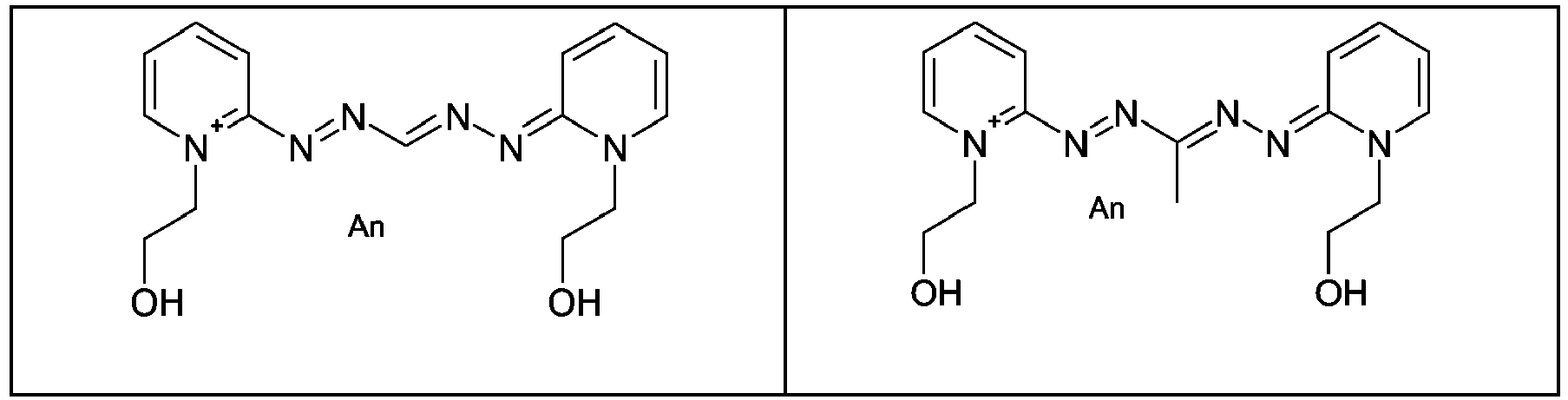
- Parmi les colorants de type tétraazapentaméthinique utilisables selon l'invention, on peut citer les composés suivants figurant dans le tableau ci-dessous, An représentant en général un anion organique ou minéral par exemple choisi parmi un halogénure tel que un chlorure, un bromure, un fluorure, un iodure ; un hydroxyde ; un sulfate ; un hydrogénosulfate ; un alkyl(C1-C6)sulfate tel que par exemple un méthylsulfate ou un éthylsulfate ; un acétate ; un tartrate ; un oxalate ; un alkyl(C1-C6)sulfonate tel que un méthylsulfonate ; un arylsulfonate substitué ou non substitué par un radical alkyle en C1-C4 tel que par exemple un 4-toluylsulfonate. An est de préférence un chlorure ; un méthylsulfate :

- Parmi les colorants directs naturels utilisables selon l'invention, on peut citer la lawsone, la juglone, l'alizarine, la purpurine, l'acide carminique, l'acide kermésique, la purpurogalline, le protocatéchaldéhyde, l'indigo, l'isatine, la curcumine, la spinulosine, l'apigénidine. On peut également utiliser les extraits ou décoctions contenant ces colorants naturels et notamment les cataplasmes ou extraits à base de henné.
- Le ou les colorants directs additionnels représentent de préférence de 0,001 à 20 % en poids environ du poids total de la composition prête à l'emploi et encore plus préférentiellement de 0,005 à 10 % en poids environ.
- La composition de la présente invention peut, en outre, comprendre un ou plusieurs précurseurs de colorant d'oxydation : une ou plusieurs bases d'oxydation et/ou un ou plusieurs coupleurs.
- A titre d'exemple, les bases d'oxydation sont choisies parmi les paraphénylènediamines, les bis-phénylalkylènediamines, les para-aminophénols, les ortho-aminophénols, les bases hétérocycliques autres que les paraphénylènediamines hétérocycliques et leurs sels d'addition.
- Parmi les paraphénylènediamines, on peut citer à titre d'exemple, la paraphénylènediamine, la paratoluylènediamine, la 2-chloroparaphénylènediamine, la 2,3-diméthyl paraphénylènediamine, la 2,6-diméthylparaphénylènediamine, la 2,6-diéthyl paraphénylènediamine, la 2,5-diméthylparaphénylènediamine, la N,N-diméthyl paraphénylènediamine, la N,N-diéthylparaphénylènediamine, la N,N-dipropyl paraphénylènediamine, la 4-amino N,N-diéthyl-3-méthylaniline, la N,N-bis-(β-hydroxyéthyl)paraphénylènediamine, la 4-N,N-bis-(β-hydroxyéthyl)amino 2-méthyl aniline, la 4-N,N-bis-(β-hydroxyéthyl)amino 2-chloro aniline, la 2-β-hydroxyéthyl paraphénylènediamine, la 2-fluoroparaphénylènediamine, la 2-isopropyl paraphénylène-diamine, la N-(β-hydroxypropyl)paraphénylènediamine, la 2-hydroxyméthylpara-phénylènediamine, la N,N-diméthyl 3-méthyl paraphénylènediamine, la N,N-(éthyl, β-hydroxyéthyl)paraphénylènediamine, la N-(β,γ-dihydroxypropyl)paraphénylène-diamine, la N-(4'-aminophényl) paraphénylènediamine, la N-phényl paraphénylène-diamine, la 2-β-hydroxyéthyloxy paraphénylènediamine, la 2-β-acétylaminoéthyloxy paraphénylènediamine, la N-(β-méthoxyéthyl)paraphénylène-diamine, la 4-amino-phénylpyrrolidine, la 2-thiényl paraphénylènediamine, le 2-β hydroxyéthylamino 5-amino toluène, la 3-hydroxy 1-(4'-aminophényl)pyrrolidine et leurs sels d'addition avec un acide.
- Parmi les paraphénylènediamines citées ci-dessus, la paraphénylènediamine, la paratoluylènediamine, la 2-isopropyl paraphénylènediamine, la 2-β-hydroxyéthyl paraphénylènediamine, la 2-β-hydroxyéthyloxy paraphénylène-diamine, la 2,6-diméthyl paraphénylènediamine, la 2,6-diéthyl paraphénylènediamine, la 2,3-diméthyl paraphénylènediamine, la N,N-bis-(β-hydroxyéthyl) paraphénylènediamine, la 2-chloro paraphénylènediamine, la 2-β-acétylaminoéthyloxy paraphénylènediamine, et leurs sels d'addition avec un acide sont particulièrement préférées.
- Parmi les bis-phénylalkylènediamines, on peut citer à titre d'exemple, le N,N'-bis-(β-hydroxyéthyl) N,N'-bis-(4'-aminophényl) 1,3-diamino propanol, la N,N'-bis-(β-hydroxyéthyl) N,N'-bis-(4'-aminophényl) éthylènediamine, la N,N'-bis-(4-aminophényl) tétraméthylènediamine, la N,N'-bis-(β-hydroxyéthyl) N,N'-bis-(4-aminophényl) tétraméthylènediamine, la N,N'-bis-(4-méthyl-aminophényl) tétraméthylènediamine, la N,N'-bis-(éthyl) N,N'-bis-(4'-amino, 3'-méthylphényl) éthylènediamine, le 1,8-bis-(2,5-diaminophénoxy)-3,6-dioxaoctane, et leurs sels d'addition.
- Parmi les para-aminophénols, on peut citer à titre d'exemple, le para-aminophénol, le 4-amino-3-méthylphénol, le 4-amino 3-fluorophénol, le 4-amino-3-chlorophénol, le 4-amino-3-hydroxyméthylphénol, le 4-amino-2-méthylphénol, le 4-amino-2-hydroxyméthylphénol, le 4-amino-2-méthoxyméthylphénol, le 4-amino-2-aminométhylphénol, le 4-amino-2-(β-hydroxyéthylaminométhyl) phénol, le 4-amino-2-fluorophénol, et leurs sels d'addition avec un acide.
- Parmi les ortho-aminophénols, on peut citer à titre d'exemple, le 2-amino-phénol, le 2-amino-5-méthylphénol, le 2-amino-6-méthylphénol, le 5-acétamido-2-aminophénol, et leurs sels d'addition.
- Parmi les bases hétérocycliques, on peut citer à titre d'exemple, les dérivés pyridiniques, les dérivés pyrimidiniques et les dérivés pyrazoliques.
- Parmi les dérivés pyridiniques, on peut citer les composés décrits par exemple dans les brevets
GB-A-1 026 978 GB-A- 1 153 196 - D'autres bases d'oxydation pyridiniques utiles dans la présente invention sont les bases d'oxydation 3-amino pyrazolo-[1,5-a]-pyridines ou leurs sels d'addition décrits par exemple dans la demande de brevet
FR-A-2 801 308 - Parmi les dérivés pyrimidiniques, on peut citer les composés décrits par exemple dans les brevets
DE-A-23 59 399 ;JP 88-169571 EP-A-0 770 375 ou demande de brevetWO 96/15765 - Parmi les dérivés pyrazoliques, on peut citer les composés décrits dans les brevets
DE-A-38 43 892 ,DE-A-41 33 957 et demandes de brevetWO 94/08969 WO 94/08970 FR-A-2 733 749 DE-A-195 43 988 comme le 4,5-diamino-1-méthyl pyrazole, le 4,5-diamino-1-(β-hydroxyéthyl) pyrazole, le 3,4-diaminopyrazole, le 4,5-diamino-1-(4'-chlorobenzyl)pyrazole, le 4,5-diamino-1,3-diméthylpyrazole, le 4,5-diamino-3-méthyl-1-phényl pyrazole, le 4,5-diamino-1-méthyl 3-phényl pyrazole, le 4-amino-1,3-diméthyl 5-hydrazinopyrazole, le 1-benzyl-4,5-diamino-3-méthyl pyrazole, le 4,5-diamino-3-tert-butyl 1-méthylpyrazole, le 4,5-diamino-1-tert-butyl-3-méthyl pyrazole, le 4,5-diamino-1-(β-hydroxyéthyl)-3-méthylpyrazole, le 4,5-diamino-1-éthyl 3-méthylpyrazole, le 4,5-diamino-1-éthyl-3-(4'-méthoxyphényl)pyrazole, le 4,5-diamino 1-éthyl-3-hydroxyméthylpyrazole, le 4,5-diamino-3-hydroxyméthyl-1-méthylpyrazole, le 4,5-diamino-3-hydroxyméthyl-1-isopropylpyrazole, le 4,5-diamino-3-méthyl 1-isopropylpyrazole, le 4-amino-5-(2'-aminoéthyl)amino-1,3-diméthylpyrazole, le 3,4,5-triaminopyrazole, le 1-méthyl-3,4,5-triaminopyrazole, le 3,5-diamino-1-méthyl-4-méthylaminopyrazole, le 3,5-diamino-4-(β-hydroxyéthyl)amino-1-méthylpyrazole, et leurs sels d'addition. - La ou les bases d'oxydation présentes dans la composition de l'invention sont, en général, présentes en des quantités allant de 0,001 à 20 % en poids environ du poids total de la composition tinctoriale, de préférence, allant de 0,005 à 6 % en poids.
- La composition selon l'invention contient, de préférence, un ou plusieurs coupleurs conventionnellement utilisés pour la teinture des fibres kératiniques. Parmi ces coupleurs, on peut notamment citer les métaphénylènediamines, les métadiphénols, les coupleurs naphtaléniques, les coupleurs hétérocycliques, ainsi que leurs sels d'addition.
- A titre d'exemple, on peut citer le 1,3-dihydroxy benzène, le 1,3-dihydroxy-2-méthylbenzène, le 4-chloro-1,3-dihydroxybenzène, le 2,4-diamino-1-(β-hydroxyéthyl-oxy)benzène, le 2-amino-4-(β-hydroxyéthylamino)-1-méthoxybenzène, le 1,3-diamino-benzène, le 1,3-bis-(2,4-diaminophénoxy)propane, la 3-uréido aniline, le 3-uréido-1-diméthylaminobenzène, le sésamol, le 1-β-hydroxyéthylamino-3,4-méthylènedioxy-benzène, l'α-naphtol, le 2 méthyl-1-naphtol, le 6-hydroxy indole, le 4-hydroxyindole, le 4-hydroxy-N-méthylindole, la 2-amino-3-hydroxypyridine, la 6- hydroxy-benzomorpholine la 3,5-diamino-2,6-diméthoxypyridine, le 1-N-(β-hydroxyéthyl)-amino-3,4-méthylène dioxybenzène, le 2,6-bis-(β-hydroxyéthylamino)toluène et leurs sels d'addition.
- Dans la composition de la présente invention, le ou les coupleurs sont généralement présents en des quantités allant de 0,001 à 20 % en poids environ du poids total de la composition tinctoriale, de préférence, allant de 0,005 à 6 % en poids.
- D'une manière générale, les sels d'addition des bases d'oxydation et des coupleurs utilisables dans le cadre de l'invention sont notamment choisis parmi les sels d'addition avec un acide tels que les chlorhydrates, les bromhydrates, les sulfates, les citrates, les succinates, les tartrates, les lactates, les tosylates, les benzènesulfonates, les phosphates et les acétates, et les sels d'addition avec une base telles que la soude, la potasse, l'ammoniaque, les amines ou les alcanolamines.
- Le milieu approprié pour la teinture appelé aussi support de teinture est notamment approprié pour la teinture des fibres kératiniques telles que les cheveux. Un tel milieu est un milieu cosmétique généralement constitué par de l'eau ou par un mélange d'eau et d'au moins un solvant organique pour solubiliser les composés qui ne seraient pas suffisamment solubles dans l'eau. A titre de solvant organique, on peut, par exemple, citer les alcanols inférieurs en C1-C4, tels que l'éthanol et l'isopropanol ; les polyols et éthers de polyols comme le 2-butoxyéthanol, le propylèneglycol, le glycérol, le monométhyléther de propylèneglycol, le monoéthyléther et le monométhyléther du diéthylèneglycol ; ainsi que les alcools aromatiques comme l'alcool benzylique ou le phénoxyéthanol ; et leurs mélanges.
- Les solvants sont présents dans des proportions comprises, de préférence, entre 1 et 40 % en poids environ, et encore plus préférentiellement, entre 5 et 30 % en poids environ, par rapport au poids total de la composition tinctoriale.
- La composition tinctoriale conforme à l'invention peut également renfermer divers adjuvants utilisés classiquement dans les compositions pour la teinture des cheveux, tels que des agents tensio-actifs anioniques, cationiques, non-ioniques, amphotères, zwitterioniques ou leurs mélanges, des polymères anioniques, cationiques, non-ioniques, amphotères, zwitterioniques ou leurs mélanges, des agents épaississants minéraux ou organiques, et en particulier les épaississants associatifs polymères anioniques, cationiques, non ioniques et amphotères, des agents antioxydants, des agents de pénétration, des agents séquestrant, des parfums, des tampons, des agents dispersants, des agents de conditionnement tels que par exemple des silicones volatiles ou non volatiles, modifiées ou non modifiées, des agents filmogènes, des céramides, des agents conservateurs, des agents opacifiant.
- Les adjuvants ci-dessus sont en général présents en des quantités allant, pour chacun d'eux, de 0,01 et 20 % en poids par rapport au poids total de la composition.
- Selon une variante, la composition de l'invention comprend un agent oxydant afin d'obtenir un éclaircissement des fibres. Les agents oxydants classiquement utilisés pour la teinture d'oxydation des fibres kératiniques sont par exemple le peroxyde d'hydrogène, le peroxyde d'urée, les bromates de métaux alcalins, les persels tels que les perborates et persulfates, les peracides et les enzymes oxydases parmi lesquelles on peut citer les peroxydases, les oxydo-réductases à 2 électrons telles que les uricases et les oxygénases à 4 électrons comme les laccases. Selon un mode de réalisation particulier, la composition contient un agent oxydant de type peroxyde et/ou un agent oxydant de type persels, par exemple un mélange de peroxyde d'hydrogène et de persulfate, le peroxyde d'hydrogène seul ou le persulfate seul.
- Bien entendu, l'homme de l'art veillera à choisir ce ou ces éventuels composés complémentaires de manière telle que les propriétés avantageuses attachées intrinsèquement à la composition de teinture d'oxydation conforme à l'invention ne soient pas, ou substantiellement pas, altérées par la ou les adjonctions envisagées.
- Le pH de la composition tinctoriale conforme à l'invention est généralement compris entre 3 et 12 environ, et de préférence entre 5 et 11 environ. Il peut être ajusté à la valeur désirée au moyen d'agents acidifiants ou alcalinisants habituellement utilisés en teinture des fibres kératiniques ou bien encore à l'aide de systèmes tampons classiques.
- Parmi les agents acidifiants, on peut citer, à titre d'exemple, les acides minéraux ou organiques comme l'acide chlorhydrique, l'acide orthophosphorique, l'acide sulfurique, les acides carboxyliques comme l'acide acétique, l'acide tartrique, l'acide citrique, l'acide lactique, les acides sulfoniques.
- Parmi les agents alcalinisants on peut citer, à titre d'exemple, l'ammoniaque, les carbonates alcalins, les alcanolamines telles que les mono-, di- et triéthanolamines ainsi que leurs dérivés, les hydroxydes de sodium ou de potassium et les composés de formule suivante :

- La composition tinctoriale selon l'invention peut se présenter sous des formes diverses, telles que sous forme de liquides, de crèmes, de gels, ou sous toute autre forme appropriée pour réaliser une teinture des fibres kératiniques, et notamment des cheveux humains.
- Le procédé de la présente invention est un procédé dans lequel on applique, sur les fibres, la composition selon la présente invention, telle que définie précédemment.
- Selon un mode de réalisation particulier, le procédé de l'invention est mis en oeuvre en présence d'un agent oxydant. Cet agent oxydant est appliqué sur les fibres kératiniques pendant un temps suffisant pour obtenir l'éclaircissement souhaité. L'agent oxydant peut être présent dans la composition comprenant le composé de type naphtalimide, il peut être ajouté juste au moment de l'emploi ou il peut être appliqué simultanément ou séquentiellement à la composition contenant le composé de type naphtalimide.
- Selon une variante, le procédé de l'invention comprend l'application de la composition de l'invention sur des fibres kératiniques foncées, notamment des cheveux présentant une hauteur de ton inférieure ou égale à 6, de préférence, inférieure ou égale à 4. Par « hauteur de ton », est entendu la classification classiquement usitée dans le domaine de la coloration capillaire défini dans l'ouvrage de C. Zviak, Science des traitement capillaires, Masson Ed., Paris, p. 278 (1988) ;
L'invention a enfin pour objet un kit de coloration des fibres kératiniques comprenant une composition comprenant d'une part, au moins l'un des colorants naphtalimide de formule (I), (II), (III) ou (IV), sels d'addition avec un acide et/ou solvates précités, et d'autre part, un agent oxydant. - Les exemples qui suivent servent à illustrer l'invention sans toutefois présenter un caractère limitatif.
-
-

-

- A une solution de 2,5 g d'anhydride 4-bromo-1,8-naphtalique [1] dans 45 mL de dioxane est ajouté 0,76 mL de méthylamine. Le mélange réactionnelle est chauffé à reflux pendant 4 h. Après refroidissement à température ambiante, le milieu réactionnel est versé dans 50 mL d'un mélange eau/glace. Une poudre jaune/orangé précipite immédiatement, elle est filtrée sur Büchner, puis dissoute dans un minimum de dichlorométhane avant d'être séchée sur sulfate de magnésium. Après filtration et évaporation, 2,4 g de composé attendu [2] sont récupérés sous forme d'une poudre jaune.
- Les analyses sont conformes au produit attendu.
-

- Une solution de 8 g de composé [2] dans 20 mL de 1-(3-amino-propyl)imidazole est plongée dans un bain préchauffé à 120 °C. Le milieu est chauffé pendant 1 h. Le milieu réactionnel est ramené à température ambiante, puis hydrolysé avec 70 mL d'eau distillée. L'eau se colore et un précipité orange commence à se former. Après avoir laissé reposer la solution pendant 12 h à 4 °C, le mélange est filtré sur Büchner. La poudre obtenue est travaillée avec plusieurs volumes de dichlorométhane et d'acétone, puis séchée sous vide. 6,2 g de composé attendu [3] sont récupérés sous forme d'une poudre jaune.
- Les analyses sont conformes au produit attendu.
-
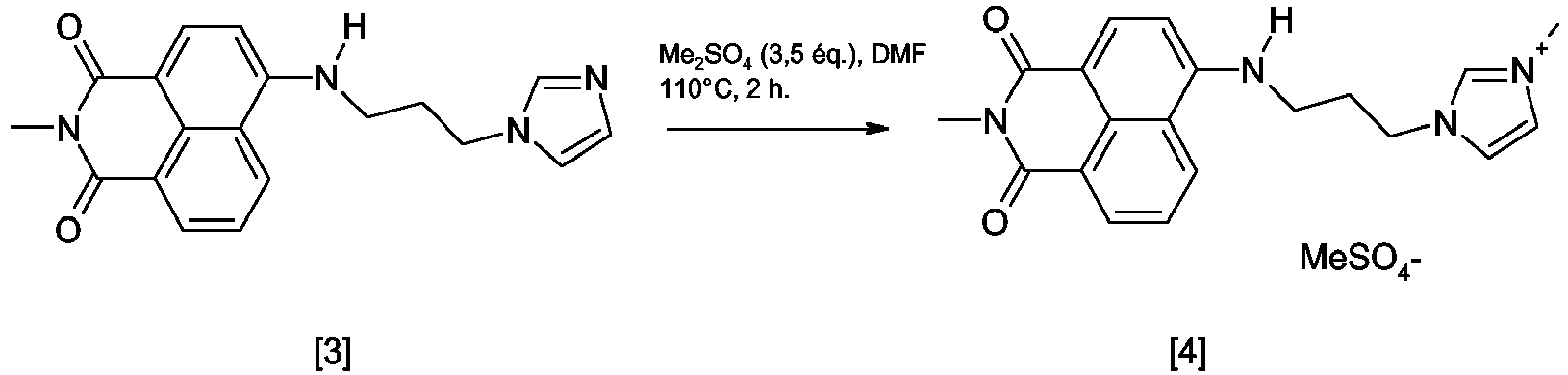
- Une suspension de 7,3 g de composé [3] dans 24 ml de DMF, placée sous argon, est chauffée dans un bain d'huile préchauffée à 110 °C pendant 5 minutes. Après que le milieu réactionnel soit revenu à température ambiante, 3 ml de diméthylsulfate sont additionnés au goutte à goutte. Le milieu est chauffé pendant 2 h à 110 °C. Le mélange réactionnel est ensuite soumis à plusieurs co-évaporations avec du toluène afin d'éliminer la DMF. Le résidu brun obtenu est repris dans un minimum de méthanol auquel on ajoute de l'acétate d'éthyle jusqu'à obtention d'un précipité. Après filtration sous argon, la poudre jaune est travaillée dans l'acétate d'éthyle (1 h), puis l'éther (1 h) et enfin le chloroforme (30 minutes). Après filtration puis séchage, 9 g de composé attendu [4] sont récupérés sous forme d'une poudre jaune.
- Les analyses sont conformes au produit attendu.
RMN 1H (MeOD) : 2,3ppm, m, 2H ; 3,8ppm, s, 3H; 3,6ppm, s, 3H ; 3,4ppm, s, 3H ; 3,5ppm, t, 2H, 4,4ppm ,t, 2H; 6,8ppm, d, 1H; 7,3ppm, s, 1H ; 7,5ppm, d, 1H; 7,8ppm, d, 1H ; 8,3ppm, d, 1H ; 8,5ppm ,d, 2H ; 9,0ppm, s, 1H -

-

-

- A une solution brune de 5,67 g d'anhydride 4-bromo-1,8-naphatalique [1] (20,5 mmol ; 1 éq) dans 90 ml de dioxane sont ajoutés 2,44 ml de 1-(3-aminopropyl)-imidazole [2] (20,5 mmol ; 1 éq). Le mélange réactionnel est chauffé à reflux du dioxane pendant 4 h.
- Après refroidissement du milieu réactionnel à température ambiante, celui-ci est versé dans 100 ml d'un mélange eau/glace. Un précipité se forme. Celui-ci est filtré, puis dissout dans quelques millilitres de dichlorométhane avant d'être séché sur sulfate de magnésium. Après filtration et évaporation, une poudre jaunâtre est obtenue. Après purification par chromatographie sur colonne de silice (éluant dichlorométhane/acétone 1/1), 4,73 g d'une poudre jaune ocre correspondant au composé [5] sont obtenus.
- Les analyses sont conformes au produit attendu.
-
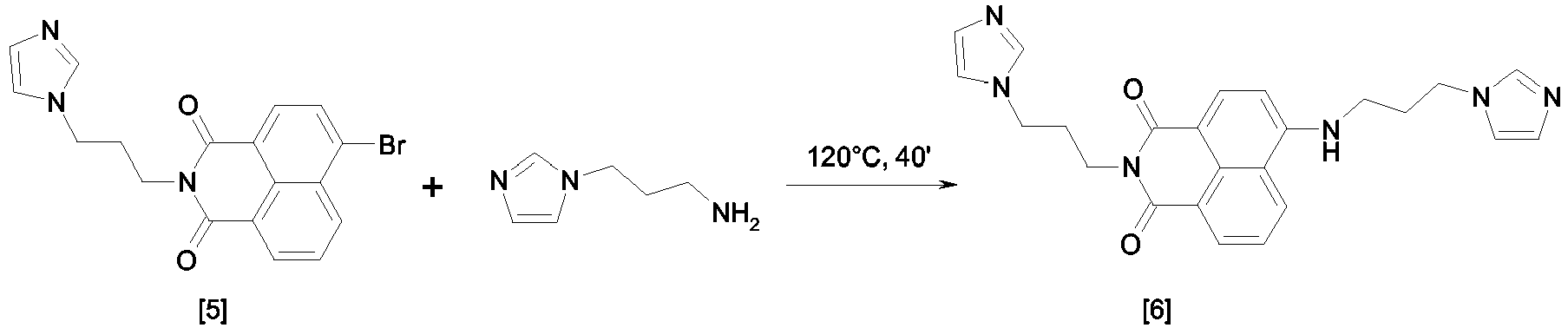
- 4,73 g de composé [5] (12,3 mmol ; 1 éq) sont dissouts par léger chauffage dans 8,8 ml de 1-(3-aminopropyl)imidazole (73,7 mmol ; 6 éq). Le mélange réactionnel est chauffé à 120 °C pendant 40 minutes. Le résidu noirâtre obtenu est ramené à température ambiante. 60 ml d'eau distillée sont ajoutés à ce résidu puis mis sous agitation pendant 5 minutes. La phase aqueuse est extraite avec du dichlorométhane.
- La phase organique est par la suite lavée au chlorure d'ammonium, séchée sur sulfate de sodium filtrée, puis concentrée sous vide.
- 4,83 g d'une poudre orange correspondant au composé [6] sont obtenus.
- Les analyses sont conformes au produit attendu.
-

- Une suspension de 4,83 g de composé [6] (11,2 mmol ; 1 éq) dans 10 ml de DMF est chauffée à 80 °C. 3,7 ml de diméthylsulfate (39,4 mmol ; 3,5 éq) sont ensuite additionnés au goutte à goutte au milieu réactionnel. Le mélange réactionnel est chauffé à 80 °C pendant 25 minutes puis ramené à température ambiante.
- Celui-ci est ensuite soumis à plusieurs co-évaporations avec du toluène afin d'éliminer la DMF. Le résidu brun obtenu est repris six fois par un mélange constitué de méthanol (10 ml), de dichlorométhane (50 ml), et de cyclohexane (50 ml) et placé sous forte agitation pendant 5 minutes. Le surnageant est systématiquement éliminé.
- Après concentration, puis séchage sous vide, 5,20 g d'une poudre jaune foncé correspondant au composé [7] sont obtenus.
- Les analyses sont conformes au produit attendu.
-
Colorant 1 (composé [7]) 3-méthyl-1-{3-[(2-méthyl-1,3-dioxo-2,3-dihydro-1H-benzo[de]isoquinolin-6-yl)amino]propyl}-1H-imidazol-3-ium méthylsulfate Colorant 2 (composé [4]) 3-méthyl-1-{3-[(6-{[3-(3-méthyl-1H-imidazol-3-ium-1-yl)propyl]amino}-1,3-dioxo-1H-benzo[de]isoquinolin-2(3H)-yl]propyl}-1H-imidazol-3-ium bis(méthylsulfate) Colorant 3 (comparatif) 2-hydroxyéthylamino-5-nitroanisole Colorant 4 (comparatif) Basic Yellow 87 : 
- On a préparé quatre solutions tamponnées à pH 9 par mélange de 2 g d'acétate d'ammonium dans 40 ml d'eau. Le pH est ajusté par addition d'ammoniaque et le volume est complété à 100 ml par addition d'eau désionisée.
- On dissout chacun des colorants 1 à 4 dans une solution tamponnée pour obtenir une concentration en colorant à 5.10-4 mol%.
- On met en contact une mèche de cheveux blancs avec la solution colorante résultante selon un rapport de bain de 10 pour 1 (1 g de mèche pour 10g de solution).
- Après 20 minutes de pause, la mèche est rincée à l'eau déionisée pour éliminer l'excès de solution de colorant.
- Avec chacune des solutions colorantes, on obtient une mèche de cheveux jaunes. Les colorants 1 et 2 selon l'invention sont visiblement plus chromatiques. Lorsque la composition contenant les colorants 1 et 2 selon l'invention est appliquée sur cheveux foncés (hauteur de ton égale à 4), on obtient un effet optique éclaircissant.
- Chaque mèche de cheveux colorés selon l'étape précédente est lavée avec une solution comprenant 1 % en volume d'un shampooing standard pendant trente secondes, puis rincée avec 200 ml d'eau. Ce procédé est répété six fois.
- On observe que l'intensité de la couleur des mèches colorées avec les compositions contenant les colorants 1 et 2 conformes à l'invention est plus importante que l'intensité de la couleur des mèches colorées avec les compositions comparatives contenant les colorants 3 et 4 : les compositions tinctoriales selon la présente invention permettent d'obtenir des colorations plus résistantes aux shampooings.
Claims (13)
- Colorant naphtalimide cationique correspondant aux composés de formule générale (I) ainsi que les dimères des composés (I) correspondant aux formules générales (II), (III) et (IV) suivantes:


 - les radicaux R1 pris séparément et indépendamment les uns des autres représentent un atome d'hydrogène ; un radical alkyle en C1-C4 éventuellement substitué par au moins un substituant choisi parmi les groupements :• hydroxyle,• alcoxy en C1-C4, (poly)hydroxyalcoxy en C2-C4,• amino, amino substitué par un ou deux groupements alkyle identiques ou différents en C1-C4 éventuellement porteurs d'au moins un groupement hydroxyle, alcoxy en C1-C2, lesdits radicaux alkyle pouvant former avec l'atome d'azote auquel ils sont rattachés, un hétérocycle comprenant de 5 ou 7 chaînons, saturé ou insaturé, éventuellement aromatique, éventuellement substitué, comprenant éventuellement au moins un autre hétéroatome différent ou non de l'azote.• Un radical alkylcarbonylamino (R'CO-NR-) dans lequel le radical R est un atome d'hydrogène, un radical alkyle en C1-C4 et le radical R' représente un radical alkyle en C1-C4, un radical phényle ;• Un radical alkylsulfonyle (R-SO2-) dans lequel le radical R représente un radical alkyle en C1-C4.• Un radical alkylsulfinyle (R-SO-) dans lequel le radical R représente un radical alkyle en C1-C4.• Un radical alkylcarbonyle (R-CO-) dans lequel le radical R représente un radical alkyle en C1-C4,- les radicaux R pris séparément et indépendamment les uns des autres représentent un atome d'hydrogène ; un radical aryle ou arylalkyle dont la partie aryle est éventuellement substituée ; un radical alkyle en Ci-Cs étant éventuellement substitué par au moins un substituant choisi parmi les groupements :• hydroxyle,• alcoxy en C1-C4, (poly)hydroxyalcoxy en C2-C4,• amino, amino substitué par un ou deux groupements alkyle identiques ou différents en C1-C4 éventuellement porteurs d'au moins un groupement hydroxyle, alcoxy en C1-C2, lesdits radicaux alkyle pouvant former avec l'atome d'azote auquel ils sont rattachés, un hétérocycle comprenant de 5 ou 7 chaînons, saturé ou insaturé, éventuellement aromatique, éventuellement substitué, comprenant éventuellement au moins un autre hétéroatome différent ou non de l'azote.• Un radical alkylcarbonylamino (R'CO-NR-) dans lequel le radical R est un atome d'hydrogène, un radical alkyle en C1-C4 et le radical R' représente un radical alkyle en C1-C4, un radical phényle ;• Un radical alkylsulfonyle (R-SO2-) dans lequel le radical R représente un radical alkyle en C1-C4.• Un radical alkylsulfinyle (R-SO-) dans lequel le radical R représente un radical alkyle en C1-C4.• Un radical alkylcarbonyle (R-CO-) dans lequel le radical R représente un radical alkyle en C1-C4 ;Ces radicaux R étant éventuellement interrompus par un ou plusieurs hétéroatomes choisis parmi l'oxygène, l'azote et le soufre, et
Ces radicaux R étant substitués par au moins un groupement correspondant aux formules (a) et (b) suivantes : - L est un bras de liaison cationique alkylène en C2-C20 interrompu par au moins un groupement correspondant aux formules suivantes :ainsi que leurs sels d'addition avec un acide et leurs solvates.
 • X- représente un contre-ion permettant d'assurer l'électroneutralité des composés de formule (I) à (IV) ;
 - Colorant selon la revendication 1, dans lequel les radicaux R, identiques ou différents, indépendamment l'un de l'autre, représentent un atome d'hydrogène ; un radical alkyle en C1-C3, un radical hydroxyalkyle, un radical alcoxyalkyle, un radical alkyle en C1-C3 interrompu par au moins un groupement correspondant à la formule (a") suivante, un radical benzyle éventuellement substitué par un ou plusieurs radicaux, identiques ou différents, choisi parmi les groupements hydroxyle, alcoxyle tel que méthoxy, amino, (di)alkyl amino,

- Colorant naphtalimide selon l'une quelconque des revendications précédentes choisi parmi :- Le sel de 3-méthyl-1-{3-[(2-méthyl-1,3-dioxo-2,3-dihydro-1H-benzo[de]isoquinolin-6-yl)amino]propyl}-1H-imidazol-3-ium
 - Le sel de 1-{3-[6-[(2-hydroxyéthyl)amino]-1,3-dioxo-1H-benzo[de]isoquinolin-2(3H)-yl]propyl)-3-méthyl-1H-imidazol-3-ium
 - Le sel de 3-méthyl-1-{3-[(6-{[3-(3-méthyl-1H-imidazol-3-ium-1-yl)propyl]ammo}-1,3 -dioxo-1H-benzo[de]isoquinolin-2(3H)-yl]propyl}-1H-imidazol-3 -ium
 - Le sel de 3-{5-[(2-éthyl-1,3-dioxo-2,3-dihydro-1H-benzo[de]isoquinolin-6-yl)amino]pentyl}-1-{3-[(2-éthyl-1,3-dioxo-2,3-dihydro-1H-benzo[de]isoquinolin-6-yl)amino]propyl}-1H-imidazol-3-ium
 - Le sel de 3,3'-butane-l,4-diylbis(1-{5-[(2-éthyl-1,3-dioxo-2,3-dihydro-1H-benzo[de]isoquinolin-6-yl)amino]pentyl}-1H-imidazol-3-ium
 - Le sel de 3-{5-[(2-éthyl-1,3-dioxo-2,3-dihydro-1H-benzo[de]isoquinolin-6-yl)amino]pentyl}-1-[3-({2-[3-(1-méthyl-1H-imidazol-3-ium-3-yl)propyl]-1,3-dioxo-2,3-dihydro-1H-benzo [de]isoquinolin-6-yl} amino)propyl] -1H-imidazol-3 -ium
 - Le sel de 1-{5-[(2-éthyl-1,3-dioxo-2,3-dihydro-1H-benzo[de]isoquinolin-6-yl)amino]pentyl}-3-(4-{1-[5-({2-[3-(1-methyl-1H-imidazol-3-ium-3-yl)propyl]-1,3-dioxo-2,3 -dihydro-1H-benzo[de]isoquinolin-6-yl}amino)pentyl]-1H-imidazol-3-ium-3-yl}butyl)-1H-imidazol-3 -ium
 - Le sel de 1-methyl-3-{3-[6-[(3-{3-[5-({2-[3-(1-méthyl-1H-imidazol-3-ium-3-yl)propyl]-1,3-dioxo-2,3-dihydro-1H-benzo[de]isoquinolin-6-yl}amino)pentyl]-1H-imidazol-3-ium-1-yl}propyl)amino]-1,3-dioxo-1H-benzo[de]isoquinolin-2(3H)-yl]propyl}-1H-imidazol-3-ium
 - Le sel de 3,3'-butane-1,4-diylbis{1-[5-({2-[3-(1-méthyl-1H-imidazol-3-ium-3-yl)propyl]-1,3-dioxo-2,3-dihydro-1H-benzo[de]isoquinolin-6-yl}amino)pentyl]-1H-imidazol-3-ium}
 - Le sel de 1-méthyl-3-[3-({2-[3-(3-{5-[6-{[3-(1-méthyl-1H-imidazol-3-ium-3-yl)propyl]amino}-1,3-dioxo-1H-benzo[de]isoquinolin-2(3H)-yl]pentyl}-1H-imidazol-3-ium-1-yl)propyll-1,3-dioxo-2,3-dihydro-1H-benzo[de]isoquinolin-6-yl}amino)propyl]-1H-imidazol-3-ium
 - Le sel de 3-{6-[6-[bis(2-hydroxyéthyl)amino]-1,3-dioxo-1H-benzo[de]isoqumolin-2(3H)-yl]hexyl}-1-{3-[(2-méthyl-1,3-dioxo-2,3-dihydro-1H-benzo[de]isoquinolin-6-yl)amino]propyl} -1H-imidazol-3-ium
 - Le sel de 3-méthyl-1-[3-({2-[6-(1-{3-[(2-méthyl-1,3-dioxo-2,3-dihydro-1H-benzo[de]isoquinolin-6-yl)amino]propyl}-1H-imidazol-3-ium-3-yl)hexyl]-1,3-dioxo-2,3-dihydro-1H-benzo[de]isoquinolin-6-yl}amino)propyl]-1H-imidazol-3-ium
 - Le sel de 1-méthyl-3-{3-[6-{[3-(3-{6-[6-{[3-(3-méthyl-1H-imidazol-3-ium-1-yl)propyl]amino}-1,3-dioxo-1H-benzo[de]isoqumolin-2(3H)-yl]hexyl}-1H-imidazol-3-ium-1-yl)propyl]amino}-1,3-dioxo-1H-benzo[de]isoquinolin-2(3H)-yl]propyl}-1H-imidazol-3-ium
 - Le sel de 3-méthyl-1-[3-({2-[6-(1-{6-[6-{[3-(1-métliyl-1H-imidazot-3-ium-3-yl)propyl]amino}-1,3-dioxo-1H-benzo[de]isoquinolin-2(3H)-yl]hexyl}-1H-imidazol-3-ium-3-yl)hexyl]-1,3-dioxo-2,3-dihydro-1H-benzo[de]isoquinolin-6-yl}amino)propyl]-1H-imidazol-3-ium
- Colorant naphtalimide selon l'une quelconque des revendications précédentes de formule :
 - W représente un radical alkyle C1-C8, de préférence C2-C8 et de manière encore plus préférée en C2-C4,- R, R1, R2, R3 et X- sont tels que définis à la revendication 1.
 - Colorant naphtalimide selon l'une quelconque des revendications 1 à 3 de formule :
 - W représente un radical alkyle en C1-C8, de préférence C2-C8 et de manière encore plus préférée en C2-C4,- R, R1, R2 et X- sont tels que définis à la revendication 1.
 - Colorant naphtalimide selon l'une quelconque des revendications 1 à 3 de formule :
 - W représente un radical alkyle C1-C8, de préférence C2-C8 et de manière encore plus préférée en C2-C4,- R1, R2 et X- sont tels que définis à la revendication 1,- L' est défini comme L.
 - Colorant naphtalimide selon l'une quelconque des revendications 1 à 3 de formule :

- Colorant naphtalimide selon l'une quelconque des revendications 1 à 3 de formule

- Composition tinctoriale pour la teinture des fibres kératiniques comprenant dans un milieu de teinture approprié au moins un composé naphtalimide cationique selon l'une des revendications 1 à 8.
- Composition selon la revendication 9 comprenant au moins un agent oxydant de type peroxyde et/ou un agent oxydant de type persel.
- Procédé de coloration des fibres kératiniques comprenant l'application sur les fibres d'une composition telles que définie à la revendication 9 ou 10.
- Utilisation de la composition selon l'une des revendications 9 ou 10 sur des fibres kératiniques présentant une hauteur de ton inférieure ou égale à 6, pour éclaircir lesdites fibres.
- Kit de coloration des fibres kératiniques comprenant, d'une part, une composition comprenant au moins l'un des colorants naphtalimide des formules (I), (II), (III) ou (IV), leurs sels d'addition et/ou solvates, telle que définie à la revendication 9 ou 10, et d'autre part, un agent oxydant.
Applications Claiming Priority (2)
| Application Number | Priority Date | Filing Date | Title |
|---|---|---|---|
| FR0602608A FR2898902B1 (fr) | 2006-03-24 | 2006-03-24 | Colorants particuliers de type naphtalimide, composition tinctoriale comprenant au moins un tel colorant, procede de mise en oeuvre et utilisations |
| PCT/FR2007/050995 WO2007110530A2 (fr) | 2006-03-24 | 2007-03-23 | Colorants particuliers de type naphtalimide, composition tinctoriale comprenant au moins un tel colorant, procede de mise en oeuvre et utilisations |
Publications (2)
| Publication Number | Publication Date |
|---|---|
| EP1963436A2 EP1963436A2 (fr) | 2008-09-03 |
| EP1963436B1 true EP1963436B1 (fr) | 2018-04-25 |
Family
ID=37685625
Family Applications (1)
| Application Number | Title | Priority Date | Filing Date |
|---|---|---|---|
| EP07731808.7A Not-in-force EP1963436B1 (fr) | 2006-03-24 | 2007-03-23 | Colorants particuliers de type naphtalimide, composition tinctoriale comprenant au moins un tel colorant, procede de mise en oeuvre et utilisations |
Country Status (8)
| Country | Link |
|---|---|
| US (1) | US7988741B2 (fr) |
| EP (1) | EP1963436B1 (fr) |
| JP (1) | JP2008536999A (fr) |
| KR (1) | KR100947843B1 (fr) |
| CN (1) | CN101374911A (fr) |
| ES (1) | ES2676285T3 (fr) |
| FR (1) | FR2898902B1 (fr) |
| WO (1) | WO2007110530A2 (fr) |
Families Citing this family (4)
| Publication number | Priority date | Publication date | Assignee | Title |
|---|---|---|---|---|
| FR3045359B1 (fr) * | 2015-12-18 | 2020-10-30 | Oreal | Composition pour colorer les fibres keratiniques comprenant un colorant direct styryle ou napthylamide a fonction aminoalkyle, procede de coloration et colorant |
| FR3060995B1 (fr) * | 2016-12-22 | 2019-05-31 | L'oreal | Procede de coloration des fibres keratiniques mettant en oeuvre au moins un colorant 2- ou 4-azopyridinium particulier et au moins un colorant fluorescent |
| FR3060993B1 (fr) * | 2016-12-22 | 2020-10-02 | Oreal | Procede de coloration des fibres keratiniques mettant en oeuvre au moins un compose 2-azo(benz)imidazolium particulier et au moins un colorant direct fluorescent |
| CN110105332B (zh) * | 2019-05-28 | 2020-05-22 | 山东大学 | 一种发光可调复合离子液体的制备方法 |
Family Cites Families (30)
| Publication number | Priority date | Publication date | Assignee | Title |
|---|---|---|---|---|
| US3625947A (en) | 1957-01-30 | 1971-12-07 | Nippon Kayaku Kk | N heterocyclic ethyl naphthalimides |
| BE626050A (fr) | 1962-03-30 | |||
| DE1492175A1 (de) | 1965-07-07 | 1970-02-12 | Schwarzkopf Gmbh Hans | Verfahren zum Faerben von lebenden Haaren |
| FR1557945A (fr) * | 1967-01-30 | 1969-02-21 | ||
| US3697525A (en) | 1968-06-08 | 1972-10-10 | Mitsubishi Chem Ind | Fluorescent naphthalimide derivatives |
| JPS506336B2 (fr) | 1971-12-03 | 1975-03-13 | ||
| DE2341289A1 (de) * | 1973-08-16 | 1975-03-06 | Hoechst Ag | Basische farbstoffe, verfahren zu ihrer herstellung und ihre verwendung |
| DE2359399C3 (de) | 1973-11-29 | 1979-01-25 | Henkel Kgaa, 4000 Duesseldorf | Haarfärbemittel |
| US4508900A (en) | 1980-11-03 | 1985-04-02 | Hoechst Aktiengesellschaft | Cationic compounds of the naphthalimide series, process for their preparation and their use |
| US4595756A (en) | 1982-09-13 | 1986-06-17 | Hoechst Aktiengesellschaft | Cationic compounds of the naphthalimide series, process for their preparation and their use |
| JP2526099B2 (ja) | 1988-07-07 | 1996-08-21 | 花王株式会社 | 角質繊維染色組成物 |
| DE3843892A1 (de) | 1988-12-24 | 1990-06-28 | Wella Ag | Oxidationshaarfaerbemittel mit einem gehalt an diaminopyrazolderivaten und neue diaminopyrazolderivate |
| DE4133957A1 (de) | 1991-10-14 | 1993-04-15 | Wella Ag | Haarfaerbemittel mit einem gehalt an aminopyrazolderivaten sowie neue pyrazolderivate |
| US5235045A (en) * | 1992-03-19 | 1993-08-10 | Microbiomed Corporation | Non-azo naphthalimide dyes |
| DE4234885A1 (de) | 1992-10-16 | 1994-04-21 | Wella Ag | Verfahren zur Herstellung von 4,5-Diaminopyrazol-Derivaten, deren Verwendung zum Färben von Haaren sowie neue Pyrazol-Derivate |
| DE4234887A1 (de) | 1992-10-16 | 1994-04-21 | Wella Ag | Oxidationshaarfärbemittel mit einem Gehalt an 4,5-Diaminopyrazolderivaten sowie neue 4,5-Diaminopyrazolderivate und Verfahren zu ihrer Herstellung |
| TW311089B (fr) | 1993-07-05 | 1997-07-21 | Ciba Sc Holding Ag | |
| TW325998B (en) | 1993-11-30 | 1998-02-01 | Ciba Sc Holding Ag | Dyeing keratin-containing fibers |
| DE59510392D1 (de) | 1994-11-03 | 2002-10-31 | Ciba Sc Holding Ag | Kationische Imidazolazofarbstoffe |
| DE4440957A1 (de) | 1994-11-17 | 1996-05-23 | Henkel Kgaa | Oxidationsfärbemittel |
| FR2733749B1 (fr) | 1995-05-05 | 1997-06-13 | Oreal | Compositions pour la teinture des fibres keratiniques contenant des diamino pyrazoles, procede de teinture, nouveaux diamino pyrazoles et leur procede de preparation |
| DE19539264C2 (de) | 1995-10-21 | 1998-04-09 | Goldwell Gmbh | Haarfärbemittel |
| DE19543988A1 (de) | 1995-11-25 | 1997-05-28 | Wella Ag | Oxidationshaarfärbemittel mit einem Gehalt an 3,4,5-Triaminopyrazolderivaten sowie neue 3,4,5-Triaminopyrazolderivate |
| FR2801308B1 (fr) | 1999-11-19 | 2003-05-09 | Oreal | COMPOSITIONS DE TEINTURE DE FIBRES KERATINIQUES CONTENANT DE DES 3-AMINO PYRAZOLO-[1,(-a]-PYRIDINES, PROCEDE DE TEINTURE, NOUVELLES 3-AMINO PYRAZOLO-[1,5-a]-PYRIDINES |
| US6693198B2 (en) * | 2002-04-22 | 2004-02-17 | Xanthus Life Sciences, Inc. | Amonafide salts |
| JP4109056B2 (ja) * | 2002-09-04 | 2008-06-25 | 大日本印刷株式会社 | 有機el素子 |
| DE102004006141A1 (de) * | 2004-02-07 | 2005-08-25 | Wella Ag | Aufhellende direktziehende Farbstoffe für Keratinfasern und diese Verbindungen enthaltende Färbemittel |
| DE102004006142A1 (de) * | 2004-02-07 | 2005-08-25 | Wella Ag | Neutrale und kationische Naphthalinderivate und diese Verbindungen enthaltende Färbemittel für Keratinfasern |
| GB0419850D0 (en) * | 2004-09-07 | 2004-10-13 | Angeletti P Ist Richerche Bio | Therapeutic agents |
| JP4993645B2 (ja) * | 2004-12-01 | 2012-08-08 | ジェネンテック, インコーポレイテッド | 抗体薬剤結合体および方法 |
-
2006
- 2006-03-24 FR FR0602608A patent/FR2898902B1/fr not_active Expired - Fee Related
-
2007
- 2007-03-23 KR KR1020077018946A patent/KR100947843B1/ko not_active Expired - Fee Related
- 2007-03-23 JP JP2008507142A patent/JP2008536999A/ja active Pending
- 2007-03-23 ES ES07731808.7T patent/ES2676285T3/es active Active
- 2007-03-23 CN CNA2007800001271A patent/CN101374911A/zh active Pending
- 2007-03-23 WO PCT/FR2007/050995 patent/WO2007110530A2/fr not_active Ceased
- 2007-03-23 EP EP07731808.7A patent/EP1963436B1/fr not_active Not-in-force
-
2010
- 2010-10-14 US US12/904,526 patent/US7988741B2/en not_active Expired - Fee Related
Non-Patent Citations (1)
| Title |
|---|
| None * |
Also Published As
| Publication number | Publication date |
|---|---|
| WO2007110530A3 (fr) | 2008-07-17 |
| CN101374911A (zh) | 2009-02-25 |
| WO2007110530A2 (fr) | 2007-10-04 |
| US20110113572A1 (en) | 2011-05-19 |
| EP1963436A2 (fr) | 2008-09-03 |
| KR20070118227A (ko) | 2007-12-14 |
| FR2898902A1 (fr) | 2007-09-28 |
| JP2008536999A (ja) | 2008-09-11 |
| KR100947843B1 (ko) | 2010-03-18 |
| ES2676285T3 (es) | 2018-07-18 |
| US7988741B2 (en) | 2011-08-02 |
| FR2898902B1 (fr) | 2010-09-10 |
Similar Documents
| Publication | Publication Date | Title |
|---|---|---|
| EP1399117B1 (fr) | Composition pour la teinture des fibres keratiniques comprenant un colorant diazoïque dicationique particulier | |
| EP1377263B1 (fr) | Composition tinctoriale pour la teinture des fibres keratiniques comprenant un colorant diazoique dicationique particulier | |
| EP1398355A1 (fr) | Composition pour la teinture des fibres kératiniques humaines comprenant un colorant monoazoique monocationique | |
| EP1297819A2 (fr) | Composition pour la teinture des fibres kératiniques comprenant un colorant azoique cationique particulier | |
| EP1634574B1 (fr) | Nouveaux colorants directs noirs di-noyaux heteroaromatiques | |
| US7407517B2 (en) | Cationic azo dyes with julolidine units, dyeing composition containing them, method of dyeing | |
| EP1757328B1 (fr) | Composition tinctoriale comprenant des composés insolubles, procédés mettant en oeuvre cette composition. | |
| US7988741B2 (en) | Specific naphthalmide-type dyes, dye composition comprising at least one such dye, process using same and uses | |
| EP1609456B1 (fr) | Utilisation de composés azoïques polycationiques en teinture des fibres kératiniques | |
| EP1647548B1 (fr) | Composé bis-hydrazone dicationique, composition tinctoriale comprenant au moins un tel composé, procédé de mise en oeuvre et utilisations | |
| US7288124B2 (en) | Heteroaromatic binuclear black direct dyes | |
| FR2917736A1 (fr) | Derives azoiques a motif pyrazolinone pour la coloration des fibres keratiniques | |
| EP1655017B1 (fr) | Utilisation de composés de type organosilane en teinture des fibres kératiniques | |
| EP1623701B1 (fr) | Utilisation de dérivés de triarylméthane à titre de colorant direct dans une composition tinctoriale, composition et procédé de mise en oeuvre. | |
| JP6427678B2 (ja) | ケラチン繊維を染色するための、ピラゾロピリジン単位を担持するアゾメチンタイプの化合物の使用 | |
| EP1738799B1 (fr) | Utilisation de composés azoïques polycationiques en teinture des fibres kératiniques | |
| US7569079B2 (en) | Polycationic monochromophoric hydrazone compounds, dye compositions comprising such polycationic compounds and dyeing process using them | |
| US20060112500A1 (en) | Use of organosilane compounds for dyeing keratin fibers | |
| EP1607393A1 (fr) | Compositions comprenant des colorants directs hydroxyalkyles, procédés de mise en oeuvre et utilisations. | |
| EP1642567B1 (fr) | Composition tinctoriale comprenant un colorant direct naphthoylène-benzimidazolium, procédé de mise en oeuvre et utilisations | |
| WO2007122340A1 (fr) | Compose dichromophorique cationique comportant deux motifs de type hydrazone et a bras de liaison cationique, composition tinctoriale comprenant au moins un tel compose, procede de mise en œuvre et utilisations | |
| EP2010494B1 (fr) | Composes monochromophoriques monocationiques particuliers de type hydrazone comprenant un motif 2-, 4-pyridinium ou 2-, 4-quinolinium, leur synthese, compositions tinctoriales les comprenant, procede de coloration de fibres keratiniques | |
| MX2007009579A (en) | Specific dyes of naphthalimide type, dyeing composition comprising at least one such dye, method of implementation and uses | |
| FR2899898A1 (fr) | Composes monochromophoriques monocationiques particuliers de type hydrazone comprenant un motif 2-(benz-) imidazolium leur synthe, compositions tinctoriales les comprenant, procede de coloration de fibres keratiniques | |
| WO2007122341A2 (fr) | Composes monochromophoriques monocationiques particuliers de type hydrazone comprenant un motif 2-(benz-)imidazolium, leur synthese, compositions tinctoriales les comprenant, procede de coloration de fibres keratiniques |
Legal Events
| Date | Code | Title | Description |
|---|---|---|---|
| PUAI | Public reference made under article 153(3) epc to a published international application that has entered the european phase |
Free format text: ORIGINAL CODE: 0009012 |
|
| 17P | Request for examination filed |
Effective date: 20070725 |
|
| AK | Designated contracting states |
Kind code of ref document: A2 Designated state(s): AT BE BG CH CY CZ DE DK EE ES FI FR GB GR HU IE IS IT LI LT LU LV MC MT NL PL PT RO SE SI SK TR |
|
| AX | Request for extension of the european patent |
Extension state: AL BA HR MK RS |
|
| 17Q | First examination report despatched |
Effective date: 20101129 |
|
| DAX | Request for extension of the european patent (deleted) | ||
| STAA | Information on the status of an ep patent application or granted ep patent |
Free format text: STATUS: EXAMINATION IS IN PROGRESS |
|
| GRAP | Despatch of communication of intention to grant a patent |
Free format text: ORIGINAL CODE: EPIDOSNIGR1 |
|
| STAA | Information on the status of an ep patent application or granted ep patent |
Free format text: STATUS: GRANT OF PATENT IS INTENDED |
|
| INTG | Intention to grant announced |
Effective date: 20171213 |
|
| GRAA | (expected) grant |
Free format text: ORIGINAL CODE: 0009210 |
|
| GRAS | Grant fee paid |
Free format text: ORIGINAL CODE: EPIDOSNIGR3 |
|
| STAA | Information on the status of an ep patent application or granted ep patent |
Free format text: STATUS: THE PATENT HAS BEEN GRANTED |
|
| AK | Designated contracting states |
Kind code of ref document: B1 Designated state(s): AT BE BG CH CY CZ DE DK EE ES FI FR GB GR HU IE IS IT LI LT LU LV MC MT NL PL PT RO SE SI SK TR |
|
| REG | Reference to a national code |
Ref country code: GB Ref legal event code: FG4D Free format text: NOT ENGLISH |
|
| REG | Reference to a national code |
Ref country code: CH Ref legal event code: EP |
|
| REG | Reference to a national code |
Ref country code: AT Ref legal event code: REF Ref document number: 992865 Country of ref document: AT Kind code of ref document: T Effective date: 20180515 |
|
| REG | Reference to a national code |
Ref country code: IE Ref legal event code: FG4D Free format text: LANGUAGE OF EP DOCUMENT: FRENCH |
|
| REG | Reference to a national code |
Ref country code: DE Ref legal event code: R096 Ref document number: 602007054667 Country of ref document: DE |
|
| REG | Reference to a national code |
Ref country code: ES Ref legal event code: FG2A Ref document number: 2676285 Country of ref document: ES Kind code of ref document: T3 Effective date: 20180718 |
|
| REG | Reference to a national code |
Ref country code: NL Ref legal event code: MP Effective date: 20180425 |
|
| REG | Reference to a national code |
Ref country code: LT Ref legal event code: MG4D |
|
| PG25 | Lapsed in a contracting state [announced via postgrant information from national office to epo] |
Ref country code: NL Free format text: LAPSE BECAUSE OF FAILURE TO SUBMIT A TRANSLATION OF THE DESCRIPTION OR TO PAY THE FEE WITHIN THE PRESCRIBED TIME-LIMIT Effective date: 20180425 |
|
| PG25 | Lapsed in a contracting state [announced via postgrant information from national office to epo] |
Ref country code: SE Free format text: LAPSE BECAUSE OF FAILURE TO SUBMIT A TRANSLATION OF THE DESCRIPTION OR TO PAY THE FEE WITHIN THE PRESCRIBED TIME-LIMIT Effective date: 20180425 Ref country code: PL Free format text: LAPSE BECAUSE OF FAILURE TO SUBMIT A TRANSLATION OF THE DESCRIPTION OR TO PAY THE FEE WITHIN THE PRESCRIBED TIME-LIMIT Effective date: 20180425 Ref country code: LT Free format text: LAPSE BECAUSE OF FAILURE TO SUBMIT A TRANSLATION OF THE DESCRIPTION OR TO PAY THE FEE WITHIN THE PRESCRIBED TIME-LIMIT Effective date: 20180425 Ref country code: BG Free format text: LAPSE BECAUSE OF FAILURE TO SUBMIT A TRANSLATION OF THE DESCRIPTION OR TO PAY THE FEE WITHIN THE PRESCRIBED TIME-LIMIT Effective date: 20180725 Ref country code: FI Free format text: LAPSE BECAUSE OF FAILURE TO SUBMIT A TRANSLATION OF THE DESCRIPTION OR TO PAY THE FEE WITHIN THE PRESCRIBED TIME-LIMIT Effective date: 20180425 |
|
| PG25 | Lapsed in a contracting state [announced via postgrant information from national office to epo] |
Ref country code: GR Free format text: LAPSE BECAUSE OF FAILURE TO SUBMIT A TRANSLATION OF THE DESCRIPTION OR TO PAY THE FEE WITHIN THE PRESCRIBED TIME-LIMIT Effective date: 20180726 Ref country code: LV Free format text: LAPSE BECAUSE OF FAILURE TO SUBMIT A TRANSLATION OF THE DESCRIPTION OR TO PAY THE FEE WITHIN THE PRESCRIBED TIME-LIMIT Effective date: 20180425 |
|
| REG | Reference to a national code |
Ref country code: AT Ref legal event code: MK05 Ref document number: 992865 Country of ref document: AT Kind code of ref document: T Effective date: 20180425 |
|
| PG25 | Lapsed in a contracting state [announced via postgrant information from national office to epo] |
Ref country code: PT Free format text: LAPSE BECAUSE OF FAILURE TO SUBMIT A TRANSLATION OF THE DESCRIPTION OR TO PAY THE FEE WITHIN THE PRESCRIBED TIME-LIMIT Effective date: 20180827 |
|
| REG | Reference to a national code |
Ref country code: DE Ref legal event code: R097 Ref document number: 602007054667 Country of ref document: DE |
|
| PG25 | Lapsed in a contracting state [announced via postgrant information from national office to epo] |
Ref country code: CZ Free format text: LAPSE BECAUSE OF FAILURE TO SUBMIT A TRANSLATION OF THE DESCRIPTION OR TO PAY THE FEE WITHIN THE PRESCRIBED TIME-LIMIT Effective date: 20180425 Ref country code: RO Free format text: LAPSE BECAUSE OF FAILURE TO SUBMIT A TRANSLATION OF THE DESCRIPTION OR TO PAY THE FEE WITHIN THE PRESCRIBED TIME-LIMIT Effective date: 20180425 Ref country code: SK Free format text: LAPSE BECAUSE OF FAILURE TO SUBMIT A TRANSLATION OF THE DESCRIPTION OR TO PAY THE FEE WITHIN THE PRESCRIBED TIME-LIMIT Effective date: 20180425 Ref country code: DK Free format text: LAPSE BECAUSE OF FAILURE TO SUBMIT A TRANSLATION OF THE DESCRIPTION OR TO PAY THE FEE WITHIN THE PRESCRIBED TIME-LIMIT Effective date: 20180425 Ref country code: AT Free format text: LAPSE BECAUSE OF FAILURE TO SUBMIT A TRANSLATION OF THE DESCRIPTION OR TO PAY THE FEE WITHIN THE PRESCRIBED TIME-LIMIT Effective date: 20180425 Ref country code: EE Free format text: LAPSE BECAUSE OF FAILURE TO SUBMIT A TRANSLATION OF THE DESCRIPTION OR TO PAY THE FEE WITHIN THE PRESCRIBED TIME-LIMIT Effective date: 20180425 |
|
| PLBE | No opposition filed within time limit |
Free format text: ORIGINAL CODE: 0009261 |
|
| STAA | Information on the status of an ep patent application or granted ep patent |
Free format text: STATUS: NO OPPOSITION FILED WITHIN TIME LIMIT |
|
| 26N | No opposition filed |
Effective date: 20190128 |
|
| PG25 | Lapsed in a contracting state [announced via postgrant information from national office to epo] |
Ref country code: SI Free format text: LAPSE BECAUSE OF FAILURE TO SUBMIT A TRANSLATION OF THE DESCRIPTION OR TO PAY THE FEE WITHIN THE PRESCRIBED TIME-LIMIT Effective date: 20180425 |
|
| PG25 | Lapsed in a contracting state [announced via postgrant information from national office to epo] |
Ref country code: MC Free format text: LAPSE BECAUSE OF FAILURE TO SUBMIT A TRANSLATION OF THE DESCRIPTION OR TO PAY THE FEE WITHIN THE PRESCRIBED TIME-LIMIT Effective date: 20180425 |
|
| REG | Reference to a national code |
Ref country code: CH Ref legal event code: PL |
|
| PG25 | Lapsed in a contracting state [announced via postgrant information from national office to epo] |
Ref country code: LU Free format text: LAPSE BECAUSE OF NON-PAYMENT OF DUE FEES Effective date: 20190323 |
|
| REG | Reference to a national code |
Ref country code: BE Ref legal event code: MM Effective date: 20190331 |
|
| PG25 | Lapsed in a contracting state [announced via postgrant information from national office to epo] |
Ref country code: CH Free format text: LAPSE BECAUSE OF NON-PAYMENT OF DUE FEES Effective date: 20190331 Ref country code: IE Free format text: LAPSE BECAUSE OF NON-PAYMENT OF DUE FEES Effective date: 20190323 Ref country code: LI Free format text: LAPSE BECAUSE OF NON-PAYMENT OF DUE FEES Effective date: 20190331 |
|
| PG25 | Lapsed in a contracting state [announced via postgrant information from national office to epo] |
Ref country code: BE Free format text: LAPSE BECAUSE OF NON-PAYMENT OF DUE FEES Effective date: 20190331 |
|
| PG25 | Lapsed in a contracting state [announced via postgrant information from national office to epo] |
Ref country code: TR Free format text: LAPSE BECAUSE OF FAILURE TO SUBMIT A TRANSLATION OF THE DESCRIPTION OR TO PAY THE FEE WITHIN THE PRESCRIBED TIME-LIMIT Effective date: 20180425 |
|
| PG25 | Lapsed in a contracting state [announced via postgrant information from national office to epo] |
Ref country code: MT Free format text: LAPSE BECAUSE OF FAILURE TO SUBMIT A TRANSLATION OF THE DESCRIPTION OR TO PAY THE FEE WITHIN THE PRESCRIBED TIME-LIMIT Effective date: 20180425 |
|
| PGFP | Annual fee paid to national office [announced via postgrant information from national office to epo] |
Ref country code: FR Payment date: 20210210 Year of fee payment: 15 Ref country code: IT Payment date: 20210211 Year of fee payment: 15 |
|
| PG25 | Lapsed in a contracting state [announced via postgrant information from national office to epo] |
Ref country code: CY Free format text: LAPSE BECAUSE OF FAILURE TO SUBMIT A TRANSLATION OF THE DESCRIPTION OR TO PAY THE FEE WITHIN THE PRESCRIBED TIME-LIMIT Effective date: 20180425 |
|
| PGFP | Annual fee paid to national office [announced via postgrant information from national office to epo] |
Ref country code: DE Payment date: 20210310 Year of fee payment: 15 Ref country code: GB Payment date: 20210310 Year of fee payment: 15 |
|
| PG25 | Lapsed in a contracting state [announced via postgrant information from national office to epo] |
Ref country code: IS Free format text: LAPSE BECAUSE OF FAILURE TO SUBMIT A TRANSLATION OF THE DESCRIPTION OR TO PAY THE FEE WITHIN THE PRESCRIBED TIME-LIMIT Effective date: 20180825 |
|
| PG25 | Lapsed in a contracting state [announced via postgrant information from national office to epo] |
Ref country code: HU Free format text: LAPSE BECAUSE OF FAILURE TO SUBMIT A TRANSLATION OF THE DESCRIPTION OR TO PAY THE FEE WITHIN THE PRESCRIBED TIME-LIMIT; INVALID AB INITIO Effective date: 20070323 |
|
| PGFP | Annual fee paid to national office [announced via postgrant information from national office to epo] |
Ref country code: ES Payment date: 20210405 Year of fee payment: 15 |
|
| REG | Reference to a national code |
Ref country code: DE Ref legal event code: R119 Ref document number: 602007054667 Country of ref document: DE |
|
| GBPC | Gb: european patent ceased through non-payment of renewal fee |
Effective date: 20220323 |
|
| PG25 | Lapsed in a contracting state [announced via postgrant information from national office to epo] |
Ref country code: GB Free format text: LAPSE BECAUSE OF NON-PAYMENT OF DUE FEES Effective date: 20220323 Ref country code: FR Free format text: LAPSE BECAUSE OF NON-PAYMENT OF DUE FEES Effective date: 20220331 Ref country code: DE Free format text: LAPSE BECAUSE OF NON-PAYMENT OF DUE FEES Effective date: 20221001 |
|
| REG | Reference to a national code |
Ref country code: ES Ref legal event code: FD2A Effective date: 20230503 |
|
| PG25 | Lapsed in a contracting state [announced via postgrant information from national office to epo] |
Ref country code: IT Free format text: LAPSE BECAUSE OF NON-PAYMENT OF DUE FEES Effective date: 20220323 |
|
| PG25 | Lapsed in a contracting state [announced via postgrant information from national office to epo] |
Ref country code: ES Free format text: LAPSE BECAUSE OF NON-PAYMENT OF DUE FEES Effective date: 20220324 |