EP1965369A2 - Affichages d'image numérique - Google Patents
Affichages d'image numérique Download PDFInfo
- Publication number
- EP1965369A2 EP1965369A2 EP08003429A EP08003429A EP1965369A2 EP 1965369 A2 EP1965369 A2 EP 1965369A2 EP 08003429 A EP08003429 A EP 08003429A EP 08003429 A EP08003429 A EP 08003429A EP 1965369 A2 EP1965369 A2 EP 1965369A2
- Authority
- EP
- European Patent Office
- Prior art keywords
- input
- value
- input value
- signal
- values
- Prior art date
- Legal status (The legal status is an assumption and is not a legal conclusion. Google has not performed a legal analysis and makes no representation as to the accuracy of the status listed.)
- Withdrawn
Links
- 238000000034 method Methods 0.000 claims abstract description 25
- 239000004973 liquid crystal related substance Substances 0.000 claims description 11
- 238000006467 substitution reaction Methods 0.000 description 27
- 238000012546 transfer Methods 0.000 description 15
- 230000008569 process Effects 0.000 description 5
- 230000004044 response Effects 0.000 description 4
- 238000012937 correction Methods 0.000 description 3
- 238000012545 processing Methods 0.000 description 3
- 239000003086 colorant Substances 0.000 description 2
- 230000000694 effects Effects 0.000 description 2
- 230000006872 improvement Effects 0.000 description 2
- 239000000543 intermediate Substances 0.000 description 2
- 238000005259 measurement Methods 0.000 description 2
- 230000000630 rising effect Effects 0.000 description 2
- 230000003190 augmentative effect Effects 0.000 description 1
- 239000000470 constituent Substances 0.000 description 1
- 230000003247 decreasing effect Effects 0.000 description 1
- 238000005286 illumination Methods 0.000 description 1
- 230000001788 irregular Effects 0.000 description 1
- 230000002045 lasting effect Effects 0.000 description 1
- 239000000203 mixture Substances 0.000 description 1
- 238000007781 pre-processing Methods 0.000 description 1
- 239000007787 solid Substances 0.000 description 1
- 230000003068 static effect Effects 0.000 description 1
- 230000007704 transition Effects 0.000 description 1
Images



Classifications
-
- G—PHYSICS
- G09—EDUCATION; CRYPTOGRAPHY; DISPLAY; ADVERTISING; SEALS
- G09G—ARRANGEMENTS OR CIRCUITS FOR CONTROL OF INDICATING DEVICES USING STATIC MEANS TO PRESENT VARIABLE INFORMATION
- G09G3/00—Control arrangements or circuits, of interest only in connection with visual indicators other than cathode-ray tubes
- G09G3/20—Control arrangements or circuits, of interest only in connection with visual indicators other than cathode-ray tubes for presentation of an assembly of a number of characters, e.g. a page, by composing the assembly by combination of individual elements arranged in a matrix no fixed position being assigned to or needed to be assigned to the individual characters or partial characters
- G09G3/2007—Display of intermediate tones
- G09G3/2044—Display of intermediate tones using dithering
-
- H—ELECTRICITY
- H04—ELECTRIC COMMUNICATION TECHNIQUE
- H04N—PICTORIAL COMMUNICATION, e.g. TELEVISION
- H04N5/00—Details of television systems
- H04N5/14—Picture signal circuitry for video frequency region
- H04N5/20—Circuitry for controlling amplitude response
-
- H—ELECTRICITY
- H04—ELECTRIC COMMUNICATION TECHNIQUE
- H04N—PICTORIAL COMMUNICATION, e.g. TELEVISION
- H04N5/00—Details of television systems
- H04N5/14—Picture signal circuitry for video frequency region
- H04N5/21—Circuitry for suppressing or minimising disturbance, e.g. moiré or halo
-
- H—ELECTRICITY
- H04—ELECTRIC COMMUNICATION TECHNIQUE
- H04N—PICTORIAL COMMUNICATION, e.g. TELEVISION
- H04N5/00—Details of television systems
- H04N5/44—Receiver circuitry for the reception of television signals according to analogue transmission standards
-
- G—PHYSICS
- G09—EDUCATION; CRYPTOGRAPHY; DISPLAY; ADVERTISING; SEALS
- G09G—ARRANGEMENTS OR CIRCUITS FOR CONTROL OF INDICATING DEVICES USING STATIC MEANS TO PRESENT VARIABLE INFORMATION
- G09G2320/00—Control of display operating conditions
- G09G2320/02—Improving the quality of display appearance
- G09G2320/0266—Reduction of sub-frame artefacts
-
- G—PHYSICS
- G09—EDUCATION; CRYPTOGRAPHY; DISPLAY; ADVERTISING; SEALS
- G09G—ARRANGEMENTS OR CIRCUITS FOR CONTROL OF INDICATING DEVICES USING STATIC MEANS TO PRESENT VARIABLE INFORMATION
- G09G2320/00—Control of display operating conditions
- G09G2320/02—Improving the quality of display appearance
- G09G2320/0271—Adjustment of the gradation levels within the range of the gradation scale, e.g. by redistribution or clipping
- G09G2320/0276—Adjustment of the gradation levels within the range of the gradation scale, e.g. by redistribution or clipping for the purpose of adaptation to the characteristics of a display device, i.e. gamma correction
-
- G—PHYSICS
- G09—EDUCATION; CRYPTOGRAPHY; DISPLAY; ADVERTISING; SEALS
- G09G—ARRANGEMENTS OR CIRCUITS FOR CONTROL OF INDICATING DEVICES USING STATIC MEANS TO PRESENT VARIABLE INFORMATION
- G09G3/00—Control arrangements or circuits, of interest only in connection with visual indicators other than cathode-ray tubes
- G09G3/20—Control arrangements or circuits, of interest only in connection with visual indicators other than cathode-ray tubes for presentation of an assembly of a number of characters, e.g. a page, by composing the assembly by combination of individual elements arranged in a matrix no fixed position being assigned to or needed to be assigned to the individual characters or partial characters
- G09G3/2007—Display of intermediate tones
- G09G3/2018—Display of intermediate tones by time modulation using two or more time intervals
- G09G3/2022—Display of intermediate tones by time modulation using two or more time intervals using sub-frames
-
- G—PHYSICS
- G09—EDUCATION; CRYPTOGRAPHY; DISPLAY; ADVERTISING; SEALS
- G09G—ARRANGEMENTS OR CIRCUITS FOR CONTROL OF INDICATING DEVICES USING STATIC MEANS TO PRESENT VARIABLE INFORMATION
- G09G3/00—Control arrangements or circuits, of interest only in connection with visual indicators other than cathode-ray tubes
- G09G3/20—Control arrangements or circuits, of interest only in connection with visual indicators other than cathode-ray tubes for presentation of an assembly of a number of characters, e.g. a page, by composing the assembly by combination of individual elements arranged in a matrix no fixed position being assigned to or needed to be assigned to the individual characters or partial characters
- G09G3/34—Control arrangements or circuits, of interest only in connection with visual indicators other than cathode-ray tubes for presentation of an assembly of a number of characters, e.g. a page, by composing the assembly by combination of individual elements arranged in a matrix no fixed position being assigned to or needed to be assigned to the individual characters or partial characters by control of light from an independent source
- G09G3/36—Control arrangements or circuits, of interest only in connection with visual indicators other than cathode-ray tubes for presentation of an assembly of a number of characters, e.g. a page, by composing the assembly by combination of individual elements arranged in a matrix no fixed position being assigned to or needed to be assigned to the individual characters or partial characters by control of light from an independent source using liquid crystals
- G09G3/3611—Control of matrices with row and column drivers
Definitions
- the present invention relates to digital image displays.
- a conventional display is divided into individual pixels. To show an image composed of regions having different intensities, it is advantages that each pixel is capable of displaying a different intensity.
- a pixel may be set at a state between states considered fully 'off' and 'on' giving a range of intensity on the display.
- This method has disadvantages however, and not all types of liquid crystal are suitable. Instead, for each frame of an image, a pixel may be held in an 'on' state for part of the time and an 'off' state for part of the time; to the human eye this will appear as a shade of grey. The ratio of 'off' time to 'on' time determines the shade of grey.
- This method is also used in colour systems to generate different intensities of the constituent colours making up the image, and the variation of intensity of each colour is still referred to as a greyscale.
- each pixel is assigned an intensity on a graded scale, for example a scale of 0-255 which can be represented by eight bits. This is converted into eight bit planes, the longest bit plane lasting 128 times longer than the shortest bit plane.
- the object of the present invention is to reduce the distortion caused by non-ideal pixel switching.
- a method of adjusting a signal for a digital display where the input signal includes a number of discrete input intensity values which causes the display to give actual output signals having discrete output intensity values, where the relationship between the input signal to actual output signal departs from a desired input signal to output signal relationship, the method comprising the steps of
- the ideal transfer curve of a display is a straight line, meaning that the light throughput increases linearly with the digital intensity level.
- Pre-processing can alter the transfer curve by applying, for example, gamma adjustment, but in the absence of this, the ideal response is linear.
- weighting crosstalk When the display is illuminated during liquid crystal switching, as well as when stable data is present, the effect of the irregular switching is that the effective weighting of each low-order bitplane varies depending upon the state of the preceding bitplane in the sequence. This effect is referred to as weighting crosstalk.
- bitplanes do not have to be displayed in any particular order; it may be more convenient, for example, to intersperse the lower significance bit planes in between or in the middle of more significant bitplanes.
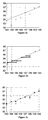
- the exact result varies depending upon the ordering of bitplanes within the sequence, but one example of the distorted transfer curve is shown in Figure 1 , where the x axis is the digital input level and the y axis is the measured light throughput.
- the most significant bit (MSB) is split into many sections, and low order bits are sandwiched between those sections. Since all of the low order bits are adjacent to the MSB, it is the MSB which causes all the low order bit weightings to be augmented, and this explains the clear division between the upper and lower halves of the curve in Figure 1 .
- the crosstalk might no longer depend entirely upon the MSB, but might depend to some measure upon, for example, the second most significant bit (MSB-1).
- the shape of the transfer curve can be changed by adjusting the weightings of the bitplanes in the sequence.
- the problem is that the number of degrees of freedom is less than the number of points in the curve.
- the weightings are adjusted to produce a smooth response in one part of the curve (in this example, the lower half)
- the response in a second part in this example, the upper half
- Such reordering does not eliminate the crosstalk - it just moves it around.
- Figure 2(a) shows a short section of the measured transfer curve. It will be seen that although some points (e.g. 187) are very close to the ideal transfer curve (shown as a rising line), others (e.g. 184) are a long way from it. Due to the shortage of degrees of freedom previously mentioned, the y -value of point 184 cannot be adjusted without affecting other points. There are other points in the real curve, however, whose ⁇ -values fall much closer to the ideal value for point 184 - point 186 is the best example.
- Dither is a technique used to make an image with a discrete number of colours appear more natural, and there are many types of dither. Any type of dither may be utilised for the following pre-dither substitution technique, though the dither technique described here is a four bit dither.
- the first stage in implementing the process is to capture a transfer curve for each of red, green and blue.
- One way to do this is to direct a remote controlled radiometer pointed at approximately the centre of the final display screen. Accurate alignment is not required, because only relative brightness values are of interest, though the radiometer must, however, be mounted stably so that it does not move during the capture process.
- Operations such as gamma correction, dither and other colourspace processing are turned off, so that the native transfer curve of the display/sequence combination is revealed.
- the display screen is then caused to display a gradual fade from zero to the maximum level (here 255), in red, green, blue or white. Specifically, the screen is filled with a solid block of colour whilst a reading is retrieved from the radiometer, before the output level is increased by one step, and another reading is taken. This process repeats until the entire native transfer curve has been captured. This generates a curve such as that shown in figure 1 .
- the sequence might handle each primary slightly differently. Consequently the transfer curves might not be exactly the same. If so, three complete curves from 0 to 255 need to be captured - one each for red, green and blue.
- m rn the measured value for any given digital input level n
- m gn the measured value for any given digital input level n
- m bn the measured value for any given digital input level n
- the ideal line (i.e. the straight rising lines shown in Figures 2 and 3 ) is derived by drawing a straight line between the darkest point m 0 and the brightest point m 255 .
- t ( x ) is a continuous function.
- the point substitution LUT has the same number of entries as there are native levels, so for 8-bit native example used in this description there are 256 entries numbered from 0 to 255.
- the set of levels ⁇ 0..255 ⁇ will be referred to as N.
- Each LUT entry r n may contain any value n' which satisfies the inequation ⁇ ⁇ n " ⁇ N , m n " - t n ⁇
- a value n' is sought whose corresponding measurement m n , is at least as close to the target value t ( n ) as the measurement m n " of any other value n" we could have chosen.
- the pre-dither substitution LUT has the same number of entries as there are dithered levels, so in the present example having 8-bits native plus 4-bits dither, there are 4080 (255 x 16) entries numbered from 0 to 4079.
- the set of levels ⁇ 0..4079 ⁇ are referred to as D.
- the dithering operation was turned off, so there are not enough samples of m n to map to all of these entries, and a linear interpolation function p(d) is constructed.
- This function allows a prediction to be made as to the light intensity produced from a dithered mixture of levels n and n +1.
- Each LUT a d entry may contain any value d' which satisfies the inequation ⁇ ⁇ d " ⁇ D , p ( d " - t d / 16 ⁇
- t is a continuous function, so in this case d /16 need not, and should not, be rounded down.
- the point substitution LUT is implemented as a step when the image is processed before the bitplanes are reordered and sent to the liquid crystal display.
- the red, green and blue channels each carry an eight bit signal, which has gamma correction applied. After various colour enhancement operations have been carried out, each signal is operated upon using the point substitution LUT as previously described.
- the point substitution provides an improvement on prior art systems and may be carried out alone.
- the point substitution LUT and pre-dither substitution LUT are implemented as steps when the image is processed before the bitplanes are reordered and sent to the liquid crystal display.
- the red, green and blue channels each carry an eight bit signal, which has gamma correction applied resulting in a 12 bit signal.
- the twelve bit signals are operated upon using the pre-dither substitution LUT, and dither is applied resulting in an eight bit signal for each channel. After dither is applied, each eight bit signal is operated upon using the point substitution LUT as previously described.
- the type of input to output substitution disclosed here can be applied beneficially to any display systems where the input to output curve of the display departs from the ideal response.
- it may be applied to, for example, micromirror displays.
- the signal described here comprises a three colour signal having eight bits (with a four bit dither) it will be realised that it can equally be applied to displays using monochrome or different colour systems and having a different number of bits-per-pixel.
Landscapes
- Engineering & Computer Science (AREA)
- Multimedia (AREA)
- Signal Processing (AREA)
- Physics & Mathematics (AREA)
- Computer Hardware Design (AREA)
- General Physics & Mathematics (AREA)
- Theoretical Computer Science (AREA)
- Control Of Indicators Other Than Cathode Ray Tubes (AREA)
- Liquid Crystal Display Device Control (AREA)
- Transforming Electric Information Into Light Information (AREA)
- Controls And Circuits For Display Device (AREA)
Applications Claiming Priority (1)
| Application Number | Priority Date | Filing Date | Title |
|---|---|---|---|
| GB0704080A GB2447088A (en) | 2007-03-02 | 2007-03-02 | Method for adjusting a digital display signal to overcome non-ideal pixel switching distortion |
Publications (2)
| Publication Number | Publication Date |
|---|---|
| EP1965369A2 true EP1965369A2 (fr) | 2008-09-03 |
| EP1965369A3 EP1965369A3 (fr) | 2008-12-17 |
Family
ID=37965818
Family Applications (1)
| Application Number | Title | Priority Date | Filing Date |
|---|---|---|---|
| EP08003429A Withdrawn EP1965369A3 (fr) | 2007-03-02 | 2008-02-26 | Affichages d'image numérique |
Country Status (4)
| Country | Link |
|---|---|
| US (1) | US20080211759A1 (fr) |
| EP (1) | EP1965369A3 (fr) |
| JP (1) | JP2008268897A (fr) |
| GB (1) | GB2447088A (fr) |
Families Citing this family (1)
| Publication number | Priority date | Publication date | Assignee | Title |
|---|---|---|---|---|
| KR20160072344A (ko) * | 2014-12-12 | 2016-06-23 | 삼성디스플레이 주식회사 | 유기 발광 표시 장치 및 그 구동 방법 |
Citations (2)
| Publication number | Priority date | Publication date | Assignee | Title |
|---|---|---|---|---|
| EP1324305A1 (fr) | 2000-10-03 | 2003-07-02 | Seiko Epson Corporation | Proc d de traitement d'image, appareil de traitement d'image, dispositif lectronique, programme de traitement d'image, et support enregistr sur lequel est enregistr le programme |
| EP1544840A2 (fr) | 2003-12-15 | 2005-06-22 | LG Electronics Inc. | Dispositif et méthode pour la commande d'un panneau d'affichage à plasma |
Family Cites Families (6)
| Publication number | Priority date | Publication date | Assignee | Title |
|---|---|---|---|---|
| EP1256924B1 (fr) * | 2001-05-08 | 2013-09-25 | Deutsche Thomson-Brandt Gmbh | Procédé et appareil pour le traitement d'images vidéo |
| KR100472483B1 (ko) * | 2002-11-29 | 2005-03-10 | 삼성전자주식회사 | 의사 윤곽 제거 방법 및 이에 적합한 장치 |
| KR100552908B1 (ko) * | 2003-12-16 | 2006-02-22 | 엘지전자 주식회사 | 플라즈마 디스플레이 패널의 구동방법 및 구동장치 |
| KR100646293B1 (ko) * | 2004-04-14 | 2006-11-23 | 엘지전자 주식회사 | 플라즈마 디스플레이 패널의 화상처리 방법 |
| TWI258109B (en) * | 2004-11-03 | 2006-07-11 | Realtek Semiconductor Corp | Method and apparatus for non-linear dithering of images |
| TWI288907B (en) * | 2005-11-17 | 2007-10-21 | Marketech Int Corp | Compensation method of brightness inaccuracy applied in a flat display |
-
2007
- 2007-03-02 GB GB0704080A patent/GB2447088A/en not_active Withdrawn
-
2008
- 2008-02-26 EP EP08003429A patent/EP1965369A3/fr not_active Withdrawn
- 2008-02-28 JP JP2008048056A patent/JP2008268897A/ja active Pending
- 2008-02-29 US US12/039,929 patent/US20080211759A1/en not_active Abandoned
Patent Citations (2)
| Publication number | Priority date | Publication date | Assignee | Title |
|---|---|---|---|---|
| EP1324305A1 (fr) | 2000-10-03 | 2003-07-02 | Seiko Epson Corporation | Proc d de traitement d'image, appareil de traitement d'image, dispositif lectronique, programme de traitement d'image, et support enregistr sur lequel est enregistr le programme |
| EP1544840A2 (fr) | 2003-12-15 | 2005-06-22 | LG Electronics Inc. | Dispositif et méthode pour la commande d'un panneau d'affichage à plasma |
Also Published As
| Publication number | Publication date |
|---|---|
| JP2008268897A (ja) | 2008-11-06 |
| GB0704080D0 (en) | 2007-04-11 |
| EP1965369A3 (fr) | 2008-12-17 |
| GB2447088A (en) | 2008-09-03 |
| US20080211759A1 (en) | 2008-09-04 |
Similar Documents
| Publication | Publication Date | Title |
|---|---|---|
| CN109074775B (zh) | 数字图像处理链和处理块以及包括它们的显示器 | |
| US8605121B2 (en) | Dynamic Gamma correction circuit and panel display device | |
| USRE42089E1 (en) | Visual calibration target set method | |
| US8134532B2 (en) | Image display apparatus and image display method | |
| US7170477B2 (en) | Image reproducing method, image display apparatus and picture signal compensation device | |
| US8111301B2 (en) | Method of performing auto white balance in YCbCr color space | |
| WO2002097784A1 (fr) | Systeme de visualisation d'images, projecteur, support d'informations, et procede de traitement d'images | |
| KR20010106168A (ko) | 비디오 데이터를 디스플레이하기 위한 액정 디스플레이디바이스 | |
| KR20090004573A (ko) | 화상표시장치 | |
| KR20050067678A (ko) | 액정 디스플레이 장치 | |
| US20060071940A1 (en) | Correction data setting method and manufacturing method of image display apparatus | |
| JP2018180333A (ja) | 表示装置及び表示モジュール | |
| US7561167B2 (en) | Image processing apparatus and image processing method | |
| KR20200015863A (ko) | 색역 제어 장치 및 방법, 색역 제어 장치를 포함하는 표시 장치 | |
| CN100501833C (zh) | 调整显示装置色调的设备与方法 | |
| EP2956924A1 (fr) | Procédés et appareil permettant d'assurer le rendu des couleurs dans un dispositif de sortie binaire de grande dimension | |
| KR20210112690A (ko) | 디스플레이 패널 구동을 위한 영상데이터를 처리하는 장치 및 방법 | |
| US7969449B2 (en) | Systems and methods for color control of display devices | |
| EP1965369A2 (fr) | Affichages d'image numérique | |
| KR100850166B1 (ko) | 디스플레이 소자 구동 장치 및 구동 방법 | |
| KR100760608B1 (ko) | 거짓윤곽경감장치, 표시장치, 거짓윤곽경감방법, 및거짓윤곽경감 프로그램 | |
| KR100487309B1 (ko) | Lcd 프로젝션 티브이의 감마 & 화이트 밸런스조정장치 및 그 방법 | |
| US11538389B2 (en) | Field-sequential-color display device | |
| US7518581B2 (en) | Color adjustment of display screens | |
| US20070013717A1 (en) | Displaying non-linear images on linear displays |
Legal Events
| Date | Code | Title | Description |
|---|---|---|---|
| PUAI | Public reference made under article 153(3) epc to a published international application that has entered the european phase |
Free format text: ORIGINAL CODE: 0009012 |
|
| 17P | Request for examination filed |
Effective date: 20080305 |
|
| AK | Designated contracting states |
Kind code of ref document: A2 Designated state(s): AT BE BG CH CY CZ DE DK EE ES FI FR GB GR HR HU IE IS IT LI LT LU LV MC MT NL NO PL PT RO SE SI SK TR |
|
| AX | Request for extension of the european patent |
Extension state: AL BA MK RS |
|
| PUAL | Search report despatched |
Free format text: ORIGINAL CODE: 0009013 |
|
| AK | Designated contracting states |
Kind code of ref document: A3 Designated state(s): AT BE BG CH CY CZ DE DK EE ES FI FR GB GR HR HU IE IS IT LI LT LU LV MC MT NL NO PL PT RO SE SI SK TR |
|
| AX | Request for extension of the european patent |
Extension state: AL BA MK RS |
|
| 17Q | First examination report despatched |
Effective date: 20090417 |
|
| AKX | Designation fees paid |
Designated state(s): AT BE BG CH CY CZ DE DK EE ES FI FR GB GR HR HU IE IS IT LI LT LU LV MC MT NL NO PL PT RO SE SI SK TR |
|
| PUAJ | Public notification under rule 129 epc |
Free format text: ORIGINAL CODE: 0009425 |
|
| 32PN | Public notification |
Free format text: COMMUNICATION "REQUEST FOR RE-ESTABLISHMENT OF RIGHTS INTO THE TIME LIMIT FOR REQUESTING FURTHER PROCESSING DATED 18.02.2010 AND RECEIVED 11.03.2010" (EPO FORM 2901) DATED 11.01.2012 |
|
| PUAJ | Public notification under rule 129 epc |
Free format text: ORIGINAL CODE: 0009425 |
|
| 32PN | Public notification |
Free format text: DECISION TO REJECT THE REQUEST FOR FURTHER PROCESSING AND THE REQUEST FOR RE-ESTABLISHMENT OF RIGHTS INTO THE OMITTED TIME LIMIT FOR FURTHER PROCESSING (EPO FORM 2901AK DATED 26.03.2013) |
|
| STAA | Information on the status of an ep patent application or granted ep patent |
Free format text: STATUS: THE APPLICATION IS DEEMED TO BE WITHDRAWN |
|
| 18D | Application deemed to be withdrawn |
Effective date: 20091028 |