EP1965501A2 - Procédés et appareil pour la translation en spectre numérique de bande de base - Google Patents
Procédés et appareil pour la translation en spectre numérique de bande de base Download PDFInfo
- Publication number
- EP1965501A2 EP1965501A2 EP08101567A EP08101567A EP1965501A2 EP 1965501 A2 EP1965501 A2 EP 1965501A2 EP 08101567 A EP08101567 A EP 08101567A EP 08101567 A EP08101567 A EP 08101567A EP 1965501 A2 EP1965501 A2 EP 1965501A2
- Authority
- EP
- European Patent Office
- Prior art keywords
- signal
- baseband
- analog
- audio
- microphone
- Prior art date
- Legal status (The legal status is an assumption and is not a legal conclusion. Google has not performed a legal analysis and makes no representation as to the accuracy of the status listed.)
- Withdrawn
Links
Images



Classifications
-
- H—ELECTRICITY
- H04—ELECTRIC COMMUNICATION TECHNIQUE
- H04B—TRANSMISSION
- H04B1/00—Details of transmission systems, not covered by a single one of groups H04B3/00 - H04B13/00; Details of transmission systems not characterised by the medium used for transmission
- H04B1/02—Transmitters
- H04B1/04—Circuits
Definitions
- This invention relates generally to methods and apparatus for wireless digital transmission and/or reception, and more particularly, to methods and apparatus for adapting wireless analog FM transceivers for digital transmission and/or reception.
- At least one known digital transceiver has specialized circuitry and software (i.e., circuitry different from that of transceivers that are designed to transmit and receive only analog-FM) built into the transceiver to send and receive digital data.
- Transceivers having such specialized circuitry are usually more expensive than simple analog FM-only transceivers.
- this frequency range from DC to about 300 Hz will be referred to as a "subaudible frequency band,” or simply “subaudible frequencies.”
- Baseband filtering in an analog FM transceiver typically rejects the subaudible frequencies from the speech audio that is transmitted and received. This rejection would normally make it very difficult or impossible to use external processing with the analog FM transceiver to produce or demodulate a digitally modulated signal (such as, for example, C4FM, which is a standard used in public safety radio systems), because the filtering removes frequency components near DC that must be retained to ensure quality in transmission such as preserving eye pattern integrity.
- C4FM digitally modulated signal
- the speech audio frequencies passed by a typical analog-FM transceiver do not extend beyond about 3000 Hz because higher frequencies are not necessary for intelligible audio communications. This maximum frequency limitation places an upper limitation on the available bandwidth for the digital data.
- frequencies from about 300 Hz to 3000 Hz will be referred to as the "speech audio frequency band,” or simply “speech audio” frequencies.
- these frequencies may be referred to as the "transmit speech audio frequency band.”
- these frequencies may be referred to as the "receive speech audio frequency band.”
- the solution is provided by a self-contained apparatus for converting an audio signal from a microphone into a baseband transmit signal suitable for transmitting with an analog FM transmitter.
- the analog FM transmitter has a transmit speech audio frequency band, a subaudible frequency band, and a direct microphone audio input.
- the apparatus includes an analog to digital converter configured to digitize a received analog audio signal from a microphone.
- the apparatus further includes a pre-modulation processor configured to generate a baseband transmit signal occupying frequencies substantially within the transmit speech audio frequency band and a digital to analog converter configured to covert the generated baseband transmit signal into an analog audio output that is applied to the direct microphone audio of the FM transmitter to thereby transmit a digitally encoded RF TX signal having a constant envelope.
- the solution is also provided by a self-contained apparatus for decoding baseband receive signals from a direct speaker audio output of an analog FM receiver.
- the analog FM receiver has a speech audio reception frequency band, a subaudible frequency band, and the direct speaker audio output
- the apparatus includes analog to digital converter configured to convert a baseband receive signal to a digital signal.
- the baseband receive signal is received from a direct speaker audio output resulting from an FM analog demodulation of a digitally encoded RF RX signal with a constant envelope and occupying frequencies substantially within the receive speech audio frequency band of the FM transceiver.
- the apparatus further includes a post-demodulation processor configured to generate a speaker audio signal using the converted baseband audio signal, wherein the speaker audio signal substantially replicates an audio signal used to generate the digitally encoded RF RX signal.
- the solution is also provided by an apparatus for translating an audio signal from a microphone into a baseband signal that includes an analog to digital converter for digitizing a received analog signal from a microphone.
- the apparatus further includes a pre-modulation processor for processing the digitized signal, wherein a sideband spectrum of the digitized signal is shifted away from subaudible frequencies by a predetermined amount to generate the baseband signal.
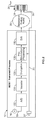
- FIG. 1 is a block drawing of a baseband digital spectrum translator (BDST) operatively coupled between a push-to-talk (PTT) speaker-mike and a conventional FM transceiver constructed in accordance with an embodiment of the invention.
- BDST baseband digital spectrum translator
- FIG. 2 is a schematic block diagram of the transmit process of the BDST of FIG. 1 .
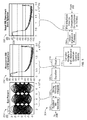
- FIG. 3 is a more detailed schematic block diagram of the pre-modulation processing block of FIG. 2 .
- FIG. 4 is a schematic block diagram of the receive process of the BDST of FIG. 1 .
- FIG. 5 is a more detailed schematic block diagram of the post demodulation processing block of FIG. 4 .
- the functional blocks are not necessarily indicative of the division between hardware circuitry.
- one or more of the functional blocks e.g., processors or memories
- the programs may be stand alone programs, may be incorporated as subroutines in an operating system, may be functions in an installed software package, and the like. It should be understood that the various embodiments are not limited to the arrangements and instrumentality shown in the drawings.
- a self-contained baseband digital spectrum translator (BDST) external adapter 10 for an analog FM transceiver 24 has two baseband processes, namely, a baseband transmit process (baseband TX process) 12 and a baseband receive process (baseband RX process) 14.
- baseband TX process baseband transmit process
- baseband RX process baseband receive process
- DSPs digital signal processors
- baseband TX process 12 may be a function implemented completely or partially by analog hardware, as may baseband RX process 14.
- Baseband TX process 12 generates a baseband transmit signal (baseband TX signal) 20 from an audio signal from a microphone input 19.
- Baseband transmit signal 20 is used in place of a direct microphone audio input 30.
- Baseband RX process 14 generates a speaker audio signal 21 from a baseband receive signal (baseband RX signal) 22 from direct speaker audio output 31.
- Baseband TX signal 20 is derived from any constant envelope digital modulation system having a bandwidth of about 2.7 kHz or less, such as C4FM modulation (as defined in the TIA P25 specification).
- the 2.7 kHz bandwidth is determined by either the transmit speech audio frequency band of analog FM transceiver 24 or the receive speech audio frequency band, both of which are assumed to be 2.7 kHz (starting at about 300 Hz and ending about 3000 Hz) in a typical FM transceiver.
- the allowable frequency range may thus differ if a different type of analog FM transceiver 24 having wider or narrower frequency ranges is used.
- Analog FM transceiver 24 produces a digitally encoded RF TX signal 26 and receives a digitally encoded RF RX signal 28 via methods and apparatus described herein.
- C4FM a digital modulation system used in public safety communications
- baseband TX signal 20 and baseband RX signal 22 at BDST external adapter 10/analog FM transceiver 24 interfaces do not have spectral content from DC to 300 Hz.
- the spectrum of a normal baseband C4FM signal is shifted away from DC using a Hilbert transform and mixing process in BDST external adapter 10, so that neither baseband TX signal 20 nor baseband RX signal 22 overlaps the subaudible frequency band that is either unused, or more typically used for continuous tone coded squelch system (CTCSS) tones.
- CCSS continuous tone coded squelch system
- Baseband RX process 14 recovers the original C4FM baseband signal by using another Hilbert transform and a mixing operation.
- the shifted baseband spectrum fits within the upper frequency cutoff of about 3000 Hz used by typical analog FM transceivers.
- a conventional microphone 16 and a conventional speaker 18 can be used with BDST external adapter 10.
- Microphone 16 and speaker 18 can be combined into a hand-held or clip-held speaker-mike or headset, and may be provided with a push-to-talk switch (PTT) 27 or a VOX circuit (not shown) that generates a PTT signal 23 when a selected microphone level is reached.
- PTT push-to-talk switch
- VOX circuit not shown
- Microphone 16, PTT switch 27, and speaker 18 may also be enclosed in the same enclosure as BDST external adapter 10.
- an analog signal 19 from microphone 16 is processed by transmit process 12 of BDST external adapter 10.
- the analog signal is converted to a digital signal by A/D converter 102.
- Additional analog processing e.g., gain control, limiting, etc.
- some configurations may provide a voice encoder (vocoder) 104 to reduce the transmitted bandwidth by efficiently encoding the audio speech into a sequence of 1s and 0s, commonly called "bits".
- vocoder voice encoder
- an encryption function 106 is provided to further encode the digital input bits into a secure data stream to make it difficult for unauthorized receivers to "eavesdrop" on a secure conversation.
- the digital bit stream is transformed into a sequence of signals that correspond to allowable symbols in the digital modulation scheme chosen. For example, in the case of C4FM modulation, the bit sequence is mapped into a sequence comprising four symbols, commonly denoted +3, +1, -1, and -3, with each symbol representing two bits of information.
- a pre-modulation processor 108 produces a smoothed digital output from this sequence and shifts the spectrum of the output so that it does not occupy the subaudible frequency band.
- this digital output is converted to an analog signal by D/A converter 110, the result is a baseband TX signal 20 that, when applied to the microphone input of analog FM transceiver 24, produces the desired digitally encoded RF TX signal 26.
- pre-modulation processor 108 includes filtering (for example, raised cosine filter 112 and inverse sinc filter 114) that produces a suitably encoded and smoothed baseband signal.
- filtering for example, raised cosine filter 112 and inverse sinc filter 114.
- the modulation is C4FM in accordance with the P25 specification.
- a typical C4FM baseband spectrum 124 for a voice audio input at microphone 16 is shown in FIG. 3 , at the output of inverse sinc filter 114.
- Pre-modulation processor 108 can also include a sinusoidal pilot tone generator 25 that generates a pilot tone at the beginning of every push-to-talk (PTT) event.
- baseband TX process 12 can include a training sequence generator 113 that generates a short (for example, 200 msec) training sequence also at the beginning of some, but not necessarily all, PTT events.
- Sinusoidal pilot tone generators 25 and training sequence generator 113 can be triggered by the same PTT switch 27 on microphone 16 that is also used to provide PTT switching of analog FM transceiver 24.
- the pilot tone can be injected by shifter 118 as a digital signal and may be derived from the complex sinusoid used by shifter 118.
- Baseband RX process 14 can lock to a pilot tone transmitted by another transceiver to facilitate downshifting the baseband spectrum back to its original C4FM form.
- the training sequence may be used for calibrating an adaptive equalization filter in baseband RX process 14 of BDST external adapter 10 to remove distortion introduced in the analog FM signal path.
- a Hilbert transform processor 116 creates I and Q complex signals from a real baseband C4FM signal with the negative spectrum removed.
- Shifter 118 which may be a complex sinusoid multiply function, produces a complex signal with an upper sideband spectrum shifted from that of the real baseband C4FM signal by a predetermined frequency, denoted f subaudible , to move the spectrum away from the subaudible frequency band.
- f subaudible 600 Hz, enough to avoid the distortion that often occurs in the speech audio band slightly above the 300 Hz cutoff).
- Baseband TX signal 20 which, in some configurations, is further filtered by de-emphasis filter 122, is generated by real part/downshift function 120, shown as "REAL" in FIG. 3 .
- Real baseband TX signal 20 can be provided to the microphone input of analog FM transceiver 24. That is, if x(nT) is the baseband output of the inverse sinc filter 114 and y(nT) is the baseband output to the microphone input,
- y nT Re ( x ( nT ) + j ⁇ x ⁇ nT ) e j ⁇ 2 ⁇ ⁇ f subaudible nT
- x ⁇ ( nT ) is the Hilbert transform of x(nT).
- the Hilbert transform x ⁇ ( nT ) can be implemented using a DSP in BDST external adapter 10 programmed to implement a finite impulse response (FIR) filter.
- FIR finite impulse response
- the resulting real baseband signal 20 represented by spectrum 126 retains all the original spectral information of the C4FM baseband spectrum 124, but contains a "hole" 128 from about - f subaudible to + f subaudible .
- FM transceivers 24 usually provide a standard frequency pre-emphasis to the transmitted signal and a compensating frequency de-emphasis to the received signal.
- an optional de-emphasis filter 122 may be applied to real TX baseband signal 20 out of real function 120 that effectively neutralizes the effect of the transmitting pre-emphasis filter in analog FM transceiver 24.
- a shifted C4FM baseband signal represented by spectrum 126 and real TX baseband signal 20 is hereafter referred to as "S-C4FM".
- An S-C4FM baseband TX signal 20 can be FM modulated in analog FM transceiver 24 even by the simplest constant-envelope direct-FM techniques used by many existing analog FM transceivers.
- Baseband RX process 14 illustrated in FIG. 4 , performs the inverse of baseband TX process 12.
- a digitally encoded RF RX signal 28 is demodulated by an FM demodulator in analog FM transceiver 24 to produce baseband RX signal 22.
- This analog signal is digitized by A/D converter 202 of baseband RX processor 14.
- the digitized signal is operated upon by a post-demodulation processor 204, which, in the illustrated configuration, downshifts the spectrum back to its original C4FM form, extracts the four symbols, +3, +1, -1, -3 and converts them into a bit steam that is sent to the optional decryption function 206 which removes the secure encoding if it was used in the transmitting transceiver.
- baseband RX process 14 includes a de-vocoder 208, which reverses the vocoding and converts the digital bit stream to a digital audio signal.
- a D/A converter 210 then generates an analog audio signal 21 suitable for a speaker 18 or headphone.
- additional analog processing or amplification is usually interspersed in the signal path between D/A converter 210 and speaker 18.
- further amplification and attenuation, and/or shaping of the audio frequency response e.g., to accentuate bass and/or treble to improve speech intelligibility
- post demodulation processor 204 comprises a pre-emphasis filter 212 to compensate for a de-emphasis filter usually present in the receiver portion of analog FM transceiver 24.
- the output of pre-emphasis filter 212 is a baseband signal represented by the associated spectrum 226 in FIG. 5 , which in this example configuration is the spectrum of a frequency-shifted S-C4FM baseband signal, but with substantially no energy in the subaudible frequency band from DC to 300 Hz.
- a Hilbert transform process 214 creates an I and Q complex signal from the baseband signal 226 (removes the negative frequency sideband), a complex multiply function 216 downshifts this spectrum by f subaudible (e.g., by 600 Hz), and then the I component is removed by real part/downshift function 218 to convert back to a real baseband signal 230 (represented in the drawings as a recovered baseband C4FM spectrum 230) for further processing. More particularly, if y(nT) is the sampled baseband input from the transceiver and z(nT) is the output of this process,
- z nT Re ( y ( nT ) + j ⁇ y ⁇ nT ) e j ⁇ 2 ⁇ ⁇ f subaudible nT + ⁇
- the complex sinusoid in equation (2) should match the frequency and phase of the complex sinusoid used in baseband TX process 12 in equation (1).
- a phase-locked-loop (PLL) technique can be employed to lock an oscillator to a sinusoidal pilot tone injected into the baseband signal by the transmitting transceiver as previously described.
- Equalizer 220 may be provided in some configurations of the present invention.
- Equalizer 220 may be a receive adaptive equalizer to ameliorate various forms of distortion (e.g., pre-emphasis filtering, de-emphasis filtering, post-modulation-limiter filtering, etc.) that are introduced into the 300-3000 Hz range by analog FM TX and RX signal paths within analog FM transceiver 24.
- equalizer 220 may be a linear adaptive filter based on a minimum mean square error (MMSE) criterion that uses a transmitted training sequence to determine tap weights.
- MMSE minimum mean square error
- the number of taps provided for equalizer 220 can vary depending on the severity and characteristics of the distortion to be equalized.
- sliding window integrator 222 is provided as a necessary component to achieve the optimum eye pattern for C4FM signals in accordance with P25 specifications; in essence, it "opens the eye".
- a typical eye pattern 232 of a C4FM signal as output from the sliding window integrator is shown in FIG. 5 .
- a symbol bit decoder 224 is then provided to determine the symbol values (+3, +1, -1, or -3) in the receive signal, and to convert the symbol values to bits to produce a signal that can be decrypted by decryption function 206 (if encryption was applied when transmitted).
- Decryption function 206 decrypts the symbols of the chosen digital modulation scheme into a bit sequence that can be decoded by de-vocoder 208 and then restored to an audio signal by D/A converter 210 and speaker 18.
- various embodiments of the present invention provide methods and/or apparatus that can use an analog FM transceiver for transmitting and/or receiving digital information without requiring any modification to the transceiver.
- the various embodiments do not require specialized circuitry and software in the analog FM transceiver for sending and receiving digital data.
- An external adapter e.g., BDST external adapter 10 having interfaces to the microphone input (for the transmit signal) and speaker output (for the received signal) is provided for this purpose in some embodiments.
- Digital data is created using BDST external adapter 10 between the speaker/microphone and the transceiver, and demodulated using the same BDST external adapter 10.
- BDST external adapter 10 can be made compatible with the typical frequency response for analog FM transceivers, and can provide many of the advantages associated with digital transmission, such as security from eavesdropping. Also, in configurations of the present invention using analog FM transmitters and/or analog FM receivers rather than analog FM transceivers, at least some of the advantages of the present invention may be achieved by BSDT 10 configurations having only a baseband TX process or a baseband RX process, respectively. Moreover, configurations of the present invention permit CTCSS tones to be transmitted and received without interference to or from the digitized baseband signals.
Landscapes
- Engineering & Computer Science (AREA)
- Computer Networks & Wireless Communication (AREA)
- Signal Processing (AREA)
- Transmitters (AREA)
- Transceivers (AREA)
- Digital Transmission Methods That Use Modulated Carrier Waves (AREA)
Applications Claiming Priority (1)
| Application Number | Priority Date | Filing Date | Title |
|---|---|---|---|
| US11/708,960 US7801559B2 (en) | 2007-02-20 | 2007-02-20 | Methods and apparatus for baseband digital spectrum translation (BDST) |
Publications (1)
| Publication Number | Publication Date |
|---|---|
| EP1965501A2 true EP1965501A2 (fr) | 2008-09-03 |
Family
ID=39365208
Family Applications (1)
| Application Number | Title | Priority Date | Filing Date |
|---|---|---|---|
| EP08101567A Withdrawn EP1965501A2 (fr) | 2007-02-20 | 2008-02-13 | Procédés et appareil pour la translation en spectre numérique de bande de base |
Country Status (4)
| Country | Link |
|---|---|
| US (1) | US7801559B2 (fr) |
| EP (1) | EP1965501A2 (fr) |
| JP (1) | JP2008206154A (fr) |
| CN (1) | CN101340195A (fr) |
Families Citing this family (6)
| Publication number | Priority date | Publication date | Assignee | Title |
|---|---|---|---|---|
| US20080233892A1 (en) * | 2007-03-19 | 2008-09-25 | Bojko Marholev | Method and system for an integrated vco and local oscillator architecture for an integrated fm transmitter and fm receiver |
| TWI441028B (zh) * | 2010-06-02 | 2014-06-11 | Realtek Semiconductor Corp | 一種用於通訊的資料傳接裝置與方法及其系統 |
| US8935160B2 (en) | 2011-09-02 | 2015-01-13 | Harris Corporation | Systems and methods for frame synchronization |
| US11051115B2 (en) * | 2019-06-27 | 2021-06-29 | Olga Sheymov | Customizable audio signal spectrum shifting system and method for telephones and other audio-capable devices |
| CN110602011B (zh) * | 2019-08-16 | 2021-11-19 | 华东师范大学 | 一种基于锁相环的数字信号调制解调电路及调制解调方法 |
| CN116470854B (zh) * | 2023-06-19 | 2023-09-05 | 成都世源频控技术股份有限公司 | 一种宽带变频自适应均衡瞬时带内平坦度装置 |
Family Cites Families (11)
| Publication number | Priority date | Publication date | Assignee | Title |
|---|---|---|---|---|
| US4404685A (en) * | 1981-10-26 | 1983-09-13 | Terra Corporation | Frequency control system for radio apparatus employing filter amplifier operated at harmonic of frequency of synthesized signal source |
| US5060295A (en) * | 1985-11-15 | 1991-10-22 | Motorola, Inc. | Radio device with controlled port and method of port control |
| US5253270A (en) * | 1991-07-08 | 1993-10-12 | Hal Communications | Apparatus useful in radio communication of digital data using minimal bandwidth |
| US5592556A (en) * | 1994-08-09 | 1997-01-07 | Ericsson Ge Mobile Communications Inc. | Digital radio with vocoding encrypting codec |
| US5926514A (en) * | 1997-03-03 | 1999-07-20 | Motorola, Inc. | Apparatus for clock shifting in an integrated transceiver |
| FR2787280B1 (fr) * | 1998-12-14 | 2001-01-05 | Cit Alcatel | Circuit electronique de conversion numerique-analogique pour une chaine de transmission en bande de base |
| US6259253B1 (en) * | 1999-06-10 | 2001-07-10 | Ohio State University Research Foundation | MRI transceiver |
| TW569558B (en) * | 2002-10-24 | 2004-01-01 | Conwise Technology Corp Ltd | Signal processing method for a walkie-talkie device |
| US7515935B2 (en) * | 2005-05-26 | 2009-04-07 | Broadcom Corporation | Method and system for flexible FM tuning |
| US8264387B2 (en) * | 2006-03-31 | 2012-09-11 | Silicon Laboratories Inc. | Transceiver having multiple signal processing modes of operation |
| US20080096484A1 (en) * | 2006-10-20 | 2008-04-24 | Silicon Laboratories, Inc. | Short range wireless communications using FM band communication links and related systems |
-
2007
- 2007-02-20 US US11/708,960 patent/US7801559B2/en active Active
-
2008
- 2008-02-13 EP EP08101567A patent/EP1965501A2/fr not_active Withdrawn
- 2008-02-15 JP JP2008034554A patent/JP2008206154A/ja active Pending
- 2008-02-20 CN CNA2008101428181A patent/CN101340195A/zh active Pending
Also Published As
| Publication number | Publication date |
|---|---|
| JP2008206154A (ja) | 2008-09-04 |
| US7801559B2 (en) | 2010-09-21 |
| CN101340195A (zh) | 2009-01-07 |
| US20080200136A1 (en) | 2008-08-21 |
Similar Documents
| Publication | Publication Date | Title |
|---|---|---|
| US4523311A (en) | Simultaneous transmission of speech and data over an analog channel | |
| TW393839B (en) | A transmission system for digital audio broadcasting | |
| JP4255376B2 (ja) | モデム受信器の非線形歪み補償 | |
| US5305384A (en) | Apparatus, system and method for transmitting secure signals over narrow spaced channels | |
| US7801559B2 (en) | Methods and apparatus for baseband digital spectrum translation (BDST) | |
| KR20010071626A (ko) | 나이퀴스트 필터 및 방법 | |
| AU697709B2 (en) | Method and arrangement in a transmission system | |
| Korn | GMSK with differential phase detection in the satellite mobile channel | |
| US5991337A (en) | Method and apparatus for improving the signal-to-noise ratio of low-magnitude input signals in modems | |
| KR860002153B1 (ko) | 비화신호 송신시스템 | |
| US4754481A (en) | Expanded partial response processing for analog signal enciphering and the like | |
| US9106485B1 (en) | System and method for FSK demodulation | |
| US5742679A (en) | Optimized simultaneous audio and data transmission using QADM with phase randomization | |
| US5796838A (en) | Method and apparatus for performing frequency spectrum inversion | |
| CN101167261A (zh) | 用于利用等幅均衡的波形传输数据的系统和方法 | |
| US7453951B2 (en) | System and method for the transmission of an audio or speech signal | |
| KR20160020170A (ko) | 초음파 신호 송수신 방법 | |
| CN100588146C (zh) | 在低信噪比下发送和接收qam信号的系统和方法 | |
| RU2221284C2 (ru) | Способ передачи и приема закодированной речи | |
| JP2003018227A (ja) | 無線通信システムにおける複合直交位相シフト方式を利用したデータ処理装置及びその方法 | |
| JP2009246430A (ja) | 無線通信装置及び無線通信装置の処理方法 | |
| WO2001082518A1 (fr) | Brouillage d'un dispositif sans fil | |
| JP5350351B2 (ja) | 通信システム、送信装置、受信装置および通信方法 | |
| Ikwuazom et al. | Simulation Analysis of Information Transmitting Mechanism Based on Amplitude Modulation Technique | |
| US8223907B2 (en) | Method for deriving parasitic signals from modulated digital signals |
Legal Events
| Date | Code | Title | Description |
|---|---|---|---|
| PUAI | Public reference made under article 153(3) epc to a published international application that has entered the european phase |
Free format text: ORIGINAL CODE: 0009012 |
|
| AK | Designated contracting states |
Kind code of ref document: A2 Designated state(s): AT BE BG CH CY CZ DE DK EE ES FI FR GB GR HR HU IE IS IT LI LT LU LV MC MT NL NO PL PT RO SE SI SK TR |
|
| AX | Request for extension of the european patent |
Extension state: AL BA MK RS |
|
| RAP1 | Party data changed (applicant data changed or rights of an application transferred) |
Owner name: PINE VALLEY INVESTMENTS, INC. |
|
| STAA | Information on the status of an ep patent application or granted ep patent |
Free format text: STATUS: THE APPLICATION IS DEEMED TO BE WITHDRAWN |
|
| 18D | Application deemed to be withdrawn |
Effective date: 20100831 |